|
|
April 1-15, 2012
Volume 19 – Number 6
$1
Prolétaires de tous les pays, unissez-vous!
Otatoskewak ota kitaskinahk mamawestotan!
Workers of all lands, unite
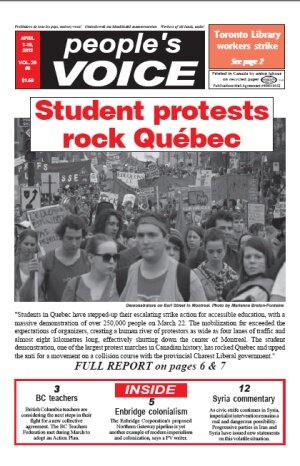
1) QUEBEC STUDENT STRIKE PUTS CHAREST LIBERALS ON DEFENSIVE
2) BC TEACHERS ADOPT ACTION PLAN TO REPEAL BILL 22
3) LIBRARY WORKERS STRIKE AS TORONTO TALKS CONTINUE
4) CUTS HIT DEEP IN TORONTO DISTRICT SCHOOL BOARD
5) NO MOVE LEFT FOR NDP - Editorial
6) BUDGET FOR THE RICH, NOT WORKERS - Editorial
7) NORTHERN GATEWAY PIPELINE: A MODERN EPISODE OF IMPERIALISM
8) MIXED SIGNALS FROM U.S. ON CUBA TRAVEL
9) CANADA OPPOSES CUBA JOINING SUMMIT OF THE AMERICAS
10) SYRIA: HERALDING A CHANGE IN THE INTERNATIONAL STRATEGIC SITUATION?
11) ON DEVELOPMENTS IN SYRIA: NEGOTIATION, NOT INTERVENTION
12) MUSIC NOTES, by Wally Brooker
13) THE LORAX: A TIMELY FABLE
14) WHAT’S LEFT
15) CLARTÉ (en français)
16) THE SPARK! (Theoretical and Discussion Bulletin of the Communist Party of Canada)
17) INTRODUCING MARX
PEOPLE'S VOICE APRIL 1-15, 2012 (pdf)
|
People's Voice deadlines: April 16-30 May 1-15 Send submissions to PV Editorial Office,
|
|
REDS ON THE WEB |
|
People's Voice finds many "Global Class Struggle" reports at the "Labour Start" website, http://www.labourstart.org/. We urge our readers to check it out! |
* * * * *
People's Voice
Canadian Publications Mail Sales Product Agreement #205214
ISSN number 1198-8657
People's Voice is published by
New Labour Press Ltd
PV Editorial Office
706 Clark Drive,
VANCOUVER, B.C. V5L 3J1
Phone:604-255-2041
Fax:604-254-9803
email: pvoice@telus.net
Editor: Kimball Cariou : Business Manager: Sam Hammond
Editorial Board: Kimball Cariou, Miguel Figueroa,
Doug Meggison, Naomi Rankin, Liz Rowley, Jim Sacouman
* * * * * *
Letters
People's Voice welcomes your letters
on any subject covered in our pages.
We reserve the right to edit for length and clarity,
and to refuse to print letters which may be libellous
or which contain unnecessary personal attacks.
Send your views to:
"Letters to the Editor",
706 Clark Dr., Vancouver, BC V5L 3J1,
or pvoice@telus.net
People's Voice articles may be reprinted without permission,
provided the source is credited.
* * * * * *
The Communist Party of Canada, formed in 1921,
has a proud history of fighting for jobs, equality, peace,
Canadian independence, and socialism.
The CPC does much more than run candidates in elections.
We think the fight against big business and its parties
is a year-round job,
so our members are active across the country,
to build our party and to help strengthen people's movements
on a wide range of issues.
All our policies and leadership
are set democratically by our members.
To find out more about Canada's party of Socialism,
give us a call at the nearest CPC office.
* * * * * *
Central Committee CPC
290A Danforth Ave Toronto, Ont. M4K 1N6
Ph: (416) 469-2446
fax: (416) 469-4063 E-mailmailto:info@cpc-pcp.ca
Parti Communiste du Quebec (section du
Parti communiste du Canada)
5359 Ave du Parc, Montréal, Québec,
H2V 4G9
B.C.Committee CPC
706 Clark Drive, Vancouver, V5L 3J1
Tel: (604) 254-9836
Fax: (604) 254-9803
Edmonton CPC
Box 68112, 70 Bonnie Doon P.O.
Edmonton, AB, T6C 4N6
Tel: (780) 465-7893
Fax: (780)463-0209
Calgary CPC
Unit #1 - 19 Radcliffe Close SE
Calgary AB, T2A 6B2
Tel: (403) 248-6489
Ottawa CPC
Tel: (613) 232-7108
Manitoba Committee
387 Selkirk Ave., Winnipeg, R2W 2M3
Tel/fax: (204) 586-7824
Ontario Ctee. CPC
290A Danforth Ave., Toronto, M4K 1N6
Tel: (416) 469-2446
Hamilton Ctee. CPC
265 Melvin Ave., Apt. 815
Hamilton, ON.
Tel: (905) 548-9586
Atlantic Region CPC
Box 70 Grand Pré, NS, B0P 1M0
Tel/fax: (902) 542-7981
http://www.communist-party.ca/
* * * * * *
News for People, Not for Profits!
Every issue of People's Voice
gives you the latest
on the fightback from coast to coast.
Whether it's the struggle for jobs or peace, resistance to social cuts,
solidarity with Cuba, or workers' struggles around the world,
we've got the news the corporate media won't print.
And we do more than that
- we report and analyze events
from a revolutionary perspective,
helping to build the movements for justice and equality,
and eventually for a socialist Canada.
Read the paper that fights for working people
- on every page, in every issue!
People's Voice
$30 for 1 year
$50 for 2 years
Low-income special rate: $15 for 1-year
Outside Canada $50 for 1 year
Send to: People's Voice, 706 Clark Drive, Vancouver, BC, V5L 3J1
You can call the editorial office at 604-255-2041
REDS ON THE WEB
http://www.communist-party.ca/
http://www.ycl-ljc.ca/
http://www.solidnet.org/
(The following articles are from the April 1-15, 2012, issue of People's Voice, Canada's leading communist newspaper. Articles can be reprinted free if the source is credited. Subscription rates in Canada: $30/year, or $15 low income rate; for U.S. readers - $45 US per year; other overseas readers - $45 US or $50 CDN per year. Send to People's Voice, c/o PV Business Manager, 706 Clark Drive, Vancouver, BC, V5L 3J1.)
1) QUEBEC STUDENT STRIKE PUTS CHAREST LIBERALS ON DEFENSIVE
By Johan Boyden
Students in Quebec have stepped‑up their escalating strike action for accessible education, with a massive demonstration of over 250,000 people on March 22. The mobilization far exceeded the expectations of organizers, creating a human river of protestors as wide as four lanes of traffic and almost eight kilometres long, effectively shutting down the center of Montreal.
The student demonstration, one of the largest protest marches in Canadian history, has rocked Quebec and "upped the anti" for a movement on a collision course with the provincial Charest Liberal government.
"We are just getting started" the students spokespeople said at the rally, calling for all groups in Quebec society to join them, including labour, and by all accounts it looks like the struggle here could be just beginning.
Hard work pays off
The mass demonstrations come after a long haul of organizing by students and allies. Sharp debates on campus just a year ago questioned whether the student unions could forge the unity necessary to launch an effective resistance, and if the students themselves were willing to fight.
The initial announcement of a significant increase in fees by the Charest government came in 2010, but it was only with the 2011 provincial budget that the exact amount of the hike was revealed: $325 annually over five years, adding up to $1,625 more per year, plus ancillary fees. The 2012 budget, tabled a few days before the demonstration, continues this plan of attack by the Liberals - but in new conditions.
Months of sustained resistance starting in December have seen tens of thousands of students, professors, parents, labour and community movements on the streets virtually every week. Even right-wing media commentators are calling for the government to negotiate with the students.
Now the question is whether the students can take the moral pressure of their strike and join forces with the labour movement.
Militancy and unity
Opposition to the tuition hike has already brought together a politically disparate group of student unions known as much for their militant actions as in‑fighting. Quebec has a long history of student mobilization. This is the eighth student strike in the last four decades, and the fruits of that pressure has been to keep fees frozen, giving Quebec the most accessible education in Canada - something the government, ironically, never fails to remind people with an all‑out media blitz of radio and TV campaign ads in support of the increase.
The stories of the student mobilizations are a hard lesson in the power of unity. Students collectively marched out classes - often for over a month at a time - in 1968, 1974, 1986, 1988, 1996, 2005. While not all students hit the streets, so many acted together that, despite fear mongering by university administrations, they were not academically penalized. All but one mobilization forced the government to back down.
But the one mobilization that did fold, in 1988, fractured the movement and leading to the end of the l'Association nationale des Etudiantes et des Etudiants du Québec (ANEEQ).
The left ‑ CLASSE
Today there are four centers of student unity and many independent unions. The largest group driving the mobilizations is called CLASSE - the Broad Coalition of the Association pour une solidarité syndicale Etudiante. CLASSE temporarily unites a number of student unions not affiliated with any broader association with the much more established Association for Student Union Solidarité (ASSE).
Know as a "left pole" of the student movement, ASSE presents itself as different kind of progressive student association, taking a bold, combative and sometimes provocative approach to the struggle. It emphasizes student union democracy, feminism, as well as anti‑globalization and social issues beyond the campus.
It is also home to different leftist and anarchist tendencies that continue to have difficulty setting aside differences over tactics like direct action and violence, the labour movement, or what to make of free education in socialist Cuba. ASSE is led by two spokespersons, a man and a woman, but the young face of Gabriel Nadeau‑Dubois has come to express the fighting voice of this movement.
The FEUQ
Larger in membership numbers and media presence but with perhaps less capacity to mobilize are the two Federations. La FECQ et la FEUQ, represent college and university students respectively. There is also a loose network of student unions including McGill and Laval, but the FECQ and the FEUQ are bigger players.
The FEUQ is particularly dominated by one of the more powerful conservative student association in Quebec, based at the University of Montreal - sometimes represented as the Eye of Mordor from Lord of the Rings, a play on the prominent main tower of that university.
The FEUQ is wedded to the Parti Québécois and is susceptible to a more electoral strategy - wipe the tuition fees increases out by voting the Charest Liberals out of office in the upcoming provincial election. But the Federations have their own internal differences and contradictions, including many that play a positive role in this battle of ideas.
Marching together
Despite these different strategies, the movements have managed to march together - literally. Last semester the students came to a unity agreement including on the demand to reduce fees and strike and staged a mass action. The agreed upon date for the strike to begin was March 22, but as early as February student union members voted to support immediate action and walk out of class. The March 22 demonstration was initially called by the FECQ‑FEUQ, but perhaps unexpectedly Gabriel Nadeau‑Dubois announced on the very popular Quebec TV show Tout le monde en parle that the CLASSE would join forces.
Today there now just under 200,000 students on what is called an unlimited general strike, meaning no participation in classes for unlimited period. For the March 22 demonstration a total of 300,000 students voted for a limited strike, such as a one day of action. This includes the lion's share of the French‑language students and, since our report in the March 16-31 issue of People's Voice, a much larger number of English‑language schools. Several departments in Dawson College, and the universities of Concordia and McGill have now voted on this question and caught the winds of change in their sails.
Strike votes, taken at a General Assembly of all students in a department‑organized student union, are taking place every week and more students are steadily joining the unlimited strike. But the clock is ticking down. In a month the semester will be over. The moral pressure of the strike, the most effective weapon of the students, will be gone.
Unity with Labour is key
That's why all eyes are now on the actions of the labour movement, who so far have offered full support to the students in words - but not so much in terms of action. The Quebec Federation of Labour and the Congress of National Trade Unions (CSN) have formed the Social Alliance Coalition, which came out of the Common Front actions of last year, although the group has yet to really bring forward its membership.
Local unions as well as the Montreal council of the CSN have more been strongly supportive of the students, forming a coalition with many other people's movements called the Red Hand Coalition. Among other things, the Red Hand coalition has suggested the need for a general political or social strike against the Charest government and its austerity measures.
As well, on their convention books most of the labour movement has adopted some form of action plan; the idea of a political strike, for example, was endorsed by the last convention of the CSN.
To Alma!
For their part the students are outreaching to labour. A week after the mass mobilization, the CLASSE held a media conference calling for mass congress or meeting of students, labour and other people's movements - a popular assembly to discuss and develop a common way forward. The students have announced that they are re‑defining the struggle: no longer is it just a question of access to education, but a social movement aimed at confronting the austerity measures of the Charest Liberal government on the streets.
This echoes and idea now widely debated in progressive circles (and which the Communist Party of Quebec was an early advocate of), "to convene an Estates General of organized labour, popular movements, and students who could help develop a plan of mobilization and joint action to roll back government attack."
Positively, the CLASSE will bring their next congress far up north, hours beyond Quebec City into the northern town of Alma. This is where the workers at the transnational corporation, RioTinto Alcan have been locked‑out since New Years' Day because they refused an attack on their jobs and the use of subcontractors.
Other good news for the students is that as far as the public debate goes, they appear to have won. Opinion polls now not only show strong support of their cause, but also a shift in the discussion.
Before, the Charest Liberals had claimed that an increase in fees is necessary because of a revenue shortfall. But the consistent work of the students around the question of corporate profits and the need for progressive taxation has pushed the government onto the defensive.
In reality the fee hike represents 4.7% of the total budget devoted to universities in 2016‑2017. Now the Charest Liberals are emphasizing the need to raise fees to maintain the quality of Quebec's education and, for example, the recruitment of star academics in the international arena.
Scandals contradicting the government's claims keep leaking out. For example, part of the ongoing crisis within the administration at Concordia University has seen several presidents resign. The latest hire for the president's chair demanded the school purchase his ritzy West Island mansion, because it would not sell on the depressed housing market.
Other voices
The government is being supported by a group of students calling for a so‑called "rational" approach to fees based on the logic of the market and big business. From McGill, these students have dubious ties including to the Quebec Liberal Party, the self‑proclaimed racist off‑shoot of the US Tea Party movement, a right‑wing think tank, and a openly pro‑Harper, pro‑war McGill student newspaper.
Likewise, Francois Legault, leader of the fledgling ultra‑right Coalition Avenir Québec, has called for even higher tuition increases and, on the secondary level, the abolition of school boards. While these forces are the darlings of the media, the student mobilizations are hurting their popularity.
Significantly, Claude Castonguay, a Quebec businessman and prominent Liberal, has come out with the demand that Charest sit down and negotiate with the students. While not supporting the demand of reduced fees and instead calling for higher bursaries, Castonguay's call is more proof of cracks on the government side.
On the other hand, the Parti Quebecois has made similar statements advocating for a major meeting with students, and a smaller step‑by‑step increase (which is more or less what the government is doing now, only slower), while Quebec Solidaire has called for the abolition of tuition fees. QS MNA Amir Khadir has also called for greater unity with the labour movement and supported the idea of a general meeting of people's forces.
The way forward
The Young Communist League of Québec and the Communist Party of Québec are both active in the struggles of the students as well. "We were more than two hundred thousand [people] yelling at the top of our lungs against the increase in tuition fees. The students must not back up, and do what it takes to build unity and stop Charest," Nicolas Welsh, chair of the YCL‑Q told People's Voice.
The LJC‑Q and PCQ are both calling for the students to maintain their actions, and to expand their unity and build with labour and all people's forces towards a general political strike to defeat the government.
The Communists are also demanding a living stipend for students, grants not loans, and the elimination of fees, protected this and other rights of youth with a Charter of Rights for youth and students.
The sense of optimism, confidence and energy necessary for such a fight seemed evident at the March 22 rally. People walked out onto their balconies and waved red pillow cases and tea towels in solidarity with the marchers. A solid line of people was still exiting the main congregation square when the front of the rally reached its terminus, eight kilometres away, and the speeches began.
This is history in the making and we can not go back. More demonstrations are planned in the coming weeks.
2) BC TEACHERS ADOPT ACTION PLAN TO REPEAL BILL 22
PV Vancouver Bureau
"Somebody has to stand up to these bullies."
That simple phrase is heard often in British Columbia these days, as the battle continues between the BC Teachers Federation and the Christy Clark Liberal government. The next stage of the struggle may include a full-scale walkout by teachers, in defiance of Bill 22, the badly misnamed "Education Improvement Act."
Among much of the working class, there's a strong sentiment that while Clark may prevail in this bitter contract fight, the province's 41,000 teachers have become a courageous example of how to resist an arrogant bully.
In fact, even if the Premier gets her way, using Bill 22 to impose a "net-zero" contract on the teachers may be a pyrrhic victory, ending in her defeat at the polls in May 2013. The question for all public sector workers then could become: what will an NDP government do differently?
That question is already on the minds of labour activists and supporters across the province these days. In the BCTF dispute, it has become obvious that the Clark government's real agenda is not just to freeze the pay of teachers, but to push the door to privatized education even further open.
The 700 delegates to the BCTF's 96th Annual General Meeting certainly understood this crucial issue. Meeting in Vancouver from March 17 to 21, the delegates spent most of their time debating the best way to respond to Bill 22, which contains serious attacks on teachers' rights and students' learning.
In response, delegates adopted a plan of action with the ultimate goal of forcing the repeal of the legislation.
"Christy Clark as education minister started this fight 10 years ago with her legislation that stripped teachers' collective agreements of our bargaining rights and of guarantees for quality learning conditions for students," said BCTF President Susan Lambert, who was re-elected with the support of almost two-thirds of the delegates. "The BC Supreme Court found her bills to be illegal and unconstitutional, yet her government has done nothing to show respect for the ruling, for public education or for the teachers and students of BC. In fact they're violating the rights of teachers and cutting the same services to students with Bill 22."
The BCTF will mount a legal challenge to Bill 22, said Lambert, who sharply criticized Education Minister George Abbott's handling of this round of bargaining.
"He is attempting to abdicate any accountability for the crisis this government has created in our schools and the broken relationship with the teachers of this province," Lambert said. "It's completely irresponsible to think he can impose this draconian legislation with its sham mediation process, order a cooling off period, and the next day head to China to recruit more fee‑paying international students to our underfunded public schools."
Despite the threat of enormous fines against individual teachers and their union, the action plan includes the possibility of a vote on a full withdrawal of services, or a withdrawal of all voluntary extra‑curricular activities. The plan will be put to a province‑wide vote of teachers on April 17 and 18.
Local teacher associations in about a dozen school districts have already voted independently to withdraw participation in extra‑curricular voluntary activities, one of the only legal options left for them under the terms of Bill 22.
Under the action plan, teachers will continue teaching and will prepare year‑end report cards. As they have throughout their job action which began with the 2011-12 school year, teachers will continue to provide the marks required for graduation, post-secondary applications and scholarships.
The action plan also foresees motivating teachers to make defense of public education a major issue in the May 2013 provincial election.
"Across BC teachers will be active in their communities, working hard to ensure a strong and stable public education system as part of the foundation of our democracy and for the rights of all children to an education that meets their individual learning needs," Lambert said. "We need a government that supports teachers and parents as we work together to provide the very best for BC kids, not one that claims to put families first while attacking all the vital public services people need."
Ironically, Education Minister George Abbott was in China during the AGM, promoting the "BC education brand" at an international student recruitment fair.
"It's a stunning contradiction," said Lambert. "George Abbott is off in Shanghai praising our public education system with the goal of luring more fee‑paying foreign students to study here. Meanwhile, he's actively undermining the quality of education with the legislation he brought in. On top of that, he's spending millions of tax dollars on a major ad campaign attacking the very teachers who are the heart and soul of public education."
"Ten years ago this government planned to cut $275 million a year from education funding to pay for their 25% tax cut. In current dollars, that's over $3.3 billion stolen from our public schools in the last decade," Lambert said.
Bill 22, which was opposed by the NDP, gives the government sweeping powers to eliminate size limits for Grades 4 to 12, and to remove protections for class composition and guarantees of services to students with special needs.
And even deeper cuts are on the way. As a BCTF research paper says, this year's provincial budget allocates a tiny $4 million increase for full‑day Kindergarten to the 2012-13 operating grants to school boards, compared to the $112 million needed by districts just to match inflation.
Nor do the Liberals address the loss of more than 1,500 learning specialist teachers, whose skills are desperately needed to support all students' learning.
Bill 22 does include a "cash‑for‑kids" clause, which would see some teachers being paid extra for having classes that exceed 30 students. The action plan calls for teachers to refuse to accept additional pay for oversized classes.
The BCTF rejects this as a "totally unethical proposition" that would do nothing to improve learning conditions for kids, while trying to encourage teachers to trade their ethics for money.
As Lambert said. "We've been advocating for decades for the conditions that kids need. All students deserve to be in a class where they can get the individual care and attention they need, but after a decade of cuts BC teachers can't keep on filling the gaps for a generation of children growing up in the highest child poverty rate in Canada."
An increasing number of BC school boards have raised serious concerns about Bill 22 and the damage it will cause to the working relationships within school communities. The imposition of severe limitations on the mediation process is seen as a major obstacle.
One powerful letter was sent to Abbott by the Sunshine Coast Board of Education chair Silas White, stating that "the Bill is rather complicated, which is our first complaint. It may be thrilling for a few legislators to take on so many BC Education issues in one swoop, but mixing heavy fines for any teacher job action in the next few months, with confirmations of contract strips from a decade ago, with the correction of ill‑advised legislation like Bill 33, with the unusual move of legislating a new line of funding, with forced and micro‑managed mediation, with the threat of legislated contractual changes supposedly necessary for the BC Education Plan, is a tough sell under the umbrella of `Education Improvement.' If there are improvements in this bill, they seem to be wrapped up as a sheep in wolf's clothing."
The letter lists a devastating point-by-point critique of the assumptions and claims underlying Bill 22, making it clear that the legislation will force local school boards to impose a whole new round of cutbacks, to the detriment of both teachers and students.
For those who keep a count, Bill 22 is the 20th piece of BC Liberal legislation since 2001 that targets teachers.
3) LIBRARY WORKERS STRIKE AS TORONTO TALKS CONTINUE
By Liz Rowley
About 2,300 Toronto Public Library (TPL) workers were still on strike as People's Voice went to press. At the same time, the negotiating committee for 23,000 inside workers, members of CUPE Local 79, were taking the City's final offer to a membership vote. It's the first time ever Local 79 negotiators have declined to make a recommendation, which indicates the viciousness of the employer in this round of bargaining.
According to sources, the deal is similar to the one offered in February to the outside workers, members of CUPE 416, which included significant concessions on job security as well as lump sum payments which reduced actual wage increases in two of the contract's four years.
Prior to the city's final offer made March 26, talks had moved into overtime, with the union publicly stating its determination to stay at the bargaining table and hammer out an agreement. The union would only strike, they said, if the City moved to unilaterally impose new terms and conditions of employment. If the final offer is rejected by the membership on March 28, 23,000 inside workers will join already striking librarians on the picket lines.
Imposing new terms and conditions was exactly what the City did to library workers, members of CUPE Local 4948, after the clock ran out on the old agreement. The city's actions were a clear message that the employer wanted to force the workers out. The City wanted to create a crisis a la Mike Harris, to stoke the fires of anger and resentment against striking workers.
Library workers had no choice but to hit the bricks March 18th, after the city unilaterally imposed new terms and conditions - exactly those that the Ford administration wanted in the new collective agreement.
As in the earlier negotiations with the city's outside workers, the key issue is job security. More than half of all city workers are part‑timers, who have no benefits, low wages, and less than 24 hours of work per week without any job security. Many have worked part‑time for years, with all of the experience and qualifications of full‑time workers. Many take on other part‑time jobs just to make ends meet.
The union has tried to achieve secure full‑time jobs at the same rates of pay and with the benefits provided to full‑time workers, but never made the fight to get it. Now the Ford administration is fighting to get rid of these achievements won over decades for full‑time workers. Attacking job security clauses as "jobs for life" for "fat cat" workers, the employer aims to decapitate opposition while slashing municipal jobs and services.
This year the City has not only rejected fairness for part-timers, it has eliminated workers through the 2012 budget cuts, and aims to eliminate hundreds more. The goal is to contract out and privatize Toronto's city services and public sector workforce.
The Ford administration has ties to a corporation which administers public library systems in the US, and which is waiting in the wings to take over Toronto's library system ‑ the biggest in Canada.
But the union, and the vast network of friends and supporters of the TPL, have brought their well‑organized opposition to the assault on the library system, which to many epitomizes mass public education, culture, freedom and democracy.
The Writers' Union of Canada, representing 2,000 writers including Margaret Atwood, Michael Ondaatje, Susan Swan, Writers' Union Chair Greg Hollingshead and others, have vocally opposed the attack since the Mayor and his brother Doug said they would close library branches in a heartbeat. The Mayor's plan to eliminate job security will clear the way to closures, and to contracting out.
Indeed the right‑wing majority on Council want to blow up and cut down programs and services built up by Toronto ratepayers and tenants over generations. If they succeed in Toronto, they'll be in your town next.
In January and February, the city's outside workers, members of CUPE Local 416, faced the same demands for deep concessions that other city workers and local unions are now fighting. The leadership of Local 416 recommended the contract, which was grudgingly supported by its members. But half declined to vote, and the final vote on the deal was never revealed.
The contract saw job security provisions removed for workers with less than 15 years of seniority, opening the way for more layoffs and next year's contracting out of garbage collection in the east end of the city. The four-year agreement also replaced some wage increases with lump sum payments, ensuring those parts of the basic wage package will have to be fought for all over again.
Local 79's inside workers voted to give their negotiating committee a strike mandate of 85%. If the City unilaterally alters the terms and conditions of work, they may be forced to join the library workers, who have strong public support.
Ford has already made numerous false steps in his dealings with labour, and with City Council's majority of right‑wing members who still don't like to be ordered around or attacked for daring to disagree. Recent defeats on the transit file have exposed the cracks in the right‑wing camp, and the weakness of the Mayor and his "cabinet" in the face of an angry public.
There is every reason to believe that public opinion will oppose the Mayor's agenda. The union's announcement that it will stay at the bargaining table until an agreement is reached, walking out only if the city imposes new terms and conditions, is a recipe for public support. Now the job for progressives is to organize that support and to force the city to negotiate a fair collective agreement for city workers ‑ in the libraries, and throughout the city.
4) CUTS HIT DEEP IN TORONTO DISTRICT SCHOOL BOARD
By S. Howard Kaplan
Toronto District School Board Trustees recently got the details of staff recommendations for cutting the expected $85 million shortfall in provincial funding of public education in Toronto. The recommended cuts include 587 full-time equivalent (FTE) school staff reductions, including secondary school teachers, vice‑principals, reading recovery teachers, literacy/numeracy coaches, intensive support programs, special education support staff, clerical staff, safety monitors, aquatics instructors, education assistants (EA's), and caretaking. This will be partially offset by the effects of implementing full day kindergarten (FDK), where the TDSB will take on additional elementary teachers, ECE's (early childhood educators), and lunch‑room supervisors.
There has been a growing ground‑swell of opposition to these cuts, more than half of which (the EA's) will be women on the lowest salary rungs, and the most vulnerable.
Most Trustees have heard the opposition. Whether most will oppose the cuts when it really counts - at the Board meetings - is another story. Groups of Trustees have been meeting informally to discuss ways of avoiding these layoffs, which are purely budget-driven, not needs‑driven.
The issue of EA's has been a thorn in the side of Provincial Governments since at least the time of Mike Harris in the late 1990s. It is claimed that no other school board uses EA's. But there is no other school board like the TDSB, with about 250,000 students from all over the world in over 400 schools, many of them falling apart because of delayed maintenance. (The TDSB has typically robbed capital budgets to pay for operating/program shortfalls.)
Ontario's school budgets almost exclusively come from the Ministry of Education through the infamous "Funding Formula" or Grants for Student Needs (GSNs). The GSNs are designed to pay less than the actual costs of mandated programs. For example, the Formula pays only 90% of the costs of FDK. Likewise, salaries are covered to only 90%. The grants for phones, office equipment, etc., would barely cover that needed by a small business, let alone a school of 500 students with varying needs, abilities and behaviours.
At the same time, negotiations are about to start on new collective agreements with the teacher and staff unions, due for August 2012.
Many Trustees fear that if the TDSB does not balance its budget, the government could appoint a supervisor to set the budget and staffing without consulting the Board. The supervisor would take over the functions of the Trustees. The last time this happened, under the Conservatives, the supervisor himself could not balance the budget!
Today, however, the Liberal Government does not have a majority in Queen's Park. They would need the support of either the NDP or the Harris‑like Progressive Conservatives.
We shall see what will happen, in the wake of the provincial budget to be handed down on March 27, one day after the deadline for this article. Watch the next issue of PV for developments.
(Kaplan is the TDSB Trustee for Ward 5, York Centre)
People's Voice Editorial
With Thomas Mulcair as the new leader of the NDP, it appears that Canada's mass social democratic party will likely continue its long-term drift to the political centre. In fact, none of the seven candidates who made it to the ballot were clearly associated with strong left positions, even on issues where working people favour a move towards genuine progressive reforms.
For example, a growing majority of voters support increased taxes on the wealthy and the corporations, to help shift the tax burden from the needy to the greedy and to help pay for vital social programs. Yet no NDP leadership candidate made more than a timid gesture in this direction. Nor did any of them mention the need for public ownership of critical economic sectors such as the energy industry - even though nearly half of Canadians back such a demand, according to surveys over recent years.
Mulcair brings a particularly poor record on issues of peace and war to his new post. Canada already has a viciously anti-Palestinian Prime Minister, and now we also have an Official Opposition leader who has been vehemently pro-Israel in his public statements. Nor did Mr. Mulcair raise any objection to the Harper government's aggressive militarist foreign policy. The NDP has shifted from its identification with the anti-war movement of a decade ago, into the camp of those who support imperialist interventions in the name of "humanitarian intervention."
None of this is any big surprise - the NDP has been on a trajectory away from left policies for many years. But those who counsel "keeping our powder dry" by blocking attempts to mobilize public opposition against the Harper Tories - so that we can elect an NDP government in 2015 - are making a huge mistake. More than ever, the main focus of opposition to the Tory/corporate agenda must be extraparliamentary, in our workplaces and communities.
6) BUDGET FOR THE RICH, NOT WORKERS
People's Voice Editorial
The first Tory majority budget was delivered two days after this PV went to the printshop. But the outlines were hinted at for weeks by Conservative cabinet ministers. Like the rest of the capitalist world, Canada remains in a protracted economic crisis, and the working class will be forced to pay the price through austerity and war.
Of course, the Tories argue that their "responsible leadership" has left Canada in a relatively well-off position. Measured by the rebound in corporate profits and share prices since the 2008 meltdown, that may be true for the wealthy. But for the 1.5 million Canadians officially counted as jobless, or working people struggling to survive on low wages, or Aboriginal peoples who remain in dire poverty, there is no "recovery" or security.
Instead of tackling the serious problems of unemployment and poverty, the Tories are joining the global capitalist attack on pension eligibility. Instead of investing in desperately needed low-income housing and affordable child care, they pour billions of taxpayer dollars into prisons, cops, and military hardware. Rather than increase taxes on corporate profits, they download costs to the provinces as a way to artificially "reduce" the federal deficit.
Whenever the Harperites say that "everyone" must help to tackle the deficit, remember that Canada's economic problems were created by big business and the wealthy - those who reap the benefits of lower taxes on profits and the highest income brackets. By "everyone", they mean the workers who create the wealth of our society, but have no voice in determining the future of Canada. In our system, budgets are just another form of class war by the rich against the poor. More than ever, we need to build a powerful coalition of the working class and its allies to change course, to win policies for the needy, not the greedy!
7) NORTHERN GATEWAY PIPELINE: A MODERN EPISODE OF IMPERIALISM
By Roy Lynn Piepenburg, Edmonton
In January, a consultation process was begun by the Canadian government regarding the planned building of the Northern Gateway Pipeline, which would run from Bruderheim, Alberta to Kitimat, B.C. The media have reported the overwhelming opposition of affected First Nations to the project along that route. Enbridge Corporation, the promoters of the pipeline, have tried to placate that opposition by offering First Nations business and employment development opportunities during the construction phase.
On March 2, the QMI Agency reported that 60 Alberta mayors, including Mayor Stephen Mandell of Edmonton, had formed a coalition called the Capital Region Board Pipeline Linkages Strategy Committee, a group aimed at promoting and advocating global expansion of the Alberta oil sands. They are so much like Frank Oliver and Richard Secord, exploiters and colonists, that operated in the Edmonton area 1880‑90. They must be reminded that their position is totally in conflict with numerous First Nations that legitimately object to the project.
When the Driftpile First Nation (Treaty 8 area of northern Alberta) presented to the three‑member panel in late January, their message was clearly resonated. The female Chief and elders testified that oil, gas and logging operations in their area had already had a damaging effect on their traditional hunting, fishing, trapping and gathering activities. They pleaded to the panel, saying the developer must do everything possible not to worsen their social and economic situation. No assurances could be immediately given.
There is considerable Canadian political history linked to this subject. Recall that in the 1970s a Mackenzie Valley pipeline was under consideration. The Dene and Métis people who lived along that great river expressed broad opposition to the project for mainly two reasons: a) they could foresee serious potential environmental damage in the future, and b) the "aboriginal title" matter of the people had not been resolved. Justice Thomas Berger held extensive consultation meetings and, in the end, concurred with the people in saying the project should be shelved for legitimate reasons. There is a similarity between this scenario and what has unfolded in Alberta and B.C. today.
The British Crown decreed by the Royal Proclamation of 1763 that Indian lands in North America could only be purchased from the First Nations with the permission of the government. This was to prevent exploitation of the indigenous peoples. A century later, after the confederation of Canada, the Crown began negotiating numbered Indian treaties in what is now parts of the North West Territories, the prairies, including Manitoba, Saskatchewan, Alberta and part of northeastern British Columbia. The vast region of central western British Columbia is the home of First Nations, almost all of whom have not entered into treaties with the federal Crown.
In 1969, the Trudeau government, in its White Paper on Indian Policy, intended to abolish Indian status and reserves, leading to absolute assimilation of the people. A strong public reaction resulted in the reversal of that policy. Next, in 1973, in a classic case, the Supreme Court of Canada ruled unequivocally that First Nations did hold "aboriginal title" to the land they occupied. They were seen as in possession of the land and had the right to retain it. Corporations ‑ mining companies, for example - are not satisfied with that aspect of the political and economic order. When the Canadian Constitution was repatriated from Britain in April 1982, Sections 25 and 35, pertaining to the legitimate treaty and aboriginal rights of Indian, Métis and Inuit people, were inserted into it. To ignore that profound reality, will always be a violation of fundamental democracy in this country.
The federal, Alberta and British Columbia governments are all aware of the legitimacy of the "aboriginal title" right, but in the case of the Northern Gateway pipeline, they prefer to deflect that historic matter. Acting like colonizers of the past four centuries or so, they have a preference for following a policy of "eminent domain," a manner to usurp the true land rights of indigenous people. That is the precise policy that the ill‑informed 60 mayors in Alberta want to steadfastly follow.
So, what strategy is followed? It's cunning, it sometimes works, but it is not politically or morally correct. The grand design is to induce First Nations (who are in the way, or vocal opponents) to subscribe to the project, while being promised economic benefits in the short‑term. That's a tonic that would presumably make First Nations forget about their "aboriginal title." Remember that 38 years have passed since the momentous S.C.C. decision on that title, and Canada and British Columbia have been incredibly slow and ineffective in settling these land title issues.
Governments, corporate citizens and the 60 mayors have an obligation to respect the historic, legal rights of First Nations pertaining to lands and resources. Now is as good a time as any to demonstrate action far superior to exploitative practices and expedience associated with colonization.
8) MIXED SIGNALS FROM U.S. ON CUBA TRAVEL
PV Vancouver Bureau
In an important legal victory, U.S. judge Joan Lenard has issued an order granting René Gonzalez, one of the Cuban Five anti-terrorist fighters, permission to travel home for two weeks to visit his seriously ill brother Roberto.
Judge Lenard, of the South Florida Federal District Court, approved the motion to travel to Cuba presented by the attorney for Rene Gonzalez. Lenard has been in charge of the trials of Antonio Guerrero, Fernando Gonzalez, Gerardo Hernandez, Ramon Labanino and René Gonzalez.
The Five were detained in 1998 for monitoring violent activities by anti‑Cuba groups based in the United States, and are currently serving sentences ranging from 15 years to double life plus 15 years.
Last October, René completed his prison term, although he must remain in the United States for three years under "supervised release." Judge Lenard ordered him to comply with conditions, including receiving all the necessary licences and permissions to travel home for two weeks, and to present the detailed itinerary of his stay and location in Cuba. Rene also has to provide information on his contacts in Cuba, as well as report to a probation officer over the phone.
At the same time, however, the U.S. State Department refused to grant two Cuban diplomats, based in Washington, DC, permission to travel to New York City to participate in a forum on the weekend of March 16‑18.
Patricia Pego, First Secretary, and Juan Lamigueiro, Deputy Chief of the Mission, at the Cuban Interest Section in Washington were slated to participate in a Left Forum panel sponsored by MLToday.com (Marxism-Leninism Today) on New Developments in Cuba and a second panel on The Cuban Five.
Cuban diplomats based in Washington and at the United Nations in New York cannot travel outside a 50 mile radius without first obtaining permission from the State Department.
The panels were part of the Socialist Scholars Conference, the largest annual U.S. gathering of left academics, students, labor and community activists. Held this year at Pace University in New York City, the conference attracted over 5,000 registrants.
On very short notice, other diplomats, based at Cuba's United Nations Mission, filled in for their Washington colleagues. They were received with gratitude and appreciation by an overflow crowd anxious to hear their presentation.
For more than 50 years the U.S. government has maintained an illegal and criminal blockade of Cuba that has caused untold damage and injury to Cuban citizens and Cuban society.
As the ML Today Editorial Board pointed out, "it is now very clear that the illegal blockade is also used to deny American citizens the freedom to hear Cuba's point of view. With the Obama Administration stepping up enforcement of the blockade itself; with the administration trying to prevent Cuba from being invited to the Summit of the Americas in Colombia next month; and with the U.S. government attempting to prevent Americans from hearing first hand from Cubans themselves, it is reasonable to ask `Why is the American government afraid of Cuba?'"
9) CANADA OPPOSES CUBA JOINING SUMMIT OF THE AMERICAS
In an ironic twist, the Harper Tory government said on March 8 that Canada opposes Cuba joining the Summit of the Americas continental forum.
Speaking to the EFE news agency, a spokesperson for Minister of State Diane Ablonczy claimed that "Cuba doesn't meet the democratic conditions unanimously adopted at the Summit of the Americas in 2001. Canada has made clear its wish to see a greater political opening in Cuba, with a complete respect for human rights."
This statement was made as revelations continue about the Harper government's attempts to manipulate the outcome of the 2011 federal election.
Colombia, the host country for the April 14-15 Summit, has not invited Cuba to the continental meeting.
The Cuban government blames the U.S. for this exclusion from the Summit, which may face a boycott by the countries of the Bolivarian Alliance for the Americas (ALBA).
The Political Council of ALBA "will continue studying" the situation, according to an official Venezuelan communique, which referred to the "historical position" of President Hugo Chavez against Cuba's exclusion from the Summits of the Americas.
Canada's official diplomatic relations with Cuba have suffered since Stephen Harper came to power in 2006. Earlier this year, Ablonczy travelled to Cuba, the first high‑level visit to the island by a Canadian representative since 2009, even though nearly one million Canadians travel each year to the island.
The Canadian Cuban Friendship Association-Toronto quickly condemned Ablonczy's comments.
"We believe that Canada has no authority to act as an arbiter of democracy and that it should confine its remarks to encouraging the democratic process in Canada," said a news release from the CCFA-Toronto executive committee. "If Ms. Ablonczy is concerned with human rights she should look at the unjust imprisonment of Five Cubans in the United States for simply trying to stop the terrorism against Cuba. We would like to remind her that a Canadian resident was killed in a bombing of a Havana Hotel by terrorists from the United States. She should be standing up for the safety of Canadian tourists and demanding that the terrorists be brought to justice.
"We support Cuba's right to participate in the upcoming Summit and welcome the statement by other Latin American nations which have shown their willingness to work towards the inclusion of Cuba in future summit meetings.
"We urge the Canadian government to return to its traditional position of cordial and friendly relations with Cuba which it has maintained for over 60 years."
10) SYRIA: HERALDING A CHANGE IN THE INTERNATIONAL STRATEGIC SITUATION?
By Ernesto Gomez Abascal, Granma International
Evidently the Cold War ended in the final decade of the 20th century with the disappearance of the Soviet Union and the European socialist countries, but the U.S. plan of domination enshrined in the Project for the New American Century, drawn up by a group of neoconservative and Zionist strategists, remains in the minds of Washington politicians.
However, Democrat and Republican priorities on the imperial agenda remain. These are: control of the Near East given its energy resources and strategic position, the elimination of governments who stand up to or interfere with its interests, and to exclude the emergence of new rival powers.
While it is a fact that things have not been going well for the U.S. government in Afghanistan and Iraq, this has not resulted in a change of plans, but merely adjustments to the new conditions. Imperialism has many years of experience in methods of regime change, as we in Latin America know very well.
In Libya, included for years on the list of seven countries whose governments had to be changed, the United States was initially successful, having taken advantage of some inconsistencies on the part of Muammar Gaddafi, and certain lack of popularity for the leader. Then came an intensive media campaign, Arab League cover and backing, which facilitated a UN Security Council resolution, and subsequently, a large part of the country's infrastructure was bombed by NATO aircraft, thousands of Libyans were killed, and a government subordinated to its interests was installed in Tripoli. Libya's large oil reserves are now more accessible to U.S. and European corporations, although the chaos created in the country has created an uncertain future.
While this was taking place in Libya, the CIA and its allies in the NATO special services were working on the next country listed, Syria. It has been acknowledged that hundreds of Syrians were trained and armed in Turkey and other countries ill disposed toward the Damascus government, especially those of the Gulf Cooperation Council, and in areas of the Lebanon under the control the March 14 alliance (directed by the Hariri clan, pro‑Saudi and linked to the French government). These Syrians are predominantly Sunnis and members of the illegal and extremist Muslim Brotherhood, but include mercenaries from other Arab countries, and commandos trained for special operations. These have received a large supply of modern armaments, sophisticated communications equipment and information via NATO satellite networks.
The predominantly Alawite Damascus government, a strong ally of Iran and a supporter of the Lebanese patriotic forces headed by Hezbollah, which controls power in Beirut, had genuine problems - as do all countries in the region and a large part of the world, including the most developed countries. These include repression, lack of democracy, and corruption, and this has provoked malaise within the population, leading to demonstrations initially encouraged by those in other countries of the region, and which were repressed particularly where they originated, in the southern city of Daraa, right on the border with Jordan.
The media war machine was immediately activated against Syria, as was the case with Libya. In Cuba, Venezuela and other Latin America countries we have become experts on how this operates, having suffered it for many years, and we also know how to combat it, despite disadvantageous material conditions given the enormous propaganda resources possessed by the enemy. Even with the abovementioned defects, the Syrian government was practising a non-sectarian policy in the religious context and one of relative social justice, anti‑imperialist and anti‑Zionist. It has been an ally of progressive causes in the South and an obstacle to U.S. and Israeli plans in the region. Allegations intended to discredit it, to the effect that its policy of peace serves Israeli interests, have no serious foundation.
Installing a pro‑Western government in Damascus would propitiate a change of government in Lebanon and possibly another war there to eliminate the power of Hezbollah, an ally of Iran together with Syria, and viewed as enemies by the Sunni Gulf monarchies, who submit to Western policy in return for protection from an alleged Iranian threat, even though no war has been initiated by that country for centuries.
If the plan concerning Syria is consummated, the Western powers would move against Tehran and, along the way, crush the resistance of Palestine, obliging it to accept crumbs of territory and the minimum rights which Israeli Zionists would be disposed to concede to the people. The U.S. "Grand Middle East" would be completed with its extension to Central Asia, and the siege of Russia and China would be laid.
However, Syria is not Libya. Although its leaders have made undeniable errors and have acted slowly in response to the conspiracy and plans of its powerful enemies, thus losing a lot of time and ground, it would seem to have sufficient internal support and resources to stand up to its enemies and defeat them, albeit at a heavy price in terms of death and destruction.
Apparently, a clear perception of this reality prompted Russian and Chinese representatives to use their veto in the February 4 Security Council vote on a resolution which - regardless of its text, as was the case with Libya - would open the gates to foreign intervention in order to destroy the country and impose a regime change. The highest authorities in both countries have clearly declared a red line and they are not prepared to allow a military intervention in Syria.
The firm stand of Moscow and Beijing and the cooperation they are giving the Syrian government, appears to be starting to change the situation on the ground. The Lebanese army has been mobilized to the border in an attempt to prevent the entry of mercenaries and military supplies into the neighbouring area of Homs, center of the anti‑government uprising and whose capital city was intended to become the Benghazi of Syria. Syrian government forces have recently moved onto the offensive there.
The Baghdad government, now closer to Iran's influence than to that of the United States, is also trying to prevent Sunni Islamic extremists - possibly linked to Al Qaeda and receiving funds from Saudi Arabia and Qatar - from continuing to infiltrate into Syrian territory. Recent terrorist attacks on the Shiite population in various parts of Iraq would seem to be a message of protest from Saudi Arabia and the United States given the change in position in favour of Syria adopted by the Iraqi government.
Turkey and Jordan, two other countries to have adopted belligerent positions against the Damascus government, are beginning to make more moderate statements. There are even signs of concern in Western capitals at the possibility of extremist Islamic forces linked to Al Qaeda coming to power in Syria in the case of the current executive being defeated.
The situation is highly fluid and extremely complex, but if Syria succeeds in resisting this imperialist, and Zionist counterrevolutionary aggression, and if Russia and China remain firm, there could be a defeat of strategic magnitude. Iran would emerge strengthened and new alliances could be established to oppose imperialist plans of domination. The countries of the BRICS group, the newly independent countries of Latin America, especially the strong core members of the Bolivarian Alliance for the Peoples of Our America (ALBA), are in agreement with the principals of a foreign policy opposed to aggression, and would favour the negotiated solution to conflicts. They also defend justice, sovereignty and non‑intervention, all of which could initiate the beginnings of a new multipolar balance in the world.
The grave economic crisis affecting the major capitalist powers and the debilitation this implies, in conjunction with the indignados movement, could significantly contribute to this potential panorama.
(Ernesto Abascal was the Cuban ambassador to Iraq.)
11) ON DEVELOPMENTS IN SYRIA: NEGOTIATION, NOT INTERVENTION
Published in Nameh Mardom, Central Organ of the Tudeh Party of Iran, Issue No. 889, Feb. 26, 2012
Developments in Syria have picked up pace in recent months. With the hesitation of the Syrian regime in rendering fundamental and real reforms, the initiative of the democratic, progressive and patriotic forces has been restricted increasingly.
On the other hand, the pro‑imperialism and reactionary forces in the region are preparing for a "regime change". The imperialist‑backed forces that are already creeping into Syria through the borders with Turkey and Jordan enjoy tens of millions of dollars of financial support from Saudi Arabia and Qatar, and the most advanced weapons provided by the imperialist states. These forces persistently encourage armed conflicts, sabotage the infrastructure of the country, and infiltrate mercenaries and smuggle weapons into the country, attempting to destabilize the country and prepare the ground to justify foreign intervention, and to repeat what we witnessed happen in Libya.
After failing to get the resolution to rationalize foreign intervention in Syria ratified in the Security Council of the UN, due to the veto by China and Russia, the imperialist states and the reactionary regimes in the region have intensified their efforts to fan the flames of the civil war in Syria by blatant and formal support of pro‑West reactionary forces like the "Muslim Brotherhood" and "Salafi" circles. On the other hand, the United States, Britain and reactionary Sheikdoms organized the conference of "Friends of Syria" to turn the Syrian crisis into an international crisis. A wide range of peace‑loving, progressive forces and advocates of Syria's sovereignty, both inside and outside of that country, have supported the just and legitimate demands of the people, and at the same time have resolutely condemned the interventions of the reactionary forces and imperialism.
The Tudeh Party of Iran supports the noble slogans of the struggle of the Syrian people for democratic changes and fundamental reforms in the interest of the people and the power of the working people, and condemns any foreign intervention in the developments of this country. We are of the belief that the United States and its NATO allies are advancing their "Great Middle East" plan, whose objective is to control the rich sources of energy of the region, domination over the market and raw material resources of the countries of the region, and to maintain their political and economic hegemony in the Middle East.
The Tudeh Party of Iran expresses its support for the strategy of the Syrian Communist Party (United) in relentless opposition to domestic, regional and international plots against the people of Syria, in condemning and rejecting the interfering policies and actions of foreign powers and lackeys of imperialism and reaction, and their efforts to fan the flames of a full‑scale civil war. As in the case of Libya, the outcome of such interventions would be the rule of dark‑minded and reactionary forces and dominance of imperialism over Syria. While maintaining this position, we also express support for the demand of the communists and democratic forces of Syria for "the urgent need to expedite the social and political reforms" and to utilize "the means for more democratic and comprehensive reforms" in Syria in order to ensure a democratic, progressive and peaceful future for that country.
What is needed in Syria is serious, responsible and accountable talks and negotiations between the government and pro-reform, pro‑democracy forces. This is the only way to prevent continuing bloodshed in that country. The Tudeh Party of Iran supports the proposal of the Syrian Communist Party (United), the democratic and progressive forces of Syria, and the international peace advocates for resuming talks between the parties and making efforts to find ways to advance the reforms through negotiations.
12) MUSIC NOTES, by Wally Brooker
Mikis Theodorakis on the front lines
Greek composer Mikis Theodorakis, best known for his acclaimed scores for films like Zorba the Greek, Serpico, Z and State of Siege, was tear‑gassed Feb. 12 at a massive Athens demonstration. The protest, organized by the All‑Workers Militant Front (PAME), attracted more than 100,000 people. It was one of dozens throughout the country against the latest round of IMF and Euro Bank austerity measures. Theodorakis, 87, is a veteran of the anti‑Nazi resistance and was a prominent figure in the struggle against the junta that ruled Greece from 1967‑74. Like another veteran who accompanied him at the rally, 89 year‑old partisan hero Manolis Glezos, he's a former MP. After being treated for tear‑gas, the two militants were allowed to witness the betrayal of the Greek people in parliament later that day. In an open letter published on his website Theodorakis calls for a "unified front of resistance and solidarity." For more info: www.mikis‑theodorakis.net/.
Madonna's imperial spectacle
Madonna's half‑time show at the Superbowl began with her arrival on a giant winged chariot pulled by 50 Roman soldiers. The pop superstar appeared as a fantasy version of an ancient Babylonian queen. The allusion to America's colonial wars in the Middle East was unmistakeable. Football's annual spectacle of bread and circuses featured Madonna lip‑synching and dancing her way through a medley of songs, surrounded by dancers, acrobats, singers, a gospel choir, a military drum corps, and (dressed as cheerleaders) two young female pop stars: M.I.A. and Nicki Minaj. Madonna exited in a puff of smoke, leaving behind a giant glowing slogan: "World Peace." She's launching a world tour May 29 in Tel Aviv, revealing her contempt for the cultural boycott of Israel and the just cause of occupied Palestine. Some of Madonna's Israeli fans recognize her "world peace" slogan for a cynical ploy. They've created a Facebook page calling for Israel not to attack Iran until after her Tel Aviv spectacle.
Rock stars rage against Rush Limbaugh
Rock musicians Tom Morello, Peter Gabriel, and Canadian band Rush are demanding that talk show host Rush Limbaugh stop playing their music on the air. The racist, misogynist Limbaugh has been losing corporate sponsors since his Feb. 29 rant against law student Sandra Fluke. He called Fluke a "slut" and a "prostitute" after she testified in Congress in support of health coverage for contraceptives. The musicians can hope that their public outcry will pressure Limbaugh to remove their songs from his syndicated show, but they have no real legal power to enforce the cease and desist orders some of them have issued. Radio networks are covered under blanket permission agreements for "public performances" of all songs in major licensing catalogues as long as they pay their fees. So far more than 30 corporate sponsors have abandoned The Rush Limbaugh Show.
Musicians protest Grammy Awards cuts
Media coverage of the 2012 Grammy Awards was dominated by tributes to R&B megastar Whitney Houston, who died at the age of 48 on Feb. 12. While the outpouring of tributes to one of the world's most popular entertainers was understandable, her death overshadowed an important story at the Grammys. This year 31 categories were dropped from the American music awards, most of them in "ethnic music" categories, such as latin jazz, native american, cajun and gospel. On Feb. 9 musicians demonstrated outside the L.A. office of the Academy of Recording Arts & Sciences (sponsor of the Grammys), where Latin jazz star and spokesperson Bobby Sanabria called the cuts "a subtle form of racism." Protests continued with a picket outside the Grammy Awards. Letters of protest have been sent by many prominent musicians including Paul Simon, Bonnie Rait, Carlos Santana and Herbie Hancock. For info visit: www.grammywatch.org/.
Springsteen's new album
In an age of commercial decline for classic rock, it's perhaps a sign of the times that a 62‑year‑old veteran like Bruce Springsteen can reach the top of the Billboard charts with a collection of pro‑working class songs influenced by the occupy movement. The left‑of‑centre populist, who's consistently supported grassroots struggles over the years, has released "Wrecking Ball," an album that reflects the hard times faced by working people in the plutocracy that is contemporary America. In 2008 he jumped on the Obama train, and even joined Pete Seeger in a rendition of Woody Guthrie's This Land is Your Land at the President's inauguration. In this election year Springsteen's support for Obama has apparently been withdrawn. But he'll be on tour singing many of these new songs ‑ some bitter, some hopeful and inspiring ‑ with an expanded E‑Street Band that includes back‑up singers and a full horn section. For more info: http://brucespringsteen.net/.
Review of Dr. Seuss' The Lorax, Universal Pictures, by Johan Boyden
The Lorax sounds like a children's cartoon but has lots to offer for the older kids.
Ted (voiced by Zac Efron) is a young tween‑ager. He lives in a town where fresh air has been commoditized and everything is artificial, even the trees. But Audrey (Taylor Swift) dreams of a better world, with real trees. Audrey inspires Ted to find a live tree. With some help from Grandma, the quest leads Ted out of the boundaries of his home town of Thneedville, into a dead landscape under dark smoke‑filled skies and to the lonely house of the Once‑Ler.
The Once‑Ler tells the story of how he helped create this environmental crisis, despite the warning of the Lorax (Danny DeVito). A lot of the movie is taken up with this entertaining story within a story about the Once‑Ler and the Lorax, the protector of the trees - a small, bald, orange creature with a giant moustache.
The good news is (spoiler alert!) that the Once‑Ler still has a tree seed. The bad news is that Ted`s adventures have attracted the interest of the boss of the town, Mr. O'Hare, who has made a fortune by selling purified air. His monopoly, of course, is threatened by trees that make clean air for free.
Ted, Grandma and Audrey take matters into their own hands. Through an act of civil disobedience, they expose corporate O'Hare, winning the moral support of the town, who send him packing.
I couldn't help notice that although Grandma kicks it up for the girls' side, Audrey generally stays at home and the boys do all the exploring. But in the end the tale is cute, silly, sweet and funny, yet addresses serious issues of ecology and sustainability.
While he didn't fully break out of the cold‑war framework he lived in, Theodor Seuss Geisel was a progressive and democratic American writer for his time. His poems and cartoons tackled topics such as racial equality, the arms race, nuclear war and, as in The Lorax, environmental destruction - a stance which attracted the flak of big forestry companies.
People wanting to hear Seuss' rhymes and word games, or a direct rendering of the book may be disappointed. One online fan claimed Universal Pictures had kept only two lines from the original story. And ironically the film is also being used to sell a new Mazda SUV and a brand of diapers.
But a critical message does shine through the 3D sizzle. How you read that message, however, depends. Are environmental problems caused by greedy human nature, dirty industrial consumerism and ultimately the people themselves? Or are the people the solution, brought together in cities by industry but now a 99 per cent who can unite, kick out the 1 per cent, and grow a better, sustainable, world where nature comes before profits?
Either way, The Lorax is a good watch, and goes down with Wall‑E as a fable of our times about the importance of nature and respecting the environment.
Victoria, BC
31st Annual Walk for Peace, Earth, and Justice, Sat., April 21, gather at the Legislature 11:30 am, walk at 12 noon to Centennial Square for speeches, entertainment, info tables. Call 250-888-2588.
Vancouver, BC
COPE Winter Gala, tribute to outgoing COPE electeds, new date Sat., March 31, 7 pm, Museum of Vancouver (1100 Chestnut). Tickets at 604-255-0400, or www.cope.bc.ca.
Left Film Night, Sunday, April 29, 7 pm Centre for Socialist Education, 706 Clark Dr. Call 604-255-2041 for information.
Media and Democracy, forum with David Barsamian, Sun., April 15, 2 pm, Room 1700, SFU Harbour Centre, 515 W. Hastings, Co-sponsored by Ctee. of Progressive Pakistani Canadians and Progressive Nepali Forum in Americas, 604-421-6752.
Free Palestinian political prisoners, rally Tue., April 17, 5-7 pm, CBC Building (700 Hamilton), called by Samidoun Palestinian Prisoner Solidarity Network & others. Info: charlotte.kates@gmail.com.
Winnipeg, MB
7th Generation Walk for Mother Earth, April 22, 1 pm, meet at Central Park, walk to Forks’ Odeena Circle. Info http://www.facebook.com/events/255423977876851/
Toronto, ON
Day of Action: Demand Prosperity, Not Austerity, Sat., April 21, 3-5 pm, Queen’s Park, organized by Ontario Federation of Labour and allies. For info call OFL, 416-571-3087
Dinner and Evening in praise of Dave Rigby, Sat., April 14 (note date change), doors open 6 pm. Ausp: Central Committee, CPC. For tickets and info, call 416-469-2446.
La Colmenita (The Beehive), the Cuban Children’s Theatre Group, April 19 (6:30 pm) and April 21 (7 pm), at the Royal Theatre, 608 College, advance $25 from Sound-scapes, 572 College. Info: 647-403-7308http://www.lacolmenita.cult.cu.
Montreal, QC