April 1-15, 2013
Volume 21 – Number 6
$1

Prolétaires de tous les pays, unissez-vous!
Otatoskewak ota kitaskinahk mamawestotan!
Workers of all lands, unite

CONTENTS

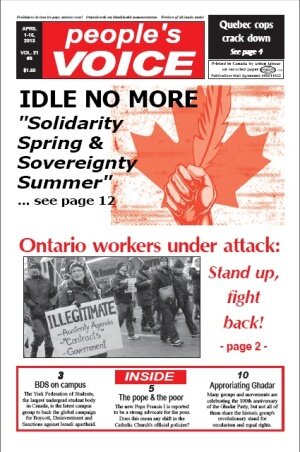
1) COPS STEP UP KETTLING IN QUEBEC

2) HOW AUSTERITY POLICIES SLAM ONTARIO WORKERS

3) PROGRESSIVE ANALYSTS DISSECT FEDERAL BUDGET

4) YORK FEDERATION OF STUDENTS ENDORSES BDS CAMPAIGN

5) RURAL CANADA AND THE HARPER GOVERNMENT'S POLICIES

6) IDLE NO MORE SOLIDARITY SPRING

7) STAGE SET FOR PIVOTAL B.C. ELECTION - Editorial

8) THE LESSONS OF CYPRUS - Editorial

9) A CANADIAN'S SOLIDARITY JOURNEY TO GAZA

10) APPROPRIATION OF THE GHADAR PARTY CONTINUES

11) MUSIC NOTES

12) POPE FRANCIS I AND THE POOR

13) WIFE OF CUBAN FIVE PRISONER TO SPEAK IN TORONTO


PRINTER FRIENDLY ARTICLES

PEOPLE'S VOICE APRIL 1-15, 2013 (pdf)

People’s Voice 2013 Calendar
”Ideas of Revolution”


People's Voice deadlines:

April 16-30
Thursday, April 4

May 1-16
Thursday, April 18

Send submissions to PV Editorial Office,
706 Clark Drive, Vancouver, V5L 3J1, pvoice@telus.net

You can call the editorial office at 604-255-2041


REDS ON THE WEB
http://www.parti-communiste.ca/
peoplesvoice.ca
www.ycl-ljc.ca
www.solidnet.org


People's Voice finds many "Global Class Struggle" reports at the "Labour Start" website, http://www.labourstart.org/. We urge our readers to check it out!


*  *  *  *  *
People's Voice

Canadian Publications Mail Sales Product Agreement #205214
ISSN number 1198-8657
People's Voice is published by
New Labour Press Ltd
  PV Editorial Office
706 Clark Drive,
VANCOUVER, B.C. V5L 3J1
Phone:604-255-2041
Fax:604-254-9803
email:  pvoice@telus.net

Editor: Kimball Cariou : Business Manager: David Au
Editorial Board: Kimball Cariou, Miguel Figueroa,
Doug Meggison, Naomi Rankin, Liz Rowley, Jim Sacouman

* * * * * *
Letters
People's Voice welcomes your letters
on any subject covered in our pages.
We reserve the right to edit for length and clarity,
and to refuse to print letters which may be libellous
or which contain unnecessary personal attacks.
Send your views to:
"Letters to the Editor",
706 Clark Dr., Vancouver, BC V5L 3J1,
or pvoice@telus.net
People's Voice articles may be reprinted without permission,
provided the source is credited.


* * * * * *

The Communist Party of Canada, formed in 1921,
has a proud history of fighting for jobs, equality, peace,
Canadian independence, and socialism.
The CPC does much more than run candidates in elections.
We think the fight against big business and its parties
is a year-round job,
so our members are active across the country,
to build our party and to help strengthen people's movements
on a wide range of issues.

All our policies and leadership
are set democratically by our members.
To find out more about Canada's party of Socialism,
give us a call at the nearest CPC office.

* * * * * *
Central Committee CPC
290A Danforth Ave Toronto, Ont. M4K 1N6
Ph: (416) 469-2446
fax: (416) 469-4063 E-mailmailto:info@cpc-pcp.ca

Parti Communiste du Quebec (section du
Parti communiste du Canada)
5359 Ave du Parc, Montréal, Québec,
H2V 4G9

B.C.Committee CPC
706 Clark Drive, Vancouver, V5L 3J1
Tel: (604) 254-9836
Fax: (604) 254-9803

Edmonton CPC
Box 68112, 70 Bonnie Doon P.O.
Edmonton, AB, T6C 4N6
Tel: (780) 465-7893
Fax: (780)463-0209

Calgary CPC
Unit #1 - 19 Radcliffe Close SE
Calgary  AB, T2A 6B2
Tel: (403) 248-6489

Ottawa CPC
Tel: (613) 232-7108

Manitoba Committee
387 Selkirk Ave., Winnipeg, R2W 2M3
Tel/fax: (204) 586-7824

Ontario Ctee. CPC
290A Danforth Ave., Toronto, M4K 1N6
Tel: (416) 469-2446

Hamilton Ctee. CPC
265 Melvin Ave., Apt. 815
Hamilton, ON.
Tel: (905) 548-9586

Atlantic Region CPC
Box 70 Grand Pré, NS, B0P 1M0
Tel/fax: (902) 542-7981

http://www.parti-communiste.ca/

* * * * * *

News for People, Not for Profits!
Every issue of People's Voice
gives you the latest
on the fightback from coast to coast.
Whether it's the struggle for jobs or peace, resistance to social cuts,
solidarity with Cuba, or workers' struggles around the world,
we've got the news the corporate media won't print.
And we do more than that
- we report and analyze events
from a revolutionary perspective,
helping to build the movements for justice and equality,
and eventually for a socialist Canada.

Read the paper that fights for working people
- on every page, in every issue!

People's Voice
$30 for 1 year
$50 for 2 years
Low-income special rate: $15 for 1-year
Outside Canada $50 for 1 year

Send to: People's Voice, 706 Clark Drive, Vancouver, BC, V5L 3J1
You can call the editorial office at 604-255-2041

REDS ON THE WEB
http://www.parti-communiste.ca/
http://www.ycl-ljc.ca/
http://www.solidnet.org/

(Contents)
(Home)


(The following articles are from the April 1-15, 2013, issue of People's Voice, Canada's leading communist newspaper. Articles can be reprinted free if the source is credited. Subscription rates in Canada: $30/year, or $15 low income rate; for U.S. readers - $45 US per year; other overseas readers - $45 US or $50 CDN per year. Send to People's Voice, c/o PV Business Manager, 706 Clark Drive, Vancouver, BC, V5L 3J1.)


1) COPS STEP UP KETTLING IN QUEBEC

By Johan Boyden, General Secretary, Young Communist League of Canada

            On March 22, I was unexpectedly kettled by Montreal police at a student demonstration together with about 60 protestors. We have all been charged a $625 fine for participating in the "illegal protest," held to mark the anniversary of the start of last year's student strike. Almost 600 arrests have been made in Québec over the past few weeks.

            Kettling, also known as corralling, is an increasingly used tactic of mass detention. Police ‑ often in riot gear ‑ will cordon off a street, blocking all exits, and then arrest everyone in between.

            In our case, the police announced the demonstration was illegal at exactly the same time as the kettle began. There was five minutes of chaos and panic, then about three hours of limbo.

            When riot police charge a crowd they exploit the moment for maximum intimidation. They dress in black, faces covered, holding round shields and pounding them in drum beat. You can hear their stomping heavy boots.

            My partner and I turned just before the charge. We were looking for the rest of the Young Communist League, who had fortunately escaped just in time as two lines of riot cops blocked either side of the street. Then an officer smashed his baton across my knuckles ‑ throw down your banner! Moments later we heard the police captain scream at one officer: "stop being so gentle with them!"

            Within a few minutes we were backed up against a large store (ironically a travel agency) and shoved into a knot of people. It had been a sunny afternoon when the protest began. But after half‑an‑hour in the kettle it started to get dark. Then it started to snow. A cold wind whistled down the street.

            Several shift‑changes of the riot cops surrounding us took place, including a team of horse police at one point. I heard a young woman's teeth start to chatter. "Please just arrest me!" she said. She was wearing in a thin jacket, black polka dot skirt, and heels. Almost three hours...

            Finally an all‑female team of officers arrived, processed us for about four minutes each, and doled out the fines. We were shoved across a yellow police cordon. Go! Get lost!

            The charges may be dropped, thrown out or defeated in court. The bylaw we were charged under is P‑6, a complimentary municipal regulation brought in basically at the same time as the Charest Liberal's anti‑democratic Bill 78.

            Like that now abolished law, P‑6 is almost certainly a violation of our constitutional rights. But that isn't the point. Through our detention we have already been punished.

            Québec Solidaire has renewed its calls for a public inquiry, and the progressive ASSE student union has condemned the new wave of arrests, which began at the annual march against police brutality.

            At the beginning of last year's student struggle the YCL made a conscious decision to actively participate in as many demonstrations as we could, including those declared "illegal" under Bill 78, but to join in a disciplined way because there was nothing to be gained from an arrest and restrictive bail conditions.

            At our last YCL meeting we checked‑in about our policy towards arrests, which are sometimes viewed romantically as badges of honour in the youth and student movement. Our approach remained unchanged. But in just a few days Nicolas, our club organizer, Marianne, our magazine editor, myself and another member of our new club at a French‑language college have all been arrested and charged.

            What has changed? The demonstrations are smaller now, but the force of the police has stayed the same and thus is proportionally much greater. Our ruling class opponents are well aware the student movement is still re‑grouping and somewhat tired. They are giving us a hard kick while we are down.

            Seeming to recognize the intention was to break morale, our kettle held up a proud face. First we launched into the familiar chants. Then, as the temperature dropped, the group began to hold "jumping" to warm up. I saw an elderly man (somebody said he was a university professor) make a few smiling leaps. Anarchopanda ‑ the CEGEP professor who dresses in a giant panda suit ‑ was also there, as well as one of the "Rabbit Crew" who wear bunny‑eared masks to demos. It was like a reunion.

            A hip hop artist came forward and began to rhyme. People started to dance. A drummer and a man with a cow bell joined in the music. Then the entire kettle was moving, bouncing around a circle. Somebody began singing popular songs. Classics from Quebec and France, from the 1940s, 50s, 60s and 70s. Soon we were all singing. Near the end we took a group photo. It seemed somehow appropriate.

Printer-friendly article

(Contents)

(Home)


2) HOW AUSTERITY POLICIES SLAM ONTARIO WORKERS

Excerpts from the keynote address by Ontario Communist leader Liz Rowley to the Party's Ontario Nominating Convention, held March 23-24 in Toronto.

            As we meet today, it's on the heels of a Statistics Canada report showing that for every job posting, there are six unemployed Canadians trying to snag that job. This accounts for 1.3 million officially unemployed Canadians, but excludes those who have given up looking for work - "discouraged workers" who have dropped out of the labour market figures. It also excludes the under‑employed, part‑timers and others in precarious employment, who account for more than 400,000 workers in Ontario alone. If all of these were included, the real figure would be close to 2 million unemployed across Canada.

            A new report from the Canadian Centre for Policy Alternatives - "More Harm Than Good" ‑ shows that Ontario, once the driver of the Canadian economy, now has the highest unemployment rate in the country after the Maritimes. In December, the official unemployment rate in Ontario was 7.8%, and even higher in many cities: 9% in Windsor‑Sarnia; 8.6% in Toronto; 7.9% in London; 7.3% in northeastern Ontario and in Kingston; 7.2% in Hamilton‑Niagara.

            The hardest hit sectors in Ontario continue to be manufacturing and forestry; including 250,000 jobs lost in manufacturing alone since 2004. Tens of thousands of these lost jobs were in the auto industry - the engine of the Canadian economy - a consequence of the loss of the Auto Pact, free trade agreements, the high Canadian dollar, and gun‑to‑the‑head negotiations following the 2008 economic crisis.

            In December, youth unemployment in Ontario officially stood at 19%. The real rate is probably twice that much. During recessions, youth generally go back to school, but with tuition fees the highest in the country that has become exceedingly difficult for students loaded down with debt. Ontario universities now receive 44% of their funding from student tuition fees.

            At the same time, the number of Ontario seniors in the workforce in 2012 has tripled to 240,000 people, or 12.5% of seniors. The jobs they are doing are in retail and food services - jobs usually filled by youth. They are working because their pensions are too small to live on, and because the federal government wants them to stay in the workforce as a source of cheap labour. That's why the Tories have raised the qualifying age to 67 for Old Age Security and the Guaranteed Income Supplement - which benefit the poorest seniors.

            Yet, access to Employment Insurance coverage by unemployed Ontario workers who have paid into this public insurance plan, dropped to just 21.2% of the insured unemployed in October 2012. Only 1 in 5 unemployed workers in the province was able to access EI, the lowest rate of coverage ever recorded. Across Canada, the rate of access is 37%.

            Of the almost 80% of insured workers who don't qualify in Ontario due to changes in legislation by the Tories, most have been forced to take low paid jobs instead, or throw themselves on the mercy of family and friends. More changes this year will force workers who do qualify to accept low paid jobs and to travel up to an hour to get to them. Seasonal workers across the country, who are hardest hit, are up in arms protesting the changes. Vicious provincial "workfare" policies have also prevented most unemployed workers from accessing social assistance in Ontario...

            Incomes in Ontario have either stalled or fallen over the last 30 years, driven down by corporations and right‑wing governments. While Ontario's 1% saw their incomes rise by 71% from $280,000 to $478,000 a year; 90% saw their incomes creep from $28,700 to $30,000 in the same period. In Toronto, 90% saw their incomes fall by $1,900 (adjusted for inflation).

            In Ontario the top 1% made 16 times more than the bottom 90%; and in Toronto, 23 times more than the bottom 90%. In January, the provincial government has also used Bill 115 to impose wage and benefit cuts in the education sector, which both government and opposition parties have stated they will extend across the broader public sector.

            The federal Tories have slashed immigration and replaced it with the temporary foreign worker program, which contracts workers to employers who can pay 15% less than the wages paid to Canadian workers, and can deport them at any time. Temporary foreign workers are forced labour in Canada. The government's main objective is to drive down wages even further, and to split and divide the working class between free and indentured labour, Canadian born and foreign born, by colour, and by gender (and any other way they can think of).

            Household debt - which bankers and governments have all warned against ‑ now stands at an average of $124,700 in Ontario, much higher than the Canadian average of $114,400. Ontario has the third highest household debt load in the country. This is a result of the inflated housing market and housing bubble in Ontario, as well as the massive job losses in manufacturing and forestry, cuts to real wages and incomes, and rising prices for food, fuel, housing, post‑secondary education and childcare.

            Across the country the situation is bad and getting worse.

Corporate income tax cuts that have made Ontario and Canada the lowest corporate income tax jurisdictions (at 11% and 15% respectively) in the industrialized world, have cost the Ontario government $17 billion a year in foregone provincial revenues. More foregone revenue in a single year, than the entire provincial deficit. The federal government has lost $14 billion a year in foregone revenues, illustrating once again, that the problem is not about expenditures, but about revenue streams that are being deliberately turned off. It's a problem created by, and about, a system geared to the insatiable greed of the biggest corporations, and the wealthiest 1%.

            While the biggest corporations sit on huge pools of aggregating capital generated by corporate tax cuts and a virtual flat tax, Ontario is starved of public investment in healthcare, public and post‑secondary education, childcare, affordable housing, cities, public services and social programs, an adequate minimum wage and income security, job creation and an environmentally sustainable industrial strategy for the province.

            All by itself, this is the case for public ownership and democratic control of the economy; for fundamental social change and for socialism.

            Yet, in defiance of all logic, governments - including Kathleen Wynne's Liberal government in Ontario - are moving to introduce more austerity to discipline the working class and reduce wages and living standards even further, with the aim of eliminating the deficit and increasing profits, and in the process pushing Ontario ever nearer to the fiscal cliff of another deep recession - caused by corporate greed and austerity measures.

            If there was any doubt about the direction being charted by Premier Wynne, it was dispelled with the statements of provincial Treasurer (and former Royal Bank of Canada executive) Charles Sousa, who praised the federal budget saying it had "made some progress in moving Ontario forward", and called for "cooperation and a strong partnership" with the federal Tory government.

            This is a federal government that will cut $4 billion in program spending this year, throwing thousands of people onto the unemployment lines, attacking and eroding universal social programs, under‑funding provincial transfers, privatizing Medicare by stealth, while simultaneously spending billions on arms, prisons, and the military, and folding up international aid and development into Foreign Affairs - the unofficial ministry of war. Not least, the budget contains proposals - once again hidden deep inside - for right‑to‑work legislation that would eliminate the closed shop and roll back workers' rights 75 years.

            It is austerity, embraced by the Liberals in Ontario and the Tories in Ottawa, that is pushing our province and our country to the brink of another deep recession - and depending on developments in the US and in Europe, into a full‑fledged depression. Most regrettably, we note that austerity has also been embraced by the NDP and the Greens, who accept capitalist dogma that the working class must pay for the economic crisis, through reduced wages and living standards, privatization, deregulation, tax cuts, and curbs on labour rights.

            Yet the capitalist prescription for ameliorating the deepening economic, social and political crisis caused by austerity, is to double down on austerity, delivering even more of the medicine that has so patently failed, generating massive strikes, protests and resistance struggles around the globe.

            The only way out of the current crisis is to reject austerity, defeat the right‑wing governments delivering austerity, and adopt policies and elect governments that will put peoples' needs before corporate profits and curb corporate power...

            The vehicle for this change is a powerful people's movement, a common front of labour and its allies including the Communist Party, engaged in escalating mass independent political action, in the streets, in the workplaces, at the Legislature and on Parliament Hill.

Printer-friendly article

(Contents)

(Home)


3) PROGRESSIVE ANALYSTS DISSECT FEDERAL BUDGET

PV Vancouver Bureau

            Much of the budgetary damage inflicted by the Harper Tories came in 2012, when the government implemented long‑term spending and job cuts. But there was more in the budget introduced on March 21 by Finance Minister Jim Flaherty.

            CUPE's Senior Economist, Toby Sanger, wrote that the 2013 Budget "involves essentially no additional funding and actually reduces overall spending in future years‑which means this budget will effectively do little or nothing to grow the economy."

            This budget, noted Sanger, "actually cuts federal infrastructure funding for municipalities and provinces through the Building Canada Fund from presently allocated levels by $250 million per year and is back‑end loaded so there will be very little available for the next two years. This is far from the $2.5 billion increase in funding for infrastructure that the FCM and its allies called for. It also renews the P3 [privatisation] Canada Fund. Reduced funding under the BCF will force more communities to apply for funding that is only available for P3s."

            The CUPE researcher adds that "the federal government has made a lot of noise about labour market and skills shortages, but the government's own projections show that the unemployment rate will remain high for foreseeable future, not declining to 6.4% until 2017."

            Canadians for Tax Fairness (not to be confused with the right‑wing Canadian Taxpayers Federation!) says that despite closing some tax loopholes, little was done to tackle tax havens which cost the treasury billions in revenue.

            The Dividend Tax Credit was made less generous, says the group, which could bring in more than $500 million a year starting in 2014. Several smaller loopholes were also addressed, but others were opened further: "For example, the Life Time Capital Gains Exemption was made more generous by $50,000 and will cost the government $15 million in 2014, rising to $35 million by 2017... The lucrative entertainment tax credit that pays for corporate boxes at sports events wasn't touched.  That perk costs Canadian taxpayers $500 million a year. Eliminating the Stock Option Deduction would have brought in $760 million more a year. This is a tax break that mainly benefits the top 1% of Canadians."

            The previous Liberal government boosted Canada Revenue Agency's capacity in its international compliance division by at least $30 million, an investment which increased revenues by $2.5 billion over four years. Instead, "the Budget reduced CRA budget by a further $60 million, in addition to the big cut they already were hit with last year. It is hard to imagine how we can take the government's new found interest in going after tax havens seriously."

            More broadly, says the CTF, the government could have rolled back the corporate tax cuts that did not result in boosting corporate investment or creating more jobs, or introduced a surtax on high income taxpayers as several provinces have done recently, "but the Conservative government has ideological blinders when it comes to considering any revenue side solutions. They opted instead to cut government spending even further even though last year's austerity budget has been responsible for almost a 1% reduction in our anemic economic rate of growth.  Even though cutbacks have undermined our weak economic recovery and lowered revenue, they seem intent on making a bad situation worse by implementing further cutbacks."

            Campaign 2000 was urging a mix of social infrastructure and income supports to reduce Canada's 14.5% rate of child and family poverty. Instead, the budget is "silent on family income security and on early childhood education and care, in no way responding to Parliament's 2009 unanimous vote to develop an immediate plan to eradicate poverty for all. It also ignores several key facts. First, the poverty rates of Aboriginal families with children are much higher than those of non‑Aboriginal Canadian families. Second, poverty is a major contributor to poor health, mental health problems, violence and lack of educational attainment among Aboriginal Canadians. The budget makes modest investments in health services, income assistance and skill training for Aboriginal people, but they will have limited impact if poverty is not eradicated."

            David Macdonald of the Canadian Centre for Policy Alternatives writes, "One of the most amazing things about this budget is that one of its three focuses is actually the opposite of what it's touting. You'll likely hear that $14 billion will be spent on infrastructure over the next 10 years... What you won't hear is that 75% of that money is going to be spent in or after 2020. In fact, there will be an effective $1 billion cut to infrastructure transfers to the cities in 2014‑15."

            "Last year at this time," adds Macdonald, "the government estimated that the deficit in 2013‑14 would be only $10.2 billion. Now, the deficit estimate for 2013‑14 is almost twice that at $18.7 billion. This is the danger of slow growth. We keep expecting that three years out everything will be great again‑unemployment will be low, growth will be robust‑but once we get to three years from now, the economy is still stagnant. The continued revision of the deficit figures are a great example of this reversion to stagnation in action."

            Budget 2013 is "not so pretty for women in Canada," says the CCPA's Kate McInturff. The budget's job creation strategy, she argues, is largely focused on sectors where women are significantly under‑represented: construction, manufacturing, and mining. Although the extractive sector anticipates increasing shortages of workers, only 14.6% of such companies have recruitment policies targeted at women. Several barriers make it more difficult for women, she says, including the lack of child care and flexible work practices, a "hostile work culture", and the lack of women in management positions.

            Budget 2013's infrastructure spending, she adds, "creates jobs where women are not". There are 382,100 Canadians working in construction, but only 6% of those workers are women, thanks to similar employment barriers.

            McInturff adds that the Budget continues to shift job creation to the private sector, while cutting jobs in the public sector, where women make $2000 more a year on average.

            Investment in fields such as health care, child care, and education, she says, would create more jobs in sectors in which women are likely to be employed, and decrease the burden of unpaid work for both men and women.

Printer-friendly article

(Contents)

(Home)


4) YORK FEDERATION OF STUDENTS ENDORSES BDS CAMPAIGN

Special to PV

In an historic vote at the largest undergraduate students' union in Canada, the York Federation of Students (YFS) has endorsed the Global Campaign for Boycott, Divestment and Sanctions (BDS) against Israeli apartheid. The YFS joins many student unions around the world, who have passed similar resolutions. In Canada these include Carleton University Graduate Students' Association, University of Regina Student Union, and most recently, York University Graduate Students' Association and University of Toronto Graduate Students' Union.

            The resolution was drafted in response to the 2005 Palestinian civil society call for boycott, divestment and sanctions against Israel. The campaign aims to pressure Israel to comply with international law and end its occupation of the West Bank and Gaza; to allow Palestinian refugees their internationally guaranteed right to return to their homes and villages; and to grant equal rights to Palestinian citizens of Israel.

            The YFS Board resolution, adopted by a vote of 18-2, also demands that York University abide by the BDS call, specifically urging the University to withdraw its investments from Northrop Grumman, BAE Systems, Amphenol and other companies that sell weapons and military equipment to Israel.

            "The oppression of the Palestinian people at the hands of the Israeli state is not some far off issue that we can choose to ignore. We are already deeply implicated in the human rights violations of the Israeli State through our investments in the above‑mentioned companies. We do not have the privilege to remain 'neutral' on this issue," said Students Against Israeli Apartheid (SAIA) York collective member Huda Al‑Sarraj.

            SAIA York now hopes to lobby the York administration to implement a socially responsible investment policy. With the support of the GSA and the YFS, as well as the TA's, GA's and contract faculty union, CUPE 3903 (which passed a BDS motion in 2006), SAIA York will now demand an end to the investment of university funds into companies that profit from violations of international law and human rights.

Printer-friendly article

(Contents)

(Home)


5) RURAL CANADA AND THE HARPER GOVERNMENT'S POLICIES

The following commentary by David Tymoshchuk, a member of the Jacob Penner‑Norman Bethune Club of the Communist Party in Manitoba, is also a contribution to the CPC's debates for the Party's 37th Central Convention, which takes place April 5-7 in Toronto.

            The current Canadian government has imposed the will of the Conservative Party to destroy the Canadian Wheat Board through removing the main reason for its creation in the first place: single desk selling. Rural Canada, in particular Western Canada has traditionally been a strong base for the Tories and in the past the Social Credit party. It should be noted that petite‑bourgeois populist base that has been a major component of Tory support may very well suffer at the hands of the party it has elected to represent its interests. As it turns out big business monopoly capital is of more interest to the Tory elite and policy makers at this juncture in time. This is yet another facet in the ongoing rightward trend among all major electoral political parties as evidenced in the ongoing NDP vs. labour situation.

            As Canada continues to urbanize, electoral maps are redrawn, and the rural population becomes less important in the eyes of big business parties. Such views have resulted in a creeping disenfranchisement if not by actual seats, then in spirit by ignoring the views of rural populations or by selective hearing of influential members of such populations ( i.e. bourgeois capitalists who stand to benefit from demographic shifts). It seems the conservatives are taking a gamble that now that they have reached a more entrenched and incumbent seat in power, that they can afford to crush not only the rural working class and small farmers. Many small farmers being targeted (or forsaken in policy) built up co‑operatives, the pool elevator system, and often organized politically for the CCF, or the Communist Party of Canada. Many farmers settled and toiled on homesteads, and still had a connection and responsibility to the land they toiled on. In a twist of irony, small farmers have been forced off the land via policy favouring larger factory farms repeating what was done to the Aboriginals they had displaced through the Tories John MacDonald era National Policy of mass settlement and forming western colonies of Eastern Canada (though with less coercion and related tragedies).

            Killing of the CWB's single desk brings Canada in line with United States (a major opponent of the single desk) and the WTO wishes and ideals of so‑called "Free Market" political economy. This single desk of a major world supplier of grain has had huge influence in the global grain markets and seen by many to have an anchor effect (argued as either high or low pressure on food prices depending on viewpoint). With the bargaining power of the single desk cut away, what effects on food prices to now shrinking food supplies, along with environmental changes remains to be seen.

            Not only is the budget and policy toward agriculture and the CWB destroying way of life of traditional farming but severely effecting the survival of small agribusiness based communities. The reduction of the number of small farms and the bypassing of local supply businesses (akin to the loss of corner stores in urban environments) due to supply contracts or larger suppliers with cheaper inputs. Combined with the general aging and flight of working age youth to more promising job markets in urban centres. Small businesses (petite‑bourgeois) are suffering and an opportunity to gain strategic support by mobilizing from this development has been made available.

            Aging farmers, some now in their 80s and 90s, are the last of many farming generations and a sea change is in full swing to wage based young farm workers versus the traditional owner‑operator family based operation. It's akin to a corporate feudal system as the means of production (of food) is shifting to the direct control of the capitalist class who own shares in corporations that have taken control of the land. Many of these corporations are foreign controlled as globalization knows no bounds. And national food security has the potential to become a serious concern.

            Interconnecting with immigration policy, these new corporate farms are large beneficiaries of these policies as they are a main exploiter of foreign temporary workers. Racism in rural communities due to the introduction of foreign workers further put negative pressure on the unity of the working class in rural areas. This situation is a revisited "White Anglo Saxon Protestant" established settler versus Eastern European etc. new settler generations ago.

            Acuteness of the rural situation is almost like an early warning system of imperialism's progress.

* Environmental destruction and intensive land over‑use. Marginal land deforested for agricultural use ( energy intensive, low labour methods demand more land plus sheer volume of inputs GMO seed, chemicals and rising food prices make such marginal lands finally marginally profitable.)

* Concentration in trust like supply chains: Chemicals, Potash‑fertilizer. Ugly end result of capitalism's profit motive: (food recalls, monoculture specialization crate calves, battery cage hens, misuse of antibiotics, GMOs etc.)

* Dehumanizing exploitation of workers imported like any cheap resource.

* Control of basic means of production transferred back to bourgeois corporations.

* Huge investment in capital to bring about these changes. Plenty of foreign capital involved.

* Vertical integration of agricultural corporations in supply chain. An example being factory hog barns being controlled through either ownership by feed mill companies and rendering plants (in turn owned by meat packers). Or through contracts that dictate supply of products to hog producer by a subsidiary of meat processor and sale of finished product back to the meat plant at set prices. Or in case of cereal grains, contracts to buy seed, fertilizer and chemicals from a corporation and selling back at a contracted price as many elevator companies have developed this business model over the years.

            The Communist Party must keep the situation ongoing in rural areas in mind when completing the final draft of the main political resolution if it is to be comprehensive in its analysis.

            Solidarity with farmers and agricultural workers is key as after all the sheaf of wheat is a major component of many Communist Parties' symbols, including our own. Uniting forces in rural areas is a major hurdle. Aboriginals, small farmers, foreign workers, and small business owners need have a common target to get them to defeat the current government and further to reject the capitalist system and towards a socialist alternative.

Printer-friendly article

(Contents)

(Home)


6) IDLE NO MORE SOLIDARITY SPRING

A Call to Action from Idle No More & Defenders of the Land, issued March 18, 2013

            Idle No More has sparked an awakening of Indigenous and non‑Indigenous peoples internationally in support for democracy, human rights and environmental protections. In three short months, the movement has succeeded in raising global consciousness through education, cultural resurgence, and democratic political activism. We have shaken the foundations of inequality in Canada, and invited communities to join in a movement for social and environmental justice. We now need many more people to stand with us.

            The Harper government's agenda is clear: to weaken all collective rights and environmental protections, in order to turn Canada into an extraction state that gives corporations unchecked power to destroy our communities and environment for profit. Harper is trying to extinguish Indigenous Peoples' Inherent, Aboriginal and Treaty rights to their territories, because these rights are the best and last protection for all Canadians.

            Idle No More has confronted these policies, and Harper supporters such as ex‑Minister of Aboriginal Affairs John Duncan, suspended Senator Patrick Brazeau, resigned minister Peter Penashue, and Tom Flanagan have been called into question by grassroots people.

            Idle No More will help rebuild the nation‑to‑nation relationship that is the foundation of this country. This means deepening democracy, respecting Indigenous sovereignty and protecting the land and waters from further resource extraction without the affected Indigenous Peoples' free, prior, and informed consent.

            We know it will take a lot more to defeat Harper and the corporate agenda. But against the power of their money and weapons, we have the power of our bodies and spirits. There is nothing that can match the power of peaceful, collective action in the defense of people and Mother Earth.

            Idle No More and Defenders of the Land, a network of Indigenous communities in land struggle, have joined together to issue this common call for escalating action. Our demands are clear and in accordance with the principles of coexistence and mutual respect between Indigenous and non‑Indigenous Peoples. We demand that Canada, the provinces and the territories:

            * Repeal provisions of Bill C‑45 (including changes to the Indian Act and Navigable Waters Act, which infringe on environmental protections, Aboriginal and Treaty rights) and abandon all pending legislation which does the same.

            * Deepen democracy in Canada through practices such as proportional representation and consultation on all legislation concerning collective rights and environmental protections,and include legislation which restricts corporate interests.

            * In accordance with the United Nations Declaration on the Rights of Indigenous Peoples' principle of free, prior, and informed consent, respect the right of Indigenous peoples to say no to development on their territory.

            * Cease its policy of extinguishment of Aboriginal Title and recognize and affirm Aboriginal Title and Rights, as set out in section 35 of Canada's constitution, and recommended by the Royal Commission on Aboriginal Peoples.

            * Honour the spirit and intent of the historic Treaties. Officially repudiate the racist Doctrine of Discovery and the Doctrine of Terra Nullius, and abandon their use to justify the seizure of Indigenous Nations lands and wealth.

            * Actively resist violence against women and hold a national inquiry into missing and murdered Indigenous women and girls, and involve Indigenous women in the design, decision‑making, process and implementation of this inquiry, as a step toward initiating a comprehensive and coordinated national action plan.

 Earth Day

            Indigenous Peoples and Indigenous rights are in many cases the best defence against environmental destruction by unchecked greed and industrial development. This Earth Day we are calling for nationwide autonomous local protests ‑ and a mass non‑violent direct action in Ottawa to be announced soon ‑ highlighting the importance of Indigenous rights in combating the Harper and corporate agenda. We are asking people to prominently include messaging on Indigenous and Treaty rights in their actions.

 Sovereignty Summer

            Indigenous communities have the right to determine the development on their traditional and treaty territories. In defending their right to say "No" to unwanted development, First Nations like Barriere Lake, KI, Grassy Narrows and many others are advancing alternatives that help us re‑imagine our relationship to the environment. Across the country, people are increasingly supporting First Nations who are trying to protect lands, waters and air for everyone, and to win recognition of marine protections, of sustainable forestry, of local, just economies, and of the principle that we must respect the environment that we are a part of.

            We are calling on non‑Indigenous people to join Indigenous communities in coordinated non‑violent direct actions in the summer. Alternatives will only come to life if we escalate our actions, taking bold non‑violent direct action that challenges the illegitimate power of corporations who dictate government policy.

Printer-friendly article

(Contents)

(Home)


7) STAGE SET FOR PIVOTAL B.C. ELECTION

People's Voice Editorial

            Weeks before B.C.'s May 14 election, the Liberal government of Christy Clark trails Adrian Dix's NDP by nearly twenty percent in the polls. The most blatantly pro-corporate government in recent British Columbia history may be heading for defeat, an outcome which we would welcome.

            But as voting day draws near, trade unionists and progressive activists are witnessing a familiar pattern. Taking its support from working people for granted, the B.C. NDP is wooing big business and denying right-wing predictions of radical policy shifts. At a March 6 fundraiser at the Hotel Vancouver, the NDP broke previous records, raking in over half a million dollars from the corporate sector.

            In early April, the NDP will release their long-awaited campaign platform. There is every reason to expect that they will adopt the corporate mantra that "the cupboard is too empty" to restore the huge B.C. Liberal cuts to health, education and social programs. After becoming NDP leader, Dix had called for minor reversals of Liberal tax giveaways to the wealthy and the corporations (ideas which were copied in Premier Clark's recent budget, indicating the depth of her party's crisis). But these token shifts will only recover a tiny fraction of the $2.4 billion per year which progressive economists say could be generated by bringing British Columbia's tax revenues up to the Canadian average.

            By limiting itself to what the corporations consider "affordable," the B.C. NDP would betray the hopes of working class and poor voters targetted by 12 years of Liberal attacks. The struggle for real change will not end on May 14, but the election will alter the political terrain. The best option is to vote for Communist Party of BC candidates where they are on the ballot. In other ridings, progressive voters should defeat the Liberals, and pressure NDP candidates to roll back the entire right-wing agenda.

Printer-friendly article

(Contents)

(Home)


8) THE LESSONS OF CYPRUS

People's Voice Editorial

            Global stock markets heaved a "sigh of relief" at the debt‑financing agreement in Cyprus, but the deal spells disaster for the people. And the consequences may spread far beyond the small Mediterranean island. On March 25, the head of the Eurozone's finance ministers suggested that the bailout could be a template for crises elsewhere. Jeroen Dijsselbloem later retracted his comment, but the cat is out of the bag. International finance capital is prepared to seize bank deposits of working people to protect the profits and assets of the capitalist ruling class. Only massive protests blocked plans to grab a percentage of smaller deposits in Cyprus, but this theft may soon be back on the agenda.

            Demanding a referendum, the Cypriot communists (AKEL) condemn the agreement as "the climax of the first phase of the Troika's plans against the Cypriot people." The deal means higher unemployment, more austerity, cuts and privatizations, and closures for many small and medium businesses. The island's massive offshore gas fields will be controlled by giant energy monopolies rather than owned by the Cypriot people.

            The broader attempt to rescue the Euro through the "three pillars of austerity, cuts and privatizations" is leading the peoples of southern Europe to disaster. In fact, the global financial meltdown of 2007‑08 is far from over. The drive by the ruling class to make workers pay the full cost of this systemic crisis is pushing hundreds of millions into poverty, fuelling another round of crises. Militant defensive resistance struggles are needed. But the real solution lies in building a powerful, united movement for a genuine People's Alternative against neoliberalism. Such a strategy can lead to the replacement of the collapsing "private profit" economy with a socialist model, based on working class political power and collective, democratic ownership of productive wealth. That's the real choice facing the working class, including here in Canada.

Printer-friendly article

(Contents)

(Home)


9) A CANADIAN'S SOLIDARITY JOURNEY TO GAZA

Victoria activist and People's Voice supporter Kevin Neish recently returned to Gaza, to document the illegal Israeli blockade of Palestinian territory. Here are photos and excerpts from his blog reports on the trip. To find the full account of Kevin's solidarity journey, go to http://kevinneish.wordpress.com/

"For heaven's sake, why are you going back on another flotilla to Gaza?!

            I've heard this comment/question repeatedly since I returned from an Israeli prison after the attack on my ship, the Mavi Marmara, in May 2010. In a nutshell, I'm returning because the illegal blockade of Gaza is still in place. The job is not done.

            I gotta go back or I couldn't live with myself. And it's all my mom and dad's fault. As a little kid, I remember my mother and father repeatedly standing up for just causes. They would stand, almost alone in the 1960s, for Cuba, unions and peace, and against the Vietnam war, nuclear bombs, apartheid South Africa, fascist Spain and book‑burning McCarthyites here in Victoria. They risked financial loss, political and social banishment and physical assaults. And in the end, they usually, eventually, were proven right.

            When I was on the Mavi that night, I thought about them a lot: while watching fellow aid workers be shot, bleed, and die all around me, while having Israeli guns put to my head, while watching others get beaten and while everyone was deprived of human dignity and basic rights for three days.

            I don't remember being scared, I remember being outraged, all the more so when I returned to Canada, to hear Israeli scripted questions from the main stream media. It was a horrific three days, even though I expected that my Canadian passport and white skin would likely get me home safe. All I could think about, was that the Palestinians have gone through all this, and much, much worse, for years and years on end.

            Once you know something, "taken the red pill" (to give that Matrix movie reference), you can't go back. You can't "take the blue pill" and ignore what you've seen and walk away, at least I can't. Sometimes, I feel that I'd give anything to take a blue pill and move into blissful ignorance, just for a while, but this isn't a movie, it can't and shouldn't happen...

            The flotilla against the blockade of Gaza has been deemed illegal by Mr. Harper and we are being sued by Canadian Zionists to try to bankrupt and stop us, but we are doing the right thing. Someone has to do something to make it end, and 40 or so Canadians aboard the Tahrir will try to do the right thing, with a ship full of medicines, witnesses and hope, regardless of Mr. Harper and his Zionist supporters. Hopefully, some Canadians feel the same way and will support us and be a part of our effort. Contact your MP and the media and tell them how you feel. Demand justice. Do the right thing.

            To keep track of the Canadian Boat to Gaza or make a donation, please visit Tahrir.ca.


February 23

            Hanna Kawas, from Vancouver's Voice of Palestine on‑line radio show, interviewed me this morning as I sat at the base of the Mavi Marmara memorial in Gaza City harbour. Moments into the interview I looked up and saw in the distance an Israeli warship circling Palestinian fishboats who were just a few miles off shore, well within the new ceasefire agreed 6 mile limit. For the rest of the interview I added a running commentary on the plight of these harassed Palestinian fish boats, until they eventually gave up and sailed back towards port.

            Last week a very similar incident occurred to Mohammed and Mehmed Sadella while only one and a half miles from shore, off Sudania, Gaza. Their ship was machine gunned and then they were forced to strip and swim to the Israeli ship and kidnapped to Ashdod. There they were shackled, hooded, terrorized and finally interrogated to gather information about their friends, family and their neighbourhood, to the point of being forced to identify theirs' and others homes from high resolution satellite photos. It sounds like the old "we know where you live" routine from Hollywood Mafia movies, right down to the IDF offer of "we'll help you if you help us". So it would seem the whole purpose of the IDF capturing 45 Palestinian fishboats, was to gather military intelligence and to terrorize the fishers into becoming collaborators. The Palestinians go fishing for food while the Israelis go fishing for them.

            So the end result is Mohammed and Mehmed have lost their boat, motor, nets and 50 kgs of fish all worth over $7000 and they and 31 members of their extended families have lost all their income. I asked Mohammed how long it will take them to earn that money back. He replied never, as that was the only boat they owned. When my Dad and uncle commercial fished, they had to worry about the weather and uncharted rocks, not bullets and kidnappers.


February 24

            Here are a few random photos of Gazan civic works... how they keep things functioning with very little to work with.

            The drinking water that comes out of all Gazan water taps is as salty as sea water. Gaza's ground water aquifer was once replenished from the Hebron hills in the West Bank. But I'm told that Israeli farm water wells have now cut off and hijacked this water, allowing sea water to infiltrate the Gaza aquifer. So Gazan tap water is only "good" for washing and bathing and that is only because there is no other choice. Don't expect any suds from this water, no matter how much soap you use! Drinking water is produced by the government, via a reverse osmosis plant and trucked to thousands of locally made stainless steel tanks, and sold for one shekel (25 cents CAN.) for 20 liters. Yes, due to Israels' blockade, and so control of the economy, Gazans' are forced to use Israeli shekels, whether they like it or not.

            Even with the limited electricity supplies, 8 to 12 hours a day, Gaza City is planning for better days ahead and is now installing street lights. And the horse cart is a necessary and efficient delivery and pick up system all over Gaza, from people, to produce, to building materials and everything in between. And in the background is more construction to replace the destruction from 2008/09 and last November. I witnessed some construction materials coming across the Egyptian border, but I'm told the vast majority of it still has to come through the very expensive, and dangerous, tunnels from Egypt.

            Caterpillar is being boycotted in the "West", due to their supplying armoured bulldozers to the IDF, but the Gazan's have to use what they have as best they can, a la the photo above. Even if you wanted to, you can't smuggle a replacement Komatsu dozer through a Rafah tunnel. Road construction is a little different in sandy Gaza. Once the loose sandy ground has been prepared and compacted by heavy equipment, locally made concrete paving stones are laid. From my own experience with asphalt pavement breaking apart on the sandy soil in Port Renfrew B.C., paving stones are an excellent idea. Much less oil is used, it takes lower technology, it's labour intensive, there's no heavy equipment needed after the initial prep, they're reusable, road repairs are easy and locally done, accessing water and sewer mains is simple and inexpensive and the "cobble" roads look beautiful.


February 26

            I spent the morning in a field of peas in Beit Hanoun, Northern Gaza, 500 meters from the Israeli border. Before the November ceasefire agreement this was a shoot to kill area, but now the Palestinians are trying to reclaim and farm this land. Happily everything was peaceful and the international peacekeepers joined in picking peas. I've been told that the rocket just fired from Gaza into Israel, by a Fatah related group, has garnered a lot of media. I only wish the 820 ceasefire breaking incidents of shootings, deaths, hijackings and kidnappings of Palestinians by the IDF, had made similar headlines in the "West". If so, there likely wouldn't be any retaliatory Fatah rocket attacks.


February 28

            The average age in Gaza is 17. After the destruction of numerous UN schools in the 2008/09 attacks, all the schools and kids centers in Gaza are running double shifts. I visited a kids community activity center in Beit Hanoun and here are some photos and thoughts about them.

            Kids look the same anywhere in the world. But these kids have grown up fast in a war zone. Like any kid they are proud to show off their "fill in the blanks" drawings.

            But this center is especially for kids suffering from the effects of the Israeli attacks. They are asked to paint what ever they want and it all looks so normal, until you look close. Tanks, ambulances, stick people spewing blood, missiles falling on houses, blob people with guns in their hands, rockets on launchers. And yet more and more horrible memories. It all comes pouring out of these smiling little souls, when a brush is put in their hands and there are no preset lines to paint inside of.

            But after 65 years of these attacks their society and these kids still appear strong and defiant. I believe the Arabic word is "sumud"... steadfast.


March 3

            Well I finally got out onto the salt chuck today as part of a 55 boat protest flotilla of Gazan fishers...

            After a year of harassment, shootings, kidnappings, torture and 36 boat hijackings by the IDF, the Gazan fishers decide to protest en masse, heading out of Gaza Port north to the Israeli border.

            Even these smaller craft are worth upwards of $7000 CAN, so when the Israelis steal them, it destroys the livelihood and future for three or more families, and Gazans get less of this much needed food production. The Israelis always attempt to convince the captured fishers to become collaborators, which appears to be the whole purpose of these kidnappings and boat thefts.

            Of particular interest to me, being from a fisher family, was the presence of a female fisher skipper, Madleen Kolab. It seems her father became too crippled to handle the boat, so she stepped into his shoes and into a very male dominated trade, like the B.C. industry several decades ago. Pull starting a 40 horsepower outboard is no easy task for anyone but she obviously knows what she's doing. The Arab media took great interest in her, which seemed to amuse her. Madleen deftly mends nets with a net needle exactly as my father once did, except she uses her hands and her feet! She kindly offered to take me out for a day of fishing, an offer which I very much hope to take her up on. In so many ways Palestinian women are at the forefront of their nation's struggle for freedom. Something you don't see or hear about in our Western media.


March 6

            I toured the northern border buffer zone yesterday and took a few photos.

            What was a desert like waste land in November, the Palestinians have transformed into productive land. Before the November ceasefire allowed the farmers back onto this land, all the areas in these photos was within the "shoot to kill" buffer zone. The IDF are still shooting farmers in spite of the supposed ceasefire, but the farmers are willing to take the risk to till their soil.

            The Palestinians are making the desert bloom again. You'll notice that are few buildings or infrastructure, as that was all repeatedly bulldozed since the 2008/09 assault. The farmers are making the bare minimum investments of just mini-green houses and irrigation pipes, as the IDF is still destroying these farms, but even so the production was amazing.

            Strawberries, onions and corn, altogether in one field. The Palestinians are making the best and fastest use of the land with multiple plantings using the same little greenhouses and irrigation pipes. Crops of potatoes, right up to the desert border area, with an Israeli base just over the hill and the smoke stacks of Ashklon Israel in the near distance. The Palestinian sheep don't know the politics involved as they now blissfully graze right up to the Israelis' border wall. The Israeli border looks clearly defined but there are multiple walls, fences and perimeter roads which all eat into Palestinian farm land. An automated machine gun tower, remotely controlled from Tel Aviv, looms over the Gazans' fields. The danger for the farmers is clear and present all the time, night and day.


March 14

            Well after 20 hours in the air I'm back home in Victoria and dealing with the jet lag and the culture shock. Less friendly people here and I'm not constantly scanning the skies for F18s and drones. The trip went very well, and I made some very good connections for future work and projects, As such I expect I'll be returning to Gaza some time soon. Later this year hopefully, depending on the situation in Egypt.

Printer-friendly article

(Contents)

(Home)


10) APPROPRIATION OF THE GHADAR PARTY CONTINUES

By Gurpreet Singh

            With the beginning of the centenary year of the Ghadar Party, all kinds of groups are interpreting the Ghadar history in their own ways. These celebrations have either become symbolic rituals, or distort the facts about the Ghadar movement.

            What did the Ghadar Party actually stand for? The party was a militant group of South Asian immigrants based in US and Canada, who believed in an armed struggle against the British occupation of India. The party came into existence in 1913 with its headquarters in the US, and a big following in Vancouver. Most members had moved to this part of the world for economic reasons, as British subjects. Many had served in the British army.

            Thanks to blatant racism and anti-immigration policies, they soon realized that the British government would not listen to their grievances. These harsh realities transformed them into social justice activists, determined to fight both against the foreign occupation of India and against racism in Canada. Many actually returned with a dream to organize a mutiny, only to face the gallows or tough imprisonments. A majority were Punjabi Sikhs, but there were activists from other faith groups as well. Ghadar members were expected to keep religion and politics apart, and there was no caste discrimination within the group.

            In a nutshell, the Ghadar Party can be portrayed as a true radical group of activists that believed in secularism, equality and social justice. During later years, some continued their fight against oppression in post-independent India as well. Even in the worst possible situation, they saved many Muslims from Hindu and Sikh mobs, risking their own lives on the Indian side of the border during the religious division of India and Pakistan in 1947 which sparked large scale sectarian violence.

            The Ghadar activists also encouraged gender equality and helped open schools for women.

            In post-independent India, many Ghadar activists became diehard supporters of the communist movements. Booja Singh, who later joined the ultra-leftist Naxalite struggle, an outcome of the oppression of the landless farmers and poor, was killed by the Indian police.

            Mangu Ram Muggowal, a former Ghadar activist, had to continue his struggle against caste-based oppression and untouchability in an independent India. Influenced by the Ghadar Party, he launched a powerful struggle for emancipation of Dalits in Punjab.

            Going by this brief description, one can easily identify contradictions in the policies of those celebrating the centenary at a mere symbolic level. Not surprisingly, these groups include India's ruling Congress party, which has always ignored the Ghadar history. The Congress portrays itself as the only major political movement behind the freedom struggle.

            If the Congress leadership was sincere about secularism, the partition of India on religious lines could have been avoided in the first place. Rather, in post-independent India, the Congress party, despite its so-called secular policies, indulged in faith based politics, engineering the anti-Sikh pogrom in 1984, or even patronizing Sikh fundamentalism when this suited it.

            The Hindu nationalist BJP and its allies also sacrificed secular principles for electoral gains.

            In Punjab, the birthplace of many Ghadar heroes, the ruling Akali Dal and its alliance partner, the BJP, have openly courted Sikh and Hindu extremists for short term gains. Yet, the Akali Dal is celebrating the Ghadar centenary while at the same time glorifying the militants seeking a theocratic Sikh state. Its coalition partner has engineered attacks on Christians and Muslims, including the 2002 anti-Muslim carnage in Gujarat.

            However, secularism isn't the only issue on which these parties have failed to prove their commitment towards the dreams of the Ghadar activists. Almost all the parties have failed to protect the interests of the women, the poor and Dalits, or the so-called untouchables. The recent Delhi gang rape and the ongoing sexual violence against poor and Dalit women have proved this fact. These vulnerable groups have been repeatedly overlooked in the name of uneven development, which has benefited only a small percentage of the elite. Despite so-called growth and progress, in the name of market reforms and foreign direct investment, manual scavenging by poor Dalit women continues. There is a general lack of will to stop caste-based oppression and untouchability in many parts of India.

            In Canada, where the party had a big following, different groups have come together to celebrate the centenary. These include organizations that try to portray the Ghadar movement as a Sikh nationalist movement, which was not the case. The secular Ghadar movement cannot be equated with any theocratic movement. Supporters of the Sikh homeland movement were also responsible for curtailing the rights and freedom of women in Punjab, and targeted non-Sikh labourers coming from outside Punjab for a better livelihood.

            Even the moderates who are in control of some of the oldest Sikh temples and bodies, established by those associated with the Ghadar movement, have failed to prove their commitment. Instead of fighting against ongoing racism and discriminatory immigration policies in Canada, they are keen on the hospitality of government officials, including Immigration Minister Jason Kenny, who has tightened immigration and citizenship rules.

            As a society, we too need to look hard at ourselves. While we all revere Ghadar heroes, we hardly spare time for rallies and campaigns against social injustice, occupation and wars. The minimum we as Canadian or South Asian admirers of the Ghadar ideology can do is support the ongoing Idle No More, a grassroots movement of the indigenous peoples in Canada.

            One should not be completely averse to any recognition of the Ghadar party, in India or here, as it helps to educate the younger generation about the role played by unsung heroes, whose contributions remained hidden for years. But these celebrations should have some lessons and meaning for a better future.

Printer-friendly article

(Contents)

(Home)


11) MUSIC NOTES, By Wally Brooker

RIP Stompin' Tom

The response of Canadians to the death of Stompin' Tom Connors on March 6 invites comparison with the passing, in 2000, of another working‑class cultural icon, hockey star Maurice ("Rocket") Richard. Unlike our political leaders, Stompin' Tom and the Rocket were recognized with affection by just about everyone. The flag at the National Arts Centre was lowered to half‑mast for the author of "Sudbury Saturday Night" and "Bud the Spud," and leaders of the mainstream parties all pronounced words of tribute. Stompin' Tom was not a socialist, but his songs reflected the everyday lives of hard‑working people. Unlike most celebrities, his fame was based upon word of mouth rather than media hype. Admittedly, Stompin' Tom's nationalism was more of the flag‑waving type than one based upon a programmatic alternative to the comprador culture he despised. However, his protests against government and industry policies that perpetuated the invisibility of Canadian performers in their own country helped to bring about positive change. Now it's up to the younger generation of Canadian musicians to find the way forward.  

Si Kahn joins Alaska struggle

Noted American singer‑songwriter and activist Si Kahn has been combining music with grassroots organizing for more than 40 years. He has composed classic working‑class songs like "Aragon Mill," published a series of acclaimed organizing manuals, and participated in countless popular struggles since the civil rights era. Last February Si could be found behind an information booth at the Folk Alliance International conference in Toronto, gathering support for "Musicians United to Protect Bristol Bay". This group is organizing musicians to spread the word about the fight to stop Alaska's Pebble Mine project, which threatens Bristol Bay ‑ the world's most abundant wild salmon fishery ‑ with deadly exposure to mine‑generated pollutants. There's a Canadian mining connection here. The venture is 50% Canadian owned. For more info: www.MusiciansUnited.info.

Halifax rapper calls out Harper

The growing fightback against government‑imposed austerity is reflected in the increasingly politicized stance of young Canadian musicians. A recent example is offered by Halifax band The Caravan. They've just released a single and video called "What Up Steve?" featuring 27‑year‑old rapper and lyricist Kyle McKenna. The broadside, aimed directly at Prime Minister Harper, displays a solid understanding of the issues fuelling the anger and activism of the younger generation. Here are a few of the grievances that McKenna calls the Harper regime on: contempt of parliament, the robocalls scandal, privatization, CBC cuts, and Omnibus Bill C45. McKenna, who works part‑time as a carpenter and sales clerk, acknowledges that he's been inspired by Idle No More and its fight against Bill C45 ‑ a law that would allow sale of reserve lands to private interests. Check out the video on YouTube and visit www.thecaravanmusic.com.

Hamilton musicians fight racists

The industrial heartland of Southwestern Ontario has been hit hard by corporate and government attacks on workers, as well as a seemingly deliberate policy of deindustrialization. In such a climate, it's not surprising that white‑supremacist groups like Blood & Honour and Golden Dawn crawl out of the woodwork. Racism remains a perennial ruling class tool to divide working people. It's gratifying therefore to learn that Hamilton musicians have responded by unfurling the banner of Rock Against Racism, that successful British anti‑racist campaign that sunk roots in North America in the eighties. Hamilton RAR's first event was a benefit at the Homegrown Cafe on March 9 for SACHA, a local feminist non‑profit based on anti‑racist values. Featured performers included dub‑poet Klyde Broox, eclectic rock band The Safety Collective, and rapper Lee Reed. Hamilton artists are sending a clear message that white supremacism will not be tolerated. For more info visit Hamilton Rock Against Racism on Facebook.

Gaza Ark song contest winners

The Gaza Ark campaign is an example of a group of activists who consistently find innovative ways to draw attention to their cause ‑ in this case a bold challenge to the Israeli state to end its illegal blockade of Gaza. A recent example of their creativity came in February. Musicians were invited to submit original songs to promote the Gaza Ark, which seeks to sail from Palestine, loaded with goods for export, to either break the blockade or focus worldwide attention on governments that look the other way should the Israeli military intervene to stop it. The response from musicians, in the words of organizers, was "breathtaking." On February 14, the Gaza Ark steering committee announced three winning songs: "Gaza's Ark" (Dave Lippman, USA), "Reaching Out to You" (Bill Hood, Canada), and "Ship of Hope" (Scott MacFarlane, Scotland). Listen to these fine songs at www.gazaark.org.

Printer-friendly article

(Contents)

(Home)


12) POPE FRANCIS I AND THE POOR

Editorial from The Guardian, weekly newspaper of the Communist Party of Australia, March 20, 2013

            The world's Catholics have a new Pope. The former Cardinal from the Argentinean capital of Buenos Aires is the first non‑European to hold the post in the Church's long history. Pope Francis I is reported to be a man of great humility, foregoing accommodation in the Archbishop's palace in Buenos Aires to live in a modest apartment, cook his own food and travel on public transport. He is also reported to be a strong advocate for the poor. The world's media hammered this officially sanctioned message heavily following the elevation of Jorge Bergoglio but Vatican spokesmen were very quickly obliged to engage in damage control as details of the Pope's more dubious past began to circulate among the people.

            The Jesuit cleric is a conservative, a strident opponent of abortion and marriage equality. More damaging still are reports that, while Archbishop in his homeland, he did little to help two young priests who were arrested and tortured during the dictatorship's Dirty War against the left between 1976 and 1983. Sydney's Cardinal George Pell rushed the Pontiff's defence saying that he had, at least, made some representations to military strongman Jorge Videla. Bergoglio was questioned by police about the matter when democracy returned to the country but, unlike a number of his clerical colleagues, was not prosecuted.

            Vatican officials tried desperately to blame the uncomfortable reminders of the Church's less‑than‑heroic role during the dictatorship on misguided "leftists" and "atheists". It is understandable that the left in Argentina would seek to remind people about the relatively recent, traumatic experience of those years. Up to 30,000 political activists were "disappeared". Thousands more were tortured horribly. Babies were taken from mothers and placed with military families throughout Latin America. In 2000, the Church in Argentina felt obliged to apologise for its failure to stand up for the people during those dark days.

            The stance of the Church's hierarchy in different countries of Latin America varied greatly during the tormented years of the 1970s and '80s. It varies significantly today, as well. But it is clear that the newly‑elected Pope is not from that tradition of priests who put their bodies on the line in defence of the impoverished peoples of the region. Pope Francis I is most certainly NOT an adherent of "liberation theology" - the movement originating in Latin America that believes that Christians need to pursue practical, political change and not just mouth platitudes about "the poor".

            The election of another conservative Pope should come as no surprise. John Paul II, the Polish Pope who played such an active part in bringing down socialism in Eastern Europe and beyond, saw to it that the pool of Cardinals from which his successors would be drawn was stacked with like‑minded clerics. Joseph Ratzinger pressed on with his predecessor's right‑wing agenda during his years as Pope Benedict XVI. His reign will probably be recalled primarily for the shameful cover‑up of paedophilia in the ranks of the Church and the failure of authorities to act against child sex abuse.

            For all this neglect of the interests of the most vulnerable, conservative Church leaders will continue to preach about the corruption of the times, excesses of capitalist consumer society and to remind adherents in the most general terms about the needs of "the poor". The faithful will carry on their seemingly endless charitable work. A long line of Popes, from the time of Pope Leo XIII's Rerum Novarum encyclical of 1891 to the present, have scolded the rich for their callousness to the poor of the world. Rich Catholics may or may not feel chastised but capitalism, which is exploitative and oppressive by its very nature, continues. In fact it is sacrosanct in the Church's eyes. Any efforts on the part of "the poor" to organise a new society based on collective ownership and solidarity (socialism) are held to be "unnatural" and a challenge to the supposedly divine model of private ownership.

            Progressive Catholics have fought a long, ongoing battle against this patently hypocritical attitude to "the poor". In this clash of political outlooks, one is reminded of the words of Brazilian Archbishop, the late Dom Helder Camara, who had the courage to speak out plainly and frequently against the dictatorship's efforts to crush his people's hopes. He said, "When I give food to the poor, they call me a saint. When I ask why the poor have no food, they call me a Communist."

Printer-friendly article

(Contents)

(Home)


13) WIFE OF CUBAN FIVE PRISONER TO SPEAK IN TORONTO

            Adriana Perez, wife of one of five Cuban intelligence officers sentenced to long prison terms in the United States for their efforts to monitor violent anti‑Cuba groups in Miami, will speak at the Toronto Steelworkers Hall, 25 Cecil Street, at 6:30 pm, Saturday, April 20.

            Perez is married to Gerardo Hernandez, one of the men known as the Cuban Five. Sent to Florida in the mid‑1990s to infiltrate anti‑Castro organizations involved in a wave of terrorist activities, the five were exposed, arrested and charged with conspiracy to commit espionage. After a widely condemned trial, Hernandez and the others - Ramon Labanino, Rene Gonzalez, Antonio Guerrero Rodriguez and Fernando Gonzalez - were sentenced in 1998 to excessive jail terms in difficult conditions.

            Hernandez was given the harshest punishment, two life terms plus 15 years. Perez will speak about his case and the U.S. government's continual refusal, in violation of international standards, to allow her to visit her husband.

            A world‑wide campaign to free the Five has attracted the support of international politicians and personalities, including many in Canada. The trial and sentences have been criticized by the United Nations and various human rights organizations as unjust.

            The free event is being hosted by the United Steelworkers and the Friends of the Cuban Five.

            For more information about the case, visit www.freethe5peoplestribunal.org; or www.freethefive.org.

Printer-friendly article

(Contents)

(Home)