|
|
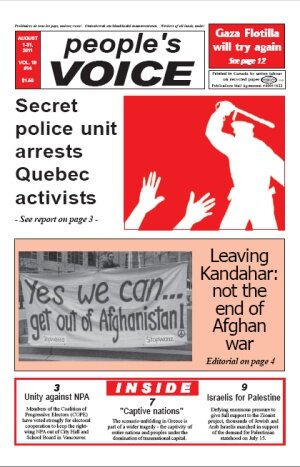
August 1-31 , 2011
Volume 19 - Number 14
$1
Prolétaires de tous les pays, unissez-vous!
Otatoskewak ota kitaskinahk mamawestotan!
Workers of all lands, unite
1) )SECRET POLICE UNIT ARRESTS QUEBEC ACTIVISTS
2) FORD BLITZKRIEG GALVANIZES OPPOSITION
3) NEW JETS LOGO: MILITARIZATION OF HOCKEY CONTINUES
4) ONTARIO COMMUNISTS GEAR UP FOR OCTOBER ELECTION
5) AFGHANISTAN DISASTER NOT OVER - Editorial
6) FASCIST TERROR STRIKES AGAIN - Editorial
7) COPE MEMBERS BACK ANTI-NPA ELECTORAL COOPERATION
8) CHOMSKY'S WORDS WILL NOT STOP THE REVOLUTION
9) CANADIAN TORTURED, BUT HARPER SILENT
10) CAPTIVE NATIONS
11) THREE IMPORTANT MARXIST AUTHORS LAUNCH IN B.C.
12) MUSIC NOTES
13) ISRAEL AND GREECE BLOCK FREEDOM FLOTILLA
14) NEW ISSUE OF THE SPARK!
15) WHAT’S LEFT
16) CLARTÉ (en français)
17) THE SPARK! (Theoretical and Discussion Bulletin of the Communist Party of Canada)
18) INTRODUCING MARX
PEOPLE'S VOICE AUGUST 1-31, 2011 (pdf)
|
|
|
|
The Spark!The Spark! The latest issue of The Spark! theoretical journal, is now on sale for $5 at Communist Party offices (see p. 8) or People’s Co-op Books, 1391 Commercial Drive, Vancouver. Articles include
plus reviews, editorials, and more.
|
|
|
Theoretical and Discussion Bulletin of the Communist Party of Canada |
|
|
People's Voice deadlines: SEPTEMBER 1-15 SEPTEMBER 16-30 Send submissions to PV Editorial Office,
|
|
REDS ON THE WEB |
|
People's Voice finds many "Global Class Struggle" reports at the "Labour Start" website, http://www.labourstart.org/. We urge our readers to check it out! |
* * * * *
People's Voice
Canadian Publications Mail Sales Product Agreement #205214
ISSN number 1198-8657
People's Voice is published by
New Labour Press Ltd
PV Editorial Office
706 Clark Drive,
VANCOUVER, B.C. V5L 3J1
Phone:604-255-2041
Fax:604-254-9803
email: pvoice@telus.net
Editor: Kimball Cariou : Business Manager: Sam Hammond
Editorial Board: Kimball Cariou, Miguel Figueroa,
Doug Meggison, Naomi Rankin, Liz Rowley, Jim Sacouman
* * * * * *
Letters
People's Voice welcomes your letters
on any subject covered in our pages.
We reserve the right to edit for length and clarity,
and to refuse to print letters which may be libellous
or which contain unnecessary personal attacks.
Send your views to:
"Letters to the Editor",
706 Clark Dr., Vancouver, BC V5L 3J1,
or pvoice@telus.net
People's Voice articles may be reprinted without permission,
provided the source is credited.
* * * * * *
The Communist Party of Canada, formed in 1921,
has a proud history of fighting for jobs, equality, peace,
Canadian independence, and socialism.
The CPC does much more than run candidates in elections.
We think the fight against big business and its parties
is a year-round job,
so our members are active across the country,
to build our party and to help strengthen people's movements
on a wide range of issues.
All our policies and leadership
are set democratically by our members.
To find out more about Canada's party of Socialism,
give us a call at the nearest CPC office.
* * * * * *
Central Committee CPC
290A Danforth Ave Toronto, Ont. M4K 1N6
Ph: (416) 469-2446
fax: (416) 469-4063 E-mailmailto:info@cpc-pcp.ca
Parti Communiste du Quebec (section du
Parti communiste du Canada)
5359 Ave du Parc, Montréal, Québec,
H2V 4G9
B.C.Committee CPC
706 Clark Drive, Vancouver, V5L 3J1
Tel: (604) 254-9836
Fax: (604) 254-9803
Edmonton CPC
Box 68112, 70 Bonnie Doon P.O.
Edmonton, AB, T6C 4N6
Tel: (780) 465-7893
Fax: (780)463-0209
Calgary CPC
Unit #1 - 19 Radcliffe Close SE
Calgary AB, T2A 6B2
Tel: (403) 248-6489
Ottawa CPC
Tel: (613) 232-7108
Manitoba Committee
387 Selkirk Ave., Winnipeg, R2W 2M3
Tel/fax: (204) 586-7824
Ontario Ctee. CPC
290A Danforth Ave., Toronto, M4K 1N6
Tel: (416) 469-2446
Hamilton Ctee. CPC
265 Melvin Ave., Apt. 815
Hamilton, ON.
Tel: (905) 548-9586
Atlantic Region CPC
Box 70 Grand Pré, NS, B0P 1M0
Tel/fax: (902) 542-7981
http://www.communist-party.ca/
* * * * * *
News for People, Not for Profits!
Every issue of People's Voice
gives you the latest
on the fightback from coast to coast.
Whether it's the struggle for jobs or peace, resistance to social cuts,
solidarity with Cuba, or workers' struggles around the world,
we've got the news the corporate media won't print.
And we do more than that
- we report and analyze events
from a revolutionary perspective,
helping to build the movements for justice and equality,
and eventually for a socialist Canada.
Read the paper that fights for working people
- on every page, in every issue!
People's Voice
$30 for 1 year
$50 for 2 years
Low-income special rate: $15 for 1-year
Outside Canada $50 for 1 year
Send to: People's Voice, 706 Clark Drive, Vancouver, BC, V5L 3J1
You can call the editorial office at 604-255-2041
REDS ON THE WEB
http://www.communist-party.ca/
http://www.ycl-ljc.ca/
http://www.solidnet.org/
(The following articles are from the August 1-31, 2011, issue of People's Voice, Canada's leading communist newspaper. Articles can be reprinted free if the source is credited. Subscription rates in Canada: $30/year, or $15 low income rate; for U.S. readers - $45 US per year; other overseas readers - $45 US or $50 CDN per year. Send to People's Voice, c/o PV Business Manager, 706 Clark Drive, Vancouver, BC, V5L 3J1.)
1) SECRET POLICE UNIT ARRESTS QUEBEC ACTIVISTS
PV Montreal Bureau
At the end of June, a new squad of the Montreal police swept down and arrested four well‑known activists. By mid‑July, four more activists, this time student leaders, had also been taken into custody. The new squad - Guet des activités des movements marginaux et anarchistes, or GAMMA (which translates as Surveillance Marginal Movements and Anarchists) - has the labour movement, civil liberties organizations, student groups, as well as many other progressive and left‑wing organizations strongly condemning both GAMMA and the arrests, and sounding the alarm.
The new squad has also been denounced by the Communist Party of Quebec (PCQ), which calls for its immediate dismantling.
"As the name indicates, this squad targets specific groups of people who question the established social and political order and challenge the resulting social injustices," a statement released by the party said, noting that the squad is blatant political police unit and a serious attack on democratic rights of citizens.
The establishment of the GAMMA squad two years ago coincided with the adoption of austerity measures by the provincial Charest government and the federal Harper Conservatives.
The government knew that its actions would be unpopular and appears to have limited organized protest, the PCQ notes. But the existence of the squad was brought to light only on June 29, during a sting operation involving thirty police officers, who arrested four left‑wing activists and searched their homes. The four were charged with a series of criminal offenses in connection with a skirmish with cops during a May First demonstration organized bay La convergence des luttes anticapitalistes (CLAC, or the Anti‑capitalist convergence).
A few days later, Gamma arrested another four activists who are militants of a leading student organization in Québec, L'Association pour une solidarité syndicale etudiante (ASSE). Three are members of the ASSE's executive committee.
The arrests occurred several months after a series of actions in March, including the occupation by students of Québec Finance Minister Raymond Bachand's office, and the Conference of Rectors and Principals of the Universities Quebec (CREPUQ), to protest rising tuition fees. In a few weeks, a major mobilization of the Quebec student movement is expected.
Complaints were lodged with the Commission on Human Rights and the Rights of Youth by individuals and by the ASSE.
"In all likelihood, the mandate of the squad directly contravenes the Charter of Rights and Freedoms, which specifies that no person shall suffer discrimination, exclusion or preference based on his political beliefs," the PCQ said, expressing full support for the students' complaints.
Repression of political dissent on the left is hardly new in Canada.
"The Communist Party of Canada has been a `victim of choice' by the ruling class since the beginning of its existence," the PCQ said. "For example, the dreadful Act to protect the province against communist propaganda, known as the Padlock Law, adopted in Quebec in 1937, was declared unconstitutional by the Supreme Court in 1957 because it encroached on the criminal law of a federal jurisdiction. This law allowed up to a year to imprison any person who printed, published or broadcast `any writing propagating or tending to propagate communism or Bolshevism.'"
The law largely served to attack not only Communists but terrorize union activists and progressives.
The PCQ also pointed to the PROFUNC (Prominent Functionaries of the Communist Party) program, administered by the RCMP from 1950 until 1983. It amounted to a massive anti‑democratic plan for internment of all those identified as Communists or sympathizers.
"In total, more than 65,000 people were registered on a list of possible arrests. The list was continually updated, and was used for hundreds of arbitrary arrests in Québec during the so‑called October Crisis of 1970, again in order to attack and intimidate progressive and nationalist movements of Québec."
The PCQ statement also noted the mass arrests of over 1100 occurred during the G8 and G20 in Toronto last summer. These arrests "have eloquently illustrated the willingness of the state apparatus in Canada to curb dissent today. Likewise, the so‑called `war on terror' is used by CSIS to justify a comprehensive surveillance and infiltration of popular solidarity and opposition movements.
"The election of a Conservative majority government May 2, 2011 aggravates threats against democratic rights in Canada. The Harper government is making continued efforts to crush all resistance by the labour movement, as we have seen recently with the special laws against the workers of Canada Post and Air Canada, to make the working class bear the brunt of the capitalist crisis.
"We call on the labour, popular and democratic movements (the main targets of attempts to criminalize dissent in Canada) to demand an end to the political repression of progressive groups."
The PCQ is demanding repeal of the anti‑terrorist laws, the cessation of secret detention without trial, security certificates and the "no‑fly list"; the cancellation of the "Declaration of Border Security," which involves sharing information with the U.S. Department of Homeland Security, and allows U.S. troops to enter Canada in the event of "emergencies"; the prohibition of "racial profiling" by the state; democratic, civilian control over police, prisons, CSIS and the armed forces; abolition of the GAMMA squad, and of all police suppression of political dissent, and the RCMP itself.
2) FORD BLITZKRIEG GALVANIZES OPPOSITION
By Liz Rowley, leader of the Communist Party (Ontario)
The chronic underfunding of cities makes Toronto's annual budget process a matter of wide public debate. Mayor Rob Ford's first budget has turned into a massive attack on city services and the workers who deliver them.
In last fall's civic election, Ford promised tax relief without service cuts to overburdened homeowners and tenants. But he has only cut the hated $60 annual vehicle tax, while launching a full scale attack on services, civic unions, and elected and appointed public boards and committees.
The Mayor, his brother Deputy Mayor Doug Ford, and the right‑wing majority they lead on Council, brought in KPMG to "review core services" and identify $800 million in cuts (or gravy, as the Mayor likes to call it) to balance the budget. If implemented, the cuts laid out by KPMG would devastate the city, eliminating or privatizing most of the services that are publicly delivered today.
In addition to the privatization of garbage, parks, and social housing which has already started (and which will eliminate thousands of public sector jobs and union wages), the KPMG proposals include library closures, an end to fluoridation of drinking water, elimination of 2,000 subsidized child care spots, privatization of seniors' homes, elimination of immigrant services, a 25 cent increase in transit fares, elimination of grants and subsidies to arts and community groups, cuts to policing and firefighting, and even a proposal that public parks could be tended by volunteers.
The review is not over. More is still to come.
In the hottest summer since 1948, most Torontonians and their labour and mass organizations were taking a break until news of the KPMG proposals broke in mid‑July. The one‑week "public consultations," intended to prevent opposition, helped to galvanize the Labour Council, civic unions, a civic action group called One Toronto, the Workers' Assembly, progressive Councillors and Trustees, and community groups and activists who are mobilizing to stop Ford's blitzkrieg.
Pulling these forces together into a united opposition would strengthen the fight overall, and could put Ford and his supporters on the defensive.
The CPC (Ontario) is demanding the provincial and federal government come up with the $800 million shortfall for Toronto, and that Ontario upload 100% of the costs of health, welfare, housing, and other downloaded services downloaded by the Harris Tories in the '90s. The Communists call to remove education from the property tax, immediately transfer 50% of road user taxes to Ontario cities, and legislate a new financial deal that would provide adequate and stable funding for municipalities.
With a provincial election on October 6, the stakes are getting higher and higher - not least the fight for democracy, and for public ownership and control.
3) NEW JETS LOGO: MILITARIZATION OF HOCKEY CONTINUES
By Johan Boyden, General Secretary of the Young Communist League of Canada
The Winnipeg Jets have crash landed. The hockey team, supposed to bring good hockey back to a city with some of Canada's poorest neighbourhoods, has revealed its new design ‑ which features a killing machine.
The Jets new logos were released July 22. The main design is a blue circle with the metallic grey silhouette of a McDonnell Douglas CF‑18 Hornet fighter jet above a red maple leaf, mirroring the Canadian air force's roundel. The Hornet is the same jet the Canadian military has deployed to bomb Iraq, Yugoslavia and now the million‑dollar‑a‑week "humanitarian" destruction of Libya.
The design was put together by True North Sports and Entertainment (the union‑busting company who own the Jets), the NHL and the transnational corporation Reebok. A secondary logo features a fighter pilot's set of wings.
"We felt it was important to authenticate the name Jets and we believe the new logo does that through its connection to our country's remarkable Air Force heritage, including the rich history and relationship that our city and province have enjoyed with the Canadian Forces," Jets owner Mark Chipman told reporters.
That history and relationship starts with the bloody military suppression of the Metis and Red River people's uprising, which lead to the hanging of leader Louis Riel and the founding of Manitoba. One of the latest chapters was written by Operation Charging Bison, when over 500 Canadian troops (backed by helicopters, armoured vehicles, and artillery) took over downtown Winnipeg for urban‑war games.
Winnipeg's poverty is highly concentrated in the inner‑city (over half of all inner‑city households are affected by poverty, and many are Aboriginal families). That is also exactly where the MTS centre, future home of the team, is located.
Despite urgent demands for affordable social housing in the downtown core, the provincial NDP has instead agreed to refurbish the MTS Centre for the Jets. The MTS Centre and True North contracted out the work of the 220‑member International Alliance of Theatrical Stage Employees (IATSE) Local 63, which staffed events at the old Winnipeg Arena.
The design comes after major controversy surrounding the Harper Conservative government's purchase of replacements for the CF‑18 from US munitions giant Lockheed Martin. The total cost of the new F‑35 fighters quadrupled in just two years.
Pentagon figures now indicate that the total cost of this purchase over a 30-year period is expected to hit $29 billion, a staggering sum for a country with serious social and economic problems.
The new Joint Strike Fighter, which carries more bombs and weapons, is not designed for defence, but rather offensive bombing runs. As a single-engine aircraft, it is reportedly unsuitable to patrol the Canadian Arctic. The F‑35 is just another example of the Harper Conservative Government's massive increase military spending and the adoption of a much more bellicose, overtly imperialist foreign policy.
According to the Canadian Centre for Policy Alternatives, "the Canada First Defence Strategy, unveiled by the Harper government in 2008, promises that Canada's military spending will continue to grow by an average of 0.6% in real terms (adjusted for inflation) and an average of 2.7% in nominal terms (not adjusted for inflation) per year from FY 2007-08 to 2027-28". Total spending over the 20-year life of this plan would likely be in the $415-440 billion range (2009 dollars), or about $13,000 per Canadian.
There has also been a renewed attempt towards the militarization of Canadian society. Recruiting booths, promoting the military's activity like the imperialist war in Afghanistan or the military "aid" to Haiti, are now common across Canada from Nanaimo's Bathtub races on Vancouver Island to sports events in Halifax.
The Manitoba Moose, Winnipeg's previous AFL Hockey team before it re‑acquired the Jets, held special "Manitoba Moose Military Appreciation Nights."
One of the most outspoken proponents of this pro‑war jingoism has been controversial hockey commentator Don Cherry, already known for his sexist, homophobic, racist and anti‑Quebec statements. Cherry, who makes a special point of commemorating the occupation of Afghanistan in his commentaries and has started referring to hockey players as troops, went as far as visiting Afghanistan and signing bombs last December.
In response, a group called Hockey Fans for Peace formed, staging actions outside hockey games and engendering widespread interest and support. Hockey Fans for Peace points to polls showing that the vast majority of Canadians oppose the war in Afghanistan. Already, a significant number of the population are against the bombing of Libya (a majority in Québec).
Hockey Fans for Peace also encourages other sports to refrain from promoting support for the war in Afghanistan. The group calls for the NHL and the mass media to end the practice of using hockey games and broadcasts to promote the view that full support for the war is the only acceptable position for any genuine hockey fan ‑ or to give anti‑war fans equal air‑time.
Their message is a timely one. Millions of Canadians enjoy hockey ‑ and also oppose militarism and war.
4) ONTARIO COMMUNISTS GEAR UP FOR OCTOBER ELECTION
PV Ontario Bureau
The Communist Party of Canada (Ontario) is kicking off a campaign to help block Tim Hudak's Tories from winning the October 6 provincial election. The Tories are "by far the greatest threat to democracy, to labour and to working people in this province," warns CPC(O) leader Liz Rowley, who notes that working people are also "extremely angry at the McGuinty Liberals, and rightfully so."
Meanwhile, the Ontario NDP remains "an unpredictable and weak partner for labour at a time when strength, dependability and durability are key assets," says Rowley, adding that "how the NDP defines the main target in the election will determine a lot."
"The Communist Party will advise working people that the best outcome in this election would be a minority government reliant on a strong progressive bloc in the Legislature and subject to mass public pressure from a people's coalition of forces outside the Legislature," Rowley says. "Electing Communists would fundamentally change politics for the better and qualitatively strengthen the fight for democratic and progressive change in this province,"
The CPC (Ontario) is the only party fighting to repeal the Harmonized Sales Tax and replace it by doubling the corporate income tax rate, cancelling corporate tax cuts, restoring the capital tax, collecting deferred corporate taxes, and introducing wealth and inheritance taxes on estates over $750,000.
"We need a progressive tax system based on ability to pay," says Guelph candidate Drew Garvie, campaigning to make post-secondary education accessible to students by eliminating tuition fees.
The Communist Party is fighting for full employment policies to put Ontario back to work, with plant closure legislation and a plan to protect and expand secondary industry and manufacturing.
The Party calls to nationalize US Steel operations in Ontario, to develop a publicly owned basic steel industry, and to take over the Canadian operations of GM, Chrysler and Ford. It advocates nationalization and regulation of Ontario's natural and energy resources, and investment in solar, wind and thermal energy, while closing down nuclear and coal-fired operations.
The Communist platform urges action to restore worker pensions, and to build a Canadian car that is small, affordable, fuel-efficient and environmentally sustainable.
On social issues, the CPC (Ontario) is campaigning for social housing, real rent controls, public child care at a cost of $7 per child, per day, a guaranteed annual income above the poverty line, and substantially increased funding for health, education, and social programs. The Party urges immediate action to raise living standards and quality of life of Aboriginal Peoples living on and off reserve, and a just and early settlement of land claims.
"Aboriginal People's have the same rights to clean water, good housing, quality public and post‑secondary education, and quality of life as everyone else. The province must act to deliver it now," says Hamilton candidate Rick Gunderman.
The Communists sharply oppose the proposed two‑strikes law that will greatly increase the rate of incarceration in provincial super‑jails, the proposed lifetime ban on those convicted of welfare fraud; the one year ban on welfare eligibility for those moving into the province, and special new police powers to end Aboriginal land reclamations and to aggressively intervene on reserve.
The Party supports a new financial deal to municipalities, uploading costs of health, housing, transportation, welfare, delivering needs‑based statutory grants, and transferring 50% of road user taxes to cities. The Party would also remove education from the property tax.
The CPC (Ontario) is fighting for a $19 minimum wage, universal pay and employment equity, and labour legislation to protect workers and workers' rights including anti‑scab laws. Other platform points include improved health and safety laws, a shorter work week with no loss in take‑home pay, early voluntary retirement at 60 with substantially increased pensions, a ban on two‑tier wages and benefits, and a Labour Bill of Rights guaranteeing the right to free collective bargaining, the right to strike, picket and organize.
Saleh Waziruddin, candidate in the Peninsula, says "Low wages and part‑time casual work are killing the future for youth. Young, and not‑so‑young workers need good jobs with good wages. That's the road to real economic recovery in Ontario."
The full program, and the list of candidates will appear on the CPC (Ontario) website.
5) AFGHANISTAN DISASTER NOT OVER
People's Voice Editorial
Almost ten years after it began, Canada's disastrous entry into Afghanistan is far from over. While the official combat mission in Kandahar is winding up, Canada remains a prominent player in the NATO occupation of the country, with no end in sight. And despite all the media hype about the accomplishments of "our brave troops", Afghanistan remains under the thumb of violent warlords and their imperialist paymasters. Most ordinary Afghan citizens are no closer to freedom or equality than they were a decade ago at the end of the Taliban era. The civil war which has wracked the country for much longer shows no sign of conclusion, as the recent killing of the governor of Kandahar province indicates.
For Canada, the human and financial costs of the Afghan disaster will keep piling up. We have lost count of the number of times when Canadian and other NATO generals have claimed that the "Taliban are on the back foot." The quickening pace of attacks against the Karzai regime's troops and police means that Canadian troops engaged in "training" these forces will continue to fight and to face grave dangers. Canadian casualties will mount beyond the 156 dead to date, and Afghans will keep being killed in huge numbers.
Billions of dollars have also been wasted on this war, with little result. As reliable military analysts frequently note, many of the Karzai troops "trained" by NATO forces often simply switch sides with their weapons. In effect, Canadian taxpayers are financing the insurgent Taliban forces.
For years, the majority of Canadians have expressed opposition to continuing this country's participation in the Afghanistan war. The "end of the combat mission" is no reason to change this view. On the contrary, it's time to tell Parliament to bring home the 1,000 troops still propping up the Karzai regime.
6) FASCIST TERROR STRIKES AGAIN
People's Voice Editorial
The horrifying news from Norway makes it clear again that the ideology of fascism remains a significant danger in every "developed" capitalist country. Any idea that the Anders Breiviks of the world are a "handful of disturbed individuals" is naive, to say the least. Far from being isolated, 21st century fascists thrive in the hothouse atmosphere of anti-communism, white supremacy, xenophobia, militarism, and fundamentalist bigotry. Extremist ideas are nurtured in the environment of a ruling class drive to destroy every hard-won gain achieved by working people. In this situation, individual fascists often lash out in a murderous fashion. Whether or not such actions can be directly tied to particular statements by a media outlet or politician, the overall tenor of bourgeois rhetoric fans the flames of violence.
On July 22, most mass media outlets initially pointed at "Muslims," even though the Oslo bombing was eerily reminiscent of the Oklahoma City attack by white racists. As the facts emerged, the media played dumb, talking about Norway's resistance against the Nazis, even though thousands of Norwegian fascists volunteered for Hitler's Wehrmacht and the far right remains active today.
A similar situation could easily erupt in Canada, where neo-Nazis openly parade through city streets, attacking innocent people and inciting bloodshed. In Calgary, for example, anti-racist activists are repeatedly threatened and assaulted, while police refuse to "take sides." The fact is that fascism is a ruling class ideology, aimed at dividing working people. Our response to the attack in Norway must be to unite against the fascist threat in our own country, including the ultra-right forces high inside the Conservative Party as well as the Nazi thugs in our streets.
7) COPE MEMBERS BACK ANTI-NPA ELECTORAL COOPERATION
PV Vancouver Bureau
Some three hundred members of Vancouver's Coalition of Progressive Electors turned out for a special meeting on June 26, voting to maintain COPE's long-standing strategy of working to isolate the right-wing Non-Partisan Alliance (NPA) in this fall's civic election. By a two-thirds majority, COPE members backed an agreement on electoral cooperation with the centrist Vision Vancouver party.
The agreement gives COPE three nominations for city council, up from two in the 2008 campaign, potentially opening the door to a stronger role on that body, where Vision will nominate seven plus Mayor Gregor Robertson.
At School Board, which currently has four Vision and three COPE trustees, the parties will nominate five and four respectively. Vision will nominate five Park Board candidates, with two for COPE.
The lively June 26 debate showed that while COPE remains strongly committed to defeating the most reactionary force in Vancouver politics, the next three years would be interesting for a re-elected Vision/COPE majority. While the two parties both have close ties to the labour movement and a shared commitment to creating a "greener Vancouver" and tackling homelessness, differences over some important issues are likely to remain.
Presenting the COPE executive's unanimous recommendation to support the agreement, David Chudnovsky made it clear that elected officials will continue to vote in line with COPE policy on matters where the two parties differ. These include taxation, where COPE remains opposed to the ongoing shift away from business towards homeowners, and a range of development proposals, which have been supported by Vision but frequently challenged by COPE's two councillors.
The situation is more positive on School Board, where the Vision and COPE trustees have worked closely for the past term to protect classrooms from Liberal underfunding of education. The two parties share School Board committee positions on an equal basis, and their vocal opposition to Liberal policies has made Vancouver a leader in the struggle to protect public schools across the province.
The COPE executive made its recommendation on the basis of a strategy to keep the labour and people's movements united during the campaign, in the face of a major challenge by the NPA. In recent months, it has been increasingly obvious that the NPA hopes to generate a "Rob Ford"-style right-wing backlash against the Vision-COPE alliance. An NPA victory would return Vancouver to the days when public opinion meant little at City Hall. Perhaps most alarming, NPA majorities on council and school board would mean a drastic turn for the worse in labour relations.
This scenario spurred a good turnout of labour activists on June 26, days after the Vancouver and District Labour Council voted unanimously to support the Vision-COPE agreement. The labour movement was the driving force behind the formation of COPE in 1968, and union members have played a key role in the organization for over 40 years. As many pointed out, it would be self-defeating for labour to back COPE and Vision if the two parties campaigned against each other, allowing the NPA to ride to victory on Nov. 19.
Some long-time COPE members voted against the agreement, mainly because of differences with Vision on development issues. But the June 26 meeting also saw members of other organizations buy COPE memberships in hopes of defeating the proposal. These included some civic Greens and other anti-labour activists who argue that there is "no difference" between the NPA and Vision, or even that the NPA is preferable. There were also members of the "Fire This Time" cult which has long engaged in splitting activities in the anti-war movement and other areas. These forces were openly encouraged by right-wing bloggers linked to the NPA, desperately hoping to split COPE and to block the electoral agreement.
The next major step in the campaign will be the COPE nomination meeting set for Sept. 18. Although incumbent city councillors Ellen Woodsworth and David Cadman are expected to win, a tough fight is likely around the third nomination. Community activist R.J. Aquino appears to have strong support of COPE's members and elected officials, but former councillor Tim Louis is also in the running. Louis has been a highly divisive figure since his blunders cost COPE dearly during the 2005 civic campaign, and he is closely linked to Fire This Time. At the June 26 meeting, Louis explicitly stated that he would not vote for Vision candidates, a direct indication that he refuses to carry out the electoral strategy backed by a large majority of COPE members. A nomination for Louis would leave COPE with council candidates operating on diametrically-opposed tracks during the campaign, likely a recipe for disaster at the polls.
8) CHOMSKY'S WORDS WILL NOT STOP THE REVOLUTION
Commentary by Rick Gunderman, Hamilton, ON
"Speaking to the Observer last week, (MIT professor and noted political analyst Noam) Chomsky has accused the socialist leader (Hugo Chavez) of amassing too much power and of making an `assault' on Venezuela's democracy." - The Guardian, UK
Accompanied by a photo of President Chavez riding a horse and pointing skyward, flanked by three llanero‑looking individuals, the UK's Guardian ran an article entitled "Noam Chomsky denounces old friend Hugo Chavez for `assault' on democracy".
Aside from being a typical example of editorializing through photographs, the article proceeds to go in depth on how Noam Chomsky's friendship with Hugo Chavez ("Hugo Chavez has long considered Noam Chomsky one of his best friends in the west") has been compromised by the imprisonment of Venezuelan judge Maria Lourdes Afiuni, head of the 31st Control Court of Caracas.
The Guardian's explanation of why Afiuni was jailed: "Afiuni earned Chavez's ire in December 2009 by freeing Eligio Cedeno, a prominent banker facing corruption charges. Cedeno promptly fled the country."
Not a word more of detail, but conspicuously followed by: "In a televised broadcast the president, who had taken a close interest in the case, called the judge a criminal and demanded she be jailed for 30 years. `That judge has to pay for what she has done.'"
The casual reader could be forgiven for concluding that Afiuni's detention was totally arbitrary and without cause.
Imagine if, in the Conrad Black case, or the Scooter Libby trial, a judge had not only allowed the accused to slip out of the back of the courthouse and escape, but had personally summoned the accused for a hearing without notifying the prosecutor, all in order to allow the escape. The judge would be arrested for assisting a fugitive, at the very least.
This is analogous to what happened in Venezuela. Eligio Cedeno was a Venezuelan banker arrested in 2007 for allegedly circumventing government currency rules to gain $27 million USD. Cedeno is now living it up in Miami (no explanation necessary).
According to Edward Ellis of Correo del Orinoco International (which, unlike the Carr Institute, actually operates in Venezuela): "While it is true that Cedeno had indeed been held beyond the stipulated time for pre‑trial detentions, it is also true that Afiuni's rogue actions were made in violation of all judicial protocols and legal procedures. In fact, hundreds of trials in Venezuela fall victim to bureaucratic slowdowns and judicial delays that prevent the timely delivery of justice in the country."
And in fact, the judicial system managed to secure Afiuni's arrest without any intervention from Chavez, although the Guardian would have it framed otherwise. Chavez went on television condemning corruption in the justice system, used Afiuni's case as an example, and described how she would be punished, i.e. how the legal system works, which a president certainly ought to know. To the Guardian, this is proof of Chavez's tyrannical ways.
Nor would Chomsky have us believe Venezuela's judicial system is impartial: "I'm sceptical that [Afiuni] could receive a fair trial. It's striking that, as far as I understand, other judges have not come out in support of her - that suggests an atmosphere of intimidation."
To Noam Chomsky, the lack of judges willing to speak out in favour of a corrupt public official who helped a known criminal escape justice must be a sign of Chavez's totalitarian agenda. Implicitly, we should have expected this. All socialist countries destroy democracy and succumb to Stalinism sooner or later.
Continuing through the list of international human rights groups joining in the chorus of anti‑Chavez voices that makes up the rest of the Guardian article, one arrives at the much‑lauded Chomsky letter.
Helpfully enough, he refers to the Carr Centre for Human Rights Policy at Harvard University as the source of his alarm over Afiuni's detention. The Canadian reader would be interested to know that the Carr Centre was headed from 2000‑2005 by our own Michael Ignatieff, former Liberal Party leader and open admirer of American imperialism.
Following this vain attempt to establish institutional credibility, Chomsky sheds crocodile tears for Afiuni's situation. She has been in prison for a little over a year, and on top of having cancer is a single mother. Nobody doubts that this is a bad situation. With poor health and young children to care for, one wonders why Afiuni would put herself in the business of assisting fugitives.
Chomsky and the Guardian fail to mention that the Attorney General managed to intervene to have Afiuni transferred first to isolation from the general population to ensure her safety (she was sharing a cell block with inmates she had sentenced), then to house arrest so she could receive cancer treatment. Some "cruelty".
Nor is it evidently worth noting that neither Afiuni nor Cedeno were known to be supporters of the opposition, which compromises the claim that this is a case of political persecution. Noam Chomsky has great influence on the petit‑bourgeois left. His books are widely available at Chapters and Indigo, and every university has a political science professor who salivates at the mention of Chomsky's name. The liberal progressive mentality can be summed up as "it's a war of information - we win the revolution through education!"
This is a noble maxim for a socialist bookstore or education centre. It can be useful as a very specific slogan for a very specific group or campaign. But it is useless as a slogan that is central, defining or paramount.
This mentality confines our roles and duties as activists to debates, demonstrations and maybe the occasional leaflet. Without real mobilization of large numbers of people, under the leadership and initiative of the most dedicated activists, nothing gets done. The policies of government and business become more vicious, more reactionary, and more damaging to workers, youth, students, women, visible minorities, recent immigrants, children, First Nations peoples, etc. That is the practical effect of the Noam Chomsky mentality, which romanticizes "political prisoners", such as disgraced judge Maria Lourdes Afiuni.
The 5.7 million members of the United Socialist Party of Venezuela, and their thousands of comrades in the Communist Party of Venezuela, will not put the brakes on the progress of their revolution just because an MIT professor, high in his ivory tower, shouts at them.
But here at home, where we're in the embryo stages of getting things going, the liberals in our ranks keep stopping to ask directions from the enemy.
9) CANADIAN TORTURED, BUT HARPER SILENT
By Finian Cunningham, www.globalresearch.ca, July 17, 2011
A young Canadian man suffering from a serious heart condition has been abducted and tortured by the Bahraini regime - yet the government of Prime Minister Stephen Harper has maintained a steadfast silence over his plight.
This lack of action by the Harper government is in spite of the fact that the Canadian Consuls in Bahrain and Saudi Arabia are fully aware of the case. The official silence may be due to a bilateral trade deal Canada is in the process of completing with the Bahraini regime, and also Ottawa's increasing subordinance to Washington's foreign policy and therefore unwillingness to upset an important US ally in the Persian Gulf.
Naser Al Raas (28), who resides in Ottawa, was caught up in the popular uprising in the oil‑rich Gulf kingdom that erupted in mid‑February while on a family holiday. He arrived in Bahrain on 6 March to visit his five sisters who live there.
But when the former Microsoft IT specialist went to exit the country on 20 March, he was stopped while boarding his flight by ministry of interior officers. Although Al Raas was travelling on a Canadian passport, he was hauled into a room at Bahrain's international airport and detained for several hours during which time he was hooded, interrogated and physically assaulted. That was just the beginning of his nightmare.
He was then taken by his captors to the infamous Al Qala - the ministry of interior headquarters in the capital, Manama, and incarcerated for four weeks without any criminal charges being made. During his illegal detention, Al Raas was severely tortured.
The Canadian suffers from a rare lung and heart condition - pulmonary embolism. He has previously undergone two open‑heart operations at the Ottawa Heart Institute and he requires constant medication. Around the time of arrest, his supply of medication, which he had brought from Canada, ran out. He has been without treatment for nearly four months now.
The sprawling grey Al Qala fortress in Manama is surrounded by an imposing 20‑metre‑high wall and is equipped with underground holding cells. It is notorious among Bahrainis as the regime's "torture chamber". This is where up to 1,000 civilians have been detained following the US‑backed crackdown against the pro‑democracy uprising that is challenging the unelected Al Khalifa monarchy, headed by King Hamad. Four people have been tortured to death while in custody in recent months, according to the Bahrain Centre for Human Rights.
The fierce repression against peaceful demonstrators escalated on 14 March when troops from Saudi Arabia and the United Arab Emirates invaded Bahrain to shore up the Al Khalifa regime. Two days before the Saudi‑led military intervention, US Defence Secretary Robert Gates held a private meeting with King Hamad in Manama.
Despite condemnations by numerous human rights groups of the Saudi‑led invasion and subsequent violations, Washington has remained a staunch supporter of the Al Khalifa regime, with President Barack Obama and Secretary of State Hillary Clinton describing it as a "key ally". The US Navy Fifth Fleet is based in Bahrain.
For one month, the family of Naser Al Raas did not know of his whereabouts or even if he was alive. They knew that his last movements were in the airport because he talked to a friend by phone just before his scheduled departure. However, for the next four weeks, the Bahraini government denied all knowledge of the Canadian man.
After one month of being held incommunicado, the Bahraini regime released Al Raas but withheld his passport. He is now stranded in Bahrain - without medication - pending a prosecution trial. On three dates in June, he was brought before a Military Court. It was during the opening hearing on 7 June that he first learnt of the charges against him.
Al Raas stands accused, along with 12 other men, of kidnapping a police officer and promoting crimes against the rulers. He recalls that during his interrogation period he was forced to sign a piece of paper. This has turned out to be a confession to the crimes he is being accused of - accusations that Al Raas denies.
The Bahraini rulers have shown boundless imagination in fabricating prosecution cases. For example, last month it sentenced an internationally respected human rights advocate, Abdulhadi Al Khawaja, to life in prison for "trying to overthrow the state while working for a foreign enemy". The regime is also currently prosecuting senior surgeons and doctors that it accuses of "concealing machine guns under hospital beds" and "exaggerating the wounds of patients for propaganda purposes, resulting in the death of patients".
All trials in Bahrain since the Saudi‑led invasion have been conducted in Military Courts, with minimal legal counsel permitted to the defendants. In over 400 trials, confessions forced through torture are the sole basis for the prosecution case. In eerie show trial fashion, sometimes videos of defendants making confessions are even televised on Bahrain state TV before the verdicts are reached.
Such flagrant violation of international legal standards have been roundly condemned by rights groups, such as Amnesty and Human Rights Watch. But while Washington has rushed to condemn Libya and Syria over alleged human rights abuses, it has remained tight-lipped about its Bahraini ally. Indeed, Washington has used its words to talk up the Al Khalifa regime's initiative for a "national dialogue" - which the pro‑democracy movement in Bahrain has dismissed as a sham, pointing out that the regime continues to attack peaceful rallies, the latest atrocity in Sitra on 15 July where police opened fire on civilians resulting in one woman Zainab Hasan Al Jumaa being killed.
For Al Raas, the next court appearance is set for September. If found guilty, the Canadian is facing up to 20 years in prison. Given his acute heart condition and weakened state from torture, Al Raas' family fear that his conviction could result in a de facto death sentence.
The fact that a civilian - a foreign civilian at that - can end up being illegally detained, tortured and dragged before a Military Court by a regime that has incurred worldwide condemnation is a sobering episode. But what makes the plight of Naser Al Raas shocking is the seeming indifference of his Canadian government.
This silence from the Harper government is not out of ignorance of the case. The plight of Al Raas has been reported in the Canadian press on two occasions in March and June.
Canada's consul in Saudi Arabia Michael Erdman travelled to Bahrain to attend two of his trial dates in June. And the man's family has made repeated phone calls to the Canadian department of foreign affairs in Ottawa. Yet to date the Harper government has failed to make any public statement on the matter.
The question of commercial interests may be a telling factor. Canada is in the process of finalising a bilateral trade agreement with the Bahraini regime. According to the Canadian Foreign Affairs and International Trade website, Bahrain "offers significant investment opportunities for Canadian investors in a variety of sectors, including education, infrastructure and healthcare."
Currently, the two countries are signing off a Foreign Investment and Protection Agreement (FIPA) after three years of negotiations.
Another factor is Ottawa's increasingly militarist foreign policy and supine deference to Washington. NATO's criminal warmongering in Libya has relied on crucial support from the monarchical dictatorships of the Persian Gulf, including Bahrain.
In the grand scheme of Canada's commercial trade interests and imperialist intrigues in the Gulf, the fate of one of its citizens appears to be a matter that needs to be buried rather than raised. The case of Naser Al Raas begs the question: have western governments become so lawless and wanton in their geopolitical calculations that even the basic human rights of their own citizens are now worthless?
Speaking to Global Research, the distraught fiancée of Naser Al Raas said: "This man has done nothing wrong. He is innocent and he is being tortured. Naser should be released immediately and allowed to return to Canada for vital medical treatment." She added: "We are begging the Canadian government to please do something... please help us. For God's sake, this innocent Canadian citizen is being tortured by a barbaric regime and Mr Harper has not even bothered to lift the phone."
Finian Cunningham is a Global Research Correspondent based in Belfast. He was expelled from Bahrain for his critical journalism on 18 June 2011.
By Zoltan Zigedy, www.mltoday.com
Nearly 35 years ago, in a rare moment of truth-speak, President Gerald Ford, participating in a televised pre-election debate with future President Jimmy Carter, denied that the socialist countries of Eastern Europe were "captive nations" under Soviet domination.
Ford, not known for his political acumen, violated one of the cardinal rules of national political campaigns: thou shall not deviate from "truths" held closely by the US ruling class. The media came down on Ford like a ton of bricks; some say his indelicate comment cost him the election.
It is likely that the bumbling Ford misread his cues or suffered a brain lock since he had earlier signed a proclamation designating the week beginning July 13, 1975 as "Captive Nations Week." Breaking with the unity of thought that ruling elites fight so hard to establish is not easily forgiven, even if it is inadvertent.
Despite the end of the Cold War, sacred and unassailable truths still are a fixture of US political discourse: politicians are not allowed to mention that the Cuban people overwhelmingly support their government; the plight of the Palestinian people - their suffering and hardships - must remain unspoken at all costs; the charge of terrorism must include and be confined to acts against imperialism; and private ownership of assets is always to be preferred over public ownership. These are theological commandments in a country that trumpets its commitment to freedom of thought.
The Real Captive Nations
Though the notion of "captive nations" was one of those ridiculous ideas born from the malignant minds of Cold Warriors, there is no better time than today to find it a precise and appropriate application. Its aptness is one of those sublime ironies that would make the old master, Karl Marx, smile.
In the wake of the most destructive waves of the economic crisis, most nations were left with extraordinary public debt. Bailouts, stimulative spending, and substantially reduced revenues pushed public debt loads dramatically higher, excepting those few countries with sufficient reserves. In a real sense, the assumption of debt was the prescription - the only prescription - for surviving an accelerating mortal spiral of the capitalist system.
But in a capitalist country in the web of a global capitalist system, debt is shorthand for an intimate relationship between borrowers and lenders, a relationship that is easy prey for international banks, hedge funds, and the global enforcers of capitalism, the International Monetary Fund and the World Bank.
The group of weaker, less developed countries of the European Union was one of the most vulnerable targets of financial predation. When the Union was formed in 1993 from the European Economic Community, Ireland, Spain, Portugal, and Greece were late comers and poor sisters to the more highly developed countries of the EU like West Germany, France, Italy and the other northern neighbours that founded the EEC. There was enormous pressure for these countries to achieve a "European" level of development and living standards. By membership, they gained open markets and access to capital. Their relatively low wages gave them somewhat of a competitive advantage within the Union. Despite this "advantage," they remained the underachievers of Europe - more the quaint vacation destinations for the rich than economic titans.
With the creation of a single currency, the euro, in 1999, and the establishment of the European Central Bank, economic relations between members were reordered. The common currency forced the surrender of individual sovereignty over monetary policy, eliminating an individual state's ability to adjust exchange rates against other currencies. Further, euro‑zone participation was predicated on a strict set of economic (neo‑liberal) parameters established by the Treaty of Maastricht. Regulatory constraints were imposed as well. In effect, countries surrendered a great measure of their sovereignty to be a part of the super‑state, the EU, the weaker economies surrendering their fate to the economic super‑powers of Northern Europe.
For the less developed, membership in the euro‑zone was an opportunity for conservative governments to impose neo‑liberal changes, justified by the promised prosperity enjoyed by the wealthier member states.
Ireland granted subsidies, lowered corporate taxes and taxes on the wealthy to draw multi‑nationals to exploit an educated, but low wage working class. Greece sold off public assets to the tune of 11.1% of GDP between 1998 and 2003. Both were hailed as exemplary team players.
Only Communists and the anti‑capitalist left foresaw danger in surrendering sovereignty to the dominant powers in the EU.
With the full blast of economic crisis in 2008, all of the EU‑based hopes were dashed. Catching up was off the table and survival was the business at hand. Ireland's unregulated banks had piled up huge debts, necessitating massive government‑funded bailing. The Iberian construction boom fizzled, leaving mountains of debt and massive unemployment.
But Greece was the special case. When the newly elected PASOK government revealed in 2009 that the budget deficit was twice what the previous government had claimed - no doubt for political reasons - the financial predators descended upon the country. Like a pack of wolves attacking the weakest, most vulnerable of the herd, international bankers, equity firms and hedge funds began to bet against Greek debt management, driving the cost of borrowing sky high. They speculated with credit default swaps and against credit default swaps, establishing an upward swing in the costs of financing and re‑financing debt and a downward swing in credit ratings. These swings invited further speculation and a further worsening of Greece's debt position.
Financial writers purposefully overlook these waves of aggression, lest they reveal the continued existence of rampant speculative capital, the very element that brought the global economy down. Instead, they write of Greek corruption, profligacy and financial irresponsibility.
In truth, Greece was the victim of international banks, equity firms and hedge funds ‑ a financial mugging that brought the country to the brink of debt default in May of 2010. And under the guidance of a social democratic government, a government wedded to neo‑liberal policies, Greece surrendered unconditionally to the rule of the EU, the ECB and the IMF, accepting a bailout of 110 billion euros. Greece became a captive nation.
As a condition of EU and IMF servitude, Greece was forced to accept an austerity program that, apart from incalculable human misery, brought the economy down, sinking into depression. Greece is, indeed, a captive nation.
The New York Times reported on May 16 that unemployment in Greece is approaching 15%, cement production is down 60% since 2006, steel production is down in the last two years, Athens has experienced a 25% increase in homelessness, and food kitchens are flourishing. Public sector jobs, wages and benefits have been slashed deeply. The human costs of this austerity program are only beginning to set in, while the cuts promise to retard Greece's ability to raise tax revenue for both human services and debt repayment. The Greek government announced in April that it will seek an additional 3 billion euros in cuts. Currently, 6.7% of the declining Greek GDP goes to debt service, a figure inevitably growing as the economy shrinks and the cost of debt increases. These are the consequences facing a nation captured in the web of the EU, ECB and the IMF.
This is not merely extortion, but a wholesale commandeering of the Greek economy, and consequently, its political and social life. Recently, EU leaders demanded that the two predominant bourgeois parties of Greece meet and agree to continuing EU policy after the October, 2013 end of the PASOK government's term. Dutifully, they met, though they could reach no agreement. Nonetheless, PASOK offered another 22 billion euros in cuts and tax increases to appease the EU lords of the manor.
But the EU game plan is not merely to bring Greece to its knees, but to steal its physical assets. The EU is demanding a fire sale of public assets, a massive privatization of the shared wealth of Greek society. So far, the appeasing PASOK government has entertained a 71 billion euro sell‑off, with ports, airports, transport, power, water, motorways, gambling companies and telecommunications under consideration for heavily discounted sale to foreign investors. While this might momentarily appease the financial vultures, the massive loss of future revenue to the Greek government will only further cripple the Greek economy.
With glee, the IMF has noted that there is additionally a potential 200‑300 billion euros of Greek property available for pillage, including the Olympic facilities and military properties. Will the Parthenon be next?
Greece has not known such domination by foreign powers since the Nazi occupation. As then, the only option is resistance.
Like a Nazi "Reichsbevollmachtigter," the plenipotentiary of the EU is currently debating Greece's fate. Understanding that Greece will be unable to pay or refinance the 66 billion euros in loans that will come due in 2012 (foreign bank lending to Greece declined 19% in 2010), the leaders are debating the best way to pick over the bones of the Greek economy. On one hand, the ECB threatens to cut off Greek banks (they borrowed 88 billion euros from the ECB in March) if the government attempts to modify its debt in any way. On the other hand, the euro‑powerhouses, Germany and France, endorse loan restructuring in lieu of an additional bailout as requested by the Greek government. Neither option treats Greece as other than a satrapy.
The Other Captive Nations?
For the mainstream media, the enslavement of Greece is simply an aberration, a condition invited by Greek irresponsibility or a tragedy loosed by the gods of mythology. In reality, Greece's plight is clearly the model for the other weak sisters in the EU. Ireland accepted a bailout that came with austerity provisos that mirrored Greece's package and resulted in a dramatic decline in Irish living standards. With over a hundred billion euros in non‑performing loans, a total that grew substantially from 2009, Irish banks continue to hang by a thread, inviting further extortionate intervention by the EU. They borrow even more than Greek banks from the ECB. And the yield on Irish bonds is 7.5% ‑ a record level - above comparable German bonds. More austerity looms.
Portugal's economy is reeling with at least a 2% annual decline in GDP projected for this and next year thanks to a severe austerity program. A 78 billion euro EU bailout is forthcoming, assuredly with further austerity and privatization demands from the EU lords. At the same time, Portugal is in the midst of a severe political crisis.
Spain, the next country in the sights of international financial predators, is also politically shaky with recent municipal elections rocking the ruling party. Spain's 21% unemployment and stagnant economy thwart the country's ability to contain and reduce its debt. While Spanish national debt trails the other three countries as a percentage of GDP, it is widely known that much Spanish regional and municipal debt has been hidden, unreported in official figures. The ruling "Socialist" Party has embarked on a severe preemptive program of budget cuts, layoffs, flexible work rules and other austerity measures that will only hasten the EU wolves to Spain's door.
Even Italy, one of the old‑guard members of the EU, may prove to be a candidate for captive‑nation status. On May 20, Standard and Poor's lowered the Italian public debt ‑ $1.9 trillion - to negative status.
Resistance, not Collaboration
Facing captive nation or neo‑colonial status imposed by their northern neighbours and the EU administration, the southern European countries have no option but to resist. Social democratic and conservative parties offer no road but collaboration. Like their Nazi‑era predecessors, these Vichy‑like leaders attempt to appease their masters while quelling the rising of the people. Trapped in the neo‑liberal bubble and with no alternative vision, they enable the developed European powers to achieve the domination that the fascists of the last century sought through military means.
Resistance, however, means refusing the terms and conditions imposed by great powers. It means ignoring the debt - placing it aside, isolated from national accounts, as the "too big to fail" international banks did at the height of the crisis. It means threatening default if national sovereignty is not respected.
Resistance means rejecting the undemocratic nature of the EU and its institutions. If this means leaving the euro‑zone and the imperious rule of the ECB, then captive nations should well entertain this option.
Resistance means formulating a new vision of a democratic, peoples' Europe free from the domination of capital and elite rule. Of course this is a vision that projects socialism as the ultimate goal of rational, humane social relationships.
In Greece, this project is borne by the peoples' movement of PAME and the militants of the Greek Communist Party. They, like their counterparts in the resistance to Nazi occupation, stand resolutely against the EU political and economic "occupiers," rallying the masses to fight collaboration.
In Portugal and Spain, mass movements of workers and youth have taken to the streets in defiance of the bankruptcy of social democracy and the pain of EU‑imposed austerity bringing joblessness and poverty. Hopefully, class‑based organizations and Communists will continue to struggle to provide a visionary focus to their anger.
Those of us who stand in solidarity with the emerging European resistance should heed their experience. The wolves of financial predation are at our doors, too. The debt scam - the principal weapon of ruling class warfare today - threatens all of us.
11) THREE IMPORTANT MARXIST AUTHORS LAUNCH IN B.C.
PV Vancouver Bureau
In mid‑July there was a an important book launch for three prominent members of the South Asian community in Surrey, British Columbia. The books include Hold The Sky, by Harjit Daudharia, Kali Anehri ("Black Storm") in Punjabi by Nachhattar Singh Gill, and Prije, an epic passionate poem in Punjabi by Sufi Amarjit.
Sam Hammond, leader of the Communist Party in BC, introduced Hold The Sky. This book of poems published in Punjabi and English editions is the latest of Harjit Daudharia's five books of poetry and two of prose. He talked of Harjit's experience and travels, his different occupations, sometimes an academic and more often a worker, but always a passionate advocate for socialism and a brighter world for peace and prosperity, for love and loyalty, for the right to live free of hunger, exploitation and war. Sam expressed the opinion that Harjit's poems expose not only what is old and outmoded politically, but also the promise of what is to come, what is worth striving for. Harjit himself spoke of the development of his literary consciousness, of childhood poverty, of the Indian caste system, his experience as a worker and trade unionist in England and his introduction to Marxism.
The novel Kali Anehri (Black Storm), a novel by Nachhattar Singh Gill, was introduced by Dr. Sukhdev Singh from Punjabi University Chandigash (India). "Black Storm" has special significance regarding South Africa, Nelson Mandela and Winnie Mandela. It concerns the struggles of the African National Congress against apartheid, the liberation of the black population and the bold vision of a strong woman for a revolution in South Africa. Gill, who has lived in India, South Africa and Canada, has created a novel that is the product of his world outlook and is sure to occupy a special place in Punjabi literature. The novel is critical of the legacy of Ghandi and his capitulation policy towards the white South African regime. It explores the relation between racial discrimination in South Africa, the apartheid model that was copied from Canadian policies towards native people, and the horrors of the caste system in India. Gill has connected India, South Africa and Canada, and incriminates the colonial/imperialist historical legacy of slavery, apartheid, exploitation, invasion and displacement.
Sufi Amarjit's Prija was introduced by Dr. Surindar Dhanjal from Kamloops, BC. Prija is an epic emotional poem about a young girl who is killed in an accident, and the silent suffering of a father whose dreams for her have been shattered. The father transfers his suffering and grief to the passionate desire that all children should be nurtured and looked after. He transfers his sorrow and dreams to all children everywhere, and to the recognition of child pain and suffering in this world.
Nazir Rizvi and Krishna Syal made important contributions to the book launch, which was well attended by writers, poets and progressive activists. Nazir reminded the audience that Canada had practised racism against black Americans who fled to Nova Scotia, against the Aboriginal people of Canada, against the Chinese workers who helped build this country and the South Asian people who emigrated here. He pointed out that Surrey has the highest number of Punjabi speakers outside of India; their history in British Columbia has been one of exploitation that should make them natural allies of the first nations people fighting for justice. Nazir Rizvi quoted Nelson Mandela and compared Mandela's analysis of colonialism in South Africa to the First Nations of Canada: "the plunder of indigenous land, exploitation of its mineral wealth and other raw materials, confinement of its people to specific areas and restriction of their movement has, with noble exceptions, been the cornerstone of Colonialism throughout the land."
The speakers, the authors, and all who expressed opinions that afternoon made eloquent reference to the crimes of colonialism and present day imperialism. These books will be a permanent contribution to Canadian and Punjabi literature by three progressive writers and poets.
Copies of these works are available from Harjit Daudharia, 407‑12075 75A Ave, Surrey, BC, V3W 1S8, 604‑543‑7179.
By Wally Brooker
Gaza Island: Greyson's new video
Gaza Island, the latest video from filmmaker/activist John Greyson, was released in mid‑June as he and other delegates prepared for the voyage of the Tahrir, the Canadian peoples' contribution to the historic Freedom Flotilla II. Greyson's brilliant short film aims its arrows at well‑known BDS‑defying musicians who gave concerts in Israel in June and July, including Kiri Te Kanaka, Laurie Anderson, Bob Dylan, Moby and Paul Simon. Gaza Island features witty parodies of songs by these artists, an inspiring montage of well‑known pro‑boycott musicians, and a message from African‑American author Alice Walker, who's also participating in Freedom Flotilla II aboard the U.S. vessel The Audacity of Hope. While none of the parodied musicians are ready to respect the call to boycott the Israeli apartheid state, the indomitable spirit of the Tahrir shines through Gaza Island. Watch it at http://vimeo.com/greyzone.
"G20 Redux" calls for public inquiry
Young Toronto musicians Lynn Harrison, Allie Hughes, Dave Borins and the band Tiny Danza joined speakers from the Canadian Civil Liberties Association, the Ontario Federation of Labour, the Canadian Federation of Students, and the Council of Canadians at Queen's Park on June 25 for the "G20 Redux" Fundamental Freedoms Festival. The event marked the first anniversary of the police state imposed on Toronto last summer, perpetrating the largest mass arrests in Canadian peacetime history. About a thousand people gathered to reinforce the call for an independent public inquiry into the events that surrounded the clampdown. Most of these young artists have websites or they can be found on YouTube. Check them out and support them if you can. Don't miss Lynn Harrison's unforgettable G20 songs "Protester" and "What Does Freedom Mean?"
Love Music Hate Racism
As U.K. workers face unprecedented attacks on their hard‑won rights, they're stepping up the fight against the divisive poison of racism. Love Music Hate Racism (LMHR) was founded in 2002 with the support of some of the country's largest trade unions. Since then it has staged hundreds of events, featuring both well‑known and up‑and‑coming bands, to counter the influence of neo‑nazi groups like the British National Party and the English Defence League. These racists hope to attract U.K. youth by appealing to fans of rock, metal, and traditional folk music. LMHR has a busy schedule this summer. In June alone there have been concerts in Reading, North London and Brixton, as well as a protest against "Slimelight," an appropriately‑named venue in North London that books bands with clear fascist ties. LMHR's July 1st Ramsgate Unity Festival drew thousands to hear a diverse mix of bands that characterize the vital cultural scene of the contemporary U.K. For more info: www.lovemusichateracism.com
Punks vs Apartheid vs Jello Biafra
A scheduled July 2 concert in Tel Aviv by hardcore punk icon and spoken word artist Jello Biafra was the catalyst that led to the formation of Punks Against Apartheid (PAA), an online musicians group aligned with the cultural boycott of Israel. PAA's call for Jello to cancel his show succeeded, as the artist acknowledged in an interesting though somewhat sour statement on June 29. Vowing to carry on until Palestine is liberated, PAA released a response on July 5. Jello Biafra, former lead singer of the Dead Kennedys, is an anarchist‑oriented social justice activist. In his statement he argued that his Tel Aviv gig would have given him a chance to "speak truth to power." But he did cancel. This is a real victory that will broaden the BDS campaign. Read Jello's statement and PAA's rejoineder here: www.alternativetentacles.com; http://punksagainstapartheid,com.
Mike Waterson: 1941‑2011
The explosion of English pop music in the early sixties obscured a simultaneous flowering of UK folk music. A key figure of that revival, an artist with a passionate belief in folk song as a voice for the working class, was Mike Waterson, who died on June 22 after a long illness. Together with sisters Norma and Lal, and cousin John Harrison, he formed The Watersons, arguably the outstanding UK folk group of their time. The Yorkshire vocal group sang like no one else, with rich, distinctive voices and powerful harmonies. Mike Waterson not only passed on ancient songs like "John Barleycorn" to the next generation, but he also contributed a few standards of his own, like "Stitch in Time," a mirthful song that celebrates the revenge of a battered wife who sews her drunken husband into his bed while he's sleeping. Look for it on YouTube, where you can also find excerpts from "Travelling for a Living," a fine 1965 BBC documentary on The Watersons.
13) ISRAEL AND GREECE BLOCK FREEDOM FLOTILLA
By Kimball Cariou
"Freedom Flotilla 2", the latest international attempt to break the Israeli siege of Gaza, was halted in July through the combined efforts of Israel, Greece and the major imperialist powers which now dictate policies to the Greek government. But the Flotilla organizers pledge to continue their efforts, which have won the support of millions around the world.
Most of the vessels in the Flotilla were blocked from sailing towards Gaza, as authorities used a series of bureaucratic obstacles to deny the right to sail from Greek ports. In some cases, vessels were physically sabotaged in operations which most observers attribute to the Israeli Mossad and military forces.
The final chapter in this stage of the struggle came on July 19, after the French ship Dignity-Al Karama managed to depart from Greek waters only to be forcibly taken over while in international waters, some 65 kilometres from the Gaza coast.
Elite troops from Israel's Shayetet 13 naval commando unit intercepted the Dignity‑Al Karama, asking the occupants to state its final destination and disclose if there were any weapons on board. The sixteen activists on board ‑ from France, Canada, Greece, Sweden and Tunisia ‑ replied that there were no weapons, and that they were heading to the port of Gaza. When they refused to change course, Israeli commandos boarded the boat. All communications with the ship were jammed, and it was forced to sail to Ashdod Port in Israel.
Dignity‑Al Karama had left the Greek island of Kastellorizo on July 16, heading south. Those aboard had told Greek authorities that they were heading for Alexandria, Egypt, so that they would not be prevented from leaving.
Canada's Tahrir ("Liberation" in Arabic) was raided July 4 by the Greek coast guard four nautical miles out of the port of Agios Nikolaos, Crete, while it was making a surprise run for open sea. Tahrir was carrying $300,000 worth of medical supplies, and dozens of social justice activists from Canada and other countries. Days later, in view of their immobilization by Greek authorities, the Tahrir participants suspended their current attempt to reach Gaza by sea from Greek ports.
Before its capture, Dignity had sent this message to the world: "This small boat is a symbol of determination of the International Solidarity Movement to end the siege imposed on Gaza and to express solidarity with 1.6 million Palestinians imprisoned there since 2007. The reality that the ship Dignity has been still in high seas is considered a setback for the Israeli government, which forcibly tries to exert pressure in order to legitimize the siege and silence the civil society movements around the world."
Responding to this Israeli action, the Palestinian Centre for Human Rights (PCHR) said, "PCHR highly appreciates the courageous attempt done by the Freedom Flotilla 2 and was represented in the French Ship, which insisted on breaking the conspiracy of silence and illegal and inhumane siege imposed on the Gaza Strip's civilians. The Palestinian people are proud of the international activists' determination to break this conspiracy, reminding that the siege has still been imposed. Those activists are considered the symbol and core of the international civil society, which demands the application of the law against what is practised against the Palestinian people of jungle law and illegal siege."
Just one day later, on July 20, the Israeli Navy attacked Palestinian fishing boats and the Oliva, a boat which monitors the situation at Gaza seashore.
A PCHR observer reported that the boat sailed at 7:45 am, with international activists Joe Catron and Alexandra Robinson on board. Around 9:30 am, two nautical miles off the Gaza coast, two Israeli gunboats approached and attacked the Oliva using water hoses. One of the gunboats hit the Oliva, causing damages. The vessel was pulled by Palestinian fishing boats to the Gaza port.
As PCHR notes, Israeli attacks against Palestinian fishing boats constitute a violation of international law and may be considered war crimes. The Oliva was attacked twice earlier in July in Israeli attempts to prevent international observers from monitoring the human rights situation at the Gaza seashore.
Issue 22 of The Spark!, the Marxist theoretical and discussion journal of the Communist Party of Canada, is now on sale.
This issue features a timely article by Toronto communist activist Catherine Holliday, on "Race and Class Bias in Law-Enforcement Agencies in Late Capitalist States." As Holliday says, "the persistent phenomenon of race and class bias in the capitalist legal system can be witnessed by anyone who attends the courts for a few days and watches the process in action."
But the author goes beyond anecdotal observation, providing a fascinating overview of the many reports and inquiries into police use of force in Canada, with particular focus on the situation in Ontario. The data she presents include figures on "deaths occurring at initial encounter with law enforcement officers."
This topic is highly relevant, considering that such deaths averaged about five per year in Ontario between 1988 and 2003, but then tripled to sixteen per year during 2004-2007. While Aboriginal people form just 2% of the population of Ontario, they accounted for a shocking 11% of such deaths at the hands of police during the thirty years ending in 2008. Similarly, 30% of such deaths were among the Black population of Ontario, who account for 21% of residents in the Greater Toronto Area, and much less in the rest of the province.
Holliday analyses the root causes of such discrepancies, especially the myth of white supremacy which is linked to the capitalist drive to expand profits and spheres of influence. She urges "active support (for) groups and communities who challenge the armed repressive forces of the state" as well as "honest efforts" to implement civilian oversight of the police, "while remaining aware that only social revolution will bring complete justice."
Another important feature of Spark #22 is the document "For a Québec Solidaire people's government." Readers in English-speaking Canada will find this piece a welcome insight into the debate over policy directions within Québec's left party, which is represented in the National Assembly by Amir Khadir and polls about 6-7% in recent opinion surveys.
This contribution was originally submitted to a QS policy review by members of the Communist Party of Québec, the section of the Communist Party of Canada based in that nation. The Québec Communists, who have been active in QS since its origins, argue that the party must prioritize "the interests of the great majority of the people and break the domination of finance capital" by adopting an openly anti-capitalist programme. This approach differentiates the Communists from some left forces in Québec which place the struggle for independence ahead of class and social issues.
"Trade Unions Under Socialism: Perestroika Revisited", by British Communist John Foster, looks back at discussions which took place during a visit by a UK trade union delegation to the USSR in 1987. As Foster concludes, in hindsight the discussions reveal a couple of important points, starting with the fact that "at the outset of perestroika the economy was not itself in crisis." While the economy was seen to be "underperforming," the Soviet Union provided a vast range of free social services and other advantages to working people.
Second, the Soviet participants in these discussions did not see any social base for capitalist counter-revolution in their country. As the author says, when leading figures within the CPSU initiated policies that were objectively anti-socialist, these were accepted by many as an antidote for apathy and passivity. Events quickly moved beyond the ability of pro-socialist forces to control, with disastrous results.
Other items in this issue include an editorial by Dan Goldstick, recalling the Stockholm Peace Appeal of the 1950s; a reprint of Annie Buller's 1945 article "Women in Canada at war"; several excellent book reviews; and a "Marxist IQ" test.
The Spark! is available for $5 per copy (or $12 for a three-issue subscription), from 290A Danforth Ave., Toronto, ON, M4K 1N6, tel. 416-469-2446.
Victoria, BC
Nagasaki Remembered, lantern ceremony, Tue., Aug. 9, 7:30 pm, at Craigflower Park/Kosapsom (Admirals Road and Gorge Road West, Saanich). Sponsored by Raging Grannies, Physicians for Global Survival, Victoria Nikkei Cultural Society, Victoria Peace Coalition, Council of Canadians-Victoria.Jjj
Surrey, BC
People’s Voice Walk-A-Thon, Sun., Aug. 21 (note date change), meet 11 am at Bear Creek Park (140 St. parking lot at 88 Ave.), walk 12 noon, lunch and program 1 pm. For info, call 604-254-9836.
Vancouver, BC
COPE Garden Party, 2-8:30 pm, Sunday, Aug. 7, at Donalda & Steve’s, $40 (includes dinner) or $20 without, call 604-255-0400 for info.
Winnipeg, MB
Lanterns for Peace, Hiroshima Day ceremony for abolition of nuclear weapons, Sat., Aug. 6, 7:30 pm, Memorial Park. Info: Project Peacemakers, 775-7178.
Toronto, ON
Salsa in the City Square, 16th Annual Toronto-Cuba Friendship Day, Sat., August 27, 1-8 pm, “CUBA - FRIEND TO THE WORLD”. Free admission, Nathan Phillips Square (City Hall). Cuban Dance Bands, Yani Borrell y Los Clave Kings, more entertainment to be confirmed. Beer Garden, Cuban Food, Free Salsa Lessons, Display and Info tables. All Welcome, organized by Canadian-Cuban Friendship Association Toronto, www.ccfatoronto.ca, 416-410-8254 or 905-951-8499 (Sharon).
Montreal, QC
Palestinians And Jews United, boycott/disinvestment/sanctions picket, every Saturday, 1-3 pm, outside Israeli shoe store “NAOT”, 3941 St- Denis Street.
(The above article is from the August 1-31, 2011, issue of People's Voice, Canada's leading communist newspaper. Articles can be reprinted free if the source is credited. Subscription rates in Canada: $30/year, or $15 low income rate; for U.S. readers - $45 US per year; other overseas readers - $45 US or $50 CDN per year. Send to People's Voice, c/o PV Business Manager, 706 Clark Drive, Vancouver, BC, V5L 3J1.)
(Contents)