|
|
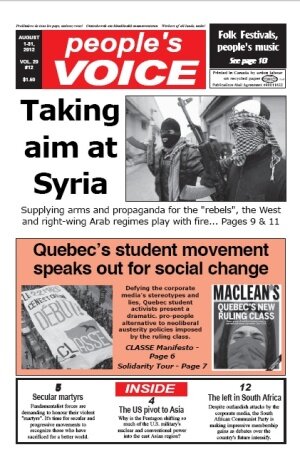
August 1-31 2012
Volume 19 – Number 22
$1
Prolétaires de tous les pays, unissez-vous!
Otatoskewak ota kitaskinahk mamawestotan!
Workers of all lands, unite
1) QUEBEC MOVEMENTS FACE ELECTION CHALLENGE
2) "REACH OUT AND BUILD THE MOVEMENT"
3) SHARE OUR FUTURE: THE CLASSE MANIFESTO
4) WAR CLOUDS IN THE PERSIAN GULF - Editorial
5) STOPPING ENBRIDGE JUST A START - Editorial
6) MFL PLEDGES SOLIDARITY WITH QUEBEC STUDENTS
7) BCTF REACHES BARGAINING DEAL
8) HOW ABOUT A MEMORIAL FOR SECULARIST MARTYRS?
9) HIROSHIMA AND THE U.S. "PIVOT" TO ASIA
10) A VILLAGE ABOUT TO BE DEMOLISHED
11) CANADA AND IMPERIALISM'S STRATEGY TOWARDS SYRIA
13) MUSIC NOTES, by Wally Brooker
14) FOLK FESTIVAL SEASON: A LOOK AT MARIPOSA
16) THE SPARK! (Theoretical and Discussion Bulletin of the Communist Party of Canada)
PEOPLE'S VOICE AUGUST 1-31, 2012 (pdf)
|
People's Voice deadlines: September 1-15 September 16-30 Send submissions to PV Editorial Office,
|
|
REDS ON THE WEB |
|
People's Voice finds many "Global Class Struggle" reports at the "Labour Start" website, http://www.labourstart.org/. We urge our readers to check it out! |
* * * * *
People's Voice
Canadian Publications Mail Sales Product Agreement #205214
ISSN number 1198-8657
People's Voice is published by
New Labour Press Ltd
PV Editorial Office
706 Clark Drive,
VANCOUVER, B.C. V5L 3J1
Phone:604-255-2041
Fax:604-254-9803
email: pvoice@telus.net
Editor: Kimball Cariou : Business Manager: Sam Hammond
Editorial Board: Kimball Cariou, Miguel Figueroa,
Doug Meggison, Naomi Rankin, Liz Rowley, Jim Sacouman
* * * * * *
Letters
People's Voice welcomes your letters
on any subject covered in our pages.
We reserve the right to edit for length and clarity,
and to refuse to print letters which may be libellous
or which contain unnecessary personal attacks.
Send your views to:
"Letters to the Editor",
706 Clark Dr., Vancouver, BC V5L 3J1,
or pvoice@telus.net
People's Voice articles may be reprinted without permission,
provided the source is credited.
* * * * * *
The Communist Party of Canada, formed in 1921,
has a proud history of fighting for jobs, equality, peace,
Canadian independence, and socialism.
The CPC does much more than run candidates in elections.
We think the fight against big business and its parties
is a year-round job,
so our members are active across the country,
to build our party and to help strengthen people's movements
on a wide range of issues.
All our policies and leadership
are set democratically by our members.
To find out more about Canada's party of Socialism,
give us a call at the nearest CPC office.
* * * * * *
Central Committee CPC
290A Danforth Ave Toronto, Ont. M4K 1N6
Ph: (416) 469-2446
fax: (416) 469-4063 E-mailmailto:info@cpc-pcp.ca
Parti Communiste du Quebec (section du
Parti communiste du Canada)
5359 Ave du Parc, Montréal, Québec,
H2V 4G9
B.C.Committee CPC
706 Clark Drive, Vancouver, V5L 3J1
Tel: (604) 254-9836
Fax: (604) 254-9803
Edmonton CPC
Box 68112, 70 Bonnie Doon P.O.
Edmonton, AB, T6C 4N6
Tel: (780) 465-7893
Fax: (780)463-0209
Calgary CPC
Unit #1 - 19 Radcliffe Close SE
Calgary AB, T2A 6B2
Tel: (403) 248-6489
Ottawa CPC
Tel: (613) 232-7108
Manitoba Committee
387 Selkirk Ave., Winnipeg, R2W 2M3
Tel/fax: (204) 586-7824
Ontario Ctee. CPC
290A Danforth Ave., Toronto, M4K 1N6
Tel: (416) 469-2446
Hamilton Ctee. CPC
265 Melvin Ave., Apt. 815
Hamilton, ON.
Tel: (905) 548-9586
Atlantic Region CPC
Box 70 Grand Pré, NS, B0P 1M0
Tel/fax: (902) 542-7981
http://www.communist-party.ca/
* * * * * *
News for People, Not for Profits!
Every issue of People's Voice
gives you the latest
on the fightback from coast to coast.
Whether it's the struggle for jobs or peace, resistance to social cuts,
solidarity with Cuba, or workers' struggles around the world,
we've got the news the corporate media won't print.
And we do more than that
- we report and analyze events
from a revolutionary perspective,
helping to build the movements for justice and equality,
and eventually for a socialist Canada.
Read the paper that fights for working people
- on every page, in every issue!
People's Voice
$30 for 1 year
$50 for 2 years
Low-income special rate: $15 for 1-year
Outside Canada $50 for 1 year
Send to: People's Voice, 706 Clark Drive, Vancouver, BC, V5L 3J1
You can call the editorial office at 604-255-2041
REDS ON THE WEB
http://www.communist-party.ca/
http://www.ycl-ljc.ca/
http://www.solidnet.org/
(The following articles are from the August 1-31, 2012, issue of People's Voice, Canada's leading communist newspaper. Articles can be reprinted free if the source is credited. Subscription rates in Canada: $30/year, or $15 low income rate; for U.S. readers - $45 US per year; other overseas readers - $45 US or $50 CDN per year. Send to People's Voice, c/o PV Business Manager, 706 Clark Drive, Vancouver, BC, V5L 3J1.)
1) QUEBEC MOVEMENTS FACE ELECTION CHALLENGE
By Johan Boyden, Montreal
The community of Trois Pistoles along the northern banks of the St. Lawrence river is known for its picturesque beauty and historic links to Basque whalers, who travelled there hundreds of years ago from Spain. Now it has become a symbol of the pre‑election polarization and fear‑mongering going on in Québec.
An ecological festival in the town, put on by community activists including some who have been fighting high‑risk shale gas development in the region, wanted to invite student leaders to speak at their event.
A storm of controversy erupted. Mayor Jean‑Pierre Rioux met with organizers and threatened to withdraw all funding. "Around here, people think that [student leader] Gabriel Nadeau‑Dubois is [...] like Maurice `Mom' Boucher" one festival organizer said.
Mom Boucher is, of course, the convicted rapist, drug dealer and murderer who leads the Montreal Hells Angels.
Québec's governing Liberal Party is expected to announce a provincial election, likely on September 4th (just before the return of the anti‑corruption commission that has implicated the party with Mafia kick‑backs through the construction industry).
Despite the public outpouring of support for the students, particularly in working class Montreal communities, Québec elections are not held on the basis of proportional representation.
Instead, the riding system, divided along regional, economic and national lines, can craftily distort public opinion. Not to mention that elections are a multi‑million dollar horse race today.
Even though they have a nationalist wing, the Liberals are the only clearly federalist party on the political map. Going into the race they are "guaranteed" almost all the ridings in Montreal's West Island, where the Anglo minority will not consider a party leaning towards independence (or any other new forms of sovereignty that could be guaranteed in a re‑drafted Constitution).
Of course, the unexpected can happen ‑ like the turn to the NDP by Québec voters in the last federal election. But that phenomenon was much more about a strategy to block the Harper Tories than a re‑evaluation of the national question.
Many commentators say the outcome hangs on ten or maybe just six ridings where the Liberals won by a whisker ‑ sometimes by a lead of one percent and less than a hundred votes. The Minister of Education has said she will not seek re‑election, no doubt expecting she would lose.
Premier Charest's party is turning a blind eye to the ultra‑right Coalition Avenir Québec, who pose little threat, instead taking aim at the pro‑corporate Parti Québécois (PQ). Some compare this ballot choice to the frying pan and the fire. The Communist Party of Québec is supporting the left-coalition party Québec Solidaire.
Low voter turnout will also help the Liberals, who are counting on their "law and order" or "strong leadership in a crisis" message.
Even the government`s own arms‑length Human Rights and Youth Rights Commission recently condemned the special law forcing the return of students to class this month, saying it was a violation of the fundamental freedoms safeguarded by the Charter of Human Rights and Freedoms. But Law 78 was always an election strategy, and there is a real danger it may bear fruit.
Which brings us back to communities like Trois Pistoles, where the militant CLASSE student union is compared to organized crime.
The CLASSE has been running a tour across Québec promoting their manifesto for democracy (see page 6), and weaving together the struggles of the people within the framework of defeating the Liberals. On July 22, CLASSE organized another mass demonstration, estimated at between 30,000 and 80,000 in size. (That same day, police arrested the two spokespeople of a student mobilization in Ottawa, including a member of the Young Communist League.)
The Liberals have asked the Director General of elections to investigate the students in case they are making election expenses.
The other two student federations have targeted specific ridings, basically advocating for the PQ. The past‑president of the college student federation will be a PQ candidate.
The election will be a challenge for the people's movements. There is a need to continue the mobilization in the streets while not falling into the "anti‑politics" trap of pretending the vote does not exist. Whatever the outcome, it should not be seen as a blank cheque for any party. This was the message delivered at a summer BBQ discussion organized by the Young Communist League of Québec (LJC‑Q) in late July.
The meeting heard a report‑back on a very successful ten campus tour in Ontario by Québec student activists including the leader of the LJC‑Q, Marianne Breton Fontaine, organized by the Canadian Federation of Students (CFS) Ontario. People chuckled when they learnt the National Post had labelled the tour a vector of the Québec protest "virus."
The tour was a concrete expression of solidarity by the CFS towards the Québec students. About a thousand students came out in total between Ottawa and Windsor.
Breton Fontaine will also be a candidate for Québec Solidaire in the Montreal riding of Acadie.
In addition to its own platform (which includes the elimination of tuition fees, public pharmacare, nationalization of energy, pay equity, and other demands) Québec Solidaire has responded to a call for a united front against the Liberals with their own two‑point proposal for an alliance: proportional representation and, basically, the abolition of the last austerity budget. Since this is also, on paper, the existing policy of the PQ, it could be the basis for a coalition or accord, but this is just speculation.
2) "REACH OUT AND BUILD THE MOVEMENT"
During July, three Quebec student activists toured southern Ontario, speaking at public forums about the historic student mobilizations in Quebec. We reprint here excerpts of the comments at these forums by one of the speakers, Marianne Breton Fontaine.
We cannot see the Quebec student strike in a glass jar or, as we say in French dans une boulle de verre.
But if you just look at the corporate media, you could think that we are a bunch of spoiled students who do not want to pay even $1600 for our education ‑ despite the fact that Quebec students pay less than in the rest of the country.
The front‑page headline from McLeans magazine on June 4th presents that wrong understanding of the student strike very well: "How a group of entitled students went to war and shut down a province, over $325."
The truth is that the student strike has arisen in a very inflamed social and political moment. We are at the crossroads of many struggles right now across Canada. Consider the Harper Conservative Budget, the Omnibus Bill C‑38. All these attacks together are what is being called austerity.
We are told there is an economic crisis and we cannot afford social programmes that the people won, after struggle, in the past. We are told the state does not have any more money.
This is exactly the message of the Quebec Bachand Budget, named after the finance minister who himself called it a radical change. And it is also what people are hearing in Greece, Spain, Britain, and elsewhere.
But the economic crisis was not created by social programmes, or by the people.
To note one statistic, from the Montreal‑based IRIS research group, in the last 40 years, Quebec corporations doubled their profits but paid four times less taxes.
Deeper than that there is a systemic problem. We need to openly state that this is an economic crisis of the capitalist system. We need to find an alternative!
The struggle of students is not just a question of having accessible education.
A few months ago, I interviewed Camilo Balesteros from the CONFECH, the Students Federation of Chile, where 300,000 gathered in the streets of Santiago, fighting directly for free education, and against one of the worst funded education systems in the world ‑ even high school is not free.
Camilo explained that their struggle could not be reduced to the demand of free education. It could not finish there, and just let the government determine how to make free education happen.
So they struggled to change the Constitution to put the right of education into that document. They also called for nationalization of natural resources, to have the wealth to pay for free education.
The Chilean students said the means that are needed to achieve accessible education are also the means to achieve the demands of other popular struggles.
Consequently, the student struggle is directly confronting the austerity measures and the social vision that austerity represents!
Internationally, young people have shown great courage and risen up, redoubling efforts to set aside their differences and fight together for a better world, often in more difficult situations than ours.
The rapid increase in involvement by the people en masse in politics ‑ beyond elections every few years ‑ has scared the ruling class.
Take this statement from the president of the Employers Association in Quebec: "Eventual elections will provide citizens with the opportunity to have their say in regard to the current debate and to decide the responsibilities of everyone involved. That is how democratic societies solve their conflicts and make their decisions ‑ at the polls instead of in the streets."
Stop mobilizing and just wait for the next election. This statement is completely anti‑democratic!
In fact, in order to make gains, including at the polls, we have to go to the streets.
The anti‑democratic Bill 78 was put together to discourage any kind of mobilisation, whatever it is the students, or other organised groups like labour that would like to protest in solidarity.
Bill 78 shows the fear of big business and the reactionary political parties, faced with a population defending its own social interests, because our struggle has opened the question of social transformation. So the student strike is also a fight for democracy.
To stop this amazing mobilisation, the Charest Liberals have tried to ignore the situation, hoping the movement will fall apart; to intimidate, through legal injunctions, police violence and repression, and now Bill 78; and to divide the student movement.
To their credit, the two other student Federations have refused to negotiate without the CLASSE.
The Charest Liberal government, and its allies, have also tried to win the battle of ideas and convince the students and the rest of the population, by saying that a diploma is a personal investment. According to this neo‑liberal logic, by paying more, the students simply invest in themselves. In other words, a student becomes a product, and education becomes a commodity, a privilege.
Instead of social solidarity, we have the atomisation of society.
Can knowledge be a commodity? Knowledge is perhaps the only thing ‑ together with love ‑ that grows when it is shared. The social tool for transmission of knowledge cannot be reduced to an individual investment.
In fact, there are two ways of viewing education. The corporations need a functional worker with a certain amount of training. The people want education as a right.
Our public education system has developed out of this contradiction. Some people say education is good for the economy. I would ask: whose economy?
Let me illustrate this point with some examples.
In 1966 the Parent Report fundamentally changed education in Quebec. For over a century the Québéquoise people had been second-class citizens in their own land. We had higher unemployment, we lived in poorer conditions, we had poorer quality health care and higher rates of disease than the rest of Canada.
The majority of Quebecers did not know how to read or write. Except for some programmes in law and theology, we could not learn in French. Education was dominated by the Church, women were not allowed in the vast majority of colleges, and there were few science and technical programmes.
But as the economy developed, people began to demand a better life. The Quiet Revolution exploded in Quebec society. At the core was the question of being "masters of our own house" and French-language education.
An official commission was established and the resulting "Parent Report" secularized education and created the CEGEP system, which is distinct from the rest of Canada, merging college with the last years of high school.
The Parent Report expressed diverging class interests at the same time. Business needed a more highly trained workforce. The people needed to get out of the Dark Ages maintained by the ultra‑right Duplessis government of the 1930s and 40s.
The Parent report proposed free education as an ultimate goal, to be achieved by freezing tuition fees and reducing them when possible. The idea was to have the most accessible education system.
Quebec is today totally different. And our education system played a big role in our emancipation.
Free education would require less than 1% of Quebec's budget and could be obtained by restoring the capital gains tax. But the corporations do not want to pay the bill for education.
You can see this also with the report that just came out from the McGuinty Liberal government, proposing three‑year degrees.
Are students over‑educated? Maybe even with "unnecessary" degrees like philosophy or women`s studies? Or do they have sufficient training to be employees ‑ and the employers, through taxes, will not pay for more?
I am reminded of another extreme example.
About a year and a half ago, I attended a conference in South Africa and met with leaders of the National Union of South African Students, which was an illegal organization under the apartheid system.
They told us that quality education was forbidden to the majority black population, and particularly for women. For them, access to education could not be separated from their struggle for emancipation. Education is freedom.
I personally think we have a lot to learn from the students of Cuba, who have won free education. There is an alternative direction, even for poor countries.
Millions of people in Canada share our sentiment that education is a social good, it should be accessible, and it should be a right. A survey by the Canadian Federation of Students showed that 83% of Canadians are for a freeze, and 37% for a reduction of fees.
Your support and your red squares are very important for us. We will continue to need your support ‑ and your fightback.
Two lessons from the Quebec struggle might be important for you.
In Quebec the students have learnt a hard lesson in the power of unity. Over the past forty years, students have collectively marched out classes eight times in a general strike. While not all students hit the streets, so many acted together that, despite fear mongering by university administrations, they were not academically penalized. All but one mobilization forced the government to back down.
But the one mobilization that did fail, in 1988, fractured the movement, killing the l'Association nationale des Etudiantes et des Etudiants du Québec (ANEEQ).
The lines of communication between the Quebec student movement and the Canadian student movement were also broken, a unity based on equality and the recognition that the Quebec people were a nation, not just residents of another province, but that we had a common struggle.
We are rebuilding that solidarity now, twenty years later, and this tour is one step.
Unity does not mean to adopt the lowest position to reach consensus, but to recognize our real opponents, to politically convince our potential allies, going beyond the campus. It means getting out of an economic discourse with demands that only speak to individual students.
By addressing the question of how to achieve free education, or even the freeze, we can reach out to other people's demands and struggles, and grow the movement.
Even where the student leadership is reactionary, like the Canadian Alliance of Student Associations, students on campuses can move into action if they can connect with the mobilization.
Perhaps the biggest lesson of Quebec is to have a plan of escalating action. The strike is the most powerful moral weapon the students have. But to get there, one day of action should be followed by another, then by an occupation, and a week of local action, a one day strike, etc.
It is militancy that won our current level of accessibility, not charity from the government. Victory through struggle is possible.
The Quebec Student Strike is not over $325, or $1600. It is not about numbers.
It is about what kind of future we have. Ignorance, debt and more poverty? Or a bold, different direction that says education is a social right?
3) SHARE OUR FUTURE: THE CLASSE MANIFESTO
Especially in English-speaking Canada, the corporate media has consistently presented a warped version of the Coalition large de l'Association pour une solidarité syndicale (CLASSE), the militant section of the Québec student movement. Here is the recent Manifesto issued by CLASSE - read it and judge for yourself!
For months now, all over Quebec, the streets have vibrated to the rhythm of hundreds of thousands of marching feet. What started out as a movement underground, still stiff with the winter consensus, gathered new strength in the spring and flowed freely, energizing students, parents, grandparents, children, and people with and without jobs. The initial student strike grew into a people's struggle, while the problem of tuition fees opened the door to a much deeper malaise - we now face a political problem that truly affects us all. To find its remedy and give substance to our vision, let us cast our minds back to the root of the problem.
The way we see it, direct democracy should be experienced, every moment of every day. Our own voices ought to be heard in assemblies in schools, at work, in our neighbourhoods. Our concept of democracy places the people in permanent charge of politics, and by "the people" we mean those of us at the base of the pyramid - the foundation of political legitimacy. This becomes an opportunity for all those who are never heard. It is a time for women to speak up as equals and to raise issues that are too often ignored or simply forgotten about. The democracy we see does not make promises: it goes into action. Our democracy banishes cynicism, instead of fuelling it. As we have shown many times over, our democracy brings people together. Each time we take to the streets and set up picket lines, it is this kind of democracy that at last breathes free. We are talking about shared, participatory democracy.
Democracy, as viewed by the other side, is tagged as "representative" - and we wonder just what it represents. This brand of "democracy" comes up for air once every four years, for a game of musical chairs. While elections come and go, decisions remain unchanged, serving the same interests: those of leaders who prefer the murmurs of lobbyists to the clanging of pots and pans. Each time the people raises its voice in discontent, on comes the answer: emergency laws, with riot sticks, pepper spray, tear gas. When the elite feels threatened, no principle is sacred, not even those principles they preach: for them, democracy works only when we, the people keep our mouths shut.
Our view is that truly democratic decisions arise from a shared space, where men and women are valued. As equals, in these spaces, women and men can work together to build a society that is dedicated to the public good.
We now know that equal access to public services is vital to the common good. And access can only be equal if it is free.
Free access does more than simply banish prices: it tears down the economic barriers to what we hold most dear. Free access removes the stumbling‑blocks to the full flowering of our status as humans. Where there is free access, we share payment for shared services.
By contrast, the concept of price determination - the so-called "fair share" - is in truth no more than veiled discrimination. Under the supposedly consensual "user‑pay" principle, a surtax is in fact charged to people whose needs are already at the bottom of the heap. Where is justice, when a hospital can charge the exact same fee from a lawyer as from a bag clerk? For the lawyer, the amount is minimal; for the bag clerk, it is a back‑breaking burden.
This burden is one that we all shoulder, each and every one of us, whether we are students or not: this is one lesson our strike has taught us. For we, students, are also renters and employees; we are international students, pushed aside by discriminating public services. We come from many backgrounds, and, until the colour of our skin goes as unnoticed as our eye colour, we will keep on facing everyday racism, contempt and ignorance. We are women, and if we are feminists it is because we face daily sexism and roadblocks set for us by the patriarchal system; we constantly fight deep‑rooted prejudice. We are gay, straight, bisexual, and proud to be. We have never been a separate level of society. Our strike is not directed against the people. We are the people.
Our strike goes beyond the $1625 tuition‑fee hike. If, by throwing our educational institutions into the marketplace, our most basic rights are being taken from us, we can say the same for hospitals, Hydro‑Québec, our forests, and the soil beneath our feet. We share so much more than public services: we share our living spaces, spaces that were here before we were born. We want them to survive us.
Yet a handful of greedy persons, answering to no one, is hard at work devastating these spaces - and they are getting away with it, with projects such as Plan Nord, shale gas, and more. For these few, who view the future in terms of the next quarter's profit, nature has value only when measured in economic spin‑offs. Blind to the beauty of the common good, this clique is avid and unpredictable, with eyes only for its faraway stockholders. It caters to those stockholders' whims in colonial style, with no consultation. The primary victims of this wholesale sell‑off are Native women, far from the media, poor and easily ignored.
Fortunately, though our Native peoples are displaced each and every time wealth is found under or on their land, they have kept up the fight. Some of these ruthless exploitation projects have been put on ice due to the women and men who have dared to defy them. These men and women have stood their ground against this plunder of resources, despite dire warnings that our economic survival depends on the speedy exploitation of our underground wealth, whatever the price.
Together, each and every one of us will be affected by the waste of our resources, because we are concerned, not only for those who will come after us, but also for the people with whom we now share these spaces - we want to think better thoughts: we want to think ahead.
This is the meaning of our vision, and the essence of our strike: it is a shared, collective action whose scope lies well beyond student interests. We are daring to call for a different world, one far removed from the blind submission our present commodity‑based system requires. Individuals, nature, our public services, these are being seen as commodities: the same tiny elite is busy selling everything that belongs to us. And yet we know that public services are not useless expenditures, nor are they consumer goods.
Together we have realized that our underground wealth cannot be measured in tons of metal, and that a woman's body is not a selling point. In the same way, education cannot be sold; it ought to be provided to each and every one of us, without regard to our immigration status or our condition. Our aim is for an educational system that is for us, that we will share together.
Because education is a training ground for humanity, and because humanity does not bow to economic competitiveness, we refuse to allow our schools to bend under the weight of well-stocked portfolios. Together, we call for an egalitarian school system that will break down hierarchies, one that will pose a threat to all those men and women who still think they can rule over us with a free hand.
In providing everyone with the resources they need to develop their full capacities, we will succeed in creating a society where decision‑making and the ways in which we organize our lives with one another are shared. This is the heart of our vision. Education is not a branch of the economy, nor is it a short‑term training service. Our educational system, which is at the root of all knowledge, can allow us to pave the way towards freeing society as a whole; it can provide a liberating education that will lay the foundation for self‑determination.
We believe that if our educational system is to be seen as a space where universal knowledge is shared, it must banish all forms of gender‑based discrimination and domination. And yet a woman in the current educational system walks a path just as difficult as the one she walks in today's society. It is futile to believe that unequal status is no longer reproduced in the halls of academe: we are disgusted to see that the professions traditionally associated with women are still undervalued, and that it is still mostly women who study for these professions. We women are numerous in Bachelor's-level classrooms, but how many of us climb to the highest rungs of the academic ladder?
We are against prolonging this discrimination against women as well as against people who are in any way shunted aside by society. Our aim is to make our educational system well and truly a space where equality reigns and differences are respected. Our fervent wish is for an educational system that allows each and every one of us to blossom.
In choosing to strike, we have chosen to fight for these ideas. We have chosen to create a power relationship, the only mechanism that will allow us to tip the scales. Sharing this responsibility together, we can accomplish a great deal: but in order to do this we have to speak up, and speak up forcefully.
History has shown us eloquently that if we do choose hope, solidarity and equality, we must not beg for them: we must take them. This is what we mean by combative syndicalism. Now, at a time when new democratic spaces are springing up all around us, we must make use of these to create a new world. Now is no time for mere declarations of intent: we must act. In calling for a social strike today, we will be marching alongside you, people of Quebec, in the street tomorrow. In calling for a social strike today, we hope that tomorrow, we will be marching, together, alongside the whole of Quebec society.
Together, we can rebuild. Share our future.
4) WAR CLOUDS IN THE PERSIAN GULF
People's Voice Editorial
The corporate media in North America continues to heap blame on the Assad government for every tragedy in Syria. Little is mentioned about arms shipments and meddling by the western powers, Israel, and Saudi Arabia and other reactionary Gulf Arab states. The pattern is familiar: a government which refuses to kowtow to imperialism faces an intense propaganda attack, followed by sanctions and threats, and then outright military intervention. Countries which resist the stampede to war ‑ in this case Russia and China ‑ are accused of "blocking consensus" and "protecting their own interests." What blatant hypocrisy!
Meanwhile, the biggest build‑up in the Persian Gulf since the 2003 invasion of Iraq is underway. The US military surge includes an influx of air and naval forces, ground troops, and even sea drones. The US already has two aircraft carriers and their striker groups in the region. The immediate target of this escalation is Iran, even though the US intelligence community finds no evidence that Teheran has decided to pursue a nuclear weapon - the ostensible reason behind Western sanctions. As an April Pentagon report states, Iran's military doctrine remains one of self‑defence, committed to "slow an invasion" and "force a diplomatic solution to hostilities."
The media blitz against Syria and Iran is a propaganda cover for the wider aims of imperialism across the entire Middle East/Central Asia region, especially the drive by transnational monopolies to control energy supplies.
Far from helping the people to address their urgent social issues, military interventions have the opposite effect, as seen in Afghanistan, Iraq, and Libya. War in Middle East will never bring liberation, only huge profits for Big Oil and the military-industrial complex. The shameful threats against Syria and Iran by the major parties in Parliament will be remembered as yet another example of Canadian complicity with U.S. imperialism.
5) STOPPING ENBRIDGE JUST A START
People's Voice Editorial
Despite a huge corporate propaganda blitz and 100% support from the Alberta and federal Tory governments, Enbridge Corp.'s Northern Gateway pipeline project is in serious jeopardy. The hearings into the project have shown powerful opposition from First Nations, environmental groups, local governments, scientists and concerned citizens. Revelations of the company's incompetent response to a huge oil leak in Michigan two years ago make it clear that this project simply cannot be built without endangering vast areas of wilderness and coastlines.
Yet the fight is far from over. This month, anti-pipeline activists are extending solidarity to indigenous people in northern British Columbia, where plans are underway to clear hundreds of kilometers of forests, streams, and wetlands along the proposed route.
The defeat of the Northern Gateway project would be a huge victory for Aboriginal peoples struggling to protect their traditional territories, for communities along the pipeline route facing ecological dangers, and for all Canadians who want an economy based on people's needs, not corporate greed.
But the drive for profits through extraction of energy resources by transnational capital and imperialist governments will continue. Even if Enbridge loses this round, other projects are on the drawing board, such as the expansion of Kinder Morgan's pipeline to Vancouver. This project would fill a tanker ship every day, with potentially disastrous consequences for the people and environment around Vancouver's harbour.
An immediate moratorium on expansion of pipelines and energy extraction projects would give Canadians time to engage in a real debate over the future of this industry. We must win the fight to block the Northern Gateway project, but that will only be the first step.
6) MFL PLEDGES SOLIDARITY WITH QUEBEC STUDENTS
By Darrell Rankin
The highlight of the June 22‑24 Manitoba Federation of Labour Convention was the near‑unanimous support by over 300 delegates for the emergency resolution in solidarity with the Quebec student struggle against the Charest government's tuition hike.
Other aspects of the convention were less positive. Resolutions to oppose similar tuition hikes in Manitoba and to support the campaign of boycott, divestment and sanction of Israel for its occupation of Palestinian territory were defeated or tabled.
Support for progressive policies and action was scattered among different union caucuses, underlining the need for better preparation and organization before the next MFL convention.
If there was a theme to the convention, it was inform delegates about the need for NDP electoral support. Asked to stand if they had helped elect the NDP in Manitoba last fall, about one‑third of delegates complied.
The MFL executive worked hard to defeat the Israel BDS motion, starting with asking the resolutions committee to reconsider its recommendation of concurrence. It said no to the circulation of BDS information to delegates inside the hall.
But MFL president Kevin Rebeck did attend the BDS workshop, participating in a frank and civil discussion about the executive's concerns, focusing on CLC jurisdiction over federal matters, existing CLC policy, and the division of powers in the British North America Act between provinces and the federal government.
Workshop participants ably addressed Rebeck's concerns, but the next day a delegate was able to table the motion and it was never considered.
CUPW president Denis Lemelin, one of the keynote speakers, condemned the Harper government's anti‑labour agenda, especially the requirement for final offer selection in five back‑to‑work bills over the last year. He pointed out that since nearly all the major unions have campaigns against the federal government, there is a need to bring them together.
"We need to develop a social project, our project," said Lemelin. "Otherwise we will lose." He also urged action against Harper's Bill C‑377 which would force unions to disclose their strike funds.
In his keynote speech, Rebeck came out in support of the provincial NDP government, saying "I don't think the Manitoba NDP moves fast enough or far enough on many issues... The MFL leads off every meeting with government reminding them of our three priorities, and one of them has been achieved now."
Fresh off the plane from the Rio+20 World Environmental Summit, where he signed an agreement to work with Quebec Premier Charest on the environment, Premier Greg Selinger received a round of applause for his speech. Selinger defended his government's policies, such as a new P3 law requiring publicity of details and the second‑highest minimum wage in Canada.
The challenges facing workers in Manitoba are far greater than the MFL's immediate demands, and will not be cured by the NDP's mild reformist policies. The challenges are already escalating as capitalism's economic crisis continues its agonizing and dangerous course.
7) BCTF REACHES BARGAINING DEAL
Members of the BC Teachers' Federation (BCTF) have voted by a margin of three to one to accept a new collective agreement. The vote came after a lengthy struggle, during which Premier Christy Clark's Liberals bitterly fought against any improvements for teachers or classroom conditions.
The agreement includes no salary improvements. But it does increase bereavement leave to up to eight weeks partially paid, and unpaid discretionary leave for up to three days and unpaid family leave for up to five days. The contract is retroactive to July 1, 2011, and expires on June 30, 2013, weeks after the next B.C. election set for May 14, 2013.
BCTF President Susan Lambert called the changes to leave a "modest improvement," but says the most important part was what government didn't include.
"The government was forced to take off the table the punitive legislations that Minister Abbott and the Premier consistently and constantly threatened to bring into being," Lambert told the media.
The threatened legislation included the elimination of seniority rights, lack of transparency in layoff and recall of teachers, and loss of autonomy in professional development.
The BCTF is taking the government to court over Bill 22, the so-called "Education Improvement Act", which required a collective agreement to meet the government's net‑zero mandate.
Lambert says the union wants government to put back the $3.3 billion cut from education over the last decade.
"This civil claim is aimed at getting our rights back," she says. "Yes, the public education system should get money back. We're asking for smaller class sizes, we're asking for full‑time a library in every school, counselling services for kids."
(With files from The Tyee)
8) HOW ABOUT A MEMORIAL FOR SECULARIST MARTYRS?
By Gurpreet Singh
Not only the political environment of Punjab has heated up since the ruling Akali Dal and Sikh hardliners started raising a demand for a monument in memory of those who died fighting against the Indian army during the controversial Operation Bluestar, it has also stirred a heated debate within the Indian Diaspora in Vancouver.
The army operation was launched in June 1984, to flush out religious militants who had fortified the Golden Temple Complex in Amritsar, the holiest shrine of the Sikhs. The operation left many dead and damaged the shrine, sparking angry protests across the world. The Indian Consulate office in Vancouver was vandalized. The assassination of Indian Prime Minister Indira Gandhi by her Sikh bodyguards was followed by anti-Sikh pogroms in different parts of India by goons belonging to Gandhi's Congress party. These ugly events culminated in the Air India bombings in 1985. The terrorist attack was blamed on the Canada-based Sikh separatists.
A campaign in support of the militants who died during Operation Bluestar is gaining momentum both in India and Vancouver. The issue is being hotly debated on Punjabi radio stations these days. Ironically, the Sikh-dominated Akali Dal, which governs Punjab in alliance with the Hindu nationalist Bhartiya Janata Party (BJP) supports the idea, whereas the BJP is advocating for a monument in memory of the Indian soldiers who lost their lives fighting against the militants.
Obviously, this has sent conflicting signals to everyone. Although the two parties claim to represent "Hindu‑Sikh unity", practically speaking the Akali Dal‑BJP combine is trying to please both the Hindu and Sikh fundamentalists, who have been feeding on each other since early 1980s when the hostilities grew, with Sikh militants threatening the Hindu minority in Punjab and Hindu extremists targeting the Sikh minority in other provinces of India.
Both the foreign powers, including the Pakistani spy agency ISI, and the opportunist Indian leadership, tried to gain advantage of the situation by resorting to "divide and rule" politics. Not to be left behind, the so-called secularist Congress party tried to give legitimacy to the Sikh fundamentalists to weaken the Akali Dal, and at the same time tried to capitalize on anti-Sikh sentiments outside Punjab. The Hindus started migrating to other provinces, while Sikhs started migrating to Punjab. This suited the ISI, who want a theocratic Sikh state of Khalistan to be carved out of Punjab. Some believe a part of the ISI game plan is to create a buffer state between India and Pakistan for strategic reasons, to weaken India's position on Kashmir.
In the meantime, those representing civil society in Punjab came up with a much more progressive idea: to bring a dignified closure by building a monument in memory of all Punjabis killed during the bloody conflict for a theocratic Sikh homeland. But the mainstream media in Punjab and the Vancouver-based Punjabi radio stations largely ignored this idea. The debate mainly revolved around angry reactions from the Sikh and Hindu leaders. A polarization of Hindus and Sikhs has once again become visible.
Such a monument would be more acceptable to everyone if raised by the government of the day. Though this seems unrealistic with two theocratic parties in power, it can still be considered to ensure communal harmony and peace. There were many unsung humanists and secularist activists who opposed fundamentalists during the conflict. They tried to avert sectarian violence by offering protection to Hindus from the Sikh extremists, and to innocent Sikhs from the Hindu chauvinists outside Punjab.
Among them were nearly 300 communists killed by the Sikh separatists in Punjab. They included Darshan Singh Canadian, who spent ten years in Canada and then retuned to India to become a towering Communist leader. He was gunned down in 1986 by the pro- Khalistan extremists, who also assassinated Arjan Singh Mastana, whose sister lives in Greater Vancouver.
The communists not only tried to bring back the Hindus who had migrated to other provinces fearing terrorist violence, but also opposed Hindu and Sikh reactionaries alike. Deepak Dhawan, who had visited Hindu refugees outside Punjab to convince them to return, was mercilessly killed by the militants. Avtar Singh Chautala was even forced to raise slogans in support of Khalistan before he was murdered. He chose to die instead, raising revolutionary slogans before being shot.
It is pertinent to mention here that a Communist government in West Bengal state resolutely protected the Sikhs from the mobs. Some of their slogans were, Na Hindu Raaj, Na Khalistan, Jug Jug Jive Hindustan! ("Neither Hindu state nor Khalistan, long live united India"), Na Hindu Raaj, Na Khalistan, Raaj Karega Mazdoor Kisan! ("Neither Hindu state, nor Khalistan, only the working class shall rule") and Hindu Sikh Noon Larhan Nahin Dena, San Santali Banan Nahin Dena! ("We won't let Hindu Sikh fight to repeat 1947", when India was divided on religious lines, resulting in the creation of Muslim Pakistan.)
Paash, a prominent communist poet, was assassinated by the militants in 1988 for launching Anti 47 Front, through which he opposed all the reactionary forces.
If Punjab needs a memorial, it needs to be dedicated to these true defenders of secularism and people's unity, not the forces inimical to peace and harmony.
9) HIROSHIMA AND THE U.S. "PIVOT" TO ASIA
By Darrell Rankin
Hiroshima Day, August 6, is humanity's chance to reflect on the danger of world nuclear war, and to recall what today would be a serious war crime ‑ the obliteration of two cities in Japan by atomic bombs in 1945.
As the U.S. threatens Iran for its alleged intention to develop a nuclear weapon, another danger is the move of 60 per cent of U.S. naval power to the Asia‑Pacific region by 2020. This is the "pivot to Asia", announced earlier this year as a result of a major military strategic review.
In atomic diplomacy, it is important to "follow the weapons" to gain a true understanding of the nuclear danger. The pivot signifies the transfer of much of the U.S. nuclear weapons arsenal half way around the world.
Essentially, the U.S. is shifting its military focus from the Middle East to Asia, from oil to people. The shift is seen by some U.S. strategists as "overdue" because of concern over China's emergence as a regional power. This, of course, is nothing but a canard against China and an excuse to dominate Asia.
The pivot helps position U.S. military forces to attack both China and Russia. But the more important reason is augment U.S. influence and power in the region, especially the all‑important U.S. corporate investments in China and other Asian countries, including by force if necessary.
In fact, the long history of U.S. nuclear policy in Asia is one of proliferating nuclear weapons, starting with Hiroshima and continuing with its anti‑China nuclear threats during the Korean war. The nuclear arsenals of China, India and Pakistan are puny compared to the U.S. arsenal.
The pivot also needs to be placed in the context of capitalism's deepening global crises. U.S. ruling circles are counting on their war machine to save their overseas investments from revolutionary change. The pivot is a direct threat to an "Asian Spring".
The pivot places U.S. naval forces closer to its new Africa Command and ready to assist its re‑established Fourth Fleet, whose purpose is to dominate and frighten South America.
U.S. imperialism is re‑positioning itself to crush social change anywhere it may occur.
The crime of Hiroshima, the history of atomic threats against China, and the present pivot underline the racist nature of U.S. imperialism. If an Asian nuclear war takes place, the expectation by U.S. ruling circles is that North America will avoid serious loss of life, or that they will escape political and legal responsibility. This is both misguided and criminally dangerous.
Without a successful campaign to abolish nuclear weapons, the world will continue towards nuclear Armageddon, accidental or deliberate, triggered by doctrines that allow for "first use" of nuclear weapons, including by U.S. naval commanders who may use such weapons without the president's permission.
The U.S. openly proclaims the need for military force to protect its foreign investments, a doctrine that equally infuses its nuclear policy. Until overseas investment, the material basis for global domination, disappears it is unlikely we will rid the earth of nuclear weapons.
As Hitler found out, humanity will never permit doctrines that allow for the murder of tens of millions. Those controlling the U.S. nuclear arsenal have doctrines that could kill billions. After all, war is merely the continuation of foreign policy by violent means, and foreign policy in the age of capitalist imperialism aims at domination, not equality among nations.
The inhumanity of the capitalist social system cannot be erased from history. In 1945, U.S. leaders chose to use atomic bombs on cities, to display the overwhelming danger of such weapons on civilians. Imperialism's nuclear strategy is the most important reason why socialists say disarmament is our ideal.
10) A VILLAGE ABOUT TO BE DEMOLISHED
By Smadar Carmon, Toronto
The small village of Susiya in the Israeli Occupied Territories is about to be demolished yet again. Most Canadians never even heard about the first, second, third and fourth times. But we should know, because Canada is heavily implicated in these human rights abuses as a result of our unconditional support for Israel.
A few years ago some fellow Israelis introduced me to Susiya and its determined and resolute residents. These Israelis have made it their business to work with and support the Palestinians living in the villages of the South Hebron hills.
The elements are harsh in these hills; the scorching heat envelopes you and all you can see is arid land dotted here and there with patches of green. The only lush areas are next to the illegal but fully water‑supplied Israeli settlements; while the Palestinians must import and pay dearly for water arriving by truck. Energy is connected for the Jewish settlements, but Palestinian villages have nothing. Recently, my Israeli friends and the Palestinians came up with a way to get power by installing a few small wind turbines and some solar panels. Now at night the residents can read and even use a refrigerator - quite an achievement in the 21st century!
Susiya was razed in 1985, 1991, 1997, and twice in 2001. An adjacent Jewish West Bank settlement of Susiya was built in 1983. In 1986, the Palestinian Susiya was declared an archaeological site as it sits atop remnants of an early Jewish settlement. Its residents were forced to move onto their farmland, into tents and caves. In 2001, the Israeli army (IDF) and Civil Administration, part of the IDF, violently expelled them, destroying their homes, fields, livestock and water cisterns. This was all under the pretense of responding to the second intifada (Palestinian uprising). Following a campaign and legal battle by Palestinian residents and Israeli leftists, the Israeli High Court of Justice instructed authorities to stop the demolitions. But it did not instruct the Civil Administration to allow the Palestinians to build, giving them no other choice but to reconstruct the village without permits.
Throughout the West Bank, East Jerusalem and Gaza, house demolitions are a constant reality for Palestinians. It is estimated that at least 24,813 houses have been demolished since 1967. The Civil Administration routinely discriminates against them by making it their acquisition of building permits almost impossible. Showing the strength and determination they are so recognized for, Susiya residents boldly erected some tents and hovels, including a school.
In spite of the 2001 High Court ruling disallowing further demolitions and other acts of harassment, Jewish settlers and the IDF subjected Palestinian farmers to ongoing violence and blockades of their land. Finally help came from the organization Rabbis for Human Rights; it, along with the residents, filed a complaint regarding their inability to access their land, and the settlers increasing encroachment on it.
In 2011, something unusual occurred: the military commanding officer declared a large part of the Palestinian residents' land closed to Israelis; this was an attempt to stop the violence and land encroachment by the settlers. To "remedy" this the settlers used the association Regavim to speed up the demolition orders for Susiya's few meagre structures Regavim's petition painted a bizarre picture of the two sides Palestinian residents became "illegal outpost settlers" (despite the fact that they have lived there for centuries), and Jewish settlers emerged as indigenous, oppressed and discriminated‑against(!).
Outrageously, throughout the court challenges and the Regavim petition the illegal building of the Jewish Susiya continued. As well, the Civil Administration hurried to fly in the face of Israeli law and demolish as much of the Palestinian Susiya as they could before the High Court intervened. On June 13, 2012 they issued demolition orders for 52 buildings, including a preschool, a clinic and a solar panel system.
Susiya is a microcosm of life for Palestinians living under Israeli occupation. The authorities' obvious discrimination, especially regarding the provision of services, resembles ethnic cleansing. As of today, Palestinians living in the little village of Susiya and elsewhere are under constant threat of demolition, expulsion and forced relocation. It feels like it will never end.
As Canadians we should implore our government to hold Israel to international standards of human rights and not condone their abuses. Let us not leave it to others, such as the current Avaaz petition www.avaaz.org/en/petition/Save_My_Village/?brfxdab&v=15503, to halt the pending Susiya demolitions. We must demand that our government state that this current state of affairs is unacceptable. We should also demand better coverage from our media so that we may learn what is happening in our name.
11) CANADA AND IMPERIALISM'S STRATEGY TOWARDS SYRIA
By Darrell Rankin
In the June 5 parliamentary debate on Syria, Tory, NDP and Liberal MPs proclaimed their common purpose, notably about the need to overthrow the Syrian government.
Earlier that day, MPs from these parties gave unanimous consent to a motion that condemned the Syrian government for allegedly massacring civilians, and that urged Russia and China to support a ceasefire that would save innocent lives.
Our parliamentarians are steeped in the legacy of imperialism's colonial attitude to the Arab world, which allows only "appropriate" rulers. They are infused with Western imperialism's latest aspiration to re‑divide the world at the expense of China and Russia.
Not once in the debate did our parliamentarians refer to the generous support for armed groups in Syria by the despotic regimes in the Middle East such as Saudi Arabia and Qatar.
The prospect for Syria is the most intense sectarian war that the West can create, with the aim of blaming Russia and China for the violence. That said, imperialism is keeping all its options open towards Syria, including military occupation.
This includes using alleged Russian and Chinese "stubbornness" to bypass the U.N. Security Council and directly overthrow the Syrian government. Western imperialism only follows international laws such as the U.N. Charter when it is helpful.
Russia and China face being demonized and made into targets of plunder for the West. Yet both countries support a ceasefire; their goal is that Syrians alone decide their future, a policy distorted as alleged "support" for the Syrian government.
The latest escalation in the Middle East also targets Iran, and the ruling classes in the western imperialist countries alone stand to benefit from the death and division.
The pro‑war countries in the Middle East are making serious miscalculations. Israel's ruling circles believe they will escape with impunity and gain from a weakened Syria. But a large war that may involve nuclear weapons could wipe out millions of people and destroy cities throughout the region.
Backed by Canada and other imperialist countries, reactionary Arab states such as Saudi Arabia are feeding sophisticated arms, communications means, and intelligence to armed groups in Syria. They are leading the effort to spark a war of regime change in Syria and to create conditions for a war against Iran.
But behind this aggression is weakness, not strength. The prospects for democratic revolutionary change are growing in these societies, whose leaders calculate that overthrowing the last secular state in the Arab world will help them in their growing domestic problems.
The feedback effect of such a war, however, will put their despotic regimes and social system to a supreme test. One has to wonder about the stability and permanence of the regimes that are launching a war against Syria.
Although the West aims to drown Syria in its own blood, the sharply polarized political conditions in the region and the world may tilt such a war into a far more serious conflagration.
Who benefits from trying to overthrow the government of Syria? A starting point in explaining the fuller picture is that wealthy Canadians have for decades made piles of money from selling weapons to Saudi Arabia and its allies, which in turn today are shipping piles of weapons into Syria.
Canada's policy actually has nothing to do with our MPs' proclaimed humanitarian concerns, which are a cover for being a partner in the U.S.‑led re‑division of the cake.
What importance do the MPs place on Syria for the kind of world they want? According to Paul Dewar (NDP, Ottawa Centre), "The priority is not trade with Russia right now; it is about action when it comes to Syria."
According to Alexandrine Latendresse (NDP, Louis-St-Laurent), Syria's Assad government made "a few timid attempts... to liberalize the economy and encourage the growth of foreign investments... The results have been very disappointing... Assad tried to get a little closer to the west and seemed to want to play the game for a while. When the Arab Spring happened, it soon became very clear that we were dealing with an unscrupulous tyrant."
This comment explains Canada's aggression towards the Syrian government, which is a non‑sectarian alliance of the working class and national bourgeoisie of that country, operating to limit foreign domination. This is a serious crime of the Syrian government, in the eyes of the neo‑liberal imperialist West.
Latendresse omits to mention that Canada is the third largest foreign investor in Syria. Not mentioned by any parliamentarian is the use of the Arab and other peoples in the region as pawns in the imperialist re‑division of the world.
On every question related to Syria, Canada's parliamentary anthill can see no farther than Washington, whose foreign policy they faithfully copy.
To sum up, Canada's three largest parties all support the overthrow of the Syrian government. In the debate, the NDP blamed the Syrian government for the massacre in Houla, an allegation made at the time without any evidence, and now contrary to clear evidence that the reactionary rebels committed the heinous crime.
Many other allegations made by MPs in the debate are without foundation, including that the UN Observer mission blamed the Syrian government for the massacre.
The debate showed a marked departure from reality by all parties in our parliament. Behind this departure is Canada's corporate ruling class, eager to impose Canadian investment in Syria.
The beautiful country of Syria, already partly occupied by Israel, will be the poorer for this, and many more may die. Canada's parliament
In mid-June, mass protests erupted in Sudan against the regime of President Omar al-Bashir. The government's response has been an escalation of repression, including an estimated 3000 arrests. The following statement was issued in early July by the Sudanese Communist Party (SCP).
On July 4th, the major opposition political parties which include the Umma Party and the SCP, signed the political document entitled the "Democratic Alternative". The signing took place on the twentieth day of continuous mass demonstrations against the al-Bashir regime. These peaceful demonstrations, which engulfed the main cities and towns of the country, are being met with cruel repressive measures, widespread detention, torture, denial of medical treatment and beatings. Despite all this the demonstrators continue to fill the streets....
Members of the Journalist Democratic Network demonstrated in their hundreds in front of the UN human rights building, demanding an end to security harassment, respect of freedom of expression, and release of detained journalists. The security forces have released two female Egyptian journalists and deported them back to Egypt.
Lawyers, in their hundreds, have picketed the Ministry of Justice demanding respect of the constitution, fair trials for the demonstrators, more humane conditions for those arrested, including the right to see doctors and defence lawyers, and release of all political prisoners and detainees.
The demonstrations, which started as protests against rising prices and austerity measures, are gradually taking a different shape. New forces are joining the protest movement and more political demands are coming to the fore. The overthrow of the regime is the main demand of the people.
The "Democratic Alternative" document calls for a transitional period during which the country is ruled under a special Constitutional Declaration, beginning with the establishment of a national unity government and finishing with fair, free and honest elections. Furthermore the document calls for the separation of religion from the state, and prohibits the exploitation of religion for political purposes... The document defines the tactics to overthrow the regime through strikes, peaceful demonstrations, occupation, civil disobedience and popular revolution.
The different political forces have agreed to continue the struggle until final victory, stressing that there is no way for talks with the regime.
The main challenge now is to transform the document into a people's manifesto that can help to bring all opposition forces together in the final push against the regime. The Sudanese Communist Party stresses that adherence to the document by those who have signed, and support by other forces who are waging fierce struggles in Darfur, Southern Kordufan and the Blue Nile, as well as international solidarity, will all pave the way for an end to the present regime, the sufferings of our people and the establishment of a democratic Sudan.
Long live International Solidarity! Victory for the Sudanese people!
Secretariat of the CC of the SCP
13) MUSIC NOTES, by Wally Brooker
Happy Birthday Woody Guthrie!
Back in 1998 American singer‑songwriter Steve Earle recorded a song called "Christmas in Washington." It had a heartfelt refrain: "Come back Woody Guthrie." Maybe Woody Guthrie, who died in 1967, never really left us, but certainly this year the great American balladeer's spirit has been omnipresent. Woody's centennial has been celebrated across North America and beyond, culminating with birthday festivities last month in Coney Island, a free Guthrie family picnic in Central Park, and a festival in his hometown of Okemah, Oklahoma. Virtually every folk festival this summer will have paid tribute in one way or another to the composer of "This Land is Your Land," whose words and lyrics gave voice to the struggles of the American working class and outlined a vision of a people's culture. In these times of crisis the relevancy of Woody Guthrie is greater than ever. Two excellent tributes were broadcast last month by Democracy Now, one with Guthrie biographer Will Kaufman, Pete Seeger and Billy Bragg (July 4) and the other with Steve Earle, Guthrie's daughter Nora and granddaughter Anna Canoni (July 12). View them at www.democracynow.org. For more info visit www.woody100.com.
David Rovics in Canada this fall
A latter‑day Woody Guthrie, singer‑songwriter David Rovics, will be visiting Canadian cities this fall. His hard-hitting and insightful songs about war, globalization and social justice have been inspiring activists across North America and Western Europe for two decades. Rovics has confirmed dates in Montreal (Oct. 12), Ottawa (Oct. 13), Toronto (Oct. 15) and London (Oct. 16). November dates are also in the works for Winnipeg, Vancouver and Victoria. More details will be published in a forthcoming column, but for now it is known that the focus will be on solidarity with Palestine, and at least two concerts will be benefits for the Gaza Ark project http://gazaark.org/. Sponsors for all or part of the tour include the Canadian Boat to Gaza Committee, Independent Jewish Voices, Palestinian and Jewish Unity, the Rosa Luxembourg Club (CPC), the United Jewish People's Order and the Young Communist League. For updates write to this column at saxawoogie@yahoo.com.
New York musicians against fracking
Singers Natalie Merchant and Joan Osborne, popular jazz trio Medeski, Martin and Wood, and actor Mark Ruffalo joined environmental activists and scientists at a May 15 rally and teach‑in against hydraulic fracturing ("fracking") in Albany, the state capital of New York. Fracking is a technique of extracting natural gas from deep within the earth by injecting water and chemicals underground. News leaks have revealed that Governor Andrew Cuomo plans to lift a moratorium on the dangerous practice and allow gas companies to operate in five impoverished counties near the Pennsylvania border. "It's a Pandora's Box we don't want to open," said Merchant, former lead singer of the popular band 10,000 Maniacs, who contacted Oscar‑winning documentary director Alex Gibney to film the rally. Check out the video at http://video.nytimes.com. For info on fracking visit the Council of Canadians at http://canadians.org.
Artists & intellectuals vs Bill 78
Sébastien Ricard (a.k.a. "Batlam") of popular Quebec band Loco Locass joined folksinger‑filmmaker Richard Desjardins, singer‑composer Richard Séguin and 50 other artists, intellectuals and trade unionists on a June 21 march from Université du Québec a Montréal to the office of Premier Jean Charest, where they presented a letter signed by 1200 of their peers demanding the abrogation of Bill 78 as "abusive, anti‑freedom and totalitarian." Authors of the open letter include writers Marie‑Christine Bernard and Jean-Francois Caron, trade unionist Francis Legacé, researcher Eric Pineault and philosopher Michel Seymour. Search online using key words "Against Bill 78 (Voir)" for an English translation. Messages of solidarity from English Canada are urgently required. For the complete text in French visit http://profscontrelahausse.org.
Adrienne Cooper 1946‑2011
The progressive Canadian Jewish magazine Outlook paid tribute in its May‑June issue to Yiddish singer, teacher and activist Adrienne Cooper, who passed away on December 25, 2011. Cooper was one of the outstanding figures in the contemporary revival of Klezmer music ‑ the popular Yiddish style that originated in Eastern Europe and spread to North America in the early twentieth century. Her recordings include solo albums, compilations, and collaborations with bands like The Klezmatics and The Flying Bulgar Klezmer Band, as well as with her partner, Canadian pianist Marilyn Lerner. Cooper was an executive member of the Workman's Circle (Arbeiter Ring), and Jews for Racial and Economic Justice, an anti‑racist, anti‑poverty and feminist New York group that has been active in the struggle against Islamophobia. She was also co‑founder of Klez Kamp, the annual Klezmer and Yiddish cultural festival in New York's Catskills region. For more info visit www.adriennecooper.com.
14) FOLK FESTIVAL SEASON: A LOOK AT MARIPOSA
By Wally Brooker
It is mid‑way through the summer, and some of the season's largest folk festivals have taken place (Calgary, Vancouver, Winnipeg, Mariposa), but there is still time to partake if you enjoy the outdoor ambience of these largely non‑profit and volunteer‑driven cultural events.
According to organizers, 30,000 people attended the Mariposa Folk Festival in Orillia over the July 6‑8 weekend. It is one of the oldest folk festivals, having begun in 1961 in this small town north of Toronto. In 1964 local residents drove the festival out after "disturbances" by crowds of young people. What followed was decades of Mariposa festivals in and around Toronto until 2000 when it moved back to Orillia.
The Mariposa Folk Festival is now very much an Orillia event. The town's early resentment is a distant memory if the enthusiastic participation of local community organizations is any indication. It's probably a safe bet that most of the 600 volunteers come from the Orillia area.
Like most arts organizations, folk festivals cannot survive on ticket sales alone. Before the era of arts cutbacks began, the portion of funding from government and arm's‑length cultural agencies was higher than today. A glance at sponsors indicates that government and cultural agencies are still important funders, but also that private sponsorship has grown. Many sponsors are local small businesses, but there are also large corporations getting in on the act.
Keeping ticket prices affordable should be a key goal of any festival that celebrates grassroots culture and people's music. Mariposa this year charged $155 for a single adult three‑day pass (including camping). This is comparable to similar festivals across the country. It's not cheap and certainly not for the poor, but what else can organizers do? They're non‑profit charities, and they need revenue to pay performers and meet all the other expenses.
While it continues to present big evening stage concerts with headline artists, Mariposa has remained true to its commitment to music workshops, storytelling and poetry, traditional dance, arts and crafts, children's activities, and participatory events. We happened upon a harmonizing sing‑along that included a rousing version of Stan Rogers' "Mary‑Ellen Carter," a ukulele workshop that proceeded from instrument‑building to an exciting first lesson, and a hands‑on, all‑ages interactive tent full of musical instruments called a "Musical Petting Zoo."
The general mood was typically laid‑back. Strolling from stage to stage, one might well forget that tremendous economic, political and social struggles are going on in the world. However, there were moments when artists alluded to these struggles and the sympathy of festivalgoers to their comments was apparent.
One such moment occurred on Sunday evening when acclaimed singer-songwriter James Keelaghan took aim at the banks with "A House of Cards," his song about the 2008 financial meltdown. Keelaghan hit home when he sang "we bought that dream and we sold it on/but it ain't worth nothin' now the money's gone/and the only shelter that credit buys/is a house of cards and a pack of lies."
Another headliner, UK punk‑folk activist Billy Bragg, dedicated his set to Woody Guthrie, (see "Music Notes" on this page). When he called for the defeat of Stephen Harper, the cancellation of the international debt, and declared himself a socialist, the enthusiastic response of the crowd suggested that artistic directors of Canadian folk festivals might well dare to book more politically engaged artists next year.
Canadian folk festivals deserve credit for their pioneering role in promoting green and sustainable alternatives. This year's Mariposa continued the tradition, banning plastic water bottles, and instead offering a free water refill station. Food plates, cups and utensils were compostable. A good part of the festival was powered by solar energy.
One aspect of the festival that could be improved is the representation of the contemporary Canadian mosaic. It seems to me that this Mariposa Folk Festival presented a less diverse array of performers from non‑European cultures than in previous decades. Reversing this trend would certainly enrich the festival experience for both performers and the public. When considering next year's performers, Mariposa's artistic directors might start by looking at nominees in the world music categories of the Canadian Folk Music Awards.
Despite this complaint, the Mariposa Folk Festival, in my opinion, is a grassroots democratic cultural institution worthy of the support of progressive‑minded people. Like its sister festivals, it brings folk artists from diverse regions, disciplines and backgrounds together, fosters creative exchanges, and becomes an example of how a co‑operative society might work.
Summer folk festivals continue with the Filberg Folk Festival (Comox, BC Aug 4‑6), the Canmore Folk Festival (Canmore, AB Aug 4‑6), the Edmonton Folk Festival (Aug 9‑12), the Red Rock Festival (Thunder Bay, ON Aug. 10‑12), Summerfolk (Owen Sound, ON Aug 17‑19), and the Shelter Valley Folk Festival (Eastern ON Aug 31‑Sept 2). Check out Penguin Eggs magazine for a complete list: www.penguineggs.ab.ca/friends.php.
Nanaimo, BC
Moncada Day Celebration, Sunday, July 29, 3 pm, at 530 Wakesia, salmon BBQ, call Grace at 250-741-7411 for information.
Vancouver, BC
Socialist Youth Conference, Sat., July 28, at the CSE, 706 Clark Drive. For info and to register, email YCL(BC), yclbcctte@gmail.com.
Moncada Day Celebration, Sunday, July 29, Chilean Coop, 3390 School Ave., sponsored by Canada-Cuba Friendship Assoc., for details call Ray, 604-254-1350.
La Pena Latinoamericana, 8 pm, July 27, August 31, and last Friday evening each month, 706 Clark Drive, $10 admission, all welcome, organized by La Trova Nuestra.
Surrey, BC
People’s Voice Walk-A-Thon, Sunday, Aug. 12, Bear Creek Park (picnic area near parking at 140 St. & 88 Ave.). Gather 11 am for walk, delicious lunch 12 noon, program 1 pm. For details, call Harjit, 604-543-7179.
Winnipeg, MB
Marxism Course, to register or for info, contact Communist Party of Canada, 586-7824 or cpc-mb@changethe-worldmb.ca.
Hiroshima Day Lantern Ceremony, Mon., Aug. 6, 7- 9:30 pm at Memorial Park. For info: Project Peacemakers, 775-8178.
5th Annual Winnipeg Radical Bookfair, Sept. 21-23, on Albert St. and in the A-Zone Building at 91 Albert, with a Car-Free Day streetfest planned for Sep. 22. Info at winnipegbookfair.blogspot.com
Montreal, QC
Palestinians And Jews United, boycott/disinvestment/sanctions picket, every Saturday, 1-3 pm, outside Israeli shoe store “NAOT”, 3941 St-Denis Street.