|
|
August 1-31, 2013
Volume 21 – Number 13
$1
Prolétaires de tous les pays, unissez-vous!
Otatoskewak ota kitaskinahk mamawestotan!
Workers of all lands, unite
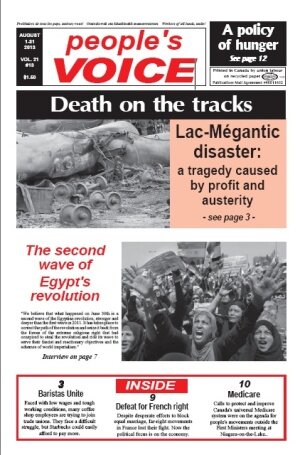
1) LAC-MEGANTIC: A TRAGEDY CAUSED BY PROFIT AND AUSTERITY
2) PQ, LIBERALS, CAQ BREAK QUEBEC CONSTRUCTION STRIKE
3) TELL THE POLITICIANS: CANADIANS DEMAND BETTER UNIVERSAL MEDICARE
4) BARISTAS OF THE WORLD, UNITE!
5) THE PAST IS THE PRESENT - Editorial
6) WHISTLE-BLOWER OF THE MONTH - Editorial
7) STARVATION INFLICTED ON FIRST NATIONS CHILDREN
8) GAY RIGHTS VICTORY A SETBACK TO FRENCH ULTRA-RIGHT
9) SIXTY YEARS SINCE THE CUBAN REVOLUTION
10) "MIDDLE CLASS REVOLUTION": A NEW END OF HISTORY?
11) MUSIC NOTES, by Wally Brooker
PEOPLE'S VOICE AUGUST 1-31, 2013 (pdf)
People’s Voice 2013 Calendar
”Ideas of Revolution”

|
People's Voice deadlines: September 1-15 September 16-30 Send submissions to PV Editorial Office,
|
REDS ON THE WEB
http://www.parti-communiste.ca/
peoplesvoice.ca
www.ycl-ljc.ca
www.solidnet.org
|
People's Voice finds many "Global Class Struggle" reports at the "Labour Start" website, http://www.labourstart.org/. We urge our readers to check it out! |
* * * * *
People's Voice
Canadian Publications Mail Sales Product Agreement #205214
ISSN number 1198-8657
People's Voice is published by
New Labour Press Ltd
PV Editorial Office
706 Clark Drive,
VANCOUVER, B.C. V5L 3J1
Phone:604-255-2041
Fax:604-254-9803
email: pvoice@telus.net
Editor: Kimball Cariou : Business Manager: David Au
Editorial Board: Kimball Cariou, Miguel Figueroa,
Doug Meggison, Naomi Rankin, Liz Rowley, Jim Sacouman
* * * * * *
Letters
People's Voice welcomes your letters
on any subject covered in our pages.
We reserve the right to edit for length and clarity,
and to refuse to print letters which may be libellous
or which contain unnecessary personal attacks.
Send your views to:
"Letters to the Editor",
706 Clark Dr., Vancouver, BC V5L 3J1,
or pvoice@telus.net
People's Voice articles may be reprinted without permission,
provided the source is credited.
* * * * * *
The Communist Party of Canada, formed in 1921,
has a proud history of fighting for jobs, equality, peace,
Canadian independence, and socialism.
The CPC does much more than run candidates in elections.
We think the fight against big business and its parties
is a year-round job,
so our members are active across the country,
to build our party and to help strengthen people's movements
on a wide range of issues.
All our policies and leadership
are set democratically by our members.
To find out more about Canada's party of Socialism,
give us a call at the nearest CPC office.
* * * * * *
Central Committee CPC
290A Danforth Ave Toronto, Ont. M4K 1N6
Ph: (416) 469-2446
fax: (416) 469-4063 E-mailmailto:info@cpc-pcp.ca
Parti Communiste du Quebec (section du
Parti communiste du Canada)
5359 Ave du Parc, Montréal, Québec,
H2V 4G9
B.C.Committee CPC
706 Clark Drive, Vancouver, V5L 3J1
Tel: (604) 254-9836
Fax: (604) 254-9803
Edmonton CPC
Box 68112, 70 Bonnie Doon P.O.
Edmonton, AB, T6C 4N6
Tel: (780) 465-7893
Fax: (780)463-0209
Calgary CPC
Unit #1 - 19 Radcliffe Close SE
Calgary AB, T2A 6B2
Tel: (403) 248-6489
Ottawa CPC
Tel: (613) 232-7108
Manitoba Committee
387 Selkirk Ave., Winnipeg, R2W 2M3
Tel/fax: (204) 586-7824
Ontario Ctee. CPC
290A Danforth Ave., Toronto, M4K 1N6
Tel: (416) 469-2446
Hamilton Ctee. CPC
265 Melvin Ave., Apt. 815
Hamilton, ON.
Tel: (905) 548-9586
Atlantic Region CPC
Box 70 Grand Pré, NS, B0P 1M0
Tel/fax: (902) 542-7981
http://www.parti-communiste.ca/
* * * * * *
News for People, Not for Profits!
Every issue of People's Voice
gives you the latest
on the fightback from coast to coast.
Whether it's the struggle for jobs or peace, resistance to social cuts,
solidarity with Cuba, or workers' struggles around the world,
we've got the news the corporate media won't print.
And we do more than that
- we report and analyze events
from a revolutionary perspective,
helping to build the movements for justice and equality,
and eventually for a socialist Canada.
Read the paper that fights for working people
- on every page, in every issue!
People's Voice
$30 for 1 year
$50 for 2 years
Low-income special rate: $15 for 1-year
Outside Canada $50 for 1 year
Send to: People's Voice, 706 Clark Drive, Vancouver, BC, V5L 3J1
You can call the editorial office at 604-255-2041
REDS ON THE WEB
http://www.parti-communiste.ca/
http://www.ycl-ljc.ca/
http://www.solidnet.org/
Top of Form
(The following articles are from the August 1-31, 2013, issue of People's Voice, Canada's leading communist newspaper. Articles can be reprinted free if the source is credited. Subscription rates in Canada: $30/year, or $15 low income rate; for U.S. readers - $45 US per year; other overseas readers - $45 US or $50 CDN per year. Send to People's Voice, c/o PV Business Manager, 706 Clark Drive, Vancouver, BC, V5L 3J1.)
1) LAC-MEGANTIC: A TRAGEDY CAUSED BY PROFIT AND AUSTERITY
Central Executive Committee, Communist Party of Canada, July 22, 2013
The July 6 derailment of crude oil tank cars in the center of Lac‑Mégantic was a terrible disaster, causing the deaths of nearly fifty people, as well as extensive property and environmental damage. The Communist Party of Canada and the Communist Party of Québec express their condolences to the families and the people of Lac‑Mégantic suffering from this tragedy.
Amidst the sadness and distress, a deep sense of anger has quickly arisen against those responsible ‑ the Montreal, Maine and Atlantic Railway (MMA) and the Transport Canada, and their policies of profit and austerity.
MMA operates 820 km of railway passing through cities in Québec and Maine, and is one of several subsidiaries of Rail World, an Illinois‑based transnational, which manages and invests in railways worldwide including Poland, Ukraine, Estonia, Latvia, and the Netherlands. Rail World's stated purpose is "to promote the privatization of the rail industry by bringing together government agencies wishing to sell their interests to investment capital and management expertise."
Rail World purchased MMA in 2003 for $50 million, with nearly $15 million invested by the Caisse de dépot du Québec, and has subsequently received tens of millions of dollars in loans and grants under government infrastructure programs.
MMA is known for its aggressive practices to reduce operating costs: reducing staff, neglecting the maintenance of its network, using worn‑out equipment and using type 111 tank wagons, which are recognized as inappropriate for the transportation of oil. Between 2003 and 2010, the company laid off 35% of its staff and imposed a wage reduction of 15%.
Last year, Transport Canada provided MMA with an exemption from safety rules, to allow the company to operate trains with only one engineer on board. At the same time, the Conservative government has imposed deep spending cuts at Transport Canada, as part of its ongoing austerity measures that have gutted many public services. As of May 2013, nearly 500 Transport Canada employees had received termination notices. These kinds of attacks on public services directly compromise the public's right to consistent and reliable safety inspections and enforcement.
Parallel to austerity measures, the Conservative government is accelerating its drive to privatize many public services. The Conservatives and their predecessors have encouraged and facilitated privatizations, with generous subsidies for corporate purchases and reductions in minimum safety rules to increase profit margins. For a dozen years Québec has had a law requiring railways to provide municipalities with the list of dangerous products transported through their territory. However, this law has never been implemented because government regulation that would enforce the rules was never adopted.
Another part of the backdrop to the Lac‑Mégantic tragedy is the frantic drive toward the development and mass export of hydrocarbons, including oil from the Alberta tar sands. A product of this policy has been a dramatic increase in oil transportation by train. Canadian National, for example, has seen an increase from 5000 cars tanks per year in 2010 to about 30,000 cars in 2012. For MMA and Rail World, the skyrocketing transport of oil is a profit opportunity to which the corporation is committed, full speed, despite its inadequate and unsafe infrastructure. These developments dramatically increase the risk of more accidents and threats to the environment, particularly in the context of Transport Canada cutbacks and deregulation.
Oil corporations and the governments that parrot them will use the disaster in Lac‑Mégantic as an argument for the development of pipelines. Within one day of the tragedy, the Globe and Mail argued that "Québec tragedy reminds us pipelines are safest way to transport oil", and that "it is time to speed up the approval of new pipeline construction in North America."
Such opportunistic comments, which prey on tragedy to further maximize profit, are shameful and must be condemned. What is urgently needed, on the other hand, is a comprehensive public discussion about economic policy, and how it connects with other public interests such as safety, environmental security, employment, and social needs. As Amir Khadir, deputy of Québec Solidaire, stated, "the tragedy of Lac‑Mégantic must, I believe, lead us to reflect on the place that oil has in our economy." The tar sands are themselves an ecological disaster. It is necessary to change from a private energy industry that is focused on non-renewable resources, to a publicly owned and democratically controlled industry that is committed to developing renewable energy.
The ongoing investigation into the Lac‑Mégantic tragedy will focus on the chain of events that led to the derailment of the train, and it may determine some individual responsibilities. But focusing only on the immediate causes and the actors directly involved in the derailment will not identify the root causes of the disaster and prevent such events from happening again.
The problem is much broader and is found in the logic of capitalism itself ‑ to the pursuit of profit above all, to the drive for massive privatization and deregulation in recent decades. As we struggle to rebuild Lac‑Mégantic and for improvements to rail safety, we must also struggle for a system that places people's needs before corporate greed, for socialism.
The Communist Party calls for:
- The immediate strengthening and enforcement of rail safety regulations;
- Nationalization of rail transport, to place it under public ownership and democratic control, and the immediate repair and upgrade to the rail network and infrastructure;
- Nationalization of all natural, energy and other resources, to form the basis of an economy that will prioritize needs and interests of the people and the environment before those of corporations.
|
|
2) PQ, LIBERALS, CAQ BREAK QUEBEC CONSTRUCTION STRIKE
By Robert Luxley, Montréal
A general strike of Quebec's 175,000 construction workers began on June 17, the first such walkout since 1986. The intransigence of the employers forced the workers to strike, after months of negotiations. In terms of working days lost, the dispute was one of the largest in recent Canadian history.
The construction industry bosses, represented by the Construction Association of Quebec (ACQ) categorically rejected union demands for real wage increases, instead seeking to impose a 1% increase, well below the rate of inflation. The unions bargained for a 3% increase in the first year, and 2.75 % in each of the following two years, or 8.5% over a three year contract.
Collective bargaining in the Quebec construction industry takes place within a particular legal framework. The law divides the industry into four sectors (industrial, institutional and commercial, residential, highways and civil engineering), each with its own collective agreement. Some clauses are common to each agreement, such as union recognition, grievance and arbitration procedures, pensions, insurance, etc. Negotiations are carried out at the provincial level, and settlement terms apply to the industry throughout Quebec.
In addition to holding wages below inflation, the employers also wanted to impose significant rollbacks in working conditions, targeting the industrial and institutional/commercial sectors. In these two cases, the employers hoped to reduce overtime rates, to establish a much longer working day (13.5 hours per day, from 5:30 am to 7 pm), to impose Saturday as a day to recover time lost due to weather at the regular pay rate, and to increase labour mobility across the province.
The mood of the employers was shown as negotiations began in January 2013, when they demanded a "special law" to impose a settlement. At the beginning of June, the president of the ACQ alarmingly told a news conference that pay increases would have grave economic consequences.
According to him, construction workers should not aim to raise their incomes through a pay increase, but by working longer hours. The union demands, he claimed, would lead to a decrease in investments.
The response to this attack was unity in action. Despite their differences and criticisms, the trade unions - FTQ‑Construction, le Conseil provincial (International), le Syndicat québécois de la construction (SQC), and la CSD Construction et la CSN‑Construction - formed a common front, the Union Alliance.
A strike involving this many workers has a major economic impact. The media clamoured that the industry affects 14% of Quebec's GDP, with considerable spin‑off effects. The Bank of Canada compared the impact of the strike to the recent Calgary flood, predicting that it could curb growth rates by 0.6%. The president of the Employers Council wrote to Premier Marois: " We believe that in the interests of the economy and people of Quebec, elected representatives must meet now to discuss the adoption of a special law."
The PQ government at first refused to bow to the demands of the opposition Liberals and the Coalition Avenir Québec (CAQ), which called for the immediate adoption of a special law to end the strike and impose a legislated contract. But while claiming to support the negotiating process, the government clearly did not intend to let the strike continue for long.
After the first week of the strike, an agreement in principle was reached on June 24, covering 41,000 workers in the highways and civil engineering sector. The agreement included an immediate pay increase of 2.0%, plus 2.1 % on 2014, 2.2 % in 2015, and 2.3 % en 2016, for a total of 8.6% over four years. It also provided for increases in transportation costs and various bonuses. The issue of labour force mobility was also covered. The workers returned to work the next day, before ratifying the agreement.
At the same time, the Premier announced the appointment of a mediator, with a mandate of one week to reach a settlement. The opposition parties denounced the government for delaying the adoption of a special law, and the.employers joined in, demanding such a law to protect business owners.
On June 25, another deal was reached in the residential sector, but this time the terms were not made public before the workers could ratify the terms. Another 57,000 workers ended their strike, leaving 77,000 still out in the industrial and institutional/commercial sectors, where negotiations were at a standstill. The bosses simply stuck to their positions. As they hoped, the special law was adopted on June 30.
The legislation proposed by the PQ minority government included an 8.6% pay increase over four years, as negotiated in the highways and industrial engineering sectors, and would have extended the collective agreement of the 77,000 workers still on strike, also for four years. But the Liberals and CAQ considered these terms too favourable to the unions. They wanted to cancel the 8.6% pay increase, replacing it with an increase indexed to the rate of inflation.
After lengthy and difficult debates, the opposition parties voted with the government to impose a 2% increase and to renew the status quo of working conditions, for one year only. The special law ordered an immediate return to work, under threat of heavy fines. Only the two Québec Solidaire deputies voted against the legislation.
The Liberals and CAQ refused to maintain the status quo of working conditions for a period as long as four years, supposedly to "urge the unions to negotiate," declared Liberal leader Philippe Couillard. In reality, these parties hope to give the employers another chance to impose contract rollbacks. The battle will resume next year.
Meanwhile, the unions expressed their disappointment. "Our fundamental rights are being violated by the special law passed last night by the National Assembly, "declared Yves Ouellet, spokesperson for the Union Alliance. "While we will respect the legislation, we will continue to denounce it." On their part, the Employers' Council expressed satisfaction at the outcome.
|
|
3) TELL THE POLITICIANS: CANADIANS DEMAND BETTER UNIVERSAL MEDICARE!
Statement by the Central Executive Committee, Communist Party of Canada, July 2013
"Let us take the private economic profit out of medicine" ‑ Dr. Norman Bethune, pioneer of the movement for universal health care in Canada, 1936
When Canada's provincial and territorial premiers gather July 24‑26 at Niagara‑on‑the‑Lake, Ontario for their Council of the Federation meeting, the future of health care will be a crucial topic. Almost fifty years after Medicare was adopted by Parliament, the fight for universal, public health care is far from complete. In fact, the Canada Health Act faces serious threats from corporations and governments intent on turning our health into a source of enormous private profit.
As the "Call to Care" by the Canadian Health Coalition says, "Health care in Canada is a fundamental right without distinction of race, gender, age, religion, sexual orientation, political belief, immigration status, and economic or social condition." But as renewal of the National Health Accord looms, mobilizations by the labour and democratic movements are necessary to defend this right from the "medical‑industrial complex" private interests.
It took similar public pressure in 2004 to force the First Ministers to boost federal support for healthcare by $41 billion over the following decade. That deal narrowed a huge funding gap created by Liberal cutbacks during the mid‑1990s, but did little to block the invasion of private profiteers into the public health system.
Canadians are justifiably proud of Medicare and the Canada Health Act principles of universality, accessibility, comprehensiveness, portability, and public administration. But Medicare has been badly undermined for many years, as provinces turn over chunks of the system to big business. Core hospital services such as laundry, housekeeping and meals have long been contracted out, and many clinics and hospitals are being turned into profit‑making operations.
As the Communist Party stressed in 2004, "this process has been devastating for the most important element of the system: healthcare workers who provide front‑line care. By treating valuable, skilled workers as disposable, governments and administrators have weakened the entire system, with negative results for patients."
While the 2004 accord increased the federal share of funding, other elements of the agreement have been sabotaged by the Harper Conservatives.
Progress on reducing wait times for diagnostic tests and surgeries has fallen far short of expectations in most provinces. The National Pharmaceutical Strategy, aimed at cutting overall drug costs through bulk buying and better co‑ordination, has been effectively killed by the Harper government. Plans to create a pan‑Canadian home and continuing care strategy have stalled, leaving huge numbers of people with heavy expenses for post‑hospital prescriptions and rehabilitation. The closure of tens of thousands of hospital beds over the past 20 years has dramatically strained access to acute and chronic care in hospitals, prematurely forcing many patients into nursing homes and home care. Many of these public services have been taken over by for‑profit companies that maximize user fees in pursuit of higher profits. Nor did the 2004 agreement end the racist underfunding of health care for Aboriginal peoples, who were shut out of the negotiations at that time.
Even as the burden of health care is shifted onto patients and their families, the federal Conservatives refuse to discuss a pan-Canadian drug program and home care, or to meet with provincial governments about renewing the health care funding formula.
In fact, the Harper Tories aim to slash funding by $36 billion over the next several years, reversing the gains in the 2004 health accord. The latest federal budget includes big cuts to the Health Council of Canada and health services for veterans and refugees. The Tories blatantly refuse to uphold single‑tier Medicare in provinces such as British Columbia, where private clinics openly break the law by extra‑billing patients.
As the Canadian and Ontario Health Coalitions warn, if the premiers allow the health accord to expire without comment, they will have betrayed a public trust to defend our public healthcare system.
The sad reality is that these governments are accomplices in a drive by the ruling class to shred the social safety net achieved through decades of struggles by working people. This neoliberal agenda deliberately targets job security, pensions, social assistance, affordable housing, public education, child care, labour rights, health and safety ‑ everything which makes it possible for working people and their families to have a decent life. Instead, acting at the direction of the "one percent", governments trample the interests of the vast majority of the people. This pattern is a global trend, as a capitalist ruling class mired in economic crisis seeks to protect the bloated profits of transnational banks and corporations by driving down the economic and social conditions of working people.
It's time to put the heat on the politicians through mass struggle, including strike action. When the Health Accord is discussed, Aboriginal people must be at the First Ministers table. Health care must be recognized as a fundamental human right and a public good, delivered on a not‑for‑profit basis, not privatized and contracted out. The federal government must fully assume its responsibilities for funding and enforcement of the Canada Health Act. The system must be expanded to include universal pharmacare, home care, long term care, opticare and denticare, and a mental health strategy. Decent wages and working conditions for health care workers must be recognized as essential.
Mass, united action is needed to drive the profiteers out of the public health care system. It's time to put the health of the people before the profits of the corporations!
|
|
4) BARISTAS OF THE WORLD, UNITE!
By Kimball Cariou
Baristas are starting to organize in Nova Scotia, and fast food workers have become increasingly militant in the United States. These two developments are linked to the efforts by big corporations to squeeze out maximum profits, at the expense of the huge service industry workforce in North America.
The recent Nova Scotia case has drawn considerable media attention, after Halifax employees at the Just Us! coffee cooperative chain joined Local 2 of the Service Employees International Union. The chain says that any new shops that open will be unionized.
This is not the same as organizing a big transnational food company. Just Us! Co‑op set out in 1995 "to become Canada's first Fair Trade coffee roaster... a small, but bold experiment to show that the coffee business, and all businesses, could be done differently, putting `People and the Planet before Profits' locally and globally."
Even so, it took a sharp struggle to make this breakthrough. Last April, two Just Us! employees who went to the Labour Board claiming that they were fired for their union activities. Putting "people before profits" apparently did not immediately extend to front line employees, as sometimes happens in cooperatives.
On a larger scale, workers at two Second Cup cafes, a large cross-Canada chain, voted recently on whether to unionize. The results of that vote have not yet been released.
How large is this sector? In the United States, 11 million people are employed in the food service industry, with about 1.1 million here in Canada - or about 6% of the total workforce.
But working conditions and incomes in this sector lag far behind the average, largely because few food service workers are organized. There are important exceptions, of course, such as many employees at arenas in the major cities. However, these unionized workers are often employed only irregularly; at Rogers Arena, where the Vancouver Canucks play, hundreds of part-time workers operate concession stands, but only for five or six hours during each of 40-50 home games per year, plus the occasional concert event.
Statistics Canada reports that employees in the accommodations and food services sector are paid an average of about $16 per hour (compared to $24 for the entire workforce), with weekly incomes of about $370. In other words, a typical working week is between 20 and 25 hours. Take-home pay works out to less than $19,000 per year, forcing most to find other low-paid jobs to make ends meet.
The trend is similar in the United States, or perhaps even worse. U.S. food service workers average about $10.20 per hour, with total annual earnings of $20,000 for those employed full time. In both countries, about three-quarters of this workforce are women, and disproportionately come from racialised communities.
As the costs of housing, food, transportation and other necessities soar, workers in these jobs find it harder and harder to survive. And as the capitalist economic crisis continues, other employment options have become even less available.
This is certainly true for coffee shop workers. Traditionally - or at least since this sector boomed in the 1980s - many baristas have been students, pouring espressos and lattes part-time to help pay for tuition and living expenses. Starbucks and other chains and independent outlets were happy to hire students, relying on a relatively cheap workforce that turns over regularly.
That pattern began to change in the 1990s, when baristas started to organize for better pay and hours. One of the outstanding examples was in Vancouver, where 150 employees at twelve Starbucks franchises joined the Canadian Auto Workers. The CAW won some improvements in job language and shift scheduling thanks to an organizing drive in 1996.
But the company resisted changes in wages or benefits at the unionized stores. Starbucks employed classic employer techniques, stalling negotiations while cutting down the hours of pro-union workers, or finding excuses to replace them with new employees. The CAW fought back with an "un-strike" and other creative tactics, but by 2007 the union was decertified at its seven remaining outlets.
At the time, the CAW said Starbucks never had any interest in trying to work with the union. High staff turnover rates affected union strength, as many pro-union workers ended up leaving after a year or two. Even so, the union considered Starbucks a "pretty good employer" by the "abysmal" standards of the service sector. But "when you look at their profitability, they could actually pay their people a living wage and still make money but they don't do that," a CAW representative said.
Today, of the 80,000 workers employed directly by Starbucks worldwide, fewer than 130 are currently union members.
Will the Second Cup and Just Us! baristas launch a significant change in the food services industry? Time will tell, but clearly, their success could have a huge positive impact for twelve million workers and their families across the continent.
|
|
People's Voice Editorial
The revelations that Canadian scientists deprived Aboriginal children of milk and other nutrients during the 1940s and '50s is further confirmation that the term "genocide" is quite appropriate to describe the origins of Canada. For decades, the strategy of the Canadian state was to eliminate the national identities of First Nations, Inuit and Metis peoples, with the aim of creating a uniformly "European" population. Various tactics were employed for this racist policy: the reservation system (essentially the theft of First Nations lands), residential schools ("taking the Indian out of the child"), the potlach ban, etc.
Those who naively argue that these policies are just "history" should think again. Many First Nations languages are disappearing, in part due to government refusal to provide financial support to save this invaluable cultural heritage. Aboriginal children suffer the highest poverty rates in Canada, leaving many suffering from hunger decades after the criminal "experiments" of the post-war years. The videotaped brutal beating of an Innu man by two Quebec police officers is a new reminder that state violence against Aboriginal people is still frequent. Attempts by governments and energy corporations to bribe and bully First Nations into allowing tar sands pipelines across their territories shows that the great land theft of previous centuries continues today.
The national oppression of the First Nations, Inuit and Metis peoples is not a relic of the past, but an defining feature of the Canadian colonial state. Instead of issuing more phony, paternalistic apologies and promises, Canada must move towards a new, equal and voluntary partnership, freely negotiated by the Aboriginal peoples. Quebec and English-speaking Canada, including the right of all nations to full self‑determination.
|
|
6) WHISTLE-BLOWER OF THE MONTH
People's Voice Editorial
If there were any justice, Sylvie Therrien would be receiving a medal for service above and beyond the call of duty. Instead, she has been suspended without pay, after leaking documents showing that federal investigators cut people off from employment insurance benefits in order to meet quotas.
Therrien's documents show that she and other investigators were ordered to find $485,000 in "savings" each year by denying EI claims. After first denying that any such quotas existed, the Harper Conservatives launched a witch-hunt to find out who spilled the beans. Under interrogation, Therrien admitted that she was the source of the leak.
"I knew my job was in peril. I knew that, but I couldn't continue. I couldn't sleep," Therrien said. "I was thinking just about those people... I was going to send them and their children into the street... and now here I am on the street."
The case may well end up in court, but it proves that pro-corporate governments will leave no stone unturned in their efforts to force workers to accept the lowest possible wages.
The documents show that Service Canada investigators were instructed to examine 1,200 EI recipients, by checking addresses, bank accounts, medical documents, and physical appearances, even knocking on the door of claimant's homes to ask for an interview on the spot. These investigations are not based on evidence of wrong-doing or cheating, they are simply random checks of recipients who have paid into the EI program while working.
At the same time, the Harper Tories (like the Liberals before them) have slashed the number of Canada Revenue Agency auditors responsible for tracking down corporate tax evasion such as offshore havens. That should tell you everything you need to know about Stephen Harper, prime minister of a government dedicated to making the rich richer, and the poor poorer.
|
|
7) STARVATION INFLICTED ON FIRST NATIONS CHILDREN
(PV Vancouver Bureau, with files from CBC and Canadian Press)
The latest chapter in the story of genocide against Aboriginal peoples in Canada came to light in mid-July, with news reports about shocking experiments against children in the residential school system during the 1940s and '50s.
Recently published historical research shows that for over a decade, about 1300 people, mostly children, were deliberately starved by government researchers. Milk rations were halved, essential vitamins were kept from people who needed them, and dental services were withheld.
Researching the development of health policy for a different project, nutritionist Ian Mosby uncovered "vague references to studies conducted on Indians,"and found the details of a government‑run experiment.
According to news reports, Justice Murray Sinclair, chair of the Truth and Reconciliation Commission, became aware of the experiments during their collection of documents relating to the abuse of native children at residential schools across Canada from the 1870s to the 1990s.
The experiments are entrenched with the racism of the time, says Sinclair.
"This discovery, it's indicative of the attitude toward aboriginals," Sinclair said. "They thought aboriginals shouldn't be consulted and their consent shouldn't be asked for. They looked at it as a right to do what they wanted then."
In his research paper, published in May, Mosby wrote, "the experiment seems to have been driven, at least in part, by the nutrition experts' desire to test their theories on a ready‑made `laboratory' populated with already malnourished human experimental subjects."
The first experiments began at Norway House in northern Manitoba in 1942, where federal scientists found "isolated, dependent, hungry people," impoverished by the collapse of the fur trade. The demoralized Cree population, they concluded, were marked by "shiftlessness, indolence, improvidence and inertia," traits they regarded as "hereditary" rather than the results of malnutrition. These people were considered ideal subjects for tests on the effects of different diets. The scientists calculated that the local people were living on less than 1,500 calories a day, far less than the 2,000 generally required by healthy adults.
Instead of recommending an increase in support, they selected 125 out of a group of 300 Cree residents to receive vitamin supplements, which were withheld from the rest.
The research was expanded in 1947, to involve about 1,000 children at residential schools in Port Alberni, B.C., Kenora, Ont., Schubenacadie, N.S., and Lethbridge, Alta.
At one school, milk rations were deliberately held to less than half the recommended amount, to get a "baseline" reading for when the allowance was increased. At another school, children were divided into one group that received vitamin, iron and iodine supplements and one that didn't. One school depressed levels of vitamin B1 to create another baseline before levels were boosted.
To compare the results, children at one school were allowed none of the supplements.
CBC has reported the recollections of 76-year-old Alvin Dixon, who was forcibly taken from his family in Bella Bella, on British Columbia's northwest coast, and relocated to Port Alberni, where he says he and many of his classmates were starved.
Dixon remembers having to milk cows during his stay at the residential school, yet he was always fed only powdered milk.
"We would be so hungry and we would steal these potatoes [from farmers' fields] and eat it raw," he told CBC News.
"The term `guinea pig' comes to mind quite quickly and readily, because that's what we were, I guess," says Dixon, who recalls having to fill out forms about his food consumption. By the time he reached high school, Dixon said he remembers being smaller compared to his non‑aboriginal classmates.
The chief councillor of the Tseshaht First Nation in Port Alberni has demanded an apology from the federal government.
"Canada has been sitting on this and hiding this information from the aboriginal people now since it first happened in the '40s and '50s," said Hugh Braker, who added that the band is horrified by the revelations.
(Written with files from CBC and Canadian Press)
|
|
8) GAY RIGHTS VICTORY A SETBACK TO FRENCH ULTRA-RIGHT
By Adrien Welsh
Finally, it happened! In the country which considers itself the homeland of human rights, the French Revolution and the Paris Commune, Vincent and Bruno could celebrate their wedding on May 29th. The first civil marriage between two people of the same sex put an end to legal discrimination based on sexual orientation in France.
While gay couples previously had the possibility to contract a civil union or pacte civil de solidarité, only now are certain rights of so‑called "traditional" marriage guaranteed, including the right to legally adopt children.
Vincent and Bruno's union, celebrated in Montpelier in the south of France, followed months of mobilization by socially-progressive forces. An important contribution was made by the French Communist Party and its youth movements, which confronted the far‑right and religious lobbies, and demanded the group Civitas be shut down.
The Catholic Civitas movement garnered considerable media attention, but failed to build a broad movement. Even staunch opponents of the marriage law, like the Cardinal‑Archbishop of Paris, André Armand Vingt‑Trois, were forced to call Civitas "un groupe borderline," or fringe.
Repeated calls by Civitas for homophobic demonstrations ended almost every time in riots. For example, last November women with the activist group FEMEN held a media stunt in support of the bill, dressing up in nuns' head dresses and with anti‑religious slogans painted on their bare chests. The women were harshly beaten by Civitas supporters.
The last Civitas mobilisation was held on May 26. Organisers claimed over one million people in the streets of Paris, although police sources believe there were about 150,000 participants.
The first gay marriage in France was therefore celebrated in a tense climate three days later. In addition to the guests, more than 140 media outlets and 200 riot police attended the ceremony. But many commentators felt that this sharp social confrontation could have been avoided had the law been voted earlier.
When Christiane Taubira, the Minister of Justice, originally presented the law, it would have been easily approved in the National Assembly, since Prime Minister Hollande's Socialist Party and coalition of other "Radical, Citizen and Miscellaneous Left" parliamentarians have a majority.
Instead, the government stalled, giving various reactionary forces several months to organize. Further delays took place when a much larger than usual number of amendments were proposed by right‑wing parties.
Since Francois Hollande's election in May 2012, which promised "change," only the extension of the right of marriage has actually been accomplished. But since the Socialists took power, there are 1000 more unemployed each day, representing over 730,000 people. Among the youth, more than 25% are unemployed.
As some commentators have said, same‑sex couples can now get married ‑ but can they find a job?
Hollande's policies are arguably worsening the economic climate for working people. Rejecting nationalising key sectors like automobile factories, Hollande has given 20 billion euros to the big corporations through tax cuts. The government has slashed pensions, and is pushing for "flexibility in employment" with its national inter‑professional agreement. The Minister for Higher Education, Genevieve Fioraso, is on the path of privatizing post-secondary education.
Hollande's government also spent billions of euros conducting an imperialist war in Mali, while claiming there are no funds left, and that the austerity "cure" is the only solution.
To confront these policies, the Communist Party and its progressive allies have tried to build a strong mobilisation. But without the full participation of the labour movement (especially the CFDT unions, which support the Socialist government), these initiatives have yet to lead to a broad movement.
This underscores how important it is to extend the right of marriage for everybody, to prevent any possibility for the ruling class to divide working people on any racial, ethnic, linguistic, religious or sexual basis. From this perspective, progressive and democratic social movements, and especially the Communist Party through its LGBT collectives, played a leading role.
It appears that the Socialists also benefited from a rather opportunist political calculation. By leaving so much time between November 2012, when he announced the marriage equality law, and its adoption in May, Hollande granted time for right-wing forces to mobilise. This broadly supported but also somewhat polarizing law became the centre of French political life, and all opposition to the Hollande government was led by the right.
This problematic situation led to serious consequences. First, most progressive forces, including the Communist Party, tended to support the government on most issues against the right-wing opposition, instead of building a genuine critical mass movement, oriented on a people's agenda and with working class demands at the core.
Perhaps most importantly, political debate in France became focused on gay marriage to the exclusion of other social and class issues. This helped big business, as anti‑popular measures were approved without any strong opposition in the streets.
Next year's municipal elections will be another important struggle, as leftists and Communists continue to try to block the rising Front National, a party linked with extreme‑right and anti‑immigrant movements.
(Adrien Welsh is a member of the international commission of the Young Communist League of Canada, and a European correspondent for People's Voice.)
|
|
9) SIXTY YEARS SINCE THE CUBAN REVOLUTION
Guest Editorial by Vinnie Molina, Communist Party of Australia
On July 26, 2013 Cuba and people around the world in solidarity will commemorate the 60th anniversary of the historical attacks on the Moncada and Carlos Manuel de Cespedes Barracks.
Cuba prior to 1953 had economic and political conditions that exacerbated the class struggle. The Cuban people resolved that the resistance movement had to utilise all forms of struggle to defeat the dictatorship. The attacks of July 26 were considered a military defeat but are regarded as the spark of the Cuban revolution that later triumphed on January 1, 1959.
Fulgencio Batista had come to power through a coup d'état in March 1952 and led a dictatorship until fleeing the country at the end of 1958 after being pushed out by the victorious Rebel Army.
Fidel Castro led the failed 1953 attacks on the Moncada Barracks in Santiago de Cuba with just over one hundred patriots while a smaller number attacked the Carlos Manuel de Cespedes Garrison in Bayamo.
The main objective was to attack the military installations and gain control of the military armaments for distribution to the people and to spark an armed insurrection. Unfortunately this objective was not achieved and most of the combatants were captured, tortured and assassinated. Only a handful had their lives spared and were taken prisoners serving long sentences; among them Fidel, Raul Castro and Juan Almeida among others.
The attacks however sparked a mass movement that campaigned for the freedom of all political prisoners forcing the Batista regime to grant an amnesty two years later releasing the Moncada survivors.
Fidel, Raul and others spent time exiled in Mexico where they organised the Granma expedition, which was joined by Ernesto Che Guevara. The expedition landed in Cuba in December 1956.
They confronted Batista's army soon after landing and faced many casualties. The few survivors from the Granma expedition engaged the people of the Sierra Maestra in the struggle for freedom. A Rebel Army was organised that through heroic battles defeated the army of the dictatorship marching to Havana in January 1959.
July 26 is now a public holiday in Cuba; the Day of National Revelry, which was first, commemorated on July 26, 1959. This first commemoration was attended by thousands of Cubans from the countryside in support of the revolutionary government's agrarian reform.
Sixty years after the historical Moncada attacks, the people of Cuba continue to support the socialist government and the gains of the revolution and commemorate this day as the spark of the revolution.
This July 26 the Communist Party of Australia salutes the people of Cuba and their determination in continuing to build a Socialist society. The CPA also reaffirms its solidarity with the Cuban people in their struggle against the US blockade and for the freedom of the Cuban Five.
|
|
10) "MIDDLE CLASS REVOLUTION": A NEW END OF HISTORY?
By Zoltan Zigedy, http://zzs‑blg.blogspot.com/
The US is notoriously unkind to "intellectuals." Popular culture portrays intellectuals as absent‑minded, divorced from the everyday world, and obsessed with spinning useless, but harmless abstractions. They are good to keep contained in universities where they can give future cogs in the capitalist machine a taste, but not a passion for, impractical thought. Regrettably, those posing as intellectuals have gone far to earn contempt, favouring arcane, specialized languages and scholastic debates.
That's not to say that there is no room for thinkers in the US, but they are dubbed "pundits," "experts," "researchers" or "consultants," words that ring with practicality and single‑mindedness; they are purveyors of small, easily digested ideas and not the "big" ideas associated with intellectuals.
In the US, we are taught to distrust big ideas unless they are linked to religions. But then religion has been compartmentalized, shunted off to Sunday mornings or weddings and funerals. All the big ideas we need were decided with the ratification of the US Constitution.
We can thank corporate marketers and their masters for our continuing alienation from big ideas and taste for small ones. They prefer ideas that are easily and flashily packaged, readily digested, and quickly obsolesced. They select for us ideas that can go "viral," grabbing the attention of not thousands, but millions. They select ideas that easily fit in a two‑minute TV commentary or on 6 or 8 column inches of news print. Intellectuals didn't invent the term "sound bite." Nor did they invent "twitter." Corporate taste makers did. So what we get in the market place of ideas are small ideas, commodified ideas with shiny packages.
Thus, it may be hard to understand how Francis Fukuyama fits into the world of ideas. We know him for his celebrated 1992 book, The End of History and the Last Man, an ambitious intellectual tome designed to place triumphant capitalism and its attendant bourgeois democracy at the pinnacle of a long historical, dialectical process. A big idea indeed!...
Fukuyama's big ideas can take small credit for the pious military crusades led by the US ruling class in the Balkans, Iraq, Afghanistan, and recently in Libya and Syria, as well as the meddling in Eastern Europe, the Middle East, Latin America and Africa. Those who failed to accept the end of history soon felt the wrath of history's enforcer. At the same time, the resistance to Fukuyama's vision of history's end challenged his big idea. The intense confrontation between the US and peoples in the Middle East and Latin America shattered the idea that with the demise of the Soviet Union the world would rush to embrace the values of the US and Europe.
With the "end of history" forestalled by unforeseen events, Fukuyama knocked around the research institute/think tank/academic circuit, writing books and resisting the temptation to join the courtiers of the mass media trading in small, nasty ideas. He passed on the enormous earnings available to the likes of the O'Reilly's, Limbaugh's, or the other aristocrats of wind‑baggery. Instead, he scoured the landscape to find new opportunities to float big ideas.
And now he's back with a new big idea.
Fukuyama won a think‑piece in the June 28/29 weekend Wall Street Journal entitled "The Middle Class Revolution." He argues that "All over the world, today's political turmoil has a common theme: the failure of governments to meet the rising expectations of the newly prosperous and educated." Cognizant of the worldwide mass risings of recent years, Fukuyama chooses this moment to offer an explanation, a theoretical explanation for those risings, an explanation palatable and comforting to US elites....
Unfortunately, he gets it all wrong.
He builds his case around reflections on events in the streets of Tunisia, Egypt, Brazil, and Turkey, a mixed collection neither reflective of all of the mass activity of our time nor sharing many common features. Seduced by recent headlines and sensationalist accounts, Fukuyama finds the "middle class" as the revolutionary agent in all cases. Besides the elusiveness of the term, he offers no evidence beyond youth, cell phones, and the presence of a vaguely sensed entrepreneurial spirit to justify the assignment of this role. And he is equally slippery in explaining what constitutes a "middle class." Instead, he considers a series of candidates: income ($6,000‑30,000 year), relative income (the middle of a country's income distribution), and relative level of consumption (greater than the subsistence level of the poor). Rejecting these, he settles on "education, occupation, and the ownership of assets," none of which is produced as evidence regarding any of the particular countries under review. In fact, the demographics of the four "revolutions" fail to show common attributes; nor do they demonstrate a rising of the "middle class."
When Mohamed Bouazizi, a fruit vender in Tunisia, set himself afire in December of 2010, he became the symbol for the uprisings that pundits have dubbed "the Arab Spring." Tunisia, under Ben Ali, was one of the success stories of neo‑liberalism, a poster child for corporate‑friendly "competitiveness" and foreign investment. Its industrial and service economies were relatively well developed.
While the neo‑liberal regimen delivered growth, modest GDP/capita, some social benefits (education and welfare), it was rocked by the economic crisis and the scourge of high unemployment. The youth (constituting nearly half of the population) endured one of the world's highest unemployment rates: 30.7%. As in the US, Tunisian youth are relatively well educated, but denied access to meaningful employment. The relative affluence of Tunisian elites enjoying the fruits of a growing economy and the lack of opportunity for a youthful population spurred the overthrow of Ben Ali.
Egypt presents a different picture. While Sadat and Mubarak also embraced the tenets of neo‑liberalism, they did so in the shadow of Nasser's legacy of anti‑imperialism, public ownership and social welfare. Moreover, free market capitalism fared far worse in this country. Despite a large industrial base and due, in part, to a relatively large agricultural sector (56.5% of Egyptians live outside of urban areas), Egypt achieved a GDP/capita roughly only 2/3 of that of Tunisia.
But Egypt shares with Tunisia an extremely youthful population with massive un‑ and underemployment. With little government educational expenditure, it is no surprise that Egyptians have a relatively low participation in higher education.
Egyptian professionals ‑ the social base for the Muslim Brotherhood ‑ could count as a "middle strata," though they are a small part of the population. Most Egyptians, however, enjoy an income only marginally above poverty, marking membership in what would properly be considered the working class.
The global economic downturn only brought the plight of young Egyptians to the fore and prompted mass action and the deposing of Mubarak. The subsequent Morsi presidency brought a further disintegration of the economy and a spike in unemployment and poverty. The Muslim Brotherhood failed to attempt an exit from neo‑liberalism and restored the foreign policy of Mubarak, even betraying the Syrian government to imperialism.
The people have again taken to the streets. In the words of Salah Adly, General Secretary of the Egyptian Communist Party, Egyptian Communists believe "that what happened on 30th June is a second wave of the Egyptian revolution that is stronger and deeper than the first wave in 2011. It has taken place to correct the path of the revolution and seize it back from the forces of the extreme religious right..."
The street demonstrations in Turkey, a country that has one historic foot in the Arab world and a tentative one in Europe, is more a political struggle than an explosion of economic discontent. Turkey's demographics are similar to a European country, a poorer European country like Portugal or Poland, but with a much higher percentage of youth in the population. The Islamist president Erdogan represents cultural traditions that conflict with that of more secular youth. Of course others, including workers, who have economic demands, support the demonstrations, as do unemployed youth. But they do not challenge the structures of bourgeois democracy or monopoly capitalism. Turkish Communists recognize this fact. As Kemal Okuyan, a member of the Central Committee of the Communist Party of Turkey, states "... this is an outburst of a huge social energy. It is powerful in extent and effect. But there are some Marxist criteria for defining a situation as a revolutionary crisis. We are far from that. At least for now..."
Brazil, Fukuyama's final example of a "middle class" revolution, demonstrates its own unique demographics and weaknesses. Despite showing exceptional economic growth, Brazil counts as one of the most economically unequal countries in the world. Highly urbanized, Brazil's poverty is concentrated in city neighbourhoods, with all of the attendant social problems of poverty intensified. The large and growing service sector affords enough jobs to contain unemployment below crisis levels. But grinding poverty and the contrasting extreme concentration of wealth produce a persisting tinderbox.
Brazil's social democratic government has shown occasional anti‑imperialist spunk, standing up to US arrogance at different times. This, along with the government's competent management of the capitalist economy, and some social welfare initiatives, has spawned national pride. At the same time, support for the government is fragile because of its inability to dent the massive economic and social inequalities suffered by working people. This contradiction between national sentiment and contempt toward the working class was brought home by the mass objection to new soccer stadia, in a soccer‑crazed country, expressed by the mass demonstrations.
Clearly what all of these countries do share is a popular response to the failure of leaders, institutions, and political parties to overcome the legacy and reality of colonialism, imperialism, and global capitalism. Fukuyama hides this failing behind the mythology of middle class dissatisfaction with the level of consumerism and cultural expression: they rebel because they want to be like us in Europe and the US. One would never guess that an almost unprecedented and persistent economic calumny has shaken the social and political foundations of nearly every country over the last five years. One would never guess that all four of the countries under discussion suffer from severe economic and political problems unsolved by their past and current leaders.
In Tunisia, Ben Ali's embrace of neo‑liberal fundamentalism was a bankrupt answer to youth unemployment. In Egypt, corrupted leaders brazenly counted on the accommodation with imperialism to prop up their aloof rule over an abused people. Turkey's leader, like politico‑theological leaders of other persuasions, overstepped the limits of governance and opened the door to airing the many grievances of the opposition, formerly trumped by religious commitment. And Brazil's social‑democratic government learned the folly of attempting to manage capitalism while promising to rectify its inequities.
From the Indignados to the Occupy movement, from the revival of the Latin American left to the Arab Spring, authentic popular up‑risings have emerged from the failure of capitalism to deliver the future and security so seemingly assured before the great crisis of 2008. Millions have been failed by the institutions, parties, and leaders that they formerly trusted. It's not as though they have been dealt a bad hand, but it is as though there is no good hand to be found in the deck.
Spinning theories based on such a corrupted sociological idea as the "middle class" guarantees failure. Of course one can't blame Fukuyama entirely for buying in on one of the great intellectual frauds of our time. Everyone, from the Chamber of Commerce to the misleaders of labor, likes to remind us that we are all members of a vast collection of people located economically between the rich and the poor. Within this distorted picture there is something for everyone. We all share home ownership, a good job, vacations, family, and comforting values, so the fantasy goes. The unfortunate poor are with us because they have failed, though they deserve our compassion and, perhaps, our charity. The rich are with us because they are successful and merit our respect. This harmonious picture is only disrupted when the rich get too greedy or the poor get rebellious.
This myth serves the ruling class, their political flunkies, and labor's class collaborationists in maintaining class peace and stability. But most importantly, it obscures the real class divide between employers and employees.
The divisions that spark genuine revolution are not between some muddy notion of a middle class at odds with an equally obscure spectre of government, but between the power and dominance of capitalist corporations and the diverse and largely unrepresented workers who enrich them. This sharply drawn class division accounts for the fundamentally economic, but also cultural and spiritual alienation of youth. Whether conscious or not, this division generates discontent and outrage. Expressed in many ways, the conflict between the employers and their employees stands behind the conflicts of the twenty‑first century. And only its resolution in favour of the employee class - the working class ‑ will bring these conflicts to a close.
It's not a new idea; it's a big, but not too big of an idea; and it's an idea that promises an escape from the failure of capitalism: Socialism.
|
|
11) MUSIC NOTES, by Wally Brooker
Sarah Harmer and the Tar Sands walk
Ontario singer‑songwriter Sarah Harmer has published an open letter on the Tar Sands Healing Walk in Huffington Post (www.huffingtonpost.ca). Harmer, co‑founder of Protecting Escarpment Rural Land and an opponent of the proposed Line 9 tar sands pipeline in eastern Canada, appealed to Natural Resources Minister Joe Oliver and Alberta Premier Alison Redford to join the peaceful walk that took place July 5‑6 along a 16‑kilometer stretch of the Alberta tar sands. She called on the Conservative politicians to "get out of their cars and walk like regular folks through an area they aren't shy about selling on a global stage." The 4th Annual Healing Walk, sponsored by Keepers of the Athabasca, was attended by more than 500 people from coast to coast. Oliver and Redford didn't join, but the campaign to compel them to meet with the affected communities continues. For more info: www.healingwalk.org.
Mos Def force‑fed Guantanano style
In an effort to draw attention to the plight of illegally‑held Muslim prisoners in the U.S. prison camp at Guantanano Bay, popular hip‑hop artist and actor Mos Def (a.k.a. Yasiin Bey) voluntarily subjected himself to nose‑to‑stomach force‑feeding and had the procedure posted on the Internet. The disturbing 4‑minute film, which demonstrates "standard operating procedure" for force‑feeding, was made by the U.K. human rights organization Reprieve with director Asif Kapadia. More than 100 prisoners, illegally detained without charges or trial, are on hunger strike at Guantanano and at least 40 are being force‑fed twice a day. Judge Gladys Kessler of the Federal District Court in Washington, DC recently ruled that force‑feeding is "a painful, humiliating and degrading process." She declared that President Obama has the power to end the force‑feeding by freeing the prisoners his own government has cleared for release. For info: www.reprieve.org.uk.
Alicia Keys & her Tel Aviv gig
Despite a 16,000 signature petition and the pleas of prominent public figures such as Alice Walker, Angela Davis, and Roger Waters, pop superstar Alicia Keys went ahead with her July 4th concert in Tel Aviv. Keys rejected the Campaign for the Academic and Cultural Boycott of Israel, arguing that her concert would "unify audiences in peace and love." She ignored the obvious fact that most Palestinians are effectively prevented from attending such concerts. Some observers were surprised, since Keys has a reputation as a socially‑conscious artist with a concern for the rights of children. Reports sent to her from Palestinian children's rights activists noted that an average of 700 Palestinian children under 18 are detained and prosecuted annually in Israeli military courts. The US Campaign for the Academic and Cultural Boycott of Israel is encouraged by the fact that so many groups and people were mobilized to urge Keys to cancel. For info: www.usacbi.org.
CBC blogger attacks misogynist pop stars
Andrea Warner, a music journalist and blogger at CBC Radio 3, called out a trio of contemporary pop stars in an article titled "Misogyny Makes a Comeback." Recently‑released songs by Rick Ross (U.O.N.E.O.), Robin Thicke (Blurred Lines), and Kanye West (On Sight) respectively celebrate drugging and raping a woman, groping after women who "want it" and (apparently) forced fellatio. While misogyny in music is not new, Warner identifies "a deliberate and task‑oriented degradation and objectification of women that's far more disturbing than the casual inherent misogyny of generations past." She notes that these artists are not an older generation of men caught up in old ways, but "younger men who were, more often than not, raised within feminism and to respect women, but who still feel it's their right to degrade and debase them." Warner has words of praise for contemporary male musicians who are outspoken in their opposition to sexism: rappers Talib Kweli and Lupe Fiasco and Canadian folk‑rocker Joel Plaskett. Read the article at http://music.cbc.ca.
David Rovics update: Into a Prism
American singer‑songwriter David Rovics has just released Into a Prism, a collection of 15 new songs. It's named after the NSA global spying program revealed by whistleblower Edward Snowden. In addition to the title song ("Prism") Rovics skewers Barack Obama and other bought‑off politicians, attacks (with characteristic wit) U.S. chauvinism and cultural imperialism, and celebrates heroes like exiled African‑American activist Assata Shakur and Vasili Arkhipov, the Soviet submarine commander who literally saved the world during the 1962 Cuban Missile Crisis. Rovics has an impressive ability to balance righteous indignation with compassion and ironic humour. He excels at incorporating historical events into his songs and making them relevant. Into a Prism is an acoustic album, and the artist's voice and guitar work are in fine form. Why is this guy not headlining the summer folk festivals? For info: http://davidrovics.bandcamp.com.
|
|