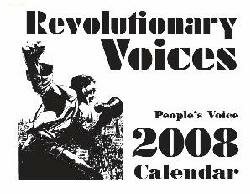
A calendar for the year 2008, dedicated to the struggles of the international working class for peace and socialism.
Featuring notable dates, short biographical sketches, plus poetry, speeches, and writings by
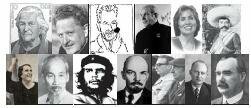
Che Guevara, Clara Zetkin, Norman Bethune, James Connolly, Emiliano Zapata, Nikos Beloyannis, Dolores Ibarruri, V.I. Lenin, Pablo Neruda, Gladys Marin, Tim Buck, Nazim Hikmet, Ho Chi Minh, and Salvador Allende.
Available for $10 plus $2 postage from People's Voice, 133 Herkimer St., Unit 502, Hamilton, ON, L8P 2H3.
|
|
|
| Theoretical and Discussion Bulletin of the Communist Party of Canada |
People's Voice deadlines:
JANUARY 1-15 issue:
Thursday, December 13
JANUARY 16-31
Thursday, January 10, 2008
Send submissions to PV Editorial Office, 706 Clark Drive, Vancouver, V5L 3J1, pvoice@telus.net
|
People's Voice finds many "Global Class Struggle" reports at the "Labour Start" website, http://www.labourstart.org. We urge our readers to check it out!
|
* * * * *
People's Voice
Canadian Publications Mail Sales Product Agreement #205214
ISSN number 1198-8657
People's Voice is published by
New Labour Press Ltd
PV Editorial Office
706 Clark Drive,
VANCOUVER, B.C. V5L 3J1
Phone:604-255-2041
Fax:604-254-9803
email: pvoice@telus.net
Editor: Kimball Cariou
Editorial Board: Kimball Cariou, Miguel Figueroa,
Doug Meggison, Naomi Rankin, Liz Rowley, Jim Sacouman
* * * * * *
Letters
People's Voice welcomes your letters
on any subject covered in our pages.
We reserve the right to edit for length and clarity,
and to refuse to print letters which may be libellous
or which contain unnecessary personal attacks.
Send your views to:
"Letters to the Editor",
796 Clark Dr., Vancouver, BC V5L 3J1,
or pvoice@telus.net
People's Voice articles may be reprinted without permission,
provided the source is credited.
* * * * * *
The Communist Party of Canada, formed in 1921,
has a proud history of fighting for jobs, equality, peace,
Canadian independence, and socialism.
The CPC does much more than run candidates in elections.
We think the fight against big business and its parties
is a year-round job,
so our members are active across the country,
to build our party and to help strengthen people's movements
on a wide range of issues.
All our policies and leadership
are set democratically by our members.
To find out more about Canada's party of Socialism,
give us a call at the nearest CPC office.
* * * * * *
Central Committee CPC
290A Danforth Ave Toronto, Ont. M4K 1N6
Ph: (416) 469-2446
fax: (416) 469-4063 E-mail info@cpc-pcc.ca
Parti Communiste du Québec
3961 Av. Barclay, App. 4
Montréal, H3S 1K9
E-mail: pueblo@sympatico.ca
B.C.Committee CPC
706 Clark Drive, Vancouver, V5L 3J1
Tel: (604) 254-9836
Fax: (604) 254-9803
Edmonton CPC
Box 68112, 70 Bonnie Doon P.O.
Edmonton, AB, T6C 4N6
Tel: (780) 465-7893
Fax: (780)463-0209
Calgary CPC
Unit #1 - 19 Radcliffe Close SE
Calgary AB, T2A 6B2
Tel: (403) 248-6489
Regina CPC
P.O. Box 482, Regina, SK S4P 2Z6
Ottawa CPC
Tel: (613) 232-7108
Manitoba Committee
387 Selkirk Ave., Winnipeg, R2W 2M3
Tel/fax: (204) 586-7824
Ontario Ctee. CPC
290A Danforth Ave., Toronto, M4K 1N6
Tel: (416) 469-2446
Hamilton Ctee. CPC
265 Melvin Ave., Apt. 815
Hamilton, ON.
Tel: (905) 548-9586
Atlantic Region CPC
Box 70 Grand Pré, NS, B0P 1M0
Tel/fax: (902) 542-7981
http://www.communist-party.ca/
* * * * * *
News for People, Not for Profits!
Every issue of People's Voice
gives you the latest
on the fightback from coast to coast.
Whether it's the struggle for jobs or peace, resistance to social cuts,
solidarity with Cuba, or workers' struggles around the world,
we've got the news the corporate media won't print.
And we do more than that
- we report and analyze events
from a revolutionary perspective,
helping to build the movements for justice and equality,
and eventually for a socialist Canada.
Read the paper that fights for working people
- on every page, in every issue!
People's Voice
$25 for 1 year
$45 for 2 years
Low-income special rate: $12 for 1-year
Outside Canada $25 US or $35 Cdn for 1 year
Send to: People's Voice, 133 Herkimer St.., Unit 502, Hamilton, ON, L8P 2H3
REDS ON THE WEB
http://www.communist-party.ca
http://www.ycl-ljc.ca
PUT DOWN THE TASERS - END POLICE BRUTALITY
(The following article is from the December 1-31, 2007 issue of People's Voice, Canada's leading communist newspaper. Articles can be reprinted free if the source is credited. Subscription rates in Canada: $25/year, or $12 low income rate; for U.S. readers - $25 US per year; other overseas readers - $25 US or $35 CDN per year. Send to: People's Voice, c/o PV Business Manager, 133 Herkimer St. Unit 502, Hamilton, ON, L8P 2H3.
Joint statement from the Communist Party of Canada and the Young Communist League, Nov. 20, 2007
The rising number of deaths involving Taser assaults by police has led a wide range of organizations to call for a full federal public inquiry into the widespread use of this weapon, and a moratorium on its use by police. The Communist Party of Canada and the Young Communist League support these demands, as part of a wider range of measures to establish full civilian oversight and control of police forces.
On Oct. 15, Robert Dziekanski died within seconds of a brutal and unprovoked Taser attack and take-down by four RCMP officers at Vancouver airport. His death was the 18th involving police use of Tasers in Canada since July 2003; an estimated 280 similar deaths have occurred in the United States since 2001.
The Dziekanski case is a tragic illustration of the misuse of this deadly weapon. The RCMP and airport authorities initially tried to downplay the key role of the police in Mr. Dziekanski's tragic death, but the attack was carried out in full view of witnesses, one of whom filmed the entire episode. The video footage shows that the officers used their Taser as the first option to deal with the Polish immigrant, who had become emotionally distressed after being stuck for many hours in the airport. After Tasering Mr. Dziekanski, the police held him down with extreme force and used the weapon a second time, a tactic which ended in his death within seconds.
Some expert observers have correctly stated that the RCMP officers involved in this badly botched operation did not follow proper procedures for dealing with a disturbed individual, particularly since Robert Dziekanski threatened no one. The list of police errors is horrifying: they took no time to assess the situation or to speak with bystanders who tried to tell them that he did not speak English; instead of beginning with less forceful measures, the police immediately used the most violent tool available; instead of helping their helpless victim to sit upright after the first Taser attack, the police continued their physical assault. The officers who committed this assault must face serious criminal charges for their utterly reckless actions. There should also be a full investigation of the role of privatised airport operations in this case.
But this incident is much more than one case of police misconduct or inadequate training. In the name of "law and order" and worshipped by the corporate media, police forces in reality are a powerful tool of the state, imposing the discriminatory prejudices of the ruling class with impunity. Limited inquiries into the circumstances of Dziekanski's death will never reveal the full scope of the problem.
Police forces regularly engage in brutal assaults against Aboriginal peoples, people of colour, immigrants, demonstrators, and so-called "troublemakers". Right across Canada, "investigations" of such abuse are conducted internally or by other police forces, with the unsurprising result that such criminal actions are almost always whitewashed. It is little wonder that many police officers assume that they can use extreme force in virtually any situation without facing consequences.
There is now a growing chorus of demands to end this impunity. Police officers who commit crimes must not get a free pass after farcical internal "reviews"; they must face the same legal standards and processes of investigation as the rest of society. The consistent pattern of racism which underlies much police brutality must be ended, with the swift removal of any officers who commit racist acts or statements.
Not least, there must be a full federal inquiry into the use of Tasers. Instead of relying on company "reports" which deny the deadly effect of this weapon, there must be a complete, unbiased scientific study of Taser deaths, and swift implementation of the necessary recommendations. In the interim, Parliament should order an immediate moratorium on the use of Tasers.
(print friendly article)
POLICE VIOLENCE REVEALS SYSTEMIC RACISM
(The following article is from the December 1-31, 2007 issue of People's Voice, Canada's leading communist newspaper. Articles can be reprinted free if the source is credited. Subscription rates in Canada: $25/year, or $12 low income rate; for U.S. readers - $25 US per year; other overseas readers - $25 US or $35 CDN per year. Send to: People's Voice, c/o PV Business Manager, 133 Herkimer St. Unit 502, Hamilton, ON, L8P 2H3.
By Kimball Cariou
The videotaped death of Polish immigrant Robert Dziekanski at the Vancouver Airport has roused a storm of protest against police use of Tasers. Unfortunately, this killing is not unique: about 18 other Taser-related deaths have been reported in Canada over the past four years, and many more deaths involve other weapons. Banning Tasers alone would not solve the issues of widespread police racism and abuse of authority, or the strategy to shield violent officers through internal investigations and other legal tactics designed to provide impunity for their actions.
Police brutality is widespread across Canada, compounded by the "law and order" and "war on terror" rhetoric of right-wing politicians and the corporate media, who consistently glorify the police and attempt to justify police crimes.
For example, since November 11, 1987, when Officer Allan Gosset killed Anthony Griffin, police in Montreal have killed at least 37 people. Most have gone unpunished, as coroners, prosecutors, and cabinet ministers cooperate to protect the cops. The situation in Montreal is not improving. Moroccan immigrant Mohamed Anas Bennis left his Montreal mosque at 6:30 am on Dec. 1, 2005. At 7:20 am, at the corner of Kent Street and Cote-Des-Neiges, he was shot twice and killed by a police officer. The shooting took place during a joint operation by the Montreal police, Quebec Provincial Police, and the RCMP, allegedly targeting "Algerian scam artists" linked to "international terrorism."
Quebec City police were assigned to investigate the killing, starting a process which can only be described as a cover-up. Eleven months later, it was announced that no charges would be laid, since there was "no evidence" that a criminal act had occurred.
The Bennis case is highly revealing. The day after the killing, the police claimed that the "unbalanced" victim used a kitchen knife to attack an officer, who fired the fatal shots in "justified self-defense." This tale was immediately challenged by Bennis' family and friends, but widely reported by the mass media. A careful study of the case indicates that the 25-year-old bearded man was "guilty" only of being a visible Muslim in the wrong place at the wrong time. It appears that "racial profiling" led a police officer to jump to the false assumption that Bennis was one of the "terrorists," igniting a tragic train of events which somehow led to the shooting.
Metro Toronto is also infamous for its levels of police brutality, particularly killings of Black men.
One early case was the 1979 shooting of 35-year-old Jamaican-born Albert Johnson. A pathologist testified in court that Johnson was probably crouching or kneeling at the foot of a stairway in his home when he was shot from above by Metro police, since the fatal bullet entered his abdomen at a 45 degree angle and travelled downward. One of Johnson's children testified that her kneeling father was shot execution style by police. Two officers were acquitted of the crime.
In August 2000, Otto Vass, a 55-year-old father of five, who ran a junk shop and a real estate business, was beaten to death by cops in a Toronto parking lot.
The police story? Responding to a call about a disturbance at a 7-11 store, they found Vass badly injured after a fight with three men who had fled the scene. When they tried to assist Vass, he tried to punch one of them. The injuries sustained in the initial fight were so serious that Vass died shortly afterwards.
But neighbours with a direct view of the parking lot saw two officers shove Vass to the ground and then savagely punch him and beat him "worse than an animal" with their nightsticks. Two more officers arrived, holding Vass down while the beating continued. Videotape from the 7-11 showed that Vass had an argument with one man, not three, and that he was unharmed when the police arrived. An autopsy report found 51 blows from police nightsticks. Charges were laid against the four officers. The eventual verdict? Not guilty.
In the early morning hours of May 21, 2004, a plainclothes Toronto officer shot unarmed Jeffrey Reodica three times in the back. The Filipino teenager was an altar boy, a marching band member, and part-time employee at Krispy Kreme Donuts. He was never arrested, nor was he part of a gang. After a four-month review, the province's Special Investigations Unit cleared the shooting officer. Evidence from witnesses at a coroner's inquest two years later disproved police claims about the killing, but the officer has gone unpunished.
Nor is this just a "big city" syndrome. On Oct. 29, 2005, Ian Bush, a young worker in the northern B.C. mill town of Houston, was ticketed by the RCMP for holding an open beer outside the local hockey arena. Bush made a flippant comment and was taken into custody. Less than half an hour later, the back of his head was blown off by an RCMP revolver. The force immediately closed ranks around the officer who pulled the trigger, taking months to concoct a "self-defence" story involving body contortions which are impossible given the angle of the shooting. No charges were ever laid in the killing.
A recent Vancouver public forum heard that there were 11 deaths in "police custody or pursuit" across British Columbia during 2004, and 13 more the next year. All such deaths in B.C. are investigated solely by police, whose findings becoming the basis for any charges. Not surprisingly, this rarely happens.
Sometimes the methods used by police to "get rid" of "troublesome" people are more devious. Perhaps the most infamous example is the racist "starlight tour," the Saskatoon police tactic of callously dumping Aboriginal men in fields outside the city during winter. That was the fate of 17-year-old Neil Stonechild, who died on a minus-28 degree night in 1990.
There are too many cases of deaths in custody to begin giving details of each. But here are a few more.
On Jan. 1, 2000, holding a pellet gun, Henry Masuka demanded help for his infant son at St. Michael's Hospital in Toronto. He died after Emergency Task Force officers shot him five times. The provincial Special Investigations Unit (SIU) said police had no choice.
In Etobicoke on Nov. 9, 1991, Jonathan Howell, a young Jamaican-born man, survived being shot but suffered brain damage. Detective Constable Karl Sokolowski was found guilty on a firearms charge, only to be granted an absolute discharge with no criminal record.
In February 1997, Charles Cooper, a suicidal man armed with a knife, was shot in the chest with a beanbag gun by an Ottawa police officer. The supposedly non-lethal beanbag lodged in Cooper's heart and killed him. A tactical unit member was cleared by the SIU.
Dudley George, a 38-year-old Chippewa man, was killed at Ontario's Ipperwash Park in 1995 by OPP Sgt. Kenneth Deane. In a rare decision, Deane was found guilty of criminal negligence causing death when a judge ruled that he knew George was unarmed.
There have been a number of deaths involving pepper spray. For example, in July 2000, Luc Aubert died of a heart attack after being pepper sprayed by four Montreal officers. Roy Sheppard died in February 1996, shortly after being pepper sprayed by Calgary police during a scuffle at the group home where he lived. Kasim Cakmak, a 37-year-old Turkish immigrant who suffered from schizophrenia, was pepper sprayed and handcuffed by police and a male nurse at the Alberta Mental Health Board on May 11, 2001. He stopped breathing and was later pronounced dead. Vernon Dale Crowe died after being pepper sprayed by Regina police inside an ambulance on July 10, 2001.
Police violence is commonplace in Winnipeg, where cops shot native leader J.J. Harper in 1988. In the early morning of Oct. 24, 1998, 27-year-old James Alexander was beaten senseless by police outside a Burger King restaurant on the city's Notre Dame Avenue. Charged with two counts of assaulting police, Alexander was later acquitted.
In 2006, cops pulled over a car in the city's North End. When a 16-year-old Aboriginal youth got out, he was elbowed in the face, thrown to the ground, and charged with assaulting an officer and resisting arrest. Allegations of racism and police misconduct in this case were investigated by the Winnipeg police Professional Standards Unit! According to Manitoba's Law Enforcement Review Agency, 251 formal complaints against the police were placed in 2005, but over half were abandoned or withdrawn, often because of the lengthy and complex process involved.
Across Canada, police attacks against Aboriginal people, members of immigrant and minority groups, and demonstrators are appallingly commonplace. Recent examples include the RCMP pepper spray assault on Squamish Nation members celebrating a soccer tournament victory, Montreal police brutality against International Women's Day marchers, and the stunningly violent arrest of US black journalist Tonye Allen by Toronto police.
The underlying problem is not the choice of weapons - it's the systemic racism and attitudes of impunity which are engrained in police forces, and the refusal of the ruling class to crack down on police violence.
(print friendly article)
THE STRIKE WEAPON - NECESSARY OR NOT?
(The following article is from the December 1-31, 2007 issue of People's Voice, Canada's leading communist newspaper. Articles can be reprinted free if the source is credited. Subscription rates in Canada: $25/year, or $12 low income rate; for U.S. readers - $25 US per year; other overseas readers - $25 US or $35 CDN per year. Send to: People's Voice, c/o PV Business Manager, 133 Herkimer St. Unit 502, Hamilton, ON, L8P 2H3.
By Sam Hammond, chair of the Central Trade Union Commission, Communist Party of Canada
The disputes raging around the CAW-Magna deal have sparked a deeper debate over the right to strike. This article will review the debate from a Marxist perspective.
The point is made by some that thousands of workers have improved their lives without the right to strike. Many unionized health care workers in Ontario and elsewhere have been legislated out of the right to strike, yet have managed through collective bargaining or arbitration to improve wages and working conditions. How can a Marxist explain this?
Some also express an opinion that the strike weapon is unrealistic in the present environment, calling for putting "new thinking" into the equation.
The majority of commentators have expressed alarm and insist the right to withdraw labour is fundamental and must be protected at all costs. They are correct, but why?
It is possible, but unscientific, to start with a conclusion - the right to strike is sacred - and then find the evidence to support it. The truth of the matter is that we have never had a complete right to strike. The right to strike in Canada is qualified in every collective agreement. The historic trade-off between representatives of capital and the organized working class is the presence in collective agreements of a standard "no strike/no lockout" clause for the duration of the agreement.
This condition was won by militant and vicious strike struggles. The "no strike/no lockout" provision is a step in a staircase, which from a left point of view was not supposed to end there.
Of course unorganized workers who withdraw their labour are subject to unchecked retribution from the bosses. Organized workers who violate the terms of a collective agreement by withdrawing their collective labour - the strike weapon unsheathed - are invariably at odds with the law. But, these wildcat strikes are not uncommon in Canadian history.
Looking at the environment subjectively will inevitably lead one to adjust to tide and flow, to survive for the moment, the day, the year or until the next contract. This view of the world doesn't require an understanding of where the road began or where it leads. The issue is not really whether we have the right to strike, but at what level we have it, and whether or not it should be expanded or given up as a negotiating point in exchange for some kind of real or imagined benefit.
Nothing in the universe or in human social development is at an absolute state of rest. Phenomena develop from the simple to the complex. Marxists base their scientific world outlook on studying the objective conditions of social being, seeking to discover the laws that govern development, the relations between quantitative and qualitative change, and antagonistic and non-antagonistic opposites. The Marxist world view known as Historical Materialism sees the class struggle as the interaction of antagonistic opposites in exploiting society, where the victory of one over the other leads to qualitative change, a revolutionary leap forward or a counter-revolution, a setback.
History does not stop. Struggle and change do not cease. Ever since the development of class society that progressed through slavery, feudalism and capitalism, antagonistic class relations have determined the state of our social being and determined who and what we are, slave or slave-owner, serf or landowner, worker or capitalist. There are strata that straddle classes or operate transiently around them, but our social identity is the product of the relations between workers and capitalists, and the level of our social and political consciousness can be measured by how close our subjective understanding is to the objective reality that exists.
Ever since capitalism reached its highest and last stage, imperialism, its ideologues and its ruling classes - because they can see the gates of the graveyard on the horizon - have tried to slow down the objective social processes that will inevitably lead to their funeral pyre.
Their weapons include military, economic and legal and social means. Our weapons are our ideology, our working class parties and the strike weapon. But bo matter how aggressive the tactics of the ruling classes appear, they are defensive in nature.
Their own economic cannibalism makes it very difficult to sustain control, and the cost of an ever demanding military apparatus so necessary to their existence becomes a component in their economic nightmare.
Therefore they must use or manipulate every organ of state power, media, educational institutions, labour law, workplace control, parliamentary parties, false ideology, etc., to try and control, to slow down the rise of social class consciousness in the exploited class.
If the social class consciousness of the working class matches the objective reality of their social being, in the ensuing sunburst of cognizance it will become obvious that the capitalist class cannot exist without us but we can exist much better in a better environment without them.
It will be obvious, as clear as the right to private property, that we possess the only thing that if taken away can destroy them, our labour. The will and ability to do this is the most dangerous threat to the ruling class and our most important asset.
It is enshrined in the working class and organized labour as the right to strike, a legal and political right we have won only partially in industrial society, more in some states less in others, never completely.
The struggle to control our own labour is the most fundamental democratic and social struggle we take part in. Therein lies the ability to defend, the ability to negotiate social conditions, the ability to protect our families, the ability to secure a greater share of the wealth we produce and the ability to act in solidarity with our brothers and sisters internationally.
To those who support capitalism, those who do not care as long as they can survive amidst carnage and suffering and to those who are just socially-historically ignorant, the right to strike qualified or not, is not important.
But there are those of us, whatever we call ourselves, who live to make real that vision of a better world, who feel anger at the conditions of ours and others lives, who resent dangling at the end of the precarious thread of capitalist greed, who are internationalists and emancipators.
We are the left and we will fight for control of our labour until the negation of exploiting capitalism and the transition to socialism. The fight for the right to strike, to withdraw our collective labour is the defining point of where we measure up in the struggle for emancipation and social justice.
Suffering is an inherent state of existence for the exploited classes throughout history. It is relative and can be eased by militant struggle, but a rest is not a holiday, and respite is not liberation. The fact of the matter is that both are worth fighting for, and the short term is a component of the larger vision. Struggle teaches method, and method requires, in the social sense, social weapons. To those who would disarm us we can very justly ask: which side are you on?
(print friendly article)
OFL WARNS THAT LABOUR WILL NOT GIVE UP RIGHT TO STRIKE
(The following article is from the December 1-31, 2007 issue of People's Voice, Canada's leading communist newspaper. Articles can be reprinted free if the source is credited. Subscription rates in Canada: $25/year, or $12 low income rate; for U.S. readers - $25 US per year; other overseas readers - $25 US or $35 CDN per year. Send to: People's Voice, c/o PV Business Manager, 133 Herkimer St. Unit 502, Hamilton, ON, L8P 2H3.
The Ontario Federation of Labour held its 50th anniversary convention at the Sheraton Centre in Toronto starting Monday, November 26. Key issues before the delegates included the massive job losses in the resource and manufacturing sectors, and the right to strike in the context of the controversial "Framework of Fairness Agreement" signed recently by the Canadian Autoworkers and the Magna auto parts giant.
After a good debate, the following resolution on the Magna deal and the right to strike was adopted unanimously by the over 800 delegates present in the hall. The CAW is not currently affiliated to the OFL; the CAW Council will discuss the Magna agreement at a meeting in Toronto this month.
Ontario Federation of Labour Emergency Resolution #5, submitted by USW Local 8782:
WHEREAS on November 6, 2007, some leaders of the CAW endorsed the Magna "Framework of Fairness Agreement" with Magna International Corporation.
WHEREAS this agreement removes from potential CAW members both the right to strike and democratic representation in their union and workplaces;
WHEREAS the OFL must continue a lead role as the voice of labour in Ontario;
BE IT RESOLVED that this historic 50th Convention of the OFL send a clear message to all employers that labour will not give up the right to strike or to the right to democratic representation in our unions and our workplaces;
BE IT FURTHER RESOLVED that the OFL and its affiliates re-affirm the rights of workers to withdraw their labour and the rights of workers for full and democratic participation in their unions and workplaces.
(print friendly article)
TSILHQOT'IN NATION WINS HISTORIC LEGAL CASE
(The following article is from the December 1-31, 2007 issue of People's Voice, Canada's leading communist newspaper. Articles can be reprinted free if the source is credited. Subscription rates in Canada: $25/year, or $12 low income rate; for U.S. readers - $25 US per year; other overseas readers - $25 US or $35 CDN per year. Send to: People's Voice, c/o PV Business Manager, 133 Herkimer St. Unit 502, Hamilton, ON, L8P 2H3.
PV Vancouver Bureau
The Tsilhqot'in (Chilcotin) First Nation in central British Columbia has won a major legal battle in the long struggle to defend their land and way of life. In a precedent-setting decision, Justice David Vickers of the B.C. Supreme Court ruled on Nov. 21 that the Tsilhqot'in people have proven Aboriginal title to approximately 200 square kilometres in and around the Nemiah Valley, south and west of Williams Lake. Justice Vickers said he could not make a declaration of title, since the Tsilhqot'in had presented an "all or nothing" legal demand for their full claim area of 440 sq. km. But he stated that aboriginal title had been proven through "continuous and exclusive occupation" in almost half the Claim Area, and urged the province to negotiate on that basis.
The trial lasted 339 days, during which 29 Tsilhqot'in witnesses gave evidence, many in their native language. More than 600 exhibits were entered, including one containing over 1,000 historical documents. The evidence proved conclusively that the Tsilhqot'in have never surrendered their traditional territories to Britain or later to Canada.
"The court has given us greater control of our lands. From now on, nobody will come into our territory to log or mine or explore for oil and gas, without seeking our agreement," said Tsilhqot'in Chief Roger William. "The court recognized that we have proven title in about half of the Claim Area - and from today we accept our renewed responsibility and powers of ownership of those lands."
Justice Vickers ruled that the Tsilhqot'in people have aboriginal rights, including the right to trade furs to obtain a moderate livelihood, throughout the entire Claim Area. He also found that B.C.'s Forest Act does not apply within Aboriginal title lands, and that the province has unconstitutionally infringed the Aboriginal rights and title of the Tsilhqot'in people since B.C. joined Canada in 1871. Parliament, he ruled, has also failed to uphold its constitutional responsibility to protect Aboriginal lands and Aboriginal rights.
In contrast to the rest of Canada and the United States, colonial governments did not make treaties with First Nations in most of British Columbia. Instead, they simply denied that indigenous people own their lands, to allow easier access to resources for corporations and ranchers. About 95 per cent of the province has been considered provincial-controlled Crown land, including surface timber and underlying mineral resources. But most of these lands are subject to claims of aboriginal title.
While the ruling may be appealed, it marks the first Canadian court decision in favour of aboriginal title. The lawsuit began as an attempt by the Tsilhqot'in to block large-scale commercial logging on their traditional territory. The Vickers ruling is a breakthrough for First Nations, since modern-day treaties in British Columbia have averaged about 5 per cent of the traditional territories claimed, plus cash compensation. In this case, the Crown had accepted the band's claims to aboriginal rights to hunt and fish in the valley, without conceding title.
"This is an absolutely critical decision and it may have significant ramifications for treaty negotiations," Shawn Atleo, B.C. Chief of the Assembly of First Nations, told the Globe and Mail in an interview.
(print friendly article)
CANADIAN CITIES "NEAR COLLAPSE"
(The following article is from the December 1-31, 2007 issue of People's Voice, Canada's leading communist newspaper. Articles can be reprinted free if the source is credited. Subscription rates in Canada: $25/year, or $12 low income rate; for U.S. readers - $25 US per year; other overseas readers - $25 US or $35 CDN per year. Send to: People's Voice, c/o PV Business Manager, 133 Herkimer St. Unit 502, Hamilton, ON, L8P 2H3.
PV Vancouver Bureau
The physical foundations of Canada's cities and communities are "near collapse," warns the Federation of Canadian Municipalities.
Released on Nov. 20, the FCM report "Danger Ahead: The Coming Collapse of Canada's Municipal Infrastructure" says that close to 80 per cent of Canada's infrastructure is past its service life. The report estimates that tackling the "municipal infrastructure deficit" will cost $123 billion.
"It took a catastrophic bridge collapse in the United States and an overpass collapse in Quebec, both with tragic loss of life, to push infrastructure decay to the top of newscasts," said Winnipeg city councillor Gord Steeves, the current FCM president. "But even when the consequences are not catastrophic, the infrastructure decay we all see around us should not be taken for granted. It points to a looming crisis that. If unchecked, will reduce our standard of living, our safety and our quality of life."
The study's cost estimates include $31 billion for waste and waste water systems, $21.7 billion for transportation, $22.8 billion for transit, $7.7 billion for solid-waste management, and $40.2 billion for community, recreational, cultural and social infrastructure.
McGill University's Dr. Saeed Mirza, leader of the study's research team, warns that "the municipal infrastructure deficit is growing faster than previously thought... Most municipal infrastructure was built between the 1950s and 1970s, and much of it is due for replacement. As assets reach the end of their service life, repair and replacement costs skyrocket. Across Canada, municipal infrastructure has reached the breaking point."
Steeves says the $33 billion earmarked by the federal government for infrastructure investments across Canada over the next seven years fall far short of the needs. As he notes, federal money is provided on an ad hoc basis to the provinces, which have different priorities than municipalities. The FCM is calling on Parliament for a national plan to fix the infrastructure deficit, and to provide direct federal funding to municipalities.
"Danger Ahead" notes that "In 1961, during the initial phase of heavy investment in Canada's infrastructure, federal, provincial/territorial and municipal governments each controlled 23.9, 45.3 and 30.9 per cent of the national capital stock,
respectively. By 2002, the federal government's share had dropped from 23.9 per cent to 6.8 per cent, and the municipal share had grown from 30.9 to 52.4 per cent of all infrastructure."
The report also points out that between 1955 and 1977, new investment in infrastructure grew by 4.8 per cent annually, falling to just 0.1 percent annually during 1978 to 2000. While capital spending by local governments has increased in recent years, this is still not sufficient to meet population growth or to rehabilitate existing capital stock.
The analysis also notes that while assuming responsibility for much of Canada's capital stock, "this had to be financed mainly through the property tax... (as) a result, the average age of municipal infrastructure increased significantly over this period."
The enormous scale of the problem calls for radical solutions, according to the Communist Party of Canada. The CPC's platform for the next federal election renews the party's historic call to give full constitutional status and wealth taxing powers to municipalities. The Communists also propose to return 50% of gas and road user taxes to cities, to provide federal funding for 25% of capital costs of municipal transit, and to re-establish low-interest loans to cities and towns. In total, the Communist platform would give municipalities the powers and funding desperately needed to tackle the growing infrastructure crisis.
(print friendly article)
(The following article is from the December 1-31, 2007 issue of People's Voice, Canada's leading communist newspaper. Articles can be reprinted free if the source is credited. Subscription rates in Canada: $25/year, or $12 low income rate; for U.S. readers - $25 US per year; other overseas readers - $25 US or $35 CDN per year. Send to: People's Voice, c/o PV Business Manager, 133 Herkimer St. Unit 502, Hamilton, ON, L8P 2H3.
The BC Federation of Labour reports that almost 600 workers from various sectors have broken ties with the Christian Labour Association of Canada (CLAC), criticizing CLAC for negotiating sub-par contracts with lower wages, poorer benefits, and inadequate representation.
"These workers have demanded a democratic choice in union representation," said B.C. Federation of Labour President, Jim Sinclair. "They want to be treated with fairness, dignity and respect on the job, and despite pressure from their employer, they won that."
In a Labour Relations Board-supervised vote counted in two health facilities on Nov. 21, workers rejected the CLAC and voted to join an HEU/BCGEU "poly-party" bargaining unit.
Two hundred and fifty health care workers at two privately-operated care facilities in the Kootenays have voted to join the Hospital Employees' Union. In Nelson, more than 90 care staff - employed by Advocare at Mountain Lake Seniors' Community - joined HEU as part of a joint campaign with the B.C. Government and Service Employees' Union (BCGEU) that also included some of the company's operations in Kelowna and Penticton. And in Cranbrook, more than 160 staff at Golden Life's Joseph Creek Village voted to join the HEU. The workers provide both support services and direct care to seniors in that community. In August 2006, the LRB found that Golden Life had intimidated and coerced workers to ratify a CLAC collective agreement.
In Abbotsford, more than 150 workers at Dynamic Windows and Doors voted to leave CLAC and become members of the United Steelworkers. Local union organizers said workers want their grievances addressed in a timely manner and to be properly represented in dealings with the company.
(print friendly article)
(The following article is from the December 1-31, 2007 issue of People's Voice, Canada's leading communist newspaper. Articles can be reprinted free if the source is credited. Subscription rates in Canada: $25/year, or $12 low income rate; for U.S. readers - $25 US per year; other overseas readers - $25 US or $35 CDN per year. Send to: People's Voice, c/o PV Business Manager, 133 Herkimer St. Unit 502, Hamilton, ON, L8P 2H3.
This article by Cathy Crowe first appeared in the Toronto Star, Nov. 15, 2007
Homelessness: a national emergency or disaster - whatever you call it, our government finds money to go to war but not build affordable housing.
In 1998, the Toronto Disaster Relief Committee formed and issued a State of Emergency Declaration, declaring homelessness a national disaster. The group's signature 1 per cent logo, a 1 per cent symbol under a roof, was crafted on a restaurant napkin late one night as a group of us lamented the amount of suffering we witnessed on a daily basis in our work on the street.
The 1 per cent campaign was a distress call - an appeal to the federal, provincial and territorial governments to simply allocate an additional 1 per cent of their budget to kick-start a new national, affordable housing program. That's the amount they used to spend on new affordable housing construction when the federal program, which had created more than half a million homes starting in 1973, was eliminated in 1993.
Cities responded quickly to the disaster declaration. Toronto voted 53 to 1 that homelessness was a national disaster. The municipalities of Ottawa-Carleton, Vancouver, Victoria, Durham Region, Nepean and Peel all passed resolutions that echoed the same sentiment. The United Nations described the situation in Canada as a "national housing emergency."
These criticisms resulted in the appointment of a federal minister responsible for homelessness and more than $1 billion allocated to homelessness relief over the next nine years through a new federal program. Yet, a succession of federal housing ministers had their hands tied, their government ignoring the need for a new national housing strategy and the money to go with it. Instead, the mantra has become polished and corporate, emphasizing privatization and home ownership, a diminished role for government and an increased charitable solution, and deeper cuts to social spending.
The results have been painfully predictable. Today, our streets are filled with homeless people and our shelters are overcrowded. The statistics are revolting: 1.8 million Canadians in core housing need, an estimated 300,000 are homeless in any given year, 60,000 are youth, 10,000 children. Aboriginal people have suffered the most, facing housing conditions both on and off-reserve that include overcrowding, inadequate sanitation, no potable water and gross levels of homelessness.
Homelessness is the worst since the Great Depression. It is now widely accepted that without a fully funded national housing program there will be persistent mass homelessness.
In the past, the chief remedy to the housing crisis was the creation of a national housing program. It was developed in response to protests led by World War II veterans who faced an acute housing shortage and campaigned for their basic human right to housing.
So, it was with some relief that many of us welcomed the words of Miloon Kothari, United Nations Special Rapporteur on the Right to Adequate Housing, in his preliminary observations at the end of his two-week fact-finding mission to Canada last month:
"Everywhere that I visited in Canada, I met people who are homeless and living in inadequate and insecure housing conditions. On this mission I heard of hundreds of people who have died as a direct result of Canada's nationwide housing crisis. In its most recent periodic review of Canada's compliance with the International Covenant on Economic, Social and Cultural Rights, the United Nations used strong language to label housing and homelessness and inadequate housing as a `national emergency.'
"Everything that I witnessed on this mission confirms the deep and devastating impact of this national crisis on the lives of women, youth, children and men."
Kothari added: "The federal government needs to commit funding and programs to realize a comprehensive national housing strategy, and to co-ordinate actions among the provinces and territories to meet Canada's housing rights obligations. Canada needs to once again embark on a large-scale building of social housing units across the country."
Nine years ago, as a somewhat naive nurse horrified by the trauma around me, I expected the federal government to act responsibly to the disaster declaration. It didn't.
Today, I see the travesty as the most blatant expenditures of federal dollars are diverted from valued social programs such as housing and child care and instead allocated to war.
While funds have not been made available to launch a new affordable housing program, the federal government has once again announced a surplus. This time it's $13.8 billion. In addition, the Rideau Institute has reported that the Department of National Defence estimates that Canada's military spending will reach $18.2 billion in 2007-8, the highest amount since World War II.
Housing will never come while we invest in war. We need a housing strategy, not a war strategy.
(print friendly article)
LATIN-AMERICAN WORKERS WIN B.C. RIGHTS DECISION
(The following article is from the December 1-31, 2007 issue of People's Voice, Canada's leading communist newspaper. Articles can be reprinted free if the source is credited. Subscription rates in Canada: $25/year, or $12 low income rate; for U.S. readers - $25 US per year; other overseas readers - $25 US or $35 CDN per year. Send to: People's Voice, c/o PV Business Manager, 133 Herkimer St. Unit 502, Hamilton, ON, L8P 2H3.
PV Vancouver Bureau
Latin-American construction workers were intimidated by companies building the Canada Line, according to a Nov. 9 ruling by the B.C. Human Rights Tribunal.
The ruling covers thirty workers from Costa Rica, Colombia and Ecuador, brought by the companies to Vancouver to operate the tunnel-boring machine being used to construct the Canada Line linking Vancouver with the city's international airport.
The tribunal found the workers had been pressured into signing a petition drafted by management, repudiating the Construction and Specialized Workers' Union Local 1611. Two workers testified they were called to a manager's office and asked to sign the petition stating they did not want the union to represent them as part of a human rights complaint against SELI Canada Inc., SNCP-SELI Joint Venture and SNC Laval in Constructors (Pacific) Inc.
The tribunal ruled that the action was "an attempt to intimidate and coerce individual members of the complainant group to withdraw their support for the union to represent them in this complaint. Second, it was an attempt on the employer's part to create evidence to be used to attack the union's representative status."
The tribunal found that the tunnel boring employees perform specialized work, making them dependent on the companies for food, housing and future work when the Canada Line construction is completed. The employers were ordered to cease these anti-union actions and pay half the union's costs of launching the complaint. Further, the phony petition cannot be considered as part of the main human rights complaint by the union, which deals with the issue of equal pay for equal work.
It was revealed in 2006 that the companies were paying the Latin American workers ten to fifteen dollars less per hour than the rates of $20-$25 for the same tasks paid to domestic workers. Until that complaint is heard, the tribunal has ordered the companies to avoid further contact with the workers except in the course of day-to-day work.
The main complaint to the B.C. Human Rights Tribunal has yet to be heard. Earlier this year, the B.C. Labour Relations Board ruled that including room and board paid by employers, the foreign workers were making an equivalent wage to domestic workers.
But the history of this case shows that it was only when the workers sought support from the labour movement that their pay and conditions began to improve. It was only during the organizing drive last year that wages were increased to $10.43/hour. Essentially, the employers' two-fold strategy has been to agree to some pay increases, while fighting tooth and nail to decertify the union and drag out the process of negotiations and hearings until construction is finished in late 2009.
(print friendly article)
CAW DEAL IS A THREAT TO INDEPENDENT UNIONISM
(The following article is from the December 1-31, 2007 issue of People's Voice, Canada's leading communist newspaper. Articles can be reprinted free if the source is credited. Subscription rates in Canada: $25/year, or $12 low income rate; for U.S. readers - $25 US per year; other overseas readers - $25 US or $35 CDN per year. Send to: People's Voice, c/o PV Business Manager, 133 Herkimer St. Unit 502, Hamilton, ON, L8P 2H3.
By Wayne Fraser, Sid Ryan, Cec Makowski, Sharleen Stewart, Dave Ritchie and Warren Thomas, in the Financial Post, Nov. 23, 2007
As the Ontario Federation of Labour meets in convention next week, the Canadian labour movement faces plenty of challenges. From the collapse of the manufacturing sector to growing economic inequality, it's clear that working men and women have never needed effective workplace representation more than they need it now.
The question is "what kind of representation?" In this age of insecure, contingent work, contrasted with soaring CEO incomes, the best hope of ordinary people to win some dignity and exercise some control over their working lives is independent democratic unionism - with workers having the right to freely choose their own representatives in the workplace, their own bargaining committees, their own local union officers.
However, within the labour movement itself, this is no longer a universal consensus. The deal struck between the Canadian Auto Workers and Magna International Inc. is a major blow against independent unionism.
There's little doubt that the agreement reached between the CAW and Magna has champagne corks popping in Bay Street boardrooms. Business and economic elites have a lot at stake in the so-called "Framework for Fairness."
It's not hard to see why. The Magna-CAW pact not only eliminates the right to strike, it takes away the right of workers to elect their own representatives without the boss's participation - a vastly more insidious weakening of workers" rights because of its daily implications.
The CAW has agreed to scrap the election of "stewards" by their co-workers, and replace it with a complex system of "employee advocates" and "fairness committees," unaccountable to the union. Instead, Magna workers who seek to be appointed as "employee advocates" (a maximum of one per factory) are assessed by "fairness committees" made up of management and union members. However, the union members are not allowed to view their roles as "union representatives nor does their role include the representation of employees."
It gets worse. Magna workers are denied the right to directly elect their own local union leadership. We encourage everyone who has only heard the chest-thumping publicity from both Magna and the CAW to read the actual "Framework for Fairness" agreement for yourselves. It will open your eyes.
The deal is defended by the CAW as an innovation and step forward, but it is nothing of the sort. The "framework" is a throwback to the days of Mackenzie King-style "company unionism."
"Company unions," whether the King model or the Stronach-Hargrove model, simply entrench paternalistic styles of management, loved by non-union employers everywhere. They are designed to silence workers" voices and ensure that workers" priorities are in lockstep with bosses" priorities.
The CAW-Magna deal follows the pattern faithfully. And the undersigned union leaders, from a broad spectrum of Ontario's economic life, do not underestimate the potential damage of these dealings.
We do not dispute that the CAW can choose such arrangements. It is free to do so, dependent on its own internal checks and balances. But the blatant publicity effort that has accompanied this deal means that critical comment from other unions cannot be a surprise to anyone.
The Magna-CAW transaction will encourage unionized employers across Canada to slap comparable "deals" on every bargaining table in the years ahead. And non-union employers have been handed a new weapon for stalling organizing drives: "You don't need your own democratic voices or the right to strike - the CAW says so!"
It seems pretty clear that this deal will help production and employment to flow out of the Big Three auto assemblers and other auto-parts makers, and into Magna, where workers will lack time-tested union rights and capacities, and where labour costs are significantly lower than in the Big Three. We agree with critics inside the CAW who are deeply concerned about the long-term effects of this deal.
Is there a silver lining? Oddly enough, we believe there is.
The result of the Magna sell-out could mean employers will face a much more militant labour movement in the days ahead. That possibility will certainly be reflected in the debates on the floor of the OFL convention, which promise to be feisty and inspiring.
Our unions intend to put every one of the employers we face on notice that they can forget about trying to import the Magna deal into our existing collective agreements, or into agreements for workers who join our unions in the future. Our activists expect us to continue to strengthen independent democratic unionism, not weaken it. And let us be very clear - we will not give up the right to strike under any circumstances.
We will continue to oppose company unionism with engaged, energized and active democratic unionism. It's too bad this fight has been provoked by one union going in the other direction, but that doesn't weaken our resolve. Working people deserve nothing less from us than a full-out commitment to enhancing their rights, not rolling them back.
Wayne Fraser is director of District 6 (Ontario and Atlantic provinces) of the United Steelworkers. Sid Ryan is president of the Canadian Union of Public Employees (Ontario). Cec Makowski is vice-president of the Ontario region of the Communications, Energy and Paperworkers Union of Canada. Sharleen Stewart is president of Local 1.on of the Service Employees International Union. Dave Ritchie is Canadian general vice-president of the International Association of Machinists and Aerospace Workers. Warren (Smokey) Thomas is president of the Ontario Public Sector Employees Union.
(print friendly article)
HARRIS TORY TO SCRIPT HARPER CAMPAIGN
(The following article is from the December 1-31, 2007 issue of People's Voice, Canada's leading communist newspaper. Articles can be reprinted free if the source is credited. Subscription rates in Canada: $25/year, or $12 low income rate; for U.S. readers - $25 US per year; other overseas readers - $25 US or $35 CDN per year. Send to: People's Voice, c/o PV Business Manager, 133 Herkimer St. Unit 502, Hamilton, ON, L8P 2H3.
The Ottawa weekly newspaper Hill Times has reported that Guy Giorno, one of the architects of Ontario's so-called "Common Sense Revolution" government under Mike Harris, is writing the script for Stephen Harper's next election campaign.
According to the Harper Index website (HarperIndex.ca), "Giorno, a corporate lawyer and lobbyist, was one of the hard-liners in the Harris years, along with prominent Conservatives like Tom Long, Leslie Noble and Deb Hutton. Giorno's and Hutton's names came up prominently in the inquiry into the death of Dudley George in Ipperwash, Ontario in 1995 in connection with a native protest that was brutally suppressed by politically-driven police action."
Giorno works with the law firm Fasken Martineu, which specializes in lobbying legislation and registration. In 2002, he worked with lobbying firm National Public Relations to help establish an industry front group called the Canadian Coalition for Responsible Environmental Solutions. Formed to oppose the Kyoto agreement on climate change, the CCRES folded less than a year later.
As Harper Index relates about the CCRES founding meeting: "There were speeches by coalition organizers, and a particularly passionate Ontario energy minister, John Baird, made his anti-Kyoto rallying cry," reported Greenpeace campaigner John Matlow. "Needless to say, the audience was very receptive."
Giorno soon exposed his hand by sending every MPP at Queen's Park an e-mail suggesting what they might say in op-ed news pieces or letters to their constituents about Kyoto. Liberal and NDP members, for whom the missive was obviously not intended, were quickly sent a second e-mail that read, "Unfortunately, materials from the Canadian Coalition for Responsible Environmental Solutions were sent to your office in error in a previous e-mail. I do apologize for any inconvenience."
John Baird went on to become a federal MP and Harper's environment minister. And despite his e-mail gaffe, Giorno appears to wield enormous power in Ottawa these days - influence that will only increase if the Tories win a majority in the next election.
(print friendly article)
(The following article is from the December 1-31, 2007 issue of People's Voice, Canada's leading communist newspaper. Articles can be reprinted free if the source is credited. Subscription rates in Canada: $25/year, or $12 low income rate; for U.S. readers - $25 US per year; other overseas readers - $25 US or $35 CDN per year. Send to: People's Voice, c/o PV Business Manager, 133 Herkimer St. Unit 502, Hamilton, ON, L8P 2H3.
People's Voice Editorial, Dec. 1-31, 2007
Next time you hear some Tory dinosaur claim that Canada can't afford a comprehensive national child care program, remind him that taxpayers just forked over $1.3 billion for the purchase and maintenance of 120 utterly useless Leopard tanks in Afghanistan. That works out to $40 per Canadian, and it's just a small fraction of the military boondoggles the Harper government aims to purchase over the next several years.
The tank deal was the outcome of an expensive battle of another kind: a fight between so-called "tank men" in the Department of National Defence, versus "new guard" warriors like military chief of staff Rick "Killer" Hillier. According to files obtained through an access-to-information request by Canadian Press, the "tank men" convinced former defence-minister Gordon O'Connor to borrow 20 German Leopard A6M battle tanks and buy 100 used ones from the Dutch, arguing that the tanks would protect Canadian troops from explosive devices. Hillier wanted lighter, more mobile vehicles better suited to offensive warfare in the harsh Afghan climate.
As anti-war groups note, this exposure of massive waste of taxpayer dollars has been ignored in the current atmosphere of "supporting our troops." The Tories want to boost military spending to the $25 billion annual range, an enormous burden of some $750 per Canadian every year. At a time when Canada's infrastructure is collapsing, social programs are slashed to the bone, and day cares are shutting down for lack of funds, the Harper government is blowing billions of dollars to kill people in Afghanistan. This criminal policy must be condemned, both inside Parliament and in the streets.
(print friendly article)
EGYPTIAN WORKERS FIGHT BACK AGAINST MUBARAK POLICIES
(The following article is from the December 1-31, 2007 issue of People's Voice, Canada's leading communist newspaper. Articles can be reprinted free if the source is credited. Subscription rates in Canada: $25/year, or $12 low income rate; for U.S. readers - $25 US per year; other overseas readers - $25 US or $35 CDN per year. Send to: People's Voice, c/o PV Business Manager, 133 Herkimer St. Unit 502, Hamilton, ON, L8P 2H3.
Special to PV
Egypt's President Hosni Mubarak faces mounting discontent from workers who have broken away from government-controlled unions and staged sporadic strikes across the nation. A recent report in the Los Angeles Times says that "ragged and often disorganized picket lines present a widening crisis for a president viewed as detached from the working class and unable to lift wages and stem double-digit inflation."
During a strike in October at the Misr Spinning and Weaving Factory in the Nile Delta city of El Mahalla El Kubra, thousands of male and female workers hanged their company president in effigy and took over the textile mill's courtyard, banging drums and giving speeches. Riot police and undercover security officers made a passive show of force, not wanting to provoke the bloody unrest that characterized strikes in Egypt decades ago.
The weeklong strike ended when the government-owned company made concessions on wages and profit-sharing bonuses. But the mill and its 27,000 employees have become a focal point of the labour unrest. Nearly a year ago, the same workers struck for several days, igniting solidarity across Egypt as work stoppages spread to railway, flour and other industries whose salaries and benefits have not kept pace with sharp rises in the cost of living.
"This is the largest, most militant strike wave since the 1940s," said Sameh Naguib, a labour expert and sociology professor at the American University in Cairo. "Hundreds of thousands of workers are involved and it's spreading quite rapidly... The question is how this labour movement may play into a larger democratic movement against the government."
Mubarak's program of privatization and lower corporate tax rates have boosted economic growth rates, without benefitting workers whose salaries have been slashed by inflation rates as high as 15% monthly.
The strikes come as Mubarak's ruling National Democratic Party, or NDP, has cracked down on political opposition, jailing journalists and members of the Muslim Brotherhood. The government claims the Brotherhood is trying to influence the unions, a tactic which it hopes will divide the country's opposition along secular and religious lines. But the textile workers say they are taking action over falling living standards and corrupt union leaders who have failed to defend them against Mubarak's neoliberal policies.
The aging Mubarak has ruled Egypt for the last 26 years. His government has moved quickly to resolve recent strikes, fearing that an alliance of labour and opposition groups could jeopardize its grip. But a country-wide labour movement, including up to 300,000 textile employees, may undermine the government's divide and rule strategy.
(print friendly article)
STRIKES CHALLENGE FRENCH PRESIDENT'S AGENDA
(The following article is from the December 1-31, 2007 issue of People's Voice, Canada's leading communist newspaper. Articles can be reprinted free if the source is credited. Subscription rates in Canada: $25/year, or $12 low income rate; for U.S. readers - $25 US per year; other overseas readers - $25 US or $35 CDN per year. Send to: People's Voice, c/o PV Business Manager, 133 Herkimer St. Unit 502, Hamilton, ON, L8P 2H3.
Special to PV
French President Nicolas Sarkozy has taken his first big hit in public opinion polls after a nine-day bus and rail strike that shook the country. The strike wound down on Nov. 23, as most transport workers voted to return to work and their union leaders entered negotiations with the government. Transport authorities said that it might be days before bus and rail lines returned to full capacity. Trains were still not running in parts of southern France, where hard-line unions voted to continue the work stoppage.
The Confédération Générale du Travail, UNSA and Sud, the three biggest rail unions, are resisting Sarkozy's plans to extend the number of years they must work to qualify for full pensions, from the current 37.5 up to 40. Transport workers are among 500,000 state employees who successfully opposed the previous round of pension cuts for the five million people employed by the public sector in 2003.
Sarkozy's so-called "reform agenda" has drawn strong opposition. A survey published in the daily Paris newspaper Metro showed that Sarkozy's approval rating fell to 58 percent from a pre-strike level of 63 percent.
Sarkozy faces continued resistance from other groups affected by his agenda of cuts to jobs and pension, and his proposal to base pay rates on "merit". Public sector workers staged a strike on Nov. 20 against pay and job cuts. Schools and the postal service were affected by the action as civil servants pressed for pay hikes and job security. More than 300,000 teachers stayed off the job, forcing some schools to close. Flights were delayed and newspapers not printed. Many workers at France's two main energy utilities, Electricite de France and Gaz de France, joined the strike.
Two days later, thousands of students marched through Paris to protest a plan that would restructure French universities with private funding. Students have been blocking classes at dozens of France's 85 public universities to protest a law allowing them to seek nongovernment funding. Critics fear the change will mean schools closing their doors to the poor and scrapping classes that can't attract private funding.
Although civil servants, transport workers, other sections of the working class, and students have different demands, their protests are the biggest test to Sarkozy's policies since he took office in May.
(print friendly article)
CORRUPTION AND TORTURE CONTINUE IN AFGHANISTAN
(The following article is from the December 1-31, 2007 issue of People's Voice, Canada's leading communist newspaper. Articles can be reprinted free if the source is credited. Subscription rates in Canada: $25/year, or $12 low income rate; for U.S. readers - $25 US per year; other overseas readers - $25 US or $35 CDN per year. Send to: People's Voice, c/o PV Business Manager, 133 Herkimer St. Unit 502, Hamilton, ON, L8P 2H3.
By Kimball Cariou
A spate of recent news reports indicates that the NATO occupation of Afghanistan is becoming a deeper disaster.
It has been revealed that many victims of the Nov. 6 bombing in northern Baghlan province were children shot by government bodyguards. About 77 people died (including four members of the Afghan parliament), and another 100 were injured. According to an internal United Nations security report obtained on Nov. 19, bodyguards for the politicians shot at least 100 rounds of gunfire "deliberately and indiscriminately" into the crowd after the suicide bombing, and that schoolchildren bore "the brunt of the onslaught at close range."
The gunshots could account for as many as two-thirds of the casualties, the report said. "Regardless of what the exact breakdown of numbers may be, the fact remains that a number of armed men deliberately and indiscriminately fired into a crowd of unarmed civilians that posed no threat to them, causing multiple deaths and injuries."
The UN spokesperson in Afghanistan, Adrian Edwards, confirmed the validity of the internal report, but said it was one of "several conflicting views."
The bombing has yet to be explained, since it took place in an area considered "friendly" to the NATO occupation. But the response of the bodyguards is further proof that after five years in power, and despite massive NATO support, the warlord-dominated Karzai government remains utterly incapable of providing security for the population.
In another development, a lawsuit launched by Amnesty International and the BC Civil Liberties Association accuses the Canadian government of handing over prisoners to Afghan authorities despite widespread torture in Afghan prisons.
When the Canadian military first entered Afghanistan, it handed over all prisoners over to U.S. forces. Serious concerns were raised that many of those prisoners would end up at Guantanamo Bay, and the practice was finally changed, but not for the better. Since late 2005, Canada's practice has turned over prisoners to corrupt Afghan authorities, into prisons where torture is rampant and systematic.
"If the risk of torture is a real one, which Amnesty believes it is," says Alex Neve of AI, "it's a matter of international legal obligation not to hand the prisoners over and to instead adopt some
other approach, some other way of keeping those prisoners in custody that corresponds with international law."
Instead of responding to questions in the House of Commons about the scandal, the Harper government has dismissed the torture allegations, saying these come from "Taliban fighters" and aren't worthy of consideration.
As Neve says, "When it comes to torture it doesn't matter if you are a Taliban fighter or a humanitarian worker, you should not be tortured and allegations made that you have been tortured should be fairly and impartially investigated and that's where Canada is falling short."
Canada's alliance with the warlords has come under closer scrutiny in recent weeks, in part due to the cross-Canada speaking tour by Afghan MP Malalai Joya. Suspended from parliament for her outspoken criticisms, Joya spoke directly to thousands of Canadians and appeared in several media interviews. She bluntly condemned the Karzai government as a body controlled by the former Northern Alliance warlords, comparing them to the Taliban but wearing business suits.
Joya's criticism was vindicated in mid-November with revelations of lucrative Canadian military contracts in Afghanistan.
The CanWest News Service, which has been strongly pro-war in its coverage of the conflict, reported that the Defence Department is keeping secret the names of dozens of companies which received almost $42 million worth of contracts in Afghanistan.
This includes $1,140,000 in business awarded to an Afghan company known as "Sherzai." The military refuses to say whether the company is owned by Gul Agha Sherzai, a powerful warlord and former governor of Kandahar who was a key backer of Hamid Karzai during the struggles against the Taliban in late 2001. As CanWest reports, "Sherzai immediately filled the power vacuum following the Taliban's ouster, establishing a fiefdom with the backing of his own private militia before he was appointed governor" of Kandahar province.
A book by U.S. journalist Sarah Chayes, The Punishment of Virtue, describes how Sherzai provided the U.S. army with fleets of trucks, loads of gravel, and other assorted labour, all at inflated prices. Chayes says that Sherzai extorted kickbacks amounting to one-quarter of the daily wages of his workers for the work his company provided at Kandahar Airfield. He was replaced as governor in 2005 under a cloud of corruption charges.
The Canadian military has paid the company Sherzai $900,000 for transportation services, and another $240,000 for services described as "defence" or "research and development."
A CanWest article on the matter says that this "censorship is only one example of the growing trend toward secrecy that appears to be enveloping the Canadian Forces as it expands its use of civilian contractors. This persists despite pledges by the Harper government to improve accountability and transparency, a key plank of the platform that brought the Conservative party to power nearly two years ago."
In another corruption scandal, the CanWest series revealed that it cost Canadian taxpayers over $4 million to open the Tim Hortons doughnut shop at Kandahar Airfield.
Early in 2006, five days after top Canadian officer Rick Hillier said that Tim Hortons would set up shop, Canada's Afghanistan commander, Brig.-Gen. David Fraser, told a CTV reporter: "Tim Hortons better get its ass over here."
Despite legal concerns that this arbitrary decision could be seen as favouritism towards one corporation, or that the "Timmy in the Stan" logistics might displace important military shipments, the operation was driven full speed ahead. In a classic example of mutual back-scratching, Tim Hortons has received enormous free publicity, and the company re-invests profits from the Kandahar venture into programs to "boost military morale".
(print friendly article)
THE VALLEY OF GREEN AND BLUE: A METIS CLASSIC
(The following article is from the December 1-31, 2007 issue of People's Voice, Canada's leading communist newspaper. Articles can be reprinted free if the source is credited. Subscription rates in Canada: $25/year, or $12 low income rate; for U.S. readers - $25 US per year; other overseas readers - $25 US or $35 CDN per year. Send to: People's Voice, c/o PV Business Manager, 133 Herkimer St. Unit 502, Hamilton, ON, L8P 2H3.
Review by Kimball Cariou
November 15 - it's a celebration of Louis Riel Day in Vancouver, organized by the Compaigni V'ni Dansi, dedicated to teaching and performing traditional and contemporary Métis dance. Suddenly a familiar voice rings out from backstage, and Don Freed emerges with his guitar, singing "Daughters of the Country" while the Louis Riel Métis Dancers perform. This tribute to Métis women was one of the highlights of the evening, including songs by Sandy Scofield and poetry by Joanne Arnott. Altogether, the event was powerful proof that the Métis Nation continues to grow 122 years after Batoche.
Don Freed performed several other numbers from his recent CD, The Valley of Green and Blue, produced with the help of the Gabriel Dumont Institute.
Readers who take the time to order this CD through a local independent music store will be richly rewarded. Not being a music critic, I'll turn to John Kendle of Winnipeg's Uptown Magazine for this commentary:
"In just 65 minutes, veteran Canadian singer/songwriter Don Freed tells the tale of an entire people, from origin to present day, in a thoroughly researched, wonderfully humanist history of the Métis and the Red River Settlement. The scope and magnitude of this project is almost unfathomable - work began with a small grant in 1991 - yet Freed manages the journey from beginning to end in just 15 songs, culminating with a breathtaking singalong of "When This Valley" (considered by some to be the Métis national anthem) at the old church in Batoche, Saskatchewan. This musical trek, which encompasses folk, roots, blues, jigs and reels, begins in the 17th century and touches on the fur-trade wars, the first settlements at Red River, the massacre at Seven Oaks, the politics of Manitoba, the tale of Louis Riel and Sir John A. Macdonald, and the struggle of a people without a home. Along the way we meet many remarkable characters, from the first man named Sansregret to Gabriel Dumont and his rifle, Le Petit. Aided and abetted by a star-studded cast of local roots and bluegrass players, from Dan Frechette to Sierra Noble to four-fifths of The Duhks, the thin-voiced but always passionate Freed has created a masterpiece of musical storytelling."
Freed dedicates the CD with the following words: "Recently, I have been telling stories and singing songs to schoolchildren. When I ask the groups gathered before me how many of them are Métis I am pleased to see hands rise. There was once a dark and difficult time when this would not happen. It is to those generations who could not raise their hands that this recording is dedicated."
I was deeply gratified to hear the following lines in "The Ballad of Johnny Sansregret": "Malcolm Norris and Jim Brady both deserve a lot of praise / For their vision in the time they lived and determined work they've done." Norris and Brady, of course, were the famed "Métis patriots of the 20th century," whose pioneer organizing campaigns starting in the 1920s played a critical role in the re-emergence of the Métis Nation. Jim Brady was also the most prominent Communist Party activist among the Métis in Saskatchewan.
The CD also features extensive liner notes, including the lyrics, historic photos, and gorgeous original artwork by Donna Lee Dumont. Check it out at Don Freed's website, http://www.donfreed.com, where you can listen to several songs from The Valley of Green and Blue.
(print friendly article)
WHAT'S LEFT
(The following article is from the December 1-31, 2007 issue of People's Voice, Canada's leading communist newspaper. Articles can be reprinted free if the source is credited. Subscription rates in Canada: $25/year, or $12 low income rate; for U.S. readers - $25 US per year; other overseas readers - $25 US or $35 CDN per year. Send to: People's Voice, c/o PV Business Manager, 133 Herkimer St. Unit 502, Hamilton, ON, L8P 2H3.)
VANCOUVER, BC
COPE Ideas Conference: A Vancouver for Everyone - Sat., Dec. 1, 9:30 am, Ukrainian Auditorium, 154 E. 10 Ave. Registration free, info at 604-255-0400 or http://www.cope.bc.ca.
Human Rights in Colombia - forum at SFU Harbour Centre campus, 1-4 pm, Sat., Dec. 1, with speakers James Brittain (Acadia University Sociology Dept.) and Tom Burke (Coordinator for Colombia Action Network), organized by La-Surda Solidarity Collective and Campaign in Support for the Humanitarian Exchange in Colombia-BC, donation $5-10. For info, contact lasurda@resist.ca.
5th Annual Frank Paul Memorial - 3-5 pm, Thurs., Dec. 6, Carnegie Centre (Main & Hastings), potluck and ceremony to acknowledge victims and survivors of police violence. Indigenous Action Movement, 604-682-3269 ext. 7718.
Dahr Jamail, independent journalist in Iraq - public forum organized by StopWar.ca, Sat., Dec. 8, 7 pm, Planetarium Auditorium, HR MacMillan Space Centre, 1100 Chestnut St.
Solidarity Notes Labour Choir - launch of new CD, “A New World for our Heirs”, Sat., Dec. 8, 7 pm, Unitarian Church, 949 W. 49 Ave., tickets $10 (reduced rate $5), call 604-730-8761.
Annual Open House - join us for refreshments and prizes at our annual Winter Solstice Open House, and tell Stephen Harper what’s wrong with his policies. Sunday, Dec. 16, 2 pm (changed from earlier date) at the Centre for Socialist Education, 706 Clark Drive. Organized by BC Committee CPC, 604-254-9836.
PV Labour Correspondent Sam Hammond - public forum on the challenges faced by labour today, Thursday, Jan. 17, 7:30 pm, Centre for Socialist Education, 706 Clark Drive. For details, call 604-254-9836 or 604-255-2041.
“Stephen Harper” - Join us for the Communist Party's annual Open House - to tell the Prime Minister what’s wrong with his pro-war, undemocratic, big business, sellout policies. We'll have door prizes (an anti-Harper poster for everyone!), contests, music, and refreshments! is coming to the Winter Solstice Open House at the Centre for Socialist Education! 2 pm, Sunday, December 16 - 706 Clark Drive, Vancouver
Panel on pharmarcare - Canadian Health Coalition cross-Canada public hearings, 2-4 pm, Tue., Dec. 11, BCGEU office, 2994 Douglas St.
Great October Socialist Revolution, political/cultural celebration - 6:30 pm, Sat., Dec. 8, Steelworkers Hall, 25 Cecil St., live music, bar and buffet dinner, guest speaker CPC leader Miguel Figueroa, participant in recent events in Minsk and Moscow marking the 90th Anniversary of the Revolution. For tickets & info, call Communist Party, 416-469-2446.
People's Voice deadlines:
JANUARY 1-15 issue:
Thursday, December 13
JANUARY 16-31
Thursday, January 10, 2008
Send submissions to PV Editorial Office, 706 Clark Drive, Vancouver, V5L 3J1, pvoice@telus.net
|
(Contents)
(Home)