|
|
December 1-31, 2011
Volume 19 - Number 21
$1
Prolétaires de tous les pays, unissez-vous!
Otatoskewak ota kitaskinahk mamawestotan!
Workers of all lands, unite
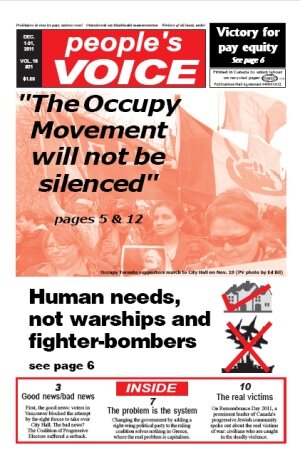
1) WARSHIPS: MASSIVE WASTE, WRONG PRIORITY
2) THE 99% MOVEMENT: A POPULACE IN ACTION
3) OCCUPY MOVEMENT WON'T BE SILENCED
4) GOOD NEWS/BAD NEWS IN VANCOUVER VOTE
5) PAY EQUITY VICTORY AT CANADA POST AFTER 28 YEARS
6) PRPP SCAM ATTACKS PENSION RIGHTS - Editorial
7) SAVE TEZTAN BINY! - Editorial
8) REMEMBRANCE DAY AND THE 99%
9) MUSIC NOTES, by Wally Brooker
10) ANTI-IMPERIALIST YOUTH MEET IN PORTUGAL
11) ANTI-LEFT TERROR CAMPAIGN ACROSS BENGAL
12) "THE DEEP CRISIS CONCERNS THE CAPITALIST SYSTEM ITSELF"
13) GUATEMALA TO BE UNDER "HARD HAND"?
14) SHOW THE HOLIDAY SPIRIT OF ANTI-CAPITALIST SOLIDARITY
15) WHAT’S LEFT
16) CLARTÉ (en français)
17) THE SPARK! (Theoretical and Discussion Bulletin of the Communist Party of Canada)
18) INTRODUCING MARX
PEOPLE'S VOICE DECEMBER 1-31, 2011 (pdf)
|
People's Voice deadlines: January 1-31 February 1-14 Send submissions to PV Editorial Office, Note to PV readers Publishing Schedule Change Due to other events and commitments, our January 1 issue will be published early in the New Year, not before Christmas. We'll see you in 2012!
|
|
REDS ON THE WEB |
|
People's Voice finds many "Global Class Struggle" reports at the "Labour Start" website, http://www.labourstart.org/. We urge our readers to check it out! |
* * * * *
People's Voice
Canadian Publications Mail Sales Product Agreement #205214
ISSN number 1198-8657
People's Voice is published by
New Labour Press Ltd
PV Editorial Office
706 Clark Drive,
VANCOUVER, B.C. V5L 3J1
Phone:604-255-2041
Fax:604-254-9803
email: pvoice@telus.net
Editor: Kimball Cariou : Business Manager: Sam Hammond
Editorial Board: Kimball Cariou, Miguel Figueroa,
Doug Meggison, Naomi Rankin, Liz Rowley, Jim Sacouman
* * * * * *
Letters
People's Voice welcomes your letters
on any subject covered in our pages.
We reserve the right to edit for length and clarity,
and to refuse to print letters which may be libellous
or which contain unnecessary personal attacks.
Send your views to:
"Letters to the Editor",
706 Clark Dr., Vancouver, BC V5L 3J1,
or pvoice@telus.net
People's Voice articles may be reprinted without permission,
provided the source is credited.
* * * * * *
The Communist Party of Canada, formed in 1921,
has a proud history of fighting for jobs, equality, peace,
Canadian independence, and socialism.
The CPC does much more than run candidates in elections.
We think the fight against big business and its parties
is a year-round job,
so our members are active across the country,
to build our party and to help strengthen people's movements
on a wide range of issues.
All our policies and leadership
are set democratically by our members.
To find out more about Canada's party of Socialism,
give us a call at the nearest CPC office.
* * * * * *
Central Committee CPC
290A Danforth Ave Toronto, Ont. M4K 1N6
Ph: (416) 469-2446
fax: (416) 469-4063 E-mailmailto:info@cpc-pcp.ca
Parti Communiste du Quebec (section du
Parti communiste du Canada)
5359 Ave du Parc, Montréal, Québec,
H2V 4G9
B.C.Committee CPC
706 Clark Drive, Vancouver, V5L 3J1
Tel: (604) 254-9836
Fax: (604) 254-9803
Edmonton CPC
Box 68112, 70 Bonnie Doon P.O.
Edmonton, AB, T6C 4N6
Tel: (780) 465-7893
Fax: (780)463-0209
Calgary CPC
Unit #1 - 19 Radcliffe Close SE
Calgary AB, T2A 6B2
Tel: (403) 248-6489
Ottawa CPC
Tel: (613) 232-7108
Manitoba Committee
387 Selkirk Ave., Winnipeg, R2W 2M3
Tel/fax: (204) 586-7824
Ontario Ctee. CPC
290A Danforth Ave., Toronto, M4K 1N6
Tel: (416) 469-2446
Hamilton Ctee. CPC
265 Melvin Ave., Apt. 815
Hamilton, ON.
Tel: (905) 548-9586
Atlantic Region CPC
Box 70 Grand Pré, NS, B0P 1M0
Tel/fax: (902) 542-7981
http://www.communist-party.ca/
* * * * * *
News for People, Not for Profits!
Every issue of People's Voice
gives you the latest
on the fightback from coast to coast.
Whether it's the struggle for jobs or peace, resistance to social cuts,
solidarity with Cuba, or workers' struggles around the world,
we've got the news the corporate media won't print.
And we do more than that
- we report and analyze events
from a revolutionary perspective,
helping to build the movements for justice and equality,
and eventually for a socialist Canada.
Read the paper that fights for working people
- on every page, in every issue!
People's Voice
$30 for 1 year
$50 for 2 years
Low-income special rate: $15 for 1-year
Outside Canada $50 for 1 year
Send to: People's Voice, 706 Clark Drive, Vancouver, BC, V5L 3J1
You can call the editorial office at 604-255-2041
REDS ON THE WEB
http://www.communist-party.ca/
http://www.ycl-ljc.ca/
http://www.solidnet.org/
(The following articles are from the December 1-31, 2011, issue of People's Voice, Canada's leading communist newspaper. Articles can be reprinted free if the source is credited. Subscription rates in Canada: $30/year, or $15 low income rate; for U.S. readers - $45 US per year; other overseas readers - $45 US or $50 CDN per year. Send to People's Voice, c/o PV Business Manager, 706 Clark Drive, Vancouver, BC, V5L 3J1.)
1) WARSHIPS: MASSIVE WASTE, WRONG PRIORITY
Commentary from the Communist Party of Canada
Disguised as a "jobs and defence program", the Harper Tory strategy to militarize Canada has gone into overdrive with detailed plans to spend $35 billion on new warships and coast guard vessels. The program is a major piece of Harper's so‑called "Canada First Defense Strategy", a massive scheme to pour nearly $500 billion into the military, even as Ottawa's contribution towards spending on social programs, health and education declines. The Communist Party of Canada condemns the massive waste of taxpayer dollars on weapons of war. Instead, we demand that these funds be used to tackle the urgent crises affecting working people across this country.
The National Shipbuilding Procurement Strategy is the largest federal shipbuilding program since World War II. Halifax‑based Irving Shipbuilding was awarded contracts to construct warships costing $25 billion over the next two decades. The 15 vessels will include six to eight Arctic offshore patrol boats and a fleet of combat ships to replace the Navy's destroyers and frigates. The company is owned by the Irving family, which has long been a dominant force in the east coast economy. Seaspan, which has yards in Victoria and Vancouver, was picked to build icebreakers and Coast Guard patrol ships, plus several naval supply ships, for an estimated cost of $8 billion over the next two decades. Seaspan is part of a group of companies owned by U.S. billionaire Dennis Washington.
Another $2 billion will be spent on building smaller vessels at other Canadian shipyards, such as Davie in Quebec. More spending will be needed to repair, refit and maintain all these ships over the next several decades. Even more significant, there has been little attention on the expensive price tag for deadly weaponry on these warships - missiles, artillery, machine guns, ammunition, and other armament.
Not surprisingly, the Canadian Association of Defence and Security Industries, which represents 860 companies, supports the decision to expand the naval fleet "in a way that mitigates the boom‑and‑bust cycles normally associated with ship fleet construction."
The opposition parties in Parliament, which had raised some criticisms of the process for purchasing 65 heavily‑armed F35 fighter‑bombers, have been cheerleaders for the warship program. The late NDP leader Jack Layton campaigned hard for the Irving bid, together with Nova Scotia's NDP Premier Darrell Dexter, who calls the ship program "the greatest opportunity for Nova Scotia since Confederation."
The NDP leadership backs the warship program as a way to create jobs, but also because it supports the "responsibility to protect" doctrine which allows the major imperialist powers to intervene militarily across the planet on short notice. Canada's aggressive participation in the NATO attack on Libya was endorsed by the NDP caucus, for example.
The Communist Party of Canada rejects the false arguments which claim that the warship program is necessary to "defend Canada", to create jobs, or to support crisis‑free regional development.
Canada's 2010‑11 military budget is $23 billion, a full 61 per cent higher than the $8.4 billion level of fiscal 1998, when military spending reached its post‑Cold War minimum. Annual military costs are projected to climb rapidly as spending on the F35 fighter‑bombers (now estimated at about $30 billion including maintenance, parts and munitions) kicks in.
The $65 billion total price tag for the warships and fighter-bombers could help tackle many pressing problems faced by working people. These funds could be used to build hundreds of thousands of low‑income, social, and cooperative housing units. Invested in the child care program cancelled by the Harper Tories, these funds could allow working class parents to improve their education and training and to find employment. Thousands of new buses could be purchased for urban transit systems, immediately reducing Canada's carbon emissions. Free tuition could be provided to tens of thousands of post‑secondary students, removing the heavy burden of loan debts as they graduate. The crisis of unsafe drinking water on First Nations reserves and Aboriginal communities could be resolved, along with the terrible shortage of good housing faced by Aboriginal peoples. Federal support for health care, social programs, and education could all be increased substantially. All these measures would create far greater net employment than spending on warships and fighter‑bombers.
Nor is it true that Canada is "threatened" by other countries. In reality, the costly "Canada First Defence Strategy" is an attempt to turn Canada into one of the most heavily armed members of the imperialist NATO alliance. Increasingly in recent years, Canada has backed the U.S. in making war against countries such as Yugoslavia, Afghanistan, and Libya, and in the police and military occupation of Haiti. With virtually no public debate, the Harper Tories plan to establish seven military bases in foreign countries, from Asia to Africa and Latin America. Far from "defending" our borders, this strategy is a plan to expand Canada's role as a willing ally of the U.S.‑led group of imperialist countries which use brute military force to impose the interests of transnational capital on the planet.
From this perspective, the National Shipbuilding Procurement Strategy is a crucial part of the drive to further militarize Canada's coastal waters, including in the Arctic. Global warming is melting the polar ice cap, opening up new shipping lanes and a mad scramble for oil and gas exploitation by the transnational energy monopolies. Canada's new icebreakers, patrol boats and naval vessels are intended to help the Canadian ruling class and its U.S. allies seize the lion's share of this new resource bonanza. The expanded fleet will also no doubt play a role in assisting the expansion of oil and natural gas exploration and exports along the west coast.
Even the argument by some that the west coast component of the shipbuilding program deserves support because of its alleged "non‑combat" character is untrue. The icebreaker and the coast guard and supplies vessels to be built in Vancouver are integral parts of a wider strategy to create a much larger Canadian military.
Given these facts, we are deeply concerned by the uncritical, even celebratory tone adopted by much of the trade union leadership regarding the warships. It is true that this military expansion would provide employment to several thousand workers. But the labour movement has a responsibility to demand that governments address the real needs of working people, rather than building expensive weapons systems which will be used to bomb, occupy and kill our sisters and brothers in other countries.
As Frederick Engels pointed out over a century ago, in real terms, military spending is similar to producing commodities which are then simply dumped into the sea. Former U.S. President Eisenhower put it another way: "Every warship launched, every rocket fired signifies, in the final sense, a theft from those who hunger and are not fed, those who are cold and not clothed. This world in arms is not spending money alone. It is spending the sweat of its labourers, the genius of its scientists, and the hopes of its children."
Rather than spending $500 billion on militarism over the next two decades, as projected in the Canada First Defense Strategy, the Communist Party of Canada needs a People's Alternative based on rebuilding our country's economic infrastructure and manufacturing sector, and on tackling the urgent social priorities of working people.
2) THE 99% MOVEMENT: A POPULACE IN ACTION
By Michael Parenti, November 9, 2011
Beginning with Occupy Wall Street in September 2011, a protest movement spread across the United States to 70 major cities and hundreds of other communities. Similar actions emerged in scores of other nations.
For the first two weeks, the corporate‑owned mainstream media along with NPR did what they usually do with progressive protests: they ignored them. These were the same media that had given the Tea Party supporters saturation coverage for weeks on end, ordaining them "a major political force."
The most common and effective mode of news repression is omission. By saying nothing or next to nothing about dissenting events, movements, candidates, or incidents, the media consign them to oblivion. When the Occupy movement spread across the country and could no longer be ignored, the media moved to the second manipulative method: trivialization and marginalization.
So we heard that the protestors were unclear about what they were protesting and they were "far removed from the mainstream." Media cameras focused on the clown who danced on Wall Street in full‑blown circus costume, and the youths who pounded bongo drums: "a carnival atmosphere" "youngsters out on a spree," with "no connection to the millions of middle Americans" who supposedly watched with puzzlement and alarm.
Such coverage, again, was in sharp contrast to the respectful reportage accorded the Tea Party. House Majority Leader, the reactionary Republican Eric Cantor, described the Occupy movement as "growing mobs." This is the same Cantor who hailed the Tea Party as an unexcelled affirmation of democracy.
The big November 2 demonstration in Oakland that succeeded in closing the port was reported by many media outlets, almost all of whom focused on the violence against property committed by a few small groups. Many of those perpetrators were appearing for the first time at the Oakland site. Some were suspected of being undercover police provocateurs. Their actions seemed timed to overshadow the successful shutdown of the nation's fourth largest port.
Time and again, the media made the protestors the issue rather than the things they were protesting. The occupiers were falsely described as hippie holdovers and mindless youthful activists. In fact, there was a wide range of ages, socio‑ethnic backgrounds, and lifestyles, from homeless to well‑paid professionals, along with substantial numbers of labor union members. Far from being a jumble of confused loudmouths prone to violence, they held general assemblies, organized themselves into committees, and systematically took care of encampment questions, food, security, and sanitation.
One unnoticed community protest was Occupy Walnut Creek. For those who don't know, Walnut Creek is a comfortable conservative suburb in northern California (with no known record of revolutionary insurrections). Only one local TV station gave Occupy Walnut Creek brief attention, noting that about 400 people were participating, average age between 40 and 50, no clowns, no bongos. Participants admitted that they lived fairly prosperous lives but still felt a kinship with the millions of Americans who were enduring an economic battering. Here was a contingent of affluent but rebellious "middle Americans" yet Walnut Creek never got mentioned in the national media, as far as I know.
The Occupy movement has promulgated a variety of messages. With a daring plunge into class realities, the occupiers talk of the 1% who are exploiting the 99%, a brilliant propaganda formula, simple to use, yet saying so much, now widely embraced even by some media commentators. The protestors carried signs condemning the republic's terrible underemployment and the empire's endless wars, the environmental abuses perpetrated by giant corporations, the tax loopholes enjoyed by oil companies, the growing inequality of incomes, and the banksters and other gangsters who feed so lavishly from the public trough.
Some occupiers even denounced capitalism as a system and hailed socialism as a humane alternative. In all, the Occupy movement revealed an awareness of systemic politico‑economic injustices not usually seen in U.S. protests. Remember, the initial and prime target was Wall Street, finance capital's home base.
The mainstream news outlets not only control opinions but even more so opinion visibility, which in turn allows them to limit the parameters of public discourse. This makes it all the more imperative for ordinary people to join together in demonstrations, hoping thereby to maximize the visibility and impact of their opinions. The goal is to break through the near monopoly of conservative orthodoxy maintained by the "liberal" media.
So demonstrations are important. They have an energizing effect on would‑be protestors, bringing together many who previously had thought themselves alone and voiceless. Demonstrations bring democracy into the streets. They highlight issues that have too long been buried. They mobilize numbers, giving a show of strength, reminding the plutocracy perched at the apex that the pyramid is rumbling.
But demonstrations should evolve into other forms of action. This has already been happening with the Occupy movement. It is more than a demonstration because its protestors did not go home at the end of the day. In substantial numbers they remained downtown, putting their bodies on the line, imposing a discomfort on officialdom just by their numbers and presence.
At a number of Occupy sites there have been civil disobedience actions, followed by arrests. In various cities the police have been unleashed with violent results that sometimes have backfired. In Oakland ex‑Marine Scott Olsen was hit by a police teargas canister that busted his skull and left him hospitalized and unable to speak for a week. At best, he faces a long slow recovery. The day after Olsen was hit, hundreds of indignant new protestors joined the Occupy Oakland site. Police brutality incites a public reaction, often bringing more people out, just the opposite of what officials want.
Where does this movement go? What is to be done? The answers are already arising from the actions of the 99%: Discourage military recruitment and support conscientious objectors. Starve the empire of its legions. Organize massive tax resistance in protest of corrupt, wasteful, unlawful, and destructive Pentagon spending. Transfer funds from corporate banks to credit unions and community banks. Support programs that assist the unemployed and the dispossessed. It was Giulio Tremonti, Italy's embattled finance minister who declared: "Salvate il popolo, non le banche" ("Save the people, not the banks"). It would be nice to hear such sentiments emanating from the U.S. Treasury Department or the White House.
Coordinate actions with organized labor. Unions still are the 99%'s largest and best financed groups. Consider what was done in Oakland: occupiers joined with longshoremen, truckers, and other workers to close the port. Already there are plans for a general strike in various communities. Such actions improve greatly if organized labor is playing a role.
We need new electoral strategies, a viable third party, proportional representation, and even a new Constitution, one that establishes firm rules for an egalitarian democracy and is not a rigmarole designed to protect the moneyed class. The call for a constitutional convention (a perfectly legitimate procedure under the present U.S. Constitution) seems long overdue.
Perhaps most of all, we need ideological education regarding the relationship between wealth and power, the nature of capitalism, and the crimes of an unbridled profit‑driven financial system. And again the occupiers seem to be moving in that direction: in early November 2011, people nationwide began gathering to join teach‑ins on "How the 1% Crashed the Economy."
We need to explicitly invite the African‑American, Latino, and Asian communities into the fight, reminding everyone that the Great Recession victimizes everyone but comes down especially hard on the ethnic poor.
We need to educate ourselves regarding the beneficial realities of publicly owned nonprofit utilities, publicly directed environmental protections, public nonprofit medical services and hospitals, public libraries, schools, colleges, housing, and transportation‑‑all those things that work so well in better known in some quarters as socialism.
There is much to do. Still it is rather impressive how the battle is already being waged on so many fronts. Meanwhile the corporate media ignore the content of our protest while continuing to fulminate about the occupiers' violent ways and lack of a precise agenda.
Do not for one moment think that the top policymakers and plutocrats don't care what you think. That is the only thing about you that wins their concern. They don't care about the quality of the air you breathe or the water you drink, or how happy or unhappy or stressed and unhealthy or poor you might be. But they do want to know your thoughts about public affairs, if only to get a handle on your mind. Every day they launch waves of disinformation to bloat your brains, from the Pentagon to Fox News without stint.
When the people liberate their own minds and take a hard clear look at what the 1% is doing and what the 99% should be doing, then serious stuff begins to happen. It is already happening. It may eventually fade away or it may create a new chapter in our history. Even if it does not achieve its major goals, the Occupy movement has already registered upon our rulers the anger and unhappiness of a populace betrayed.
3) OCCUPY MOVEMENT WON'T BE SILENCED
Guest editorial from the Morning Star, Britain
Official explanations for the crackdown and dismantling of protest camps in various US cities do not hold water. Statements that the co‑ordinated removal of peaceful encampments was dictated by health and safety considerations or to prevent violence defy credibility. They are on a par with the St. Paul's Cathedral decision to close the church to worshippers because of health and safety risks posed by a few dozen tents pitched in its vicinity.
Everyone can imagine the response that would have emanated from London and Washington if the Ukrainian authorities had acted in a similar manner by sweeping their poster woman Yulia Tymoschenko and her pro‑democracy forces from Independence Square in Kiev in 2004 as they protested against ballot rigging and, on occasion, launched forays into parliament to intimidate MPs.
If there were indeed fears for health and safety, cleanliness or public sanitation regarding the Occupy Wall Street camp in New York's Zuccotti Park, the Frank Ogwaza Plaza camp in Oakland or similar settlements in Oregon, Vermont, Colorado, Utah and Missouri, the answer lay in the authorities' own hands.
They could have replicated what they did in Kiev in 2004, intervening to ensure that the happy campers did not lack for life's essentials. US finance paid on a daily basis for 5,000 tonnes of porridge and 10,000 loaves of bread, together with 300 portable toilets, tents with heaters, foam pads and sleeping bags. Even rubbish disposal was coordinated, with 11 lorries a day removing the protesters' detritus.
If such a sterling effort was good enough for pro‑democracy campaigners half a world away, surely it should be offered to US citizens in their own backyard to enable them to point out that the American Dream is turning into a nightmare for too many of them. However, it seems that, for Washington, neither charity nor solidarity begins at home. For them it's armed riot police and fire hoses to wash away any trace of their protest.
The authorities should come clean and admit that they are embarrassed by the presence of these witnesses to the injustice of the capitalist system and to the system's defence of the interests of society's richest 1 per cent over those of the other 99 per cent.
Capitalism's defenders are happiest when they deal in cliches and generalisations about freedom and democratic rights. They are less confident when protesters highlight specifics and draw attention to the vast rewards gained by the tiny elite in the face of hardships and tumbling living standards assailing the dispossessed majority.
After initial paralysis in the face of the mass protests in Cairo's Tahrir (Freedom) Square, following the upsurge in Tunisia, Washington tuned in to the talk of democracy and attempted to incorporate the Egyptian national liberation movement into its own historical narrative. It ignored the reality that ousted military dictator Hosni Mubarak had been a US tool, reliable and dependable in his brutality and corruption.
Egyptian popular sentiment against the dictatorship was echoed by angry denunciations of Washington for its protection and manipulation of Mubarak because of his complicity with Israel in holding back Arab liberation.
US citizens and Europeans launching their own mass protests against being treated as pawns by bankers don't languish under similar brutal dictatorship that oppressed Egyptians. But their economic and democratic complaints are valid and should not be silenced by authoritarian repression.
4) GOOD NEWS/BAD NEWS IN VANCOUVER VOTE
PV Vancouver Bureau
The good news from Vancouver's Nov. 19 civic election was very good. But the news for Canada's oldest progressive municipal reform party was very, very bad.
On the positive side, over 140,000 Vancouverites went to the polls (a relatively high turnout of 34%), blocking this city's version of the Rob Ford gang in Toronto. Mayor Gregor Robertson of the centrist Vision party was re-elected by 77,000 to 58,000 votes over the NPA's Susan Anton, and Vision won majorities on city council, school board and park board. The outcome was a welcome rejection of the NPA's far-right agenda and its fear-mongering tactics, based largely on Anton's demands to attack the Occupy Vancouver camp at the Art Gallery.
For working people, the negative result was the defeat of the Coalition of Progressive Electors at every level. Only one of COPE's four incumbent candidates was re-elected: Allan Wong, who won a fifth consecutive term as school trustee. The other COPE incumbent trustees, Al Blakey and Jane Bouey, both went down to defeat, despite winning about 52,000 votes, a gain of 4,000 over their 2008 results, as the NPA and Vision candidates scored even larger gains.
At City Council, COPE incumbent Ellen Woodsworth missed the tenth and final seat by just 91 votes to the Green Party's Adriane Carr (although the Greens' Stuart Mackinnon lost his position on the park board). COPE's Tim Louis lost his bid to regain the city council seat he held from 1999 to 2005, finishing 17th with 43,926 votes, almost 5,000 behind Carr. The other COPE council candidate, first-timer R.J. Aquino, was 19th with 39,054 votes.
The results left the NPA with two council seats, three out of nine on the School Board, and two on park board. These gains may help the flagging fortunes of the city's historic favoured party of big business, but the NPA will have little direct influence over the next three years. Politically, however, many observers fear that the NPA gains and the losses by the left-oriented COPE may tempt Vision's council caucus to shift to the right in an attempt to maintain their hegemony at City Hall.
The post-mortem of COPE's setback began immediately, but it will take time and studies of poll-by-poll results to gain a clearer picture. Some quickly blamed COPE's electoral agreement with Vision for the losses, accusing the governing party of failing to do enough to encourage its supporters to also vote COPE. They argue that COPE members should have backed an alliance with the Greens or smaller parties and independents which have been sharply critical of Vision.
But "what-ifs" are no substitute for a more in-depth analysis. For example, some pundits claim that if COPE had teamed up with the newly-formed Neighbourhoods for a Sustainable Vancouver, the outcome would have been better. This observation ignores several significant points. For one thing, NSV did not even exist until after COPE's September nomination meeting. For another, NSV's core support was the 4,007 votes cast for its mayoralty candidate. Since the NSV had urged supporters to back both its own and COPE's council candidates, there is little "net gain" in this equation.
Perhaps more to the point, the COPE/Vision alliance reflected the determination of the labour movement and other progressive groups to avoid a split which could have handed City Hall back to the NPA. In the wake of the Harper majority won with just 39% of votes last May, that nightmare scenario was key to the decision by most COPE members to support the agreement with Vision.
Rejection of the agreement would have cost COPE much of its $340,000 campaign budget, as well as sharply dividing the city's centre and left voters. An anti-Vision campaign would probably have meant less votes for COPE, not more as actually happened on election night.
The biggest lesson may be that campaign budgets determine the overall outcome of Vancouver civic elections. Vision and the NPA each spent over $2 million, pouring vast amounts into TV, radio and print ads, and hiring armies of "volunteers". This spending overwhelmed COPE's attempt to mobilize enough real volunteers to pull the vote on E-Day. The most urgent electoral reform in Vancouver is not establishing a ward system or proportional representation - it has to be spending limits, which seem equally difficult to achieve at this point.
Another factor which hurt COPE was the voter suppression strategy conducted by the NPA, which tried to deny ballots to large numbers of poor people in the Downtown Eastside.
"This is not a time for COPE to look inward or backwards," says Jane Bouey. "This is a time for COPE to focus on grassroots issues, to strengthen our links with working people and progressive movements. If we can put COPE at the heart of community struggles, we'll be in a much better position to elaborate a winning electoral tactic when the next campaign arrives."
5) PAY EQUITY VICTORY AT CANADA POST AFTER 28 YEARS
Twenty‑eight years after their case was filed, members of the Public Service Alliance of Canada have won a decisive pay equity victory against Canada Post. On Nov. 17, the Supreme Court ruled in favour of PSAC, ending attempts by the crown corporation and governments to deny justice to the female employees, some of whom have since retired or passed away.
The union first filed a complaint over "unequal pay for work of equal value" in 1983 on behalf of women clerical workers in the CR classification, who were paid much less than male employees in other jobs. This practice, argued the union, was contrary to the anti‑discrimination provisions of the Canadian Human Rights Act.
The Canadian Human Rights Tribunal compared wages between 6,000 mainly female clerical staff and the predominantly male postal operations group. More than a decade of hearings took place, over 410 working days between 1992 and 2003, to consider and quantify the work done by male and female workers. The tribunal ruled in 2005 that Canada Post had violated the Act and awarded back pay covering 50% of the wage gap in damages.
Together with interest, the award totalled about $150 million. That amount, of course, does not compensate for the other half of the wage gap over decades, nor for the resulting lost pension income.
The corporation continued to use every possible legal avenue to have the Tribunal overturned. The Federal Court of Appeal later set aside the tribunal's decision, saying the finding of discrimination could not be supported. "In our respectful view, the tribunal became confused, and therefore fell into error," Justices Sexton and Ryer wrote for the majority on the appeal court.
The Supreme Court unanimously backed the original Tribunal ruling. In a rare move, the Nov. 17 decision was released directly by Chief Justice Beverly McLaughlin, sending a powerful signal that the Federal Court got it wrong.
Meanwhile, the Harper Tory government has moved to deny workers any legal avenue to redress pay equity claims. In 2009, the Conservatives pushed through legislation requiring workers to secure pay equity during collective bargaining rather than in courts and tribunals. Given the tendency for the new Conservative majority to interfere in labour negotiations on behalf of employers, it appears that opportunities to correct such inequities in future may be severely limited.
Ginette Chartrand was one of the women who filed the original case in 1983. Speaking from the Supreme Court, she reflected on the victory: "I attended all of the hearings in the last few years. We believed in our case. But we did not expect a decision so quickly. I cried."
Helene Arbique shared similar sentiments. "At first was hard to believe. Then the euphoria set in - we won after a 30 year battle."
Anyone who worked as a CR at Canada Post between 1982 and 2002 will now be eligible to receive pay equity payments. Many of the women were single mothers who raised families.
"Today we celebrate a hard‑won victory for equality," said Patty Ducharme, National Executive Vice‑President of PSAC. "But the fact that this took 28 years is completely unacceptable. Canada needs a proactive pay equity law that ensures that women won't have to wait decades to be compensated for the value of their work."
PSAC says it will push Canada Post to issue payments as soon as possible.
6) PRPP SCAM ATTACKS PENSION RIGHTS
People's Voice Editorial, Dec. 1-31, 2011
The Canadian Labour Congress was right to quickly slam the Harper government's "Pooled Registered Pension Plans". The PRPP is no "solution" to the pensions crisis; it's a deliberate attempt to sabotage the public pension system in the interests of finance capital. As the CLC says, PRPPs would reward banks, insurance companies and mutual fund companies instead of offering secure retirement options for all Canadians.
Anyone who thinks the PRPP sounds like a good idea should look a bit closer. Unlike the Canada Pension Plan, PRPPs are privately administered workplace pension plans that resemble group RRSPs. They will be unable to provide a secure, predictable benefit, indexed against inflation. They will not require employers to contribute. They won't match the CPP's very low cost. They lack the survivor and disability benefits offered by the CPP, and they will not be universal portable, following the worker no matter where he or she is employed. There is no indication that the PRPP legislation will control high management fees charged by banks and mutual fund companies on pension investments.
The Conservative plan ignores the discussions held by provincial finance ministers in December 2010, when the majority of provinces pressed Ottawa to examine proposals to expand the CPP. This is a big disappointment for the labour movement, which had been pushing governments to double future CPP benefits through modest increases in contributions from workers and employers.
Instead, the PRPP takes Canadians in the opposite direction, towards replacing the CPP with private pensions. The result will be a massive growth of poverty among seniors, and an equally rapid boost in profits for finance capital. It's a trend sweeping the capitalist world, and it must be met with determined resistance by the labour movement and its allies across Canada.
People's Voice Editorial, Dec. 1-31, 2011
The struggle over Teztan Biny (Fish Lake) is a microcosm of issues which are central to the future of Canada and indeed the entire world. Similar issues arise around other projects, such as plans to boost exports of tar sands oil to satisfy the energy demands of U.S. imperialism.
As reported in this issue, Taseko Mines has submitted a "revised" proposal for a gold and copper mine on the Chilcotin Plateau in northern British Columbia. The project would turn Teztan Biny and other bodies of water into tailings ponds, causing permanent damage to trout stocks and other wildlife, and to the surrounding area. Even Stephen Harper's former environment minister Jim Prentice called a federal assessment of the project "probably the most condemning I have ever read."
This dispute raises two crucial questions. First: just because a mineral deposit has been discovered, should corporations be allowed to "develop" such resources in the interests of their shareholders, regardless of consequences? In our view, the clear answer must be "No." The future of our world depends on halting the unchecked capitalist plunder of natural resources in pursuit of private profits. The rights of human beings and the natural environment must trump the greed of corporations.
Second: like most of British Columbia, Teztan Biny is on unceded aboriginal lands, in this case the ancestral territories of the Tsilhqot'in Nation. For them, Teztan Biny is an important spiritual place, which would be destroyed by twenty years of open pit mining. The government of Canada is obliged by the Constitution to protect First Nations, a commitment reinforced by the United Nations Declaration on the Rights of Indigenous Peoples. The national rights of aboriginal peoples must take priority over the corporate drive to rip gold out of the earth.
8) REMEMBRANCE DAY AND THE 99%
Excerpts from a Remembrance Day 2011 commemoration at the Association of United Ukrainian Canadians' hall in Toronto, by David Abramowitz, Co‑President of the United Jewish People's Order of Canada
My attitude to Remembrance Day has changed over the years. At school we were indoctrinated to honour those soldiers who died protecting our freedom ‑ truly a noble cause where it applies.
But as I matured I began memorializing all those innocent civilian relatives of mine, killed in the first and second world wars. During WW 1, in Poland, my dad's father died in 1916 (when dad was 9) and his mom in 1917 when he was 10 ‑ an orphan in war‑time raised by older sisters who delayed their weddings to help the three youngest become somewhat self sufficient. My dad, at age 13, was a tailor in a union shop! But, as a child, I always felt that WW 1 had robbed me of my paternal grandparents.
In my mother's family, tragedy struck in 1918. Zlotchev, where my grandparents came from, (then part of the Austro‑Hungarian Empire) was under siege by the Austrian army fighting the advancing Polish army. My grandparents only lived a few kilometers away, in Olesko, known locally for its famous Olesko Castle on whose surrounding hills my mother and her childhood friends played. Word reached my mother's father that Jews in Zlotchev were being attacked particularly severely by the Poles ‑ a pogrom ‑ in addition to the war.
My grandfather went to help the Jews, only to return a few days later (the end of October) with significant wounds in his leg. Gangrene set in, incurable in those days, and he died on November 11, 1918, Armistice Day, when my mother was 11 years old. The Poles won the war in that region, so it became part of Poland which is what my mother left when she came to Canada in 1928 and joined the Toronto Ukrainian Labour Temple. Thus I no longer had three of my potential grandparents.
During the mid-1930's my mother, her sister and two brothers applied three times to bring their mother and her youngest daughter to Canada. Each time they were told to try again in a few years, the last time in 1938. We now know that Jews were routinely denied Canadian immigration as a government policy in the mid to late 1930's. Irving Abella and Harold Troper wrote a book about it called None Is Too Many.
World War II intervened and some in my mother's family in Canada became soldiers. What we didn't know was what happened to the youngest sister, Rifke, and their mother. The aunt I had never seen, Rifke, had become a nurse and worked in a Kyiv hospital. In 1941, she was killed when the Nazis bombed the hospital. My grandmother, an orthodox Jew, with no immediate relatives around her (Olesko and Zlotchev were not nearby), decided to help defend Soviet Kyiv and joined the Home Guard. She would have been 61 or 62 then. She was given a "gun", possibly a rifle, was taught how to shoot it and was sent to defend Kyiv.
During her vigil she noticed Nazis storing arms in a bombed out building. Somehow she acquired two grenades and went near that cache of arms. With the first grenade she partially blew up the building and finished the job with the second. She apparently didn't duck and was shot from behind by a hidden Nazi sniper. As she lay dying from loss of blood a soldier, wounded at the front, and in Kyiv for rehabilitation before returning to the front, witnessed this and went to see if he could help. This sounds like fiction, but he was from Olesko, knew my grandmother and her family; his sister went to school with my mother! He stayed with my grandmother while she told him the story I've just relayed, till she died from loss of blood. He wrote of this "miraculous meeting" to his sister in Toronto, who by chance saw my mother in a supermarket and conveyed the story to her for the first time. I was to never know any of my grandparents ‑ because of war.
Today, the loss of my grandparents and their families would simply be depersonalized and called "collateral damage". Thus the capitalists, who are responsible for the wars in the first place, have desensitized several generations from seeing and understanding the true cost of war on all humanity.
But are we reminded of the millions of innocent civilians who have been slaughtered so brutally by wars in the 20th century alone? A few brave journalists and societal observers/commentators have written about it, though these issues are not widely reported upon. Even General Romeo Dallaire wrote about the travesty of the genocide in Rwanda in Shake Hands with the Devil, and how we could have but failed to prevent or stop it. But innocent civilian casualties go largely played down (or rather I should say suppressed) by our capitalist‑controlled "free press". Rupert Murdoch's media "manipulations" come to mind most recently; but other generations had their own charlatans misinforming civilian society. In the first half of the 20th century it was William Randolph Hearst ("give me the pictures and I'll give you the war" he said as he financed Franco in the Spanish civil war); most recently, on TV, it's the FOX Network.
And the top 1% couldn't care less. They have what they want so let the rest go to hell. And there is no single leftist movement which now can provide inspiration and guidance to the masses.
In the movie Network the broadcaster ranted "I'm fed up and I'm not going to take it any more!" It's taken 30 years or so but the public, the other 99%, are awakening and beginning to take up the cry. Among them are conservationists, environmentalists, opponents of agri‑business and large conglomerates, and many, many people disgruntled with their indebtedness but no idea how they will escape it. Students with huge university loans have no job prospects to pay them off. Families in mortgaged homes with cars bought on credit where the breadwinner(s) have lost their jobs as corporations moved their operations "south or offshore" to save on salaries and make more profit. And their greed denies them the decency to share some of their cost savings by lowering prices.
So this year, on Remembrance Day, I also thought about those who are at war with the 1%, with the rabid capitalists, even though many may not realize it ‑ yet. I mourned for more than 100 of my father's family and more than 70 of my mother's who died in the holocaust. I was grateful that all my enlisted family members returned home safely. And I mourned for all those recently killed Canadian soldiers who thought they were fighting to preserve our freedom.
Canada has many black marks against it in this regard. Of the 80,000 Ukrainian Canadians during WW 1, all of whom were declared "enemy aliens", 6,000 were placed in 26 prison camps, starved, and many used as slaves to build the infrastructure of Banff National Park, its hotel and other projects. The description of their prison camps sound as if the Nazis used them as a model for their later concentration camps. The denial of basic freedoms to Chinese immigrants so vital in building our railroad, charged a huge head tax and denied the right to bring over their families ‑ this wasn't freedom. The internment of thousands of Japanese Canadians during WW II, their property, as the Ukrainians before them, confiscated without compensation and their resettlement to their home regions prohibited ‑ how could we call this freedom?
When I hear our politicians talk about our wonderful country, though in some contexts it still has some merits, I want to paraphrase Churchill by saying, "Some Freedom! Some democracy!"
When our founders came to a Canada that discriminated against many of its "foreign workers," as Conservative leader Tim Hudak called them during the last Ontario election campaign, I thought very little had changed. Your organization's founders and mine, in combination with other progressive ethnic organizations, had to campaign long and hard to be able to have the right to legal unions and the right to collective bargaining, pensions for the aged, for single mothers, for the disabled, the right to universal healthcare and so on. And now they're all under attack not only by the 1% but by their representatives in our federal government.
Our battles aren't yet over as the struggle to retain and improve our social safety net continues. It's not for us but for those who, inspired by the Occupy Wall Street movement, are now occupying many major city spaces in Canada, the U.S. and world-wide, and from which some are now being forcefully removed.
We must support them; join with them in their demonstrations; and, as some of us may find it difficult to march with them, let's meet them at their destination and mingle amongst them. Help enlighten those with whom we come in contact, and prove to the 1% that this isn't just a movement of a disgruntled bunch of youngsters blowing off steam. Let the cameras record that it's a movement of all, young AND old, who want a truly free, peaceful and prosperous world where ALL are entitled to a decent piece of the pie ‑ and until that happens that the movement will build (above or underground) till, in one united voice it says, we say, "We're all really mad, and we're not going to take it anymore."
Our campaigns of the past have to become a part of the foundation of this emerging international movement.
And should some in this movement also become victims of the "war against the masses", on future Remembrance Days, we will also remember their sacrifices, just as we legitimately remember those veterans who fought against fascism, dictatorships, genocide, oppression, slavery, capitalism, bondage, racism, anti‑Semitism, homophobia and the like. Then their sacrifices will not have been in vain. Then we can proudly say we have done our share to make this a better world where justice and democracy will also be the victors.
9) MUSIC NOTES, By Wally Brooker
Hawaiian musician stages APEC protest
Hawaiian guitarist Makana sang his anticapitalist song "We Are Many" to Barack Obama, Stephen Harper, Hu Jintao and other Pacific Rim leaders at the APEC Summit's gala dinner in Honolulu on Nov. 12. Hired to provide instrumental music to the assembled heads of state, Makana revealed a t‑shirt bearing the words "Occupy with Aloha" and calmly began singing his song, repeating the lyrics for 45 minutes. "We Are Many" opens with the "many" telling world leaders "the time has come for us to voice our rage," and concludes with the lines "we'll occupy the streets, we'll occupy the courts, we'll occupy the offices, till you do the bidding of the many, not the few." To download a free copy of "We Are Many" visit http://makanamusic.com/. Anti‑capitalist culture jammers the Yes Men facilitated the action. See their news release at www.yeslab.org/APEC#video.
Music celebrities spread OWS message
Some might argue that the presence of well‑known musicians is a distraction from the serious work going on at Occupy Wall Street, but their support is important. They've helped to keep spirits up and inspired millions with the message of the "99%." On Oct. 21, Pete Seeger, now 92 and walking with two canes, led a thousand marchers from his concert at Symphony Space to the alternate OWS site at Columbus Circle. There he joined old musical partner Arlo Guthrie, composer David Amram and a multitude of voices in a moving version of "We Shall Overcome." More recently, David Crosby and Graham Nash of the rock band Crosby, Stills & Nash played an impromptu acoustic set at Liberty Square, and Joan Baez sang out in solidarity at nearby Foley Square. A host of prominent musicians have been raising their voices for OWS, including outstanding contemporary urban/hip‑hop artists like Talib Kweli, Lupe Fiasco and Immortal Technique. Check out their contributions on YouTube.
NPR opera host under attack
Non‑profit U.S. radio network NPR has dropped its distribution of the weekly show World of Opera because of the political activism of freelance host Lisa Simeone, who's been supporting the occupation movement in Washington, D.C. The show's producer, NPR affiliate WDAV in North Carolina, correctly interpreted the network's ethical guidelines to mean that a journalist working on a non‑news program is free to openly engage in partisan political activity. In fact, even NPR news hosts have taken political stands in the past (usually on the conservative right). WDAV will now distribute World of Opera itself. Hopefully the 60 NPR‑affiliated stations that carried the show will not be intimidated by this political appeasement. NPR is often accused of "liberal bias" by conservatives. However, while the network receives donations from individuals and charities, its biggest funders are a who's who of the corporate elite including GM, Prudential, Cargill, Citibank and UPS. Media watch group FAIR has started a petition to protest the intimidation. To sign it visit www.fair.org.
U.S. musicians support René Gonzalez
Rock musicians Bonnie Rait and Jackson Browne joined folk artists Pete Seeger and Si Kahn and actors Susan Sarandon, Danny Glover and Elliott Gould, in an open letter to President Obama calling for the immediate return of Cuban Five prisoner René Gonzalez to Cuba. The letter was the latest action by Actors and Artists United for the Freedom of the Cuban Five. Gerardo Hernandez, Antonio Guerrero, Ramon Labanino, Fernando Gonzalez, and René Gonzalez were convicted of espionage in 2001 by a kangaroo court in Miami for the crime of defending their country against terrorist attacks. Gonzalez is the first to be released, but U.S. courts have ordered that he remain on parole in the U.S. for an additional three years, with a continuing ban on visits from his wife and family. Meanwhile convicted anti‑Cuban terrorist and international fugitive Luis Posada Carriles walks the streets of Miami with impunity. For more info: www.thecuban5.org/wordpress/index.php.
Calle 13 sweeps Latin Grammys
Puerto Rican urban/hip‑hop duo Calle 13 dominated the 12th annual Latin Grammys in Las Vegas on Nov. 10. Calle 13 are noted for their socially‑conscious lyrics, their pan‑American influences, and their avoidance of the genre's traditional macho posturing. They're also supporters of the Puerto Rican independence movement. Their 2005 video "Querido FBI" protesting the FBI's killing of militant independence leader Filiberto Ojeda Rios can be seen on YouTube. Prominent among Calle 13's awards this year: Best Album ("Entren Los Que Quieran") and Song of the Year ("Latinoamérica"). Unlike the regular Grammys, which recognize recordings made only in the U.S., the Latin Grammys honour recordings made in Spanish and Portuguese anywhere in the world. Calle 13's homeland is the oldest colony in the world. Puerto Rico was seized by the U.S. in the Spanish‑American war of 1898 and its inhabitants are still second‑class citizens. For more info visit http://lacalle13.com/.
10) ANTI-IMPERIALIST YOUTH MEET IN PORTUGAL
Special to PV
Representatives of youth organizations from around the world gathered Nov. 8-13 in Lisbon to discuss the work and political direction of the largest international anti‑imperialist grouping of young people.
The Assembly of the World Federation of Democratic Youth was hosted by the Young Communists of Portugal, who have held the presidential position of WFDY for the past eight years.
Delegations from 82 youth organizations were present at the largest meeting of WFDY in over two decades. The Assembly was held a year after the successful 17th World Festival of Youth and Students in Tshwane, South Africa, the first festival ever held in sub‑Saharan Africa.
"There was vigorous discussion and debate about the economic crisis and the nature of the imperialist system today," Johan Boyden (who represented the Young Communist League of Canada at the General Assembly) told People's Voice.
"We are in a difficult time but with significant potential. Everywhere, young people are redoubling their resistance," Boyden said. "Developments like the Arab uprisings across the Middle East and North Africa, as well as the `spontaneous' mobilizations of the youth across Europe and North America with the Indigenous and Occupy Wall Street actions, were at the front and center of the meeting, as was the continued struggle of the Latin America against imperialism."
A statement issued by WFDY noted that the meeting underlined the world federation's anti‑imperialist character and reaffirmed that the struggle of the youth, together with the workers, in each country, is the only way to overthrow imperialism.
"The present crisis is not just a "bad moment" or the result of a "bad administration of the system," said the WFDY statement, but rather "the only possible result of a system based on exploitation. Capitalism was never, is not, and won't ever be capable of responding to the needs of humankind as whole, as it is based on inequality when sharing resources and wealth."
"I think the WFDY showed great determination by laying out that it is the capitalist system, in its highest imperialist phase, that is responsible for the tremendous inequalities and injustices in the world, and war," Boyden said. "As numerous delegations said, there are many different global charities, humanitarian groups, and liberal‑oriented organizations but WFDY is the only anti-imperialist youth federation."
The Assembly expressed its full solidarity with the peoples of Palestine, Western Sahara, Cuba, Korea, and "all those who fight against imperialism" adding that "this is a daily struggle and demands courage and determination, despite the clear advantage that imperialism has to fight the peoples."
The meeting was also an important step forward for the YCL Canada's continued international relations, Boyden told PV. "We are continuing the work we began at Tshwane. Although we are a small organization among many in Canada that campaign for solidarity with the oppressed people's and nations of the world, we are strengthening relations with progressive‑democratic, national liberation, socialist and communist youth organizations from around the world."
The YCL Canada also made a number of resolutions and contributions to the discussion and resolutions, raising issues like the self‑determination of North American indigenous peoples, the militarization of the Arctic, the Occupy movement in Canada, and the struggles of young women and girls.
The Assembly also elected a new leadership for the Federation. The communist youth of Cyprus, EDON (represented by Dimitris Palmyris) and communist youth of Cuba (represented by Hanoi Sanchez) are the new President and Secretary‑General, respectively. Two vice‑presidents were elected from each region (Europe and North America, North Africa and the Middle East, Asia-Pacific, Latin America, and Africa), one to work locally and the other from the WFDY office in Budapest.
The WFDY's 35‑member General Council includes the General Union of Palestinian Students, the Communist Youth of Syria, the United Progressive Youth of Egypt, the Japanese League of Socialist Youth, the Youth Federation of Nepal, the youth of the MPLA Angola, the KSM of Czech Republic, the Communist Youth of Greece, the Young Socialists of Brazil, the Young Socialists of Mexico, and the YCL USA.
The closing ceremony of the Assembly was held at Voz do Operario (Voice of the Worker), where a rally organized by the JCP Portugal was greeted by Jeronimo de Sousa, Secretary-General of the Portuguese Communist Party.
Delegates to the Assembly also marched in a massive general strike of 180,000 Portuguese public sector workers against IMF and EU reforms being forced on the country. Portugal is building towards a general strike at the end of November.
Videos of the demonstration and the Assembly are online at the YCL's site www.Rebelyouth‑magazine.blogspot.com.
11) ANTI-LEFT TERROR CAMPAIGN ACROSS BENGAL
By Kimball Cariou
In the months since the May 2011 electoral defeat of Bengal's Left Front government, the campaign of violence against the Indian state's progressive parties has continued, taking dozens of lives. The violence is part of a long-term strategy by right‑wing and extremist elements to destabilize the Left Front, which had been in power since 1977, and to reverse the land reform and democratization policies adopted during these years.
A recent letter to the Prime Minister from the Left Front - a coalition of ten communist, socialist and progressive parties, the largest of which is the Bengal unit of the Communist Party of India (Marxist) - outlines the wide scope of the attacks against its supporters.
Most of the killings and assaults have been the work of thugs from the Trinamul Congress (TMC) which won the May election in part by creating an atmosphere of intimidation and fear. The new state administration, headed by Mamata Banerjee, has concentrated its post‑election offensive against the CPI(M), which had been at the forefront of decades of struggles to defend the interests of peasants and other working people in Bengal.
One result may be a greater impetus for the disintegration of Bengal, such as the push to create a separate "Gorkhaland" within the current borders of the state. Ever since India gained independence from Britain in 1947, the country's main left forces have opposed tendencies to fragment its territory into smaller pieces, a process which they argue will divide the population along caste and ethnic lines, at the expense of building broad, united struggles for fundamental social progress.
A 100‑page summary of the violence unleashed against the Left from the Assembly elections up to August 15 is highly revealing. During this time, thirty Left Front leaders and workers (28 from the CPI‑M and two from the Revolutionary Socialist Party) were killed, and another seven driven to commit suicide. Assaults against women totalled 684, including 23 rapes. A total of 3785 people had to be hospitalized for injuries inflicted by their attackers, and others were prevented from seeking treatment or lodging complaints with the police. There were 2064 reports of arson and looting of houses, and 14,081 persons were evicted from their homes. Thousands more have been compelled to pay off local TMC leaders to avoid being driven out or attacked. According to a conservative estimate, the total of extorted funds could exceed Rs. 277.7 million ($5.6 million).
A wide range of offices and buildings used by trade unions, political parties and other organizations have been attacked. The summary counts 758 such premises as being ransacked, burnt, forced to close or taken over by TMC goons. In 77 cases, student union offices have been captured, with elected leaders driven out or forced to resign. Student activists have been threatened against taking exams, effectively driving them out of their schools.
There has also been a widespread attack on the peasantry, with 3418 denied the right to cultivate their own lands, amounting to over 9000 acres. Another 26,838 rural tenants and sharecroppers have been forcibly evicted.
Thousands of Left Front activists face trumped-up legal charges, often accused after weapons were allegedly "found" in their homes or offices. The campaign extends to attacks on freedom of the press; 241 public display boards featuring the pages of the CPI‑M daily Ganashakti have been dismantled, thousands of copies have been burnt, and its vendors often beaten up to disrupt circulation.
The terror extends to disruption of the widespread network of local institutions of self‑government built up during the Left Front period. Physical attacks, threats, and orders of the new government have shut down many panchayats and other forms of local administration, as well as elected bodies on university campuses. In some areas, teachers and other staff are not allowed to enter their institutions.
12) "THE DEEP CRISIS CONCERNS THE CAPITALIST SYSTEM ITSELF"
From a statement from the Communist Party of Greece (KKE), on the formation of a new government of the social democratic PASOK and the right‑wing ND (New Democracy), with the support of the nationalist LAOS (Popular Orthodox Rally).
A government of the front of the parties of capital is being formed, of capital itself, with the EU in the role of chief maestro, in order to impose the interests of Greek and European capital in conditions of crisis and competition, to deal with the friction in the EU and to subjugate the people. Ostensibly the EU pressured ND and PASOK to form this government. In reality the pressure is being turned against the people. We state with certainty that this government is not going to deal with the debt or the deficits or the depth of the crisis, is not even going to deal with the possibility of an uncontrolled bankruptcy.
The avoidance of uncontrolled bankruptcy in the following months or years does not depend on the formula of political management, which the various bourgeois governments implement, nor whether it will be a coalition or single party government. The question as to whether there will be more parties in the coalition, is chiefly related to the disciplining and subjugation of the people, because the problem of the crisis is deeper: it concerns the capitalist system itself and not its management.
The people must know the following: that what it has experienced in the previous period it will experience now. To begin with they will take anti‑worker anti‑people measures. Afterwards the instalment will be paid and we will begin the new cycle of instalments of the new memorandum. We do not believe in the slightest that the initiative of Papandreou to proceed with a "Euro or Drachma" referendum is what led to the formation of the coalition government. They had been preparing it for a long time. Of course this was the opportunity.
Capital in our country and the EU wanted to impose a dynamic and strong government. It did not want to have ND as an official opposition. It wanted a unified alliance government.
A large section of the people feel humiliated by the interventions of the EU and the statements of Merkel and Sarkozy. If they want to be liberated from this humiliation they must, first of all, be liberated from the power of the monopolies in our country, to disengage from the EU. Otherwise such humiliations will remain and we reiterate that they will be even worse.
Contemporary patriotism for us is this: Socialisation of the monopolies, working class‑people's power, disengagement from the EU, which in today's conditions also entails the unilateral cancellation of the debt.
This government will not be for a few weeks only. They intend to drag it on for as long as possible. But even if it is for a few weeks it will take measures which concern the life, the living standards and the rights of the people for at least 10 to 15 years.
Indeed, the IMF talks about a two‑year government. We call on the working class, the popular strata to cast down this government with their struggle as quickly as possible, to make its life difficult, to utilise whatever difficulties the new alliance government has and to shorten its stay as far as possible, before final decisions are made, and to impose elections. Of course what is needed here is an unprecedented struggle and particularly that the workers, the popular strata who still believe in PASOK and ND, should not have any inhibition about this. They must not hope that this alliance will bring about something better...
The people have an additional weapon today, not only their just cause and experience which they have acquired in the past and recent period, but also the fact that the EU is experiencing serious difficulties. The governments of the EU cannot manage the crisis.
The people must not be anxious about the weaknesses of the bourgeois system. The debts, the deficits, the memoranda, the medium‑term programs, whether they will be passed or not, is the anxiety of the ruling class of our country and the parties which serve it. The people must be anxious about one thing: how it will be able to prevent and overthrow measures, how it will be able to be victorious.
They are threatening the Greek people that they will expel Greece from the Eurozone. The people must use this threat, to lift their heads and say: With our decision, with our strength, with our project from now on we will disengage from the EU.
It is not impossible; it is possible that in the following years the EU might not look as it does today. Countries might be expelled from the Eurozone, from the EU, the EU might be split, and something else might appear in its place. Indeed there was a discussion to transform the EU to an organisation like the USA. They think that they can abolish the nation state through political decisions. The reason is that this is a way to subjugate the people, to suppress their militancy. And secondly, it is a way to ensure that the struggle between the monopolies is carried out in the best possible way for them. Nor can this plan abolish the crises in the capitalist system, the rivalries and the divisive splits.
As regards the question Euro or Drachma, our answer was that there are sections of capital, not only in Greece but in other countries as well, which are interested in Greece remaining in the EU and leaving the Eurozone because their economic position in the system is appropriate for speculation.
However our answer is: disengagement. We will not take sides with the speculators of the Euro or the Drachma. The people's interests will not be served by a general "anti‑memorandum" front, no matter if it is called progressive, patriotic or left. Until now ND classified itself amongst the forces against the memorandum and you see where it has ended up.
The front we need today must not be simply an "anti" front. It must say where the people should go. We are talking about a social popular front for the overthrow of the power of the monopolies, for their socialisation, for the workers' and people's control, for the disengagement of Greece from the EU and NATO and of course all these entail the cancellation of the debt. We do not want the anti‑worker policy either with the Euro or with the Drachma.
From this point of view any fronts against the memorandum like these are not only temporary - they will split sooner or later - but they also constitute one of the ramparts to protect the bourgeois class, which on the one hand wants a clear reactionary conservative front, but at the same time it can utilise a front for struggle as a form of protection. Anyone who fights within the framework of the EU in terms of negotiation and changes in the political formula does not constitute a threat to the system...
We believe that fronts of struggle must develop immediately. The forthcoming budget will cut expenditures even further, it does not leave anything for education, healthcare, welfare, nurseries, for the elderly, for the persons with special needs, for the special problems of women and youth, for unemployment...
The fronts of struggle arise from the people themselves in the neighbourhood, in the factory. Consequently we need to immediately use all forms of struggle - strikes, demonstrations, people's committees and social alliance at the ground level. There cannot be any factory or people's neighbourhood without centres for action and struggle. All of these must gather together in a massive torrent for the overthrow of the power of the monopolies. There is no other alternative solution today.
13) GUATEMALA TO BE UNDER "HARD HAND"?
By Emile Schepers, People's World
Guatemalans went to the polls on November 6 for a runoff presidential election between a military man who promised to rule with a "hard hand" ("mano dura") and a businessman who promised to carry out public executions. With a choice like that, it is perhaps not surprising that turnout was low, about 50 percent.
The Patriotic Party's General Otto Perez Molina, the one with the hard hand, won with 53.7% over the execution‑happy Manuel Baldizon of the LIDER Party, who got 46.3%.
In a region where the left has considerable strength, how did it come about that the runoff was between two right wingers? Perez Molina is credibly accused of involvement in massive human rights abuses during the long period of US‑supported military dictatorships that began with the CIA's overthrow of left‑wing President Jacobo Arbenz in 1954. Baldizon, besides his enthusiasm for public executions, has been accused of having ties to drug cartels.
In the first place, the main centre‑left political alliance, the National Unity of Hope‑Grand National Alliance, of incumbent President Alvaro Colom, made a miscalculation. Under the Guatemalan constitution, Colom could not succeed himself, so his party decided to run his wife, Sandra Torres, as their candidate. But the constitution also forbids relatives, including the spouse, of the incumbent president from running. Colom and Torres tried to get around this by having her divorce him, but the courts did not buy this. So the centre‑left ended up with no candidate at all.
Further to the left, the "Broad Left" alliance consisting of the Winaq, URNG‑MAIZ and Alternative New Nation organisations ran Nobel Peace Prize winner and indigenous Maya rights activist Rigoberta Menchu. However, she only got about three percent of the vote on September 11. Given Menchu's fame and the fact that the organisations backing her candidacy were, in part, derived from the old guerrilla movement, which at one time had considerable grassroots support, such a low figure may seem surprising.
But although the wars that were set off by the 1954 coup were "settled" by negotiation in the 1990s, Guatemala is still the land of impunity, where the rich and powerful rule the impoverished majority by violence and fear. Rural Guatemalans especially are vividly aware that political activism on the left can get you killed.
The major reason for the move to the right, however, is the consternation generated among the Guatemalan people by a massive increase in violent crimes during Colom's tenure as president. This is a regional phenomenon, seen also in El Salvador and Honduras. Mexican drug cartels have been colonising whole areas of Guatemala, especially the Peten, which sticks up into the jungles of the Yucatan Peninsula, and along the border with Mexico, so as to control the routes by which cocaine is transported into the United States.
Gangs like the infamous "Zetas" eliminate anybody who gets in their way. Very seldom are any of the murderers brought to book. Evidently there was a feeling that Colom's government was inadequate to the task of dealing with this crime wave.
Perez Molina promises that he will use the same methods of dealing with crime as former Colombian President Alvaro Uribe and Mexican President Felipe Calderon, in spite of the fact that in both cases a military approach (supported materially by the United States) has led to much greater violence. Perez Molina is going to increase the size and presence of the military and police. What he will do about Guatemala's struggling economy and endemic poverty is unknown.
The new president is likely to get support from the 158 seat unicameral Congress. In the September 11 general election, his Patriotic Party picked up 26 new seats (for a total of 56), while Colom's National Unity of Hope‑Grand National Alliance lost 37 (leaving them 48). Menchu's leftist coalition picked up a seat, giving them only three in total. Baldizon's LIDER Party picked up 14 seats. Most of the other parties represented in Congress are also right wing.
How hard will the hard hand be? Among the first cabinet appointments by Perez Molina was Colonel Mauricio Lopez Bonilla as Minister of Interior, in charge of internal security. Lopez Bonilla was an advisor to dictator Efrain Rios-Montt, who ruled Guatemala from 1982 to 1983. Rios‑Montt, with the full support of the Reagan Administration, unleashed a genocidal wave of repression against the indigenous Maya population of the highlands, killing around 70,000.
So chances are the "hard hand" will be very hard indeed.
14) SHOW THE HOLIDAY SPIRIT OF ANTI-CAPITALIST SOLIDARITY
The past twelve months have seen intense political, economic and social confrontations across the planet. From the battles in Tahrir Square and Athens to the Occupy actions across North America, popular resistance by the 99% against the corporate bosses is on the rise.
But power yields nothing without a struggle. And the working class never makes lasting advances without a revolutionary contingent which can help elevate spontaneous fightbacks into a conscious, united movement for radical change.
The Communist Party warned a year ago that the corporate attack on labour and democratic rights, on women, workers, youth and racialized communities would be sharper than ever during 2011. Since then, the economic recovery has been exposed as a recovery for profits, while working people pay the price with escalating wage cuts, job cuts, collapsing living standards and insecurity. As capitalism wobbles on the brink of yet another meltdown, the situation demands urgent action, mass political struggle, and an alternative and progressive vision for the future.
While many voices criticise the crimes of capitalism, only the Communist Party of Canada puts forward such a comprehensive strategy. As we enter the New Year, we urgently need your support to help fan the anger against capitalism and take the fight for peace, jobs, democracy and sovereignty to the next stage.
A small party with big ideas, the Communist Party is Canada's working class party of socialism. We know the future will be grim without a powerful People's Coalition that can mount a counter-offensive against the corporations and the Harper Tories. We are doing everything in our power to help build such a coalition, one which can turn the tables in favour of working people, for real and fundamental change opening the doors to socialism.
In the spirit of anti-capitalist solidarity, please show your solidarity this holiday season. Your tax deductible donation will help us build a strong Communist Party and a powerful and united People's Coalition to defeat war and reaction in Canada.
Your donation up to $400 will generate a $300 tax rebate when you file your 2011 taxes, costing you just $100. A $500 donation will cost you just $150. A $750 donation will cost $275.
Here's how it works:
For donations up to the first $400, you receive a federal tax rebate of 75%. For the next $350 in total donations, receive a tax rebate of 50%. And for the next $350, the tax rebate is 33%. The maximum allowable annual federal donation is $1100, for which the rebate totals $600.
Unlike the larger parties, we do not receive any taxpayer funding. The Communist Party is solely supported by contributions from people like you. With your donations, large or small, we can keep organizers in the field, publish new leaflets and pamphlets, build the fightback, and campaign for a progressive people's alternative to the crisis ‑ during and between elections.
Thank you for your support! We couldn't do it without you.
Please make your cheque or money order payable to "CPC", and mail to: 290A Danforth Ave, Toronto, ON, M4K 1N6.
Vancouver, BC
Left Film Night, screening of “Will the Real Terrorist Please Stand Up,” 7 pm, Sun., Nov. 27, Centre for Socialist Education, 706 Clark Dr. Admission by donation, call 604-255-2041 for details.
Winnipeg, MB
Celebrate 90 years of the Communist Party, Sat., Dec. 3, Ukrainian Labour Temple, 591 Pritchard Ave. Dinner-Politics-History-Culture. Tickets $50 waged (includes tax credit), $15 unemployed/students. Call 586-7824.
Toronto, ON
East Toronto Club CPC Invites You!, Sat., Dec. 10, GCDO Hall (290 Danforth). Dinner 6:30, “Occupy Toronto” (short film) 7:15 pm, “Inside Job” (feature film on the 2008 crisis) 7:30 pm. Tickets: $20 advance, $23 at door, $15 Unemployed/Students - Children Under 12 Free. Call 416-469-2446 for details.
Montreal, QC
Palestinians And Jews United, boycott/disinvestment/sanctions picket, every Saturday, 1-3 pm, outside Israeli shoe store “NAOT”, 3941 St- Denis Street.
Occupons la fete! Occupy the party! Tomemos la Fiesta! Seasonal party and celebration at the end of a historic year of struggle, organized by the Ché club Of the PCQ. Features a delicious meal by a professional chef from one of Montreal’s famous five-star hotels, live entertainment and great company. Nothing’s too good for the working class! Sat., December 10, 6:00 pm, 5359 ave du Parc (Greek Workers Association Hall).