|
|
December 1-31, 2012
Volume 20 – Number 20
$1
Prolétaires de tous les pays, unissez-vous!
Otatoskewak ota kitaskinahk mamawestotan!
Workers of all lands, unite
1) ONTARIO COMMUNISTS WELCOME ROB FORD'S REMOVAL
3) STILL NO SOLUTION TO ABORIGINAL HOUSING CRISIS IN MANITOBA
4) "DEFEND DEMOCRATIC AND ECONOMIC RIGHTS IN ONTARIO"
5) SINCLAIR RE-ELECTED AS B.C. FEDERATION PRESIDENT
6) WORSE THAN HARRIS: ONTARIO'S NEW SOCIAL ASSISTANCE CUTS
7) PALESTINE: GOOD NEWS AND BAD - Editorial
8) REFLECTING ON A TUMULTUOUS YEAR - Editorial
9) STOP THE PRIVATIZATION OF CANADA POST
10) WFDY ANNOUNCES 18TH WORLD FESTIVAL OF YOUTH AND STUDENTS
11) HISTORIC MEETING OF COMMUNISTS IN BEIRUT
12) WHAT DID INDIA ACHIEVE BY HANGING KASAB?
13) SOUTH KOREAN PRESIDENTIAL CAMPAIGN IN FULL SWING
14) MUSIC NOTES, by Wally Brooker
15) SASKATCHEWAN WOMEN'S FORUM 2013
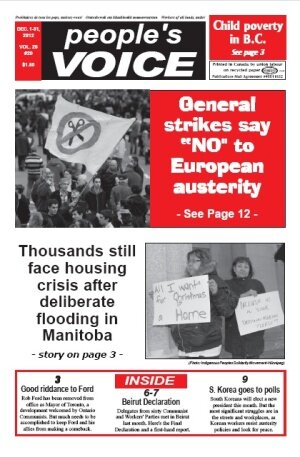
PEOPLE'S VOICE DECEMBER 1-31, 2012 (pdf)
People’s Voice 2013 Calendar
”Ideas of Revolution”

|
People's Voice deadlines: January 1-31 February 1-15 Send submissions to PV Editorial Office,
|
REDS ON THE WEB
http://www.parti-communiste.ca/
peoplesvoice.ca
www.ycl-ljc.ca
www.solidnet.org
|
People's Voice finds many "Global Class Struggle" reports at the "Labour Start" website, http://www.labourstart.org/. We urge our readers to check it out! |
* * * * *
People's Voice
Canadian Publications Mail Sales Product Agreement #205214
ISSN number 1198-8657
People's Voice is published by
New Labour Press Ltd
PV Editorial Office
706 Clark Drive,
VANCOUVER, B.C. V5L 3J1
Phone:604-255-2041
Fax:604-254-9803
email: pvoice@telus.net
Editor: Kimball Cariou : Business Manager: Sam Hammond
Editorial Board: Kimball Cariou, Miguel Figueroa,
Doug Meggison, Naomi Rankin, Liz Rowley, Jim Sacouman
* * * * * *
Letters
People's Voice welcomes your letters
on any subject covered in our pages.
We reserve the right to edit for length and clarity,
and to refuse to print letters which may be libellous
or which contain unnecessary personal attacks.
Send your views to:
"Letters to the Editor",
706 Clark Dr., Vancouver, BC V5L 3J1,
or pvoice@telus.net
People's Voice articles may be reprinted without permission,
provided the source is credited.
* * * * * *
The Communist Party of Canada, formed in 1921,
has a proud history of fighting for jobs, equality, peace,
Canadian independence, and socialism.
The CPC does much more than run candidates in elections.
We think the fight against big business and its parties
is a year-round job,
so our members are active across the country,
to build our party and to help strengthen people's movements
on a wide range of issues.
All our policies and leadership
are set democratically by our members.
To find out more about Canada's party of Socialism,
give us a call at the nearest CPC office.
* * * * * *
Central Committee CPC
290A Danforth Ave Toronto, Ont. M4K 1N6
Ph: (416) 469-2446
fax: (416) 469-4063 E-mailmailto:info@cpc-pcp.ca
Parti Communiste du Quebec (section du
Parti communiste du Canada)
5359 Ave du Parc, Montréal, Québec,
H2V 4G9
B.C.Committee CPC
706 Clark Drive, Vancouver, V5L 3J1
Tel: (604) 254-9836
Fax: (604) 254-9803
Edmonton CPC
Box 68112, 70 Bonnie Doon P.O.
Edmonton, AB, T6C 4N6
Tel: (780) 465-7893
Fax: (780)463-0209
Calgary CPC
Unit #1 - 19 Radcliffe Close SE
Calgary AB, T2A 6B2
Tel: (403) 248-6489
Ottawa CPC
Tel: (613) 232-7108
Manitoba Committee
387 Selkirk Ave., Winnipeg, R2W 2M3
Tel/fax: (204) 586-7824
Ontario Ctee. CPC
290A Danforth Ave., Toronto, M4K 1N6
Tel: (416) 469-2446
Hamilton Ctee. CPC
265 Melvin Ave., Apt. 815
Hamilton, ON.
Tel: (905) 548-9586
Atlantic Region CPC
Box 70 Grand Pré, NS, B0P 1M0
Tel/fax: (902) 542-7981
http://www.parti-communiste.ca/
* * * * * *
News for People, Not for Profits!
Every issue of People's Voice
gives you the latest
on the fightback from coast to coast.
Whether it's the struggle for jobs or peace, resistance to social cuts,
solidarity with Cuba, or workers' struggles around the world,
we've got the news the corporate media won't print.
And we do more than that
- we report and analyze events
from a revolutionary perspective,
helping to build the movements for justice and equality,
and eventually for a socialist Canada.
Read the paper that fights for working people
- on every page, in every issue!
People's Voice
$30 for 1 year
$50 for 2 years
Low-income special rate: $15 for 1-year
Outside Canada $50 for 1 year
Send to: People's Voice, 706 Clark Drive, Vancouver, BC, V5L 3J1
You can call the editorial office at 604-255-2041
REDS ON THE WEB
http://www.parti-communiste.ca/
http://www.ycl-ljc.ca/
http://www.solidnet.org/
(The following articles are from the December 1-31, 2012, issue of People's Voice, Canada's leading communist newspaper. Articles can be reprinted free if the source is credited. Subscription rates in Canada: $30/year, or $15 low income rate; for U.S. readers - $45 US per year; other overseas readers - $45 US or $50 CDN per year. Send to People's Voice, c/o PV Business Manager, 706 Clark Drive, Vancouver, BC, V5L 3J1.)
1) ONTARIO COMMUNISTS WELCOME ROB FORD'S REMOVAL
The Communist Party of Canada (Ontario) welcomes the Ontario Superior Court's order for Rob Ford to vacate the mayoralty of Toronto because of his failure to excuse himself on conflict‑of‑interest grounds from a council debate, triggered by his abuse of office to benefit a charity named after himself. The Party supports a by‑election to replace Ford, and calls for the movement fighting the right‑wing policies and forces behind Rob Ford to keep mobilizing, otherwise his agenda could continue under a different face.
Party Leader Liz Rowley explained that "Rob Ford had campaigned on ending `the gravy train', but when he took office Torontonians saw that in reality this meant lay‑offs, contracting out, cutting services, and charging steep fees for services the public needs and wants. It's the corporations who backed Ford who are on a `gravy train' of enjoying record profits, record low taxes, and municipal services at the expense of ratepayers and tenants who are paying more and more, and getting less and less. They're also salivating at the prospects of more privatization of city services and assets under the right‑wing majority at City Hall.
"Ford's own exploitation of his office for his family's benefit and his personal causes, as well as his contempt for democracy, for the public and the public interest, and for the high office of Mayor of the sixth largest government in the country, by being absent during Council meetings to coach football games amongst many other transgressions, shows he was making a new Gravy Train all by himself and has no respect for the people of Toronto.
"Congratulations are in order to the Stop Cuts Coalition and others who have had success in stopping his agenda, such as the `lifeboat' motion to moderate some of the cuts in January. But we need to keep up the mobilization because the right‑wing majority on Council and the corporate interests who bankrolled Ford's election won't rest. They could find someone else to do their bidding, with more grace and less Gravy."
Rowley had characterized the Ford administration as one where "the public is not welcome" when she was removed from City Hall for merely suggesting budget committee hearings be extended by one day to allow for all 348 registered deputants to have their democratic say.
As she said, "Rob Ford and the right‑wing agenda he represents were going after our libraries, recreation centres, seniors' homes, HIV/AIDS programs, school nutrition programs, three of our child care centres, three of our homeless centres, theatres, and zoos, but his removal does not mean they are stopping. We need to show we reject this agenda now, under any face new or old."
The only real guarantee that the Fords and co. will be side-lined is through the building of a strong and progressive civic reform movement that can unite all those forces now fighting the right‑wing agenda at City Hall, to develop a progressive municipal platform and put forward a slate of candidates who will fight for it and win in the 2014 civic election.
The Communist Party of Canada (Ontario) calls on the provincial and federal governments to end the chronic financial crisis in Toronto and other municipalities by providing cities with a new financial deal, including:
* provide adequate funding through statutory transfers to Toronto and all municipalities, enabling cities to provide the array of municipal services necessary in the 21st century.
* stop the firesale of municipal land and assets, including public housing, schools, and parks; and reverse user fees.
* upload the Harris download and rescind balanced budget legislation.
* fund the capital and operating costs of the TTC and municipal transit systems; reduce fares and increase ridership.
* transfer 50% of gas and road user to municipalities.
* collect unpaid and deferred corporate taxes, and introduce progressive tax policies based on ability to pay.
* remove education from the property tax, cut property taxes in half, and fund education through provincial general revenues
* develop a provincial and federal affordable housing plan and enact rent controls.
* introduce a provincial system of universally accessible affordable quality public child care.
* give cities status in the Constitution; and protect local autonomy and democracy.
The Party's 10‑point prescription for a People's Recovery, and its alternative to the austerity policies, is online at www.ontariocpc.ca/10‑point‑prescription‑for‑a‑peoples‑recovery.
By Adrien Welsh, Paris
"No to European austerity!" the main labour unions of 23 countries across the continent chanted on November 14th, from Portugal to Hungary, overwhelming the continent with crowds of workers responding to the call of the European Trade Union Confederation (ETUC) to mobilise against austerity.
France
According to the General Labour Confederation (CGT), the most important and militant French trade union, 15,000 people gathered in Paris from Montparnasse to Ecole militaire, while in Marseille 20,000 people responded to the call. People demonstrated in 130 cities across the country behind the slogan "For jobs, European solidarity and against austerity".
The general feeling of the crowd in Paris was one of deep discouragement about the socialist government of Francois Hollande, elected under the promise of change but behaving almost exactly like his predecessor Nicolas Sarkozy, by following the austerity policies dictated by EU troika. It is urgent to act, otherwise "we'll get caught like the Greeks," a teacher from the Saint‑Denis suburb in northern Paris told me.
In the same mood, Bernard Thibault, general secretary of the CGT, historically linked with the Communist Party of France, told the crowd that, "Certainly in France we're not on the same scale of austerity as in Greece or in Spain. But austerity policies are in Europe and in France: as soon as wages are frozen, the announcement of higher income taxes and less public investments, is an austerity policy!" The Hollande government is allocating 21 Billion Euros to the rich as tax cuts.
The Paris demonstration followed a massive protest on Sept. 30 for a public referendum on the European Fiscal Compact. Formerly known as the Treaty on Stability, Coordination and Governance (TSCG, or the Fiscal Stability Treaty), the Fiscal Compact is a coercive system developed by big business to accelerate the economic integration of Europe to more effectively strong‑arm austerity measures on the people.
The treaty institutes the principle that no budget exceeding 0.5 percent of the structural deficit could be voted on by the French parliament. If this were to happen, "consequent corrective measures" would be applied by the EU. Concretely, it means that the French parliament will have to cut 33 billion Euros in useful public services.
Despite strong popular opposition in which the Front de Gauche (an electoral coalition including the Communist Party of France) played an outstanding role, all aspects of the treaty were voted by the National Assembly, with the Senate confirming the vote on Oct. 29.
The most important contradiction here is that when Sarkozy and Merkel presented the first version of the TSCG, the opposition Socialist Party were clearly opposed. This position was reiterated even more strongly during the presidential campaign. Hollande told voters, several times, that as President he would "renegotiate" the Fiscal Compact and "change the global orientation of Europe."
Hollande was elected, but unsurprisingly, not only did he drop his call to "renegotiate" the treaty, but he imposed it on the French people.
"When we see how the government, which was elected thanks to the 11 million votes from the Front de Gauche and the Communists, is making fun of us, we want just one thing: go into the streets and cry out loud our opposition," one trade unionists from the RATP (Paris public transportation network) told me, adding "if it worked for you guys in Québec, why wouldn't it work for us too?"
Iberian Peninsula
Strikes were also organized in Portugal, where the official unemployment rate is around 16% (the global data for Europe is around 10.6%). Armenio Carlos, the general secretary of the General Portuguese Workers' Confederation (CGTP), the only major labour central which called for a general strike, described the action as "one of the biggest strikes since April Revolution" in 1974.
The strike came right after a massive demonstration against a visit to Portugal by Angela Merkel, who kept repeating that the Portuguese would eventually understand the long term benefits of austerity measures.
Portugal is a country where the population keeps getting poorer after experiencing the troika of European Union, International Monetary Found and European Central Bank policies. The general strike showed how the people, and especially the organized workers, are determined to fight together for their rights, highlighted by the unity of social movements and major trade unions during the mobilizations.
Meanwhile in Spain, homeland of the Indignados who launched the Occupy movement, and where 54% of the youth are unemployed, the movement went further than just indignation. According to the Communist Party of Spain (PCE), the strike experience was "globally positive" despite an unmeasured presence of the police forces. November 14 was the second general strike in eight months.
According to Luis Centella, PCE General Secretary, the strike was "one of the strongest since democracy returned" after Franco. Indeed, the country was paralysed: 75% of employees went on strike to oppose the austerity policies of the Rajoy government and its next 40 Billion Euro budget amputation. The trade unions are calling for a referendum on these imposed on the Spanish people.
Belgium's "tsunami"
"No to our industry's genocide", was a slogan of the workers in Belgium, where the Parti du Travail de Belgique (PTB) obtained a historically high vote in recent municipal elections. People gathered to express opposition to deindustrialization and the massive loss of jobs. October 2012 will be designated as "Black October", due to the loss of 30,000 jobs in one month. The brutal situation is compared to a "social tsunami."
The major trade unions didn't call for a general strike, but many rallies and actions were organised, especially in Brussels, the EU capital, in front of the different embassies. Strikes are being planned among the most impacted workers, including railway workers and the steel workers from Arcelor Mittal.
"No to fascism" in Budapest
In Hungary, anti‑austerity demands were boosted by strong opposition against the ultra‑right or quasi‑fascist Orban government. Elected in 2010 in a period of economic and social crisis, the new government imposed authoritarian measures, restricting freedom of the press. The government adopted a new nationalist Constitution, affirming the Christian roots of the nation and preparing for action against labour unions and social movements to allow debt refunding and market flexibility. Every opponent of the government could be a traitor to the nation!
These policies are supported by the neo‑fascist Jobbik party, which attributes Hungary's problems to "Roma criminals". The party uses the Roma as a pretext to form paramilitary groups, charged with "re‑establishing social order."
The intransigent attitude of the European governments as well as the whole EU troika, in the face of such popular opposition, and the poor results of their austerity plans, all suggest that tensions on the continent will continue to sharpen.
Nevertheless, the perspective of fighting the EU itself is not yet envisaged by many social movements and unions. The main trade unions, including the ETUC itself which called the action, and many progressive parties such as European United Left/Nordic Green Left, believe this battle has to be fought within the EU framework.
This debate within the people's movements is also sharpening. Strike actions in Greece, led by the PAME labour union and the Communist Party of Greece, did not hesitate to recognise the imperialist nature of the EU. If this more global perspective doesn't overtake the current understanding, the Greeks point out, the struggle could fail.
Nevertheless, many left and progressive commentators agreed that the success of this "Day of Action" shows the European people's struggle against austerity measures has reached a further step, beyond just outrage. More and more people, especially youth, are willing and ready to organise themselves and act in a united and militant way, which has to be the way forward for the working class of Europe.
(Adrien Welsh, originally from Montreal, is currently a student and journalist based at the National Institute of Eastern Languages and Civilization in Paris.)
3) STILL NO SOLUTION TO ABORIGINAL HOUSING CRISIS IN MANITOBA
By Darrell Rankin
For one and a half years, more than 2,000 members of the Lake St. Martin First Nation have been without homes and split up. The life of an entire nation is forever damaged by imposed provincial flood control and federal government/corporate‑caused climate change. This is genocide in Manitoba today.
Hundreds of children will "celebrate" their second Christmas without a real home, in hotels or essentially in a foreign land.
The federal and provincial governments have failed to respond in a meaningful way, although the scale of the disaster is monumental. To put this in perspective, the Lake St. Martin First Nation represents 1 out of 604 people in Manitoba, or about 1 of 272 Manitobans living outside of Winnipeg.
It is another stark example of the inequality of Aboriginal peoples in Canada. Rather than respect the treaty signed with the Lake St. Martin First Nation, pro-corporate governments are rejecting this nation's choice of location to establish a new reserve.
The Manitoba NDP government is making unilateral decisions where the First Nation must live "temporarily." The government even secretly bought some neighbouring land, a location rejected as unsuitable by the First Nation.
Deliberate flooding since 1961 has made the First Nation's land uninhabitable, ending with the forced, emergency transfer of people in 2011. Roughly the same number of people are still displaced from other First Nations after the historic 2011 Manitoba flood.
Stephen Harper, Greg Selinger and their corporate backers are responsible for the gross injustice. Instead, the Harper government is accusing members of the Lake St. Martin First Nation of "fraud" and dropping people from evacuation lists to cover up its racist inaction.
The federal government also cut its meagre evacuation allowances on November 1. "Before, each adult evacuee received $23.40 a day and each child $18.70 a day. Now, Ottawa will pay rent or hotel charges, as well as $3.20 a day in living allowances for children and $4 a day for adults." (Winnipeg Free Press, November 21, 2012). Try to eat on that!
Evacuee costs for Aboriginal people make up about 7 per cent of the total spent to recover from the flood. Yet the federal government cut the allowances because it says the nation is in "recovery." There is no recovery, because no solution is in sight!
A town of 2,000 non‑Aboriginal people would be relocated and rebuilt by now. Last year's Slave Lake, Alberta fire displaced 700 people. Three‑quarters of private homes are rebuilt; all apartments will be completed within another year. When 100,000 people lost their homes to the 1871 Chicago fire, the large majority had new homes in two years and the city doubled in size by 1880. Ontario supplied forests of lumber.
What is the hold‑up now in Manitoba?
The 2011 flood never directly touched most people in Manitoba, yet governments are "warehousing" the unresolved problem of displaced Aboriginal peoples. Compared to Hurricane Sandy in the eastern U.S., this was a major climate catastrophe for our small province of 1.2 million people.
The City of Winnipeg, other communities and farmers downstream owe a great debt to the Lake St. Martin First Nation, yet public gratitude by these communities is lacking. One Winnipeg City Councillor is hesitating to express thanks and a wish for a solution because it might create a "legal or financial obligation" to the First Nation!
This is plain cruelty and ingratitude to people who sacrificed their homes and ancestral homeland. The labour movement and every group that supports justice for Aboriginal peoples clearly needs to step forward and demand a solution to this national housing crisis, and soon.
Enough is enough. Justice delayed in justice denied.
(Darrell Rankin is the Manitoba leader of the Communist Party of Canada.)
4) "DEFEND DEMOCRATIC AND ECONOMIC RIGHTS IN ONTARIO"
The Ontario Federation of Labour and its community allies have issued a call for a major rally on Jan. 26, 2013, at the upcoming Ontario Liberal party convention. The following is from the OFL website:
The Ontario government has been shut down while workers' rights are under threat and cuts to jobs and services are hurting every community.
The 2012 Ontario Budget slashed funding and threatened thousands of jobs that are essential to the delivery of vital public services that support every community. Meanwhile the Ontario Liberal government maintained corporate tax cuts that continue to bleed $15 billion from the province every year. This fall, McGuinty's Liberals, with the backing of Tim Hudak's Progressive Conservatives, passed Bill 115 - an unprecedented law stripping educational workers of their most basic democratic rights. By cheating teachers and educational support staff of the right to strike and the right to bargain collectively with their employer, the Liberals and Conservatives have established a precedent that threatens the rights of every worker in Ontario.
Now the Ontario Legislature has been prorogued while public services and workers' rights are continue to hang in limbo. However, with a provincial election on the horizon, workers and community members across the province can demand new priorities for Ontario that put people ahead of corporate profit.
The Ontario Federation of Labour and community allies have launched a campaign to defend the democratic and economic rights of everyone. The campaign will bring the fight for rights and democracy directly to the doorstep of every Member of Provincial Parliament in the leadup to the Ontario Election. It has already started with regional town hall community meetings across the province and it will culminate in a mass rally at the Ontario Liberal Leadership Convention in Toronto on January 26, 2013.
Get involved in the campaign! Help build labour‑community coalitions in every community! Mobilize for January 26 to defend the democratic and economic rights of everyone!
Website: www.ofl.ca/index.php/campaigns/DemocraticRights
Facebook: www.facebook.com/events/489963847693178
Twitter Hashtag: #J26Rally
5) SINCLAIR RE-ELECTED AS B.C. FEDERATION PRESIDENT
PV Vancouver Bureau
In an unusual development, there was a contest for the top elected positions at this year's B.C. Federation of Labour convention, held Nov. 26-30 in Vancouver. But few observers were surprised when Jim Sinclair and former BC Teachers Federation president Irene Lanzinger were re-elected as President and Secretary-Treasurer, defeating Michele Laurie (an electrician and president of IBEW Local 282), and CUPE activist Trevor Davies. Sinclair took 1382 votes against 599 for Laurie, a winning margin of 70%. The second race was a bit closer, but the margin gave a strong mandate to the incumbents over the next two years.
There were various interpretations for the first such race in many years at the B.C. Fed. But the Laurie-Davies team was strongly backed by CUPE-BC, which walked out of the Fed convention two years ago in a protest against the Sinclair leadership.
That action was related to complex wider issues over raiding, leading many to conclude that it was not a division over fundamental policies. Instead, the differences reflect internal dynamics in a federation which requires strong consensus among major affiliates and executive members to move forward.
This year, the leadership of CUPE-BC, including its president Barry O'Neill, backed the challengers and tried to impose caucus solidarity for the vote. A major component of CUPE-BC, the Hospital Employees Union, took a different view and endorsed Sinclair and Lanzinger. In the end, CUPE-BC and IBEW were unable to convince many other delegates to back Laurie.
The incumbents were supported by Action Caucus members and others on the left of the labour movement in British Columbia. While many trade union activists with a militant outlook have raised criticisms of the BC Fed leadership over the years, there is an understanding that Sinclair's options are sometimes limited by the strength of some "business union" oriented affiliates.
The overarching consideration for many of the convention debates was the impending B.C. provincial election, set for May 13, 2013. After nearly 12 years of rabidly pro-corporate, anti-working class rule under Gordon Campbell and now Christy Clark, the B.C. labour movement is desperate to dump the Liberals. Opinion polls for the last year have consistently given a lead of about 20% to Adrian Dix's NDP, and delegates were eager for the campaign to begin.
Dix got a far better reception than his predecessor Carole James, whose tepid pro-business approach barely got delegates out of their seats two years ago, shortly before a caucus revolt pushed her out of the job. Likewise, federal NDP leader Thomas Mulcair got a standing ovation, and many hope that he can defeat the Harper Tories in 2015.
But Adrian Dix is being cautious. He has already pledged to reverse some of Gordon Campbell's tax cuts to the wealthy and the banks, but as he hinted to the BC Fed delegates, there will be no major move to shift the provincial tax burden back onto the corporate sector. He pledged to treat labour with respect, but also to consult closely with business interests. In other words, those who hope for a sharp swing to the left under the NDP should lower their expectations. There are even strong indications that a Dix government would not make significant pro-labour changes to the B.C. labour code, leaving that reform to a second term in office, i.e. 2019, after another six years of corporate attacks on working class rights.
The sharpest debate at the convention came on a composite resolution about the proposed Enbridge Northern Gateway pipeline. Seeking unity, the resolutions committee limited the wording to this particular controversial project, and to exports of diluted bitumen from the Alberta tar sands. Labour would only support the pipeline, the resolution stated, if various conditions were met, including support from First Nations and an environmental assessment giving definitive approval.
Judging by the reaction to speakers, it appeared that a solid majority of delegates were opposed to Northern Gateway and to dilbit exports. Since the "conditions" set out in the compromise are very unlikely to be met, adoption would have meant in reality that labour opposes tar sands exports.
But the resolution drew angry opposition from the building trades unions, whose members hope for jobs building the pipeline. More significant for the final result, a number of delegates also spoke against, saying that it watered down opposition to any new oil pipelines. In the end, the supporters of the project and some of its sharpest critics joined to defeat the resolution, much to the dismay of many delegates.
The vote leaves B.C. trade unions in disarray, with some intending to keep up their involvement in campaigns against Northern Gateway and other pipelines, and others supporting these projects. The decision is clearly a setback for efforts to strengthen unity among labour, First Nations and environmentalists around energy issues, such as the big Oct. 22 anti-pipeline rally at the Legislature in Victoria.
6) WORSE THAN HARRIS: ONTARIO'S NEW SOCIAL ASSISTANCE CUTS
By Jean Kenyon
When Premier Mike Harris slashed welfare and froze disability benefits in 1995, he subsequently mitigated some of the worst impacts by introducing two new benefits in 1997. One was the Community Start‑Up and Maintenance Benefit (CSUMB), which a recipient could access once every two years for special housing needs, such as first and last month's rent or getting disconnected utilities turned back on. The second was a Discretionary Benefit for welfare recipients, by which the municipality could dole out small amounts for adult dental work or food hampers.
Well, Grinch McGuinty has decided these small graces are too rich for Ontarians to sustain. As of Dec. 31 the CSUMB will be gone and the Discretionary Benefit capped. It means the municipalities will get less than half of the money the province used to provide through both benefits. They will have to either slash benefits to the poorest people or jack up regressive property taxes, because municipalities aren't allowed to run a deficit.
But the people of Ontario aren't taking it lying down. Town halls have been held around Ontario with speakers from Ontario Coalition Against Poverty (OCAP) and CUPE. Occupations of Liberal MPPs' offices have taken place from Sudbury to Kitchener ‑ especially at the office of Social Services minister John Milloy, whom activists have dubbed the Minister of Misery. Many more actions are planned throughout December.
Meanwhile a long‑awaited review of social assistance was completed in October. Before the ink was even dry, Minister Milloy told the media that Ontario couldn't afford the recommended meagre $100/month increase.
Alliances are now forming between poverty activists and the labour movement, stinging from McGuinty's assaults on public sector bargaining rights and wages. Watch for much new militancy in Ontario's streets in the new year.
7) PALESTINE: GOOD NEWS AND BAD
People's Voice Editorial
First the good news, as they say. Recent weeks have seen important victories for the Palestinian people, starting with their heroic resistance against the Israeli aggression which killed some 140 residents of Gaza. The threat of an IDF ground invasion was blocked, thanks to the courage of the people of Gaza, and powerful protests across the world, even inside Israel. This was followed by the historic vote of the United Nations General Assembly to grant Palestine "observer state" status, a major step towards full international recognition and self‑determination of the Palestinian people. This was more than a symbolic decision, since it gives the Palestinians access to new legal and diplomatic tools to help achieve their goal of full statehood.
For Canadians, the bad news is that our Tory government has again shown its vicious hatred of the Palestinians. Canada, the U.S., the Czech Republic and Israel were isolated in voting against the General Assembly resolution. (Ironically they were joined by a handful of Pacific Islands which will eventually be swamped by rising oceans if global warming is not checked. Perhaps Harper's climate change deniers will offer these islanders refuge in Canada?)
Foreign Minister John Baird was greeted with silence when he urged the General Assembly to vote against Palestine. But that matters little compared to the praise of Benjamin Netanyahu, who immediately thanked Stephen Harper for backing the apartheid occupation of Palestinian territories. This "special relationship" was seen again when Canada failed to criticise the latest illegal expansion of Israeli settlements in the West Bank.
The day is coming when Palestine will be free. The best solidarity Canadians can provide is to demand that the Harper Tories and all parties in Parliament join the rest of the world in recognizing the legitimate rights of the Palestinian people.
8) REFLECTING ON A TUMULTUOUS YEAR
People's Voice Editorial
As 2012 comes to an end, revolutionary and progressive activists have much to reflect upon. This was the fourth full calendar year of the global economic crisis which erupted in the fall of 2008, and there is no end on the horizon for 2013. Everywhere in the "developed" capitalist world, austerity is the only item on the menu for the corporate elite and their parties, including social democratic politicians who were elected on platforms to defend working people.
This was also a year in which the US-dominated NATO imperialists and their local supporters ramped up efforts to sabotage the "Arab Spring." Terrified by the popular mobilizations across the Arab world to demand better pay and working conditions, social equality, and democratic freedoms, the ruling classes are willing to use every weapon at their disposal to divide the peoples and fan bloody civil conflicts, such as the current attempt to overthrow the government of Syria.
Not least, 2012 saw the spread of environmental catastrophes and climate change, arising from greenhouse gas emissions which are the result of unchecked capitalist expansion. It is obvious that our planet's future cannot be left to the whims of an economic system driven solely by the quest for maximum corporate profits.
The recent meeting of Communist and Workers' parties in Beirut (see pages 6 & 7) showed that there is a people's alternative to the austerity agenda. However, the working class and its allies must be prepared to fight for fundamental social change to halt the slide into poverty, ecological collapse, fascism and war. This will be a difficult and complex battle against a ruthless enemy, but as a famous revolutionary once warned, the only options for our world are socialism or barbarism.
9) STOP THE PRIVATIZATION OF CANADA POST
By T.J. Petrowski, Winnipeg
Canada Post was founded in 1867 and has since become a vital service to all Canadians, delivering 40 million items to 14 million addresses everyday, and employing over 70,000 full and part‑time employees.
However, Canada Post is under threat from the Harper Government's attack on public sector workers and unions, with the Conservatives continuing the push for privatization.
In the 1980s and the 1990s, 1500 public post offices were closed, the services offered being taken over by multinational corporations that do not serve the interests of Canadians, but private investors with anti‑worker policies. Now at least 16 closures in urban areas across Canada underway.
The privatization of Canada Post would negatively impact Canadians in many ways. Since private postal outlets are only interested in making a profit, they are less reliable and do not provide the same services that a public postal service does, and unlike public services, are not accountable to Canadians. Rural mail delivery would be especially threatened by privatization, since it is not profitable for private corporations to deliver to remote areas.
The workers at private postal outlets are often underpaid and overworked, as corporations exploit workers in an endless desire to force larger profits out from their workers. Workers are more likely to have less secure and part‑time employment, while many jobs will be eliminated entirely, exacerbating the rising income inequality in Canada.
Countries that have privatized their postal service have experienced significant repercussions, with the workers and the general public forced to endure the burden. More than 16,000 well‑paid jobs were eliminated in Sweden between 1993 and 2005, with only a meager 2,000 jobs created as a result of the privatization. Additionally, postage rates for small business and the public increased dramatically as a result of the privatization of the national postal service. In New Zealand, postal workers suffered a major wage reduction as a result of privatization.
According to polls by Ipsos Reid and The Canadian Federation of Independent Business, 69% and 52% of respondents do not want a privatized postal service in Canada. The two major concerns of the respondents were the environmental consequences of a private postal service and the risk to their privacy.
Canadians don't want to see their post offices closed and replaced by private corporations. Canada needs a reliable public postal service that is accountable to the public. Stand up to the privatization of vital public services!
10) WFDY ANNOUNCES 18TH WORLD FESTIVAL OF YOUTH AND STUDENTS
From Rebel Youth
From Nov. 8‑12, representatives from more than 40 different youth and student organizations descended on Quito, Ecuador for a General Council meeting of the World Federation of Democratic Youth (WFDY). The main task of the meeting was to examine a proposal that made Ecuador the host of the next World Festival of Youth and Students.
Progressive and Communist organizations were represented from a geographically diverse range of countries such as Greece, Portugal, the United States, Canada, Mexico, Venezuela, Cuba, Brazil, Western Sahara, Syria, Egypt, Palestine, Vietnam, India, Angola and Eritrea.
The meeting coincided with the sixty‑fifth anniversary of the youth organization. WFDY was founded in 1947 as a product of the anti‑fascist struggles of the period, with its mandate being to unite youth for peace and against imperialism.
Sixty‑five years later, WFDY reiterated its anti‑imperialist stance in the political resolution amended and adopted unanimously: "Our choice, to stand for the needs and interests of the youth, derives from our founding principle: to struggle against imperialism".
WFDY and its members dedicated themselves to fighting against imperialism's increased aggressiveness, such as the creation of a bloody proxy‑wars in Syria and Libya, the danger of intervention in Iran, the US backed campaign against the DPR Korea, continued occupations of Afghanistan, Western Sahara, Palestine and Iraq.
The Young Communist League of Canada's representative to the General Council was Drew Garvie.
"The political choice to have the meeting in Latin America was a powerful one," Garvie said. "While capitalist governments are bringing in austerity policies to make the people pay for capitalist crisis around the world, the struggle in Latin America is giving rise to progressive policies and a process that is uniting the continent against imperialism."
Ecuador is starting to become a leading protagonist in this transition away from over a century of domination by United States monopoly capitalism. President Rafael Correa and his "PAIS" coalition were elected in 2006 after several years of mobilization by indigenous and anti‑neoliberal forces. Since then, Ecuador has kicked out a US military base from its territory, written a constitution that includes the right to the regeneration of the environment, eliminated tuition fees in public universities, joined regional progressive trading partnerships, refused to participate in any international meeting that Cuba is not invited to, and is currently shielding Wikileaks' Julian Assange from extradition to the United States.
The Young Communists of Ecuador proposed the hosting of the 18th World Festival of Youth and Students in Ecuador in order to help "strengthen and radicalize the national democratic revolution". Several government officials, including the Governor of Imbabura province, a cabinet Minister of the PAIS coalition, and representatives from the Secretariat of the People, Social Movements and Citizens Participation, greeted the WFDY meetings.
The Ecuadorian delegation has proposed to mobilize ten thousand youth from Ecuador and invite ten thousand international delegates to participate in the 18th WFYS. After hearing a comprehensive presentation, which included a political report and logistical details, the international delegates adopted the proposal unanimously.
Garvie was optimistic about the potential of organizing for the upcoming festival: "The overwhelming feeling of the delegates leaving the meeting was one of enthusiasm start mobilizing to build the Festival movement back home. We know that the 18th WFYS comes at an important political time, when more and more youth are taking to the streets and starting to look for an alternative to the war, crisis and environmental destruction inherent in capitalism."
"Several delegates were very interested in the recent student strikes in Québec," said Garvie. The Young Communist League of Canada's intervention to the meeting noted that sharing struggles like the victory of the Québec students is important at this time. "Of course, we see the World Festival of Youth and Students as an excellent venue to come together and share our struggles, and build the necessary unity for the struggles ahead."
11) HISTORIC MEETING OF COMMUNISTS IN BEIRUT
By Kimball Cariou
For the first time, this year's International Meeting of Communist and Workers' Parties (IMCWP) took place in an Arab country. Delegates representing sixty parties from five continents took part in the 14th IMCWP, held Nov. 22-25 in Beirut, Lebanon.
The event was hosted by the Lebanese Communist Party, which draws its membership from all of the country's cultural and religious communities. The LCP was an important force in popular resistance against past Israeli invasions, and its members take great pride in their military and political role in helping to drive the aggressors from their homeland.
Large areas of Beirut have been rebuilt after the devastating civil wars of 1975-1991 and 2005. Some of the city's historic mosques and churches still remain, not far from the Hamra neighbourhood where the IMCWP delegates met at the Hotel Commodore. Many of us arrived a day early, and took a few hours to explore nearby neighbourhoods with very different demographics, from poor to wealthy. Beirut's reputation as a financial centre is seen with gleaming bank buildings, casinos, and upscale retail shops familiar to North Americans. Nothing says "transnational capitalism" quite like a Macdonalds or a Starbucks!
The IMCWP began on the evening of Nov. 22, with a meeting of the "Working Group" of parties which organize the annual event. Other delegates used the time to share news from our respective countries over a delicious Lebanese-style dinner.
The full meeting started the next morning, with ten-minute contributions by each party, going in alphabetical order. As we moved from Azerbaijan to Bahrain, Belgium to Brazil, Britain to Canada, several themes emerged.
One was the confirmation of the Marxist analysis of the nature of capitalist economies, especially the crisis of overproduction which is at the root of the "boom-bust" cycle of the system, leading to constant inter-imperialist rivalries and intensified exploitation of the working class.
In nearly every major capitalist country, the crisis which erupted in 2008 has continued. Unemployment levels are again rising, living conditions are falling, and austerity policies are being implemented ruthlessly, especially in the European region. At the same time, working class and popular resistance to austerity keeps growing. On Nov. 14, just a week before the IMCWP convened, general strikes shook six European countries, and demonstrations against austerity were held in many more (see page 12). In Latin America, the left and progressive forces have made important gains in recent years.
Many of the contributions in Beirut revolved around a crucial question: how to transform protests against austerity into a powerful movement for fundamental social change, and for socialism? There are no easy answers, but in most countries, the Communists are fighting for immediate measures to defend working people, while also warning that social democratic parties have usually abandoned anti-austerity platforms upon taking office.
A second theme of the Beirut meeting concerned developments in the Middle East and the Arab world: how to understand the origins of the "Arab Spring", and how to ensure that these popular uprisings win real gains for democracy and working class rights.
There was a broad consensus among the delegates that the uprisings in Tunisia and Egypt, which helped spark wider popular movements, were based in the anger of working people against unemployment, inflation, falling living standards, lack of human rights, and the widening gap between rich and poor. These uprisings were not the result of "conspiracies," as some have suggested. But imperialism and the regional capitalist elites - such as the rulers of Saudi Arabia and the Gulf states - have had some success in redirecting popular anger into forms of so-called "political Islam", for example the Muslim Brotherhood in Egypt. Such ideologies, the delegates agreed, are a reactionary diversion from genuinely revolutionary struggles for working class interests.
This has been seen clearly in countries such as Libya and Syria, where legitimate popular discontent around certain problems was channelled into reactionary alternatives. The result was the imperialist-backed overthrow of the Gadaffi government in Libya, and the current attempt by outside forces to topple the secular-oriented Assad government of Syria. There was strong agreement by the IMCWP that communists will continue to condemn the intervention against Syria by imperialist powers and the Gulf states, at the same time as helping to build genuine popular struggles for political freedoms and improved living standards.
Since the IMCWP convened just as the latest Israeli aggression against Gaza was ending, solidarity with the Palestinian people was a third major theme. The delegates strongly condemned the attacks by Israel, and its refusal to negotiate a peace agreement which would end its "settlement" policies and allow the establishment of a viable Palestinian state within the pre-1967 borders.
On the first full day of the meeting, delegates adjourned in mid-afternoon to travel by bus to United Nations House in central Beirut, for a rally and news conference to condemn the bombing of Gaza. There was a large turnout by local media and by Al-Jazeera, which reported the protest on its website.
Following two days of presentations, the meeting concluded on Nov. 25 with a plenary to consider a final statement (see page 6 for full text). Several concrete proposals were made to strengthen the initial draft, but much of the discussion focused on the complex and critical issues of how to resist imperialist interventions in the region.
With consensus reached on the final wording, delegates went by bus to Batroun, a historic town north of Beirut where a new office of the Lebanese Communist Party was being opened. We packed the building together with local members and supporters, and the party's general secretary, Dr. Khaled Hadadah, gave a powerful speech, thanking those who helped make the new office a reality, and outlining the work of the LCP in the current conditions.
Possible venues for the 15th IMCWP are still being considered, taking into account the need for geographic diversity of this important annual event. The Working Group is expected to announce the date and location for the 2013 meeting early in the new year.
(People's Voice editor Kimball Cariou represented the Communist Party of Canada at the Beirut meeting. Readers can find the Final Statement and contributions by most parties at http://solidnet.org.)
12) WHAT DID INDIA ACHIEVE BY HANGING KASAB?
By Gurpreet Singh
The recent hanging in India of Ajmal Amir Kasab, a convicted terrorist of Pakistani origin, has sparked euphoria both in India and Canada. Kasab was executed on Nov. 28 for his involvement in a terrorist attack on Mumbai, India's financial capital on November 26, 2008 that left 166 people dead.
Kasab and other armed extremists came by boat from Pakistan and took the city hostage. While Kasab survived, others died fighting with the police and soldiers. Undoubtedly, it was an attack on India's sovereignty that originated from a hostile neighbour which had been helping anti-India activities on its soil for years.
The trial of Kasab revealed the level of involvement of the Pakistani agencies in the attack. This helped India in isolating Pakistan diplomatically in a post 9/11 environment. Ironically, the US that welcomed the hanging of Kasab had largely ignored past complaints by the Indian government against Pakistan over its support of terrorism. After all, Pakistan is an old US ally, and any complaints coming from a pro-Soviet India from the cold war era were bound to fall on deaf ears.
With India emerging as a nuclear ally of the US, it is not surprising that the US has learned to acknowledge trans-border terrorism in India as a real threat. The 2008 attack quickly came to be known as 26/11 as a 9/11 synonym, whereas Mumbai has witnessed terror attacks more than once, including those before 9/11.
Kasab filed for mercy after receiving his death sentence. However, his mercy petition was rejected by the President of India. His hanging was welcomed by the Hindu nationalist BJP, the major opposition party of the country, and people danced and rejoiced his death in different parts of India.
This may have helped India's Prime Minister Manmohan Singh domestically, by raising his profile from being a docile leader to a hawkish politician, but it has saddened the members of civil society whose voices have been virtually muzzled by jingoism.
Manmohan Singh had lost his credibility in the face of massive corruption and his inability to bring economic reforms both nationally and internationally. The western media had portrayed him as a weak leader. The hanging of Kasab coincides with the recent death of ultra Hindu nationalist leader Bal Thackrey who was given a state funeral. If that was not enough, Manmohan Singh, who represents the so-called secular Congress party, had cancelled a dinner meeting with BJP leaders because of Thackrey's death. Thackrey, who considered Hitler as his role model, was known for Pakistan bashing. His supporters recently announced that they won't let the Pakistani cricket team play on Indian soil. It is a separate matter that they did not show up to fight against Kasab and others who invaded Mumbai.
While Thackrey was honoured despite his involvement in anti- Muslim violence in Mumbai, Kasab was hanged for an equivalently grave crime against humanity. Only recently the President of India stayed the death sentence of Balwant Singh Rajoana, a Sikh extremist convicted for bombing, after receiving a mercy plea from the Chief Minister of Punjab state, Parkash Singh Badal. This was in spite of the fact that Rajoana wanted to be hanged and had refused to file a mercy petition. Clearly, Badal had buckled under pressure from Sikh radicals in Punjab. Likewise, the leaders from Kashmir and Tamil Nadu have also been pleading for the lives of convicted extremists on death row from their regions.
The issue of capital punishment has been totally politicized in India. There is no serious consideration given to abolish such an inhuman system. The hanging of Kasab has actually made him a hero for supporters of the pan-Islamic militant movement. Instead of hanging Kasab, India could have used him to bargain for amnesty for Indian prisoners languishing in Pakistani jails.
Above all, the state should not be allowed to become a killer. The Indian government had scored a victory, by giving him a fair trial, and also bringing forward the real face of Pakistan. It was in a win-win situation. What was the point in hanging Kasab when he could have languished in jail for life?
It's a shame that Rajoana has been spared for political compulsions, whereas Kasab has been killed despite his plea for life. This sends conflicting signals about the impartiality of the legal system and secularism in India. While there is no justification for Pakistan to support terrorism in India, the Indian government should also punish those guilty of anti-Muslim or anti-Sikh pogroms, and those accused of state repression against other minorities. This would help to defeat the designs of terrorist organizations which survive due to lack of political will to address such sensitive issues in a fair and just manner.
13) SOUTH KOREAN PRESIDENTIAL CAMPAIGN IN FULL SWING
By Sean Burton
South Koreans will vote for a new president on December 19 as Lee Myung‑bak's single five‑year term comes to an end. Several candidates have registered, but the focus has been on three: Ahn Cheol‑soo, Park Geun‑hye, and Moon Jae‑in.
Ahn Cheol‑soo, a computer technology entrepreneur and professor at Seoul National University, is known primarily for his company's widely‑used antivirus software. Registered as an independent until Nov. 23, Ahn presented himself as delivering "new politics", condemning the Lee Myung‑bak administration and adopting a populist platform similar to the late president Roh Moo‑hyun.
Moon Jae‑in, a civil rights lawyer and a close friend of President Roh who served as his chief of staff, has been registered as the Democratic United Party candidate. The DUP is ultimately derived from liberal groups that supported Roh ten years ago, and Kim Dae‑jung years before that.
The similarities between candidates Ahn and Moon led to talks about joining forces. Ultimately, Ahn resigned his candidacy. So far, Moon is doing what the opposition has done for years: present himself as the inheritor of Roh's legacy against right‑wing politics. A Moon victory probably won't bring substantial change, but would likely see a change toward north Korea. Whether that means a return to the "Sunshine Policy" of Kim and Roh is not yet clear.
Then there is Park Geun‑hye. As the daughter of military dictator and architect of modern south Korea Park Chung‑hee, Park Geun‑hye carries a certain legacy. To her supporters in the New Frontier Party, Park is just what the doctor ordered: a strong commitment to conservative principles and a direct connection to the man who facilitated rapid economic expansion in the 1970s. This allows her to present herself in a very different light from the much‑maligned Lee Myung‑bak. Even beyond right‑wing circles, General Park's legacy is still often a cause for positive opinions. But Park Geun‑hye's opponents look at history differently. Many found themselves arrested and tortured by the so‑called Yushin government just for being activists.
Painfully aware of these things, Park's angle has been to present herself, absurdly, as non‑ideological. Naturally she doesn't dwell on her father's regime. A few months earlier, Park apologized for some of those who suffered in the past. It rang rather hallow, as it was never specified exactly what she was apologizing for.
Regarding her father's 1961 coup d'etat, which General Park called a "revolution to save the country", his daughter called it "an event that happened which cannot be refuted", and insisted that it is not the province of politicians to judge the matter, but a job for historians. After all, why "live in the past"?
Presenting herself as non‑ideological, Park instead applies such labels to her opponents. Even the late president Roh was accused of waging ideological battles, such as attacking the National Security Law and the Private Education Act, dividing and agitating the people.
It is easy to see through Park's comments. Everyone understands that the National Security Law can get people arrested or threatened even for innocuous activities, just for being remotely pro‑DPRK or anti‑imperialist. A number of internet message boards have gotten people in trouble this year. The law was made to reinforce the previous dictatorship and prevent any real engagement with the north. Park acts as if the law was always there; questioning this "natural" entity in the service of Korea means being "ideological", i.e. belonging to the wrong ideology.
Candidate Moon has been poking holes in Park's view of Korean history, as well as mocking her pampered upbringing. Conservatism and liberalism are set for a heated campaign against each other.
Where is south Korea's left in all of this? Moon and DUP might strive to represent the values of Roh Moo‑hyun, but what are those values? Roh made a name for himself as a human rights lawyer and a critic of certain right‑wing policies. But his tenure was no great victory for working Koreans, and Lee Myung‑bak has done much to roll back whatever was done.
The Unified Progressive Party has also put forward a candidate. Lee Jung‑hee has had little exposure in the media and will be overshadowed by Park and Moon. And even the UPP is a moderate social‑democratic party at best. Working people in south Korea demand a government that serves their interests and doesn't force concessions or sell out. Too bad the system is rigged to perpetually deny them such an option.
14) MUSIC NOTES, by Wally Brooker
"Cape Breton Island Protest Songs"
A heroic era lives again with the release of the compilation album "Cape Breton Island Protest Songs." More than 30 local musicians have contributed to a landmark album that demonstrates the depth of Cape Breton people's music. It all began when scholar and musician Richard MacKinnon unearthed some 120 poems and songs from the Maritime Labour Herald. The weekly paper, co‑founded by communist labour leader J.B. McLachlan, was a powerful voice of the workers at a time (1921‑1926) when Cape Breton coal miners and steelworkers were engaged in epic struggles that reverberated across Canada. Determined to set the lyrics to music, MacKinnon and musician Victor Tomiczek circulated verses among a host of musical friends. The result is an utterly compelling album. For this writer standout tracks include "Grand and Glorious Day" (a celebration of May Day), "The Shutdown" (concerning plant closures) and "They Cannot Stand the Gaff" (a satire of the British Empire Steel Corporation sung in classic rock style by Richard MacKinnon). This album has great contemporary relevance. It would make a fine gift for the music‑minded socialist on your holiday shopping list. For lyrics, musician biographies, historical notes and ordering information visit www.protestsongs.ca.
Cops attack Cameroon musicians union
A peaceful march by 500 members of the Cameroon musicians' union SYCAMU was brutally repressed on Nov. 8 by more than a thousand police. The rally in the West African republic's capital city of Yaoundé was called to protest music piracy and the refusal to pay royalties to music copyright holders. SYCAMU President Roméo Dika, one of 63 unionists arrested, is accused of starting an insurrection, a charge that could be punishable by death. Among those beaten and tear‑gassed was renowned 85‑year‑old singer Anne‑Marie Nzié. Cameroon has one of the highest rates of music piracy in sub‑Saharan Africa. A local support organization recently revealed that 18 musicians died over the past three years because they lacked the means to pay for medical treatment. The festering copyright issue and the violence of the state response is ultimately the responsibility of the corrupt 30‑year dictatorship of President Paul Biya and the failure of his neo‑colonial regime to establish a cultural infrastructure to serve recording artists. Sign on to the solidarity campaign at www.labourstart.org.
AFM takes on digital gaming industry
As gross revenues in the digital gaming industry exceed the combined world‑wide revenues of pop music and motion pictures, game music has evolved from tinny beeps to fully‑scored orchestral works. Now the American Federation of Musicians (AFM) is campaigning for a tough new agreement with digital game companies. The union's first agreement with a video game company was negotiated in 1993. By 2006 it had signed collective agreements with more than 60 companies. But in 2006, in a bid to encourage more AFM music scoring, the union made the fateful decision to relax use agreements and offer wage concessions. The move only encouraged digital game companies to contract with unorganized third parties. With industry profits sky‑high despite the crash of 2008, the AFM began to fight back, prohibiting third‑party agreements in 2010. But one of the biggest companies, Sony Computer Entertainment of America (SECA) persisted in hiring non‑union musicians. Last October, the AFM revised its digital game agreement, abolishing the concessions of 2006 and placing SECA on its international unfair list. AFM members are now prohibited from working with SECA, with penalties including stiff fines and expulsion. For more info: www.afm.org.
Félix Awards: window on Québec music
The Québec recording industry's annual celebration, the Félix Awards, took place in October at Montréal's Théatre St‑Denis. This event is a golden opportunity for Canadians to learn about the province's vibrant music scene. The awards have been presented by the Association québecoise de l'industrie du disque, du spectacle et de la video (ADISQ) since 1979. Named for the outstanding writer and musician Félix Leclerc (1914‑1988), the Awards were established because of the failure of the JUNOs to adequately acknowledge French‑Canadian music. Here are just a few 2012 winners to check out: Fred Pellerin (Folk Album for C'est un monde), Richard Desjardins (Adult Contemporary for L'Existoire), Coeur de Pirate (Pop Album for Blonde and Female Artist), and Lisa Leblanc (Newcomer of the Year for her self‑titled debut album). Many artists are creating thoughtful and exciting music in Québec today, and the list of Félix nominees is a good place to start an investigation. Another excellent entry point, especially for the linguistically challenged, is CBC Radio's weekly show A Propos, hosted by Jim Corcoran, whose Félix Award preview shows are available online. Corcoran provides helpful English translations of lyrics. For more info: www.adisq.com and www.cbc.ca/apropos.
15) SASKATCHEWAN WOMEN'S FORUM 2013
If you are interested in women's rights, in connecting with individuals and organizations who have been working on women's issues recently and through the decades, and in spending a weekend learning, having fun, and moving a women's agenda forward in our province, then please set aside Friday, January 18 (evening) and Saturday, January 19, 2013!
We are a coalition of women and organizations who have come together to plan a Saskatchewan Women's Forum taking place at the Bessborough Hotel in Saskatoon. For too long, we have been having conversations in isolation from each other about the current context that women and women's organizations find themselves in. So we are creating this opportunity to collectively develop how we can move forward on the issues that we care about.
We are currently finalizing our program, which will be centered on women's stories and respectful of intergenerational, intercultural and diverse experiences. If you are interested in attending, please respond back to us <michelle.beveridge@oxfam.ca>, tel. 306.242.4097, and we will ensure you receive the program and registration package by mid‑December.
In the meantime, please save the date! And get in touch with us if you would like to be part of the planning, to volunteer at the forum in any number of capacities, or have other ideas for us.
Registration is $50/person. (Please let us know if you are in a situation where you would only be able to attend with a reduced rate, or conversely, if you are able and willing to donate money to assist in covering a portion of registration for others.)
Sincerely, Michelle Beveridge and Katelyn Jones, Oxfam Canada, Saskatoon; Sue Delanoy, Elizabeth Fry Society, Saskatoon; Diane Fletcher, Vadis Group, Saskatoon; Lori Hanson, U of S, Community Health and Epidemiology, Saskatoon; Laura Hopkins, Saskatoon Women's Community Coalition; Lori Johb, Saskatchewan Federation of Labour; Audra Krueger, U of S, Centre for the Study of Co‑ops, Saskatoon; Darla Leard, Canadian Labour Congress, Saskatoon; Barb Macpherson, YWCA Saskatoon; Adriane Paavo, Prairie Lily Feminist Society, Regina; Priscilla Settee, U of S, Native Studies, Saskatoon; Lenore Swystun and Samantha Mark, Prairie Wild Consulting, Saskatoon; Laura Westman, Saskatoon; Bernadette Wagner, Regina.