|
|
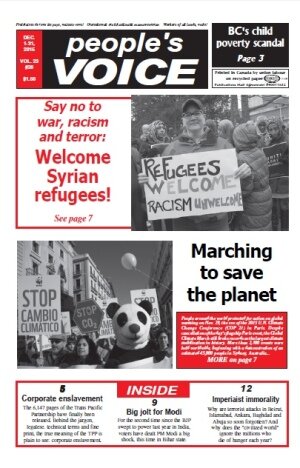
People’s Voice December 1-31, 2015
Volume 23 – Number 20 $1
1) SAY NO TO WAR, RACISM AND TERROR - WELCOME THE SYRIAN REFUGEES!
2) OFL LEADERSHIP SHIFTS RIGHT
3) THE CLOCK HAS BEEN TICKING FOR 500 YEARS
4) INTERNATIONAL LAW AND HUMAN RIGHTS – Editorial
5) LET THE WAR RESISTERS STAY! - Editorial
6) OPEN LETTER CALLS FOR PUBLIC CONSULTATION ON C-51
7) TPP TEXT REVEALS CORPORATE ENSLAVEMENT
8) GLOBAL MARCHES CALL TO SAVE THE PLANET
9) TELL LIBERALS TO SCRAP ANTI-COMMUNIST MEMORIAL
10) MAURICE RUSH MARKS 100TH BIRTHDAY
11) B.C. GOVERNMENT STILL IN DENIAL OVER POVERTY RATES
12) BIG JOLT FOR BJP IN BIHAR ASSEMBLY POLLS
13) MUSIC NOTES, by Wally Brooker
14) AFTER THE SHOCK, FIGHT BACK AGAINST IMPERIALISM AND ITS NIGHTMARES
PEOPLE'S VOICE DECEMBER 1-31, 2015 (pdf)
|
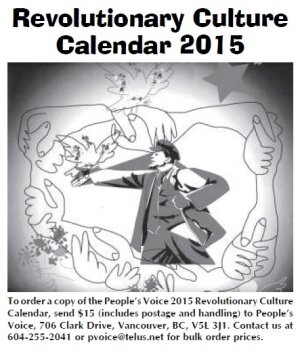
To order a copy send $15 (includes package and handling) to People’s Voice, 706 Clark Drive, Vancouver, BC, V5L 3J1. Contact us at 604-255-2041 or pvoice@telus.net for bulk order prices. |
|
People's Voice deadlines: January 1-31 February 1-14 Send submissions to PV Editorial Office,
|
|
|
REDS ON THE WEB
http://www.communist-party.ca
peoplesvoice.ca
www.ycl-ljc.ca
www.solidnet.org
|
People's Voice finds many "Global Class Struggle" reports at the "Labour Start" website, http://www.labourstart.org/. We urge our readers to check it out! |
* * * * * *
Central Committee CPC
290A Danforth Ave Toronto, Ont. M4K 1N6
Ph: (416) 469-2446
fax: (416) 469-4063 E-mailmailto:info@cpc-pcp.ca
Parti Communiste du Quebec (section du
Parti communiste du Canada)
5359 Ave du Parc, Montréal, Québec,
H2V 4G9
B.C.Committee CPC
706 Clark Drive, Vancouver, V5L 3J1
Tel: (604) 254-9836
Fax: (604) 254-9803
Edmonton CPC
Box 68112, 70 Bonnie Doon P.O.
Edmonton, AB, T6C 4N6
Tel: (780) 465-7893
Fax: (780)463-0209
Calgary CPC
Unit #1 - 19 Radcliffe Close SE
Calgary AB, T2A 6B2
Tel: (403) 248-6489
Ottawa CPC
Tel: (613) 232-7108
Manitoba Committee
387 Selkirk Ave., Winnipeg, R2W 2M3
Tel/fax: (204) 586-7824
Ontario Ctee. CPC
290A Danforth Ave., Toronto, M4K 1N6
Tel: (416) 469-2446
Hamilton Ctee. CPC
265 Melvin Ave., Apt. 815
Hamilton, ON.
Tel: (905) 548-9586
Atlantic Region CPC
Box 70 Grand Pré, NS, B0P 1M0
Tel/fax: (902) 542-7981
* * * * * *
News for People, Not for Profits!
Every issue of People's Voice
gives you the latest
on the fightback from coast to coast.
Whether it's the struggle for jobs or peace, resistance to social cuts,
solidarity with Cuba, or workers' struggles around the world,
we've got the news the corporate media won't print.
And we do more than that
- we report and analyze events
from a revolutionary perspective,
helping to build the movements for justice and equality,
and eventually for a socialist Canada.
Read the paper that fights for working people
- on every page, in every issue!
People's Voice
$30 for 1 year
$50 for 2 years
Low-income special rate: $15 for 1-year
Outside Canada $50 for 1 year
Send to: People's Voice, 706 Clark Drive, Vancouver, BC, V5L 3J1
You can call the editorial office at 604-255-2041
<pvoice@telus.net>
REDS ON THE WEB
www.communist-party.ca
peoplesvoice.ca
www.ycl-ljc.ca/
http://solidnet.org/
http://www,rebelyouth-magazine.blogspot.com
(The following articles are from the December 1-31, 2015, issue of People's Voice, Canada's leading socialist newspaper. Articles can be reprinted free if the source is credited. Subscription rates in Canada: $30/year, or $15 low income rate; for U.S. readers - $45 US per year; other overseas readers - $45 US or $50 CDN per year. Send to People's Voice, c/o PV Business Manager, 706 Clark Drive, Vancouver, BC, V5L 3J1.)
1) SAY NO TO WAR, RACISM AND TERROR - WELCOME THE SYRIAN REFUGEES!
Statement by the Central Executive Committee, Communist Party of Canada, Nov. 29, 2015
Just weeks after the most racist and reactionary government in recent Canadian history suffered a major defeat at the polls, far-right forces are making a brazen attempt to use tragic events in other countries to press the new Liberal government to adopt the discredited right-wing agenda of the Harper Tories. This right-wing drive must be blocked by united and powerful resistance by the labour and democratic movements, bringing together all those who want a future based on economic and social justice, human rights, and world peace.
The imperialist drive towards increased militarization and war on a global scale is an intrinsic feature of capitalist development in general. In turn, it inevitably has a negative impact upon domestic politics, including a pattern of “selective attention”. Events such as the bombings in Beirut, Ankara and other cities, the US military’s massacre at a civilian hospital in Afghanistan, the Saudi aggression in Yemen, or the Ukraine government’s shelling of civilians, are downplayed or ignored in the West. However, the shocking Nov. 13 attack in Paris quickly became the focus of a hypocritical attempt to whip up fear and hatred against refugees and immigrants.
In Canada, the most immediate feature of this xenophobic campaign has been a conscious and deliberate attempt to smear Muslims and members of racialized communities as the alleged source of terrorist threats, crime, and economic problems. This campaign has been fanned by far-right, racist elements in the United States, such as Donald Trump and other Republican presidential candidates who call for fascist measures such as surveillance and registering of Muslim people in a database, removal of citizenship rights, and even the mass incarceration and expulsion of racialized communities. Similar racist voices emerged from the shadows during the recent federal election to support the Tories in their attempt to bar refugees from war-torn areas of the Middle East, central Asia and Africa, and then to fight the new Liberal government’s plan to bring 25,000 Syrian refugees to Canada.
These forces have adopted the rhetoric used by racist movements in Europe, such as the lie that refugees and immigrants aim to use their higher birth rate to “swamp” Canada’s supposedly “white Christian” values. Earlier in the election, they demonized Islamic women who choose to wear the niqab, in an attempt to claim that they support women’s equality – equality rights which in reality were systematically attacked and undermined for a decade by the Harper Tories. The most cowardly and despicable elements among these racists torch mosques under cover of darkness and assault Muslim women and children in the streets. Politicians such as Saskatchewan premier Brad Wall openly spread lies and misinformation, claiming that bringing Syrian refugees to Canada will lead to a dramatic escalation of terrorist recruiting. These forces condemn the Liberal government’s plan to end Canadian participation in bombing of targets in Syria and Iraq, and demand an immediate escalation of military force and a major increase in the military budget.
All of these efforts are connected to a wider corporate push to further erode labour, civil and democratic rights in the name of “protecting” Canadians. The political and physical attacks against Muslim-Canadians are part of a long-standing drive to intimidate and silence all those who reject the agenda of austerity, poverty, environmental destruction, corporate trade sellouts, and war.
The Communist Party of Canada joins with all other progressive people in condemning every form of terrorism, including both the imperialist wars and occupations of the US, Canada and other NATO countries, and those committed by fundamentalist movements such as Daesh and al-Qaeda. At the same time, we stress once again that these dangerous forces have gained strength in large part because of the state terrorism, interventions and exploitation of the Middle East, central Asia and Africa by the imperialist powers and their regional ally, Israel. Many of the terrorist attacks in recent years have been carried out by forces which were in fact spawned and supported by the US and its NATO allies, the root source of mass terror and destruction on our planet today.
Both the al-Qaeda affiliated al-Nusra Front and ISIS (or “Daesh”) – the main forces attempting to overthrow the Assad government in Syria – have long been financed and armed by Saudi Arabia, Qatar and Turkey, with the direct knowledge and support of Washington. Our Party condemns the imperialist-orchestrated campaign to impose ‘regime change’ on Syria, the real cause of the conflict which has virtually destroyed the country and driven millions from their homes as refugees. The downing of a Russian jet by Turkey, under highly dubious circumstances, has further heightened tensions, and could provoke a wider regional and even global war.
The Communist Party calls for an immediate cessation of all foreign military, political and economic interference and aggression in both Syria and neighbouring Iraq, not an expansion of foreign military operations under the pretext of a “war on ISIS”. We express our solidarity with the Syrian people struggling to defend their sovereignty and territorial integrity, and favour negotiations to end the ‘civil’ war as determined by the Syrian people themselves, without outside involvement, interference, or ‘dictat’. The crisis needs a political solution that has the elected government of Bahsar al-Assad at the table. This is the only path to de-escalate the war tensions in the region, and to end the humanitarian tragedy that has afflicted its peoples.
We also call for full solidarity with the Syrian refugees coming to Canada, and for restoration and adequate funding of the services they desperately need, including housing, language training, legal aid, social assistance and much more. Instead of expanding the Canadian Armed Forces, we demand a complete end to the Syria/Iraq mission, and a 75% reduction in military spending, which would provide $15 billion annually for social programs, housing and infrastructure projects in this country.
Finally, we demand swift action against the racist groups and individuals which are engaged in violence against the Muslim community. These criminal elements must not be allowed to conduct their campaign of racist terror under cover of sympathy for the victims of the Paris attacks.
2) OFL LEADERSHIP SHIFTS RIGHT
By Liz Rowley, Toronto
Delegates at the Ontario Federation of Labour Convention voted unanimously on Nov. 27 to adopt an Action Plan advocated and motivated by President Sid Ryan, chairing his last convention. Ryan was pushed out by a coalition of the “freight-payers” (unions which pay the largest per capitas and are the biggest funders of the OFL), whose right-wing leaders have campaigned for his ouster since his 2009 election on a platform of mass independent labour political action against austerity. Ryan’s crime? He delivered, making the OFL and its social and community allies in the Common Front a force to be reckoned with by reactionary governments and employers alike.
New OFL President Chris Buckley, along with running mate Patty Coates (Secretary-Treasurer) were acclaimed. The third member of their “FedForward” slate, Ahmad Gaied, won the Executive Vice-President position in a three way race that included Mark Brown from CUPW. Brown received a quarter of the votes on a day when the convention was almost twice its normal size, salted with one-day delegates bussed in by the FedForward “freightpayers”. Minus the one-day delegates, Brown’s vote was viewed as a reliable measure of opposition to the new leadership’s rightward shift, and to the disinformation and slander campaign that preceded the convention.
Sadly for delegates, they had no choice in the matter. The incoming leadership was settled in October when Ryan was effectively forced out after Unifor President Jerry Dias announced his union was backing Chris Buckley, a Unifor National Rep and former President of CAW 222 (GM Oshawa). Nancy Hutchison and Irwin Nanda were also told that they would face challenges and were encouraged to not run again.
Unifor’s defection was critical, as Ryan’s leadership had been supported by the CAW and CUPE - the two largest unions in Canada - as well Labour Councils, the equity caucuses, and the left in the affiliates throughout his three terms. It was Ryan who brought the CAW back into the OFL after their long absence and return to the CLC. Why did Unifor walk away from Ryan?
In the 2011 and 2013 conventions, Ryan had been sharply attacked by the leadership of ETFO, Steel, UFCW, and other critics of his stand on issues like BDS and solidarity with the Palestinian struggle, his criticisms of the NDP and Liberals (both of which had the support of some unions), his determination to bring labour into the streets to fight austerity, and to link labour with the people’s movements through the Ontario Common Front (a coalition of more than 90 people’s organizations with branches centred on Labour Council) which was created on his watch.
At the 2013 convention, delegates rejected right-wing attacks that focused on accusations of mismanagement of the OFL’s finances and harassment, and instead supported the mass mobilizations and progressive direction charted under Ryan’s leadership. The OFL’s rejuvenation as a force in Ontario stood in sharp contrast to the previous leadership’s inaction (beyond unwavering support for the NDP). For twelve years, the OFL had been a sleeping giant. On Ryan’s watch, it had awakened and was in motion.
Financial constraints were a real factor, and the OFL did lay off staff as a result. But the main cause was not spending, but slashed income - the direct result of a dues strike by OPSEU ($3 million), and other large affiliates ($2 million more) who objected to the campaigns, and to the Common Front seen by some as little more than a free lunch for ‘activists’.
The 2013 convention debated a constitutional amendment to create an unelected special committee with control over finances that would act like a senate to an elected Executive. The amendment was defeated, despite efforts to whip convention delegates. It was a trial run for 2015.
In early 2014, as the OFL tried to convene affiliates to organize to defeat the Hudak Tories in the upcoming provincial election, CLC President Hassan Yussuff was inveigled to speak to a secret counter-meeting of ‘freight-payers’ who were attempting to by-pass and supercede the OFL meeting. Exposure forced cancellation of the gathering, while the OFL proceeded to organize the mass mobilization of affiliates, labour councils and social and community allies that defeated the Tory campaign for right to work legislation, and to cut 100,000 public sector jobs.
Undeterred, the freight-payers continued their campaign, beating the drums on the financial crisis. They claimed the dues strike was the fault of the ‘divisive’ Ryan, who had to go for unity to prevail. Rumors abounded that other large affiliates, including Steel and UFCW, would also join the dues strike, and that the OFL building would be sold, if Ryan continued as president. Leaks to the media made the OFL’s problems front page news and began to shape public opinion and workers’ opinions about the crisis and who was responsible. The die was cast.
Hassan Yussuff appointed Unifor National Rep Chris Buckley to examine the OFL’s books, and report back. The OFL gave Buckley free and full access to books and accounts, as well as to Officers, personnel, Committee and Board members and affiliates. In the middle of the examination, Buckley abruptly resigned his job and announced he was running for OFL President.
At the same time last summer, Yussuff abruptly convened a meeting of “the freight-payers”, as he called them. The meeting deliberately excluded the elected OFL officers, the smaller affiliates, and the Labour Council and equity Vice-Presidents. The subject was the leadership of the OFL and the need for ‘unity’, i.e. unity that would bring OPSEU and ONA back into the OFL, conditional on the departure of Sid Ryan.
As the walls started closing in, a sensational story about secret hidden cameras in the OFL building was leaked to the media, painting Ryan as morally and fiscally unfit to lead. Ryan responded that this was a security system put in place by a previous leadership, only installed in public places like stairwells and the main lobby. This defrayed some of the damage.
When Unifor jumped ship, President Jerry Dias told CBC radio that while Ryan was a great guy, he still had to go. Ryan responded that Unifor had cut a deal; abandoning their support for Ryan would let them put one of their own in the OFL President’s chair.
With Ryan’s announcement that he would not run, there was no progressive slate at the convention, and no time to put one together. Only Mark Brown from CUPW and Nancy Griffith-Bonaparte from PSAC contested the Executive VP position.
The FedForward slate’s political action plan, according to its election flyer, is about “Building Political Influence – Political action training programs for grassroots members, and OFL lobby day days at Queen’s Park with the labour councils, labour leaders, and rank and file participation.” That’s quite a shift from the mass mobilizations of the last six years.
In general, the new leadership is a reflection of the NDP’s shift to the right, and of that party’s strongly-held view that labour’s role should be to support the NDP with money and workers during elections. Independent labour political action is not welcome, even when it’s led by left NDPers like Sid Ryan. Criticism of NDP policies, which Ryan also expressed after the 2014 provincial election, is also unwelcome, even criticisms widely held in the trade union movement. In fact, NDP leader Andrea Horwath did not attend the OFL convention, a clear sign of the strained relations.
The left will have to get much better organized and more influential at future conventions to turn this around. Its main task going forward is to hold the new leadership to account, to make sure it implements the main points of the Action Plan. Details of the amended Plan will soon be available on the OFL website.
The Action Plan and the Left Caucus
Delegates did the obvious, focusing on OFL policy, the strong Action Plan, building the Common Front, and moving the fight from the defensive to the offensive against the employers and right-wing governments.
The Action Caucus mobilized in a joint caucus with Take Back Labour, a new caucus born at the CLC convention, around Hassan Husseini’s campaign for CLC President. The joint caucus worked hard to highlight key issues including the fight to stop ratification of the TPP by the Ontario government, the struggle to rescind Bill C-51, the privatization of Hydro One, and other urgent issues.
The joint caucus also led the fight from the floor against a Constitutional amendment to create a new, unelected Executive Committee with responsibilities for the budget and expenditures, comprised of the four largest private sector unions, the four largest public sector unions, plus one each from the building trades unions, the Labour Councils, and the equity VPs.
Passage of the amendment was apparently a key part of the deal to bring back OPSEU and the other unions involved in the dues strike.
The amendment was a slight variation on the 2013 version, aimed to dampen criticism of its undemocratic nature. After a short debate that was quickly cut off by persistent calls for the question, the amendment passed by just two votes over the required two-thirds majority. The OFL is now closer to the US model, where transparency, accountability and membership control are far removed from the delegates and concentrated in the hands of unelected committees and individuals.
An angry Hassan Husseini told delegates that the amendment would not have carried in a secret ballot. CUPW President Mike Palecek later told People’s Voice that the fight next time will be to make every position on the newly created committee directly elected by the convention.
The convention heard from many invited speakers and guests, including Dennis Edney, the lawyer for Omar Khadr, who received a standing ovation and $53,000 from the OFL towards his expenses in the Khadr case. Edney painted a frightening picture of Canada’s role in the US war machine, in Afghanistan and in the US torture centres and black sites around the world.
A session on police racism was animated, as delegates got a firsthand description of policing in Black neighbourhoods, where “carding” puts Black youth into the system where their names come up as “known to police” whenever an employer requests a police check on a new employee or job applicant. Black journalist Desmond Cole moderated the panel discussion.
Natalie Mehra, Executive Director of the Ontario Health Coalition, also addressed the Convention, with an expose of the growing momentum of healthcare and hospital privatization in the province. She called on the labour and people’s movements to redouble their struggle to save Medicare in Canada.
In his final remarks to the Convention, President Buckley spoke about the Common Front strikes in Quebec and his intention to send greetings of solidarity from the OFL. Mass protests were held in Quebec the next day, heading towards a general strike.
3) THE CLOCK HAS BEEN TICKING FOR 500 YEARS
By Kimball Cariou
After a decade of denial under the previous federal government, swift progress is now underway to launch a national inquiry into the tragedy of missing and murdered indigenous women and girls. For family members, grassroots activists and Aboriginal organizations which have campaigned since the 1990s for such an inquiry, this reversal is breathtaking, even among those who remain wary of the Trudeau government’s intentions.
The new situation also compels everyone involved to think carefully about what comes next. The hunger for immediate answers and genuine justice is tempered with the realization that conducting this inquiry in a comprehensive and respectful manner may take several years. On the other hand, a recent series of articles in the Globe and Mail points to the likelihood that serial killers continue to target young indigenous women, adding new urgency to the crisis.
A key part of the problem is the enormous scope of this issue. After years of sharing stories and researching statistics, most family members and activists who have led this struggle agree that over 1200 indigenous women and girls have been killed or gone missing across Canada since 1980. This will likely be the general period addressed in most detail by the inquiry, in part because shortcomings in data collection make it increasingly difficult to arrive at precise numbers for earlier periods of time.
But indigenous peoples and their allies are painfully aware that the past 35 years are only a fraction of the historical era of colonization of the Americas.
In 1534, Jacques Cartier “claimed” the Gulf of St. Lawrence for France, and the pace of land grabs and genocide soon accelerated, including the extermination of the Beothuk people on Newfoundland. Other forms of genocide were a deadly consequence of colonization, such as the 1639 smallpox epidemic which killed half of the Hurons. Everywhere throughout the hemisphere, indigenous peoples died in huge numbers as European empires and then the newly independent settler-capitalist states expanded into their territories. Resistance was continuous, but as in the 1864 Tsilhqot’in War in central BC or the 1885 Metis Rebellion in Saskatchewan, was usually overcome by superior firepower and brutal repression.
For First Nations, Metis and Inuit peoples, the events of the last 35 years can only be viewed through the prism of stolen lands, broken treaties, residential schools, the “60s scoop,” and shocking crimes committed by police and other state institutions. From this perspective, the 1200 murdered and missing women are not an exception; they are part of an ongoing pattern which weaves together complementary policies of extermination and assimilation. Even today, with a federal government which includes Justice Minister Jody Wilson-Raybould, the daughter of iconic First Nations leader Bill Wilson, the Canadian corporate elite remains deeply committed to the destructive extraction of tar sands and other resources from traditional aboriginal territories.
All this background hints at the complex issues around the convening of the national inquiry, especially to understand fears that the terms of reference could be set up to limit participation or to pre-determine an outcome favoured by the government.
It comes as welcome news that Indigenous Affairs Minister Carolyn Bennett has already started pre-inquiry consultations with families of the missing and murdered indigenous women and girls. Unlike her Conservative predecessors, Bennett has stated her intention to listen closely to the families, who are determined to be at the forefront of the inquiry process.
Bennett is also carrying out “engagements" with provincial and territorial governments, aboriginal organizations, and civil society groups. She wants an inquiry which will be culturally sensitive, not simply token attention to indigenous practices. So far, the Liberals have committed to spending $40 million over two years, and they have not finalized the scope of the inquiry. Bennett is aware, for example, that the systemic racism of the residential school system, which aimed to “take the Indian out of the child”, also had a terrible impact on boys, and that many indigenous men have been murdered or gone missing.
None of this is any guarantee that the outcome will satisfy the families or others who have been deeply involved in this issue, or that the inquiry’s final recommendations will be implemented by governments and other bodies. The Canadian state will still be in the hands of corporate interests determined to squeeze maximum profits from the exploitation of human beings and nature. The police, armed forces, the courts and prisons, spy agencies etc. will remain instruments of force to maintain the rule of the wealthy as long as they hold power.
Even if the inquiry exposes the systemic roots of violence against indigenous peoples, it will not by itself bring a final end to the legacy of centuries of colonial oppression and racism. As Buffy Sainte-Marie sang in Now That The Buffalo’s Gone, “oh it’s all in the past you can say / but it’s still going on here today.”
What might change, however, is something even more profound. Despite setbacks, the struggle to overcome the legacy of racism is gaining momentum. The Mohawk struggle at Oka, the Caledonia land reclamation by the Six Nations, the Idle No More movement, resistance against fracking and pipeline projects, and the demand for the national inquiry, have all won growing support across Canada. The Conservatives refused to accept the Truth and Reconciliation Commission’s 94 recommendations - including the definition of cultural genocide - and were voted out of office less than four months later.
The fact that this inquiry is about to happen reflects a dramatic shift in public opinion, which the new Liberal government has chosen not to ignore. The Liberals must establish broad terms of reference and ensure that the inquiry will allow people to speak truth to power. But they must also act quickly. Justice delayed is justice denied, and the clock has already been ticking for nearly five hundred years.
(An earlier version of this article was published in Radical Desi magazine.)
4) INTERNATIONAL LAW AND HUMAN RIGHTS
People’s Voice Editorial
In a world where “might makes right” usually seems to prevail, it is highly instructive to remember that international law contains important protections for the rights of both human beings and sovereign states. For example, the term “a crime against peace” refers to "planning, preparation, initiation, or waging of wars of aggression...” Those who advocate escalated bombing of Syria should recall that the US-led war of occupation against Iraq in 2003 was not only the worst political and humanitarian disaster of the 21st century; it is also widely considered to be such a crime, the most serious violation of international law which a state can commit.
International law also requires states to protect basic human rights. The historic Universal Declaration of Human Rights was proclaimed by the General Assembly on December 10, 1948. The year 2016 will mark the 50th anniversary of the International Covenant on Economic, Social and Cultural Rights, which expands further upon the responsibilities of governments to protect a wide range of human rights, such as: free public education for all, “the highest attainable standard of physical and mental health,” adequate food, clothing and housing, the right of unions to function freely and to strike, safe and healthy working conditions, the rights to take part in cultural live and to enjoy the benefits of scientific progress, and much more.
These remarkable documents were signed by Canada and the other leading capitalist countries. There is no international legal requirement to fight wars of aggression or to drive people into poverty for the sake of corporate profits. There are, however, binding legal obligations to ensure that people can live in peace and to have food, shelter, clothing and education. December 10th, International Human Rights Day, is an important occasion to demand that governments uphold those obligations.
5) LET THE WAR RESISTERS STAY!
People’s Voice Editorial
The first week of December is “Let Them Stay Week”, an important occasion to tell federal Minister of Immigration John McCallum to take steps to allow U.S. war resisters to stay in Canada, and to end the vicious legal proceedings against them. For a decade, U.S. Iraq War resisters were the target of political interference in their cases by the previous Conservative government. Despite strong public opposition, some were deported by Canada, and received harsh jail sentences for opposing the illegal and immoral invasion of Iraq.
Before and during the recent federal campaign, Justin Trudeau’s Liberals made a number of important promises in response to public pressure. The new PM is on record as backing the stand taken by Liberal governments of the 1965-1973 period, when some 50,000 conscientious objectors and other Americans were allowed to enter Canada rather than take part in the Vietnam War. Trudeau has also been a sharp critic of Conservative policies on this issue.
Now the Liberals must take swift action on their promises. The deportations must end, along with all legal and court proceedings against the war resisters. As the War Resisters Support Campaign says, this must including rescinding Operational Bulletin 202, a directive issued in July 2010 by the Harper Government which instructs Immigration Officers to flag all U.S. war resisters, label them criminals, and define them as potentially inadmissible before even hearing their cases. This draconian regulation must be replaced by a new Operational Bulletin that restores fairness for all war resister cases and reverses the harm done to date.
Too many war resisters and their families have already suffered for their brave stand. We urge readers to help end this tragedy. For more information on how to support the campaign at this crucial moment, visit www.resisters.ca.
6) OPEN LETTER CALLS FOR PUBLIC CONSULTATION ON C-51
An important Open Letter to the new Prime Minister calls for broad public consultations around Bill C-51, the so-called “Anti-Terrorism Act 2015,” which Trudeau pledged to amend. Signed by a wide range civil society groups (see below), the letter was issued on November 20. It reads as follows:
Recent events in France have left people around the world, including Canadians, understandably shaken. It is difficult to see our friends suffering, and to imagine their lives under attack. However, as we look toward how we can best help our stricken friends, we are also calling on you to lead our country in helping Canada stay true to its values.
As you quite rightly said just last week, “Governments have a responsibility to keep their citizens safe while defending our rights and freedoms. And that balance is something that the Canadian government and indeed all governments around the world will be focusing on.”
The recent events in France are a stark reminder of the need for effective security legislation. However, it is in times of adversity that the challenge of upholding our values is greatest. Former Bill C-51, the Anti-Terrorism Act, 2015, represents precisely the type of disproportionate and excessive response to adversity that a truly democratic country must avoid. The new powers, mandates, and crimes it established continue to pose a direct and ongoing threat to Canadian innovation, political discourse, freedom of expression, privacy, and civil liberties more generally — without providing increased or effective security.
Your government has made a commitment to address some problematic elements of Bill C-51, and we are encouraged by that pledge. However, we are concerned by indications that you will seek to introduce a Bill C-51 reform package before engaging in public consultations. The case for Bill C-51 has never been made to the public, and Canadians have not yet been provided with an opportunity to provide meaningful input regarding its faults. Such consultation must precede any further legislative initiatives.
Bill C-51’s one-sided expansion of Canada’s security powers was adopted without any regard to the many long-standing and well documented problems in Canada’s already permissive security regime. These problems, which span information-sharing, flight restrictions, intelligence oversight, foreign intelligence mandate creep, vaguely defined state powers, and proceedings lacking constitutional protections, to name a few, have already caused serious harm to Canada. Not least amongst these harms is the torture of innocent Canadians, including Maher Arar, whose wrongful imprisonment and torture in Syria is directly attributable to overly permissive information sharing mechanisms that Bill C-51 expanded. Instead of addressing these problems, many of Bill C-51’s provisions directly compounded them.
It is little surprise that hundreds of organizations, academics, independent experts and entrepreneurs, as well as over 300,000 concerned Canadians, have spoken out against Bill C-51. Despite the significant and sustained opposition to the Bill’s introduction and adoption from all elements of Canadian society, the previous government failed to engage in meaningful consultation on its provisions. In fact, the government has yet to make a credible case for any of its elements. An informed and democratic debate must begin with a public explanation of the government’s rationale for Bill C-51, demonstrating why Canada’s pre-Bill C-51 security apparatus was insufficient, and justifying changes to that apparatus.
Canadians remain concerned with Bill C-51’s legacy. Its constitutionality is in question and many of its elements are currently being challenged in court. In the last week alone, more than 10,000 Canadians have sent you emails inviting you to take part in a public conversation about Bill C-51. A proportionate legislative approach to security – one that does not unduly impact our civil liberties – is necessary if Canadians’ trust in our government and justice system is to be restored. Finding the proper approach to security requires a meaningful public consultation on the various elements of Bill C-51, and of Canada’s approach to security in general. It is clear that Canadians want to participate in formulating a balanced solution.
As civil society groups and experts with a vested interest in the outcome of this process, there are three phases that we believe are essential for an effective, credible, and fruitful public consultation process that we hereby ask you to adopt:
1. Government position statement: An informed and democratic debate must begin with a public explanation of the government’s rationale for Bill C-51. Such a document must clearly demonstrate how Canada’s pre-Bill C-51 security apparatus was inadequate, and justify any changes introduced by Bill C-51 that the government seeks to retain. It should also outline any anticipated impacts on civil liberties and explain why these are justified.
2. Public consultations: The Canadian public remains gravely concerned about the implications of Bill C-51. Through a national online consultative process, members of the Canadian public should be given adequate opportunity to have their voices heard and acted upon, prior to the tabling of new legislation.
3. Consultation with experts and stakeholders: Once the government has made the case for its vision of security reform, it must undertake an open and unbiased public consultation with civil society groups, academics, businesses, Indigenous peoples, and other stakeholders on the basis of the Government’s position statement and plans to move forward, again prior to the tabling of new legislation. It is only through meaningful engagement with stakeholders that the government can hope to address security in a manner that appropriately respects civil liberties. In light of the sweeping and fundamental nature of the changes imposed by Bill C-51, such consultation must occur before the parliamentary reform stage begins.
Democracy requires robust debate, as does any bona fide attempt to address security. You have assured Canadians that you want to govern in a more participatory and transparent manner. To rebuild public trust after Bill C-51 we need to restore a democratic dialogue that is more collaborative and generates results that are constitutional and consistent with Canadian values. We urge you to set the proper tone for a truly participatory democracy by committing to an open public debate on Bill C-51 as a precondition to the tabling of any legislative changes.
In light of last week's tragedies, it is more critical than ever to ensure that we have effective, thoughtful, and measured legislation in place. We hope that you will act quickly to advance these public consultations and address the legacy of C-51 – an urgent issue for all of us. As we look to move forward, we hope that you will invite us to work together, and ensure that we get this right.
We believe that we are better as a country when we work together. We look forward to working with you to build a better Canada.
SIGNATORIES: BC Freedom of Information & Privacy Association; British Columbia Civil Liberties Association; Canadian Civil Liberties Association; Canadian Internet Policy & Public Interest Clinic; Canadian Journalists for Free Expression; Canadian Access and Privacy Association; Centre for Free Expression, Ryerson University; Centre for Law and Democracy; Canadian Institute of Access and Privacy Professionals; Council of Canadians; FACIL; Free Dominion; International Civil Liberties Monitoring Group; Keepers of the Water; Leadnow; National Council of Canadian Muslims; Ontario Civil Liberties Association; OpenMedia; Privacy and Access Council of Canada; Privacy International; PrivaSecTech; The Student Coalition for Privacy; United Steelworkers; Voices-Voix; Youth Vote Canada; and many prominent individuals.
For further information, visit https://killc51.ca/canadians.
7) TPP TEXT REVEALS CORPORATE ENSLAVEMENT
By Bob Briton, in The Guardian, weekly newspaper of the Communist Party of Australia
The planners behind the Trans-Pacific Partnership (TPP) have bowed to mounting international pressure and released the text of the trade and investment pact. Revelations from WikiLeaks and the alarm they have caused are the likely cause for the sudden shift towards “transparency”. The architects no doubt believed that few would be able to plough through its 6,147 pages to discern the dangers to their future collective well-being. “The agreements – filled with jargon, convoluted technical, trade and financial terms, legalese, fine print and obtuse phrasing – can be summed up in two words: corporate enslavement,” as US journalist Chris Hedges noted.
The deal comprises 12 signatory countries – the US, Chile, Mexico, Peru, Canada, Japan, Brunei, Singapore, Vietnam, Malaysia, New Zealand and Australia. This accounts for roughly 40 percent of the world’s economy. If and when it comes into effect and combined with the corresponding Transatlantic Trade and Investment Partnership (TTIP), 85 percent of the global economy will be operating under a new, very different order. The related Trade in Services Agreement (TiSA) will complete the transformation to untrammelled corporate dictatorship.
These agreements leave out some very major countries and economies, notably those involved in BRICS – the economic co-operation framework established between Brazil, Russia, India and China. The TPP will enhance competition with this rival bloc by stripping away the rights of previously sovereign countries to legislate in any way that limits transnationals’ profitability. Trade unions will be further sidelined.
The rules set out in the TPP will trump any commitments made at the climate change conference in Paris. There are references to a “low-emissions” future economy but none to climate change. This document was written by and for the big polluters.
Governments are giving assurances that they will retain the right to regulate. This is misleading. The agreement will work to lock in any weakening of regulation and this has been the trend with governments covered by the TPP, with their commitment to cutting “red tape”, removing “obstacles to investment” and hiring and firing.
The same governments say that problems with the highly controversial Investor State Dispute Settlement provisions have been fixed. Not so. As the New Zealand It’s Our Future website points out, “Most arbitrators are still likely to come from a small club of investment lawyers, with no effective control of conflict of interest rules (though some are promised). There is no guarantee they will apply consistent rules and no way to appeal if they make rogue decisions. There’s no cap on damages or compound interest.”
The case of Oceana Gold versus El Salvador, which has the mining giant suing the Central American country for affecting profits through a moratorium on mining activity, is a foretaste of the sort of corporate bullying to become widespread under the TPP. Nothing will stop the exporting of jobs to low wage centres.
Though the trade and investment regime is designed chiefly to favour US corporations, it will dramatically and negatively impact the people of the United States. Fifty-one percent of working Americans now earn less than US$30,000 a year. Forty percent are getting less than US$20,000 a year and the federal government considers a family of four on an income of less than US$24,250 to be living in poverty. This crippling reality has developed despite official promises of highly paid jobs to flow from the North American Free Trade Agreement, a precursor of the TPP and TTIP, concluded between Canada, Mexico and the US in 1994.
Presidential candidate Hillary Clinton has picked up on widespread concern and gone public with her “reservations” about the rash of new trade and investment agreements. The people in countries to be impacted by the TPP would be wrong to take comfort from these comments. Her Democrat colleague, current US President Barack Obama, has done all he can to limit debate and “fast track” the agreement becoming law. It is estimated that corporations paid US$200 million-worth of contributions to members of the Congress to vote for a Trade Promotion Authority to negotiate treaties like the TPP. Hillary will change her tune if elected.
The text does nothing to dispel fears of the people of Australia for their public services, including health and education and the viability of the Pharmaceutical Benefits Scheme (PBS). There is some eyewash concerning “legitimate public policy” but market models will remain the norm. Any new state owned enterprise, such as a public national superannuation scheme can receive no advantage over commercial rivals. People will simply not be able to reverse the neo-liberal agenda.
Threats to food labelling, regulation of mining, fracking and action on climate change are still there. Medicines will be more expensive with pharmaceutical companies’ monopoly over drugs to be extended from five years to eight years. New generation biologic medicines to treat diseases like cancer and diabetes with low side-effects will be more expensive for longer than they need be.
“The TPP creates a web of corporate laws that will dominate the global economy,” as US attorney Kevin Zeese and TPP opponent said. “It is a global corporate coup d’état. Corporations will become more powerful than countries. Corporations will force democratic systems to serve their interests. Civil courts around the world will be replaced with corporate courts or so-called trade tribunals.”
The people of the world are responding to the threat. Large demonstrations are occurring in the US. Over 250,000 people in Berlin protested recently against the TTIP. Australians must play their part in binning the TPP. The trade unions, which have shown considerable energy in opposing negative aspects of the China Australia Free Trade Agreement, must take an even stronger stand against the much bigger threat posed by the TPP.
8) GLOBAL MARCHES CALL TO SAVE THE PLANET
PV Vancouver Bureau
People around the world protested for action on global warming on Nov. 29, the eve of the 2015 United Nations Climate Change Conference (COP 21) in Paris.
Despite cancellation of the day’s flagship Paris event, the Global Climate March still broke records as the largest climate mobilisation in history. More than 2,300 events were held worldwide, beginning with a demonstration of an estimated 45,000 people in Sydney, Australia. The largest action in Canada saw over 5,000 take to the streets of Vancouver.
Organizers report that over 785,000 people took part in 175 countries, calling for a clean energy future to the planet. The March was front page on media platforms worldwide, and the impact was felt at the summit in Paris.
Many countries, from Bangladesh to Ireland, saw the largest climate marches in their history. In Australia, 120,000 people marched, in India, over 100,000. Small groups of people held events in a wide range of circumstances. Even in Sana'a, Yemen, organisers went ahead with their march despite bombs falling close to the route.
In France, massive planned marches of over 500,000 people were cancelled, but organizers collected and displayed over 20,000 shoes of people who wanted to march - including Pope Francis and UN Secretary-General Ban Ki-Moon - at the Place de la Republique, on the doorstep of the climate talks. Protesters did form a human chain along the three km. route of a march that was banned under the state of emergency declared by the Hollande government following the Nov. 13 terror attacks. About 100 people were arrested in clashes after riot police fired tear gas.
In his opening address to world leaders, Ban Ki-moon stressed: “The peoples of the world are also on the move. They have taken to the streets, in cities and towns across the world, in a mass mobilization for change… They expect each and every one of you to show leadership equal to the test. History is calling.”
These days, capitalist leaders often talk about becoming “the greenest government ever.” But in most cases, slavish devotion to the profits of the big energy monopolies has trumped investment in a sustainable future. Austerity cuts have devastated public services, workplace safety, affordable housing, and clean energy programs.
This must change, and very soon. Scientists estimate that current levels of emissions from burning oil, gas and coal would warm the planet by 3.5ºC over the next 60 years. The consequences include rising sea levels that may submerge many of the world’s biggest cities, ferocious hurricanes and typhoons, and more severe droughts.
The message from the streets is that the world leaders gathered at COP 21 in Paris need to agree on an urgent action plan. The next issue of People’s Voice will include analysis of the outcome of this crucial conference.
9) TELL LIBERALS TO SCRAP ANTI-COMMUNIST MEMORIAL
By Johan Boyden, Central Organizer, Communist Party of Canada
Visiting picturesque Ottawa a few weeks ago for a meeting with Elections Canada, I found a city still breathing a sigh of relief. Locals described a certain air of solace inside the beehive of tens of thousands of federal employees. The Harper Conservatives had shifted labour relations with the public sector towards a neoliberal orthodoxy that at times felt like the Spanish Inquisition. This year, almost 20,000 layoffs of government employees had been expected in Ottawa.
A host of issues are still buzzing around, like flies over Harper’s garbage, such as Bill C-51 (which the Liberals want to “amend”), and democratic reform (specifically “a special parliamentary committee to consult on electoral reform, including preferential ballots, proportional representation, mandatory voting and online voting”).
In coming issues of People’s Voice, we will write about a wide range of issues which urgently require big policy changes under the new government. But swift action is needed to put the “Victims of Communism Memorial” into the dustbin of history.
Everyone apparently now agrees that this monument planned for Ottawa was ugly, expensive, poorly thought-out and imposed on the city, and “ideological”. The new Minister of Heritage, Melanie Joly, has vowed to make consultations, and letters can be addressed to the Minister care of Parliament Hill. Some are already coming. “There appears to be an assumption that the majority of Canadians are in favour of the monument, and just want it in a less wildly inappropriate location,” Oxfam activist Cathleen Kneen wrote Joly, adding that actually “it is time to can the idea altogether.”
Exactly. Now is the time to send that message, in the form of resolutions and letters from across the country.
10) MAURICE RUSH MARKS 100TH BIRTHDAY
One of the most significant leaders in the Communist Party of Canada’s history, comrade Maurice Rush reaches his 100th birthday on December 4th. Born in 1915 in Toronto, Maurice was one of nine children in a Jewish family which had escaped from Czarist oppression in Poland.
The Rush family moved to Los Angeles in 1923, and then to Vancouver the following year. He attended his first Communist public meeting at the age of 14, and left school soon after to find work. Seeking better opportunities, the family moved to Kamloops in 1930, but economic conditions became worse as the Depression deepened. In January 1934, he and several other activists established a Kamloops club of the Communist Party, determined to organize the unemployed and fight for social justice. Working in a local cannery, Maurice helped lead a strike for better pay and working conditions.
By early 1935, the struggle of the Relief Camp Workers Union against Tory Prime Minister R.B. “Iron Heel” Bennett’s slave labour camps was gaining momentum. As the 19-year-old secretary of the Young Communist League club in Kamloops, Maurice was tasked with organizing billets and meals for about 70 RCWU delegates at the historic March 1935 conference which voted to take the demands of the unemployed to Vancouver. This was the origin of the On to Ottawa Trek later that spring.
Maurice was soon a key leader of the YCL and the Communist Party in British Columbia. He was involved in the famous 1938 Vancouver post-office sit-down strike by unemployed workers, and later served as an artillery instructor in the Canadian military from 1942-1944. He fought Hitler’s fascists in Holland and Germany, where was taken prisoner in February 1945, and later liberated by British forces. Upon his return to Canada, he became the Party’s provincial organizer, and later served as the BC labour secretary, Vancouver regional organizer and the national education director. In 1960, he was appointed associate editor of the Pacific Tribune, and then became the editor in 1970. In 1977, he became the BC provincial leader, a position he held until retirement.
Over the post-war decades, Maurice was deeply involved in labour activities, campaigns against the arms race, the Coalition of Progressive Electors (COPE), and many other movements. He travelled overseas to various socialist countries on behalf of the Pacific Tribune and the Party, including to the USSR, the German Democratic Republic, Vietnam, and China. When a section of the leadership tried to liquidate the Party in the early 1990s, Maurice was among those who remained loyal to the Party and to its ideology of Marxism-Leninism. After the Party’s 30th Central Convention in December 1992 restored control to the membership, he became a frequent contributor to People’s Voice, which carried on the traditions of the Pacific and Canadian Tribunes. In 1995, Maurice published his political memoir We Have a Glowing Dream, and he continued his participation in the North Shore Club CPC as long as his health allowed. Today he is a resident of the Silver Harbor seniors’ centre in North Vancouver.
On the occasion of his 100th birthday, the Central Executive Committee and BC Provincial Executive Committee of the CPC send our warmest greetings to comrade Maurice Rush and to his family. We salute Maury’s many decades of contributions to the cause of the working class, and his powerful revolutionary spirit, which have been an inspiration to new generations of Canadian Communists!
11) B.C. GOVERNMENT STILL IN DENIAL OVER POVERTY RATES
PV Vancouver Bureau
Touted by Premier Christy Clark’s Liberal government as “the best place on earth,” British Columbia is no paradise for hundreds of thousands trapped in poverty.
The 2015 Child Poverty Report Card issued by First Call and other anti-poverty groups shows that the situation here is not improving. Figures from Statistics Canada show that BC’s child poverty rate continues to exceed the Canadian average, and BC remains among the provinces taking the least action on this issue.
For children living in lone-parent families in BC in 2013, a shocking 50% were
poor. The report demonstrates that child poverty touches every part of the province. In some regions, one-third or even half of all children were living in poverty. In some urban and suburban neighbourhoods, the proportion of children living in poverty was over 50%, and as high as 70%.
First Call stresses that “stubbornly high child and family poverty rates are a result of growing income inequality in BC and across Canada. They reflect the failure of employers, both public and private, to create decent full-time jobs with wages and benefits that enable parents to lift their families out of poverty. They reflect the choice by our federal and provincial governments to apply the squeeze of austerity to our public institutions and social safety net, while allowing and facilitating the massive accumulation of wealth in very few hands. They reflect an indifference by those in positions of power and influence to the high cost of poverty to individuals, families and society.”
According to 2013 taxfiler data, 20.4% of British Columbia’s children lived below the poverty line, representing one in five children in the province, as measured by Statistics Canada’s Low Income Measure (LIM) after income taxes. This was the fifth-highest child poverty rate among Canadian provinces, with 167,810 BC children living in poverty in 2013. The BC rate was higher than the national rate of 19.0%.
Using the LIM after tax, 16.3% of British Columbians lived below the poverty line, higher than the Canadian average of 14.6%, and second only to Manitoba. In 2013, according to this measure, 714,960 British Columbians were in poverty. The fact that child poverty rates are higher than overall poverty rates in Canada and in every province, concludes First Call, “points to the need for systemic policy changes that better support families in their child-rearing years.”
The overall statistics hide the fact that particular groups of children are over-represented in these numbers. Census data consistently show significantly higher poverty rates for children of recent immigrants, children of Aboriginal identity, children of female lone-parent families, children in racialized (visible minority) families, and children with a disability.
According to a study using 2006 census data, the poverty rate for status First Nations children in BC was 48%, and the rate for other Aboriginal children was 28%, compared to 17% for non-indigenous children.
Data from the 2011 National Household Survey indicated an all-ages poverty rate for
recent immigrants in BC of 34% and a rate of 22% for visible minorities, compared
to a non-immigrant poverty rate of 14% and a non-visible minority rate of 14.%
Many poor families actually live far below the poverty line. In 2013, the median after-tax family income for poor lone-parent families with one child was $14,300, or $10,019 below the poverty line of $24,319 for this family type. The poverty gap for poor couple families with one child was even larger: their median after-tax family income of $17,680 was $11,851 below the poverty line of $29,531 for this family type.
In the same year, the median after-tax family income for poor lone-parent families with two children was $18,590, or $10,941 below the poverty line of $29,531 for this family type. The gap was similar for poor couple families with two children, whose income of $24,100 was $10,642 below the poverty line of $34,742.
(To read the full report, visit www.still1in5.ca.)
12) BIG JOLT FOR BJP IN BIHAR ASSEMBLY POLLS
By B. Prasant, PV correspondent in India
India’s BJP-led “national democratic alliance” or NDA has been defeated in Bihar, and in a big way. This is the second time the so-called ‘Modi wave’ was wrecked on the rock of popular will, following the comprehensive defeat some months back in the Delhi state polls.
The chief contestants in the crucial Bihar assembly elections, held in six stages during October and November, were: the former Socialist group parties Janata Dal-United (JD-U) and Rashtriya Janata Dal (RJD), which combined and led a string of smaller secular parties; the BJP-led NDA; the Congress; a small bloc of Communist and left parties; and regional groupings.
The BJP, which dominates the NDA, organised its electoral battle around Prime Minister Narendra Modi, who found time between foreign junkets (he has been on close to thirty trips abroad in the past fifteen months or so), to unleash massively belligerent speeches at carefully-orchestrated ‘mass’ rallies.
Modi principally played the Hindu card, but little else is expected from a dyed-in-the-wool RSS organiser and leader. In his addresses, the Prime Minister attacked the secular forces as ‘pseudo entities,’ questioned the political veracity of the former Socialists, attacked the RJD and JD-U leaders for their ‘incompetence’ to rule a state as diverse as Bihar, promised the Biharis billions of rupees of ‘packages’ (without budgetary underpinning of course), and finally, repeatedly ad nauseum, that the rule of the jungle (a jangli raj) would follow an electoral sweep by the former Socialists.
Modi’s most infamous memorandum during the rallies was that should BJP lose the election in Bihar, patakas (firecrackers) would burst and lamps would be lit in celebration in Pakistan.
He never tired of consistent, arrogant attacks on secular politics, in the process condoning by default the constant uttering of the many RSS mass fronts, which in the run up to the Bihar elections called at various times for a ban on cow slaughter, attacks on select Muslims for their food habits, assaults against “low caste” Hindus, and finally calling upon those who would not support the idea of a Hindu state (Hindu rashtra) to go away bag and baggage to Pakistan.
The former Socialists, on the other hand, spoke about all round development, constantly emphasising sadak-bijli-paani-ghar (roads, electricity, water, and housing). They also pointed to the manner in which Biharis could come out of the deteriorating law-and-order situation with determined political will. The RD and JD-U underlined how minorities, dalits and mahadalits (low-caste and very low caste) not only remained secure in Bihar, but also had opportunities for development in the past 25-odd years. They never attacked Modi per se, which paid off in the face of the very personal attacks that the BJP supremo launched on the RJD and JD-U leadership.
Of the 243 Bihar Assembly seats, the JD-U, RJD alliance won 151, compared to 27 for the Congress, 58 for the NDA, and seven for left parties and independents.
Meanwhile, the Communist Party of India (Marxist)-led left and democratic front (LDF) scored an important success in elections recently held in the urban and rural bodies in Kerala, a state presently ruled by a Congress-led “United Democratic Front” (UDF) government.
The LDF was able to register wins in a large majority of the municipal bodies and in the three-tier Panchayats at the village, block, and district levels. This win is significant because the UDF exerts strong political domination Kerala. In the local polls, the BJP electioneered on both communal and caste lines, a new development.
Finally, the BJP has lost two Lok Sabha (parliament) byelections: the Ratlam-Jhabua seat in the BJP-ruled Madhya Pradesh state, and the Warangal seat in Telangana, where a regional party heads the state government. Losing a seat each in north and south India is a significant debacle. Both constituencies have sizeable tribal populations, and clearly the well-publicised hostile stance of the RSS against the lower castes had an impact on the poll outcome.
13) MUSIC NOTES, by Wally Brooker
Ron Hynes: 'Man of a Thousand Songs'
Newfoundland is a province with a famously rich musical culture, both past and present. It comes as a surprise therefore, to discover that Ron Hynes, the beloved singer-songwriter who died on November 19, was the first Newfoundland musician to release an album composed of totally original content (Discovery, released in 1972). Hynes was born in 1950 in St. John's and raised in the outport of Ferryland. During his long career he won many awards and distinctions, first as an East Coast artist, then nationally, and ultimately internationally. His songs have been recorded by more than 100 artists, including Emmylou Harris and Christie Moore. Ron Hynes was so warmly embraced in his home province because his many poignant and beautifully-crafted songs explore experiences common to several generations of Newfoundlanders. As is the case with much great folk music, his broad appeal is directly related to those local stories. The affection in which he is held was evident in the outpouring of tributes at his statue in downtown St. John's and in the public singalongs of his famous song “Sonny's Dream”. That song is a good place to start if you're new to Ron Hynes. Recommended also is the 2012 CBC documentary Ron Hynes: Man of a Thousand Songs.
Instrumental music for activists
When thinking of the kind of music used in struggles for social justice, most people probably think of music with lyrics. Over the past fifteen years, Stefan Christoff, a Montreal-based musician and activist, has been exploring something different: the role of instrumental music as a force to unite people and cultivate transformative visions. Christoff seeks to create instrumental music that nurtures the “dream-based and imaginative zone” of activism, and sustains the energy and mental health of activists. Stefan Christoff first began working as a musician in solidarity with Montreal anti-poverty groups in the late 90's. The scope of his work expanded when he organized concerts for activists during the Summit of the Americas in Quebec City in the spring of 2001. Since then, his artistic projects have included organizing Artists Against Apartheid concerts in solidarity with Palestine, as well as concerts in solidarity with indigenous struggles and migrant workers. Recommended recordings include: 'Duets for Abdelrakik'; 'Regard sur le 7e feu', and 'Flying Street' (with Egyptian-Canadian musician Sam Shalabi). Check out Stefan Christoff's music at http://soundcloud.com/spirodon.
Highlights from the Latin Grammys
Mexican rock band Maná, one the most popular groups in the Spanish-speaking world, and Los Tigres del Norte, long considered the voice of the Mexican community in the U.S., joined forces at the Latin Grammys on November 19 to perform the Tigres' pro-migrant song “Somos Más Americanos”. It's worth looking up the English lyrics to this proud anthem to appreciate the political nature of their performance, coming as it does after recent outbursts of racist, anti-immigrant rhetoric by politicians, notably Republican presidential front-runner Donald Trump. At the song's end, with the audience cheering, the musicians unveiled a banner that read “Latino unidos, no voten por los racistas” (“Latinos united don't vote for the racists”). The action was well-timed to coincide with an online Latino voter registration campaign. In other news, Cuban music fans had plenty to cheer about at the glitzy Las Vegas event. Best Video award went to Cuban maestro Silvio Rodriguez and Puerto Rican duo Calle 13 (“Ojos Color Sol”), Septeto Santiaguero won for Best Traditional Tropical Album (“No quiero llanto/Tributo a los Compadres”), and Cuban trova maestro Pablo Milanés received a lifetime achievement award.
The 'audiopolitics' of Noise Uprising
Verso Books has published an important new book on music by the American cultural historian Michael Denning. Noise Uprising: The Audiopolitics of a World Music Revolution is a study of the sound revolution that took place between 1925 and the onset of the Great Depression, a time when record companies from the imperial metropolises recorded musicians in colonial port towns and released millions of 78 rpm shellac discs for both local and international consumption. Although the first electronic recording boom fizzled out during the early thirties, it nurtured a revolution in the craft of music-making, as well as in musical tastes. While folklorists of the day argued about the purity as “folk music” of the recordings that local urban musicians made in New Orleans, Havana, Buenos Aires, Rio de Janeiro, Cairo, Shanghai, and elsewhere, these same recordings, with their non-European timbres and rhythms, challenged the musical orthodoxy of the colonial overlords, and were celebrated as subversive by many local revolutionaries. Denning makes a fascinating case for a 'decolonizing of the ear' - one that preceded the political decolonization that came after World War II. Noise Uprising is rightly being hailed as a classic. (Added bonus: a playlist of recordings mentioned in the book can be streamed for free on Spotify.)
14) AFTER THE SHOCK, FIGHT BACK AGAINST IMPERIALISM AND ITS NIGHTMARES
Statement from the Communist Youth of the 15th district of Paris, republished by Rebel Youth
Paris, 14th of November: young communists from the 15th district, whom gathered with comrades from the province and the public sector unions discussed the events that occurred the night before.
The terrorist attacks claimed by the fascist and Islamist group "Daesh" caused more than 120 casualties with more than 200 injured, and the numbers are still increasing. Our first reaction was shock and a great deal of emotion. Everybody was concerned and affected by these events and many of us were near the actions as they occurred. Others worked close to these areas, as bus drivers and nurses, and lived close to the places where the disturbances occurred throughout the Paris region. Some of us, finally, knew some of the victims of these terrible acts of violence.
In these serious moments, when fear and tension are strong, we were revolted by the first declarations from our government and President François Hollande. Since 2012, imperialist governments have been supporting a war from France and the United States to destabilize Syria. Motivated by economic interests, they have put the Middle East and Africa through blood and fire and have not hesitated in supporting the most shady and reactionary movements. The biggest allies of Mr. Hollande, the theocratic dictatorships of Saudi Arabia and Qatar, are directly supporting Islamist groups in Syria: delivering arms, vehicles, and financial support. Yesterday, the monster Daesh, created by the imperialists, turned against the civilian population thousands of kilometres from Syria. Yesterday in Paris, innocent people of all ages, workers from many professions, paid with their lives and were killed by acts of folly fed by imperialist wars.
Yesterday evening, President Hollande announced the adoption of exceptional measures: the declaration of a state of emergency, the closure of the borders, the banning of demonstrating and gatherings, the right to police searches without judicial oversight, etc. These measures are the first of their kind since the Algerian Independence War (1962) and we are greatly worried by the attack on democratic and social rights.
Major strikes were planned next week against the cuts to holidays for workers in the APHP (hospitals), against the degradation of the working conditions at the RATP (transit), against the liquidation of the remnants of the public company of Air France, and against mergers and staff cuts in the public sector . These demonstrations have a good chance of not happening. With the lure of national unity and the manipulation of fear and emotion, union and political tendencies of class collaboration have been calling workers to surrender without resistance under the latest attacks of the bosses against social rights, by cancelling all the strikes and the labour fightback.
As union and political activists, we refuse to give in to this blackmail: the deception of “the spirit of January 11th” (the period just following the attack on Charlie Hebdo in Paris in early 2015). Capital, throughout that time, did not stop its destructive anti-social policies. It won't stop its imperialist wars. Workers in Syria and France are paying with the cost of their lives for wars that are not theirs. Since earlier this evening, activists are posting on social networks the words "your wars, our deaths". This spontaneous and imprecise message comes from the frustration and anger of all of us for the victims of imperialist policy denounced tirelessly, every day in high schools, universities, and in workplaces.
We, young communists of the 15th district of Paris, more than ever, denounce imperialism and its mirror image: blind and complicit terrorism. More than ever, we will rise against the pursuit and deepening of imperialist conflicts and wars lead by our governments, for peace and international solidarity. In all the places of expression, despite attempts to stifle debate and dissent, we have only one cause: to put forward and defend the workers' demands, in France, Africa, the Middle East and around the world. Workers of the world, unite!