February 1-14, 2013
Volume 21 – Number 2
$1

Prolétaires de tous les pays, unissez-vous!
Otatoskewak ota kitaskinahk mamawestotan!
Workers of all lands, unite

CONTENTS

1) BILL 115 ISN'T GONE - BUT ONTARIO GOVERNMENT MIGHT BE
2) IDLE NO MORE GIVES VOICE TO MILLIONS OF CANADIANS
3) COMMUNISTS DEBATE THE CRISIS AND THE FIGHTBACK
4) TURFING OUT THE RACISTS IN VICTORIA
5) AS THE WORLD BURNS - Editorial
6) THE TORY TWO-STEP STRATEGY - Editorial
7) FIRE KEVIN O'LEARY
8) STOP THE WAR ON MALI
9) LIBYA ALL OVER AGAIN
10) "PROFITS OF THE WORLD'S 100 WEALTHIEST COULD END POVERTY FOUR TIMES OVER"
11) REMEMBERING AN UNSUNG DALIT HERO
12) MUSIC NOTES
13) JUSTICE FOR COLOMBIAN POLITICAL PRISONER DAVID RAVELO!


PRINTER FRIENDLY ARTICLES

PEOPLE'S VOICE JANUARY 1-31, 2013 (pdf)
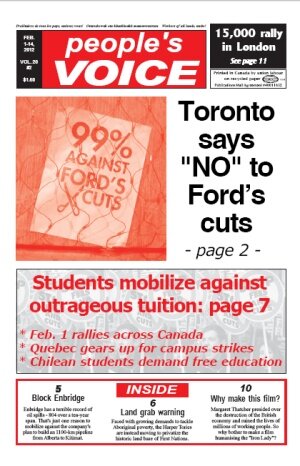
People’s Voice 2013 Calendar
”Ideas of Revolution”


People's Voice deadlines:

February 15-28
Thursday, February 2

March 1-15
Thursday, February 16

Send submissions to PV Editorial Office,
706 Clark Drive, Vancouver, V5L 3J1, pvoice@telus.net

You can call the editorial office at 604-255-2041


REDS ON THE WEB
http://www.parti-communiste.ca/
peoplesvoice.ca
www.ycl-ljc.ca
www.solidnet.org


People's Voice finds many "Global Class Struggle" reports at the "Labour Start" website, http://www.labourstart.org/. We urge our readers to check it out!


*  *  *  *  *
People's Voice

Canadian Publications Mail Sales Product Agreement #205214
ISSN number 1198-8657
People's Voice is published by
New Labour Press Ltd
  PV Editorial Office
706 Clark Drive,
VANCOUVER, B.C. V5L 3J1
Phone:604-255-2041
Fax:604-254-9803
email:  pvoice@telus.net

Editor: Kimball Cariou : Business Manager: Sam Hammond
Editorial Board: Kimball Cariou, Miguel Figueroa,
Doug Meggison, Naomi Rankin, Liz Rowley, Jim Sacouman

* * * * * *
Letters
People's Voice welcomes your letters
on any subject covered in our pages.
We reserve the right to edit for length and clarity,
and to refuse to print letters which may be libellous
or which contain unnecessary personal attacks.
Send your views to:
"Letters to the Editor",
706 Clark Dr., Vancouver, BC V5L 3J1,
or pvoice@telus.net
People's Voice articles may be reprinted without permission,
provided the source is credited.


* * * * * *

The Communist Party of Canada, formed in 1921,
has a proud history of fighting for jobs, equality, peace,
Canadian independence, and socialism.
The CPC does much more than run candidates in elections.
We think the fight against big business and its parties
is a year-round job,
so our members are active across the country,
to build our party and to help strengthen people's movements
on a wide range of issues.

All our policies and leadership
are set democratically by our members.
To find out more about Canada's party of Socialism,
give us a call at the nearest CPC office.

* * * * * *
Central Committee CPC
290A Danforth Ave Toronto, Ont. M4K 1N6
Ph: (416) 469-2446
fax: (416) 469-4063 E-mailmailto:info@cpc-pcp.ca

Parti Communiste du Quebec (section du
Parti communiste du Canada)
5359 Ave du Parc, Montréal, Québec,
H2V 4G9

B.C.Committee CPC
706 Clark Drive, Vancouver, V5L 3J1
Tel: (604) 254-9836
Fax: (604) 254-9803

Edmonton CPC
Box 68112, 70 Bonnie Doon P.O.
Edmonton, AB, T6C 4N6
Tel: (780) 465-7893
Fax: (780)463-0209

Calgary CPC
Unit #1 - 19 Radcliffe Close SE
Calgary  AB, T2A 6B2
Tel: (403) 248-6489

Ottawa CPC
Tel: (613) 232-7108

Manitoba Committee
387 Selkirk Ave., Winnipeg, R2W 2M3
Tel/fax: (204) 586-7824

Ontario Ctee. CPC
290A Danforth Ave., Toronto, M4K 1N6
Tel: (416) 469-2446

Hamilton Ctee. CPC
265 Melvin Ave., Apt. 815
Hamilton, ON.
Tel: (905) 548-9586

Atlantic Region CPC
Box 70 Grand Pré, NS, B0P 1M0
Tel/fax: (902) 542-7981

http://www.parti-communiste.ca/

* * * * * *

News for People, Not for Profits!
Every issue of People's Voice
gives you the latest
on the fightback from coast to coast.
Whether it's the struggle for jobs or peace, resistance to social cuts,
solidarity with Cuba, or workers' struggles around the world,
we've got the news the corporate media won't print.
And we do more than that
- we report and analyze events
from a revolutionary perspective,
helping to build the movements for justice and equality,
and eventually for a socialist Canada.

Read the paper that fights for working people
- on every page, in every issue!

People's Voice
$30 for 1 year
$50 for 2 years
Low-income special rate: $15 for 1-year
Outside Canada $50 for 1 year

Send to: People's Voice, 706 Clark Drive, Vancouver, BC, V5L 3J1
You can call the editorial office at 604-255-2041

REDS ON THE WEB
http://www.parti-communiste.ca/
http://www.ycl-ljc.ca/
http://www.solidnet.org/

(Contents)
(Home)


(The following articles are from the February 1-14, 2013, issue of People's Voice, Canada's leading communist newspaper. Articles can be reprinted free if the source is credited. Subscription rates in Canada: $30/year, or $15 low income rate; for U.S. readers - $45 US per year; other overseas readers - $45 US or $50 CDN per year. Send to People's Voice, c/o PV Business Manager, 706 Clark Drive, Vancouver, BC, V5L 3J1.)

1) BILL 115 ISN'T GONE - BUT ONTARIO GOVERNMENT MIGHT BE

By Liz Rowley, leader of the Communist Party (Ontario)

     Ontario Education Minister Laurel Broten says that the government will repeal its vicious anti-labour Bill 115 on January 23 ‑ just 2 days before the Liberal leadership convention and a massive OFL‑Common Front demonstration. But this "is a meaningless gesture and shallow response to the chaos it has created in schools", says the Elementary Teachers' Federation of Ontario (ETFO).

     "The premier and education minister are deluding themselves if they think the repeal of Bill 115 will promote goodwill and stability in the education sector and restore their popularity," said ETFO President Sam Hammond. "They used the bill and are now trying to make it disappear in the most crass of political acts. It's a sleight of hand that ETFO members and most Ontarians will see through."

     Passed in early September with the support of the Tories, Bill 115 strips elected School Boards and unions in the education sector of their rights to free collective bargaining and the right to strike. The intent was to take $1.6 billion in wages and benefits out of collective agreements, to pay down the $14 billion provincial deficit, while also off‑setting the costs to implement provincially mandated full day kindergarten.

     The unions have launched a Charter challenge, arguing that Bill 115 infringes on workers' rights to freedom of association. The challenge continues, despite the government's efforts to make the Bill "disappear".

     The government also introduced a second Bill to extend the suspension of free collective bargaining and the right to strike right across the public sector. That Bill died when the Liberal minority government prorogued Parliament after the Tories refused to support it, demanding an election instead.

     The NDP opposed both Bills, and voted against Bill 115, arguing that the same concessions could be achieved voluntarily.

     Only the Communist Party opposes the Bills because they attack free collective bargaining, and force working people to shoulder the costs of an economic and political crisis caused by neo‑liberal policies and unlimited corporate greed.

     "It's the banks and the biggest corporations that caused the 2008 crisis, aided and abetted by Liberal and Conservative governments that helped them do it and then bailed them out afterwards. Workers didn't cause the crisis, and they shouldn't pay for it," says the CPC (Ontario).

     On Jan. 3, the Minister of Education invoked Bill 115 and imposed 385 contracts on teachers, educational workers and school boards across the province. Despite months of threats and vilification, only 65 of 450 collective agreements had been accepted in gun‑to‑the‑head negotiations. Protests escalated, with both elementary and secondary teachers planning a Day of Protest and work stoppage in mid-January. The government took the unions to court, claiming the protests were an illegal strike under Bill 115, since contracts had been imposed and the right to strike eliminated. The court ruled for the government and the work‑day protests were cancelled. But demonstrations continued, along with the decision not to carry out unpaid, voluntary extra‑curricular activities.

     Bill 115 is strongly opposed by the general public, which sees the Liberal actions as unnecessary and undemocratic threats to fundamental labour rights which are currently the law in Ontario.

     Provincial Tory leader Tim Hudak has been campaigning for months to eliminate the Rand Formula, which is the basis for the closed shop (the union shop) across Canada. Eliminating the closed shop would reprise the open shop of the 1940s, when unions had little power and no rights, and workers were fired for joining or even supporting the union. This is the "choice" that Hudak says workers (read: corporations) need in the 21st century.

     The Rand Formula, Hudak says, is an "old, out of date, law".  In fact, the Rand Formula was achieved by the whole working class after victories in the historic 1945 Ford strike in Windsor, and the 1946 Steel strike in Hamilton.

     That's what the Tories and their corporate bosses want to undo in Canada, and that's what workers in Ontario are smelling in Hudak's campaign, Bill 115, and successor legislation affecting the broader public sector.  This is "right to work" legislation, which the Canadian working class defeated in 1945‑46.

     If the Liberals and Tories ‑ working alone, or together as proposed by outgoing Premier Dalton McGuinty ‑ are able to make the attack on labour and democratic rights stick, Ontario will be on its way to the right‑to‑work jurisdictions in Michigan, Indiana, and 22 other U.S. states. Teachers, educational workers, and their unions are on the front line of this attack.

The Liberal Convention and the Common Front

     The candidates for the Liberal leadership are all, save Gerard Kennedy, on the same page. Most were part of the Cabinet that imposed Bill 115 and the proposed successor legislation. Kennedy, who is not expected to win, has not been clear about his differences over the Bill.

     Kennedy's absence from the Legislature may give him a way to dissociate from an extremely unpopular government. The two frontrunners ‑ Pupatello and Wynn ‑ are both campaigning to win public support for those disgraced anti-labour policies, fronted by a new leader.

     It's too early to say whether the new Premier will try to save the government by aligning with the Tories (who want an election, not a coalition), or with the NDP (who support austerity, but not by legislation ‑ today at any rate).

     Either way, it's a slippery slope in which the corporations win, and working people lose. Already the Liberals are moving towards further privatization of public assets and resources, more user fees, and deeper cuts; while the Tories campaign to gut social assistance, cut the minimum wage, eliminate the closed shop, and privatize nuclear power plants.

     In early December the Common Front of labour and its community and social allies, met in a one day conference. Participants reviewed the Common Front's first year of existence, and planned for the Jan. 26 Liberal Convention protest. They also discussed subsequent actions for a people's agenda of good jobs, higher wages and incomes, affordable housing, quality education and healthcare, strong social programs, strong civil, democratic, labour and social rights, Aboriginal rights, and environmental protections.

     Those present understood they would have to fight. It was clear from those involved in the anti‑poverty movement and the occupation of the offices of the Social Services Minister, that a broad and united movement taking mass action was essential to win. What was largely missing, however, were representatives from labour, though members of the OFL Executive were prominent and supportive throughout the proceedings.

Escalating province‑wide action needed

     If ever the labour movement needed friends and allies, it is now. This is the time for the Common Front and the bulk of the trade union movement to come together to roll back and defeat this anti-people agenda. Surrounded by right‑wing governments at every level, and a corporate offensive that aims to eliminate the trade union movement itself, there's no other way.

     Labour must throw its weight behind the Common Front and start mapping out a forward agenda of mass escalating struggle that will gain the support of all those threatened by austerity and corporate greed.

     Occupy, the Quebec student movement, and Idle No More all show the way forward.

Printer-friendly article

(Contents)

(Home)


2) IDLE NO MORE GIVES VOICE TO MILLIONS OF CANADIANS

Statement of the Central Executive Committee, Communist Party of Canada, Jan. 15, 2013

     Less than two months since its first public actions, Idle No More has become the most widespread and significant movement for indigenous rights in recent decades. The Communist Party of Canada sends warm solidarity greetings to all Idle No More activists. By demanding the repeal of Bill C‑45, C‑38 and other Tory legislation, Idle No More gives voice to millions of Canadians who oppose the dangerous agenda of the Tory government.

     Bringing tens of thousands of supporters out to hundreds of actions across the country, the Idle No More movement has already compelled Prime Minister Harper to meet with a number of First Nations chiefs. But following their usual strategy, the Tories are attempting to smear their opponents, and to recycle old broken promises to improve living conditions for First Nations reserves and urban indigenous people.

     These desperate dirty tricks must be exposed and rejected. The real corrupt criminals in Canada are those who carry out the corporate agenda to drive down wages, gut social programs and pensions, attack labour and democratic rights, and give the big monopolies unfettered rights to extract and export natural resources. The politicians who accuse Chief Theresa Spence and other First Nations leaders of financial irregularities are hypocrites who transfer billions to the rich through tax cuts, forcing all working people to pay the costs of the economic crisis. The $300 million promised by PM Harper to provide safe drinking water to reserves is less than one percent of the amount his government proposes to waste on deadly fighter‑bomber jets. Finally, while right‑wing forces talk about "divisions" among indigenous movements, Harper's Tories were backed by just one‑quarter of all registered voters in the 2011 federal election, showing that they have no genuine political mandate for their reactionary policies.

     We urge all the labour and democratic movements in Canada to help this courageous struggle become a rallying point for a broad, united campaign to turn back the racist, anti‑people, anti-environment assault by the Tories and the corporations. Such unity must be based on support for the Idle No More demands to rescind omnibus Bill C‑45 and the rest of Harper's reactionary legislation, and to respect the inherent land and treaty rights of the Aboriginal peoples on the basis of genuine equality among all the nations within the Canadian state.

     This is not a time to base tactics and strategies of the fightback on hopes of electing a different federal government in 2015. Only a powerful, united, determined alliance of the broadest possible range of people's forces can make the Harper Tories back down. Idle No More has presented a truly historic opportunity to create such a united resistance ‑ it is the collective responsibility of the labour and people's movements to grasp this opportunity and make it a reality.

Printer-friendly article

(Contents)

(Home)


3) COMMUNISTS DEBATE THE CRISIS AND THE FIGHTBACK

The Communist Party of Canada's 37th Central Convention will be held April 5-7 in Toronto. Members of the CPC are currently discussing the Draft Political Resolution for the Convention. Over the next few issues, PV will reprint excerpts from the Resolution, starting with these introductory paragraphs. For more information, visit www.communist-party.ca.

     The 37th Convention of our Party takes place at a particularly complex and dangerous moment in the workers' and people's struggle. The systemic crisis of capitalism in Canada and internationally has continued to deepen over the past three years, reflected in ever‑widening social disparity, intensified economic and social attacks against the people, fresh assaults on labour and democratic rights, the further degradation of the national and global environment, and increasing militarism, aggression and war.

     The maturing structural contradictions of the global system of capitalism, which have been steadily gaining pace throughout the last century and particularly since the 1970s onwards, created conditions for the current global cyclical crisis ‑ a crisis which erupted in 2007‑08 and which continues today, making it one of capitalism's most acute cyclical crises in history. This crisis in turn has exacerbated all of the structural aspects of the general crisis of the capitalist system, resulting in greater instability, insecurity and intensified class struggle.

     The austerity policies pursued by ruling circles in all of the leading imperialist states, including Canada, to resuscitate economic activity and profits on the backs of the working class and working people in general have failed miserably. The economies of the U.S., Europe and Japan ‑ the "tripod" epicentre of this global crisis ‑ remain stagnant or in absolute decline. The crisis and the intense, all‑sided offensive launched by the ruling class in its wake are exacting a heavy economic, social, cultural, psychological and environmental cost on all humanity.

     The main target of this anti‑social offensive of Capital is the working class, especially its organised section, the trade union movement. It is also falls heavily on women, youth and students, indigenous peoples, pensioners and the elderly, peasants and small farmers, the extreme poor and marginalized sections of the people, and on all those reliant on the social functions and services of capitalist states ‑ benefits that have been won through many decades of hard struggle.

     This capitalist offensive is understandably creating an atmosphere of insecurity and desperation among wide sections of the working class and the people, but it is also giving rise to increased resistance and struggle against ruling classes and their governments around the world. While this fightback is still predominantly defensive in character, it is growing almost everywhere around the world. Anti‑imperialist and anti‑capitalist sentiments are on the increase, and the size and capacity of forces consciously embracing the socialist alternative are continuing to grow, albeit unevenly and still as a minority current in most countries.

     The counter‑offensive of labour and people's movements is also growing across Canada. The historic Québec student strike and social struggle which took place in the spring and summer of 2012, and the Canada‑wide "Idle No More" protests of Aboriginal peoples and their supporters which began last December are particularly significant in this regard. These struggles, taken together with the determined struggle of teachers in Ontario and many other mobilizations in defence of labour, social and equality rights and in defence of our environment, signal a qualitative change in the mood of the working class and its allies to fight back against the austerity agenda of Capital and its governments. 

     The challenge for our Party at this 37th Convention is to reach an objective assessment of the nature and trajectory of this capitalist offensive, to identify the class and social forces which are moving into action to resist and defeat this offensive, and to situate the Communist Party and its work so that it can best make its contribution to the building of a mass, united people's coalition, and to the building of a larger, stronger and more influential Party in the process.

Printer-friendly article

(Contents)

(Home)


4) TURFING OUT THE RACISTS IN VICTORIA

By Anti‑Racist Action Victoria

     Anti‑racist organizers report they have won several skirmishes with a "conspiracy cult" linked to US patriot and militia organizations. Anti‑Racist Action says members of a group called We Are Change Victoria (WAC) began sparring with social justice activists and the People's Assembly (Occupy Victoria) over a year ago.

     WAC is part of a North American network loosely connected to US radio host Alex Jones, the Libertarian Party, the militia movement and patriot groups, according to the Southern Poverty Law Center. The group promotes conspiracy theories about 9/11, chemtrails, gun control, human rights law, climate‑change denial, and Holocaust denial.

     In Victoria, WAC members joined the Occupy movement soon after it began, but they split over angry disagreements about the camp's stance on social justice and indigenous rights. Later, WAC members disrupted meetings, denounced the movement, and launched an online harassment campaign targeting those they considered camp organizers.

     In October 2012, WAC announced that Doug Christie, Canada's best‑known white supremacist, would address their rally on the BC Legislature lawn. Anti‑Racist Action called for a counter‑protest and blew the whistle on the event. Ultimately, Christie didn't show and some of the other speakers stayed away as well. Only about a dozen people attended the rally.

     What was supposed to be WAC's proudest day became a lesson in failure. As volunteers set up the sound system for their rally, three angry WAC "free speech advocates" crossed the Legislature lawn to confront the counter‑protestors picketing on the sidewalk 150 meters away. The shouting match that ensued drew the attention of nearby police officers. The WACkos told the officers to arrest the counter‑protestors, but instead the wingnuts were sent scurrying back to the stage with their tails between their legs. The police moved off, and the counter‑protestors spent the afternoon on the sidewalk handing flyers to passers‑by and explaining why they were protesting WAC's racism and sexism.

     A month later, ARA confronted WAC at its hangout, a downtown diner where the group held well‑advertised but poorly‑attended weekly meetings. ARA called for a meetup at the same diner and dozens responded. They filled every table and the wingnuts were turfed out before they could get in the door.

     Since then, WAC no longer advertises its events or meeting locations. Its only response to the controversy is a Youtube video featuring one‑time Esquimalt city council candidate Josh Steffler blaming the conflict on "Bolsheviks" who are the "real racists."

     More recently, members of WAC have been harassing a Victoria environmental activist in an effort to suppress photos of the October confrontation and take down her websites. As a result, one WACko is facing a BC Supreme Court lawsuit for fraud, perjury, and copyright violations.

     Anti‑Racist Action meets every Sunday at 6:30 pm at QV restaurant, 1701 Government at Fisgard in downtown Victoria, Coast Salish territory.

Printer-friendly article

(Contents)

(Home)


5) AS THE WORLD BURNS

People's Voice Editorial

     The rest of the planet watched nervously in early January as wildfires raged across Australia. Temperatures topped 50 degrees, forcing the country's Bureau of Meteorology to add a new colour ‑ deep purple ‑ to show areas that shattered all-time heat records. Climate scientists say the fires and the heat are unprecedented in scale and intensity. Even worse, this is the "new normal" of runaway climate change, and not just in the southern hemisphere. The Russian heatwave of 2010, which killed 50,000 and wiped out $15 billion worth of crops, was part of the hottest European summer for 500 years. Such mega‑heatwaves will become five to 10 times more likely over the next 40 years, scientists predict. Along with the heat will come more intense droughts, stronger hurricanes, more landslides, and higher tides. Why? Because heat‑trapping carbon emissions mean more energy is being pumped into the atmosphere, increasing climate chaos.

     Meanwhile, new research proves that contamination spread by tar sands extraction covers a much wider area than previously thought. Demolishing the idea that heightened levels of toxins could be "naturally occurring," scientists report that since large scale tar sands production began in 1978, deposits of carcinogenic hydrocarbons in Alberta lakes have increased 2.5 to 23 times.

     The debate is over; the coffin is nailed shut, as one scientist commented. Yes, the extraction and consumption of fossil fuels is extremely profitable for transnational corporations. But the ultimate cost is prohibitive, even fatal. The time has come to shift the world's $1 trillion in annual military spending towards investment in technologies to slash carbon emissions. Such a radical change will face enormous resistance by the military-industrial complex and Big Oil. In other words, capitalism itself has become incompatible with human survival; only socialism offers hope for the planet. That's the message from "deep purple" Australia.

Printer-friendly article

(Contents)

(Home)


6) THE TORY TWO-STEP STRATEGY

People's Voice Editorial

     Courageous and inspiring Idle No More mobilizations continue across Canada and in many other countries, proving that the racist, genocidal status quo will no longer be tolerated. In fact, indigenous peoples have growing support in their opposition to the Harper government's destructive agenda. Yet (with some honourable exceptions) the corporate media largely keeps recycling Tory lies and misinformation.

     To those smug pundits who speculate about "divisions" among the First Nations, we say: look closer to home. Are Canadians "united" simply because our blatantly undemocratic electoral system gives complete political power to a party which receives only 39% of ballots cast on voting day? When you gloat about "financial irregularities" on reserves, we ask: why did the auditors sent by the Harperites to "investigate" Attawapiskat refuse to even look at many of the records kept by the band? When you repeat fairy tales about the "benefits" given to Aboriginal peoples, we wonder: were the treaties signed between First Nations and the colonizers just a fiction to open the door for history's greatest theft of lands, waters and resources?

     The campaign of media distortion is part of the classic "Tory two-step." On the one hand, under enormous pressure to hold meaningful consultations about improving the living conditions of Aboriginal peoples, the Conservatives offered a brief symbolic meeting and threw out some vague promises. On the other hand, their racist spin machine is working overtime to smear Chief Teresa Spence and other First Nations activists. It's time to make Harper & Co. sit down and talk with Aboriginal peoples, nation to nation, on the basis of genuine respect and equality. Nothing less can be accepted.

Printer-friendly article

(Contents)

(Home)


7) FIRE KEVIN O'LEARY

By Johan Boyden, General Secretary, Young Communist League of Canada

     Speaking at an anti‑austerity campaign meeting in January, I was happy to hear spontaneous applause from the audience after announcing the launch of a new campaign to be led by the magazine of the Young Communist League, Rebel Youth.

     "Fire Kevin O'Leary" is urging the CBC to dismiss this notorious venture capitalist "dragon." O'Leary appears almost daily as a business commentator and in various reality TV shows. O'Leary is abusing his position at the CBC to explicitly promote his own for‑profit businesses. He is hijacking the public broadcaster with a socially destructive message of corporate greed, privatization, selfishness, and austerity.

     As most People's Voice readers know, Kevin O'Leary is a multi‑millionaire and owner of the asset management company O'Leary Funds. He has appeared with Amanda Lang on CBC's The Lang and O'Leary Exchange since 2009, and stars on the shows Dragons Den and its US counterpart, Shark Tank on ABC.

     The CBC's administration likes to talk about how these shows are wildly popular. But I think they are really about catering to the Harper Tory government and its "slash-and-burn economic action plan". It is ironic that the CBC seems to have become a bastion of right‑wing commentators like Rex Murphy and Don Cherry. In this group, O'Leary stands out as a chief spokesperson for the vicious agenda of "money‑over‑everything" and "greed is good," which is being used as an ideological battering ram against young workers and all people in Canada.

     Thus he is the face of the poverty‑creators, the job‑destroyers, the union‑busters ‑ basically, of the austerity agenda. I was not surprised to find that Google prompts the phrase "Kevin O'Leary is a jerk" when you type his name into the search engine.

     O'Leary's nasty approach has got him into hot water more than once. Researching for the campaign, YCL Ontario organizer Drew Garvie found a series of cases where O'Leary called unions a "parasite" on business.

     "Elect me as Prime Minister for 15 minutes," O'Leary says. "I will make unions illegal. Anybody who remains a union member will be thrown in jail." He adds that "Unions are sheer evil [...] Unions themselves are born out of evil. They must be destroyed with evil", and "no one could contain unions in hell. They were so evil they came out of hell and they came upon earth."

     These remarks, which could have come out of the mouth of a fascist dictator, prompted several complaints. The National Union of Public and Government Employees wrote that "Trade unionists are beaten and murdered in many countries around the world, simply because they believe in workers acting collectively to improve workplace conditions such as pay, hours of work, health and safety, and job security. [...] Mr. O'Leary's wilful promotion of contempt and hatred towards unions reflects a viewpoint that has often ended in violence perpetrated against union members and leaders."

     The CBC Ombudsperson, however, refused to intervene.

     More of O'Leary's remarks are in the new issue of Rebel Youth. The campaign will also demand full restoration of government funding to the CBC. In its early stages, the campaign so far features an online petition and some publicity information, with plans to take it to the streets as well.

Printer-friendly article

(Contents)

(Home)


8) STOP THE WAR ON MALI

Canadian Peace Alliance, Jan. 15, 2013

     The Government of Canada has recently announced that it is sending a CF‑17 transport plane to northern Mali to add to the military buildup by the NATO powers in the area. The Canadian Peace Alliance is calling on the government to recall the plane and to cease any further contribution to the France‑led mission.

     One transport plane and a few Canadian "trainers" is just the thin edge of the wedge. There is a real fear of "mission creep" as witnessed in the Libyan situation. Canada's involvement as a junior partner to a NATO aggression in Africa could mushroom in the coming months and years. All this is being done without public or parliamentary debate. This unilateral support for war by the Harper government without consultation must stop.

     The Tuareg people of Northern Mali have been waging a campaign for independence for decades, which has been a thorn in the side of both the Malian government and to those who wish to exploit the natural resources of the area. The borders drawn up by the French colonialists were never appropriate to the needs of the primarily nomadic peoples of the deserts in the north.

     More recently, the overthrow of the Libyan government by NATO (with direct Canadian military participation) has allowed for huge numbers of weapons to fall into the hands of local militias. The Mali situation is, therefore, yet another case of blow‑back against Western interests.

     The failure of the Libyan mission is one of the more recent causes of the current conflict in Mali. Sending Western troops to the region does nothing more than compound that folly and continue the cycle of perpetual war in the region. Canada should not participate.

     The real reason for NATO's involvement is to secure strategic, resource rich areas of Africa for the West. Canadian gold mining operations have significant holdings in Northern Mali as do may other western nations. Canada's new interventionism, which includes the building of 3 military bases in Tanzania, Senegal and Kenya, is therefore primarily about securing the area for further plunder. Canadian troops are already stationed in Niger ready to launch an invasion. We also urge the Canadian Government to withdraw all troops from the surrounding region. We also call on Canadians to demand of the Harper government that it withdraw from membership in NATO, which constantly drags us into every neo‑colonial, military adventure of the western powers in the world.

     Also of concern is the use of the "Islamist" threat to justify any intervention by the NATO powers. Islamophobia is a key tool in perpetuating these foreign advances. It is ironic that since the death of Osama Bin Laden, the US military boasts that Al‑Qaeda is on the run and has no ability to wage its war. Meanwhile, any time there is a need for intervention, there is suddenly a new Al‑Qaeda threat that comes out of the woodwork.

     Canada must not participate in this process of unending war.

Printer-friendly article

(Contents)

(Home)


9) LIBYA ALL OVER AGAIN

Editorial from the Morning Star, UK

     The situation in Mali is directly linked to the NATO mobilisation in 2011 to overthrow the Gadaffi regime in Libya. Deployment of NATO air forces in support of the anti‑Gadaffi opposition turned the tide for the Benghazi‑based National Transitional Council, but it didn't create national unity behind the new NATO‑approved government.

     Nor did it take account of regional forces, secular and Islamist, that had provided much of the Gadaffi regime's military backbone.

     Africa's borders are porous, not least because the straight-line‑obsessed European colonialists paid little attention to the interests or identities of local people when they carved up the continent in search of valuable resources.

     Despite efforts by Washington, many of the colonial‑era links between Britain, France and Africa's nominally independent states continue to hold sway.

     French politics has been awash for decades with stories concerning diamonds, bags of cash and boltholes in France for Paris‑backed dictators from "Emperor" Bokassa of the Central African Republic to Zairean despot Mobutu Sese Seko, to say nothing of their easily bought French counterparts Jacques Chirac and Nicolas Sarkozy.

     When he took over as French president last year, Francois Hollande declared an end to "Francafrique," telling Senegal's National Assembly in October that he wanted to "update the relationship between France and Africa."

     Hollande promised a "respect" agenda in French‑African links, explaining: "Respect means a crystal clear definition of France's military presence in Africa, which can continue only in a legal, transparent framework."

     "Respect" has become just another word as the French president has authorised military strikes against targets in Mali said to be bases of Islamist forces bent on overthrowing the second interim government authorised by US‑approved military junta leader Amadou Sanogo ‑ the real power in Bamako ‑ and imposing a theocracy.

     NATO governments only have to hear the word "Islamist" to bring on an outbreak of hysteria ‑ apart, that is, from Syria where a Qatar-funded international alliance of holy warriors is assessed as objectively pro‑democratic.

     Stomach‑knotting declarations that Mali is just five hours from France are on a par with Blair government warnings about Iraqi missile strikes on Britain being just 45 minutes away.

     And it has opened the way for colonial powers France, followed by Britain, to commit themselves to air strikes, troop deployment and provision of armaments.

     The runaway opposition forces in Mali have no planes, but they are well‑armed, having benefited from Gadaffi forces' conventional weaponry brought south after the Libyan dictator's murder. They are also acclimatised to the Sahara desert conditions in northern Mali ‑ a tract of land the size of Spain that they control.

     The same cannot be said for French troops, potential west African states' units or even the Malian army whose major operations have rarely moved beyond removing its own government.

     France would prefer to restrict its own operations to air support and is anxious for west African soldiers to replace its own, but neither Paris nor London has made a cogent case for involvement in a local military dispute.

     To portray an internal Malian dispute over separatism and the role of religion as a potential military threat to Europe indicates a loss of political equilibrium.

     Mali's problems will not be improved at all by a NATO onslaught in support of one side or another. Politicians should drop the martial rhetoric. There is no case for European military interference in Mali.

Printer-friendly article

(Contents)

(Home)


10) "PROFITS OF THE WORLD'S 100 WEALTHIEST COULD END POVERTY FOUR TIMES OVER"

From Common Dreams, www.commondreams.org

     The profits of the world's one hundred most wealthy individuals last year would be enough to wipe out world poverty, says a new report. And not just once over, or twice over, but the vast amount of money that has flowed to the top of the world's financial food chain would be enough to eradicate the worst kind of poverty a full four times over.

     Such an explosion in extreme wealth and income inequality represented by these numbers is exacerbating and hindering the world's ability to tackle poverty, warns international aid group Oxfam International in a new analysis published ahead of the World Economic Forum which started in Davos on January 22.

     According to the report (posted at www.oxfam.org), "The cost of inequality: how wealth and income extremes hurt us all," the $240 billion net income in 2012 of the richest 100 billionaires would be enough to eliminate extreme poverty four times over. In releasing the report, Oxfam is calling on world leaders to curb today's income extremes and commit to bringing back inequality levels to at least those experienced in the early 1990s.

     "Concentration of resources in the hands of the top one per cent depresses economic activity and makes life harder for everyone else - particularly those at the bottom of the economic ladder," said Jeremy Hobbs, Oxfam's executive director.

     "We can no longer pretend that the creation of wealth for a few will inevitably benefit the many - too often the reverse is true," he said. "In a world where even basic resources such as land and water are increasingly scarce, we cannot afford to concentrate assets in the hands of a few and leave the many to struggle over what's left. From tax havens to weak employment laws, the richest benefit from a global economic system which is rigged in their favour. It is time our leaders reformed the system so that it works in the interests of the whole of humanity rather than a global elite."

     In addition, Barbara Stocking, Oxfam's chief executive, says the world's extremity of wealth inequality is "economically inefficient, politically corrosive, socially divisive and environmentally destructive".

     Oxfam is calling for a "new global deal" which would stabilize the world's economic systems and bring equality back in way that would benefit all humanity.

     "From tax havens to weak employment laws, the richest benefit from a global economic system which is rigged in their favour. It is time our leaders reformed the system so that it works in the interests of the whole of humanity rather than a global elite."

     The group estimates that closing tax havens - which hold as much as $32 trillion or a third of all global wealth - could yield an additional $189 billion in additional tax revenues. In addition to a tax haven crackdown, elements of the "global new deal" Oxfam envisions would include:

* a reversal of the trend towards more regressive forms of taxation;

* a global minimum corporation tax rate;

* measures to boost wages compared with returns available to capital;

* increased investment in free public services and safety nets.

     According to Al‑Jazeera, the group says that the world's richest one percent have seen their income increase by 60 percent in the last 20 years, with the latest world financial crisis only serving to hasten, rather than hinder, the process.

     "We sometimes talk about the have‑nots and the haves ‑ well, we're talking about the `have‑lots'. [...] We're an anti‑poverty agency. We focus on poverty, we work with the poorest people around the world. You don't normally hear us talking about wealth. But it's gotten so out of control between rich and poor that one of the obstacles to solving extreme poverty is now extreme wealth," Ben Phillips, a campaign director at Oxfam, told Al Jazeera.

Printer-friendly article

(Contents)

(Home)


11) REMEMBERING AN UNSUNG DALIT HERO

By Gurpreet Singh

     As secularist and progressive groups celebrate the Ghadar Party centenary this year, those organizing the events need to highlight the role played by many unsung heroes of the freedom struggle. Among them was Mangu Ram Muggowal, a prominent Dalit icon of Punjab. He was a part of the Ghadar party launched in the U.S. on Nov. 1, 1913 and believed in an armed struggle against the British occupation of India.

     The contributions by individual participants of historical struggles are sometimes overshadowed by the role played by a few dominant leaders. But the followers of Muggowal believe that his role in the Ghadar movement may have been deliberately ignored because of caste prejudice. While this allegation is debatable, Muggowal's role should be acknowledged by events to mark 100 years of the Ghadar Party in Vancouver and elsewhere. Incidentally, his descendants live in Greater Vancouver area.

     Born in Punjab in 1886, Muggowal immigrated to the U.S. for economic reasons. He became involved in the freedom struggle following a realization of racism and discrimination in the foreign land.

     The members of the Ghadar Party believed that their sufferings were the result of slavery back home and resolved to fight against imperialism. A person like Muggowal endured double discrimination for being a person of colour and a Dalit. Born in a so-called low-caste "untouchable" family, he faced segregation at school and suffered physical abuse for defying the caste laws. Thankfully, the Ghadar Party believed in secularism and kept religion and politics apart, yet he faced such prejudice even in the U.S.

     Muggowal not only worked for the Ghadar newsletter, but also went to Java to help in collecting and sending arms to India. He escaped a death sentence at the hands of the British allies. Thinking he had died, his family remarried his widow to his brother. 

     On coming back to India he was disillusioned by the continued oppression of the Dalits, who were considered untouchables by orthodox Hindus and Sikhs. He was partly upset with the popular leaders of the freedom struggle who failed to address the issue of casteism. He resigned from the Ghadar Party in order to mobilize Dalits, and eventually launched the Aadi Dharam movement in Punjab. He believed that without bringing social revolution first, it was impossible to bring real freedom in India.

     The Ghadar Party also assured him full support in his struggle against caste oppression. Since his movement was in conflict with the interest of the freedom struggle, his cause was not dear to the popular leadership. Rather, Muggowal was branded as a tool of the British Empire that was playing a divide and rule game to prolong its rule in India. Whereas the British Empire was happy to give concessions to the Dalits, leaders like Muggowal felt deceived by the mainstream nationalist leaders. Despite such differences, it goes to the credit of Muggowal that he did not support a religion based partition of India in 1947.

     Even after freedom, Dalits continue to suffer caste based discrimination. Untouchability is still practised in many parts of India in accordance with orthodox principles of Hinduism, despite India being a secular country. Thousands of Dalits are forced to indulge in manual scavenging for a livelihood, in spite of claims of development and progress. Mangu Ram's legacy therefore should be kept alive to stop oppression against Dalits. Let Muggowal be remembered both as a Ghadar and a Dalit activist.

Printer-friendly article

(Contents)

(Home)


12) MUSIC NOTES, by Wally Brooker

Musicians mobilize for Idle No More

Canadian pop star Nellie Furtado's salute at a New Year's Eve concert in Niagara Falls was a highly‑visible celebrity endorsement of Idle No More. Musicians had been supportive since at least Dec. 21, when the "Canadian Artists Statement of Solidarity with Idle No More" was published on Facebook. 150 artists initially signed on, including singer‑songwriter Sarah Harmer, Gordon Downie (Tragically Hip), Greg Keelor & Jim Cuddy (Blue Rodeo) and Steven Page (Barenaked Ladies). The statement calls on Steven Harper to meet with First Nations peoples "in the intended spirit of the original treaties, as sovereign nations." The artists were following a vanguard of First Nations musicians with little access to the industry's star making machinery. Take for example the outstanding indigenous musician Derek Miller, who appeared at a Jan. 5 benefit for Chief Spence at Ottawa club Zaphod Beeblebrox. His song "7 Lifetimes (for Chief Spence)" is the opening track on the album Idle No More: Songs for Life Vol 1. Download it for free at http://rpm.fm/.

Folk Alliance to meet in Toronto

Several thousand folk musicians and related industry types will gather at Toronto's Delta Chelsea Hotel Feb. 20‑24 for the 25th annual International Folk Alliance conference www.folkalliance.org. The Memphis‑based IFA is a non‑profit educational organization. Its annual meeting is an important showcase for everyone involved in North American folk music, whether they are performers, educators, club owners, radio hosts or record companies. In addition to more than 50 workshops, panels and exhibitions, there will be a wide variety of showcase concerts and open mic stages. A "Canadian Spectacular" on Feb. 20 will be open to the general public, with shows on seven stages. Visiting artists will appear at Hugh's Room during the week. Incidentally, the same hotel is the site of the free Winterfolk Blues and Roots Festival (Feb. 14‑17). For info: www.winterfolk.com.

Paraguay's "Recycled Orchestra"

Cateura, Paraguay is a town of 25,000 built on a landfill. Several years ago social worker Favio Chavez wanted to introduce music to local indigenous children in this poor region where kids have few opportunities. With a lack of funds, he decided to make instruments from objects found in the landfill (e.g. barrels, forks, bowls, water pipes, and bottle caps). The instruments were made by Nicolas Gomez, a resourceful local trash picker. Today the 20‑member "Recycled Orchestra," conducted by Luis Szaron, makes beauty out of garbage as it performs traditional Paraguayan music as well as Beethoven, Mozart, Bach, Mancini and the Beatles. They've performed in Brazil, Panama and Columbia. Recently they travelled to Phoenix, Arizona for a performance at the Musical Instrument Museum. A documentary film "Landfill Harmonic" (produced and directed by Alejandra Amarlla Nash and Juliana Penaranda) will be released later this year. View the trailer at YouTube or Vimeo.

Cubana All‑Stars: "A Dream Come True"

One of the most acclaimed Latin recordings of 2012 is a fiery salsa album by the Cubana All‑Stars called "A Dream Come True." Recorded in Havana under the auspices of the Musicalia festival and the Ministry of Culture, the album unites outstanding local musicians with long‑time Cuban expatriates from New York, Miami, Mexico, Spain and Puerto Rico. Returning legends include vocalists Issac Delgado and Justo Betancourt (Puerto Rico) and trumpeter Alfredo "Chocolate" Armenteros (New York City). Their musical hosts include guitarist‑singer Eliades Ochoa (Buena Vista Social Club) and pianist‑composer Adalberto Alvarez (Son 14). The Cubana All Stars have been called "the most significant Cuban orchestra to form in the last decade," and their record company calls the album their "debut," suggesting that this may be more than a one‑time project. Ochoa no doubt speaks for many when he says the album is "a dream come true for all Cubans." Best online deal: www.elwatusi.com

Jayne Cortez: 1934‑2012

African‑American jazz poet and activist Jayne Cortez died in New York on Dec. 28. Her visceral and surrealist verse linked African oral traditions with blues, avant‑garde jazz, and political protest (she was a lifelong opponent of racism, misogyny and the capitalist system). Although she published acclaimed volumes of print poetry, Cortez is best remembered for her work with jazz musicians. Her collaborations with artists like bassist Richard Davis and her son, drummer Denardo Coleman (in her band The Firespitters) are essential to understanding the evolution of jazz poetry from its beginnings in the Harlem Renaissance to its links with contemporary rap and hip‑hop. As a young woman Cortez was active with the Student Nonviolent Coordinating Committee, registering black voters in Mississippi. Later she became a key figure in the influential Black Arts Movement founded by poet Amiri Baraka. She was also a co‑founder of the Organization of Women Artists of Africa. Check out Jayne Cortez performing the brilliant "If the Drum is a Woman" on YouTube.

Printer-friendly article

(Contents)

(Home)


13) JUSTICE FOR COLOMBIAN POLITICAL PRISONER DAVID RAVELO!

Information from the Alliance for Global Justice website, http://afgj.org.

     The complex struggle for social justice and democratic freedoms in Colombia continues on several fronts. On one level, a difficult set of negotiations between the government and the FARC insurgents has begun, with the goal of ending the nearly five‑decade civil conflict. People's Voice will carry further reports on this important process.

     Meanwhile, the Colombian state has not abandoned its policy of repression against many movements and individuals who carry on heroic efforts to achieve human rights, such as political prisoner David Ravelo.

     Ravelo is a member of Colombia's Regional Human Rights Corporation and was honoured by the Catholic Diocese of Barrancabermeja for his defense of human rights. He was recently convicted to 18 years in prison for what is widely regarded as a sham trial by human rights organizations.

     The North American Committee to Free David Ravelo is canvassing for signatures on the following letter to the Colombian authorities. (For more information, visit the website above, or email freedavidravelo@gmail.com or atwhit@roadrunner.com.)

     "This letter concerns David Ravelo, who was arrested on Sept. 14, 2010. He is presently wrongly held by your government at La Picota Prison in Bogota. It was announced on Dec. 11, 2012 that he had been convicted of "aggravated homicide" and sentenced to 18 years in prison.

     "The pretext for David Ravelo's arrest and conviction is the allegation he participated in the murder in 1991 of David Nunez Cala, Secretary of Public Works in Barrancabermeja. That charge is false. David Ravelo is innocent. He must be released from prison. Both Mr. Ravelo's family and his colleagues at the CREDHOS human rights organization in Barrancabermeja have long been subjected to death threats. The Colombian government must guarantee their safety.

     "Your government's purpose in inflicting a long prison sentence on David Ravelo, we suspect, was to silence a recognized defender of human rights. David Ravelo was instrumental in publicizing abuses and violence in Barrancabermeja at the hands of murderous paramilitary criminals.

     "Conduct of Mr. Ravelo's trial was scandalous. The case against him rested on accusations from two jailed paramilitary murderers who, by testifying, gained reductions in their sentences. Witness Orlando Noguera testified that the accusers tried to bribe him to corroborate their story. Over 30 witnesses prepared to defend David Ravelo were prevented from testifying at his trial. (See sidebar article for further details.)

     "...The world is watching. United Nations human rights specialists and the Inter‑American Commission of Human Rights have come to David Ravelo's defense. In December, 2012, British parliamentarians denounced his trial and conviction. We join these international human rights advocates. We call for justice to be done, now."

Printer-friendly article

(Contents)

(Home)