|
|
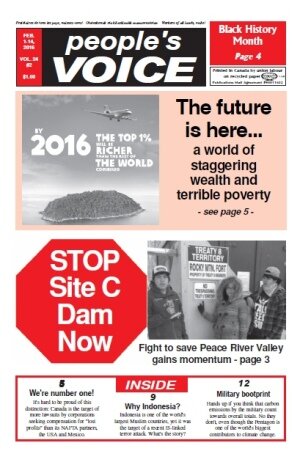
People’s Voice February 1-14, 2016
Volume 24 – Number 2 $1
1) OPPOSITION TO SITE C DAM KEEPS GROWING
2) STOP SITE C, URGE B.C. COMMUNISTS
3) SCABS: THE SECRET INGREDIENT AT COVERED BRIDGE
4) WEALTHIEST PEOPLE ON EARTH EVADE TAXES
5) CANADA NUMBER ONE IN NAFTA LAWSUITS
6) TIME TO RENEW ANTI-WAR ACTION - Editorial
7) BLACK HISTORY MONTH - Editorial
8) ARE WE PART OF THE DARK SIDE?
9) SOLIDARITY WITH NEPAL AGAINST INDIA’S BLOCKADE
10) JOURNALISTS OR COURTESANS?
11) MILITARY’S “CARBON BOOTPRINTS” CONTRIBUTE TO CLIMATE CRISIS
12) MUSIC NOTES, by Wally Brooker
PEOPLE'S VOICE FEBRUARY 1-14, 2016 (pdf)
|
People's Voice deadlines: February 15-29 March 1-15 Send submissions to PV Editorial Office,
|
|
|
REDS ON THE WEB
http://www.communist-party.ca
peoplesvoice.ca
www.ycl-ljc.ca
www.solidnet.org
|
People's Voice finds many "Global Class Struggle" reports at the "Labour Start" website, http://www.labourstart.org/. We urge our readers to check it out! |
* * * * * *
Central Committee CPC
290A Danforth Ave Toronto, Ont. M4K 1N6
Ph: (416) 469-2446
fax: (416) 469-4063 E-mailmailto:info@cpc-pcp.ca
Parti Communiste du Quebec (section du
Parti communiste du Canada)
5359 Ave du Parc, Montréal, Québec,
H2V 4G9
B.C.Committee CPC
706 Clark Drive, Vancouver, V5L 3J1
Tel: (604) 254-9836
Fax: (604) 254-9803
Edmonton CPC
Box 68112, 70 Bonnie Doon P.O.
Edmonton, AB, T6C 4N6
Tel: (780) 465-7893
Fax: (780)463-0209
Calgary CPC
Unit #1 - 19 Radcliffe Close SE
Calgary AB, T2A 6B2
Tel: (403) 248-6489
Ottawa CPC
Tel: (613) 232-7108
Manitoba Committee
387 Selkirk Ave., Winnipeg, R2W 2M3
Tel/fax: (204) 586-7824
Ontario Ctee. CPC
290A Danforth Ave., Toronto, M4K 1N6
Tel: (416) 469-2446
Hamilton Ctee. CPC
265 Melvin Ave., Apt. 815
Hamilton, ON.
Tel: (905) 548-9586
Atlantic Region CPC
Box 70 Grand Pré, NS, B0P 1M0
Tel/fax: (902) 542-7981
* * * * * *
News for People, Not for Profits!
Every issue of People's Voice
gives you the latest
on the fightback from coast to coast.
Whether it's the struggle for jobs or peace, resistance to social cuts,
solidarity with Cuba, or workers' struggles around the world,
we've got the news the corporate media won't print.
And we do more than that
- we report and analyze events
from a revolutionary perspective,
helping to build the movements for justice and equality,
and eventually for a socialist Canada.
Read the paper that fights for working people
- on every page, in every issue!
People's Voice
$30 for 1 year
$50 for 2 years
Low-income special rate: $15 for 1-year
Outside Canada $50 for 1 year
Send to: People's Voice, 706 Clark Drive, Vancouver, BC, V5L 3J1
You can call the editorial office at 604-255-2041
<pvoice@telus.net>
REDS ON THE WEB
www.communist-party.ca
peoplesvoice.ca
www.ycl-ljc.ca/
http://solidnet.org/
http://www,rebelyouth-magazine.blogspot.com
(The following articles are from the January 1-31, 2016, issue of People's Voice, Canada's leading socialist newspaper. Articles can be reprinted free if the source is credited. Subscription rates in Canada: $30/year, or $15 low income rate; for U.S. readers - $45 US per year; other overseas readers - $45 US or $50 CDN per year. Send to People's Voice, c/o PV Business Manager, 706 Clark Drive, Vancouver, BC, V5L 3J1.)
1) OPPOSITION TO SITE C DAM KEEPS GROWING
By Kimball Cariou, Vancouver
Preparatory work for the controversial Site C dam in northern BC is underway, but opposition to the project is also growing, including a camp by First Nations members and other local residents at the historic site of Rocky Mountain Fort. This location on the west side of the Peace River was chosen by Alexander Mackenzie as British Columbia’s first trading post. It’s on the traditional territory of Treaty 8 First Nations, who are determined to defend their lands from flooding as BC Hydro seeks to expand what many consider to be completely unnecessary power production.
Along with expanded liquid natural gas exports and the relentless expansion of ports in the Lower Mainland, Site C is one of the favourite projects of Premier Christy Clark’s Liberal government. These all involve massive injections of provincial funds or major tax breaks for corporations, as part of a strategy to make BC even more dependent on exports of unprocessed resources.
Since even BC Hydro’s own reports say the province can meet current demands through energy conservation, Site C is essentially a huge taxpayer subsidy to the energy and mining industries.
The purpose of what would be the third BC Hydro dam on the Peace River, is to supply electricity to proposed liquid natural gas (LNG) investors, such as the Petronas project backed by the Malaysian government. Towards this end, the 60-meter high dam is now expected to cost some $8.8 billion, flooding 107 kilometers of the Peace and its tributaries, including critical hunting and fishing grounds The valley is one of the most important wildlife corridors in the Yellowstone to Yukon migration corridor chain. It also contains the only Class One soil north of Quesnel in BC, at a time when agriculture and food security are increasingly seen as crucial issues.
Yet there is no guaranteed return on such a huge investment.
As professional engineer Randy Evanchuk wrote in a recent letter to the Vancouver Sun, B.C. gas faces tremendous worldwide competition for market share from LNG projects already under construction in the U.S., Australia and Russia, and more to come in East Africa, Mozambique and the Malay Peninsula. Since Canada simply does not appear in industry reports as a serious LNG supplier, says Evanchuk, “it is foolish to destroy so much of the rich Peace River ecosystem to supply electricity for one project at an estimated cost of $8 billion or more.”
He also demolishes the argument that Site C power can be exported: “If so, where are the 25-year, take-or-pay contracts? Where are the market studies?... If power exports are the justification for Site C, wouldn’t it be far less expensive to use the existing phases which are planned and ready to be installed in the Columbia River system?”
Evanchuk sums up what many are saying: “It’s time for our government to stop work on this disastrous economic and ecological boondoggle before we end up paying through the nose for future electricity costs – or worse, having to sell BC Hydro at a fire sale price like Ontario is doing with their former Crown jewel, which has been destroyed by short-sighted Liberal governments.”
Not surprisingly, First Nations and environmental groups are preparing to risk arrest to preserve the area.
The Dunne-Zaa people have lived in the productive lands around the Site C dam flood zone for at least 11,000 years. When they joined Treaty 8 in 1900, the terms explicitly guaranteed the Dunne-Zaa would be able to continue their traditional practices - hunting, trapping, fishing, collecting medicinal plants -“for as long as the sun shines, the rivers flow and the grass grows.”
Instead, Treaty 8, First Nations in northeastern B.C. have seen their lands steadily impacted by logging, oil and gas extraction, mines, dams and other resource development. Research by the David Suzuki Foundation revealed that nearly two-thirds of their traditional territories have been affected by industrial development, leaving little intact habitat for wildlife like moose and caribou, which have sustained communities for millennia. Site C would also wipe out hundreds of graves and ceremonial sites, and directly hinder Treaty 8 First Nations’ cultural and ceremonial practices.
As David Suzuki and Grand Chief Stewart Phillip wrote after a recent visit to the camp, “the Peace Valley is one of the few remaining places where Treaty 8 First Nations can participate in traditional activities as their ancestors did for thousands of years before the treaty was signed — activities crucial to maintaining their cultural and spiritual identity and connection to the land.”
Critics call this illegal, pointing out that years of case law, and the Supreme Court of Canada’s Tsilhqot’in decision, have made clear that without access to traditional lands and waters, the treaty and aboriginal rights enshrined by Section 35 of the Canadian Constitution are effectively meaningless. The Crown, they warn, must at least try to maintain the ecosystems critical to those rights so that First Nations can continue to live off healthy populations of wild game, fish and plants.
On October 14, 2014, the governments of BC and Canada announced that the Site C dam had been granted environmental assessment approval, despite the conclusion of the Joint Review Panel convened by both governments that Site C would have “significant adverse effects” on fishing, hunting and trapping, and other traditional land uses, not just in B.C., but also downstream where the Peace River enters Alberta. According to the panel, most of these adverse effects are impossible to mitigate.
Two Treaty 8 First Nations, West Moberly and Prophet River, have launched court cases to stop Site C on the grounds that it infringes on their treaty rights. Yet the Premier has urged BC Hydro to clear cut large areas of the Peace Valley to make way for the dam and reservoir, before First Nations get their day in court. Preliminary work has begun to clear lands, build access roads, and to establish a construction camp for 1600 workers.
All this is happening while politicians pledge support to reconciliation with First Nations. David Suzuki and Stewart Phillip ask, “While politicians are bandying about reconciliation as the salve that will heal centuries-old injustices, are treaty promises even worth anything, when hunting grounds will be under water, moose populations decimated and fish contaminated with toxic methyl mercury from decaying organic matter if the dam is built?”
Faced with this reality, a coalition of environmental groups has appealed directly to Prime Minister Justin Trudeau, who has carried through on an election promise to create a moratorium on oil tanker traffic off B.C.’s northwest coast. But so far, the federal government has dodged this issue.
The coalition includes the Canadian Parks and Wilderness Society, Peace Valley Environment Association, Peace Valley Landowner Association, Sierra Club of B.C., the Wilderness Committee and the Yellowstone to Yukon Conservation Initiative. They argue that Site C is a net contributor to climate change when the loss of carbon sinks from forests and farmland and the use of the energy to facilitate the extraction of natural gas through fracking are factored in. They stress that the joint provincial-federal review did not measure Site C’s overall carbon contribution, including such factors.
In early January, BC Hydro issued an eviction notice, warning protesters that all contents of the camp will be removed and delivered to the RCMP.
Then on Jan. 21, the company filed a petition in B.C. Supreme Court, seeking an injunction to prevent protesters from impeding work on the site, and from “threatening or intimidating contractors.”
The notice of civil claim mentions eight people — members of the Peace Valley Landowner Association, the Treaty 8 Tribal Association, the Prophet River First Nation and the owner of a nearby equestrian centre, among others.
The move surprised the protesters and their supporters, who have repeatedly expressed their hope to negotiate with B.C. Hydro and the province towards a resolution of the dispute.
2) STOP SITE C, URGE B.C. COMMUNISTS
The BC Provincial Executive of the Communist Party has issued the following statement, urging the provincial government and BC Hydro to cancel the Site C dam project.
The Communist Party of BC expresses our full solidarity with the growing movement to halt the destructive, expensive and unnecessary Site C dam project on the Peace River. We urge BC Hydro and the provincial government to cease all preparatory work for this project, and to drop legal proceedings and threats against those who are using their democratic rights to express their opposition to Site C.
The facts about this project are very clear, starting with the truth that the federal and provincial governments have failed in their responsibility to uphold the terms of Treaty 8, which promised the signatory First Nations across a vast area of Alberta, Saskatchewan, British Columbia and the Northwest Territories that they would be able to continue their traditional practices of hunting, trapping, fishing, and collecting medicinal plants “for as long as the sun shines, the rivers flow and the grass grows.”
As many court cases in recent years have proven, the Canadian state is obligated to engage in meaningful consultations with First Nations regarding economic developments on their traditional territories. The days when racist governments and corporations could simply trample on the rights of indigenous peoples in Canada are gone forever. Site C cannot proceed without the full consent of Treaty 8 First Nations, and since there has not even been a token attempt to win such consent, the project is completely illegal.
Beyond this, there are many other powerful reasons to oppose the Site C dam, which will flood some of the best agricultural lands in northern British Columbia, and deal a devastating blow to wildlife in the area. The arguments by the Liberal provincial government and BC Hydro, which claim that the dam must be built to generate electricity for economic development or export, are patently bogus. Rather than spending over $8 billion to destroy the environment of the Peace River valley, B.C. Hydro and the province could invest in conservation measures which would be far less expensive. The real reason for this project is to provide power for the government’s nightmarish plan to expand fracking on a massive scale, and to make British Columbia even more dependent on extraction and export of hydrocarbons and other unprocessed raw materials.
This economic strategy is based on hopes that energy prices will rebound in the near future, and on unproven assumptions that a combination of huge tax breaks and low-cost electricity will lure big energy transnationals to make multi-billion dollar investments in British Columbia. Even if these unlikely claims were true, this strategy is a direct threat to the global environment, since it will result in a major expansion of carbon emissions, which are a key factor in unchecked global warming and climate change.
Site C is a wildly speculative gamble which could throw away billions of taxpayer dollars. It is a serious violation of First Nations treaty rights, and a threat to the people and environment of northern BC, and to the global climate. This fatally flawed project must be blocked now by the power of public opinion. We stand with the protesters at Rocky Mountain Fort, and with all those who demand to end this dangerous fiasco immediately.
3) SCABS: THE SECRET INGREDIENT AT COVERED BRIDGE
By Gabriel Jarman
Ryan Albright, President of Covered Bridge Chips, has a reputation for being confrontational. In August of last year, the New Brunswick Employment and Labour Board ruled Albright had violated the province’s labour law for threatening the workers during their organizing drive.
The Board’s written decision describes Albright “storming out” of a mediation session after telling a UFCW representative “Screw you and your f**king union.”
Today Albright is again claiming he will give his workers what they want – but not in a union environment.
Members of the United Food and Commercial Workers Local 1288P at the Covered Bridge potato chip plant near Hartland, New Brunswick, have been in a legal strike position since June 2015. They walked out on January 5. At issue is securing a first collective agreement, which guarantees seniority, wages and working conditions in the plant.
The UFCW is calling for a boycott of the chips. Already Memorial University student union in Newfoundland are saying they have halted business with the company.
The workers note that the factory has quadrupled its production capacity in the past few years but they have only seen a wage increase from $10.10 an hour to $10.30, mandated by a provincial minimum wage increase.
Safety enforcement is very poor, and the workers say the plant does not require steel toes or hard-hats. Equipment such as ladders are often coated in grease from the chip fryers, and break times are short. Perhaps most damning of all is that the boss prohibits having water to drink on the factory floor, so breaks function as water breaks.
The workers are insisting that a new collective agreement include seniority, which would help guarantee job security in the plant. Currently one union worker is involved in legal action after Albright laid her off and then hired three new employees the next day.
The company has received around $700,000 in subsidies from the provincial government under support for local business initiatives. Albright is even featured in a government TV advertisement, as an so-called example of a good local employer.
Located in central-western New Brunswick, Hartland is home to the world’s largest Covered Bridge, which is a National Historic Site.
The strikers argue that raises for them will have a strong ripple effect in improvement for the community, and there is great public support for the strikers. Hartland has a population of just under 1000 while the factory employs around 90 to 100 people total. Just over thirty people are currently organized by the UFCW but any gains would impact all the workers.
The provincial Gallant Liberals are “consulting” for their upcoming budget, which comes down on Feb. 2 and is expected to cut upwards of $50 million from both New Brunswick health-care and education.
Covered Bridge Potato chips are sold at Atlantic Superstore, Sobeys, Costco, Dollarama, and the Great Canadian Dollar Store. Chip flavours include the usual selection as well as “Atlantic Lobster” and soon, according to the company’s twitter feed, a “Donair flavour.” Shoppers can send a letter to the President of the factory, saying Covered Bridge are off your grocery list, via the union website: www.ufcw.ca.
4) WEALTHIEST PEOPLE ON EARTH EVADE TAXES
PV Vancouver Bureau
The world’s 62 wealthiest people own as much as the globe’s poorest half— around 3.6 billion people, Oxfam revealed on Jan. 17. In January 2015, Oxfam warned that within two years, the richest 1% would own more than the rest of the planet. That predication came true a year earlier than expected.
The total riches of the group — just nine of whom are women — has increased by another $1.76 trillion (all figures US) since 2010, yet their wealth has not led to higher tax revenues to help the most needy. In comparison, the wealth of the poorest half of the world fell by $1 trillion over the same time, even though the number of people in this group rose by 400 million.
The gap between rich and poor widened “dramatically” over the past year, exacerbated by the super-rich holding $7.6 trillion in untaxed, hidden offshore accounts. Their aversion to paying a total of $190 billion in taxes each year on this amount contributes to starving developing countries of funds that would pay for health, education, sanitation and infrastructure.
Oxfam said urgent “concrete action” must be taken by world leaders to honour promises to crack down on tax-dodgers in order to tackle the “inequality crisis” by 2030.
As much as 30 per cent of all African financial wealth is believed to be held offshore, according to the An Economy for the 1 Per Cent report published before the annual World Economic Forum, taking place Jan. 20-23 in Swiss ski resort Davos. This has cost $14 billion in lost tax revenue each year — enough to save four million children’s lives a year and to keep every African child in school.
Oxfam’s chief executive Mark Goldring said: “It is simply unacceptable that the poorest half of the world population owns no more than a small group of the global super-rich — so few, you could fit them all on a single coach. In a world where one in nine people go to bed hungry every night we cannot afford to carry on giving the richest an ever bigger slice of the cake.”
Tackling the “veil of secrecy” shrouding Britain’s network of tax havens would be a huge step in improving the living standards of the most impoverished people, he added.
British PM David Cameron vowed in Davos three years ago to get tough on tax avoidance and warned corporations who get away with paying minuscule amounts on their huge profits to “wake up and smell the coffee.”
Now he must deliver on his promise, Goldring said, as promises to increase transparency in British tax havens have not yet been implemented.
Systematic tax avoidance is one of the “defining issues of global injustice,” according to Nick Dearden, director of campaign group Global Justice Now.
He added: “The flow of aid that goes to countries in Africa is dwarfed by financial flows that are leaked out of the continent via offshore tax havens, exacerbating inequality and entrenching poverty. Even the aid that a country like Britain does pay becomes controversial because of tabloid-fuelled accusations that ‘charity begins at home. But again it is the fact that corporations and financial elites manage to pay so little tax that vital public services become starved.”
According to Oxfam Canada, the wealthiest five Canadians have seen their assets increase by $16.9 billion since 2010, a 44 percent increase. Their total wealth is as much as the bottom 30 per cent of the country’s population – more than 11 million people. The poorest 10 per cent of Canadians only make about $2.30 more per day than they did 25 years ago, and the poorest half of Canada’s population has received just 26 per cent of the total increase in income growth.
Oxfam Canada says the Trudeau Liberal government must combat the patterns being highlighted in this report, by leading the charge internationally against tax havens.
(With files from www.morningstaronline.co.uk)
5) CANADA NUMBER ONE IN NAFTA LAWSUITS
Canada is the most-sued country under the North American Free Trade Agreement and a majority of the disputes involve investors challenging environmental laws, according to a new study from the Canadian Centre for Policy Alternatives. Over 70 per cent of claims since 2005 have been brought against Canada, and the number of challenges under NAFTA’s settlement clause is rising sharply.
A Huffington Post story by Sunny Freeman on the CCPA report says that the investor-state dispute settlement mechanism contained in NAFTA’s chapter 11 grants investors the right to sue foreign governments without first pursuing court action. The provision included in the 1994 treaty on the argument that U.S. and Canadian investors needed protection against corruption in Mexican courts. But the mechanism limits governments from enacting policies on public concerns such as the environment and labour or human rights, and negotiations are often carried out in secret.
The CCPA believes the federal government’s commitment to Chapter 11 and its willingness to settle and compensate claimants is encouraging this trend. There were 12 cases brought against Canada from 1995 to 2005, and another 23 in the last decade. This compares to 22 against Mexico and 20 percent against the U.S. since 1995.
Canada has lost or settled six claims paying a total of $170 million in damages, while Mexico has lost five cases and paid out $204 million. The U.S. has won 11 cases and has never lost a NAFTA investor-state case.
“Thanks to NAFTA chapter 11, Canada has now been sued more times through investor-state dispute settlement than any other developed country in the world,” said Scott Sinclair, who authored the study. He estimates that Canada has spent $65 million defending such claims over the past two decades.
About 63 per cent of the claims against Canada involved challenges to environmental protection or resource management programs that allegedly interfere with the profits of foreign investors. The government has lost some of these challenges and has been forced to overturn legislation protecting the environment.
In 1997, the Ethyl Corporation, a U.S. chemical company, used chapter 11 to challenge a Canadian ban on the import of MMT, a gasoline additive that is a suspected neurotoxin and which automakers have said interferes with cars’ diagnostic systems. The company won damages of $15 million and the government was forced to remove the policy.
A year later, U.S.-based S.D. Myers challenged Canada’s temporary ban on the export of toxic PCP waste, which was applied equally to all companies. Canada argued it was obliged to dispose of the waste within its own borders under another international treaty. However, the tribunal ruled the ban was discriminatory and violated NAFTA’s standards for fair treatment.
There are currently eight cases brought by U.S. companies against the Canadian government asking for a total of $6 billion in damages. Many of the current challenges involve domestic environmental protections such as the promotion of renewable energies, a moratorium on offshore wind projects on Lake Ontario and Nova Scotia’s decision to block a mega-quarry.
In one case, Lone Pine Resources Inc., is suing the Canadian government for $250 million over Quebec’s moratorium on natural gas fracking, which applies equally to foreign and domestic companies. Lone Pine argues it was not consulted before the ban nor compensated for its wasted investment or loss of potential revenue.
Sinclair argues that the threat of challenges under chapter 11 has a chilling effect on public interest regulation, which will only worsen unless political and legal action is taken.
“Buoyed by their past successes, foreign investors and their legal advisors are now turning to NAFTA chapter 11 with increasing frequency and assertiveness,” he wrote. “Unfortunately, compared to other parts of the world, there is surprisingly little political debate about the corrosive influence of ISDS on public policy and democracy in Canada.”
Canada is embarking on a new generation of treaties such as the Comprehensive Economic and Trade Agreement (CETA) with the European Union, and the Trans Pacific Partnership, both of which contain investor-state dispute settlement (ISDS) systems. While governments can be sued under ISDS, there is no similar recourse for states to hold foreign investors accountable for their actions.
6) TIME TO RENEW ANTI-WAR ACTION
People’s Voice Editorial
The anti-war movement has seen many ups and downs, reflecting the international climate and the situation in Canada. Widespread peace actions in recent decades included the 1960s protests against the US imperialist war in Vietnam, and the 1980s decade of mass resistance against the escalation of the arms race, US cruise missile tests in Canada, and imperialist-backed proxy wars in Central America. More recently, in 2002-2003, hundreds of thousands filled the streets across Canada, especially in Quebec, to block Canadian participation in the disastrous US-led destruction of Iraq.
At other times, the anti-war movement has ebbed, even as other progressive and radical struggles emerged. Recent years have seen big mobilizations around indigenous rights, the wealth gap between the 1% and the 99%, the threat of catastrophic climate change, and Bill C-51. Meanwhile, anti-war actions dwindled. There are a variety of explanations, of course. The intensity of the right-wing attack on working people called for a fightback on many fronts, and the launch of the Iraq war and subsequent events left many people feeling powerless to halt the militarist juggernaut.
But another factor has been the propaganda campaign around the so-called “responsibility to protect” doctrine. Wherever imperialist meddling in pursuit of control over resources touches off violent local and regional conflicts, the argument is heard that the US and its allies must launch “humanitarian interventions”.
Now, the $15 billion sale of armoured vehicles to Saudi Arabia has exposed the true nature of this doctrine. Canada is an imperialist country, dominated by a ruling class which puts corporate profit above all else, eager to arm one of the most brutal, reactionary regimes on the planet. The time has arrived to reject imperialist platitudes, and to start rebuilding a broad and powerful peace movement.
People’s Voice Editorial
February is Black History Month, an occasion to celebrate the contributions of the Black community in Canada, but also to confront the persistence of racism.
The first named Black person to set foot on what became Canada was Mathieu Da Costa, a free man who was hired as a translator for Samuel de Champlain's 1605 excursion. The first named enslaved African to reside here was a six-year-old boy, who was later sold several times. In 1689, King Louis XIV gave official permission for the colonists of New France to keep Black and Pawnee Indian slaves, in response to complaints about the shortage of servants and workers. By the time slavery was abolished in British North America in 1834, there were dozens of flourishing Black communities in Upper and Lower Canada and the Maritimes. The Underground Railroad brought slaves from the US South to freedom in Canada. Today, a recent Angus Reid poll found that 55% of Canadians think that our country has overcome racism.
How does that naive belief fit with the fact that Black males living in Toronto are three times more likely to be carded by police? Or with studies which document that racialized people in Canada are more likely to be unemployed, and earn an average of $30,385 per year compared to $37,332 for other Canadians? Racialized Canadians are three times more likely to live in poverty (19.8 per cent compared to 6.4 per cent). The number of Black Canadians being jailed grew at a startling 69% over the past 10 years; while Black people make up about 2.5% of Canada’s population, they represent 9% of federal inmates.
The ugly truth is that racism is widespread in this country, not only against indigenous peoples, but towards the 700,000 Canadians who identify as black, and members of other racialized communities. Pretending otherwise simply perpetuates the problem.
8) ARE WE PART OF THE DARK SIDE?
By Johan Boyden, Central Organizer, Communist Party of Canada
Are we part of the Dark Side?
I recently found myself asking that bizarre question while listening to the radio. And no, it wasn’t in the context of the new Star wars movie.
Last month in People’s Voice I wrote about the new Prime Minister’s “sunny ways” in contrast with his predecessor. On a whim while researching that article, I googled “Harper + Darth Vader” and was surprised to get hundreds of hits, including under image search. But I wasn’t listening to that either.
I was listening to a interview, hosted by CBC’s Michael Enright, with William Watson.
Maybe you’ve never heard of William Watson. I hadn’t. But he is an esteemed McGill University professor and author of The Inequality Trap: Fighting Capitalism Instead of Poverty (University of Toronto, 2015).
Enright seemed to greatly enjoy doing the interview. I couldn’t see, but I have no doubt he was wearing a special ultramarine conservative blue bowtie for the occasion.
Together the two Old Boys were having a jolly good time, disseminating more neo-liberal clap trap about how the poor are to blame for their own misery.
At one point Watson offered up this gem of wisdom: “I think it is very fashionable not to defend capitalism and not to appreciate its virtues. Which is kind of funny, because [my] book starts with a discussion of the 'End of History' with the fall of the Berlin Wall and capitalism had won, it had vanquished everything, [...] and in the 25 years since, well, the Dark Forces have made a comeback against capitalism.”
Well, we may be from the Dark Forces. But apparently we’ve made a comeback. We are even “fashionable.” Tell me more, Professor, this is getting interesting.
Watson isn’t, of course, very interested in that story. It would involve talking about how capitalism has acquired even more blood and dirt on its hands in the last ten years, the detritus of smashed civilizations, bomb-blasted cities, life-crushing poverty, ecological disasters, famine and cyclical crisis.
Build a monument to the Victims of Capitalism since this “end of history,” where every brick is a fatality, and you might as well build a stairway to the Moon.
The juggernaught of exploitation, oppression and misery will always, as Marx so aptly put, create its gravedigger. The Dark Forces, at Watson so inaptly put it, will return.
To be sure, the professor is not in the least outraged about social inequality – in fact, the opposite. Social inequality, he admits, is one of the burning questions of our time. But, he says, it is also misconception and a trap.
A misconception because inequality is greatly over-rated as a social problem. And a trap, because instead of focusing on the poor, we blame the rich. Most importantly, “obsession with it may cause poor and non-poor alike to doubt capitalism,” he says in his book.
“[I]t can hardly be healthy if millions of people believe the economic and social system they live under is fundamentally unfair,” he writes, adding: “The strength and bitterness of the criticism of capitalism emerging not just from the Occupy Movement but across the political spectrum suggests many people may well begin to look for alternative ways of organizing society, especially if, as some economists forecast, slower economic growth becomes the twenty-first-century norm.”
For example, Watson has a beef with the current Pope who likes to talk about the poor. Maybe Watson agrees with the Fox news commentators who announced a few months ago that “all the Pope needs is a dog with a bandana and he could be on Occupy Wall Street.”
Look closer at what Watson is saying, however, and you will see a problem that has the entire capitalist class very looking serious: slower economic growth is here to stay.
No doubt Barack Obama was being somewhat rhetorical when he told a meeting of US banking CEOs at the start of the economic crisis that his administration was “the only thing between you and the pitchforks.”
But on the sidelines of last year’s Davos conference, an economic advisor quietly let slip that a number of his billionaire clientele from the “one percent” are buying up “boltholes with private airstrips” – mansions tucked away in places like New Zealand’s Southern Alps, in case of mass civil unrest.
The professor, despite his class loyalties, probably does not have funds for a secret villa on Lake Hawea, accessible by helicopter. His main effort is to argue-away the problem of inequality. Economic fairness and unfairness, he says, are just part of the natural social order – like good or bad cholesterol!
But in so doing, Watson unabashedly confesses, he largely justifies “the position of the winners.”
So – who really is part of the Dark Side? And yes, the pitchforks will reach your office window, professor.
9) SOLIDARITY WITH NEPAL AGAINST INDIA’S BLOCKADE
PV Ontario Bureau
Mississauga, Ontario – On December 13, as part of International Human Rights Day, Concern Nepal Canada organized a conference and demonstration against India’s illegal and undeclared blockade of Nepal.
The event featured many guest speakers, including Govinda Siwakoti of Concern Nepal Canada, Shamshad Elahee Shams of the Indo Canadian Workers Association, Dave McKee of the Canadian Peace Congress, Fozia Tanveer of the Committee of Progressive Pakistani Canadians, former Conservative MP Bob Dechert and former Nepal government minister Kamal Prasad Chaulagain.
In May 2008, the Nepali people abolished the monarchy and established a federal democratic republic. Since then, Nepal has struggled to craft and adopt a new constitution. The process was completed on September 20, 2015, when the new constitution was announced, with 85% support in the Constituent Assembly.
Early on, though, there were already indications that the Nepali people were facing significant foreign interference in their internal and sovereign affairs. In particular, the government of India repeatedly voiced objections to some provisions in the new constitution and even submitted 7 amendments through official channels. This is quite astonishing – should any country accept having its constitution written by a foreign government?
Dave McKee of the Canadian Peace Congress noted that there are many good features of the constitution, some of which stand in stark and interesting contrast to the constitutions of both India and Canada.
* Rights of gender and sexual minorities are protected by the new constitution with provisions of special laws to protect, empower and develop minority groups as well as allowing them to get citizenship in their chosen gender.
* Recognizing the rights of women, the constitution of Nepal explicitly states that “women shall have equal ancestral right without any gender-based discrimination.” India has yet to introduce a similar right for women from all faiths. Moreover, ancestral property rights for women are not a fundamental right in India.
* Nepal has become the second country after Bhutan in South Asia to abolish the death penalty.
* Under the new constitution, victims of environmental pollution or degradation in Nepal now have the fundamental right to receive compensation from the polluter. In India the “right to a clean environment” is not explicitly mentioned in the constitution, but the Supreme Court has interpreted it be included under the right to life. However, unlike Nepal, the victims of environmental pollution or degradation in India are not entitled to any compensation as a fundamental right. The state may impose a penalty on polluters but this does not necessarily mean that the affected will be compensated.
The biggest issue for the reactionary, religious fundamentalist party of Indian PM Modi, as Shamshad Elahee Shams noted, is the Nepali constitution’s secular orientation. “Nepal is the first country to face suffocation by India’s sectarian policies,” said Shamshad, “but there are millions of Muslims and others within India who are facing this same problem.”
The government of India responded to the new constitution by imposing an undeclared blockade, which is having a profound effect. Nepal’s Central Bank estimates that the severe shortages will push nearly one million people into poverty. Conference speakers noted many other immediate and long-term effects, including:
- Pressure on vulnerable forest resources, as the fuel shortage increases the demand for firewood and illegal logging increases.
- Shortages of medicines, one of the worst-hit supplies. More than three million children under the age of five are at risk of death or disease due to the shortages.
- Severely weakened education system, as school buses take periodic holidays due to fuel shortages and textbooks cannot be printed.
- Stalled relief and rebuilding efforts from the April earthquake, which killed nearly 10,000 people and destroyed nearly 600,000 homes.
- Economic crisis, with trade declining by one-third during the months of the blockade and estimates that the blockade will inflict greater economic damage than the $7 billion losses caused by the earthquakes.
- Foreign incitement to division, polarization and even violence, as India’s actions essentially amount to aggressive outside support for a specific political group within Nepal.
Taken together, both the immediate and long term effects of the blockade are clear and direct attacks on Nepal’s sovereignty, on the right of the Nepali people to determine their own future. As Dave McKee stated, “These are calculated actions by the Indian government, whose self-described role as the “regional big brother” is currently guided by its own narrow, dangerous ideological orientation. The blockade and interference must end, and be replaced with international cooperation and solidarity.”
Govinda Siwakoti noted that international law guarantees landlocked countries the right of access to and from the sea. The blockade is in clear and intentional violation of this right. He encouraged participants to take action for justice for Nepal. He identified the World Trade Organization and the International Court of Justice as two institutions that need to be brought into action on the Nepal blockade.
Following the conference, participants held a peaceful demonstration calling for India to end the blockade, and for the Canadian government to speak out in support of Nepal’s sovereignty.
10) JOURNALISTS OR COURTESANS?
By Zoltan Zigedy, http://zzs-blg.blogspot.com, zoltanzigedy@gmail.com
If there is an honest, unfettered, or unsullied investigative reporter or commentator working for the major—even minor—US commercial press, would he or she please stand up?
This past several weeks have demonstrated that the so-called “free press” may well be free of overt US government dictate, but it nevertheless hews faithfully to the US government line on foreign policy matters. The words that flow from the official US spokespersons are dutifully recorded and slavishly reported as news copy by every domestic reporter or pundit holding a press badge and assigned to cover a branch of government.
Consider the outrageous rebuff of Seymour Hersh who has won well over a dozen of the most prestigious US journalism awards, including the Pulitzer and five Polk prizes. Responsible for the My Lai and Abu Ghraib atrocity revelations, Hersh has been effectively blacklisted from publishing in the US since 2013. His accounts of the Syrian war and the US assassination of Osama bin Laden were published overseas in the London Review of Books, since his former primary publisher, The New Yorker, and other US outlets refused to accept them. Amazingly, no groups of journalists, journalist organizations, or “freedom of the press” advocates have risen in protest against this muzzling of one of their most esteemed colleagues. Collective letters protesting alleged media repression in socialist countries or countries critical of US policy appear regularly in the New York Review of Books and as paid ads in the New York Times; yet these same indignant journalists, pundits, and academics have remained overwhelmingly silent when it comes to Seymour Hersh.
Even more outrageous is the lack of any serious effort by the mainstream press to confirm or refute Hersh’s claims. His counter narrative to the Obama Administration’s well publicized and embarrassingly self-serving account of bin Laden’s death would be easily assessed by following the threads developed by Hersh. Instead, the press interviewed a handful of government officials and camp followers and left the official story intact.
Even more egregious, some independent investigations of Hersh’s Sarin-gas claims have surfaced that suggest strongly that he might be right in laying the gassing of civilians at the doorstep of US allies in the anti-Assad crusade. Both a UN agency and a Turkish legislative body have challenged the sensational claims of alleged Syrian government barbarity that prop the US argument for regime change. However, no major US media outlet has actively acknowledged this challenge—a shameful affront to journalistic integrity.
The Blair/Ghadaffi Phone Transcripts
A few weeks ago, Tony Blair, former UK Prime Minister, released transcripts of two phone conversations that he had with Muammar Ghadaffi on February 25, 2011. Despite their significant bearing on the early moments of the Libyan rising that led to Ghadaffi’s assassination and overthrow, US media barons and their sycophant employees chose to trivialize the importance of the calls.
Ten days after the date that the West marks as the major start of the Libyan uprising, Tony Blair placed an anxious call to the Libyan leader, self-admittedly at the behest of the Obama administration and the NATO allies. It is just as clear, with hostilities at an early stage, that Blair is threatening Ghadaffi on behalf of his sponsors. He begins innocuously enough, decrying violence and calling for a peaceful outcome. He then adds that Ghadaffi must “engage with the international community, including American and European…” Why that engagement is essential is not clear. But it soon becomes so…
Five hours later, Blair is back on the phone with a message from his masters: “…if you have a safe place to go you should go there because this will not end peacefully and there has to be a process of change, that process of change can be managed and we have to find a way of managing it.”
He goes on: “the violence needs to stop and a new constitution needs to take shape… I repeat the statement people have said to me, if there is a way that he can leave he should do so now. I think this can happen peacefully but he has to act now and signal that he wants this to happen.”
Blair could not be clearer. He is demanding that the leader of a sovereign country step aside and allow the US and European powers unilaterally and without the consent of the people of Libya to determine the future of Libya. Moreover, Blair clearly backs the demand with the threat of violence: “…this will not end peacefully.” Sane people would count this as tantamount to a coup.
For his part, Ghadaffi asks Blair to come and see the situation himself. He denies that the situation is either dire or unstable. But he does affirm strongly that his opposition is Al Qaeda — that is, extreme fundamentalists. He asks Blair if he supports them: “…are you supporting terrorism?” Exasperated with the threat, Ghaddafi concludes: “…we have no problem, just leave us alone. If you are really serious and you are looking for the truth, get on a plane and come see us.”
Of course Blair and those pulling his strings were not “looking for the truth’ anymore than the Western media are seriously looking for the truth.
Less than three weeks later, the UN declared the infamous “no fly zone” that allowed NATO forces to launch an air war against Ghadaffi’s forces. US and NATO planes, along with covert fighters from the Gulf States, crippled loyalist forces and violently turned the war against Ghadaffi just as Blair said they would.
And today, Libya is a broken, ungovernable state, a haven for jihadists, just as Ghadaffi said would happen. A pity the courtesans of the US media show no interest in “looking for the truth.”
Adrift in the Persian Gulf
Two shallow draft riverine craft operated by the US military were boarded and held by Iranian security forces near Farsi Island the day of President Obama’s state of the union address and days before a radical shift in US-Iranian relations.
Any reasonably alert reader of US news accounts of this encounter would be curious about nearly every detail and subsequent explanation offered. The fact that two specialized military craft favoured by US special operations and used extensively for command, control and reconnaissance, were boarded in Iranian territorial waters near Iran’s largest naval base might cause some wonder.
The fact that the riverine craft are designed to operate in shallow river or coastal waters, but found their way over two hundred miles from the Saudi shore and in the middle of the Persian Gulf surely warrants some further wonder.
The military’s first explanations of these bizarre circumstances blamed engine failure and drift for the embarrassing presence of two boats and ten US personnel in unauthorized waters.
Of course, it’s hard to imagine that both boats suffered engine failure at the same moment and no relief was mobilized to render assistance. Before anyone asked embarrassing questions (not that the lapdog press would), Defense Secretary Ash Carter offered another tale: navigational failure caused the boats to go off course (way off course!).
But should anyone press this explanation (no one did), they might notice that the boats are equipped with sophisticated navigation, radar, and communication systems; and the likelihood that both of the boats would make the same error, go undetected, and proceed radically off course is about the same as a commercial air craft leaving New York’s LaGuardia airport and heading east rather than west.
So the military (CENTCOM) returned to a version of the first account, stating emphatically that mechanical failure of one boat’s diesel engine caused the two to stop for repairs while travelling from Kuwait to Bahrain. Of course that leaves the question of why the shallow draft boats needed to be hundreds of miles from the Saudi coast in the middle of the Persian Gulf, far away from the most direct and appropriate route to their destination.
But the bumbling explanations caused no consternation among the willfully gullible capitalist press. Instead, they reported earnestly the xenophobic ranting of election-season politicians about imaginary offense to US virtue.
Apart from Glenn Greenwald at The Intercept, no significant media figure cast a doubt on the Pentagon’s ever changing fairy tale, another demonstration of the utter spinelessness of the US media.
11) MILITARY’S “CARBON BOOTPRINTS” CONTRIBUTE TO CLIMATE CRISIS
Excerpts from the executive summary of “Demilitarization for Deep Decarbonization: Reducing Militarism and Military Expenditures to Invest in the UN Green Climate Fund and to Create Low-Carbon Economies and Resilient Communities,” a draft working paper by Tamara Lorincz, Senior Researcher, International Peace Bureau, September 2014. To read the full paper, visit the Bureau’s website, at http://ipb.org
Not only have carbon emissions increased for the past ten years, so too have military expenditures to a record high. The Stockholm International Peace Research Institute estimated that global military spending was $839 billion in 2001 and rose to $1.6 trillion in 2011 – a 92% increase.
The U.S. and its allies have spent trillions of dollars financing their deadly and destructive wars in Iraq and Afghanistan. These wars have had terrible social, economic and environmental costs and have made global warming much worse. Expensive weapons systems such as fighter jets, destroyers, and tanks are extremely energy inefficient and emit highly toxic, carbon-intense emissions. Oil Change International estimated that the U.S. military emitted 100 million metric tonnes of CO2 in fuelling its war in Iraq in five years.
The U.S. Department of Defense is the largest industrial consumer of fossil fuels in the world. It is also the top arms exporter and military spender at $640 billion, which accounts for 37% of the total. Other western countries that are top military spenders like the United Kingdom, Australia and Canada, have high carbon emissions per capita.
Military expenditures are depriving the international community of the funds desperately needed to mitigate and adapt to the climate crisis. Over the past two decades, the developed countries have provided a paltry $12.5 billion for the Global Environmental Facility, one of the first funding mechanisms under the United Nations Framework Convention on Climate (UNFCCC). In ten years, the Adaptation Fund has only disbursed $150 million to help developing countries, which are the most vulnerable and least responsible for climate change. In 2009 at the UNFCCC 15th Conference of the Parties (COP) in Copenhagen, developed countries made a commitment to raise $100 billion annually by 2020 for the Green Climate Fund to finance the national adaptation plans for developing countries. This is less than 1% of global annual military expenditures. Yet, wealthy, industrialized countries have failed to make adequate pledges to pay their climate debt.
The report shows the different pathways that countries can take to reach net zero emissions with a mixed renewable energy system. However, the IPCC and the DDPP failed to include the fuel consumption and carbon emissions for the military in their calculations and analysis. According to the UNFCCC reporting guidelines, most of the military sector’s fuel consumption and emissions are excluded from national greenhouse gas inventories.
While the military’s domestic fuel use is reported, international marine and aviation bunker fuels used on naval vessels and fighter aircraft outside national borders are not included in a country’s fuel and GHG total. The exemption of the military sector in calculations and reporting is because of the intense lobbying by the United States during the Kyoto Protocol negotiations in the mid-1990s. Since then, the military’s carbon “bootprint” has been ignored. There is no mention of the military sector’s emissions in the fifth and latest IPCC assessment report. Without complete and transparent information about the emissions and impacts in the military sector, it will not be possible to develop and implement the mitigation and adaptation strategies needed to stabilize the climate. Though, the IPCC and DDPP have argued for decarbonization that supports sustainable development, they overlook one of the most carbon-intensive and environmentally-destructive sectors.
The problem of military expenditures and emissions must be confronted not only by the IPCC and the DDPP, but the entire international community. We need to answer some basic questions: Why is spending for the military prioritized over spending on the climate and the environment? How much of the global carbon budget, if any amount, should be allocated to the military? And should the limited supply of fossil fuels be burned to build new weapons, drop bigger bombs, and fight more wars?
The International Peace Bureau argues that war must stop for global warming to slow down. Military expenditures must be reduced and re-directed for climate finance to create low carbon economies and climate-resilient communities. Disarmament must take place alongside mitigation and adaptation. The military is the problem, not the solution to the climate crisis.
Recommendations:
1. Disarm and demilitarize for climate justice and sustainable development. In 2004, a UN Group of Governmental Experts released a report, The Relationship between Disarmament and Development in the Current International Context, and advocated for the mainstreaming of the disarmament-development relationship. Thus, an integrated parallel process of disarmament and demilitarization must be pursued alongside climate mitigation and adaptation and the post-2015 development agenda.
2. Reduce and re-direct military spending to climate finance and research, development, demonstration and deployment (RDD&D). The International Energy Agency (IEA) calculated that the total additional investment needs for mitigation for the period 2010-2050 are US $45 trillion. The IEA also estimated that funding for climate RDD&D requires a two to five fold increase to $40-90 billion annually. Combined, this is approximately $1 trillion a year for mitigation and research for the next forty years and roughly equivalent to annual military expenditures.
3. Mitigate and adapt to prevent the drastic impacts of climate change in the Arctic, stop its industrialization and militarization. Countries, such as Russia, the United States, and Canada have plans for increased natural resource development and shipping in the Arctic. These countries are also modernizing their navies for the Arctic environment. Yet to protect this fragile ecosystem and stay within the carbon budget, oil and gas should stay under the ice. The region should be demilitarized, declared a nuclear-weapons free zone and a zone of peace.
4. Convert defence industries into civilian, green industries to create a low-carbon economy. The UN Group of Governmental Experts’ 2004 report, recommended that conversion should be encouraged for disarmament and development. To tackle the climate crisis, a conversion plan would help lay the foundation for building a green economy. A University of Massachusetts report found that more jobs could be created with $1 billion in government expenditures in health care, education, and construction than in the military.
5. Abolish nuclear weapons and avoid nuclear energy. Due to the inherent link with nuclear weapons, nuclear power as a pathway to a low-carbon future should be avoided by the DDPP. Nuclear power risks cost-overruns and accidents. In its report, Nuclear Weapons Cost Study, Global Zero estimated that world spending to date on nuclear weapons exceeded one trillion dollars per decade and predicted that another trillion dollars will be spent over the next decade as countries modernize their arsenals.
6. Integrate cooperation, peacebuilding and nonviolence for climate-resilient communities. Cooperation is necessary to stay within the carbon budget in an equitable and just way. The UNFCCC has established the cooperative architecture of diplomacy and the rule of law to peacefully resolve climate conflict. At the local level, peacebuilding and nonviolent conflict resolution help to ensure climate resiliency in communities. Climate change must not be securitized as a threat multiplier that requires a robust military response.
12) MUSIC NOTES, by Wally Brooker
Musicians unite to save Bristol Bay
In 2010, activists in Alaska invited folk musician and grassroots organizer Si Kahn to help in their struggle to stop the Pebble Mine. The tailings from this gold and copper extraction project would endanger the fisheries of Bristol Bay, source of 50% of all wild fish caught in North America, including most of the world's sockeye salmon. The Pebble Mine consortium wants to build the world's largest open-pit mine next to the headwaters of the rivers where the salmon spawn. To help Alaskans resist the Pebble Mine, Si Kahn has built a unique solidarity organization, Musicians United to Protect Bristol Bay. Hundreds of musicians from Alaska, continental USA, Canada, and Europe have signed on. They publicize the campaign through their websites, social media, and gigs. Some write songs about the issue and perform at campaign-related concerts around Alaska. In December, President Obama banned oil and gas drilling in Bristol Bay, declaring it to be "one of America's greatest natural resources." But the struggle continues. The company is in the courts challenging recent Environmental Protection Agency decisions that favour the mine's opponents. Here's to Musicians United to Protect Bristol Bay. May they carry on the struggle until victory is finally achieved. For more info: www.musiciansunited.info.
Harry Somers opera "Louis Riel"
The Canadian Opera Company has announced that it will produce "Louis Riel", the acclaimed 1967 opera by Canadian composer Harry Somers, as part of its 2016-17 season. Somers (1925-1999) is widely regarded as one of Canada's most influential and innovative composers. He composed "Louis Riel" for Canada's centennial in 1967, with a bilingual libretto by Mavor Moore and Jacques Languirand. "Louis Riel" is based upon the events surrounding the uprisings of the Métis and First Nations peoples in Red River in 1869-70, and in Saskatchewan in 1885. It dramatizes the political trial and execution of Métis leader Louis Riel, who fought to preserve Métis rights and culture, as the West came under the influence of the expanding Canadian state. For generations Riel was characterized as a half-crazed rebel by the Canadian ruling class. By 1967, when Somers composed his opera, attitudes were just starting to change. Today Riel is acknowledged as the founder of Manitoba and the leader of the Métis people of the Canadian prairies. Unfortunately the COC is based in Toronto; few of its productions travel. Let's hope "Louis Riel" will be an exception.
Catching up with David Rovics
Music journalists love to make lists of their favourite releases at the end of the year, typically selecting their top ten from mainstream artists who have enjoyed the benefit of mass distribution and publicity. In December, radical singer-songwriter David Rovics, who self-manages his recordings and publicity, proposed his own list in his "Songwriter's Notebook" blog. He offers us "2015 in 10 Songs": the "top ten" news events of the year, each one accompanied by a link to a Rovics song composed in response. Terrorism of all stripes, racist and Islamophobic violence, rampaging police, right-wing xenophobes, deranged U.S. presidential candidates, and the international refugee crisis, all receive a sharply-focused response from the hard-working anti-imperialist troubadour. What's wrong with tooting your own horn if it's to show that you've risen to the occasion to pen another collection of politically astute songs in response to the challenging times in which we live? Many of these songs can be found on Rovics' latest CD, which bears the ominous title "1939". To order Rovics albums, subscribe to his newsletter, get tour info, and read his blog, visit www.davidrovics.com.
Leon Bibb: 1922-2015
Folksinger, actor, and civil rights activist Leon Bibb died on Oct. 23 in his adopted city of Vancouver. He was 93. Bibb was born in the segregated city of Louisville, Kentucky in 1922. He moved to New York City in the 1940's, and established himself as a singer and actor, appearing in Broadway musicals and recording albums for the progressive Folkways and Vanguard labels. By the late fifties he'd become a familiar figure in the burgeoning New York folk music scene, along with contemporaries like Harry Belafonte, Pete Seeger, and Odetta.
By 1963, he was appearing regularly on national TV shows like Hootenanny and The Ed Sullivan Show. A famous 1965 photograph shows him center-stage in Montgomery, Alabama, at the conclusion of the Selma march, singing with Peter, Paul & Mary, Belafonte, and Joan Baez. Bibb moved to Vancouver in 1969, and spent the rest of his life there, producing and performing in stage and TV shows, including One More Stop on the Freedom Train, a gospel musical about the Underground Railroad. He also created 'A Step Ahead', an acclaimed anti-racism school program that has been presented throughout Canada for decades. A celebration of Leon Bibb's life was held Jan. 10 at Vancouver's Arts Club Theatre.