|
|
January 1-31, 2012
Volume 19 - Number 1
$1
Prolétaires de tous les pays, unissez-vous!
Otatoskewak ota kitaskinahk mamawestotan!
Workers of all lands, unite
1) TORONTO NEGOTIATIONS WILL SET PATTERN ACROSS CANADA
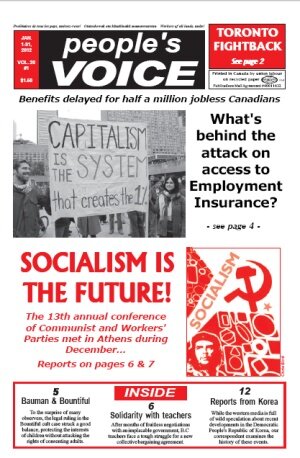
2) EI, THE 99%, THE 1%, AND THE WIDENING GAP
3) COMMUNISTS CALL FOR BIG CHANGES IN BRITISH COLUMBIA
4) BC COMMUNISTS CALL FOR SOLIDARITY WITH TEACHERS
5) COMMUNIST PARTY SLAMS DISMANTLING OF OCCUPY WINNIPEG
6) COPE WEIGHS UP POST-ELECTION STRATEGIES
7) ATTAWAPISKAT: COLONIALISM ON TRIAL - Editorial
8) SUPPORT CALL TO SAVE MEDICARE - Editorial
9) BAUMAN RULING STRIKES A BETTER BALANCE
10) SOCIALISM IS THE FUTURE!
11) "TO IDENTIFY THE PROBLEM IS NOT ENOUGH" - CPC
12) NO TO WAR THREATS AGAINST SYRIA AND IRAN!
13) PEACE CONGRESS CONVENTION DELIVERS ACTION PLAN FOR PEACE
14) JAPAN REMAINS UNREPENTANT FOR PAST CRIMES
15) THE LEGACY OF KIM JONG IL
16) MUSIC NOTES
17) WHAT’S LEFT
18) FIGHT TO SAVE WHEAT BOARD NOT OVER
19) CLARTÉ (en français)
20) THE SPARK! (Theoretical and Discussion Bulletin of the Communist Party of Canada)
21) INTRODUCING MARX
PEOPLE'S VOICE JANUARY 1-31, 2012 (pdf)
|
People's Voice deadlines: February 1-14 February 15-29 Send submissions to PV Editorial Office,
|
|
REDS ON THE WEB |
|
People's Voice finds many "Global Class Struggle" reports at the "Labour Start" website, http://www.labourstart.org/. We urge our readers to check it out! |
* * * * *
People's Voice
Canadian Publications Mail Sales Product Agreement #205214
ISSN number 1198-8657
People's Voice is published by
New Labour Press Ltd
PV Editorial Office
706 Clark Drive,
VANCOUVER, B.C. V5L 3J1
Phone:604-255-2041
Fax:604-254-9803
email: pvoice@telus.net
Editor: Kimball Cariou : Business Manager: Sam Hammond
Editorial Board: Kimball Cariou, Miguel Figueroa,
Doug Meggison, Naomi Rankin, Liz Rowley, Jim Sacouman
* * * * * *
Letters
People's Voice welcomes your letters
on any subject covered in our pages.
We reserve the right to edit for length and clarity,
and to refuse to print letters which may be libellous
or which contain unnecessary personal attacks.
Send your views to:
"Letters to the Editor",
706 Clark Dr., Vancouver, BC V5L 3J1,
or pvoice@telus.net
People's Voice articles may be reprinted without permission,
provided the source is credited.
* * * * * *
The Communist Party of Canada, formed in 1921,
has a proud history of fighting for jobs, equality, peace,
Canadian independence, and socialism.
The CPC does much more than run candidates in elections.
We think the fight against big business and its parties
is a year-round job,
so our members are active across the country,
to build our party and to help strengthen people's movements
on a wide range of issues.
All our policies and leadership
are set democratically by our members.
To find out more about Canada's party of Socialism,
give us a call at the nearest CPC office.
* * * * * *
Central Committee CPC
290A Danforth Ave Toronto, Ont. M4K 1N6
Ph: (416) 469-2446
fax: (416) 469-4063 E-mailmailto:info@cpc-pcp.ca
Parti Communiste du Quebec (section du
Parti communiste du Canada)
5359 Ave du Parc, Montréal, Québec,
H2V 4G9
B.C.Committee CPC
706 Clark Drive, Vancouver, V5L 3J1
Tel: (604) 254-9836
Fax: (604) 254-9803
Edmonton CPC
Box 68112, 70 Bonnie Doon P.O.
Edmonton, AB, T6C 4N6
Tel: (780) 465-7893
Fax: (780)463-0209
Calgary CPC
Unit #1 - 19 Radcliffe Close SE
Calgary AB, T2A 6B2
Tel: (403) 248-6489
Ottawa CPC
Tel: (613) 232-7108
Manitoba Committee
387 Selkirk Ave., Winnipeg, R2W 2M3
Tel/fax: (204) 586-7824
Ontario Ctee. CPC
290A Danforth Ave., Toronto, M4K 1N6
Tel: (416) 469-2446
Hamilton Ctee. CPC
265 Melvin Ave., Apt. 815
Hamilton, ON.
Tel: (905) 548-9586
Atlantic Region CPC
Box 70 Grand Pré, NS, B0P 1M0
Tel/fax: (902) 542-7981
http://www.communist-party.ca/
* * * * * *
News for People, Not for Profits!
Every issue of People's Voice
gives you the latest
on the fightback from coast to coast.
Whether it's the struggle for jobs or peace, resistance to social cuts,
solidarity with Cuba, or workers' struggles around the world,
we've got the news the corporate media won't print.
And we do more than that
- we report and analyze events
from a revolutionary perspective,
helping to build the movements for justice and equality,
and eventually for a socialist Canada.
Read the paper that fights for working people
- on every page, in every issue!
People's Voice
$30 for 1 year
$50 for 2 years
Low-income special rate: $15 for 1-year
Outside Canada $50 for 1 year
Send to: People's Voice, 706 Clark Drive, Vancouver, BC, V5L 3J1
You can call the editorial office at 604-255-2041
REDS ON THE WEB
http://www.communist-party.ca/
http://www.ycl-ljc.ca/
http://www.solidnet.org/
(The following articles are from the January 1-31, 2012, issue of People's Voice, Canada's leading communist newspaper. Articles can be reprinted free if the source is credited. Subscription rates in Canada: $30/year, or $15 low income rate; for U.S. readers - $45 US per year; other overseas readers - $45 US or $50 CDN per year. Send to People's Voice, c/o PV Business Manager, 706 Clark Drive, Vancouver, BC, V5L 3J1.)
1) TORONTO NEGOTIATIONS WILL SET PATTERN ACROSS CANADA
PV Ontario Bureau
Close to 30,000 municipal workers, organized into three CUPE Locals, are facing Toronto Mayor Rob Ford and a right-wing majority on City Council, with Canada-wide implications for years to come.
The Ford administration have made it clear that their main aim is to privatize, contract out, and eliminate city services, and to break the back of the union whose members deliver these services.
As CUPE Local 416 President Mark Ferguson said in late December, "This round of negotiations will be a watershed for city services right across the county. If we lose this battle in Toronto, Canada's largest city, you can bet the pattern will be repeated in city after city.... (This is) the toughest round of bargaining in our history."
Paul Moist, National President of CUPE, has called the negotiations in Toronto "our PATCO moment" ‑ a reference to the air traffic controllers in the US who were all fired by President Ronald Reagan in his first act after being elected. Moist has called on CUPE locals across Canada to "move their war rooms to Toronto."
The three unions representing outside workers (Local 416), inside workers (Local 79), and library workers (Local 4948) have tried to negotiate with the city through the fall. But they have been stymied by city negotiators who refused to bargain seriously, or to provide any figures on the city's financial position, other than public announcements of catastrophic financial crisis.
Instead, the city has laid charges against Local 79 of bad faith bargaining, in a pre‑emptive move to secure public support. Local 79 had asked the city to open the books on its financial situation, citing the $139 million year‑end surplus which public organizations are demanding should be plowed back into services, not Ford's "rainy day" fund.
The unions, and many organizations, have also questioned the grossly inflated $779 million budget shortfall projected for 2012 as a creation of the Ford administration. About $500 million is the gap caused by chronic under‑funding, and is usually covered with funding provided by the province (which would rather cough up for Toronto than deal with the chronic and province‑wide underfunding of cities).
The unions have indicated they are not intending to strike, but expect the city to lock them out as early as mid-January. The city has made no secret of the fact it hopes a winter lockout will demoralize picketers and hurt the union. As well, the just‑released budget includes layoffs and the elimination of 2,338 jobs ‑ another nail in the coffin of public services, and another attempt to split and demoralize city workers and their unions.
Under the rubric of ending so‑called "jobs for life" provisions in the current collective agreement, the Ford administration is aiming to strip job security provisions which workers fought hard to secure in previous agreements, and which are a significant obstacle to Ford' slash and burn agenda. The city is also demanding cuts and take‑aways to almost every part of the existing collective agreement.
Linking the attack on municipal workers' jobs with the attack on public services is a challenge the union has already taken up, with a fall PR campaign of posters and ads called "Taking Care of Toronto." The campaign followed on the heels of a September poll showing broad and deep opposition to Ford's proposed budget and service cuts. The poll showed Ford's popularity collapsing, including amongst those who said they voted for him in November 2010.
Without recall legislation, there is no simple way to unload the Mayor and his brother, Deputy Mayor Doug Ford. They and other right-wing Councillors were elected on a platform of cutting unpopular taxes levied by the previous administration (under the City of Toronto Act) without cutting services. This could be done, Ford said, by eliminating the "gravy" that flowed through city hall.
The "gravy", it's now becoming evident, was not the $14,000 tab for an end‑of‑term goodbye dinner paid for by the public when outgoing Councillor Kyle Rae used up his expense account treating friends and supporters. It's the public sector workers who deliver an extensive range of public services in Toronto every day, including libraries, child care, transit, social services, parks and recreation, garbage collection and disposal, public health, public housing, school food and nutrition programs, programs for at‑risk youth and seniors, HIV‑AIDS services, homeless shelters and transitional housing, settlement services, and much more.
Last July, a mass public movement against the cuts was born after Ford brought in KPMG to prepare a list of services not mandated by provincial legislation to be cut in the 2012 budget. Over 300 individuals and organizations signed up to make presentations against the cuts, but only one day was set for the hearings which went through the night before adjourning at 7 am.
Stop the Cuts was formed, and demonstrations and public education and organization began across the city. The Labour Council became very visible as labour once again moved into the fray. One Toronto, a coalition of citizens and organizations concerned about arts, culture and democracy, moved into action, including Margaret Atwood (whom Doug Ford said he wouldn't know if she walked past him, and said she should run for public office if she had anything to say. Atwood had been very critical of the proposal to close public libraries.)
In early December, two days were set aside for public presentations to the Budget Committee, and once again almost 300 presenters signed up. Speaker after speaker laid out the horrendous impacts, begging or demanding that the proposed cuts be stopped. Doug Ford wrote a cheque for $1,000 to one of the school food programs in his ward. The message wasn't missed: in future, charitable works will replace social programs in Toronto.
Progressive councillors tried to draw out presenters with questions about the services they were losing, but were cut short repeatedly by Budget Chair Mike Del Grande who said "You're wasting time!"
Communist Party (Ontario) leader Liz Rowley was escorted out of the building by security, for proposing from the gallery that the Committee extend the hearings for a third day. The Party's presentation, subsequently delivered in writing to all members of Council, asserted the City's financial situation was a chronic problem of under‑funding. not over‑spending. The presentation urged Council to stop the cuts to services, negotiate a fair deal with its employees, and rejoin the campaign for a new financial deal for cities, once led by Toronto Mayor David Miller, and now by the Mayor of Calgary. Cities should receive adequate transfers through statutory grants, or be granted new wealth taxing powers in order to secure the funds to provide the services needed in 21st century cities. Further, 50% of gasoline and road user taxes should be returned to cities immediately, the Party said.
Many others said similar things, but none were heeded by the Budget Committee. The Stop the Cuts Committee, supported by the Labour Council, One Toronto, and other organizations have organized a mass demonstration against the budget for January 17, 5:30 pm, at City Hall. Council is expected to vote on the budget on Jan. 17, 18, or 19. This will be a critical moment for the city and for unionized city workers.
The Communist Party is calling on all its members and supporters to come out on Jan. 17, to join workers on their picket lines, and to support them in every way possible, including through phone calls and letters to City Councillors and the Mayor, letters to the Editor, calls to phone‑in radio and TV talk shows, and messages of support and solidarity.
This struggle will have repercussions across Canada for civic workers and their unions, and for cities and working people who want and depend on those services. This is a struggle for everyone.
2) EI, THE 99%, THE 1%, AND THE WIDENING GAP
PV Commentary
As many activists have pointed out, the Occupy movement continues to have a huge political impact, even though most of the tent cities have been removed by the ruling class. Beyond the matter of who decides where poor people can live and protest, the issues posed by Occupy remain: what is the source of staggering inequality in our society, and what can be done to change this situation?
Claims by Canada's right-wing politicians that "there are no serious problems" here are utterly false. A recent analysis from the OECD (a key institution of global capitalism) finds that the gap between Canada's rich and poor is growing. The OECD says that income inequality is at a record high among industrialized (read "developed capitalist") nations, and that the gap in both Canada and the U.S. is well above the 34‑country average.
In Canada, the chasm has been widening since the mid‑1990s, when the Chretien Liberals began slashing the social safety net. By 2008, the average income of the top 10 percent of Canadians was $103,500, compared to $10,260 for those in the bottom 10 percent. This ratio has widened to 10-to-1 from the 8-to-1 figure of the early 1990s. Moreover, the richest 1 per cent of Canadians saw their share of total income grow to 13.3% in 2007, up from 8.1% in 1980. At the same time, the top federal marginal income tax rates tumbled to 29% in 2010, from 43% in 1981.
The wider gap is largely due to deliberate steps by the ruling class to remove the redistributive impact of taxes and social benefits, which had previously cushioned the effect of unemployment. The growth of part‑time and temporary contract work is also eroding wage levels, as is the shift to "self-employment".
As the OECD reports, before the mid‑1990s, Canada's tax-benefit system offset more than 70% of the rise of market‑income inequality. Today, taxes and benefits offset less than 40% of the rise in inequality.
Similar findings emerge from other sources. A September 2011 study by the Conference Board of Canada said that income inequality has risen more rapidly in Canada than in the U.S. since the mid‑1990s, and that among 18 major countries, Canada had the fourth-largest increase in inequality since the mid‑1990s.
This is not just an abstract problem, it's a matter of life and death. Montreal's public health agency has found an 11‑year difference in life expectancy between men who live in the city's poorest neighbourhood and those in its richest.
Instead of trying to reverse this deadly trend, the Harper Tories are consciously making things worse for working people. One scandalous example is the ruthless slashing of employees at Services Canada, those who are responsible for ensuring the flow of employment insurance benefits to jobless Canadians.
Just four years ago, in October 2007, 181,931 unemployed Canadians were waiting for EI claims to be processed, according to information published by the Globe and Mail last month. By October 2011, that number had skyrocketed to 360,481, which may seriously underestimate the real total. Some economists pin the actual figure by the end of 2011 at nearly 500,000.
This trend directly parallels a 13% decline in temporary and permanent staff in EI processing centres since October 2007. While hundreds of additional processing agents were hired during the economic crisis of 2008 and 2009, these employees and others have been let go without being replaced.
The result is catastrophic for jobless workers, many of whom are unable to find out why their benefits are delayed. Documents obtained by the Globe and Mail claim that telephone lines are so jammed that just one in three calls is answered. Claimants who have spoken to People's Voice say it's worse; one in Vancouver was unable to get a single phone call answered for an entire month, and could only get help by pressing Service Canada staff to bypass the regular procedures to give her access to a special line.
Are such policies the result of uncaring, thoughtless political decisions, or are they a deliberate strategy? Given that the negative impact of neoliberal policies on poor people is widely documented, it seems clear that pro-corporate governments like the Harper Tories know exactly what they are doing.
It seems equally clear that only massive political pressure by a highly united and mobilized working class - organized and unorganized, young and old, male and female, citizens and migrants, straight and gay - can force a shift to pro-people economic policies.
But as Miguel Figueroa told the recent Athens meeting of Communist and Workers' Parties (see pages 6 & 7), "traditional bourgeois mechanisms of regulating and overcoming the crisis are increasingly ineffective... the resulting ruling class response to the crisis is more socially brutal, more militaristic, more dangerous to all humanity than during previous rounds of crisis..."
Our struggle begins with the fight to reverse neoliberal attacks such as the corporate drive to remove access to EI benefits. But our aim must be to topple the system which is based on maximizing corporate profits at the expense of working people. Capitalism is the source of the crisis, and socialism must be our goal.
3) COMMUNISTS CALL FOR BIG CHANGES IN BRITISH COLUMBIA
PV Vancouver Bureau
As the clock ticks towards a May 2013 provincial election, British Columbia Communists held their 39th convention in Vancouver over the first weekend of December.
Much of the convention debate was focused on a Political Resolution which analyses the main economic and social trends in the province after eleven years of Liberal rule. The Resolution stresses that "the political, economic and social environment in British Columbia must be viewed within the Canadian state, and where it fits into the wider context of the deepening systemic crisis of capitalism globally."
By the time that crisis erupted in 2008, British Columbia had already been squeezed by "free trade" deals into even deeper dependence on the export of unprocessed resources. The last two decades have seen the closure of hundreds of sawmills, a serious decline in shipbuilding, and closures of pulp and paper factories. This economic shift has been matched by major job losses, escalating deficits and debts, and under the Liberals, by "an orchestrated shift of wealth from 80% of the population to the top 20% who were either corporations or top feeders living off the corporate plunder of the economy and the environment."
One of the main policy goals of ex-premier Gordon Campbell was to remove most elements of progressive taxation. Campbell's tax cuts gave huge benefits to the wealthy and the big corporations, while middle and low-income earners saw their tax cuts swallowed up by regressive changes such as increased Medical Service Plan premiums and user fees.
As the Political Resolution points out, these changes have also reduced provincial revenues by an estimated $3.4 billion per year. This deliberate revenue reduction has been used by the Liberals to dramatically reduce spending on social programs, education and health care as a percentage of the provincial GDP. The targets of this reduction, not surprisingly, are organized public sector employees, poor people, students, seniors, and other sections of the population who are not part of the "1%" upper crust.
The BC Liberals' grip on power was finally shaken by the popular revolt against the HST in 2009. This hated tax, imposed without warning on British Columbians, marks yet another shift of wealth and income from the pockets of working people to big capital. But in a unique development, citizens used the province's initiative legislation to force a referendum on the HST. This upsurge of popular anger also compelled Campbell to resign in disgrace in late 2010.
Since then, his replacement Christy Clark has tried "populist" tactics to revive Liberal fortunes, with little success. Nearly 55% of B.C. voters rejected the HST, with the highest margin among working people and economically depressed areas. Opinion polls show the Liberals trailing the NDP by ten points or more, and the re-energized provincial Conservatives gaining ground, which could divide right-wing votes and let the NDP sail to victory.
As the Resolution points out, "The NDP under the leadership of Adrian Dix might be able to shed some of (former leader) Carole James' image with big business and the main antagonists of the BC working class, especially with the call to roll back the last few years of Campbell's corporate tax cuts. However there's a problem with this, because even in pre‑Campbell days the corporate taxes weren't enough and the system was skewed against working people."
In contrast to the NDP strategy of tinkering to reduce the impact of the Campbell legacy, the B.C. Communists are preparing to advance policy alternatives calling for fundamental change: "Make the corporations pay, regain ownership of resources, put the wealth to work for the people, create jobs and fight for a proportional representation system."
The Resolution calls for a new and truly progressive taxation system; major changes to resource policies, such as an end to anti-environmental "fracking" by the energy industry; action to defend and expand universal public healthcare, public education and child care; reversal of privatization; and an end to government attacks on the labour movement.
On the second day of the convention, delegates elected a new 15-member BC Provincial Committee of the Communist Party, and re-elected Sam Hammond as the party's provincial secretary and electoral leader.
The Provincial Committee will meet in late February to finalize editing of the Political Resolution and other reports, and to launch plans for expanded communist activity across British Columbia over the next year.
4) BC COMMUNISTS CALL FOR SOLIDARITY WITH TEACHERS
Resolution in support of the BC Teachers' Federation, adopted unanimously at 39th B.C. Provincial Convention of the Communist Party of Canada, Dec. 3-4, 2011
It is very clear that the BC provincial Liberal government has been provoking the BC Teachers' Federation (BCTF) to a full strike, so that they can impose a legislated contract. Aside from the net zero mandate, the BC Public School Employers Association (BCPSEA) has put a series of union busting proposals forward.
The latest set of BCPSEA proposals calls for further stripping of the BCTF collective agreement and includes (amongst a host of provocative proposals) the virtual elimination of seniority, the elimination of postings filled during the year (teachers to be placed by the employer), forced transfers of any employee at the initiative of the employer, elimination of a grievance process for disputes in posting, in filling, elimination of processes during discipline and dismissal, caps and restrictions on sick leave, and maternity leave, and substantial restriction to professional autonomy. The employer has offered no improvement to any provision. The Labour Relations Board has turned down BCPSEA's outrageous demand for a 15% reduction in teachers' pay, and their claim that report cards were an essential service.
The recently announced BC Education Plan, the province's vision for education in the 21st Century ‑ assumes contractual changes not yet agreed to by teachers. It is clear that the provincial government ‑ rather than dealing with the Supreme Court's decision re the illegality of the contract stripping of Bills 27 and 28 ‑ is intent on steamrolling an agenda that will increase corporate influence in schools, diminish democratic control by school boards, and severely weaken the BCTF.
The attack on the BCTF should be a major cause for concern by the labour movement.
The Communist Party of BC condemns the provincial government and BCPSEA for its unwillingness to fairly bargain with teachers. We call on the provincial government to provide a massive infusion of funding into the woefully underfunded education system; to end the net‑zero mandate; to expand the scope of local bargaining, and provide the necessary funding for that expansion; to drop the provocative demands that undermine basic union rights such as seniority; to seriously address the Supreme Court's decision re the illegality of Bills 27 and 28 and to begin to bargain fairly with the BCTF.
The Communist Party also declares solidarity with BCTF in whatever actions it takes to protect its members and further the interests of BC children, youth and parents.
5) COMMUNIST PARTY SLAMS DISMANTLING OF OCCUPY WINNIPEG
The Communist Party has criticized the Manitoba NDP government for forcibly dismantling the Occupy Winnipeg campsite in Memorial Park and for illegally detaining the protesters in the camp.
"The Occupy movement in Winnipeg and around the world is exposing capitalism's enormous crime and greed, which continue today with impunity, protected by corporate‑friendly governments," said a Dec. 21 statement by the Party's Manitoba Committee. "Because of its efforts, the Occupy movement is facing an often violent crackdown by governments which are acting in the interest of the top 1 per cent of income earners, who are benefiting enormously from present‑day capitalism.
"The Manitoba government's surprise action this morning is inexcusable and illegal. The excuse provided today by the Manitoba government for forcibly detaining the Occupy protesters and removing their belongings from the protest camp site is totally lame and is a cover for what amounts to a heavy blow to the democratic rights of all Manitobans.
"Thousands of people have visited or stayed at the campsite since it was set up in October and no one has been hurt by any `hazards' identified by the Manitoba government. The right to protest and to freedom of expression must be respected by the Manitoba NDP government and the belongings returned immediately to the protesters. The government should apologize to the protesters for violating their constitutional rights.
"Compared to the Mulroney Progressive Conservative government which allowed protesters to establish a Peace Camp which lasted two winters on Parliament Hill itself, Manitoba today has a less democratic government. The Manitoba NDP government treated the 2000 Peace Camp set up in Memorial Park in solidarity with the Esk nuopitijk (Burnt Church) First Nation in a completely differently manner.
"The Communist Party supports the right of the Occupy movement to continue camping in Memorial Park and to continue its activities which have already found wide support among the trade union and other popular movements in the province."
6) COPE WEIGHS UP POST-ELECTION STRATEGIES
PV Vancouver Bureau
On election night in Vancouver, as losses for the Coalition of Progressive Electors became painfully clear, COPE supporters at the party's campaign office began wrestling with the results and considering the future.
For many, the emphasis is on looking forward. COPE has faced major setbacks before, such as the 1996 campaign which saw the defeat of every candidate. That outcome sparked a review of the labour/left civic party's strategy, leading to a successful campaign three years later, based on building broader electoral alliances.
Young community activists who have played a major role in rebuilding COPE in recent years quickly began discussing what comes next. With school trustee Allan Wong as the only COPE elected official, their focus is on moving into action around a wide range of urgent local issues, rather than immediately locking into a particular electoral tactic for 2014.
Among some others, one reaction was very different. Before anyone had an opportunity to examine poll-by-poll results, defeated council candidate Tim Louis was attacking the party's electoral cooperation agreement with Vision Vancouver. Speaking that night to the media, before the COPE executive or campaign team could weigh up the situation, Louis blamed COPE members for making a "tragic mistake" by voting 2-1 for the agreement with Vision, which he claimed had failed to urge its supporters to also vote COPE.
On the surface, the argument looks persuasive. The 18 Vision candidates for mayor, council, school board and park board all won, averaging some 60,000 votes. Only one of COPE's nine candidates was elected, and COPE candidates averaged 47,967.
But this analysis breaks down on closer examination. The fact is that for six years, Vision has claimed a larger share of voter support than COPE, the party from which it bolted back in 2004. Reports from the campaign indicate that while many Vision and COPE voters fully backed each other's candidates, others did not. COPE itself may have contributed to this development, by deciding during the initial campaign period to avoid listing Vision candidates or the joint slate on COPE materials. This was done to allow COPE to project a stronger independent image, appealing to voters who might have sharp disagreements with Vision's record running the city over the past three years.
Some COPE candidates disagreed with this strategy, which was shifted by early November. For the final two weeks of the campaign, both COPE and Vision materials and ads placed much more emphasis on the joint slate. The E-day "doorknocker" delivered to tens of thousands of likely supporters was a useful tool to promote the full slate.
But was it too late? At that point, the media had turned the contest into a head-to-head battle for the mayoralty between Vision's Gregor Robertson and the right-wing NPA candidate, Suzanne Anton. As Vision and the NPA poured vast amounts into print, TV and radio ads, COPE's strategy of trying to compete for media attention by focusing on policy proposals was drowned out.
Another factor was the splintering of progressive voters at the ballot box. This hurt COPE incumbent councillor Ellen Woodsworth, who lost to Green candidate Adriane Carr by just 91 votes. Many COPE-leaning voters also backed Carr, unwittingly defeating Woodsworth and depriving council of its most powerful radical voice.
Could COPE have achieved more by running full slates and a mayoralty candidate? This seems unlikely. A "go-it-alone" strategy would have cost COPE most of its financial and organizational support from the labour movement, which desperately wanted to block the NPA from regaining control of City Hall. COPE's election budget would have been far lower, there would have been no E-day doorknockers, and the number of volunteers would have been far lower than the 400 who formed the backbone of the COPE campaign.
Here are some facts and figures which will be weighed up as COPE members analyse the campaign.
Overall votes and turnout were up, from 120,000 (31%) in 2008 to 144,000 (34%) in 2011.
The gap between Vision and NPA candidates stayed constant. For Mayor, Robertson won over Anton by 77,005 to 58,152 in 2011 (and 4007 for Randy Helten of Neighbourhoods for a Sustainable Vancouver), compared to his 2008 margin of 67,598 to 48,794 against the NPA's Peter Ladner. These numbers also show that both the NPA and Vision votes went up considerably.
COPE also made gains in 2011, such as a 2700 vote increase for Woodsworth. At school board, COPE incumbent Jane Bouey gained 3800 votes over 2008, followed by increases of 2900 for Al Blakey and 900 for the popular Allan Wong, the only COPE candidate who stayed ahead of the NPA.
For the four COPE incumbents (Woodsworth, Wong, Bouey, Blakey), the average vote was 52,362. For the first timers, the average was 43,331. The result for former councillor Tim Louis, 43,936, was far closer to the first‑timers, even though Louis received enormous media coverage, including a front page of the Georgia Straight weekly.
David Cadman, the long‑time COPE councillor who was defeated for a nomination this time, received 56,000 votes in 2008. Following the pattern of other COPE incumbents, he would have gained votes and been re‑elected by a margin of over 8,000, probably helping to pull Woodsworth up into tenth place. That would have given COPE two councillors instead of zero.
COPE first‑time candidates like R.J. Aquino brought new activists and energy into the campaign. But this was not enough to overcome the disadvantage of lower name recognition in an at-large election dominated by massive media ads.
While Tim Louis drew some new and former COPE supporters into the race, his vote gain of 600 over his 2005 result was very small. Even some COPE supporters did not vote for Louis for various reasons, such as his enthusiastic support for the Fire This Time cult which has sown divisions on the left. It appears that COPE did not benefit from having Louis on the ballot, and lost significantly by dropping Cadman.
The COPE executive is still reviewing the results, and preparing to move towards a more grassroots action strategy now that the political balance of forces has changed in Vancouver.
7) ATTAWAPISKAT: COLONIALISM ON TRIAL
People's Voice Editorial
The revelations of appalling living standards in the northern Ontario community of Attawapiskat tell us more about the genocidal nature of Canadian racism and colonialism than about any so-called "failures" of aboriginal leaders. For many years, Aboriginal groups have told Canadians about abysmal housing, lack of clean drinking water, high unemployment and poor educational standards on reserves across the country. But instead of taking decisive action to promote Aboriginal living standards and genuine self-government, Canadian politicians have consistently stepped back from doing the right thing. Baby steps towards tackling the needs of First Nations are invariably followed by refusals to live up to treaties and campaign promises. The traditional lands and waters of Aboriginal peoples remain a source of vast wealth for transnational corporations, while the people themselves suffer Third World levels of poverty.
The racist claim that the Attawapiskat scandal somehow "proves" that Aboriginal peoples are incapable of managing their own affairs is a particularly vile accusation. The Harper Tories immediately called in a third‑party manager to make decisions for the community, for a huge fee, of course. The "manager" was kicked out, but this episode raises a question: how can a government which plans to waste nearly $500 billion on military purchases over the next 20 years accuse an Aboriginal community of misspending and lack of transparency?
It is not the Aboriginal peoples who drove millions of Canadians into poverty and unemployment, or who sold out Canada's industry and sovereignty for a quick buck. That historic failure was the work of our own ruling class, who have no right to point fingers at anyone, especially the peoples whose lands were stolen to lay the basis for Canadian capitalism. It's long past time to redress the historic injustices imposed on Aboriginal peoples in Canada, starting with decent housing and clean water on reserves across the country.
8) SUPPORT CALL TO SAVE MEDICARE
People's Voice Editorial
The Canadian Health Coalition is seeking widespread support for its updated Call to Care statement, which articulates a common vision for the future of health care, as governments prepare to re‑negotiate the renewal of the Health Accord in 2014.
As the Call reminds us, "Health care in Canada is a fundamental right without distinction of race, gender, age, religion, sexual orientation, political belief, immigration status, and economic or social condition," and organizations must mobilize to defend this right.
The CHC urges that important principles shape the Health Accord renewal, including: recognition of the highest attainment of health as a fundamental right; recognition that Aboriginal people must be at the table of First Ministers discussions on the Health Accord; recognition of health care as a public good for which no financial barriers must be erected, and which must be delivered on a public, not‑for‑profit basis; opposition to any commercialization and privatization of health care; the need for the federal government to fully assume its responsibilities in respect to health; expansion of the system to include a universal Pharmacare plan, a system of home and community care, long‑term care, and a strategy for mental health; the need to move towards a community-based, multi‑disciplinary team approach to the organization and delivery of services; accountability through democratic participation and transparent governance at all levels of the health system; recognition that decent wages and working conditions for health care workers are critical to a high quality system.
We urge all labour and people's organizations to sign on to this statement, which can be found at www.healthcoalition.ca.
9) BAUMAN RULING STRIKES A BETTER BALANCE
By Kimball Cariou
The legal ruling on Canada's law banning polygamy, handed down by BC Supreme Court Chief Justice Robert Bauman on Nov. 23, continues to draw both praise and criticism. Bauman was rendering a highly complex decision on matters which seem related, but are actually very different.
Written in 1890 to target Mormon settlers, S. 293 of the Criminal Code has been unenforced for decades. This vague but sweeping statute provides up to five years in prison for more than two people who are in "any kind of conjugal union."
The case was launched to test the validity of S. 293 as a tool to address the practices of the patriarchal FLDS Mormon cult based in Bountiful, British Columbia. But the broad scope of the legislation means that it could potentially be used by the state to criminalize large numbers of Canadians who are "guilty" of nothing more than non‑monogamous sexual activity, or of participating in family forms which differ from the model promoted by the capitalist state and many religious outlooks.
The Bauman ruling will likely be appealed, perhaps directly up to the Supreme Court of Canada. But it would be unfortunate if a lengthy appeal process delayed prosecutions of the Bountiful patriarchs. The evidence presented to Justice Bauman, and the long history of the FLDS cult in Canada and the U.S., makes it clear that the "plural marriage" Mormon doctrine has long become a convenient cover for a shocking pattern of child rape. The beneficiaries have been a handful of powerful men who supply themselves with "celestial wives" to satisfy their personal desires for sex with young girls. Other victims include the young non‑elite males of Bountiful, who are poorly educated, and often must leave their homes and families to seek employment and the chance of normal human relationships elsewhere.
The Bountiful cult is supported financially by the taxpayers of British Columbia, who have unwillingly subsidized the FLDS religious schools for many years. This scandal is a clarion call to end public funding of private religious schools, which violates the principle of separation of church and state. Those who engage in child sex abuse must be prosecuted under relevant Canadian legislation, and the Bauman ruling helps establish that the human rights of women, youth and children trump "religious beliefs".
The Bountiful cult is an extreme form of patriarchal control over women and children. On one level, this form of "polygamy" parallels the social system under which we live. Capitalism is also a form of human relations based on control by a tiny minority of (mostly male) bosses, who impose a range of forms of exploitation on working people. Unfortunately, the Bountiful abuses have sometimes been lumped together with ideas and practices which are the opposite of patriarchy.
To give one example, a literal reading of S. 293 would seem to open the prosecution of individuals who practise non‑monogamous forms of family relations commonly known as polyamory. Such people reject the patriarchal control of women which is sometimes reinforced through marriage, the very institution which Justice Bauman presents as a "core value" of western society.
This part of the ruling raises troublesome questions. Just because a social institution has ideological hegemony, is it above criticism? Given the figures regarding divorce rates, infidelity, violence, and abuse within families, the monogamous nuclear family model is no guarantee for happiness. As Frederick Engels recognized, the subordination of wives and the shift towards the nuclear family from larger kin networks were associated with the historic development of private property.
Other family forms must be considered on their own merits. The Canadian Polyamory Advocacy Association (CPAA) was a key intervenor in the case, arguing that many polyamorous women, as well as men, freely choose to have more than one partner. They fear that the wording of the 120-year-old statute might be used to criminalize egalitarian, secular, long-term relationships. Justice Bauman's decision clarifies that S. 293 does not apply to unformalized polyamorous relationships, although other questions are left unresolved.
"Polyamorists are relieved they can be in loving, egalitarian, conjugal relationships without criminal sanction," said CPAA legal counsel, John Ince. "Polyamorists who are dealing with immigration or family custody issues for instance now need no longer worry about being considered to be criminals".
In the CPAA's view, the real issue is not the number of people in any given relationship; the health of the relationship and family is what matters.
This should be the focus of debate if and when Parliament rewrites polygamy laws. Will a new law be used to impose certain narrow religious precepts on the entire population, at the expense of those who establish non-traditional but freely-chosen relationships? Given the influence of fundamentalist views within the Harper Tory caucus, this could pose serious implications.
In the meantime, the Bauman ruling, on balance, advances the rights of Canadians to be protected against patriarchal exploitation, while also beginning to recognize that adults should not be punished for choosing to love more than one partner.
Statement issued by the 13th International Meeting of Communist and Workers' Parties, held in Athens on December 9-11, 2011. The meeting was attended by representatives from 78 Parties from 59 countries; other parties which did not manage to take part sent written messages. The Communist Party of Canada was represented in Athens by CPC leader Miguel Figueroa.
We salute from Athens the growing popular struggles releasing huge emancipatory potential against imperialism, against capitalist exploitation and oppression, and for the social, labour and social security rights of workers' all over the world.
The meeting was held in critical conditions in which the deep and prolonged capitalist crisis continues to prevail in the international situation, accompanied by the escalation of the aggressiveness of imperialism which is expressed in the decisions of the Lisbon Summit for the new NATO strategy. This reality confirms the analyses outlined in the statements of the 10th, 11th, 12th, International Meetings that took place in Brazil (Sao Paolo) in 2008, India (New Delhi) in 2009 and South Africa (Tshwane) in 2010.
It becomes increasingly obvious for millions of working people that the crisis is a crisis of the system. It is not faults within the system but the system itself that is faulty, generating regular and periodic crises. It results from the sharpening of the main contradiction of capitalism between the social character of production and the private capitalist appropriation and not from any version of the management policy of the system or from any aberration based on the greed of some bankers or other capitalists or from the lack of effective regulatory mechanisms. It highlights the historical boundaries of capitalism and the need to strengthen the struggles for anti‑monopoly anti‑capitalist ruptures, the revolutionary overthrow of capitalism.
In the USA, Japan, the EU, and in other capitalist economies the impasses of the various versions of the bourgeois management are being demonstrated. On the one hand the restrictive political line leads to a prolonged and deep recession; on the other, the expansionist political management, with large state support packages to the monopoly groups, finance capital, and the banks, intensifies inflation and leads to the swelling of the public debt. Capitalism converts corporate insolvencies into sovereign insolvencies. Capitalism has no other response to the crisis beyond the mass destruction of productive forces, resources, mass dismissals, factory closures, and the comprehensive attack on workers and trade union rights, on wages, pensions, social security, the reduction in people's income, the huge increase in unemployment and poverty.
The anti‑people offensive is strengthening which is manifested with particular intensity in certain regions. The concentration and centralization of monopoly capital is intensifying the reactionary character of economic and political power. Capitalist restructuring and privatisations are being promoted, aiming at competitiveness and maximisation of profit of capital, at ensuring a cheaper labour force and the regression of decades in terms of social and labour rights.
The intensity of the crisis, its global synchronisation, the prospect of the slow, weak recovery intensify the difficulties of the bourgeois forces in managing the crisis, leading to the sharpening of the inter‑imperialist contradictions and rivalries while the danger of imperialist wars is being strengthened.
The attacks on democratic rights and sovereignty are intensifying in many countries. Political systems become more reactionary. Anti‑communism is being reinforced. There are generalised measures against the activity of the communist and workers' parties, against the trade union, political and democratic freedoms The ruling classes develop a multi faceted attempt to trap the people's discontent through changes in the political systems, through the utilisation of a series of pro‑imperialist NGOs and other organizations, through attempts to channel the people's discontent into movements with allegedly non‑political or even with reactionary characteristics.
We salute the people's and workers extensive struggles and uprisings, for democratic, social and political rights against the anti‑people regimes in the Middle East and North Africa, namely in Tunisia and Egypt. Despite the contradictions which the current situation manifests, it constitutes a significant experience that the communist movement should study and utilise. Simultaneously we strongly condemn the imperialist war of NATO and the EU against the Libyan people and the threats and interference in the internal affairs of Syria and Iran, as well as of any other country. We consider that every foreign intervention against Iran under whatever pretext attacks the interests of the Iranian workers and their struggles for democratic freedoms, social justice and social rights.
These developments confirm the necessity of strengthening the Communist and Workers' Parties in order to play their historical role, to further strengthen the workers and people's struggle in defence of their rights and aspirations, to utilise the contradictions of the system and the inter‑imperialist contradictions for an overthrow at the level of power and economy, for the satisfaction of people's needs. Without the leading role of the communist and workers parties and the vanguard class, the working class, the peoples will be vulnerable to confusion, assimilation and manipulation by the political forces that represent the monopolies, finance capital and imperialism.
Significant realignments in the international correlation of forces are under way. There is the on‑going relative weakening of the position of the USA, the general productive stagnation in the most advanced capitalist economies and the emergence of new global economic powers, notably China. The tendency for the increase of contradictions is strengthening, between the imperialist centres, and of these with the so‑called emerging economies.
Imperialist aggressiveness intensifies. There are already several regional points of tension and wars and they are multiplying: in Asia and Africa, in the Middle East with the increasing aggressiveness of Israel particularly against the Palestinian people. At the same time we note the rising of neo-Nazi and xenophobic forces in Europe, the multifaceted interventions, threats and the offensive against the people's movements and the progressive political forces in Latin America. Militarization is being reinforced. The risk for a general conflagration at a regional level becomes even greater. In this sense the expansion and strengthening of the anti‑imperialist social and political front and the struggles for peace in the direction of eradicating the causes of imperialist wars are fundamental.
There are two paths of development:
‑ the capitalist path, the path of the exploitation of the peoples which creates great dangers for imperialist wars, for workers', people's democratic rights
‑ and the path of liberation with immense possibilities for the promotion of the interests of the workers and the peoples, for the achievement of social justice, people's sovereignty, peace and progress. The path of the workers' and people's struggles, the path of socialism and communism, which is historically necessary.
Thanks to the decisive contribution of the communists and the class oriented trade‑union movement the workers' struggles in Europe and all over the world were further strengthened. Imperialist aggressiveness continues to meet resolute popular resistance in the Middle East, Asia, Africa and Latin America. This fact, along with experience accumulated so far especially in Latin America, the struggles and the processes that take place demonstrate the possibilities of resistance, of class struggle, in order for the peoples to make steps forward, to gain ground inflicting blows to imperialism when they have as their goal the overthrow of imperialist barbarity.
We salute the workers' and people's struggles and note the need to further strengthen them. The conditions demand the intensification of the class struggle, of the ideological, political, mass struggle in order to impede the anti‑people measures and promote goals of struggle that meet the contemporary people's needs; demand an organized workers' counterattack for anti‑monopoly and anti‑imperialist ruptures, for the overthrow of capitalism putting an end to the exploitation of man by man.
Today the conditions are ripe for the construction of wide social anti‑monopoly and anti‑imperialist alliances, capable of defeating the multifaceted imperialist offensive and aggression and of fighting for power and promoting deep, radical, revolutionary changes. Working class unity, the organisation and the class orientation of the labour movement are fundamental factors in ensuring the construction of effective social alliances with the peasantry, the urban middle class strata, the women's movement and youth movement.
In this struggle the role of the communist and workers' parties at national, regional and international level and the strengthening of their cooperation are indispensable. The joint coordinated activity of the Communist and Workers' Parties, of the communist youth organizations and the anti‑imperialist organizations in which the communists have an important contribution constitutes one of the most reliable elements for the expansion of the anti‑imperialist struggle and the strengthening of the anti‑imperialist front.
The ideological struggle of the communist movement is of vital importance in order to defend and develop scientific socialism, to repulse contemporary anti‑communism, to confront bourgeois ideology, anti‑scientific theories and opportunist currents which reject the class struggle; combat the role of social democratic forces that defend and implement anti‑people and pro‑imperialist policies by supporting the strategy of capital and imperialism. The understanding of the unified character of the duties of the struggle for social, national and class emancipation, for the distinct promotion of the socialist alternative requires the ideological counteroffensive of the communist movement.
The overthrow of capitalism and the construction of socialism constitute an imperative need for the peoples. In view of the capitalist crisis and its consequences the international experiences and practice of the socialist construction prove the superiority of socialism. We underline our solidarity with the peoples who struggle for socialism and are involved in the construction of socialism.
Only socialism can create the conditions for the eradication of wars, unemployment, hunger, misery, illiteracy, the uncertainty of hundreds of millions of people, the destruction of the environment. Only socialism creates the conditions for development according to the contemporary needs of the workers.
Working people, farmers, urban and rural workers, women, young people, we call on you to struggle together to put an end to this capitalist barbarity. There is hope, there is a prospect. The future belongs to socialism.
SOCIALISM IS THE FUTURE!
Athens, December 11, 2011
11) "TO IDENTIFY THE PROBLEM IS NOT ENOUGH" - CPC
Excerpt from the contribution of the Communist Party of Canada to the 13th Meeting of Communist & Workers' Parties, Dec. 9‑11, 2011, Athens, presented by Miguel Figueroa on behalf of the Central Executive Committee, CPC
Concerning the current crisis. It is especially intense, global and all‑sided not only because the onset of the cyclical crisis of relative over‑production was artificially delayed as a result of neoliberal policies, financial speculation, the rise of fictitious capital, etc., but also because it is merging with intractable structural crises of the system, not least of which is the growing environmental crisis.
This confirms that capitalism is fast approaching its historical limits ‑ perhaps more rapidly than even we Communists had anticipated ‑ and also helps to explain why traditional bourgeois mechanisms of regulating and overcoming the crisis are increasingly ineffective, and why the resulting ruling class response to the crisis is more socially brutal, more militaristic, more dangerous to all humanity than during previous rounds of crisis ‑ at least since the end of WW II. The objective "space" for reformist "solutions" is evermore restricted. This is the objective basis for the deepening crisis and bankruptcy of the social democratic 'alternative' today.
While the contradictions underpinning this rotten system are more mature than ever before, laying the objective conditions necessary for the revolutionary leap to socialism, we must acknowledge that the subjective factors for transformation are lagging far behind in many if not most of our countries, especially in most of the advanced capitalist states including Canada.
The capitalist offensive against the social, economic and political advances and rights of the working class and its allies, the growing social disparities, the increasing state repression, etc. ‑ all these developments are giving rise to increasing anger among working people, to the loss of bourgeois political legitimacy, and even to the growth of anti‑capitalist sentiments.
And yet for the most part, the working class ‑ even within its most organized sections ‑ is not yet prepared to embrace the socialist alternative, much less actively fight for it, to rally to the Communist parties, etc. In general we know the reasons for this growing divide, this contradiction between the objective and subjective factors for revolutionary advance ‑ the increased sophistication of bourgeois ideological instruments of social control, of its use of racism, sexism, narrow nationalism, religious extremism to cloud and divert class consciousness; of the particularly pernicious use of anti‑communism and the systematic dissemination of lies and distortions about socialism past and present to scare the workers away from the socialist alternative, and so on.
But to identify the problem ‑ including our own subjective weaknesses and failings as a movement in this regard ‑ this is hardly enough, comrades. We need to undertake a far more rigorous study of the problem of the formation of social and class consciousness in the current conditions, and most importantly, how best to counteract bourgeois ideological influences on our class, and make a more skilful and compelling case for socialism as the only alternative to capitalism, as the necessary and desirable alternative to capitalism. And we need to develop new and creative ways to make that case. Simply repeating over and over again slogans about the "superiority of socialism" just won't suffice. Perhaps we can make this a topic for a future meeting, or better yet, organize a special international conference around this theme.
Finally, a few words about these meetings. At the risk of repetition, we appeal again to all parties ‑ and especially those parties in the Working Group ‑ to give concentrated attention to improving the format for these annual gatherings. A great deal of time, energy and resources go into convening this international assembly every year, and we must find better ways to ensure that they are as purposeful and productive as possible ‑ for instance by finding more time for targeted discussions and constructive debate on some of the big theoretical and practical challenges we face, more time for discussion and planning of joint actions, more time for regional caucuses, and so on. We are confident that this can be achieved.
12) NO TO WAR THREATS AGAINST SYRIA AND IRAN!
Statement by StopWar, Vancouver's broad-based anti-war coalition, Dec. 15, 2011, www.stopwar.ca
The drumbeats of preparations for military intervention and war against Syria and Iran are becoming louder. StopWar, Vancouver's broad‑based anti‑war coalition, which was founded in the movement to prevent the disastrous war against Iraq in 2003, appeals to all Canadians to help reverse this dangerous process. We call for the internal disputes in Syria and Iran to be left for their own populations to settle, without recourse to foreign military intervention.
The consequences of a new war in this region would be far reaching for the entire world. A NATO‑led military aggression against Syria or Iran would result in massive human casualties, and enormous economic damage on a local and global scale. The impact would not be confined to the immediate military targets of the NATO powers and their allies; such a war could spread across borders, inflicting new suffering and chaos throughout the region.
There is no justification for such a reckless and potentially catastrophic course of action. In our view, military intervention by NATO in the Middle East and Central Asia is being driven by the interests of transnational energy and resource corporations. NATO is acting to defend and advance these interests, not to "protect human rights".
To those who argue that the so‑called "Responsibility to Protect" doctrine obliges Canada to intervene in the name of human rights and wage yet another war, we point out that many of the leaders who are escalating tensions against Syria and Iran are themselves accused of widespread violations of human rights, or even of committing serious breaches of international law.
The United States, for example, stands accused by world public opinion and many legal experts and scholars of practising systematic torture. In 2003, it committed the supreme war crime of unprovoked military aggression against Iraq ‑ a crime which has resulted in millions of deaths, vast population displacements, and enormous damage to economic and social infrastructures. Israel, one of the most vocal critics of Syria and Iran, has for decades illegally occupied Palestinian territories, imposing a deadly apartheid‑style oppression against the Palestinian people.
The NATO countries killed thousands of people recently in Libya in an attack that was a blatantly aggressive intervention aimed at `regime change', despite the fact that it was initially presented as a limited mission to provide a `No Fly Zone'. Libya risks becoming a precedent that NATO countries cite in order to justify new aggressive wars and interventions.
Far from advancing the cause of human rights, imperialist military threats and interventions often simply give excuses to authoritarian rulers to suppress struggles for freedom. We stand in solidarity with Iranians and Syrians, while we oppose any kind of sanctions and military interventions.
What right do the United States and Israel ‑ or their faithful ally the Harper government of Canada ‑ have to intervene in the internal problems of Syria and Iran? Why should Canada and the United States, which have led the destructive military occupation of Afghanistan for over a decade, have any right to choose where their military forces will intervene next to topple local governments and impose western‑friendly regimes?
Genuine social justice and peace are not created by crippling economic sanctions or endless wars and militarism. Instead, military spending and the arms trade must be dramatically reduced, and all weapons of mass destruction must be eliminated, including the creation of a nuclear‑free zone in the Middle East. The peoples of the world must mobilize to change our planet's priorities and tackle the urgent needs of those who are today the most oppressed and poverty‑stricken.
This is the view of StopWar. We urge all our supporters and friends to join with us in demanding that the Harper government end its vocal support for the war drive against Syria and Iran. Canada must instead begin to support steps which will de‑escalate tensions in the region, including the immediate removal of all Canadian military forces from Afghanistan, and a complete end to Israeli occupation of Palestinian territories.
13) PEACE CONGRESS CONVENTION DELIVERS ACTION PLAN FOR PEACE
Special to PV
The Canadian Peace Congress held a successful convention in Toronto on November 25‑26. Delegates representing 14 member organizations adopted a detailed political resolution and a bold action plan for the current period.
Delegates discussed the deepening global crisis of capitalism, which is driving an increased aggressiveness by imperialism. While working people in capitalist countries face severe austerity measures that drastically cut jobs and social programs, their governments are ramping up military spending and seeking new pretexts for war. In Canada, NATO was identified as the key vehicle used by the Harper government for increasing militarism and aggressiveness.
The convention had an excellent discussion on the Action Plan, which identified and prioritized key areas of Peace Congress work. Delegates agreed that the Action Plan needed to be bold but doable, and one to which all the organizations in the Congress would be committed. Key areas of work are:
* Campaigning against NATO, demanding Canada's withdrawal and the military alliance's dissolution, including the development of a cross‑Canada anti‑NATO tour and participation in the "Retire NATO" activities in Chicago in May 2012;
* Campaigning against Canada's active involvement in wars in Afghanistan, Haiti and Libya, working to immediately withdraw Canadian military and to end those conflicts, and to build opposition to aggression and war against Syria and Iran;
* Campaigning against military spending in Canada, which is at its highest levels since before World War 2 and continuing to rise, with special emphasis on engaging the trade union movement and on pressuring the NDP;
* Developing a new campaign to oppose the development of Canadian military bases in foreign countries, to link this with the World Peace Council campaign against foreign military bases, and to relate this issue to that of Canadian resource industries in Africa, Latin America and the Caribbean;
* Working to oppose militarization of the Arctic and make it an international zone of peace, and encouraging cooperation and joint campaigning on this issue among WPC members organizations in circumpolar countries;
* Working toward the Third Trilateral Peace Conference, between the peace committees in Canada, the United States and Mexico and with participation of the Cuban Movement for Peace, to be held in Cuba in 2012;
* Developing a new campaign to end nuclear weapons and strengthen Canada's commitment to a policy of no nuclear weapons, including opposition to building nuclear subs through the recently‑awarded shipbuilding contracts to the Irvings;
* Producing a regular, cross‑country peace publication.
The convention had a number of special interventions, including from the Canadian Peace Alliance (whose coordinator brought greetings and a report on the CPA convention and current campaigns), participants at the 17th World Festival of Youth and Students (held Dec. 2010 in South Africa), CODIR (the Committee for the Defense of the Iranian People's Rights), and activists who are working to rebuild the Quebec Peace Council.
The Convention held elections to the two Executive positions that are elected at large; Cheryl‑Ann Carr from Winnipeg was acclaimed as Aboriginal representative and Dave McKee of Toronto as President. The remaining Executive positions are filled by designates from local peace councils.
This convention was a solid demonstration of the quantitative and qualitative growth of the Canadian Peace Congress. Membership and participation have increased significantly since the last convention three years ago, and the delegates concretely discussed how to build the membership further. The mood was strongly united, and eagerly geared toward campaigning.
The documents from the convention are available at the Peace Congress web site: www.canadianpeacecongress.ca.
14) JAPAN REMAINS UNREPENTANT FOR PAST CRIMES
By Sean Burton
On Dec. 14, the Korean Council for the Women Drafted for Military Sexual Slavery held its 1000th protest outside the Japanese embassy in Seoul. During its wartime occupation of Korea and other parts of east Asia, the Japanese military forced hundreds of thousands of so-called "comfort women" to provide sexual services to its soldiers. At protests held every Wednesday since January 1992, the women have presented demands to Japan: to recognize the drafting of the women as a criminal act, to conduct an investigation, to issue a parliamentary resolution for an apology, to provide legal remedies, to list in history textbooks, to construct a memorial and archive, and punish those responsible.
Japan's war crimes are widely known, but there has been a concentrated effort to sweep them under the rug as the country became a key U.S. ally. True, some war criminals were punished, and limited apologies were made. But Japan has had great difficulty being up front with its past actions, and many right‑wing activists refuse to even acknowledge that crimes were committed.
Today, there are only 63 former comfort women still living, and the frequency of the protests has wavered. Tokyo undoubtedly desires the issue to die out along with these women. At the 1000th protest, a special monument funded by private donations was unveiled on the sidewalk across from the Japanese embassy. The statue depicts a young Korean girl staring at the building with the shadow of an old women beneath her. Shockingly, Hankyoreh newspaper quoted Japan's State Secretary for Foreign Affairs Osamu Fujimura as saying it was "truly dismaying" that the statue was set up and that calls would be made to have it removed via diplomatic channels. Prime Minister Yoshihiko Noda conveyed the same demands directly to south Korean president Lee Myung Bak at a summit in Kyoto on December 18.
It does not help that the position of the south Korean government is not clear. On the surface, Seoul insists that Japan make amends for drafting the comfort women. President Lee purportedly informed Noda that the monument would not be removed "unless sincere measures were taken". Nonetheless, Japan and south Korea have long had a cozy business relationship. New Korean history textbooks have evidently purged the comfort women from their pages. Earlier standards required textbooks to describe how Japan mobilized the Korean people via military and labour conscription, including the comfort women. Since 2009, standards for high school texts have omitted comfort women, nor have they been mentioned in any supplemental manuals. Given that high school texts require more in‑depth study, the absence is conspicuous. Yet the territorial dispute over Dokdo island is mentioned a number of times. As one professor remarked, human rights and peace concerns were being superseded by blind patriotism.
Japan must not be allowed to get away with this heinous wrong. The thousands around the world who come out in support of the surviving comfort women will continue their struggle one way or another. But there will be no true reconciliation until the full weight of Korean society is mobilized, and that will never happen so long as south Korea remains a client state of larger powers.
By Sean Burton
The passing of Kim Jong Il, the Democratic People's Republic of Korea's top leader, is a timely moment to consider the tremendous threat to Korea posed by U.S. imperialism and its lapdogs in east Asia, particularly south Korea and Japan.
When Kim Jong Il assumed formal leadership of the DPRK, he had enormous shoes to fill. His father, revolutionary leader and DPRK founder Kim Il Sung, had long striven to preserve Korean socialism and national liberation. But by the time of Kim Il Sung's death in July 1994, the DPRK was entering a period of extreme privation brought about by the loss of economic support from the Soviet Union and eastern Europe, a series of natural disasters, and the ceaseless efforts of Washington to sanction the country to death. Indeed, American pressure to stamp out whatever remnants of socialism could be found naturally provoked the DPRK to pour more of its increasingly limited resources into its military budget.
In the absence of Kim Jong Il's illustrious father, the DPRK's detractors claimed that the country would soon fall apart. Much to their chagrin, socialist Korea is still very much alive in 2012. Kim Jong Il had to preside over what has been arguably the most difficult period of his country's existence. The DPRK has even become a nuclear power, enough to make the U.S. military hesitant to attack.
With the passing of Kim Jong Il on Dec. 17, another imperialist media frenzy is stirring rumours and anti‑North propaganda. In addition to mocking the grief displayed by thousands of Koreans, mainstream coverage of events in the DPRK pins all the blame on Kim Jong Il for the so‑called nuclear crisis and lack of cooperation with other countries in the region, particularly for tensions with U.S.‑occupied south Korea.
It is a common refrain that the DPRK is isolated and closed‑off, to reinforce the myth that the DPRK is the author of all its problems. And yet Pyongyang graciously announced that it would open its doors to any and all mourning parties from the south! Seoul's response was to prohibit any such travel, save for a handful of people. Seoul also produced a very weak message of condolences, but for the most part its actions have been anything but friendly. The ROK military and US Forces Korea have been placed on high alert, and plans to intervene militarily in the north in the event of a "stability crisis" have long since been developed. Right‑wing groups also stepped up efforts to send propaganda over the border during the mourning period.
Japan is also watching the situation very closely. It has built up its military to a substantial degree and now maintains one of the largest and most well‑equipped forces in the world, with a $50 billion budget. Japan is highly invested in Korean affairs, and has never made amends for its brutal colonization of the peninsula that started 100 years ago. Whereas the south Korean regime was established primarily by the help of former Japanese collaborators, the fiercely independent and anti‑imperialist north has long vexed the government in Tokyo. Given Japan's impressive military and its close ties with the Americans, the DPRK has every right to feel threatened.
It has been widely claimed that Kim Jong Il was a barrier to peace and reunification. Indeed he has been a barrier - to the imperialist‑led absorption of the north and the inevitable destruction of its socialist system. The DPRK's leaders know all too well what would happen to their country. They also know that there will be no true peace or unification so long as U.S. imperialism and its cronies threaten the north on a regular basis. Kim Jong Il guided a small, economically poor country against the mightiest empire on earth, while trying to maintain a socialist system. For that, he deserves the respect of all who call themselves anti‑imperialists. Long live the Democratic People's Republic of Korea!
16) MUSIC NOTES, By Wally Brooker
Philip Glass joins NYC opera protest
Composer Philip Glass joined 200 "Occupy Museums" protesters at a Dec. 1 rally outside the Lincoln Centre where Satyagraha, his opera about M.K. Ghandi, had just completed its final performance. The targets of the protest were far‑right billionaire David Koch (who has a Lincoln Centre theatre named after him) and New York's billionaire mayor Michael Bloomberg (a major sponsor of the Metropolitan Opera). The protesters, playing upon on the Gandhian principle of Satyagraha ("truth force"), chanted "let's tell the truth, join us" as the crowd filed out. Initially separated from the protest by a metal barrier, opera-goers quickly joined the demo after seeing the composer on the side of the protesters "mic‑checking" passages from the Bhagavad Gita. Tycoons like Koch and Bloomberg attack the people while currying public favour by patronizing elite cultural institutions. It's encouraging to see people fighting back against corporate colonization of the arts.
Common Thread choir shines at CFMA
Toronto's Common Thread Community Chorus promotes ideals of community and social justice through choral music. While a "flying squad" of activists from this choir has been mentioned before in this column, the full 80‑voice chorus must be seen and heard. On Dec. 4 they sang before hundreds of appreciative fans at the 7th annual Canadian Folk Music Awards. Under the direction of conductor Isabel Bernaus, the choir performed a glorious 30‑minute set in the foyer of Toronto's Isabel Bader Theatre. For this observer it was an affirmation of choral music's rightful place in the folk music world. As for the Canadian Folk Music Awards, the packed house was a sign of a healthy roots music scene in Canada. A review of this significant event will appear in People's Voice in the near future. For more info: http://commonthreadchorus.ca/ and http://folkawards.ca/.
Dick Gaughan on working class song
Last spring Scottish communist musician Dick Gaughan gave a talk in Edinburgh on the topic "Song and the Working Class Movement." The socialist daily Morning Star sponsored the lecture as part of its "Our Class Our Culture" series. Now it's been posted on the Scottish Communist Party's website. Gaughan's majestic voice and skilful guitar work have uplifted working class struggles for more than forty years. Calling upon songwriters to join him in taking a class perspective, he examines the issue of arts patronage, discusses differences between protest songs and songs that offer hope and "clarification," and contrasts the pursuit of fame with an artist's legitimate need for recognition. Gaughan illustrates his points with salient references to artists like Bertolt Brecht, Hanns Eisler, Woody Guthrie, Victor Jara and Si Kahn. The discussion that follows dwells upon the contradictions of labour arts programs. If you're a musician or interested in working class culture don't miss Gaughan's stimulating lecture. Visit the Morning Star video section at www.scottishcommunist.org.uk.
David Rovics: Songwriters Notebook
David Rovics is a perceptive journalist as well as a talented songwriter. The same powers of observation and analysis that underlie his anti‑capitalist music are evident in his news analysis, his observations of life on the road and his thoughts on what it means to be a contemporary independent musician. Since 2006 Rovics has been publishing a blog in addition to maintaining a musical website. His Nov. 24 posting "Recollections From a 3‑Month Tour" is highly recommended. From early August until well into November Rovics toured the USA, Canada and Western Europe, as people were organizing in resistance to the current ruling class offensive. Beginning at a protest in New Orleans, Rovics' itinerary included Norway, Denmark, Greece, Germany, Portugal and Ireland before returning to New York to play at Occupy Wall Street. Then he was off to sing at occupations across North America. Rovics' description of the people he met and the local acts of resistance that he witnessed is an inspiring read. Check it out at http://songwritersnotebook.blogspot.com/.
Celebrating Ben Shek (1927‑2011)
The Morris Winchevsky Centre was filled to capacity on Nov. 20 as the United Jewish People's Order celebrated the life of scholar, journalist, singer and choir activist Ben Shek. It was fitting that the tribute ended with Shek's beloved Toronto Jewish Folk Choir performing a set of Yiddish folk songs. Ben Shek had been a member and key organizer of the choir since 1951, and he personified its progressive spirit. The Choir celebrated its 85th anniversary not long ago with a live CD that collects recordings of recent performances under the direction of conductor Alexander Veprinsky. Remembering Our Roots features a host of Yiddish folk songs with a sprinkling of other favourites. To order send $23 ($20 each for two or more) to Toronto Jewish Folk Choir, c/o Winchevsky Centre, 585 Cranbrooke Ave., Toronto, ON M6A 2X9. For more info: www.winchevskycentre.org.
Vancouver, BC
StopWar Winter Fundraiser, join StopWar members and supporters for a potluck dinner, Sat., Jan. 7, 7 pm at 65 W. Cordova (just east of Abbott), bring a dish and/or something to drink, and a donation for Vancouver’s broad-based antiwar coalition.
Left Film Night, 7 pm, Sun., Jan. 29, Centre for Socialist Education, 706 Clark Dr. “Cultures of Resistance,” (2010, 73 min., dir. Lara Lee). Admission by donation, call 604-255-2041 for details.
Jose Marti Celebration, sponsored by Canadian-Cuban Friendship Association-Vancouver, for details on date and location, contact CCFA c/o
Ray Viaud, 604-154-1250.
Ottawa, ON
Celebrate the 53rd Anniversary of the Cuban Revolution, 7-9 pm, Thurs., Jan. 19, at Carleton Univ., 2203 Dunton Tower. Guest speaker Kenia Ador Agramonte (2nd Secretary of Cuban Embassy), will talk on the current situation in Cuba, followed by screening of the new Saul Landau film, “Will the Real Terrorist Please Stand Up”. Hosted by CPC Carleton and Ottawa Cuba Connection.
Toronto, ON
Celebrate Howard Kaplan’s First Year as York Centre School Trustee, buffet dinner, Sat, Jan. 7, 5-9 pm, 209 Oakwood Ave. (just north of St. Clair W., adults $15, kids $8, proceeds to People’s Voice. Sponsored by Public Sector Workers Toronto. Can’t come? Buy & donate a dinner ticket. Info: elizzhill@hotmail.
Annual Norman Bethune Dinner, Sat., Feb. 25, 7 pm, at 290 Danforth Ave. Tickets just $5, available across Canada from supporters of media sponsor People’s Voice. Door prize: all-inclusive trip for two to Cuba! Info: 416-469-2446.
Montreal, QC
Palestinians And Jews United, boycott/disinvestment/sanctions picket, every Saturday, 1-3 pm, outside Israeli shoe store “NAOT”, 3941 St-Denis Street.
Street.
18) FIGHT TO SAVE WHEAT BOARD NOT OVER
By Darrell Rankin
The fight to save the Canadian Wheat Board may need to change into a broader fight to save the family farm across Canada.
...
The Harper government is claiming victory in its effort to deliver the sale of wheat and barley produced in Western Canada from the control of farmers into the clutches of the giant global grain corporations. A legal challenge in mid-January may still block the legislation, but the Tories are planning to end the few remaining “supply management” programs that protect smaller farms right across Canada by means of new free trade agreements.
Harper’s CWB law ignores the wishes of the majority of farmers who supported keeping the CWB (62%), and the fact that more than 60 per cent of Canadians voted in the last election for parties which respect the views of farmers.
The fight to block the attack on Western Canadian farmers grew since the day after the May 2 election, when Agriculture Minister Gerry Ritz reversed his six-week-old promise to respect farmer wishes. By mid-November, friends of the Wheat Board were able to enlist 46 groups to sign a letter urging Ottawa to respect farmer wishes before making any changes to the CWB. The list included the Canadian Labour Congress, and twelve other union bodies. At the end of November, the Alberta, Saskatchewan and Manitoba federations of labour issued a joint statement in support of the CWB.
The movement to save the CWB has seen a wide range of tactics, including legal challenges, lobbying, interrupting the House of Commons from the visitor’s gallery, and rallies.
All of these efforts are helping to build the coalitions needed to defeat the Harper Conservatives in the next election, including in the prairie provinces. A longer term issue is the need to develop stronger policies to defend the family farm. Thousands of smaller farms may be wiped out, consolidating the position of larger, corporate wheat farms.
Meanwhile, there have been several suspicious fires destroying property on pro-CWB farms in Saskatchewan. In one case, fires destroyed a pro-CWB sign and later machinery worth a quarter million dollars.
The Communist Party was also attacked in the House of Commons Committee hearings on the CWB bill for handing out leaflets at the large meetings of farmers held last summer.