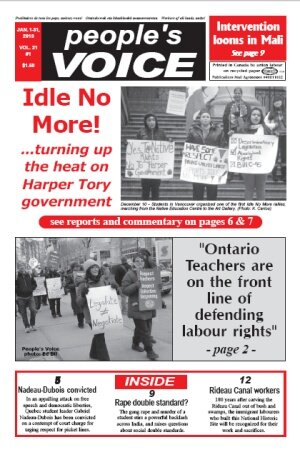
January 1-31, 2013
Volume 21 – Number 1
$1

Prolétaires de tous les pays, unissez-vous!
Otatoskewak ota kitaskinahk mamawestotan!
Workers of all lands, unite

CONTENTS

1) SOLIDARITY WITH THE "IDLE NO MORE" MOVEMENT

2) COMMUNIST PARTY ISSUES CALL FOR 37TH CENTRAL CONVENTION

3) ONTARIO GOVERNMENT MUST RESIGN: LET ELECTORS KILL BILL 115

4) THE ATTACK ON TEACHERS IS AN ATTACK ON ALL WORKING PEOPLE

5) OVERTURN THE CONVICTION OF GABRIEL NADEAU-DUBOIS

6) CANADA: PRISON HOUSE OF NATIONS - Editorial

7) LEAVING A MESS IN AFGHANISTAN - Editorial

8) LEGAL GROUPS RESPOND TO OPPAL REPORT

9) PITTING TAXPAYERS AGAINST PENSIONERS

10) WHAT IS THE IDLE NO MORE MOVEMENT ... REALLY?

11) RIDEAU CANAL WORKERS FINALLY WIN RECOGNITION

12) US, EU PREPARE FOR INTERVENTION IN MALI

13) GANG RAPE STORY SHOULD STIR CLASS AND CASTE DEBATE IN INDIA

14) MUSIC NOTES, by Wally Brooker

15) EIGHT CHARGED IN VICTOR JARA MURDER

PRINTER FRIENDLY ARTICLES

PEOPLE'S VOICE JANUARY 1-31, 2013 (pdf)
People’s Voice 2013 Calendar
”Ideas of Revolution”


People's Voice deadlines:

February 1-15
Thursday, January 17

February 16-28
Thursday, January 31

Send submissions to PV Editorial Office,
706 Clark Drive, Vancouver, V5L 3J1, pvoice@telus.net

You can call the editorial office at 604-255-2041


REDS ON THE WEB
http://www.parti-communiste.ca/
peoplesvoice.ca
www.ycl-ljc.ca
www.solidnet.org


People's Voice finds many "Global Class Struggle" reports at the "Labour Start" website, http://www.labourstart.org/. We urge our readers to check it out!


*  *  *  *  *
People's Voice

Canadian Publications Mail Sales Product Agreement #205214
ISSN number 1198-8657
People's Voice is published by
New Labour Press Ltd
  PV Editorial Office
706 Clark Drive,
VANCOUVER, B.C. V5L 3J1
Phone:604-255-2041
Fax:604-254-9803
email:  pvoice@telus.net

Editor: Kimball Cariou : Business Manager: Sam Hammond
Editorial Board: Kimball Cariou, Miguel Figueroa,
Doug Meggison, Naomi Rankin, Liz Rowley, Jim Sacouman

* * * * * *
Letters
People's Voice welcomes your letters
on any subject covered in our pages.
We reserve the right to edit for length and clarity,
and to refuse to print letters which may be libellous
or which contain unnecessary personal attacks.
Send your views to:
"Letters to the Editor",
706 Clark Dr., Vancouver, BC V5L 3J1,
or pvoice@telus.net
People's Voice articles may be reprinted without permission,
provided the source is credited.


* * * * * *

The Communist Party of Canada, formed in 1921,
has a proud history of fighting for jobs, equality, peace,
Canadian independence, and socialism.
The CPC does much more than run candidates in elections.
We think the fight against big business and its parties
is a year-round job,
so our members are active across the country,
to build our party and to help strengthen people's movements
on a wide range of issues.

All our policies and leadership
are set democratically by our members.
To find out more about Canada's party of Socialism,
give us a call at the nearest CPC office.

* * * * * *
Central Committee CPC
290A Danforth Ave Toronto, Ont. M4K 1N6
Ph: (416) 469-2446
fax: (416) 469-4063 E-mailmailto:info@cpc-pcp.ca

Parti Communiste du Quebec (section du
Parti communiste du Canada)
5359 Ave du Parc, Montréal, Québec,
H2V 4G9

B.C.Committee CPC
706 Clark Drive, Vancouver, V5L 3J1
Tel: (604) 254-9836
Fax: (604) 254-9803

Edmonton CPC
Box 68112, 70 Bonnie Doon P.O.
Edmonton, AB, T6C 4N6
Tel: (780) 465-7893
Fax: (780)463-0209

Calgary CPC
Unit #1 - 19 Radcliffe Close SE
Calgary  AB, T2A 6B2
Tel: (403) 248-6489

Ottawa CPC
Tel: (613) 232-7108

Manitoba Committee
387 Selkirk Ave., Winnipeg, R2W 2M3
Tel/fax: (204) 586-7824

Ontario Ctee. CPC
290A Danforth Ave., Toronto, M4K 1N6
Tel: (416) 469-2446

Hamilton Ctee. CPC
265 Melvin Ave., Apt. 815
Hamilton, ON.
Tel: (905) 548-9586

Atlantic Region CPC
Box 70 Grand Pré, NS, B0P 1M0
Tel/fax: (902) 542-7981

http://www.parti-communiste.ca/

* * * * * *

News for People, Not for Profits!
Every issue of People's Voice
gives you the latest
on the fightback from coast to coast.
Whether it's the struggle for jobs or peace, resistance to social cuts,
solidarity with Cuba, or workers' struggles around the world,
we've got the news the corporate media won't print.
And we do more than that
- we report and analyze events
from a revolutionary perspective,
helping to build the movements for justice and equality,
and eventually for a socialist Canada.

Read the paper that fights for working people
- on every page, in every issue!

People's Voice
$30 for 1 year
$50 for 2 years
Low-income special rate: $15 for 1-year
Outside Canada $50 for 1 year

Send to: People's Voice, 706 Clark Drive, Vancouver, BC, V5L 3J1
You can call the editorial office at 604-255-2041

REDS ON THE WEB
http://www.parti-communiste.ca/
http://www.ycl-ljc.ca/
http://www.solidnet.org/

(Contents)
(Home)


(The following articles are from the January 1-31, 2013, issue of People's Voice, Canada's leading communist newspaper. Articles can be reprinted free if the source is credited. Subscription rates in Canada: $30/year, or $15 low income rate; for U.S. readers - $45 US per year; other overseas readers - $45 US or $50 CDN per year. Send to People's Voice, c/o PV Business Manager, 706 Clark Drive, Vancouver, BC, V5L 3J1.)

1) SOLIDARITY WITH THE "IDLE NO MORE" MOVEMENT

Resolution adopted by the Central Committee, Communist Party of Canada, December 15‑16, 2012, Toronto

     On December 10, the United Nations International Human Rights Day, Aboriginal peoples took to the streets by the thousands, in cities and towns across Canada. The Central Committee of the Communist Party of Canada sends our deepest solidarity to the "Idle No More" movement which initiated this historic struggle against Bill C‑45 and the entire racist agenda of the Harper Tory government.

     The December actions, which reflect a significant surge in protests by Aboriginal peoples, have blown the lid off the arrogant colonial lie that Canada is a country of equality, fairness and social justice. In Canada today, Aboriginal peoples suffer high rates of poverty, unemployment and incarceration, and dramatically shorter life spans. In Attawapiskat and on other reserves, and even in urban centres, many live in terrible housing conditions. Over 100 First Nations communities lack clean drinking water. In Manitoba, over 2000 members of the Lake St. Martin First Nation remain homeless 18 months after their reserve was deliberately flooded to save Winnipeg and other communities from the massive floods of 2011. Despite centuries of broken treaties promising fair treatment, and decades of protests and reports, this situation has not improved. In the latest examples, Bill C‑45 is removing federal environmental protections for thousands of lakes, streams and rivers which are crucial for the well‑being of Aboriginal peoples in all parts of Canada, and the Tory government is trampling the land and water rights of First Nations which oppose the expansion of tar sands exports.

     Refusing to accept these genocidal policies, four Aboriginal women in Saskatchewan took the initiative this fall to begin the Idle No More campaign, using social media tools and teach‑ins to spread the word. Their courageous example helped inspire a number of chiefs to take their case directly to PM Stephen Harper, only to be barred from entering Parliament. Now this movement has taken root in communities in every part of the country.

     The Communist Party of Canada calls for the strengthening of solidarity by the labour and other democratic movements with the Idle No More movement and with the overall struggle for Aboriginal rights, including the hunger strike by Chief Theresa Spence of Attawapiskat and the fasting relay by other women.

     The manifesto of Idle No More truthfully places this struggle in the context of the national question within the Canadian state. As this statement says, "The Treaties are nation to nation agreements between Canada and First Nations, who are sovereign nations. The Treaties are agreements that cannot be altered or broken by one side of the two Nations. The spirit and intent of the Treaty agreements meant that First Nations peoples would share the land, but retain their inherent rights to lands and resources. Instead, First Nations have experienced a history of colonization which has resulted in outstanding land claims, lack of resources and unequal funding for services such as education and housing. Canada has become one of the wealthiest countries in the world by using the land and resources. Canadian mining, logging, oil and fishing companies are the most powerful in the world due to land and resources. Some of the poorest First Nations communities (such as Attawapiskat) have mines or other developments on their land but do not get a share of the profit. The taking of resources has left many lands and waters poisoned ‑ the animals and plants are dying in many areas in Canada. We cannot live without the land and water. We have laws older than this colonial government about how to live with the land. Currently, this government is trying to pass many laws so that reserve lands can also be bought and sold by big companies to get profit from resources. They are promising to share this time...Why would these promises be different from past promises? We will be left with nothing but poisoned water, land and air. This is an attempt to take away sovereignty and the inherent right to land and resources from First Nations peoples. There are many examples of other countries moving towards sustainability, and we must demand sustainable development as well. We believe in healthy, just, equitable and sustainable communities and have a vision and plan of how to build them. Please join us in creating this vision."

     This profound manifesto challenges the destructive agenda of the Harper Tories, and presents an alternative which puts the interests of people and the environment ahead of corporate profiteering. The Communist Party of Canada welcomes this manifesto for the future of the peoples of this country. We pledge to strengthen and find new ways to build the alliance of the labour and democratic movements with Aboriginal peoples, whose aim is full justice and national rights for Aboriginal peoples in Canada, and the creation of a fairer, anti‑racist society for all.

Printer-friendly article

(Contents)

(Home)


2) COMMUNIST PARTY ISSUES CALL FOR 37TH CENTRAL CONVENTION

     Meeting shortly before the holiday season, the Central Committee of the Communist Party of Canada issued a call for the party's 37th Central Convention, to take place April 5-7 in Toronto. Founded in 1921, the CPC currently holds central conventions every three years; between conventions, the Central Committee functions as the party's highest body.

     Over the next three months, party clubs and committees will hold intensive discussions on the main political resolution for the 37th Convention, and make nominations for the incoming leadership positions. Delegates to the convention will be elected over several weekends in March, at meetings held in several provinces. Those meetings will also consider proposed amendments to the draft political resolution, a process which will be finalized in Toronto.

     The CC's Dec. 15-16 gathering spent much of its time analysing the main trends in the global crisis of the capitalist economies, the dangerous tendency towards new imperialist wars, and growth of fascist movements which are part of the ruling class strategy to smash working class resistance against neoliberal policies. As the CC members noted in the discussions, that resistance has taken several notable forms in Canada, especially the Occupy movement which began in the fall of 2011, last year's massive and successful Quebec student strike, and most recently the Idle No More upsurge sparked by Indigenous grassroots organizers.

     The draft political resolution puts these militant actions in the context of the wider political fightback against the corporate agenda in Canada. The resolution argues that the main shortcoming of this fightback in recent years has been the reluctance by the top leadership of the Canadian Labour Congress to take the initiative to build a broad, united popular resistance struggle, in contrast to many countries where trade unions have held huge general strikes and protests.

     The most important way to help overcome this weakness, the resolution says, is to strengthen the Communist Party, which has historically played a key role in helping to move the labour movement towards militant strategies.

     The draft political resolution and other documents for the CPC's 37th Central Convention will be posted on the party's website, www.communist-party.ca.

Printer-friendly article

(Contents)

(Home)


3) ONTARIO GOVERNMENT MUST RESIGN: LET ELECTORS KILL BILL 115

Statement from the Communist Party (Ontario), Jan. 7, 2013

     The Communist Party (Ontario) has called on the government to resign following Education Minister Laurel Broten's action this week. The Education Minister has unilaterally and illegally suspended free collective bargaining between elected Public School Boards and teachers and educational workers' unions across the province. She has imposed wages and conditions of work modeled on the Ontario English Catholic Teachers' Association (OECTA) deal ‑ a deal that is currently being appealed in the courts by OECTA locals whose members were not allowed to vote on the deals agreed to by OECTA officials.

     CPC (Ontario) leader Elizabeth Rowley said: "With Parliament suspended by the Premier, the Minister and government have no right to take such sweeping, arbitrary and anti‑democratic action affecting fundamental rights and freedoms of workers in this province, affecting the rights of public school supporters and elected School Boards to local autonomy and democracy, and severely and negatively impacting over one million public school students, their parents and families.

     "The Premier must reverse Broten's actions, call an election, and let the people decide.

     "The government has misread public opinion on Bill 115 from the start. The by‑election defeat in Kitchener Waterloo was proof that the government was way off in right field with this Bill. The public does not support cuts to public education, attacks on labour and democratic rights, and cuts to wages and working conditions.

     "By adopting the austerity agenda of the 1% and driving it into the 99%, the Liberals hope to regain the support of Big Business which has shifted to the Tories.  The Liberals' only hope is to shift away from the right, by repealing Bill 115, by restoring free collective bargaining, and by adequately funding public education, healthcare, cities, social programs, and public services in Ontario. 

     "The Communist Party will join thousands of protestors at the Liberal Party Convention January 26th to demand exactly this agenda, and the doubling of the corporate income tax rate and restoration of the capital tax as the best and fairest way to pay for it.

     "Further, we reiterate our long‑held demand ‑ now supported by a majority of Ontario electors ‑ for the phasing out of Catholic school funding, and for the establishment of a single, secular, and quality public school system, open to all regardless of religion, gender, sexual orientation, or nationality."

Printer-friendly article

(Contents)

(Home)


4) THE ATTACK ON TEACHERS IS AN ATTACK ON ALL WORKING PEOPLE

People's Voice Ontario Bureau

     If the basis of all real wealth - the real economy, past, present and future - is the application of human labour‑power to material from the natural environment, why has the most draconian use of state power been summoned up as a weapon against the Ontario Teachers Unions? Most people would argue that teachers do not produce wealth. In fact, in the anti‑teacher propaganda blasted by the capitalist media and whispered in a thousand dark corridors, this slander against an honoured profession is perpetrated: why should people who are essentially a drain on the public purse be compensated so generously?

     What is it about this area of collective bargaining that would cause the ruling elite to instruct their political lackeys to suspend parliament, to violate constitutional law and go to direct one party rule?

     The capitalist state has undemocratically dispensed with parliament in Ontario, to launch an unhindered attack on the teachers' unions and their ability to exercise collective bargaining. The instrument of direct class intervention is the Ontario Liberal Party, with the Tories trying to be even more hawkish, and the NDP sitting on their hands.

     Now the silk gloves have been shed for the naked fist, dispelling any illusion that these three parties protect parliamentary democracy. If the NDP had called for massive public resistance, they could have done a service to all working people, especially if the trade union leaders who belong to the NDP had organized labour unity across the board with the Teachers.

     Any Marxist will see immediately the relationship of teachers to the real economy. Their vital role to the ability of capitalism to create and expropriate surplus value is the reproduction of labour-power, the primary human ingredient in the creation of wealth. The scientific and technological revolution demands an ever higher level of education and training for working people. This is about productivity and the rate of exploitation. This is about the uncountable wealth of the one percent.

     No educated person (the product of teachers) would vulgarize the value of the teaching profession as only an instrument to maintain and expand the parasite role of the one percent. But we live in a class society. The historic service of teachers against the mental pauperization of capitalism, their resistance to the increasing demand to produce literate industrial and social drones, instead of people armed with a sense of themselves and a demand for a better future, is a direct threat to the one percent.

     It is also no accident that generations of women have dominated and transformed the profession. Witness the power of their efforts embodied in the courage and unity of the Quebec student's strike. Witness the threat to the capitalist state when student activists are a major part in the defeat of a governing political party. You cannot separate teachers from students, from the awareness of the Occupy movement, from the mental hunger and sense of wrongness and violation that is surging through our youth and through the indigenous people.

     The viciousness of the attempted destruction of collective bargaining in Ontario can only be understood clearly with a world view of the antagonism between the capitalist class in the advanced stages of imperialist decline, and the possessors of labour‑power, the global working class. Teachers worldwide develop a consciousness that makes their students much more than units of labour power, an awareness of self that will become an awareness of class, an awareness that labour power is also the essential ingredient in building the shared wealth of a non‑exploiting socialist alternative.

     The crisis of capitalism will continue to destroy whatever stands in the way of its drive to buy more life for an obsolete and historically unnecessary system, at war with its own productive forces. In the crosshairs everywhere are those who teach our children and youth, those who preserve and pass on knowledge. The capitalists cannot dispense with teachers, but they seek to break their relative independence and their dedication to humanity. They want to turn teachers into trainers who prepare our young for more efficient and profitable exploitation. This struggle is about much more than sick days, wages or classroom size. These issues might be the field of battle, but the stakes are much higher.

     The Ontario Teachers are on the front line of defending labour rights. They will decide on the extent of their resistance, on their tactics, where to attack and where to retreat. The Communist Party calls for one hundred percent support, now and in the future.

Printer-friendly article

(Contents)

(Home)


5) OVERTURN THE CONVICTION OF GABRIEL NADEAU-DUBOIS

     The Central Committee of the Communist Party of Canada strongly condemns the conviction and sentencing of student leader Gabriel Nadeau‑Dubois, on a charge of contempt of court, by Quebec superior court Justice Denis Jacques.

     Nadeau‑Dubois is the former co‑spokesperson of the Coalition large de l'Association pour une solidarité syndicale étudiante or CLASSE ‑ the main student union coalition behind the 2012 Quebec student strike called to defend the right to accessible education.

     During this magnificent and historic struggle that saw over 300,000 students walk out of their classes and equally large street mobilizations, the Quebec government attempted to break the resistance by denying students their long‑established right to autonomously and democratically organize through general assemblies, strike votes and picket lines. Instead, the previous Charest Liberal government encouraged and directly facilitated anti‑democratic injunctions by the minority of students who opposed the strike, campus‑by‑campus.

     The charge of contempt of court arose in this context. On May 13, 2012, Gabriel Nadeau‑Dubois stated in a Radio Canada interview "I think that it is completely legitimate for students to undertake the means necessary to respect the democratic choice to strike ... It's completely regrettable that a minority of students are using the courts to go around decisions that were made collectively. If students need to form picket lines to ensure that their strike votes are respected, we think that's completely legitimate."

     Therefore he has been convicted for expressing a political opinion. Justice Denis Jacques has been exposed as a donor to the former Charest Liberal government. It is not a coincidence that he explicitly based his decision on another anti‑democratic ruling that attacked the rights of working people and organized labour: the 1972 court case which tried to smash the ten‑day general strike by the Front commun of Quebec trade unions through injunctions and imprisoning union presidents.

     The Communist Party of Canada strongly decries the conviction of Nadeau‑Dubois and sees it as a serious attack on freedom of speech, civil liberties as well as democratic, labour and student rights. The conviction continues the repressive and anti‑democratic policies of the previous Charest Liberal government, which sought to criminalize the right to free speech and assembly. It should also be seen as part of the serious and escalating attack on the right to protest across the country.

     The decision has also drawn attention to the hundreds of students still facing charges from the Quebec student strike last fall. The fact that Nadeau‑Dubois quickly received an outpouring of donations to launch a January appeal is an indication of the strong support of the Quebec people behind his case. We call for the conviction to be overturned and that the Quebec judiciary drop all charges against the student strikers. We also reaffirm our support to freeze, reduce and eliminate all tuition fees, replace student loans with living‑stipend grants, and for a system of free, quality, public, not‑for‑profit and accessible education from cradle to grave.

Printer-friendly article

(Contents)

(Home)


6) CANADA: PRISON HOUSE OF NATIONS

People's Voice Editorial

     The Idle No More movement has done all working people an enormous favour, by mobilizing popular anger against the pro-corporate Harper Tories. The slumbering leadership of the Canadian Labour Congress could certainly learn how to resist the neoliberal offensive, just by following the examples of Idle No More, the Quebec students, the Occupy movement, and opponents of the tar sands pipelines.

     These struggles have all drawn attention to crucial issues of economic inequality, social justice, and environmental devastation. But Idle No More has gone further, tearing down the curtain hiding an ugly sight: the festering issue of national inequality within the Canadian state.

     For generations, the ruling class has painted Canada as a happily unified country where everyone gets a fair shake, including immigrants and Aboriginal peoples. From time to time, an Oka crisis or a sovereignty referendum in Quebec temporarily dispels this Potemkin village scenario, then it's back to business as usual.

     Not today. When Stephen Harper meets with Assembly of First Nations leaders on Jan. 11 (under intense pressure from Idle No More and the courageous Chief Theresa Spencer) he will try to buy some time with empty promises of more funding. But that simply won't cut it any longer. The brilliant achievement of the grassroots Idle No More has been to make it absolutely clear that Canada was built on the theft of Aboriginal lands and resources, and that only genuine equality of all the nations in this country, large and small, can begin to overcome this genocidal policy.

     No nation can liberate itself while holding another in chains. Canada is literally a prison house of nations, and the prison doors must be smashed. A unified People's Coalition against the Harper Tories is needed to accomplish this goal, and the moment to build such unity has arrived, thanks to Idle No More.

Printer-friendly article

(Contents)

(Home)


7) LEAVING A MESS IN AFGHANISTAN

People's Voice Editorial

      For years, Canadians have been bombarded with propaganda about the humanitarian accomplishments of our military mission in Afghanistan. But somehow, we don't expect Christy Blatchford to join the troops for a follow-up report on the mess Canada leaves behind. That tougher job has been left to journalists who understand that their job is to report news, not to lick Stephen Harper's expensive footwear.

     As the New Year begins, we recall one genuine expose of the grim realities, as reported recently by the Toronto Star's Paul Watson. Writing from Baqi Tanah just across the Pakistan border, Watson reminds readers that Canada hoped to win the hearts and minds of local villagers by building a new school just two years ago. Village elder Haji Abdul Raziq named the school after himself and took credit for the project. Now the school is falling apart because Canada did not provide enough money for maintenance: "the concrete walls are cracked and crumbling around the flimsy wooden door frames... There isn't a stick of furniture in any of the classrooms, and a single, metal‑framed blackboard sits propped against the front wall, the rough concrete floor covered in a layer of dirt that blows in through cracked windows."

     As Watson writes, Afghanistan was Canada's largest recipient of development aid until Ottawa sharply cut back funding last year. Not only schools and clinics are affected. He points to the Dahla Dam and irrigation system, which still doesn't supply enough water to desert farms crucial to Kandahar's economy. These and other "signature projects" were built to score media points, not to provide long-term benefits to Afghanistan's impoverished rural areas.

     Over the past decade, taxpayers have wasted over $20 billion to wage war in Afghanistan, and nearly $2 billion on such "aid" scams. Shameful? That doesn't begin to describe the nauseating truth about Canada's murderous role in the Afghan debacle.

Printer-friendly article

(Contents)

(Home)


8) LEGAL GROUPS RESPOND TO OPPAL REPORT

PV Vancouver Bureau

     Almost a year after it was originally expected to go to the Attorney General, the final 1500-page report of the Missing Women Commission of Inquiry, "Forsaken", was released on Dec. 17, 2012.

     Three progressive legal organizations - the BC Civil Liberties Association, Pivot Legal Society, and West Coast LEAF (Legal and Education Fund) - had warned that the inquiry was built on a series of profound mistakes, including the appointment of a commissioner, Wally Oppal, who had stated he saw no need for an inquiry. They noted the lack of community consultation on the terms of reference, and the failure to fund groups granted participant status at the inquiry. These errors, they warned, undermined the ability of the Inquiry to bring forward voices that have been silenced, rebuild relationships, and promote trust and healing. However, they also hoped that the evidence of the families, independent legal council for the Vancouver Downtown Eastside, and the police themselves would lead to useful recommendations for change.

     "Forsaken" includes 63 recommendations on equality, community engagement, collaboration and accountability. Commissioner Oppal also urged the BC government to commit to two immediate measures: funding for existing centres that provide emergency services to women engaged in the sex trade, to enable them to remain open 24 hours per day; and an enhanced public transit system to provide a safer travel option connecting communities along Highway 16 where many women have been killed or gone missing. The province has already allocated $750,000 the first measure, far less than it spent on lawyers for the commission.

     As the three groups noted, since this Inquiry focused on the internal workings of the police and criminal justice system, "the vast majority of the recommendations are focused on technical questions related to information sharing and other bureaucratic protocols of the criminal justice system. In spite of this... buried in the report are a number of important recommendations that could make our justice system significantly more responsive to the needs and realities of vulnerable women, as well as accountable to marginalized communities and to the public as a whole."

     These include equality‑promoting measures which have "the potential to address the biases within the criminal justice system (which sadly were replicated in the Inquiry process), whereby those women most vulnerable to violence are not considered credible as witnesses as a result of those precise vulnerabilities."

     For example, Oppal urges steps to counter the bias of police, lawyers and judges against people who are affected by drug and alcohol use, and against women in the survival sex trade. His report calls for changes to better allow vulnerable witnesses, including those who have been sexually assaulted or suffer from addictions, to take part in court processes. Another important recommendation urges that the RCMP should be included in the provincial police complaints process.

     But the groups say that these and other equality‑promoting measures are recommended by the Commission, it is unclear how these changes will be implemented and enforced.

     Some of Oppal's recommendations go in a negative direction, such as steps to promote "informal" methods of police discipline, particularly in marginalized communities. As the groups point out, "stressing alternative discipline when there has still not been a single police officer who has ever been disciplined for failing to investigate the missing and murdered women in this province is an insult to all involved."

     In this context, it is shocking that Oppal's only finding of misconduct was levied against Cameron Ward, "the lawyer given the herculean task of representing all of the families in the face of dozens of police and government lawyers."

     Perhaps most significant, as the legal community and other progressive movements have stressed, the Oppal Inquiry had no mandate to address the systemic racism behind the wave of murders and disappearances of Aboriginal women in British Columbia.

     How different would the situation have been if unemployment among Aboriginal people wasn't in the fifty percent range, or if society provided a guaranteed livable income and decent low-cost housing for all? Such policies could have allowed many of the murdered women a much wider range of options to survive, and some hope for their futures.

     Instead, Oppal's exclusive focus was on the criminal justice system. It may be that his report will encourage police forces to take quicker action when Aboriginal women are attacked or go missing. From this perspective, perhaps the most significant outcome of this Inquiry is the determination by Aboriginal peoples and their allies that violence against women must be challenged in a more direct way than in the past.

     As seen by the massive Aboriginal opposition to the Enbridge pipeline project, and the upsurge around the Idle No More movement, the struggle against systemic racism and colonialism in Canada is on the rise. This will inevitably include much sharper scrutiny of racist actions by police forces, and that represents real progress.

Printer-friendly article

(Contents)

(Home)


9) PITTING TAXPAYERS AGAINST PENSIONERS

By Jean Kenyon

     In cities across Ontario an alarm is being raised in the weekly local papers. The cost of municipal employee pensions is growing out of control, we are told. The demographic time bomb is ticking, as more and more retirees live to a ripe old age. Taxpayers can't afford a defined‑benefit pension plan any more! Cities will be bankrupted! The sky is falling!

     In December a Waterloo city councillor decided to put these ideas to a balanced discussion. She organized a public forum with speakers from CUPE, the right‑wing group Fair Pensions for All, and OMERS ‑ the Ontario Municipal Employees Retirement System.

     The right‑wingers had their say first. A local man known for heading up a taxpayers' committee said defined‑benefit plans are "flawed" and are leading to problems "everywhere in the world".

     Then Bill Tufts of Fair Pensions for All really started working the crowd. The OMERS plan has a $10 billion deficit and it's being dumped on the municipalities! People are getting 70% of their salary, when they only paid in 15%! And some of them even live to be 100! At this, a retired teacher shouted from the back of the room, "What are you going to do, shoot them?"

     Finally Mike Robinson from OMERS had a chance to explain how the plan is managed. OMERS has assets of $55 billion, and current pension obligations are paid 70% from return on investments and 30% from current contributions by employees and employers. Two boards keep an eye on actuarial trends, and adjust contributions and benefits to keep the system stable. Taxpayers aren't on the hook for anything except making the day‑to‑day contributions to the plan, the same as any employer should do.

     Fred Hahn, president of CUPE Ontario, which represents most municipal employees, explained that good pensions are a boon to the whole community. Far greater than the risk of paying taxes to contribute to city staff pension plans, would be the risk of letting our seniors retire into poverty. Who would pay for affordable housing for them, and home care and long‑term care?

     CUPE calls for the Canada Pension Plan to be strengthened for all workers, so that separate pension plans like OMERS would no longer be necessary. Even Canada's finance minister Jim Flaherty ‑ no friend of public pensions ‑ said that the CPP is actuarially sound. So why doesn't he simply double it, as the Canadian Labour Congress calls for?

     The problem is that employers don't want to pay payroll taxes, including CPP contributions. So they set up private pension plans ‑ if they set up any at all ‑ and then under‑fund them. We all witnessed the heartbreak of Nortel retirees, including those with disabilities, being shoved to the back of the line when the bankrupt company's assets were divided by the courts.

     But when public pension plans build up surpluses, the funds get siphoned off by governments. In December the Supreme Court of Canada ruled that surplus funds, which the Mulroney and Chretien governments took from public service pension funds to pay down the national debt, do not have to be returned to the public service unions.

     In Ontario, Hahn explained, the Harris Tories in 1998 downloaded a lot of costs to municipalities, then "compensated" the cities by declaring a 5‑year contribution holiday to the OMERS plan. It was simply robbery from OMERS to make the provincial books look good, he said.

     So if the plans make too much money, the government Is allowed to dip into them. And if their earnings fall, as in 2008‑9, the ideologues howl that they're unsustainable and a burden to taxpayers.

     The rhetoric against public service pensions is only going to be stepped up, as PC leader Tim Hudak continues rolling out his months‑long campaign for an Ontario election he hopes to trigger in the spring. We must not be fooled by the right wing's attempt to dismantle one of the biggest assets that workers in Canada have ‑ namely stable pension plans like OMERS.

     It's important for now to defend public service pension plans, even as we dream of the day when workers' pensions will no longer have to be sustained through investments in the stock market.

Printer-friendly article

(Contents)

(Home)


10) WHAT IS THE IDLE NO MORE MOVEMENT ... REALLY?

Excerpts from a commentary by Pamela Palmater, one of the organizers and spokespersons of the Idle No More movement, in response to questions posed by Al Jazeera, CBC, Rabble.ca, CTV, and the Ottawa Citizen. For the full text and related links, see Palmater's blog at www.indigenousnationhood.blogspot.ca.

     I have been honoured by the request of the Idle No More Founders to be one of their organizers and spokespersons. Working within this movement was a natural extension of the work we already do in First Nations with leaders and citizens. In the last few weeks, many of the media's questions related to how the movement started, what do we want and where it might be headed. I have done my best as one of the spokespeople to answer these questions based on the views shared with me by some of those in the movement.

     The Idle No More movement is part of a larger Indigenous movement that has been in the making for several years now. Indigenous activists all over the country have been monitoring the political and legal scene in Canada at both the federal and provincial levels and making a concerted effort to help inform First Nation community members and leaders about any potential threats. We noted a clear assimilation agenda that emerged within the Conservative government and we started planning on how we could address that if Prime Minister Harper insisted on putting his plan into action.

     We of course worked very hard to try all the usual channels to address our growing concerns, which included lobbying, letter-writing, testifying before Senate and Parliament, endless meetings with MPs, Senators, Ministers and others ‑ all to no avail. The Harper government was not interested in talking to us, let alone consulting or getting our consent. Harper decided instead to use the Assembly of First Nations as his primary vehicle to call all the shots. Harper's government set the agenda, they drafted the joint action plans and they alone decided what was and was not on the table. In other words, Harper managed to bully his assimilation plan onto the First Nation agenda with hardly a squeak of opposition at the political level.

     At the co‑called Crown‑First Nation Gathering (CFNG) last January 2012, Harper promised First Nations his government would not unilaterally amend or repeal the Indian Act. After the CFNG, he broke that promise and proceeded with an aggressive legislative agenda that will include upwards of 14 bills that will devastate our First Nations in various ways. It is the White Paper 2012 with a twist ‑ instead of it being a policy, like the 1969 White Paper, which wanted to assimilate Indians, Harper's plan will be law. This is the spark that ignited the Idle No More movement into action.

     We always knew action would be required at some point, but the legislation posed an imminent threat and required immediate mobilization. That is how a movement was born. In the early days, some were calling the Idle No More movement, some calling it an Indigenous rights movement, but we all agreed that we needed to immediately oppose Harper's assimilatory legislative agenda. So many of the early activities included teach‑ins which helped explain the legislation's potential impacts on First Nations and more importantly, what we could do to oppose it. Early protests started out as opposing the massive omnibus Bill C‑45, but later came to include the whole suite.

     The Idle No More movement, initially started by women, is a peoples' movement that empowers Indigenous peoples to stand up for their Nations, lands, treaties and sovereignty. This movement is unique because it is purposefully distanced from political and corporate influence. There is no elected leader, no paid Executive Director, and no bureaucracy or hierarchy which determines what any person or First Nation can and can't do. There are no colonial-based lines imposed on who joins the movement and thus issues around on & off‑reserve, status and non‑status, treaty and non‑treaty, man or woman, elder or youth, chief or citizen does not come into play. This movement is inclusive of all our peoples.

     To my mind, the true governing power of our Indigenous Nations has always been exercised through the voice of our peoples. The leaders were traditionally more like spokespeople which represented to views and decisions of the people. In this way, the Idle No More movement, led by grassroots peoples connects very closely to our Indigenous traditional values. But it is not a movement where the people stand alone, their elders, elected leaders and traditional leaders stand with them. This movement is not in competition with any First Nation political organization or elected leaders. This movement is focused on the critical issues before us, not power‑struggles, political games or competing for government funding. Everyone so far has donated their time, money, energy and skills to making this work despite the inevitable critiques, push‑back and misinformation.

     Yet, what makes this peoples' movement so unique, is also what makes it so difficult for many Canadians and the media to understand. Generally speaking, people understand that each government, group or organization has a leader, a clearly defined hierarchy and rules about who can say and do what. This movement on the other hand, is very organic in nature and first and foremost respects the sovereignty of individual Indigenous peoples and their Nations to participate how and when they choose, if at all. This will mean that some First Nations leaders will choose not to participate, but some of their members will. It could mean one First Nation community organizes teach‑ins whereas First Nations peoples living in urban areas will get together and organize flash mob round dances.

     Think of the many ways in which this movement has already developed. We had teach‑ins at Louis Bull, Saddle Lake and other First Nations. We have posted information, publications and videos online for all to access. We have engaged the media to help educate the public about why this impacts them as well. The Chiefs organized a protest during the AFN assembly to oppose the legislation (including Bill C‑45). Chief Spence is on a hunger strike standing up for all First Nations and the treaty relationship which Canada has forgotten. Kids in schools have held Idle No More Rallies and there have been marches, protests and temporary traffic and railways slow downs. The core unifying theme to all of it has been that they are peaceful activities meant to help educate Canadians about how this is in all our interests.

     We do have structure, we are organized, we work very closely with one another across the country to strategize and we are growing. We have worked with active First Nation leaders on the ground since the very beginning and many of us continue to do so. Our allies increase every day as more and more organizations are joining the movement. Now we have widespread international support which also grows everyday. Pretty soon you will see more and more prominent figures stand up to put pressure on Canada to come to the table in a real, meaningful way.

     To me, Idle No More is a responsibility ‑ a responsibility to live up to the sacrifices of our ancestors, to the duty we have as guardians of the earth, and to the expectations that our children and grandchildren have of us to protect them. Every single one of us has that responsibility, though, at any given time, we all have different capacities, skills and opportunities in which to fulfill it. Regardless of our situation, I believe that we all carry that responsibility from the very moment the Creator blesses us with our first breath until our last.

     This responsibility means that it is not good enough to work hard, get an education, find a job, and provide for one's family. These are important things, and our ancestors did their best to ensure that we would have a prosperous future. Many even negotiated these provisions in some of our treaties. But, it is not good enough for us to simply be comfortable, at least not as long as we have brothers, sisters and community members who live without food, water or housing. Right now, many of our Indigenous peoples are facing multiple, overlapping crises that require emergency attention. The very grassroots people standing on the front lines of this movement are there because they are the ones without clean water, housing or sanitation and the politicians have done little to address this.

     This movement is set apart from any other before it. Unlike the Occupy movement, this movement involves peoples with a shared histories, experiences, goals and aspirations. We as Indigenous peoples are all related, we all care about each other's futures and we share the same responsibility to protect our rights, cultures and identities for our seventh generation. This movement also has a special spiritual significance in that this was prophesied ‑ that the seventh generation would rise and restore the strength of our Nations, bring balance and see that justice was restored to our peoples.

     This movement is also unique in that it includes Canadians as our allies. Just as the early days of contact when the settlers needed our help to survive the harsh winter months, and seek out a new life here, Canadians once again need our help. They need our help to stop Harper's destructive environmental agenda. First Nations represent Canadians last best hope at stopping Harper from unfettered mass destruction of our shared lands, waters, plants and animals in the name of resource development for export to foreign countries like China. Why? Because only First Nations have constitutionally protected Aboriginal and treaty rights which mandate Canada to obtain the consent of First Nations prior to acting. These rights are also protected at the international level with the United Nations Declaration on the Rights of Indigenous Peoples.

     When First Nations organize in Idle No More to oppose this legislation, they do so to protect all of our interests ‑ First Nation and Canadian alike. The most precious resources in the near future will be farmable lands and drinkable water. If there is no clean water, this impacts everyone. We are standing up not only to protect our lands and waters, but we are also standing up to restore justice for First Nations and democracy for Canadians. We can work together to defeat this threat to Canada and find a way to share the lands and resources as the treaties envisioned.

     When asked what do we want, that question can be answered in two parts:

(1) In the short term, Canada must withdraw the suite of legislation impacting First Nations, amend those omnibus bills which threaten our lands and waters, and restore the funding that was cut to our First Nation advocacy organizations and communities;

(2) In the long term, Canada must set up a Nation to Nation process whereby First Nations and Canada can address many of the long outstanding issues related to the implementation of treaties and sharing the lands and resources.

     Ultimately, we want to be free ‑ free to govern ourselves as we choose; free to enjoy our identities, cultures, languages and traditions ‑ i.e., to live the good life as we see fit. This means Canada must respect our sovereignty and get out of the business of managing our lives. Given that Canada has worked hard to put us in the situation we are in, Harper will have to come to table with some good faith and offer some solutions to address the current crisis facing many of our communities in relation to the basic essentials of life ‑ water, sanitation, housing, and education. If Harper can do no more than appear at a meeting on January 24th as requested by the AFN, our most vulnerable citizens will not see justice.

     What Idle No More means to me is the coming together of Indigenous peoples from all over Turtle Island to work together to restore pride in our peoples, to stand up for our rights and live up to those responsibilities we have to one another and Mother Earth.

     It is inspiring hope, when many had lost hope that anyone would ever stand on their behalf.

     It has inspired pride in who we are as Indigenous peoples because our peoples and the ways of our peoples are beautiful and something to be cherished and defended.

     It has inspired leadership in those who thought they had nothing left to offer their Nations.

     It has inspired a reconnection of youth to elders, citizens to leaders and men to stand beside their women.

     It has inspired the most oppressed peoples to stand up and exercise their voices.

     We are alive again and the spirits of our ancestors are walking with us on this journey.

     I believe in the power of our peoples ‑ we can do this!

Printer-friendly article

(Contents)

(Home)


11) RIDEAU CANAL WORKERS FINALLY WIN RECOGNITION

Based on an article by David Butler from the Ottawa Citizen

     Six years after they were nominated, the workers who built the Rideau Canal will finally be recognized as historically significant. The thousands of labourers - mostly Irish immigrants and French‑Canadians - who carved the 202‑kilometre waterway through a wilderness of bush, swamps and lakes will be formally recognized by the government of Canada for their contribution. The labourers worked in extremely difficult and dangerous conditions, and hundreds paid for it with their lives.

     The existing designation of the 180‑year‑old canal as a national historic site will be expanded to commemorate the workers. Larger‑than‑usual plaques and interpretive panels will be erected at the Ottawa locks and Jones Falls to tell their story.

     "The workers are integral to the story of the Rideau Canal, which is why I decided that the original designation should be expanded to honour their contributions," said a news release from Environment Minister Peter Kent.

     The Rideau Canal, declared a UNESCO world heritage site in 2007, was first designated a national historic site in 1925. However, the contributions of the canal workers were not formally recognized in the original designation.

     It is estimated that between 5,000 and 6,000 labourers were involved each year during the main construction period from 1827 to 1831. The Rideau Canal, which extends from Ottawa to Kingston, opened in 1832 and was one of the largest construction projects in 19th century British North America.

     The labourers worked exclusively with tools such as axes, picks and shovels for 12 to 16 hours a day and six days a week in summer, clearing brush, excavating lock pits and channels, quarrying stone, erecting wooden weirs and bridges and building rubble embankments and masonry locks and dams.

     They had to deal with the ever‑present threat of disease, especially malaria, then called "ague" or swamp fever. Due to illnesses and accidents as many as 1,000 are believed to have died, though no reliable statistics were kept.

     Many of the workers settled in Eastern Ontario, where up to 100,000 descendants still live, but winning recognition for them was an uphill struggle.

     In 2010, the Historic Sites and Monuments Board rejected an application from the Celtic Cross Commemorative Group, saying the canal labourers weren't of national historic significance because their work "represented a typical and common form of labour at the time, and that it was not unusual, nor was it remarkable."

     But after a Citizen story on the rejection triggered a torrent of criticism, the board - which is supported by Parks Canada - reversed its position and recommended that Kent bestow recognition on the workers. When no announcement was forthcoming, the group's Kevin Dooley went public with his concern that recognition of the workers had "gone off the radar."

Printer-friendly article

(Contents)

(Home)


12) US, EU PREPARE FOR INTERVENTION IN MALI

By T.J. Petrowski, Winnipeg

     A consequence of the western imperialist powers' intervention in Libya in 2011, under the guise of the Responsibility to Protect doctrine (R2P), which cost the lives of thousands of civilians, was the destabilization of the west African state of Mali.

     The US and EU, especially France, the former colonial power, are seeking to militarily intervene in the ongoing conflict. On Dec. 20, the United Nations Security Council adopted Resolution 2085, authorizing deployment of an African‑led International Support Mission (AFISMA) in northern Mali. The Harper government is hinting that Canada may take part in such an intervention.

     The Republic of Mali, like much of Africa, has a long history of European colonialism and western-backed military coups, which have left the people in extreme poverty and despair.

     Following the defeat of Gaddafi, thousands of his Tuareg fighters returned to northern Mali heavily armed and with a deep sense of frustration over their living conditions.

     An estimated 1.2 million Tuareg people inhabit the Saharan interior of Africa, living as nomadic pastoralists in Mali, Algeria, Niger, Libya, and Burkina Faso. Since the European powers first colonized the region, causing wide‑scale displacement and suffering, the Tuareg have struggled for better living conditions and the right to self‑determination. They have continued this struggle against the Western‑backed leaders of their now independent nations.

     In January 2012, with the experience and resources acquired in Libya, they began the National Movement for the Liberation of Azawad (MNLA), an armed insurgency against the Malian government. (Azawad is the territory in northern Mali consisting of the federal regions of Gao, Kidal, Tombouctou, and Mopti.) With them was an influx of radical Islamists who cooperated with NATO to oust Gaddafi, many of them from Sudan, Yemen, Algeria, Egypt, and other Muslim nations.

     On March 21, 2012, US‑trained Captain Amadou Sanogo, who maintains close ties with US intelligence, ousted President Amadou Toumani Touré. The circumstances leading to the coup d'etat included social discontent by the mass of peasants and students. Mali was experiencing a food crisis, a consequence of the sellout of arable land to foreign capitalists. After the coup, emergency law was enforced, with the constitution suspended and a curfew imposed on the people.

     Soon after the interim government of Dioncounda Traoré was installed, the MNLA unilaterally declared their secession from Mali as the state of Azawad. Although its members are predominately Tuareg, MNLA leaders have said their movement represents all Saharan peoples, seeking independent, secular representation for those neglected by the federal government in Bamako.

     Now the US and EU are using the "war on terror" ruse to justify a military intervention in support of the interim government. The official pretext is the seizure of Azawad by the Islamist organizations Al‑Qaeda in the Islamic Maghreb (AQIM) and Ansar Dine. The Islamists taking control of northern Mali from the MNLA ‑ an area the size of France ‑ can be directly linked back to the imperialist intervention in Libya. Under Gaddafi, Libya invested heavily in sub‑Saharan nations, which made him incredibly popular throughout the continent. He also mediated the conflict between the Tuaregs and the Malian government, and opposed radical Islamist groups such as AQIM. With Gaddafi gone, Islamists from the Middle East are converging to fight for their vision of Sharia law in all of Mali, not strictly Azawad.

     Of course, the real aim of imperialism is to further exploit the extensive natural resources in Mali, including gold, uranium, cotton, and suspected oil reserves. France's nuclear industry is especially dependent on uranium from West Africa, and the French ruling class wishes to recolonize its former colonies, having recently intervened in the Ivory Coast. The US, France, Germany, other European states, and China are all competing for these resources, in yet another "Scramble for Africa."

     Direct investment from China in particular has increased 300‑fold in Mali over the last decade. Along with South Africa, Zambia, and Egypt, Mali has some of China's largest direct investments in Africa. The US seeks to reduce China's influence in the region, to reestablish its hegemony, just as the intervention in Libya was in part to deny China access to North African oil.      Oblivious to the mass starvation and malnourishment that plagues Malian civilians, a foreign intervention would undoubtedly result in a new quagmire for the imperialists, similar to the situation in Afghanistan, and could further destabilize the region. The people of Mali have the right to determine their own socio‑political structure without foreign intervention.

Printer-friendly article

(Contents)

(Home)


13) GANG RAPE STORY SHOULD STIR CLASS AND CASTE DEBATE IN INDIA

By Gurpreet Singh

     The outrage caused by the recent gang rape of a 23‑year‑old student in Delhi should also stir a class and caste debate within Indian society. The victim was not only raped in a bus but also beaten by the assailants. She succumbed to her injuries at a Singapore hospital where she was shifted amidst violent protests that rocked the Indian capital.

     The anger was partially caused by the fact that Delhi has witnessed over 500 rapes since last year, earning it a reputation as a capital of rapes. While this outrage and subsequent activism are justified, poor and so-called "low caste" women continue to suffer sexual violence almost every day in rural and tribal India, outside the urban and fortified setting of Delhi and other big cities. It's very rare to see outrage over the rapes of such women in Indian society, which largely claims to be puritan and ethical in character. The stories of rapes involving poor women during recent weeks did not gain a matching attention.

     While Indians (particularly Hindus) revere goddesses, other religious groups like Sikhs claim themselves to be the protectors of the modesty of women.

     The sexual violence against women from the marginalized sections of society goes on in spite of the fact that India has been led by a female Prime Minister, the late Indira Gandhi, and its first woman President, Pratibha Patil. Several provinces have also been led by female politicians at different times.

     Following the Delhi incident, some prominent female politicians broke down in tears while debating in parliament. But this will not end the vulnerability of women, especially those who come from the weaker sections. Obviously, poor women in a class and caste based society become double victims when a sexual crime is committed against them. In many instances, political goons and security officials have committed sexual crimes against them with impunity.

     The Delhi incident that captured international media attention has reopened an unwanted debate on capital punishment, with some suggesting the death sentence to rapists. However, this would encourage a rapist to murder the victim to destroy evidence. In fact, Indian society and the justice system need to provide moral support to the victims of sexual violence, instead of protecting the perpetrators.

     Often the victims of rape are harassed by the police and the courts, discouraging them to testify against the offender. A case in point is that of a 17‑year‑old Dalit rape victim in Punjab state who recently committed suicide after being harassed by the police. Apparently, the police were not taking action against the culprit. Instead the victim was accused of concocting a story of rape.

     Such is the plight of victims of sexual violence in an orthodox male-dominated Indian society. Instead of comforting the victims, the system tries to protect the perpetrators. The grievance of rape victims should be heard passionately by the police and the courts, instead of putting the onus to prove the crime on them.

     But what can one expect from an establishment whose lawmakers are either accused of such crimes or shamelessly make sexist remarks by blaming the victims? A Hindu right-wing BJP Party legislator recently went to the extent of suggesting a ban on skirts in schools to save girls from potential molesters, while a minister belonging to the Congress party cautioned women not to take public transport at night. Instead of shedding tears, the least women politicians can do is to make such male chauvinist politicians accountable, and try to bring the rapists enjoying state patronage to book.

Printer-friendly article

(Contents)

(Home)


14) MUSIC NOTES, by Wally Brooker

Music fest flees Mali conflict

Mali's "Festival in the Desert" will take place in exile because of political instability and violence in the north African country. Organizers have announced that the annual music festival (www.festival‑au‑desert.org), originally scheduled for Timbuktu Feb. 20‑22, will become a "caravan of artists united for peace, tolerance and human dignity." Caravans will visit Mauritania, Algeria and Niger before converging on Burkina Faso for the three‑day celebration, to feature renowned Malian musicians Toumani Diabaté and Samba Touré. Resolution of the longstanding aspirations of the Tuareg people for autonomy within Mali has been complicated by the US‑NATO war against the Gaddafi regime in Libya, which opened the north of Mali to Islamist extremists and provoked a military coup in the south.

Canadian musicians vs. bullying

A group of musicians calling themselves Artists Against Bullying have recorded a charity version of Cyndi Lauper's 1986 hit "True Colors." Released in November to coincide with Bullying Awareness Week, the song reached #1 on Canadian singles charts with proceeds going to Kids Help Phone (www.kidshelpphone.ca). Artists Against Bullying includes Pierre Bouvier (Simple Plan) and Jacob Hoggard (Hedley), Kardinal Offishall, Fefe Dobson, Lights, Alyssa Reid and Walk Off the Earth. Meanwhile 16‑year‑old Ottawa student Meagan Landry has produced an excellent homemade video of her original anti‑bullying song "Stronger." Both "True Colors" and "Stronger" can be found on YouTube. They come in the aftermath of the suicide of Amanda Todd, the 15‑year‑old Port Coquitlam student who took her life in October after posting a heart‑wrenching video online of her struggle with bullying.

Stan Rogers re‑mastered

Toronto folk label Borealis has been diligently re‑mastering the catalogue of the great Stan Rogers. The fourth and latest album in the series is Northwest Passage, perhaps his most iconic work. The project is overseen by long‑time Rogers producer Paul Mills and the late singer's wife Ariel. Stan Rogers was a brilliant artist who painted the landscape of English‑speaking Canada and populated it with vivid and sympathetic portraits of working people. His 1983 death in a fire aboard an Air Canada flight came when he was only 33. But his legacy is rich. It's a good bet that Rogers' songs will continue to inspire for years to come. Word is that the sound quality of this series is exceptional. For info: http://borealisrecords.com/.

K'Naan on artistic self‑censorship

Canadian hip‑hop star K'Naan engaged in a little self‑criticism last month with a New York Times op‑ed entitled "Censoring Myself for Success." K'Naan was referring to his latest album Country, God, or the Girl, an effort that betrays a drift towards mainstream pop. He describes being called by his record label for "a little talk" before recording the album, and being warned to avoid "subjects too far from fun and self‑absorption." K'Naan suggests that he censored himself. "I may never find my old walk again," he writes, "but I hope someday to see beauty in the graceless limp back towards it." Keinan Abdi Warsame was born in Somalia in 1978. His family fled the war‑torn country when he was a child and eventually settled in Toronto. 

"Meanwhile in Afghanistan"

Radical singer‑songwriter David Rovics has just released Meanwhile in Afghanistan, an album he calls "a folk‑punk manifesto in twelve parts." It's a departure from his earlier mostly acoustic recordings. In this outing, thanks to a successful fundraising campaign, Rovics expands his sound with keyboards, bass, drums, backup vocals, and guitars (including a cameo appearance by rock star Tom Morello). Meanwhile in Afghanistan is by turns indignant, denunciatory, poignant, and playful. Listeners who only think of Rovics as a writer of protest songs might be pleasantly surprised by contemporary love songs like "Adelaide" and "Syrian Princess", and humorous tracks like "Watch Out for the Cops" and "If Only It Were True." For info: http://davidrovics.com.

Ravi Shankar: 1920‑2012

Sitar virtuoso Ravi Shankar died on December 11th. Shankar was celebrated for his encounters with extraordinary western musicians like violinist Yehudi Menuhin and Beatles guitarist George Harrison, but before achieving international fame he had already been music director of All‑India Radio and composed film music for Satyajit Ray's classic Apu Trilogy. While his role as organizer (with Harrison) of the 1971 Concert for Bangladesh is well‑known, his other political interventions have been ignored in the obituaries. In the 1940s Shankar was active in the radical Indian People's Theatre Association, a left‑wing cultural group that promoted independence from Britain, solidarity with the USSR and relief for victims of famine. In 1992 he attended an "Artists Against Communalism" concert in Mumbai, and issued a strong statement against that sectarian political trend. Both of India's major communist parties have issued condolences. For info: www.ravishankar.org.

Printer-friendly article

(Contents)

(Home)


15) EIGHT CHARGED IN VICTOR JARA MURDER

     On December 27, Chilean Judge Miguel Vasquez charged two officers, Pedro Barrientos and Hugo Sanchez, in the 1973 murder of Chilean communist folk singer Victor Jara; six others have been charged as accomplices in the murder.

     Four of the eight accused took courses at the School of the Americas, the U.S. military base which trained thousands of officers for pro-Yankee regimes across Latin America.

     The four SOA graduates include Pedro Barrientos, the second-in‑command of the National Stadium which was turned into a open‑air prison following the U.S‑sponsored coup led by General Augusto Pinochet; Raul Jofré took the same Officers' Orientation course as Barrientos in 1968; Edwin Dimter Bianchi took a Combat Arms Orientation course in 1970; and Jorge Smith Gumucio took a Combat Arms Orientation course in 1972. An international arrest order has been issued for Pedro Barrientos, who now lives in Florida, and was in charge of the squad which killed Jara.

     The Pinochet dictatorship launched its coup d'etat on Sept. 11, 1973, with the bombing of the presidential palace, detentions and killings of thousands of opponents, and the death of elected president Salvador Allende. Jara was detained in Santiago on the day of the coup, taken to a concentration camp in the stadium, subjected to brutal torture, and had his fingers and wrists broken by soldiers. He was then murdered by machine gun fire, and his body left on the street to be discovered by passersby. But Jara's powerful music lives on; many of his songs can be found on YouTube.

Printer-friendly article

(Contents)

(Home)