|
|
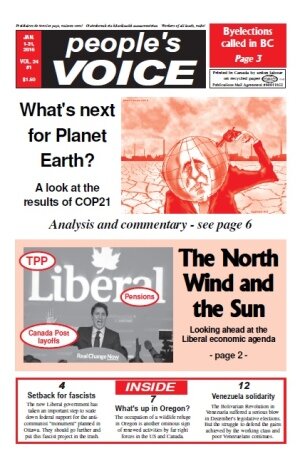
People’s Voice January 1-31, 2016
Volume 24 – Number 1 $1
1) TIME TO SCRAP ANTI-COMMUNIST MONUMENT IN OTTAWA
2) B.C. BY-ELECTIONS A REFERENDUM ON LIBERAL CORPORATE AGENDA
3) BETWEEN THE SUN AND THE NORTH WIND
4) CANADA’S SHAMEFUL HOUSING FAILURE - Editorial
5) COP21: HALF FULL OR HALF EMPTY? - Editorial
6) AN INITIAL ANALYSIS OF THE COP21 CLIMATE AGREEMENT
7) CLIMATE CHANGE: WHAT KIND OF WORLD AT THE CLOSE OF THIS CENTURY?
8) THE STORY BEHIND THE MILITIAS AT MALHEUR REFUGE
9) ONE YEAR SINCE CUBA-U.S. DIPLOMATIC RELATIONS RE-ESTABLISHED
10) VENEZUELA: THE STRUGGLE CONTINUES
11) MUSIC NOTES, by Wally Brooker
12) COMMUNIST PARTY OF UKRAINE BANNED
PEOPLE'S VOICE JANUARY 1-31, 2016 (pdf)
|
To order a copy send $15 (includes package and handling) to People’s Voice, 706 Clark Drive, Vancouver, BC, V5L 3J1. Contact us at 604-255-2041 or pvoice@telus.net for bulk order prices. |

|
People's Voice deadlines: February 1-14 February 15-29 Send submissions to PV Editorial Office,
|
|
|
REDS ON THE WEB
http://www.communist-party.ca
peoplesvoice.ca
www.ycl-ljc.ca
www.solidnet.org
|
People's Voice finds many "Global Class Struggle" reports at the "Labour Start" website, http://www.labourstart.org/. We urge our readers to check it out! |
* * * * * *
Central Committee CPC
290A Danforth Ave Toronto, Ont. M4K 1N6
Ph: (416) 469-2446
fax: (416) 469-4063 E-mailmailto:info@cpc-pcp.ca
Parti Communiste du Quebec (section du
Parti communiste du Canada)
5359 Ave du Parc, Montréal, Québec,
H2V 4G9
B.C.Committee CPC
706 Clark Drive, Vancouver, V5L 3J1
Tel: (604) 254-9836
Fax: (604) 254-9803
Edmonton CPC
Box 68112, 70 Bonnie Doon P.O.
Edmonton, AB, T6C 4N6
Tel: (780) 465-7893
Fax: (780)463-0209
Calgary CPC
Unit #1 - 19 Radcliffe Close SE
Calgary AB, T2A 6B2
Tel: (403) 248-6489
Ottawa CPC
Tel: (613) 232-7108
Manitoba Committee
387 Selkirk Ave., Winnipeg, R2W 2M3
Tel/fax: (204) 586-7824
Ontario Ctee. CPC
290A Danforth Ave., Toronto, M4K 1N6
Tel: (416) 469-2446
Hamilton Ctee. CPC
265 Melvin Ave., Apt. 815
Hamilton, ON.
Tel: (905) 548-9586
Atlantic Region CPC
Box 70 Grand Pré, NS, B0P 1M0
Tel/fax: (902) 542-7981
* * * * * *
News for People, Not for Profits!
Every issue of People's Voice
gives you the latest
on the fightback from coast to coast.
Whether it's the struggle for jobs or peace, resistance to social cuts,
solidarity with Cuba, or workers' struggles around the world,
we've got the news the corporate media won't print.
And we do more than that
- we report and analyze events
from a revolutionary perspective,
helping to build the movements for justice and equality,
and eventually for a socialist Canada.
Read the paper that fights for working people
- on every page, in every issue!
People's Voice
$30 for 1 year
$50 for 2 years
Low-income special rate: $15 for 1-year
Outside Canada $50 for 1 year
Send to: People's Voice, 706 Clark Drive, Vancouver, BC, V5L 3J1
You can call the editorial office at 604-255-2041
<pvoice@telus.net>
REDS ON THE WEB
www.communist-party.ca
peoplesvoice.ca
www.ycl-ljc.ca/
http://solidnet.org/
http://www,rebelyouth-magazine.blogspot.com
(The following articles are from the January 1-31, 2016, issue of People's Voice, Canada's leading socialist newspaper. Articles can be reprinted free if the source is credited. Subscription rates in Canada: $30/year, or $15 low income rate; for U.S. readers - $45 US per year; other overseas readers - $45 US or $50 CDN per year. Send to People's Voice, c/o PV Business Manager, 706 Clark Drive, Vancouver, BC, V5L 3J1.)
1) TIME TO SCRAP ANTI-COMMUNIST MONUMENT IN OTTAWA
The following letter from Communist Party leader Miguel Figueroa was sent on December 18 to the new Minister of Canadian Heritage Mélanie Joly:
Dear Minister,
On behalf of the Central Committee of the Communist Party of Canada, I am writing to convey our view with regard to the proposed “Memorial to the Victims of Communism” to be located in the National Capital Region, and to strongly urge your Ministry to deny final approval and withdraw government financial support for this controversial project.
We note your announcement yesterday to refer the proposal back to the National Capital Commission (NCC) for further consideration. In our view however, the current project is far too politically tainted to serve any socially useful purpose in a balanced and historically accurate manner. For this reason, we feel that this particular project should be rejected on principle.
Our Party was among the very first to express its vehement opposition to this highly partisan project when the proposal first went before the National Capital Commission (NCC) for consideration in 2009. In a letter to Russell Mills, Chair of the Board of Directors, National Capital Commission on October 1, 2009, we noted that the proposed monument would besmirch and slander the history of our Party in Canada, and “constitute an unjust attack on the pride Canadian Communists feel for our pioneering contributions to Canada since 1921, such as fighting against fascism, organizing industrial workers into unions, initiating the movements to win Unemployment Insurance, public healthcare and other social programs, campaigning for peace and disarmament, fighting for the full national rights of Aboriginal peoples and Quebec, and in defending Canada’s sovereignty.”
In that letter, we added:
“This proposal smacks of the type of vicious anti-communism which plagued our country (among others) during much of the latter half of the last century. [T]hat sordid period of our history was marked by crude, unsubstantiated and unjust slanders and attacks on progressive-minded Canadians, and resulted in a wave of mass hysteria and witch-hunts, social ostracism, and great hardships, including imprisonment, for many of its victims. Most importantly, it had a ferocious ‘chilling effect’ on public discourse and sharply curtailed the freedom of expression and associated democratic rights of all Canadians. McCarthyism was ultimately relegated to the dustbin of history, and that is where it should remain.”
As you are well aware, this “memorial” was not only welcomed by the previous government; it was aggressively championed by former PM Stephen Harper and senior members of his Cabinet for blatantly partisan and self-serving reasons. And when private fundraising for the project fell far short, the former Government offered substantial monetary assistance from the public treasury to finance its construction.
The justification for this “memorial” has been based on highly questionable historical claims. The authors of the proposal have stated for instance that the monument would “honour the 100 million lives lost under Communist regimes”. This is a monstrous lie, as demonstrated in numerous objective historical studies. The 20 million Soviet citizens who perished during World War II, for example, died at the hands of the Nazi invasion, and in defending their national sovereignty, not at the hands of ‘Communist regimes’. This is a crude attempt to turn history on its head.
But the political implications of this proposal go far beyond its tainted history; it would have international consequences as well, and be widely perceived as a retrograde step contributing to attempts elsewhere to whip up a renewed atmosphere of anti-communism. In Europe, for instance, anti-democratic attacks have been launched by governments against Communist parties and affiliated organizations in several countries, including the Czech Republic, Hungary, Latvia, Ukraine, Estonia, Greece and elsewhere, without any legal or justifiable basis. The true underlying goal of this campaign is intended to intimidate and isolate progressive parties and movements, and to limit the free expression of ideas.
We would further note that the name for this monument also defames the many accomplishments of communist parties which have formed governments, in countries such as the People’s Republic of China, Cuba, and Vietnam, or taken part in governments, including South Africa, India, Venezuela, Brazil, Chile, etc.
We therefore urge you to withdraw all federal support from this controversial project, and prevent this manifestation of anti-communism from becoming a permanent, shameful blot on the capital city, and on Canada as a whole.
2) B.C. BY-ELECTIONS A REFERENDUM ON LIBERAL CORPORATE AGENDA
The Communist Party of BC is urging voters in Vancouver-Mount Pleasant and Coquitlam-Burke Mountain to reject Premier Christy Clark’s Liberals in by-elections to be held on Feb. 2. The premier delayed calling these votes for nearly six months, reflecting her political history of contempt for the people of British Columbia and for the right to effective representation in the Legislature.
“These by-elections will be an important occasion for working class and poor people to reject the right-wing, pro-corporate agenda of the BC Liberals,” says George Gidora, leader of the Communist Party of BC.
While the CPBC has decided not to nominate candidates in these by-elections, it will be on the ballot in Vancouver-Mount Pleasant and several other ridings in the provincial general election set for May 2017. The party has spoken out strongly against the anti-people policies of the BC Liberals ever since Gordon Campbell became premier in 2001. Communist candidates have been on the ballot in every election, and the CPBC has taken part in fightback struggles by trade unions, anti-poverty groups, environmentalists, First Nations, public education supporters and many other progressive movements over the past fifteen years.
During the Feb. 2 by-elections, the CPBC will distribute materials raising a number of key demands for progressive change in British Columbia:
- An immediate 50 percent increase in social assistance and disability rates, which were below poverty levels during the NDP of the 1990s and have been frozen for many years under the Liberals.
- Emergency action to build tens of thousands of low-income and social housing units, to help reduce the skyrocketing housing costs faced by residents of Metro Vancouver and other regions of the province.
- Increase the minimum wage immediately to the $15/hour demanded by the labour movement, and to $20/hour within two years.
- Expand transit services for the Lower Mainland including a massive increase in the bus fleet.
- Roll back and eliminate tuition fees for post-secondary students.
- Reverse the cuts to provincial funding for public schools and the health care system, and block the growing privatization of public services.
- Reverse the huge tax cuts for corporations and top income earners, which have cost the provincial treasury over $2 billion annually since 2001.
- Launch a comprehensive plan to shift from reliance on export of resources, towards an economy based on job creation through environmentally sustainable processing of raw materials.
- Full recognition of inherent indigenous rights, including measures to help implement all 94 recommendations of the Truth and Reconciliation Commission and to end the legacy of centuries of violence against indigenous peoples.
The NDP candidate in the Vancouver-Mount Pleasant by-election is Melanie Mark, a former president of the Urban Native Youth Association, who hopes to become B.C.'s first female indigenous MLA. For several years, Mark worked in the office of BC’s representative for children and youth, Mary Ellen Turpel-Lafond, who has been scathing in her criticisms of the government’s abysmal failure to protect the interests of young people. Mark has a stronger record as a social activist than Green candidate Pete Fry. The Liberal candidate is Gavin Dew, a communications consultant who has worked for the deeply unpopular Trans Mountain pipeline expansion proposed by Texas-based energy giant Kinder Morgan. For these reasons, the Mount Pleasant campaign will be a referendum on the right-wing policies of the Campbell and Clark governments, and the CPBC is urging a vote for Melanie Mark.
Coquitlam-Burke Mountain was formerly represented by B.C. Liberal Doug Horne, who was defeated last October as a federal Conservative candidate. Running for the NDP in this by-election is Jodie Wickens, the executive director of the Autism Support Network, but the candidate with the strongest record of progressive social activism is musician Joe Keithley for the Greens.
“The Communist Party of BC will use these by-elections to speak about the real issues facing our province, and to urge the defeat of the Liberals,” says George Gidora. “The demands we raise will be the focus of our May 2017 provincial election platform to call for people’s needs, not corporate greed.”
Gidora stresses that “the only sure way to drive the Liberals out of office next year is to build a powerful mass fightback around these and other progressive demands, uniting the labour movement, indigenous peoples, environmentalists, students, seniors, poor people, and everyone suffering from the impact of the capitalist economic crisis and the Liberal attacks on social programs and education. If the NDP runs yet another campaign based on accepting so-called `balanced budgets’ and other neoliberal policies, the Liberals will likely win a fifth consecutive majority. That would be a disaster for the working class of British Columbia.”
3) BETWEEN THE SUN AND THE NORTH WIND
By Johan Boyden, Montreal
As People’s Voice readers and progressive-minded folks across Canada head into the New Year, we are looking at a different political landscape.
Last week, a friend of the Communist Party here in Montreal sent me a cartoon they had drawn with their interpretation of the change. It showed Steven Harper holding a Guy Fawkes-style mask – bearing the face of new Liberal Prime Minister, Justin Trudeau.
A catchy image. But is it entirely correct? To be sure, the “new boss” is “same as the old boss” in terms of class agenda. But people’s forces should take heart in the defeat of Harper. The Liberals very carefully and consciously crafted their campaign in response to the public sentiment generated from nearly a decade of popular struggles, which should not be short-changed.
To back up this claim, consider this anecdote from the Canadian Club. (No, not the whiskey: the elite Toronto organization that holds “opinion-shaping luncheon discussions.”) Trudeau spoke here in May, and was quick to acknowledge that he was addressing a crowd that included millionaires and billionaires.
“I know people in your position get asked for a lot, and, as evidenced by the thriving and generous philanthropic culture in Canada, you step up,” he said, pitching his tax hike on the rich. “Your contributions to Canadian society have been appreciated. I'm asking for one more.”
Never mind how perverse is the framework of taxes as charity. Trudeau was talking about the need to shift away from Harper’s austerity agenda and instead adopt infrastructure spending to combat the capitalist economic crisis and “secular stagnation.”
This economic theory deserves a whole other article, but what is interesting is Trudeau’s sales pitch: “If we don't deliver fairness, Canadians will eventually entertain more radical options. All the time I spent with Canadians tells me that the status quo is not sustainable. Change is coming, my friends. What we need is leadership and to plan to shape that change responsibly for the benefit of us all. Either we choose to act now or we will be forced to react later.”
Since the election, Trudeau’s “responsible change,” or “real change,” has been re-branded by the media as “sunny ways.” The phrase is not original. Justin Trudeau borrowed it from Sir Wilfred Laurier, aka the Liberal Prime Minister on the five dollar bill, who liked to recount the story of The Wind and the Sun as a political parable. Found in the folklore of both ancient Greece and India, it is a fable worth recounting.
The North Wind and the Sun are competing to see who is stronger. The challenge? Make a passing traveller remove his cloak. The North Wind blew and blew. But the traveller only wrapped his cloak tighter to keep warm. Then the Sun shone. The traveller, overcome with heat, soon took his cloak off.
In Laurier’s time, the fable meant that persuasion was better than force. So, for Trudeau, are we up against the sun, or the north wind?
A lot has been said about the Liberals’ nation-to-nation approach to Indigenous peoples, and their policies on climate change and refugees. All these questions are important for the working people, and whatever has been achieved should be attributed to mass campaigning. Less attention has been given to other class issues. Considered these notes:
In November, Trudeau surprised many by becoming the first Canadian Prime Minister since Diefenbaker to meet with the Canadian Labour Congress. He received a standing ovation, promising to repeal Harper’s most vicious anti-labour laws.
A few weeks later, Chrystia Freeland, Minister of International Trade, and MaryAnn Mihychuk, Minister of Employment, Workforce Development and Labour, met again with a select group of CLC-affiliated labour leaders about the Trans-Pacific Partnership trade deal.
It is worth noting that Freeland’s ministerial mandate letter calls for such consultation, and to “Implement and expand Canada’s Free Trade Agreements globally.” Mihychuk’s mandate letter also states, among other things, that she is to “Amend the Canada Labour Code to allow workers to formally request flexible work arrangements from their employers.”
In December, Judy Foote, Minister of Public Services and Procurement, quietly announced that the Liberals will not restore all home mail delivery. Foot’s mandate letter simply calls to “Undertake a review of Canada Post.” While phase-out of home delivery is currently suspended, 300,000 more addresses were converted into “superboxes” hours before the announcement.
Finally, a day before Christmas Eve, the government announced it will take no action on enhancing the below-poverty Canada Pension Plan (CPP) and instead consider options in the upcoming year, including to “do nothing.”
Making sense of this new political landscape is an important challenge. No doubt it will be at the heart of the discussion at the end of January, when the Communist Party of Canada’s Central Committee launches preparations for the 38th Central Convention.
After all, the creative application of Marxism-Leninism to today’s conditions and the elaboration of the way forward is probably the Party’s most powerful qualitative contribution to our class in its struggle for socialism.
Johan Boyden is the Central Organizer of the Communist Party of Canada.
4) CANADA’S SHAMEFUL HOUSING FAILURE
People’s Voice Editorial
Can a wealthy country such as Canada find ways to tackle the massive problems of homelessness and unaffordable housing? On any given night, over 35,000 people in Canada are homeless, and one in five household spend half of their income on rent. As long as federal and provincial governments refuse to address this crisis, no serious progress is likely. Instead, municipalities are left holding the bag, usually responding with feeble bylaw changes or “incentives” to urge developers to include a handful of “affordable” units and some public amenities as part of huge new condo projects in major cities.
So it’s remarkable to read that China completed 7.72 million units of affordable housing in urban areas in 2015, according to official data reported by the Xinhua news agency. China’s Ministry of Housing and Urban-Rural Development adds that last year, 6 million dilapidated urban homes were renovated, with a goal of rebuilding 18 million such homes between 2015 and 2017. The country invested $237 billion U.S. last year in its affordable housing program, aimed at low-income families that have been priced out of the property market.
This is not to ignore the serious social and economic contradictions which affect China in its current period, including a growing “wealth gap”. But these numbers represent a sharp contrast to Canada, even considering that China has 40 times the population of and five times the GDP of our country. Comparable numbers here would mean spending $6 billion annually, to build 200,000 new units of affordable housing and renovate another 150,000 urban housing units every year. The Universal Declaration of Human Rights signed by Canada includes the right to adequate housing among its provisions. The new federal government should be pressed to establish a national housing program to help achieve this goal.
5) COP21: HALF FULL OR HALF EMPTY?
People’s Voice Editorial
In the wake of last month’s COP21 climate conference in Paris, two schools of thought have emerged. Some argue that by setting targets, establishing a $100 billion “mitigation” fund to help developing countries adapt, and requiring greater transparency in reporting emissions, the Paris agreement may open the door for an escalating push to prevent a disastrous increase in global warming.
But critics warn that the agreement is not legally binding on the 195 countries which signed up. Why? Mainly because President Obama’s administration insisted on this condition, since the Republican-dominated U.S. Congress, loaded with climate change deniers, would not approve a binding treaty. That makes compliance voluntary, hostage to the whims of anti-science, far-right legislators in Washington.
And even if all countries meet their emissions reduction pledges, most scientists warn that temperatures will rise 3 to 4 degrees, spreading homelessness, disease, poverty and death for hundreds of millions of poor people in large areas of Africa and Asia. Rapidly rising temperatures could generate feedback loops with impacts much worse than previously feared, and the mitigation fund is far too small to handle such consequences.
The Paris agreement focusses on proposals to reduce consumption and demand, while doing little to cut the deadly production of fossil fuels. That’s no surprise, because the profits of the giant energy monopolies are the number one priority of many of the world leaders who went to France for this crucial meeting.
It would be comforting to believe that the Paris deal set our planet on the path to a secure future. But global warming arises from the relentless profiteering of capitalism. The only good news is that more and more people are grasping the necessity to replace this destructive economic system with a socialist society based on protecting people and nature instead.
6) AN INITIAL ANALYSIS OF THE COP21 CLIMATE AGREEMENT
A new draft climate agreement was reached on Dec. 14, the last day of the COP21 talks in Paris. In this preliminary analysis, Council of Canadians political director Brent Patterson writes that “unfortunately, despite the framing of this agreement as ambitious and equitable, it falls well short of what is needed in terms of real commitments to emission reductions, keeping fossil fuels in the ground, adequate financing for mitigation, adaptation, and loss and damage, recognition of human rights, and protection from transnational corporate lawsuits.”
Patterson’s commentary on the rabble.ca website continues:
1. Emission reductions
We had demanded a legally binding commitment to keep the global temperature increase to 1.5 degrees Celsius. We believe that emission reduction targets and the overall temperature target should be legally-binding on all countries. The United States has opposed this and some commentators have stated there is no "global sheriff" to enforce this (apparently different than multilateral trade agreements which are legally-binding and enforceable). We have also stated that beyond a "target" there needs to be real commitment to meet that target. That would mean committing to a 100 per cent clean economy by 2050 and keeping about 80 per cent of fossil fuels in the ground.
The agreement:
- commits the world to limiting warming to "well below 2 degrees Celsius", and to "pursue efforts" to keep it below 1.5 degrees Celsius.
- requires countries to "communicate a nationally determined contribution every five years" starting in 2020.
- relies on the honour system for emission reduction targets (these "Intended Nationally Determined Targets" or INDTs are not legally-binding).
- requires countries to verify and report on their emissions.
- does not commit to a 100 per cent clean economy by 2050.
- does not commit to keeping 80 per cent of fossil fuels in the ground.
- does not address the problem that country emission reduction pledges submitted for the Paris talks would mean a 2.7 to 3.7 degree Celsius increase by 2100.
2. Mitigation and adaptation
We had demanded adequate funding for mitigation and adaptation. Mitigation means cutting or preventing greenhouse gas emissions (by supporting renewable energy, halting deforestation in developing countries) and adaptation means preparing for future climate change (by building better drainage systems to deal with higher seas and more severe storms, shifting to heartier crops that can withstand higher temperatures and lower rainfalls). Again, beyond the setting of an amount of funding, governments of developed countries have to commit to paying their fair share of the funds needed for this fund. To date, developed countries have failed to contribute their fair share.
The agreement:
- pledges countries to "mobilize" $100 billion a year to developing countries by 2020 to deal with the consequences of climate change.
- says this $100 billion a year is "a floor" and that a new commitment to funding will be set by 2025.
- fails to make the $100 billion pledge legally binding.
3. Loss and damage
We had demanded the inclusion of a "loss and damage" provision. Loss and damage means developed countries paying compensation to developing countries already suffering the impacts of climate change. While adaptation is about infrastructure and actions to adapt to the impacts of climate change, loss and damage is about recoverable damages (paying for damaged buildings, roads, power lines) and irreparable losses (loss of lives, species, land). The United States, Canada and other countries have rejected the "loss and damage" provision claiming it implies a legal liability for them to compensate for this damage.
The agreement:
- includes a loss and damage clause that will allow countries to claim for compensation for financial losses due to climate change.
- rules out legal liability for loss and damage.
4. Human rights
We had demanded the inclusion of Indigenous rights, migrant rights, the rights of women in the operative text. This would recognize that the rights of the peoples most directly impacted by climate change. Indigenous peoples are very often the front-line communities directly impacted by oil, gas and coal projects. Their right to free, prior and informed consent to stop this devastation is essential. The United Nations has stated that up to one billion people could be displaced through climate change by 2050. And yet refugees fleeing from environmental disasters do not have the same minimal rights as political refugees fleeing war and persecution. And women who often suffer the most from climate change, given their responsibility for children, growing food, securing drinking water for their families.
The agreement fails to fully recognize these human rights, and notes these rights in the non-legally-binding preamble of the text.
5. Investor-state rights
We had demanded that the agreement include a provision that would shield national climate actions form investor-state dispute settlement (ISDS) challenges through so-called "free trade" agreements. Corporations have used ISDS to challenge governments over 600 times, and in numerous cases these challenges are clearly related to health or environmental decisions by governments. While countries may be pledging to take action on climate change, they are also negotiating "free trade" agreements that give corporations the right to undermine climate actions (policies, regulations, legislation) that would impact their future profits.
The agreement fails to include this protection from ISDS challenges.
Our allies have condemned this agreement.
Wenonah Hauter from Food & Water Watch says, "This agreement coming out of the Paris COP falls far short of what is needed to actually address our climate crisis, It doesn't mention the words "oil," "gas" or "fossil fuels" at all - all of which we must swiftly transition away from to avert climate crisis." Nick Dearden from Global Justice Now says, "It's outrageous that the deal that's on the table is being spun as a success when it undermines the rights of the world's most vulnerable communities and has almost nothing binding to ensure a safe and liveable climate for future generations." And Asad Rehman from Friends of the Earth International says, "The draft Paris agreement puts us on track for a planet three degrees hotter than today. This would be a disaster. The reviews in this agreement are too weak and too late. The finance figures have no bearing on the scale of need. It's empty."
7) CLIMATE CHANGE: WHAT KIND OF WORLD AT THE CLOSE OF THIS CENTURY?
By Baldev Padam
The fast melting Arctic, the shrinking Himalayan glaciers and the onset of unexpected rains, floods, droughts, windstorms and tsunamis are some of the known indexes of climate change. But a more treacherous form of it has rather silently been spreading its tentacles, without getting much attention.
Climate change is warming 235 lakes the world over, with more than half of the earth's freshwater supplies, says, a recent study by Professor Sapna Sharma, an Indian-origin researcher from Toronto's York University. The study funded by NASA and others finds that the lakes are warming at an average of 0.34 degrees Celsius each decade, with profound effects on drinking water and the habitat of fish and other animals.
The pace of warming of lakes is greater than the warming of the ocean or the atmosphere, with life threatening consequences. When temperatures swing quickly and widely from the normal range, life in lake waters not only changes in form but could even disappear, said Prof. Sharma. Fish from freshwater sources is also an important source of protein, especially in the developing world. The results suggest that large changes in our lakes are not only unavoidable, but are happening already.
Nature, in the course of time, had framed laws to help evolution and sustenance of flora and fauna on our planet, which humanity observed more in violation than adherence, particularly after the industrial era began in Europe. The reckless burning of fossil fuels like coal, oil and natural gas to run industrial units spewed immense amounts of CO2 into the atmosphere. That thickened the greenhouse gasses layer, changing the climate. Global warming was exacerbated by cutting down forests to build big industrial, residential and commercial complexes. Extensive farming of livestock for dietary purposes has added fuel to the fire.
Climate change is a complex environmental problem which influences our very existence. At the heart of this problem lies the need to reduce emissions.
The recent UN Climate Change Conference held in Paris took serious note of the existential threat to life on earth posed by ever-increasing global warming, and a carbon emission deal was agreed. This was the first assembly of world leaders to consider ways and means to restrict the deadly march of human-made climate change.
Among many decisions taken, the most crucial was to keep global temperatures from rising another degree Celsius between now and 2100. This was the key demand of poor countries like Tuvalu and others ravaged by rising sea levels, who face extinction soon if oceans continue to rise at the present rate. Such a show of solidarity was not witnessed in conferences held earlier for this cause, say international media reports.
Since the developed countries account for the overwhelming amount of accumulated greenhouse gases in the atmosphere, they were mandated to provide monetary help to the developing and the least-developed nations to adapt to the impacts of climate change. The Paris meeting also bound them to transfer climate-friendly technologies to such countries.
Despite all the good things said and done in Paris, some loose ends remain. For example, the agreement won't bind member states until parties which produce over 55% of the world's greenhouse gas emissions have ratified the deal. There is doubt whether some, like the U.S. with its Republican-dominated Congress, will agree to do that. Achieving a reduction in emissions would involve a complete transformation of ways and means to get energy, and environment activists worry that despite the pledges, countries are not ready to make such profound, costly changes.
Months ago, during a chat with a witty gray-haired friend of mine over the unsure future of life on earth, he advised me not to get alarmed because nothing terrible would happen before we leave this world for eternity. But when I reminded him tongue-in-cheek of our chance to get reborn (reincarnation is the Indian majority's ironic belief), he smiled and changed the gear and route of our confab.
As a senior member of my household, I offer best wishes to my grandchildren, but I get a little bewildered to imagine how Canada and the world, because of climate change, might look like in the year 2090, when they too would be grandparents. In my life span, I have observed some disturbing changes in weather conditions. Summers are hotter and more prolonged than before, and according to climate experts, the average night temperature the world over is on the rise. Recently I read a funny report that by the turn of present century "old folks" (born in 2015) in Toronto would take their grandchildren north to experience something they have never seen: snow.
I'm not sure of that. but as I write this in Toronto on December 16, we find no snow on the roads. This isn't the rule here, but an exception. Back home, memories of floods in Kashmir in 2014 and Uttarakhand in 2013, and similar deluges in parts of Pakistan, are still fresh in my memory. But I don't recall that a place like Chennai (Madras) in India was ever inundated in flood waters as witnessed recently. Why was that happening?
Environmentalists hold that climate change arises from human industrial activity. Skeptics say that nature has changed earth's face many times, arguing that volcanic eruptions or changes in sun's intensity, along with other factors, could be the real climate drivers of climate change. The deniers, however, seem either to be self-styled intellectuals, US Republicans, friends of corporations, or spokespersons of the big oil and coal companies or automakers, whose business could collapse once eco-friendly sources of energy become viable and replace existing fuel-based vehicles.
Though the Paris declaration has projected that our survival depends on how effectively we resist global warming, governments must go in for some binding agreement even if this curtails industrial growth targets. The good intentions of restricted green house gas emissions and monetary assistance to the developing nations mentioned in the final draft need to be translated in action to prevent climate change becoming atrocious in future.
The next few years will indicate if this is followed by the developed world in both letter and spirit. The UN infrastructure to monitor emissions and regulate monetary aid is not yet in place, and environmental conditions continue to deteriorate unabated. But if the world wants to breathe free, self discipline must be imposed. Will this ever happen? That is the million dollar question today!
8) THE STORY BEHIND THE MILITIAS AT MALHEUR REFUGE
By Kimball Cariou
New Year 2016 started off with a range of important news developments, ranging from the global impact of stock market losses in China, to the escalating tensions between Iran and Saudi Arabia, and neoliberal political advances in Latin America.
Compared to these stories, the militia takeover of the Malheur National Wildlife Refuge seems less significant. But the news from Oregon is another worrisome indication that far right forces are on the offensive in many parts of the world, including North America.
The level of armed militia actions in the United States varies over the long run. After a sharp increase during the late 1980s and early ‘90s, this phenomenon dropped off for some years following the 1995 terror bombing of a federal building in Oklahoma City by neo-fascists. The mass murder of 168 people - including 15 kids at a day care and four other children - exposed the militias as vicious killers. But the relentless drumbeat of militarist propaganda in the U.S. over the past decade and a half has given wider political scope for neo-fascist gangs to operate. Despite the media focus on extremist “jihadis”, most violent terror attacks in the U.S. and Canada are committed by ultra-right groups.
This may be particularly true in the western U.S., which has a long and bloody history of colonial genocide to accomplish the theft of indigenous territories. One result has been the spread of white supremacist and “libertarian” ideologies to justify the activities of so-called militias, even to the point of armed insurrection against the U.S. state itself.
As others have noted, these ideologies tend to feed off the popular discontent arising from very real economic and social distress. Many rural areas of the western U.S. suffer from environmental problems and cyclical economic crises which result in high rates of poverty and the dispossession of homes, farms and ranches.
Writing on the People’s World website, Patrick J. Foote reviews the background to “a decades-long movement which began as the Sagebush Rebellion” in response to legislation of the mid-1970s, which placed under federal ownership lands which had previously been opened to homesteading as part of the theft of Native American lands. Ranchers were compelled to pay grazing fees on lands controlled by “Washington bureaucrats”. Developers and industrialists suddenly lost the unfettered “right” to mine or drill on vast areas.
The resulting “Sagebrush Rebellion” was backed by Ronald Reagan, who appointed James G. Watt as Secretary of the Interior to roll back the gains of the environmental movement. Watt blocked the transfer of private lands for conservation and multiplied the areas leased to coal mining companies. In 1983, Watt was compelled to resign after a series of racist statements, but the damage was done. Resource corporations fanned the flames of so-called “grassroots activism” demanding the turnover of all public land to private owners.
These “astroturfing” political tactics soon connected up with the "patriot militias," creating what Foote calls “the modern tip-of-the-spear” for fringe conservative movements like the Tea Party and racist hate groups. Such strategies resonated in Oregon, which was founded as a "white utopia"and became a hub of neo-Nazi groups.
These movements multiplied after the election of Barack Obama, the first black U.S. President. To attract working class support, such forces make populist appeals to pit manual labour against “intellectuals”, scapegoat minority groups, or attack "international bankers" using coded anti-Jewish language.
Some, like Nevada rancher Ammon Bundy, who helped instigate the militia occupation in Oregon, are openly racist. Bundy is on record claiming that African Americans "had it better" under slavery, for example.
Not surprisingly, however, these forces repel most Oregon residents. Even many who sympathize with the grievances raised by the Bundys want nothing to do with their violent threats and virulent racism.
Behind all these historical and political factors, the truth is that the Malheur National Wildlife Refuge was actually unceded indigenous territory, long before it was taken over by white ranchers and farmers starting around 1900.
The leaders of the Burns Paiute tribe, whose ancestors fought and died to defend this land, want the militias to get out of the Refuge. Speaking to U.S. media outlets, tribal leaders said in early January that they are still fighting over land use, but are also working with the Bureau of Land Management to save archaeological sites.
"We have good relations with the refuge. They protect our cultural rights there," said tribal council Chairwoman Charlotte Rodrique.
"They just need to get the hell out of here," tribal council member Jarvis Kennedy told a crowd of reporters and local residents. “To me they are just a bunch of bullies and little criminals coming in here and trying to push us around over here and occupy our aboriginal territories out there where our ancestors are buried.”
Members of the tribe are descendants of the Wadatika band of northern Paiutes, whose history in the area dates back 9,000 years. Their ancestors lived near the shores of lakes in the U.S. Northern Great Basin, but migrated when those lakes dried up.
The tribe has never ceded its right to the land. In 1868 they signed a treaty with the U.S. government, which promised to prosecute any crime or injury perpetrated by any white man upon the Paiutes. Just eleven years later, the Paiutes say their people were "loaded into wagons and ordered to walk under heavy guard" in knee-deep snow and forced off their land on foot.
"They literally walked our people, children and women off our lands. They had no problem killing us," Kennedy said.
Inside the Malheur Refuge headquarters now occupied by white militias from out of state, there are important official papers that document the tribe's history.
"It gets tiring. It's the same battles that my ancestors had. And now it's just a bunch of different cavalry wearing a bunch of different coats," Kennedy said.
There are now about 200 Burns Paiute tribe members, most of whom work hard at odd jobs to survive.
"It's tough out here. Not a lot of jobs. If any company wants to relocate we'd welcome it," according to Kennedy.
According to media reports, the tribal leaders agree with the tactics used by the federal, local and state law enforcement authorities, who are waiting out the militias. But they also believe that if they occupied the Refuge headquarters, the government’s response would be quite different.
"We'd be already shot up, blown up or in jail. Just being honest; they are used to killing us," Kennedy said. "They are white men. That is the difference. That is just how I see it."
9) ONE YEAR SINCE CUBA-U.S. DIPLOMATIC RELATIONS RE-ESTABLISHED
Statement by Cuban President Raúl Castro Ruz on the first anniversary of the December 2014 decision to re-establish diplomatic relations between Cuba and the United States
One year has gone by since the simultaneous announcements made on December 17, 2014, by the presidents of Cuba and the United States to re-establish diplomatic relations between both countries and work to improve our relations.
One year ago, as part of the agreements reached to find a solution to issues of interest for both countries, we were able to announce, to the great joy of all of our people, the return to our homeland of Gerardo, Ramón and Antonio, with which we made true the promise made by Fidel who had asserted that our Five Heroes would return.
On that same date, in accordance with our reiterated disposition to hold a respectful dialogue with the Government of the United States, on the basis of sovereign equality, to discuss a wide variety of issues in a reciprocal way, without any detriment to our people’s national independence and self-determination, we agreed to take mutual steps to improve the bilateral atmosphere and move on towards the normalization of relations between the two countries.
It could be said that, since then, we have achieved some results, particularly in the political, diplomatic and cooperation spheres:
• Diplomatic relations were re-established and the embassies in both countries were re-opened. These actions were preceded by the rectification of the unjust designation of Cuba as a State sponsor of terrorism.
• High level meetings and visits have taken place.
• The already existing cooperation in areas of mutual interest, such as aviation safety and security as well as the combat against drug-trafficking, illegal migration, alien smuggling and migration fraud has been expanded. The regular and respectful meetings between the military commands of Cuba and the United States in the perimeter of the U.S. Naval Base in Guantánamo have continued.
• New possibilities for bilateral cooperation have opened up in areas of mutual benefit, such as environmental protection, law enforcement, maritime and port security and health.
• New dialogues have been initiated on bilateral and multilateral topics of interest, such as climate change, mutual compensations, traffic in persons and human rights, this latter being the one on which we have profound differences and about which we are having an exchange on the basis of respect and reciprocity.
• We have signed agreements on environmental protection and the re-establishment of direct postal services.
All of this has been achieved through a professional and respectful dialogue based on equality and reciprocity.
Quite on the contrary, this year we have not made any progress in the solution of those issues which are essential for Cuba to be able to have normal relations with the United States.
Although President Obama has repeatedly stated his opposition to the economic, commercial and financial blockade and has urged Congress to lift it, this policy remains in force. The persecution of Cuba’s legitimate financial transactions as well as the extraterritorial impact of the blockade, which causes damages and hardships to our people and is the main obstacle to the development of the Cuban economy, have been tightened.
The steps taken so far by President Obama, although positive, have proved to be limited in scope, which has prevented their implementation. By using his executive prerogatives, the President could expand the scope of the steps that have already been taken and take new steps that would substantially modify the implementation of the blockade.
Despite Cuba’s repeated claim for the return of the territory illegally occupied by the Guantánamo Naval Base, the Government of the United States has stated that is has no intention to change the status of that enclave.
The U.S. Government is still implementing programs that are harmful to Cuba’s sovereignty, such as the projects aimed at bringing about changes in our political, economic and social order and the illegal radio and television broadcasts, for which they continue to allocate millions of dollars in funds.
A preferential migration policy continues to be applied to Cuban citizens, which is evidenced by the enforcement of the wet foot/dry foot policy, the Medical Professional Parole Program and the Cuban Adjustment Act, which encourage an illegal, unsafe, disorderly and irregular migration, foment human smuggling and other related crimes and create problems to other countries.
The Government of Cuba will continue to reiterate that, in order to normalize relations, it is imperative for the U.S. Government to derogate all these policies that date from the past, which affect the Cuban people and nation and are not in tune with the present bilateral context and the will expressed by both countries to re-establish diplomatic relations and develop respectful and cooperative relations between both peoples and governments.
No one should expect that, in order to normalize relations with the United States, Cuba will renounce the principles and ideals for which several generations of Cubans have struggled throughout more than half a century. The right of every State to choose the economic, political and social system it wishes, without any interference whatsoever, should be respected.
The Government of Cuba is fully willing to continue advancing in the construction of a kind of relation with the United States that is different from the one that has existed throughout its prior history, that is based on mutual respect for sovereignty and independence, that is beneficial to both countries and peoples and that is nurtured by the historical, cultural and family links that have existed between Cubans and Americans.
Cuba, in fully exercising its sovereignty and with the majority support of its people, will continue to be engaged in the process of transformations to update its economic and social model, in the interest of moving forward in the development of the country, improving the wellbeing of the people and consolidating the achievements attained by the Socialist Revolution.
10) VENEZUELA: THE STRUGGLE CONTINUES
By Robert Navan and Seán Edwards, Socialist Voice (newspaper of the Communist Party of Ireland)
When Obama declared Venezuela to be a threat to the United States he wasn’t being absurd. He meant, of course, a threat to US hegemony in the region.
The Bolivarian Revolution in Venezuela was the greatest challenge to that domination since the Cuban Revolution in 1959. The ruling oligarchies in Latin America always needed to ally themselves with the imperialist power, not being strong enough to rule on their own. Ever since Hugo Chávez’s election displaced them from office the old Venezuelan political regime strove to overthrow the government by any means, always in alliance with the United States.
With the death of Chávez, and the absence of his charismatic personality, the right-wing opposition saw an opportunity to go on the offensive. The election of Nicolás Maduro was followed immediately by a campaign of street violence instigated by the right, repeated the following year.
When this failed in its objective, the opposition forces concentrated on economic sabotage, manipulating currency, hoarding necessary foodstuffs to create shortages, smuggling state-subsidised commodities abroad to be sold at an enormous profit, and driving inflation into an upward spiral. This caused considerable hardship in working-class communities.
Neither Nicolás Maduro nor Hugo Chávez before him managed to apply an effective policy to protect the currency or to stem the flow of capital abroad. An estimated $100 billion has been moved out of Venezuela since the election of Chávez. While the effect of this was cushioned by the high price of oil, it was still a huge loss to the economy, and the bourgeoisie always chose to squirrel their profits abroad rather than invest in Venezuela.
The currency controls introduced by the government were generally easily circumvented, and sometimes made matters worse. Likewise, the measures taken to counter the hoarding and speculation proved inadequate—even the closing of the border with Colombia to stop the smuggling. President Maduro at one point held talks with the Chamber of Commerce, which had no interest in any settlement, only in intensifying their economic campaign.
The Communist Party of Venezuela and others have long advocated a state monopoly of foreign trade to prevent the fraud and manipulation, as all the less radical measures had failed.
Now, for the first time in seventeen years, Venezuela will be ruled by a right-wing government, following the success in National Assembly elections on 6 December of a coalition that goes by the name Mesa de la Unidad Democrática (Round Table of Democratic Unity). As suggested by the name, this is not a unified political party but more a splintered opposition coalition that throughout its existence has been plagued by factionalism; nevertheless these divisions were successfully papered over to present a united front to the electorate. It is expected that when the new assembly sits, these divisions will reappear.
Among the coalition members there are extreme right-wing elements who are already trying to stop President Maduro completing his term of office, which is not due to end until April 2019. To do this they could try to suspend the constitution. This move would prove very unpopular among much of the general public and could lead to civil unrest. The constitution was written during the presidency of Hugo Chávez, following a huge consultative process with all sections of Venezuelan society, and to have it suspended could be seen as an insult not only to Chavistas but to all sections of the people. Venezuelans from all sides (except the extreme right) are proud, and rightly so, of their constitution.
Another option that is available under the constitution is a presidential recall referendum, which can be initiated three years into the term of office. That option could be exercised in April this year, but there’s no guarantee that the vote would be carried.
The opposition is not made up only of extreme right-wing elements: it includes centrists and left–of-centre members. The more sensible groups could be classed as “gradualists,” and if they emerge as leaders there may not be an immediate frontal assault on the gains of the revolution; rather, it would happen stealthily and over time.
So far, unfortunately, most noise has been heard from the extreme right-wing elements. An Irish journalist described this section of Venezuelan society as “one of the most unpleasant set of people he had had dealings with anywhere in Latin America.” These are the people who led the civil disturbance that resulted in the death of more than twenty people and the wholesale destruction of state property. Health clinics were among the sites that were targets, as with many Cuban doctors working in them, they were seen as one of the main gains of the revolution.
An opposition politician, Henrique Capriles Radonski, has already made statements about ending the Petro-Caribe initiative, which since 2005 has provided neighbouring Caribbean countries with much-needed oil at significantly preferential repayment rates. He has also cast doubts on the future of the Venezuela-Cuba project known as the Bolivarian Alliance for the People of Our Americas (ALBA). This promotes direct non-monetary and fair-trade relations among its eleven member-states, including the exchange of Venezuelan oil for the training of medical personnel by Cuban doctors.
With the continuing fall of oil prices internationally, the incoming government will still have a major task on its hands in trying to improve the lot of the ordinary person. Add to this the fact that previous right-wing governments in Venezuela were probably the most venal in the world and considered assets such as the state oil company to be their own personal financial kingdoms. We may see the oil that for the last seventeen years has been used to facilitate spending on social schemes now being used to provide lavish condos in Miami and other such items for a minority of the population. This was the situation in pre-Chávez times.
It’s worth remembering that Venezuela has already experienced some of the worst excesses of neo-liberalism. In 1988, after a similar fall in oil prices, the government of Carlos Andrés Pérez was elected on an anti-neoliberal platform but went on to implement such a policy, as recommended by the International Monetary Fund. This included privatising state companies, tax reform, reducing customs duties, and diminishing the role of the state in the economy.
As a direct result of these measures there was widespread rioting and a brutal repression that led to death of more than two thousand people. This period in Venezuelan history is referred to as the “Caracazo” (the “Caracas shock”), which refers to the fact that most of the rioting and subsequent deaths occurred in the Caracas area. This bitter experience contributed to the emergence of Hugo Chávez and the Bolivarian Revolution.
What now for the left in Venezuela? Well, as the saying goes, “the genie is out of the bottle.” During the years of the Bolivarian Revolution the people, particularly the poor, have seen massive progress in the areas of health, education, housing, and nutrition. Any immediate attempts to reverse these policies would meet with popular resistance.
The gains of the Bolivarian Revolution will be defended. The parties, trade unions and social organisations organised in the Chavista coalition, known as the Gran Polo Patriótico (Great Patriotic Pole), face a daunting task of self-criticism and reorganisation. They have the potential to mount a successful defence and bring Venezuela back onto the path of progress.
11) MUSIC NOTES, by Wally Brooker
NHS Choir reaches #1 in U.K.
A single by the Lewisham National Health Service Choir reached number one in the U.K. music charts over Christmas, temporarily beating out Canadian crooner Justin Bieber for the coveted spot. The NHS Choir's chart-topping song, “A Bridge Over You”, is a medley of Paul Simon's 1970 song “Bridge Over Troubled Water” and Coldplay's 2005 hit “Fix You”. It was released to celebrate U.K. healthcare workers at a time when they face fresh attacks from the Tory government of David Cameron. The choir, launched in 2013, consists of doctors, nurses, porters, physiotherapists, administrators, technicians, and other workers. They sing mostly for patients and the local community. Their video shows healthcare workers in action at South London's University Hospital Lewisham, caring for sick children, elderly people, and those undergoing major operations. The choir's fundraising campaign is worth your support. Proceeds from sales are going to Carers UK (http://www.carersuk.org/) and Mind (http://www.mind.org.uk/). Both charities support people with health issues not covered by NHS. By the way, Biebs was supportive, tweeting the link to the campaign's website: www.nhsno1.com.
Musicians rally at COP21
Musicians rallied with climate-change activists in Paris during the UN Climate Change Conference (COP 21), held in the French capital last month. The "Pathway to Paris" concert at the historic Montmartre music hall, Le Trianon, on December 5, featured American rock & roll poet Patti Smith, Radiohead singer Thom Yorke, Tibetan singer-songwriter Tenzin Cheogyal, Red-Hot Chili Peppers bassist Flea, and Congolese star Fally Ipupa. They shared the stage with renowned activists Naomi Klein, Vandana Shiva, and Bill McKibbon. "Pathway to Paris" was founded in 2014 by American composer Jesse Paris Smith and Canadian cellist-vocalist Rebecca Foon. They staged a series of musical events in various cities that built awareness and momentum for the COP21 conference. The Paris concert was the culmination of a process that included a "Pathways" presence at key way stations, including the UN gathering of world leaders in New York on September 21, 2014, and the UN Framework Convention on Climate Change in Lima, Peru in December 2014. Video highlights of the Paris concert can be viewed at K"http://www.350.org/"www.350.org.
What's up with M.I.A.'s "Borders"?
Maya Arulpragasam is an English recording artist and video director, better known to her fans as M.I.A. Born in the U.K. in 1975, she spent her childhood in Sri Lanka, where her father, a Tamil activist, was forced into hiding during the country's civil war. In 1986 she returned to England as a refugee and lived in a housing project in London. Her academic training and early career was oriented to visual arts and fashion design, but since 2004 she's been a best-selling hip-hop artist, creating dance music and video that is celebratory and infused with her concerns: defense of refugees and protest against political repression, war, and gender stereotypes. M.I.A.'s new single, “Borders”, and its accompanying video, are both worth investigating. The lyrics reference a series of politicized buzzwords, of which M.I.A. repeatedly asks “What's up with that?” Depending on one's point of view, these lyrics might be interpreted as trivial, evasive, or thought-provoking. The video presents a series of epic (and expensive) scenes of actors representing refugees on land and sea. “Nobody wants to be dancing to political songs,” she's said. “I wanted to see if I could write songs about something important and make it sound like nothing.” Nothing? So what's up? Is M.I.A. being flippant or is this a provocative artistic stance in an age of iPhone pop?
John Trudell 1946-2015
John Trudell, the esteemed Native-American poet, musician, actor, and activist died on December 8. His acclaimed work as an artist began in earnest only after he had achieved wide recognition as a militant leader of the American Indian Movement in the 1970s. Trudell left Native-American (institutional) politics in 1979 after his activist wife Tina Manning, three children, and mother-in-law were killed in a mysterious and still-unsolved fire, twelve hours after he had set fire to an American flag at a protest in Washington, DC. He turned to poetry and began reciting in public. Encouraged by singer-songwriter Jackson Browne, and a friendship with the great Native-American guitarist Jesse Ed Davis, he launched his career as a recording artist, creating a series of outstanding albums that fused his spoken word poetry with rock and blues. Unlike most poetry-music collaborations, Trudell's albums really rock. His lyrics and voice fit well with the musical forms. The 1992 album AKA Graffiti Man is a good place to start for those who are new to Trudell (with "Bombs Over Baghdad" being a standout track). John Trudell, a member of the Santee Sioux nation of Nebraska, left an important legacy of revolutionary activism, music, books, film, and recorded speeches. Learn about him at www.johntrudell.com.
12) COMMUNIST PARTY OF UKRAINE BANNED
In a December 18 statement, the Communist Party of Ukraine (CPU) condemned the latest developments in the Ukrainian government’s move to ban the party.
On December 16, two judgments against the Communist Party of Ukraine were announced. In the morning, the Kiev Appeal Administrative Court rejected the CPU’s appeal of a judgment of the District Administrative Court of Kiev (DACK) on the party’s lawsuit against the Ministry of Justice (MoJ). This new decision allowed DACK to rule later that day in favour of the MoJ’s move to ban the CPU.
Filed by the Ministry in July 2014, the first lawsuit against the CPU was based on “grossly rigged” evidence. Judge Kuzmenko, who was responsible for the case, called the process politically motivated and disqualified himself. His action was followed by all other judges of the District Administrative Court of Kiev. Their recusals led to the transfer of the charges to another court which does not have jurisdiction over such cases.
Also, the regime ordered criminal proceedings against Kuzmenko and other judges. In spring 2015, new laws on “decommunization” were adopted in Ukraine. While these laws are contrary to the country’s Constitution, international law, the Universal Declaration of Human Rights, the European Convention for the Protection of Human Rights and Fundamental Freedoms, and the conclusions of the Venice Commission, they are the basis for the MoJ’s suit to ban the CPU.
By a strange coincidence, this new case was "accidentally" given to Judge Kuzmenko, who had been conscripted to the armed conflict zone in the east of Ukraine but somehow avoided military service. The same judge banned two other communist parties during 2015.
The regime insists that the CPU should drop its communist name and symbols: the star and the hammer and sickle. Calling the “decommunization” law “ill-conceived, populist, undemocratic and anti-European,” the CPU notes that “advanced EU countries today have abolished laws that banned the use of Communist ideology and symbolism of the Soviet period.”
In December 2010, appeals from the Ministers of Foreign Affairs of Bulgaria, the Czech Republic, Hungary, Latvia, Lithuania and Romania were rejected by the European Commission, which noted that Resolution 213 (2009) of the European Parliament condemns totalitarian and undemocratic regimes, but does not mention anything about the use of Communist symbols.
The CPU says the legal attack aims to destroy the only real opposition to the current regime. Appealing for solidarity, the Communists vow to keep up the struggle for the rule of law and democracy, for human rights and fundamental freedoms. They continue to oppose the transformation of Ukraine into a colony, and the social genocide policy imposed by the IMF, including the freezing of salaries and pensions. Not least, they condemn the official campaign to turn Hitler's collaborationists into "heroes" and to insult the memory of the Red Army soldiers who defeated fascism.