* * * * *
People's Voice
Canadian Publications Mail Sales Product Agreement #205214
ISSN number 1198-8657
People's Voice is published by:
New Labour Press Ltd:
706 Clark Drive,
VANCOUVER, B.C. V5L 3J1
Phone:604-255-2041
Fax:604-254-9803
email: pvoice@telus.net
Editor: Kimball Cariou
Editorial Board: Kimball Cariou, MiguelFigueroa,
Doug Meggison, Naomi Rankin, Liz Rowley, Jim Sacouman
* * * * * *
Letters
People's Voice welcomes your letters
on any subject covered in our pages.
We reserve the right to edit for length and clarity,
and to refuse to print letters which may be libellous
or which contain unnecessary personal attacks.
Send your views to:
"Letters to the Editor",
796 Clark Dr., Vancouver, BC V5L 3J1,
or pvoice@telus.net
People's Voice articles may be reprinted without permission,
provided the source is credited.
Send me information on the Communist Party of Canada.
The Communist Party of Canada, formed in 1921,
has a proud history of fighting for jobs, equality, peace,
Canadian independence, and socialism.
The CPC does much more than run candidates in elections.
We think the fight against big business and its parties
is a year-round job,
so our members are active across the country,
to build our party and to help strengthen people's movements
on a wide range of issues.
All our policies and leadership
are set democratically by our members.
To find out more about Canada's party of Socialism,
give us a call at the nearest CPC office.
* * * * * *
Central Committee CPC
290A Danforth Ave Toronto, Ont. M4K 1N6
Ph: (416) 469-2446
fax: (416) 469-4063 E-mail info@cpc-pcc.ca
Parti Communiste du Québec
3961 Av. Barclay, App. 4
Montréal, H3S 1K9
E-mail: pueblo@sympatico.ca
B.C.Committee CPC
706 Clark Drive, Vancouver, V5L 3J1
Tel: (604) 254-9836
Fax: (604) 254-9803
Edmonton CPC
Box 68112, 70 Bonnie Doon P.O.
Edmonton, AB, T6C 4N6
Tel: (780) 465-7893
Fax: (780)463-0209
Calgary CPC
Unit #1 - 19 Radcliffe Close SE
Calgary AB, T2A 6B2
Tel: (403) 248-6489
Regina CPC
P.O. Box 482, Regina, SK S4P 2Z6
Ottawa CPC
Tel: (613) 232-7108
Manitoba Committee
387 Selkirk Ave., Winnipeg, R2W 2M3
Tel/fax: (204) 586-7824
Ontario Ctee. CPC
290A Danforth Ave., Toronto, M4K 1N6
Tel: (416) 469-2446
Hamilton Ctee. CPC
265 Melvin Ave., Apt. 815
Hamilton, ON.
Tel: (905) 548-9586
Atlantic Region CPC
Box 70 Grand Pré, NS, B0P 1M0
Tel/fax: (902) 542-7981
http://www.communist-party.ca/
* * * * * *
News for People, Not for Profits !
Every issue of People's Voice
gives you the latest
on the fightback from coast to coast.
Whether it's the struggle for jobs or peace, resistance to social cuts,
solidarity with Cuba, or workers' struggles around the world,
we've got the news the corporate media won't print.
And we do more than that
- we report and analyze events
from a revolutionary perspective,
helping to build the movements for justice and equality,
and eventually for a socialist Canada.
Read the paper that fights for working people
- on every page, in every issue!
People's Voice
$25 for 1 year
$45 for 2 years
Low-income special rate: $12 for 1-year
Outside Canada $25 US or $35 Cdn for 1 year
Send to: People's Voice, 706 Clark Drive,
Vancouver BC V5L 3J1
(The following editorial is from the June 1-15/2005 issue of People's Voice, Canada's leading communist newspaper. Articles can be reprinted free if the source is credited. Subscription rates in Canada: $25/year, or $12 low income rate; for U.S. readers - $25 US per year; other overseas readers - $25 US or $35 CDN per year. Send to: People's Voice, 706 Clark Drive, Vancouver, Canada, V5L 3J1.)
People's Voice Editorial
The soap opera of capitalist democracy keeps playing in Ottawa, with enough defections, broken hearts and secret meetings to keep the most cynical viewer enthralled. Fortunately for Canadians, the latest plot twists feature welcome defeats for the right-wing Harper Conservatives. It now appears that there will not be a federal election in early summer, much to the relief of the vast majority of voters.
The key element in this turn of events was not the Stronach surprise, but the loose alliance formed by the Liberals and the NDP, on the basis of budgetary amendments to increase spending on social programs and to slow down tax breaks for the rich. This was broadly supported by working people across Canada. The deal also met with ferocious attacks by the Tories and the right-wing political pundits, a sure indication that even the slightest backing down from neoliberal policies will not be tolerated by the most aggressive sections of the ruling class.
We urge Canadians, and especially the labour movement and other democratic forces, to keep the pressure on Ottawa. There should be no backing down from the budget changes which helped block a dangerous early election. In fact, the NDP and Liberals should be pressed to go further and faster on urgently needed reforms to child care, public health, community infrastructure, public transit, and to ensure passage of Bill C-38 (the Equal Marriage law) before another election takes place. That would be the best way to pound some nails into Stephen Harper's political coffin.
Canadians want an end to scandals and corruption. But even more, they want to defend Canadian sovereignty, and to win progressive change on a wide range of economic and political issues. This is a golden opportunity to move in such a positive direction. Let's keep pushing!
(The following article is from the June 1-15/2005 issue of People's Voice, Canada's leading communist newspaper. Articles can be reprinted free if the source is credited. Subscription rates in Canada: $25/year, or $12 low income rate; for U.S. readers - $25 US per year; other overseas readers - $25 US or $35 CDN per year. Send to: People's Voice, 706 Clark Drive, Vancouver, Canada, V5L 3J1.)
Statement on the May 17 B.C. election, from the B.C. Provincial Executive of the Communist Party
The 2005 BC provincial election held few surprises. At the CPC's October Provincial Convention our prediction had been that the NDP would make a good showing but the Campbell Liberals would not be defeated by Carole James' "balanced" response to the government's relentless attacks on the working class.
With two recounts still possible, the NDP won 33 seats out of 79, an impressive gain from the 2 they won in 2001. Many of these new NDP seats are from areas that have been hard hit with closures of hospitals and government offices over the last four years, like Vancouver Island and the Kootenays. Significantly, while the NDP leadership was busy divorcing itself from organized labour, many union members worked very hard on their election campaign.
The NDP also managed to increase its share of the popular vote by about 20% over the 2001 election. That sends a clear signal that many British Columbians have no use for the corporate agenda put forward by the incumbent government. The provincial Liberals lost about 11% of the popular support they had enjoyed in the previous election.
The government was able to ride the wave of high commodity prices for resources, official unemployment figures of less than seven percent, and windfalls from the federal treasury which enabled them to "shovel money off the back of a truck" in the months before the election. This cynical attempt at vote buying was less successful than they perhaps expected, but it helped their cause in some areas, for example in Delta South, where a $1 million last‑minute cash infusion for the hospital played a big role in re‑electing the Liberal incumbent.
The Green Party dropped in popular support from 12% to 9%. Party leader Adriane Carr came in a distant third in her riding of Powell River‑Sunshine Coast. This may have surprised some Green supporters but was not at all unexpected, both because of the highly polarized politics in BC, and because the Greens refuse to take a principled, class-based approach to environmental issues; instead they consider themselves "neither left nor right" and are trying to attract votes "across the spectrum."
The CPC ran a small campaign with three candidates: Peter Marcus in Vancouver‑Mount Pleasant; Harjit Daudharia in Surrey‑Green Timbers; and Steve Roebuck in Kelowna‑Mission, a traditional right‑wing riding where incumbent Sindi Hawkins, former Minister of Health Planning, received more votes than all other candidates combined.
What does this election result mean for the BC working class? For sure four more years of privatization, union busting and cuts to working and living standards. The economic upswing that is being touted by Campbell does not include the majority of British Columbians. The 2001 tax cuts did not "pay for themselves," they were paid for by cuts to services, new and increased user fees and fire sales of public assets. The "thousands of new jobs" are not of the same quality as the thousands that have been lost. The hospital workers who are employed by private companies like Sodexho earn much less than the 6,000 HEU members who were fired when the services were privatized.
At the same time it shows that bourgeois ideology continues to be extremely pervasive in the working class. The corporate media continue to reinforce the government spin on healthcare, education, unions, the WCB and so on, but most importantly, they perpetuate the lie that under capitalism "anybody" has the same opportunity to become wealthy. Many ordinary people still believe that they, too, will become rich and famous any day soon, and if those dreams fail to materialize they think it's their own fault because they aren't working hard enough or aren't smart enough to take advantage of opportunities, or they fall into the demagogic trap of blaming scapegoats like "big labour" or immigrants.
This election campaign shows clearly that the labour movement needs to develop its independent political agenda. It cannot "contract out" to any political party but must conduct its own fight both outside of parliament as well as by pressuring the NDP caucus to push for reversing the changes to the labour code and other anti‑worker, anti‑union measures taken by the previous government. Labour cannot afford to go to sleep for another four years and hope for a different election result in 2009.
This is an initial response to be followed by a more detailed analysis in a future issue of the PV.
(The following article is from the June 1-15/2005 issue of People's Voice, Canada's leading communist newspaper. Articles can be reprinted free if the source is credited. Subscription rates in Canada: $25/year, or $12 low income rate; for U.S. readers - $25 US per year; other overseas readers - $25 US or $35 CDN per year. Send to: People's Voice, 706 Clark Drive, Vancouver, Canada, V5L 3J1.)
Statement from the B.C. Provincial Executive Committee, Communist Party of Canada
The 57.3 percent vote in favour of changing B.C.'s electoral system could well be the best possible outcome of the referendum. It underscores the wide support for electoral change, but provides an opportunity to choose a better way of achieving proportional representation other than the flawed BC-STV, which the B.C. Communist Party rejected as undemocratic, cumbersome and unworkable for many reasons.
The provinces of Prince Edward Island, New Brunswick and Quebec are all considering proportional representation models, none of which include the single-transferable vote (STV) but rather a mixed-member proportional (MMP) system.
The wording of the B.C. referendum, which asked voters if they were in favour of BC-STV as recommended by the B.C. Citizens' Assembly, made it very difficult to vote "no" as it appeared that voters were either commending or condemning the Assembly. It made it impossible for those who did not approve of the BC-STV to protest against the present system. Many felt that if they didn't vote "yes", there wouldn't be another opportunity for change in many years - better a flawed system than no change was the argument.
With the present result demonstrating a demand for change but not tying the government to the BC-STV model, and with both Premier Gordon Campbell and NDP leader Carole James stating that the issue must come before the Legislature, there is a need to again press the politicians to give citizens a real opportunity to express their wishes. We note that James stated the day after the election that she had voted "no" to the referendum and is in favour of an MMP model. Her suggestion that another vote be taken during the municipal elections in November was countered by Campbell that poor voter turnout for local elections would preclude such a timing of a new referendum.
The Communist Party of BC urges all democratically-minded and progressive citizens to let both Campbell and James know that electoral reform is demanded before the 2009 election, and that an MMP model as used in a number of European nations is the best way for this province to proceed.
(The following article is from the June 1-15/2005 issue of People's Voice, Canada's leading communist newspaper. Articles can be reprinted free if the source is credited. Subscription rates in Canada: $25/year, or $12 low income rate; for U.S. readers - $25 US per year; other overseas readers - $25 US or $35 CDN per year. Send to: People's Voice, 706 Clark Drive, Vancouver, Canada, V5L 3J1.)
Special to PV
At least 12.3 million people are trapped in forced labour around the world, the International Labour Office (ILO) said in a new study released on May 11. ILO Director‑General Juan Somavia called forced labour "a social evil which has no place in the modern world".
The new report, "A global alliance against forced labour," says that nearly 10 million people are exploited through forced labour in the private economy, rather than imposed directly by states. Of these, the study estimates a minimum of 2.4 million to be victims of human trafficking.
The report also provides the first global estimate of the profits generated by the exploitation of trafficked women, children and men ‑ US $32 billion each year, or an average of US $13,000 from every single trafficked forced labourer.
"Forced labour represents the underside of globalization and denies people their basic rights and dignity", Somavia said. "To achieve a fair globalization and decent work for all, it is imperative to eradicate forced labour."
The report is the most comprehensive analysis ever undertaken by an intergovernmental organization of the facts and underlying causes of contemporary forced labour. It was prepared under the Follow Up to the Declaration on Fundamental Principles and Rights at Work adopted by the ILO in 1998 and will be discussed at the Organization's annual International Labour Conference in June.
The new study confirms that forced labour is a major global problem which is present in all regions and in all types of economy. Of the overall total, some 9.5 million forced labourers are in Asia, which is the region with the highest number; 1.3 million in Latin America and the Caribbean; 660,000 in sub‑Saharan Africa; 260,000 in the Middle East and North Africa; 360,000 in industrialized countries; and 210,000 in transition countries.
Forced economic exploitation in such sectors as agriculture, construction, brick‑making and informal sweatshop manufacturing is more or less evenly divided between the sexes. However, forced commercial sexual exploitation entraps almost entirely women and girls. In addition, children aged less than 18 years bear a heavy burden, comprising 40 to 50 per cent of all forced labour victims.
Approximately one‑fifth of all forced labourers globally are trafficked but the proportion varies widely from region to region, the report says. In Asia, Latin America and sub‑Saharan Africa, the proportion of trafficked persons is less than 20 per cent of all forced labour, while in industrialized and transition countries and in the Middle East and North Africa, trafficking accounts for more than 75 per cent of the total.
Most forced labour today is still exacted in developing countries where older forms of forced labour are sometimes transmuting into newer ones, notably in a range of informal sector activities, the report says. Debt bondage frequently affects minorities ‑ including indigenous peoples ‑ that have long experienced discrimination on the labour market, and locks them in a vicious cycle of poverty from which they find it ever more difficult to escape. Many victims are working in remote geographical areas, where labour inspection presents a particular challenge.
The report sheds new light on the emerging forms of forced labour affecting migrant workers, in particular irregular migrants in rich and poor destination countries alike. It also examines the labour market conditions under which forced labour is most likely to occur, such as where there are inadequate controls over recruitment agencies and subcontracting systems, or weak labour inspection.
The appearance of new forms of coercion in today's globalized economy also raises some difficult policy questions. The report examines the strong pressures to deregulate labour markets as part of the overall drive to reduce labour costs and thereby increase competitiveness.
"Forced labour is the very antithesis of decent work, the goal of the ILO", says Somavia. "There is critical need for devising effective strategies against forced labour today. This requires a blend of law enforcement and ways of tackling the structural roots of forced labour, whether outmoded agrarian systems or poorly functioning labour markets".
The report makes the case that forced labour can be abolished, but only if governments and national institutions pursue active polices, vigorous enforcement and show strong commitment to eradicating such treatment of human beings. It also presents the positive experience in selected countries that, with ILO assistance, are now tackling forced labour by adopting strong legislation and enforcement mechanisms, implementing policies and programmes to tackle the underlying causes, and helping victims rebuild their lives.
"Although the numbers are large, they are not so large as to make abolishing forced labour impossible", Somavia says. "Thus, the ILO calls for a global alliance against forced labour involving governments, employers' and workers' organizations, development agencies and international financial institutions concerned with poverty reduction, and civil society including research and academic institutions. With political will and global commitment over the next decade, we believe forced labour can be relegated to history."
(The following article is from the June 1-15/2005 issue of People's Voice, Canada's leading communist newspaper. Articles can be reprinted free if the source is credited. Subscription rates in Canada: $25/year, or $12 low income rate; for U.S. readers - $25 US per year; other overseas readers - $25 US or $35 CDN per year. Send to: People's Voice, 706 Clark Drive, Vancouver, Canada, V5L 3J1.)
By Sam Hammond
THE COUNTDOWN IS UNDERWAY. The Canadian Labour Congress Convention begins on June 13 in Montreal, winding up on June 17. This convention could be historic, and it will definitely be different because of Carol Wall's challenge to Ken Georgetti for the position of President.
This is the main topic of tongue wag preceding the convention. Even though a lot of it is cynical, there is an unease in the establishment and a restlessness in the ranks that makes the outcome unpredictable. The more unpredictability the better for Carol Wall, it would seem. Unpredictability makes the establishment uneasy and indicates that the control mechanisms are not foolproof. The very nature of a challenge produces results that are not necessarily tied to the outcome. That is why there is a value in the challenge for its own sake.
After the campaign, the caucusing, and the arm-twisting are over at this convention, it will never again be possible for the other officers and the movers and shakers to hide behind a screen of progressiveness or quasi‑independence from the CLC establishment representing appeasement and non‑struggle leadership. Hassan Yussuff, Barbara Byers and Marie Clarke Walker are under the microscope. Their support of one candidate or the other will probably not affect their status at this convention, but it will ultimately place them in the struggles which lie ahead, of which Carol Wall's challenge is an early indicator.
In today's environment of union sector density decline, compliance with capital and just plain absence from the class struggle, the labour movement might have a leadership, but the working class certainly does not. The implications of this observation are staggering. As the density of sector membership percentages declines, the leadership of the labour movement leads fewer organized workers and continues to pursue political strategies that by and large absent them entirely from the unorganized.
In the most dramatic struggles over the past 25 years, the rank and file workers have not given up to defeat, have not once exhausted their ability to fight. In the British Columbia solidarity struggle in 1983, the historic political strike in 1997 by Ontario Teachers, the Ontario Days of Action in the late 1990's, and the HEU generated‑interrupted British Columbia developing general strike of 2004, the workers were just starting to fight when they were handed over by leadership. The failure of labour leadership - cold war generated, corporate structured, affluent and capital-friendly - has been and is monumental. Anyone who aspires to leadership must be forced to either support or oppose this model. Convention delegates must make the same decision when they cast their ballots.
Carol Wall will have a formidable but not impossible task. She will, of necessity, strive to break the caucus control which most of the large unions will attempt to exercise over their delegates. She must break into and influence those present at these meetings. Her ability to gain access to these caucuses, to present her platform and policies for consideration, will be a measure of democracy in itself. Those who would deny her that right work against democracy, against the right of their members to access information and to make informed choices.
Carol Wall's campaign in the days ahead will be the pivot point of labour politics. The result of her campaign, win or lose, will influence labour policy and develop alliances. Every delegate to this convention is responsible for the success or failure of labour democracy. Every delegate should remember that they were not elected by caucuses, but by their rank and file peers. If every delegate listens at their caucus meetings, where Carol Wall should be invited to speak, and then weighs the policies and makes principled choices, then she can win.
Caucus meetings are an important labour tradition. They have developed historically around programs and around discussions on how to implement those programs within labour. Candidates should represent policy and program. When caucuses become instruments of leadership control, mechanisms to maintain the status quo, they thwart creative democracy and in time will implode.
The very nature of the secret ballot and the rank-and-file-generated delegate system is to give the largest possibility for the will of the majority to be translated into policy. This should be an important part of the development of policy as represented by leadership campaigns. Incumbents, by default, are represented by their past performance. Challengers, by default, must present more progressive programmatic and policy alternatives.
Delegates to this month's CLC must vote for what is best for all working class people, on behalf of the workers who sent them to do this very thing.
(The following article is from the June 1-15/2005 issue of People's Voice, Canada's leading communist newspaper. Articles can be reprinted free if the source is credited. Subscription rates in Canada: $25/year, or $12 low income rate; for U.S. readers - $25 US per year; other overseas readers - $25 US or $35 CDN per year. Send to: People's Voice, 706 Clark Drive, Vancouver, Canada, V5L 3J1.)
By Johan Boyden
AT THE BEGINNING of April, one of Canada's biggest employers held its annual general meeting. There, Loblaws Cos. made announcements that will directly affect Superstore workers across the country, and indirectly hundreds of thousands of Canadians who work in grocery stores, especially young workers.
Here's the lowdown: the company will open eight more huge Superstores in Ontario. Workers at Superstores already have a weak contract. That collective agreement has been re‑opened a second time ahead of schedule, as People's Voice warned in its Feb. 1-14 issue was about to happen.
This time, according to Kevin Corporon, President of United Food and Commercial Workers (UFCW) Local 1000A, Loblaws doesn't want concessions, just "increased flexibility" (Metro Toronto, May 5). Who is he kidding? It's a giant superscam.
Most of Ontario's monster-size Superstores have been built within the last three years; in western Canada they have been around a bit longer. In 2004 I worked for over half a year in a Toronto superstore before moving to another grocery job closer to home.
As well as the usual grocery items, that store had a Mr. Drycleaner, a wine store, Krispy Kreme Donuts shop, an electronics store, a sushi bar, a Good Life fitness centre, and a department store merchandise section selling everything from children's toys and china sets to bed sheets and wheelbarrows. It was big, cavernous, and painted yellow. None of the shop stewards had been properly trained in grievances and arbitration.
The vast majority of workers earned less than $10 an hour. Working night‑crew part‑time, I was making about $8.15 an hour. Few of us had the dignity of a full‑time job. The workers were generally youth, single mothers (over half of the 1000A's members are women) and recent immigrants. As Statistics Canada reported in April, these groups "have not seen their chances of escaping low-paid jobs improve between the 1980s and the 1990s" in spite of rising education levels.
Superstore and Wal‑Mart are slugging it out for mega-profits, in a classic case of how the marketplace makes it impossible to provide benefits to the people who do all the work. Loblaws, the media, and the UFCW often pick up on this conflict, presenting the grocery industry as a boxing match between two heavyweights. But there is more to the Superscam. First, let's review the challengers.
On one side of the ring is Wal‑Mart, the world's largest corporation - bigger than ExxonMobil or General Motors - using its muscle to squeeze out profits larger than the GDP of many countries. Wal‑Mart's work standards are so poor, it has the honour of getting sued by a worker once every two hours. Most of its stores are in the USA.
On the other side of the ring is Canadian‑based Loblaw Cos., which owns the No Name and Presidents Choice brands as well as Weston Bakery and Neilson Dairy. Their stores include Atlantic Save Easy, Extra Foods, Fortinos, No Frills, Provigo, Real Canadian Superstore, Valu‑Mart and Zehrs. As Canada's largest food distributor, they decide what you eat.
Behind the big yellow gloves of Loblaws is the profit‑drunk Galen Weston, the 32nd richest billionaire in the world, according to Forbes 2005. He has his fingers in the Canadian Imperial Bank of Commerce, Holt Renfrew and Brown Thomas, and also runs Associated British Foods. Together with his wife Hillary Weston, the last Lieutenant Governor of Ontario, he lives in a posh neighbourhood of Toronto and owns a private community in Vero Beach, Florida.
But this is no fair fight. First, the monopolies are not just battling each other. Most of their punches are really being thrown at the workers whose blood, sweat and tears makes the gold robes worn by these sparring capitalists. The difficult struggle of Quebec workers to organize at Wal‑Mart shows the company's strength. Their courageous act of resistance may have lost a battle, but they may yet win the war.
A second problem is that Loblaws is using the threat of Wal-Mart as a stick to beat its own workers. Wal‑Mart entered the Canadian grocery market in 1994, but focused most of its energies into going global. Whether they will have the same impact in Canada as elsewhere remains to be seen. After all, Loblaws copied Wal-Mart's model with the Superstore before Wal-Mart even arrived.
According to Karl Morre and Stacey Caney of McGill University, "A central question at the moment is, will Wal‑Mart win the Canadian grocery war? The answer is simple: Loblaws will win because they are not going to lose. They have positioned themselves competitively in the market such that Wal‑Mart may gain some market share but they will probably not gain their famed market domination." (European Retail Digest, Summer 2003). Two years later, it looks like they were right.
In June 2003, Loblaws pressured the UFCW to quietly re‑open contracts barely two years old, pointing to the Wal-Mart bogey. A new contract was signed. "Loblaws could have imposed Wal‑Mart style wages, benefits and working conditions," said Local 1000A's magazine, but "negotiations by the UFCW have averted a disaster for retail food workers in the Loblaw Supermarkets." (Connections, Fall 2003)
Except there were concessions. For example, under the new RCSS deal, part‑time workers are limited to 24 hours per week, with no guarantees of hours of work. If more hours are needed, managers can hire as many part‑timers as they like. On the other hand, a part-timer can work for up to 13 weeks in a row at 40 hours a week until the company has to hire them as full time and increase their rate of pay accordingly.
Part‑timers can also be temporarily assigned to work in higher paying jobs for up to three days without extra pay; after that they get an extra buck. And the number of managers overall has been increased. Under the old Loblaws agreement, management was restricted to five positions; now their ranks have been expanded to 23. As one commentator said, "if you're up to your ass in managers, how many bargaining unit employees are you going to need?" www.ufcw.net.
The union claimed no more concessions were to come until 2012. Never mind that in Ontario, the Wal-Marts didn't show up in droves. Never mind that workers at the few Sam's Clubs and Wal-Marts in Ontario are actually getting a higher rate of pay than many unionized employees working for Superstores. Never mind all that, because the union was forced to re‑open the collective agreement a second time at the end of 2004. With egg on its face, the leadership sought permission from membership in the form of a vote.
Now the predicable results are in. Local 1000A votes were held at London, Ottawa, Trenton, and Toronto. The biggest opposition came from London and Toronto, where the official count said that over 35 percent were opposed. I can't speak to what was going on at those votes, but when I was at RCSS the union did a poor job of getting membership out to meetings, and nothing different occurred this time around. Now it's back to concession land again.
At one time 75% of grocery store workers were full‑time, and the rest part‑time. Today, the ratio is reversed, and grocery workers are seeing their union sign deals like the Superstore contract. As Michael J. Fraser, national director of the UFCW told the pro‑business Canadian Grocer Magazine (February 2005), "when we're in collective bargaining and there's a possibility of a strike, we try to identify the problems and try to find a solution." Apparently that solution is making the union an appendage of the corporation.
Grocery workers need policies that place our needs first. Good steps in this direction would include: benefits for part‑time and contract workers as soon as they join the bargaining unit, not five years down the road; a starting wage of $12/hour; a real team of stewards from the shop floor up; union transparency and democracy where membership - not the International and the boss - have the effective voice. Above all, grocery workers need a more militant, united and independent union.
These problems are rooted in a system run by giant monopoly corporations whose bottom line is always profit, a system which creates union leadership like the top UFCW brass. Their concessions haven't worked in the past, and they won't work in the future.
Except for Weston. He also announced $142 million profits at the annual general meeting, profit wrung from his grocery store workers. He must be chuckling right now. But he wouldn't be laughing if we were about to strike.
(The following article is from the June 1-15/2005 issue of People's Voice, Canada's leading communist newspaper. Articles can be reprinted free if the source is credited. Subscription rates in Canada: $25/year, or $12 low income rate; for U.S. readers - $25 US per year; other overseas readers - $25 US or $35 CDN per year. Send to: People's Voice, 706 Clark Drive, Vancouver, Canada, V5L 3J1.)
By Anthony Fenton, Haiti‑Progrès, May 12, 2005
Haiti's de facto government will soon announce the appointment of Robert Tippenhauer as its new ambassador to Canada. Previously, Tippenhauer was the President of the first‑ever Haitian-Canadian Chamber of Commerce. He says he will be arriving in Canada shortly after the early June visit to Haiti of Quebec Premier Jean Charest.
Should the Canadian government accept Tippenhauer's credentials, it will mark Canada's clearest official alignment with Haiti's right‑wing elites.
Prior to the Feb. 29, 2004 ouster of democratically elected President Jean Bertrand Aristide, Tippenhauer was Jamaica's honourary consul in Haiti. His ideological leanings were apparent on Mar. 15, 2004, when he "resigned in protest against the decision by the Jamaican government to host former President Jean Bertrand Aristide, which he reportedly described as a `slap in the face' to the Haitian people." (Radio Galaxie, Mar. 17, 2004)
During a recent telephone interview, Tippenhauer affirmed that he is the uncle of sweat‑shop magnate Hans Tippenhauer, who played the role of a Group of 184 "opposition leader" for the corporate media in the lead up to Aristide's removal. On Feb. 24, as the U.S. funded and trained paramilitaries were escalating the destabilization against Haiti's elected government, the Washington Post offered up nephew Tippenhauer's rationalization for the coming coup: "The Haitian people's voice today is very clear; they want Aristide to leave." Hans Tippenhauer, a former member of the Washington establishment's Center for Strategic and International Studies (CSIS), also described the rebels as "freedom fighters," a phrase that would be echoed one month later by Haiti's de facto Prime Minister in Gonarives in front of then Canadian Ambassador to the OAS, David Lee.
Needing employment after resigning his consulate post, Robert Tippenhauer was soon given the prestigious role of directing the newly created Haitian‑Canadian Chamber of Commerce, which he described as "the link between Canadian investors and Haiti." This link was officially developed in late October 2004, when a delegation of twelve Canadian companies, including procurement giant SNC‑Lavalin, joined the Francophonie Business Forum for a trip to Haiti. Tippenhauer said that the meetings, in which Canadian Ambassador Claude Boucher and Latortue took part, "like [Canadian Foreign Affairs Minister] Pettigrew said, were a very important place to meet, to encourage Canadian investors to come down here."
Of the many reconstruction projects that are being created, Tippenhauer feels that "considering the active role that Canada is playing with their lead role in the transition, Canadian firms should have a first look at these projects." On Canada's leadership role, Tippenhauer made the point that Canada had "one the most active ambassadors here." Tippenhauer further lauded Canada's "constant interest in Haiti," stating "the mere presence of these officials is good for us."
Some of the incentives offered to companies like SNC, and Gildan Activewear, who Tippenhauer estimates employ 5,000 people between their independent factory (which is next to Tippenhauer's Dollar Rent‑a‑Car) and Andy Apaid's factories; Apaid has been Gildan's primary subcontractor in Haiti for many years, according to a Gildan spokesperson.
Asked about specific contracts, Tippenhauer simply affirmed that there are "several discussions, negotiations" going on.
For its part, Ottawa remains mum on the particulars of reconstruction projects. The recent OAS document on the French‑led "reconstruction" meeting in Cayenne, Guyana (Mar. 18, 2005) finds frequent references to Canada and notes that Canada has proposed to organize the next ministerial "reconstruction" meeting in a few months.
It's logical that SNC‑Lavalin is involved in reconstruction. A maxim of their business objective in the 2004 annual report finds "the ability to win contracts around the world is a good indicator of a successful business strategy." As a sign of the immensity of SNC's global operations in realms of defense, oil, infrastructure, engineering, mining, pharmaceuticals and agribusiness, SNC states that "we won significant contracts in all our sectors of activity and are working on projects of all sizes worldwide. In fact, our backlog increased by 52% from year end 2003, to reach $6.3 billion at year end 2004."
With Haiti as "the latest procurement hot spot" and post‑war rebuilding contracts representing a US$200 billion a year business, the Toronto Star (Mar. 23, 2004) cited SNC‑Lavalin as a darling on the UN's approved list of vendors. The UN doled out some $813 million in contracts in 2002. The Star cited estimates of some $100 million in potential military contracts annually for operations in Haiti.
Asked about activities in Haiti, an SNC spokesperson would only say that they are involved in "highly confidential negotiations" with the Canadian International Development Agency (CIDA), to whom she deferred. CIDA media relations officer Regine Beauplan would only state that "CIDA has entered into negotiations with SNC‑Lavalin and because those negotiations are on‑going, CIDA is unable to provide information."
Fortunately, SNC‑Haiti's General Manager, Bernard Chancy, was not so reticent. Contradicting CIDA's statement, Chancy confirmed that CIDA and SNC are well past negotiations on some projects. "In fact there is already one project in activity and another one which is a study project," he said. The project already underway is the Carrefour Railroad, one of two major road‑building projects that are listed in the OAS "reconstruction" document.
According to Chancy, CIDA has already contributed $500,000 to the "labour intensive" initial phase of the Carrefour project. "The Haitian government has decided to construct a new road that gets out of Port‑au‑Prince by the South," said Chancy. This aspect of the project involves constructing one of the streets that will connect the Carrefour road with the new one. The new road, a major undertaking that Chancy says they hope to have completed "before the new government takes over" will not be built without the assistance of SNC‑Montreal's team of engineers, who are conducting studies that will "permit the main part of the road to be constructed." For this work, SNC will get a big slice of the additional $8 million that Canada is contributing to the project.
There is scant mention of Haiti in their latest annual report, and yet this recent information reveals that SNC‑Lavalin is playing a major role in the pro‑coup policies of Canada and the "international community," a 'community' which implicitly excludes the African Union, CARICOM, Venezuela and Cuba for their persistent refusal to recognize Haiti's de facto regime.
Fittingly, it was SNC‑Lavalin who procured the $20 million contract to build the new Canadian embassy in Port‑au‑Prince, perhaps the most auspicious harbinger of Canada's "long term presence" in Haiti. When Pettigrew inaugurated the new Embassy in September 2004, there was no mention of SNC‑Lavalin, which would rather have their penchant for profiting from war, occupation and colonial policies kept off of the radar.
Protestors in Toronto recently denounced SNC‑Lavalin for their role in providing bullets for the U.S. military in Iraq, among other things. SNC‑Lavalin also provides 70% of Canada's military ammunition, which has been used in UN and NATO occupations worldwide. Like the infamous Halliburton in Iraq, SNC is profiting from and encouraging the imperialist project in Haiti and the continued repression of Haiti's masses.
(The following article is from the June 1-15/2005 issue of People's Voice, Canada's leading communist newspaper. Articles can be reprinted free if the source is credited. Subscription rates in Canada: $25/year, or $12 low income rate; for U.S. readers - $25 US per year; other overseas readers - $25 US or $35 CDN per year. Send to: People's Voice, 706 Clark Drive, Vancouver, Canada, V5L 3J1.)
People's Voice Editorial
We're about to say "we told you so." Before, during and after the historic 1988 "free trade" federal election, the predecessor publications of this newspaper, the Canadian and Pacific Tribunes, warned repeatedly that the Mulroney-Reagan Free Trade Agreement (FTA) would sell out Canadian energy security.
For example, an editorial in the Pacific Tribune of July 27, 1988, wrote that the FTA would "guarantee that U.S. customers cannot be charged more for any good (energy resources included) than Canadians - even in case of severe shortage or conservation of non-renewable resources. The agreement means we guarantee the U.S. that energy shipments will continue as long as they wish to buy."
At the time, such warnings were airily dismissed by "free trade" supporters. But today, as the world approaches the point where proven oil reserves begin to decline, this issue is moving from the hypothetical to the actual.
The Globe and Mail Report on Business recently printed a four-page section titled "Welcome to the age of scarcity" (May 21, 2005, pages B15-18). One article in this section analyses the ever-tighter energy links between Canada and the U.S., stressing that "the North American free-trade agreement severely limits Canada's ability to limit energy exports to the United States."
In other words, NAFTA (which replaced the FTA) virtually eliminates Canada's sovereign control over one of our most vital resources, just when the value of that resource is starting to skyrocket. This is one of the most compelling reasons that abrogation of NAFTA should become a top priority issue, whenever the next federal election does occur.
(The following article is from the June 1-15/2005 issue of People's Voice, Canada's leading communist newspaper. Articles can be reprinted free if the source is credited. Subscription rates in Canada: $25/year, or $12 low income rate; for U.S. readers - $25 US per year; other overseas readers - $25 US or $35 CDN per year. Send to: People's Voice, 706 Clark Drive, Vancouver, Canada, V5L 3J1.)
With the daunting prospect of an early federal election out of the way (fingers crossed!) it's time to get this spring's PV Fund Drive completed. The Fund Drive is officially back on again in British Columbia, and fundraising is up and running in other provinces where things had slowed down for election preparations.
Despite these problems, we have made some progress since our last report. The drive not stands at $34,070, just over two-thirds, thanks to contributions of $3,672 over the past two weeks. That includes almost $800 raised at the always-successful Burnaby Club's annual Mother's Day Pancake Breakfast. Many thanks to the cooks and clean-up crew for a great job!
From Sam Hammond, we have this report: "The supporters and readers of People's Voice in Hamilton, Ontario area staged a very successful fund-raiser for the newspaper on May 14. The event was in honour of the June birthday of Che Guevara and all the fighters for solidarity and socialism. About 180 people attended, had good food, watched youthful dancers and danced to an excellent Latino band. The Festival was enjoyed by all and a considerable amount of money was generated to fulfill the Hamilton Area Quota in this year's PV Fund Drive. The Committee thanks all our friends and readers who supported the Festival so generously."
As we reported last time, readers in British Columbia can look forward to the 13th Annual PV Victory Banquet, set for Saturday, June 11, at the Russian Hall, 600 Campbell Ave., Vancouver. Doors open at 6pm, and preparations are in full swing. This year's speakers, David Lethbridge and Elspeth Gardner, will help pay tribute to the 70th anniversary of the On-to-Ottawa Trek, one of the pivotal events in Canadian labour history. Tickets are $18 (or $9 low-income), available from the Dogwood Centre, 706 Clark Drive, tel. 604-254-9836 or 604-255-2041.
Finally for now, the Lower Fraser Club's annual Walk-A-Thon for People's Voice will take place on Sunday, July 17, at the picnic area in Surrey's Bear Creek Park. Participants will gather starting at 10 am for the usual walk through the park, followed by a fantastic lunch. To help sponsor a walker, call Krishna, at 604-940-0420.
PV FUND DRIVE: May 20 reportArea--------------------Target------------Raised-------------Percent
BC--------------------$22,000------------15,406---------------70.0%
Alberta----------------$1,700--------------1,166---------------68.6%
Saskatchewan----------$800----------------910--------------113.7%
Manitoba--------------$3,000-------------1,918---------------64.9%
Ontario---------------$20,000------------12,260---------------61.3%
Quebec-------------------$500----------------310---------------64.0%
Atlantic Canada------$1,200-------------1,495--------------124.6%
Other----------------------$800---------------605---------------75.6%
TOTAL-----------------$50,000----------34,070---------------68.1%
(The following article is from the June 1-15/2005 issue of People's Voice, Canada's leading communist newspaper. Articles can be reprinted free if the source is credited. Subscription rates in Canada: $25/year, or $12 low income rate; for U.S. readers - $25 US per year; other overseas readers - $25 US or $35 CDN per year. Send to: People's Voice, 706 Clark Drive, Vancouver, Canada, V5L 3J1.)
In our last issue, we began a regular feature dealing with technical aspects of producing People's Voice, starting with some tips on how to write and send us a news article.
This time, the topic is photos and graphics. People's Voice subscribes to Union Art Service and the Canadian Association of Labour Media, both of which provide excellent cartoons. We also pick up graphics and photos from free sources such as Indymedia websites, Z Magazine, and the websites of other Communist parties.
But we are always delighted to receive photos and graphics from our own readers, many of whom have excellent talents and skills, such as our Toronto-based photographer Ed Bil.
Why not take some photos of the next rally or picket line in your area? You can mail us the photos at our Vancouver office, where we can scan them into our system. But for the computer-savvy, an easier option is to send pictures via email. Just make sure your photos are high-resolution - preferably at least 170 dpi, which is the standard used at our printshop. Please remember to tell us who took the photos! We are also happy to receive drawings and cartoons; if you want the originals returned, please include a self-addressed, stamped envelope.
Of course, we can't promise to use every photo or graphic you send us. Every issue, we have to make content decisions based on criteria ranging from the quality of submissions, to what topics are "hot", and even the shape of spaces to be filled on a page. But why not give it a try? It could be your first step towards a rewarding role in the working class media!
(The following article is from the June 1-15/2005 issue of People's Voice, Canada's leading communist newspaper. Articles can be reprinted free if the source is credited. Subscription rates in Canada: $25/year, or $12 low income rate; for U.S. readers - $25 US per year; other overseas readers - $25 US or $35 CDN per year. Send to: People's Voice, 706 Clark Drive, Vancouver, Canada, V5L 3J1.)
By Demetri Sevastopulo
Russia would consider using force if necessary to respond if the US put a combat weapon into space, according to a senior Russian official.
According to a May 18 New York Times report, the Bush administration was moving towards a new space policy that would move the US closer to placing offensive and defensive weapons in space. Russia, China and many US allies oppose any weaponisation of space, partly out of concerns that it would lead to an extremely expensive post-cold war arms race.
On May 17, Vladimir Yermakov, senior counsellor at the Russian embassy in Washington, told a conference on space militarisation that Russia was working through diplomatic channels to urge the US not to move towards fielding weapons in space. But he said Russia would have to react, possibly with force, if the US successfully put a "combat weapon" in space.
In an interview, Yermakov emphasised that Russia's priority was to solve the problem diplomatically. Russia has declared that it will not be the first country to place weapons in space in an effort to encourage the US to move away from space weaponisation.
Force is "not a subject for discussion right now", Yermakov said. "It depends on what happens, and why it happens, upon what agreements we have with the US government, and what understandings we have with the US government... Our policy is not to create situations that would lead [to] confrontation. If we don't find such understandings with the US government, and we find ourselves in a situation where we need to react, of course we will do it."
Any new US policy would replace a 1996 policy implemented by the Clinton administration calling for a less militaristic approach to space. The 1967 treaty on outer space prevents countries from putting only weapons of mass destruction in space. Other countries are concerned that some of the weapons being considered by the US could be considered new types of WMD.
One weapon the air force would like to develop is the Common Aero Vehicle, which would give the US the ability to launch precision-guided strikes at any point on the globe within a short time frame.
(The following article is from the June 1-15/2005 issue of People's Voice, Canada's leading communist newspaper. Articles can be reprinted free if the source is credited. Subscription rates in Canada: $25/year, or $12 low income rate; for U.S. readers - $25 US per year; other overseas readers - $25 US or $35 CDN per year. Send to: People's Voice, 706 Clark Drive, Vancouver, Canada, V5L 3J1.)
By Sarah Wagner, Venezuelanalysis.com
On May 19, Venezuelan President Hugo Chavez denounced the Bush Administration's decision to try Cuban terrorist Luis Posada Carriles for violating US immigration laws instead of recognizing him as a "self-confessed terrorist" and complying with Venezuela's extradition request.
According to Chavez, the US government will have to answer to the international community. "Now [the Bush administration] is saying cynically and hypocritically that they are going to try Posada for having illegally entered the US. What cynicism!" said Chavez.
Posada Carriles, who has dual Venezuelan-Cuban citizenship, is wanted in Venezuela and Cuba for masterminding the 1976 in-flight bombing of a Cuban airplane resulting in 73 deaths. He was tried twice and acquitted in Venezuela, but escaped from a Venezuelan prison in 1985 while awaiting an appeal. Since then, declassified FBI and CIA documents have linked Posada to the crime.
Posada was arrested again in 2000, this time in Panama while allegedly planning to assassinate Castro, but in the final hours of her Presidency, outgoing President Mireya Moscoso gave Posada and three other Cuban-exiles involved in the plot presidential pardons. Posada's fellow conspirators immediately surfaced in Miami, but Posada stayed underground before turning up in Miami himself in March of this year.
Posada Carriles was arrested on May 17 by US immigration officials. He is wanted in Venezuela for acts of terrorism.
The US government denied knowledge of Posada's whereabouts, even after his lawyer entered an asylum plea on his behalf. On April 12, Venezuela filed an extradition request to have Posada returned to face trial in Caracas, but the Bush administration continued to profess ignorance as to Posada's location until he held a press conference in Miami on May 17. Immigration police arrested him soon afterwards.
Posada, a former CIA agent during the 1960s and 1970s and a near-Bay of Pigs veteran (his ship had not yet landed when the April 17, 1961 attack failed), has dedicated his life to the violent overthrow of the Cuban revolution.
In addition to the 1976 bombing, in the 1980s Posada assisted Oliver North's illicit contra-supply network to supply US-hired and trained mercenaries, the "Contras" fighting the Sandinista government in Nicaragua. The Contras committed large-scale human rights violations and fought a protracted war against the Nicaraguan revolution that resulted in tens of thousands of deaths.
Posada has also admitted to masterminding a series of bombings at Cuban hotels and tourist areas in 1997 in which an Italian businessman Fabio di Celmo was killed. He has been quoted on several occasions referring to his victims as being "in the wrong place at the wrong time," and asserting that "at times, you cannot avoid hurting innocent people."
Posada was extensively trained in explosives, interrogation tactics and espionage by the US military - techniques he implemented during his tenure in Disip, the Venezuelan equivalent of the FBI. According to Chavez, Posada and convicted anti-Castro terrorist Orlando Bosch were responsible for numerous cases of torture, repression and disappearances in Venezuela.
The capture of Posada is nothing more than a "show," Chavez affirmed, adding that the US "captured him in order to protect him." Posada crossed the Mexican border in mid-March and spent two months in Miami before his arrest.
Posada is currently "being held without bail at a federal lockup in El Paso, Texas, for a hearing before an immigration judge June 13," stated US authorities.
During a televised speech Chavez held up declassified CIA and FBI documents revealing that the US government knew that the Cuban exiles were planning to "plant a bomb on a Cuban Airline flight" four months before it took place in 1976. These documents were declassified on May 10, 2005 and verified by sources in the National Security archive, an independent Washington-based organization.
"George Bush the father was the director of the CIA in that moment," Chavez stated, adding "now George Bush the son is protecting the terrorist. The cynicism of the US is that [for them] there is good terrorism and bad terrorism. They armed Bin Laden and Saddam Hussein only to throw them to the wolves against the Iranian revolution. They tried to use us against Guyana. They are in Colombia trying to set up an altercation between [the Colombians] and Venezuela."
Chavez affirmed that the decision of the US government basically equates to "spitting on the world," because Posada is an "assassin" and his actions show that although he "has a human form, he is not human; he is a beast." The Venezuelan President then reminded the world that the US uses the war against terrorism as an excuse to violate the people of the world, citing Iraq, Afghanistan and Columbia as the most recent examples.
The US media has referred to the Posada case as a "political dilemma" for the Bush Administration. However, by legal (and humanitarian) standards it is a fairly clear-cut case. The 1992 Venezuelan-US extradition treaty states that, "[i]f a fugitive criminal claimed by one of the parties hereto shall be also claimed by one or more powers pursuant to treaty provisions, on account of crimes committed within their jurisdiction, such criminal shall be delivered to that state whose demand is first received." To date, Venezuela is the only country to have filed an extradition request for Posada, meaning any attempt by the US to extradite Posada to the third country (such as Italy) would violate the treaty.
The other option, granting him political asylum in the US, has been condemned by human rights groups and major newspapers across the world.
(The following article is from the June 1-15/2005 issue of People's Voice, Canada's leading communist newspaper. Articles can be reprinted free if the source is credited. Subscription rates in Canada: $25/year, or $12 low income rate; for U.S. readers - $25 US per year; other overseas readers - $25 US or $35 CDN per year. Send to: People's Voice, 706 Clark Drive, Vancouver, Canada, V5L 3J1.)
If implemented, the recommendations of the Task Force on the Future of North America would seriously jeopardize Canada's ability to pass laws or make independent decisions in the public interest, says the Council of Canadians.
In its report released May 17, the Task Force recommends large-scale concessions to ensure further integration of Canada and Mexico with the United States. The Task Force is a private, well-funded initiative by corporate lobbyists such as the Canadian Council of Chief Executives (CCCE) and high-profile former politicians such as John Manley.
"These proposals are not in the interests of Canadians and are inherently undemocratic," says Maude Barlow, National Chairperson of the Council of Canadians. "All three countries are being asked to relinquish their sovereignty in critical areas of public policy and to surrender vast quantities of their natural resources without input from citizens."
Under NAFTA, Canada is already committed to sharing unsustainable quantities of energy with the United States. The report recommends that Canada's commitment to supplying North America's energy be taken even further. It proposes that Canada and Mexico eliminate all protective barriers and disregard all concerns for domestic use of their own energy resources in order to provide the U.S. with secure sources of energy. Canada would be locked into a continental pact that does little to provide energy security for this country.
The report also recommends North American regulatory standards and a "tested-once" policy for biotechnology and pharmaceuticals.
"The 'tested-once policy' proposed for pharmaceuticals and biotechnology is dangerous and unacceptable," said the Council's Guy Caron. "If this policy was in effect in the late 1990s, we would have approved Bovine Growth Hormone (BGH), a drug linked to cancer that had already been approved in the U.S. Instead, due to heavy public pressure, BGH was ultimately rejected by Health Canada. Canadians have the right to decide for themselves what drugs and foods are safe to approve."
"Tom d'Aquino, Chair of the CCCE, swore up and down that water and culture were not on the table," points out Barlow. "But the report recommends that excluded sections of NAFTA be reviewed. We all know that this means Canadian water and Canadian cultural industries. As Task Force member Thomas Axworthy states in his dissenting opinion, 'cultural protection and a prohibition of bulk water exports should remain within national not joint jurisdiction'."
(The following article is from the June 1-15/2005 issue of People's Voice, Canada's leading communist newspaper. Articles can be reprinted free if the source is credited. Subscription rates in Canada: $25/year, or $12 low income rate; for U.S. readers - $25 US per year; other overseas readers - $25 US or $35 CDN per year. Send to: People's Voice, 706 Clark Drive, Vancouver, Canada, V5L 3J1.)
Meeting in Nairobi, more than 200 African women leaders and rights activists called on May 11 for the continent's governments to stop paying billions of dollars in external debt and spend the money instead on social programs.
"African women are tired of rhetoric," said participants in a two-day meeting on Africa's attempts to meet the UN-backed Millennium Development Goals, which aim to cut global poverty in half by 2015.
"We want action," they said. "Therefore, we demand African governments stop paying immoral debt - bilateral and multilateral."
In a statement entitled "A Call to Action for Gender Justice and Equality," the women said debt "depletes and derails our development agenda and denies hardworking Africans an honest wage for their labour... We demand transparent and proper utilisation of funds saved from the non-payment of debt."
The meeting, organized by the African Women's Millennium Initiative, was the first gathering of female African leaders and experts on world trade issues, foreign aid and debt relief. Participants called for African leaders to press the point with developed nations when they meet in July at the British-hosted G8 summit.
The following article is from the June 1-15/2005 issue of People's Voice, Canada's leading communist newspaper. Articles can be reprinted free if the source is credited. Subscription rates in Canada: $25/year, or $12 low income rate; for U.S. readers - $25 US per year; other overseas readers - $25 US or $35 CDN per year. Send to: People's Voice, 706 Clark Drive, Vancouver, Canada, V5L 3J1.)
Tony Blair's "New Labour" government suffered a serious blow to its campaign for "flexible labour markets" throughout the European Union when MEPs voted by a large majority on May 11 to scrap Britain's law allowing employers to opt-out from the maximum 48-hour working week.
MEPs voted 378 to 262, with 15 abstentions, in favour of phasing out the directive within three years. The law was originally passed by the government of Tory PM John Major 13 years ago. About four million Britons, or one in seven of the workforce, work more than 48 hours a week.
The scale of the majority shocked business leaders, but they took heart from the immediate rejection of the decision by Vladimir Spidla, EU employment and social affairs commissioner. British Labour MEPs ignored Tony Blair in spite of warnings from ministers and business groups not to undermine UK competitiveness.
The vote was hailed by union leaders as a victory against the long-hours culture spreading across Europe and a step towards restoring the work-life balance. It will bring a fierce power battle between MEPs on one side and the council of ministers and the commission on the other.
The British government counts on Germany, Luxembourg, Malta and several former socialist east European states to form a blocking minority when employment ministers meet to consider the European parliament's amendments on June 3 and again at a summit two weeks later.
"Today's vote shows the European parliament has learned nothing about the challenge of globalisation. Presumably these are the same MEPs who will be complaining about employers relocating to China and India in the years to come," said Confederation of British Industries chief Sir Digby Jones.
Trades Union Congress leader Brendan Barber said that many British bosses had never informed their employees that they had the right to refuse to work more than 48 hours a week. He called the European parliament's decision a "victory for a commonsense compromise on the 48-hour working week."
But he said unions would concede that the maximum working week would in future be averaged aver the whole year, rather than the current 17 weeks. This means companies could get workers to work long hours at certain times of the year and less at other times. Two million British workers working more than 48 hours a week over a 17-week period would not be affected - only the other two million who work long hours all year round.
(The following article is from the June 1-15/2005 issue of People's Voice, Canada's leading communist newspaper. Articles can be reprinted free if the source is credited. Subscription rates in Canada: $25/year, or $12 low income rate; for U.S. readers - $25 US per year; other overseas readers - $25 US or $35 CDN per year. Send to: People's Voice, 706 Clark Drive, Vancouver, Canada, V5L 3J1.)
Despite the fact that Canada was told that armed soldiers are not needed in Sudan (according to Ambassador Robert Fowler, Prime Minister Martin's personal representative for Africa), Ottawa is preparing to send troops to Sudan. Here is a statement from the Sudanese Trade Unions' Federation on the possibility of intervention by Western or NATO forces.
The Sudan Workers Trade Unions' Federation (SWTUF) has always been in support of the peace process in southern Sudan and has always been propagating this issue until real peace has been at last achieved. Moreover, the Federation has exerted all efforts to support the social texture in that region so as to put an end to the bloodshed.
In this respect it has conducted a number of field visits and provided material and moral support to the affected people and victims. This has been crowned by the creation of the trade unions' forum in Darfur region, where the Federation has actively participated in organising and activating this issue in order to reach a reasonable, acceptable solution to the crisis. We praise the support we got from all brothers and sisters in the African trade union movement, namely through the Secretariat of the Organisation of African Trade Unions' Unity (OATUU) which has visited and explored the situation on the ground and written a very elaborate report about its own findings there.
At a time when the people of the Sudan, after a long struggle, full of great sacrifices, could stop the war in southern Sudan which has continued for more than half a century, and when they started to reap the fruits of peace in terms of stopping bloodshed and achieving workers' prosperity, the Darfur Crisis has been created. Consequently, many different circles are doing everything they can to add more oil on the fire. This has happened at a time when the wisdom of the people of the Sudan could contain the problem, and took pride in putting an end to the long civil war. At that crucial time, the Security Council has unfortunately decided to continue sending wrong messages to the outlaws and the rebels so that the negotiations cannot continue and a final solution cannot be seen.
Recently the Security Council has issues three consecutive resolutions which can be described as rewarding (replacing?) good deeds by bad ones to a nation that has recently signed a peace agreement to stop the longest civil war in the region. The resolutions were full of deficiencies, defects and contradictions, with a lot of indications of double standards, and neo-colonialist hegemony and superiority.
These recent resolutions, namely the latest - No. 1593 - clearly display a new round of targeting and pressurizing against the people of the Sudan. This adds to the somber record of injustices against Palestine, Iraq, Syria and Lebanon, to draw a new chapter of sufferings which cannot be the last. It is nothing but a continuous targeting of the weak people of the Third World.
We, in the Sudan Workers Trade Unions Federation, strongly reject and condemn any act aiming at undermining any nation's sovereignty or their territorial integrity, as well as rejecting any form of segregation or discrimination between human beings on the basis of race or ethnicity. The recent resolutions contradict all legal principles, including those of the United Nations itself, because this case is still being studied by the African Union. Sadly, this means that the Security Council intervention is in total contradiction with the agreed upon charters. Moreover, the Sudan Government's efforts are still continuing in order to prosecute and try all the perpetrators of any crimes.
All these facts put together, definitely rule out submitting the case to the jurisdiction of the International Criminal Court, which stipulates that it can intervene in case the State refuses or is unable to prosecute or try the perpetrators. In addition, the Sudan is not a signatory to the Rome Statute. Moreover, the Sudan's judiciary system enjoys a considerable reputation for impartiality and integrity, witnessed by all our brothers in the Arab and African regions.
In this context, this is nothing but political opportunism, implementation of double standards and a continuation of neocolonialism. It suffices to see the apparent contradictions in the first article of the resolution, which stipulates that Sudanese citizens shall be transferred and prosecuted before the International Criminal Court, bearing in mind that the Sudan is not a signatory to the court's Charter, while the same resolution exempts in its sixth article citizens of the United States of America from being prosecuted before the same court, on the pretext that the United States is not a signatory to the court's charter.
... (I)t consequently becomes imperative for all of you to denounce this unfair resolution, (and) to reject and refute this colonial approach which does not respect the nations' interests and does not achieve workers' prosperity.
We would like to confirm that the workers and the peoples of the Sudan will always stick to their promises and abide by the principles of defending the nation and its dignity in order to protect the values of real freedom to put an end to all forms of oppression, repression, colonialism and hegemony.
God is always the victorious but very few people know that.
SWTUF Secretarial General, April 9, 2005
(The following article is from the June 1-15/2005 issue of People's Voice, Canada's leading communist newspaper. Articles can be reprinted free if the source is credited. Subscription rates in Canada: $25/year, or $12 low income rate; for U.S. readers - $25 US per year; other overseas readers - $25 US or $35 CDN per year. Send to: People's Voice, 706 Clark Drive, Vancouver, Canada, V5L 3J1.)
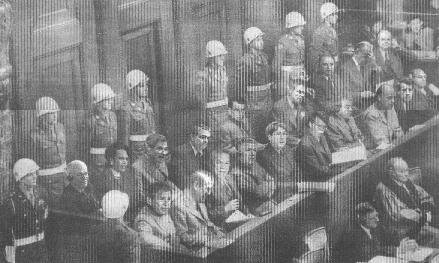
This photo shows defendants in the dock at the Anglo-American War Crimes Trial of 2010, held at The Hague under the jurisdiction of the International Criminal Court.
Of the 20 defendants shown here - the so-called "Republican Guard" - only one (Alan Greenspan, second row, second from right) was found not guilty, on the grounds that the destruction of the U.S. economy and the global financial crash of 2008, while regrettable, did not constitute war crimes as defined by the Geneva Convention.
Another defendant (Ari Fleischer, front row, extreme right) received only a light sentence, as the court determined that lying to the American people was too common a crime to merit more severe punishment.
In a more controversial decision, former Secretary of State Colin Powell was spared any prison time, after the judges ruled that being seated between former Defense Secretary Donald Rumsfeld and Chairman of the Joint Chiefs of Staff Richard Myers for the entire eight-month trial constituted "punishment enough."
Former Vice President Richard Cheney (second row, extreme left), who feigned narcolepsy throughout most of the trial, was committed to the newly established United Nations Hospital for the Criminally Insane, as was former National Security Advisor and Secretary of State Condoleeza Rice (next to Cheney), who insisted on being addressed as "Mrs. Bush" during the trial. The remaining defendants were sentenced to life terms at the Guantanamo War Crimes Penitentiary.
Credit: http://billmon.org, May 15, 2005
(The following article is from the June 1-15/2005 issue of People's Voice, Canada's leading communist newspaper. Articles can be reprinted free if the source is credited. Subscription rates in Canada: $25/year, or $12 low income rate; for U.S. readers - $25 US per year; other overseas readers - $25 US or $35 CDN per year. Send to: People's Voice, 706 Clark Drive, Vancouver, Canada, V5L 3J1.)
By Bill Sloan
On May 20-21, the Cuban Revolution permitted a "dissident assembly" in Havana, the first since 1959. It was organised by Marta Beatriz Roque, one of the leading "dissidents" of the 75 detained in 2002 for operating under the direction and financing of the U.S. "ambassador" James Cason (CIA regime change specialist). Ms. Roque has been co-ordinating the effort since her release last year for medical reasons.
About a hundred Cubans attended, and an equivalent number of foreigners. The featured speaker was George W. Bush, on tape, introduced by James Cason. Internationally known dissident Oswaldo Paya, organiser of the VARELA PROJECT, refused to participate because of "... distrust of where these people come from. They don't represent the majority of the opposition or even the most important groups. It's a smoke screen."
Several extreme right-wing politicians from Spain, Poland and the Czech Republic who sought to attend, without announcing their intentions to attend on entry, were deported. Bourgeois news services have made much ado about this, yet in April 2001, several young US citizens who came to the protests at the Summit of the Americas in Quebec City were deported by the Canadian Government because they had announced at the Windsor border that they were coming in as tourists.
Of course Robert Menard of Reporteurs Sans Frontières will make a big deal of it, but then he's on the same US payroll (USAID) & National Endowment for Democracy). He admitted the funding sources publicly on his recent trip to Montreal.
The general message is that this CIA-organised and financed "opposition" has to buy its little groups in Cuba, and bring in its OPUS DEI crowd from Europe. They don't fool anyone in Cuba, nor anyone outside who is well informed.
The following article is from the June 1-15/2005 issue of People's Voice, Canada's leading communist newspaper. Articles can be reprinted free if the source is credited. Subscription rates in Canada: $25/year, or $12 low income rate; for U.S. readers - $25 US per year; other overseas readers - $25 US or $35 CDN per year. Send to: People's Voice, 706 Clark Drive, Vancouver, Canada, V5L 3J1.)
PV Vancouver Bureau
One year after the release of photographs of US personnel torturing Iraqi detainees at the Abu Ghraib prison in Iraq, a new report shows that psychological torture was systematic and central to the interrogation process of detainees in Iraq, Afghanistan and Guantanamo.
The 135-page report, "Break Them Down: Systematic Use of Psychological Torture by US Forces," by Physicians for Human Rights (PHR), explains how psychological torture is used in the "war on terror."
"What the now infamous images from Abu Ghraib do not show is that psychological torture has been at the center of treatment and interrogation of detainees," said Leonard Rubenstein, PHR's Executive Director. "The Bush Administration decided to 'take the gloves off' in interrogations and 'break' prisoners."
There is strong evidence that psychological torture remains in use. The US Defense Department recently announced that a new interrogation manual will eliminate techniques like stripping prisoners, keeping them in stressful positions for prolonged periods, using military dogs to intimidate prisoners, and sleep deprivation. But it remains unclear whether other techniques, including isolation and severe humiliation, remain permitted, and whether there are exceptions either at the behest of commanders or for certain detainees. And while the December 2004 opinion of the Office of Legal Counsel of the Justice Department largely restored individual accountability for engaging in physical torture, it essentially immunized military and intelligence officials from liability for psychological torture.
Among the report's findings:
* In mid-2004, up to a quarter of the over 500 detainees were kept in isolation and that a new isolation facility, Camp Five, at Guantanamo opened in May 2004, modeled after a US "Supermaximum" prison. It apparently has over 100 isolation units where lights are kept on for 24 hours a day.
* The use of sleep deprivation was a common interrogation tactic in Afghanistan, Iraq, and Guantanamo. Detainees held in Afghanistan in 2002 and 2003 describe routinely being deprived of sleep. Similarly, at Guantanamo, sleep deprivation was regularly employed, and continued in 2004. Detainees held in January, March and April 2004 in Mosul and Tikrit, Iraq reported being subject to sleep deprivation.
* Severe humiliation through nakedness, violations of Muslim customs, and other methods have been pervasive. According to a PHR source familiar with conditions in Guantanamo, female interrogators sat on detainees' laps and fondled themselves or detainees, opened their blouses and pushed their breasts in the faces of detainees, kissed detainees and if rejected, accused them of liking men, and forced detainees to look at pornographic pictures or videos. Although the use of female interrogators appeared to decline in 2004, humiliation and violation of cultural and religious taboos, including forced shaving, persisted.
* Dogs were used to instill fear and threaten detainees in all three theaters of operation, not only Abu Ghraib. Aside from the use of dogs, mock executions and death threats were prevalent in Afghanistan and Iraq. Threats were extended to family members, particularly the wives and daughters of detainees.
"The administration has created a regime of torture," said Rubenstein. "Decisions by civilian and military leaders, including Secretary of Defense Donald Rumsfeld, have permitted these types of techniques. it is a drastic departure from values, laws and practices long enshrined and embraced by military and civilian investigative traditions."
Compiled in this report are witness accounts, documents released under the Freedom of Information Act, official investigations, leaked reports from the International Committee of the Red Cross, media reports and investigative reporting by PHR.
The full report can be read at http://www.phrusa.org/research/torture/pdf/psych_torture.pdf