|
|
June 1-15, 2011
Volume 19 - Number 11
$1
Prolétaires de tous les pays, unissez-vous!
Otatoskewak ota kitaskinahk mamawestotan!
Workers of all lands, unite
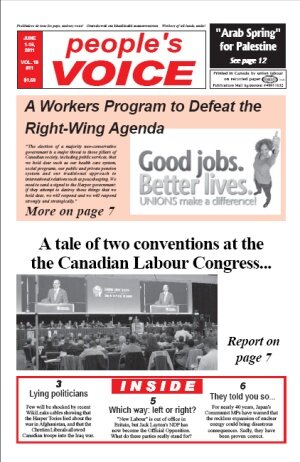
1) THE CLC: A TALE OF TWO CONVENTIONS
2) A WORKERS PROGRAM TO DEFEAT THE RIGHT WING-AGENDA
3) POSTAL WORKERS FIGHTING AGAINST CONCESSIONS
4) TORIES AND LIBERALS LIED ABOUT WAR PLANS
5) STEPS FORWARD.... AND BACK - Editorial
6) TIME FOR PALESTINIAN FREEDOM - Editorial
7) NATO CONTINUES KILLING SPREE IN AFRICA AND ASIA
8) FROM BRITAIN: THE ONGOING DEMISE OF SOCIAL DEMOCRACY
9) JAPAN'S COMMUNISTS WARNED OF NUCLEAR POWER RISKS
10) "THE ARAB SPRING" REACHES PALESTINE
11) MUSIC NOTES, By Wally Brooker
13) CLARTÉ (en français)
18) THE SPARK! (Theoretical and Discussion Bulletin of the Communist Party of Canada)
14) INTRODUCING MARX
PEOPLE'S VOICE JUNE 1-15, 2011 (pdf)
|
|
|
|
The Spark!The Spark! The latest issue of The Spark! theoretical journal, is now on sale for $5 at Communist Party offices (see p. 8) or People’s Co-op Books, 1391 Commercial Drive, Vancouver. Articles include
plus reviews, editorials, and more.
|
|
|
Theoretical and Discussion Bulletin of the Communist Party of Canada |
|
|
People's Voice deadlines: June 16-31 July 1-31 Send submissions to PV Editorial Office,
|
|
REDS ON THE WEB |
|
People's Voice finds many "Global Class Struggle" reports at the "Labour Start" website, http://www.labourstart.org/. We urge our readers to check it out! |
* * * * *
People's Voice
Canadian Publications Mail Sales Product Agreement #205214
ISSN number 1198-8657
People's Voice is published by
New Labour Press Ltd
PV Editorial Office
706 Clark Drive,
VANCOUVER, B.C. V5L 3J1
Phone:604-255-2041
Fax:604-254-9803
email: pvoice@telus.net
Editor: Kimball Cariou : Business Manager: Sam Hammond
Editorial Board: Kimball Cariou, Miguel Figueroa,
Doug Meggison, Naomi Rankin, Liz Rowley, Jim Sacouman
* * * * * *
Letters
People's Voice welcomes your letters
on any subject covered in our pages.
We reserve the right to edit for length and clarity,
and to refuse to print letters which may be libellous
or which contain unnecessary personal attacks.
Send your views to:
"Letters to the Editor",
706 Clark Dr., Vancouver, BC V5L 3J1,
or pvoice@telus.net
People's Voice articles may be reprinted without permission,
provided the source is credited.
* * * * * *
The Communist Party of Canada, formed in 1921,
has a proud history of fighting for jobs, equality, peace,
Canadian independence, and socialism.
The CPC does much more than run candidates in elections.
We think the fight against big business and its parties
is a year-round job,
so our members are active across the country,
to build our party and to help strengthen people's movements
on a wide range of issues.
All our policies and leadership
are set democratically by our members.
To find out more about Canada's party of Socialism,
give us a call at the nearest CPC office.
* * * * * *
Central Committee CPC
290A Danforth Ave Toronto, Ont. M4K 1N6
Ph: (416) 469-2446
fax: (416) 469-4063 E-mailmailto:info@cpc-pcp.ca
Parti Communiste du Quebec (section du
Parti communiste du Canada)
5359 Ave du Parc, Montréal, Québec,
H2V 4G9
B.C.Committee CPC
706 Clark Drive, Vancouver, V5L 3J1
Tel: (604) 254-9836
Fax: (604) 254-9803
Edmonton CPC
Box 68112, 70 Bonnie Doon P.O.
Edmonton, AB, T6C 4N6
Tel: (780) 465-7893
Fax: (780)463-0209
Calgary CPC
Unit #1 - 19 Radcliffe Close SE
Calgary AB, T2A 6B2
Tel: (403) 248-6489
Ottawa CPC
Tel: (613) 232-7108
Manitoba Committee
387 Selkirk Ave., Winnipeg, R2W 2M3
Tel/fax: (204) 586-7824
Ontario Ctee. CPC
290A Danforth Ave., Toronto, M4K 1N6
Tel: (416) 469-2446
Hamilton Ctee. CPC
265 Melvin Ave., Apt. 815
Hamilton, ON.
Tel: (905) 548-9586
Atlantic Region CPC
Box 70 Grand Pré, NS, B0P 1M0
Tel/fax: (902) 542-7981
http://www.communist-party.ca/
* * * * * *
News for People, Not for Profits!
Every issue of People's Voice
gives you the latest
on the fightback from coast to coast.
Whether it's the struggle for jobs or peace, resistance to social cuts,
solidarity with Cuba, or workers' struggles around the world,
we've got the news the corporate media won't print.
And we do more than that
- we report and analyze events
from a revolutionary perspective,
helping to build the movements for justice and equality,
and eventually for a socialist Canada.
Read the paper that fights for working people
- on every page, in every issue!
People's Voice
$30 for 1 year
$50 for 2 years
Low-income special rate: $15 for 1-year
Outside Canada $50 for 1 year
Send to: People's Voice, 706 Clark Drive, Vancouver, BC, V5L 3J1
You can call the editorial office at 604-255-2041
REDS ON THE WEB
http://www.communist-party.ca/
http://www.ycl-ljc.ca/
http://www.solidnet.org/
(The following articles are from the June 1-15, 2011, issue of People's Voice, Canada's leading communist newspaper. Articles can be reprinted free if the source is credited. Subscription rates in Canada: $30/year, or $15 low income rate; for U.S. readers - $45 US per year; other overseas readers - $45 US or $50 CDN per year. Send to People's Voice, c/o PV Business Manager, 706 Clark Drive, Vancouver, BC, V5L 3J1.)
1) THE CLC: A TALE OF TWO CONVENTIONS
By Sam Hammond, Vancouver
For the 26th time since its founding, the Canadian Labour Congress met in Convention May 9-13 in Vancouver, BC. President Ken Georgetti welcomed the 2500 delegates with a speech that probably won't be remembered for more than a few days, if at all. The speech did not reflect the anger and anguish the people are going through across Canada, or the dangerous reality of a new Harper majority in Ottawa. That reality had to come from the floor, and it did several times during the week.
The structural changes that will effectively reshape the CLC into a consensus of the largest private and public sector union leaders were adopted as expected, with only mild squirming from the Labour Councils which are left out of the new structure completely.
Ken Georgetti managed the microphones with clumsy prejudice. Early in the convention he twice cut off Dave Pritchett from the Longshore Union, while CAW leader Ken Lewenza to go four minutes beyond the speaking time. On Tuesday morning, Georgetti apologized for his sins the day before, but throughout the week he continued giving speakers at pro mikes preference over speakers at con mikes. The chairing became quite a topic of discussion in the food courts and even in some of the caucuses. Many new affiliates and first‑time delegates were particularly upset.
More than at any other CLC convention, the several hundred resolutions sent in were grouped into watered down composites and squeezed into debate times that were severely compressed by a line‑up of guest speakers, cultural presentations and discussion panels. Some of the delegates who took part in the Action Caucus estimated that in the week‑long convention, only about nine hours were allotted to floor debate on resolutions.
One of the guest speakers was Jack Layton, who understandably was on a high over the NDP election success, and of course received a resounding welcome from the delegates.
The Action Caucus had its first meeting on May 8, before most delegates had not arrived. Regular daily meetings of the Caucus began in earnest the next day. The main thrust of the Action Caucus was to get adoption of an "Action Plan to Resist the Harper Agenda". A petition to get the Action Plan on the floor was signed by over 500 delegates, the most effective work done at the convention. Although the Action Plan did not make it to the floor, it was in tune with the feelings of the majority of delegates. Much of it was incorporated by the executive into "Good Jobs, Better Lives: A Workers Program to Defeat the Right‑Wing Agenda," an action resolution which was passed and is now policy.
Because of the behind the scenes work of the Action Caucus, the language of the "Good Jobs, Better Lives" resolution is militant and emphasizes the need to support unions in struggle and under attack such as CUPW and PSAC, to promote "public demonstrations" and "direct action where necessary to defeat the right‑wing agenda".
The resolution states, "We will work with affiliates, federations and labour councils to build a strong progressive workers movement to counter the right‑wing corporate agenda in this country. This will include engaging in member‑to‑member campaigns, public outreach and direct action..."
It also states, "At the 27th Constitutional Convention in 2014, the CLC will bring forward a political plan to defeat the Conservative government and to elect a federal New Democratic Party government." This is a much different posture than two conventions back when Gilles Duceppe and Jack Layton got equal billing.
The members of the Action Caucus brought militancy to the mikes, reflected the urgency of delegates who want a stronger fightback, and built respect and prestige for the left, for the ideology of struggle against capital and unity of working people.
In the words of one member of the Action Caucus, "It was as if there were two conventions going on at the same time that did not connect."
This is an accurate observation. The thrust from the top is to prepare conditions for the election of an NDP majority in 2015. The thrust from the left is to fight every day over the next four years, to prevent the Tories from implementing their pro‑corporate, pro‑war, pro‑imperialist agenda.
The youth, the homeless, the disenchanted, the unemployed and the abandoned, our entire working class, cannot wait for social democratic salvation in 2015. Thanks to the Action Caucus and the militant delegates the "Good Jobs, Better Lives" resolution gives equal billing to both agendas. It has the potential for unity and resistance.
2) A WORKERS PROGRAM TO DEFEAT THE RIGHT WING-AGENDA
Adopted by the 26th Convention of the Canadian Labour Congress, May 9-13, Vancouver, BC
The election of a majority neo‑conservative government is a major threat to those pillars of Canadian society, including public services, that we hold dear such as our health care system, social programs, our public and private pension system and our traditional approach to international relations such as peacekeeping.
We need to send a signal to the Harper government: if they attempt to destroy those things that we hold dear, we will respond and we will respond strongly and strategically.
We will not stand by while medicare is destroyed and we will not stand by while unions in the public sector, such as CUPW or PSAC, are attacked or while private sector unions are weakened through the continued elimination of their jobs. We will all work together so we strengthen and defend all affiliates.
The Canadian Labour Congress (CLC) and the National Campaign Committee (NCC) will work with our affiliates through the federations of labour and the labour councils to build momentum by mobilizing our membership and our allies in the community through education, public demonstrations and direct action where necessary to defeat the right‑wing agenda.
As outlined in the policy paper, Building on Our Success Mobilizing for Our Future, adopted by the delegates, we will continue the work of the CLC in mobilizing targeted, effective, focussed campaigns that build capacity, visibility and power for the labour movement.
We will combine the work of this workers action plan with the ongoing political work of the CLC and we will utilize these efforts toward building an effective broad‑based opposition to the mean‑spirited, right‑wing agenda. At the 27th Constitutional Convention in 2014, the CLC will bring forward a political plan to defeat the Conservative government and to elect a federal New Democratic Party government.
1. We will create a strong and principled opposition both within the labour movement and with our coalition allies that will anticipate and counter the government's legislative initiatives with a series of targeted and specific actions. We will also work to develop a parliamentary strategy on lobbying and parliamentary committee work.
2. We will utilize the CLC National Campaign Committee to develop strategies, create materials in traditional format and electronically (Facebook, email, Twitter, websites, etc.) for our activists, membership, canvassing and for our social allies in order to build community‑based opposition.
We will poll our members and the general public to gather information to develop common messaging based on broad labour and progressive, Canadian values such as our commitment to medicare, education, and equality. We will use this information to also anticipate and counter the Conservative government agenda.
3. We will work with the affiliates, provincial and territorial federations of labour and labour councils to commit resources to coordinate both direct and indirect political campaigns in support of progressive parties and candidates in their respective provincial and municipal elections over the next three years. We will continue to use these elections as a means to test and modify our strategies and tactics as a lead up to October 19, 2015, the date of the next federal election.
4. We will work with affiliates, federations and labour councils to build a strong, progressive workers movement to counter the right‑wing corporate agenda in this country. This will include engaging in member‑to‑member campaigns, public outreach and direct action, based on issues affecting the affiliates specifically on the broader political issues of the day. We not only need to build support within our own membership for this program, we also need to build support among the broader public.
5. We must strengthen our coalitions and work to develop stronger relationships with civil society partners to broaden the base of our campaign work. We must find ways to assist civil society and our coalition partners to improve their capacity and resources, and link their work to our labour council activities in our communities.
6. We will continue our campaign and fight for improved pensions through the CPP/QPP, defend defined benefit pension plans and work to ensure adequate funding for the health and social transfer programs prior to the upcoming review.
7. We will work with affiliates through the CLC Canadian Council to develop strategies and support for unions who are in difficult bargaining and/or political situations and take whatever actions are necessary to defend our affiliates.
8. We will work with affiliates to defend and expand union density and will coordinate with the federations of labour campaigns to change provincial and territorial legislation to achieve automatic certification through card check in order to build a strong worker base.
3) POSTAL WORKERS FIGHTING AGAINST CONCESSIONS
By Kimball Cariou
As this issue of People's Voice went to press, negotiations between Canada Post and the Canadian Union of Postal Workers were going down to the wire.
On May 22, making an attempt to "energize negotiations," CUPW presented a "global offer" to the Canada Post Corporation negotiating committee. The next day, Canada Post management replied that it was preparing a response. These developments meant that the union had not yet given the required 72‑hour notice of strike action, leaving May 28 as the earliest date for a potential walkout by the union's 54,000 members.
The CUPW negotiations are seen as the first major test of the new Harper majority government's strategy to roll back the labour movement. While Canada Post is technically an "arm's length" crown corporation, the company's drive to gut the collective bargaining agreement gains achieved over many years by its employees would signal a wider attack on the wages, benefits and pension rights of all public workers in the federal sector.
One indication of the importance attached to these negotiations by pro-business forces has been the vocal intervention by the Canadian Federation of Independent Business. This far-right lobby group has sent a letter in support of Canada Post's attempt to impose lower wages and pensions for new hires, and to replace the banking of sick days with a new program reducing the ability of postal workers to access sick leave.
In a response, CUPW says, "We do not understand why the Canadian Federation of Independent Business is encouraging Canada Post to hold fast to bargaining positions, especially in connection with major negotiations issues such as new hires and sick leave. We think your members would be better served by an organization that encouraged bargaining rather than the kind of intransigence that leads to strikes... It may be difficult to get a settlement given the unprecedented number of concessions being demanded by Canada Post, but the union is determined to try. Unfortunately, letters such as yours encourage Canada Post not to try, which will not help our negotiations or your members."
After months of bargaining, Canada Post has proposed a 4-year agreement with wage increases of 1.75%, 1.75%, 1.9% and 2.0%. For new employees, the company is proposing a starting rate of $18/hour, which would be 22% less than the current starting rate for a letter carrier. CUPW points out that the wage offer is also well below the annual inflation rate of 3.3%. The union has also stressed that Canada Post has racked up 16 consecutive years of profits, including $281 million in the 2009 fiscal year.
While the company wants to continue installing new equipment and work methods which threaten the health and safety of its employees, CUPW has called for ergonomic studies prior to such changes, as well as improved rotation of duties and delivery methods.
In another key issue, Canada Post wants to eliminate the impose a Short Term Disability Plan administered by Manulife insurance, which provides for seven personal days per year. Employees with borrowed sick leave credits would have to reimburse Canada Post, and there would be no protection for short term illnesses once employees have exhausted their personal days.
Calling to protect the current sick leave plan, CUPW says the employer should address the reasons for the increasing number of days lost due to workplace injuries.
The union's bargaining position is backed up with a 94.5% strike vote by CUPW members.
4) TORIES AND LIBERALS LIED ABOUT WAR PLANS
By Kimball Cariou
The latest diplomatic cables released by the WikiLeaks project to major news outlets show that Stephen Harper's minority Conservative government lied to Canadians about its Afghanistan policies, and that the Chretien Liberals gave covert support to the U.S. aggression against Iraq. Neither story will surprise most anti-war activists, but the news is likely to help reinforce public opposition against the war in Afghanistan.
According to a U.S. diplomatic cable released by WikiLeaks to CBC News, by early 2009 the Harper Tories were already reconsidering the 2011 end date for the Afghan mission. While denying such plans, a cabinet meeting in March 2009 "agreed that `all options are back on the table' with respect to Canada's military role in Afghanistan after 2011," the March 17 secret cable says.
The cable quotes from conversations held with a senior adviser from the Department of Foreign Affairs and International Trade.
"It will take time for the government's public rhetoric to catch up to this `new reality,' however, requiring some `patience' on the part of allies," the senior adviser apparently told U.S. officials on March 16. Allies should not "publicly press" Canada to extend its troop deployment past 2011, he urged.
Not surprisingly, these comments encouraged U.S. officials to hope that Harper might keep the Canadian combat force in Kandahar beyond 2011. The mission had already been extended once beyond the original 2009 end date, in part because of feuding in Parliament between the opposition parties.
The fly in the ointment for the pro-war government, of course, was the "increasingly dubious Canadian public," the cable says, noting that a decision to extend the end-date would be a "political goldmine" for the Liberals.
At the same time, the officials speculated that upcoming U.S. policy reviews on Afghanistan might change the "dynamics enough to give this government - or its successor - enough political flexibility" to continue a combat role after 2011.
However, Canadian public opinion has remained solidly against continuing the military mission. While the opposition parties ignored Afghanistan during the May 2 federal election, even the Harper Tories did not dare present extension of the Kandahar mission as an option.
All the major parties in Parliament support the current official line, which claims that a small number of Canadian troops will remain in Kabul to train Afghan security forces. Recent information suggests this scenario is already changing. The number of Canadians to be engaged in training will be over 1,000, and their activity will extend beyond the capital into several other cities. The anti-war movement is warning that this "mission creep" inevitably means that Canadian troops will continue to kill and die for several more years in Afghanistan, fighting to prop up a corrupt government of warlords and reactionary fundamentalists.
The duplicity of Canadian politicians was also revealed in another WikiLeaks document, showing that Canada promised "clandestine" military support for the invasion of Iraq.
On March 17, 2003, bowing to massive public pressure in Quebec and the rest of the country, PM Jean Chretien told the House of Commons that Canadian forces would not join the U.S.-led "coalition of the willing." The occupation of Iraq began two days later.
But on the same day, Canada was secretly singing a different tune. A confidential note written by a U.S. diplomat states that following a March 17 meeting of Canadian, U.S. and British officials in Ottawa, Foreign Affairs representative James Wright privately "emphasized" that Canadian naval and air forces could be "discreetly" put to use during the assault on Iraq.
At that time, Canada had warships, aircraft and over 1,200 naval personnel already in the Strait of Hormuz at the mouth of the Persian Gulf. The Canadians were part of Operation Enduring Freedom, the so-called "war on terror" launched by the U.S. after Sept. 11, 2001.
"While for domestic political reasons... the GOC [Government of Canada] has decided not to join in a U.S. coalition of the willing... they are also prepared to be as helpful as possible in the military margins," the briefing note states.
At the time, the Chretien government said a "few" Canadian soldiers embedded with the U.S. and British militaries would be allowed to remain in their positions, even if they wound up in Iraq. But in reality, these soldiers, including Canadian general Walt Natynczyk, were deeply involved in war preparations.
In 2004, Natynczyk became deputy commander of 35,000 U.S. soldiers and other occupation forces in Iraq. Now Canada's chief of defence staff, Natynczyk was part of the team of senior U.S. military brass which helped prepare for the invasion from a mobile command in Kuwait.
People's Voice Editorial
The struggle to make police forces accountable to the people of Canada who pay their salaries saw both gains and setbacks during recent weeks.
One victory was the decision by the government of British Columbia to establish an independent process to review cases of police violence. For decades, cops who kill in British Columbia have been immune against any serious penalty. Their crimes are "investigated" by members of other police forces, rarely producing any result more dire than dismissal, especially when the victim is Aboriginal. After a growing number of police homicides in B.C. in recent years, the public demand for civilian review could not be denied any longer. However, the details of the new process have yet to be announced.
On the downside, prosecutors in B.C. will not lay murder charges against the four RCMP officers responsible for the 2007 taser killing of Polish immigrant Robert Dziekanski. Why? "No reasonable likelihood of conviction." In our opinion, the real reason is that a jury would likely have convicted these brutal cops, further undermining support for the RCMP.
Meanwhile, Ontario's Special Investigations Unit says it cannot identify officers involved in a G20 arrest that left Dorian Barton with a broken arm. Civilian witnesses told the SIU that Barton, who was taking pictures of mounted police officers, was struck with a riot shield and then hit with a baton after he fell to the ground. Photos were shown to 11 officers, but apparently none could identify the perpetrator. Even with a civilian-based review process, the "boys in blue" and the politicians who support them will invariably close ranks to protect violent, abusive cops.
The lesson? Despite some steps forward, Canada is far from reaching the goal of police forces under genuine civilian control.
6) TIME FOR PALESTINIAN FREEDOM
People's Voice Editorial
As this issue goes to press, events in the Middle East continue to unfold rapidly. Pressure is mounting on Israel to step back from its apartheid-style domination of the Palestinians.
Within days, the second Freedom Flotilla is expected to sail, with the goal of breaking Israel's inhumane and illegal naval blockade of Gaza. We salute the courageous Flotilla activists, including those on the Tahrir (Liberation), purchased through the collective contributions of thousands of supporters in Canada.
The Flotilla and the recent marches by Palestinians upon the borders of Israel are powerful expressions of global rejection of the Zionist project of ever-expanding occupation. Even the President of the United States, Israel's most important ally, has called to accept the 1967 borders as a starting point for genuine negotiations.
Barack Obama's recent statements mark a potentially important geopolitical shift, but peace in the Middle East cannot be achieved without justice. In particular, the relevant resolutions of the United Nations on this conflict must be accepted by Israel and its U.S. imperialist protector. The vast expansion of Israeli settlements into Palestinian territories must be ended. The Palestinians driven out of their ancestral homes and lands during and after the Zionist terrorist Nakba of 1948 must have the right of return. The status of East Jerusalem as the capital of a truly independent Palestinian state must be recognized.
Today, the Harper government stands virtually alone as a defender of the most viciously anti-Palestinian elements of the Israeli state. This policy does nothing to win peace, or even to advance its alleged aims of protecting Israel. Solidarity with the Palestinian people must be combined with stronger efforts to reverse Canada's shameful policy of unconditional support for the murderous Netanyahu regime.
7) NATO CONTINUES KILLING SPREE IN AFRICA AND ASIA
By Rick Rozoff, www.globalresearch.ca, May 15, 2011
On May 13 President Barack Obama welcomed North Atlantic Treaty Organization secretary general Anders Fogh Rasmussen to the White House and the two pledged to continue the world's two major wars, those in Afghanistan and Libya. There are over 150,000 foreign troops engaged in the nearly ten‑year war in Afghanistan, at least 130,000 of them serving under NATO's International Security Assistance Force. Since taking command of the war against Libya on March 31 the military bloc has conducted almost 7,000 air missions, including over 2,600 combat flights. Obama and Rasmussen also announced that the U.S. will host next year's NATO summit.
In a column in the same day's Wall Street Journal, Rasmussen said, "NATO's operational commitments have changed beyond recognition in the past 20 years, and we have never been busier." Indeed.
NATO troops killed a 12‑year‑old girl and injured four other girls ages 8 to 15 in Afghanistan's Kunar province on May 15, according to the provincial police chief. The day before NATO forces killed a 15‑year‑old boy, the son of an Afghan soldier, in a night raid in Nangarhar province, resulting in a demonstration by local Afghans that was fired upon by government forces with four protesters killed, including a 14‑year‑old boy.
On May 12 NATO troops killed a 12‑year‑old girl and a policeman, her relative, also in Nangarhar province. According to the girl's father: "They (foreign troops) hurled a hand grenade at my daughter after she ran out of the room in a panic. She was killed on the spot." [1]
Two weeks before NATO and Afghan government troops attacked a Pakistani checkpoint in the South Waziristan Agency. Three Afghan soldiers were killed and two Pakistani security personnel were injured. "Pakistani security forces said they returned fire when they came under attack from Afghan and Nato forces...." [2]
According to a leader of a Pakistani opposition party: "The NATO attack was not accidental but a calculated and planned move to target Pakistan so as to hide its failure in Afghanistan. The violation of Pakistani territory indicated that the US was planning to push the war inside Pakistan." [3]
U.S. drone missile attacks killed eight people in Pakistan's North Waziristan Agency on May 12, after which "locals said the dead were innocent people." [4] Two days before "U.S. drone aircraft fired two missiles at a vehicle, killing at least five people and injuring seven others" in South Waziristan. "The identities of the deceased were not known immediately." [5]
The U.S. had enough Hellfire missiles left over to launch a drone attack in Yemen earlier this month, missing the intended target and killing two other people instead.
Late last month three NATO helicopters fired on Iranian fishermen 750 kilometers north of the Somali capital of Mogadishu in the Indian Ocean, wounding three Iranians and killing three Somalis in the second such attack in two days. Iran's minister for Fisheries and Marine Resources Mohamed Ali "condemned the NATO attack and demanded an apology from the international forces." [6]
On May 13 NATO aircraft bombed the Libyan city of Brega, killing 16 civilians, including 11 clerics who were there on a peace mission, and wounding 45 others.
The same day Alliance warships, part of a 20‑ship flotilla enforcing a naval blockade of Libya, shelled a Red Crescent Society building in rebel‑held Misrata as well as bombing the outskirts of the nearby town of Zlitan.
The preceding day Libyan state television reported that a NATO air strike hit the North Korean embassy in Tripoli. Several other sites were targeted in the capital hours after Libyan leader Muammar Gaddafi made his first television appearance since a NATO strike on April 30 killed one of his sons and three of his grandchildren.
General Carter Ham, the commander of U.S. Africa Command, which was in charge of the air war and naval operations against Libya from March 19‑30, spoke in Uganda on May 11 and advocated the deployment of more troops for the ongoing armed conflict in Somalia, offering American assistance for the effort. Since last year NATO has airlifted thousands of Ugandan troops into and out of the Somali capital, where three Ugandan soldiers were killed and as many wounded three days after Ham's statement.
On May 14 Djibouti, where the Pentagon has its only permanent military base in Africa and at least 2,500 troops assigned to its Combined Joint Task Force ‑ Horn of Africa based there, announced it would deploy two battalions to Somalia to join 9,000 Ugandan and Burundian forces there.
There will be far more innocent people, including children, killed in Africa, Asia and the Arabian Peninsula before the NATO summit convenes in the U.S. next year.
Notes: 1) Pajhwok Afghan News, May 12 2) Dawn News, April 27 3) News International, April 28; 4) The Nation, May 13; 5) Online News International, May 10; 6) Press TV, April 24.
8) FROM BRITAIN: THE ONGOING DEMISE OF SOCIAL DEMOCRACY
By Steve McGiffen, Morning Star (UK)
European centre‑left leaders gathered recently in Oslo to discuss their difficulties in winning power, and their inability to do anything with it once they've got it.
Patrick Diamond, an author of Labour's last manifesto, believes that recent local electoral success "cannot disguise the governing crisis which threatens Labour's very survival as a party of power." This crisis is not confined to Britain.
Centre‑left parties hold office in Norway, Greece, Spain and Portugal, but only in Norway do their policies bear any resemblance to social democracy ‑ the political philosophy behind the movement which brought us the welfare state, low rates of poverty and a code of values based on equality, solidarity and dignity.
This may be because the Norwegian government includes a party to the left of the social democrats or it may be because as a non‑member of the EU, the country's rulers have a bit more space to determine policies than do those of the 27 countries bound hand and foot by the neoliberal Lisbon Treaty.
A recent poll conducted in the US, Britain, Germany and Sweden found that the vast majority of people in those countries do not believe that governments can stand up to vested interests, while sizeable minorities ‑ almost three in 10 in Britain ‑ are sceptical of any possibility that governments can be effective in bringing about positive social change.
This is hardly surprising when governments of the centre‑left have failed to reproduce anything like the achievements of social democracy of the post‑war years. The Labour Party and its sister organisations have failed to challenge the logic of neoliberalism.
Take the financial crisis and the economic crisis which it provoked. The problem began with a US sub‑prime mortgage crisis which was the result of a process of national and international deregulation of financial services which centre‑left parties might have been expected to resist.
After all there is nothing particularly radical in believing that consumers ‑ both public and private ‑ as well as honest investors should be protected from the unscrupulous and the greedy. Instead, nominally social democratic leaders were amongst the most enthusiastic advocates of global financial anarchy.
Once the system collapsed, governments bailed out the very institutions most culpable in bringing the crisis about. The result was a wave of destruction caused by the private sector being magically transformed into a crisis of government debt. The people's money was used to ensure that the people's enemies continue to sleep off their champagne suppers under silken sheets.
In Britain, the government is not just venal and absolutely unrepresentative of the country's people. It is also incompetent, floundering into an electoral trouncing, the junior partner staring into the abyss of total meltdown. Yet there is absolutely no sense that when people vote against this government they are voting for anything at all.
When I first voted Labour, in 1974 at the age of 19, I had a clear idea that the party stood for a gradualist approach to social progress. Although it was clearly not going to lead Britain to a glorious socialist future it was all we had on an electoral level.
Blair transformed it into a fully bourgeois party with only nominal links to the working class. This has been demonstrated by the Labour leadership's failure to promote a social democratic response to the intensified class war unleashed in the wake of the crisis.
In some ways this is puzzling. Labour consistently shunned real left politics, ostensibly on the grounds that they would not have been popular with sufficient voters.
Whether this was really the case in the past or not is debatable, but it is surely the case that a programme of financial reform would ‑ as the global economy began to fall apart, taking people's jobs with it ‑ have been popular. A Keynesian programme including additional massive investment and public ownership of banks would have been capable of mobilising broad support. Proving to people that the state can stand up for their interests in the face of the concentrated power ‑ the inevitable product of deregulated markets ‑ could have restored faith in democracy.
There are whole areas of public life which are being undermined by cynicism, corruption and that great British disease, nepotism. This could have been tackled by a programme of reform which could have been carried out at no great expense.
The survey cited above also showed that people associate the centre‑left with high taxation but that they do not object to taxes in principle. It's just that they want value for money.
Taxation to strengthen public services, education and health care has majority support. Most people in western Europe and Britain are social democrats even if they don't know it. Survey after survey has shown that people want a strong welfare state, healthcare accessible to all, sound pensions and a good system of education.
Labour does not heed this because it is now, as much as the Tories, a representative of big capital and not of working people at all. It does not heed it because it is unwilling and unable to challenge the dictatorship of the European Central Bank and the European Commission.
For socialists to support the Labour Party is to indulge in a pessimistic nostalgia which has no real relationship to the world as it is now. Parliament itself is no longer an agent capable of bringing about meaningful social change.
Electoral politics in the context of modern Britain can only ever be protest politics.
However movements are stirring ‑ UK Uncut, the refusal of students to lie down and see their education and their future prospects blighted, the emerging mass movement to save the health service ‑ which promise to be far more effective than the passive strategy of putting a cross next to the name of the candidate whose party will, you hope, close down the fewest hospitals.
9) JAPAN'S COMMUNISTS WARNED OF NUCLEAR POWER RISKS
From Akahata, the daily newspaper of the Japanese Communist Party (abridged)
The ongoing crisis at the Fukushima No. 1 Nuclear Power Plant has sharply raised concerns regarding the construction of nuclear power plants. The Japanese Communist Party has called on successive governments to make a drastic change in the atomic energy administration and has opposed additional construction plans together with concerned citizens. The JCP's consistent stance is crucial for Japan to take appropriate measures to prevent future accidents.
Expose "safety myth"
The biggest issue of Japan's nuclear power administration is that it is based on the "safety myth," a lie that instils the belief that serious accidents emitting a vast amount of radiation are unlikely to occur. No other country has clung to this myth so blindly and built so many nuclear plants in earthquake zones.
In January 1976, then JCP Secretariat Head Fuwa Tetsuzo pointed out in the Diet [Japan's parliament], "Nuclear power is a dangerous and unproven technology with great potential risks. Development of nuclear power generation must provide safety arrangements as strong as technology can offer. Otherwise, it can bring about a very dangerous outcome."
At that time, the government launched a project to build 50 nuclear power reactors capable of generating 49 million kilowatts of electricity. The JCP opposed the reckless plan on the grounds that safety must be given the highest priority.
In 1979, a partial meltdown of the reactor core occurred at the Three Mile Island nuclear power plant. Fuwa, at the 1980 Diet discussion, cited a report compiled by the US President's Commission on the accident, which stated, "[T]he belief that nuclear power plants are sufficiently safe grew into a conviction."
Introducing the report, which stresses that "this attitude must be changed to one that says nuclear power is by its very nature potentially dangerous," Fuwa revealed the dangerous nature of the "safety myth".
Nuclear power advocates repeatedly made statements asserting that nuclear power is safe. Suita Tokuo, head of the Cabinet Office Nuclear Safety Commission, stated that an accident as serious as the one at Three Mile Island "would be highly unlikely to occur in Japan." Arisawa Hiromi, who led the Japan Atomic Industrial Forum at that time, said the emergency core cooling system for nuclear reactors is actually "overdesigned".
JCP Chair Shii Kazuo stated on March 23, "Now is the time for the Japanese government to stop promoting the `safety myth', sincerely reveal the dangers of atomic energy before the public, and create an honest and scientific nuclear energy administration that takes thoroughgoing measures to secure citizens' safety."
Oppose nuclear plant construction
In 1976, Fuwa warned, "Japan's national safety will face a crisis" with the construction of the many proposed additional nuclear power plants.
At a Diet deliberation in February 1981, Fuwa showed that nuclear power plants in Fukushima, Miyagi, Niigata, Shizuoka, Ehime, Fukui and Shimane prefectures are all located in areas susceptible to massive earthquakes on active faults. "No other country in the world is building nuclear power stations on such dangerous active earthquake faults," said Fuwa, calling for the construction plan to be retracted and all existing plants to be thoroughly inspected.
In response, the government and electric companies made some improvements in safety features, including increasing quake-resistant capabilities, but refused to cancel the massive development plan.
Since the 2007 earthquake that hit Niigata Prefecture caused serious damage to the Kashiwazaki‑Kariwa plant, three reactors are still shut down. The latest earthquake triggered a major crisis at the Fukushima No. 1 plant and also caused the suspension of the operation of the Onagawa plant in Miyagi Prefecture.
Warning of loss of supply
The crisis at the Fukushima plant was caused by the destruction of its cooling system and the loss of electricity supply due to the massive earthquake and tsunami. JCP Lower House member Yoshii Hidekatsu warned of these risks years ago.
On March 1, 2006 at a House of Representatives Budget Committee workshop, Yoshii cited the examples of the massive tsunami that followed major earthquakes in Chile (May 1960), Sumatra (December 2004), and the Sanriku Coast of Japan (June 1896). Pointing out that the Sanriku tsunami reached a recorded height of 38 metres, he proposed that the government seriously consider the risks and take appropriate measures.
Yoshii introduced the worst‑case scenario following a tsunami with a major undertow: nuclear reactors will not be able to utilise seawater for cooling due to the fall of sea level for a long time, leading to a core meltdown. "A case similar to the Chernobyl disaster must be always kept in mind when designing countermeasures," he said.
In response, Nuclear and Industrial Safety Agency Director General Hirose Kenkichi stated that nuclear power plants are already designed to secure the necessary seawater and to cool their reactors, and denied the need to take further measures.
A possible loss of electricity was pointed out by Yoshii at a Lower House Economy and Industry Committee meeting in 2010. He stated that a massive earthquake could destroy both the external electric supply and the in‑house power generation of a nuclear power plant at the same time. "What would happen when the backup cooling system fails due to the loss of both external supply and in‑house power generation must be examined," stressed Yoshii, calling on the government to urgently plan for such worse case scenarios.
After the latest disaster, Prime Minister Kan Naoto stated, "It is undeniable that we had a weak understanding [of the effects of tsunamis]. It will be a problem if the present standards for tsunami preparedness continue to be set in accordance with a low tsunami height," admitting that the ongoing nuclear crisis was caused by the government and electric companies which promoted and continued to adhere to the "safety myth" of nuclear energy.
Call for independent regulatory body
Japan's nuclear safety measures fall far behind the rest of the world. The fundamental cause of this problem is the lack of an independent regulatory body. Although the Nuclear Safety Commission is an independent body, its role is limited due to an insufficient number of staff and inadequate authority.
Presenting the JCP proposal regarding safety control measures on nuclear energy, Fuwa Tetsuzo in 1976 said as follows: "It is necessary for the government to urgently create an independent safety control organisation separated from the promoter of nuclear power generation. Like in other countries such as the United States, the United Kingdom, Germany and France, this independent body should take responsibility for the entire process of nuclear power generation from building a nuclear power plant to disposing used fuels."
Successive Japanese governments avoided establishing an independent regulatory authority. They wanted the construction of more nuclear plants as demanded by Japanese electric power companies and the US nuclear power industries. The other reason is that if a regulatory body launches its activity to control nuclear safety, it will impose tighter regulations on US nuclear‑powered aircraft carriers and submarines visiting Japanese ports.
In January 1974, Fuwa revealed that a private institution for chemical analysis submitted fabricated data on radiation leaked from US nuclear‑powered submarines. After that, US nuclear‑powered ships stopped entering Japanese ports for 183 days. Following this event, the government partially improved the system, monitoring radiation near nuclear power plants and seaports in which the US nuclear‑powered vessels enter.
In response to requests made by residents and researchers and to the JCP's continuous demands, the government in 1978 established the Nuclear Safety Commission, whose actual working‑level section was placed in the former Science and Technology Agency. However, it had no permanent member in its special committees, in contrast to the US Nuclear Regulatory Commission consisting of about 1,900 experts and full‑time staff.
In his one‑on‑one debate with the Prime Minister in November 1999, Fuwa asked, "The Convention on Nuclear Safety stipulates that a regulatory body should be separated from those concerned with the promotion of nuclear energy. In Japan, which organisation is a regulatory body and which is a promoter?"
In his response, Prime Minister Obuchi Keizo said that "the Science and Technology Agency (the current Ministry of Science and Technology) and the Ministry of International Trade and Industry (the current Ministry of Economy, Trade and Industry)" have authority over both regulation and promotion. This clearly revealed that Japan was in violation of the international convention on nuclear safety.
Following Fuwa's questioning, the government in 2001 decided to shift the Nuclear Safety Commission to the Cabinet Office. However, all members of its special committees, except five nuclear safety commissioners, are temporary members. In addition, the Nuclear and Industrial Safety Agency (NISA) is placed under the nuclear‑promoting Ministry of Economy, Trade and Industry, although NISA should play a part in controlling nuclear safety.
In the Fukushima crisis, NISA is only releasing reports by Tokyo Electric Power Co, failing to play the role required by the international convention on nuclear safety.
Cancel plans to construct more reactors
JCP Chair Shii Kazuo has visited the disaster‑hit areas and victims and made representations to the government three times. He has urged the government to respond to urgent demands of affected municipalities and their residents and to change its nuclear power administration drastically.
On March 31, Shii met with Prime Minister Kan Naoto to hand over the "JCP proposal in the aftermath of the Great East Japan Disaster" and said, "The government should drastically review its nuclear power administration and energy policy." When Shii said the government must stop the construction of more than 14 nuclear reactors under its "basic national energy development plan", Kan replied, "I will reconsider the plan to build 14 more nuclear reactors. When doing so, going back to the beginning is one option." He also expressed his intention to revise the government energy policy fundamentally.
The JCP proposal states that the Fukushima crisis is "a human‑generated disaster caused by the irresponsible attitude of the atomic energy administration, which has promoted the `safety myth' of nuclear energy and blindly pushed for more nuclear power generation without implementing necessary measures to ensure a modicum of safety."
In the proposal, the JCP calls for: an implementation of a nuclear power administration which breaks away from the "safety myth" and is fully aware of the danger of nuclear energy; a thorough inspection of all reactors and a cancellation of the planned construction of more nuclear reactors and the nuclear‑fuel recycling program that uses plutonium; and a separation between regulation and promotion of nuclear power generation and an establishment of an independent regulatory organ with strong authority.
Prime Minister Kan Naoto said that "it is necessary to seriously reflect" on the current situation, in which a promoter of nuclear energy doubles as a regulatory organ. He indicated the need to change the structure as proposed by Shii.
10) "THE ARAB SPRING" REACHES PALESTINE
The Palestinian People's Party has issued its views on the "reconciliation agreement" in Palestine and recent developments in the Middle East and North Africa. The full commentary is available at SolidNet, http://solidnet.org.
Having all Palestinian political factions come together for national reconciliation was an emotional experience for all who witnessed the events taking place in Cairo. The Arab Spring has finally reached Palestine.
All the parties across the Palestinian political spectrum, with the support of the new Egyptian government, reached an agreement to establish a technocratic government in order to hold elections within one year and rebuild the Gaza Strip. This is a critical step in our path toward freedom and independence.
Our party has an important part in this reconciliation. We have worked through the past four years in order to end the division and retain Palestinian unity. At the same time we should not overestimate what has happened. This is the first right step towards unity. The next step is to form a new unity government of technocrats and independent figures for one year.
Politically speaking, Hamas has mostly agreed to go on according to the political platform of the PLO, in exchange of lifting the siege from Gaza, mainly opening the Rafah entrance, rebuilding Gaza after the destruction inflicted by the Israeli aggression there in 2008/2009.
Even with this positive development there are still problems. The main cause for the division is not solved yet. The main discussion after forming the unity government will be on the comparative representation of each party in the civil and security establishment (and) in the Authority. As a party we think that this problematic issue could be a ticking bomb. The only solution is through general elections and through consolidating the democratic base of the Palestinian National Authority. This necessitates a collective national effort and not a monopoly of Fatah‑Hamas.
It is quite obvious that the revolutionary developments in the Arab world affected positively the developments in Palestine. The reverberation of the Arab revolutions, especially in Egypt, has been reflected quickly in Palestine. The movement of young Palestinians to end the division proved that the people here will not tolerate any more this split.
The main slogan in the Arab world is "The people want to overthrow the Regime" and the main slogan here is "The people want to end the division". So we were inspired by what is going on in the Arab states. The timing of the reconciliation proved that. We think that Fatah and Hamas were obliged under the pressure of the mass movement in Palestine and the Arab world to step forward in the right direction.
Besides that, we should notice that the previous negative positions and pressures by certain Arab states have been negated by the revolutions there. The Palestinian leadership felt itself freer to do what it wants to do. That feeling made President Mahmoud Abbas initiate his visit to Gaza, which triggered the walk towards reconciliation.
As usual the US has a negative position toward these developments in Palestine. In the Annapolis meeting in 2008 the issue of Palestinian unity was raised, and it was declared then that any peaceful solution should be with one representative of the Palestinians in the West Bank and Gaza. Ironically, now the American administration is following a wait and sees position. It declared that it will take a final position after the formation of the Palestinian unity Government... We consider that such a position is an unacceptable intervention in the internal affairs of the Palestinians. Threatening to withhold financial support for the Palestinian Authority is a rude and one-sided policy in favour of the Israelis. It is an extortion and a way to dictate the Palestinian agenda. We reject that completely.
Directly after the Palestinian reconciliation, the Israeli finance minister declared that his government decided not to transfer the Palestinian tax money collected by the Israelis to the Palestinian authority... As a result, the Palestinian government stopped the monthly salaries of about 151,000 employees. Israel is using the financial leverage to thwart the reconciliation, under the pretext that this money will go to Hamas.
Prime Minister Netanyahu complained to the international community that the Palestinian reconciliation is a unity of war against Israel. This is a false accusation because whoever listened to Khalid Mashaal's speech in the reconciliation ceremony in Cairo will understand that there is a big change in the Hamas approach. It accepts now an Independent Palestinian state within the borders of June 4, 1967.
What Israel wants is to keep division in the Palestinian society as long as possible. Before the reconciliation Netanyahu was asking all the time: Shall I make peace with Gaza or with the West Bank? We can now reply: You shall make peace with a unified Palestinian entity, you should make peace with the State of Palestine. But Netanyahu will persist to find excuses how to fail all chances to make a just and comprehensive peace.
With the establishment of a government of national unity, we will close one of the darkest periods in the history of our people. Palestinians are looking forward now. We will continue to work hard on gaining international recognition for the State of Palestine in the 1967 borders, with East Jerusalem as its capital. Today, we have received such recognition from 112 countries. The latest vote in the UN Security Council calling for an end to settlement expansion (14 countries in favour and the United States against) shows unprecedented support for the Palestinian position: the Israeli occupation of Palestinian land must end.
According to the World Bank, the International Monetary Fund, the United Nations and the European Union, Palestine has reached a point where it is ready to take the reins of state. Only the Israeli occupation stands in the way of our progress.
In September 2011, a united Palestinian people will go to the United Nations to request that the State of Palestine be admitted as a full member of the UN. It is time for Israel to stop denying freedom to the Palestinian people. We deserve to live free, just like all other peoples in the world. Our message is very simple: the Palestinian people will not remain hostage to Israeli intransigence and unilateralism; settler violence and expansion are not going to stop us.
National reconciliation will also re‑energize and empower our struggle for justice and peace. So as we continue our efforts at uniting our people and building our state, we call on Israel not to interfere in domestic Palestinian politics.
The choice is not between Hamas and Israel, as Prime Minister Netanyahu has suggested. The choice is between settlement‑colonies or Palestinian state: between accepting two states with the 1967 border outlining the shape of the future for Israelis and Palestinians where real peace is possible, or maintaining the occupation and a relationship with Israelis as one of oppressor and oppressed.
The way to peace is through reconciliation and democracy. We hope that the international community will stand shoulder to shoulder with us in order to support peace and reconciliation by ending the Israeli occupation and consolidating a sovereign Palestinian state in the 1967 border.
11) MUSIC NOTES, By Wally Brooker
Toronto's Mayday cultural evening
The United Mayday Committee's celebration at Toronto's Steelworkers Hall demonstrated the truth of the slogan "capitalism divides, Mayday unites." With its broad spectrum of endorsing organizations and diverse cultural program, the evening made a positive contribution towards greater unity among the city's working class and progressive forces. A splendid lineup of performers was a key factor in the evening's success. Hats off to hip‑hop artist Mohammad Ali Aumeer, guitarist Maneli Jamal, poet Lisa Makarchuk, Sudanese musicians Omer Mansour and Haiba, poet Charles Roach, poet Salimah Valiani, performing ensemble Voces Poeticas and bassist‑poet Nichola Ward for their stellar contributions. The United Mayday Committee advocates advancing from Toronto's current two Mayday marches to a single march under the auspices of the Toronto and York Region Labour Council. Avanti!
Miriam Makeba: Mama Africa
Mama Africa, a film about South African singer Miriam Makeba (1932‑2008), received enthusiastic reviews after its Canadian premiere at Toronto's "Hot Docs" Festival. Makeba played a key role in popularizing African music and was both a lifelong critic of racism and a consistent fighter for peace and social justice. Mama Africa traces the singer's life from her poverty-ridden childhood and rise to fame in the sixties, to her emotional homecoming in 1990 after a 30‑year exile from apartheid South Africa. Finnish director Mika Kaurismaki includes archival footage of Makeba performing with Dizzy Gillespie, Nina Simone, and Harry Belafonte, as well as interviews with family, friends and former band members. Learn more at http://en.wikipedia.org/wiki/Miriam_Makeba.
Detroit musicians ratify agreement
The six‑month strike of Detroit Symphony Orchestra musicians (AFM Local 5) ended with the signing of a collective agreement on April 3. In what can be described as a public rebuke to management, the musicians were met with a prolonged standing ovation when they returned to the stage of Detroit's Orchestra Hall on April 9. Although the worst of management's proposals were defeated, the musicians paid a heavy price with a near 25% reduction in salaries. Health and pension benefits were protected, but the orchestra will be reduced in size from 96 to 85 members. The musicians' modest achievements were mostly the result of their own efforts. They did a great deal of community outreach, including numerous free concerts. Thousands of AFM members supported them with resolutions, donations and benefit performances, but more solidarity from organized labour will be required to halt the drive to apply "free market principles" to North American orchestras.
Tom Morello's Union Town
Readers of this column will be familiar with American guitarist‑singer Tom Morello, who rose to fame with hard rock bands Rage Against the Machine and Audioslave. Morello, a key figure in the current upsurge of radical musical activism, is co‑founder of Soundstrike, the musicians' solidarity campaign with Arizonans fighting against racist Bill SB1070. Last winter he was an inspirational presence at rallies in Wisconsin against the repressive anti‑union administration of Governor Scott Walker. Morello has just released a new album of songs for the struggle: Union Town. All proceeds go to the America Votes Labor Unity Fund. It's available at iTunes. For info: www.nightwatchmanmusic.com.
Ghost Town Remembers Chernobyl
April 26 was the 25th anniversary of the Chernobyl disaster, which remains (even after Fukushima) the world's worst nuclear accident. A 2006 Greenpeace report estimated that the meltdown in the Ukraine had caused 200,000 cancer deaths, with more to come. Chernobyl must never be forgotten. On the 20th anniversary, American folk duo Huns and Dr. Beeker released a timeless song: Ghost Town. Now is an appropriate time to revisit it. The duo sing eloquently of the response of the victims to the unfolding terror, and raise questions about the ultimate meaning of the nuclear disaster. Watch the video on YouTube and visit www.hunsanddrbeeker.com.
The Education of Justin Bieber
Canadian teen idol Justin Bieber has been in the spotlight for his opinions on social and political issues. In a February Rolling Stone interview he declared his opposition to abortion, likening it to "killing a baby." Coming from a top-selling artist among teenage girls, these comments are deeply troubling. In the same interview, however, Bieber defended Canada's single‑payer health insurance system, and later, after a wave of bullying‑related suicides, he contributed a video message in defence of LGBT youth. Regrettably, Bieber ignored requests from BDS activists to respect the cultural boycott of Israel and cancel his April 14 Tel Aviv concert. However, the next day he denied a photo‑op to Israeli PM Benjamin Netanyahu, who had lined up a meeting with children from a community that had been hit by a rocket from nearby Gaza. Check out BDS activist and filmmaker John Greyson's brilliant Justin Bieber parody (banned on YouTube ‑ a story in itself) at http://artthreat.net.
Vancouver, BC
Revolutionary Bus Tour, Sun., May 29, leaves 10 am from 706 Clark Drive. Visit sites in Vancouver linked with the history of the Communist Party and the labour movement! Tickets $20 (includes lunch), call 604-255-2041.
Palestine-South Africa Solidarity Tour, Sunday, May 29, 7 pm, Maritime Labour Centre, 1880 Triumph St., (two blocks north of Hastings), Info 604-779-7430.
Sanctions-Busting Fundraiser for Abousfian Abdelrazik, Monday, May 30, 7 pm, at Grandview Calvary Baptist, 1803 E. 1st Ave. Tickets $20 at People’s Co-Op books and other locations. Hosted by No One Is Illegal-Vancouver (http://www.nooneisillegal.org) and Streams of Justice.
19th Annual People’s Voice Victory Banquet, 6 pm, Sat., June 4, Russian Hall, 600 Campbell Ave. Admission $15, for information call 604-254-9836.
Toronto, ON
Hemingway On Stage: IN DEADLY ERNEST, Thur., June 2, 7:30 pm, 585 Cranbrooke Ave., preview performance of world premiere at the International Colloquium Ernest Hemingway in Havana, awardwinning actor Brian Gordon Sinclair as Hemingway. Sponsored by CCFA Toronto (Canadian-Cuban Friendship Association) and United Jewish People’s Order, advance tickets $10, door $15. Ph. Liz 416-654-7105 or Sharon 905- 951-8499.
Montreal, QC
Palestinians And Jews United, boycott/disinvestment/ sanctions picket, every Saturday, 1-3 pm, outside Le marcheur, at Duluth & St. Denis.