|
|
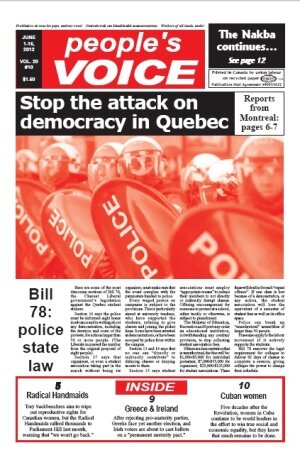
June 1-15, 2012
Volume 19 – Number 10
$1
Prolétaires de tous les pays, unissez-vous!
Otatoskewak ota kitaskinahk mamawestotan!
Workers of all lands, unite
COMPACT VERSION OF PEOPLE’S VOICE
JUNE 1-15, 2012 ARTICLES
FOR MOBILE DEVICES
1) BILL 78 IS A DANGEROUS CLUB TO BEAT THE PEOPLE!
2) BILL 78: POLICE STATE LAW
3) "STUDENT STRIKE, POPULAR STRUGGLE"
4) "WE WILL NOT BE SILENT, WE WILL NOT GO BACK"
5) LABOUR MOVEMENT SLAMS ANTI-WORKER MEASURES
6) THE PROBLEM IS CAPITALISM - Editorial
7) WARM UP THE CHOPPERS - Editorial
8) HUNGER A HUMAN RIGHTS ISSUE, SAYS UN EXPERT
9) SOLIDARITY TRUMPS RACISM AT KANONHSTATON RALLY
10) SOLIDARITY AGAINST AUSTERITY BUILDS IN OTTAWA
11) LEE LORCH RECEIVES DISTINGUISHED ACADEMIC AWARD
12) NDP LEADER BETRAYS STUDENT PROTESTERS
13) CANCEL THE DEBT, DISENGAGE FROM THE EU
14) MANTO'S LEGACY REMAINS ALIVE
15) MUSIC NOTES, by Wally Brooker
16) THE NAKBA IS ONGOING FOR TODAY'S PALESTINIANS
17) PERMANENT AUSTERITY TREATY - VOTE NO
18) WHAT’S LEFT
19) CLARTÉ (en français)
20) THE SPARK! (Theoretical and Discussion Bulletin of the Communist Party of Canada)
21) INTRODUCING MARX
PEOPLE'S VOICE JUNE 1-15, 2012 (pdf)
|
People's Voice deadlines: June 16-30 July 1-31 Send submissions to PV Editorial Office,
|
|
REDS ON THE WEB |
|
People's Voice finds many "Global Class Struggle" reports at the "Labour Start" website, http://www.labourstart.org/. We urge our readers to check it out! |
* * * * *
People's Voice
Canadian Publications Mail Sales Product Agreement #205214
ISSN number 1198-8657
People's Voice is published by
New Labour Press Ltd
PV Editorial Office
706 Clark Drive,
VANCOUVER, B.C. V5L 3J1
Phone:604-255-2041
Fax:604-254-9803
email: pvoice@telus.net
Editor: Kimball Cariou : Business Manager: Sam Hammond
Editorial Board: Kimball Cariou, Miguel Figueroa,
Doug Meggison, Naomi Rankin, Liz Rowley, Jim Sacouman
* * * * * *
Letters
People's Voice welcomes your letters
on any subject covered in our pages.
We reserve the right to edit for length and clarity,
and to refuse to print letters which may be libellous
or which contain unnecessary personal attacks.
Send your views to:
"Letters to the Editor",
706 Clark Dr., Vancouver, BC V5L 3J1,
or pvoice@telus.net
People's Voice articles may be reprinted without permission,
provided the source is credited.
* * * * * *
The Communist Party of Canada, formed in 1921,
has a proud history of fighting for jobs, equality, peace,
Canadian independence, and socialism.
The CPC does much more than run candidates in elections.
We think the fight against big business and its parties
is a year-round job,
so our members are active across the country,
to build our party and to help strengthen people's movements
on a wide range of issues.
All our policies and leadership
are set democratically by our members.
To find out more about Canada's party of Socialism,
give us a call at the nearest CPC office.
* * * * * *
Central Committee CPC
290A Danforth Ave Toronto, Ont. M4K 1N6
Ph: (416) 469-2446
fax: (416) 469-4063 E-mailmailto:info@cpc-pcp.ca
Parti Communiste du Quebec (section du
Parti communiste du Canada)
5359 Ave du Parc, Montréal, Québec,
H2V 4G9
B.C.Committee CPC
706 Clark Drive, Vancouver, V5L 3J1
Tel: (604) 254-9836
Fax: (604) 254-9803
Edmonton CPC
Box 68112, 70 Bonnie Doon P.O.
Edmonton, AB, T6C 4N6
Tel: (780) 465-7893
Fax: (780)463-0209
Calgary CPC
Unit #1 - 19 Radcliffe Close SE
Calgary AB, T2A 6B2
Tel: (403) 248-6489
Ottawa CPC
Tel: (613) 232-7108
Manitoba Committee
387 Selkirk Ave., Winnipeg, R2W 2M3
Tel/fax: (204) 586-7824
Ontario Ctee. CPC
290A Danforth Ave., Toronto, M4K 1N6
Tel: (416) 469-2446
Hamilton Ctee. CPC
265 Melvin Ave., Apt. 815
Hamilton, ON.
Tel: (905) 548-9586
Atlantic Region CPC
Box 70 Grand Pré, NS, B0P 1M0
Tel/fax: (902) 542-7981
http://www.communist-party.ca/
* * * * * *
News for People, Not for Profits!
Every issue of People's Voice
gives you the latest
on the fightback from coast to coast.
Whether it's the struggle for jobs or peace, resistance to social cuts,
solidarity with Cuba, or workers' struggles around the world,
we've got the news the corporate media won't print.
And we do more than that
- we report and analyze events
from a revolutionary perspective,
helping to build the movements for justice and equality,
and eventually for a socialist Canada.
Read the paper that fights for working people
- on every page, in every issue!
People's Voice
$30 for 1 year
$50 for 2 years
Low-income special rate: $15 for 1-year
Outside Canada $50 for 1 year
Send to: People's Voice, 706 Clark Drive, Vancouver, BC, V5L 3J1
You can call the editorial office at 604-255-2041
REDS ON THE WEB
http://www.communist-party.ca/
http://www.ycl-ljc.ca/
http://www.solidnet.org/
(The following articles are from the June 1-15, 2012, issue of People's Voice, Canada's leading communist newspaper. Articles can be reprinted free if the source is credited. Subscription rates in Canada: $30/year, or $15 low income rate; for U.S. readers - $45 US per year; other overseas readers - $45 US or $50 CDN per year. Send to People's Voice, c/o PV Business Manager, 706 Clark Drive, Vancouver, BC, V5L 3J1.)
1) BILL 78 IS A DANGEROUS CLUB TO BEAT THE PEOPLE!
Parti communiste du Québec; Communist Party of Canada; Ligue de la jeunesse communiste du Québec; Young Communist League of Canada
The adoption of Bill 78, May 18, 2012 by the corrupt and reactionary government of Jean Charest (with the support of the ultra‑right party, Coalition Avenir Québec or CAQ), will go down in Canada and Quebec`s history as one of the most serious attacks against civil liberties, fundamental rights and democracy in general.
The attack in Quebec on freedom of speech, assembly, and the right to organize threatens the people across Canada.
We call on labour, students, popular movements and all democratic‑minded people of Quebec and English‑speaking Canada to unite and fight for the preservation of our democratic rights and against Bill 78. A unified and coordinated resistance is the only effective way for the people of Quebec to repeal the Act and to make a break from the policies of austerity, privatization and higher fees. We call to intensify mobilization efforts to organize a general strike in Quebec.
An anti‑democratic law
The President of the Bar Quebec Association, Louis Masson, has said "that this bill, if passed, constitutes a violation of the constitutional and fundamental rights of citizens. The extent of these limitations to fundamental freedoms is not justified to achieve the objectives of the government."
The amendments made by the CAQ in no way diminish these concerns. In particular, the law:
* seriously limits the right of association, the right to demonstrate and freedom of expression,
* requires organizers of events with 50 or more people to reveal to police the route and mode of transport at least eight hours before they start;
* gives police the authority to unilaterally order demonstrators to change their route or location;
* imposes financial sanctions so severe that they threaten the continued existence of student unions and employee associations on campus;
* demands student associations and employees to take steps to ensure that their members comply with the law;
* imposes a reverse onus of proof on the employee associations in which a member would be charged with offense;
* while the explicit notion of encouragement has been removed, the law still states that anyone who helps or induces another person to commit an offense under the Act is liable to the penalties provided.
The Swiss "example"
During a press conference Robert Dutil, Quebec Minister of Public Security, raised that Quebec would be neither worse nor better than other countries in Europe or US states that also, he claimed, limit the right to protest in the same way. He mentioned in particular the case of Switzerland. It seems that the Charest government has been greatly inspired by a law passed in April 2012 by the canton of Geneva, which limits the right to protest similarly to Law 78.
The Swiss law was an initiative of the extreme right. Its progressive opponents are currently challenging the law in federal court because it is contrary to the constitution and international treaties. Minister Dutil did not mention that the UN Special Rapporteur on the Rights of Peaceful Assembly and Association, Maina Kiai, has made serious proposals for amendments to the Geneva law. Kiai, whose position is connected with the Council for Human Rights, said the Swiss law would "unduly restrict the rights to freedom of peaceful assembly and expression, which are the essence of democracy," and that "the exercise of fundamental freedoms should not be subject to prior authorization."
The right to protest is a fundamental democratic right. However, a fundamental right subject to an authorization is no longer a fundamental right. The exercise of the fundamental right to demonstrate must be without any prior authorization. We call on the people to continue to exercise their right to protest with or without permission.
The student strike expands
What began as a campaign for access to education by the students has become a broad popular struggle against cuts, privatization and austerity measures. Now it is a battle for the right to organize, freedom of association, and for democracy itself.
In fact, the student movement is currently in the forefront of popular struggle against a widespread political and social crisis. This is why the bourgeoisie wants to crush it at once. The stakes are high: a defeat of the student movement would be a setback to all progressive forces, in Quebec and Canada, while a victory for the students would help everyone.
That is why the labor movement has a duty to become directly involved in the fight.
Helping the monopoly corporations
Law 78 also fits with Charest's election strategy, so much so that it could be titled "An Act to support the Liberal campaign." Charest not only intends to get political mileage from the student struggle by presenting the Liberals as the party of Law and Order, he also wants to curb any protests during his election campaign.
The stubbornness of the Charest Liberals is entirely responsible for the crisis. This obstinacy is the consequence of their total loyalty to the ruling class, the big capitalist monopolies which are increasingly worried about the development of the popular struggle that has shook the Quebec nation.
By refusing to seriously negotiate with the student movement and instead deploying violent paramilitary police, anti‑democratic court orders, and now adopting this reactionary and provocative law, the Charest Liberals have again demonstrated arrogant contempt for the youth, educators, unions, and all the people of Quebec.
Class struggle
At each stage of this struggle, the class nature of the claims of youth, students and workers have become clearer. Similarly, the fight has exposed the limitations of democracy in a capitalist system.
According to Jean Charest, democracy is limited to voting in elections every four years. Now, between elections it seems, we have a dictatorship of the 1 percent where it is almost needless to consult or accommodate popular demands.
In a democracy according to Charest, rights are increasingly reduced to only those who can afford them, such as the right to use private health services, or as the right to education, which becomes the individual right to attend paid courses. The corporations can ignore workers' rights or pollute a river for a tiny penalty, but when the people resist, the government tries to fine them out of existence.
The crisis of the capitalist system
The crisis in Quebec is also a reflection of the general and systemic economic crisis of capitalism as a whole. This crisis takes the form of an attack against the democratic rights coupled with increasing militarization and war.
The Harper Conservative government federally has wasted billions of dollars to bomb Libya, to keep the Canadian military in Afghanistan, and to increase military spending and prisons, all at the expense of social programs. One F-35 bomber could pay for Charest's tuition increases.
The Harper Conservatives have attacked also the right to strike by imposing back to work orders at Air Canada and Canada Post. They also deliberately manipulated the electoral and parliamentary processes with "robocalls."
Last March, BC elementary and high school teachers had their right to bargain collectively and strike violated. The fierce repression at the G20 summit in Toronto in 2010 led to over a thousand arrests, while the Occupy movement was evicted last fall.
As the Central Committee of the Communist Party said in spring 2010, the reason behind this class repression is the same: to stifle the democratic aspirations of the masses, weaken the struggle of the working class and, if necessary, crush anti-capitalist dissent.
The seeds of fascism
True democracy is actually an anathema to capitalist domination. As the systemic crisis deepens and expands the class struggle, the ruling class does not hesitate to use all means at its disposal to maintain its hegemony, even removing the democratic rights that it generally tolerates under bourgeois democracy.
Bill 78 must be fought not only by the people of Quebec, but by all democratic Canadians, because it plants the seeds of fascism.
Chants on the street have compared Law 78 with the War Measures Act or the Padlock Law of Duplessis. The Padlock Law began as an attack on the Communist Party in Quebec and rapidly expanded to almost any labour or progressive group. The law was brought into force in 1937, and it took twenty years before the Supreme Court struck it down. By that time the government had created the PROFUNC list, which was used by the police and military in 1970 to help round up "suspects" after the declaration of the War Measures Act.
Quebec solidaire
To overcome Bill 78 to win the battle against austerity measures, the people of Quebec must not be limited to a legal battle or hope for a change in government through elections. The best approach for working people and youth, against big business and its government power, is above all united action and mass mobilization.
An election will also take place, sooner or later, and will bring together parties which voted against Bill 78, but at the same time opposed other progressive demands. For example, although she wears the red square today, Pauline Marois says it is necessary to increase tuition, but at a slower pace.
The best vehicle for the hope of the students and peoples is, currently, Quebec solidaire. Notably, Quebec solidaire calls for free education, a longstanding demand of the Communist Party and Young Communist League. Blocking the right, defeating the Liberals, and electing a government of Quebec solidaire is an important part of the way forward.
Call for solidarity
In the context of Bill 78, the Quebec students have called for solidarity and material support from across Canada.
Bill 78 comes on top of already harsh repression. As of May 18 there have been 472 criminal charges during the strike. One week in April saw over 600 arrests in three days. Thousands have been pepper sprayed and tear gassed, clubbed and beaten, detained and released. Victims of the strike include Francis Grenier, who lost most of his sight when a sound grenade was illegally thrown by a police officer into his eye; Maxence Valade who lost an eye from a rubber bullet; and Alexandre Allard, who was in a coma for several days from a rubber bullet to the head.
Four students are currently being charged under provisions of anti‑terrorist laws enacted following September 11th. Gabriel Nadeau-Dubois, co‑spokesperson of CLASSE, will appear in Superior Court for having dared say that "I find it legitimate" that students form picket lines to defend their strike.
On the other hand, Federal NDP leader Tom Mulcair's opportunist decision to say nothing about the principles behind this dramatic, massive struggle is a serious betrayal of the student protesters. Mulcair said the tuition hike "is first and foremost a matter of provincial jurisdiction... Our fight is not with the Charest government... Violence is not the right way to do things." All these statements were helpful to the Charest government, while isolating the students from the solidarity of popular organizations who follow the lead of the NDP.
We call for labour, student, community and progressive organizations to send messages of support to the Quebec students, and for emergency solidarity actions to be held across the county to break the silence in English‑speaking Canada about this incredible people's movement!
For a Charter of Youth Rights!
Bill 78 is also a direct attack on the rights of youth. Instead, we demand a Charter that defends their right to accessible education; good quality and safe union employment, democracy; peace; leisure and democratic culture; justice for Aboriginal youth and Quebec; and full equality. The Charter would be legislation with teeth, preventing further erosion of our rights on all levels.
In Quebec, forward for a general strike
United mass mobilization must continue to grow with the labour movement fully involved. It is now time to start organizing a general strike, social and political! The coming months of summer and fall will be a crucial period to further expand the struggle and mobilization. This is why the Communist Party calls for the organization the working class and student movements to be prepared to increase the response early in the fall.
Here are some of the most draconian sections of Bill 78, the Charest Liberal government's legislation against the Quebec student strikers.
Section 16 says the police must be informed eight hours in advance and in writing about any demonstration, including the duration and route of the protests, for actions larger than 50 or more people. (The Liberals increased the number from the original proposal of eight people).
Section 17 says that organizers, or even a student association taking part in the march without being its organizer, must make sure that the event complies with the parameters handed to police.
Every waged person on university and college campuses is subject to the provisions. This is particularly aimed at university teachers, who have supported the students, refusing to give classes and joining the picket lines. Some have been arrested at demonstrations, or have been scooped by police from within the campus.
Section 13 and 14 says that no one can "directly or indirectly contribute" to delaying classes or denying access to them.
Section 15 says student associations must employ "appropriate means" to induce their members to not directly or indirectly disrupt classes. Offering encouragement for someone to protest at a school, either tacitly or otherwise, is subject to punishment.
The Minister of Education, Recreation and Sport may order an educational institution, notwithstanding any contrary provision, to stop collecting student association fees.
If there is a demonstration that is unauthorized, the fine will be: $1,000‑$5,000 for individual protesters; $7,000‑$35,000 for organizers; $25,000‑$125,000 for student associations. These fines will double for each "repeat offence". If one class is lost in a university because of a demonstration, or any action, the student association will lose the equivalent of a semester of student fees as well as its office space.
Police can break up "unauthorized" assemblies of larger than 50 people.
Fines also apply to the labour movement if it actively supports the students.
Bill 78 removes the legal requirement for colleges to deliver 82 days of classes to complete a session, giving colleges the power to change their schedule.
3) "STUDENT STRIKE, POPULAR STRUGGLE"
Gabriel Nadeau-Dubois is the co‑spokesperson of la CLASSE ‑ Coalition Large of ASSE, one of the key sections of the Quebec student strike movement. A student at the University of Quebec at Montreal (UQAM), he was elected Secretary for Communications ASSE in April 2010, and became co‑spokesperson of the CLASSE, with Jeanne Reynolds, later that year. Since the beginning of the Quebec student strike of 2012, he has become the voice of the left‑wing of the student movement, a prominent media personality, and a symbol of resistance against the government. One particularly vicious section of Bill 78 has been nicknamed "clause Gabriel Nadeau-Dubois" because it allows the law to apply in addition to existing charges, and he has already been charged with a potential $50,000 fine or jail time in convicted.
People's Voice interviewed Nadeau-Dubois outside the May 19-20 weekend congress of the CLASSE.
What is the work of the congress today?
The main discussion, as an organization, is about do we want to publicly defy this law? Do we want to respect this law? If we want to defy it, how? It is a big congress, a big decision for the student movement to decide to be publicly illegal.
(NOTE: Unlike the university and college students federations who have said they will abide by Law 78, the CLASSE has since announced that it is calling on students to continue mobilizations and carry out their constitutional rights of assembly and protest. A website has also been launched where students are posting their faces, stating they defy the law, called Someone Stop Me. http://www.arretezmoiquelquun.com/)
Can you talk about this law?
I think this is the last chance of the government to stop our movement. They tried to divide us, they tried by police brutality, they made offers in the media hoping that the students in the general assemblies would stop the strike, and they encourage the students who are against the strike to seek injunctions in the courts to force the teachers to give courses. All those attempts have failed. So now the government is desperately trying to kill the movement at the moment it is stronger.
Can you explain your slogan - student strike, popular struggle?
We started on this specific issue of the tuition increase, but quickly students began to talk in the general assemblies about the tuition increase being part of a much broader wave of neo‑liberal reforms, not just in Quebec but all over the world. We have more and more citizens coming to our protests who are not students. We have called for the workers to join us and it has worked - workers, citizens, community groups, other youth. The strike is about the possibility of the social movements to continue to contest the decisions of the government... This gave birth to the slogan that the strike is a student issue but the fight is for everyone.
What is the Red Hand Coalition?
This was founded three years ago at the time of the Bachand Budget, the first budget that really clearly attacked public services, to terrify and privatize. In the same budget we had the tuition increase, and the imposition of the $200 annual health tax per citizen. This huge coalition was created, regrouping the student movement, health and teachers unions, community groups, to contest not only the specific measures but also the vision of society and state that is inside this budget. Since then it has been the main coordination place for the social movements.
What support do you need from English‑speaking Canada?
In Quebec we have a very active student movement. The best support we can have is for students elsewhere in Canada and the world to mobilize themselves against the tuition increases. We have seen this more and more, we are receiving more and more emails and phone calls.
4) "WE WILL NOT BE SILENT, WE WILL NOT GO BACK"
By Larry Wasslen, Ottawa
Pro‑choice activists rallied May 17 on Parliament Hill to stand up to the annual anti-choice "March for Life" organized by Campaign Life Coalition, whose goal is the abolition of abortion rights in Canada.
Approximately 300 people gathered across the street at the Terry Fox Monument, then marched forward onto the Hill with colourful placards, chanting "Not the church and not the state women must decide their fate" and "my body, my right, my choice (women), her body, her right, her choice (men)". They were young and old, women and men, rallying together for women's fundamental reproductive rights and to counter MPs, Senators, Knights of Columbus, Evangelical Fellowship and other religious groups who want to abolish a woman's right to choose.
The counter-demonstration was organized by Planned Parenthood, Canadians for Choice, and the Radical Handmaids, a newly formed grassroots group of women engaged in their communities, schools and unions in the national capital region. Organizers are particularly concerned about Conservative backbench MP Stephen Woodsworth's Motion 312. Aimed to convene a special parliamentary committee to review the definition of "human being" (Subsection 223(1) of the Criminal Code of Canada) to determine if it should be extended to include fetuses, this motion is another attempt by the right wing to attack women's reproductive rights, including the right to abortion.
Shelley Melanson of Canadians for Choice, and a member of the Radical Handmaids, said she wanted to bring a message to Canadian youth that what they are being taught in some schools and churches is inadequate and inaccurate concerning abortion rights. For example, promoting abstinence instead of providing comprehensive sex education where health, protection and facts are discussed, teaching students that women who seek abortions are promiscuous, whereas even when using the pill one can still get pregnant, etc.
She wants youth to understand that Canada is a pro‑choice society, that this issue has already been fought for and won decades ago. Melanson said the real issue is how we can ensure more access to health services for women across the country.
Katrin, another Radical Handmaid activist, specifically mentioned the new threat brought forward by the Woodsworth private member's motion. Her group has used social media and word of mouth to encourage people to come out in support of women's reproductive and sexual rights. Katrin was active in the Occupy Ottawa movement, and credited that movement with her inspired activism. She stated that if women were covered by hate crime legislation the anti-choice speeches at the "March for Life" would qualify as hate speech. The "March for Lifers", she said, were not just anti‑choice but clearly anti‑woman, putting a fetus before a woman in the hierarchy of human rights.
Sandrine, a long‑time feminist, pro‑choice activist, and one of the founding Radical Handmaids in Ottawa, said: "I am here today because it is imperative that wherever there is an attempt on fundamental human rights in our society we be there together and strong to name it, denounce it and fight it."
When asked about the "March for Life" Sandrine added, "it is important to understand that the anti‑choice political movement is not at all about life. It is about the control of women's sexuality, her bodily integrity and fundamental human rights. Generations of women, and men, before us fought to achieve the rights of women to personhood, education, health and reproductive rights including abortion rights. It is up to us, today, to defend these rights. We will not be silent and we will not go back."
Demonstrators then marched to the Human Rights Monument on Elgin Street.
5) LABOUR MOVEMENT SLAMS ANTI-WORKER MEASURES
PV Vancouver Bureau
The labour movement has sharply condemned new anti-working class measures announced by the Harper Conservative federal government.
At the heart of the Harper government's 2012 budget is a "pay‑less wage model" that is unfair to temporary workers from abroad and is designed to provide business with a pool of low‑paid employees, Canadian Labour Congress representatives and other activists said at an Ottawa news conference on May 15.
Effective immediately, the far‑reaching changes to Employment Insurance (EI) and the Temporary Foreign Worker Program (TFWP) are buried in the federal government's controversial omnibus budget legislation being pushed through Parliament by the Tories.
The changes to TFWP permit employers to pay migrant workers up to 15% less, and employer applications for these workers will be fast-tracked.
"Allowing employers faster access to migrant workers and paying them less for their labour sends a message that this government believes migrant workers are not equal," said Hassan Yussuff, Secretary‑Treasurer of the CLC. Yussuff said the new measures will exert a "terrible downward pressure" on all workers' wages.
"Employers will benefit by having a pliable workforce available at a moment's notice," commented Naveen Mehta, director of human rights with United Food and Commercial Workers Canada (UFCW), who warned that the main thrust of the budget changes is to help business.
"Rather than further skewing Canada's Temporary Foreign Worker Program to unfairly serve employers' interests," said Mehta, "what is needed are stronger compliance, monitoring and enforcement measures to protect migrant workers' rights."
Alfredo Barahona, Migrant and Indigenous Rights Program Coordinator with KAIROS, added, "Instead of focusing on filling long‑term labour needs with short‑term workers who don't enjoy the same rights and protections as other workers, Canada should be nation‑building by bringing in workers as permanent residents."
While the full details have been slow to emerge, the changes quickly raised alarms.
The new regulations will allow employers to pay temporary highly‑skilled foreign workers up to 15 per cent less (for low‑skilled workers, up to 5 per cent less) than the prevailing local wage under some circumstances. So far, the reduced wage threshold measures do not apply to temporary farm workers.
Human Resources Minister Diane Finley says the lower wages can be paid to temporary foreign workers only if other Canadian employees accept the same pay. But government officials admit that if a company once had Canadian employees who were being paid below the average local wage, but no longer has Canadian workers, temporary foreign workers can be brought in as needed and paid at up to 15 per cent below the local going rate.
The labour movement says the government is creating an unwieldy, confusing and unfair system for determining the wages of temporary foreign workers, and that the new approach discriminates.
"Canada's laws don't support wage discrimination based on where you come from," said Yasmeen Khan of MIGRANTE‑Canada, an alliance of organizations supporting Filipino migrants, who comprise the largest number of temporary workers in Canada. "Many people recognize the majority of migrant workers are people of colour and oppose wage discrimination based on race."
Union representatives argue that the federal government should be expanding immigration quotas to allow skilled foreign employees to stay permanently. Canada's economic prospects are not improved by training thousands of foreign workers and then throwing them out of the country after three or four years, said the UFCW's Mehta.
The news conference also raised concerns about measures in the budget legislation to pressure EI recipients to lower their criteria for employment. The Tories want the changes to "clamp down" on EI claimants, despite the fact that less than 40% of unemployed workers are eligible for EI.
Finance Minister Jim Flaherty says that recipients who pass up "reasonable" job offers could lose their EI benefits.
Claiming that "there is no bad job", Flaherty says he has "little sympathy" for EI recipients. He has used his own personal history to make this argument, claiming that he once worked as a taxi driver and a hockey referee.
Conservative cabinet ministers have frequently claimed that Canadians are passing up jobs such as Christmas tree harvesting, forcing employers to bring in foreign workers.
But NDP MPs have demanded more information on the planned changes, which would compel the unemployed to take jobs well below their skill level and previous earnings.
NDP Leader Thomas Mulcair asked in the Commons, "Does the prime minister actually agree that our teachers and our nurses should be taking jobs driving taxis rather than being given a chance to look for work in their own field?"
In reply, PM Harper has ignored the fact that 1.4 million Canadians are officially unemployed, claiming that Canada's job-creation record is among the best in the industrialized world, and that there will be an ongoing labour shortage for years to come.
Finley has sent a slightly different message, downplaying concerns that unemployed workers will be pressured to take distant, unskilled jobs. "Canadians will be expected to take jobs appropriate to their skill level - in their area," Finley said. But big questions remain about how the new policies will be implemented.
People's Voice Editorial
There are a variety of explanations for the neoliberal agenda which continues to drive working people into poverty, credit card debt, homelessness and despair - and for the best way to reverse this attack.
The latest moves by the Harper Tories offer a good example of this debate. The federal government's changes to immigration policies will bring in more temporary workers, and allow employers to pay such workers 15% below prevailing wage rates. Meanwhile, so-called "reforms" to the Employment Insurance program will compel workers to accept unsuitable job offers outside their home areas.
The labour movement and its allies have condemned these anti-working class measures. As CLC Secretary-Treasurer Hassan Yussuff warns, such policies put downward pressure on all workers' wages.
But some critics have offered ideas for "better" ways to improve to generate economic growth. Others argue that the Tories are somehow "misguided" or "uncaring".
The point is not that such policies are "immoral" or poorly considered. These "reforms" are necessary for big capital and compliant governments to maintain overall rates of profit by expanding the army of unemployed workers who are compelled by hunger and deprivation to accept any job at any rate of pay. From the perspective of the "1%", these policies are absolutely justified to keep the wheels of capitalism turning.
For the working class, the immediate struggle is to block these attacks. But victory will not be achieved through temporary successes or stalemates, as long as the capitalist system itself remains in place. Sooner or later, resistance must move in the direction of replacing the economic system based on private profit, with a socialist society in which those who create the wealth are also those who have the democratic power to create a better world.
People's Voice Editorial
Faced with the inevitable, NATO leaders gathered in Chicago May 20-21 took the next steps towards pulling out of Afghanistan. More than a decade after the US-NATO invasion began, President Barack Obama and other NATO leaders are whistling in the dark, expressing "confidence in Afghanistan's ability to take the lead for its own security" by next year. But the stampede to the exits has begun. Sixty-six per cent of Americans oppose this war, compared to just 27 per cent in support, according to recent polls. French voters just elected President Francois Hollande, who promised to pull their 3,300 troops out of Afghanistan ahead of schedule.
The reality is that only the Afghan people can find political, negotiated solutions for a better future. That path will be paved with harsh difficulties, but the imperialist intervention has only delayed this process. Canada, for example, has spent over $20 billion on the occupation, leaving the Afghan people nothing for this monumental sum. Claims about Canadian troops building hospitals and schools are simply PR propaganda, and the percentage of girls attaining literacy has barely budged. There will be no proud exit, no "job well done" for the NATO armies who failed to subdue the "enemy". NATO's true legacy will be its despicable role in temporarily propping up the coalition of thugs and drug lords around President Karzai.
Finally, after the 2014 exit date, Canada will continue to pump $110 million annually into "training" the Afghan army and police forces. We have a better idea. Canada should pay a much larger amount in reparations for our country's share of the deaths and destruction inflicted on the Afghan people. And maybe we should also send Don Cherry, Christy Blatchford, Rob Ford, Peter Mackay and a few more pro-war mouthpieces over to Kandahar to help repair the damage.
8) HUNGER A HUMAN RIGHTS ISSUE, SAYS UN EXPERT
PV Vancouver Bureau
"Canada has long been seen as a land of plenty. Yet today one in ten families with a child under six is unable to meet their daily food needs. These rates of food insecurity are unacceptable, and it is time for Canada to adopt a national right to food strategy."
Those were the words of Olivier De Schutter, the UN Special Rapporteur on the right to food, on May 16, the last day of his official visit to Canada. De Schutter's statements were welcomed by the Assembly of First Nations.
"What I've seen in Canada is a system that presents barriers for the poor to access nutritious diets and that tolerates increased inequalities between rich and poor, and Aboriginal non‑Aboriginal peoples, said De Schutter, noting that Canada has been viewed as a "champion" of human rights. "But hunger and access to adequate diets, too, are human rights issues ‑ and here much remains to be done."
The UN human rights expert argues that Canada could move towards food systems that deliver adequate and affordable diets for all. He called upon the Canadian government to convene a food conference that would clarify the allocation of responsibilities between the federal level, the provinces and territories.
De Schutter pointed to three areas of concern.
First, many Canadians are too poor to afford adequate diets: 800,000 households are food insecure in Canada, a rich country which fails to adapt social assistance benefits and minimum wages to the rising costs of basic necessities, including food and housing. Food banks that depend on charity are not a solution, he said, calling these a symptom of failing social safety nets.
Second, high levels of obesity impose costs on the health care system and economic productivity. This problem is also a result of poverty: adequate diets are too expensive for poor Canadians, who have to pay the most when they live in "food deserts" and depend on convenience stores that charge high prices.
Third, the situation of Aboriginal peoples raises specific concerns. Referring to the fly‑in communities in Manitoba and reserves in Alberta that he visited during the mission, De Schutter called for a reform of the Nutrition North Canada program that subsidizes retailers to serve remote communities. He also called for a structural approach to tackling the socio‑economic and cultural barriers which prevent those living on reserves from enjoying fully their right to adequate food.
Neither the federal nor provincial governments, he added, accept a responsibility to support off‑reserve Aboriginal peoples in overcoming the structural discrimination they face.
While many useful initiatives seek to rebuild local food systems, to ensure adequate incomes to farmers, and to improve consumers' access to fresh and nutritious foods, De Schutter said, these efforts are not sufficiently supported at the federal level.
"School breakfast and lunch programs still depend on local initiatives in the absence of a national policy in this regard," he said.
The Special Rapporteur will present his final report to a session of the UN Human Rights Council in 2013. Appointed in May 2008 by the Council, he is independent from any government or organization.
9) SOLIDARITY TRUMPS RACISM AT KANONHSTATON RALLY
By Rick Gunderman
On April 28, some 400 people marched through the small town of Caledonia, Ontario to demand justice for the Six Nations of the Grand River Territory.
A grand coalition of people from all backgrounds and walks of life came to express solidarity with Six Nations. Many came from other parts of the province, with a significant presence from Toronto and Hamilton. Members of the Six Nations as well as non-Native residents of Caledonia and the surrounding area counted themselves among the demonstrators.
The demonstration was peaceful, positive and vibrant. Participants gathered in Edinburgh Square, on the north side of the Grand River. There, officers from the Ontario Provincial Police walked through the crowd with video cameras, recording participants from the pro‑Six Nations side. When one officer came across two comrades from Hamilton's Communist Party and Young Communist League, he stopped and stood recording for several minutes.
Afterward, a fellow demonstrator confronted the officer. A small crowd had gathered around the man, who put his hand in front of the officer's video camera, and most started taking pictures or recording. The situation was defused and no further problems resulted.
Shortly after, youth from the Six Nations used a megaphone to recite a Haudenosaunee (Iroquois) prayer. Following this, the demonstration proceeded down Argyle Street, over the iconic Caledonia Bridge and through the south side of the town.
The march generally proceeded smoothly, with the some minor exceptions. A local storeowner slung a baseball bat over his shoulder as he watched the demonstration pass his business. Many demonstrators understood this to be an intimidation tactic.
Before the march, local residents had gathered on the side of the streets. While most were simply watching with curiosity, a handful had come out to oppose the solidarity demonstration. The demonstrators either politely acknowledged or simply ignored the hecklers.
As we drew nearer to the land occupied by Six Nations - or Kanonhstaton, "the Protected Place", as it has been renamed ‑ a small crowd of opponents had gathered. Several were recognized as supporters of Gary McHale and Mark Vandermaas, well‑known instigators who run the groups Canadian Advocates for Charter Equality (CANACE), Caledonia Victims Project and Voice of Canada.
This group heckled the demonstrators, accusing them of being uninformed outsiders who only came to the town to cause trouble. However, among the solidarity marchers were non‑Native residents of Caledonia and the surrounding area, and many marchers testified that they had connections in Caledonia through family or friends.
The marchers returned the curses and pejoratives with peace signs, raised fists and waves of the hand.
The solidarity crowd proceeded a short distance to Kanonhstaton. There, four Six Nations members stood upon a steel structure at the entrance, holding up flags and welcoming their supporters.
At Kanonhstaton, a bouncy castle had been set up, food was distributed, and rock band from Caledonia came out to perform, including songs by Rise Against and Sublime.
In the aftermath, Vandermaas accused demonstrators of "terrorizing" the town, taking no responsibility for reopening old wounds. He even acknowledged the communist presence: "Just seeing the communist flag and banner fly was a great victory for us."
In fact, no flag was present. Most participants in the demonstration warmly welcomed the banner, and only a handful of residents outwardly opposed the communist presence.
True to form, Vandermaas ignored what the solidarity demonstration was about, i.e. unity between Six Nations and non‑Native residents of the area, in favour of scaremongering and red‑baiting.
Townspeople talked to the media that day, and several locals said they are supportive of Six Nations. Schools in Caledonia and in most towns in the area adjacent to the Grand River Territory have both Native and non‑Native students. Six Nations members regularly shop in the surrounding towns, and many non‑Native Canadians make regular visits to the reserve.
Like any town, Caledonia is not ideologically homogeneous. There are those who believe in harmony, peace and respect among all people, and others who wish to deny Canada's colonial past and present and hold onto racist, uninformed views of First Nations people.
The lines have been drawn in Caledonia. Not on April 28 - rather, they have existed since the area was settled. The abuses that the federal and provincial governments have inflicted upon the Six Nations only led to a sharpening of the lines. It led to a radicalization of the racists, and to the mobilization of all those who believe in justice and equality.
The Communists know which side they are on, and few other than the extreme right seem to have a problem with it.
10) SOLIDARITY AGAINST AUSTERITY BUILDS IN OTTAWA
By Larry Wasslen, Ottawa
Following Ottawa's most successful May Day protest in recent memory, labour, community, and student activists met to continue the momentum gained from a dynamic day of rallying, marching, teach‑in, community dinner, and cultural presentations.
The Solidarity Against Austerity committee grew out of the labour outreach action spawned by the Occupy Ottawa anti‑capitalist movement in the autumn of 2011. The labour outreach committee, described by activist Phil McGavin as "immensely positive", met weekly after the police violently broke up the peaceful occupation of a park in downtown Ottawa. About two months in advance, a sub-committee was struck with the purpose of planning for May Day.
An estimated 3,000 people converged on Stephen Harper's office to denounce his attacks on the working class, First Nations peoples, women, students, the poor, and the environment. PSAC delegates from their National Convention marched west to meet the community groups that were marching North. Led by CUPW, the demo took over Wellington Street, marching past Parliament to Quebec in a show of solidarity with the Quebec students' strike.
An impromptu speech of solidarity between the labour and student movements in a common battle against austerity was given by Dennis Lamelin, President of CUPW, as workers waved their support from their work stations. At least two of the major bridges between Quebec and Ontario had to be shut down, as the police did not know which bridges the demonstrators were going to cross.
The follow‑up gathering included workers from CUPE, PSAC, ONA, CAW, CUPW as well as community activists such as ACORN, anti-poverty groups, Rally for Truth, and student activists from the U of Ottawa. This meeting provided an opportunity to review all aspects of the May Day effort: planning, preparation, communication, languages, accessibility, education and implementation.
The significance of choosing May Day was underlined. A tremendous amount of work was undertaken barely two months before the event, and while the results were truly impressive given the short lead time, the consensus was that we can do better with more time to plan. Since most of the organizers are working, that organizing was done in their "spare time". The late addition of two paid staff was highlighted as an important element that greatly improved efficiency in the last weeks of planning for May Day.
All aspects of the event were reviewed, including capacity building and where do we go from here. It was decided to have a half day planning season, tentatively on June 9, while continuing solidarity actions.
Two actions were identified for immediate attention: a solidarity march from to Gatineau in support of students' fight against the pro‑austerity Charest Liberal government's tuition fee increases, and a June 23 action by Rally for Truth, a broad‑based movement denouncing last spring's electoral fraud and the corruption which has accelerated under the the Harper Tories.
It is evident that the ruling class intends to press forward with its plans to attack the working class, students, First Nations Peoples, women, the poor and the environment. But it is also clear that austerity can be blocked, as demonstrated in Greece, where the Conservative/Social Democratic alliance parties were clearly defeated. May Day 2012 was just the beginning.
11) LEE LORCH RECEIVES DISTINGUISHED ACADEMIC AWARD
By Liz Hill
On May 9th, Lee Lorch was presented with an award from the Canadian Association of University Teachers (CAUT), which has over 66,000 members. The Distinguished Academic Award is CAUT's highest honour and is given annually to an academic in recognition of excellence in all aspects of academic life, scholarship, teaching and service.
Usually, the award is presented at the CAUT spring council, but unfortunately, Professor Lorch's health will not permit him to travel to Ottawa. The award was presented at Toronto's Bridgepoint Health Centre with over thirty of Lee's family, friends and colleagues present. Guests included former Member of Parliament Jean Augustine, and two former speakers of the Ontario Legislature, David Warner and Alvin Curling.
In her remarks, Jean Augustine said Lee is a champion, a fighter, someone who has gone beyond, to support country and ensure things he believed in would be heard. He worked with her in the Canada Cuba Parliamentary group.
"Lee lived a life that is full‑service, and was always encouraging, nudging you in quiet fashion to ensure all can move forward in a society where justice is supreme," said Augustine.
The award was presented by Jim Turk, Executive Director of CAUT, who spoke of Lee's work as teacher, researcher and community activist.
Lee Lorch was given the microphone, and noted the struggle for the eight-hour day that is marked all over the world on May First, and the struggles for the rights of women, in which his wife Grace had been active after being fired from her teaching job because she "committed matrimony" - the school board did not allow married women to work.
Lee delighted everyone present with stories of his work in the U.S. civil rights movement in the 1950s, which resulted in his being fired from four different universities before coming to Canada to work and make his home.
Martin Muldoon, of the Mathematics Department at York University, and a colleague of Lee for over 50 years, told of how during a CUPE strike at York in 2000, Lee insisted they walk in solidarity with the picketers at all seven different entrances to the campus, never giving up. Prof. Muldoon commented on how well Lee is looking, making a wonderful recovery due to the good care at Bridgepoint.
12) NDP LEADER BETRAYS STUDENT PROTESTERS
By Darrell Rankin, Leader, Communist Party of Canada‑Manitoba
May 20, 2012 - Now banned by the Charest government's draconian Bill 78, the massive student protests in Quebec involve important principles for a better society.
Federal NDP leader Tom Mulcair's decision to say nothing about the principles behind the student struggle is a serious betrayal of the protesters.
Mulcair said the Quebec tuition hike "is first and foremost a matter of provincial jurisdiction... Our fight is not with the Charest government... Violence is not the right way to do things."
These statements were helpful to the Charest government and worked to isolate the students from the solidarity of popular organizations who follow the lead of the NDP.
Mulcair is obviously not pointing to the police, who use extreme violence against student protesters, with impunity.
Bloc Québécois MPs and media said the NDP caucus was ordered to "sit on their hands" and to "shut up," an important decision for a party which holds the majority of seats in Quebec. Mulcair said the role of other NDP MPs did not involve weighing in on Quebec provincial debates.
The Mulcair NDP was essentially telling the students to stop protesting, because there was some property damage.
Like right‑wing social democrats throughout history (and in Europe today), the Mulcair NDP has a deep aversion to the inconvenient realities of the actual class struggle, especially the fact that isolated struggles are easily crushed, protecting the narrow, selfish interests of the 1 per cent.
The student strike has been a model of collective decision-making, discipline, public debate, and open, not secret, negotiations. This did not stop Mulcair from repeating the slander of the 1 per cent mouthpieces that the student protests were violent.
The Mulcair NDP may prefer to act like the class struggle does not exist, that vital class interests were not involved in the Quebec student struggle. But the NDP cannot pretend to be neutral both towards the Charest government and towards the students. In fact, Tom Mulcair chose a side.
Objectively, the NDP has supported Charest's tuition hike. Expecting the parties of big business to be discredited in a few years, it is working hard to be recognized by the 1 per cent as "the last reserve of capitalism."
The Mulcair NDP is more interested in getting elected by condemning "violence" than it is in clearly stating its actual principles about higher education. Yet Mulcair's one‑sided comments show that the NDP in fact supports higher tuition fees. He has proven his loyalty to the capitalist big shots in Quebec and across Canada.
What will happen when protests erupt for higher wages, for Aboriginal rights, or against war and some violence occurs? Will the NDP be more interested in condemning the violence, or will it take a principled stand?
What is the NDP's position on tuition? I'm writing from a province where the NDP government has lifted a tuition freeze. What does this mean for the popular organizations ‑ the labour movement particularly ‑ who normally follow the NDP's lead? If they followed the NDP and did not send a solidarity message to the Quebec students, they did not help break the isolation and the struggle was not made stronger.
In contrast, the Communist Party sent messages of solidarity to the Quebec students and circulated an appeal for support widely through all popular organizations in Canada and internationally.
The main question today emerging in the battle against austerity and against new wars is if humanity will progress to a higher civilization or be forced to retreat, to a world or reaction, environmental catastrophe and permanent, spreading war. How this question is settled hinges on the active participation of the popular movements, in the first place the labour movement.
On this question, the Mulcair NDP is leading people in the opposite direction. We cannot have a vibrant, engaged civil society if the popular organizations in Canada contract out their political views to a single party, such as the NDP. Without the critical support of the popular movements, a purely parliamentary path towards a perfect society will only lead Canada to somewhere over the rainbow.
13) CANCEL THE DEBT, DISENGAGE FROM THE EU
Communist Party of Greece (KKE) statement, May 16, 2012
The KKE, when it was asked before the elections, what it would do in case it received the exploratory mandate, clarified honestly and boldly before the people (without caring about the cost it would have regarding votes) that it would immediately return the mandate. [Ed. note - In the Greek electoral system, the three parties which receive the largest numbers of votes are given mandates to explore the formation of a coalition government.] The KKE clarified that it will not participate in a government of bourgeois management that objectively entails an anti‑people way out from the crisis.
It is very well aware of the position and the practice of other parties, that none of the proposed governments, either those in favour of "negotiation" or those in favour of the "amendment" and a new Memorandum can solve the acute problems, even approach the needs of the people.
Respecting the institution of the mandates does not mean that the various parties should make exploratory attempts with hypocritical discussions and proposals since one or more parties have decided not to participate in the government as they want a new round of elections for their own purposes. Why, for instance, did SYRIZA (Coalition of the Radical Left) not say from the beginning that it wants a one party government so as to avoid this wretched game?
For this reason we asked for elections, not because elections constitute, as it is usually said, the culmination of the people's intervention, the solution for the people's problems but in order to stop the deception. In any case, we are heading for elections.
Therefore, the people must be ready to intervene drawing conclusions from this process of deception. These are staged games. But even if they form a government at the last moment the people should again be vigilant because elections will be around the corner.
We assess at the same time that each party via the procedure of the mandates attempted to place at the centre of the people's attention new misleading dilemmas so that if new elections are held the people will be trapped in old and modernised dilemmas and that the endurance of radical popular masses will be reduced in the face of the pressure.
Such dilemmas are:
1. Euro or drachma, despite the fact that whether with the euro or the drachma the people will be destitute.
2. Greek or European solution, despite the fact that the issue will be determined by the class struggle and confrontation within Greece first of all and of course at a European level, not by negotiations but by strengthening European labour and the people's movement in its struggle against the EU, in rupture with it.
3. Austerity or development, but the path of capitalist development entails austerity in the conditions of the sharpening capitalist competition, and sharpening inter‑imperialist contradictions.
4. Right or left, Memorandum or Anti‑memorandum, dilemmas which will also take on other forms, according to the developments, through the new form of the two poles centre‑right‑centre‑left.
These dilemmas, for which SYRIZA bears very serious responsibilities, marginalised and obscured the real contradictions inside Greece and the EU.
The real question for the Greek people is: Greece _ working people, independent and freed from European commitments or a Greece incorporated in the imperialist EU?
The real contradiction inside Greece and in the EU is between the capitalist businesses, the monopoly businesses and the interests of the working class, the self‑employed in the city and countryside, the contradiction between the governance of the people's power and the power for the perpetuation of the bourgeois class.
The only patriotic pro‑people position is the unilateral cancellation of the debt, the struggle for the disengagement from the EU and its blackmails.
These blackmailing and intimidating dilemmas are creating the two new poles of two‑party rotation, absolutely painless for the business groups, and in the end useful for the EU, as they all agree with the participation in the EU and therefore compliance with it. The people must not reinforce these two poles with their vote, reproduce them or support them in any way.
The election battle has begun. It is an opportunity for the suffering people to understand that there is a real danger that the radicalism, which they demonstrated, that the tendency to seek an alternative solution will be subjugated to the illusion of the "solution here and now", the lesser evil, "something better" whatever that may be.
The people have a major opportunity today to utilise their experience and not to throw it away in the name of the crisis, the dilemmas and illusions. The people and the country need a strong KKE and a movement fully emancipated from every governmental, employer and EU embrace. Consequently the vote must serve the regroupment of the labour movement, the social alliance and this is the reason why the strengthening of the KKE is important.
The people will pay a high price for every retreat from this perspective. Such a price would be new torments and disappointments and the loss of valuable time.
14) MANTO'S LEGACY REMAINS ALIVE
By Gurpreet Singh
The legacy of Saadat Hasan Manto, a progressive Urdu writer, remains alive as secularists around the world celebrate his birth centenary this year.
A prominent Pakistani author, Manto was born on May 11, 1912 in an undivided India. He grew up and studied in Punjab and ended up becoming a professional film script writer in Bombay. However, he gained much prominence as a fiction writer who authored over 200 short stories. His first collection was published in 1936. His first story, Tamaasha (Show) was about the 1919 massacre of supporters of the passive resistance movement by British troops in Amritsar, Punjab.
The partition of India on religious lines in 1947 became a major turning point both in Manto's personal life and work. The division came along with independence from the British occupation. A theocratic Muslim state called Pakistan came into being, whereas India chose to become a secular republic. The partition sparked sectarian violence - innocent Muslims were murdered on the Indian side and Hindus and Sikhs were massacred on the Pakistani side.
Manto, who lived in Bombay, migrated to Pakistan in 1948. This migration came as a rude shock to Manto, who admitted his disappointment in one of his essays, revealing his pain over the partition. He made Pakistan his home out of family compulsions, but remained an ardent opponent of theocracy. His anguish towards religious fanaticism and autocracy are also explicit in his stories. Those depicting the goriness and pains of partition became most read. Among them were Thanda Gosht (Cold Flesh), Khol Do (Open It) and Nangi Awaazein (Naked Voices).
He was charged and tried for spreading obscenity and promoting sexuality in Thanda Ghost. The story is about a Sikh man who tries to rape a dead Muslim woman during riots. The incident renders the Sikh impotent. Though Manto was repeatedly charged for such offences, he was never convicted. Both Thanda Gosht and Khol Do reveal sexual violence against women during riots.
These stories are still relevant as India and Pakistan continue to witness religious and sectarian bloodshed. The history of massacres has been repeated in a free and secular India a number of times, most notably the anti-Sikh pogrom of 1984 and anti-Muslim violence of 2002. Women belonging to these minority groups became a target of sexual abuse by the mobs during these massacres. Likewise, minorities continue to be persecuted in Pakistan. So much so, Shia and Sunni Muslims continue to fight in a Muslim state.
Nangi Awazein is another of Manto's stories relevant today. The story is about the frustration of a newly married couple in a refugee camp, who fail to make love because of lack of privacy. Years later, when Hindus were forced to flee the Indian side of Kashmir due to threats from Islamic militants and live in a tent city in Delhi, it was reported that the population growth came to halt in the refugee camps.
Manto has left a legacy that can help in bridging the cultural gap between India and Pakistan, but also bring awakening against forces inimical to people's unity and peace anywhere in the world.
15) MUSIC NOTES, by Wally Brooker
Karkwa's "Le Bon Sens"
Innovative indie rock band Karkwa has been making waves in Quebec for more than a decade. In 2010 their reputation spread to English‑speaking Canada when they received the Polaris Music Prize, an annual award given to the best Canadian album, regardless of genre, sales or record label. It was interesting to notice, while watching video of one of the mammoth student protests for accessible education in Quebec, their song Le Bon Sens being used as part of a soundtrack. Le Bon Sens is from their award-winning album "Les Chemins de Verre." It's easy to see why Quebec students might be attracted to the song. Here's a rough translation of a few lines: "It's difficult to see Paradise with one's face in the exhaust of a Ferrari...liquid paper is effacing my name...I want to walk backwards to move forward in the right direction." Visit CBC Radio's A Propos website for host Jim Corcoran's tribute to the band, including English translations of six songs from "Les Chemins de Verre."
Norwegians sing out against Breivik
When Norwegian mass‑murderer and Islamophobe Anders Breivik testified at his trial that Pete Seeger's 1973 song My Rainbow Race was a tool of "cultural Marxists" to brainwash children, citizens of the Scandinavian country responded swiftly. On April 26, 40,000 people gathered at Oslo's Youngstorget Square in the pouring rain, lifting their voices to join folksinger Lillebjoern Nilsen in the Norwegian version of the song. At the same time, thousands more sang in public squares across the country in defiance of Breivik's message of hate. The 33‑year‑old Breivik, with ties to a network of far‑right groups across Europe, went on a bombing and shooting rampage last July that left 77 dead, most of whom were members of the Labour Party's youth wing. For a complete YouTube video, search with keywords "thousands of Norwegians in Youngstorget Square."
Evalyn Parry at Toronto Mayworks
Singer‑songwriter Evalyn Parry closed Toronto's Mayworks festival last month with an entertaining and politically‑engaged concert at the Gladstone Hotel. Parry, who's also an actor, playwright and director, accompanied herself on guitar and shruti box, and led bandmates David Celia (guitar), Ben Whiteley (bass) and Brad Hart (drums) through two sets of original material, touching upon a wide variety of political and personal themes, including a witty feminist take on the history of cycling and a rap on the politics of bottled water. Between sets with the band Parry offered a fascinating glimpse of a work in progress. To Live in the Age of Melting will deconstruct Canadian folk icon Stan Rogers' song Northwest Passage, and examine issues of Arctic sovereignty, global warming, colonization, folk music and the history of conquest in the Canadian North. Stay tuned for more on this ambitious project. For more info: www.evalynparry.com.
On Lache Rien (We Don't Give Up)
In 2011 HK & Les Saltimbanks, a French band from the northern city of Lille, released its debut album "Citoyen du Monde." Founded in 2006 by Kaddour Hadadi, a son of Algerian immigrants, the band blends blues, reggae and hip‑hop with `chaabi' (a style of Algerian folk music). On Lache Rien (We Don't Give Up) is a celebratory song from "Citoyen du Monde." It was posted on YouTube last fall with equally uplifting video images. The result is a near‑perfect expression of the spirit of revolt that is raging in Europe and throughout the world these days. As the song says: "From deep in my ghetto to the depths of your countryside our reality is the same, and everywhere revolt is brewing." Unless you're bilingual look for the version with English subtitles. HK & Les Saltimbanks demonstrated their support of France's new Left Front coalition when they performed at a massive rally in April at Place de la Bastille for presidential candidate Jean‑Luc Mélenchon. For more info: www.saltimbanks.fr/.
Drummer Billy Bryans: 1947‑2012
Drummer, producer, and Parachute Club co‑founder Billy Bryans died on April 23 after a long struggle with cancer. He was remembered in a Toronto memorial and celebration on May 6. Family and friends, as well as musicians and fans attended an afternoon drum procession, led by local Brazilian percussion groups Samba Squad and Baque de Bamba, through Bryans' old haunts in the Queen Street West club district. Later the scene moved to the Lula Lounge, the popular world music nightclub in the west end, for a moving memorial service followed by an evening of performances by artists associated with the drummer during his 40‑year career, including Lillian Allen, Mojah, Molly Johnson, Lorraine Segato and Ken Whiteley. Billy Bryans will long be remembered for his solidarity and friendship with musicians from the city's insurgent anti‑racist, feminist and LGBT movements in the 1980s and beyond, as well as with countless visiting artists from Latin America, the Caribbean and Africa.
16) THE NAKBA IS ONGOING FOR TODAY'S PALESTINIANS
By Ramzy Baroud, Morning Star (UK)
The event marks the expulsion of nearly a million Palestinians, while their villages were destroyed. The destruction of Palestine in 1947‑8 ushered in the birth of Israel.
Older generations relay the harsh and oppressive memory of their collective experience to younger Palestinians, many of whom live their own Nakbas today.
In covering the Nakba, sympathetic Arab and other media play sad music and show black and white footage of displaced, frightened refugees. They rightly emphasise the concept of Sumud, steadfastness, as they show Palestinians of all ages holding onto the rusty keys of their homes and insisting on their right of return.
Other, less sympathetic, media discuss the Nakba as a side note ‑ a nuisance in the Israeli narrative of a nation's supposedly miraculous birth and its progression to an idyllic oasis of democracy.
What such reductionist representations often fail to show is that the Nakba never truly finished. Those who underwent the pain and loss of the Nakba are yet to receive the justice that was promised to them by the international community.
UN Resolution 194 states that "the refugees wishing to return to their homes and live at peace with their neighbours should be permitted to do so at the earliest practicable date."
Those who wrought this injustice are also yet to achieve their ultimate objectives in Palestine. After all, Israel doesn't have defined boundaries by accident.
Israel's first prime minister David Ben Gurion once prophesied that "the old [refugees] will die and the young will forget."
He spoke with the harshness of a conqueror. Ben Gurion carried out his war plans to the furthest extent possible. Every region in Palestine that was meant to be taken was captured, its people were expelled or massacred in their homes and villages.
Ben Gurion "cleansed" the land but he failed to cleanse Israel's past. Memory persists. Ben Gurion referenced my own family's village Beit Daras, which witnessed three battles and a massacre.
In an entry in his diaries on May 12, 1948, he wrote: "Beit Daras was mortared. Fifty Arabs [were killed]. The [villages of] Bashit and Sawafir were occupied. There is mass exodus from nearby areas [in Majdal]. We sustained five dead and 15 wounded."
More than 50 people were killed in Beit Daras that day.
An old Gazan woman, Um Mohammed, who I discussed in my book My Father Was A Freedom Fighter, refers to what is likely the same event: "The town was under bombardment and it was surrounded from all directions. There was no way out. The armed men [the Beit Daras fighters] said they were going to check on the road to Isdud to see if it was open. They moved forward and shot few shots to see if someone would return fire. No‑one did. But they [the zionist forces] were hiding and waiting to ambush the people.
"The armed men returned and told the people to evacuate the women and children. The people went out [including] those who were gathered at my huge house, the family house. There were mostly children and kids in the house. The Jewish [soldiers] let the people get out and then they whipped them with bombs and machine guns. More people fell than those who were able to run.
My sister and I ... started running through the fields ‑ we'd fall and get up. My sister and I escaped together holding each other's hands. The people who took the main road were either killed or injured. The firing was falling on the people like sand. The bombs from one side and the machine guns from the other."
Ben Gurion would not necessarily doubt Um Mohammed's account. He candidly stated: "Let us not ignore the truth ourselves ... politically we are the aggressors and they defend themselves... The country is theirs because they inhabit it, whereas we want to come here and settle down, and in their view we want to take away from them their country."
It is precisely for this reason that neither the old nor the young have forgotten. Every day is another manifestation of the same protracted Nakba that has lasted 64 years now. Young people's hardships today are inextricably linked to the violent and horrific uprooting decades ago.
The Nakba has also remained an ongoing project through generations of Israeli zionists. When Ben Gurion died in 1973, current Israeli Prime Minister Benjamin Netanyahu was in his mid‑twenties. He was then serving his last year in the Israeli army and today he rules Israel in a coalition that includes almost three‑quarters of the Israeli parliament.
Like most Israeli leaders, he continues to contribute to the discourse by which Palestine was conquered. He speaks of peace, while his soldiers and armed settlers take over Palestinian homes and farms. He makes repeated offers to Palestinians for "unconditional" talks, as he repeats his violent rejection of every Palestinian aspiration.
His lobby in Washington is much stronger than ever before. He reigns supreme, as he continues to fulfil the "vision" of early zionists.
Old keys and deeds of stolen lands attest to the intergenerational experience that is the Nakba.
Today Palestinians continue to be herded behind military checkpoints. They are denied the right to proper medical care and their ancient olive trees are ruthlessly bulldozed.
What Israel has not been able to control, however, is the resolve of Palestinians. The prison, the checkpoint and the gun reside in our collective memory in a way that cannot be held captive, controlled or shot.
In fact, the Nakba is not a specific date or an estimation of time but the entirety of those 64 years and counting.
The event must not be assigned to the shelves of history ‑ not as long as refugees are still refugees and settlers continue to rob Palestinian land.
As long as Netanyahu speaks the language of Ben Gurion, other "catastrophic" episodes will follow. And as long as Palestinians hold onto their keys and deeds, the old may die but the young will never forget.
Ramzy Baroud (www.ramzybaroud.net) is the editor of PalestineChronicle.com.
17) PERMANENT AUSTERITY TREATY - VOTE NO
Statement of the Communist Party of Ireland
On May 31, the people of Ireland will vote on the "Treaty on Stability, Coordination and Governance in the Economic and Monetary Union", which can only be called the Permanent Austerity Treaty. While the public debate is focused on this treaty, the Government is quietly pushing through the Dail its sister, the "Treaty on the European Stability Mechanism" (ESM). They are twins; they cannot be separated.
The Permanent Austerity Treaty is being presented as the means of bringing stability to the euro and the EU. As in all cases, treaties and national laws are but congealed politics. Those who have economic power and thereby political power will ensure that laws reflect their fundamental interests. They don't care too much about the frilly stuff as long as it does not interfere with their power structures and profit‑making.
What this treaty is about is removing the ability of national governments - never mind the people - to determine what the economic and social priorities should be. In our case the priority is paying the corporate debt turned into "sovereign debt." To achieve this, balancing the books becomes the priority, and part of the budget must be the repayment, plus interest, of this corporate debt.
As is always the case in our society, we have to look at the underlying politics, and here is laid bare what this all means for working people, not just here in Ireland but throughout the European Union. Angela Merkel, the German Chancellor, has said: "The debt brakes [Treaty rules] will be binding and valid forever. Never will you be able to change them through a parliamentary majority."
This can only lead to a situation whereby, if there is only so much money in the Government's kitty, money will be made available to service the debt, and only whatever is left will be made available to meet the needs of the people. So when the cost of servicing the debt rises, the amount available to the people will be reduced - not the other way round - because we will have to operate within constitutionally determined controls.
The Treaty on the ESM is an even greater assault on national democracy. Under this treaty a Board of Governors is being established to "supervise" the stability fund - a board made up of bankers. The Irish Government will have to contribute nearly 11 billion Euros, which it will have to borrow in order to give it to the fund.
The ESM constitutes an even greater assault on democracy and the transfer of even more powers to a body outside this state and beyond the influence of the people.
It is for this reason that the case taken by Thomas Pringle TD to the High Court, where he is arguing that, because of the provisions in the ESM Treaty it must be put to the people, needs to be supported.
Under the provisions of the ESM, the "governors" and their agents will be above all national laws and unaccountable. None of its documents and papers can be interfered with or intercepted by national governments or any other body. Governments will have to submit budgetary provisions for their supervision. If the governors consider it necessary they can demand additional funds from governments, which they have to respond to within seven days - no ifs or buts. National governments will have to submit to their demands and priorities.
The principal drafters of this treaty were Goldman Sachs - international corporate financiers. This is a virtual coup d'etat by finance capital. Why? Because democracy is increasingly becoming an obstacle to decision‑making: it's too slow and cumbersome in their world of instant movement of money and investment strategies. Their virtual world runs much more smoothly, unencumbered by having to consult people.
The peripheral countries will in effect become protectorates of the dominant economic powers, with constant transfers of wealth on a long‑term structural basis as a result of the massive corporate debt imposed upon the people. Once again, debt repayment is the primary role for governments. The elite wish to keep working people in an unbreakable "debt trap."
The Irish Government and, unfortunately, some trade union leaders appear to believe that democracy and sovereignty can be traded as some sort of bargaining chips in the hope of obtaining some relief on the debt burden. The decision by four trade unions - Mandate, TEEU, CPSU, and Unite - to come out and call for a No vote is therefore to be welcomed. This is significant new development and marks a possible move away from the deadening impact of "social partnership."
Democracy and sovereignty are not negotiating chips to be given away for some crumbs of relief. We have to stand up for ourselves, reject this imposed debt, and demand
- that we end the destruction of our health service
- that patients not be lying on trolleys in hospitals
- that the cut‑backs in education be cancelled, so that our children can get the schools they deserve
- that public services and public enterprises not be privatised
- that work be provided for the unemployed
- that our children do not have to have to emigrate
- that we take back under public control our rich natural resources - that we repudiate the corporate debt shackled on our people.
The EU is not a vehicle for change but instead is the main vehicle for debt‑slavery and corporate control. It is the vehicle of choice of the ruling class and the big monopolies throughout Europe for defending and advancing their economic and political interests.
Democracy and sovereignty are the very tools we need to tackle the deep economic, social, cultural and moral crisis that our country is mired in and in which it is sinking fast.
All the establishment talk about the forthcoming treaties is just waffle and spin to get us to accept the chains of debt around our necks. They tell us we might need another bail‑out, and so the treaties are an insurance policy. The problem is that we can't afford the price of the first bail‑out as it is, never mind a second or a third one. All that means is that we borrow more money from the very people to whom we already owe a mountain of debt, and give it back to them at high interest.
A No vote is a vote against the debt trap and a vote to defend democracy.
Vancouver, BC
La Pena Latinoamericana, 8 pm, Friday, May 25, and last Friday evening each month, 706 Clark Drive, $10 admission, all welcome, organized by La Trova Nuestra.
Left Film Night, “The Big Fix”, documentary on BP Deepwater Horizon oil spill, Sunday, May 27, 7 pm, Centre for Socialist Education, 706 Clark Dr. Free, call 604-255-2041 for info.
StopWar Annual Meeting, 11-4, Sat., June 2, 65 W. Cordova, includes roundtable discussion on Canadian Peace Alliance campaign on “Peace and Prosperity, Not War and Austerity.” For further info: stopwar@resist.ca.
People’s Voice Victory Banquet, Sat., June 2, doors open 6 pm, guest speaker Joey Hartman (President of Vancouver & District Labour Council), international buffet, video presentation, live music, tickets $20 (low-income $10), call 604-254-9836.
People’s Voice Victory Banquet, Sat., June 2, doors open 6 pm, guest speaker Joey Hartman (President of Vancouver & District Labour Council), international buffet, video presentation, live music, tickets $20 (low-income $10), call 604-254-9836.
COPE Membership, Sunday, June 3, Dodson Conference Centre. Register 1:30, begins with community forum on gentrification in East Van, and general meeting and reports 3:30-4:30 pm.
St. Catharines, ON
Solidarity Fundraiser for CUPE 1287 (Lincoln County Humane Society), on strike since February, by Niagara Regional Labour Council, Friday, June 8, 7:30 pm, 124 Bunting Rd.
“A Taste of Cuba”, family social afternoon of food, Cuban music and dancing, Sunday, June 17, 2-6 pm, 1760 Ridge Rd, Ridgeway (Ft Erie). Special Guests: Cuban Ambassador Teresita Vicente Sotolongo, Consul General Jorge Soberon Luis. Cost $10, information and/or RSVP to Dave (905-382-3468), email: ccfaniagara@yahoo.ca. Canadian Cuban Friendship Association of Niagara.
Winnipeg, MB
Marxism Course, information or to register, contact the Communist Party, phone 586-7824 or send email to cpcmb@changetheworldmb.ca
Montreal, QC
Palestinians And Jews United, boycott/disinvestment/sanctions picket, every Saturday, 1-3 pm, outside Israeli shoe store “NAOT”, 3941 St-Denis Street.