|
|
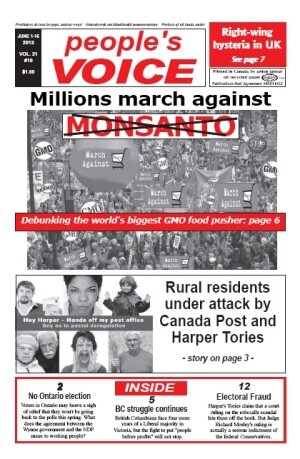
June 1-15, 2013
Volume 21 – Number 10
$1
Prolétaires de tous les pays, unissez-vous!
Otatoskewak ota kitaskinahk mamawestotan!
Workers of all lands, unite
1) ONTARIO ELECTION AVERTED AS NDP SLIPS
2) WHY MILLIONS MARCHED AGAINST MONSANTO
3) RURAL CANADA UNDER ATTACK BY CANADA POST
4) MAJOR FEARS FOR COPPER-GOLD MINE IN KAMLOOPS AREA
5) FEDERAL COURT RULES ON "ROBOCALLS" CASE
6) HARPER AND FORD: CORRUPT CRIMINALS - Editorial
7) POVERTY AMIDST UNTOLD WEALTH - Editorial
8) THE STRUGGLE IN BRITISH COLUMBIA WILL CONTINUE
9) "BRIGADISTAS" RETURN FROM CUBA VOLUNTEER WORK PROGRAM
10) "OUR GOVERNMENT HAS PUT US AT RISK"
11) HYSTERICAL MEDIA WHIPS UP FAR-RIGHT
12) WFTU REPORTS ON SOLIDARITY MISSION TO MALI
13) MUSIC NOTES, By Wally Brooker
PEOPLE'S VOICE JUNE 1-15, 2013 (pdf)
People’s Voice 2013 Calendar
”Ideas of Revolution”

|
People's Voice deadlines: June 16-30 July 1-31 Send submissions to PV Editorial Office,
|
REDS ON THE WEB
http://www.parti-communiste.ca/
peoplesvoice.ca
www.ycl-ljc.ca
www.solidnet.org
|
People's Voice finds many "Global Class Struggle" reports at the "Labour Start" website, http://www.labourstart.org/. We urge our readers to check it out! |
* * * * *
People's Voice
Canadian Publications Mail Sales Product Agreement #205214
ISSN number 1198-8657
People's Voice is published by
New Labour Press Ltd
PV Editorial Office
706 Clark Drive,
VANCOUVER, B.C. V5L 3J1
Phone:604-255-2041
Fax:604-254-9803
email: pvoice@telus.net
Editor: Kimball Cariou : Business Manager: David Au
Editorial Board: Kimball Cariou, Miguel Figueroa,
Doug Meggison, Naomi Rankin, Liz Rowley, Jim Sacouman
* * * * * *
Letters
People's Voice welcomes your letters
on any subject covered in our pages.
We reserve the right to edit for length and clarity,
and to refuse to print letters which may be libellous
or which contain unnecessary personal attacks.
Send your views to:
"Letters to the Editor",
706 Clark Dr., Vancouver, BC V5L 3J1,
or pvoice@telus.net
People's Voice articles may be reprinted without permission,
provided the source is credited.
* * * * * *
The Communist Party of Canada, formed in 1921,
has a proud history of fighting for jobs, equality, peace,
Canadian independence, and socialism.
The CPC does much more than run candidates in elections.
We think the fight against big business and its parties
is a year-round job,
so our members are active across the country,
to build our party and to help strengthen people's movements
on a wide range of issues.
All our policies and leadership
are set democratically by our members.
To find out more about Canada's party of Socialism,
give us a call at the nearest CPC office.
* * * * * *
Central Committee CPC
290A Danforth Ave Toronto, Ont. M4K 1N6
Ph: (416) 469-2446
fax: (416) 469-4063 E-mailmailto:info@cpc-pcp.ca
Parti Communiste du Quebec (section du
Parti communiste du Canada)
5359 Ave du Parc, Montréal, Québec,
H2V 4G9
B.C.Committee CPC
706 Clark Drive, Vancouver, V5L 3J1
Tel: (604) 254-9836
Fax: (604) 254-9803
Edmonton CPC
Box 68112, 70 Bonnie Doon P.O.
Edmonton, AB, T6C 4N6
Tel: (780) 465-7893
Fax: (780)463-0209
Calgary CPC
Unit #1 - 19 Radcliffe Close SE
Calgary AB, T2A 6B2
Tel: (403) 248-6489
Ottawa CPC
Tel: (613) 232-7108
Manitoba Committee
387 Selkirk Ave., Winnipeg, R2W 2M3
Tel/fax: (204) 586-7824
Ontario Ctee. CPC
290A Danforth Ave., Toronto, M4K 1N6
Tel: (416) 469-2446
Hamilton Ctee. CPC
265 Melvin Ave., Apt. 815
Hamilton, ON.
Tel: (905) 548-9586
Atlantic Region CPC
Box 70 Grand Pré, NS, B0P 1M0
Tel/fax: (902) 542-7981
http://www.parti-communiste.ca/
* * * * * *
News for People, Not for Profits!
Every issue of People's Voice
gives you the latest
on the fightback from coast to coast.
Whether it's the struggle for jobs or peace, resistance to social cuts,
solidarity with Cuba, or workers' struggles around the world,
we've got the news the corporate media won't print.
And we do more than that
- we report and analyze events
from a revolutionary perspective,
helping to build the movements for justice and equality,
and eventually for a socialist Canada.
Read the paper that fights for working people
- on every page, in every issue!
People's Voice
$30 for 1 year
$50 for 2 years
Low-income special rate: $15 for 1-year
Outside Canada $50 for 1 year
Send to: People's Voice, 706 Clark Drive, Vancouver, BC, V5L 3J1
You can call the editorial office at 604-255-2041
REDS ON THE WEB
http://www.parti-communiste.ca/
http://www.ycl-ljc.ca/
http://www.solidnet.org/
Top of Form
(The following articles are from the June 1-15, 2013, issue of People's Voice, Canada's leading communist newspaper. Articles can be reprinted free if the source is credited. Subscription rates in Canada: $30/year, or $15 low income rate; for U.S. readers - $45 US per year; other overseas readers - $45 US or $50 CDN per year. Send to People's Voice, c/o PV Business Manager, 706 Clark Drive, Vancouver, BC, V5L 3J1.)
1) ONTARIO ELECTION AVERTED AS NDP SLIPS
By Liz Rowley
An Ontario election has been averted, with the NDP throwing its support behind Premier Wynne's budget, despite the Liberal government's plan to cut jobs and wages across the public sector, and slash spending on health, education, social programs, and public services.
The Liberal minority will survive to fight another day because the NDP's conditions for support were so timid. While the NDP asked for 25,000 youth jobs, the Liberals gave them 30,000. The NDP asked for long term care beds, so the Liberals gave them beds. The NDP asked for a 15% cut in auto insurance rates, and the government promised to get it done.
Perhaps feeling the heat of public criticism, the NDP came back just before budget day, asking the Liberals to create and staff a Parliamentary Budget Office. The only thing the government didn't give was authority for the Provincial Ombudsman to supervise the healthcare file.
With pressure from labour to avoid an election and the possibility of a Tory win, the NDP backed the budget, no doubt with some sense of relief.
But why did labour support this budget with its devastating attack on public services and public sector workers?
There are two sharply different reasons. First, the right wing social democratic leadership is still predominant in many Ontario trade unions, which refuse to criticize the NDP and view the labour movement solely as an electoral machine for the party.
Second, there is real fear and trepidation in the OFL and among progressives at the strength in the polls for the Tories, despite scandals in the Prime Minister's Office in Ottawa, and in the Mayor's office in Toronto. While a majority of voters and working people generally are appalled by massive Tory corruption, the Tories still have a sizable base which rejects all criticism as `lies' and `damned lies' by the `soft‑on‑Communism' press and media `maggots'.
They take their lead from Rob and Doug Ford, John Baird, Jason Kenney, Tim Hudak, and an assortment of pit‑bulls. And their leaders are very well funded, as the little $90,000 solution to the Duffy problem shows.
Well, everything's relative. Perhaps the $90,000 is peanuts, compared to what it was designed to hide from public scrutiny. An independent public inquiry would help to find out.
More important, the corporations behind them are huge funders ‑ never mind the Canada Elections Act, tax receipts, financial rules and laws, etc. Pierre Poutine was funded by people with deep pockets, who never asked for receipts. How many other extra-judicial operators are getting ready to steal the next election - maybe in Ontario, maybe in Toronto, or maybe Canada again?
The federal Tories and the Ford Brothers' machine in Toronto broke election financing laws, and got away with a slap on the wrist. It helps to have friends in high places. New laws to sharply reduce election spending, and to police and enforce those spending limits, would also reduce the frenzy of US‑style attack ads that coincidentally helped the BC Liberals hang on to government.
It would all be "ridiculous" (to quote the Mayor) if he and the Tory machine weren't such an immediate threat to democracy and to working people.
In the context of deep austerity, the public is feeling the pain of the cuts and insecurity imposed by right‑wing "with us or with them" governments. Some, like those described as "Ford Nation," are looking to blame someone for their falling living standards. Their grievances are real. But the tea party populism whipping up their anger is manipulated by powerful corporate forces. Front men like Ford, Hudak and Harper are directing that anger at unions and unionized workers, at women, migrants, youth, Aboriginals, people of colour, and LGBTQ persons, all labelled the privileged "social elites". This is a dangerous and explosive cocktail.
It may be that the Ford Brothers have gone too far. The Mayor could be forced out in advance of next year's election. No doubt that would be a victory for democracy in Toronto. But the Mayor and his Bro were elected as part of a right‑wing majority in City Hall that aimed to privatize city services, sell public assets, slash jobs and wages, and smash city unions, amongst other things. The Mayor may go, but his agenda remains, 18 months before they can be turfed out. Too long to wait on stand‑by.
So, we have by‑passed an Ontario election this spring after all. Instead we can anticipate new opportunities for an election this fall, when the stakes are too high, and the political options too limited to stop the train wreck that's surely ahead. The 5-year austerity plan put in place by Premier Wynne, backed by the NDP, and imposed by PM Harper's majority federal government, is the guarantee that things are about to get much worse for the 99%.
There's no solution in the current Legislature or Parliament, and with the undemocratic first-past-the-post system, little hope for any real progressive change in the near future. In fact, this electoral system gave Harper a majority with the support of only 20% of eligible voters ‑ a scenario that's quite possible in Ontario.
The present minority situation gave the NDP a golden chance to fight for significant concessions like public auto insurance, rent controls and social housing construction, substantial increases in the minimum wage and social assistance, plant closures legislation, and infrastructure spending to create jobs and raise living standards. Instead, they supported an austerity budget that will do great harm to working people, the unemployed, women, youth, and many others in Ontario.
Mass independent and escalating political action in the streets to resist austerity and demand new policies that meet people's needs: that is what the labour, democratic and people's movements must organize now. A Peoples' Coalition is the political vehicle to stop austerity and change direction.
In Ontario, the OFL's Common Front is a good first step, but needs more action on the agenda, and more active participation by OFL affiliates. The Days of Action are a good model for sustained and escalating action. What's urgently needed is the political will and the money. We need to get on with it while there are still public services, jobs, pensions, and rights left to fight for.
For more on this, check out the Communist Party's 10 Point Prescription for a People's Recovery @ontariocpc.ca.
2) WHY MILLIONS MARCHED AGAINST MONSANTO
By Jean Kenyon
"Roundup Ready" alfalfa is about to be registered for use in Eastern Canada in June or July, over the protests of farmers and concerned consumers. So says the latest update from the activist group CBAN ‑ the Canadian Biotechnology Action Network.
The new genetically modified hay variety is a Monsanto product, to be distributed in Canada by Forage Genetics. If you and your family eat beef or drink milk, the introduction of this new cattle feed could soon be important to you.
The National Farmers' Union (NFU) held a protest outside Kitchener's Delta Hotel last October, where the Canadian Seed Trade Association was meeting. The CSTA, which includes Monsanto, Forage Genetics, and other agribusinesses, was promoting the idea that genetically modified (GM) alfalfa could "coexist" with conventional hay, so farmers wouldn't need to worry.
But few people believe Monsanto's assurances any more.
Protester Phillip Woodhouse, president of NFU Grey County Local 344, said the term `co‑existence' is merely industry spin meant to allay farmers' concerns about contamination. "Make no mistake ‑ GM alfalfa will cross‑pollinate with non‑GM and organic alfalfa, and will threaten the very livelihoods of Ontario's family farmers," he warned.
For one thing, farmers are terrified of being sued by Monsanto, if a few unwanted GM plants should turn up on their land. After all, Monsanto "owns" these life forms ‑ they have patents saying so. In the state of Indiana, Monsanto agents have been known to go onto farms at will, sample what's growing there, and then show up at the supper table to serve farmers with huge lawsuits. Farmers can be rapidly put out of business or forced to settle out of court, while Monsanto "snitch lines" turn neighbour against neighbour.
A similar thing happened to Saskatchewan canola farmer Percy Schmeiser, with the Supreme Court of Canada finding in Monsanto's favour. The commentator who tells the Indiana story in the stunning documentary The World According to Monsanto, calls these company tactics "totalitarian".
Conventional farmers are also afraid of losing export markets, if they can no longer guarantee that their crops are 100% GM‑free. As for organic farmers, they will be out of business if the pasture and hay on which their cows graze might be contaminated with GM alfalfa. They are desperate to stop it from ever being approved here.
A Canada‑wide protest against GM alfalfa in April was ignored by the Harper government. There was one small victory, though: the approval didn't come through in time for this year's planting season. So the protests against Monsanto are being stepped up.
The effect of GMOs (genetically modified organisms) on human and animal health hasn't been definitively established. In fact Monsanto makes sure of that! Dozens of scientists who have attempted to investigate the health effects of Monsanto products over the years have lost their funding, jobs, and reputations.
But the 2012 study "Myths and Truths of GMOs", by Earth Open Source, reports some alarming findings. In Quebec's Eastern Townships, pregnant women and their fetuses had insecticide chemicals in their bloodstream that are found in Bt plants. (Bt's are a type of GMO that secretes insecticide, killing not only pests but beneficial insects ‑ a real wonder crop!) Did the women get the chemical from eating Bt corn (or animals that had consumed it), or living near a plantation of these Franken‑crops? Obviously further study is needed.
People with a nut allergy developed symptoms after eating soy beans grown from seeds into which a Brazil nut gene had been blasted.
The insertion of the foreign gene is about as accurate as a BB gun, and depending on where the gene lands in the DNA of the target plant, the effects can vary. The World According To Monsanto shows pictures of monstrous specimens of corn that have resulted in Mexico from contamination by U.S. GM corn imported at subsidized prices under NAFTA, and by lab experiments with random insertion of the genes.
Yet the US Food and Drug Administration (FDA) would have us believe that GMO crops are "substantially equivalent" to conventional crops, and therefore need no special testing! Monsanto officials and their friends in the FDA must be laughing on their bar stools after these pronouncements are made. After all, they're often the same people, switching position every few years through the industry‑government revolving door.
Canadians may remember how three federal scientists were fired in 2004, after one of them revealed to a Senate committee that Monsanto had offered a bribe to Health Canada to approve Bovine Growth Hormone. Thanks to the scandal, BGH was never approved for use in Canada. But their careers were sacrificed.
Now their research linking BGH to mastitis in cows, as well as increased use of antibiotics, joint problems, and more, is becoming public knowledge. In 2008 the US too stopped the use of BGH.
"If genetically engineered products like this were safe, Monsanto would put `made with GE' in big block letters on all its products," said Josh Brandon, an agricultural campaigner with Greenpeace. "Instead Monsanto is doing everything it can to obstruct the consumer's right to know what they are eating. Monsanto's strategy backfires, once consumers start asking questions about the health and environmental safety of GE products."
In response to these and a host of other issues involving Monsanto, in February a concerned American named Tami Canal started a social media campaign. She called for rallies around the world on May 25 against Monsanto's practices and against government collusion with the company. A key demand was for mandatory labelling of foods containing GMOs. She put up a very informative web site at: www.march‑against‑monsanto.com.
When the day came she told Yahoo news, "If I had gotten 3,000 people to join me, I would have considered that a success." But instead she was overwhelmed by the response. At last count, "March Against Monsanto" protests were held in 52 countries and 436 cities on six continents!
We must hope it will prove to be the beginning of resistance to one of the most destructive multinational corporations in history.
The film The World According to Monsanto can be viewed for free at: http://bit.ly/R9lY0k
See also Canadian Biotechnology Action Network www.cban.ca. CBAN calls for the banning of all GMOs.
3) RURAL CANADA UNDER ATTACK BY CANADA POST
By Mark Hamilton
The Canada Post Act (1981) mandates the maintenance and expansion of our public post office. Canada Post is a public service that belongs to all of us, connecting communities both large and small, from isolated locations like Pictou Island to downtown Vancouver. The services provided by Canada Post are invaluable for individuals and businesses, even in this "digital age," especially in rural areas.
Contrary to what many have been led to believe, Canada Post Corporation has made consistent profits, year in and year out. For a full sixteen years, the post office returned handsome dividends to the federal government, costing the taxpayer nothing.
For the first time, Canada Post announced a financial loss for the year 2011. It claimed that this was due to a major and continuing decline in letter mail volumes. Certainly, letter mail has declined, but not at the exaggerated levels presented by the Corporation.
The real reasons for the loss in 2011 differ from what Canada Post suggests. During labour negotiations, Canada Post locked out their workers, and invested billions into new sorting machinery. If letter mail is truly in a historic decline, why invest so much into machinery to sort an ever diminishing volume of mail?
Despite plenty of fear mongering, Canada Post once again returned to profits in 2012, claiming that this rebound was due to cost savings achieved through the last collective agreement. The mistakes of management were paid for by the postal workers themselves, in direct cuts to benefits such as sick leave and two‑tier wages for new hires.
Based on a report issued by The Conference Board of Canada, a corporate think tank, Canada Post projects a return to a loss position for next year and into the future. This biased report was funded by Canada Post, and Deepak Chopra, the current President and CEO of Canada Post, sits on the Board of Directors of the Conference Board.
Canada Post and the Harper Tories are using such "studies," and the gradual decline in letter mail, to justify dramatic cuts in both jobs and services. Rural Canada and Quebec have been hit especially hard. Small villages and towns have seen local post offices close or reduce their hours.
Canada Post also provides decent jobs in rural areas which often have few employment opportunities, and the post office is still a hub of activities in many communities. Rural mail delivery has a long and proud history. Rural and Suburban Mail Couriers (RSMCs) deliver mail to residents in every corner of the country, in all types of weather.
One prong of the attack has been made under the guise of health and safety. Canada Post has sent so-called safety inspectors to evaluate mail boxes on rural routes. Out of a feigned concern for employees, Canada Post has declared many such mail boxes to be unsafe. Residents who may have received mail for decades at the end of their driveway have had their mode of delivery changed to a community mailbox, which can be kilometres away. Many rural routes have lost significant numbers of points of call, costing jobs and forcing seniors and those with disabilities to travel to get their mail.
In December of last year, Canada Post made changes to how local mail is processed. Until then, local mail would be cancelled and sorted in its office of origin, and usually delivered the next day. Now mail is being sent to urban centres to be sorted, and returned to the local destination address. Canada Post has tried to maintain that these changes do not impact delivery standards, but the truth is otherwise. For example, almost all mail in the provinces of Nova Scotia and PEI, will be sent to Halifax to be sorted, returning later. The deterioration of service was immediate, as were job losses, with huge numbers to come as more workers retire and more services are cut.
A new smaller, retail model is being implemented by Canada Post. All postal outlets are to be reviewed, and many of the first targets are in rural Canada. In Nova Scotia, some of the offices to make the first list are Truro, Yarmouth, Pictou and North Sydney. This new model involves the downsizing from the standard two wickets, to one single wicket. This prevents relief staff from assisting when necessary, and creates long wait times for customers. The postal clerk is left to work out of a hole in the wall, with the products hidden behind the counter.
While there are challenges facing the post office, the solution is not to be found in reducing jobs and services, but rather through an expansion of services. Canada Post has the ability and infrastructure to reach every household in the country, actively competing with private courier companies. Postal banking and financial services are another promising avenue for revenues. Many postal administrations around the world have successfully moved into banking, like Germany, New Zealand and China. Canada Post should do the same. An expansion into banking would be a great asset for rural areas, many of which no longer have access to banks.
Rural Canadians deserve to have mail delivery. But there is a clear agenda by the Corporation's management and the Harper Conservatives to dismantle and destroy Canada Post as a public service. The decisions point in the direction of privatisation, which would be a disaster for postal workers and the public.
Stay informed and participate in local actions organised by the Canadian Union of Postal Workers. Tell your Member of Parliament and Canada Post that you want an expansion of services! Canada Post has an online site where you can provide your thoughts on the future of the post office. This site may be accessed through www.canadapost.ca.
Your public post office delivers for now!
4) MAJOR FEARS FOR COPPER-GOLD MINE IN KAMLOOPS AREA
By Kimball Cariou
Few left-wing activists in British Columbia held out much hope that electing an NDP government on May 14th would have led to far-reaching reforms. But most agreed that the unexpected Liberal victory makes it much more difficult to achieve even limited progressive changes over the next four years.
For example, armed with her new majority, Premier Christy Clark will continue the drastic under-funding of public education, and even the tiny $20 monthly increase in social assistance rates proposed by the NDP is off her radar screen.
Some of the most serious consequences of the election are on the environmental front. Clark is much more likely to strike a deal with the Conservative federal and Alberta governments to allow the Enbridge and Kinder Morgan tar sands pipelines and tankers to move ahead, providing a few hundred jobs at the risk of oil spills which could inflict huge damage to the fragile coastal ecosystem and the tourism sector.
Another project which has received little attention in the corporate media could devastate the Kamloops area.
As Allison Griner wrote recently for the Tyee website, some preparation work has already begun for the Ajax copper/gold mine planned by KGHM International. This area of grassland, forest and lakes on the southwest edge of Kamloops will be transformed into a 261‑hectare open pit mine, with a 150-meter-high tailings storage just a few kilometres from schools and residential neighbourhoods.
Two similar projects are within ten and seventy-five kilometers of this central B.C. city of 85,000 people. But the push for an open-pit mine within the natural geographic "bowl" which contains Kamloops has many residents deeply worried.
Dr. Jill Calder recently formed the Kamloops Physicians for a Healthy Environment to press for an independent health assessment of the mine.
"We don't disagree with mining and the creation of jobs and projects that are good for the economy. But this particular mine, in this location, we are against it," says Calder.
The mine's proposed boundaries will overlap with Kamloops city limits. Wind and the sloping nature of the land could carry pollutants towards schools, hospitals and seniors' residences.
Worried that KGHM has not been "transparent and forthcoming" about health concerns, the 50-member Kamloops Physicians group is looking into other projects, including the Rio Tinto Kennecott copper mine near Salt Lake City, Utah. The evidence from Utah points to serious health issues, including increases in lung disease, cancer, heart attacks, strokes and neurological diseases like Parkinson's.
The physicians warn that heavy metals unleashed through mining will seep into the soil or be picked up by the wind as dust. The local water table could plummet under the strain of the mine's operations, and added emissions from burning diesel at the site will be released into the city.
For its part, KGHM is conducting its own environmental assessment of 41 components of the project. No physicians have been employed in the company assessment, which is gauging potential effects on air and water. KGHM says it aims to finish sampling and testing by the end of September, when the results will become part of its application to the provincial government.
During the following 180-day period, the provincial Environment Assessment Office (EAO) will review the application and hold open houses to hear public concerns. Among those expected to speak out are local ranchers, whose families have been in the area for over a century, and First Nations people who trace their origins around Kamloops back for thousands of years.
Dr. Calder's group are sceptical of KGHM's claims that the company has a good record of not polluting urban areas at nine similar operations across the western hemisphere. Critics stress that existing mining rules were established for construction in areas with large geographical buffers and few nearby inhabitants - not on the border of major cities.
The mine became a big issue for Kamloops voters in the May 14 election. While serving as Clark's environment minister, the Liberal incumbent in Kamloops-North Thompson, Terry Lake, declined to call for a joint federal-provincial review of the project. Both Kamloops ridings were held by the Liberals, increasing concerns that the Ajax mine could become virtually unstoppable.
Supporters like MLA Terry Lake argue that the mine will generate jobs, a view which swayed some working class voters at a time of economic uncertainty. But the Ajax mine would only employ some 380 people, for a period of just 23 years. Critics say the negative impacts on health and the environment far outweigh this relatively small economic benefit, and that the local tourism industry would also suffer.
Having received huge financial support from the resource corporations going into the May 14 election, Premier Clark and her cabinet will try to ignore the opposition of many Kamloops area residents. But a big enough mobilization of public opinion could still affect the outcome of this project.
For more information, visit www.stopajaxmine/home.
5) FEDERAL COURT RULES ON "ROBOCALLS" CASE
PV Vancouver Bureau
The long‑awaited Federal Court ruling on "voter suppression" tactics used during the 2011 election campaign was released on May 23. To the satisfaction of the Council of Canadians, which has worked to keep the case in the public arena, Judge Richard Mosley wrote: "I find that electoral fraud occurred during the 41st General Election."
In a statement about the ruling, Maude Barlow, National Chairperson of the Council of Canadians, wrote the following:
While his ruling stopped short of annulling election results, this is a powerful victory for Kay Burkhart, Ken Ferance, Yvonne Kafka, Bill Kerr, Sandra McEwing, Tom Parlee, Jeff Reid and Peggy Walsh Craig - the eight brave Canadian voters who launched their legal challenges and the thousands of us who continue to stand behind them.
The judge raised grave concerns that the fraudulent calls `struck at the integrity of the electoral process by attempting to dissuade voters from casting ballots for their preferred candidates. This form of voter suppression, was, until the 41st General Election, largely unknown in this country.'
From the outset, the eight applicants argued that the fraudulent robocalls were widespread, targeted and centrally organized - which is precisely what Judge Mosley found: `I am satisfied that it has been established that misleading calls about the locations of polling stations were made to electors in ridings across the country, including the subject ridings, and that the purpose of those calls was to suppress the votes of electors who had indicated their voting preference in response to earlier voter identification calls,' and that `the most likely source of the information used to make the misleading calls was the CIMS database maintained and controlled by the CPC [Conservative Party of Canada], accessed for that purpose by a person or persons currently unknown to this Court.'
Of course the [Conservatives] will try to paint this as a victory, but they have nothing to celebrate. That is unless an attempt to steal the election using their database, to which only senior Conservative Party members have access, is a cause for rejoicing. This is a serious indictment of the Conservatives.
Judge Mosley himself praised the eight applicants for their virtue, while chastising the Conservative MPs. `It has seemed to me that the applicants sought to achieve and hold the high ground of promoting the integrity of the electoral process while the respondent MPs engaged in trench warfare in an effort to prevent this case from coming to a hearing on the merits.'
And Mosley even made special note of their shameful obstructionist tactics, stating, `Despite the obvious public interest in getting to the bottom of the allegations, the Conservative Party made little effort to assist with the investigation at the outset despite early requests. I note that counsel for the Conservative Party was informed while the election was taking place that the calls about polling station changes were improper. While it was begrudgingly conceded during oral argument that what occurred was "absolutely outrageous", the record indicates that the stance taken by the respondent MPs from the outset was to block these proceedings by any means.'
... The Federal Court has found fraud and this isn't over. The applicants have an automatic right to appeal this ruling to the Supreme Court of Canada - and the Council of Canadians is committed to standing with them every step of the way.
The Council is raising funds to cover the applicants' Supreme Court appeal, which must be filed within eight days of Mosley's ruling.
For more information, see www.canadians.org
6) HARPER AND FORD: CORRUPT CRIMINALS
People's Voice Editorial
Rarely has the gap between the pompous rhetoric of right-wing politicians and the sleazy reality been so vast. Both Stephen Harper and Rob Ford gained office as supposed enemies of corruption and crime, and both now stand revealed as utterly corrupt criminals.
The Prime Minister is deeply entangled in a web of payoffs and backroom deals involving his fired chief of staff and a gaggle of buffoonish Tory Senators caught scamming the public with phony expense claims. The only downside to this news is that the PM may yet force his patronage appointees - Mike Duffy, Pamela Wallin, and Patrick Brazeau - to take the fall. But the stench of this scandal will cling to Harper, since it infuriates much of his own voter base who have long been suspicious of the unelected Senate.
Rob Ford's downfall - for surely he cannot survive his latest debacle - is more bad news for the political right. It's true that there is a certain classist and racist twist to the mayor's situation; if Ford had been filmed swilling expensive Scotch with "business leaders" in expensive suits, few would bat an eyelash. But after constructing his image of a down-to-earth fighter for the "little guy", Ford has now betrayed even his most loyal believers.
The task of the left, however, is not to focus on these tawdry spectacles, since the anti-working class agenda is not the product of individual politicians. Scandals can help to erase the phony "populist" image of hypocritical right-wing leaders. But the real question is how to mobilize resistance against big capital and governments (Conservative, Liberal, and even NDP and PQ) which follow the neoliberal model. This requires a conscious effort by the labour movement and its allies to build unity around a real People's Alternative to corporate domination. There are welcome stirrings of interest along such lines, but much more needs to be done.
7) POVERTY AMIDST UNTOLD WEALTH
People's Voice Editorial
Next time you hear that we "can't afford" decent pay, working conditions and pensions for those who actually make the wheels turn round, here are a few facts to consider. In 2011, Canadian CEOs made $7.7 million on average, or 171 times more than the median Canadian wage of $45,448, according to the Canadian Centre for Policy Alternatives. In the Globe and Mail's new listing of Canada's top 100 CEOs, Canadian Pacific Railway boss Mark Harrison was number one, taking home $49,151,065 for the year. The remaining top 20 on the Globe's list all topped $10 million. For example, Gordon Nixon, the CEO of the Royal Bank of Canada, raked in $13.7 million. Yes, that's the same Royal Bank which took advantage of the Temporary Foreign Worker Program to replace 45 employees in its Securities division, until RBC's insatiable greed was inconveniently exposed to the public.
And the greed‑fest is getting uglier. The Globe writes about "a fevered pace of CEO turnover... as firms pay millions in severance to former executives while also shelling out to attract new leaders". No wonder that a Pew Research Centre study finds that 76 per cent of Canadians think income inequality is worsening. Overall, 74 per cent of people polled in the developed capitalist countries said the economic system favours the wealthy and is unfair to most people.
We live under a system which functions very well indeed for the top sliver of the 1%. But for those on the bottom of the heap ‑ minimum wage workers bringing home $15,000 a year, social assistance recipients starving on less than $8,000 a year, unemployed students graduating with massive debt loads ‑ the capitalist system is a life sentence of poverty in the midst of staggering wealth. Makes the idea of a socialist Canada sound pretty good, doesn't it?
8) THE STRUGGLE IN BRITISH COLUMBIA WILL CONTINUE
Statement by the BC Provincial Executive Committee, Communist Party of Canada
The May 14 B.C. provincial election saw the right‑wing Liberals win a fourth consecutive majority, thanks largely to the corporate sector which financed a massive anti‑NDP attack ad blitz. But it must be also noted that Adrian Dix's NDP failed to campaign on a platform to defend the interests of the working class against big business.
Coming after years of popular anger against the Liberals, including the historic defeat of the HST, the election result defied polling numbers which had given the NDP a wide lead.
The Liberal share of the popular vote dropped slightly, from 45% in 2009 to 44% in this campaign, and Premier Christy Clark was defeated in her own riding. But the BC Conservatives took less than five percent of the popular vote, so the anticipated split of the right‑wing forces did not materialize. Decisive sections of big capital united to preserve B.C.'s traditional "free enterprise" coalition of federal Liberals and Conservatives. In particular, the energy and resource industries made enormous efforts to save the Liberal government, which is expected to repay them with support for projects to expand hydrocarbon exports.
The coming months will expose the true, anti‑working class character of the B.C. Liberals. Despite their gamble on big revenues from resource exports, the Liberals cannot save British Columbia from the effects of the global capitalist economic crisis. Hydro charges will skyrocket, the union‑bashing seen during Campbell's years as premier will return, the rights of First Nations will be trampled, and poverty will deepen for large sections of the population. On May 15, six more schools were closed by the underfunded Cowichan Valley school district, an ominous sign of things to come. The Premier's "balanced budget" will be seen as a cynical lie, and next year's budget will launch a new round of social spending cuts.
This situation is a powerful rebuke to those who argued that the working class and popular forces should try to ride out the storm until the NDP's return to power.
The defeat of the NDP proves yet again that change cannot be won simply through electoral tactics. This is not to dismiss the aspirations of labour and progressive activists who worked so hard to elect a new government. Their courageous efforts over the past twelve years, and during this election, deserved a far better result.
But this struggle was not matched by the NDP leadership, which repeatedly dampened any hopes of reversing the damage inflicted by the Liberals, instead calling for "small, realistic" changes. In fact, the NDP (like social democratic parties in other countries) largely accepts the basic premise that the capitalist system can only be adjusted, not challenged. This allowed the Liberals to set the tone for the campaign, falsely pitting "economic growth" against "the environment", when in fact the Liberal record on both issues has been dismal.
Adrian Dix did pledge to reverse a small part of Campbell's $2 billion annual tax breaks for the corporate sector and upper‑income brackets ‑ but so did Christy Clark, to distance herself from Campbell's legacy. Dix had planned to use some of these revenues to support badly‑underfunded public schools and post‑secondary education. On the other hand, the NDP's promise to raise starvation‑level social assistance rates by a miserly $20 a month ‑ and only after two years ‑ was seen by many poor people and anti‑poverty advocates as a slap in the face. The NDP also failed to present any serious plan to build more low‑income housing, or to make strong commitments to progressive changes to labour legislation.
This strategic failure, not so‑called vote splitting by the Greens, is the real reason for the NDP's defeat. The NDP share of the vote declined from 42% in 2000 to 39.5% in this campaign. The drop in turnout of eligible voters to below 50% indicates that many potential NDP supporters were not inspired by the party's weak platform.
Adrian Dix will lead 33 MLAs back to Victoria, and some of these members will be powerful critics of the Clark government. The Green MLA Andrew Weaver will also be a welcome voice for the environment rather than corporate interests.
But the key struggles over the coming four years will be in workplaces, communities, and wilderness areas across British Columbia. The Liberal attack must be met with a powerful, militant, united response, by working people, First Nations, youth, seniors, women. We cannot allow our movements to be distracted and divided by narrow electoral ambitions, nor by counter‑productive tactics of isolated individuals. Only broad, united movements can set the stage for fundamental change in British Columbia.
The BC Federation of Labour, and other organized labour groups in the province can play a crucial and positive role in such a struggle. When the organized labour movement gets involved politically for social change in the interests of the working class, they can make a difference. Political action by labour must move beyond simply providing foot soldiers, resources and mobilization as a part of the NDP electoral strategy, although this may be a part of it. Independent political action together with its allies in community and social activist groups, raising the issues year‑round from a working class perspective, is needed. This kind of political action must break out of narrow sectarian strategies and be inclusive as a rallying point for progressive opponents to the Liberal pro‑corporate agenda.
This is why it remains critical to build a much larger and more influential Communist Party in British Columbia. The Communist candidates presented a comprehensive platform to put people and the environment ahead of corporate greed. As expected, the low vote for Communist candidates reflected the difficult choices faced by working people desperate to defeat the Liberals. But much larger numbers of young people supported the Communist Party in the Student Vote BC project. This shows that our policies for fundamental change do have wider support. The time is coming when Communist MLAs will be on the floor of the Legislature to fight for the rights and interests of the working class.
To all our friends who campaigned and voted for change on May 14th, only to face bitter disappointment, we say: the struggle to block the corporate agenda will continue in British Columbia. Our party will continue to fight shoulder to shoulder with others for poverty reduction, social housing, improved labour legislation, a higher minimum wage, full equality, reduction of greenhouse gas emissions, and other vital demands. We welcome you to join our Party, to help us build a powerful People's Alternative to the neoliberal agenda, and to work for a socialist Canada, where exploitation, oppression and environmental destruction are replaced by economic justice, social equality, and a sustainable future!
9) "BRIGADISTAS" RETURN FROM CUBA VOLUNTEER WORK PROGRAM
Chevy Phillips, Toronto
A press conference was held May 15 in Toronto's City Hall to welcome back and hear from the most recent Che Guevara Work Brigade, a group of 43 people aged from 15 to 82 years of age, from five provinces across Canada and one American state, who spent three weeks engaging in a variety of volunteer work projects across the island of Cuba.
The highly diverse group included 12 students and 9 retirees, 13 people on their first Brigade experience, 12 who were present last year and one person for whom 2013 saw their fifth Brigade excursion. Many participants are active in Canada with Cuba Solidarity campaigns, work with their local Cuban Friendship Associations, and take part in the global campaign to free the "Cuban 5" prisoners held in US prisons. Rene Gonzales, one of the 5, has recently been given leave to remain in Cuba and is no longer obliged to fulfil the restrictive bail conditions imposed after his release from incarceration due to the popular pressure of the international "Free the Cuban 5" campaign. Members of the Young Communist League of Canada were also proud participants of the Brigade.
The Brigade's press conference was led by Niagara's Dave Thomas, who has been the coordinator for the Work Brigade for the past three years, and heard contributions from four of the Brigadistas. Examples of the activity of the Brigade were discussed, including work on a cooperative farm and visits to schools and hospitals. Work Brigade members of all ages were given tasks according to their abilities; on a mango farm this meant sorting fruit for distribution or weeding out in the fields, since the overwhelming majority of Cuban agriculture is organic. The Brigade participants related how their efforts were always warmly and gratefully received by local Cuban workers.
A visit to a housing complex for victims of recent hurricane damage was also discussed, the Brigade members relating how impressed they were that even this small community on an island off the mainland was still generously served by education and health services, both of which are world class and free to all citizens. This community has seven teachers for ten students, four daycare workers for around a dozen young children, and a doctor and nurse in residence in the community. One of the Brigade participants, a nursing student from Vancouver, spoke of how trainee nurses in Cuba receive excellent levels of one‑on‑one training with qualified doctors, and how the average wait time in ER in Cuba is just 30 minutes. In Canada, the average wait times are over four hours, among the highest in the world. Cuba's health service provided a dramatic and lasting example to the Brigadistas of how even a relatively poor country can have excellent health provision if resources and spending priorities are set accordingly.
One highlight was, as anticipated, May Day in Havana. The Brigade participants spoke of their admiration for the enthusiasm and collective spirit of the million or so participants, who from first thing in the morning began to gather with great pride at the achievements of their country, their ranks being led this year by scientific workers currently engaged in ground breaking cancer research. This year's May Day parade also saw a giant tribute display to the late Hugo Chavez, recently deceased president of Venezuela, who was a great friend of Cuba and much loved by the people there.
In the words of some of the Brigadistas themselves:
"I have great hope that the Cuban Revolution is strong and surviving, and has answers for the problems we have here in Canada."
"I was greatly impacted by the warmth and humanity of the Cuban people."
"Cuba is a beautiful and powerful example of what a country can achieve when its people work together."
Organising for the next Che Guevara Work Brigade will begin a little later this year. See www.canadiannetworkoncuba.ca/ to keep up with the latest news on Cuba and more information on the Brigade.
Rebel Youth Blog will be publishing more on this year's Brigade and hearing from some of the participants themselves... so stay tuned!
10) "OUR GOVERNMENT HAS PUT US AT RISK"
By Lindsey German
The attack in Woolwich was horrific. There can be no justification for a murderous attack on an individual soldier in the streets of London. It must have been awful too for the local people who witnessed it.
Unlike with most terrorist attacks or indeed other crimes, we have been able to see film footage of the perpetrators, hear testimony from the witnesses who saw or talked to them.
So we know what these men say motivated them. They claimed that the killing of the soldier was in response to the killing of Muslims by British soldiers in other countries. One said that the government did not care for people and should get the troops out.
The Boston bombers last month were supposedly similarly motivated. The Woolwich attack, carried out by two men now shot and wounded and under arrest in hospital, appears to represent a phenomenon that was pointed out nearly a decade ago by the security services in Britain ‑ that the wars in Afghanistan and Iraq would lead to a growing threat of terrorism in Britain.
Those of us in Stop the War have long predicted that these sorts of attacks would happen because of the war on terror.
Unfortunately there is little sign that the government, media and military will draw any of the conclusions that they should from the attack.
The instant response was to brand it as a serious terrorist attack, although already many commentators are saying they believe it more likely that this was a one‑off and isolated incident, and unlikely to be part of a wider conspiracy.
David Cameron cut short a visit to Paris in order to fly home. This reaction is one which manifestly fails to deal with the political causes underlying such attacks.
The simple truth is that there were no such cases in Britain before the start of the "war on terror" in 2001, which led to the invasions and occupations of Afghanistan and Iraq.
The consequences of those wars have been devastating for the people of those countries and further afield. Up to a million died in Iraq and four million were made refugees. Tens of thousands have died in Afghanistan.
Fighting still continues and Iraq looks like descending into civil war in some parts of the country.
The US and its allies have been involved in bombing attacks on these countries which have been responsible for many thousands of deaths.
A media comment that this was the day Baghdad came to the streets of Britain shows a grotesque ignorance of the country the invasion was meant to rescue for democracy, where daily sectarian bombings and killings are escalating on a scale not dreamt of in this country.
The interventions have spread in the name of "fighting terrorism." Drone attacks are taking place in a number of countries including Pakistan, Yemen and Somalia.
The bombing of Libya by the West in 2011 led to at least 30,000 dead. British troops are aiding the French in Mali. The British are intervening in the war in Syria for their own ends, and want to lift the EU arms embargo there in order to escalate the war and achieve regime change.
The US and EU continue to back Israel despite its treatment of the Palestinians, even sending the architect of the Iraq war, Tony Blair, as envoy for peace in the Middle East.
Any rational balance sheet of the last decade and more would demonstrate that the war on terror has been a failure on its own terms. It has not prevented terrorism but has caused it to spread.
The failure of politicians and military to face up to this has further damaging consequences.
If the government refuses to change its own policy it has one simple solution ‑ "blame the Muslims." Muslims are expected to condemn any such attack whereas no such demand is put upon people of other faiths when a killing is carried out by Christians.
Muslim is also equated with black or Asian, as when one television reporter described the men as of "Muslim appearance."
Again, atrocities by white gunmen, in Norway and the US for example, which are often highly politically motivated, are not regarded as needing to be defined by race. They are also rarely described as terrorism, but as the acts of fanatics or madmen.
It is an integral part of the war on terror that the invasion and occupation of mainly Muslim countries abroad has to lead to the dehumanising of the victims of the wars, so Muslim comes to equal extremist and terrorist.
Racists like the English Defence League turned up in Woolwich to try to further foster Islamophobia. But this treatment of Muslims goes to the top of government and is spewed out daily in the press.
Similar views of the Irish were much more common in the 1970s and '80s when the IRA had a major bombing campaign in Britain. In the end there had to be a political solution which recognised a genuine grievance.
In the end there has to be a political solution to terrorism. But it can only start with recognition of the disastrous effect of Western foreign policy in the Middle East and south Asia for decades now, exacerbated by the consequences of 12 years of wars.
That means acknowledging that those of us who said these wars were not the answer and would make things worse were absolutely right. Terror is inexcusable. But it is bred by terror.
Lindsey German is convenor of the UK Stop the War Coalition
11) HYSTERICAL MEDIA WHIPS UP FAR-RIGHT
From www.morningstaronline.co.uk
Far‑right fanatics cashed in on the May 22 murder of a British soldier with attacks on three mosques and dozens of other racist incidents. Aided and abetted by an ill‑judged media frenzy following the death of off‑duty soldier Lee Rigby at the hands of self‑styled "jihadists", extremists from the English Defence League fought with police near the scene of the killing.
Anti‑racist campaign group Hope Not Hate said the far‑right acted swiftly to cash in on the atrocity: "As soon as the identity and motives of the perpetrators were known, EDL, BNP and National Front supporters rushed to whip up hatred and incite violence. Thousands more vented their racist and Islamophobic hate online. Dozens of other incidents were reported."
Hope Not Hate said it stood "against the violent and sickening jihadist ideology that motivated these attackers just as we stand against the racists and fascists who will target all Muslims in response."
Lindsey German of the Stop the War Coalition said of the far‑right reaction: "Racists like the EDL turned up in Woolwich to try to further foster Islamophobia. But this treatment of Muslims goes to the top of government and is spewed out daily in the press."
The Muslim Council of Britain described the murder as "a truly barbaric act that has no basis in Islam and we condemn this unreservedly ‑ our thoughts are with the victim and his family."
Train drivers union ASLEF general secretary Mick Whelan said the union was "appalled" by the attack. "At the same time we are disgusted by right‑wing groups who are callously exploiting this personal tragedy for their own ends. Our union is horrified at the intrusive and sensational way the media has covered today's tragedy... To stir up hatred in order to sell newspapers or advertising is perverse."
In a May 24 editorial, the Morning Star wrote: "Communities across Britain should be on guard against the efforts of troublemakers to set us against each other in the wake of the sickening butchery of soldier Lee Rigby in Woolwich.
"The tanked‑up yobs of the English Defence League have already sought to fish in these troubled waters and expressed their love for British freedoms by heaving bottles at the police. But it is not just the far‑right fringe that poses a threat to people's unity. Too many right‑wing politicians and newspapers have kept up a constant drip‑drip propaganda campaign against national and religious minorities, especially Muslims, as alien to British society.
"Neither the Woolwich attack nor the views expressed after it can be pinned on our Muslim fellow citizens. In common with the vast majority of people in Britain, from whatever ethnic or religious background, they regard what took place in Woolwich as alien and unjustifiable. Some Muslim organisations and individuals have gone public in their condemnation, but this should not be a demand targeted generally at Muslims.
"The tiny minority of Muslims who carry out atrocities are no more representative of Islam than Tony Blair's easy recourse to illegal mass slaughter in Iraq and Afghanistan can be laid at the door of the Catholic church or individual Christians. Such crimes are the responsibility of those who carry them out no matter how loudly they claim to be acting on behalf of an entire community.
"However, as horrific and unjustifiable as the random killing of a British soldier in London is, it cannot be separated from the western powers' support for imperialist carnage in north Africa, the Balkans and central and western Asia, including Palestine.
"One of the men filmed on smartphones after the soldier's murder articulated the argument that people in many Muslim countries have routinely witnessed human destruction delivered remotely on their streets. Bombs and rockets are programmed from thousands of miles away to be fired from warplanes or drones in supposed `precision' strikes. These targeted assassinations, which often kill bystanders, are dubbed `bug splats' by some keyboard warriors, equating them to the squashing of an insect.
"George W. Bush and his loyal lieutenant Blair always ascribed ridiculous motives to al‑Qaida and other groups seeking to bomb civilian targets in Europe and the US. `They hate our way of life and our freedoms,' they intoned piously rather than admit the reality that civilians in western countries were being targeted in acts of revenge for what our governments were perpetrating overseas.
"Government security services forecast after the invasion of Iraq that this would be likely to happen. However, the immediate reaction of the political elite to such mayhem is to demand that society stands together against `terrorism,' as though this makes any sense.
"Working people will continue with their normal lives because they have no other choice, but pro‑war politicians portray this as embodying `resistance' to extremism and, by extension, support for `our boys' in Afghanistan and whatever new war our political masters next have in mind.
"Compassion for the murdered soldier and sympathy for the troops, because of the harsh and dangerous conditions they endure on occupation duties, should never extend to backing for the unjustifiable overseas wars ordered by venal politicians. We should unite against those who would divide us and demand a more ethical foreign policy from our warmongering leaders."
12) WFTU REPORTS ON SOLIDARITY MISSION TO MALI
Following the 2nd meeting of Panafrican affiliates of the World Federation of Trade Unions, held in Sudan in February 2013, a WFTU delegation travelled to Mali on May 19-21.
More than half of Mali's 14.5 million people survive on less than $1.25 per day, even though Mali is the third biggest producer of gold in Africa. Eighty percent of the population are involved in agriculture; cotton is the main product.
Mali has seen continuous instability and suffering following the autonomist extremist movement of jihadist groups in Northern Mali, the coup d'état of March 2012, and the French‑led imperialist intervention supported by NATO forces as well as African countries. The French government has announced that it will sustain a force of 1,000 soldiers indefinitely, adding to the 5,000 soldiers at its four bases in Africa. A "Donors Conference" is taking place in Brussels to decide upon the future of the country.
The mandate of the WFTU delegation was to examine the living and working conditions of the people of Mali, to hold bilateral discussions with the trade union movement, and to help strengthen international solidarity for the struggles of the Malian people.
The delegation included Abdou Isaaka from Niger, a representative of WFTU's Francophone African affiliates and a member of the WFTU Youth Secretariat, and Alexandra Liberi, representative from the Central Office of WFTU.
In Bamako, the capital city, the delegation visited the headquarters of the Malian Confederation UNTM, which was attacked during the coup in March 2012. They had a fruitful discussion with UNTM General Secretary Siaka Diakite, and Tibou Telly, General Secretary of the Education Union.
The UNTM leaders spoke about the conditions of the workers, the reasons that led to the conflict, and the problems of the displaced populations today, in the context of an election announced for July 28th.
Wider geostrategic developments were discussed, from Afghanistan, to Libya, to the conflict in Mali. In the UNTM's view, the profile cultivated by the French as "liberators of Mali" hides the imperialist interests for control of the region and its resources. Siaka Diakite denounced the strings attached to "donor funding for the reconstruction of Mali". His view was in agreement with the WFTU's analysis of the imperialist motives for intervention in the region.
The WFTU delegation visited the state textile industry to meet with the local trade union and the administration of the enterprise. At the Institute of Rural Economy, they discussed agricultural development and the WFTU campaign against high food prices.
A meeting was also held with local WFTU affiliates, to discuss the struggles of workers in Mali, as well as trade union coordination in the French‑speaking region of Africa and across the continent.
Ibrahima Toure, the 2nd Deputy General Secretary of UNTM, and General Secretary of SYNAPRO, one of the biggest affiliates of UNTM, welcomed the delegation to this meeting.
Alexandra Liberi, head of the WFTU Media and Communications Department noted:
"The people of Mali have suffered long from lack of education - since only 15% are enrolled in schools, from diseases that could have been made extinct if not for the multinationals' control of medicines, from food insufficiency, from a life expectancy which is only 53 years, from lack of access to water, even from slavery in some regions. Only half of the population has some access to electricity. All this misery was dramatically increased since the Malian people have been caught in the middle of regional and international imperialist plots. On top of that, those who created the problem are presented as `liberators', and will be given as a gift the whole country, its resources and the future of the Malian people under their full control, continuing their colonial grab."
She added: "We cannot forget that it was the imperialists who created the extremist groups against the popular movement in Afghanistan. It was the imperialists who had common goals with the extremist groups in Libya, aiming at control of oil resources, and it was their imperialist intervention in Libya that pushed these groups towards Northern Mali. A new fragmentation of the region would not be a surprise."
Abdou Isaaka stated that: "We have seen that the imperialists don't do favours. They have interests, and they want to protect only their interests. The `reconstruction' planned through the `Donors Conference' in Brussels will not solve the problems of the Malian people. We see it more like a modern day slave‑market. As WFTU, we will stand in solidarity with the people of Mali as our internationalist duty. The African people must become truly strong and independent, to control their present and future and provide complete solutions to their suffering. The positions of WFTU reflect the reality and the interests of the African people. WFTU's voice is the voice of the 90% of the African people."
Based on a report issued by the WFTU delegation, www.wftu.org.
13) MUSIC NOTES, By Wally Brooker
"Ding Dong the Witch is Dead"
American songwriter E.Y. "Yip" Harburg (1896‑1981) would have been amused when a song he wrote with composer Harold Arlen for The Wizard of Oz reached the top of the U.K. singles charts in April. "Ding Dong the Witch is Dead" became an instant hit in the aftermath of the death of former P.M. Margaret Thatcher, as spontaneous celebrations broke out across the U.K. In the ensuing controversy about whether it is acceptable or useful to celebrate the death of a reviled public figure, singer‑songwriter Billy Bragg warned against raising a glass "to the death of an infirm old lady." Bragg's advice: "Don't celebrate. Organize!" Harburg's son Ernie begged to differ. "For the 99%," he said, "laughing and joy are required at the funeral of a tyrant." BBC Radio refused to play the 60‑second song on its weekly roundup of best‑selling singles. It was not the first time that Harburg's music has been censored. The socialist songwriter was blacklisted by the House Committee on Un‑American Activities (HUAC) in the 1950's.
Solidarity with Guitar Center workers
Guitar Center is the world's largest retailer of musical instruments, with 247 locations across the USA. In April, workers at its flagship New York City store announced their intent to join the Retail, Wholesale and Department Store Union. Most Guitar Centre workers are musicians. Until recently many saw a job at Guitar Center as a temporary step on the way to a more satisfying career. Their attitude started to change after 2007 when the chain was bought out by Mitt Romney's bottom‑feeding Bain Capital, a company that specializes in slashing wages, gutting labour rights and outsourcing jobs. Non‑sales workers now eke out a living on poverty‑level wages, part‑timers receive no health benefits, paid sick‑leave or vacation days, and full‑time sales workers are faced with reduced commissions. Sign the solidarity petition at www.rwdsu.info/.
The Sandy Hook Promise
Folk musicians Peter Yarrow and Dar Williams have joined forces with singer Francine Wheeler, whose six‑year‑old son Ben was killed in the December 14, 2012 mass shooting at Sandy Hook, where a youth gunned down 20 school children and six adults before taking his own life. The musicians are appearing together to promote The Sandy Hook Promise, a Newtown, CT non‑profit formed in the aftermath of the massacre to fight for gun control. In April the group was present in Washington to witness the defeat of a bipartisan Senate resolution to require instant background checks on all persons buying guns on the internet or at gun shows. The resolution won the support of 54% of the senators, but in the aristocratic Senate it takes a 60% majority to pass a bill. On May 5, Wheeler and Yarrow were guests on "Moyers and Company", the weekly public television interview show. Visit http://billmoyers.com for the full interview, including a moving performance by Wheeler and Williams.
Fair Trade Music in Seattle
AFM Local 76‑493 in Seattle is reaching out to club musicians. Fair Trade Music Seattle will certify venues as having "Fair Trade Music" when they pay wages and benefits that are fair to both the musicians and the venue. The union also seeks to raise public awareness of the difficult economic circumstances that club musicians face, and it's working with elected officials to improve working conditions. This summer the city will instal "Musicians Loading Zone" signs to help out bands that get hit with stiff parking violation fines when loading and unloading gear in traffic-congested club districts. Fair Trade Music was started by Local 99 (Portland, Oregon) in 2005. Since then the campaign has been embraced by Local 47 (Los Angeles), Local 174‑496 (New Orleans) and Local 1000 (non‑geographic). While Fair Trade Music has had a limited impact so far, it's good to see musicians working together. For info: http://fairtrademusicafm.org/.
Rita MacNeil: 1944‑2013
Flags were at half‑mast in Cape Breton April 17th as fans paused to remember singer Rita MacNeil, who died the night before of complications following surgery. Cape Breton's "first lady of song" will long be remembered for her soaring voice and her music that celebrated the daily lives of hard‑working women and men. Her popular songs, "Flying On Your Own", "Home I'll Be", and "Working Man," are excellent introductions to her work, illustrating a recurrent theme: the courage of working people to rise above the challenges of everyday life at both the individual and community level. "Working Man," recorded with the Cape Breton miners' choir Men of the Deeps, is her signature song, but the feminist anthem "Flying On Your Own" stands beside it as a classic. Rita MacNeil was an activist in the Canadian feminist movement in the seventies and she always honoured those formative years. For info: www.ritamacneil.com.
|
|