|
|
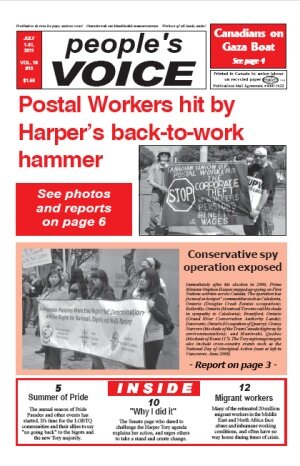
July 1-31 , 2011
Volume 19 - Number 13
$1
Prolétaires de tous les pays, unissez-vous!
Otatoskewak ota kitaskinahk mamawestotan!
Workers of all lands, unite
1) HARPER TORIES DO CANADA POST'S DIRTY WORK
2) "WE WILL NEVER GIVE UP THE STRUGGLE" - Lemelin
3) TORIES ESCALATE FIRST NATIONS SURVEILLANCE
4) ONTARIO COMMUNISTS GEAR UP FOR OCTOBER ELECTION
5) TORIES PREPARE TO DESTROY CANADIAN WHEAT BOARD
6) LAYTON FLUNKS FIRST TEST - Editorial
7) STORM WARNINGS ON HORIZON - Editorial
8) NO GOING BACK: DEFEAT HARPER'S BIGOTS!
9) THE ANTIDOTE FOR DESPAIR IS ACTION
10) TANKS AND TROOPS IN KELOWNA STREETS
11) REPLACING ECONOMIC DEMOCRACY WITH FINANCIAL OLIGARCHY
12) INDIA'S COMMUNISTS ASSESS BENGAL DEFEAT
13) WHO'S EXPLOITED, AND DOES IT MATTER?
14) MUSIC NOTES, by Wally Brooker
15) THE HUMAN FACE OF SOLIDARITY
16) WHAT’S LEFT
17) CLARTÉ (en français)
18) THE SPARK! (Theoretical and Discussion Bulletin of the Communist Party of Canada)
19) INTRODUCING MARX
PEOPLE'S VOICE JULY 1-31, 2011 (pdf)
|
|
|
|
The Spark!The Spark! The latest issue of The Spark! theoretical journal, is now on sale for $5 at Communist Party offices (see p. 8) or People’s Co-op Books, 1391 Commercial Drive, Vancouver. Articles include
plus reviews, editorials, and more.
|
|
|
Theoretical and Discussion Bulletin of the Communist Party of Canada |
|
|
People's Voice deadlines: August 1-31 SEPTEMBER 1-15 Send submissions to PV Editorial Office,
|
|
REDS ON THE WEB |
|
People's Voice finds many "Global Class Struggle" reports at the "Labour Start" website, http://www.labourstart.org/. We urge our readers to check it out! |
* * * * *
People's Voice
Canadian Publications Mail Sales Product Agreement #205214
ISSN number 1198-8657
People's Voice is published by
New Labour Press Ltd
PV Editorial Office
706 Clark Drive,
VANCOUVER, B.C. V5L 3J1
Phone:604-255-2041
Fax:604-254-9803
email: pvoice@telus.net
Editor: Kimball Cariou : Business Manager: Sam Hammond
Editorial Board: Kimball Cariou, Miguel Figueroa,
Doug Meggison, Naomi Rankin, Liz Rowley, Jim Sacouman
* * * * * *
Letters
People's Voice welcomes your letters
on any subject covered in our pages.
We reserve the right to edit for length and clarity,
and to refuse to print letters which may be libellous
or which contain unnecessary personal attacks.
Send your views to:
"Letters to the Editor",
706 Clark Dr., Vancouver, BC V5L 3J1,
or pvoice@telus.net
People's Voice articles may be reprinted without permission,
provided the source is credited.
* * * * * *
The Communist Party of Canada, formed in 1921,
has a proud history of fighting for jobs, equality, peace,
Canadian independence, and socialism.
The CPC does much more than run candidates in elections.
We think the fight against big business and its parties
is a year-round job,
so our members are active across the country,
to build our party and to help strengthen people's movements
on a wide range of issues.
All our policies and leadership
are set democratically by our members.
To find out more about Canada's party of Socialism,
give us a call at the nearest CPC office.
* * * * * *
Central Committee CPC
290A Danforth Ave Toronto, Ont. M4K 1N6
Ph: (416) 469-2446
fax: (416) 469-4063 E-mailmailto:info@cpc-pcp.ca
Parti Communiste du Quebec (section du
Parti communiste du Canada)
5359 Ave du Parc, Montréal, Québec,
H2V 4G9
B.C.Committee CPC
706 Clark Drive, Vancouver, V5L 3J1
Tel: (604) 254-9836
Fax: (604) 254-9803
Edmonton CPC
Box 68112, 70 Bonnie Doon P.O.
Edmonton, AB, T6C 4N6
Tel: (780) 465-7893
Fax: (780)463-0209
Calgary CPC
Unit #1 - 19 Radcliffe Close SE
Calgary AB, T2A 6B2
Tel: (403) 248-6489
Ottawa CPC
Tel: (613) 232-7108
Manitoba Committee
387 Selkirk Ave., Winnipeg, R2W 2M3
Tel/fax: (204) 586-7824
Ontario Ctee. CPC
290A Danforth Ave., Toronto, M4K 1N6
Tel: (416) 469-2446
Hamilton Ctee. CPC
265 Melvin Ave., Apt. 815
Hamilton, ON.
Tel: (905) 548-9586
Atlantic Region CPC
Box 70 Grand Pré, NS, B0P 1M0
Tel/fax: (902) 542-7981
http://www.communist-party.ca/
* * * * * *
News for People, Not for Profits!
Every issue of People's Voice
gives you the latest
on the fightback from coast to coast.
Whether it's the struggle for jobs or peace, resistance to social cuts,
solidarity with Cuba, or workers' struggles around the world,
we've got the news the corporate media won't print.
And we do more than that
- we report and analyze events
from a revolutionary perspective,
helping to build the movements for justice and equality,
and eventually for a socialist Canada.
Read the paper that fights for working people
- on every page, in every issue!
People's Voice
$30 for 1 year
$50 for 2 years
Low-income special rate: $15 for 1-year
Outside Canada $50 for 1 year
Send to: People's Voice, 706 Clark Drive, Vancouver, BC, V5L 3J1
You can call the editorial office at 604-255-2041
REDS ON THE WEB
http://www.communist-party.ca/
http://www.ycl-ljc.ca/
http://www.solidnet.org/
(The following articles are from the July 1-31, 2011, issue of People's Voice, Canada's leading communist newspaper. Articles can be reprinted free if the source is credited. Subscription rates in Canada: $30/year, or $15 low income rate; for U.S. readers - $45 US per year; other overseas readers - $45 US or $50 CDN per year. Send to People's Voice, c/o PV Business Manager, 706 Clark Drive, Vancouver, BC, V5L 3J1.)
1) HARPER TORIES DO CANADA POST'S DIRTY WORK
By Kimball Cariou
As widely expected, the Harper government introduced legislation on June 20 to order locked‑out CUPW members back to work on terms highly favourable to the management of Canada Post. As People's Voice went to press, the NDP opposition in Parliament pledged to oppose the legislation, but it was unclear whether this would mean more than rhetorical resistance.
Ignoring the reality that Canada Post has dragged its feet for months while demanding huge concessions from its workers, Labour Minister Lisa Raitt claimed that the two sides have had "ample time" to reach a settlement. The legislation will appoint an arbitrator to choose between final offers from management or the union, a choice obviously stacked against CUPW.
CUPW says the back‑to‑work bill penalizes postal workers and rewards Canada Post for locking out employees and stopping mail delivery country‑wide.
The legislation sets wage increases well below the company's last offer of 1.9% in 2011, 2012 and 2013, and 2.0% in 2014. At the current 3.3% rate of inflation, this which would have cut the income of workers by a total of 5.5% after four years. The Tory bill includes raises of 1.75% in 2011, 1.5% in 2012, 2% in 2013 and 2% in 2014, leaving workers nearly 6% behind after inflation.
"Imposing wage increases that are lower than Canada Post's last offer punishes postal workers for a disruption that was caused by the corporation's national lockout," said CUPW National President Denis Lemelin. "The bill would take $875.50 out of the pockets of an average full‑time postal worker during the four years of the agreement. All told, it represents a theft of $35 million from postal workers and their families."
Lemelin said this heavy‑handed intervention will damage labour relations for years to come. The last time the federal government imposed back to work legislation in 1997, it included a provision that ensured the mediator arbitrator considered the importance of good labour‑management relations. The current legislation contains no such provision.
"The arbitrator who is assigned to do the final offer selection will not have to live with the results," said Lemelin. "An imposed settlement will not help the post office in the long term."
The Canadian Foundation for Labour Rights (CFLR) has also expressed alarm at the government's interference with the free collective bargaining rights of Canada Post employees, and Air Canada workers.
"It looks like the Harper government is treating the Supreme Court of Canada's decision in Fraser, which appears to narrow the Charter's protection of collective bargaining rights, as a green light for back‑to‑work legislation," said Judy Fudge, law professor at the University of Victoria and CFLR Board Member. "Legislating workers back to work instead of letting the process of collective bargaining unfold simply creates bad labour relations and does not resolve issues that can only be solved through negotiation."
The recent Fraser decision denied agricultural workers the same collective bargaining rights afforded other workers in Ontario. It did however affirm that government interference with existing collective bargaining rights may be a violation of the freedom of association guarantee in the Charter.
"Armed with a majority, it looks like the Harper government is willing to use its political power to interfere with the collective bargaining process and order workers back‑to‑work," said Fudge. "Short‑term coercive fixes do not create the conditions for developing long‑term solutions to the challenges facing Canadian workers and employers."
"Back‑to work legislation is a blunt tool and the speed with which the government is resorting to this tool is unprecedented," according to Veena Verma, labour lawyer and CFLR Board Member. "The Harper government's response to both the Air Canada strike after a mere 16 hours - and in the Canada Post case - sends a message that free collective bargaining will not be respected and government will interfere to tip the scales on the employer's side."
One immediate response to the bill was a series of occupations by postal workers and their community allies, who took over several Conservative MP's offices on June 20. They demanded withdrawal of the legislation, an end to the lockout, and a return to collective bargaining at Canada Post.
Speaking to The Tyee website, Aaron Spires, a union member involved in the occupation of North Vancouver Tory MP Andrew Saxton`s office, a critical issue is the Canada Post plan to establish two-tier wages, with newly hired workers earning about four dollars an hour less than current employees.
"This is a classic attempt to bust the union and divide workers," he said. Another concern he cited was a new "two bundle" system of mail handling. In a pilot project test in Winnipeg, this system has already seen injury reports go up dramatically.
Similar occupations occurred at the Edmonton constituency office of Rona Ambrose and the Winnipeg office of Shelly Glover.
"We are going to stay in this office until the government withdraws the lock out and the back to work legislation," said Spires. "We hope the public will come by to support us. We deliver an important public service, and all we want is to settle our issues through collective bargaining, which the Supreme Court has recognized as a Charter right."
Although most corporate media coverage of the dispute was blatantly pro‑management, some fair reporting did break through in certain areas. A recent article in the Welland Tribune reported the views of CUPW Local 628 president Gerry Tulio, who said he was "overwhelmed" by community support for the locked out workers, including the 200 members of his local in Dunnville, Port Colborne and Welland. That support has included a statement from two local NDP representatives, MP Malcolm Allen and MPP Peter Kormos, who called on Raitt and Canada Post to end the lockout and resume negotiations. The release stressed that Canada Post is not subsidized by taxpayers, and made almost $2 billion in profit in the past 15 years.
Union members in many areas were angry that management has even sabotaged mail delivery, which CUPW points out is actually breaking the law.
"Some of us had our mail ready for the street but Canada Post would not let us get the mail out of the building," said Ruth Breen, spokesperson for Fredericton and Oromocto's CUPW Strike Committee. "We quickly re‑strategized. We had amazing shop floor organizing! Just as we came in en masse, we left en masse with empty mail bags. We set up an info picket at the Waggoners' Lane distribution centre to inform the public that the mail was not leaving the building. Another group went to Fredericton's downtown with flyers to talk to customers and let them know there is mail at the post office and we want to deliver it but Canada Post won't let us. Public support has been fantastic."
Postal workers entered a legal strike position on May 24th, when CUPW members held a 94.5% vote in favour of strike action. The massive vote was a rejection of Canada Post's proposals to pay new workers 30 per cent less and give them reduced benefits, an inferior pension and weaker job security. Postal workers also voted against an increase in the amount of temporary employees and a reduction in the number of full‑time employees.
Also rejected by postal workers were cuts to their extended health care plan, replacement of their sick leave plan with an inferior short‑term disability plan and the unsafe "double bundle" delivery procedure. Canada Post has one of the highest injury rates in Canada with over 9,000 CUPW members reporting injuries last year.
Communist leader condemns legislation
Responding to the back-to-work legislation, Communist Party leader Miguel Figueroa said "This confirms what we said leading into the dispute: instead of engaging in serious bargaining, Canada Post has been counting on the Harper government to help impose major contract rollbacks. Despite turning a profit every year, the company has been demanding a huge pay cut for new hires, attacks on the sick leave program, and many other concessionary proposals.
"This attack is part of a broader strategy by the Harper government to attack the overall wages, pensions and working conditions of both public and private sector employees across Canada. This corporate/government drive to boost profits by slashing the wages and pensions of working people will be the mantra of the Harper Tories for the next four years. It will take a massive fightback campaign led by the labour movement and its social justice partners to block this agenda. We urge the Canadian Labour Congress, the CSN and all levels of the labour movement to take emergency steps to begin building such mobilizations immediately."
2) "WE WILL NEVER GIVE UP THE STRUGGLE" - Lemelin
June 20, 2011, Negotiations Bulletin 72
Contrary to the CPC media spin there was no scheduled meetings between the parties this weekend. It is obvious that CPC management is waiting for the back‑to‑work legislation that they wanted so badly.
From the very beginning of negotiations, CPC set the stage by demanding drastic rollbacks. From current employees they wanted to end the WCB top‑up for injured workers, replace employer‑paid retiree benefits with a health care spending account, abolish the seventh week of annual leave and eliminate sick leave and impose a short‑term disability plan. For new hires they wanted weaker job security, fewer benefits, a worse pension and a much lower starting pay rate. During the negotiations they dropped some of their rollbacks, but they never addressed any of the union's demands concerning staffing, health and safety and working conditions. Throughout the process they made offers on issues such as staffing, bar charts and householders only to withdraw them. Their final offer still contains many rollbacks and no significant improvements.
In order to set the stage for back‑to‑work legislation management engaged in a series of media stunts. First they claimed that our demands would cost $1.4 billion. They refused to explain or justify this figure, but it got them the headlines they wanted. To portray themselves in a crisis they invented the figure of a 17% reduction in overall mail volumes since 2006. They ignored the fact that 2009 was a record year for profits. To create the appearance of an emergency they claimed that our rotating strike had reduced volumes by 50% and cost them $70 million. The same day they raised the figure to $100 million. When everything failed they locked us out to give the government a pretext to pass legislation.
Unlike CPC we never attacked the postal system or stopped providing service to the public. Our one‑day rotating strikes were designed solely to pressure the employer to negotiate. Before CPC stopped all postal service and locked us out, only 51% of the population had experienced any direct impact of our rotating strikes. People were still using the postal service in the knowledge their mail would arrive, perhaps a day later than usual. CPC's action ended all of this. They attacked the postal service to pressure the government to legislate: something the Conservative government was only too happy to do.
In locals across the country postal workers are participating in rallies and meeting with politicians to try and stop this unnecessary, unjust, and counter‑productive legislation. We demand the right to negotiate and the right to strike. We continue to receive tremendous support from the labour movement, the NDP, and many community allies, including students, women's groups, pensioners and anti‑poverty organizations. Whatever happens in the upcoming days we will never give up the struggle for our rights.
The Struggle Continues.
In solidarity, Denis Lemelin, National President and Chief Negotiator
3) TORIES ESCALATE FIRST NATIONS SURVEILLANCE
PV Vancouver Bureau
An in-depth report by Russell Diabo and Shiri Pasternak, published recently by The Media Co‑op, reveals internal government documents showing that immediately after his election in 2006, Prime Minister Stephen Harper stepped up spying on First Nations activists across Canada. The surveillance is largely focused on grassroots indigenous groups and campaigns, but the news has also sparked anger from other First Nation bodies.
Documents obtained by Access to Information requests shows that the Department of Indian and Northern Affairs Canada (INAC) was given the lead role to spy on First Nations leaders, participants and outside supporters of occupations and protests.
INAC established a "Hot Spot Reporting System," which puts together weekly reports highlighting movements engaged in direct action to protect their lands and communities.
As the Media Co-op authors note, "What we see in these documents - from the hot spot reports themselves, to the intelligence‑sharing between government and security forces - is a closely monitored population of First Nations, who clearly are causing a panic at the highest levels of Canadian bureaucracy and political office."
INAC focused on conflicts of "growing concern" due to "unrest" and increasing "militancy". In a briefing to the RCMP, INAC identified "hotspot" communities such as Caledonia, Ontario (Douglas Creek Estates occupation); Belleville, Ontario (Montreal/Toronto Rail Blockade in sympathy to Caledonia); Brantford, Ontario (Grand River Conservation Authority Lands); Desoronto, Ontario (Occupation of Quarry); Grassy Narrows (Blockade of the TransCanada highway by environmentalists); and Maniwaki, Quebec (Blockade of Route 117).
But the weekly reports cover all actions taking place from Vancouver Island to the east coast, naming dozens of communities as sources of potential unrest organized by "Aboriginal extremists."
Such protests, according to INAC, "are arguably harder to manage as they exist outside negotiation processes to resolve recognized grievances with duly elected leaders. We seek to avoid giving standing to such splinter groups so as not to debase the legally recognized government."
This fear of aboriginals who function "outside negotiation processes" is as old as the Canada itself. The colonization of the prairies is largely a story of the emerging Canadian state's strategy of compelling tribes to sign unfair treaties (invariably broken to a greater or lesser degree), while crushing resistance movements which rejected this process.
At the heart of the new revelations is the reality that to this day, the Canadian state seeks to channel all relations with Aboriginal peoples through forms which reject inherent indigenous sovereignty and self-determination. In fact, aboriginal movements and forces based on such concepts are regarded by definition as outside the bounds of legality.
From this perspective, the role of INAC is clear. Rather than functioning as a regular government ministry or an "institution of reconciliation and negotiation," INAC is closely integrated with the state security forces, especially the RCMP, with the mandate of controlling "unrest".
The Media Co-op article reports that the Harper government established a "Standing Information Sharing Forum," chaired by the RCMP. This "Forum" includes the Canadian Security Intelligence Service (CSIS), the Department of Fisheries, Natural Resources Canada, and Transportation Canada, holding weekly conference calls. "Harper is moving towards a security paradigm familiar since the War on Terror was launched in 2001," say the authors. "The inclusion of Transportation Canada at the Information Sharing Forum should also alert us to the commercial threat of blockades to the free trade agenda. Aboriginal people who are defending their lands are now treated on a spectrum from criminals to terrorists."
The authors report that the government seems "particularly worried about the Haudenosaunee/Six Nations Iroquois Confederacy" and "Warrior Societies" with an "illicit agenda," such as tobacco smuggling without paying federal taxes.
The Haudenosaunee/Six Nations are also seen as a threat because of the land reclamation at Caledonia, which "continues to serve as a beacon on land claims and Aboriginal rights issues across Canada," according to the documents. For this reason, the authors say, "hard‑nosed, experienced negotiators (have) presented unmovable positions from the Harper government, which is likely why there hasn't been any negotiated resolution of the situation at Kanenhstaton/Caledonia to this date."
The 2007 National Day Of Action launched by the Assembly of First Nations was another source of government concerns. The documents point to "the often disparate and fractured nature of these events," which can damage the public's perception of the police. The documents imply a fear that a violent response by police to First Nations actions could result in solidarity actions across the country, such as railway blockades outside the control of the AFN.
The authors find that "most threatening of all to security and government forces is coordinated First Nations action... Their fear is palpable where they follow the trajectory of the Day of Action ... first proposed by Chief Terrance Nelson at the Assembly of First Nations' general assembly, where the motion carried."
Noting the historic government tactic of "dividing First Nations into the `progressive' Indian Bands and the backward or `traditional' Indian Bands," the authors conclude that "what the INAC and RCMP briefings show is that there needs to be unity on the ground with coordinated political actions between First Nations Peoples in order to protect, defend and advance First Nation pre‑existing sovereignty, and First Nation Aboriginal and Treaty rights to lands and resources. Divide and conquer tactics can only be met with new strategies of alliance‑building, and by bringing the leadership back down to the land."
4) ONTARIO COMMUNISTS GEAR UP FOR OCTOBER ELECTION
PV Ontario Bureau
Delegates to a special Ontario convention met June 18 in Toronto to lay out the Communist Party's platform and message for the October 6 provincial election. Delegates also condemned back to work legislation for postal workers and Air Canada workers as "a frontal attack on free collective bargaining" by Ottawa's new Tory majority government.
The attack on free collective bargaining and on workers rights and living standards began with the attack on Canadian autoworkers in 2008‑09, on municipal workers in Windsor and Toronto, and miners and smelter workers in Hamilton in 2009‑10, and on workers in basic steel in 2007, up to today's lock‑out in Hamilton.
"This fight for labour rights and standards is also the fight for public services, for a Canadian industrial and manufacturing base, and for good jobs, wages and benefits for all", said CPC (Ontario) leader Liz Rowley.
The Party will start its campaign in early August to block the Tories from forming the next government "because they are by far the greatest threat to democracy, to labour and to working people in this province," said Rowley.
"The ferocity of the Tory‑led assault on workers' jobs, pensions and living standards and on free collective bargaining and the right to strike at the federal level, combined with the ferocity of Tim Hudak's platform for Ontario, make the Tories the greatest danger in this election, though they aren't the only threat.
"The McGuinty Liberals, were elected in 2003 to reverse the years of Tory devastation under Mike Harris, are a failure. Instead the Liberals have carried out the same policies in health care and education, and have done nothing to reverse the cuts which reduced the purchasing power of a welfare cheque to 50% of what it was in 1995. So much for the Liberals' war on poverty! More like the continuing war on the poor by the parties of Big Business and the rich.
"Working people are extremely angry at the Liberals, and rightfully so. They also remember who was in charge in 2008 when collective agreements were stripped and autoworkers lost half their pensions. And they remember who brought in the HST ‑ colluding with the federal Tories ‑ to deliver a whopping $9 billion in total corporate tax cuts last year," Rowley said.
The NDP under Andrea Horwath has a very mixed record, supporting back to work legislation for some workers and opposing it with others. For Toronto transit workers, they supported back to work legislation and then opposed essential services designation. Horwath has led the fight against the HST, but has said the NDP will not repeal the HST legislation.
Hoping for a provincial "orange crush", the NDP is still at the bottom of the polls, and has not yet revealed its election platform. The NDP's reluctance to take a firm stand on the side of labour makes it an unpredictable and weak partner for labour at a time when strength, dependability and durability are key assets. How the NDP defines the main target in the election will determine a lot.
"The Communist Party will campaign to block the Tories and defeat the right, and will advise working people ‑ surrounded by circling sharks ‑ that the best outcome in this election would be a minority government reliant on a strong progressive bloc in the Legislature and subject to mass public pressure from a people's coalition of forces outside the Legislature. Electing Communists would fundamentally change politics for the better and qualitatively strengthen the fight for democratic and progressive change in this province," Rowley said.
The CPC (Ontario) is the only party fighting to repeal the Harmonized Sales Tax and replace it by doubling the corporate income tax rate, cancelling corporate tax cuts, restoring the capital tax, collecting deferred corporate taxes, and introducing wealth and inheritance taxes on estates over $750,000.
The Communist Party is fighting for full employment policies to put Ontario back to work; plant closure legislation and a plan to protect and expand secondary industry and manufacturing; nationalization and regulation of Ontario's natural and energy resources; investment in solar, wind and thermal energy; and closing down nuclear and coal fired operations.
On social issues, the CPC (Ontario) is campaigning for social housing, real rent controls, public child care at a cost of $7 per child, per day, a guaranteed annual income above the poverty line, substantially increased funding for health, education, and social programs, and immediate action to raise living standards and quality of life of Aboriginal Peoples.
The complete Communist program, and the list of candidates will appear on the CPC (Ontario) website in July. See the next issue of People's Voice for full details.
5) TORIES PREPARE TO DESTROY CANADIAN WHEAT BOARD
PV Vancouver Bureau
The Harper government is preparing to use its new majority to gut the Canadian Wheat Board, warns the National Farmers Union (NFU).
Agriculture Minister Gerry Ritz recently warned that the government intends to remove the CWB's single desk authority to sell wheat and barley through legislation. He also stated that the CWB would continue to be an "option" for farmers after the changes, and that farmers would be better off without the single desk.
"Ritz is not being honest with farmers. The fact is farmers won't be better off without the single desk, because the CWB won't survive without it," says NFU President Terry Boehm. "This idea of a dual market is a myth. It's the CWB with its single desk, or no CWB at all."
The NFU points to Australia, where the government removed the single desk of the Australian Wheat Board (AWB) in 2008. Today the AWB no longer exists. It was broken up, with parts sold off to Agrium and Cargill, two of the world's biggest transnational grain monopolies. This happened despite the fact that the AWB possessed considerable assets, in contrast to the CWB which has not been allowed to possess assets such as grain handling facilities.
"The Harper government continues to argue that farmers will be better off without the CWB. However, they have never produced any financial analysis to demonstrate this," points out Boehm. "The only academic studies on this have always proven that the CWB brings substantial benefits to farmers through the power of its single desk selling advantage. The fact is, the CWB brings $1.5 billion into farmers pockets every year, money they would not have otherwise."
"The advantage of the single desk to farmers is no surprise either," concludes the NFU president. "Patents work the same way for big corporations. Patents give corporations exclusive selling rights on their products. Why do you think corporations defend their patents so vigorously? It's the same with OPEC in the oil sector and it's the same with Canpotex in the Potash sector, a point the Brad Wall government was quick to make in Saskatchewan last fall."
During the recent federal election, Ritz said that it was up to farmers to decide the future of the Wheat Board. Soon after, Ritz reversed himself, stating that changes to the CWB single desk authority would be legislated.
"Clearly the Conservative government cannot be trusted. They say one thing during the election campaign, and do the opposite when the election is over," according to NFU Region 3 Coordinator Joe Dama.
Since its formation, the Wheat Board has been governed by a 15-member board of directors, ten of whom are elected by Prairie farmers, with another five appointed by Ottawa. Since taking office in 2006, the Conservatives have tried a wide range of tactics to eliminate the CWB or remove its single-desk authority. But CWB elections have consistently resulted in a majority of single-desk supporters, despite government tricks such as removing voting rights for many farmers.
"The Conservative government needs to respect the director elections, the process through which farmers decide the future of the CWB. The Conservatives are showing contempt towards the farmers who have expressed their views on the board through the director elections, and whose livelihoods are at stake. This is totally unacceptable," says Dama, warning that the supply management system is the next Tory target.
"They have said publicly that they are not going to touch supply management," adds Dama. "But, privately they are in negotiations where getting rid of supply management is on the table, both at the World Trade Organization and with the European Union."
People's Voice Editorial
Many Canadians had hoped that the New Democratic Party's status as Official Opposition might blunt the far‑right agenda of the Harper Tory majority. This was particularly the case around war and militarism, since the majority of the new 103‑member NDP caucus are from Quebec, where national sentiments are strongly anti‑war. Overall, sixty percent of Canadians cast their ballots for the NDP, Liberals, Bloc Québecois and Greens, parties which in varying degrees questioned the increasingly aggressive Tory foreign policy.
Unfortunately, Jack Layton has flunked his first major foreign policy test ‑ the June 14 parliamentary debate around Libya. In a nod to anti‑war sentiments among Canadians, the NDP moved amendments to the government resolution to extend the war, calling for increased foreign aid to Libya, and prevention of war rapes allegedly committed by the Gadaffi forces. PM Harper happily seized on these amendments to win a 294‑1 vote. Layton's feeble argument that the NDP will only support one extension amounts to an offer to back future "regime change" wars on a six‑month basis. Similarly, his opposition to ground troops in Libya will simply be ignored if NATO intervenes directly to capture and kill the Libyan leader.
The NDP made a serious error by backing this war. Allowing the U.S. and its allies to carry out the so‑called "responsibility to protect" doctrine gives carte blanche to the western imperialist powers to attack other countries at will. The NDP cannot pretend to be an anti‑war party while voting in favour of war. Jack Layton is looking less like some former leaders of his party, and more like Tony Blair. This is a betrayal of Canadians who want the NDP to oppose Harper's dangerous foreign policy.
Fortunately, Green Party leader Elizabeth May refused to give "a blank cheque to a mission that doesn't have an exit strategy." She voted "No", braving enormous pressure to join the chorus of unanimous support for the war. Congratulations to May for voicing the concerns of millions of Canadians.
People's Voice Editorial
We've said this before, but it's worth repeating: any idea that the global economic crisis which broke out in 2008 has been resolved is a fantasy. The return of corporate profits to the record levels of 2007-2008, and the overstated decline in unemployment rates, are indicators which have been misread by those who claim that capitalism has been restored to full health. A more accurate view is that the system is entering a fifth year of the crisis, which began with the severe contraction in U.S. housing markets in mid‑2007.
Fears of new turmoil are reflected in the Dow and the TSX, which have declined by 8-10% from peak levels. Some 15% of U.S. workers remain unemployed or under-employed, counting those who have given up looking for work. The real jobless rate is similar in Canada. U.S. housing prices are falling, and consumer debt levels in the U.S. and Canada are hitting new records. Wages are stagnant, and pensions and other benefits are under sharp attack by employers and right-wing governments. Add to this the raging debt crisis in Europe, and it is clear that serious storms lie ahead.
The capitalist "solution" is to continue impoverishing workers, which will only make the next economic decline even steeper. Instead, urgent and radical measures are needed to improve the living standards of working people, by reversing the shift of wealth towards the rich. A real "People's Alternative" must include a combination of expanded public ownership of key industries, higher taxes on the corporations and the rich, drastic cuts in wasteful military spending, and restoration of social programs. Only a united, mass struggle led by the labour movement and its allies can block the Harper agenda and achieve these policies. The time to begin is today.
8) NO GOING BACK: DEFEAT HARPER'S BIGOTS!
Pride 2011 statement from the Communist Party of Canada and the Young Communist League
This summer, as the LGBTQ communities and their allies across Canada hold Pride events, there is much to celebrate, but also serious challenges. The Communist Party of Canada and the Young Communist League send warmest greetings, and pledge our solidarity to the ongoing struggles for full equality.
These struggles gained more new ground in the past year, in Canada and many other countries. The powerful movement for full gender and sexual equality continues to break down old barriers and prejudices. The right to same-sex marriage equality is being recognized in more U.S. states and in other countries. The "It Gets Better" campaign has given some hope to millions of queer and questioning youth who face abuse and hatred. Toronto City Council has rejected attempts by homophobic mayor Rob Ford to deny funding to Pride Toronto.
We welcome the continued expansion of queer‑positive environments in the public realm, the growing numbers of trade unions with active Pride and LGBTQ caucuses, and the increase of gay‑straight alliances, safe school spaces and "Pride proms" in our schools. These and other legal, political and cultural victories are the hard‑won results of decades of efforts by the LGBTQ community and allies.
But this progress is under attack. Those who rely on the divisive tactics of fear and bigotry have a powerful new ally - the Conservative majority elected on May 2. Other far-right forces seek to gain power with the aid of reactionary, fundamentalist groups, such as the Hudak Tories in Ontario. The manufactured outcry against the Burnaby School District's new anti-homophobia policy, and the Toronto Catholic School Board's banning of a lesbian comedian from an anti-bullying event, are reminders that anti-equality groups will keep trying to turn back the clock.
Alarmingly, police‑reported hate crimes motivated by sexual orientation rose by 18% in 2009 according to Statistics Canada, after more than doubling from 2007 to 2008. Hate crimes motivated by sexual orientation are often violent, confirming news of more gay-bashings in recent years. Despite the "It Gets Better" campaign, most LGBTQ students still report feeling unsafe at school, and prosecutors are often unwilling to prosecute vicious gay‑bashings as hate crimes.
Bill C-389, the historic legislation to amend the Canadian Human Rights Act by making it illegal to discriminate on the basis of gender equality or gender expression, was adopted by the last House of Commons, only to die with the dissolution of Parliament before a vote in the Senate. The struggle for legal equality for transgender Canadians will now be much more difficult and complex.
We are confident in eventual victory for trans equality, but the cost of delaying for years will be tragic. To those who dismiss the significance of this issue, we point out that trans people are about one-tenth of the LGBTQ population, and face huge medical costs, higher levels of unemployment, less access to housing, widespread intimidation at work, and lack of legal protections.
The demand for trans equality must be intensified by the LGBTQ communities and our allies in the coming period. But the Harper Tories hope to use their new majority to reverse queer rights as well as decades of gender equality gains by women. Right-wing forces continue to scapegoat the LGBTQ community and racialised groups, to divide working class resistance against finance capital, corporate bailouts and global environmental plunder.
Globally, the struggle to end the criminalization of sexual orientation, gender identity and gender expression faces stubborn resistance. Violent expressions of homophobia are on the rise in many countries, sometimes in response to courageous attempts to hold public events such as Pride Parades. Working class queer people suffer vicious discrimination, along with women and racialized communities who bear the brunt of neoliberal economic and social policies.
ILGA, the association of lesbian, gay, bisexual, trans, intersexed peoples, reports that 76 United Nations member states still criminalize consensual same‑sex acts among adults. In five countries, punishment for homosexuality still includes the death penalty.
But the ILGA also notes that "from the adoption of marriage laws in Argentina and Iceland, and the decision of the Brazilian Supreme Court recognizing rights of same‑sex civil unions, to the issuing of a Statement signed by 85 countries at the UN Human Rights Council condemning persecution on the basis of sexual orientation or gender identity, a lot of progress has been made the last year on recognition of LGBTI rights in the world."
The myth that queer rights can only be won in wealthy capitalist countries is shattered by these advances, and by the reality that homophobic and racist concepts are exported from North America and Europe.
Today the so‑called "war on terror" is an excuse to remove civil liberties, and the ruling class is using the economic crisis to conduct a vicious assault on workers and hard-won social equality gains. We must always remember that "an injury to one is an injury to all." Just like racism, sexism, and national chauvinism, homophobia and transphobia are weapons to divide working people. Equality and human rights must be expanded to include full legal and political protections for sexual orientation and expression, and gender identity.
This demand is not "divisive." It is a vital part of the fightback by people's movements. A broad democratic and social resistance is needed to block and reverse the corporate agenda. Together, we must build a powerful coalition around a genuine people's alternative ‑ a common front of labour, Aboriginal peoples, youth and students, women, seniors, farmers, immigrant and racialized communities, environmentalists, peace activists, the LGBTQ community, and many other allies.
Ultimately, this struggle in our communities and workplaces, in the streets and at the ballot box, can defeat the Harper Tories and open the door to a people's coalition government. The goal of the Communist Party is to win fuller social freedom and genuine people's power in a socialist Canada, where our economy will be owned by all and democratically controlled. It will then become possible to eradicate the intersecting forms of exploitation and oppression which we all face today. We urge you to join us in this goal of creating a liberated society in which, as Karl Marx said, "the freedom of each is the condition for the freedom of all."
9) THE ANTIDOTE FOR DESPAIR IS ACTION
By Kevin Neish, Victoria, BC
"For heavens sake, why are you going back on another flotilla to Gaza!!"
I've heard this comment/question repeatedly since I returned from an Israeli prison after the attack on my ship, the Mavi Marmara, last May.
In a nutshell, I'm returning because the illegal blockade of Gaza is still in place. The job is not done. I gotta go back or I couldn't live with myself.
And it's all my mom and dad's fault. As a little kid, I remember my Marxist mother and father repeatedly standing up for just causes. They would stand, almost alone in the 60's, for Cuba, the USSR, unions and peace, and against the Vietnam war, nuclear bombs, apartheid South Africa, fascist Spain and book burning McCarthyites here in Victoria.
They risked financial loss, political and social banishment and physical assaults. And in the end, they usually, eventually, were proven right. While I was on the Mavi that night last May I thought about them a lot, while watching fellow aid workers be shot, bleed and die all around me, having Israeli guns put to my head, watching others get beaten and everyone being deprived of human dignity and basic rights for three days.
I don't remember being scared, I remember being outraged, all the more so when I returned to Canada, to hear Israeli-scripted questions from the mainstream media. It was a horrific three days, even though I expected that my Canadian passport and white skin would likely get me home safe. All I could think about, was that the Palestinians have gone through all this, and much much worse, for years and years on end.
Once you know something, "taken the red pill", you can't go back, you can't "take the blue pill" and ignore what you've seen and walk away, at least I can't. Sometimes, I feel that I'd give anything to take a blue pill and move into blissful ignorance, just for a while, but this isn't a movie, it can't and shouldn't happen. In a high school political science class, which I not surprisingly failed, I remember a quote from a Nuremburg WWII war crimes judge. He said that when citizens are faced with an immoral law, they have not only the right, but an obligation, to disobey that law. So when Rosa Parks refused to obey the law and not move to the back of the bus, or when Gandhi milled his illegal salt, or when Greenpeace illegally sailed into atomic bomb test zones, they broke the State's laws, but they were all morally right and history absolved them all.
The flotilla against the blockade of Gaza, has been deemed illegal by Mr. Harper and we are being sued by Canadian Zionists to try to bankrupt and stop us, but we are doing the right thing. Someone has to do something to make it end, and 40 or so Canadians aboard the Tahrir will try to do the right thing, with a ship full of medicines, witnesses and hope, regardless of Mr. Harper and his Zionist supporters.
Hopefully some Canadians feel the same way and will support us and be apart of our effort. Contact your MP and the media and tell them how you feel. Demand justice. Do the right thing.
If you want to keep track of the Canadian Boat to Gaza or make a donation, check out www.tahrir.ca. If anyone wants to keep track of me on the Mavi Marmara take a peek at www.kevinneish.ca. For info on the Freedom Flotilla 2 in general, see www.freegaza.org.
Watch for us sailing to Gaza around the 24th of June.
10) TANKS AND TROOPS IN KELOWNA STREETS
By Mark Haley
Delegates to the bi‑annual Southern Interior Peace Coalition conference were treated to a display of armed troops and tanks in the streets of Kelowna recently as "Freedom of the City" was re‑proclaimed for the B.C. Dragoon's hundredth anniversary.
Conference participants from Grand Forks, Vernon, Penticton, and Kelowna, who had been discussing the "Arab Spring" and related topics during the morning's session, heard a General explain that in former times the appearance of armed troops on city streets had been considered a "fearsome thing". The B.C. Dragoons are the only group to have received the Freedom of the City award, the city's highest honour.
Alongside the B.C. Dragoons fresh‑faced Cadets were reviewed by the Kelowna Mayor. "They are part of an organization dedicated to developing citizenship and leadership among young men and women aged 12 to 18 years of age with a military flavour, and are not required to join the Canadian Forces," according to their literature.
The city hopes the $20,000 cost for the two hour ceremony will be picked up by Veteran's Affairs.
The Kelowna Peace Group, host to the Southern Interior Peace Coalition conference and an affiliate of the Canadian Peace Alliance, distributed the following statement at the Dragoons celebration:
"We oppose the old wars in Vietnam and Iraq, we oppose the current wars in Afghanistan and Libya and we oppose the next wars ‑ likely somewhere in Africa using our brand new F‑35 bombers. And we oppose the sinister spectacle of tanks rolling down our city streets.
"The resort to armed force is always accompanied by noble rhetoric about protecting vulnerable populations, bringing democracy and freedom and insuring human rights. The grim realities of resource control, `regime change' and enormous profits for military contractors lurk beneath the rhetoric.
"Our tax dollars are being spent in a huge propaganda campaign to normalize military interventions, militarize our society, recruit our young and vulnerable citizens and justify the largest military budget since WWII.
"The biggest beneficiary of the tragic ten year Canadian military entanglement in Afghanistan has been the narcotics trade and yet the BC Dragoons ask us to celebrate their participation and the government of Canada is again talking about extending the `mission'.
"Though Canadians like to think of our foreign policy as benign, as part of NATO we are allied with a failing ex‑ superpower that engages in extrajudicial "targeted assassinations" and refuses to renounce nuclear weapons. The $30 billion purchase of fighter bombers can achieve no humanitarian purpose. It prepares us for endless wars."
11) REPLACING ECONOMIC DEMOCRACY WITH FINANCIAL OLIGARCHY
By Michael Hudson, Information Clearing House (abridged)
Soon after the Socialist Party won Greece's national elections in autumn 2009, it became apparent that the government's finances were in a shambles. In May 2010, French President Nicolas Sarkozy took the lead in rounding up 120 billion Euros (US$180 billion) from European governments to subsidise Greece's unprogressive tax system that had led its government into debt - which Wall Street banks had helped conceal with Enron‑style accounting.
The tax system operated as a siphon collecting revenue to pay the German and French banks that were buying government bonds (at rising interest risk premiums). The bankers are now moving to make this role formal, an official condition for rolling over Greek bonds as they come due, and extend maturities on the short‑term financial string that Greece is now operating under. Existing bondholders are to reap a windfall if this plan succeeds. Moody's lowered Greece's credit rating to junk status on June 1 (to C1, down from B1, which was already pretty low), estimating a 50/50 likelihood of default. The downgrade serves to tighten the screws yet further on the Greek government. Regardless of what European officials do, Moody's noted, "The increased likelihood that Greece's supporters (the IMF, ECB and the EU Commission, together known as the "Troika") will, at some point in the future, require the participation of private creditors in a debt restructuring as a precondition for funding support."
The conditionality for the new "reformed" loan package is that Greece must initiate a class war by raising its taxes, lowering its social spending - and even private‑sector pensions - and sell off public land, tourist sites, islands, ports, water and sewer facilities. This will raise the cost of living and doing business, eroding the nation's already limited export competitiveness. The bankers sanctimoniously depict this as a "rescue" of Greek finances.
What really were rescued a year ago, in May 2010, were the French banks that held 31 billion euros of Greek bonds, German banks with 23 billion euros, and other foreign investors. The problem was how to get the Greeks to go along. Newly elected Prime Minister George Papandreou's Socialists seemed able to deliver their constituency along similar lines to what neoliberal Social Democrat and Labor parties throughout Europe had followed - privatising basic infrastructure and pledging future revenue to pay the bankers.
The opportunity never had been better for pulling the financial string to grab property and tighten the fiscal screws. Bankers for their part were eager to make loans to finance buyouts of public gambling, telephones, ports and transport or similar monopoly opportunities. And for Greece's own wealthier classes, the EU loan package would enable the country to remain within the Eurozone long enough to permit them to move their money out of the country before the point arrived at which Greece would be forced to replace the euro with the drachma and devalue it. Until such a switch to a sinking currency occurred, Greece was to follow Baltic and Irish policy of "internal devaluation," that is, wage deflation and government spending cutbacks (except for payments to the financial sector) to lower employment and hence wage levels.
What actually is devalued in austerity programs or currency depreciation is the price of labor. That is the main domestic cost, inasmuch as there is a common world price for fuels and minerals, consumer goods, food and even credit. If wages cannot be reduced by "internal devaluation" (unemployment starting with the public sector, leading to falling wages), currency depreciation will do the trick in the end. This is how the Europe's war of creditors against debtor countries turns into a class war. But to impose such neoliberal reform, foreign pressure is necessary to bypass domestic, democratically elected Parliaments. Not every country's voters can be expected to be as passive in acting against their own interests as those of Latvia and Ireland.
Most of the Greek population recognises just what has been happening as this scenario has unfolded over the past year. "Papandreou himself has admitted we had no say in the economic measures thrust upon us," said Manolis Glezos on the left. "They were decided by the EU and IMF. We are now under foreign supervision and that raises questions about our economic, military and political independence."
On the right wing of the political spectrum, conservative leader Antonis Samaras said on May 27 as negotiations with the European troika escalated: "We don't agree with a policy that kills the economy and destroys society... There is only one way out for Greece, the renegotiation of the [EU/IMF] bailout deal."
But the EU creditors upped the ante: To refuse the deal, they threatened, would result in a withdrawal of funds causing a bank collapse and economic anarchy.
The Greeks refused to surrender quietly. Strikes spread from the public‑sector unions to become a nationwide "I won't pay" movement as Greeks refused to pay road tolls or other public access charges. Police and other collectors did not try to enforce collections. The emerging populist consensus prompted Luxembourg's Prime Minister Jean‑Claude Juncker to make a similar threat to that which Britain's Gordon Brown had made to Iceland: If Greece would not knuckle under to European finance ministers, they would block IMF release of its scheduled June tranche of its loan package. This would block the government from paying foreign bankers and the vulture funds that have been buying up Greek debt at a deepening discount.
To many Greeks, this is a threat by finance ministers to shoot themselves in the foot. If there is no money to pay, foreign bondholders will suffer - as long as Greece puts its own economy first. But that is a big "if." Papandreou emulated Iceland's Social Democratic Sigurdardottir in urging a "consensus" to obey EU finance ministers. At issue is whether Greece, Ireland, Spain, Portugal and the rest of Europe will roll back democratic reform and move toward financial oligarchy. The financial objective is to bypass parliament by demanding a "consensus" to put foreign creditors first, above the economy at large. Parliaments are being asked to relinquish their policy‑making power. The very definition of a "free market" has now become centralised planning - in the hands of central bankers. This is the new road to serfdom that financialised "free markets" are leading to: markets free for privatisers to charge monopoly prices for basic services "free" of price regulation and anti‑trust regulation, "free" of limits on credit to protect debtors, and above all free of interference from elected parliaments. Prying natural monopolies in transportation, communications, lotteries and the land itself away from the public domain is called the alternative to serfdom, not the road to debt peonage and a financialised neofeudalism that looms as the new future reality. Such is the upside‑down economic philosophy of our age.
Concentration of financial power in non‑democratic hands is inherent in the way that Europe centralised planning in financial hands was achieved in the first place. The European Central Bank has no elected government behind it that can levy taxes. The EU constitution prevents the ECB from bailing out governments. Indeed, the IMF Articles of Agreement also block it from giving domestic fiscal support for budget deficits.
The moral is that when it comes to bailing out bankers, rules are ignored - in order to serve the "higher justice" of saving banks and their high‑finance counterparties from taking a loss. This is quite a contrast compared to IMF policy toward labour and "taxpayers." The class war is back in business - with a vengeance, and bankers are the winners this time around.
...Greece and Ireland have become the litmus test for whether economies will be sacrificed in attempts to pay debts that cannot be paid. An interregnum is threatened during which the road to default and permanent austerity will carve out more and more land and public enterprises from the public domain, divert more and more consumer income to pay debt service and taxes for governments to pay bondholders, and more business income to pay the bankers.
If this is not war, what is?
12) INDIA'S COMMUNISTS ASSESS BENGAL DEFEAT
Special to PV
A month after the communist-led Left Front government of West Bengal went down to defeat, the leadership of the Communist Party of India (Marxist) met on June 12 in Hyderabad to review the results.
The Left Front was first elected in 1977. These 34 years saw important gains for the peasants and workers in Bengal, including India's most comprehensive land reforms, a wide expansion of local democratic governance, and measures to improve living standards.
But in recent years, the Left Front suffered setbacks at the local and central levels. A terror campaign by Maoists and right-wing forces killed hundreds of left activists. This campaign became a bitter struggle between the Left Front and the Trinamool Congress party led by Mamata Banerjee, who has also been the railways minister in the central government.
Under the slogan of "change", the TMC won 184 seats to 62 for the Left Front parties. (The Indian National Congress took another 42 seats, and smaller parties won five.) The Left Front slipped to 41% of the total popular vote.
Elections were also held in three other states, including Kerala, where a left alliance and right-wing parties have alternated in office for many years. This time, the left was narrowly defeated in Kerala.
In its review, the CPI(M) Central Committee noted the "concerted effort to ensure a gang‑up of disparate political forces ranging from the extreme right to the Maoists to isolate and weaken the Left Front."
Despite the achievements of Left Front governments, the CC said, "there were shortcomings and weaknesses in some of the policies and measures adopted for the welfare of the people. The mistakes with regard to Singur and Nandigram proved costly."
This conclusion points to the efforts by the Left Front to strengthen the economy of West Bengal. Facing limits on gains from its progressive agricultural policies, the government decided to purchase areas of rural land to establish industrial projects. The strategy was to increase employment and to defeat the central government's attempt to isolate radical West Bengal by turning the state into an agricultural backwater.
But a combination of mistakes cost the Left Front valuable support. Many peasants in the affected areas objected to the projects, and in one case, police killed a number of protesting villagers. The Left Front raised the proposed land purchase prices and took steps to crack down on police abuse, but the tragedy gave opposition forces a powerful rallying point.
The Central Committee review also identified "organizational defects and shortcomings which have alienated various sections of the people" and launched "corrective steps to be taken at the political and organizational level."
Despite its problems, the Left Front polled about 19.5 million votes, and the Bengal communists and their allies reject the idea that they have become "politically irrelevant." The CPI(M) statement pledges to "continue the struggle for the working class and the toiling people against neo‑liberal policies and to defend the historic gains achieved by the people."
Since the election, violence has continued, killing another fourteen Left Front members and injuring hundreds more. Scores of Party and trade union offices have been attacked or captured, and many activists have been driven from their homes, but the new government has taken no steps to curb the attacks.
A "long and arduous struggle" lies ahead, said CPI(M) leader Prakash Karat in a recent commentary.
Karat gives a sharp response to what he calls "another form of attack", the attempt to slander the entire record of the Left Front and to claim that its earlier victories were due to the repression of anyone who opposed the CPI(M).
"These critics conveniently forget that in every assembly election since 1977, the anti‑Left opposition has got less than 40% of the vote at any time," said Karat. "The CPI(M) and the Left Front had a remarkable record of winning between forty five to fifty per cent of the vote in all previous elections owing to their deep roots among the people and the popular support that they commanded particularly in the rural areas."
It is not accidental, Karat noted, that the highest voter turnouts in India are in West Bengal, Kerala and Tripura, states where communist-led land reforms "have broken the old landlord structure and expanded democracy... It is the agents of the dominant classes and vested interests who seek to tarnish and distort this democratic record of the Left."
In West Bengal, Karat said, the CPI(M) will defend the gains achieved over the last three decades: "Given the class nature of the ruling alliance, there will be efforts to undo the land reforms and undermine the gains achieved by the working people. We will defend the land reforms and the rights of the bargadars (share-croppers) and agricultural workers; the workers will be better organised to fight for their rights and all sections of the working people in defence of their livelihood. The legacy of secularism and communal harmony has to be protected and the divisive forces out to disrupt the unity of the people and integrity of the state countered. All this will be accomplished by strengthening the Left unity."
13) WHO'S EXPLOITED, AND DOES IT MATTER?
Marxist Theory, by Clarence Torcoran
Here's a question to ask the people you work with: are you exploited at this job?
Probably the answers will vary, depending on pay and benefit levels, working conditions, whether the workplace is unionised, even the attitudes of the boss and management.
Since we live in a capitalist society, the popular understanding of "exploitation" is based largely on interpretation of these factors. If workers receive well below the average pay in a particular occupation or economic sector, if working conditions are abysmal, if the job is non-union and the boss is a slave-driver, people are more likely to say "yes", these workers are being exploited. On the flip side, if the pay is "decent", if conditions are bearable and the employer treats workers like human beings, the answer is often "no", they aren't being exploited.
This is no idle philosophical debate. Deciding whether or not particular groups of workers are exploited can have a direct impact on public perception of the need to raise the minimum wage, strengthen labour standards protections, or allow greater ability to conduct union organizing campaigns.
The "exploitation" question has many practical implications. For example, the debate around prostitution and the sex trade industry is, on one level, a discussion about whether certain occupations are by their very nature "exploitive" while others are not. Debates about foreign investments - made by corporations taking over Canadian assets, or by Canadian-based monopolies expanding in other countries - often raise issues about whether such companies are exploiting their workforces.
The question of exploitation reflects our basic understanding of the nature of society and social change. Do some workers suffer from exploitation, but not others? If so, we could begin to eliminate exploitation by legislating better labour standards, increasing wages, and compelling employers to treat their workers in a humane fashion. The adoption of such measures would show that capitalism itself is not necessarily an exploiting system. There would be no pressing need to replace capitalism with another system based on social ownership and working class political power.
But is this the reality? Are some fortunate workers free from the curse of exploitation?
A Marxist analysis of modern capitalist society shows that this is not the case. Yes, some workers are better-paid than most, working in clean and safe conditions, with pleasant supervisors and free lattes in the lunchroom. But even these workers are exploited.
This is not because the bosses are all "immoral" or evil people (although many are!). Their personal motivations have nothing to do with the basic functioning of the "private ownership" system. Under capitalism, employees are hired for one simple reason. Through their labour - physical or mental - they create "surplus value" - profits which are appropriated by the owners.
This is not always easy to see at the workplace, especially during periods of economic crisis. While some companies go bankrupt, others survive and flourish. Seeking to expand their overall profits, and the rate of profit at particular businesses, the owning class shift capital and investments, squeeze suppliers and employees for every nickel, and engage in cutthroat battles with competitors. While these titanic business clashes continue, the overwhelming proportion of the population who must sell their labour to survive are all being... yes, exploited.
In fact, sometimes the better-paid workers are more exploited than their poorer sisters and brothers. How can this be? Because these workers are often employed in industries and sectors with a huge investment in other forms of capital - machinery, for example. Workers in the petrochemical industry tend to be among the highest paid in Canada, but their labour generates enormous profits. Measured by the ratio of the "surplus value" they create, to the wages they are paid, these workers may have a higher "rate of exploitation" than low-paid workers in tiny sweatshops or in a mine in Central America.
The point is that exploitation is the "glue" which holds capitalism together, the process which underlies our entire society. Despite any illusions, no section of workers is "free".
Every struggle to increase wages or improve working conditions is a fight to shift the balance against the exploiters, to claw back some of the wealth created by workers. As such, these struggles are critical to the immediate survival of working people and our families. But our true destiny as the working class lies in a greater vision, the aim of a society in which exploitation has been eliminated. This can only be achieved by ending capitalist economic relations, and creating a new system in which workers own the "means of production." Far from being "outdated", this dream is more necessary than ever for the survival of our planet.
14) MUSIC NOTES, by Wally Brooker
Musicians sing out for Tahrir
Musicians contributed to the atmosphere of hope and solidarity among Toronto supporters of the Canadian Boat to Gaza (the Tahrir) at a June 9 fundraising dinner for Freedom Flotilla II delegates Lyn Adamson and Robert Lovelace. Guests at the Friends House dinner erupted into song at the prompting of the Common Thread Singalong Chorus, who offered, among their five‑song set, the classic "Somos El Barco" ("We are the Boat") and an adapted version of the African‑American spiritual "Oh Freedom." Local singer‑guitarist Maria Kasstan moved the audience with a powerful version of her composition "Those Who Would" and young vocalist Kimberley Howell impressed with a Sarah Harmer cover. The event featured powerful speeches from Holocaust survivor Suzanne Weiss and Christian Peacemaker James Loney, as well as greetings from Robert Massoud, director of Toronto's Palestinian cultural centre Beit Zatoun. Lyn Adamson summed things up: "It was lovely to feel the energy of support from that room. We'll take it with us on our trip!"
Palestine's Amandla moment
Amandla ("Power") was the rallying cry of the South African people during their long struggle against apartheid. In the 1980s, thanks in part to musicians like Peter Gabriel ("Biko"), Special AKA ("Free Nelson Mandela") and Steven Van Zandt ("Sun City"), the world‑wide anti‑apartheid movement deepened its mass impact. Today musicians are beginning to reach the mass audience for Palestine. Case in point: on July 3, OneWorld, a collective of prominent contemporary U.K. musicians, artists and solidarity groups, will release the upbeat single "Freedom for Palestine." Featured artists include Maxi Jazz (Faithless), Dave Randall (Slovo), Jamie Catto (1 Giant Leap), vocalist LSK, and South Africa's Durban Gospel Choir. Proceeds go to War On Want (a trade union charity) exclusively for projects in Palestine. Other supporters include: Stop the War Coalition, Palestine Solidarity Campaign and Jews For Justice in Palestine. Buy the song and spread the word. For more info: www.waronwant.org.
Major league baseball's hypocrisy
Guitar great Carlos Santana was booed by Atlanta fans on May 15 for talking about civil rights at major league baseball's annual "Civil Rights Game." Santana was accepting baseball's "Beacon of Change" award when he slammed the host city and the state of Arizona for passing immigration bills that discriminate against Latinos. He was referring to Georgia's draconian Bill HB 87, signed into law by Governor Nathan Deal just two days before, and inspired by Arizona's Bill SB 1040. "I would invite all Latin people to do nothing for about two weeks," Santana told the crowd, "so you can see who really is running the economy." Baseball Commissioner Bud Selig left the building long before the guitarist appeared at a post‑game press conference to elaborate on his views. The game's head honcho stubbornly refuses to heed calls to move the upcoming all‑star game from Arizona. Kudos to Santana, a supporter of the cultural boycott of Israel, who once again shows himself to be an artist with a keen sense of social justice.
Steve Earle sings for New Orleans
Earlier this year the Obama Administration made the appalling decision to allow offshore oil drilling to resume without additional environmental protection. Grammy‑winning musician and activist Steve Earle pointed out in a May 13 interview on Democracy Now the equally appalling fact that Louisiana is the only coastal state that does not collect royalties from drilling. Earle, 56, has been appearing in Treme, a TV series set in post‑Katrina New Orleans. He has just released I'll Never Get Out of This World Alive, a new CD of original songs recorded in the Crescent City. A highlight from the album is "The City," a poignant anthem for the people of New Orleans with horn charts by local great Allen Toussaint. Readers can watch Earle perform an acoustic version of "The City," as well as his classic songs "Christmas in Washington" and "The Ballad of John Walker Lindh" at www.democracynow.org/.
Leon Rosselson's BC & Toronto gigs
Acclaimed U.K. singer, songwriter, author and activist Leon Rosselson will appear at the Vancouver Island Musicfest (July 7) and the Vancouver Folk Festival (July 15), as well as giving five other concerts in BC. Several will be with folk artist Robb Johnson, including a June 22 performance in Vancouver of "The Liberty Tree," their narrated song cycle about the life of revolutionary democrat Thomas Paine. Rosselson will conclude his visit to Canada with a concert at Toronto's Beit Zatoun on August 6. Don't miss this great progressive artist, of whom it has been said "he has the passion of Brel, the commitment of Brecht, and the wit of Lehrer." For more information about Rosselson's itinerary visit www.leonrosselson.co.uk. Look also for the 2010 Guardian article celebrating his 50th anniversary as a performer: www.guardian.co.uk/music/2009/jun/05/folk.
15) THE HUMAN FACE OF SOLIDARITY
By Vinnie Molina, for The Guardian, newspaper of the Communist Party of Australia
On my recent visit to Colombia I visited Colombian trade unionist Liliany Obando. She has been held at the Buen Pastor Women's Prison in Bogota for almost three years.
The visit is grueling; arriving to line up for the visit at 7 am is not early enough. It took four hours of processing before I saw Liliany through the window in Yard 6. People I met in the queue waiting to get a number told me they sometimes spend the night outside to get one of the first places.
Getting the number is just one step, many check points follow. You are searched by dogs and questioned; if you bring food stuffs it must be searched thoroughly. You are weighed, pass through the metal detector and take your shoes off before passing to a small room where you are searched again. Finally you are asked who you are visiting. Liliany is in the 6th yard where political prisoners are held. When they learn that a whole new round of processing begins.
After a not so pleasant search, ID or passport and two finger prints are taken. The food is returned and you are walked to another building where another finger print is taken. At each of these checks your arm is stamped; you end up with an armful.
There is still another metal detector and search before getting to the door of Yard 6. Again you are asked to give your ID, name and address. Finally the prisoner who has been waiting since 8 am gets to see their visitor.
Liliany was charged with one count of rebellion and one count of fundraising for a terrorist organisation. Rebellion is a "catch all" charge aimed at the political opposition, trade union and human rights activists. Under normal circumstances Liliany and other political prisoners charged with rebellion have their cases quashed due to irregularities in due process including the use of fabricated evidence. However, because the latter charge must be heard by a specialised anti‑terrorist judge Liliany's charges come under a much more complex process and the judge has greater leeway in imposing harsher sentences up to 40 years.
Liliany's case is one of up to nine cases that emerged after computers were seized in an illegal incursion into Ecuador in which FARC (popular resistance movement) commander Raul Reyes was assassinated with 25 others. The tragic event of March 1 2008 resulted in a number of personalities, parliamentarians, trade unionists and academics being named and charged using computer files taken from the FARC encampment as evidence.
On May 18, 2011 the Supreme Court made a critical finding in the trial of former parliamentarian Wilson Borja who was also charged with links to FARC. The judge found the computer files were obtained illegally; the army didn't follow correct procedure. Lawyers for Liliany believe she should also be immediately released.
Liliany and I spent three hours talking about her case and about international solidarity. She thanks the international solidarity movement for being instrumental in breaking the silence and providing a voice for the 7,500 political prisoners currently in detention so their stories can be taken beyond the walls.
The international community calls for respect for human rights in Colombia, the humane treatment of political prisoners and for a humanitarian exchange of prisoners of war. A humanitarian agreement will be a first step towards a political solution to the deep armed and social conflict. Recently, for the first time almost 50 years of armed conflict was recognised by Colombian President Juan Manuel Santos. The recognition of the armed conflict and its causes is an important step towards the recognition of both the FARC (Revolutionary Armed Forces of Colombia) and the ELN (National Liberation Army) as belligerent forces in the conflict and should lead to their removal from terrorist lists in Colombia, US and the European Union.
At 2:45 pm I heard the whistle that signals visits are over. It was time to line up to leave the premises by 3 pm.
Liliany thanks all those in Australia and around the world whose solidarity keeps her revolutionary spirit high. She looks forward to her freedom after already spending three years behind bars despite her innocence. These three years have left serious scars on the life of her loved ones. I also had the opportunity of spending a few lovely days with her mother and children. They welcome seeing a human face of solidarity and I value learning their story. Koalas and kangaroos are essential toys in that household.
For more information visit: www.inspp.org
Surrey, BC
People’s Voice Walk-A-Thon, Sun., Aug. 14, meet 11 am at Bear Creek Park (140 St. parking lot at 88 Ave.), walk 12 noon, lunch and program 1 pm. For info, call 604-254-9836.
Vancouver, BC
Moncada Day Celebration, Sunday, July 24, Chilean Coop, 3390 School Ave., sponsored by CCFA Vancouver, for details call Ray, 604-254-1350.
Winnipeg, MB
22nd annual Cuba Friendshipment caravan, send-off Sat, July 2, 2 pm, Charleswood Mennonite Church, 699 Haney St., info Manitoba-Cuba Solidarity Committee 783-9380.
2nd International Copwatching Conference, July 22-24. For information visit http://conference.winnipegcopwatch.org/ or 204-942-1588.
Toronto, ON
Davenport Club Annual People’s Voice BBQ, 2-5 pm, Saturday, July 9 (rain or shine), $20/person, $10 low waged & students, children under 12 free. 58 Albany Ave. (first street east of Bathurst, north of Bloor). To help us prepare better, please let us know if you will be coming, ph. 416-536-6771.
Salsa in the City Square, 16th Annual Toronto-Cuba Friendship Day, Sat., August 27, 1-8 pm, “CUBA - FRIEND TO THE WORLD”. Free admission, Nathan Phillips Square (City Hall). Cuban Dance Bands, Yani Borrell y Los Clave Kings, plus more entertainment to be confirmed. Beer Garden, Cuban Food, Free Salsa Lessons, Display and Info tables. All Welcome, organized by Canadian-Cuban Friendship Association Toronto, www.ccfatoronto.ca, 416-410-8254 or 905-951- 8499 (Sharon).
Montreal, QC
Palestinians And Jews United, boycott/disinvestment/sanctions picket, every Saturday, 1-3 pm, outside Le marcheur, at Duluth & St. Denis. Tribute to Oscar Chavez, Sat., June 25, 1 pm, at the Hotel Lord Berri, 1199 Berri St. (near metro Berri UQAM and rue Ste-Catherine).
(The above article is from the July 1-31, 2011, issue of People's Voice, Canada's leading communist newspaper. Articles can be reprinted free if the source is credited. Subscription rates in Canada: $30/year, or $15 low income rate; for U.S. readers - $45 US per year; other overseas readers - $45 US or $50 CDN per year. Send to People's Voice, c/o PV Business Manager, 706 Clark Drive, Vancouver, BC, V5L 3J1.)
(Contents)