
|
|
July 1-31, 2013
Volume 21 – Number 12
$1
Prolétaires de tous les pays, unissez-vous!
Otatoskewak ota kitaskinahk mamawestotan!
Workers of all lands, unite
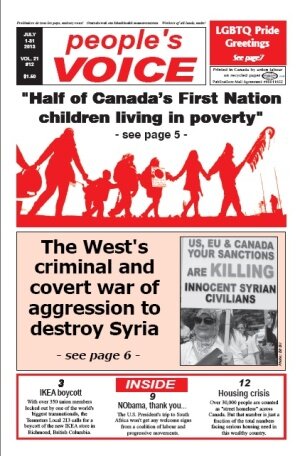
1) SHOCKING POVERTY RATES FOR ABORIGINAL CHILDREN
2) CANADA'S HOUSING PROBLEM CAN BE SOLVED
3) OUR LGBTQ RIGHTS: CELEBRATE! DEFEND! EXPAND!
4) MANDELA'S LEGACY - Editorial
5) DISASTER FOR PEOPLE, PROFIT FOR CORPORATIONS - Editorial
6) BOYCOTT IKEA! RICHMOND STORE WORKERS LOCKED OUT
7) DUMP CORPORATE INSIDERS, SAYS FRIENDS OF MEDICARE
8) ANTI-"RIGHT-TO-WORK" CONFERENCE HELD IN ST. CATHARINES
9) REPLACE THE SENATE WITH AN ELECTED HOUSE OF NATIONALITIES
10) WESTERN EMPERORS HAVE NO CLOTHES
11) "NObama" CAMPAIGN TO PROTEST US FOREIGN POLICY
12) CJPME URGES MPs TO OPPOSE ISRAELI SETTLEMENTS
13) MUSIC NOTES, by Wally Brooker
PEOPLE'S VOICE JULY 1-31, 2013 (pdf)
People’s Voice 2013 Calendar
”Ideas of Revolution”

|
People's Voice deadlines: August 1-31 September 1-15 Send submissions to PV Editorial Office,
|
REDS ON THE WEB
http://www.parti-communiste.ca/
peoplesvoice.ca
www.ycl-ljc.ca
www.solidnet.org
|
People's Voice finds many "Global Class Struggle" reports at the "Labour Start" website, http://www.labourstart.org/. We urge our readers to check it out! |
* * * * *
People's Voice
Canadian Publications Mail Sales Product Agreement #205214
ISSN number 1198-8657
People's Voice is published by
New Labour Press Ltd
PV Editorial Office
706 Clark Drive,
VANCOUVER, B.C. V5L 3J1
Phone:604-255-2041
Fax:604-254-9803
email: pvoice@telus.net
Editor: Kimball Cariou : Business Manager: David Au
Editorial Board: Kimball Cariou, Miguel Figueroa,
Doug Meggison, Naomi Rankin, Liz Rowley, Jim Sacouman
* * * * * *
Letters
People's Voice welcomes your letters
on any subject covered in our pages.
We reserve the right to edit for length and clarity,
and to refuse to print letters which may be libellous
or which contain unnecessary personal attacks.
Send your views to:
"Letters to the Editor",
706 Clark Dr., Vancouver, BC V5L 3J1,
or pvoice@telus.net
People's Voice articles may be reprinted without permission,
provided the source is credited.
* * * * * *
The Communist Party of Canada, formed in 1921,
has a proud history of fighting for jobs, equality, peace,
Canadian independence, and socialism.
The CPC does much more than run candidates in elections.
We think the fight against big business and its parties
is a year-round job,
so our members are active across the country,
to build our party and to help strengthen people's movements
on a wide range of issues.
All our policies and leadership
are set democratically by our members.
To find out more about Canada's party of Socialism,
give us a call at the nearest CPC office.
* * * * * *
Central Committee CPC
290A Danforth Ave Toronto, Ont. M4K 1N6
Ph: (416) 469-2446
fax: (416) 469-4063 E-mailmailto:info@cpc-pcp.ca
Parti Communiste du Quebec (section du
Parti communiste du Canada)
5359 Ave du Parc, Montréal, Québec,
H2V 4G9
B.C.Committee CPC
706 Clark Drive, Vancouver, V5L 3J1
Tel: (604) 254-9836
Fax: (604) 254-9803
Edmonton CPC
Box 68112, 70 Bonnie Doon P.O.
Edmonton, AB, T6C 4N6
Tel: (780) 465-7893
Fax: (780)463-0209
Calgary CPC
Unit #1 - 19 Radcliffe Close SE
Calgary AB, T2A 6B2
Tel: (403) 248-6489
Ottawa CPC
Tel: (613) 232-7108
Manitoba Committee
387 Selkirk Ave., Winnipeg, R2W 2M3
Tel/fax: (204) 586-7824
Ontario Ctee. CPC
290A Danforth Ave., Toronto, M4K 1N6
Tel: (416) 469-2446
Hamilton Ctee. CPC
265 Melvin Ave., Apt. 815
Hamilton, ON.
Tel: (905) 548-9586
Atlantic Region CPC
Box 70 Grand Pré, NS, B0P 1M0
Tel/fax: (902) 542-7981
http://www.parti-communiste.ca/
* * * * * *
News for People, Not for Profits!
Every issue of People's Voice
gives you the latest
on the fightback from coast to coast.
Whether it's the struggle for jobs or peace, resistance to social cuts,
solidarity with Cuba, or workers' struggles around the world,
we've got the news the corporate media won't print.
And we do more than that
- we report and analyze events
from a revolutionary perspective,
helping to build the movements for justice and equality,
and eventually for a socialist Canada.
Read the paper that fights for working people
- on every page, in every issue!
People's Voice
$30 for 1 year
$50 for 2 years
Low-income special rate: $15 for 1-year
Outside Canada $50 for 1 year
Send to: People's Voice, 706 Clark Drive, Vancouver, BC, V5L 3J1
You can call the editorial office at 604-255-2041
REDS ON THE WEB
http://www.parti-communiste.ca/
http://www.ycl-ljc.ca/
http://www.solidnet.org/
Top of Form
(The following articles are from the July 1-31, 2013, issue of People's Voice, Canada's leading communist newspaper. Articles can be reprinted free if the source is credited. Subscription rates in Canada: $30/year, or $15 low income rate; for U.S. readers - $45 US per year; other overseas readers - $45 US or $50 CDN per year. Send to People's Voice, c/o PV Business Manager, 706 Clark Drive, Vancouver, BC, V5L 3J1.)
1) SHOCKING POVERTY RATES FOR ABORIGINAL CHILDREN
Half of Canada's First Nation children are living in poverty, according to a new analysis of census statistics by the Canadian Centre for Policy Alternatives. Released on June 19, two days in advance of National Aboriginal Day, the study also finds that for other indigenous children - Métis, Inuit, and non‑status Indian - the poverty rate is about 27 per cent.
By comparison, one‑third of immigrant children and almost one-quarter of visible minority kids live below the low‑income line, and the overall rate for children who belong to none of those groups is about 12 per cent.
The report also points out that First Nations children often live in communities that are impoverished when it comes to services and infrastructure. According to the study, indigenous children trail the rest of Canada's children on practically every measure of well‑being.
"Canada cannot and need not allow yet another generation of indigenous citizens to languish in poverty," the study states. "Failure to act will result in a more difficult, less productive, and shorter life for indigenous children."
To define poverty, the analysis uses Statistics Canada's after tax low‑income measure, which amounts to about $38,000 a year for a family of four. Co‑authored by economist David Macdonald, the report estimates it would cost $7.5 billion a year from either market income or government transfers to bring all children in the country up to the poverty line.
The following excerpts from the study's summary give further details of the situation:
"As the most vulnerable members of any community, children have a fundamental right to protection and survival. This right is broadly acknowledged. For children living in poverty, the vulnerability runs much deeper. It is well established that poverty is linked to a variety of physical, social and economic disadvantages later in life. Children living in poverty require greater support to live and to fulfil their potential, a challenge that can only be met with assistance from the broader community.
"Despite repeated promises from federal and provincial governments to address the issue ‑ including a 1989 commitment by all Parliamentarians to eliminate child poverty by the year 2000 ‑ Canada ranks 25th among the 30 countries in the Organization for Economic Co‑operation and Development with regard to child poverty. Recent modest declines in rates cannot hide the fact that over a million children in Canada still live in poverty.
"More troubling, however, is the reality facing Indigenous children in Canada. Based on data from the 2006 census, this study found that the average child poverty rate for all children in Canada is 17%, while the average child poverty rate for all Indigenous children is more than twice that figure, at 40%.
"In fact, even among children living in poverty in Canada, three distinct tiers exist. The first tier, with a poverty rate of 12%, excludes Indigenous, racialized and immigrant children. This is three to four times the rate of the best‑performing oECD countries.
"The second tier of child poverty includes racialized children who suffer a poverty rate of 22%, immigrant children whose poverty rate is 33%, and Métis, Inuit and non‑status First Nations children at 27%.
"Most shocking, however, is that fully half ‑ 50% ‑ of status First Nations children live below the poverty line. This number grows to 62% in Manitoba and 64% in Saskatchewan.
"Some of these differences in child poverty appear to be a matter of jurisdiction. The provinces provide social services to all but status First Nation children on reserve, children who fare considerably better than their counterparts under federal responsibility.
"For status First Nations children living on reserves, the federal government is responsible for funding social services, health care, education and income supports. Transfer payments for these social services on reserve have increased by a mere 2% per year since 1996, unadjusted for population growth or need. The removal of this cap on funding growth and an adjustment of transfers for need could reduce the alarming rate of status First Nations households living in poverty. It is a matter of choice.
"The federal government can also have an impact on child poverty rates among children under provincial jurisdiction. Increasing the National Child Benefit Supplement (NCBS) so that the total benefit from the NCBS and the Canada Child Transfer total $5,400 for the first child would reduce that child poverty by approximately 14%.
"To bring all children in Canada up to the poverty line would cost $7.5 billion, $1 billion of which is required for Indigenous children. Of that, $580 million would be required to lift status First Nations children to the poverty line, which equates to 11% of the budget of Aboriginal Affairs and Northern Development Canada for the comparable year.
"Although these investments are significant, the cost of continuing neglect is higher, both to Canada's economy and to the children. The Royal Commission on Aboriginal Peoples estimated "the cost of doing nothing" ‑ representing lost productivity and increased remedial costs ‑ at $7.5 billion annually back in 1996, a figure that would be much higher today. And a study by the Centre for the Study of Living Standards projected a $115 billion cumulative benefit (2006-26) for federal and provincial governments from equivalent educational attainment and labour market outcomes for Indigenous people.
"Indigenous children trail the rest of Canada's children on practically every measure of wellbeing: family income, educational attainment, poor water quality, infant mortality, health, suicide, crowding and homelessness. For example, Status First Nations children living in poverty are three times more likely to live in a house that requires major repairs compared to the non‑Indigenous children of families with similar income levels, and five times more likely to live in an overcrowded house.
"The failure of ongoing policies is clear. The link between the denial of basic human rights for Indigenous children and their poverty is equally clear. Failure to act will result in a more difficult, less productive, and shorter life for Indigenous children. The choice is ours."
|
|
2) CANADA'S HOUSING PROBLEM CAN BE SOLVED
By Kimball Cariou
Canadians frequently criticize attacks against human rights around the world, and often with good reason. But one of the worst global human rights abuses is also a huge problem here in this country. The Universal Declaration of Human Rights specifically includes the right to housing - but at least 30,000 people in Canada on any given day are homeless. Every year, homelessness affects about 200,000 people across the country, and this crisis is now estimated to cost $7 billion annually.
A landmark report on the issue paints "a picture of a disaster in communities across the country," according to Tim Richter, one of the authors of State of Homelessness in Canada: 2013, and the president of the Canadian Alliance to End Homelessness.
"In a natural disaster, the loss of housing or life happens because of a fire or flood or something like that," he told the media following the mid-June release of the report. "In the unnatural disaster of homelessness, the same things are happening, but it's happening because of poverty, disability, addiction, mental illness and trauma."
Natural disasters are met with emergency response plans to get people back to their normal lives, notes Richter, but the response to homelessness is "stuck in crisis mode".
The study found that on any given night, at least 30,000 people are in homeless or domestic violence shelters, sleeping outside or temporarily housed in places like prisons or hospitals.
Another 50,000 are the "hidden homeless," couch-surfing with friends or family because they have nowhere else to go.
A joint effort by the Canadian Homelessness Research Network and the Canadian Alliance to End Homelessness, this is the first attempt by researchers to quantify the problem on a Canada-wide scale, going beyond the "homeless counts" conducted in many communities.
Co-author Tanya Gulliver taught the "Homelessness in Canadian Society" course at Ryerson University from 2003 to 2010. A key figure in the Toronto Disaster Relief Committee, Gulliver writes that "many more Canadians are facing challenges in paying their rent and meeting other basic survival needs, including food."
"I've been working in the homelessness sector for nearly 20 years," says Gulliver, who is excited to be able to quantify homelessness in a meaningful way.
"Yet, even this report is, in a few places, only our best guess," she points out. "It's an informed, well‑researched best guess, but the lack of a common definition around homelessness, varying methodologies for counting homeless people and a lack of funding and support for research and evaluation means we are trying to take different sets of numbers and make them all match up. And those numbers show us that homelessness is affecting more Canadians than we might realize."
The 30,000 nightly figure, she says, includes 2,880 unsheltered (outside in cars, parks, on the street); 14,400 staying in emergency shelters; 4,464 provisionally accommodated (homeless but in hospitals, prison or interim housing); and 7,350 staying in women's anti-violence shelters.
Homelessness is often a very short experience. About 29% of people in this category spend only one night in a shelter and are able to resolve their homelessness crisis with minimal supports.
At the other end of the spectrum, 4,000 to 8,000 people are chronically, long-term homeless, and 6,000 to 22,000 experience repeated episodes of homelessness over a lifetime. While these are just one-seventh of the total homeless population in Canada, they use about 50% of the emergency shelter spaces and consume the most resources (including emergency services and hospital treatment).
"When we think about how much cheaper it is to provide rent supplements, supportive and social housing - not to mention the moral issues of warehousing people in shelters - it's really time that we started focusing on the solutions," says Gulliver.
Other research across North America has repeatedly found that homelessness is cheaper to fix than to ignore or deal with on an emergency basis.
In a 2005 study comparing four Canadian cities, Steve Pomeroy estimated that it costs $66,000 to $120,000 per person per year for institutional responses to homelessness (e.g. prison, psychiatric hospitals), compared with $13,000 to $18,000 for supportive housing.
A Simon Fraser University study in 2006 estimated it costs $55,000 per person per year to leave someone homeless in British Columbia, versus a housing and support cost of $37,000.
In 2007, the Calgary Homeless Foundation estimated that chronically homeless people consume emergency services averaging $134,000 per year. The Foundation has been able to provide housing and support to chronically homeless people for $10,000 to $25,000 per year, in effect saving huge amounts of tax dollars.
Gulliver argues that some cities are making progress. Vancouver has had a 66% reduction in street homelessness since 2008; Edmonton saw a 30% reduction in overall homelessness since 2008; and Toronto reports a 51% decrease in street homelessness since 2006. Alberta has provincial plan which has led to a 16% province‑wide reduction since 2008.
But the reality can be more complicated. In Vancouver, for example, the shocking rise in street homelessness became a hot button topic by the late 1990s, finally compelling city council to take steps to provide more temporary shelter spaces. But the overall numbers of people who lack affordable housing in the most expensive city in Canada remain stubbornly high.
On a wider scale, the number of people in "core housing need" across Canada is huge, estimated at over 3 million by the Wellesley Institute. The situation is most dire in impoverished First Nations communities, which frequently lack decent schools or even clean drinking water.
The State of Homelessness report makes recommendations to improve the situation, calling on communities and governments to develop plans to end homelessness, and to increase the supply of affordable housing. Another recommendation calls for a "housing-first" approach to ending homelessness.
The study points to initiatives such as the At Home/Chez Soi pilot program in five cities. Backed by $110 million in federal funding from the Mental Health Commission, this program aims to get homeless people into subsidized housing, and then provide services to address their underlying problems.
The Harper government's latest federal budget includes $253 million annually over five years, which must be matched by the provinces, to be spent on new construction, renovation, home ownership assistance, rent supplements, shelters and homes for battered spouses.
The budget also commits to five more years of funding for the Homelessness Partnering Strategy, at $119 million a year, lower than the previous $135 million a year, with a "housing first" emphasis as discussed above.
But is this all just window dressing to obscure the government's true agenda?
Most anti-poverty advocates and housing researchers point to a long-term withdrawal from social housing by the federal government as the origin of the growth in homelessness. Liberal and Conservative governments alike during the 1980s and '90s slashed support for cooperatives and other social housing options. Canada and the U.S. are now virtually the only major capitalist countries with no national housing strategy. The downloading of federal responsibilities left provinces and municipalities holding the bag for vital social services. Provincial governments froze or reduced social assistance, just as market housing costs began to skyrocket.
This deadly mix of policy changes led to today's crisis, with millions of people stuck in unaffordable, cramped, unhealthy housing situations.
The argument that "we can't afford" decent housing doesn't stand up to real scrutiny. A country which can budget $70 billion over the next two decades for fighter-bomber jets and massively armed warships could surely decide to make housing a priority instead.
Advocates for the "one-percent solution" argued in the last decade that federal and provincial investments of about $4 billion per year (about one percent of Canada's GDP) could provide adequate housing for all. This would also employ huge numbers of building trades workers, and dramatically cut spending on emergency services for the homeless. But federal investments on such housing have instead fluctuated around 0.25% of GDP, far below the level necessary to solve the problem.
Of course this crisis can be solved. But for that, we need a government which puts people's needs ahead of corporate greed. Reviving the "one-percent solution" housing campaign would be a good way to step up public pressure on Parliament.
|
|
3) OUR LGBTQ RIGHTS: CELEBRATE! DEFEND! EXPAND!
Pride 2013 Statement from the Communist Party of Canada and the Young Communist League
It's Pride! Time to celebrate the advances of the LGBTQ communities in Canada and around the world. The Communist Party of Canada and the Young Communist League applaud these victories. More and more countries around the world are recognizing same‑sex marriage and other fundamental LGBTQ rights. In Canada, the struggle for concrete steps to end harassment based on sexual orientation and gender expression/identity has seen a number of key victories. The number of GSA's in schools, and districts with explicit LGBTQ policies continue to increase. Working with the queer community, Newfoundland and Manitoba have become the most recent provinces to ensure schools are safer and more welcoming places for all students. This year is the tenth anniversary of same‑sex marriage in Canada.
We all welcome the continued expansion of queer‑positive environments in the mass media, the labour movement and in the traditionally homophobic arena of male professional sports, where the "you can play" campaign is sending a powerful message that gay athletes must be treated with respect.
The vote by the Ontario Legislature to enshrine "gender identity" and "gender expression" in the provincial Human Rights code, the defeat of attempts to deny civic funding to Pride Toronto, the adoption of Vancouver Pride as a civic event and other legal, political and cultural victories are the hard‑won results of decades of efforts by the LGBTQ community and our allies.
But those who spread fear and bigotry are not giving up. The anti‑equality protests in France and the near‑unanimous vote in the Russian Parliament to ban so‑called "propaganda of non‑traditional sexual relations" are, in part, a reaction to the democratic progress being made elsewhere. The Communist Party of Canada strongly supports the statement of the International LGBTI Association‑Europe co‑chair, Gabi Calleja: "We are deeply concerned by the negative impact of this law (in Russia). Homophobic rhetoric which accompanied the adoption of this law at the regional and federal level for the last few years already significantly contributed toward a climate of hatred and physical violence against LGBTI people which recently resulted in a number of murders."
There are still far too many countries where LGBTQ people face laws that can result in imprisonment or even death. Of course the myth that queer rights can only be won in wealthy capitalist countries is shattered by advances in countries such as Cuba, Brazil, and South Africa, and by the reality that homophobic and racist views are deliberately exported from North America and Europe.
And while we have made great strides here in Canada, we should not be complacent. The forces that spread hate in other countries, have powerful friends in the Conservative caucus of Stephen Harper. Canada's corporate‑driven "austerity" cuts to social spending, and the attacks on unions, heavily impact women, Aboriginal peoples, and racialized groups, and make it far more difficult to implement significant advances towards equality. The sharpest negative impact is on the most marginalized members of the LGBTQ community, including trans, two‑spirited, racialized queers and young people.
The trans community is frequently left out of the gains made by the rest of the LGBTQ community. While we celebrate the recent decision by the Nova Scotia Government to fund gender reassignment surgery, there is a long ways yet to go. The cost of delaying full equality for trans people would be tragic. This is not a "marginal" issue; trans people are 10% of the LGBTQ population, and face huge medical costs, higher unemployment, less access to housing, widespread intimidation at work, and lack of legal protections.
Despite attempts to hide their destructive social agenda, the Harper Tories aim not only to reverse queer rights but also the decades of hard‑fought gender equality gains by women. Right‑wing forces continue to scapegoat the LGBTQ community and racialised groups, to divide working class resistance against finance capital, corporate bailouts and global environmental plunder.
Homophobia and transphobia are weapons to divide working people; just like racism, sexism, and national chauvinism. Today, those in charge of our economy, the ruling class, use the economic crisis and the so‑called "war on terror" to justify their assault on workers and social equality. But "an injury to one is an injury to all." Our unity will be strengthened by adopting full legal and political protections for sexual orientation and gender expression, and gender identity.
This unity is a vital element of the broad democratic and social resistance against the corporate agenda of austerity and war. Together, we must build a powerful coalition to put people's needs before corporate greed. Our LGBTQ community must be a key player in a "People's Coalition" of labour, Aboriginal peoples, youth and students, women, seniors, farmers, immigrant and racialized communities, environmentalists, peace activists and many other allies.
Ultimately, our unified struggle in our communities and workplaces, in the streets and at the ballot box, can defeat the Harper Tories and open the door to a "people not profits" government. The goal of the Communist Party is to win fuller social equality and genuine people's power in a socialist Canada, where our economy and resources will be socially owned and democratically controlled.
This historic advance will make it possible to eradicate the intersecting forms of exploitation and oppression which we all face today. We urge you to join the Communist Party and the Young Communist League to achieve a liberated society in which, as Karl Marx said, "the freedom of each is the condition for the freedom of all."
|
|
People's Voice Editorial
As this issue of PV goes to press, the towering leader of South Africa's liberation movement remains in critical condition in a Pretoria hospital. Nelson Mandela has faced many powerful adversaries during his 94 years, inspiring new generations to take up the cause of human freedom. To those who focus only on the poverty which still faces the majority of black South Africans 20 years after "Madiba" became the first post‑apartheid president, we reply that without his courage and wisdom, the fight for real change would have been even more difficult.
Nelson Mandela was one of the true visionaries of the 20th century. Born into a society which denied any semblance of human equality to non‑whites, Mandela overcame enormous obstacles, becoming one of the first black lawyers in South Africa, and also a transformative leader of the African National Congress Youth League and then the ANC itself. With his colleagues and comrades, Mandela explored every strategy to overcome the apartheid system through non‑violent means, from mass mobilizations, to strikes, to legal cases. The ANC's brilliant use of a wide range of tactics helped to win the vast majority of the people for the transition to armed struggle. When that time arrived, Mandela was jailed for 27 years for his role in creating Umkhonto we Sizwe, "the spear of the nation." Even from a prison cell on isolated Robben Island, he played a critical role in the liberation movement, helping to unite a broad spectrum of democratic forces, from Communists to liberal reformers, against the white supremacist system. Mandela's unifying strategy steered South Africa through those dangerous years, avoiding the nightmare of a bloody internal war.
Yes, the hopes of those who crafted South Africa's "Freedom Charter" remain far from completion. But Nelson Mandela and his legacy belong to all those who carry on the struggle for a world free from racism, war, violence and oppression.
|
|
5) DISASTER FOR PEOPLE, PROFIT FOR CORPORATIONS
People's Voice Editorial
Once again, a major North American city has been hit with a devastating flood. Eight years ago, New Orleans was inundated when Hurricane Katrina overwhelmed inadequate flood levees. This time, 100,000 residents of Calgary had to evacuate when torrential rains poured into the Bow and Elbow rivers, along with thousands more in smaller centres and on First Nations lands. We send our support and solidarity to all those hit by the disaster.
One of the main concerns of the corporate media has been the impact on business activities in Calgary, a key centre for the oil and gas sector. But while it may take some time to restore power and clean up downtown head offices, we predict that the major shareholders lose a nickel, since their profits are not generated in such buildings. Similarly, the major insurance companies are moving to limit losses, brazenly refusing to cover much of the flood damage. But many working class Albertans will lose employment income, and the damage to their homes and vehicles will not be fully compensated.
At least two conclusions can be drawn from this catastrophe. One is that right‑wing governments will always put the interests of big capital ahead of the needs of working people, even as politicians express sympathies for all the victims. Second, of course, is that the intensified scale of climate disasters likely reflects global warming. "Once in a century" weather events are becoming more frequent; this phrase was used in southern Alberta in the 2005 floods. Humanity must begin to tackle the global warming trend by reversing greenhouse gas emissions. The private profit system can never address this challenge; it's time to consider urgent solutions based in social ownership of productive wealth.
|
|
6) BOYCOTT IKEA! RICHMOND STORE WORKERS LOCKED OUT
By Jane Bouey
Trade unionists and other supporters rallied outside the Ikea store in Richmond, B.C. on June 21, in solidarity with 350 unionized workers locked out since May 13 by the international furniture giant.
Ikea did $1.4 billion in sales at its 12 stores in Canada last year, and had a 7% increase in sales in 2012. The Richmond store was recently rebuilt with a massive expansion. But the company claims that it must extract concessions from their workers in Richmond.
Teamsters Local 213 (the union representing the Richmond Ikea workers) Business Representative Anita Dawson, points out that Ikea has "locked us out in an attempt to force the Union members to accept the terms of their last offer and invite the members back to work under the terms of the rejected offer."
Local 213 members have rejected Ikea's offer three times: on March 17 by 96%, May 5 by 83%, and on May 9 by 84% - the last vote offer conducted by the Labour Board.
Ikea is demanding major concessions, and warning workers with letters, that it will just get worse if they don't come back to work. Ikea has in fact been reducing its own May 9th offer, taking away items like a lump sum payment.
The concessions demanded by the company include reintroducing a tiered wage system. The Richmond Ikea workers successfully eliminated this with a strike in 2007 and won "equal pay for equal work". The company is demanding a difference of as much as $7 per hour between workers performing the same job.
Ikea is also demanding major changes to the benefits program, including increasing the number of hours per week that an employee needs to work to secure benefits for their family. Like most retail outlets, a large percentage of the workers are part‑time, so this change would have a huge impact on those families.
Other concessions demands include contracting out of cleaning at the store.
Dawson states that, "Bargaining has since come to an impasse as the company will not move from wanting to reintroduce a multi-tiered wage system as well as other concessions and the union will not agree to this. We are going to continue to stand strong. We are not interested in a race to the bottom. These are good jobs, we really need to stand up to these big companies and protect what we have."
The union is asking the public to boycott Ikea. For more information, visit the Teamsters 213 site on Facebook. Listen to the Media Mornings Co-op Radio interview with Anita Dawson by Jane Bouey (Wed., June 19, on the W2Media.ca website, http://w2radio.wordpress.com/2013/06/19/media‑mornings‑wed‑jun‑19/).
|
|
7) DUMP CORPORATE INSIDERS, SAYS FRIENDS OF MEDICARE
Special to PV
Long regarded as one of Canada's wealthiest provinces, Alberta has also seen major health care cutbacks since the era of former premier Ralph Klein. Repeatedly the province's health system has been decentralized, centralized again, then decentralized, as local or central boards are created and abolished.
Each time, the Conservative government's focus is on "administrative problems", not the fact that too few doctors, nurses and support staff are hired to work in hospitals and clinics.
In the latest act of this drama, Health Minister Fred Horne axed the entire Alberta Health Services board on June 12, after AHS directors defied his orders to halt the payment of bonuses, worth $3.2 million, to 99 executives for 2012‑13. The directors argued that they were legally bound to pay these bonuses.
According to Sandra Azocar, Executive Director of Friends of Medicare, "the question that Albertans should be asking is why the Premier and the Minister of Health do not read the employment contracts that are offered to Executives before hiring them? They are the ones that are ultimately responsible for the decisions that are being made regarding the use of our public health dollars.
"Since prior to the inception of AHS Board, Friends of Medicare expressed concerns regarding the manner in which this super board was appointed. In our view, a voice for the public interest was always conspicuously absent. Also, there was very limited representation of actual health care workers and health expertise. With the future of Alberta's health care system at stake, these have been glaring omissions.
Given the abrupt end to this costly experiment, says Azocar, "the issue is not the structure, it is the culture and expectations that this ideologically driven government has created within our health care system. AHS was created through an internal coup; its whole culture is corporate and secretive, driven by an undisclosed agenda. It discloses trivia on expenses but nothing on the allocation of $13 billion per year. It's privatizing without a mandate or public input.
"What we need is REAL Local input into our health care, regardless of structure. REAL public discussion of agenda, and real disclosure of allocations of public health dollars. Let's reflect back on the Colonoscopy issue in Calgary or the Home Care contracts that were just awarded to Toronto based companies, the ongoing aggressive privatization of seniors care. Everything about AHS's reaction showed a will to manage and minimize the issue, no sense at all that it was an ethical crisis.
"Structure does not matter, culture does, and AHS and this government who holds the responsibility over our health care have been heading towards the wrong direction.
"The ongoing financial mismanagement that we have seen over the years, has led to constant upheaval and costly reorganizations. Every time we need to reorganize the governance of our healthcare system we have seen millions of dollars being unnecessarily spent, and our health care thrown into chaos. We are constantly trying to change a tire on car that is upside down in a ditch."
Friends of Medicare is demanding that the Minister of Health commit to a more transparent, accountable and democratic structure of governance of our healthcare system, "a structure that is no longer open to elitists, golden‑parachuting, corporate insiders."
|
|
8) ANTI-"RIGHT-TO-WORK" CONFERENCE HELD IN ST. CATHARINES
By Saleh Waziruddin
The Ontario Federation of Labour's Executive Council passed a motion earlier this year calling for immediate preparations for a province‑wide general strike in the event of any so‑called "Right to Work" bill appearing in the provincial legislature.
Although there are few signs of such preparations, the Niagara Regional Labour Council, which initiated the motion, held a conference of about 40 activists in St. Catharines on how this particular anti‑union attack can be fought. "Right to Work" is being aggressively advocated by Ontario Conservative leader Tim Hudak, who represents the riding adjacent to St. Catharines in Niagara.
The panel discussion was kicked off by two academics who pointed out that "Right to Work" undermines the very existence of unions, by allowing individuals to circumvent the democratically-decided collective action of their co‑workers. The idea has its roots in racist Southern US reaction to post‑World War II gains by labour. Both speakers singled out the Cold War attack on the Communist Party as responsible for the weak state of the labour movement today, undermining the "economic and political power" of unions.
The Ontario NDP's silence on the danger of this fundamental attack was noted even by a sitting NDP MP, who told the conference "voting NDP is not necessarily the solution". One of the report‑back groups at the end of the conference echoed this by adding that they couldn't tell if the NDP was or wasn't an ally in the fightback. Speakers pointed out that "Right to Work" is but one of many points of assault of the austerity agenda, and so the fight against it can only be part of a broader common front.
Some speakers objected to even using the phrase "Right to Work" as a concession to labour's enemies, suggesting instead "Radical Republican US‑Style Legislation" or "old tired policies from the racist Republican deep South". No local action or demonstration is planned coming out of the conference so far, but getting clarity on the threat ahead is a preparatory step.
|
|
9) REPLACE THE SENATE WITH AN ELECTED HOUSE OF NATIONALITIES
Central Committee, Communist Party of Canada, June 1‑2, 2013
The latest scandals around corrupt Conservative senators Mike Duffy, Pamela Wallin and Patrick Brazeau have renewed the longstanding and justified demand to abolish this completely undemocratic relic of Canada's colonial past. From its inception, a seat in the Senate has been a lucrative reward for faithful political servants of the ruling class. Far from being a so‑called "chamber of sober second thought," it has always served as a buffer against any meaningful democratic reform of the Canadian state. In fact, the Senate was established to protect the interests of ruling cliques in the provinces which joined Confederation, at the expense of the national rights of oppressed peoples.
The struggle to abolish the Senate must be placed within a truly democratic framework, rather than as an attempt to simply "rebalance" the federal and provincial power structures in the interests of competing sections of monopoly capital.
The Communist Party of Canada calls to replace the Senate with a democratically elected body which would give the Aboriginal peoples (First Nations, Inuit, Métis), the Acadians, and Québec effective powers to control their own destinies. Such a fundamental constitutional reform, starting with the convening of a truly broad and representative Constituent Assembly, and a referendum to ratify the proposals from such a body, is needed to end the historic denial of Québec's status as a nation, and to recognize the full national, economic, social, and political equality of the Aboriginal peoples.
We propose a confederal republic, eliminating the vestiges of the British colonial system, and based on a government consisting of two chambers: a reformed House of Commons, elected through a new system of mixed‑member proportional representation; and a House of Nationalities, composed of an equal number of elected representatives from Québec and from English‑speaking Canada, with guaranteed and significant representation from the Aboriginal peoples (First Nations, the Métis, the Inuit) and the Acadians. Each chamber should have the right to initiate legislation, but both would have to adopt the legislation for it to become law. Furthermore the Aboriginal peoples must have the right of veto on all matters pertaining to their national development. This structure will protect both fundamental democratic principles: equality of the rights of nations whatever their size, and majority rule.
Structural changes reflecting this confederal arrangement would need to be made throughout the legal system and state apparatus, as part of entrenching the right of nations to self‑determination in the Canadian constitution. Urgent constitutional change must also extend to recognition of the role of municipalities within the Canadian state, guarantees for the rights of workers to organize and bargain collectively, and protections for the natural environment. The struggle for such reforms is crucial to the wider movement for democracy, social advance and socialism. Uniting the working class across the country will not be possible without combating national oppression and fighting to achieve a new, equal and voluntary partnership of Canada's nations.
|
|
10) WESTERN EMPERORS HAVE NO CLOTHES
By Finian Cunningham, Information Clearing House, June 13, 2013
The military victory for Syria's government forces in the strategic central town of Qusayr was a watershed event for several reasons. But of the crucial turning points heralded by this event, one is inimitably clear - the Western powers, the would‑be emperors of Syria, stand naked in their failed criminal conspiracy to destroy that country.
These would‑be emperors - Washington and the region's former has‑been colonial powers, Britain and France, have been shown demonstratively to have not a shred of credibility. The emperors have no clothes and they are running for cover.
The Syrian army now has the upper‑hand and the momentum towards outright victory in a conflict that has ransacked large swaths of the Levantine nation, resulting in up to 80,000, mainly civilian, deaths, and causing 4‑5 million internal and external refugees.
Western‑backed insurgents are being destroyed or routed from villages and towns across Syria as the Syrian army moves swiftly on to its next objective of freeing the country's second major city, Aleppo, in the north. That clash may prove a more bloody and protracted fight than the three‑week campaign to retake Qusayr. But, given their withering loss of fighters and the severance from key supply routes through Qusayr, the eventual defeat of insurgents in Aleppo looks all but assured.
The recapture of Aleppo, and shutting off the NATO weapons supply line from Turkey in the north, would then prove to be the last stand for the foreign‑backed mercenaries. These mercenaries have been terrorising Syria since March 2011 at the behest of NATO powers and their regional allies, including Israel, Jordan, Turkey, Saudi Arabia and Qatar. The Western agenda of regime change to oust President Bashar al‑Assad is therefore, in a word, a dead letter.
But perhaps a more telling repercussion from the victory in Qusayr is the stripping bare of the ugly face of Western imperialism in Syria and the wider region.
The routing of the mercenaries who had laid siege to Qusayr for the past year showed more clearly than even the largely foreign component of the so‑called Free Syrian Army and the minimal support among the Syrian population for this outfit of Al‑Qaeda‑linked extremists. The FSA should henceforth be known as the Foreign Supplied Army. Without foreign supplies, there is no FSA, and there never would have been one in the first place.
Why were the 30,000 inhabitants of Qusayr obliged to hide in their homes for the past year while gangs of Libyan, Egyptian, Tunisian, Saudi, Chechen, Yemeni, French and British self‑styled jihadists and, yes, local Syrian criminal opportunists, roamed the streets, looting and brutalising?
When these Western‑backed killers and bandits were eventually run out of Qusayr, why did the inhabitants greet the Syrian army and their Lebanese Hezbollah comrades with relief and gratitude? Why have street celebrations been held in Qusayr feting the restoration of civilian life?
Why did thousands of Qusayr's residents flee the town over the past year? Of course, it was to escape from the Western‑backed so‑called "rebels" who imposed their draconian, twisted fundamentalist tyranny that they have adopted from their Saudi and Qatari paymasters. This is the same kind of tyranny that is being imposed on the suffering communities of Aleppo still under the control of the mercenaries.
This week, reports emerged of a 14‑year‑old boy in Aleppo who was executed in a public square by foreign gunmen because he allegedly blasphemed over a cup of coffee. He was sentenced to death by a kangaroo court before being shot twice in the head in front of his mother and father.
Why is it that now those inhabitants who had fled Qusayr - Muslim, Sunni, Shia, Alawite, Christian alike - are returning to the resumed safety of their town to pick‑up their hitherto peacefully co‑existing lives?
None of these questions are being asked in the mainstream Western media, or of Western politicians, since the fall of Qusayr. Incredibly, the Western media coverage on Syria seems stricken by a sudden muteness over the past week, as if crippled by a huge spanner tossed into its wheels. Conveniently, the news agenda seems to have inexplicably moved on to other matters.
At this juncture, what Western governments and their media propaganda system want most to avoid is for the Western public to see the naked, glaring truth: that these governments and media have been lying for the past two years about what is going on in Syria. This country is not undergoing a pro‑democracy uprising, supported by Syrian people and benevolent Western powers. Rather, Syria has been subjected to a criminal covert war of aggression by Western powers for selfish strategic interests in the oil and gas‑rich Middle East. This kind of conspiracy is what war criminals at Nuremburg were hanged for.
Qusayr has made Western government crimes in the Middle East abundantly clear. And that is why the story is being discarded down the Western media memory hole.
So let's drag it out of the memory hole. To achieve their illicit objectives, Western governments have secretly funnelled weapons, money, Special Forces and networks of foreign cutthroat killers into a sovereign country to terrorise its people into submitting to their agenda for regime change. The blood of 80,000 Syrian people is on the hands of Western presidents, prime ministers and their foreign diplomats: Barack Obama, David Cameron, Francois Hollande, John Kerry, William Hague and Laurent Fabius. They all stand accused and should be tried before a war crimes tribunal.
When Syrian army forces retook the bombed‑out, sabotaged town of Qusayr, the facade of Western pretence and propaganda was demolished forever.
Now, as with the dregs of the retreating insurgents, Western governments are running scared from the damning exposure. Last week [mid-June] the White House held a series of emergency meetings on Syria. US Secretary of State John Kerry had to cancel a tour of the Middle East in order to attend those meetings. On the cards for discussion was the US moving towards sending weapons and other lethal aid openly to its Foreign Supplied Army in Syria - a desperate move that probably won't happen because the Western criminal agenda has already been defeated. The Obama administration - assailed by other scandals and imploding legitimacy among the American people and the wider world - is in no position to step up criminality in the Middle East.
The Associated Press reports, "[Syrian] opposition leaders [that is, Western stooges] have warned Washington that their rebellion could face devastating, irreversible losses without greater support."
That one sentence says it all. The emperors have no clothes.
|
|
11) "NObama" CAMPAIGN TO PROTEST US FOREIGN POLICY
Statement by a coalition of progressive movements against the late June visit to South Africa by President Obama
We as South Africans, in the form of the South African Communist Party (SACP), the Young Communist League of South Africa (YCL), the South African Students Congress (SASCO), the Muslim Students Association (MSA), the National Education, Health and Allied Workers Union (NEHAWU), the Congress of South African Trade Unions (COSATU), Friend of Cuba Society (FOCUS), Boycott, Divestment and Sanctions against Israel in South Africa (BDS South African), and the World Federation of Trade Unions (WFTU), declare our utmost rejection of visit of the U.S. President, Barack Obama to our country.
Our rejection is based the USA's arrogant, selfish and oppressive foreign policies, treatment of workers and international trade relations that are rooted in war mongering, neo‑liberal super‑exploitation, colonial racism and the disregard and destruction of the environment, thus making the realisation of a just and peaceful world impossible.
The coming of President Barack Obama to South Africa is the first ever since he was elected head of state. The USA under his leadership has escalated its assault on human rights, militarisation of international relations and continuing galloping of world resources at the absolute expense of the environment and oppressed peoples of the world.
The USA is deeply implicated in the oppression of the people of Western Sahara, the only remaining colonised country on the African continent, colonised by Morocco. And to this day, the release of the Cuban Five and a continuing baseless embargo against the country and peoples of Cuba still seems unmovable issues of commitment for the USA. The call for the release of the Cuban Five has been an important international campaign supported even by Nobel Prize winners...
The criminal occupation of Palestine by the Apartheid State of Israel, as a well‑known fact in our country, has only been made possible by the USA's financial and political support for the Racist Israeli regime. This is expressed in the main, through both its open support and military donations that come to billions of dollars every year - with USA aid to Israel being more than that of Africa, Latin America and Asia combined.
In addition, the USA has for years been single‑handedly blocking any progress and is totally divorced and isolated from the consensus of the international community. In fact, the USA is the most frequent user of the UN veto: it has used its veto power over 40 times to defend Apartheid Israel. As South Africans, we painfully recall how the US used its veto power to defend Apartheid South Africa, particularly from UN resolutions imposing economic and military sanctions. The USA, under Reagan and others, supported Apartheid South Africa and was on the wrong side of history. Why does the USA not learn from its history, and be on the right side of history this time?
Finally, the United States' policies on the environment, specifically the fact that it is one of the largest contributors to global warming, yet to this day continues to refuse the observing and singing of the Kyoto protocol, is simply unacceptable.
Progressive forces in South Africa have consistently been raising these issues and many others regarding the role of the USA in the global community. We categorically make it known, that the visit of the USA President to South Africa is an unwelcome visit that will be protested, picketed and resisted by all justice and peace‑loving peoples of this country. Friendship with South Africa must be based on values of justice, freedom and equality and these the USA has offended, undermined and ridiculed through its actions in the global front.
The following issues will be highlighted in upcoming protests of President Barack Obama:
1. The championing and maintenance, by the USA, in the militarisation of international relations and co‑operation. It is a well‑known fact that the USA approaches conflicts in the world through inciting, encouraging as well and championing war, primarily driven by its business interests often masqueraded in the language of defence of human rights. The militarisation of international relations is in the main exemplified by institutions like Africom, NATO, and the continuing double standards around nuclear disarmament that the USA preaches when it comes to countries in the South, whilst continuing to collaborate with on nuclear weapons with Israel.
2. The continued greed in the guzzling of world resources by the USA epitomised by its encouragement and support of its multinational companies that have no regard for the environment, human rights, progressive labour laws etc.
3. The USA's active support and defence of colonial and oppressive regimes. This is the one aspect of USA foreign policy that most exposes its hypocritical character where regimes that support its interest are never opposed; instead they are not only supported but maintained through amongst other things, the USA war machinery. Chief amongst these is Israel, which continues to serve as the USA's frontline state in the Middle‑East whilst suppressing and maintaining its racist apartheid policies on Palestinian people. Another example is the USA's support to Morocco, that is oppressing and colonially occupying Western Sahara, and increasingly the support of oppressive regimes like the one in Colombia.
4. The USA's role maintaining the underdevelopment of the African continent and its imperialistic trade relations with African countries.
5. The unjustifiable blockade on Cuba, and the unfair imprisonment of the Cuban 5.
6. The USA is the single largest contributor to global warming which is condemning the world into catastrophic environmental disasters.
The coalition has called a National Day of Action on June 28, including a march to the U.S. Embassy in Pretoria. The Day of Action will raise several key demands: Immediate release of the Cuban 5! Cease US/NATO warmongering in Syria and everywhere else! Take your "Africom", we don't want it! Immediate closure of "GITMO"! Stop snooping on our e‑mails, phone calls and social networking! Halt the unleashing of your Al Qaeda forces on the World's people! Free Bradley Manning!
|
|
12) CJPME URGES MPs TO OPPOSE ISRAELI SETTLEMENTS
Canadians for Justice and Peace in the Middle East (CJPME) is urging MPs to denounce both the soaring Israeli "settlement" housing starts in the West Bank and the recent extremely belligerent statements by Israel cabinet ministers.
According to Israel's Peace Now group, settlement starts in the first three months of 2013 tripled the number in 2012's first quarter, and were 355 percent higher than in the last quarter of 2012. On June 17, Israel's Economics and Trade Minister Naftali Bennett proposed that Israel confiscate "Area C" ‑ the 62 percent of the Palestinian West Bank under full Israeli control ‑ "as quickly as possible."
Disparaging the idea of a separate Palestinian state, the Israeli minister commented, "Never have so many people invested so much energy in something that is hopeless... The most important thing ... is to build, build, build. It's important that there will be an Israeli presence everywhere."
Israel's deputy foreign minister Zeev Elkin, who lives in a West Bank settlement, agreed with Bennett's remarks. Two weeks earlier, deputy defence minister Danny Danon claimed a majority within the Israeli government staunchly oppose the creation of a Palestinian state.
A CJPME statement notes that neither Canada's Foreign Affairs minister John Baird, nor opposition critics Paul Dewar (NDP) and Dominique Leblanc (Liberal), have deplored the soaring settlement starts or the Israeli cabinet ministers' appalling statements.
"Canadian MPs' silence in the face of such belligerence is unethical and contradicts all Canadian parties' long‑standing support for a `two‑state solution'," notes CJPME President Thomas Woodley. The group calls on government and opposition MPs to be "less passive in the face of statements and actions by Israel that run contrary to Canadian policy and the international consensus on a feasible solution to the Israeli‑Palestinian conflict."
CJPME points out that Israel's "settlement" (colonization) of the West Bank violates Article 49 of the Fourth Geneva Convention, which prohibits occupying powers from transferring their civilian population into the territory occupied. Palestinian leaders have repeatedly offered to negotiate a peace agreement based on the 1967 borders, even though those borders would leave Palestinians with only 22 percent of British Mandatory Palestine.
|
|
13) MUSIC NOTES, by Wally Brooker
"Do You Hear the People Sing?"
On June 10, shortly after Turkish Prime Minister Erdogan dismissed Taksim Square protesters as "capulcular" (i.e. riff-raff), a "capulcular chorus" performed an English‑Turkish version of "Do You Hear the People Sing?" in the square. In the circulating YouTube video the choir stands in front of a banner that reads "Taksim Solidarity." The rousing anthem comes from the 1980 hit "Les Misérables." The perennially‑popular musical by Claude‑Michel Schonberg and Alain Boubil is based on the Victor Hugo novel, set in France in the 1830s. The song appears in a climactic scene where revolutionary Parisian students and urban poor take a stand on the barricades against the forces of the old regime. The same Turkish YouTube user has also posted a video of protesters surrounding a grand piano and singing the old Italian anti‑fascist song "Bella Ciao." To find the story and both videos enter the keywords "Les Mis Turkey" at www.cbc.ca/news.
Alicia Keys in "soul danger"
An open letter from writer Alice Walker to superstar singer Alicia Keys, calling upon her to cancel a July 4 concert in Tel Aviv, was published in May on the website of the US Campaign for the Academic & Cultural Boycott of Israel. In it, the author of "The Color Purple" writes "it would grieve me to know you are putting yourself in danger (soul danger) by performing in an Apartheid country that is being boycotted by many global conscious artists." In June a delegation representing hundreds of organizations presented a petition with 13,000 signatures to the office of the singer's HIV/AIDS foundation Keep a Child Alive. University of New Mexico students have produced an eloquent video combining the singer's current hit "Girl on Fire" with images of Palestinian women peacefully confronting the Israeli military. A recent poll by Black Entertainment Television revealed that 63% of respondents thought Keys should cancel the gig. To learn more visit: www.bdsmovement.net/.
An anthem for USA immigration reform
La Santa Cecilia is a popular LA‑based Mexican‑American band (named for the patron saint of musicians) that plays a hybrid of styles including cumbia, Afro‑Cuban, rock, jazz, and klezmer. Recently they joined forces with filmmaker Alex Rivera and the National Day Laborer Organizing Network (www.ndlon.org) to release Ice‑El Hielo. Hielo is Spanish for ice ‑ a loaded term for undocumented workers who are constantly harassed by the Immigration and Customs Enforcement agency (ICE). Both song and video sympathetically portray the daily struggles of undocumented immigrants. In fact, the parents of lead singer Marisol Hernandez and accordionist Jose "Pepe" Carlos were both illegal immigrants. In April the band sang Ice‑El Hielo at a massive immigration rally in Washington and joined in the march to the ICE offices. Bilingual lyrics can be found at www.onlylyrics.com. Ice‑El Hielo appears on the band's new album "Treinta Dias." For more info: http://lasantacecilia.com.
Guitar Centre workers unionize
Last month Music Notes carried a story about the struggle of workers to unionize at the Guitar Center's flagship store in Manhattan. The world's largest musical instrument retailer is owned by Mitt Romney's Bain Capital. Working conditions have deteriorated since the corporate bottom‑feeder took over the company in 2007. The good news is that Guitar Center workers in Manhattan are celebrating a huge victory. On May 24 they voted by a decisive 27-15 margin to join the Retail, Wholesale and Department Store Union (RWDSU). The momentum is spreading with elections at Guitar Center stores in Brooklyn and Queens on the horizon. Thanks to their own resolve, as well as the support of co‑workers and customers (including musicians like Steve Earle and Tom Morello), the Guitar Center workers have ensured that their voice will be heard as they negotiate for improved wages, benefits and respect. For more info: www.rwdsu.info/.
Music against Child Labour
Some of the world's leading classical musicians have joined with the International Labour Organization in an initiative to combat child labour. The Music against Child Labour Initiative calls for orchestras, choirs, and musicians of all genres to dedicate a concert between October 2013 and December 2014 to the struggle against child labour. Supporters include renowned conductors Claudio Abbado and Daniel Barenboim, the International Federation of Musicians, and Fundacion Musical Simon Bolivar El Sistema. The "call to batons" was launched, along with the Music Against Child Labour Manifesto, at a June 11 concert in Paris. Signatories to the manifesto point to the 215 million children worldwide who are trapped in child labour, and highlight the transformative power of music and the positive effects of engaging vulnerable children in musical activity. The official beginning of the concert series is scheduled for October 8 in Brasilia, where a concert will open the Third Global Conference Against Child Labour. For more info: www.ilo.org.
|
|