|
|
May 1-15, 2011
Volume 19 - Number 9
$1
Prolétaires de tous les pays, unissez-vous!
Otatoskewak ota kitaskinahk mamawestotan!
Workers of all lands, unite
CONTENTS
1) MAY DAY 2011: TAKE THE ROAD OF CLASS STRUGGLE
2) THE CAMPAIGN IN QUEBEC - A WORKING CLASS PERSPECTIVE
3) CAPITALIST MELTDOWN STILL AFFECTS MILLIONS
4) "PEOPLE'S COALITION" COULD BLOCK ONTARIO TORY BULLDOZER
5) GLOBAL HUNGER OFF THE RADAR? - Editorial
6) A SALUTE TO SOCIALIST CUBA - Editorial
7) NDP AND COMMUNISTS: WHAT ARE THE DIFFERENCES?
8) CUPE-BC OPPOSES GAZA BLOCKADE
9) THE CUBAN NATION'S COMMUNIST PARTY CONGRESS AND DEMOCRACY
10) CANADA STEPS UP FREE-TRADE NEGOTIATIONS IN HONDURAS
11) CPC CANDIDATE CONDEMNS MARTY BURKE'S RACIST COMMENTS
12) ABORIGINAL DEATHS IN CUSTODY: LITTLE PROGRESS IN AUSTRALIA
13) MUSIC NOTES, By Wally Brooker
14) "AGAINST CAPITAL AND IMPERIALISM"
15) TO LIBYA WITH GOD ON OUR SIDE
16) WHAT’S LEFT
17) CLARTÉ (en français)
18) THE SPARK! (Theoretical and Discussion Bulletin of the Communist Party of Canada)
190) INTRODUCING MARX
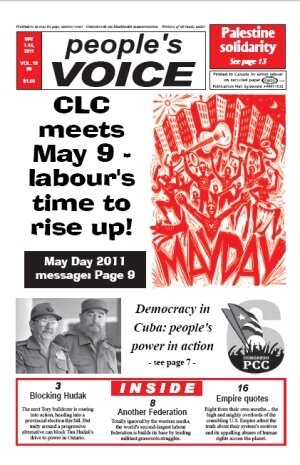
PEOPLE'S VOICE MAY 1-15, 2011 (pdf)
|
|
|
|
The Spark!The Spark! The latest issue of The Spark! theoretical journal, is now on sale for $5 at Communist Party offices (see p. 8) or People’s Co-op Books, 1391 Commercial Drive, Vancouver. Articles include
plus reviews, editorials, and more.
|
|
|
Theoretical and Discussion Bulletin of the Communist Party of Canada |
|
|
People's Voice deadlines: May 16-31 June 1-15 Send submissions to PV Editorial Office,
|
|
REDS ON THE WEB |
|
People's Voice finds many "Global Class Struggle" reports at the "Labour Start" website, http://www.labourstart.org/. We urge our readers to check it out! |
* * * * *
People's Voice
Canadian Publications Mail Sales Product Agreement #205214
ISSN number 1198-8657
People's Voice is published by
New Labour Press Ltd
PV Editorial Office
706 Clark Drive,
VANCOUVER, B.C. V5L 3J1
Phone:604-255-2041
Fax:604-254-9803
email: pvoice@telus.net
Editor: Kimball Cariou : Business Manager: Sam Hammond
Editorial Board: Kimball Cariou, Miguel Figueroa,
Doug Meggison, Naomi Rankin, Liz Rowley, Jim Sacouman
* * * * * *
Letters
People's Voice welcomes your letters
on any subject covered in our pages.
We reserve the right to edit for length and clarity,
and to refuse to print letters which may be libellous
or which contain unnecessary personal attacks.
Send your views to:
"Letters to the Editor",
706 Clark Dr., Vancouver, BC V5L 3J1,
or pvoice@telus.net
People's Voice articles may be reprinted without permission,
provided the source is credited.
* * * * * *
The Communist Party of Canada, formed in 1921,
has a proud history of fighting for jobs, equality, peace,
Canadian independence, and socialism.
The CPC does much more than run candidates in elections.
We think the fight against big business and its parties
is a year-round job,
so our members are active across the country,
to build our party and to help strengthen people's movements
on a wide range of issues.
All our policies and leadership
are set democratically by our members.
To find out more about Canada's party of Socialism,
give us a call at the nearest CPC office.
* * * * * *
Central Committee CPC
290A Danforth Ave Toronto, Ont. M4K 1N6
Ph: (416) 469-2446
fax: (416) 469-4063 E-mailmailto:info@cpc-pcp.ca
Parti Communiste du Quebec (section du
Parti communiste du Canada)
5359 Ave du Parc, Montréal, Québec,
H2V 4G9
B.C.Committee CPC
706 Clark Drive, Vancouver, V5L 3J1
Tel: (604) 254-9836
Fax: (604) 254-9803
Edmonton CPC
Box 68112, 70 Bonnie Doon P.O.
Edmonton, AB, T6C 4N6
Tel: (780) 465-7893
Fax: (780)463-0209
Calgary CPC
Unit #1 - 19 Radcliffe Close SE
Calgary AB, T2A 6B2
Tel: (403) 248-6489
Ottawa CPC
Tel: (613) 232-7108
Manitoba Committee
387 Selkirk Ave., Winnipeg, R2W 2M3
Tel/fax: (204) 586-7824
Ontario Ctee. CPC
290A Danforth Ave., Toronto, M4K 1N6
Tel: (416) 469-2446
Hamilton Ctee. CPC
265 Melvin Ave., Apt. 815
Hamilton, ON.
Tel: (905) 548-9586
Atlantic Region CPC
Box 70 Grand Pré, NS, B0P 1M0
Tel/fax: (902) 542-7981
http://www.communist-party.ca/
* * * * * *
News for People, Not for Profits!
Every issue of People's Voice
gives you the latest
on the fightback from coast to coast.
Whether it's the struggle for jobs or peace, resistance to social cuts,
solidarity with Cuba, or workers' struggles around the world,
we've got the news the corporate media won't print.
And we do more than that
- we report and analyze events
from a revolutionary perspective,
helping to build the movements for justice and equality,
and eventually for a socialist Canada.
Read the paper that fights for working people
- on every page, in every issue!
People's Voice
$30 for 1 year
$50 for 2 years
Low-income special rate: $15 for 1-year
Outside Canada $50 for 1 year
Send to: People's Voice, 706 Clark Drive, Vancouver, BC, V5L 3J1
You can call the editorial office at 604-255-2041
REDS ON THE WEB
http://www.communist-party.ca/
http://www.ycl-ljc.ca/
http://www.solidnet.org/
(The following articles are from the May 1-15, 2011, issue of People's Voice, Canada's leading communist newspaper. Articles can be reprinted free if the source is credited. Subscription rates in Canada: $30/year, or $15 low income rate; for U.S. readers - $45 US per year; other overseas readers - $45 US or $50 CDN per year. Send to People's Voice, c/o PV Business Manager, 706 Clark Drive, Vancouver, BC, V5L 3J1.)
1) MAY DAY 2011: TAKE THE ROAD OF CLASS STRUGGLE
May Day 2011 statement, from the Central Executive Committee, Communist Party of Canada
This year's May Day celebrations across Canada take place just before a critical federal election, and prior to two critical labour events. The 26th Convention of the Canadian Labour Congress opens on May 9 in Vancouver, followed by the 63rd Congress of the Confederation of National Trade Unions (CSN) in Montréal. As we send solidarity greetings to all Canadian workers on May Day, the Communist Party also salutes our sisters and brothers around the planet on this International Day of working class solidarity.
Today we are in a period of aggressive imperialist wars, a time when global capitalism is mired in a deep and multifaceted systemic crisis, expressed in economic stagnation and decline, environmental degradation, increasing assaults on the labour and democratic rights of the people, and every other aspect of modern life. It is more evident than ever that capitalism is incapable of solving the problems of the world. So‑called "reforms" which put more burdens on the backs of working people will only create more misery and deepen the next round of economic crises. Fundamentally different solutions must be found, based on meeting the interests of the people and the environment, and defeating the corporate drive for maximum profits.
Here in Canada, the May 2 election campaign has seen a surge in actions by youth, working people, Aboriginal peoples, women, seniors, and other Canadians, responding to the threat of a possible Conservative victory. As our Party has warned, a Harper Tory majority would escalate its attacks on jobs, living standards, social programs, pensions, labour and equality rights and civil liberties. It would accelerate the sellout of Canadian sovereignty and the environment, and the integration of Canada into the militarist, aggressive global agenda of U.S. imperialism. For these reasons, the labour and democratic movements have made the defeat of the Harper Tories as the critical first step in forging a new direction for the country and its peoples.
But whatever the balance of forces in the next Parliament, the fight to defend the interests of the working class must be intensified. Even if the big business drive for a Tory majority is blocked at the polls, it will take a huge mobilization by the working class and its allies to compel the next Parliament to reverse the neoliberal policies imposed by both Liberal and Tory governments in recent decades.
After May 2, the main focus of the class struggle in Canada will return to the extra‑parliamentary arena, to our workplaces, campuses and communities across the country. Big capital has no intention of slowing its drive to take advantage of the economic crisis by wringing further concessions and rollbacks from both organized and unorganized workers. As the Vale Inco and U.S. Steel cases prove, the transnational corporations are determined to cut wages and strip the pension rights of private sector workers, and to trample Canadian sovereignty in the process. Public sector workers at the federal, provincial and municipal levels also face sharpening attacks on their wages, benefits, working conditions and collective bargaining rights.
On this May Day, it is crucial to strengthen the working class fightback which is gaining momentum. The heroic resistance of the Hamilton steelworkers locked out by US Steel is a beacon for their sisters and brothers across Canada, and the labour movement must build much wider solidarity with this struggle. Just weeks ago, over 50,000 trade unionists and their allies marched through the streets of Montréal in a powerful display of mass opposition against the reactionary policies of the Charest Liberals. On April 9, some 10,000 rallied in Toronto against the attacks of the McGuinty Liberals and the union‑bashing privatization agenda of Mayor Rob Ford's regime at City Council.
These and other examples show that workers in Canada are increasingly prepared to take the road of class struggle which is building across the capitalist world.
The past year witnessed the biggest upsurge of huge general strikes in the past century. Sparked initially by the general strike actions called by the All‑Workers Militant Front of Greece (PAME) against the dictates of the European Union and the IMF, workers in country after country of Europe and Asia have walked out by the millions to protest the imposition of vicious policies designed to enrich the corporations while destroying social gains achieved through decades of progressive struggles.
Inspired by these class battles, other sections of the international working class are moving into action. The workers of Tunisia and Egypt have played critical roles in defeating reactionary, pro‑imperialist regimes in their countries. The workers of Wisconsin and other U.S. states have mobilized enormous rallies to fight back against the drive by Republican politicians and their corporate backers to strip away collective bargaining rights.
This militant strategy must be the path for Canadian workers to follow. May Day 2011 must be a day to step up our efforts to make the organized working class a more powerful, unifying force in the struggle to roll back neoliberal governments and the corporate agenda. It is also a day to press the leadership of the trade union movement to move into wider action.
Whatever the outcome of the federal election, the Canadian Labour Congress in particular must assume its responsibility to advance the interests of workers across the country, to project strong leadership in the streets and workplaces. "Business as usual" tactics - simply issuing speeches and news releases, or calling for only the most timid measures to ameliorate the fall in living and working conditions in Canada - are woefully insufficient to build the fightback workers need today.
The CLC and CSN conventions will be an important measure of the top trade union leadership and the rank and file. Unity of the labour movements in Canada and Québec around strategies to move in such a militant direction is critical. Unfortunately, it appears that much of the attention at the CLC will be focused on internal matters, such as structural changes which will sharply limit the ability of labour's rank and file to influence and set the movement's course of action. We urge delegates to reject this step backwards, and to instead demand that the CLC advance a program for mass, militant action, including a call to convene an emergency meeting of all trade unions and their social allies to work out a common fightback program against the offensive of big capital and its governments.
On May First, the Communist Party of Canada extends our warmest solidarity to all those in struggle against imperialist war and aggression, and for a better world of peace, democracy, equality, and socialism. Long live May Day! Workers of all countries, unite!
2) THE CAMPAIGN IN QUEBEC - A WORKING CLASS PERSPECTIVE
By Johan Boyden, Montreal
As the federal election campaign wraps up in the area of the country that most effectively denied the Conservatives a majority in 2008, much discussion has been around class and social issues.
At the French‑language leaders debate, Madame Muguette Paille, a middle‑aged, working‑class woman, living in a de‑industrialized Québec town asked: "Myself, together with many people in my community, are unemployed. We will soon run out of employment insurance. What will you do?"
By the end of the debate Michael Ignatieff had said her name eleven times. Soon, facebook groups in this previously unknown woman's name sprang up with thousands of members.
One wonders how Madame Paille would respond to the Communist Party's proposal to set EI benefits at 90% of previous earnings for the duration of unemployment.
The Communist Party is also putting up messages for peace which have proved distinctive and popular. In the four Montreal ridings with Communist candidates, over six hundred signs have gone up, calling for voting for people before profits, ending support of Apartheid Israel, and immediate withdrawal of the troops from Afghanistan.
Talking down to workers
The Liberals too have signs - giant billboards showing a silhouette of a fighter‑jet to one side, a family on the other, each with a check box. The message is clear. Voters face a question of priorities. And almost everyone understands it ‑ even though the fighter jets will be built here.
Of course, the Liberals are trying to re‑write history. They got Canada into the imperialist war in Afghanistan and started this bonanza for the merchants of death by increasing military spending. They shamelessly raided the EI fund to pay off the federal debt.
But with decades of inflation, high unemployment (higher than many other parts of Canada), lower wage levels, and de‑industrialization ‑ a situation that has only got worse with the economic crisis ‑ is it any surprise that working class Québécois connect with Muguette Paille?
Nor has the Canadian military ever been very popular here.
Between these sentiments of the people and the solutions offered by the major parties is a wide class gulf. As elsewhere in Canada, when the big business parties propose their solutions they are speaking directly down to ‑ but not for ‑ the working people.
Cheap Québec‑bashing
What is different from the rest of the country is the unrecognized and constitutionally denied sovereignty and self‑determination of the Québec nation within Canada. This grievance finds its expression in the Bloc Québécois.
The English‑language corporate media portrays the Bloc as malicious nation‑wreckers. An Angus Reid‑Toronto Star poll after the TV debates claimed to reveal high levels of antipathy toward Bloc Leader Gilles Duceppe. "Virtually every utterance from Duceppe prompted viewers to press buttons registering their annoyance,'" the Star reported.
The irrational fear‑mongering reaches a high‑point with the Harper Conservatives' endless rant about the `coalition with the separatists.' Conservative incumbent for Fort McMurray‑Athabasca, Brian Jean, even announced Ignatieff would put Duceppe in charge of defense.
The Communist Party's candidates have exposed this cheap Tory fear‑mongering as big‑nation chauvinism.
"Parlons Québec"
In fact, the Bloc Québécois campaign ‑ "Parlons Québec", based on the idea that they are the only true voice for the nation - is more about jobs.
Accepting GM and the auto industry's departure, the Bloc platform calls federal attention to this industry an example of Ontario bias (`attention' that has forced auto workers and retirees to accept major concessions). Instead, the BQ puts the emphasis on Québec's crisis‑afflicted forest sector - proposing loans to the forest industry.
This is the Bloc's vision of Québec as a "market" and they also say the other parties "refuse to fight for Québec's financial sector so as not to offend Toronto." In essence it is a class-collaborationist illusion that the workers and bosses of Québec are in the economic crisis together.
Like the New Democrats, the Bloc voted for the bombing of Libya; nor does their platform call for immediate withdrawal from Afghanistan. But on other issues it is stronger: banning scabs, establishing a guaranteed income supplement, opposing the privatization of Canada Post, eliminating tax havens, and abolishing tax give‑aways for oil companies.
A different direction
The BQ will never form a government. Its identity is as a protest vote. This allows it to put forward some progressive policies, even drawing trade union leaders into its ranks as MPs. Yet after some twenty years of protest votes, perhaps the limitations of this tactic are becoming clearer to Québécois.
The "surge" of the New Democrats in the polls in Québec is also "fluffing" NDP support in the rest of Canada, pollsters say. The NDP made their break into Québec with the 2007 byelection victory of a former member of the Québec National Assembly and Charest Liberal, Thomas Mulcair. Now the NDP's Québec lieutenant, Mulcair has also "distinguished" himself as a hard pro‑Zionist voice.
Mulcair has given his party new visibility. And at least some of the rise in interest in the New Democrats is also likely connected with growing support for Québec Solidaire, the left‑wing party represented by National Assembly member Amir Khadir.
But the NDP's policy history on the national question includes opposition to Québec's right of self‑determination (ie. supporting the Clarity Act). In this election they are calling for extension of the language law, Bill 101, to federal workers in Québec. The constitutional implications, however, are unclear. Some opinions suggest it may actually be illegal. Will the NDPs rise in popularity will translate into votes in Quebec? Not necessarily.
Of all the Parties on the ballot, the Communists alone are calling for a new, democratic constitution based on an equal and voluntary partnership of the Aboriginal peoples, Québec, and English‑speaking Canada up to and including the right of separation.
While the national question has not been the burning issue this campaign, it would be naive to suggest the long‑standing grievance of the unequal union of Canada is about to go away. Nevertheless, the election debate in Québec about social issues shows how this is a campaign taking place in tough times. People are looking for different ideas - and feeling more connection with Madame Paille, perhaps, than any of the big parties.
3) CAPITALIST MELTDOWN STILL AFFECTS MILLIONS
PV Vancouver Bureau
Corporate profits have rebounded since the depths of the 2008-10 economic meltdown, but the seeds of another crisis are being sown in the form of widespread poverty. Reading between the lines, that's the message of the latest report from the Organization for Economic Co‑operation, which urges Canada, the U.S. and other capitalist countries to extend jobless benefits and stop the slide into mass poverty.
According to the OECD report, unemployment remains a scourge on the global economy in the wake of the brutal recession and financial crisis.
"A main concern in countries most severely hit is that persistently high levels of unemployment - and a rising share of unemployed workers facing long spells without a job - will eventually result in widespread deterioration of human capital, discouragement and labour market withdrawal," the OECD said. "The risk is strongest for youth and less skilled workers who have been disproportionately affected by the rise in unemployment."
Noting that the duration of unemployment benefits has been extended somewhat in the United States, Canada and other countries, the report argues that the case can be made for maintaining such extensions "until labour market prospects have sufficiently improved to prevent individuals from falling into persistent poverty."
Not surprisingly for a leading capitalist organization, the OECD report argues that extended jobless payouts will ultimately reduce social costs, by blocking the unemployed from accessing more permanent benefit systems, such as disability pensions. The report also urges that jobless benefits be made conditional on recipients satisfying job‑search requirements, a measure which helps maintain a large "reserve army of the unemployed."
In at least 10 countries, including Canada, the OECD has found that the share of long‑term unemployment has climbed, making it more difficult for jobless workers to find a job. The OECD calls this phenomenon "unemployment duration dependence or hysteresis," an academic term meaning "cheap labour" for employers.
Meanwhile, a new study by Toronto‑Dominion Bank has found that almost one‑third of Canadians do not have enough money to live on day‑to‑day, and almost 55 per cent say it's tough to save money. A separate survey by Royal Bank of Canada also found a "significant rise" in the number of retirees returning to work because they need the money.
Analysing the reports, the Globe and Mail concludes that "many Canadians are still smarting from the effects of the recession, while record debt levels are pinching many families' budgets."
Despite the "recovery," more than 1.4 million Canadians are still officially counted as unemployed, a figure which leaves out hundreds of thousands who have given up looking for non-existent jobs.
"Working to pay off debt and cover basic living expenses, more than half [or 54 per cent] of Canadians find it a real struggle or impossible to save," the TD report said, noting that Canadians struggle to save because many use disposable income to service debts, do not have enough money to cover living expenses and "shop beyond their means."
The proportion of retirees going back into the work force because they need the income hit 41% this year compared with 32% in 2010, the RBC poll found. The proportion of Canadians who are retiring debt‑free fell to 56%, down from 61% in 2010.
Four in ten respondents who have already retired said their retirement date was unplanned, most often due to employer "requests", health reasons or reaching mandatory retirement age.
However, the Royal Bank places the blame for this situation on retirees, not the capitalist system. "Even Canadians who think they are well‑prepared for their retirement years have not taken the unexpected into consideration," according to Lee Anne Davies, head of retirement strategies for the Royal Bank. "When their job disappears suddenly, they struggle with financing the added years in retirement that they hadn't counted on."
But such advisors never explain how working people who are already deep in debt or living "day-to-day" are supposed to save money for retirement, or how to foresee the next round of layoffs. Workers in their 50s and early 60s are particularly vulnerable, and in fact are still paying for the latest crisis.
Confirming this reality, the managing director of the International Monetary Fund, Dominique Strauss-Kahn, warned on April 14 that "we are still in the crisis." The IMF director highlighted the danger of "complacency" among governments as one of the key risks to a sustainable recovery.
Strauss-Kahn pointed to the danger of a "recovery without enough jobs". He also noted that economic problems have contributed to political instability in places such as the Middle East and North Africa. "Jobs, jobs, jobs", he said, should be the priority, urging governments not to cut training and education programmes while focusing on budget deficits. "Growth is not enough. You cannot have decent growth without having decent jobs."
Unemployment among the young, Strauss-Kahn added, could lead to a global "lost generation", for example in Great Britain, where youth unemployment totals almost one million.
But again, it appears that such pious phrases issued by global capitalist think tanks are simply ignored by the wealthy corporations. Transnational corporations keep pushing politicians to slash taxes on their record profits, leaving governments with less revenue to pay for social programs or public education. This "short-term gain" profit agenda brings pain for working people, but if the IMF director is correct, the long-term consequence may well be an explosion of anger by unemployed youth against governments which have ignored their needs.
4) "PEOPLE'S COALITION" COULD BLOCK ONTARIO TORY BULLDOZER
In our previous issue, Ontario Communist leader Liz Rowley analyzed the recent Liberal budget. This time, she looks at the strategy of Tim Hudak's Conservatives heading toward the province's October election campaign.
Ontario's far‑right Tories have caught some wind in their sails, according to recent polls. In part this is because of voter anger at the HST introduced by the Liberals last year, as well as continuing job losses, falling incomes and living standards, and growing social insecurity. It's fueled by ferocious attacks on the trade union movement and public sector workers, xenophobic scapegoating against immigrants and racialized communities, poor-bashing, and the gross manipulation of statistics that show the crime rates in Ontario and across Canada have actually been falling for years.
The Tories are counting on "Ford Nation" ‑ those mainly working class voters who supported Mayor Rob Ford and his very right‑wing slate in last fall's municipal election - to deliver their votes to Tory candidates in Toronto. The provincial Tories are also counting on the election of a federal Tory majority on May 2nd.
With two back to back majorities behind them, the Ontario Liberals are vulnerable. But the NDP is stalled in the polls, unable ‑ or unwilling ‑ to advance the kind of fundamental policy alternatives that would attract voters fed up with the neoliberal and Big Business policies of the Liberals and Tories. Still attempting to woo the support of Business, the NDP hammers at the Liberals, who they see as the main obstacle to an NDP government in October. It could be a fatal mistake.
What's needed, of course, is a broad political coalition aimed to stop the Tories and block the Liberals from forming a majority in Queen's Park. The election of a minority government in Ontario, with a strong progressive block including Communists on which the government was reliant, would change the direction of politics in Canada's largest province.
In 1988 the NDP-Liberal Accord enabled working people in Ontario to shake off more than 40 years of uninterrupted Conservative governments. A coalition of progressive forces inside and outside Queen's Park could block the Tories and hobble the Liberals in 2011.
A People's Coalition, built around a People's Agenda, can stop the Tory bulldozer, and block the right too. Such an agenda would aim to put Ontario back to work, to build and expand a strong network of universal, accessible and affordable social programs including healthcare, childcare, and public and post‑secondary education; lower tuition fees; a massive social housing construction program, a new financial deal for cities; reindustrialization of the province based on sustainable development and value added manufacturing and secondary industry; public ownership of natural and energy resources; phasing out of nuclear and coal‑burning power; redirection of military to civilian spending; progressive tax reform based on ability to pay; and raising wages and incomes beginning with substantial increases to the minimum wage, ODSP and social assistance, public pensions, and the introduction of a guaranteed annual income.
This could stop the Tory bulldozer in Ontario. And the Liberal one too!
5) GLOBAL HUNGER OFF THE RADAR?
People's Voice Editorial
The world beyond our borders was almost totally ignored by the major parties and the corporate media during the May 2 federal election. In the months ahead, this campaign may seem a bit like rearranging the deck chairs on the Titanic.
Most Canadians would agree that climate change remains an urgent issue, swept under the rug by the Tory lie that steps to cut greenhouse gas emissions would cost jobs. In reality, such measures would generate employment, but perhaps at the expense of oil industry profits. The major parties also avoided any serious debate around Canada's military policies, which are increasingly based on protecting imperialist domination of hydrocarbon reserves.
Then there's the crisis of global hunger. A new report by the World Bank says that over 935 million people do not have enough to eat, and that food prices have soared 36% over the past year, reaching record peaks. Everywhere in the global south, hungry people are responding with angry protests, in some cases helping to topple right-wing governments.
And yet the situation is becoming worse, not better. The rush to invest in "biofuels" has sent the prices of corn, cassava, canola and sugar through the roof. In 2008, leaders of the G20 countries pledged $22 billion over three years to help poor countries increase food production. Yet the fund set up to administer this money has received only $400 million so far.
Clearly, the resources to feed the hungry do exist. During the financial meltdown, the US, Britain, and other imperialist countries spent billions to "rescue" their banks and billionaires. Nearly a trillion dollars a year goes into wasteful military spending, mostly by the NATO countries. As long as our world is dominated by the capitalist private profit system, the rich will get richer, and the hungry will starve. This shameful situation must change, before famine and chaos lead to millions of preventable deaths.
People's Voice Editorial
On the occasion of May Day 2011, we salute the Communist Party of Cuba, and all the people of the "first liberated territory of the Americas," who recently celebrated the 50th anniversary of the Battle of Playa Giron. For Cubans, this courageous victory over Yanqui imperialism and its mercenaries marked a decisive break with centuries of colonial domination and capitalist plunder. By declaring the socialist character of the Cuban Revolution, Comandante Fidel Castro opened the door to wide vistas of human freedom for our hemisphere, and indeed the entire world. Cuba's internationalism has inspired millions in the struggles to overcome colonialism, apartheid, exploitation and oppression.
After the destruction of socialism in Europe, tiny Cuba, against enormous odds, proved that the victory of capitalism was not inevitable. Cuba's example made it possible to rekindle the global working class movement for the revolutionary overthrow of capitalism, and its replacement with a socialist society based on environmental sustainability and human dignity.
The historic 6th Congress of the Communist Party of Cuba has proven once again that socialism is deeply rooted among the people of Cuba. As Comrade Raul Castro and the other members and leaders of the Communist Party of Cuba face the critical challenges of strengthening the Revolution in extremely complex conditions, we extend our warmest wishes and our deepest solidarity.
We particularly pledge to continue our struggle to build friendship and solidarity among Canadians with the people of Cuba. Our common task is to put maximum pressure on our own government to speak out against the illegal U.S. blockade and to demand freedom for the heroic Cuban Five, unjustly jailed in U.S. prisons.
Long live the Cuban Revolution! Long live the Communist Party of Cuba!
7) NDP AND COMMUNISTS: WHAT ARE THE DIFFERENCES?
By Kimball Cariou
During the election campaign which was wrapping up as this issue of People's Voice went to press, voters often asked about the differences between the Communist Party and the New Democrats. Given Canada's backward "first-past-the-post" electoral system - and the urgent danger posed by the far-right Harper Tories - this is not an idle question.
One way to answer is to compare the platforms of the NDP and the Communist Party. While there are similarities (both parties favour increased spending on social programs, for example) on other critical issues there are major differences.
Some policies are not even on the NDP's radar, such as the Communist proposal for public ownership of natural resources, the energy industry, and the big banks. On a wider scale, the Communist Party calls for a socialist economy, while the NDP limits itself to measures to improve the lives of the "middle class" - a term which avoids reference to the working class, which includes the large majority of the population.
But perhaps the most revealing "line of demarcation" at this dangerous moment in history concerns foreign policy.
The Communist Party platform explicitly calls for immediate withdrawal of the Canadian military mission in Afghanistan, no to the war against Libya, cancellation of the F-35 fighter jet purchase, a 75% cut in military spending, and opposition to the Israeli state's apartheid policies imposed on the Palestinian people.
Looking at the NDP platform, and its recent statements, one sees a very different picture. NDP leader Jack Layton pledged to maintain Canada's military spending, now up to $21 billion annually. This reflects the NDP platform, which would "maintain the current planned levels of Defence spending commitments." Thus the NDP actually endorses the monumental increases in military spending projected in Harper's "Canada First" defence policy paper.
Why? According to the NDP platform, to "give... the best equipment to do the job..." and "ensure the Canadian Forces are properly... equipped."
From this perspective, the NDP advocates some shifts in the timing of military procurements. In particular, they call to move up spending on new warships, while pledging to "review" (not cancel) the multi-billion dollar F‑35 jet purchase. Nothing in the NDP platform suggests reconsidering the basic premise of Canadian military policy, which since the 1990s has focused on transforming the Canadian Armed Forces into a combat-ready element of the US-led NATO alliance. Considering this context of global militarism, the NDP platform's phrases about committing the military to "peace-building and peacekeeping" ring hollow. Since U.S. imperialism and its closest allies determine the global military agenda, even the bloodbath of the Iraq war was defined as "peacekeeping."
Nobody should be surprised at this development. After all, under the "New" Labour government of Tony Blair, Britain was the most reliable ally of U.S. imperialism.
It is true that the NDP has taken a somewhat different approach at times, such as on the Iraq war and the occupation of Afghanistan. Yet the NDP voted to support the Canadian military mission when it began in October 2001, and then in 2008 voted with the Conservatives against a Liberal resolution to end the combat mission by 2009. ("Not soon enough," they explained.)
In recent years, Jack Layton has repeatedly praised the Canadian troops in Kandahar. The NDP election platform includes no time lines or words such as "immediate" withdrawal from Afghanistan. Instead, the NDP proposes only to "end Canada's combat involvement... and bring our troops home." This unfortunately leaves a loophole for ongoing Canadian military operations such as "training" of Afghan troops.
One explanation for the NDP's shift is their attempt to hold seats in regions where the Canadian Armed Forces have a strong presence, such as the Halifax area. More fundamentally, the NDP is reluctant to challenge Stephen Harper's aggressive, militarist policies, fearing accusations that they are "soft on terrorism" or "unpatriotic." (Remember Harper's absurd "Taliban Jack" line?)
This retreat has weakened the anti-war movement in Canada. While a solid majority of Canadians continue to oppose the war in Afghanistan, the muffling of anti-war voices in Parliament makes it more difficult to mobilize this majority in the streets. Only the Harper Tories have benefitted from taking war and peace off the table as a key campaign issue.
Electing even one Communist would radically change this picture. Sooner or later, Communist MPs will return to Parliament, and opposition to war and militarism will be heard loud and clear in the halls of power. A vote for a Communist candidate is not wasted; it's a vote to bring that day nearer.
8) CUPE-BC OPPOSES GAZA BLOCKADE
The following resolution was passed overwhelmingly at the Canadian Union of Public Employees‑British Columbia provincial convention held in Vancouver in mid‑April. The resolution was brought forward by CUPE‑BC's International Solidarity Committee, which made it clear to the Resolutions Committee that this was their priority resolution.
CUPE BC WILL:
Through CUPE National demand that the Federal Government pressure the Israeli and Egyptian Governments to end the illegal blockade of Gaza and open the borders so that goods and people may pass freely;
Condemn the Israeli attack on the Gaza relief ships on May 31, 2010 resulting in the killing of nine civilians; and
Support the Free Gaza Movement in their peaceful efforts to end the illegal blockade of Gaza.
BECAUSE:
‑ Gaza's million and a half residents are imprisoned in a tiny territory, less than the size of Surrey, BC; and
‑ Gaza residents have had their houses and infrastructure destroyed by the Israeli Defence Forces (IDF) and more than 1,400 Palestinians have been killed; and
‑ A peaceful flotilla of boats, sponsored by the Free Gaza Movement (FGM) an organization of Palestinians, Israeli and international human rights activists, was attacked in international waters by the IDF on May 31, 2010; and
‑ Since that time, according to Amnesty International and Oxfam, Israel and Egypt continue the illegal siege of Gaza preventing the movement of people in and out of Gaza, even for medical emergencies; and
‑ The Free Gaza Movement are organizing a new flotilla of boats to break the siege in 2011 and they are requesting international support from unions and other social justice organizations.
9) THE CUBAN NATION'S COMMUNIST PARTY CONGRESS AND DEMOCRACY
By Arnold August
Article 5 of the Cuban Constitution stipulates that the Communist Party of Cuba is the "organized vanguard of the Cuban nation."
The symbiotic relationship between the Party and the nation has been demonstrated many times over the decades since the establishment of the Party in 1965. This unique heritage takes its roots going back to the revolutionary party established by José Marti in 1892; it was so successful in its political orientation, military strategy and organisation that the Revolutionary Party of Cuba actually led the nation to defeat the Spanish colonialists in 1898; this victory was robbed at the last instant by the United States.
In the Sierra Maestra from December 1956 until the January 1, 1959 the victory which escaped the Cuban people in the previous century was finally achieved. This took place, among other factors, thanks to the unbreakable ties between the leading forces at the time, on the one hand the July 26 Movement and its Rebel Army led by Fidel Castro, and on the other hand the most humble sections of the Cuban people.
However, to describe this relationship in terms of simple ties and links is to really underestimate the fact that the leadership and the people were really one. How else could such a relatively small leading force defeat such a powerful enemy as the United States and its allies in Cuba? The historic victory in Playa Giron proved to be a second instance demonstrating the unity of the leadership and the people who in fact fought a defensive war of all the people against the United States‑backed mercenary invasion. This is the tradition on which the Communist Party of Cuba, as the organized vanguard of the nation, is based and has been nurtured.
The Sixth Party Congress is the latest of many examples of this tradition. Cuba, at a critical juncture in its history began discussion at the grassroots level in 2007 following the now famous Raul Castro July 26 Camaguey speech of that year; he exhorted his compatriots to openly present their preoccupations and suggestions in order to deal with the many profound problems facing the nation.
They did so, and after a serious and methodical process the leadership drafted the Economic and Social Policy Guidelines for the Party and the Revolution. As soon as they were released, the de facto Party Congress was initiated with debates and discussions in the labour and educational centers as well as in the neighbourhoods.
Raul Castro announced in his Report to the Congress on April 16 that from December 1, 2010 to February 28, 2011 close to nine million people participated in more than 163,000 meetings in which over three million contributed with their opinions and suggestions. Raul described this consultation as a "popular referendum"; this is not an exaggeration at all. The Introduction to the discussions, changes, proposals, modifications, additions and suppressions constitutes an irrefutable testimony in itself to the effective debate which took place at all levels of the Cuban society.
The document was elaborated and modified as a result of this process. It was this version which the elected delegates to the Congress received. They were handed the revised document even before the deliberations so as to be in a position to further work out their thinking based on the opinions of the basic organisations from which they were elected. The Congress deliberations in Commissions proved to be an impressive and lively scene of debates, discussions and proposed changes. This process resulted in a series of reports, findings and opinions (dictamenes) to be taken into account in order to work out what will probably be a new and final version whose goal is to strengthen socialism and the Revolution.
The theme of close indestructible ties between the leadership and the people, the Communist Party vanguard and the nation, took on a sort of personal and emotional turn with the three Reflections by Fidel during the four‑day period of the Congress. The first one dealt with the April 16 military parade and demonstration by the Habaneros and Habaneras in support of the Revolution and socialism.
Secondly, he offered his thoughts on the Congress debates, and thirdly on the composition of the Central Committee and his absence on this important body.
In the unique style which is characteristic of this iconic revolutionary leader, his ideas addressed what was on the mind of the vast majority of the Cuban people (and many of us foreign observers as well). It was in this manner that he dealt with the peasant allies in 1957‑58; in a similar fashion he addressed people from all walks of life in the First and Second Havana Declarations (1960, 1962) through exchanges with crowds numbering close to one million on each occasion. There is of course the April 16, 1961 proclamation of the Socialist Character of the Revolution which seemed to spontaneously emerge out of the dialectical relationship between the leadership and the people.
The title of this article includes the term "democracy." However, nowhere is it used in the article itself up until now. There is no universal definition of democracy; universalism is used by the big powers, based mainly in the United States and in many European countries, as a pretext to define democracy in a most arbitrary way. They then use their own definition in an even a more glaring double‑standard manner to try and impose their domination over the world, especially the Third World. Cuba, as exemplified in the examples given above, forges its own democracy in the course of struggles which includes the relationship of the Communist Party and the nation.
For those of us who pay close attention to this very controversial issue of democracy as exemplified in the Congress, its preparation and actual proceedings, the valuable lessons seemed to be coming to an end. However, the President of the National Assembly of People's Power, Ricardo Alarcon, took the podium. He dealt with an entirely different institution which is not the Communist Party, but rather the State, Government and Elections to these instances. He presented the "Resolution on Perfecting the Organs of People's Power, the Electoral System and the Political/Administrative Division" of the country. Its essence is to further perfect People's Power and the electoral system striving to make it them even more democratic and participatory. Once the suggestions are worked out and proposed to the National Assembly, those elected by all the citizens will deal with the suggested changes.
For those of us anywhere in the world who have a sincere interest in Cuban democracy, here are the most recent events: the experience of the Congress and the call to perfect and improve even further People's Power. What better arguments to oppose any ideological and political pressure against Cuba and its political system. In any case, it will always be the Cuban people who determine its type of democracy, no one else.
10) CANADA STEPS UP FREE-TRADE NEGOTIATIONS IN HONDURAS
From Socialist Voice (Ireland), April 2011
In February this year Canadian trade negotiators travelled to Tegucigalpa to discuss a free‑trade agreement with Honduras. This was the second meeting to take place after an opening meeting had been held in Ottawa in December. The meetings are being held in order to allow the Canadian state and its transnational corporations greater access to Honduras' natural resources. They also deepen relations between Canada and the post‑coup Honduran regime of Porfirio Pepe Lobo.
Canadian corporations, supported by the Canadian state, have been expanding their influence throughout Latin America over the last couple of decades, becoming the third‑largest foreign investor in Lain America.
Three years ago Canada signed free‑trade agreements with Peru and Colombia. The agreement with Peru was passed in the Canadian Parliament only two weeks after the massacre of fifty protesters by Peruvian police and soldiers, while the human rights record of Colombia speaks for itself. Now Canada wants to sign an agreement with Honduras, less than two years after the illegal coup against President Manuel Zelaya.
They are negotiating with a so‑called president with no democratic mandate, as, according to international observers, there was no possibility of that election being free and fair.
Already Canadian corporations are falling over themselves in preparation for setting up in Honduras. Gildan Activewear, one of the largest T‑shirt and sock manufactures in the world, has announced that it will be opening a new $100 million factory in Honduras. Gildan has a horrendous record for working conditions and for trying to smash trade unions. Its officials have already held seven meetings with senior Canadian politicians since June 2010.
The free‑trade agreement will further open up Honduras to Canadian mining companies. Socialist Voice has reported extensively on both the environmental impact and the human rights violations of these companies throughout Latin America. Already 90 per cent of investment in Honduras' mining industry comes from Canada.
The free‑trade agreement will further increase this investment, and further increase the exploitation of Honduras' natural resources, further increase environmental damage and human rights violations, as well as leading to further conflict between long‑suffering communities and the transnational corporations and their allies in the Honduran state and police.
The negotiations are taking place against a backdrop of continuing serious human rights abuses. According to a leading human rights organisation, Comité de Familiares de Detenidos Desaparecidos en Honduras (Committee of Families of Disappeared Prisoners in Honduras) there have been 1,071 documented violations of human rights in the first four months alone of the Lobo regime. These have included arbitrary detention, threats of physical harm, torture, and assassination.
There have been sixty‑four assassinations of activists of the Frente Nacional de Resistencia Popular (National Front of Popular Resistance). In the Aguan region twenty campesinos have been murdered by gunmen, including police and soldiers, working for Miguel Facusse, Honduras' richest man and all‑round thug and parasite. Ten journalists were also murdered during 2010. Anyone speaking out against the illegitimate regime is threatened with violence or murdered.
Trade agreements, as history shows, very much favour the foreign investor. They are created to give wide‑ranging powers to foreign governments and their transnational corporations, indeed powers that often supersede those of national governments. These agreements create even greater profits for foreign capitalists, while pushing the indigenous people into greater poverty.
The Canadian‑Honduran agreement will lead to more campesinos being driven from their land. There will be more repression of trade union activists and those opposing mining as well as those opposing the coup.
11) CPC CANDIDATE CONDEMNS MARTY BURKE'S RACIST COMMENTS
"I am appalled by Marty Burke blaming Aboriginal peoples in their struggle against forced impoverishment and Canada's colonial legacy," Drew Garvie said on April 18. "The Conservative candidate let his true colour show when he clearly implied that Aboriginal communities are misspending funding and that if there is anyone to blame it is the people themselves. In fact, the opposite is true," said Garvie, the Communist Party of Canada's candidate in the Guelph riding for the May 2 federal election.
At an all‑candidates debate on April 17 at Our Lady of Lourdes Catholic High School, Burke stated that funding was "flooding" into aboriginal communities, and then followed up with "I just wish it was a little better spent when it got there."
"The Harper Conservatives have done nothing to alleviate poverty in general and Aboriginal poverty specifically," Garvie said. The Communist Party of Canada is calling upon Marty Burke to formally apologize to Aboriginal communities in Canada and for other parties to speak out about Burke's comments until they are retracted.
"The federal government must take emergency action to improve living conditions, employment, health and housing of Aboriginal communities." Garvie said. The government must also recognize and respect Aboriginal nations' right to sovereignty and self‑determination."
The Communist Party of Canada demands the Canadian state and corporations "pay the rent" for stolen lands and justice denied, including: remove all vestiges of colonialism from federal legislation; fast and just settlement of all land claims, including natural resource‑sharing agreements without extinguishment of inherent Aboriginal title; immediately end the discriminatory cap on education and health funding for treaty First Nations.
"We've come to expect this thinly veiled bigotry from Mr. Burke and the Party he represents," Garvie said, noting that Marty Burke came under fire for similar racist comments before being declared the Guelph Conservative candidate. In a letter to the editor in 2005, Burke criticized the appointment of Governor Generals Adrienne Clarkson and Michaelle Jean, by saying that Canada is running out of "visible minority, immigrant, former CBC commentators with odd husbands."
12) ABORIGINAL DEATHS IN CUSTODY: LITTLE PROGRESS IN AUSTRALIA
By Richard Titelius, The Guardian (Australia)
In the northwest of Western Australia (WA) on Sept. 28, 1983, 16‑year‑old Aboriginal youth John Pat was part of a group of people drinking outside Roebourne's Victoria Hotel when the evening took a violent turn. A brawl developed between Aboriginal youth and off‑duty police. A blow from one of the off‑duty officers knocked John Pat backwards causing him to fall and smash his head on the road.
The police involved in the death faced charges and all were acquitted. However, the death of John Pat helped to spark sufficient outrage in Australians that on August 10, 1987, Prime Minister Bob Hawke announced that there would be a Royal Commission into Aboriginal Deaths in Custody.
The final report was signed on April 15, 1991. It made 339 recommendations, mainly concerned with procedures for persons in custody, liaison with Aboriginal groups, police education and improved accessibility to information to people about to enter into custody. It also noted that for the situation to improve, racism had to be addressed and Aboriginal health had to improve.
Since 1991 there have been more than 269 further deaths in custody. Each of these deaths was represented by a white cross carried from the Supreme Court Gardens to Parliament House as part of a remembrance and a call to action on April 15, in Perth.
The march and rally was organised by Deaths in Custody Watch Committee and Aboriginal Legal Aid and was attended by over 150 people. A number of people addressed the rally outside Parliament House including Ted Wilkes, a researcher at Curtin University and member of the National Indigenous Drug and Alcohol Committee. Wilkes said that poor access to education and health facilities were contributing factors to the high incidence of incarceration of Aboriginal people.
"The Liberal government of Colin Barnett should spend money on improving access to health services rather than building a new prison in Kalgoorlie which would mostly be for locking up Aboriginal people," Wilkes said.
Tammy Solonec, the Managing Solicitor of the Law and Advocacy Unit at the WA Aboriginal Service, also spoke of the problems being faced by Aboriginal people in Kalgoorlie. Although they have the state's only Aboriginal Community Court, they still experience high rates of Aboriginal offending and re‑offending. Solenec said, "One third of the deaths in custody examined by the Royal Commission during the period of its mandate were from Western Australia and of these most were from Kalgoorlie." She added that Aboriginal rates of incarceration were increasing in the Magistrates Courts jurisdictions in WA which included the Children's Court. She said 73.8 percent of those incarcerated there were Aboriginals, who are less than four percent of the population.
Land rights and self‑determination were also issues which the Royal Commission said needed to be addressed in the context of providing justice to the Aboriginal people of Australia. Little has been done to implement the recommendations of the Royal Commission and racism is still evident in the actions of some police officers, in the prison system and the wider community.
One of the last speakers was Yamitji MLA Ben Wyatt who grew up in the Laverton area north of Kalgoorlie. He recalled the young men from his youth who had all now gone, due in part to the short lifespan of most Aboriginal people, brought on by a lack of access to health services, to good nutrition, decent education and employment opportunities. He posed a bigger picture question to the rally: "After so many Aboriginal people had died so young and so unnecessarily, how far have we come since the referendum of 1967 to include Aboriginal people as citizens?"
13) MUSIC NOTES, By Wally Brooker
Toscanini's banned "Internationale"
The May Day edition of this column opens with news about a celebrated broadcast of the greatest working‑class anthem: The Internationale. In 1944, after Allied armies liberated Italy, the legendary Arturo Toscanini, exiled Italian conductor of the NBC Symphony Orchestra, decided to commemorate the victory with a special performance of Guiseppe Verdi's Hymn to the Nations. The work was originally based upon the national anthems of Italy, France and Britain. Toscanini added the anthems of the other main allied countries: The Star Spangled Banner (USA) and The Internationale (USSR). A film of the broadcast was distributed in theatres, but U.S. censors later cut The Internationale segment, and it was considered lost forever until a print was recently discovered in Alaska. Now you can watch this historic film on YouTube. Search for "Internationale Arturo Toscanini."
BDS activists target Dylan
Activists are calling for Bob Dylan to cancel his June 20 show in Tel Aviv and respect the Palestinian call for boycott, divestment and sanctions on Israel. The iconic musician, who turns 70 this month, was identified with civil rights and anti‑war movements in the sixties. In subsequent decades he stood by wrongfully‑convicted African‑American boxer Ruben "Hurricane" Carter and lent his name to the South African liberation struggle with his participation in Artists Against Apartheid's 1986 recording "Sun City." Pete Seeger's recent conversion to the BDS cause offers hope that Dylan might reconsider, but there is less reason to expect a change. Unlike Seeger, who never ceased being an activist, Dylan has long cultivated a more ambiguous approach. Tell him it's time to wake up. Join the Facebook group Bob Dylan Boycott Israel and spread the word.
Eminem, the UAW & Chrysler
Rap superstar Eminem's March 23 video message to 1200 UAW bargaining convention delegates seemed exciting news at first, but on second thought was a disappointment. The Detroit artist, who has 30,000,000 Facebook followers, offered autoworkers a message of moral uplift, based upon the theme of his comeback album "Recovery." Ever the individualist, he posed as a living metaphor for the Motor City's recovery. A Chrysler ad from February's Superbowl was also shown at the convention. It features Eminem as a GM pitchman combining images of urban decay with Detroit boosterism. While such messages may make some people feel good, it's misleading to claim that GM has the same interests as its workers. For a report on the three‑day convention that doesn't mention Eminem visit http://peoplesworld.org and seach for "UAW."
Ono nixes PM's "Imagine" cover
In February Winnipeg grade five student Maria Aragon released a YouTube cover of Lady Gaga's queer‑positive song Born This Way. It went viral with 10,000,000 visits in five days, and led to her March 3 appearance with the superstar at Toronto's Air Canada Centre. Enter political opportunist Stephen Harper, who managed to stage a photo‑op with Ms. Aragon. During the meeting they recorded a duet of John Lennon's Imagine which was quickly posted on YouTube ‑ an act of sheer political cynicism, coming from a politician who panders to a homophobic base and whose war-mongering is precisely what Lennon opposed in his famous anthem. Luckily Yoko Ono is on guard against people abusing her late husband's legacy. Harper's attempt to exploit a child's celebrity was quickly stopped as Ono exercised her copyright and pulled the video from YouTube.
"Sweet Mickey" ‑ selected not elected
Haiti's new president is right‑wing musician Michel "Sweet Mickey" Martelly, who defeated former First Lady Mirlande Manigat in an April 4 second‑round vote. Despite the veneer of a "democratic" electoral process one could argue that he was "selected not elected." Fanmi Lavalas, Haiti's most popular party, was banned. Understandably, most voters boycotted the election. The 22% turnout was the lowest in Latin America since records began 60 years ago. Martelly only got on the second ballot after the original second‑place winner, outgoing President René Préval's candidate Jude Celestin, was forced out by a U.S.‑influenced OAS panel. Expect "Sweet Mickey" to end the previous administration's timid overtures to the regional Bolivarian bloc and sing the tune of his imperialist backers.
Christine Jensen's JUNO award
Women jazz musicians have always had to fight for recognition. Pioneers like pianist‑composer Mary Lou Williams and trombonist‑arranger Melba Liston were exceptions to the rule. American big‑band leader Maria Schneider is a notable contemporary success story, but today it's only marginally easier for women to establish themselves in jazz. In Canada, most fans can name only a handful of women jazz players. There's saxophonist‑flautist Jane Bunnett, pianist Renee Rosnes, and trumpet star Ingrid Jensen. Now they have company. This year's JUNO award for Best Contemporary Jazz Album went to "Treelines," an impressive big band album by Ingrid's sister Christine, a talented and hard‑working saxophonist and arranger‑composer. For more info: http://www.christinejensenmusic.com.
14) "AGAINST CAPITAL AND IMPERIALISM"
By Zoltan Zigedy, MLToday (abridged; for the full text, visit the Marxism-Leninism Today website, http://mltoday.com)
"We shall produce an open, class oriented, democratic congress, all together, workers, men and women, fighters from all the branches, all of us who have voluntarily joined the rows of the class struggle against capital and imperialism." George Mavrikos, General‑Secretary, World Federation of Trade Unions (WFTU), opening remarks, April 6, 2011.
"Against capital and imperialism" defined the work of the five-day WFTU Congress of 881 delegates and observers from 104 countries assembled in Athens in early April. Representing nearly 80 million workers world‑wide from well over 200 labor organizations, delegates assembled to assess the work of the Federation and plan for the future struggle "against capitalist barbarism, for social justice, and a world without exploitation."
Since its inception in 1945, the World Federation of Trade Unions has been the vanguard of workers' struggles throughout the entire world. Despite efforts by the minions of capital and class collaborationist trade union leaders to split, marginalize and subvert it, the Federation has endured as a beacon of class struggle, anti‑imperialism, peace and internationalism.
Founded as a worldwide centre for workers' organizations inspired by the broad antifascist unity resulting from the victory in World War II, the WFTU swiftly became the target of those most threatened by working class unity and militancy. Stirred by anti-Communist hysteria and pressured and supported by the agents of capital, US and UK unions, along with their subservient friends, destroyed this promising unity by leaving the Federation to form the provocatively named International Confederation of "Free" Trade Unions in 1949. Besides destroying the unity and primacy of workers' interests, the breakaway Federation - enchained by Cold War ideology ‑ became the centre for appeasement and collaboration with capitalism and a propellant for divisive anti‑Communism.
The World Federation of Trade Unions suffered a severe blow with the demise of the Soviet Union and the Eastern European socialist countries. Socialist countries offered generous material assistance to the work of the Federation and, with this support removed, the WFTU had to regroup to offer workers an international centre for class struggle.
Nonetheless, the Federation persevered through the difficult period of capitalist triumphalism and reactionary ascendancy. Moving its headquarters from Prague, Czech Republic to Athens, Greece, the WFTU began a steady, determined ascendancy back to leadership of the world's most class conscious, anti‑capitalist workers.
The now consolidated WFTU took even bolder steps after the Havana Congress in December of 2005 with new leadership and the energetic, capable direction of General‑Secretary George Mavrikos.
Dynamic leadership and ideological firmness combined to grow the WFTU since 2006. Over the last six years, the Federation has added 89 new affiliate organizations and re‑vitalized many regional and sector organizations. Through persistent work, Trade Union Internationals - units organized around key industrial and service sectors such as transport, construction, metalworking, education, public sector and so forth - have been established and energized to spur initiatives in these areas. Organizing meetings and conferences, the WFTU has established links with nearly every national and regional federation where class struggle is on the agenda. In addition, the WFTU put action to words by initiating international solidarity campaigns with struggles emerging throughout the world. The organization brought consistent, uncompromising anti‑capitalist, anti‑imperialist understanding to all its campaigns.
Life confirmed the resolve of the Havana Congress to "...enhance the militant characteristics as a class oriented trade union organization able to unite the workers to the struggle against capital." With the profound capitalist crisis breaking out in 2008, confidence in employee/employer cooperation suffered a severe blow, undercutting the authority and relevance of class-collaborationist unionism embedded in the International Trade Union Confederation, the trade union centre spawned by the International Federation of Free Trade Unions. Workers world‑wide turned to the WFTU for leadership against the predation and inhumanity revealed by the devastation of working class living standards by a wounded capitalist system.
Much credit belongs to the many trade union organizations that materially supported the WFTU through its most difficult years. Organizations throughout the Middle East, Asia, Africa and South America provided funding for the Federation to keep the spark of militant, class‑struggle unionism alive.
In recent years, PAME, the Greek All Workers Militant Front, has made a signal contribution in terms of both funding and key cadres. PAME, founded in 1999, is the federation uniting workers, small business people, independent farmers, students, youth, and women in the struggle against the capitalist policies ravaging Greece. They have emerged as the leading force against the EU and IMF imposed austerity now destroying Greek living standards. PAME's disciplined, organizational imprint was felt throughout the Congress, from the smallest detail to the enthusiastic, militant tone permeating the Congress. Similarly, they have been the backbone of the WFTU revival.
A Celebration of Success and the Resolve to Win
On April 6, the 16th Congress of the WFTU opened with a rousing demonstration attended by over 4,000 working class citizens of Athens and international delegates and observers. After energetic, stirring songs and chants, the delegates, observers and friends witnessed a video tracing the 65 years of WFTU action.
Gloria Restrepo of Fenaltrase, the National Federation of State Service Workers, a component of the Colombian Workers Confederation, greeted those in attendance, asking for a moment of silence for those martyred in the class struggle since the last Congress. Restrepo was one of over 180 delegates from Latin America, coming from almost every Spanish‑ and Portuguese‑speaking country in the Americas. Greetings from political leaders throughout Greece were conveyed by the WFTU President, Muhammad Shaaban Azouz.
Mavrikos rallied the assembly with a speech outlining the role, successes and prospects of the WFTU: "The participation in the Congress has exceeded all expectations... The great interest for our Congress was expressed through proposals and written texts that have arrived from all corners of the globe... In total we received 1,850 pages of suggestions and comments...
"[O]ur meeting takes place at a crucial period, a period that has two basic characteristics. One is the deep crisis of the capitalist system and the escalating war against workers that leads millions of workers to massive unemployment, misery, poverty, migration and the other is the growing aggressiveness of imperialism by military means and interventions...
"Faced with these anti‑labor policies, the working class in many countries in five continents has resisted and disobeyed, it has organized big strikes, important events and multiform activities. We deeply realize that the capitalist mode of production has nothing else to give but barbarism...
"In the same period we took advantage of any existing possibility... as we did for the murders of trade unionists in Colombia, in Philippines, for the five Cubans who are illegally imprisoned in the US etc...
"We see it [the intensity of imperialist conflicts] in a very characteristic way these days in Libya where under the pretext, the fake excuse of protecting civilians, the aircrafts of the imperialists, the EU and NATO are bombing Libya. They are the same people who supported the undemocratic regime of Gaddafi, with whom they were taking pictures and were signing profitable contracts after having organized internal reactions; they are now bombing and killing the people of Libya... When Gaddafi announced that he will not renew its contract with such oil companies as the French Total, the Italian ENI, British BP, the Spanish REPSOL, Exxon Mobil, then the secret services of France, Great Britain and Spain begin their work to organize the so called anti‑regime in eastern Libya. And it was then that the bombing begin....
"What international trade union movement [does] the global working class movement need today? A movement that is compatible and allied with the capitalist system to `modernize' it? Or a movement that will represent the working class and its allies and will be in conflict with the capitalists to overthrow the exploitation system?... A movement that seeks to unite the working class to cooperate with the monopolies and multinationals in the line of class collaboration? Or a movement which will follow the line of class struggle and unite the entire working class based on its class interests?"
(On the following days of the conference) Mavrikos noted the deepening crisis of capitalism marked by massive and growing unemployment, the enormous debt piled up from rescuing capitalist enterprises and for military adventure, and the escalating battle against workers through work‑place "flexibility", destruction of social benefits, privatization, and increased exploitation. He projected unemployment as the most important issue and committed the WFTU to the fight for a 35 hour week/7 hour working day.
He cited the deaths of 2 million workers in the work place every year as an example of capitalist indifference and the 22% increase in military spending from 2007‑2008 as an example of waste and imperialist war mongering.
Mavrikos pledged to grow the Federation, preserve its militancy and further the work advanced since the last Congress. He warned that much of the labor movement has atrophied and that "...a trade union that does not strike is for decoration." At the same time, he was open and candid about some of the weaknesses of the WFTU, including financial commitments, communication, and opportunism.
Over 120 delegates and observers spoke at the Congress, including the Vice Chair of the All China Federation of Trade Unions and the President of the Vietnamese General Confederation of Labor. Leaders of major organizations from Africa (OATUU), the Arab countries (ICATU) as well as numerous unions and federations in Central and South America made militant reports and statements. COSATU from South Africa had a strong and militant presence and gave indications that it will soon join the WFTU fraternity. COSATU international relations secretary, Bongoni Masuku said: "Capitalism is responsible for poverty, unemployment and illiteracy. We struggle against these conditions and thanks to WFTU we are given the chance to express our solidarity to all peoples that try to resist!"
Of course representatives from the Cuban labor movement were present and active in the work of the Congress. Salvador Valdes Mesa, General‑Secretary of the Central Organization of Cuban Workers (CTC) noted: "Thanks to our socialist system and the solidarity expressed by the peoples of the world, we managed to maintain our social and trade‑union rights. We have also expressed our solidarity towards the peoples of the world like in Haiti. We will struggle and participate actively within WFTU so that it becomes a wider, democratic, class oriented and anti‑imperialistic organization."
Salutes to the Congress were received and read from Raul Castro, Hugo Chavez, and Evo Morales, as well as the Presidents of Syria and Cyprus.
On the evening of April 7, delegates and observers were treated to an evening of internationalism at Greek Communist Party (KKE) Athens headquarters. A brief speech by KKE Central Committee General‑Secretary, Aleka Papariga, was followed by an evening of militant songs from the world‑wide workers movement followed by a reception. Papariga offered: "It is inevitable, in our opinion, that today the specification of the strategy and the tactics of the labor movement is a top priority, so that it can withstand the pressure in the period of the crisis, in order to pass into the phase of counterattack, to make a serious step forward, a small or big leap, so that the negative balance of forces over the last 20 years begins to be reversed..."
George Mavrikos was re‑elected General‑Secretary unanimously and by acclaim, a tribute to the leadership provided by him and his team since the Havana Congress. He spoke to the enthusiastic audience: "Today we are stronger and we shall move with greater determination. We must fight against whatever weaknesses we have. You should know that we are aware that we have not done anything great, but our duty. That is the way we have been educated since we were young, and in the same way we are going to continue our work. We are working class soldiers of the working class movement in the war of bringing down the system of exploitation."
The Congress closed with the election of a new, expanded Presidential Council representative of men and women leading the working class throughout the world.
15) TO LIBYA WITH GOD ON OUR SIDE
By Saul Landau and Nelson Valdes, Information Clearing House
"The United States ... should not try or be widely perceived as trying to manipulate religion in pursuit of narrowly drawn interests." The Chicago Council on Global Affairs, February 22, 2011 Task Force report.
"I will never hesitate to use our military swiftly, decisively, and unilaterally when necessary to defend our people, our homeland, our allies and our core interests. That's why we're going after al‑Qaida wherever they seek a foothold... God Bless you, and may God Bless the United States of America." - Obama speech on Libya, March 28, 2011.
"If the president orders assassination, it must be legal... If the president orders torture, it must be legal." - Condoleezza Rice.
Grabbing other people's land and interfering in their affairs became as American as apple pie before the annexation of Texas, and "Manifest Destiny" as the engine of US foreign policy.
In 17th Century inspirational moments God sent His chosen from England to found the "city on a hill" (Boston). He had dispatched other select British subjects to settle "the promised land" (Virginia).
According to John L O'Sullivan in 1839, God intended "the fulfilment of our manifest destiny to overspread the continent allotted by Providence for the free development of our yearly multiplying millions."
See how Americans talked to God before Pat Robertson - before God punished us with Hurricanes for allowing homosexuals to cavort. In 1898, God, doubling as President McKinley's National Security Adviser while simultaneously suggesting headlines for William Randolph Hearst, answered McKinley's prayers for advice. The Big Guy "told me to take the Philippines," McKinley explained to the press as he launched the Spanish American War.
Secretary of War Elihu Root extolled the virtues of that war because "The American soldier is different from all other soldiers of all other countries since the world began. He is the advance guard of liberty and justice, of law and order, and of peace and happiness." (Peter Maguire, Law and War: An American Story, Columbia University Press, 2002)
Root omitted discussion of US troops' involvement in massacring suspected Philippine resisters. Our vanguard soldiers killed some 600,000 before President Herbert Hoover ended the US occupation in January 1933. (Howard Zinn, Common Dreams, June 6, 2007)
Woodrow Wilson fought a holy war for democracy. Harry Truman to stop an atheist Communist dictator in North Korea and prop up a Christian fascist one in South Korea. And Kennedy, Johnson and Nixon all invoked His name.
Reagan invaded Grenada, but didn't recall who advised him, and Bush 1 ordered the hit on Panama after his third lunchtime martini. The born‑again Bush 2 knew his direction came from above. The Iraqis and Afghans will remain ever grateful for those wars.
Making war without congressional declaration has become traditional. Some thought the Nobel Peace Prize winner would challenge that behaviour. But, he explained, he had to kill (he used euphemisms) bad Libyans to save good ones. "God bless us all," he added at the end of his speech.
Was the photo of smiling Obama shaking hands with President Gaddafi taken before or after Obama knew he was a bad Libyan? Did Obama's smile came from constipation, or did God only recently inform him after prayer that Gaddafi was evil? Did Divine consultation convince Obama not to save rebels' lives in Bahrain and Yemen? He did nothing when their nasty leaders murdered them for protesting.
Or did God, again as national security adviser, explain the important religious functions of Bahrain's King (hosting the US fleet) and Yemen's President (torturing Washington's Al‑Qaida suspects). GIs with cell phone cameras might send email photos of naked prisoners to loved ones and thus reveal national security secrets as they did in Abu Ghraib and Guantanamo!
Obama couldn't let all the despots that obeyed the US kill their people with impunity; so with NATO allies he launched a "humanitarian" intervention. Warplanes and ships fired missiles against Libyan targets, speculating correctly that the mainstream media would not inquire whether these impressive explosive displays killed civilians. Well, even if some died, it wasn't intentional.
Later their families might even collect compensation. We're generous in war spending. By calling the mission "humanitarian" we distinguish it from older missions when Belgians in 1911 massacred about 12 million Congolese. Germans between 1903‑1906 killed 60,000 Hereros in Namibia.
In 1964, the CIA provided names of some one million plus suspected atheist‑communists in Indonesia. Our anti‑communist friends in that obedient Muslim nation wiped them out - humanely.
Our soldiers killed some four million (mostly civilians) in Vietnam - hard to remember why. And our zealous Latin American friend General Rios Montt (a religious Christian) exterminated about 70,000 Guatemalan peasants (1965‑77) - and so on.
The United States claims authority to kill people in Pakistan, Somalia and Yemen, without formal accusations - forget due process - if the President (after praying) decides they might be enemies. So, US Kill Teams (ah, cooperation!) and drones (hi‑tech is super!) waste suspected enemies (God's enemies, of course). Do these newly named entities kill more than that G. damned Gadhafi? Oops. Almost used God's name in vain - a sin. But we not need worry, the weapons Obama instructed the CIA to deliver to "free Libyans" will carry Jesus' blessing. God Bless America!
(Saul Landau's new film Will the Real Terrorist Please Stand Up is available through cinemalibrestudio.com. Nelson Valdes is Professor Emeritus at the University of New Mexico.)
Nanaimo, BC
May Day March & Potluck, Sunday, May 1, meet in front of downtown library for march at 1 pm, followed by potluck at Maffeo Sutton Park Pavilion.
Victoria, BC
David Rovics concert, fundraiser for Canadian Boat to Gaza, Sat. May 21, 7:30 pm, BCGEU Hall, 2994 Douglas St. $20 waged/$15 unwaged, call Kevin at 250-595-3991.
Vancouver, BC
May Day Social, Sat., April 30, at the CSE, 706 Clark Drive. Film at 4 pm, food, music & solidarity, 604-254-9836 for info.
May Day March, 1 pm, Sunday, May 1, from Clark Park (14th and Commercial), to McSpadden Park (5th & Victoria). Bring your banners!
“Champagne and Meatballs,” launch of autobiography of Bert Whyte, the late Canadian Tribune correspondent in Moscow and Berlin, Friday, May 6, 7 pm, People’s Co-op Books, 1391 Commercial Drive, call 604-253-6442.
Re:Imagine Schools, Defending the Potential of Public Education, Tue., May 17, 7:30 pm, at Museum of Vancouver, 1100 Chestnut St. Presented by COPE Education Ctee., with COPE school trustees and other speakers. Tickets $10 online thru eventbrite, or contact COPE at 604-255-0400 or cope@cope.bc.ca.
Fair Taxation Conference, cosponsored by BC Fed, Coalition to Build a Better BC, and other groups. May 27-28 (Friday 7-9 pm, Sat. (9:30-4), Maritime Labour Centre, 1880 Triumph St. Registration $75 for union-sponsored; $50 individual; $35 low wage/student. Contact Rachel at VDLC, 604-254-0703.
Left Film Night, 7 pm, Sunday, May 29, Centre for Socialist Education, 706 Clark Drive. For info, call 604-255-2041.
Historic Bus Tour, Sunday, May 29, 10 am, visit sites linked to Vancouver's working class & Communist history. Leaves from 706 Clark Drive, call 604-255-2041 for tickets ($20, includes lunch) & details.
Winnipeg, MB
May Day banquet, Sat., May 7, 7 pm, Fort Garry Hotel. Tickets $30. dinner, politics, culture and dancing. 479-8089.
Mayworks Festival of Labour and the Arts, throughout May, see http://www.mayworks.org for full program, or call 947-2220.
Marxism course, register with the Communist Party at 586-7824 or cpc-mb@mts.net
Toronto, ON
International Worker’s Day march, Sunday, May 1, 1 pm, Christie Pits Park (Bloor & Christie), organized by May First Movement, will join with “Status for All” rally, 4 pm at Dufferin Grove Park.
Status For All, day of action, Sunday, May 1, starts 1 pm at Queen St. & Jameson, march to Dufferin Grove Park, 4 pm, organized by No One Is Illegal.
May Day 2011 Political & Cultural Evening, Sunday, May 1, Steelworkers Hall, 25 Cecil St., doors open 6 pm. Free, sponsored by May Day Committee. For details, see ad on page 3 of this issue.
Montreal, QC
May Day Rally, Sunday, May 1, Parc Baldwin, corner of Marie-Anne and Fullum. Gather 12 noon, march begins 1 pm.