|
|
May 1-15, 2012
Volume 19 – Number 8
$1
Prolétaires de tous les pays, unissez-vous!
Otatoskewak ota kitaskinahk mamawestotan!
Workers of all lands, unite
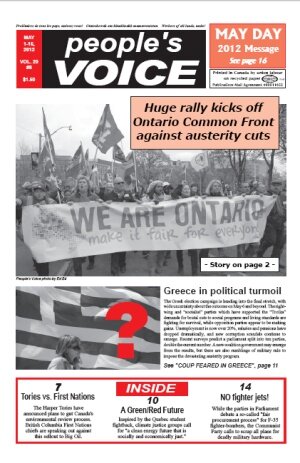
1) STUDENTS-LABOUR-ENVIRONMENTALISTS UNITE FOR "QUEBEC SPRING"
2) 15,000 DEMONSTRATE AGAINST ONTARIO'S AUSTERITY BUDGET
3) MAY DAY 2012 SOLIDARITY MESSAGE
4) BC TEACHERS SQUEEZED BY GOVERNMENT & LRB
5) END THE AFGHAN TRAGEDY NOW - Editorial
6) RED ALERT FROM QUEBEC - Editorial
7) "TIME FOR A UNITED FIGHTBACK STRATEGY"
8) SOLIDARITY WITH THE QUEBEC STUDENT MOBILIZATIONS
9) PEACE AND FRIENDSHIP EVENTS IN CALEDONIA/KANONHSTATON
10) FIRST NATIONS "DEEPLY DISTURBED" BY ENVIRONMENT REVIEW CHANGES
11) OUR GENERATION'S QUIET AWAKENING MUST BE GREEN AND RED
12) NO FIGHTER JETS - SLASH MILITARY SPENDING
13) COUP FEARED AS GREECE VEERS TOWARD ECONOMIC COLLAPSE
14) GAITAN, OAS, AND CUBA: FROM TRAGEDY TO FARCE
15) MUSIC NOTES
16) WHAT’S LEFT
17) CLARTÉ (en français)
18) THE SPARK! (Theoretical and Discussion Bulletin of the Communist Party of Canada)
19) INTRODUCING MARX
PEOPLE'S VOICE MAY 1-15, 2012 (pdf)
|
People's Voice deadlines: May 16-31 June 1-15 Send submissions to PV Editorial Office,
|
|
REDS ON THE WEB |
|
People's Voice finds many "Global Class Struggle" reports at the "Labour Start" website, http://www.labourstart.org/. We urge our readers to check it out! |
* * * * *
People's Voice
Canadian Publications Mail Sales Product Agreement #205214
ISSN number 1198-8657
People's Voice is published by
New Labour Press Ltd
PV Editorial Office
706 Clark Drive,
VANCOUVER, B.C. V5L 3J1
Phone:604-255-2041
Fax:604-254-9803
email: pvoice@telus.net
Editor: Kimball Cariou : Business Manager: Sam Hammond
Editorial Board: Kimball Cariou, Miguel Figueroa,
Doug Meggison, Naomi Rankin, Liz Rowley, Jim Sacouman
* * * * * *
Letters
People's Voice welcomes your letters
on any subject covered in our pages.
We reserve the right to edit for length and clarity,
and to refuse to print letters which may be libellous
or which contain unnecessary personal attacks.
Send your views to:
"Letters to the Editor",
706 Clark Dr., Vancouver, BC V5L 3J1,
or pvoice@telus.net
People's Voice articles may be reprinted without permission,
provided the source is credited.
* * * * * *
The Communist Party of Canada, formed in 1921,
has a proud history of fighting for jobs, equality, peace,
Canadian independence, and socialism.
The CPC does much more than run candidates in elections.
We think the fight against big business and its parties
is a year-round job,
so our members are active across the country,
to build our party and to help strengthen people's movements
on a wide range of issues.
All our policies and leadership
are set democratically by our members.
To find out more about Canada's party of Socialism,
give us a call at the nearest CPC office.
* * * * * *
Central Committee CPC
290A Danforth Ave Toronto, Ont. M4K 1N6
Ph: (416) 469-2446
fax: (416) 469-4063 E-mailmailto:info@cpc-pcp.ca
Parti Communiste du Quebec (section du
Parti communiste du Canada)
5359 Ave du Parc, Montréal, Québec,
H2V 4G9
B.C.Committee CPC
706 Clark Drive, Vancouver, V5L 3J1
Tel: (604) 254-9836
Fax: (604) 254-9803
Edmonton CPC
Box 68112, 70 Bonnie Doon P.O.
Edmonton, AB, T6C 4N6
Tel: (780) 465-7893
Fax: (780)463-0209
Calgary CPC
Unit #1 - 19 Radcliffe Close SE
Calgary AB, T2A 6B2
Tel: (403) 248-6489
Ottawa CPC
Tel: (613) 232-7108
Manitoba Committee
387 Selkirk Ave., Winnipeg, R2W 2M3
Tel/fax: (204) 586-7824
Ontario Ctee. CPC
290A Danforth Ave., Toronto, M4K 1N6
Tel: (416) 469-2446
Hamilton Ctee. CPC
265 Melvin Ave., Apt. 815
Hamilton, ON.
Tel: (905) 548-9586
Atlantic Region CPC
Box 70 Grand Pré, NS, B0P 1M0
Tel/fax: (902) 542-7981
http://www.communist-party.ca/
* * * * * *
News for People, Not for Profits!
Every issue of People's Voice
gives you the latest
on the fightback from coast to coast.
Whether it's the struggle for jobs or peace, resistance to social cuts,
solidarity with Cuba, or workers' struggles around the world,
we've got the news the corporate media won't print.
And we do more than that
- we report and analyze events
from a revolutionary perspective,
helping to build the movements for justice and equality,
and eventually for a socialist Canada.
Read the paper that fights for working people
- on every page, in every issue!
People's Voice
$30 for 1 year
$50 for 2 years
Low-income special rate: $15 for 1-year
Outside Canada $50 for 1 year
Send to: People's Voice, 706 Clark Drive, Vancouver, BC, V5L 3J1
You can call the editorial office at 604-255-2041
REDS ON THE WEB
http://www.communist-party.ca/
http://www.ycl-ljc.ca/
http://www.solidnet.org/
(The following articles are from the May 1-15, 2012, issue of People's Voice, Canada's leading communist newspaper. Articles can be reprinted free if the source is credited. Subscription rates in Canada: $30/year, or $15 low income rate; for U.S. readers - $45 US per year; other overseas readers - $45 US or $50 CDN per year. Send to People's Voice, c/o PV Business Manager, 706 Clark Drive, Vancouver, BC, V5L 3J1.)
1) STUDENTS-LABOUR-ENVIRONMENTALISTS UNITE FOR "QUEBEC SPRING"
By Marianne Breton Fontaine and Johan Boyden, based on a presentation given by Marianne, leader of the YCL in Quebec, to YCL student activists.
APRIL 24 - After almost eighty days of protest, the Québec student strike is entering a record 11 weeks. After 250,000 students and their allies from community and labour groups flooded downtown Montreal with a river of people on March 22, another enormous demonstration was held on Earth Day, April 22.
Close to 300,000 people were in the street ‑ students, environmentalists, labour activists and others from diverse backgrounds. The rally, linked explicitly with the student struggle, showed the unprecedented mounting public anger against with the Charest Liberals and strong support for pro‑people and pro‑nature policies and a "Québec spring."
Making History
The Québec student strike is one of the longest student protests in North American history and has seen some of the biggest mobilizations in Canadian history.
To achieve this magnificent level of resistance, the Québec student movement has had to work on the "ground‑level" of their campuses, convincing their members of the importance of accessible education, but also beyond their campuses, reaching out to larger forces in society and building unity.
What we are seeing today is the result of many years of hard work and some painful lessons, especially over the last five years.
In 2007, after several years of tuition freezes won through student pressure, the Charest Liberals increased fees. The most recent student mobilization was in 2005, when 200,000 students hit the streets in a record united effort against an attack on bursaries. Charest waited two years, and then announced an increase of $500 in tuition fees. There were immediate calls made by the left student organization ASSE for an unlimited general strike (like today, where there is no end date set for the mobilization other than victory).
Unfortunately, because of a lack of unity and a low level of preparation, the strike did not succeed, although a large three‑day strike took place on many campuses.
This taught an important lesson to the Québec student movement, particularly the ASSE. Recognizing their mistake, the progressive and left students went back to work knowing that this was just the first round of a much larger battle.
FECQ, FEUQ, ASSE
For those who don't know the Québec student movement, there are three major national student union centrals. The FECQ and the FEUQ are the largest and always work together. They are somewhat oriented towards lobbying and parliamentary strategies; whereas the ASSE, smaller but much more active, is oriented towards actions in the street.
As the strike votes were just beginning to be organized, the ASSE decided to unite with a number of independent (unaffiliated) student unions for the time of the struggle. This CLASSE coalition currently represents 47% of the strikers. These two poles of organisation have a long standing history of conflict, but as we see today ‑ when they are together, they have achieved amazing mobilisations.
Red Hand Coalition
After 2007 the ASSE made a lengthy two‑year reflection and internal debate on the question of strategy (including about how to place the question of elimination of tuition fees, and how to work with other forces). ASSE decided to push for the creation of a united left front against austerity, the Red Hand coalition.
The Charest Liberals announced in 2010 the tuition fees will again increase, by an unspecified amount. A series of demonstrations were made with the student movement, labour and community organisations under the Red Hand Coalition's banner.
Their rallying cry was not just against the fee increase, but more largely against austerity measures in the Charest budget ‑ such as a regressive flat tax for health care of several hundred dollars. Electricity costs for working families and sales taxes have also been jacked‑up.
Every month, statements were spread on campus calling for an unlimited general strike, whatever the actual increase. An important agitational role was played by regularly published newspapers produced by the national Québec student unions.
A year ago, nobody thought that the very elitist McGill University could go on strike. Today, McGill students (and other campuses that are usually removed from the broader student movement) are in the middle of the action. At McGill the strike of PSAC‑affiliated campus technical support staff reinforced the solidarity between workers and students, as well as the students` class consciousness.
Mobilisation is never easy, but it works!
All this organizing has also been done in a special context of the global economic crisis and a political crisis in Québec.
Québec unemployment has spiked with 25,700 job losses in January alone. Employment fell by 2% in seven months following May 2011. (To put this number into context, Canadian employment fell by 2.5% in the nine months following the October 2008 economic crisis). Official youth unemployment is 13‑16 percent in Québec cities, +20 percent in the Saguenay.
Scandals and victories
A major corruption scandal (linking the mafia with the government) has also been building. For over a year, the Charest government refused to launch a public inquiry. The resulting Charbonneau Commission will hear witnesses in June, but the RCMP are not cooperating with the commission.
Plus, a huge mobilisation against Hydraulic Fracking inspiringly succeeded in reversing the government`s position.
In this context, the Communist Party of Québec (and other left voices) have begun calling for a general social strike to make a sharp break with the current direction and win a people`s alternative agenda.
While the student strike is supported by most Québecers, there has been a polarization of opinion. The far right‑wing is more brazen. On April 12, high‑level bureaucrat Bernard Guay published an article on the Québec city‑based Sun newspaper website calling for the use of "fascist tactics" against the students and the left. Earlier, a right‑wing (and Islamophobic) mayor of Hérouxville called on drivers to run over students blocking traffic and to deploy the military against students.
The government, on the other hand, has mocked the student strike. For example, while a police riot took place outside the Palais des congres de Montréal against a tent camp of Aboriginal people and protesting students (who were opposing the promotion of a major corporate resource extraction project in northern Québec called Plan Nord) Charest joked inside that the students just wanted to get in to get jobs.
Blind in one eye...
Before the student strike the government also announced the formation of a special police unit ‑ clearly anti‑communist, anti-democratic, and anti‑student - against anarchist and marginal groups or GAMMA.
By February the violent methods of the police were evident. Rallies were suddenly gassed, protestors pepper sprayed. Student Francis Grenier lost sight in his right eye when riot police fired a sound bomb into his face at a non‑violent picket. Grenier was playing a harmonica. There are sometime arrests of 500 people in a weekend. The students are threatened with criminal records.
The government is also using tribunals with injunction powers, forcing the students to return to class. But the injunctions have failed because of the amazing actions by the students and teachers ‑ occupying offices and shutting down university buildings.
The teachers have been key players in this movement ‑ respecting the students in their strike and challenging the university administration, and creating Teachers Against Fee Increases. The teachers have constantly worked in the media and strongly encouraged "yes" strike votes on campus. Some teachers have even been arrested by the police on the picket lines.
Negotiations
Finally, the government agreed to talk with the students ‑ but not on the question of fee increases! The government will only discuss the administration of public funds within the university (apparently covered by an old law that the ministry never implemented).
Minister of Education Line Beauchamp also refused to meet with the CLASSE because they do not openly condemn violence. The CLASSE, however, did not play the game, passing a resolution "defending the principle of civil disobedience [...] condemning deliberate physical violence against persons except in self‑defense [...] and condemning police and institutional systemic violence, including discrimination in access to education as socio‑economic criteria, injunctions harassing the right to strike, and freedom from association, humiliation, intimidation, and violent repression by the security forces and government[...]"
Begrudgingly, the Minister has started negotiations with all three student groups.
Support needed
The Young Communist League of Québec and the Communist Party of Québec are both calling for the students to stand strong, together "just one minute more" than the government can.
Québec now needs solidarity. The Charest government continually justifies the tuition increase by pointing to English-speaking Canada`s higher fees. Québec students, they say, are cry babies. We must show English‑speaking Canadian students do not agree. Proposals and draft resolutions are at www.RebelYouth‑Magazine.blogspot.com
Lastly, we must to break the silence about the Québec student strike, which shows that with hard work, an escalating plan of mobilization, and brave leadership ‑ the people will fight. Spreading the information about the Québec strike is therefore calling to begin such a broad and united mobilisation in the rest of Canada!
2) 15,000 DEMONSTRATE AGAINST ONTARIO'S AUSTERITY BUDGET
PV Ontario Bureau
More than 15,000 people descended on Queen's Park April 21 to protest the most right‑wing provincial budget in decades ‑ more devastating to working people, the unemployed and the poor than even the Mike Harris budgets of the 1990s, according to OFL President Sid Ryan.
The austerity budget includes massive layoffs in the public sector, and closures of hospitals, schools and child care centres. Social programs are slashed, with the elimination of many services. Cities face deep cuts to public transportation and housing. Social assistance and disability support rates, already among the lowest in Canada, are frozen. Many public assets, lands, and crown corporations will be privatized. Major new user fees are planned.
The budget viciously attacks public sector wages and pensions, with the government threatening to impose wage controls if unions refuse to accept the proposed "voluntary" pay freeze and other concessions that will eliminate thousands of jobs and the services that go with them.
According to the Communist Party of Canada (Ontario), the budget is aimed to drive down wages, pensions, incomes and living standards in the public and private sector, to privatize or eliminate social programs, and severely weaken labour and democratic rights. It will force the unemployed, those on social assistance and ODSP, and many in precarious jobs, to live on incomes too small to cover the cost of housing, let alone food. Combined with the federal budget, this could tip the province into another deep economic recession.
In January the OFL issued a call for the April 21 Day of Action. One hundred buses were filled with workers and community activists from all over Ontario. Thousands more arrived from the GTA and Toronto, filling the lawns of Queen's Park. Thunderous applause echoed across the downtown during the speeches, followed by chants, songs and music throughout the boisterous march that followed.
But it wasn't all applause. NDP leader Andrea Horwath was roundly booed by demonstrators (including many wearing orange scarves) who clearly felt the NDP caucus was giving away the store in negotiations with the minority Liberal government over the terms of the April 24 budget vote.
The Tories - the Official Opposition in Queen's Park - oppose the budget in an effort to force another election which they believe they can win. The ball fell to the NDP to get austerity off the agenda. But the big majority of demonstrators clearly felt the NDP had conceded too much, and ought to have pressed the Liberals a lot harder for the platform it had campaigned on last September, including its policy to restore the corporate income tax rate to 14%. A long stream of speakers talked about the horrendous effect of the budget cuts, underlining how little the NDP appeared to have secured.
Sid Ryan and many others spoke about the need for a sustained and broad‑based fight against austerity, about the bold and extended fight by Quebec students and labour against tuition hikes. They called on the labour and democratic movements to get involved in the Common Front.
A day earlier, in a downtown Toronto church, over a hundred labour, social, community and political activists crowded in to unanimously support the OFL's proposal for a Common Front to fight austerity and the budget cuts. Ryan, OFL Secretary‑Treasurer Nancy Hutchison, Ontario Health Coalition director Natalie Mehra, Social Planning Council Chair Peter Clutterbuck and others spoke about the need for a massive response to austerity. Ryan referenced the Days of Action that almost brought down the Harris government in the 90s, clearly indicating the direction he wants to move.
Ryan also expressed the view that the NDP should not be afraid of an election, clearly critical of the concessions made by Horwath. A survey commissioned by the OFL showed that a large majority of those polled supported taxing the corporations and the wealthy to avoid devastating budget cuts. An NDP member and sometime candidate, Ryan clearly expects the party to clean up if an election is called.
Not everyone shares that view. Other polls indicate an election now would likely result in another minority government, with voter support split among Liberals, Tories and NDP. The Greens and small parties could also be a factor in a tight vote.
The CPC (Ontario) warned against a snap election, suggesting an NDP outcome was far from certain, and that an NDP minority would be more likely to move towards the Liberals in a three‑party House, giving the Liberals and their austerity policies the upper hand in any future negotiations.
"Today the working class and its allies will be in the strongest position by building the Common Front into a massive extra‑parliamentary movement that can bring its weight to bear on the minority Liberal government ‑ and the NDP caucus," said CP (Ontario) leader Liz Rowley.
Instead of austerity measures, the Ontario Communists are calling for wealth taxes and inheritance taxes on large estates, higher corporate income taxes, restoring the capital tax, and increased capital gains taxes. This would generate the revenue needed to fund health, education, childcare and social programs, to create jobs and build affordable social housing, to substantially raise the minimum wage and social assistance rates on the road to a guaranteed annual income above the poverty line, and to enforce free collective bargaining and the right to strike.
"This is also the time to win gains such as rent control legislation, anti‑scab legislation, plant closure legislation, and other social, civil, labour, and democratic rights", said Rowley. "The working class and its allies must rely on their own united and mass independent political action to force the Legislature to jettison austerity and introduce policies for jobs and an economic recovery for working people."
The mass demonstration and the Common Front are welcome developments at a time when many battles are being fought alone by the few directly involved. The birth of the Common Front makes each struggle a common struggle for jobs and justice. It transforms the few into the many, the fingers of struggle into the fist of a powerful movement for real and progressive change.
"The capitalists cannot live without us, but we can live better without them"
Solidarity message from the Communist Party of Canada
Organized labour in Canada is under attack legislatively and economically, blackmailed by strike and lockout. Two and three tier levels of wages, benefits and pensions are being forced on workers under the bludgeon of lockout and forced strikes. There has not been a major victory in years for labour but the corporate offensive is still escalating.
Ask the Toronto Transit workers, the BC Teachers, airline workers, Sudbury miners, Rio Tinto workers in Quebec, Hamilton Steelworkers or Windsor Diesel Plant workers if this is a hospitable or a dangerous environment. All these workers were and are militant. Some are licking their wounds others are still engaged, but the formula for victory has not been found.
In BC the attack of "net‑zero" bargaining threatens public sector workers who are emerging from previous wage freezes, and a 15% roll‑back for hospital employees just a few years ago. In Ontario the provincial Liberals are sneering at public sector workers and teachers who thought they could bargain with them. Ditto Quebec and every other jurisdiction in Canada.
In every capitalist state in the world, the neo‑cons have forced "labour reform" on the agenda. The anguish of the present is only a sample of the staggering misery that is looming if we do not organize more effective resistance. The global plan for cheap, flexible, mobile, compliant and un‑organized labour requires the destruction of organized labour as we know it, or its transformation into a control mechanism of management.
Organized labour will be legislated into compliance and tolerated only if it is not an inconvenience to the corporations. The right to strike, to withdraw labour and to free assembly is being denied larger sections of workers by provincial and federal legislation. The International Labour Organization cites 30 violations of the United Nations Declaration of Human Rights by Canadian governments.
The two and three tier conditions are a direct and vicious attack on youth, the future workers. The different levels of economic citizenship that this creates will eventually separate youth from organized labour, which they so badly need as an instrument of resistance. In Europe the "reforms" in the Lisbon Treaty talk about "productive" and "non‑productive" labour, where a worker's right to freedom of movement will be determined by their usefulness to employers. In Canada, with over 10% real unemployment (closer to 20% for youth), less than 40% qualify for E.I. benefits that all paid for when they were employed. Yet the Tories are talking about E.I. "reform" geared to satisfying the need for agricultural labour. This is forced labour paid for from the workers' own contributions; for the employers, a disposable pool of strong and healthy youth for subsistence wages and third world living conditions. "Guest Workers" in our own country. A Harper refinement of the "dirty thirties" work camps.
The debt‑based paper wealth of capitalism that feeds off the destruction of the real (manufacturing) economy nourishes itself on the privatization and plunder of public wealth and services, the destruction of lives doomed to hunger, disease, unemployment and subservience. The accumulation of wealth and the degree of misery are unparalleled in human history and the "trickle down" theory has been exposed as the "cascade up" of wealth into the maw of insatiable greed.
The resilience of the world's working people, the 99%, has produced rumblings of discontent that emerges in movements ranging from peaceful protest to insurgency. The Occupy Movement has flexed its global muscle. The Greek Militant Workers Front (PAME) has inspired Portuguese, French, Italian and Spanish workers into massive strikes and protests. The Indian people, both organized and unorganized, responded in millions to a general strike in February that was not reported in our media. The Quebec students have launched an historic strike struggle over tuition fees with labour support. The BC Teachers persevere, and will probably win in the courts and public opinion, only to be robbed in the legislature. The Hamilton Steelworkers and the Sudbury Miners fought courageously and will fight again.
The will is there but the top leadership and unity is not. Where is the Canadian Labour Congress in these struggles? Why are centre or left‑centre elements under attack from the right? The vaunted re‑organization of the CLC structure has given us a resounding more of less. Raiding continues, and mergers are organizational consolidations for business purposes without fightback ideology or strategy.
How long can the leadership of the Canadian labour movement preside over a membership mauled by trade agreements, de‑industrialization, claw backs, anti‑labour legislation, plant closures and unemployment? And what about the 70% unorganized? Who will speak for them, who will organize them?
What were sore points in the class struggle twenty years ago have become open wounds. But we need more than bandages, we need the weapons of program, planning and unity. We need the indignation of oppression and defeat to express itself in organization and resistance. If the entire workforce, or a sizeable percentage merely stayed home, we could bring them to the bargaining table. We can win because the capitalists cannot live without us, but we can live better without them. There is another world and it is waiting for us.
Happy International Labour Day, May 1st!
4) BC TEACHERS SQUEEZED BY GOVERNMENT & LRB
By Kimball Cariou
Trapped in a government/Labour Relations Board squeeze play, British Columbia's 41,000 public school teachers continue to stand up for their rights and for the interests of students. At this point, one of the few options left for teachers is to withdraw from extra-curricular activities.
In early March, faced with a refusal to bargain by the BC Public School Employers' Association (BCPSEA), the Teachers' Federation escalated their limited job action which began last September. The BCTF held a three-day strike, pressing the Liberal government to back down from its "net zero" mandate which locks BCPSEA into a pay freeze position.
The response by Premier Christy Clark's Liberals was to ram Bill 22 through the legislature. The Bill virtually wipes out limits on class size and composition, and forces the BCTF to engage in so-called "mediation" which will strip crucial clauses from their existing collective agreements. The legislation imposes enormous fines against the union and its members for any new strike actions.
BCTF delegates voted at their March annual meeting to hold a province-wide vote on a resistance strategy against Bill 22. In mid-April, 21,625 teachers voted in favour, and 7,846 against - a 73% rejection of the "Education Improvement Act."
BCTF President Susan Lambert called the result "a powerful message to government that they must rethink Bill 22, listen to the concerns of teachers, respect our rights, and invest in services to students. Teachers are united in opposition to this terrible piece of legislation, the twentieth bill passed by the BC Liberals since 2001 targeting teachers' professional and labour rights."
Lambert acknowledged that teachers made a difficult decision to withdraw from extra‑curricular activities, which "bring so much joy to our engagement with students. We know this will mean the loss of some highly‑valued activities, and we sincerely regret that. But we have to look at the bigger picture and the longer term."
The fightback plan also calls for non-cooperation with the Ministry of Education; a public awareness campaign to educate British Columbians about the impact of Bill 22; a possible future vote on a full withdrawal of services; and working to help elect a new government in May 2013 that will repeal Bill 22.
The BCTF has also applied to the B.C. Labour Relations Board to quash the appointment of Dr. Charles Jago as mediator. Given his past actions and writings, and his financial contributions to the BC Liberals, most observers conclude that Jago was appointed to do the government's dirty work. Jago has until June 30 to mediate the dispute, receiving $2000 per day. He is expected to fail, and will then be directed to submit non‑binding recommendations.
In another development, the LRB ruled on April 19 that teachers have until April 27 to produce report cards with student marks dating back to September 2011. The LRB ruling was triggered by a BCPSEA application which argued that the teachers' refusal to write second‑term report cards amounted to an illegal strike. It remains to be seen how this will play out, since the BCTF maintains that the decision compels its members to perform "struck work." On April 23, the LRB ruled that the Victoria BCTF local, which had refused to direct its members to comply with the report card order along this timeline, was engaged in an illegal strike.
The LRB ruling supports the lie spread by the Liberals that high-quality report cards can be prepared at the push of a button. Much of the government and corporate media attack against the BCTF is based on similar demagogic slanders, accusing the teachers of being "lazy" and "overpaid."
The withdrawal of extra-curricular activities is one of the few cards the BCTF had left to play. The union stresses the fact that by underfunding public education, the Liberals bear the true responsibility for this tactic.
However, the BCTF still has a powerful base of support among parents, students, and some school boards whose positions are not reflected by BCPSEA. The Vancouver Board of Education, for example, passed a resolution stating that "Bill 22 is causing our valued education partners to feel bullied and disempowered, putting any real improvement to our education system in peril. We support and respect the rights of employees to freely and collectively bargain the terms of their employment and we ask you to do the same."
The resolution sharply criticizes the Bill's provision to pay extra to teachers who accept over‑sized classes, and for failing to provide supports for students with special needs. It concludes by backing the call from the Vancouver District Parent Advisory Council to rescind Bill 22.
Despite Christy Clark's deepening unpopularity - and her party's devastating losses to the NDP in two April 19 byelections - the Premier still commands a majority in the legislature. The Liberals intend to ride out the protests, as a scare tactic to gain votes. But in the end, her anti-public education policies may contribute to a resounding defeat at the polls next May.
People's Voice Editorial
Amidst a deepening crisis, pressures are building for an end to the imperialist occupation of Afghanistan. This disaster is not an unexpected turn of events. For example, in January 2002, People's Voice reported on a study by Prof. Marc Herold of the University of New Hampshire, who presented reliable evidence that more than 3,500 civilians had been killed by U.S. bombs since the attacks were launched on the previous Oct. 7. For over a decade, Afghan civilians have suffered a death toll far larger than the casualties of U.S., Canadian and other occupation armies.
The litany of horrors keeps growing, from the burning of Korans, to the sickening revelations about U.S. troops posing with corpses and body parts. One in five U.S. combat deaths in Afghanistan are now caused by Afghan security forces, trained and supplied by Canada and other NATO allies. "Guardian angel" soldiers have to stand guard while other U.S. troops sleep.
A recent CBS poll shows a record 69% of Americans think the U.S. should not be involved in Afghanistan, and a solid majority of Canadians have called for return of the troops for years.
The truth is clear to all. Imperialism's military strategy in Afghanistan has been a total, abysmal failure. failed. Canadians are wasting billions of dollars to occupy a population bitterly angry about the unending deaths and humiliations inflicted by the NATO powers. Despite all the feel-good news stories about "reconstruction," Canada's role in Kandahar has been closely linked with drug warlords and violent thugs. This shameful chapter in Canada's history must be closed, not in 2014, but immediately. Bring the troops home now, and begin to pay compensation to the Afghan people for the terrible crimes committed in our name.
People's Voice Editorial
Whatever the immediate outcome, the Quebec student will has raised the bar for popular resistance struggles, for at least two compelling reasons.
One concerns the broad movement which has emerged in solidarity with the students. By uniting around core demands for accessibility to education which resonate with all working people, the students have expanded their base, from campuses across Quebec, to the wider population. This fight expresses the sentiments of working people in many countries, fed up with endless demands by bosses and governments to make us pay for an economic crisis caused by big capital's drive for profits. The student strike shows that the way forward is not through isolated individual protests, but through conscious efforts to build mass, united action.
The Quebec students have also begun to question the basis of our entire social system. As the Climate Justice statement (see page 10) says, "the fight against an unjust economy and the fight against climate change" are one and the same, "because the crises of the climate and the economy have the same root: putting profits before people and the planet.... This economic model that celebrates greed above all else is not just making education inaccessible, but it will make our planet uninhabitable."
The policies demanded in this statement are urgent: reducing inequalities; mass public transit; free education; green jobs that decrease dependence on fossil fuels; restraining the power of corporations and banks; rapid reduction of carbon emissions.
Although not explicitly socialist, the statement calls for change that is "green as well as red", for "a clean energy future that is socially and economically just". This moves in the direction of democratic public ownership of productive wealth, i.e. replacing the private profit system with working class power. Once this concept wins the support of millions, it will become a powerful political force to win a new Canada and a better world.
7) "TIME FOR A UNITED FIGHTBACK STRATEGY"
Special to PV
As global capitalism continues to flounder, the attraction of radical alternatives appears to be rising. Meeting in Toronto over the April 14-15 weekend, the Central Committee of the Communist Party of Canada analyzed this important development, and how to help strengthen the working class movements. Elected from across Canada at the Party's 36th Convention in 2010, the 20-member CC meets twice yearly.
One indication of change has been the wave of mass political strikes by workers in Greece, Portugal, and Italy, but also in India and other countries where anger is rising against the so-called "austerity reforms" imposed by pro-business governments.
In North America, the upsurge in labour resistance was sharpest in Wisconsin, where huge mass protests were followed with a campaign to recall far-right Republican governor Scott Walker. Then last fall, the Occupy movement emerged to challenge the domination of the corporations on a continental scale.
Just as significant, left and communist alternatives are gaining voter support in some countries. As the Main Report adopted by the CC meeting says, "These struggles in turn have radicalized political thinking, weakened the grip of social democratic and reformist illusions among workers, and increased support for the Communist and revolutionary left forces in these countries." In Greece, the PASOK (social democratic) party is down to about 15% in the polls, while support for the KKE (Communists) and the left in general has risen to nearly that level. Support is also growing for the Left Front in France (which includes the PCF), for the Communist‑led United Left (IU) in Spain, and for the Communist Party of the Russian Federation.
These developments, the Report notes, are linked to the downward spiral of the imperialist system. Despite frantic efforts to stabilize their economies since the outbreak of the crisis in 2008, most capitalist countries still face persistently high unemployment and low growth rates.
As the Report says, "The political‑economic offensive launched by monopoly and capitalist governments to drive down the price of labour‑power through savage wage cuts, increasing the intensity of labour (`speed‑up'), pension and other benefit take‑backs, and the gutting of public services, has in turn spawned growing labour and popular resistance and fightback."
In Canada, the CC members pointed to several powerful expressions of this fightback: the Quebec students' mass strike for access to post-secondary education; the battle of BC teachers against the Liberal government's "net-zero" mandate; and the efforts of the Ontario Federation of Labour to build a broad common front of the organized working class and its allies. The move to hold united May Day events in several major cities this year is another important advance. Movements to block the Harper government's attack on pension rights and to stop the Enbridge Northern Gateway pipeline project are also welcome signs of popular resistance to the corporate agenda.
But the meeting also noted that unlike in some countries, the leadership of the main trade union body in Canada is doing little to help mobilize a concerted fightback. Over the past several years, the Communist Party and left labour activists have urged the CLC and its affiliates to convene an emergency meeting of the trade unions and key social forces to put together such a united strategy, but the Georgetti leadership has so far refused to take any such initiative.
The Communist Party will continue to press for an orientation towards mass labour and democratic resistance. With its next Central Convention now set for April 2013, the Party will focus on "identifying and helping to overcome the weaknesses which are inhibiting a more powerful and dynamic resistance movement among broad labour and people's movements, and to build our Party, the YCL and our press in the process."
Looking at the international situation, the CC meeting warned that today "all three imperialist blocs are mired in a protracted economic crisis of great magnitude." The ruthless austerity measures dictated by big capital are driving down wages, cutting pensions, wiping out social programs, and spreading malnutrition and hunger.
Most alarming, says the CC Report, is "the stepped‑up drive for militarization and war, and the incessant saber‑rattling by the main imperialist powers ‑ including Canada ‑ for foreign aggression against both Syria and Iran."
"The drive to war is an inherent feature of capitalism in its imperialist stage," the Report notes, as rival imperialist powers struggle to increase domination over markets, seize natural resources, and re‑divide the world."
But this "impulse to aggression" has been intensified by the prolonged economic crisis, since militarism is one way in which capitalism seeks to shed "excess capacity" and resuscitate stagnant economies. The ruling classes are whipping up war hysteria, aiming to distract working people from their class‑based grievances against the dominant "1%". The campaign to launch new wars is also being carried out under the pretext of the "responsibility to protect" (R2P) civilian lives.
In this dangerous situation, the CC stressed, "it is vital that every effort be made to rally the peace movement across Canada and internationally to stave off imperialist aggression, and to support a peaceful, political solution of the Syrian conflict."
Coming shortly after the Ontario and federal "austerity" budgets presented in late March, the CC meeting concluded that these documents express the "long-term strategic offensive of monopoly capital."
Despite the Harper government's attempts to "soft‑pedal" its funding cuts, the Report warns that the impact of slashing $5.2 billion in program spending (a 6.9% reduction, or actually more than 10% over three years when inflation is taken into account) will be substantial. The losses will not be the 19,200 job cuts claimed by the government, but more likely 50‑60,000 jobs in total, when the earlier `program review' cuts and the loss of spin‑off jobs are taken fully into account, at a time when the real unemployment rate is well over 10% (and more than 20% for young people).
These reductions will affect numerous frontline services, covering everything from employment counsellors to food inspectors. Over 5,500 Public Service Alliance of Canada members in 22 federal government departments have already received termination notices. More than 1,500 scientists, veterinarians, engineers, medical doctors and other staff represented by the Professional Institute of the Public Service of Canada also received notices.
The effect of the budget will fall most heavily on programs and services which the Tories want to target for political and ideological reasons, such as the environment, aboriginal affairs, the CBC, and so on. The changes to the pension system will have the most negative effect on low income earners with the least ability to protect themselves; many will be forced to stay longer in the workforce.
In condemning this vicious austerity budget, the Central Committee noted that if the government's real intent was to achieve a balanced budget by 2015, "this could have been achieved in other ways, such as by cutting swollen military/security expenditures, by reducing corporate hand‑outs, and by increasing public revenues by reversing the massive cuts in corporate and wealth taxes."
But in fact, the CC said, "the Tories have used crude scare tactics of looming `economic meltdown' on the scale of Greece and Spain if they fail to curb spending, while at the same time down‑playing this vicious budget as 'cautious' and 'moderate' (swiftly and uncritically parroted by the mainstream corporate press). In this respect, the Flaherty budget is a skilfully cynical and dishonest piece of work, one which fits neatly into... monopoly's long‑term strategic objectives, especially with respect to the role of the Canadian State."
The Central Committee agreed to organize a public campaign by Party this fall, around the general theme of progressive alternatives to the corporate austerity agenda. The six-week campaign will include a range of materials calling for radical policy changes, and presenting the Communist Party as the most consistent force for fundamental change in Canada.
8) SOLIDARITY WITH THE QUEBEC STUDENT MOBILIZATIONS
For free education and a general political strike!
Resolution of the Central Committee, Communist Party of Canada
Since early February, college and university students across Québec have been confronting the Charest Liberal government's attack on accessible education with a magnificent and historic student strike that has rocked the province. The student strike has been marked by its high level of support from the people of Québec, the unity of the students, and the sheer scale of the mobilization.
In a lesson of the power of unity and militancy, the four main Québec student union centrals have set aside their differences to combat a tuition increase of $1625 over five years. The students have also been clear that their campaign is part of the broad struggle against austerity measures and about a projet social for a different and better society with accessible and free education.
Over three hundred thousand students have engaged in limited strike action, and close to two hundred thousand students are currently out of class and in the streets. Multiple demonstrations and occupations are taking place daily across Québec, with a record and enormous mobilization of over two hundred and fifty thousand protestors on March 22. Another massive action is planned on Earth Day under the slogan "for a Québécois spring!"
The Central Committee of the Communist Party of Canada gives our full solidarity and support to this magnificent struggle, to the student organizations, and the people of Québec. In the critical labour and people`s fight‑back against the corporate anti‑people agenda of budget cut backs and privatization, attacks on labour unions, the right to strike, pensions, environmental destruction, etc. across the country, the Québec students directly are on the front‑line.
Our Party fully endorses the slogan "Just one minute longer" adopted by the National Executive of the Communist Party of Québec (PCQ), calling upon the students to bravely continue to hold out and stay united against the Charest Liberals. We also support the proposal of the PCQ`s newspaper Clarté, that the trade union movement throw it`s active support behind this struggle and convene an Estates General of progressive forces against the Charest Liberals, with labour the core, to formulate the way forward with a general, political strike.
The Québec government, big business and right‑wing forces (with the collusion of the top‑level of many university administrations) have attempted to break the student strike through police brutality, court challenges, unilateral decrees, an expensive media blitz of mis‑information, and an anti‑democratic strategy of standing "tough" and refusing to seriously negotiate with the students.
But the Charest Liberal government has not succeeded and have instead lost the broad support of the people of Québec. The final report of the Charbonneau Commission (examining links between the construction industry, politicians, and organized crime) is inevitably around the corner. Despite all their bluster, the Charest Liberal`s are in an increasingly precarious position.
It is essential that Québec labour step‑up now, amplifying the moral pressure that the students have wielded with the economic pressure of a new Common Front and general political strike. The people`s options are also very difficult, but there is no other way forward than a united fightback. On the other hand, as the left‑wing political party Québec Solidaire said just this week, we can make a sharp break with the programme of the monopoly corporations and win a people`s agenda including the elimination of tuition fees.
The students are now entering the eleventh week of their strike, an increasingly tough and important juncture. To detract solidarity, media coverage of the student strike outside of Québec has been limited and has made great efforts to focus on a handful of altercations involving the protestors. In reality, it is the notoriously violent Sureté du Québec (and other security forces) that are repeatedly tear gassing and pepper spraying demonstrators, have blinded a student with a sound bomb, and are now arresting large numbers of protestors at demos.
We call for labour, student, community and progressive organizations to send messages of support to the Quebec students, and for emergency solidarity actions to be held across the county to break the silence in English‑speaking Canada about this incredible people's movement!
We repeat our long‑standing demand for free education from cradle to grave, a living stipend for students, the abolishment of student debt and replacement of loans with grants, the right of students to organize autonomously without interference, rolling back privatization by restoring and expanding all public funds to education, and the de‑militarization of research and development.
9) PEACE AND FRIENDSHIP EVENTS ON APRIL 28 IN CALEDONIA/KANONHSTATON
April 20, 2012 marked the sixth anniversary of the OPP raid of the Six Nations reclamation of the former Douglas Creek Estates, which cast a spotlight on Native land disputes in Canada.
In an historic event, hundreds of non‑native supporters are being organized to bus in from eight Southern Ontario cities to peacefully rally in Caledonia and walk to a celebration at Kanonhstaton, the former Douglas Creek Estates, on Saturday, April 28.
Following years of inaction on unresolved land and treaty issues at all levels of Canadian government, Native and non‑native communities are rallying together in unprecedented numbers to demand that Six Nations land rights be respected.
Tracy Bomberry, a Six Nations spokesperson for the April 28th Coalition says "It has been six years since Kanonhstaton ("the Protected Place") or the Reclamation began in 2006. Much has occurred since then. Our people have stood up and raised our voices and many connections, friendships, and relationships have been built. However, at the same time nothing has been done by the Canadian Government to address our treaties and land rights."
This day of celebration and lead‑up events are being organized by a broad based April 28th Coalition. Luke Stewart, a historian and lifetime Haldimand Tract resident, is one of the group's spokespeople. Stewart described the march as "a call to honour and respect our historical agreements, and move toward a peaceful future of healthy coexistence, not colonial subjugation and corporate land theft." Stewart added that the Coalition is comprised of residents of Caledonia, Oshweken, Hamilton, Kanonhstaton, Brantford, Dunville, Kitchener, and other small towns along the Grand River as well as supporters from Toronto and beyond.
According to Caledonia resident and group spokesperson Katherine Moesker "This day can mark the beginning of the reconciliation of relationships between two communities. We cannot move forward if we all don't take a stand and decide to work together. This event can be a powerful statement to anyone who witnesses it: we can show the world that it is possible to grow closer together as a community despite what has happened in the past."
10) FIRST NATIONS "DEEPLY DISTURBED" BY ENVIRONMENTAL REVIEW CHANGES
The B.C.-based First Nations Leadership Council has issued an open letter to Natural Resources Minister Joe Oliver, condemning the Harper government's "Responsible Resource Development Plan". Announced on April 17, the policy gives the federal government sweeping powers to fast-track projects at the demand of resource monopolies.
The Open Letter reads:
We are writing with respect to your government's shocking announcement to completely gut the environmental assessment process. We are gravely concerned with this announcement to eviscerate the process for environmental review on resource development projects after the changes lay waste to the credibility of the process. These environmental laws and the associated processes do not replace the judicially‑recognized and constitutionally‑protected Aboriginal Title, Rights and Treaty Rights but there are vital parts of the Crown's relationship with First Nations. Fundamental changes to the environmental assessment process and other environmental protection laws can only be
undertaken with meaningful consultation with First Nations. We urge the federal governmental to work with First Nations to improve environmental protections rather then weaken them with the reduction of assessment timelines and the reduction of required organizations responsible for such reviews.
First Nations have legal and constitutionally protected rights and responsibilities to protect their traditional territories and all that this encompasses, and are not merely stakeholders in resource development projects. Both domestic and international law recognize the importance of Indigenous Peoples' relationship to resources and all activities that take place on our traditional territories.
A recent report by the United Nations Committee on the Elimination of Racial Discrimination emphasized the need for Canada to include Indigenous peoples in decision making, recommending that Canada "Implement in good faith the right to consultation and to free, prior and informed consent of Aboriginal peoples whenever their rights may be affected by projects carried out on their lands, as set forth in international standards and the State party's legislation." Further, the United Nations Declaration on the Rights of Indigenous Peoples sets out in Article 26(1) that "Indigenous peoples have the right to the lands, territories and resources which they have traditionally owned, occupied, or otherwise used or acquired." We fully expect Canada to uphold its commitment to this important international doctrine.
We remind you that the Crown cannot legislate itself out of its duties to consult and accommodate First Nations. With upcoming projects that require further review such as Taseko Mines Ltd's Prosperity Mine, expansion of the Kinder‑Morgan pipeline, Enbridge Northern Gateway Project as well as other resource development projects, the Federal government must engage in good faith and meaningfully consult with First Nations. Removing or weakening environmental reviews for projects will only result in greater uncertainty and heightened conflict on the land.
We are keenly aware that the British Columbia government is simultaneously working to create regulations to exempt some so‑called "low‑risk activities" from the requirement to hold a Mines Act permit. The regulatory changes to the Mines Act were set out in Bill 19, which was introduced on November 14th and rushed through the House to receive Royal Assent on November 24th, the last day that the Legislative Assembly sat in 2011. We wish to put you on notice that we are monitoring the dovetailing approaches taken by both the provincial and federal governments to categorically erode the approval process for environmental projects in favour of industry and in complete disrespect for Aboriginal Title and Rights and Treaty Rights.
Again, we are deeply disturbed by these developments and we urgently request a meeting with the First Nations Leadership Council to further discuss how these proposed changes to the environmental assessment process and other environmental protection laws will impact on the Aboriginal Title, Rights and Treaty Rights of First Nations in BC.
The letter was signed on behalf of the First Nations Summit by Grand Chief Edward John, Chief Douglas White III Kwulasultun, and Dan Smith; on behalf of the Union of BC Indian Chiefs by Grand Chief Stewart Phillip, Chief Bob Chamberlin, and Chief Marilyn Baptiste; and on behalf of the BC Assembly of First Nations by Regional Chief Jody Wilson‑Raybould.
11) OUR GENERATION'S QUIET AWAKENING MUST BE GREEN AND RED
By Climate Justice Ottawa and the Canadian Youth Climate Coalition, and Climate Justice Montreal
The creative, courageous and inspiring Quebec student movement will today [April 22 - Editor] weave its way through Montreal's Earth Day rally, mixing red and green, merging its demands for a freeze on tuition with respect for the earth and those most impacted by climate change. Let their meeting not remain accidental, but deepen and flourish.
Our country has always been divided by solitudes of nation, religion, and language, but no two solitudes are as important to overcome today as this: the fight against an unjust economy and the fight against climate change.
It has never been more urgent to make the connection. The old mentality may have told us to fight our battles separately: Let environmentalists deal with the environment. Let workers and students deal with the economy. But a new mentality tells us this is the same fight, because the crises of the climate and the economy have the same root: putting profits before people and the planet.
This must be our generation's quiet awakening.
If students squarely in the red is a warning our economic model is failing them, then climate change is a terrifying expression - the ultimate red alert - that the economy is failing the earth. This economic model that celebrates greed above all else is not just making education inaccessible, but it will make our planet uninhabitable.
It says to us: each person for himself; make the students shoulder the burden; and let people stricken the world‑over by climate change‑induced droughts, storms, flooding and crop‑failures suffer their fate.
The neoliberal economic model that commercializes education is also the model that will turn the St. Lawrence valley into an industrial shale gas experiment. That will turn the north of Quebec into a mining and forestry sacrifice zone. That will turn the gulf of St. Lawrence into an oil pumping site. And that will turn the province into an eastward launching pad of the Alberta tar sands, a carbon bomb.
Science tells us that this model of business as usual - of perpetual growth and greed, of constant expansion and extraction - is spilling so much carbon into the atmosphere that it will ensure cataclysmic climate change. It insists we find alternatives.
The real solutions to the climate crisis will come in creating an economy that serves everyone and our ecology: closing deepening inequalities; funding a strong public sphere that includes mass public transit and free education; creating good, green jobs for young people that decrease dependence on fossil fuels; and restraining the reckless power of corporations and banks that profit off the privatization of our schools and the pollution of the planet.
We need to end the reign of oil in Ottawa, and its influence in Quebec city. The federal government now hands‑out $1.4 billion a year to the world's richest and most polluting oil companies, when such a hand‑out to students could begin a system of free education in Quebec and across Canada.
Climate change adds great urgency to all these demands for social, economic and ecological justice - because we must reduce our carbons emissions rapidly, time is short. Climate change must be the spark to remake our economy on a very tight deadline.
The values of our new social movements - solidarity over individualism, reciprocity over hierarchy, cooperation over competition - should orient our vision for a clean energy economy. This is a movement that will be stronger when it is united. When it finds solutions simultaneously to the crises of the economy and ecology. When it is green as well as red.
During POWERSHIFT 2012 this October 26 to 29, thousands of youth from across the country will converge in Ottawa to force these issues onto the national agenda, to fight for a clean energy future that is socially and economically just. If the spirit and power of Quebec's spring blossoms, and spreads across Canada, we can achieve it.
www.facebook.com/powershiftcanada
12) NO FIGHTER JETS - SLASH MILITARY SPENDING
Resolution adopted by the Central Committee, Communist Party of Canada, April 14‑15, 2012
Demands are growing for the resignation of Defense Minister Peter MacKay and Prime Minister Harper, in the wake of the Auditor‑General's report that the purchase of sixty‑five F‑35 fighter‑bombers would cost taxpayers at least $10 billion more than the Conservative government ever admitted. But while corruption and lies are among the defining features of the Harper Tory regime, this scandal raises far deeper issues. Far more significant questions concern the true nature of Canada's role in the global imperialist drive for markets, resources, and corporate profits, and the choice between military spending versus urgent social needs.
As the Communist Party and the anti‑war movements have warned for several years, the Harper government and the top military brass have repeatedly lied to Canadians about the F‑35s. The calls for MacKay's resignation are welcome, but the real responsibility for this $10 billion whopper lies squarely with Stephen Harper, who runs his government with an iron fist.
Fundamentally, however, the F‑35 scandal is not about a flawed procurement process, or finding the "most suitable" jet, or "defending" Canada. The real problem is the concept that Canada needs to spend tens of billions to purchase new fleets of aircraft and warships, even though there is simply no military threat to this country. Nor are 21st century fighter jets like the F‑35 suitable for use as "patrol planes" with search‑and‑rescue capabilities ‑ they are killing machines with massive arsenals of bombs, rockets, and bullets, and alarmingly, with the capability to carry nuclear weapons payloads. They are a key part of the imperialist strategy for global corporate control of raw materials such as hydrocarbon resources, and for NATO's tactics of "regime change", under the "responsibility to protect" doctrine.
Another lame justification for the F‑35 and warship procurements has been the argument that these programs are necessary to boost research and development spending in Canada, allegedly to create high‑tech jobs. But the reality is that the government's "Canada First" plan to spend $500 billion on military purchases over the next two decades will create far fewer jobs than investments in clean water for Aboriginal communities, social housing, public transit, a Canada‑wide childcare program, universal pharmacare and other improvements in the Medicare system, or many other urgent social and economic priorities. In short, the fighter‑bomber program and other military purchases will come with an enormous human and environmental cost to Canadians, while serving no purpose other than to fuel the insanely expensive and dangerous global arms race.
With the exception of Green Party leader Elizabeth May, no party in the current Parliament has taken a principled stand against the F‑35s, or more broadly in opposition to the "Canada First" military expansion strategy. During the F‑35 debate, Thomas Mulcair's NDP, which claims to be a party of peace, has failed to reject the drive to make Canada an integral part of the U.S. war machine, preferring to join in the chatter about improved military procurement processes.
The Communist Party of Canada urges the labour and democratic movements to address the real issues arising from the F‑35 scandal. Tell all the parties in Parliament: No to any purchases of fighter‑bombers and warships! Slash military spending by 75%, in favour of investments in peaceful priorities for Canada!
13) COUP FEARED AS GREECE VEERS TOWARD ECONOMIC COLLAPSE
By Petros Papakonstantinou, Granma International News, Havana, April 11, 2012
In an interview published in the French newspaper Liberacion, March 3, 81‑year‑old Michel Rocard, Prime Minster during Francois Miterrand's administration, declared, "My conclusion is that the inequitable developments will lead to a civil war. This implies important questions for Greece. How can elections be held in this environment? How can anyone govern telling the people that they must give up 25% of their salary over the next 10 years in order to pay the debt? No one talks about this, but the only way to get out of the problem in Greece is through military rule."
Three days later, the Spanish El Pais published an article by sociologist Ignacio Sotelo about the Greek crisis which arrived at the following conclusion, "The danger exists that democracy could be destroyed by a developing process approaching social revolution. The radicalization that this process could imply would not be tolerated by the upper classes in Greece and most likely, not by their European associates either. This obliges them to justify some form of military intervention."
Several British media have expressed sentiments along these same lines, "Fears of army coup as Greece hits meltdown," according to the Daily Express.
We should not underestimate the seriousness of these statements, mistaking them as exaggerated. Despite the social horror being proposed and the enormous difficulties, the lack of continuity and leadership within the popular movement (which cannot be derailed by the elections, a hopeless quagmire), a social explosion is not inevitable. The question is not if it will happen, but when and how and what the outcome will be.
Five years after the fall of the first domino ‑ the U.S. real estate market - it is abundantly clear that global capitalism is experiencing an unprecedented structural crisis, with no resolution in sight. For the first time in its history, there is no positive idea to offer the popular classes, no wellbeing produced by a "New Deal" or national greatness as proposed by Fascism, or the 30‑year consumerist society of the "glorious" postwar era, not even "popular" capitalism with easy credit and benefits. This is the high point of neo‑liberalism. The only thing promised is a terrifying nightmare of "internal devaluation" in which the French become Greeks and Greeks become Bulgarians and Greeks, Chinese.
In this context, the system's last great idea, the battle which remains, is that of fear. The only struggle permitted is one against your neighbour, for survival, in a world where people become wolves. Such a social environment, as Hobbs foresaw in the Leviathan, generates legitimacy for a new type of totalitarianism, especially if working class uprisings take on the desperation of Los Angeles or an Iron Heel, terrorizing the petty bourgeoisie, in a climate of anarchy, real or manufactured.
The negative forecasts are accumulating. The Observer reported that some of Britain's most important construction companies, possibly in collaboration with the police and M15 secret services have formed a semi‑state gang organization to pursue left‑wing workers and trade unionists they have included on a "black list," to make it difficult for them to find work. Governments of non‑elected "technocrats" appointed by Berlin, the abolition of union contracts ‑ something even the Military Junta did not do ‑ attacks on peaceful demonstrators with chemical weapons, arrests and prosecutions of minors on the basis of anti‑terrorist laws, government statements about the possibility of tanks protecting banks... What else is this, if not a steady drift toward authoritarianism?
Capitalism's development from "creative destruction" to "disastrous evolution" undermines traditional reformist politics, that is the two‑pronged strategy in which the party does parliamentary work and the trade unions carry out an economic struggle for growth. Another type of politics on the left has become a necessity, focused on policy and on the struggle at a national level to solve social problems, ‑ not in the sense of a guerrilla movement, but yes, giving the idea of having a plan for government power, for the popular, democratic renovation of the country.
Regardless of strategic disagreements, the forces on the left must create a broad alliance to defend democratic rights, creating the necessary mechanisms (counter information, organization and security of struggles, enemy vigilance and popular self‑defense, etc.) to support the level of popular struggle, solidarity and morale in the coming battles.
14) GAITAN, OAS, AND CUBA: FROM TRAGEDY TO FARCE
By W. T. Whitney Jr.
On April 9, 1948 in Bogota, Colombia, an assassin's bullets killed the eloquent, populist Liberal Party leader Jorge Eliecer Gaitan. Onlookers murdered the shooter, Juan Roa Sierra, variously described as deranged or fascist. Radio broadcasters blamed the assassination on the government and its Conservative Party leaders. For months, police and paramilitaries had been eliminating adherents of a newly unified Liberal Party widely expected in the 1950 elections to propel Gaitan into the presidency.
The assassination was tragedy, and so too was violent upheaval that within 48 hours took 330 lives in Bogota and killed 3000 people throughout Colombia over two weeks. Then ten years of conflict between guerrillas identifying with Gaitan's Liberal Party wing and military forces of governments led by the Conservative Party or by dictator Rojas Pinilla caused over 200,000 deaths. Beginning with the early 1960s, war between leftist insurgents and the government's U.S. supported military machine killed tens of thousands more.
Congressman Gaitan, condemning the 1928 massacre of United Fruit Company banana workers, castigated a "government [with] its tremulous knee on the ground before Yankee gold." The young lawyer founded the short‑lived National Revolutionary Left Union as a vehicle for land reform. Rejoining the Liberal Party, he served as Bogota mayor in 1936 and later as national education minister and labor minister. The branch of the Liberal Party headed by Gaitan called for agrarian reform, poverty alleviation, and poor people's rights. Party disunity led to Conservative Party victory in the 1946 presidential elections.
On February 7, 1948 in Bogota, a "silent march" ended with Gaitan's famous "Oration for Peace." Mr. President," he said, "We ask you for deeds of peace and civilization...We deeply love this nation, and we don't like that our victorious ship has to navigate rivers of blood."
In 1948, the government attributed violence and Gaitan's killing to communists wanting to eliminate a rival and bring down the state. Colombia cut relations with the Soviet Union. John C. Wiley, U.S. Ambassador to Colombia in 1946‑1947 had reported that Gaitan "blindly promoted state socialism" and "would deplume our eagle."
Simultaneously, amidst shootings, fires, and tumult, the ninth Pan American Conference was meeting in Bogota. For safety, delegates retreated to a secure warehouse. U.S. Secretary of State George C. Marshall was on hand to promote establishment of the Organization of American States and thereby create an institutional framework for cold war in Latin America. Marshall explained to reporters that chaos enveloping the city and nation represented "the first important communist attempt in the Western hemisphere since the end of the war." He reiterated that theme in radio broadcasts to Colombians.
U.S. Ambassador Beaulac had warned Gaitan earlier of communist plans for an uprising that would be blamed on his Liberal Party. An Embassy official supposedly offered Gaitan a prestigious European academic position in return for leaving Colombian politics.
History did repeat. The Organization of American States (OAS) returned to Colombia on April 14‑15 as the 6th Summit of the Americas, which it sponsored. News coverage centered on Cuba's exclusion from the meeting in Cartagena. Evidently Ecuadorian President Rafael Correa regarded Cuban absence, a non-event, as farce. His government stayed away.
The OAS, having expelled Cuba in 1962, worked afterwards to isolate and enforce continent‑wide hostility against revolutionary Cuba. Under Latin American pressure, the United States relented in 2009 allowing the OAS to readmit Cuba, which remains a non-member.
The "Bogotazo," as the leaderless rebellion following Gaitan's killing is labeled, yielded another Cuba connection. Young Fidel Castro was in Bogota at the time representing the (Cuban) University Student Federation at an international student conference. He consulted with Gaitan.
And CIA operative John Mepples Espirito was in Bogota in 1948 monitoring leftist students. Later in Cuba he fought against Batista and was jailed for complicity in the death of a comrade. Mepples' revelations to Cuban intelligence officials about helping to assassinate Gaitan for the CIA became the basis for a documentary film shown to Gaitan's daughter Gloria in 1961. Verification problems prevented its release.
Later jailed as a counterrevolutionary insurgent, Mepples in 1980 told more in return for release from prison. He claimed he and others had set up Juan Roa Sierra as the assassination's "fall guy."
U.S. lawyer Paul Wolf eventually gave up on Freedom of Information requests to secure U.S. intelligence material on the assassination. The CIA refused to release relevant microfilms, and, according to Wolf, the FBI had disposed of hundreds of files. Prior to the Summit of the Americas, host President Juan Manuel Santos announced he'd urge the U.S. government to let up on Cuba. That too may end as farce.
15) MUSIC NOTES, by Wally Brooker
Celebrating working-class culture
This month labour arts festivals are again bringing working‑class culture to centre stage. From the beginning in Toronto in 1986, when Mayworks was founded by the Labour Council, the idea has sunk roots in Winnipeg, Halifax, Windsor and several other cities. In the present era of intensified class struggle the growing importance of such festivals should be obvious. Whereas in the past cynics might have dismissed them as small centres of cultural resistance, now it is increasingly possible to imagine them as catalysts for a broader progressive culture. While Mayworks festivals offer a full spectrum of artistic activity, here are some musical acts to check out: Greg Crowe & the Scarlet Union (Winnipeg), Dub Trinity (Toronto), Ian LaRue (Winnipeg), Norma MacDonald (Halifax), Evalyn Parry (Toronto), Deedee Slye (Halifax). For more info visit: www.mayworks.ca.
Hip‑hop responds to Trayvon's killing
The fatal shooting of black teenager Trayvon Martin in Sanford, Florida has focused international attention on the flagrant racism that persists in American society. The scandalous reluctance to press charges against community watch vigilante George Zimmerman has led many African‑Americans, especially young males, to conclude that it must be open season on any black youth sporting a hoodie. Hip‑hop artists were quick to express their outrage and solidarity. Mos Def, Dead Prez, Nas, Young Jeezy & Immortal Technique all took to the airwaves to release statements, and Pittsburgh MC Jasiri X released Trayvon, a powerful protest track (check it out on his YouTube page). Only after 45 days and the protests of millions was Zimmerman finally arrested and charged with second‑degree murder. Once again the hip‑hop community has reminded the world that the alleged "post‑racial" character of contemporary U.S. society is a sham.
Peggy Seeger: Swim to the Star
On the centenary of the sinking of the Titanic, observed with much fanfare last month, eminent Anglo‑American folk musician Peggy Seeger released a poignant tribute to the people who perished on that April evening in the North Atlantic. Swim to the Star (co‑written with son Calum MacColl for BBC Radio) has been released as a single, as well as with a haunting video. Seeger and MacColl have not forgotten that the majority of the victims, those denied access to the limited supply of lifeboats, were the crew and the second and third‑class passengers. They've also remembered the grieving families on both sides of the Atlantic, in particular, relatives of the crew in Southampton and Belfast. The Titanic disaster is often interpreted as a metaphor for the collision of industrial civilization with the forces of nature. It takes on richer metaphorical meaning if one looks at the logic of a malevolent capitalist system that will, if not stopped, destroy the earth's eco‑system in its pursuit of profit, leaving behind countless millions of victims. Look for "Swim to the Star" at http://www.peggyseeger.com/.
Planting seeds of peace
Hanna Khoury is an outstanding Arab‑Israeli musician currently residing in Philadelphia. On March 31 the violinist gave a masterclass on Arabic music at Toronto's Palestinian cultural centre Beit Zatoun. Khoury was accompanied by Palestinian percussionist Hafez Ali and qanun master and York University musicologist George Sawa. The next day the artists, under the banner of Intercultural Journeys, were joined by Israeli cellist Udi Bar‑David, Syrian singer Youssef Kassab and students from the Royal Conservatory of Music for a concert at the RCM's Koerner Hall. They presented Arabic music from Egypt, Palestine, Lebanon, Syria and Turkey, and engaged in a cross‑cultural experiment called "Vivaldi gone wild." Intercultural Journeys was founded in 2001 to promote concerts and discussions between musicians who might, because of political conflict, be unable, or reluctant to play together. Hanna Khoury and his colleagues are making a vital contribution to peace in the Middle East. For info: www.interculturaljourneys.org.
Earl Scruggs: 1924‑2012
Earl Scruggs, the virtuoso of the five‑string banjo, died March 28 at the age of 88. Tributes to the former textile mill worker from North Carolina poured in from around the world. Bluegrass music features distinctive instrumental and vocal stylings, usually with a combination of banjo, guitar, fiddle and mandolin. From its Appalachian birthplace it was carried to cities by migrant workers in search of economic opportunity. Like the rural blues musicians who were its African‑American counterpart, bluegrass met up in the sixties with a younger generation looking for an alternative to the commercial music mainstream. Scruggs is a key figure in this history. A bluegrass band is not complete without a banjo played in the unique three‑finger picking style he developed. Check out Lester Flatt and Earl Scruggs' classic 1950 recording "Foggy Mountain Breakdown" on YouTube. Bluegrass continues to flourish as a distinctive part of the contemporary roots music scene. To learn more visit http://bluegrasstoday.com/.
Burnaby, BC
Mother’s Day Pancake Breakfast, 10-1, Sunday, May 13, at 5435 Kincaid, $12 ($8 for kids under 12). Organized by Burnaby Club, proceeds to PV Fund, 604-294-6775 for info.
Vancouver, BC
Left Film Night, Sunday, April 29, 7 pm Centre for Socialist Education, 706 Clark Dr. This month: “Class Dismissed”, critical documentary on TV portrayals of the working class. Free, call 604-255-2041 for info.
May Day Rally, gather 3 pm, Tue., May 1, Art Gallery, speakers & displays, march at 6 pm. Organized by Vancouver & District Labour Council and Occupy Vancouver.
Edmonton, AB
May Day rally, Tuesday, May 1, gather 5:30 pm Corbett Hall lawn, march down Whyte Ave. to End of Steel Park.
Cultural Dinner Celebration for Victor Jara Dance Group, Sat., May 19, 7 pm, Holiday Inn, 4485 Gateway Boulevard (Evergreen Ballroom), to recognize its history and contributions, donation $40, tickets from Panaderia Latina, 5716-19A Ave.,780-462-5295.
Winnipeg, MB
May Day March, Tue., May 1, 5:30 pm from City Hall. Info: Wpg Labour Council 942-0522.
Welcome for Yinka Dene Alliance, Freedom Train to Stop the Tar Sands. Friday, May 4, Feast (6 pm) followed by panel (8 pm) at Thunderbird House, 715 Main St. Sat, May 5, 1 pm Water ceremony and rally at Fork’s Odeena Circle. Info (204) 898-6460
Festival of Mandolins, Sat.,May 12, 8 pm. Ukrainian Labour Temple, $15, info AUUC, 589-4397.
Spring Concert, Sunday, May 13, 2 pm. Ukrainian Labour Temple, info 589-4397.
Woody Guthrie’s 100th Birthday Party, Thur., May 17, West End Cultural Centre. Info Mayworks 998-4748; mayworksmedia@gmail.com.
Marxism Course, information or to register, contact the Communist Party, phone 586-7824 or send email to cpcmb@changetheworldmb.ca
Toronto, ON
Workers Unite, Stand Up and Fight!, celebrate May Day, the international worker’s day. Performers, speakers, children’s program, food & refreshments, free admission. Sunday, April 29, 2-6 pm, Steelworker’s Hall, 25 Cecil St. Visit “Mayday Cultural Event” on Facebook for info, or phone 416-469-2446.
United May Day March, Tue.,May 1, 4 pm, from Nathan Phillips Square.
Ottawa, ON
Solidarity Against Austerity, May 1, gather 11:30 at Confederation Park, march 12 noon to rally at Prime Minister’s Office, www.maydayottawa.ca
Montreal, QC
Palestinians And Jews United, boycott/disinvestment/sanctions picket, every Saturday, 1-3 pm, outside Israeli shoe store “NAOT”, 3941 St-Denis Street.