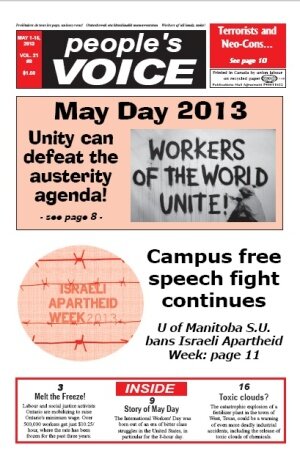
May 1-16, 2013
Volume 21 – Number 8
$1

Prolétaires de tous les pays, unissez-vous!
Otatoskewak ota kitaskinahk mamawestotan!
Workers of all lands, unite

CONTENTS

1) LABOUR AND PEOPLE'S UNITY CAN DEFEAT AUSTERITY

2) MELT THE FREEZE! CAMPAIGN TO RAISE ONTARIO'S MINIMUM WAGE

3) WHICH TRAGEDY? WHOSE BOMBS? - Editorial

4) VIVA VENEZUELA AND MADURO! - Editorial

5) MANITOBA BUDGET HARMS WORKERS

6) CHECHEN TERRORISTS AND THE NEOCONS

7) GHADAR: A CONTINUOUS STRUGGLE

8) THE HISTORY OF MAY DAY

9) MUSIC NOTES, By Wally Brooker


PRINTER FRIENDLY ARTICLES

PEOPLE'S VOICE MAY 1-16, 2013 (pdf)

People’s Voice 2013 Calendar
”Ideas of Revolution”


People's Voice deadlines:

May 16-31
Thursday, May 09

June 1-15
Thursday, May 23

Send submissions to PV Editorial Office,
706 Clark Drive, Vancouver, V5L 3J1, pvoice@telus.net

You can call the editorial office at 604-255-2041


REDS ON THE WEB
http://www.parti-communiste.ca/
peoplesvoice.ca
www.ycl-ljc.ca
www.solidnet.org


People's Voice finds many "Global Class Struggle" reports at the "Labour Start" website, http://www.labourstart.org/. We urge our readers to check it out!


*  *  *  *  *
People's Voice

Canadian Publications Mail Sales Product Agreement #205214
ISSN number 1198-8657
People's Voice is published by
New Labour Press Ltd
  PV Editorial Office
706 Clark Drive,
VANCOUVER, B.C. V5L 3J1
Phone:604-255-2041
Fax:604-254-9803
email:  pvoice@telus.net

Editor: Kimball Cariou : Business Manager: David Au
Editorial Board: Kimball Cariou, Miguel Figueroa,
Doug Meggison, Naomi Rankin, Liz Rowley, Jim Sacouman

* * * * * *
Letters
People's Voice welcomes your letters
on any subject covered in our pages.
We reserve the right to edit for length and clarity,
and to refuse to print letters which may be libellous
or which contain unnecessary personal attacks.
Send your views to:
"Letters to the Editor",
706 Clark Dr., Vancouver, BC V5L 3J1,
or pvoice@telus.net
People's Voice articles may be reprinted without permission,
provided the source is credited.


* * * * * *

The Communist Party of Canada, formed in 1921,
has a proud history of fighting for jobs, equality, peace,
Canadian independence, and socialism.
The CPC does much more than run candidates in elections.
We think the fight against big business and its parties
is a year-round job,
so our members are active across the country,
to build our party and to help strengthen people's movements
on a wide range of issues.

All our policies and leadership
are set democratically by our members.
To find out more about Canada's party of Socialism,
give us a call at the nearest CPC office.

* * * * * *
Central Committee CPC
290A Danforth Ave Toronto, Ont. M4K 1N6
Ph: (416) 469-2446
fax: (416) 469-4063 E-mailmailto:info@cpc-pcp.ca

Parti Communiste du Quebec (section du
Parti communiste du Canada)
5359 Ave du Parc, Montréal, Québec,
H2V 4G9

B.C.Committee CPC
706 Clark Drive, Vancouver, V5L 3J1
Tel: (604) 254-9836
Fax: (604) 254-9803

Edmonton CPC
Box 68112, 70 Bonnie Doon P.O.
Edmonton, AB, T6C 4N6
Tel: (780) 465-7893
Fax: (780)463-0209

Calgary CPC
Unit #1 - 19 Radcliffe Close SE
Calgary  AB, T2A 6B2
Tel: (403) 248-6489

Ottawa CPC
Tel: (613) 232-7108

Manitoba Committee
387 Selkirk Ave., Winnipeg, R2W 2M3
Tel/fax: (204) 586-7824

Ontario Ctee. CPC
290A Danforth Ave., Toronto, M4K 1N6
Tel: (416) 469-2446

Hamilton Ctee. CPC
265 Melvin Ave., Apt. 815
Hamilton, ON.
Tel: (905) 548-9586

Atlantic Region CPC
Box 70 Grand Pré, NS, B0P 1M0
Tel/fax: (902) 542-7981

http://www.parti-communiste.ca/

* * * * * *

News for People, Not for Profits!
Every issue of People's Voice
gives you the latest
on the fightback from coast to coast.
Whether it's the struggle for jobs or peace, resistance to social cuts,
solidarity with Cuba, or workers' struggles around the world,
we've got the news the corporate media won't print.
And we do more than that
- we report and analyze events
from a revolutionary perspective,
helping to build the movements for justice and equality,
and eventually for a socialist Canada.

Read the paper that fights for working people
- on every page, in every issue!

People's Voice
$30 for 1 year
$50 for 2 years
Low-income special rate: $15 for 1-year
Outside Canada $50 for 1 year

Send to: People's Voice, 706 Clark Drive, Vancouver, BC, V5L 3J1
You can call the editorial office at 604-255-2041

REDS ON THE WEB
http://www.parti-communiste.ca/
http://www.ycl-ljc.ca/
http://www.solidnet.org/

(Contents)
(Home)


(The following articles are from the May 1-15, 2013, issue of People's Voice, Canada's leading communist newspaper. Articles can be reprinted free if the source is credited. Subscription rates in Canada: $30/year, or $15 low income rate; for U.S. readers - $45 US per year; other overseas readers - $45 US or $50 CDN per year. Send to People's Voice, c/o PV Business Manager, 706 Clark Drive, Vancouver, BC, V5L 3J1.)


1) LABOUR AND PEOPLE'S UNITY CAN DEFEAT AUSTERITY

May Day 2013 message from the Communist Party of Canada

     On May Day, the International Workers' Day, the Communist Party of Canada extends warmest solidarity to all those in struggle against capitalist austerity and war.

     The systemic crisis of capitalism in Canada and internationally continues to deepen, reflected in ever‑widening social disparity, intensified economic and social attacks against the people, fresh assaults on labour and democratic rights, the further degradation of the national and global environment, and increasing militarism, aggression and war.

     The austerity policies pursued by ruling circles in the leading imperialist states, including Canada, to resuscitate economic activity and profits on the backs of the working class and working people in general, have failed miserably. The economies of the U.S., Europe and Japan ‑ the "tripod" epicentre of this global crisis ‑ remain stagnant or in decline. The crisis and the intense, all‑sided offensive launched by the ruling class are exacting a heavy economic, social, cultural physical, psychological and environmental cost on all humanity.

     The main target of this anti‑social offensive of capital is the working class, especially its organised section, the trade union movement. It is also falls heavily on women, youth and students, indigenous peoples, immigrants and migrants, pensioners and the elderly, peasants and small farmers, the extreme poor and marginalized sections of the people, and on all those reliant on the social functions and services of capitalist states ‑ benefits won through many decades of hard struggle.

     This capitalist offensive is creating an atmosphere of insecurity and desperation among wide sections of the working class and the people, but it is also giving rise to increased resistance.      Labour and mass democratic struggles across Europe have been marked by countless general strikes, mass demonstrations and factory occupations. Millions have come out into the streets of Greece, Spain, Portugal, France, Britain, Italy, Cyprus and elsewhere to demand jobs, decent wages and pensions, to defend labour rights, to insist on the restoration of health, education and other public services, and to denounce the austerity policies dictated by the EU at the behest of European bankers and monopolists.

     The counter‑offensive of labour and people's movements is also growing across Canada. The historic Québec student strike and social struggle which took place in 2012, and the Canada‑wide "Idle No More" protests of Aboriginal peoples and their supporters are particularly significant. These and many other mobilizations in defence of labour, social and equality rights, and the environment, signal a qualitative change in the mood of the working class and its allies to fight back against the austerity agenda of capital and its governments.

     Today, the issue of working class unity has become critical, as the big corporations attempt to pit sections of workers against each other. Even as the ruling class removes any barriers to the mobility of capital and investments, new obstacles are erected against the legal rights of workers to move across borders in search of better employment opportunities. Instead, the Harper Conservatives have dramatically boosted the Temporary Foreign Workers' Program, aiming to provide cheap labour for employers, and keep overall wage levels low. At the same time, right‑wing forces fan the flames of racism, blaming migrants for high unemployment and declining living standards. The enemy of Canadian workers is not our sisters and brothers from other countries, but rather the anti‑worker policies of the federal government and the big corporations. May Day 2013 should see a powerful rejection of this racist divide‑and‑rule capitalist strategy, and a call for unity of all workers ‑ employed and unemployed, organized and unorganized, Aboriginal and non‑Aboriginal, young and old, of all genders and national origins, including migrant workers.

     The shift to the use of temporary, non‑unionized workers, paid minimal wages and benefits, is part of a wider reactionary agenda which the Harper government, and its pro‑corporate counterparts at the provincial and municipal levels, are carrying through on behalf of finance capital. Their goal is to accelerate the accumulation of capital through every conceivable means (privatization, state-restructuring, corporate tax cuts, etc.), and to weaken and suppress working class and popular resistance.

     Lest we forget, the first target of the new Harper majority after the 2011 election was organized labour (CUPW, the Air Canada and CP Rail workers, etc.).

     Harper's "war on labour" in the federal jurisdiction gave a green light to right‑wing provincial and municipal governments to demand that workers yield concessions or face the legislative hammer, such as Ontario's attack on the bargaining rights of teachers.. Since 1982, federal and provincial governments in Canada have passed 199 pieces of legislation to restrict, suspend or deny collective bargaining rights. What is qualitatively new is the speed, ferocity and punitive nature of these legislative attacks.

     At its core, this offensive aims at crippling and ultimately destroying the organized labour movement. The federal passage of C‑377, requiring unions to disclose salaries, time spent on political activities and expenses, was only the beginning. There are now ominous signals that the Harper Conservatives are preparing to impose "right‑to‑work" legislation on all workers under federal jurisdiction.

     From the perspective of the ruling class, the weakening of the trade union movement is the key to reducing the cost of labour‑power, and not only among organized workers. They know that such reductions will put tremendous downward pressure on the wages and incomes of all workers, most of whom have no union protection. Finance capital realizes that the labour movement ‑ because of its size, resources and ability to take job action ‑ is the only social/class force capable of uniting broad sections of the people against its offensive.

     The struggle against rampaging militarism, aggression and war must also be a central focus of the labour and people's fightback. As this May Day approaches, threats of fresh imperialist aggression against Syria, Iran and the DPRK are escalating. We are called upon to oppose this growing war danger, to defend the national sovereignty of all countries, and to condemn the drive to militarization, along with the chauvinist, "anti‑terror" rhetoric used to justify it. This May Day, we express unwavering solidarity with socialist Cuba, the Bolivarian Revolution in Venezuela and with all progressive and anti‑imperialist forces and movements around the world!

     The labour movement is the key to building broad struggles for the rights of all workers, for jobs and improved living standards, in defence of social services and programs, for gender equality, for justice for Aboriginal peoples, for young people's right to an education and a future, for genuine environmental protection, and for a foreign policy based on peace and disarmament.

     But the overall state of labour's fightback has so far been insufficient. More than five years into the current crisis, the CLC under Ken Georgetti (and the leaders of some important unions) have yet to draw the entire labour movement and its social partners together into a broad labour‑community "common front" against austerity. Instead, the CLC is focussing on organizing "political action" conferences to line up labour participation in the NDP's electoral machine for the 2015 general election.

     The Communist Party urges the CLC and its key national affiliates to act now to build the extra‑parliamentary fightback by convening an emergency "labour & people's summit", bringing together the entire trade union movement (including the non‑affiliated labour centrals in Québec) and its social partners ‑ Aboriginal peoples, women, youth & students, peace, environmental and LGBTQ activists, seniors and other mass democratic movements.

     Recent experiences show that it is quite possible to build a stronger labour resistance against the corporate offensive, and to win broad support from community allies. Despite the adverse conditions and subjective weaknesses, many labour and popular movements are becoming ever more vibrant and militant. New forces are coming into the fightback. Militant tactics and coalition‑building can move labour from a defensive posture towards a fighting strategy of mobilizing the entire working class and its allies to block the right‑wing agenda and to move onto the counter‑offensive.

     While situations elsewhere cannot be mechanically replicated in Canada, militant, class struggle trade unionism seen in Greece and other countries should inspire union activists here. A Canada‑wide common front against the corporate/government attack in turn can win wider support for the goal of a labour‑led People's Coalition to unite broad sections of the people's movements, not around a nostalgic return to a "rosy" Keynesian past, but rather around a platform of radical progressive demands, and for a fundamental challenge to the economic and political hegemony of finance capital, both domestic and international.

     As we salute the struggles of workers in all countries on May Day 2013, the Communist Party of Canada is confident the labour and people's unity can defeat austerity and war!

Printer-friendly article

(Contents)

(Home)


2) MELT THE FREEZE! CAMPAIGN TO RAISE ONTARIO'S MINIMUM WAGE

By Jean Kenyon

     Fourteen communities across Ontario took part in a campaign to Raise the Minimum Wage, launched on March 21. The campaign was co‑ordinated by the Workers' Action Centre and supported by eight other grassroots groups including the Toronto and York Region Labour Council.

     Participants rallied at the Ministry of Labour in Toronto, and at MPPs' offices from Sault Ste Marie to Belleville to Windsor. They brought blocks of ice with a $10 bill and a quarter inside, to illustrate their demand to Melt the Freeze! The minimum wage in Ontario has been frozen at $10.25/hr since April 2010, while the cost of living in this expensive province keeps pulling out of reach.

     One in ten workers in Ontario ‑ 534,000 of us ‑ now work for the minimum wage. This is double the number it was ten years ago. If you include workers who earn scarcely above the minimum, the proportion rises to one in six, or about 800,000 workers. Many are trying to scrape together a living with two or three part‑time low‑wage jobs.

     And it isn't only youth who are struggling with abysmally low wages, Armine Yalnizian of Canadian Centre for Policy Alternatives points out. The proportion of older workers among minimum wage earners is steadily increasing.

     A wage of $10.25 at 35 hours per week comes to approximately $1700/month, or $18,000/year. And many low‑wage workers do not even get this many hours.

     Who can live on $1700/month in Ontario today? You are continually choosing between housing, proper food, heat and hydro, a means of transportation, internet and phone bills, clothing and shoes ‑ and that's if you don't have a child to provide for too. Or student debt to pay down. And saving for retirement? A joke.

     Trish Hennessy heads up the new Ontario office of Canadian Centre for Policy Alternatives. She points out that Ontario's minimum wage cannot be considered a living wage. "In Ontario, one in three children who live in low‑income families have at least one parent who is working ‑ meaning work doesn't pay enough to lift them out of poverty. That's the problem with using the minimum wage as the only standard. It limits the conversation to what's the lowest amount we can pay workers that's politically acceptable."

     The Workers' Action Centre states, "The minimum wage should be enough to keep workers out of poverty. It should be benchmarked at 10% above the poverty line." Therefore WAC is calling for a raise to $14/hour.

     For a single person in Ontario today, the poverty line, or "Low Income Measure", is $23,000/year. (That is, half of our society's median income.) This is the income one needs in order not to experience social exclusion because of a lack of things that others take for granted.

     To have breathing room of 10% above the poverty line, a single Ontarian would need to earn $24,500/year. This works out to $14/hr. No full‑time worker in Ontario should earn any less than this, before deductions.

     In a report by Bob White on Corporate Social Responsibility and a Living Wage, he writes, "The living wage is defined as the minimum hourly wage necessary for each of two workers in a family of four to meet basic needs and to participate in the civic/social life of their community." He places a living wage in Canada today at over $16/hr.

     But the trend is now clearly in the opposite direction. Stephen Harper may claim that most new jobs are being created "in industries that pay high wages". But as Armine points out in her article Welcome to the Wageless Recovery! ‑ Harper is pulling a bit of a deception. The construction industry, for example, pays high wages to some highly skilled workers. But that doesn't mean that most of the new jobs created in that industry pay high wages! In fact entry‑level positions are falling further and further behind the average wage in many industries, and wage scales are starting to be ratcheted down. The bottom 40% of the work force has seen a significant erosion of wages, and a loss of hope for the future.

     The trend toward lower wages is made worse by Ontario's starvation‑level social assistance rates. One group supporting the Workers' Action Centre's campaign is called Put Food in the Budget. This group challenges "middle class" Ontarians to try eating on a welfare budget for a week. Spokesperson Lily Baumgartner said, "I'm tired of seeing the government and the media play the poor against each other. Low social assistance rates and low minimum wages are part of one strategy: to keep people in perpetual poverty, to keep them down, so they can easily be exploited by those with power."

     But wouldn't raising the minimum wage cause unemployment? Wouldn't employers stop hiring? Experience does not bear this out, according to Armine Yalnizian. The years when the minimum wage was being steadily raised were also years of strong hiring. And even during the recession, many provinces and territories raised their minimum wages without suffering job loss.

     Better wages at the bottom actually support job growth, she adds, because the lowest‑income people spend all they have back into the economy. Consumer spending drives more than half of our gross domestic product. So bringing the lowest‑paid people up makes the most sense for economic prosperity.

     Just to reach the equivalent value of the minimum wage we had back in the 1970s, we would have to raise it to $11.50/hr immediately. This is recommended by Ontario's biggest anti‑poverty group, 25 in 5. It would give the lowest paid workers an increase of $2500 a year.

     And if the Ontario government's annual 75‑cent increases had continued beyond 2010, we would be reaching $12.50/hr now, in the spring of 2013. That would have been good, but it would still be short of the poverty line for a single person, and far below it for a worker with any dependants.

     We need to get the minimum wage up to at least $14/hr as fast as possible ‑ then see that it is indexed to inflation thereafter.

     The Workers' Action Centre concludes: Ontarians can't wait for another commission to study when the minimum wage should be raised and by how much. We need action now!

     The campaign continues.

Printer-friendly article

(Contents)

(Home)


3) WHICH TRAGEDY? WHOSE BOMBS?

People's Voice Editorial

     Once again, unexpected bomb blasts have killed and wounded large numbers of innocent people, instantly turning a joyous celebration into a scene of terrible carnage. But which city? What event? Whose bombs?

     These are critical questions. Why? Because for every Boston Marathon atrocity committed on U.S. soil, dozens of similar slaughters have been perpetrated elsewhere, most often by the governments and military machines of the U.S., Canada and our NATO allies. For example, a crude form of cluster bomb was used by the accused Boston attackers. But during the Vietnam War, the U.S. Air Force dropped an astronomical 300 million similar bombs. The most "cluster-contaminated" countries include Vietnam, Laos, Cambodia, Afghanistan, Iraq, and the former Yugoslavia.

     The shock and horror felt by North Americans in the wake of the Boston events are normal human reactions. Yet our own governments have inflicted deadly violence across the planet. The anti-war movement, and the people of other countries victimized by such "government terrorism," are increasingly demanding an end to imperialist killings, such as the drone attacks which frequently hit family weddings or village markets.

     Just as in Afghanistan, imperialist support for local reactionary forces can result in terrible "blowback". The article "Chechen terrorists and the Neo-Cons" in this issue reports on the links between the ultra-right in the U.S., and anti-communist forces backed by imperialism in its drive to overthrow socialism. The repercussions of this strategy continue to the present day, quite possibly to the events in Boston.

     Any attempt to limit expressions of sympathy to "our" victims would be utterly hypocritical. We extend our deepest support and solidarity to all victims of terrorism - including those killed by the state terrorism of the NATO countries.

Printer-friendly article

(Contents)

(Home)


4) VIVA VENEZUELA AND MADURO!

People's Voice Editorial

     When is a majority not a majority? Apparently, when Uncle Sam and his toadies say so. That seems to be the lesson from Venezuela, where PSUV candidate Nicolas Maduro received 50.7% of the votes in the April 14 election to succeed the late President Hugo Chavez. Despite the fact that opposition candidate Henrique Capriles received just 49.0% of the total, the numbers don't seem to matter in Washington, which continues to whine about the results.

     To remove any doubts, President Maduro agreed to expand the audit of the ballot boxes to a full 100%. The North American corporate media has remained silent on the fact that on election night, after the end of the electronic voting, at least half of the ballot boxes at each polling station were opened and counted in the presence of both Maduro and Capriles supporters. This process matched the initial electronic results, as will the audit of the remaining 46% of ballot boxes. But the pro-Yankee opposition don't care about the real numbers. Their aim is to spread confusion, setting the stage for further attempts to destabilize Venezuela, even a U.S.-backed coup. Canadians who care about democracy and social justice need to mobilize against this threat.

     Yes, the April 14 result was closer than the revolutionary forces in Venezuela would have preferred, and clearly they face challenges in the coming years. But the PSUV and its allies do have majority support for their policies - unlike Stephen Harper's Tories, who have never received 40% backing in a Canadian election.      Instead of attacking Venezuela, our federal government should look at borrowing some chavista policies. Public ownership of energy, for example, could help expand social programs, and put many of Canada's 2 million jobless back to work. Sadly, Mr. Harper speaks only for the corporations, not the people - the opposite of President Maduro.

Printer-friendly article

(Contents)

(Home)


5) MANITOBA BUDGET HARMS WORKERS

By Darrell Rankin

     Dealing a blow to workers and the poor, the Manitoba NDP raised the provincial sales tax from seven to eight percent in its April 16 budget. Take‑home pay is taking another hit, reinforcing Manitoba's status as a low‑wage province.

     The wealthy elite will barely notice the PST hike. However, workers will have less for the necessities of life. This is a wage cut by other, indirect means ‑ about $300 a year per family. Before-tax wages in Manitoba were $3,500 (or 8 percent) below the country's annual average in 2012.

     The budget follows the model of pro‑corporate governments around the world, making cuts that harm workers and the needy and protecting the corporations and the wealthy. Impoverishing workers prolongs and deepens the economic crisis that has gripped global capitalism since 2008.

     In one sense, it is a standard Canadian Prairie provincial budget with no grand vision or hope for a fair society. It is blind to inequality, the wholesale robbery of Aboriginal peoples, the inequality of women and the growing climate catastrophe. Good-paying jobs, higher education and child care will continue to be just a crushed dream for many.

     Without any factual basis, Manitoba NDP Finance Minister Stan Struthers claims that the PST hike will be "shared by everyone." Struthers emphasizes the need for urgent flood protection spending, but most new spending is for overdue maintenance and an aging population's needs.

     Needed spending has been delayed for decades as a way to keep public spending low and give Manitoba a "competitive advantage," but there is a limit to how long our infrastructure will last. No doubt, the Manitoba NDP tax hike was urged by local corporate leaders.

     There is no other reason why workers and the poor are facing this new burden. And unlike the two‑year "wage pause" announced in the 2010 provincial budget that continues to rob public sector workers of hundreds of millions of dollars, this tax hike hurts all workers.

     Labour and other groups are condemning the budget for promoting inequality and failing to reduce poverty. For example, the Progressive Conservative and Liberal opposition parties both endorsed an anti‑poverty campaign pledge to raise the welfare housing allowance to 75 percent of market value, weeks before the budget.

     The budget raised the housing allowance by a paltry $20 a month, far below the required amount of $100 to meet the anti-poverty coalition demands. This is the first real increase in the allowance since 1992.

     A relatively small sum of $19 million would solve the housing allowance demand, something the NDP might do before the 2015 election. It will take far more significant measures to eliminate poverty, create good‑paying jobs and grow the economy than this minor reform.

     The Manitoba Federation of Labour is pointing out that the NDP has cut $1 billion in personal and corporate taxes since it was elected in 1999. These tax cuts helped the corporate elite. They also helped create a weaker and more unequal economy.

     Taxes must shift to a progressive basis, on ability to pay. An inheritance tax on large estates would also go a long way to boost revenue for needed public spending and reduce social inequality.

     Working people and the poor are being told by the Manitoba NDP that they must pay more to solve the crisis. It's like the NDP has no memory how Canada's economy grew faster and more people had better paying jobs when the wealthy and the corporations paid higher taxes.

     The NDP is pushing the line that taxes are "good" regardless who pays them because we need medicare and roads, but the NDP "overlooks" the main reality. Today's tax hikes and spending cuts are impoverishing workers. They protect the greedy, not the needy.

     The Manitoba NDP is creating a new, cruel reality just like other pro‑corporate governments.

     Darrell Rankin is the leader of the Communist Party of Canada ‑ Manitoba

Printer-friendly article

(Contents)

(Home)


6) CHECHEN TERRORISTS AND THE NEOCONS

Coleen Rowley, April 19, 2013, Consortiumnews

     The revelation that the family of the two suspects in the Boston Marathon bombings was from Chechnya prompted new speculation about the attack as Islamic terrorism. Less discussed was the history of U.S. neocons supporting Chechen terrorists as a strategy to weaken Russia.

      I almost choked on my coffee listening to neoconservative Rudy Giuliani pompously claim on national TV that he was surprised about any Chechens being responsible for the Boston Marathon bombings because he's never seen any indication that Chechen extremists harboured animosity toward the U.S.; Giuliani thought they were only focused on Russia.

     Giuliani knows full well how the Chechen "terrorists" proved useful to the U.S. in keeping pressure on the Russians, much as the Afghan mujahedeen were used in the anti‑Soviet war in Afghanistan from 1980 to 1989. In fact, many neocons signed up as Chechnya's "friends," including former CIA Director James Woolsey.

     For instance, see this 2004 article in the UK Guardian, entitled, "The Chechens' American friends: The Washington neocons" commitment to the war on terror evaporates in Chechnya, whose cause they have made their own."

     Author John Laughland wrote: "the leading group which pleads the Chechen cause is the American Committee for Peace in Chechnya (ACPC). The list of the self‑styled "distinguished Americans" who are its members is a roll call of the most prominent neoconservatives who so enthusiastically support the "war on terror."

     "They include Richard Perle, the notorious Pentagon adviser; Elliott Abrams of Iran‑Contra fame; Kenneth Adelman, the former US ambassador to the UN who egged on the invasion of Iraq by predicting it would be "a cakewalk"; Midge Decter, biographer of Donald Rumsfeld and a director of the right-wing Heritage Foundation; Frank Gaffney of the militarist Centre for Security Policy; Bruce Jackson, former US military intelligence officer and one‑time vice‑president of Lockheed Martin, now president of the US Committee on Nato; Michael Ledeen of the American Enterprise Institute, a former admirer of Italian fascism and now a leading proponent of regime change in Iran; and R. James Woolsey, the former CIA director who is one of the leading cheerleaders behind George Bush's plans to re‑model the Muslim world along pro‑US lines."

     The ACPC later sanitized "Chechnya" to "Caucasus" so it's rebranded itself as the "American Committee for Peace in the Caucasus."

     Of course, Giuliani also just happens to be one of several neocons and corrupt politicians who took hundreds of thousands of dollars from MEK sources when that Iranian group was listed by the U.S. State Department as a Foreign Terrorist Organization (FTO). The money paid for these American politicians to lobby (illegally under the Patriot Act) U.S. officials to get MEK off the FTO list.

Down the Rabbit Hole

     Alice in Wonderland is an understatement if you understand the full reality of what's going on. But if you can handle going down the rabbit hole even further, check out prominent former New York Times journalist (and author of The Commission book) Phil Shenon's discovery of the incredible "Terrible Missed Chance" a couple of years ago.

     Shenon's discovery involved key information that the FBI and the entire "intelligence" community mishandled and covered up, not only before 9/11 but for a decade afterward. And it also related to the exact point of my 2002 "whistleblower memo" that led to the post 9/11 DOJ‑Inspector General investigation about FBI failures and also partially helped launch the 9/11 Commission investigation.

     But still the full truth did not come out, even after Shenon's blockbuster discovery in 2011 of the April 2001 memo linking the main Chechen leader Ibn al Khattab to Osama bin Laden. The buried April 2001 memo had been addressed to FBI Director Louis Freeh (another illegal recipient of MEK money, by the way!) and also to eight of the FBI's top counter‑terrorism officials.

     Similar memos must have been widely shared with all U.S. intelligence in April 2001. Within days of terrorist suspect Zaccarias Moussaoui's arrest in Minnesota on Aug. 16, 2001, French intelligence confirmed that Moussaoui had been fighting under and recruiting for Ibn al‑Khattab, raising concerns about Moussaoui's flight training.

     Yet FBI Headquarters officials balked at allowing a search of his laptop and other property, still refusing to recognize that: 1) the Chechen separatists were themselves a "terrorist group" for purposes of the Foreign Intelligence Surveillance Act's (FISA) legal requirement of acting "on behalf of a foreign power" and 2) that Moussaoui's link to Ibn al Khattab inherently then linked him to bin Laden's well‑recognized Al Qaeda group for purposes of FISA (the point in my memo).

     This all occurred during the same time that CIA Director George Tenet and other counter‑terrorism officials - and don't forget that Tenet was apprised of the information about Moussaoui's arrest around Aug. 24, 2001 - told us their "hair was on fire" over the prospect of a major terrorist attack and "the system was blinking red."

     The post 9/11 investigations launched as a result of my 2002 "whistleblower memo" did conclude that a major mistake, which could have prevented or reduced 9/11, was the lack of recognition of al Khattab's Chechen fighters as a "terrorist group" for purposes of FISA.

     As far as I know, the several top FBI officials, who were the named recipients of the April 2001 intelligence memo entitled "Bin Laden/Ibn Khattab Threat Reporting" establishing how the two leaders were "heavily entwined," brushed it off by mostly denying they had read the April 2001 memo (which explains why the memo had to be covered up as they attempted to cover up other embarrassing info).

     There are other theories, of course, as to why U.S. officials could not understand or grasp this "terrorist link." These involve the U.S.'s constant operating of "friendly terrorists," perhaps even al Khattab himself (and/or those around him), on and off, opportunistically, for periods of time to go against "enemy" nations, i.e., the Soviet Union, and regimes we don't like.

Shifting Lines

     But officials can get confused when their former covert "assets" turn into enemies themselves. That's what has happened with al‑Qaeda‑linked jihadists in Libya and Syria, fighters who the U.S. government favoured in their efforts to topple the Qaddafi and Assad regimes, respectively. These extremists are prone to turn against their American arms suppliers and handlers once the common enemy is defeated.

     The same MO exists with the U.S. and Israel currently collaborating with the Iranian MEK terrorists who have committed assassinations inside Iran. The U.S. government has recently shifted the MEK terrorists from the ranks of "bad" to "good" terrorists as part of a broader campaign to undermine the Iranian government. For details, see "Our (New) Terrorists, the MEK: Have We Seen This Movie Before?"

     Giuliani and his ilk engage, behind the scenes, in all these insidious operations but then blithely turn to the cameras to spew their hypocritical propaganda fueling the counterproductive "war on terror" for public consumption, when that serves their interests. Maybe this explains Giuliani's amazement (or feigned ignorance) on Friday morning after the discovery that the family of the alleged Boston Marathon bombers was from Chechnya.

     My observations are not meant to be a direct comment about the motivations of the two Boston bombing suspects whose thinking remains unclear. It's still very premature and counterproductive to speculate on their motives.

     But the lies and disinformation that go into the confusing and ever‑morphing notion of "terrorism" result from the U.S. Military Industrial Complex (and its little brother, the "National Security Surveillance Complex") and their need to control the mainstream media's framing of the story.

     So, a simplistic narrative/myth is put forth to sustain U.S. wars. From time to time, those details need to be reworked and some of the facts "forgotten" to maintain the storyline about bad terrorists "who hate the U.S." when, in reality, the U.S. Government may have nurtured the same forces as "freedom fighters" against various "enemies."

     The bottom line is to never forget that "a poor man's war is terrorism while a rich man's terrorism is war" - and sometimes those lines cross for the purposes of big‑power politics. War and terrorism seem to work in sync that way.

     Coleen Rowley is a retired FBI agent and former chief division counsel in Minneapolis. She's now a dedicated peace and justice activist and board member of the Women Against Military Madness.

Printer-friendly article

(Contents)

(Home)


7) GHADAR: A CONTINUOUS STRUGGLE

By Gurpreet Singh

     As the Indian Diaspora celebrates the centenary of the Ghadar Party this year, many observers have mainly focused on its role in India's independence from the British Empire, overlooking the party's contribution to mass movements in the post‑independent period.

     India gained independence from the British rule in 1947, following years of struggles by both the passive resistance movement and armed insurgents. The Ghadar Party was among the groups that believed in violence to rid India of foreign occupation. The word ``Ghadar'' means mutiny in Urdu, and the British rulers referred to the first organized act of rebellion in 1857 as the "Ghadar" which was suppressed. When Indian immigrants on the Pacific coast of the US and Canada formed the Hind Pacific Association in 1913 to seek independence, they chose to rename their first newsletter after Ghadar.

     The new Ghadar Party came into being after ugly experiences of systematic racism and discrimination suffered by the Indian migrants from the white supremacy in both countries. Most of these men came to Canada as British subjects, as Canada like India was a British colony. Many had actually served in the British army, but this did not help them in an alien land. Never did the British government come to the rescue of these people when they complained against racial discrimination. They were not allowed to bring their families to Canada, and were disfranchised in 1907. This alienation laid the foundation of the Ghadar Party that fought against social injustices in a foreign land, and foreign occupation back home. Most of these men returned to India to organize an uprising, only to face gallows or life imprisonment, while others went underground to continue resistance.

     Since the contributions of the Ghadar movement have largely been obscured in the mainstream history books, several myths have formed. One of the most popular mythologies says the party failed in its mission, primarily because the Ghadar Party's identity as a continuous struggle has been completely misunderstood.

     First, let's face it that the party did not achieve what it intended through an armed rebellion. That their strategy did not work is one thing, but to suggest that the movement failed is not correct. Their strategy failed as the people of India were not prepared for mutiny. The mainstream  political leadership either believed in passive resistance, or was pro‑British. Despite such a bitter experience, these men did not give up. Some became  members of the latter armed struggles like the Babbar Akali movement, a group seeking freedom of Sikh temples from the corrupt and pro‑British priest class. Others joined the communist movement.

     In post‑independence India they continued their fight against state repression and injustices. Among them was Mangu Ram Muggowal, who launched a movement against the caste‑based oppression of untouchability, a form of physical mistreatment practised against the so‑called low caste people. Muggowal launched his movement before independence, and continued it after the British left India. Likewise, Boojha Singh became a member of the ultra‑leftist Naxalite movement of the landless tillers, and died at the hands of the Indian police. So the movement's influence on other mass struggles continued after independence.

     Other militant movements prior to 1947 were also greatly inspired by the Ghadar activists. For instance Bhagat Singh, a towering revolutionary leader who was hanged by the British in 1931, considered Kartar Singh Sarabha, one of the founders of the Ghadar Party as his role model.

     Even before the Ghadar Party came into being, the Indian immigrants in London had celebrated the 50th anniversary of the first mutiny of 1857, despite opposition from the British government and the white supremacists. They openly honoured the participants of the first mutiny. Nor was the Ghadar of 1857 the first act of resistance against colonization, as many earlier anti‑British skirmishes took place in different parts of India.

     All this suggests that the struggle is a continuous process. The Ghadar was not limited by boundaries of time and place. The challenges that gave birth to the Ghadar Party in 1913 are still there, both in India and Canada. The ongoing social and political injustices, like casteism, uneven development, imperialism, racism and discriminatory immigration policies, will never be able to shut the door to a Ghadar-like uprising.

Printer-friendly article

(Contents)

(Home)


8) THE HISTORY OF MAY DAY

Excerpts from "The History of May Day," by Alexander Trachtenberg, International Pamphlets, 1932, available online at www.marxists.org.

The Fight for the Shorter Workday

     The origin of May Day is indissolubly bound up with the struggle for the shorter workday ‑ a demand of major political significance for the working class. This struggle is manifest almost from the beginning of the factory system in the United States.

     ...Already at the opening of the 19th century workers in the United States made known their grievances against working from "sunrise to sunset," the then prevailing workday. Fourteen, sixteen and even eighteen hours a day were not uncommon. During the conspiracy trial against the leaders of striking cordwainers in 1806, it was brought out that workers were employed as long as nineteen and twenty hours a day.

     The twenties and thirties are replete with strikes for reduction of hours of work and definite demands for a 10‑hour day were put forward in many industrial centers. The organization of what is considered as the first trade union in the world, the Mechanics' Union of Philadelphia, preceding by two years the one formed by workers in England, can be definitely ascribed to a strike of building trade workers in Philadelphia in 1827 for the 10‑hour day. During the bakers' strike in New York in 1834 the Workingmen's Advocate reported that "journeymen employed in the loaf bread business have for years been suffering worse than Egyptian bondage. They have had to labor on an average of eighteen to twenty hours out of the twenty‑four."

     The demand in those localities for a 10‑hour day soon grew into a movement, which, although impeded by the crisis of 1837, led the federal government under President Van Buren to decree the 10‑hour day for all those employed on government work. The struggle for the universality of the 10‑hour day, however, continued during the next decades. No sooner had this demand been secured in a number of industries than the workers began to raise the slogan for an 8‑hour day. The feverish activity in organizing labor unions during the fifties gave this new demand an impetus which, however, was checked by the crisis of 1857. The demand was, however, won in a few well‑organized trades before the crisis. That the movement for a shorter workday was not only peculiar to the United States, but was prevalent wherever workers were exploited under the rising capitalist system, can be seen from the fact that even in far away Australia the building trade workers raised the slogan "8 hours work, 8 hours demand in recreation and 8 hours rest" and were successful in securing this by 1856...

     The 8‑hour day movement which directly gave birth to May Day, must, however, be traced to the general movement initiated in the United States in 1884....

     Although the decade 1880‑1890 was generally one of the most active in the development of American industry and the extension of the home market, the year 1883‑1885 experienced a depression which was a cyclical depression following the crisis of 1873. The movement for a shorter workday received added impetus from the unemployment and the great suffering which prevailed during that period, just as at the present time the demand for a 7‑hour day is becoming a popular issue on account of the tremendous unemployment which American workers are experiencing.

     The great strike struggles of 1877, in which tens of thousands of railroad and steel workers militantly fought against the corporations and the government which sent troops to suppress the strikes, left an impress on the whole labor movement. It was the first great mass action of the American working class on a national scale and, although they were defeated by the combined forces of the State and capital, the American workers emerged from these struggles with a clearer understanding of their class position in society, a greater militancy and a heightened morale. It was in part an answer to the coal barons of Pennsylvania who, in their attempt to destroy the miners' organization in the anthracite region, railroaded ten militant miners (Molly Maguires) to the gallows in 1875.

     The Federation [American Federation of Labour], just organized, saw the possibility of utilizing the slogan of the 8‑hour day as a rallying organization slogan among the great masses of workers who were outside of the Federation and the Knights of Labor, an older and then still growing organization. The Federation appealed to the Knights of Labor for support in the movement for the 8‑hour day, realizing that only a general action involving all organized labor could make possible favourable results.

     At the convention of the Federation in 1885, the resolution on the walk‑out for May First of the following year was reiterated and several national unions took action to prepare for the struggle, among them particularly the Carpenters and Cigar Makers. The agitation for the May First action for the 8‑hour day showed immediate results in the growth of membership of the existing unions. The Knights of Labor grew by leaps and bounds, reaching the apex of its growth in 1886. It is reported that the R. of L., which was better known than the Federation and was considered a fighting organization, increased its membership from 200,000 to nearly 700,000 during that period. The Federation, first to inaugurate the movement and definitely to set a date for the strike for the 8‑hour day, also grew in numbers and particularly in prestige among the broad masses of the workers. As the day of the strike was approaching and it was becoming evident that the leadership of the K. of L., especially Terrence Powderly, were sabotaging the movement and even secretly advising its unions not to strike, the popularity of the Federation was still more enhanced. The rank and file of both organizations were enthusiastically preparing for the struggle. Eight‑hour day leagues and associations sprang up in various cities and an elevated spirit of militancy was felt throughout the labor movement, which was infecting masses of unorganized workers.

The Strike Movement Spreads

     The best way to learn the mood of the workers is to study the extent and seriousness of their struggles. The number of strikes during a given period is a good indicator of the fighting mood of the workers. The number of strikes during 1885 and 1886 as compared with previous years shows what a spirit of militancy was animating the labor movement. Not only were the workers preparing for action on May First, 1886, but in 1885 the number of strikes already showed an appreciable increase. During the years 1881‑1884 the number of strikes and lockouts averaged less than 500, and on the average involved only about 150,000 workers a year. The strikes and lockouts in 1885 increased to about 700 and the number of workers involved jumped to 250,000. In 1886 the number of strikes more than doubled over 1885, attaining to as many as 1,572, with a proportional increase in the number of workers affected, now 600,000. How widespread the strike movement became in 1886 can be seen from the fact that while in 1885 there were only 2,467 establishments affected by strikes, the number involved in the following year had increased to 11,562. In spite of open sabotage by the leadership of the K. of L., it was estimated that over 500,000 workers were directly involved in strikes for the 8‑hour day.

     The strike center was Chicago, where the strike movement was most widespread, but many other cities were involved in the struggle on May First. New York, Baltimore, Washington, Milwaukee, Cincinnati, St. Louis, Pittsburgh, Detroit, and many other cities made a good showing in the walkout. The characteristic feature of the strike movement was that the unskilled and unorganized workers were drawn into the struggle, and that sympathetic strikes were quite prevalent during that period. A rebellious spirit was abroad in the land, and bourgeois historians speak of the "social war" and "hatred for capital" which was manifested during these strikes, and of the enthusiasm of the rank and file which pervaded the movement. It is estimated that about half of the number of workers who struck on May First were successful, and where they did not secure the 8‑hour day, they succeeded in appreciably reducing the hours of labor.

The Chicago Strike and Haymarket

     The May First strike was most aggressive in Chicago, which was at that time the center of a militant Left‑wing labor movement. Although insufficiently clear politically on a number of the problems of the labor movement, it was nevertheless a fighting movement, always ready to call the workers to action, develop their fighting spirit and set as their goal not only the immediate improvement of their living and working conditions, but the abolition of the capitalist system as well.

     With the aid of the revolutionary labor groups the strike in Chicago assumed the largest proportions. An 8‑hour Association was formed long in advance of the strike to prepare for it. The Central Labor Union, composed of the Left‑wing labor unions, gave full support to the 8‑hour Association, which was a united front organization, including the unions affiliated to the Federation, the K. of L., and the Socialist Labor Party. On the Sunday before May First the Central Labor Union organized a mobilization demonstration which was attended by 25,000 workers.

     On May First Chicago witnessed a great outpouring of workers, who laid down tools at the call of the organized labor movement of the city. It was the most effective demonstration of class solidarity yet experienced by the labor movement itself. The importance at that time of the demand ‑ the 8‑hour day ‑ and the extent and character of the strike gave the movement significant political meaning. This significance was deepened by the developments of the next few days. The 8‑hour movement, culminating in the strike on May First, 1886, forms by itself a glorious chapter in the fighting history of the American working class.

     But revolutions have their counter‑revolutions until the revolutionary class finally establishes its complete control. The victorious march of the Chicago workers was arrested by the then superior combined force of the employers and the capitalist state, determined to destroy the militant leaders, hoping thereby to deal a deadly blow to the entire labor movement of Chicago. The events of May 3 and 4, which led to what is known as the Haymarket Affair, were a direct outgrowth of the May First strike. The demonstration held on May 4 at Haymarket Square was called to protest against the brutal attack of the police upon a meeting of striking workers at the McCormick Reaper Works on May 3, where six workers were killed and many wounded. The meeting was peaceful and about to be adjourned when the police again launched an attack upon the assembled workers. A bomb was thrown into the crowd, killing a sergeant. A battle ensued with the result that seven policemen and four workers were dead. The blood bath at Haymarket Square, the railroading to the gallows of Parsons, Spies, Fischer, and Engel, and the imprisonment of the other militant Chicago leaders, was the counterrevolutionary answer of the Chicago bosses. It was the signal for action to the bosses all over the country. The second half of 1886 was marked by a concentrated offensive of the employers, determined to regain the position lost during the strike movement of 1885‑1886.

     One year after the hanging of the Chicago labor leaders, the American Federation of Labor, at its convention in St. Louis in 1888, voted to rejuvenate the movement for the 8‑hour day. May First, which was already a tradition, having served two years before as the concentration point of the powerful movement of the workers based upon a political class issue, was again chosen as the day upon which to re‑inaugurate the struggle for the 8‑hour day. May First, 1890, was to witness a nation‑wide strike for the shorter workday...

     On July 14, 1889, the hundredth anniversary of the fall of the Bastille, there assembled in Paris leaders from organized revolutionary proletarian movements of many lands, to form once more an international organization of workers, patterned after the one formed 25 years earlier by their great teacher, Karl Marx.

     Those assembled at the foundation meeting of what was to become the Second International heard from the American delegates about the struggle in America for the 8‑hour day during 1884‑1886, and the recent rejuvenation of the movement. Inspired by the example of the American workers, the Paris Congress adopted the following resolution:

     "The Congress decides to organize a great international demonstration, so that in all countries and in all cities on one appointed day the toiling masses shall demand of the state authorities the legal reduction of the working day to eight hours, as well as the carrying out of other decisions of the Paris Congress. Since a similar demonstration has already been decided upon for May 1, 1890, by the American Federation of Labor at its Convention in St. Louis, December, 1888, this day is accepted for the international demonstration. The workers of the various countries must organize this demonstration according to conditions prevailing in each country."

     ...May Day, 1890, was celebrated in many European countries, and in the United States the Carpenters' Union and other building trades entered into a general strike for the 8‑hour day. Despite the Exception Laws against the Socialists, workers in the various German industrial cities celebrated May Day, which was marked by fierce struggles with the police. Similarly in other European capitals demonstrations were held, although the authorities warned against them and the police tried to suppress them. In the United States, the Chicago and New York demonstrations were of particularly great significance. Many thousands paraded the streets in support of the 8‑hour day demand; and the demonstrations were closed with great open air mass meetings at central points.

Printer-friendly article

(Contents)

(Home)


9) MUSIC NOTES, By Wally Brooker

The indomitable Anne Feeney

Several years ago Music Notes carried a story about U.S. labour singer Anne Feeney, who'd just been diagnosed with lung cancer. The odds were against her survival, but medical statistics were unable to factor in the Pittsburgh native's indomitable fighting spirit. While illness has reduced her ability to perform, this summer Feeney will be singing with the Summer of Solidarity Tour (a roving band of U.S. musicians out to support striking workers and union organizing drives), and the "Almanac Singers Tour" (in the footsteps of that historic band's 1941 tour). She'll also appear at the Northern Lights Festival Boreal in Sudbury. In 2010 Feeney headlined a Detroit solidarity concert that raised $2500 for striking Sudbury miners of USW Local 6500. If you don't know Feeney's work her popular song "War on the Workers" is a great place to start. Look it up on YouTube. Then buy an album or make a PayPal donation to help make up for the income she's lost to illness. For more info: http://annefeeney.com/.

Progressive choirs in the U.K.

Canadian choirs with a radical‑progressive orientation might consider establishing links with their counterparts in the U.K. Take Raised Voices for example, a socialist choir based in north London. It sings for peace, justice, environmental sustainability, and against capitalism, racism and sexism. Raised Voices also participates in U.K. campaigns against Canada's tar sands ‑ something that clearly invites a response from our side of the pond. A spokesperson recently told Music Notes that they is interested in sharing songs with Canadian choirs. As my contribution, I suggested David Francey's contemporary classic "Torn Screen Door." To send a song suggestion and view a video of Raised Voices at a recent action against healthcare cuts visit www.raised‑voices.org.uk. For a list of radical choirs in the U.K. visit the Workers' Music Association, a venerable cultural organization with a wealth of resources: www.wmamusic.org.uk/.

Local 1000 at Folk Alliance 2013

A highlight of the Folk Alliance International (FAI) conference in Toronto last February was a concert presented by American Federation of Musicians Local 1000. The AFM represents many musicians in the USA and Canada, but Local 1000, founded in 1996, is unique. Unlike other AFM chapters, Local 1000 (a.k.a. the North American Travelling Musicians Union) is not based upon geography. The vast majority of its members are, apparently, progressive‑minded activist folk musicians. The achievements of Local 1000 were enumerated at the FAI convention by President Tret Fure. Most notable are pensions and health insurance ‑ benefits that labour activist musicians have always dreamed about. Local 1000's convention showcase, ably hosted by Canadian VP and Toronto roots music luminary Ken Whiteley, demonstrated the spirit, talent and commitment of dozens of its members. If you're a progressive musician why not consider joining? For info: www.local1000.com.

A gala tribute to Marcelo Puente

Toronto's Lula Lounge was packed on March 17th as dozens of musicians from the city's Latin American community and beyond paid homage to Marcelo Puente, one of the outstanding exponents of the "nueva cancion" tradition in this (or any) country.  Marcelo Puente came to Toronto in the aftermath of the coup in Chile in 1973, bringing his songs and poetry. In the late seventies he co‑founded the popular Chilean‑Greek band Los Compañeros, a group of anti‑fascist exiles who discovered a common musical language, and who have, after a period of inactivity, returned to the bandstand. Earlier this year Puente suffered a career‑threatening injury. Long‑time bandmate and friend Juan Opitz quickly rose to the occasion and organized the well‑earned tribute at the popular nightclub, with old musical friends like Proyecto Altiplano, El Fernan, Ismael Duran, Nancy White and Heather Chetwynd. The homage concluded with an emotional performance by Los Compañeros, with Puente singing his popular song of exile "Mis Amigos del Bar." Check out YouTube for concert clips. For more info: http://companeros‑group‑international.com/.

Radical street bands to meet in Toronto

Radical street bands from across North America will gather in Toronto August 23‑25 for BAM! 2013 (Bands Agitate & Mobilize Convergence). Invited bands from Milwaukee, Seattle, Montreal, Minneapolis, New York, Oakland and elsewhere are all active in anti‑capitalist community struggles. In Toronto they'll discuss strategy and share skills. The host band is Toronto's Rhythms of Resistance, itself part of an international movement of street bands, and also a militant and highly‑respected presence at local mobilizations. Organizers of BAM! are fundraising to meet travel expenses and other costs, expected to be in the range of $25,000. Individuals and organizations interested in helping out can make cheques payable to Rhythms of Resistance Toronto (with BAM! 2013 in the notes line) and send them to Rhythms of Resistance Toronto, c/o Katelyn Blascik, 1269 Davenport Rd., Toronto, ON M6H 2H2. For more info: http://rortoronto.wordpress.com/.

Printer-friendly article

(Contents)

(Home)