|
|
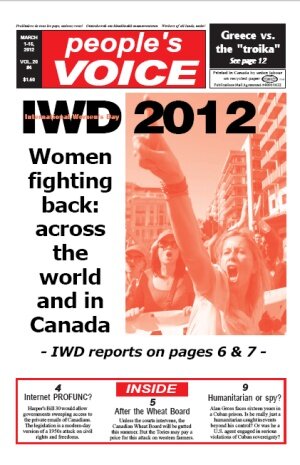
March 1-15, 2012
Volume 19 - Number 4
$1
Prolétaires de tous les pays, unissez-vous!
Otatoskewak ota kitaskinahk mamawestotan!
Workers of all lands, unite
1) IWD 2012 GREETINGS FROM THE COMMUNIST PARTY OF CANADA
2) THE HARPER MAJORITY VS. WOMEN'S EQUALITY
3) EDUCATION COSTS PUT HEAVIER BURDEN ON WOMEN
4) ONTARIO COMMUNISTS SAY "NO" TO DRUMMOND CUTS
5) STUDENT ACTIONS A STEP AHEAD, BUT NOT ENOUGH
6) BILL 30: PROFUNC REVISITED? - Editorial
7) GREETINGS FOR IWD 2012 - Editorial
8) FARMERS, THE WHEAT BOARD, AND DEFEATING HARPER
9) YINKA DENE ASK CHINA TO RAISE HUMAN RIGHTS
10) UNITE TO STOP THE GROWING WAR AGAINST SYRIA
11) DOMESTIC WORKERS WIN NEW LABOUR STANDARDS
12) USAID CONTRACTOR ENGAGED IN ANTI-CUBA ESPIONAGE
13) GREEKS PROTEST DESPITE POLICE REPRESSION
14) MUSIC NOTES, by Wally Brooker
15) ICAP AWARDS FRIENDSHIP MEDAL TO LIZ HILL
16) PV FUND DRIVE: YOU NEED US.... AND WE NEED YOU!
17) WHAT’S LEFT
18) CLARTÉ (en français)
19) THE SPARK! (Theoretical and Discussion Bulletin of the Communist Party of Canada)
20) INTRODUCING MARX
PEOPLE'S VOICE MARCH 1-15, 2012 (pdf)
|
People's Voice deadlines: March 16-31 April 1-15 Send submissions to PV Editorial Office,
|
|
REDS ON THE WEB |
|
People's Voice finds many "Global Class Struggle" reports at the "Labour Start" website, http://www.labourstart.org/. We urge our readers to check it out! |
* * * * *
People's Voice
Canadian Publications Mail Sales Product Agreement #205214
ISSN number 1198-8657
People's Voice is published by
New Labour Press Ltd
PV Editorial Office
706 Clark Drive,
VANCOUVER, B.C. V5L 3J1
Phone:604-255-2041
Fax:604-254-9803
email: pvoice@telus.net
Editor: Kimball Cariou : Business Manager: Sam Hammond
Editorial Board: Kimball Cariou, Miguel Figueroa,
Doug Meggison, Naomi Rankin, Liz Rowley, Jim Sacouman
* * * * * *
Letters
People's Voice welcomes your letters
on any subject covered in our pages.
We reserve the right to edit for length and clarity,
and to refuse to print letters which may be libellous
or which contain unnecessary personal attacks.
Send your views to:
"Letters to the Editor",
706 Clark Dr., Vancouver, BC V5L 3J1,
or pvoice@telus.net
People's Voice articles may be reprinted without permission,
provided the source is credited.
* * * * * *
The Communist Party of Canada, formed in 1921,
has a proud history of fighting for jobs, equality, peace,
Canadian independence, and socialism.
The CPC does much more than run candidates in elections.
We think the fight against big business and its parties
is a year-round job,
so our members are active across the country,
to build our party and to help strengthen people's movements
on a wide range of issues.
All our policies and leadership
are set democratically by our members.
To find out more about Canada's party of Socialism,
give us a call at the nearest CPC office.
* * * * * *
Central Committee CPC
290A Danforth Ave Toronto, Ont. M4K 1N6
Ph: (416) 469-2446
fax: (416) 469-4063 E-mailmailto:info@cpc-pcp.ca
Parti Communiste du Quebec (section du
Parti communiste du Canada)
5359 Ave du Parc, Montréal, Québec,
H2V 4G9
B.C.Committee CPC
706 Clark Drive, Vancouver, V5L 3J1
Tel: (604) 254-9836
Fax: (604) 254-9803
Edmonton CPC
Box 68112, 70 Bonnie Doon P.O.
Edmonton, AB, T6C 4N6
Tel: (780) 465-7893
Fax: (780)463-0209
Calgary CPC
Unit #1 - 19 Radcliffe Close SE
Calgary AB, T2A 6B2
Tel: (403) 248-6489
Ottawa CPC
Tel: (613) 232-7108
Manitoba Committee
387 Selkirk Ave., Winnipeg, R2W 2M3
Tel/fax: (204) 586-7824
Ontario Ctee. CPC
290A Danforth Ave., Toronto, M4K 1N6
Tel: (416) 469-2446
Hamilton Ctee. CPC
265 Melvin Ave., Apt. 815
Hamilton, ON.
Tel: (905) 548-9586
Atlantic Region CPC
Box 70 Grand Pré, NS, B0P 1M0
Tel/fax: (902) 542-7981
http://www.communist-party.ca/
* * * * * *
News for People, Not for Profits!
Every issue of People's Voice
gives you the latest
on the fightback from coast to coast.
Whether it's the struggle for jobs or peace, resistance to social cuts,
solidarity with Cuba, or workers' struggles around the world,
we've got the news the corporate media won't print.
And we do more than that
- we report and analyze events
from a revolutionary perspective,
helping to build the movements for justice and equality,
and eventually for a socialist Canada.
Read the paper that fights for working people
- on every page, in every issue!
People's Voice
$30 for 1 year
$50 for 2 years
Low-income special rate: $15 for 1-year
Outside Canada $50 for 1 year
Send to: People's Voice, 706 Clark Drive, Vancouver, BC, V5L 3J1
You can call the editorial office at 604-255-2041
REDS ON THE WEB
http://www.communist-party.ca/
http://www.ycl-ljc.ca/
http://www.solidnet.org/
(The following articles are from the March 1-15, 2012, issue of People's Voice, Canada's leading communist newspaper. Articles can be reprinted free if the source is credited. Subscription rates in Canada: $30/year, or $15 low income rate; for U.S. readers - $45 US per year; other overseas readers - $45 US or $50 CDN per year. Send to People's Voice, c/o PV Business Manager, 706 Clark Drive, Vancouver, BC, V5L 3J1.)
1) IWD 2012 GREETINGS FROM THE COMMUNIST PARTY OF CANADA
Message from the Communist Party of Canada and the Young Communist League
March 8 is a day to honour women's struggles, take stock of hard‑won gains, and to demand full equality.
This year, International Women's Day comes amidst inspiring new struggles. The global Occupy Movement has exposed the growing income gap and political power disparity between the wealthiest 1% and the other 99%. Working people in Europe are conducting huge struggles against austerity measures.
Across the capitalist world, women are disproportionately paying the price for bailouts of the banks and major corporations, neo‑liberal cuts to social programs, public service layoffs and massive tuition increases.
In Canada, IWD 2012 comes amidst intense attacks by corporations upon the hard won pensions of workers, and by governments upon public pension plans. These attacks have the sharpest impact on women, given their lower average incomes, and higher rates of poverty.
The election of a majority Harper Conservative government has intensified the threats to democratic gains. The ground breaking House of Commons vote in early 2011, adding gender identity and gender expression as prohibited grounds for discrimination and harassment in both the Canadian Human Rights Code and the Criminal Code, was killed in the Senate. The Conservatives have followed the lead of the federal Liberals (who abolished the Canadian Advisory Council on the Status of Women and cut funding to the National Action Committee on the Status of Women ‑ NAC). The Tories closed 12 of 16 offices of the Status of Women Canada, eliminated the funding of any women's organization involved in advocacy, and amended the Act on Equitable Compensation to prevent the use of courts to advance pay equity.
The Harper government also threatens women's reproductive rights, with actions like a Conservative MP's so-called "private member's bill" asking Parliament to declare a fetus a person under the law.
Canada's Employment Insurance program fails the majority of part‑time and minimum wage workers, especially women. Only three women workers out of ten are eligible to collect EI. Even those who meet the requirements can't survive on benefit rates set at 55% of their low previous earnings. The lay‑off of public sector workers has resulted in long waits for claims to be processed.
Provincially, cuts to welfare, health care and legal aid, abolition of advisory councils on the status of women, tuition increases, and inadequate child care, are just some actions which have impacted women.
IWD is particularly significant for working class women, oppressed by the "double burden" of exploitation in the workplace and the major share of domestic labour. Despite their growing numbers in Canada's workforce, women's unequal economic status is reflected in a 30% "wage gap" and other indicators.
The unequal status of women in Canada has been condemned internationally. High poverty levels and the lack of social assistance to women have been raised by virtually every United Nations body that reviews Canada's human rights performance, including the CEDAW Committee, the Committee on Economic, Social and Cultural Rights, the Human Rights Committee, and the Human Rights Council.
Despite the claim that women have achieved "equality," they still face under‑funding of emergency shelters and support services for victims of family violence. Economic and social conditions are shameful for Aboriginal women and girls, who are particularly vulnerable to racism and inequality, and hundreds of whom have been murdered or disappeared. Conditions in First Nations communities like Attawapiskat are being condemned internationally.
Today, war is the most terrible crime against humanity. From the Middle East to Afghanistan to Colombia, wars increasingly target civilian populations. Women and children are casualties of bombardment from the air and atrocities on the ground, and the victims of health catastrophes arising from the destruction of power plants, water supply systems and hospitals. Trillions of dollars are wasted on militarism instead of development to provide education and economic opportunities, clean water, health care, and more human rights protection, including personal security, choice in marriage, and reproductive choice.
Global environmental devastation impacts women and children, from those near Alberta's tar sands, to those living in drought stricken sub‑Saharan Africa. Changing material conditions goes hand in hand with changing social attitudes.
The Communist Party expresses our full solidarity with all women involved in the struggle for survival under difficult conditions. We demand that Israel abandon its apartheid policy of territorial expansion, violence and economic strangulation of Palestine, which imposes terrible hardships upon the women of Gaza and the West Bank. We condemn the drive for new wars against Iran and Syria.
Needed: a working class response
Since the demise of NAC, a truly pan‑Canadian voice for women's rights has been missing. The organized women's movement has been deeply wounded by systematic cuts to funding. Yet the fightback continues. Young women held the Rebelles conference in Winnipeg, and thousands of young women discussed feminism and developed a manifesto, www.rebelles.org/en/manifesto.
Women trade unionists have maintained structures like the Canadian Labour Congress's Women's conferences, which help keep the pan‑Canadian fight for women's rights alive. However, this is not enough. The re‑establishment of an organization like NAC, which could bring together women from labour, young Rebelles women, women in organizations that fight for legal rights, reproductive rights, disability rights, child care, organizations that represent Aboriginal women and racialized women, would be an important advance.
The response to the economic crisis by working people, women and men, must be to build a People's Coalition for a genuine alternative to corporate greed. Such a campaign, led by the labour movement and its allies, should fight to restructure the economy, to provide sustainable jobs, and to improve social services and increased opportunities for women. To protect jobless workers and their families, EI payments must be set at 90% of previous earnings. Evictions and utility cutoffs against all families affected by unemployment must be banned. The labour movement must focus on organizing unorganized women, the most important way to combat poverty and income disparity.
But as long as capitalism continues, it will generate poverty, inequality, exploitation, environmental degradation and war. These are not side‑effects, they are built into a system designed to maximize profit in private hands. Under capitalism, every step forward for women is threatened by the next economic downturn or war. Only socialism, based on democratic, collective ownership and working class power, can permit the enormous creative and productive potential of the world's workers to be used constructively for human needs.
For a century, since IWD was adopted by a Socialist International women's conference in Copenhagen in 1910, the full participation of women has been essential for the success of working class and democratic movements.
On IWD 2012, the Communist Party of Canada stands in solidarity with all those who struggle for peace, equality, democracy and social progress. A better world is both possible and necessary ‑ the world of socialism, which can guarantee full equality and a future for humanity!
2) THE HARPER MAJORITY VS. WOMEN'S EQUALITY
By Helen Kennedy
As we celebrate International Women's Day this year, let's take a look at the Stephen Harper's continuing agenda to roll back equality rights. How much more damage have the Tories inflicted in the first year of their new majority?
The anti‑woman policies of the Harper Tories have been well documented since they came to office as a minority government in 2006. The first move was to back‑pedal on the national childcare program and offer a stingy $100 a month tax credit. Dismantling support for advocacy around legislative and constitutional change was next, with the cancellation of the Court Challenges Program, the closure of most Status of Women offices across the country and cancellation of research and advocacy funding for women's organizations.
Despite statistics showing crime rates are flat or declining, the Harper Conservatives declared law and order a top priority. Legislation supported by both the Liberals and the NDP introduced mandatory minimum sentences for gun crimes. Bill C‑10, the Safe Streets and Communities Act, is currently in Senate hearings. If passed, C‑10 will greatly reduce and/or eliminate rehabilitation programs and recast the criminal justice system towards punishment and vengeance.
Harper's "law and order" legislation will result in huge increases in criminal justice budgets ‑ more policing, courts and prisons. Ignoring early childhood and school age supports that could be delivered through a childcare program, the Tory priority is to invest instead in jailing poor, aboriginal and racialized youth and adults.
The Harper government has rolled back supports to help eliminate violence against women. The Tories are close to realizing their goal of eliminating the Long‑Gun Registry, a core platform of the party from their Reform‑Alliance roots. The Registry was created in 1995 as a direct result of the Montreal Massacre. It is estimated to have saved 300 lives per year and is supported by the Canadian Association of Chiefs of Police.
Violence against women is not a priority of the Harper government. The United Nations has announced an inquiry into the hundreds of missing and murdered aboriginal women in Canada. The inquiry will investigate serious violations of the Conventions on the Elimination of all Forms of Discrimination against Women. Harper's failure to take effective action in connection with the murders and disappearances led directly to the request to the UN.
The large scale attack on public services began during the Harper minority, but his majority status has upped the ante. After eliminating pay equity as a basic human right in the 2009 budget, the Harper government is now looking at cutting up to 60,000 public sector jobs ‑ most of them good jobs with decent benefits that are held by women. The push to downsize the civil service is mirrored across the country, provincially and municipally.
The Harper Tories continue to favour two‑parent families with a stay‑at‑home mom for tax credits, not childcare. Tiny tax rebates for children enrolled in arts and recreation programs disproportionately aid stay‑at‑home moms who are also likely to benefit the most from the $100 a month tax credit. At the same time, the corporate takeover of childcare is gaining a foothold in Canada ‑ after decimating the public, not‑for‑profit sector in Australia.
Laws protecting women's right to an abortion may be in danger. Most recently, MP Steven Woodworth filed a motion in the House of Commons asking for a review of medical evidence about when a child can be considered a human being separate from the mother, and the legal impact of denying full human rights to an unborn child. Tory MPs have also fought to deny funding to Planned Parenthood, and to restrict international aid for maternal health to groups which are anti‑abortion. Women's fears are well‑grounded.
It is clear that the Harper government continues to erode women's equality rights while allowing social programs to be cut or cancelled. This International Women's Day, women need to stand up and expose the misogynist policies of the Tory government. Women's rights are human rights ‑ we want our fair share!
3) EDUCATION COSTS PUT HEAVIER BURDEN ON WOMEN
PV Montreal Bureau
Tuition fee increases disproportionately impact the access of women to education, an example of social policy perpetuating gender inequality, says a new policy report from a feminist research group at Concordia University in Montreal.
The report, authored by the Simone de Beauvoir Institute, was released as students mobilize for increased access to education. The Charest Liberals have announced a $1,625 across‑the‑board increase in tuition fees in Quebec. Across Canada, over the past three decades, tuition fees have increased by 400 per cent above inflation, pushing student debt to a record four billion dollars.
On average, the report notes, women are poorer than men because of pay inequality. In Canada, women workers make 71 cents on each dollar for a man for comparable work. At the same time, to fund their education, more young women students are working than ever before.
In Quebec today, over 40 per cent of students work more than 20 hours a week, considered a threshold‑level critical for academic success. Women are over‑represented in low and minimum‑wage jobs. Many students also work for free, in so‑called "co‑op" placements, for‑profit research, or other such "partnerships" with corporations.
Pay‑inequality has a very negative affect on single parents (overwhelmingly mothers) who are forced to allocate 18 per cent of family revenue on education costs for a bachelor‑level diploma, compared with two‑parent families who already spend 10 per cent of revenue for a diploma. Likewise, child support payments rarely cover the expenses of raising children. (In Ontario, for example, the average child support payments are only $3,000 a year - when they are paid).
Women's life‑long learning, post‑secondary education or re‑training is further held back by the Harper government's refusal to implement a country‑wide child care program. The total number of quality child care spaces is inadequate; nor is day care affordable. Even in Quebec, which has a $7 a day child care, spaces are limited with waiting lists up to three years. Child care is rarely available in the evenings, when night courses are offered.
While provincial governments justify tuition increases by claiming education is a good investment and will result in an increased salary, women and men do not get the same financial result out of their diplomas. On a life average, women will make $863,268 less than a man for the same diploma. This inequality is even greater for women from racialized and new immigrant communities.
Aboriginal women face additional obstacles to obtaining a diploma. While 25% of non‑aboriginal women hold a diploma at the age of 25, only 9% of Aboriginal women do so at same age. Breaking Treaty rights guaranteeing access to post‑secondary education, the federal government has capped First Nations and Inuit education funding at two per cent growth since 1996. Métis and non‑status students receive no funding to pursue their education.
This racist policy has likely prevented hundreds of thousands of Aboriginal students from attending college or university. About 20,000 eligible students are on current waiting lists. A dire crisis of unemployment and poverty exists in Aboriginal communities fighting the genocidal legacy of colonial policies, leaving young Aboriginal women struggling to just graduate high school.
Trade school and art and design programs, as well as apprenticeship programs to recruit women into so‑called "non‑traditional" work are also under‑funded or non‑existent. Despite massive increases in military spending and an aggressive recruitment campaign, there have been virtually no new programs to counter the higher sexual violence, harassment and domestic abuse experienced by women training, working, or living on military bases.
The barriers women face are reflected in the character and quality of education received by students, the Institute said. Greater barriers to post‑secondary education result in fewer women instructors and tenured professors, which can be reinforced by racist and sexist hiring practices. Under pressure to immediately find a job after graduation, women students are less likely to enrol in courses such as Gender Studies. These programs have been the specific target of cutbacks by university administrations. The University of Northern British Columbia, for example, has all but eliminated its Women Studies program.
"Ensuring equitable access to state‑funded education not only supports students; it is one concrete way to support the work of post-secondary teachers, as well," the Institute said.
Responding to the claim that governments, and particularly the Charest Liberals, do not have sufficient funds to adequately support women's education, the Institute noted that imposing licensing fees on mining and industrial manufacturing companies using water in Quebec alone could yield $775 million annually (at a rate of just one penny for each litre used). "[C]ollectively, Quebec does have the resources required to ensure that all people have equitable access to post‑secondary education," the Institute said.
4) ONTARIO COMMUNISTS SAY "NO" TO DRUMMOND CUTS
Statement by the Executive of the Communist Party of Canada (Ontario)
The Communist Party of Canada (Ontario) is demanding the provincial government shelve the Drummond Report, warning that the province will be unrecognizable if its recommendations are implemented. Instead the Party says the government should invest in health, education and social programs, create jobs, and introduce progressive tax reform based on ability to pay, which would address the revenue crisis caused by three decades of regressive tax shifts from the corporations and the wealthy onto the working class and the unemployed.
If the Drummond Report is implemented, tens of thousands will lose their jobs, and wages and living standards ‑ and purchasing power ‑ will fall dramatically for millions of Ontarians. Public services will be privatized and public assets sold off, while spending on health and education will be cut so deep as to turn the clock back 50 years. Property taxes and user fees (a hidden consumption tax) will rise while services fall.
The spending cuts described by Drummond as "unprecedented in the postwar period in Canada" are so great that implementation could trigger a full‑blown recession, or worse, in Ontario.
Drummond's report is the prescription from the bankers and the biggest national and transnational corporations for felling universal social programs, public healthcare and public and post-secondary education in Ontario. If implemented, the recommendations will open up Ontario like a sardine can for the biggest corporations to walk in and devour the choicest pieces.
This is the austerity plan that the right‑wing parties and the corporations they speak for want to impose on Ontario, as Tory leader Tim Hudak's whole‑hearted embrace of the Report proves. The Liberals with a minority government are more circumspect, but they too will embrace the recommendations unless there is an immediate and massive response from the labour and people's movements opposing the Report as a whole.
The response of NDP leader Andrea Horvath that the report is not balanced, suggests that the NDP might find it supportable if this year's corporate tax cuts were scuttled.
But it's the Report as a whole that must be scuttled, not just this year's corporate tax cuts.
Failing to grasp this is a failure to grasp that the Liberals' austerity plan is contained within the Drummond Report. The government will reveal its austerity agenda in a publicity campaign of rejecting various recommendations, and gauging public reaction to others before the budget is unveiled in early March. The Liberals hope to be remembered for what they reject, not for what they will adopt. This is their strategy for austerity with a minority government. It can and must be rejected with urgency, breadth and heft.
The CPC (Ontario) calls on the labour and democratic movements to demand the government shelve the Drummond Report, and act to protect Ontario's valuable social programs, public healthcare and education with an injection of new funds. What we face now is a revenue crisis (not a spending crisis) caused by a sharp decline in corporate tax revenues, and inadequate social transfers.
It's a crisis caused by corporate greed and by right‑wing Big Business governments unwilling to put people's needs ahead of corporate greed. Bailing out the banks and the corporations in 2008, combined with changes to the tax system that shifted billions out of the public purse and into the pockets of the corporations and the wealthy, is what created the deficit. Reversing those measures, introducing a progressive tax system based on ability to pay, creating jobs, raising wages and living standards, expanding social spending on healthcare, education, social housing, childcare, and social programs, investing in infrastructure, and value‑added manufacturing and secondary industry, and converting military to civilian spending, is what will turn the situation around.
This is a prescription to put people's needs before corporate greed, and to put the public interest before business interests and the drive for private profits.
5) STUDENT ACTIONS A STEP AHEAD, BUT NOT ENOUGH
By Johan Boyden
The Feb. 1 cross‑Canada day of action by the Canadian Federation of Students was an important step towards the kind of broad, united fight for accessible education that is urgently needed right now.
Students are facing a powerful opponent - the agenda of big business. That means higher and higher tuition fees. Heavier student debt. Increased privatization. The corporate engines seem to be running on nitrous with the economic crisis these days.
The February 1st demonstrations should act as a wake‑up call for students in English‑speaking Canada, not just because of the scale of the protests. Crowds of a few thousand marched in several cities - below potential, but a good start. What was lacking was a clear, militant action plan to return to the streets, draw in a much stronger range of forces, and keep up the pressure.
That means ramping‑up actions on campus. Sit ins. Occupations. More rallies. But it also means bringing the struggle into the community and winning the moral support of the public which, at least in sentiment, is probably already there - but not yet in a visible way that cannot be ignored.
What's the best strategy? When I spoke to one student leader in Ontario, she honestly said she wasn't exactly clear on their next step forward.
But from the speakers and the mood at the rallies, it would seem for some top organizers the plan is to bring down the Harper Conservatives - by voting NDP in 2015.
Certainly the Tories are the main danger. The Conservative government are swinging their wrecking ball in parliament, but now with the full force of a majority. Their coming slash‑and‑burn budget will do even more damage. But the way to bring down this government is to build the fightback every day, working to prevent the Tories from implementing their pro‑corporate, pro‑war, pro‑imperialist agenda.
Moreover, in Winnipeg and Halifax the student rallies were actually protesting tuition increases brought about by NDP provincial governments. And when Brian Topp visited Greece for the conference of the Socialist International last summer, he returned to write a glowing editorial in the Globe and Mail praising the now‑collapsed Papandreou government's austerity measures for the Greek debt crisis.
Despite their support of a Post‑Secondary Education Act, the NDP cannot claim to be a consistent defender of accessible education. Youth and students just can't wait for social democratic salvation in 2015.
Growing and deepening the resistance also demands the movement go further than lobbying, corporate media coverage and buy‑in (i.e. advertisements), or social networking. These tactics are similarly too narrow and not enough.
The student movement in English‑speaking Canada has got to make time for a full‑on offensive of coalition building and united action.
One key player has to be labour - as a movement, not just spokespersons at demos. Some students might ask where the Canadian Labour Congress has been all this time - a fair question given the current Georgetti leadership. But since the election of the Harper Tories, the labour movement, often at the local level, has often been at the core.
The success of drawing together the threads of resistance in sustained, united mass action was demonstrated in the magnificent struggles in Chile last year. Chilean students have re‑defined the debate about the constitutional status of accessible education in their country.
One of the leaders of the Chilean student movement recently toured Canada. Camilo Ballesteros, who is also a member of the Young Communists of Chile, spoke of the need to interweave social networks with the people, the workers, social organizations, trade unions, and the youth "who did not make it into the University [and] were left kicking stones."
Unity, Ballesteros said, is not simply the goal: it is the only weapon we have.
This is the general direction that a number of student, labour and progressive forces in Quebec are already taking. The seeds of this political and strategic direction are also organically in the people's movements of Canada. With a militant united action plan by the students, and the political will to fight, they can flourish here too.
Johan Boyden is the General Secretary of the Young Communist League of Canada. Next issue, he will look at the growing struggles of students in Quebec.
6) BILL 30: PROFUNC REVISITED?
People's Voice Editorial
Just two years ago, the Harper Tories killed the long form census, arguing that the government has no right to gather personal information about Canadians. Today, they demand the ability to read our private email. The Tories try to spin every issue for their political benefit, whether that means "defending privacy" or snooping into our computers.
Bill 30 would force every Internet provider to hand "authorities" access to our private information, at any time, without a warrant. Even more disgusting, the Tories are using child porn criminals to justify this outrageous attack on civil rights. Despite overwhelming public opposition, they are still pushing Bill 30 through parliament.
The details have changed, but there's nothing inherently new in this "Big Brother" legislation. Over sixty years ago, the federal government established PROFUNC, under which the RCMP gathered a mountain of data on communists and "sympathisers". Eventually over 50,000 people were on the PROFUNC list, along with family members. The RCMP even recorded the exits from homes, to help them round up "security threats" for internment on "Mobilization Day." (No, we aren't making this up.)
That particular operation lasted until the early 1980s. PROFUNC was used by the police and military in 1970 to help round up "suspects" after the declaration of the War Measures Act.
Today, Bill 30 would give the state new powers to collect a vastly expanded range of information about Canadians, with much less effort than the labour-intensive RCMP spy operations of earlier decades. This terrifying legislation must be blocked, before it renders civil rights and democratic freedoms almost meaningless.
People's Voice Editorial
This year, March 8th marks the beginning of a second century of International Women's Day celebrations. Launched in Copenhagen by a conference of socialist women, IWD quickly became a key date on the calendar of working class and revolutionary movements. March 8th remains a day to measure successes on the path to equality, and to mobilize to achieve complete emancipation from exploitation, oppression, militarism and patriarchy.
This issue of People's Voice looks at many of the current issues facing women: the ongoing gender pay gap, the impact of high tuition fees, the demands to save and expand vital social programs, the attacks on reproductive rights, and much more. In every such case, full equality is not just a question for women; progress requires unity of all working people against our common enemy, the capitalist ruling class which is destroying our planet in the pursuit of higher corporate profits.
Today in Canada, the Harper Tories, their corporate backers, and their fundamentalist and male supremacist allies are the most vicious enemies of women's equality. These forces aim to roll back every past gain for pay equity, access to employment and education, and women's control over their own bodies.
But as powerful as these reactionary forces appear, the strength of the working class and its allies is much greater. Women are now nearly half of the total workforce, and a majority among organized workers in Canada. United to demand people's needs, not corporate greed, millions of working class women have the potential to stop Harper's gang in their tracks, and to help build a powerful movement for equality and fundamental social change.
The same is true on a global scale. On March 8th, we salute the women of the world, engaged in a historic and courageous struggle to create a future in which the liberation of each is the way towards the emancipation of all!
8) FARMERS, THE WHEAT BOARD, AND DEFEATING HARPER
By Darrell Rankin, Winnipeg
Unless a court overturns Bill C-18, the so-called "Marketing Freedom for Grain Farmers Act", the loss of the Canadian Wheat Board will be a heavy blow to prairie farmers, to all Canadians, and to the global food system. The millions who rely on grain imports are now more firmly in the grip of giant transnational corporations, based mainly in the U.S. The Harper Conservatives destroyed the CWB as a way to boost their profits and for no other reason.
It is a good time to look at the fight to save the CWB, and to discuss strategy to stop the Conservative campaign to dismantle Canada and turn it over to their favourite bidder.
By killing the Wheat Board, the Conservatives declared war on the family farm. Thousands of small farms will be ruined if the CWB's single‑desk mandate ends in August. This places the matter of building labour‑farmer unity as a key strategy to defeat Harper's big business agenda.
A crack is being created in the relationship between big business and farmers. To find a comparable conflict between small and big business in Canada, we have to go back the Mulroney Tories' introduction of the GST in 1991, the last time a general strike was considered by the Canadian Labour Congress.
An anti‑CWB farmer, Jeff Nielson, told MPs at a House of Commons committee last fall that there were "about 20,000 commercial grain producers in western Canada," and complained the CWB sent out plebiscite ballots to 66,000 producers. The significance of this figure is enormous.
Nielson's comment reveals a sharpening struggle between large and small farms in Canada, sparked by the giant corporations/Tories, where the commercial farms have the upper hand. These larger capitalist farmers hope to prevail and profit from the demise of 46,000 smaller farms.
Most family farmers have small operations and have to make ends meet with off‑farm jobs. They are partly in the working class and partly self‑employed capitalists. Many are already members of trade unions.
They are often close to losing their farms and joining the ranks of the working class. These farmers can work with the labour movement in creating a better society, where the family farm has a future and city dwellers have food they can trust.
When the labour movement picks the time for a battle in its own name to bring down the Harper Conservatives, it will have a potential ally in the majority of prairie farmers. That is the crowning achievement of the last several months.
Two tactics: the NDP and the Communists
When Tory agriculture minister Gerry Ritz vowed after the May 2 federal election to destroy the Wheat Board, the NDP said it would do all in its power to block such a law. It assigned MP Pat Martin (Winnipeg Centre) to head up the effort.
Martin spoke often to Parliament and the media. But he never tried to engage groups outside parliament to block Bill C-18 or to build support for farmers in the trade union movement. That says much about why the Conservatives were able to pass the bill without paying a much higher political price.
On the eve of the first big protest by farmers in October (soon after C‑18 was introduced), Martin declared defeat: "This is a runaway freight train and I don't think there's any stopping it." The comment was not warmly received by farmers who had worked all summer to build alliances and protests.
The only way to defeat the Conservative agenda is to help mobilize and unite all sections of working people - something the NDP is failing to do. The exclusively parliamentary path to defeating the Tories is one of disappointment and defeat.
Since the federal election, the Communist Party fought to save the Wheat Board by building labour‑farmer unity, helping to organize protests and establish coalitions to defend the family farm. We were part of the effort that helped win the support of the CLC and the prairie provincial labour federations for the CWB. We are planting the seeds of a better future.
Anti‑communist slander
Anti‑communist slander is one of reaction's most crude and dishonest weapons. An internet search contains at least a thousand references to the "Communist Wheat Board."
Some top Conservative politicians took part in the effort, such as David Anderson, the Tory minister responsible for the Wheat Board. Anderson posted a video on his website portraying a CWB official telling a wheat farmer who wants to sell his grain to a baker "Slow down, young man. You are talking Eskimo. You cannot do those things in Saskatchewan." The farmer questions how the CWB can exist, arguing that it seems "kind of communist."
This anti‑Aboriginal racism was condemned by Inuit leader Mary Simon. The video also promotes the false idea that the main market for farmers' grain is small bakeries across the prairies, and thus there is no need for single‑desk selling. I'd like to live in Anderson's world, without the giant grain transnationals!
Agriculture minister Gerry Ritz sent out a statement in early September, complaining about the large farmer meetings organized by CWB directors to discuss the board's future. He huffed that "pro-board participants had to be bused in to legitimize the process. Even cousin organizations of the CWB, such as the Communist Party of Canada, were fully represented" (Western Producer, Sept. 15).
Buses had nothing to do with bringing more than 2,000 farmers to seven large meetings last summer. The Communist Party handed out leaflets at these meetings, which is our democratic right.
In fact, farmers have direct experience how the government cancels democracy by dropping them off voters' lists and replacing their elected directors. Some sent letters to the Producer rebuffing Ritz' anti‑communist outburst (Stooping low; Waste of Energy, October 27), and the struggle continued.
Then there is Nielsen's comment to the Commons committee that looked at Bill C‑18. He said the "so‑called producer meetings where special interest groups and the Communist Party of Canada were allowed to attend and spread their propaganda" was all part of the CWB's "constant standoff" with the government.
Although Nielson is deeply offended by democracy, farmers will continue to meet across the prairies to resist the Tories. And the Communist Party will continue to distribute literature as it has for more than ninety years, legal or not.
Anti‑communism is the crude weapon of people who want to disguise their real agenda. Stephen Harper's agenda is being more loyal to the giant U.S. grain transnationals than to prairie farmers. U.S. reactionaries consider Canada "communist," because for many years we have had medicare, the CBC and the Canadian Wheat Board. Harper is working hard to please his masters in Washington, selling out Western wheat farmers and the country along with them.
9) YINKA DENE ASK CHINA TO RAISE HUMAN RIGHTS
PV Vancouver Bureau
The Yinka Dene Alliance, a group of five First Nations that represent several thousand people in north‑central B.C., has sent open letters to the Chinese people and to President Hu Jintao, asking that he raise their human rights concerns with Stephen Harper.
Harper left on Feb. 6 for a four‑day trip to China, accompanied by executives from Canada's energy sector.
The letter from the Yinka Dene Alliance stresses that "Our communities have yet to sign a treaty with the Canadian government and our title to the land in British Columbia remains unextinguished. The Supreme Court of Canada has confirmed that our Aboriginal title remains unextinguished. We have been at the negotiation table with public governments for many years with no success and the current deliberations are on hold awaiting mandates from federal negotiators...
"Since colonization Canada has forced us to live under an Indian Act, a piece of federal legislation that restricts our rights and freedoms. During colonization our territories were taken away, along with our voting rights and ability to hire legal counsel for to negotiate the return of our lands. In recent years, with the patriation of Canada's Constitution (1982) including the creation of Section 35, we have been forced to the Courts to protect our rights.
"Aboriginal communities in Canada live at the margins of society - in abject poverty with appalling conditions. Recently the community of Attawapiskat was highlighted in the news for the extreme conditions with lack of housing, running water and sewage. Attawapiskat is one of more than 100 First Nations communities in Canada that face this reality. These conditions violate the adequate standard of living guaranteed by the Universal Declaration of Human Rights, and the rights to adequate housing, education, and other rights guaranteed in the International Covenant on Economic, Social and Cultural Rights.
"We have other examples that we feel should be highlighted in your meeting with Canada's Prime Minister. These are only a few examples in the recent history of human rights abuses against Aboriginal people committed by Canada - in violation of Canadian law and of International law."
The letter cites the over 580 aboriginal women and girls in Canada who are missing or murdered, and the fact that much of Canada's prison population are Aboriginal. It also notes cases of police involvement of killings of Native men, such as Dudley George, Frank Paul, and Clayton Willey.
From there, the letter turns to "Resource development without our support. There are so many cases that are too numerous to report about First Nations protecting our rights to the land and then being sent to prison. The most recent issue that is of interest to your government is the transport of crude oil through our territories. A Canadian company called Enbridge has taken a hostile approach with our people by its continued intention to build their pipeline from the Alberta oil sands to the Pacific Ocean in spite of our opposition, and we do not support their proposal. Several Chinese State‑Owned Enterprises have been reported to invest in this proposal and we are open to meeting directly with them, but Enbridge has refused to reveal the identity of most of these companies. We have learned that Sinopec, and a subsidiary of China National Offshore Oil Corp. (CNOOC), are among the companies that have signed preliminary, non‑binding agreements with Enbridge in relation to this pipeline.
"The Canadian government's hearing process to review the Enbridge project cannot be relied upon to provide certainty to project investors, because it does not respect our rights to our land. Investors should not place confidence in Canada's system to review oil pipeline projects until the underlying question of our land rights has been resolved. An oil spill in our lands and rivers would destroy our fish, poison our water, and devastate our Aboriginal people, our culture and our livelihoods. An oil spill on the coast would destroy sources of seafood and fish, like crabs, for thousands of people."
In conclusion, the letter says, "President Hu, our people are not against development. In fact it was with us that the first Europeans and Chinese traded with upon entering into our territories. We seek sustainable development based upon our principles and laws and this development must be negotiated, not imposed. As you are the leader of a new world superpower we respectfully request you to raise these human rights concerns with Prime Minister Stephen Harper."
10) UNITE TO STOP THE GROWING WAR AGAINST SYRIA
By Darrell Rankin
Events continue to move quickly towards very dangerous, destabilizing wars of occupation in the Middle East, wars that will trample democracy and conditions for working people in all countries that take part. Imperialist and reactionary countries are pushing ahead with an onslaught of deception and justifications, bringing armed groups to life, and making sure to involve as many countries as they can.
Western‑backed armed groups and weapons are flooding into Syria, with the aim of creating conditions where a political solution to the civil war is impossible. Imperialist countries would rather drown Syria in blood than allow democratic elections to take place.
The former colonial powers in the Middle East such as France and Britain, the United States, Israel and the most reactionary members of the League of Arab States, are making every effort to de‑legitimize the Syrian government, saying it is incapable of reform and that bloody regime change and foreign "help" are the only options.
These countries will be at the core of the pro‑war "Friends of Syria" coalition, to be unveiled in Tunisia on Feb. 24. Pouring gasoline on the flames, these countries reject pressuring all sides of Syria's internal conflict to hold talks and decide Syria's future with ballots not guns.
They make unbalanced demands on the Syrian government, such as to remove its military from urban areas and allow other armed groups to take over, creating a situation for a dual government and invited foreign armies. They vilify the Syrian government, but make no promise that the armed groups it equips and helps are better than the regime it wants to overthrow.
The outcome of NATO's imposed regime change in Libya should dash any easy illusions that the armed groups trying to topple the Syrian government are all freedom fighters with a broad humanitarian agenda. In fact, the U.S., Canada and other pro‑war governments dismiss evidence to the contrary, such as the co‑operation of the Al‑Qaeda terrorist group, Libyan armed groups, and Syrian insurgents.
Imperialism's dangerous plans go far beyond Syria. They include the take‑over of Iran and the suppression of all democratic revolutionary movements in the Arab world. The accelerating spread of war is the direst threat to working people everywhere, to life and humanity's future. It is essential to unite against the war danger.
Massacre or civil war?
One of the key disputes over Syria is if the government is committing a large massacre against its own people, or if the Syrian armed forces are engaged in a serious conflict where they are also suffering casualties. Objective observers estimate that close to 7,000 people have died in the conflict, including between 2,000 and 2,800 members of the Syrian armed forces.
The estimates strongly indicate a very serious engagement with non‑government armed groups, not a massacre. The Arab League monitoring group's report states that according to its teams in the field, "the media exaggerated the nature of the incidents and the number of persons killed in incidents and protests in certain towns." The report was accepted by all the AL executive members except Qatar, a country leading the effort to overthrow the Syrian government.
"Modern" armed conflict has a far higher civilian casualty rate compared to military losses; for example, the civilian rate was 90% in Vietnam and 80% in World War Two. Considering that Syrian soldiers make up one‑third to nearly half of the casualties, and not even counting deaths among the other armed groups, it is clear that the civilian casualty rate is far lower than other contemporary wars. This is convincing evidence that the Syrian armed forces are not targeting civilians to be massacred, but are engaged in a conflict with other armed groups.
The peace movement ‑ all anti‑war groups and people ‑ must force governments to recognize this reality: there is a civil war, fueled in no small measure by outside intervention, which needs a ceasefire, not a massacre whose "only" solution is foreign military intervention. This truth is a necessary precondition for real diplomacy to occur; for example, demanding a ceasefire and talks that produce a democratic outcome.
War and working people in Syria
The biggest danger for the Syrian people is that the civil war will change into an international conflict, and this is exactly the aim of imperialism and the reactionary forces in the Arab League. It is still a largely civil conflict, like the early part of the Spanish civil war in the 1930s. But like the Spanish conflict which saw fascist German and Italian involvement, it holds the danger of increasing foreign intervention, which is already taking place with sophisticated weapons, satellite and other intelligence, and special forces units backing the insurgents.
Fascist imperialism tipped the scale in favour of Franco in Spain. NATO tipped the scale against Gaddafi, and there is now a social and human rights catastrophe in Libya. The same danger for working people exists if the most powerful countries enter against Syria's Assad government.
Unpopular groups that have no confidence in the masses use terrorism and launch wars with no consideration for the interests of the broad working masses. The armed struggle in Syria was not started by working class parties, but by all credible accounts reactionary groups bolstered by international terrorists and, to a lesser extent, defecting soldiers and officers of the Syrian army. The communists and other patriotic forces of Syria condemn foreign intervention which is creating a disaster for all working people.
Unless pressure mounts for a ceasefire and talks, Syria's working people will pay a high price for being caught in the middle of this conflict. The longer it lasts, the higher the price. The Syrian army itself comes from the working class, and the soldiers are paying a high price in this civil war.
The conflict in Syria is a dispute between sections of the national bourgeoisie. One part would move Syria into the camp of Qatar, Bahrain and other Arab League states whose obedience is to Washington and whose aim is the complete end of the Arab revolution. The other section, led by Assad, is a compromised, anti‑popular bourgeoisie. The Assad government for years followed a neo‑liberal agenda, but is now being forced into a choice of giving concessions to the working class or losing its leadership of the nation.
This fact is confirmed by the defiant or outright hostile position of most Syrians towards the misnamed "revolution" despite a massive disinformation and agitation campaign by the major international media. The reactionaries are straining to break the unity of Syria's working people along sectarian lines and turn sections of them into active participants in a conflict that they do not lead and cannot win no matter what the outcome.
Both sides in the conflict have or have had an unpopular agenda and thus are prone to the use of terror. One side has the possibility of saving itself through concessions to the working class. The other side has only a future of bloody sectarian division and bowing to imperialism, which will plunder the country.
The Assad regime is objectively and consciously in the position of defending the Syrian state and the unity of the country. The goal of the imperialist assault is to destroy the state and possibly divide the country, weakening Syria's ability to resist plunder and domination and undermine its rightful claim to the Golan Heights now occupied by Israel.
Now is the time for concessions by the Assad regime, not to the U.S. whose appetite has no end, but to the working people in order to build a strong national front. It is a duty of progressives everywhere to stand in solidarity with the Syrian people, for genuine democratic and economic reform, and against imperialist aggression.
The U.N. General Assembly and Syria
Imperialism's lies are having some effect on world opinion, or the Feb. 16 non‑binding vote in the U.N. General Assembly would not have been so weighted against the Syrian people. The vote was 137 in favour, 12 opposed, 17 abstentions and 27 not voting. The Palestinian territories could not vote.
Why would a large majority of states vote in support of Saudi Arabia's resolution urging, among other demands, that the Syrian government withdraw its military from urban areas? This demand alone shows how unbalanced the resolution was in favour of one side of the conflict, because the armed insurgent groups remaining in urban areas could then form a provisional government and invite foreign military forces into the country.
There have been few similar occasions when imperialism has been able to lead its former colonies to vote for solutions that undermine their sovereignty, like when most voted in 1994 to form and join the World Trade Organization, soon after the setbacks to socialism in the Soviet Union and Eastern Europe. Capitalism's global problems and imperialism's efforts to erase national sovereignty through economic diktat and war have since produced a growing and uneven reappraisal. Adding more wars will make the situation worse.
The majority support of world governments for the unbalanced resolution on Syria (71%) helps hide the fact that 33.4% of the world's people live in the 56 countries that did not support the resolution. About 24.2% of the world's people live in the 12 countries that opposed the resolution (6% of 193 member states of the United Nations).
It is important to understand why several important countries spoke against a war of forced regime change in Syria, though they supported the resolution ‑ either through conscious betrayal or because of promises and threats like those used to create the U.S.‑led "coalition of the willing" in 2003 that occupied Iraq.
India: "Explaining India's vote on the UNGA resolution, India's Permanent Representative Hardeep Singh Puri underlined that while India condemned violence, it opposed any use of force by a third country and advocated a Syrian‑led political reconciliation." (Hindustan Times, February 17, 2012)
Pakistan: "The representative of Pakistan said he supported the Arab League position and had voted in favour of the resolution, but condemned the use of violence on all sides. An immediate end to violence and killing, as well as a peaceful resolution were aims upon which all Member States agreed. In that light, Pakistan had been stressing the need for consensus... noting that there could have been better efforts... to fully assure delegations that there was no intention to carry out a hostile intervention. Reiterating his call for the Syrian people to be respected, he said they must be allowed to resolve their crisis, and he reaffirmed the absolute importance of respecting the sovereignty, territorial integrity and independence of all States" (U.N. Public Information Department, Feb. 16, 2012)
Ukraine: "Ukraine's Ministry of Foreign Affairs had issued a statement last week in which it had expressed grave concern at the escalating violence in Syria, "which threatens to grow into a full-scale civil war, with unpredictable consequences in the entire Middle East". Ukraine urged all parties in Syria to cease the violence and begin a dialogue, with the aim of finding a mutually acceptable and effective way to resolve their differences." (Same source)
So why is the expressed view of India, Pakistan and Ukraine at complete odds with the actual, unbalanced and pro‑war intention of Saudi Arabia's resolution? The comments of these diplomats are a deception for the people of their countries who comprise 21.2% of the world's people; they are proclaiming "peace" but voting for war.
World opinion does not support a war of regime change and occupation against Syria. Some governments are being forced to cover their tracks, but they cannot hide the bodies in Syria.
Emboldened by the UN vote, imperialism is moving quickly to stoke violent regime change and launch new, dangerous adventures in defiance of world opinion. The danger has only increased.
The Iranian people have every reason to fear they will be imperialism's next target. It is urgent to unite labour and all other popular movements to oppose the growing war against Syria.
11) DOMESTIC WORKERS WIN NEW LABOUR STANDARDS
In June 2011, the international labour movement, working closely with domestic workers around the globe, brought the voices of these mostly women workers to the International Labour Organization in Geneva where a new convention was passed.
The ILO Convention on Decent Work for Domestic Workers sets out specific standards for the treatment of Live‑In Caregivers, which includes giving domestic workers employed in people's homes the right to form unions. It also establishes standards such as working hours, maternity leave and minimum wage.
The Canadian Labour Congress funded women to attend the ILO meeting, including four domestic workers' advocates from Canada. CLC Vice-President Barbara Byers indicated in a press release that, "Having these women present made it a different discussion, because when employers and governments have said `we don't have problems in our country', there were domestic workers there who would say `actually, you do have problems in your country, and we've seen many cases where people come from our country to your country and experience serious workplace abuses'."
One result already seen in Canada by the passing of this Convention is that on Dec. 15, 2011, Citizenship and Immigration Minister Jason Kenney announced the federal government will finally allow Live‑In Caregivers to benefit from open work permits after completing nearly 4000 hours of work. This long overdue change for these predominantly female workers ends the lack of choice that required them to remain tied to an employer who could easily abuse labour standards, while the worker waited for the permanent residency application to be reviewed. The previous process was lengthy and contributed to a situation of indentured servitude, where if a worker registered a complaint against their employer, they risked losing their work visa and their job.
The new ILO Convention on Decent Work for Domestic Workers is an important and historic victory. The CLC has stated that the next step is to ratify and implement the Convention within Canadian labour law, so that the 150,000 Live‑In Caregivers currently working in the country can have access to what the rest of the world has now recognized as basic labour rights for domestic workers. The CLC is now calling on the Canadian government to ratify and implement the ILO Domestic Worker Convention.
12) USAID CONTRACTOR ENGAGED IN ANTI-CUBA ESPIONAGE
PV Vancouver Bureau
While the North American media continues to call the imprisonment of Alan Gross "proof of Cuba's human rights violations," the truth is beginning to break into the news.
In March 2011, Gross was sentenced to 15 years for seeking to "undermine the integrity and independence" of Cuba. While claiming to be a member of a Jewish humanitarian group, Gross was actually engaged in espionage activities inside the country.
One of the most significant news reports is an Associated Press article by Desmond Butler, revealing the U.S. aid contractor's role in the so-called "democracy movement" which seeks to overthrow socialism on the island.
As Butler writes, "piece by piece, in backpacks and carry‑on bags .... Alan Gross made sure laptops, smartphones, hard drives and networking equipment were secreted into Cuba. The most sensitive item, according to official trip reports, was the last one: a specialized mobile phone chip that experts say is often used by the Pentagon and the CIA to make satellite signals virtually impossible to track."
The operation was funded by the Agency for International Development (USAID), a conduit for the promotion of U.S. policy goals for over four decades.
At his trial, Gross said that he was a "trusting fool". But his trip reports, according to Butler, show that he knew his activities were illegal.
Gross worked for JBDC Inc., which sets up Internet access in countries such as Iraq and Afghanistan. JBDC had been hired by Development Associates International Inc. (DAI), which had a contract with USAID to supply phone banks, satellite Internet and cell phones to "dissidents" in Cuba.
USAID officials reviewed Gross' trip reports and received regular briefings, according to DAI. The reports were made available to Associated Press by an anonymous person familiar with the case.
Five such trip reports from 2009, ending with the arrest of Gross in December of that year, provide a fascinating glimpse into the actions of this amateur U.S. agent. Gross enlisted the help of others to bring in electronic equipment one piece at a time, in carry-on luggage. On his final trip, he brought a "subscriber identity module" (SIM) card designed to keep satellite phone transmissions from being detected. This government-only SIM card is distributed frequently to the Defense Department, the CIA, and the State Department, which oversees USAID.
Given USAID's historic record of subverting governments which are "unfriendly" to U.S. imperialism, Cuba considers all USAID activities to be illegal, including the distribution of high-tech communications equipment. Gross himself noted in a trip report that use of Internet satellite phones would be "problematic if exposed." "Democracy promotion" programs, funded under a 1996 U.S. law calling for regime change in Cuba, are operated by the CIA as part of plans to destabilize the country. USAID got a big boost in funding under the Bush administration, including tens of millions of dollars to supply communications technology to Cubans who are in effect paid U.S. agents.
Gross was paid a half‑million dollars as a USAID subcontractor, anonymous officials told Associated Press. The U.S. claims that his work was not "subversive" because he was setting up connections for Cuba's Jewish community, not for dissidents. But Jewish leaders say they were unaware of his links to the U.S. government, and that they already have internet connections.
Much of the equipment Gross brought is legal in Cuba, but the volume of the goods could have tipped authorities to his role. The "total equipment" listed on his fourth trip included 12 iPods, 11 BlackBerry Curve smartphones, three MacBooks, six 500‑gigabyte external drives, three Internet satellite phones known as BGANs, three routers, three controllers, 18 wireless access points, 13 memory sticks, three phones to make calls over the Internet, and networking switches. Some pieces, such as the networking and satellite equipment, are explicitly forbidden in Cuba.
Gross claimed to have established wireless networks in three communities, with about 325 users, greatly improving communications to and from the U.S.
"Of course, this is covert work," said Robert Pastor, former president Jimmy Carter's national security adviser for Latin America and now director of the Center for Democracy and Election Management at American University in Washington. "It's about regime change."
13) GREEKS PROTEST DESPITE POLICE REPRESSION
By Kimball Cariou
Hundreds of thousands of demonstrators rallied across Greece on Feb. 12, in the largest action yet against the attempt by the Greek government and the EU to impose drastic cuts in living standards. In Athens, the main rally organized by PAME (All-Workers Militant Front" demanded the resignation of the government, and rejection of any agreement to force working people to pay for the financial crisis.
The main speaker at PAME's rally, Christos Katsiotis, said "The people must not be quiet and allow themselves to be flayed alive. It is of no importance whether this happens inside or outside of the Euro, with a controlled or uncontrolled bankruptcy. What is of vital importance is that the people decide that they will make no more sacrifices for the plutocracy, to fill the treasure vaults of the capitalists, while they and their children will be submerged in absolute poverty and destitution."
The demonstrators remained for over six hours in the streets, formed into huge contingents with arms linked, despite violent police repression and the provocateurs who burnt buildings in the city centre.
The government's plan was that the people should not reach Syntagma Square in front of Parliament. In unprovoked attacks, the police used tonnes of tear gas (exhausting their entire supplies) and stun grenades, against demonstrators who had flooded the city centre when the new memorandum was being discussed in Parliament.
The Greek Communist Party (KKE) condemned a "state plan to repress and intimidate the people. At the time when the parties of the plutocracy and the EU predatory alliance extort and threaten the people, voting for a memorandum for the people's bankruptcy .... the riot police and the hooded ones operated in a coordinated fashion against the magnificent demonstrations of the people in order to disperse them..."
Inside Parliament, the 21-member Parliamentary group of the KKE exposed the blackmailing by the government, PASOK, ND (New Democracy), and the media, concerning the "inevitability" of the Loan Agreement. The communists argued that no MP has the right to vote for barbaric measures which wipe out working class income.
Public pressures sharpened the contradictions in the ruling class parties, to the point where 22 PASOK and 21 New Democracy MPs voted "no" and were expelled from their caucuses (including current and former cabinet ministers). The nationalist LAOS party, which had said it would vote no, did not participate. Overall 199 out of the 278 MPs voted for the Loan Agreement, with 74 against.
The draft law was symbolically thrown from the benches of the KKE Parliamentary Group at the benches of the cabinet ministers.
The General Secretary of the KKE, Aleka Papariga, took the floor and said, "You are literally trying to subjugate the minds of the people who suffer, of the poor people, by means of an unprecedented ideological intimidation. Excuse me, I do not identify you with him, but Goebbels would be envious of you. A big bankruptcy is coming! Whom are you talking to? To the people who have already been bankrupted? No, we are not interested in a Greece which will have been saved and the people will have been bankrupted...
"Since the morning you have been continuously talking about destruction even about civil war ... We have been listening to you all day telling us that we will have no pensions, that we will receive vouchers, and at the end you are talking about civil war. Now who is triggering the situation? We have our limits. We are polite but we are not stupid... Therefore we say to the people the following: the deep bankruptcy will come, either with the euro or the drachma, we cannot know this in advance.
"Even if Greece enhances its competitiveness other countries will develop even more. In the best case it might climb up 2‑3 positions. But this competitiveness will cost even more to the working people. Greece will be over‑indebted for 150 years, as was the case with the loans of independence.... In any case he who is down must fear no fall. The people will not avoid bankruptcy no matter what they do, even if they accept to work for free, for one, two or three years. Our position is: struggles which might prevent the worst. But in order to do this the people's movement must be directed towards the succession of this political system by the political system of the workers' and people's power. Disengagement and unilateral cancellation of the debt; there is no other solution for the people."
Recent opinion surveys indicate that the KKE, which received 7.5% of the votes in the 2009 parliamentary election, is now running at 12-13%, ahead of PASOK. New elections are expected this spring.
14) MUSIC NOTES, by Wally Brooker
Diem Lafortune: "Beauty and Hard Times"
Singer‑songwriter Diem Lafortune ("Mama D") is a well-known Toronto activist, educator and musician. The former cab driver, actor, and photographer recorded an album of original songs some years ago, but was never really happy with it. Now with the release of "Beauty and Hard Times," she's realized a musical ambition. With the help of producer Del Brown she's created a powerful re‑mix of the album with new vocals, instruments and arrangements. Lafortune calls her blend of country, rock, blues and folk "Old New World Revolutionary Rocking Ballroom Dance Music." She sings in a deeply evocative and mournful voice that has been likened to a female Johnny Cash. Her lyrics evoke images of sorrow, struggle, and resistance to the corporate order. "Beauty and Hard Times" is a unique album that must be heard. Check out Mama D's video "Mr. Businessman's Blues" at Occupy Toronto's YouTube page and visit her website at: www.mamadhorizondancer.ca
Jane Bunnett: 30 years of Cuban music
Toronto jazz musician Jane Bunnett is celebrating the 30th anniversary of her involvement with Cuban music. The saxophonist/flautist and her trumpeter husband Larry Cramer have just released the two-CD retrospective: "Mundo: The World of Jane Bunnett." On Jan. 23 they appeared at a forum where they were interviewed by Toronto Star journalist John Terauds. Unfortunately, the event was marred by a certain romanticizing of the lives of pre‑revolutionary musicians and an unwillingness to engage with an important political issue. At one point in the interview the couple mentioned the difficulties Cuban musicians face repairing and maintaining their instruments, but declined to take advantage of a teachable moment. They might have been more forthcoming, since they are undoubtedly aware that Cubans suffer under an illegal U.S. embargo that has been condemned annually by overwhelming majorities at the United Nations. For more info: www.janebunnett.com.
Artist unions want Internet regulation
In the struggle over online piracy and Internet regulation, the concerns of musicians, actors, and other cultural workers who rely on royalties and residuals are being overshadowed by the dramatic image of a "Hollywood vs Silicon Valley" clash. When Wikipedia, Google, Mozilla and others sounded the alarm about a threat to online freedom, enormous public response resulted in a stunning reversal in the U.S. Congress, where the Senate's Protect Internet Property Act (PIPA) and the House of Representatives' Stop Online Piracy Act (SOPA) were hastily shelved. Most accounts of the controversy highlight the battle between Internet giants and powerful industry lobbies like the Motion Picture Association of America and the Recording Industry Association of America. While there are serious concerns that copyright legislation could pose a threat to civil liberties, the demand of the artists and cultural workers of the AFM, ACTRA and other unions for effective fair use policies deserves the respect of all who defend Internet freedom.
Harry Belafonte's "Sing Your Song"
Filmmaker Suzanne Rostock's acclaimed documentary about the life of Harry Belafonte, "Sing Your Song," had its Canadian premier at the Vancouver Film Festival last fall, but it's still making the rounds of the festivals. Now film lovers in Central Canada can catch it, with screenings on March 4 at the Wakefield International Film Festival (in Quebec) and March 9 at the Toronto Urban Music Festival. Belafonte, now 84, is one of the outstanding artist‑activists of the past 60 years. The film follows him from childhood in New York and Jamaica, to his rise in the jazz and folk clubs of Greenwich Village, through to stardom as he launched a calypso craze in the mid‑50s, and on to the present day. During his long career Belafonte has been on the front line of many social justice struggles, combining a successful career as a musician and actor with outspoken opposition to racism and oppression of all kinds. For more info: http://singyoursongthemovie.com/.
Sara Gonzalez (1949‑2012)
Beloved Cuban singer Sara Gonzalez died on Jan. 25 after a long struggle with cancer. Gonzalez was a key figure in Cuba's Nueva Trova song movement. She joined the Grupo de Experimentacion Sonora of Cuba's ICAIC film institute in 1972, and soon became the outstanding female vocal performer in that organization, sharing the spotlight with fellow Nueva Trova co‑founders Silvio Rodriguez, Pablo Milanes and Noel Nicola. Sara Gonzalez performed with many outstanding artists including Chico Buarque, Mercedes Sosa, Soledad Bravo, and Daniel Viglietti. Her iconic song "Giron, La Victoria," celebrating the defeat of the U.S.‑led counter‑revolution at the Bay of Pigs in 1961, was played at the 50th anniversary celebration last April. Gonzalez will be especially remembered for her musical interpretations of the verses of Cuba's national hero Jose Marti. Check out the video of Sara Gonzalez singing "Giron, La Victoria" on YouTube.
15) ICAP AWARDS FRIENDSHIP MEDAL TO LIZ HILL
On February 15, Elizabeth Hill, president of the Canadian‑Cuban Friendship Association (CCFA‑Toronto), was awarded with the Friendship Medal of the Council of State of the Republic of Cuba, in recognition of her outstanding example of solidarity with the Island. The medal was presented by Kenia Serrano, president of ICAP (the Cuban Institute for Friendship with the Peoples), in a simple ceremony at the institution's headquarters.
Over the past several decades, Liz Hill has opened her home in Toronto to a countless number of Cuban artists, intellectuals and civil servants. She has carried out tireless work for the liberation of the Cuban Five and for an end to the blockade, emphasized Erperanza Luzbert, director of ICAP's North American Department.
The activist, who also co‑chairs the Canadian Network on Cuba, stated that she never thought about receiving such an honour for being loyal to her ideas.
Thanking ICAP, Liz Hill said, "this recognition is not for me alone but for everyone who is part of the Canadian‑Cuban Friendship Association and its sister organizations that make up the Canadian Network on Cuba.
"The CCFA‑Toronto was founded 35 years ago when 17 people gathered together in someone's living room to organize a group in support of Cuba. We appreciated the assistance of the Vancouver-based CCFA, which was the second such organization created in the world after the Triumph of the Revolution and the formation of ICAP...
"Long before that meeting I had actually fallen in love with Cuba when I was in high school. Our school books, our music and our economy were dominated by our biggest neighbour, the USA. I resented this and believed Canadians had a right to their own culture and destiny. I was deeply inspired when Cuba, a country so much smaller than Canada, stood up to the United States and said it would run things its own way. No more casinos, no more discrimination, no more foreign domination.
"The people of Cuba chose independence and sovereignty that worked for the wellbeing and justice of its own people inspired by the visions of its leaders: Jose Marti, Che, Celia Sanchez, Fidel and Raul Castro and numerous others. This is the vision that I wanted for Canada too...
"Over the years I've learned a lot, met wonderful people in Canada and Cuba, and worked with a great collective in the CCFA, CNC, ICAP, and the Cuban Consulate and Embassy in Canada. And I bring greetings from one of these individuals, our beloved 96‑year‑old honourary chair, Professor Lee Lorch.
"So this Friendship Medal and honour from ICAP is for everyone, to celebrate our collective work and goals. This medal is a symbol to inspire and find new energies and friends, and to strengthen the struggle to Free the Cuban Five, End the Blockade and create lasting friendship and solidarity between Canadians and Cubans.
"On reflection, friendship means peace. We need it as we need life."
16) PV FUND DRIVE: YOU NEED US.... AND WE NEED YOU!
We've all seen it coming: the avalanche of devastating attacks on the working people of Canada. Early warning signs were frequent, from the lockouts at Vale Inco and Hamilton's US Steel, to the propaganda war against the hard-won rights and benefits of public sector employees, to the skyrocketing tuition fees which saddle students with a lifetime of debt.
Millions of Canadians are realizing that these are not isolated cases. The war of the rich against the rest of us which is shaking Europe is also being fought right here. Not satisfied with pay freezes and the occasional private pension grab, the bosses want everything. They are demanding much lower wages, an end to job security, and a rollback of pensions.
It gets worse. They want to privatize every public asset and to scrap regulations which restrict their exploitation of workers and the environment. They want the "sacred right to profits" enshrined in "free trade" deals like CETA, which will permanently prevent citizens from exercising democratic sovereignty over our country and our economy. The Tories attack their critics as "enemies of Canada" and want full access to our private communications. Social equality rights are under fire.
Perhaps most terrifying, Stephen Harper wants to turn Canada into a highly-militarized partner of U.S. imperialism, killing people in deadly new wars of aggression in the Middle East and beyond.
These are dangerous times. Today every voice of opposition to Harper is critical, and every action to block the corporate agenda is urgent.
This year, People's Voice will continue to report on the fightback, from the picket lines to the streets to the ballot box. Like the newspapers which preceded People's Voice over the past 90 years, our pages will feature the millions of working people who refuse to surrender, who keep fighting for a better future.
But as we launch our 2012 Fund Appeal, we remind our readers that People's Voice has an even more important role. Working people need to understand the source of the attacks, and to rally around an alternative which goes far beyond criticism of the existing order.
Uniquely among the democratic media across Canada, we stand for a socialist alternative to the destructive impact of 21st century capitalism. The policies of Stephen Harper and his cohorts are not simply a reflection of their far-right ideas. These policies flow from the capitalist system itself, which needs to boost the rate of profits to keep expanding.
People's Voice will continue to combine revolutionary theory with the daily struggles of working people, in a format which is accessible and unifying. We will give full support to the fightback, such as the April 21 rally being organized by the Ontario Federation of Labour at Queen's Park, and we will continue to argue that labour must begin to build a powerful, militant, united people's coalition against the corporate agenda.
But we can't do this without you. It costs tens of thousands of dollars to print and mail PV twice a month, and our subscription rates cover only part of this expense. If you agree that the working class of Canada needs its own socialist media, please give us your support. When you receive your 2012 Fund Appeal in the mail, be generous with your solidarity!
Surrey, BC
NATO and the danger of war, with Peace Congress President Dave McKee, Tue., Feb. 28, 7 pm, Strawberry Hill Library, 7399-122 St. Sponsor Fraser Valley Peace Council, call Nazir, 604-940-0420.
North Vancouver, BC
NATO and the danger of war, with Peace Congress President Dave McKee, Wed., Feb. 29, 7 pm, 1044 St. George Ave., sponsored by Centre for Socialist Education.
Vancouver, BC
Left Film Night, “Jesus Camp”, documentary about fundamentalist indoctrination of children, 7 pm, Sun., Feb. 26, Centre for Socialist Education, 706 Clark Dr. Admission by donation, call 604-255-2041. (Mark your calendar: March 25 Left Film Night pasta dinner, proceeds to PV Fund Drive.)
Rocky Mountaineer support rally, for locked-out workers, Mon., March 5, 3:30 pm, station at 1755 Cottrell St. (behind Home Depot off Terminal).
Fundraising concert for CODEV Canada and Independent Jewish Voices, Sat., March 10, 8 pm, with Fraser Union and Gram Partisans, St. James Hall, W. 10th and Trutch.
COPE Winter Gala, tribute to outgoing COPE electeds, new date Sat., March 31, 7 pm, Museum of Vancouver (1100 Chestnut). Tickets at 604-255-0400, or www.cope.bc.ca.
Winnipeg, MB
“Retire NATO” public meeting with Dave McKee, president, Canadian Peace Congress. Tue., March 6, 7 pm, at St. Boniface library, 131 Provencher (at Tache). Call Manitoba Peace Council, 792-3371.
Marxism course, information or to register, contact the Communist Party, 586-7824 or cpc-mb @changethe-worldmb.ca.
Toronto, ON
Dinner and Evening in praise of Dave Rigby, Sat., March 17, doors open 6 pm, Ausp: Central Committee, CPC. For tickets and info, call 416-469-2446.
Montreal, QC
Palestinians And Jews United, boycott/disinvestment/sanctions picket, every Saturday, 1-3 pm, outside Israeli shoe store “NAOT”, 3941 St-Denis Street.
IWD EVENTS
LONDON, ON - IWD Luncheon, Sat., March 3, 11:30 am, office of Ontario Public Service Employees Union, 1092 Dearness, RSVP 519-207-3444.
ST. CATHARINES, ON - Women’s Fair, Sunday, March 4, 1-5 pm, at CAW Hall, 124 Bunting Road, organized by CAW 199 Women’s Committee.
TORONTO, ON - Good Jobs, Services and Dignity, Sat., March 3, rally 11 am at OISE Auditorium, 252 Bloor St. W, march 1 pm, info fair 2 pm at Ryerson, 55 Gould St. Organized by Women Working With Immigrant Women and IWD Organizing Ctee.
IWD Celebration honouring women in the Latino community, Sunday, March 11, 3-7 pm, at CUPE 4400 - 4th Floor 1482 Bathurst, organized by Casa Salvador Allende.
VANCOUVER, BC – IWD Celebration, Sat., March 10, 2-5 pm, info fair and films at W2 Atrium (111 W. Hastings), organized by BC Federation of Labour and VDLC.
WINNIPEG, MB - IWD March, Thur., March 8, speakers 5:30 pm at City Hall, march starts 6 pm to Union Centre (275 Broadway) for speakers, food and refreshments.
WOLFEVILLE, NS – IWD celebration Fri., March 9, 7 pm, St. John’s Parish Hall, presented by Acadia University Faculty Association Women’s Committee Cafe. Proceeds toChrysalis Transition House.