March 1-15, 2013
Volume 21 – Number 4
$1

Prolétaires de tous les pays, unissez-vous!
Otatoskewak ota kitaskinahk mamawestotan!
Workers of all lands, unite

CONTENTS

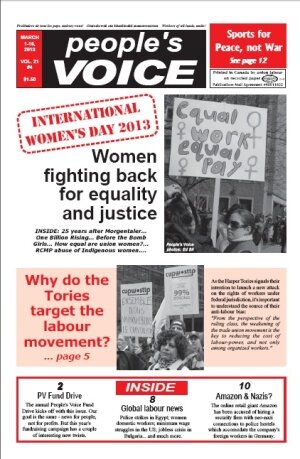
1) IWD 2013: WOMEN FIGHT BACK FOR EQUALITY AND JUSTICE

2) RCMP SLAMMED FOR ABUSE OF INDIGENOUS WOMEN

3) 25 YEARS AFTER MORGENTALER

4) YOUNG COMMUNISTS MEET TO BUILD STUDENT STRUGGLES

5) STORIES FROM THE ONE BILLION RISING

6) RESIDENTIAL SCHOOLS: CANADA'S GENOCIDE - Editorial

7) WHAT'S BEHIND CANADA POST RUMBLING? - Editorial

8) UNION WOMEN: HOW EQUAL ARE WE?

9) SPORTS FOR PEACE, NOT MILITARISM

10) BEFORE THE BOMB GIRLS: WOMEN & THE WUL

11) MUSIC NOTES, by Wally Brooker

12) WITNESSING A GLIMPSE OF THE REAL CUBA

13) A VERY SPECIAL 2013 FUND DRIVE


PRINTER FRIENDLY ARTICLES

PEOPLE'S VOICE MARCH 1-15, 2013 (pdf)

People’s Voice 2013 Calendar
”Ideas of Revolution”


People's Voice deadlines:

March 16-31
Thursday, March 7

April 1-15
Thursday, March 21

Send submissions to PV Editorial Office,
706 Clark Drive, Vancouver, V5L 3J1, pvoice@telus.net

You can call the editorial office at 604-255-2041


REDS ON THE WEB
http://www.parti-communiste.ca/
peoplesvoice.ca
www.ycl-ljc.ca
www.solidnet.org


People's Voice finds many "Global Class Struggle" reports at the "Labour Start" website, http://www.labourstart.org/. We urge our readers to check it out!


*  *  *  *  *
People's Voice

Canadian Publications Mail Sales Product Agreement #205214
ISSN number 1198-8657
People's Voice is published by
New Labour Press Ltd
  PV Editorial Office
706 Clark Drive,
VANCOUVER, B.C. V5L 3J1
Phone:604-255-2041
Fax:604-254-9803
email:  pvoice@telus.net

Editor: Kimball Cariou : Business Manager: David Au
Editorial Board: Kimball Cariou, Miguel Figueroa,
Doug Meggison, Naomi Rankin, Liz Rowley, Jim Sacouman

* * * * * *
Letters
People's Voice welcomes your letters
on any subject covered in our pages.
We reserve the right to edit for length and clarity,
and to refuse to print letters which may be libellous
or which contain unnecessary personal attacks.
Send your views to:
"Letters to the Editor",
706 Clark Dr., Vancouver, BC V5L 3J1,
or pvoice@telus.net
People's Voice articles may be reprinted without permission,
provided the source is credited.


* * * * * *

The Communist Party of Canada, formed in 1921,
has a proud history of fighting for jobs, equality, peace,
Canadian independence, and socialism.
The CPC does much more than run candidates in elections.
We think the fight against big business and its parties
is a year-round job,
so our members are active across the country,
to build our party and to help strengthen people's movements
on a wide range of issues.

All our policies and leadership
are set democratically by our members.
To find out more about Canada's party of Socialism,
give us a call at the nearest CPC office.

* * * * * *
Central Committee CPC
290A Danforth Ave Toronto, Ont. M4K 1N6
Ph: (416) 469-2446
fax: (416) 469-4063 E-mailmailto:info@cpc-pcp.ca

Parti Communiste du Quebec (section du
Parti communiste du Canada)
5359 Ave du Parc, Montréal, Québec,
H2V 4G9

B.C.Committee CPC
706 Clark Drive, Vancouver, V5L 3J1
Tel: (604) 254-9836
Fax: (604) 254-9803

Edmonton CPC
Box 68112, 70 Bonnie Doon P.O.
Edmonton, AB, T6C 4N6
Tel: (780) 465-7893
Fax: (780)463-0209

Calgary CPC
Unit #1 - 19 Radcliffe Close SE
Calgary  AB, T2A 6B2
Tel: (403) 248-6489

Ottawa CPC
Tel: (613) 232-7108

Manitoba Committee
387 Selkirk Ave., Winnipeg, R2W 2M3
Tel/fax: (204) 586-7824

Ontario Ctee. CPC
290A Danforth Ave., Toronto, M4K 1N6
Tel: (416) 469-2446

Hamilton Ctee. CPC
265 Melvin Ave., Apt. 815
Hamilton, ON.
Tel: (905) 548-9586

Atlantic Region CPC
Box 70 Grand Pré, NS, B0P 1M0
Tel/fax: (902) 542-7981

http://www.parti-communiste.ca/

* * * * * *

News for People, Not for Profits!
Every issue of People's Voice
gives you the latest
on the fightback from coast to coast.
Whether it's the struggle for jobs or peace, resistance to social cuts,
solidarity with Cuba, or workers' struggles around the world,
we've got the news the corporate media won't print.
And we do more than that
- we report and analyze events
from a revolutionary perspective,
helping to build the movements for justice and equality,
and eventually for a socialist Canada.

Read the paper that fights for working people
- on every page, in every issue!

People's Voice
$30 for 1 year
$50 for 2 years
Low-income special rate: $15 for 1-year
Outside Canada $50 for 1 year

Send to: People's Voice, 706 Clark Drive, Vancouver, BC, V5L 3J1
You can call the editorial office at 604-255-2041

REDS ON THE WEB
http://www.parti-communiste.ca/
http://www.ycl-ljc.ca/
http://www.solidnet.org/

(Contents)
(Home)


(The following articles are from the March 1-15, 2013, issue of People's Voice, Canada's leading communist newspaper. Articles can be reprinted free if the source is credited. Subscription rates in Canada: $30/year, or $15 low income rate; for U.S. readers - $45 US per year; other overseas readers - $45 US or $50 CDN per year. Send to People's Voice, c/o PV Business Manager, 706 Clark Drive, Vancouver, BC, V5L 3J1.)

1) IWD 2013: WOMEN FIGHT BACK FOR EQUALITY AND JUSTICE

IWD 2013 greetings from the Communist Party of Canada

            March 8 is a day to honour women's struggles, take stock of hard‑won gains, and to demand full equality.

            This year, International Women's Day comes amidst inspiring new struggles. Working people around the world, particularly in Europe, continue their huge struggles against austerity measures. In Canada we saw students in Quebec rose up, leading a fight against tuition fee increases, against neo‑liberal policies, and in opposition to a draconian bill that attempted to repress dissent. The result: the Quebec Liberal government's defeat at the polls, a tuition freeze and the scrapping of Loi 10. Young women played a key and leading role in that struggle.

            The "Idle No More" movement has initiated an historic struggle against Bill C‑45 and the entire racist agenda of the Harper Tory government.

            The actions by Indigenous peoples have blown the lid off the arrogant colonial lie that Canada is a country of equality, fairness and social justice. In Canada today, Aboriginal peoples suffer high rates of poverty, unemployment and incarceration, and dramatically shorter life spans. In Attawapiskat and on other reserves, and even in urban centres, many live in terrible housing conditions. Over 100 First Nations communities lack clean drinking water. In Manitoba, over 2000 members of the Lake St. Martin First Nation remain homeless after their reserve was deliberately flooded to save Winnipeg and other communities from the massive floods of 2011. Despite centuries of broken treaties promising fair treatment, and decades of protests and reports, this situation has not improved. In the latest examples, Bill C‑45 is removing federal environmental protections for thousands of lakes, streams and rivers which are crucial for the well‑being of Aboriginal peoples in all parts of Canada, and the Tory government is trampling the land and water rights of First Nations which oppose the expansion of tar sands exports.

            Refusing to accept these genocidal policies, four Aboriginal women in Saskatchewan took the initiative to begin the Idle No More campaign, using social media tools and teach‑ins to spread the word. Now this movement has taken root in communities in every part of the country, and everywhere Indigenous women play leading roles. Non‑Indigenous allies joined the struggle.

            The opposition to the tar sands and pipelines is a growing movement that challenges the most reactionary sections of capital. Women play an integral role in this and in the larger global environmental movement.

            In Canada, and across the capitalist world, women are disproportionately paying the price for bailouts of the banks and major corporations, neo‑liberal cuts to social programs, public service layoffs and massive tuition increases.

            The Harper Conservative government has intensified the threats to democratic gains. The Conservatives have followed the lead of the federal Liberals (who abolished the Canadian Advisory Council on the Status of Women and cut funding to the National Action Committee on the Status of Women ‑ NAC). The Tories closed 12 of 16 offices of the Status of Women Canada, eliminated the funding of any women's organization involved in advocacy, and amended the Act on Equitable Compensation to prevent the use of courts to advance pay equity.

            The Harper government also threatens women's reproductive rights, with actions like a Conservative MP's so‑called "private member's bill" asking Parliament to declare a fetus a person under the law.

            Canada's Employment Insurance program fails the majority of part‑time and minimum wage workers, especially women. Only three women workers out of ten are eligible to collect EI. Even those who meet the requirements can't survive on benefit rates set at 55% of their low previous earnings. The lay‑off of public sector workers has resulted in long waits for claims to be processed.

            Provincially, cuts to welfare, health care and legal aid, abolition of advisory councils on the status of women, tuition increases, and inadequate child care, are just some actions which have impacted women.

            IWD is particularly significant for working class women, oppressed by the "double burden" of exploitation in the workplace and the major share of domestic labour. Despite their growing numbers in Canada's workforce, women's unequal economic status is reflected in a 30% "wage gap" and other indicators.

            The unequal status of women in Canada has been condemned internationally. High poverty levels and the lack of social assistance to women have been raised by virtually every United Nations body that reviews Canada's human rights performance, including the CEDAW Committee, the Committee on Economic, Social and Cultural Rights, the Human Rights Committee, and the Human Rights Council.

            Despite the claim that women have achieved "equality," they still face under‑funding of emergency shelters and support services for victims of family violence. Economic and social conditions are shameful for Aboriginal women and girls, who are particularly vulnerable to racism and inequality, and hundreds of whom have been murdered or disappeared. Conditions in First Nations communities like Attawapiskat are being condemned internationally.

            Today, war is the most terrible crime against humanity. From the Middle East to Afghanistan to Colombia, wars increasingly target civilian populations. Women and children are casualties of bombardment from the air and atrocities on the ground, and the victims of health catastrophes arising from the destruction of power plants, water supply systems and hospitals. Trillions of dollars are wasted on militarism instead of development to provide education and economic opportunities, clean water, health care, and more human rights protection, including personal security, choice in marriage, and reproductive choice.

            Global environmental devastation impacts women and children, from those near Alberta's tar sands, to those living in drought stricken sub‑Saharan Africa. Changing material conditions goes hand in hand with changing social attitudes.

            We express our full solidarity with all women involved in the struggle for survival under difficult conditions. We demand that Israel abandon its apartheid policy of territorial expansion, violence and economic strangulation of Palestine, which imposes terrible hardships upon the women of Gaza and the West Bank. We condemn the drive for new wars against Iran and Syria.

Needed: a working class response

            Since the demise of NAC, a truly pan‑Canadian voice for women's rights has been missing. The organized women's movement has been deeply wounded by systematic cuts to funding. Yet the fightback continues.

            Women trade unionists have maintained structures like the Canadian Labour Congress's Women's conferences, which help keep the pan‑Canadian fight for women's rights alive. However, this is not enough. The re‑establishment of an organization like NAC, to bring together women from labour, young Rebelles women, women in organizations that fight for legal rights, reproductive rights, disability rights, child care, organizations that represent Aboriginal women and racialized women, would be an important advance.

            We welcome the development of Leadership, Feminism and Equality in Unions in Canada, a research‑based initiative that is doing important work in identifying barriers and current issues relating to women in the labour movement. Moving these findings into actions is a most important next step in reinvigorating a more democratic and equity‑driven labour movement.

            The response to the economic crisis by working people, women and men, must be to build a People's Coalition for a genuine alternative to corporate greed. Such a campaign, led by the labour movement and its allies, should fight to restructure the economy, to provide sustainable jobs, and to improve social services and increased opportunities for women. To protect jobless workers and their families, EI payments must be set at 90% of previous earnings. Evictions and utility cutoffs against all families affected by unemployment must be banned. The labour movement must focus on organizing unorganized women, the most important way to combat poverty and income disparity.

            But as long as capitalism continues, it will generate poverty, inequality, exploitation, environmental degradation and war. These are not side‑effects, they are built into a system designed to maximize profit in private hands. Under capitalism, every step forward for women is threatened by the next economic downturn or war. Only socialism, based on democratic, collective ownership and working class power, can permit the enormous creative and productive potential of the world's workers to be used constructively for human needs.

            Socialism has shown that there is an alternative. One small island in the south is a strong example how if social equality is a priority, huge advances in the status of women can be achieved. With intentional supports like maternity leave for candidates, in Cuba 48.7 % of those elected to the National Assembly are women.

            For a century, since IWD was adopted by a Socialist International women's conference in Copenhagen in 1910, the full participation of women has been essential for the success of working class and democratic movements.

            On IWD 2013, the Communist Party of Canada stands in solidarity with all those who struggle for peace, equality, democracy and social progress. A better world is both possible and necessary ‑ the world of socialism, which can guarantee full equality and a future for humanity!

            - Central Women's Commission, Communist Party of Canada

Printer-friendly article

(Contents)

(Home)


2) RCMP SLAMMED FOR ABUSE OF INDIGENOUS WOMEN

PV Vancouver Bureau

            For many years, indigenous women living in northern British Columbia have been the targets of deadly attacks, especially along the "Highway of Tears" from Prince George to Prince Rupert.

            Now, the U.S.-based Human Rights Watch group (HRW) has presented evidence that the RCMP has failed to prevent such violence, and that some officers have even been responsible for excessive use of force, and physical and sexual assault.

            Released on Feb. 13, an 89‑page report by HRW, "Those Who Take Us Away", documents allegations of police failures to protect indigenous women and girls. These failures and abuses add to longstanding tensions between the RCMP and indigenous communities, Human Rights Watch said, calling on the federal government to establish a commission of inquiry into the murders and disappearances of indigenous women and girls.

            "The threat of domestic and random violence on one side, and mistreatment by RCMP officers on the other, leaves indigenous women in a constant state of insecurity," said Meghan Rhoad, women's rights researcher at HRW. "Where can they turn for help when the police are known to be unresponsive and, in some cases, abusive."

            Human Rights Watch conducted research along Highway 97, and the 724‑kilometer stretch of Highway 16 where dozens of women and girls have gone missing or were found dead since the late 1960s. Last July and August, researchers interviewed 50 indigenous women and girls, and conducted another 37 interviews with families of murdered and missing women, indigenous leaders, community service providers, and others across 10 communities.

            Those interviews said that the RCMP has failed to protect them, and described excessive use of force, strip searches of women by male officers, and physical and sexual abuse. One woman said that in July, four police officers took her to a remote location, raped her, and threatened to kill her if she told anyone.

            Women who call the police for help have been blamed for the abuse, shamed over alcohol or substance use, and found themselves at risk of arrest for actions taken in self‑defense, women and community service providers told Human Rights Watch.

            Despite policies requiring investigation of all reports of missing persons, some family members and service providers who made calls to police said the RCMP failed to take prompt action.

            Researchers say the fear expressed by women they interviewed was comparable to post‑conflict countries, where security forces have played an integral role in government abuses. While Human Rights Watch has informed the RCMP about the allegations, details of specific incidents were not included because of victims' fears of police retaliation.

            Victims of police abuse or neglect can take their cases to the Commission for Public Complaints. But as HRW says, the process is time consuming and the investigation is likely to fall to the RCMP itself or to another police force. British Columbia recently established the Independent Investigations Office (IIO) to carry out independent civilian investigations regarding police‑related incidents. But HRW says the province must expand the mandate of the Office to include allegations of sexual assault by police.

            It also recommends improved training and monitoring of the RCMP, the elimination of searches and monitoring of women and girls by male police officers in "all but extraordinary circumstances," and the prohibition of cross‑gender strip‑searches.

 Printer-friendly article

(Contents)

(Home)


3) 25 YEARS AFTER MORGENTALER

Abridged from a longer Rebel Youth article, at http://rebelyouth-magazine.blogspot.ca

            As Canadians celebrate the 25th anniversary of the historic Morgentaler decision which decriminalized abortion, three Conservative MPs - Maurice Vellacott (Saskatoon‑Wanuskewin), Leon Benoit (Vegreville‑Wainwright), and Wladyslaw Lizon (Mississauga East‑Cooksville) - want to push women's reproductive rights back into the dark ages.

            In a letter to the RCMP Commissioner, the MPs demand a "national investigation" into abortions after 19 weeks gestation, calling them "possible murders."

            "From 2000 to 2009 in Canada, there were 491 abortions, of 20 weeks gestation and greater that resulted in live births. This means that the aborted child died after it was born," reads the letter dated Jan. 23.

            The MPs cited Christian fundamentalist blogger Patricia Maloney (who also runs the "Ultimately faith is the only key to the universe" blog). These stats, however, result from a peculiar reporting anomaly in the Canadian Vital Statistics Programme, not actual live‑born fetuses; modern abortion providers use techniques to ensure this never happens.

            According to the Criminal Code, a child is a human being when it emerges completely from the womb.

            Women's rights activists call the letter another nasty attempt to bully women and re‑open the Parliamentary debate on this issue. The opposition NDP also highlighted the contradiction between the Prime Minister officially denouncing the motion from the floor, but in practice allowing members of his ultra‑right party to re‑open the discussion.

            In Ontario, Tim Hudak, leader of the Progressive Conservatives, has also vowed to re‑open the abortion debate if elected.

            Last fall, many Canadians were shocked when Rona Ambrose, Minister for Status of Women, voted in support of the anti-choice Motion 312, claiming that she wished to "raise concern about discrimination by sex‑selection abortion."

            The failed motion found strong supporters in the Conservative caucus, including 10 cabinet ministers and long‑time anti‑choice activist Jason Kenney, according to Anjali Kulkarni, Melissa Graham and Jesse McLaren in Rabble.ca. Their article, "Sexism, ableism and other anti‑choice claims" notes that Motion 312 acted as a "launch pad" for Motion 408, which calls on "the House [to] condemn discrimination against females occurring through sex‑selective pregnancy termination."

            The petition supporting the motion claims "millions of girls have been lost through sex‑selective abortion" and Parliament must "condemn this worst form of discrimination against females." But research shows sex‑selective abortions account for less than 0.035 per cent of abortions in Canada.

            "Bad science aside, the purpose of this motion is inherently racist in nature and seeks to racially stereotype Indian communities in Canada and stigmatize them," the Rabble authors note.

            "[W]omen must be at the center of their own decision [about reproductive rights and control of their bodies]," Alexa Conradi for Fédération des femmes du Québec (FFQ) wrote in Le Devoir about the Tory motion and sex‑selective abortion. "We promote the empowerment of women and the fight against systems of oppression. When there is tension between the two, it is important not to introduce new forms of social control that women lose control over their lives and their bodies. It is important to trust the judgment of women how to deal with prejudice and discrimination they face. Fighting sexism with sexism is not progress."

            The FFQ makes the case that women and girls do not need such protection, they need a society with full equality.

25 years after Morgentaler victory

            The renewed attacks on abortion come a quarter of a century after the Supreme court ruling in the Morgentaler case.             Honouring the anniversary, Anand Grover, United Nations Special Rapporteur on Right to Health, wrote that "States are required to respect the right to health of women by not interfering with their right to autonomy and right to privacy and dignity all of which are critical to the right to sexual and reproductive health.

            "The right to health also mandates States to ensure that quality health facilities, goods and services are available and accessible to all, without discrimination. This requires the removal of economic, physical and legal barriers to healthcare services, including for abortion. Criminalization is an impediment to the successful realization of the right to health of women and exposes them to the risks associated with unsafe and illegal abortions."

            As Viki Sappora of the National Abortion Federation wrote recently in the Vancouver Sun, "Before Jan. 28, 1988, abortion was permitted only in very limited circumstances. Hospitals with Therapeutic Abortion Committees could approve and provide abortion care only in cases of life or health endangerment. In order to obtain a legal abortion, women were forced to face an intimidating process of going before a hospital committee to petition for care. [...] It is estimated during this time that 35,000 to 120,000 illegal abortions took place each year. And we may never know the actual number of women who sacrificed their lives and health through back alley or self‑induced abortions."

            Today, the benefits of decriminalizing abortion are clear: abortion rates have steadily declined since 1997; almost all abortions occur early in pregnancy; maternal deaths and complications from abortion are very low; abortion care is fully funded and integrated into the healthcare system (improving accessibility and safety); further legal precedents have advanced women's equality by affirming an unrestricted right to abortion; and public support for abortion rights has increased.

            The victory for reproductive rights was won through hard struggle.

            In 1970, the Vancouver Women's Caucus organized the first national feminist protest to liberalize the abortion law. The Abortion Caravan travelled 4,828 kilometres to Ottawa, where 500 women demonstrated for two days demanding legal access to abortion. Thirty women chained themselves to the gallery in the House of Commons, closing Parliament for the first time in Canadian history, and giving voice to women who were unable to legally obtain the abortion care they needed.

            The struggle, however, continues. According Karen McVeigh writing in the British newspaper The Guardian "Hundreds of women have been arrested, convicted, jailed, detained in mental institutions or forced to endure medical procedures as a result of the `criminalisation of pregnancy' over the last four decades [in the US]", including "413 criminal and civil cases across 44 states involving the arrests, detentions and equivalent deprivations of pregnant women's liberty between 1973 and 2005 [and] a further 250 cases since 2005."

            Likewise, The Tyee reports that "in Canada and the U.S. combined there have been eight murders of abortion providers since 1997, 17 attempted murders, 41 clinic bombings and 175 clinics torched by arsonists. For the same time period, the organization reports 1400 acts of clinic vandalism, 179 assaults against clinic staff and clients and 763 clinic blockades."

            On campuses, anti‑abortion groups intimidate students with stunts like handing out plastic fetuses, or displaying large pictures of babies to invoke shame in young women. The issue has become a battle‑ground topic for the right wing, who call it a matter of free speech.

            The same claim was heard last month in Abbotsford, BC, when the mayor refused to ask for the removal of a "Cemetery of the Innocent" on a farmer's field. The field contains hundreds of small white crosses symbolizing abortions.

            Women still find difficulties in accessing abortion. As Rebel Youth reported last year, women in rural and remote areas are particularly disadvantaged. Overall the number of abortion providers in hospitals is slightly dropping in Canada.

            And in PEI abortions are in a legal grey area ‑ not permitted in practice and provincial law. A 1988 resolution, passed in the legislature just after Morgentaler, is the province's last word on the subject, saying "life begins at conception, and any policy that permits abortion is unacceptable." PEI women's groups chose the anniversary of the Morgentaler decision to stage a series of protests of the policy.

Printer-friendly article

(Contents)

(Home)


4) YOUNG COMMUNISTS MEET TO BUILD STUDENT STRUGGLES

Special to PV

            Members of the Young Communist League from as far as Montreal, Quebec and Windsor descended on Hamilton, Ontario in January for the 2nd annual YCL conference on the student movement. The conference brought together YCL student activists from eight university campuses to reflect on the turbulent battles of the past year and the way forward for the student movement.

            "The uprisings of students in the Middle East and North Africa, the brave united battles of the Chilean students, and the massive struggle in Quebec last winter and spring have shown the validity of the optimistic claim that the young people, united with the working class, are continuously an important catalytic force for social transformation, overthrow and revolution," the call to the conference said.

            "At the same time, new, contradictory and even confusing developments are taking place internationally and locally. We believe that the student movements in Quebec and English‑speaking Canada are at a difficult but significant and even historic juncture. At stake is our basic access to education," it added.

            Speaking to People's Voice, YCL Ontario organizer Drew Garvie said that the YCL believes there is "very positive potential" to build a united student fightback against the Harper Conservatives, reactionary governments and the corporate austerity agenda and even push, with labour and people's movements, towards a real counter-offensive.

            "The key question is how? and I think we made a pretty good effort at outlining that direction over the weekend," he said.

            The conference analysed the role of both reactionary and social democratic political parties in the student struggle.

            Marianne Breton Fontaine and comrades from Québec made an evaluation of the 2012 Québec student strike.

            First, they said, the movement has to have programme; you cannot draw people into the streets based on demands that have little or no substance. The students started with the solid demand of access to education and popularizing the question of free education. They also linked up their struggle with the battle against austerity and for democratic rights; taking the battle beyond the campus won critical support from the people.

            Second, in whatever form it takes, mass participation and empowerment is essential. In Québec, this went beyond just the way decisions were made, but really entered into the life of the struggle as one in which the students and youth took ownership over. Nor did the drive of the struggle simply come from the organized bodies of the students alone; it came from the grassroots. The battle became everyone's struggle, and from this came the strength and confidence to keep going and escalate the fightback.

            Third, there is the connection of unity and struggle. The two must be together ‑ because whenever a real struggle develops the response of the ruling class has been to spread divisions. It became clear that the ruling class had widespread support in the media as well as the courts, police and prison system. its "tool box" against the students. What the people have is numbers, which becomes a real force when organized.

            All this means struggle and unity. From the start in fall 2011, the student organizations agreed on a basis of unity, including not condemning each other publicly and standing together in the negotiations. They took the attitude that they could not wait to "ride out the storm," but needed to start right away. They kept that unity in the face of serious assaults and differences of tactics and approach, like when the government tried to exclude CLASSE from the negotiating table and in the face of Bill 78.

Printer-friendly article

(Contents)

(Home)


5) STORIES FROM THE ONE BILLION RISING

The "One Billion Rising" actions held on Feb. 14 drew attention to global violence against women and girls. The following are dramatizations prepared by PV correspondent Jean Kenyon, based on the sources listed.

Indigenous women in Thunder Bay

            My name is Christi Belcourt. I am a Métis artist living in Thunder Bay. This is what happened to a good friend of mine. She doesn't want to give her name.

            One evening in December she was walking to the store, when a green car slowed down beside her. The two white men in the car started taunting her. They called her squaw and dirty Indian as she was walking, and they threw things at her from the car, pieces of garbage and cans.

            The men then stopped the car and reached out and pulled her by her hair into the back seat. She tried to fight back, but there were two of them and the one was stronger than she was and he sat on her and pinned her down while the other one drove the car to the outskirts of Thunder Bay.

            They said what they were going to do to her as they were driving, and she started to panic and she was fighting back, but they overpowered her. At the edge of town they pulled her out of the car and raped her.

            They told her they had done similar things before and would do it again. While they were brutalizing her they kept yelling, "You Indians deserve to lose your treaty rights." They were making fun of the Idle No More movement.

            They strangled her and left her for dead, there in the bush on the edge of town. But my friend lived. She walked for hours back to the city in the freezing cold, and reported the crime to the police. She is still afraid that if the men find out she survived, they'll come after her again to kill her. She has gone to a reserve to heal.

            The next week the people held a candle light vigil on the reserve to pray for female victims of crime. The police are investigating this incident as a hate crime.

            We have started an initiative called Thunder Bird, to map all the reports of Aboriginal women who have been murdered or assaulted or gone missing. My fellow artist Leah Dorion has painted a powerful depiction of the Red Thunderbird Woman.

            I meanwhile have taken the traditional name Waaseyaasin. I write medicine stories to help my people, for we must be Divided No More.

http://m.theglobeandmail.com/news/national/thunder‑bay‑sex‑assault‑hate‑crime‑probe‑sharpen‑focus‑on‑native‑womens‑plight/article6885373/?service=mobile


A little girl in Mali

            My name is Maryam. I am ten years old, and I live in an African village in Mali. At least I used to live there.

            One day I was working in the yard in front of our round hut, when a man came by. He said I would make a lot of money if I went with him. My Mommy and Daddy need money and I wanted to help them, so I went with the man.

            In the village he put me in the back of a truck. Two other children were there. We had never ridden in a truck before, and we were excited. The truck took off, it was noisy and fast and bumpy and we were scared. As the sun moved on into the afternoon, we came to a strange place, and he left us there. A man gave him money and put us on a bus, and the man with the truck went away. Another truck came with children and they were put on the bus with us, and we drove a long long way. It got dark and we kept driving. Where were we going?

            Finally we were let out in a field with strange trees like none we had back home. The men there didn't speak our language. We were in a foreign country ‑ in Ivory Coast.

            In the morning we were made to start harvesting fruit from the trees. They were cocoa trees, and the fruits were big and hard. We had to cut them off the trees with machetes. Then we used the machetes to cut them open. It was dangerous! We had to hold the cocoa pods in our left hand and whack them hard to crack them open! Then we had to dig out the beans and spread them to dry. Next day we washed the beans and carried heavy bags of them to be loaded onto big trucks.

            The work was endless, day after day after day. No matter how fast we'd go, we couldn't keep up. If we slowed down or stopped to play, we were beaten.

            I am still here working every day. I've never been paid any money. I've never been to school since I got here. I miss my Mommy so much.

            The next time you buy chocolate, please remember us, the child slaves of the cocoa plantations. I wish I could just go back home, to Mali.

            ("Maryam" is a composite of the children seen in the documentary The Dark Side of Chocolate. Some brands are slavery-free. The most available in Canada are Cadbury and Camino.)


A girl who immigrated to Canada

            My name is Aisha. I'm 18 years old and I was born in Grenada in the West Indies. When I was in my early teens, my father remarried and moved to Canada with his new wife. So I was excited when Dad sent for me and sponsored me to immigrate to Canada. I was 15 and full of hopes and plans for the future.

            We lived together happily in Toronto for two years, and I went to high school. But I had a hidden weakness ‑ I was born with sickle cell anemia. Every time my symptoms flared up I would have to go to the emergency room. It was OK because I was on my Dad's Ontario health card.

            Then my Dad and step‑Mom separated, and they didn't want to stay in Canada. I was left alone here. My sponsorship lapsed, and I had no status.

            I was used to taking care of myself. I got a part‑time job and rented a room and finished high school. Then I enrolled in college.

            I was doing OK until I had another sickle cell episode. This time I went to the Community Volunteer Clinic for the Medically Uninsured, in Scarborough. I told them I had no health card, and if I went to Emerg they would ask for $350 up front. It had happened before. The doctor assured me that the episode I was having was an emergency, and the hospital wouldn't demand the $350 this time.

            So I went. The triage nurse denied I was in a medical emergency and asked for money. I said I couldn't pay but I knew I was going to lose consciousness soon. The nurse said as soon as I lost consciousness then they would triage me without payment. So I waited on a chair nearby, getting weaker and weaker.

            The next thing I knew I was in a hospital ward receiving treatment. I was released after three days ‑ and was handed a bill for $5000.

            $5000. Now I have to drop out of college for good, and figure out how I can ever earn this money. My hopes and dreams for the future have come to nothing.

Canadian Family Physician journal, www.cfp.ca/content/58/7/725.full


A woman in Guatemala

            My name is Rosa Elbira Choc. I live in the town of Lote Ocho, Guatemala. My people are descended from the ancient Maya, and we have lived on this land for thousands of years.

            In 2007 a mining company came into our town. They wanted our land for a nickel mine. It was a company from Canada called Skye Resources. They started building a mine nearby on the shores of Lake Izabel. Then they started trying to evict us from our land! We put up a fight!

            One day a crowd of police and soldiers and security men from the mine came into town. They shot two men ‑ one was my relative Adolfo Ich, they shot him and hacked up his body ‑ then a bunch of men broke into my house. There were nine of them. They beat and bruised me and tore off my clothes and they raped me, one after the other, then they just left me there bleeding.

            As I lay there sobbing, I started to hear more shouting outside. Later I learned that more women were raped that day, all my neighbours that I knew, all Mayan women. Eleven of us were raped. The village was shocked and devastated. And the man that was shot ‑ the other one ‑ he lived but he's now a quadraplegic. Some of the security men were wearing insignia from the Canadian mining company, we all saw it.

            No one in Guatemala would prosecute the men. We went through a 25‑year‑long civil war here, and thousands of women were raped. There's a culture of impunity. Rape is standard practice when you want to intimidate a whole community.

            But this time we said No More! Now we are suing the company in a Canadian court for violation of our human rights.

www.minesandcommunities.org/article.php?a=10815

http://nobelwomensinitiative.org/2012/11/guatemalans‑seeking‑justice‑in‑canada‑hudbay‑minerals‑inc/


 A mother in Haiti

            My name is Evelyne Pierre‑Paul. Before the earthquake my three children and I lived in a two‑room flat in Port‑au‑Prince, Haiti. I worked in a garment factory all my life ‑ 25 years, now I'm 50 ‑ yet I still couldn't afford to rent a house for my family. So we lived in two rooms.

            Then the earthquake came and the whole building was destroyed. Everything we had was gone!

            They only built us temporary tent camps to live in. After two years I'm still there, with my three teenage kids. I earn $5.90 a day. There are no apartments left that I can afford to rent. Something's wrong with my country, Haiti.

            These tents aren't a safe place for women and girls. I worry all the time about my daughter. I can't afford to send her to school.

            It costs half of my day's wages just to take three buses to work and back and buy lunch at the plant. Food is twice as expensive as before the earthquake. How can I ever save up? When payday comes, you pay back all the little debts you accumulated, and you don't have anything left.

            We sew clothes for Walmart, and labels like Levis and the GAP. The owner of the factory says he can't pay us more because his buyers would leave.

            Last year five union leaders came into the textile plants in Port‑au‑Prince and they certified a union! A week later all five of them were fired. The owners were ordered to take them back, but they never did. Nothing ever gets done here. I wish I could give my daughter a better life.

            You want cheap clothes and designer labels? You think it doesn't come at a cost?

            Just look at me ‑ I am the cost.

www.commondreams.org/headline/2011/12/21

Printer-friendly article

(Contents)

(Home)


6) RESIDENTIAL SCHOOLS: CANADA'S GENOCIDE

People's Voice Editorial

            After decades of speculation, figures are emerging about the extent of Deaths at Indian residential schools. At least 3,000 children died while attending the schools, which were infamously designed to "take the Indian out of the child." The findings are the result of the first systematic search of government, school and other records, carried out by the Missing Children Project. The numbers will rise as more documents from government archives are studied.

            Researchers say that the 3,000 deaths are all proven by primary documentation indicating dates and circumstances. The biggest killer was disease, particularly tuberculosis which spread rapidly in dormitories. The Spanish flu epidemic of 1918‑1919 killed 20 children at one Ontario residential school alone. Others died of malnutrition, or accidents such as fires and drowning.

            About 150,000 children went through 140 church‑run schools from the 1870s until the 1990s, a deliberate policy of "civilizing" Aboriginal peoples. Students were forbidden to speak their own languages, and contact with families was severely limited. Many were physically, mentally and sexually abused, causing frequent suicides. Student deaths were considered a part of the system; architectural plans for many schools included cemeteries, and fifty burial sites have been identified.

            This all fits the term genocide, under the definition adopted by the United Nations General Assembly in 1948. The reverberations of this crime continue: an ongoing epidemic of suicides among Aboriginal peoples, the loss of irreplaceable cultural knowledge, and devastating poverty. A lawsuit by survivors resulted in a $1.9‑billion settlement, a government apology, and the creation of a Truth and Reconciliation Commission.

            And yet the Conservatives still fling accusations at First Nations leaders, and refuse to take responsibility for the appalling legacy of racism and colonialism. Legislation such as Bills C-45 and C-37 inflict new damage on indigenous peoples, and indeed all Canadians. "Shameful" is much too polite a term for this government's actions.

Printer-friendly article

(Contents)

(Home)


7) WHAT'S BEHIND CANADA POST RUMBLING?

People's Voice Editorial

            The latest sign of the drive to privatize anything that moves is the impending service cuts at Canada Post. According to the big business media, the crown corporation operates at a loss, so the only solution is to close more outlets, reduce deliveries (possibly to just three days a week), consolidate sorting centres, and fire thousands of employees. The public will be the big loser through this process, but it's also hard to imagine how the postal system could survive such a body blow.

            Anyone who pays attention to postal workers and their union will realize that Canada Post management and the Tories are blowing plenty of smoke about the state of this vital service. These rumours and proposals come not long before the current collective bargaining agreement expires, conveniently just in time to try to bulldoze the workers who actually deliver our mail into submission.             "They're cutting the link with the public and the citizens of the country," as CUPW national president Denis Lemelin warns. The union points out that prior to its recent expensive "postal transformation," Canada Post made big profits for some 18 consecutive years. Was the "transformation" plan a scam to help the Harper government sell off Canada Post? And if that happens, does anyone really believe that UPS and FedEx will get packages delivered more efficiently and cheaper? In fact, these private operators already use Canada Post to ship items to smaller centres, because they lack the infrastructure to do it themselves. Just imagine the skyrocketing price increases if these transnationals take over the postal system.

            To save our reasonably affordable and timely way to send mail across the country, we need to mobilize quickly against this threat.

Printer-friendly article

(Contents)

(Home)


8) UNION WOMEN: HOW EQUAL ARE WE?

By Helen Kennedy

            The angry and frustrated energies of union women have been vocalized in a new initiative to reassess the movement toward equality within the labour movement. "Leadership, Feminism and Equality in Unions in Canada" is a project led by four labour women, Linda Briskin, Sue Genge, Marg McPhail and Marion Pollack.

            During the spring of 2012, the organizers held facilitated conversations with 50 union women from across the country, but excluding Quebec. From these interviews, they found agreement that there is a "serious problem within the labour movement in advancing women's equality work and supporting feminist activists at all levels."

            Five themes emerged from these discussions, as documented in detail on the list‑serve at http://womenunions.apps01.yorku.ca/

            Many women cited the loss of the National Action Committee on the Status of Women, and other national women's groups, as having a huge impact on the ability of women in labour to fight for equality gains: "Once we lost NAC and started losing a number of the other national women's organizations ... women in the trade union movement also started losing support."

            The impact of austerity policies emerges as one of the key issues for debate. In their fight to halt the slide towards job loss and concession bargaining, unions have framed the debate for "Wage Fairness". And thus women's fight for equal pay or pay equity is subsumed by a vague demand to maintain fairness. In many cases, bargaining campaigns that included the fight for women to make equal pay to their male counterparts would have been a more popular (and possibly successful) strategy.

            As frustrated as the union women's voices are, there is also an optimism that emerges from the conversations. Women support the need to have these discussions locally, to begin to rebuild the powerful voice for women at the grassroots level. There was also a suggestion that women look at rebuilding groups like Organized Working Women in Ontario, BC's Union Sisters, and Saskatchewan Working Women as ways to win labour support for women's issues.

            Many women have started convening discussion groups using the results of these conversations to begin. In Ontario, the project has presented their results at an Ontario Federation of Labour Women's Summit. In the upcoming Women's Day edition of Our Times, there is an article on the Summit as well as the first of three articles on the project itself.

            The Leadership, Feminism and Equality in Unions in Canada Project gives a needed boost to women in the labour movement, some of whom have fought for equality for decades and border on severe burnout. But the benefit will be more than refuelling our energies. The Project may help to rebuild a movement that includes the diversity of all working women, and a society that provides universal childcare, pensions for all, pay equity, a truly universal healthcare system that respects women's reproductive rights, and eliminates all forms of violence against women.

Printer-friendly article

(Contents)

(Home)


9) SPORTS FOR PEACE, NOT MILITARISM

By Peter Miller and Daniel Lyder

            An oft‑repeated opinion in the sports media is that sport and politics should never mix. If an athlete uses his or her spotlight to voice a social or political opinion, sports journalists, owners, and executives will often express disapproval.             One famous example is Tommy Smith and John Carlos. The two African-American athletes at the 1968 Olympics were stripped of their medals for their famous Black Power raised fist salute, wearing black gloves in civil rights solidarity.

            At the 2012 Summer Olympics in London, Damien Hooper, an aboriginal boxer from Australia, was threatened with expulsion for wearing a black T‑shirt with a picture of an Aboriginal flag, while warming up in the ring before a fight. Hooper had broken the Olympic policy preventing athletes from representing flags unapproved by corporate sponsors.

Shut up and play

            Yet there is an immense self‑serving irony contained in the "shut up and play" culture perpetuated by the media. Sports are constantly used by right‑wing corporate forces and the military to promote their pro‑war, aggressively nationalist and repressive agendas. The truth is that sports journalists, owners, and executives actually believe that sports and progressive politics should never mix.

            Iconic ESPN host "Big Game" Brent Musburger famously analyzed Smith and Carlos' demonstration by saying at the time, "Perhaps it's time twenty year‑old athletes quit passing themselves off as social philosophers."

            Musburger has never apologized for his remarks. And the attitude hasn't changed much since then.

            Consider the incredible backlash against Miami Marlins manager Ozzie Guillen last year for simply admitting that he "liked" Fidel Castro. Guillen was forced to recant at length or lose his job, and was suspended for five games.

Military cheerleading

            Anyone who's watched an NFL game or the recent Super Bowl could attest to the unquestioned platform for pro‑military viewpoints: from troop displays during the national anthem, to fighter jets buzzing over the stadium, to the bizarre "USA" chants throughout stadiums announcing the killing of Osama Bin Laden and his family. The league's official website proclaims that "supporting the military is part of the fabric of the NFL."

            In fact, capitalist countries like Canada and the USA actively use the sports "business" to promote the military and imperialism.

            Canadian pro sports franchises openly promote war in conjunction with the mass media and the government. While the old Winnipeg Jets logos (from 1972‑1996) featured a civilian airliner, the True North Inc. new design explicitly pays "homage" to the Air Force with a fighter jet.

            The federal and Manitoba governments contributed over 11 million dollars to the construction of a new arena for the Jets to play in, quite a unique form of advertising.

Don Cherry

            Perhaps the most infamous hockey "analyst" in Canada is Don Cherry, who makes a $700,000 salary, paid from public money, and uses his airtime to promote xenophobia, anti‑Quebec nationalism and war during Hockey Night in Canada on CBC. In 2010 Cherry signed bombs and actually fired a shell when he visited occupied Afghanistan. He later received an honourary degree from the Royal Military College (although not without protest) for his work supporting the war.

            Unlike what the Harper Conservative government and Don Cherry would have us believe, the war in Afghanistan is not about justice or women's rights. As Yves Engler points out in his latest book, The Ugly Canadian, the president of Afghanistan, Hamid Karzai, has supported decrees from religious leaders in the country stating that women must be subordinate to men, and cannot be in public without their male partner or family member by their side.

            This war, like all wars undertaken by the military industrial complex, has generated enormous profits for "defence" corporations from the public purse.

Case study: the war in Libya

            Canada was ranked 6th in foreign military sales in 2009, according to the Federation of American Scientists Arms Sales Monitoring Project.

            Perhaps then it is no surprise that the Winnipeg Jets' new logo is a blue circle with a metallic grey silhouette of a McDonnell Douglas CF‑18 Hornet Fighter Jet above a red maple leaf. This is the same plane used by the Canadian Forces to bomb Iraq, Yugoslavia, and Libya. In fact, the logo was revealed during Canada's war in Libya.

            Despite claims of humanitarian intervention or "Responsibility to Protect" (R2P), the Libyan War was pursued for the benefit of big corporations and oil wealth. NATO simply used the Arab Spring to intervene and interfere with another country's sovereignty.

            Libya had bigger than average royalties on oil corporations. Its nationalized oil company interfered with profits for companies like Suncor, Canada's largest energy corporation. And the Libyan regime was an inconsistent ally of imperialism.

            The US‑led NATO alliance thus saw an opportunity to influence Libya's uprising and actively supported the "Transitional National Council" to further increase profits, secure a geo‑strategic military foothold in Africa and the Mediterranean, and push‑back against the inroads of Chinese capital into Africa.

            Canadian Lieutenant General Charles Bouchard officially commanded the NATO campaign, signing off on every pre‑selected bombing target. Fifteen Canadian aircraft dropped at least 700 bombs. On one occasion, a strike from NATO is alleged to have killed 47 civilians, and the total civilian death toll is estimated to be much higher.

            Doctors Without Borders ended up pulling out of Libya, refusing to be complicit in the NATO mission and noting that they were actually treating many captured pro‑Gaddafi soldiers who were tortured by rebels. (Gaddafi repeatedly called for a ceasefire, yet the NATO‑backed rebels refused.)

            Meanwhile, Don Cherry was busy praising the new Jets logo. "How could you do better than to honour the people who lay their lives down for us?" he told Sun News.

Raptors Canadian Forces Night

            Military cheerleading reaches into sports like basketball as well. On January 26, the Toronto Raptors held their 6th Canadian Forces Night at the Air Canada Centre. The team and cheerleaders wore camouflage jerseys while pro‑military programming aired during breaks.

            After the game, Raptors players, the coaching staff, and cheerleaders posed for a group picture with Canadian soldiers. The event was described as a "natural extension of the Raptors and Maple Leaf Sports & Entertainment's longstanding support of Canada's military".

            Canadian Forces Night was used by the Canadian military to advertise its growing "brand." The federal government spent $353 million on public relations for the military in 2010‑2011.

            The military targets youth with TV commercials, ads on campuses, and recruitment displays at sports and public events. Canadian youth are pushed to join the military and become cannon‑fodder for imperialist wars.

            Positively, groups like "Hockey Fans For Peace" are taking on commentators like Don Cherry, and calling on the anti‑war movement to become more active and visible on sports issues. Maybe it's time to flyer Raptors games to tell working class sports fans why it is wrong to support war and militarism.

Canadian imperialism flexing its military muscle

            The militarization of sports is taking place at a time when the Harper Conservative government seems to be constantly flexing Canada's military muscle. Canadian troops are still on the ground in Afghanistan. The government is also getting involved in the French‑led and US‑backed occupation of Mali.

            Canadians are also faced with the threat of our country following NATO to go to war in Syria and Iran. While Canadian‑based corporations do not officially have any direct investments in the country, Iran has a tremendous amount of oil wealth.

            American and Canadian imperialist interests do not like that Iran provides oil for China. Canada's government is basically lying about nuclear weapons in Iran, to try to sway public opinion and start another war allied beside Israel, America, and NATO.

            Despite claims of a "peace dividend" after the overturn of the Soviet Union and socialist countries, military spending is 2.3 times higher in Canada now than during the peak of the Cold war. The ever‑increasing military budget is being prioritized over public healthcare, education, affordable housing, universal childcare, and other important social services, ironically including non‑commercial sports, culture and physical activities.

Sports for a world at peace

            While Canada is setting up military bases around the world, youth are faced with a future that, for the first time in generations, is predicted to be worse materially than our parents.

            Let us show fellow sports fans that the future does not have to be this way. Instead of joining the armed forces, let us convince the youth to join social movements. Together we can stop another greedy war by hitting the streets!

            Progressive‑minded and peace‑loving people must not shy away from pushing back against the pro‑military agenda on the sports field, arena, or court. Sports are part of popular culture and it is important to use this venue to get anti‑war and socially positive messages across.

            An important beginning is to recognize when anti‑establishment political opinions are voiced by athletes, and to support them to the best of our ability. It doesn't help that some of the most powerful examples are given no attention in the media or quickly drowned out.

            Together, we can also promote a radically different sports culture.

            Speaking at the United Nations on resolutions in support of sports for peace and development, socialist Cuba said that sports should "undoubtedly strengthen solidarity and friendship among peoples" and that for Cuba, after the Cuban Revolution, "sports ceased to be exclusive and became a right for all the people."

            Cuba has also condemned "athleticism that was purely motivated by financial gains," and "the theft of sport talent from developing countries." Instead of weapons, Cuba has said: "Let us invest in projects for the sake of education, sport and health".

            Officially, much of the past rhetoric of international sports and the Olympics also opposed war, like the "Olympic Truce." The World Festival of Youth and Students traditionally holds an anti-imperialist soccer match at each gathering.

            It is time that sports in Canada promote fair play and cooperation, as well as friendship, internationalism, and solidarity ‑ not militarism, elitism, or crude consumerism. Recreation, leisure time, and sports are democratic rights, not privileges. It's time to stand up together, for these rights and sports for peace!

Printer-friendly article

(Contents)

(Home)


10) BEFORE THE BOMB GIRLS: WOMEN & THE WUL

By Kimball Cariou

            The simplification of history sometimes becomes an art form in bourgeois society. The struggle for women's equality apparently skipped a couple of generations, going into hibernation between the era of the suffragettes and the emergence of women's liberation some fifty years later.

            Occasionally Rosie the Rivetter pops up, adding a touch of working class reality. CBC's Bomb Girls has been an exception, offering a glimpse into the wartime lives of women in a Toronto munitions factory. In Bomb Girls, the depiction of tough working conditions and low pay is expanded by plot lines involving the problems faced by minority groups, including young black women, lesbians, and immigrant workers. But there has been little mention of trade unionism.

            That brings us to one of the missing links in the equality narrative: the long struggle to organize industries which employed working class women. Historian Stephen Endicott adds an important dimension to this story as part of his new book. Raising the Workers' Flag tells the record of the Workers' Unity League, which was the most revolutionary labour federation in Canada's history from 1930 to 1936. (See review in our Feb. 15‑28 issue.)

            Nearly every page of this volume contains fascinating new information, dug out from the archives by the author. Those interested in real "herstory" will find plenty of substance, since the WUL included powerful leaders like Annie Buller, Becky Buhay, and many more. One of the real gems of is Chapgter 9, titled "Women of the workers' Unity League: Taking their place side by side as Activists in the Labour Market."

            Endicott gives a clear picture of the situation faced by working class women before and during the "Great Depression". Such women often had to work a double day, going from the workplace back to the unpaid domestic labour of the household. Married women who worked were accused of "stealing" men's jobs.

            Already difficult enough during the so‑called "Roaring Twenties," the lives of these women became worse as the capitalist economy crashed. Their wages, already lower than those of their male counterparts, were rolled back as the bosses passed on the burden of the crisis to their employees. The report of the first WUL National Congress noted that "the average earnings of women workers have decreased from $12 per week in 1926 to $9 per week in 1930; at the same time the hours of labour have increased from 48 per week to 52 hours per week."

            Many women activists in the WUL were involved in an earlier formation, the Women's Labour Leagues, which originated at the time of the 1919 Winnipeg General Strike. In contrast to the YWCA and other groups, the WLL focused on demands for equal pay and a higher minimum wage. The Leagues grew to about sixty branches and affiliates by 1929, publishing their own newspaper, the Woman Worker. Most of the members were from Finnish immigrant left‑wing communities in northern Ontario, with a few English‑ or Yiddish‑speaking branches in other areas.

            At that point, the strategic orientation of the WLL shifted, away from cooperation with "reformist" women's organizations, towards a more militant stance. Over the next couple of years, under the leadership of Becky Buhay, one of the top Communist organizers of the time, the WLL merged into the Workers' Unity League.

            Despite considerable turmoil, Endicott writes that "in the end, joining the WUL gave the Women's Labour Leagues a new unifying focus: to strive for the improvement of the living and working conditions of working class women through vigorous support of various economic and social issues and the drive for industrial trade unionism."

            As the author explains, the events of the Great Depression included hundreds of strikes, battles for relief and civil rights, campaigns for unemployment insurance. Women often played a prominent role as participants and leaders.

            Much of their inspiration came from the huge advances towards equality made by women in the Soviet Union, as reported by a six-member WLL delegation which toured the USSR in 1930. The delegates found a society which aimed to break the subordination of women to the patriarchal family model, a goal which resonated strongly with many women in Canada.

            The Soviet example helped to bolster the WUL position that married women should be allowed to work for pay ‑ controversial at a time when unemployment was skyrocketing among male workers. But such right‑wing opposition was contradicted by a more powerful imperative: employers hired women because they were a source of cheap labour and higher profits.

            This factor alone ensured that the WUL's female membership went much beyond the WLL branches and women's auxiliaries, although these were a major area of activity. Many women were involved in the new unemployed movements. One was Flora Hutton, a member of the Capitol Hill (Burnaby) WLL branch and also the Unemployed Girls' Club in Vancouver. During a Workers' Economic Conference organized in Ottawa by the WUL, Hutton boldly confronted Deputy Prime Minister Sir George Perley, telling him that unemployed girls in Vancouver starved or sold their bodies for a meal while Prime Minister Bennett lived in luxury.

            Across the country, women organizers led many delegations, pickets, and protests to demand relief for jobless women, unemployment insurance, and hot meals for schoolchildren. Thousands took part in solidarity campaigns around the Relief Camp Workers Union, which led the 1935 On to Ottawa Trek. Despite government repression, these activists helped expand the annual celebrations of March 8, International Women's Day. Some were jailed for their actions, notably Annie Buller, imprisoned for her outstanding leadership of the Estevan‑Bienfait coal miners strike in Saskatchewan.

            The struggle for industrial trade unionism (as opposed to the old "craft union" system) had particular relevance for women in certain industries. The needle trades in Montreal, Toronto and Winnipeg were infamous for low wages and sweatshop conditions. As another chapter in Raising the Workers' Flag relates, the WUL played a huge role in bringing women in the needle trades into the labour movement, overcoming the opposition of the Catholic Church, and cultural barriers between French‑Canadian and Jewish workers. The WUL's Industrial Union of Needle Trades Workers led a number of successful strikes, winning important gains for women in the industry.

            It's true that these struggles sometimes failed, and also that male chauvinism was not eradicated by the growing participation of women in the trade unions. But the WUL did bring thousands of women into the labour movement, setting the stage for the mass entry of women into industry during WW2, and for the dramatic growth of public sector unions during the 1950s and '60s.

            These enormous social changes in turn created far better conditions for a more explicit women's liberation movement to emerge. As women made progress towards greater economic independence, the protections afforded by collective agreements made it easier to speak out on a wide range of social issues.

            In a very real way, the victories for pay equity, child care, reproductive rights and much more achieved in the decades of the 1960s through the 1990s were built on the efforts of earlier generations of women who refused to accept subordination to the bosses, the Church, the state, and patriarchal "family values". The Workers' Unity League was instrumental in this transformation of the role of women in Canada, and Endicott's book sheds new light on this historic shift.

 Printer-friendly article

(Contents)

(Home)


11) MUSIC NOTES, by Wally Brooker

CFM fights Bill C‑377

The Canadian Federation of Musicians is calling on its 17,000 members to stand with their union brothers and sisters to resist the Harper government's discriminatory and punitive Bill C‑377, which will force Canada's union movement to make its finances public, including time spent on political activities. The top‑priority "private member's bill" was passed in the House in December. It's now working its way through the Senate, but the fight is not over. Legal challenges could tie up implementation long enough to see the bill die, but only if voters can defeat the Harper Tories in the next election. The CFM estimates that an average union local will need up to 400 hours annually to prepare the returns or face a $1,000 a day fine for failure to comply. Bill C‑377 is a key part of a ruling‑class offensive whose ultimate goal is to wipe out the hard‑won rights of organized labour. For more info: www.cfmusicians.org/.

Symphony NS musicians vote to strike

Negotiations continue between Symphony Nova Scotia and members of CFM Halifax Local 571. In December the 37 SNC musicians gave their negotiators an overwhelming strike mandate. They're demanding that their base salary for a 33‑week season be raised from $28,000 to $30,000 over two years. During the season musicians work six days a week. Much of it is split shift, with morning rehearsals and evening concerts. There's little opportunity for outside work in Halifax during the off‑season and travel is difficult for musicians with homes and families. Moreover SNS is flush with cash, having raised $7 million in a fundraising campaign. While the city of Halifax basks in the rave reviews the orchestra receives, it's stingy when it comes to funding. If it picked up the tab for the modest proposed wage increase, Halifax would still be providing less than a tenth of the support that comparable Canadian orchestras receive from municipal governments. For more info: www.afmcanada.org/.

Stanley Jordan cancels Israel gig 

The Palestinian Campaign for the Academic and Cultural Boycott of Israel has won a significant victory. On Jan. 5, noted American jazz fusion guitarist Stanley Jordan, who was to headline the winter instalment of Israel's Red Sea Jazz Festival, announced on his Facebook page that he was cancelling his engagement. Jordan's image had been used on publicity posters for the state-funded event. The Festival is held twice a year in the resort town of Eilat, and until recently has been successful in distracting attention from the apartheid policies of the Israeli state. The unusual thing about the campaign to convince Jordan to cancel his gig was the serious debate that took place on his Facebook page. It included interventions by many BDS activists, as well as the online journal Palestine Chronicle and the artist himself. Author Rima Merriman's fascinating account of this Facebook conversation can be found at http://palestinechronicle.com/.

"Rise Up" theme for 2014 World Pride?

Despite a copyright faux‑pas by Pride Toronto, it seems a reasonable bet that Parachute Club's landmark 1983 hit "Rise Up" will become the theme song of the 2014 World Pride event in Toronto. The award‑winning song was a unique achievement in Canadian music, celebrating peace, gay rights, feminism and anti-racism. At the time this was a cultural breakthrough. When the song was premiered at Toronto Pride it was dangerous to even attend the event. An eager member of Pride Toronto's communications committee posted a World Pride promotional video including "Rise Up" on YouTube without securing copyright permission. It was quickly withdrawn until the rights question is resolved. The copyright situation is uncertain at the moment since the band recently changed record labels. However, singer Lorraine Segato has declared that it would be "fitting and fantastic" for an agreement to be reached. For info: www.xtra.ca.

Yoko Ono award honours Julian Assange

Renowned artist, musician and peace activist Yoko Ono has announced that the recipient of her annual Courage Award for the Arts would be Wiki‑Leaks founder Julian Assange. The whistle-blower is currently being sheltered by the Ecuadoran embassy in London, where he's being hounded by British and U.S. authorities for exposing imperialist war crimes in the Middle East. "Julian Assange took a courageous step by rightfully returning what belongs to the public domain," said Ono. "For that reason, I believe we need to stand by him." The Yoko Ono Lennon Courage Awards for the Arts were established in 2009 to honour individuals and groups who have shown "extraordinary courage with their work and interests, defying censorship, public doubt or even scorn in pursuit of their vision." For more info: http://imaginepeace.com.

Printer-friendly article

(Contents)

(Home)


12) WITNESSING A GLIMPSE OF THE REAL CUBA

By Peter Liakhov

            What is Cuba? Ask the average American, and it is likely that you will hear some variation on JFK's "imprisoned island" hokum, where that small island is described as a testament to the bearded tyranny that is seemingly endemic to the developing world.

            Ask the average Canadian and you will probably hear a description of softly lapping waves, cheap but delicious rum, and how they bought a t‑shirt with some fellow named Che on it for only $10.

            But if you were to leave the privileged confines of the West, to the villages of Angola, the streets of South Africa, or the Barrios of Venezuela, you would hear about the shining example that Cuba presents in the face of Empire. You would hear about the sacrifices that the Cuban people have made and still make, sacrifices in the name of solidarity with the people who Franz Fanon called "the wretched of the Earth".

            All of this in mind, a question emerges: what is Cuba? And which description is right?

            For me the answer didn't come from a book, a film, or a "CNN Special Report". I was able to witness the real Cuba when I went on the 20th annual Che Guevara Volunteer Work Brigade, and saw for myself the beautiful nuances and complexities of Cuban life.

            The Brigade was a three‑week long program that took me and 40 other Canadians (fellow Brigadistas as we called each other) through the eastern half of Cuba, centered primarily in the pleasant and slightly dreamy city of Holguin (the capital of Holguin province). The city became a defacto base camp, as we had a packed itinerary that saw us visit a diverse collection of locales ranging from medical centers, to wind farms, to opera houses.

            Each daily trip offered a glimpse at the life of the Cuban people in a way that you could never otherwise see; a glimpse that did not hide the difficulties and the struggles of the Cubans, but also revealed their resilience, optimism, and continued vigor in building a better world.

            The most amazing surprise of the whole experience, however, was not mentioned in the pamphlets or the itinerary. Even considering all that was planned and organized, much of the trip placed us at full liberty, and during this time everyone was able to explore and understand the Island on entirely their terms.

            The adventure and idiosyncrasies of such exploration are not easily generalized, so instead allow me to share a personal anecdote.

            This particular adventure began on May Day, after we had been in Cuba only two days. As this was our first day of free time, a number of Brigadistas (including myself) decided to dedicate the day to unbridled exploration; it was as good a day as any, and the annual May Day parade provided a colourful backdrop to our adventure.

            What we didn't anticipate was the lack of directional sense that afflicted everyone in our little group. Now getting lost in Cuba is not a heart‑quickening experience by any stretch of the imagination, as crime is almost non‑existent ‑ I would venture to claim that the streets are more dangerous in Canada. However, we were getting hungry and were not used to Cuba's sweltering heat. Alas, our Spanish was poor, and with nary a peso in our pockets a taxi back to our quarters was out of the question. Thankfully, we were rescued by an unlikely hero.

            That afternoon a medical student by the name of Fares was walking home from the May Day Parade, with a large Palestinian Flag hanging off a bamboo pole. Though our group spoke little Spanish, one person did speak Arabic, and when we saw the young student with the flag we were certain we were saved.

            Lucky for us, Fares was not simply bilingual in Spanish and Arabic. A veritable polyglot, he spoke fluent English among many other languages. Not only did he offer to direct us back to the hotel, but he also invited us for tea and lunch at the student residence. Without hesitation we took him up on the offer, and our small group of adventurers quickly found itself sipping tea at the International Residence of Holguin University, discussing middle‑eastern politics with Fares and his two roommates.

            As it turned out, Fares and his roommates had moved to Cuba four years ago from Palestine, enrolling in medical school thanks to Cuba's policy of internationalist free post‑secondary education.

            The friendship between the rescuers and the Brigadistas quickly flourished, and we would see Fares and his friends many other times throughout the trip. With their assistance and knowledge of the city, we saw the nooks and crannies of Holguin, the little art galleries, the best salsa‑halls, and the student haunts. They even brought us to a Deep Purple tribute concert where we heard an excellent if slightly accented rendition of "Smoke on the Water".

            Somehow, even with the daily excursions and the spontaneous adventure, the Brigade also engaged in volunteer labour (as per the name). This consumed only a small amount of time, but as I fondly recall those weeks, it brings the biggest smile to my lips.

            The volunteer labour consisted of us Canadians helping out at a construction site for the first two weeks, and at a farm for the final week. We worked side by side with everyday working class Cubans, doing the kind of manual work that is exhilaratingly different for a bookish student such as myself.

            The labour was obviously more symbolic than necessary; the Cuban workers were much more qualified to do farming or construction than most of the Canadians. But it decreased the workload for the labourers onsite, and provided an opportunity for us to bond with the Cubans through shared labour.

            In my case, I hope that my broken Spanish mixed with wild gesticulation was enough to establish a connection with some of my temporary Cuban co‑workers, and in this way foster a feeling of solidarity.

            Among the tapestry of new experience and adventure that made up the Ernesto Che Guevara Volunteer Brigade, the tales above are but a single thread. By the end of the trip, a sense of Cuba emerged for all of the Brigadistas, a feeling that made us understand why that little island has survived in the face of such adversity, and why it still needs our solidarity. We saw a Cuba that was complex but beautiful, a human Cuba that's been too often hidden from our sight.

            Get involved in the Brigade ‑ check out www.canadiannetworkoncuba.ca/brigade for details of the current adventure including prices and dates, and connect with more past Brigadistas over Facebook.


Printer-friendly article

(Contents)

(Home)


13) A VERY SPECIAL 2013 FUND DRIVE

A message from the People's Voice Editorial Board

            With this issue of People's Voice, our annual Press Fund Drive is officially underway. We're changing things up a bit this year, but the basic story remains the same: working people in Canada still need our own media, as an alternative to the corporate-owned "weapons of mass distraction."

            Among the many progressive publications, radio shows and social media in this country, People's Voice is truly unique, with our 90-plus years of revolutionary journalism. Over those decades, PV and our predecessor newspapers featured a variety of names, mastheads and writing styles. But we have consistently analysed events from a working class perspective, using our pages to promote the labour and people's movements for equality, peace, labour rights, expanded democracy, sovereignty and much more.

            The copy in your hands is a good example. Our annual International Women's Day issue gives particular attention to pay equity, reproductive rights, freedom from violence, and other important demands of the women's movement. As always, we link these critical struggles with the need to build wide unity of all working class people - organized and unorganized, across genders, in all nations within the Canadian state and around the world. The fight for gender and national equality is a crucial element of the working class movement for full emancipation from capitalist exploitation, racism, sexism, and oppression.

            Our pages are filled with the voices of people and movements engaged in these struggles. Unlike the mainstream corporate media, we want our readers to hear directly from activists in the Occupy actions, the Quebec student strike, and the Idle No More movement. And unlike the big dailies and TV networks, we extend full solidarity with their actions, helping to educate other working people about the issues at stake.

            At the same time, we present our own outlook on these developments. Like the Canadian and Pacific Tribunes before PV, we stand with our sisters and brothers on every picket line and every fight for social justice, and we also call for an end to capitalist rule, for working class political power and an economy owned collectively by the people, not private capitalists. We urge the defeat of right-wing governments such as the Harper Tories, but we will never be satisfied with strategies to simply "stop making things worse." Our view is that while the bosses of this world cannot exist without workers to generate profits, workers have no need for capitalists. In fact, the world would be much better off without capitalist exploiters and imperialist war-makers.

            For all these reasons, we appeal to readers to dig deep when you receive your mail appeal for the 2013 PV Press Fund Drive. If you agree that Canada needs a genuine, revolutionary working class newspaper, please help us to keep publishing.

            As a special incentive, we are announcing a one-time project to raise extra funds. A generous friend of PV has offered to contribute a further $100, for each donation of at least $300 received by the end of March. For example, if we get thirty such donations by March 31, our benefactor will add a cheque for another $3000. This amount is not part of our provincial quotas, but it will be used to improve our equipment and to expand our web and social media presence.

            These extra funds will also help to carry out another important project. We have invited a prominent solidarity and women's activist associated with our sister publication in Britain, the Morning Star (the world's only daily socialist newspaper), for some events in early June. Your prompt and generous contributions will help us bring Liz Payne to Canada, to speak on the impact of the Cameron Conservative government's policies upon women in that country. Since the Harper Tories present Cameron's Britain as a model for their neoliberal attacks, comrade Payne's events will help raise awareness of the need for a much stronger working class fightback here in Canada.

            Starting with our next issue, we will report on the initial progress of the Fund Drive. Thank you in advance for your solidarity!

Printer-friendly article

(Contents)

(Home)