|
|
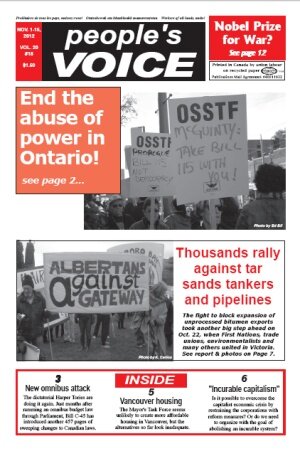
November 1-15, 2012
Volume 20 – Number 18
$1
Prolétaires de tous les pays, unissez-vous!
Otatoskewak ota kitaskinahk mamawestotan!
Workers of all lands, unite
1) RECALL THE ONTARIO LEGISLATURE: END THE ABUSE OF POWER!
2) 5,000 RALLY AGAINST TAR SANDS EXPORTS
3) VANCOUVER'S HOUSING TASK FORCE DRAWS CRITICISM
4) OMNIBUS BILL "ATTACK ON DEMOCRACY" SAYS COUNCIL OF CANADIANS
5) PUBLIC OWNERSHIP OF ENERGY - Editorial
6) ESTELLE PASSENGERS TRUE HEROES - Editorial
7) THE LABOUR MOVEMENT AND THE YOUTH
8) DON'T BLAME CHINESE WORKERS - BLAME CAPITALISM
9) THE NOBEL PRIZE FOR WAR
10) CANADA'S TOXIC SPILL OF ANTI-NATIVE RACISM
11) WHY CANADIANS MUST OPPOSE THE WAR THREAT
12) CASTE OPPRESSION IN BOTH INDIA AND CANADA
13) “CAPITALISM’S DISEASE IS INCURABLE”
14) ELECTORAL GAINS FOR EUROPEAN COMMUNISTS
15) THE BEST FILM ABOUT THE RUSSIAN REVOLUTION
16) MUSIC NOTES
PEOPLE'S VOICE NOVEMBER 1-15, 2012 (pdf)
|
People's Voice deadlines: November 16-30 December 1-31 Send submissions to PV Editorial Office,
|
REDS ON THE WEB
http://www.parti-communiste.ca/
peoplesvoice.ca
www.ycl-ljc.ca
www.solidnet.org
|
People's Voice finds many "Global Class Struggle" reports at the "Labour Start" website, http://www.labourstart.org/. We urge our readers to check it out! |
* * * * *
People's Voice
Canadian Publications Mail Sales Product Agreement #205214
ISSN number 1198-8657
People's Voice is published by
New Labour Press Ltd
PV Editorial Office
706 Clark Drive,
VANCOUVER, B.C. V5L 3J1
Phone:604-255-2041
Fax:604-254-9803
email: pvoice@telus.net
Editor: Kimball Cariou : Business Manager: Sam Hammond
Editorial Board: Kimball Cariou, Miguel Figueroa,
Doug Meggison, Naomi Rankin, Liz Rowley, Jim Sacouman
* * * * * *
Letters
People's Voice welcomes your letters
on any subject covered in our pages.
We reserve the right to edit for length and clarity,
and to refuse to print letters which may be libellous
or which contain unnecessary personal attacks.
Send your views to:
"Letters to the Editor",
706 Clark Dr., Vancouver, BC V5L 3J1,
or pvoice@telus.net
People's Voice articles may be reprinted without permission,
provided the source is credited.
* * * * * *
The Communist Party of Canada, formed in 1921,
has a proud history of fighting for jobs, equality, peace,
Canadian independence, and socialism.
The CPC does much more than run candidates in elections.
We think the fight against big business and its parties
is a year-round job,
so our members are active across the country,
to build our party and to help strengthen people's movements
on a wide range of issues.
All our policies and leadership
are set democratically by our members.
To find out more about Canada's party of Socialism,
give us a call at the nearest CPC office.
* * * * * *
Central Committee CPC
290A Danforth Ave Toronto, Ont. M4K 1N6
Ph: (416) 469-2446
fax: (416) 469-4063 E-mailmailto:info@cpc-pcp.ca
Parti Communiste du Quebec (section du
Parti communiste du Canada)
5359 Ave du Parc, Montréal, Québec,
H2V 4G9
B.C.Committee CPC
706 Clark Drive, Vancouver, V5L 3J1
Tel: (604) 254-9836
Fax: (604) 254-9803
Edmonton CPC
Box 68112, 70 Bonnie Doon P.O.
Edmonton, AB, T6C 4N6
Tel: (780) 465-7893
Fax: (780)463-0209
Calgary CPC
Unit #1 - 19 Radcliffe Close SE
Calgary AB, T2A 6B2
Tel: (403) 248-6489
Ottawa CPC
Tel: (613) 232-7108
Manitoba Committee
387 Selkirk Ave., Winnipeg, R2W 2M3
Tel/fax: (204) 586-7824
Ontario Ctee. CPC
290A Danforth Ave., Toronto, M4K 1N6
Tel: (416) 469-2446
Hamilton Ctee. CPC
265 Melvin Ave., Apt. 815
Hamilton, ON.
Tel: (905) 548-9586
Atlantic Region CPC
Box 70 Grand Pré, NS, B0P 1M0
Tel/fax: (902) 542-7981
http://www.parti-communiste.ca/
* * * * * *
News for People, Not for Profits!
Every issue of People's Voice
gives you the latest
on the fightback from coast to coast.
Whether it's the struggle for jobs or peace, resistance to social cuts,
solidarity with Cuba, or workers' struggles around the world,
we've got the news the corporate media won't print.
And we do more than that
- we report and analyze events
from a revolutionary perspective,
helping to build the movements for justice and equality,
and eventually for a socialist Canada.
Read the paper that fights for working people
- on every page, in every issue!
People's Voice
$30 for 1 year
$50 for 2 years
Low-income special rate: $15 for 1-year
Outside Canada $50 for 1 year
Send to: People's Voice, 706 Clark Drive, Vancouver, BC, V5L 3J1
You can call the editorial office at 604-255-2041
REDS ON THE WEB
http://www.parti-communiste.ca/
http://www.ycl-ljc.ca/
http://www.solidnet.org/
(The following articles are from the November 1-15, 2012, issue of People's Voice, Canada's leading communist newspaper. Articles can be reprinted free if the source is credited. Subscription rates in Canada: $30/year, or $15 low income rate; for U.S. readers - $45 US per year; other overseas readers - $45 US or $50 CDN per year. Send to People's Voice, c/o PV Business Manager, 706 Clark Drive, Vancouver, BC, V5L 3J1.)
1) RECALL THE ONTARIO LEGISLATURE: END THE ABUSE OF POWER!
The proroguing of the Ontario Legislature by Premier Dalton McGuinty has met widespread opposition from the labour and progressive movements. On Oct. 19, the Communist Party of Canada (Ontario) issued the following statement:
The Communist Party of Canada (Ontario) condemns Liberal Premier Dalton McGuinty's indefinite proroguing of the Provincial Parliament and suspension of parliamentary democracy, and demands the government recall Parliament and end its abuse of power.
Unable to pass his government's anti‑democratic "Protecting Public Services Act" (Bill 155) - which would legislate a wage freeze and suspend free collective bargaining across the public sector - the Premier wants to dispense with Parliament and try to impose his program of austerity without legislation. The government also hopes to evade any accountability or responsibility in the ongoing exposure of wrong‑doing by government Ministers and agencies.
The Liberals were counting on the Tories to support Bill 155, but the Tories are demanding the government go much further. The Tories are already campaigning to disembowel existing labour laws under the slogan of "flexible" labour law "reform". They want to eliminate the Rand Formula, make Ontario a right to work jurisdiction, and break the back of the labour movement as has been done in Wisconsin, Ohio, and other US states.
The Premier has said he will use the next months to force a negotiated wage freeze onto public sector unions. A negotiated wage freeze has the support of NDP leader Andrea Horwath according to statements made at a recent news conference filmed by CP24. While the NDP opposed a legislated freeze, they support a negotiated freeze. The NDP caucus apparently believes that working people should pay for an economic crisis caused by corporate greed and ably assisted by right‑wing governments in Ontario and elsewhere. The 99% would disagree with the caucus, just as they disagreed with Bob Rae's social contract in 1993.
The Liberals' anti‑labour, anti‑democratic austerity agenda has provoked massive public opposition, including ongoing protests and demonstrations. The prorogation is bound to generate even more opposition as public outrage at the government's abuse of power spills over.
The Communist Party calls on the Premier to immediately recall the Legislature, and move quickly to withdraw Bill 155, repeal Bill 115, and allow the province's public employers and public sector unions to move forward to freely negotiate unfettered collective agreements.
The Premier must also take the strong medicine needed to clean up the corruption caused by years of privatization and deregulation by stealth, including ORNGE and other P3 arrangements, and by vote‑buying in ridings with gas plants.
The Communist Party also demands that the Premier and the Liberal government, as well as the Tories and the NDP remove themselves from collective bargaining and let the public employers and public sector unions exercise their bargaining rights to negotiate free and unfettered agreements.
We stand with labour and all those who oppose this government's austerity policies, and the efforts to download the costs of the economic crisis onto the backs of working people through this on‑going attack on public sector wages, pensions, jobs and public services. A massive struggle against austerity in the streets and at the bargaining table is the only way to beat back the attack on wages, incomes, jobs and living standards, and save public services and assets.
Another Ontario is possible. And urgent. The Communist Party offers a 10 point prescription that is a pro‑people alternative to austerity. For details visit www.communistpartyontario.ca.
2) 5,000 RALLY AGAINST TAR SANDS EXPORTS
By Kimball Cariou
October 22 saw a powerful show of opposition to the expansion of tar sands pipelines and tankers along the British Columbia coast. About 5,000 people gathered on the lawn of the Legislature in Victoria, including hundreds trained in non-violent civil disobedience. In the end, police did not make arrests, an indication that the B.C. government prefers to avoid a direct confrontation with the movement against exports of diluted bitumen dug out of the tar sands in northern Alberta.
Held on a Monday (rather than a weekend when travel might have been easier), the rally was remarkable for its diversity. Hundreds arrived from communities in the northern interior and along the coast. Busloads of First Nations people joined activists from across Vancouver Island and the Vancouver area, and from many other places across North America. Flags of the Communications, Energy and Paperworkers Union (CEP) and the CAW, which have just voted to form a new union, flew prominently in the centre of the rally. Every major environmental group was represented, along with a host of groups based in smaller cities and towns.
The rally also united a wide range of political beliefs. Many participants were NDP or Green Party members, but others were Liberals or even Conservatives concerned about protection of the west coast. Communist Party members distributed hundreds of leaflets and copies of People's Voice, and took part in civil disobedience workshops held the previous day. And of course many demonstrators came from non-partisan or anarchist outlooks.
The rally was opened by First Nations leaders who led a march to the Legislature along the Victoria harbour. For several hours, speakers from organizing groups were interspersed with songs and First Nations drummers, as the civil disobedience unfolded. Over 300 volunteers risked arrest, erecting a black banner 235 metres in length, to show the size of an oil supertanker. Stakes to hold up the fabric were hammered into the lawn, in violation of the law, and the banner was extended across Belleville Street, also an illegal direct action. Police simply watched, and some even quietly agreed with the aims of the protest.
Far behind in the polls, Premier Christy Clark is trying to ride the wave of anti-Enbridge sentiment. On the morning of the rally, the Globe and Mail reported that Clark calls the dispute over potential revenues from the pipeline a "national crisis." But few in the crowd took Clark's posturing seriously, and the movement is increasingly united against any expansion of bitumen exports, for any price.
The strength of that opposition was seen again on Oct. 24, when thousands of people took part in over 60 local actions across the province against pipelines and tankers.
For more reports on the Oct. 22 action, including coverage of speakers and performers, visit www.defendourcoast.ca.
3) VANCOUVER'S HOUSING TASK FORCE DRAWS CRITICISM
By Kimball Cariou
Bike lanes, chicken coops and civil liberties may spark hot debates in Vancouver, but local controversies often revolve around housing. That's not surprising, since single detached home prices average about a million dollars here, and one‑bedroom condos cost over half a million. Over 50% of Vancouverites under 34 years old spend more than half their income on housing. Renters pay $1500 or more for a two‑bedroom suite. Despite some progress, homelessness remains a major problem. Many working people move to the suburbs, accepting the commute to get lower housing costs.
Against this background, Vancouver's task force on housing affordability was eagerly anticipated. Released in late September, the task force's recommendations met a skeptical reaction, not just from groups representing renters and low‑income people, but even among sectors which tended to back the governing Vision party in the past three civic elections.
Some pundits attribute this response to "communications" errors. Civic affairs blogger Frances Bula wrote, "the 15‑point priority action plan in Appendix A was just too big a wad of policy to swallow for many people... There were too many nuances and technical terms for reporters, even some hard‑working ones, to get everything that was in there."
There's an element of truth to this analysis. Looking for easy targets, the media jumped on the task force's so‑called "thin streets" proposal, essentially a plan to encourage new housing developments beside existing buildings along certain streets. This unpopular idea was quickly re‑branded an "option" for neighbourhoods to consider ‑ basically a way to drop the idea, without admitting that the concept was a fiasco.
But while the complexity and bulk of the report meant some misunderstandings, its general direction confirms the orientation of Mayor Robertson's Vision majority. On the one hand, they argue that building more housing will reduce prices for middle and low‑income people. But to make this happen, they rely on private developers who have a huge stake in driving up prices. Compounding the problem, investment in Vancouver real estate has become international in scope.
Having been elected in 2008 and 2011 largely on promises to make Vancouver more liveable and affordable, Robertson does hope to deliver.
But Vision may be trapped in a bind which he helped to create. The Mayor and his Vision councillors argue that they have a responsibility to ensure that more housing is built. This commitment, they say, sets them apart from neighbouring Burnaby, also governed by a centrist party linked to the NDP. The Burnaby council's view is that housing is a provincial and federal responsibility which should not be downloaded to municipalities.
Grassroots social housing advocates have tried for years to make the demand for a National Housing Strategy a priority issue. One campaign has been to earmark 1% of total federal spending for social and low‑income housing. Anti‑war groups point out that this could easily be achieved through a reduction in Canada's growing military spending.
But for tactical reasons, Vision has done relatively little to press Victoria and Ottawa for such commitments, even though the federal government boosted homelessness by eliminating funding for social housing during the 1980s and '90s.
Vancouver faces sky‑high prices for the relatively few spaces available to build on, and few political tools except incentives and zoning changes. So the Vision majority often gives quick approval for new high‑rises, despite significant neighbourhood criticism. Vision is increasingly regarded as a developer‑friendly party, especially since some of the same developers make big campaign donations.
Nothing in the Task Force changes this overall picture. One positive recommendation is to establish a Vancouver Housing Authority, a proposal first raised by the Coalition of Progressive Electors. It's also true that the Task Force calls for six‑story apartments on major streets, or stacked townhouses and rowhouses, not the high‑rises favoured by giant developers like Westbank, PCI, or Wall Developments.
But will these smaller‑scale projects lower housing costs? There are few teeth in the well‑intentioned hopes to encourage developers to make some percentage of new units available at vaguely‑defined affordable rates. Builders large and small want to make maximum profits; prices may fall only when the Vancouver bubble bursts, after twenty years of feverish speculation.
Unfortunately, the debate on the Task Force has so far been limited mainly to criticisms of Vision's pro‑market strategy.
One important response came from COPE, which lost its two city council members in a major electoral setback in 2011. COPE's Housing Affordability Committee has issued a 12‑page report, which warns that "the refusal of City Hall to build affordable housing capable of competing with and under‑cutting the private sector has left Vancouverites to rely on the private market alone. The City's dependence on private condominiums as the dominant form of housing tenure has fuelled unaffordability."
The COPE report criticizes the "incentivization of private construction" through tax exemptions and subsidies, the city's inadequate consultation process, a failure to acknowledge the impact of gentrification, and the lack of any meaningful definition of "affordability."
There is much to commend in the COPE report, which calls for an end to "renovictions", alternative forms of housing tenure, and other urgent reforms.
But the report also has some puzzling weaknesses. One is the implicit agreement with Vision that the housing crisis can mainly be resolved at the local level. In fact, there is only one reference to the responsibilities of provincial and federal governments, in the final sentence of the document.
Without major funding commitments from higher levels of government, how will social, low‑income, non‑market and co‑op housing be built? Here the report has little to say. For many years, COPE has urged that the city's Property Endowment Fund be tapped for urgent priorities such as low‑income housing. Yet the report does not mention this important potential revenue source. Nor does it include COPE's call for reversing the property tax shift which has benefited the city's business sector.
Instead, the report argues that building non‑market housing for the homeless will create additional funding for affordable housing "in a positive feed‑back loop, with money drawn away from currently‑strained City resources." In other words, money spent on emergency health and policing services for homeless persons could be saved simply by providing them with a place to live. This is quite true, but the funds to build such housing must be raised and then spent before the social savings start rolling in.
Similarly, the report addresses the problem of high land costs by proposing to "take a portion of land and housing out of the private marketplace." But how? It would take many billions of dollars for the city to buy enough private land, and municipal nationalization of such property would be immediately overturned by the capitalist state and courts.
Without presenting a coherent political approach to achieve these goals ‑ such as a wider struggle for a comprehensive national housing strategy ‑ the COPE report sounds more like a wish list than a serious plan to create affordable housing. Perhaps the authors could not resist the temptation to blame Vision and Mayor Robertson for the housing crisis. But by presenting this issue as mainly a municipal problem, the report lets the provincial and federal governments off the hook, and that's a strange shortcoming.
To read the COPE report, visit http://cope.bc.ca.
4) OMNIBUS BILL "ATTACK ON DEMOCRACY" SAYS COUNCIL OF CANADIANS
On Oct. 18, Finance Minister Jim Flaherty introduced the Harper government's new 457‑page omnibus budget implementation Bill C-45.
Toronto Star columnist Tim Harper listed some of the changes in Bill C-45 which "cannot be properly scrutinized (by MPs) to hold a government to account."
These include: amendments to the Canada Shipping Act and the Fisheries Act; changes the definition of an aboriginal fishery; eliminating environmental restrictions on building a bridge across the Detroit River; amendments to the Indian Act to change voting rules for land designation; changes to benefits and salaries for federally‑appointed judges; amending the Customs Act to make it easier for the government to collect information on passengers; a temporary refund on Employment Insurance premiums for small business owners; elimination of the Hazardous Materials Information Review Commission; changing the Navigable Waters Act to eliminate impediments to pipelines, power lines or forestry equipment.
C-45 will also mean new changes to the Environmental Assessment Act. The Bill makes workers pay taxes on their employers' contributions to group health and accident insurance plans, and sets time limits on worker complaints under the Canada Labour Code.
The Council of Canadians strongly criticized Stephen Harper's first omnibus budget bill, and says Bill C‑45 continues "this undemocratic manipulation of our political system."
"This bill calls our whole democracy into question," says Maude Barlow, national chairperson of the Council. "Laws are now made unilaterally by the Prime Minister, with no regard for the people or their parliamentarians."
C-45 has been defined as a budget bill to ensure that the vote is a confidence vote. MPs - including Conservative backbenchers - cannot amend this bill, even to protect the interests of their own communities. As a result, warns the Council, the Prime Minister's Office, a small group of political appointees, now have more power than MPs.
The last omnibus bill contained everything from the gutting of environmental assessments to Employment Insurance cuts. It extended the age to collect pensions, shut down long‑standing government agencies, and made fundamental changes to the Fisheries Act.
Bill C‑45 again denies House of Commons Committees the chance to examine areas pertaining to their expertise. MP pension reductions, pipelines, small business tax credits, interprovincial trade rules, cross‑border travel and environmental assessments will be reviewed by a few members of the Finance Committee in a very compressed and superficial manner, says the Council. The group says it will stand with many organizations and individual Canadians in rejecting these tactics to remove political oversight and accountability.
People's Voice Editorial
Across the planet, ownership and control of natural resources - especially energy - is an urgent issue. U.S. imperialism and its allies are shifting their military might into the Middle East and Asian Pacific regions, largely to secure domination over such resources. The human cost is enormous, from those killed in the occupations of Iraq and Afghanistan, to the lives cut short by spending on weapons rather than clean water, housing, health care and other urgent needs.
This is the backdrop for the escalating struggle over economic policies within the borders of the Canadian state. From the Abbott Plan - the post-WW2 decision of the emerging Canadian ruling class to become a supplier of raw materials for the Yankee war machine - to the free trade era, manufacturing and secondary industry have declined, and reliance on raw materials has grown.
Today, the sharpest fight is over the extraction and export of unprocessed tar sands bitumen. In this situation, some argue that Canada should block energy deals with Chinese-based companies, or that the Canada-China Foreign Investment Promotion and Protection Agreement is "worse" than other FIPAs signed by the undemocratic Harper government without public debate. This approach is based on the absurd claim that China is less democratic or more militaristic than the United States or other western imperialist powers.
Here's the real question: why not nationalize energy resources in Canada? Public ownership under democratic control would offer a path to redress the historic theft of Aboriginal lands and resources, and to use energy resources to meet Canadian domestic needs and dramatically reduce carbon emissions. The blind greed of the ruling class cannot remain the determining factor in setting economic policy. The call for public ownership must be raised within the growing struggles to end the destructive extraction and export of the tar sands.
6) ESTELLE PASSENGERS TRUE HEROES
People's Voice Editorial
Canadians were relieved to hear that Jim Manly, the former Member of Parliament, had been released from an Israeli prison. We join with others in extending our thanks to all the passengers and crew of the Freedom Flotilla vessel Estelle, for their courageous action against the illegal blockade of Gaza.
Details are gradually emerging about the brutal conduct of Israeli troops during their seizure of the vessel, which was bringing humanitarian aid to the people of Gaza. Israel's lie that the Estelle may have been bringing weapons to Gaza is utterly ludicrous; few boats have ever been subjected to such intense and public searches before sailing.
Several passengers on the Estelle were members of parliament from Norway, Sweden, Greece and Spain. But no current Canadian MPs were on board, and none dared express support for the solidarity mission. This is sad but hardly surprising, since the Harper Tories and the corporate media immediately demonize any public figures who criticize the Israeli state's apartheid policies. One of the worst examples is the National Post's shameful slander of Gaza solidarity activists as "holocaust deniers." Such media could look at Canada's home-grown white supremacists for some real anti-Semitism; perhaps their reluctance stems from embarrassing links between these hate groups and ultra-right activists inside the Conservative Party.
Fortunately, criticism of Israel's policies is stronger in other countries. As the Flotilla organizers said, "the Estelle's mission was successful in declaring to the world that Israel's blockade of Gaza is inhuman and illegal, and showing to the Palestinians in Gaza that our solidarity is relentless and we will come again." Very true, and the Harper Tories will not silence us here in Canada.
7) THE LABOUR MOVEMENT AND THE YOUTH
By Rick Gunderman, Hamilton
In the midst of the capitalists' economic crisis, organized labour in Canada has been seeking for several years now to reorient itself to meet the needs of the working class.
Attacks on the public sector include the imposition of a wage freeze in various jurisdictions, the designation of ever‑more segments as "essential services" to undermine the right to strike, and back‑to‑work legislation. The response needs to be a determined, united and militant struggle of the working class.
Promising developments in the Canadian labour movement have shown the willingness of organized labour to not only survive, but to grow and regain their prominence and influence. These include the formation of the Common Front led by the Ontario Federation of Labour, the involvement of organized labour in Quebec in the student strike, and the decision of the Canadian Auto Workers and the Communications, Energy and Paperworkers to form Canada's largest private‑sector union.
Amid these positive developments, however, are underlying concerns, especially for progressive youth. Unionization rates are particularly low among young workers, with many youth and students employed in tenuous, part‑time labour. Despite several militant struggles, such as those waged by workers at US Steel, Caterpillar and Vale Inco, Canada continues to experience deindustrialization due to outsourcing and continued dominance of transnational capital. This has left far fewer good‑paying, unionized industrial jobs for Canadian youth than our parents and grandparents had available to them.
Successive governments, the grip of neo‑liberal ideology on the mass media, and of course the unceasing efforts of monopoly and finance capital to demonize organized labour, have all attempted for the last several decades to smash the labour movement.
It's not difficult to see why. To the extent that some unions in Canada rejected business unionism in favour of social unionism, the Canadian labour movement had a greater capacity for survival than their brothers and sisters in the United States.
Social unionism combines militant struggles against the employer with broader involvement in community and social justice struggles. What could cause a capitalist to tremble with greater fear?
In spite of decades of concerted attacks by the capitalist class, as well as a delay in presenting an effective response, organized labour in Canada has survived and is showing signs of reinvigoration and a renewed desire to fight the capitalist system.
From a dialectical point of view, this is good news. Struggles are the key means by which the working class acquires its political and class education, and it appears that the Canadian labour movement is preparing for many new struggles. Having seemingly "went to sleep" since the class struggle shifted in favour of the capitalists in the late 1970s and early 1980s, the reawakening of the labour movement will demonstrate that the only effective way to advance the working class is through unapologetic, dauntless, and above all else united class struggle. The complete bankruptcy of the twin policies of business unionism and class collaboration will be laid bare for all to see.
It's too soon to predict a massive union drive among young workers. However, the appearance of young workers' committees among various unions, such as CUPE and OPSEU, is encouraging. Should the labour movement as a whole focus at least a significant part of its efforts on refreshing its ranks with young, class‑conscious workers, the survival and advancement of organized labour in Canada will be all but assured.
The tradition of social unionism is of vital importance to the unity of organized labour with all those rejecting neo‑liberalism and seeking social justice. This naturally includes the student movement, alongside feminists, anti‑racists, environmentalists, anti‑war activists, LGBTQ persons and their supporters, seniors' rights advocates, etc.
The case of the unity of the student movement in Quebec with these forces is illustrative. The Liberal government of Jean Charest responded with police brutality, anti‑democratic and oppressive laws and a slanderous campaign against the students. In the end, however, the unity of all progressive people in Québec forced Charest to resign and brought the Parti Québecois to power.
Organized labour in Québec, like most popular democratic forces in the province, is considerably more active and confrontational. Their example has proven to be effective. The gains of the movement in Québec this year cannot be said to be revolutionary, but they have left the people's forces with a seemingly much less hostile environment in which to work. Those with experience in political activism know how valuable this is.
At the same time, movements cannot slow down after victories, major or minor, but must always continue full speed ahead. This is the lesson of the last one‑third of the 20th Century for the labour movement across Canada.
The student movement would do well to reflect on their own experiences, including the dramatic weakening of student activism as a result of OUSA and CASA raiding CFS‑affiliated student unions. The comparisons and contrasts with the experience of the labour movement will provide further valuable insight. In the end, this will serve to reinforce this truth: that only a determined, united and militant struggle of the working class can challenge the rule of capital and the increasingly anti‑democratic nature of the Western world's governments.
8) DON'T BLAME CHINESE WORKERS - BLAME CAPITALISM
PV Commentary
The news that 2,000 coal miners are being recruited in China to work in British Columbia sent shock waves through the labour movement, especially since these workers will be paid below current wages in the industry. But in sharp contrast to the anti-Asian riots by some Canadian workers a century ago, there have been no expressions of racism by trade unions in the current situation.
According to The Tyee online news site, Chinese miners being recruited for temporary work in Canada must pay for the privilege, and their actual wages are less than advertised.
Posing as a Chinese miner, a Tyee journalist contacted two of three companies that placed ads on a Chinese website, and found that the workers are paying fees to recruiters in exchange for jobs in Canada. One recruiter, who claimed to be working for the B.C.-based Canada CIBS Investment and Trade Group, said 30,000 yuan ($4,700) is paid upon a contract being signed in China. An additional 50,000 yuan ($7,800) will be paid over 20 months after arrival in Canada, through $400 monthly deductions from the workers' paycheques.
The advertisement offered jobs in Canadian mines at a rate of $25 to $30 per hour, but according to the recruiter the wage is actually between $22 and $25 per hour.
Speaking on CKNW radio, B.C. Jobs Minister Pat Bell claimed that the company had "undergone an exhaustive search" for Canadian applicants and had "come up empty handed."
That argument does not convince Frank Everitt, president of USW Local 1‑424.
"I just think it's shameful, I think there are enough people in Northern B.C. that they could recruit for the mine," said Everitt. "It's not that we haven't done it, it's just that nobody has put the resources to it and it's a scam to bring guest workers in."
According to the Steelworkers, the three companies involved always intended to hire temporary foreign workers. They received government approval to bring up to 2,000 miners into B.C. to work in new mining operations, by claiming not enough Canadian workers are available. Job postings by the companies list standard qualifications such as mining experience and training certificates, plus "Other languages: Mandarin."
The ads appeared online through Human Resources and Skills Development Canada's job posting service, and were placed by HD Mining, Canadian Kailuan Dehua Mines, and Canadian Dehua International Mines Group, searching for hundreds of workers to fill a variety of positions at four mines.
"Never in the history of Canadian mining have we ever seen a requirement to speak Mandarin mentioned in a posting for a job in a Canadian mine," says Steve Hunt, the Steelworkers' Western Canadian Director. "A requirement like that automatically eliminates the vast majority of Canadian job applicants from consideration. What possible justification can the company provide for requiring Mandarin to be spoken in a mine in B.C., other than being a convenient and disingenuous way to claim there are no qualified Canadian applicants?"
This situation appears to be simply another example of the Harper Tory government's cheap labour strategy. While cutting back on immigration and refugee numbers, the Tories have expanded the Temporary Foreign Worker Program, and allowed employers to pay temporary workers 15% below the standard wages. It appears that in this case, the differential will be in the 30% range or even higher. There are now an estimated 300,000 temporary foreign workers in Canada, triple the number of a decade ago, employed in virtually every industry and region of the country.
Understanding that the government/employer strategy is pitting Canadian vs. "foreign" workers, the labour movement is reaching out to temporary workers, offering assistance in standing up for their rights. This struggle will be ever more crucial as right-wing forces try to blame foreign workers for high unemployment and falling living standards.
It is probably no coincidence that neo-nazi and white racist movement in Canada, which declined in the mid-1990s, has begun to re-emerge in recent years. Similar trends are seen in Europe, such as the fascist Golden Dawn anti-immigrant party in Greece.
Our problem is not Chinese workers, who have a fundamental human right to seek better-paying employment in other countries. Unemployment and economic crisis are endemic to capitalism, regardless of the specifics of the labour market at any particular moment. Neither is our problem that "bad" foreign companies are hurting "good" Canadian companies. (Tell that one to victims of Canadian-based mining firms in many Third World countries!)
Our problem is the capitalist system itself, and a far-right Tory government eager to help corporations slash wages, working conditions, pensions, and social benefits, in short to increase exploitation with the aim of boosting private profits. The solution is greater unity of all workers - organized and unorganized, employed and unemployed, Aboriginal and non-Aboriginal, Canadian-born and migrants, young and old, of all genders, no matter what our language or ethnic backgrounds.
As the saying goes, an injury to one is an injury to all. The Chinese miners being recruited to work here are being injured through lower wage rates. Our fight is not to keep them out - it will be to help them win the same wages and working conditions achieved through generations of struggle by miners in this country.
By Michael Parenti
Those who own the wealth of nations take care to downplay the immensity of their holdings while emphasizing the supposedly benign features of the socio‑economic order over which they preside. With its regiments of lawmakers and opinion‑makers, the ruling hierarchs produce a never‑ending cavalcade of symbols, images, and narratives to disguise and legitimate the system of exploitative social relations existing between the 1% and the 99%.
The Nobel Peace Prize would seem to play an incidental role in all this. Given the avalanche of system‑sustaining class propaganda and ideological scenarios dished out to us, the Nobel Peace Prize remains just a prize. But a most prestigious one it is, enjoying a celebrated status in its anointment of already notable personages.
In October 2012, in all apparent seriousness, the Norwegian Nobel Committee (appointed by the Norwegian Parliament) bestowed the Nobel Peace Prize upon the European Union (EU). Let me say that again: the European Union with its 28 member states and 500 million inhabitants was awarded for having "contributed to the advancement of peace and reconciliation, democracy, and human rights in Europe." (Norway itself is not a member of the EU. The Norwegians had the good sense to vote against joining.)
Alfred Nobel's will (1895) explicitly states that the peace prize should go "to the person who shall have done the most or the best work for fraternity between nations, for the abolition or reduction of standing armies and for the holding and promotion of peace congresses."
The EU is not a person and has not worked for the abolition or reduction of standing armies or promotion of any kind of peace agenda. If the EU award looked a bit awkward, the BBC and other mainstream news media came to the rescue, referring to the "six decades of peace" and "sixty years without war" that the EU supposedly has achieved. The following day, somebody at the BBC did the numbers and started proclaiming that the EU had brought "seventy years of peace on the European continent." What could these wise pundits possibly be thinking? Originally called the European Economic Community and formed in 1958, the European Union was established under its current name in 1993, about twenty years ago.
The Nobel Committee, the EU recipients, and the western media all overlooked the 1999 full‑scale air war launched on the European continent against Yugoslavia, a socialist democracy that for the most part had offered a good life to people of various Slavic nationalities ‑ as many of them still testify today.
The EU did not oppose that aggression. In fact, a number of EU member states, including Germany and France, joined in the 1999 war on European soil led largely by the United States. For 78 days, U.S. and other NATO forces bombed Yugoslavian factories, utilities, power stations, rail systems, bridges, hotels, apartment buildings, schools and hospitals, killing thousands of civilians, all in the name of a humanitarian rescue operation, all fuelled by unsubstantiated stories of Serbian "genocide." All this warfare took place on European soil.
Yugoslavia was shattered, along with its uniquely designed participatory democracy with its self‑management and social ownership system. In its place emerged a cluster of right‑wing mini‑republics wherein everything has been privatized and deregulated, and poverty has replaced amplitude. Meanwhile rich western corporations are doing quite well in what was once Yugoslavia.
Europe aside, EU member states have sent troops to Afghanistan, Iraq, Libya, and additional locales in Africa, the Middle East, and Central Asia, usually under the tutorship of the U.S. war machine.
But what was I to expect? For years I ironically asserted that the best way to win a Nobel Peace Prize was to wage war or support those who wage war instead of peace. An overstatement perhaps, but take a look.
Let's start back in 1931 with an improbable Nobel winner: Nicholas Murray Butler, president of Columbia University. During World War I, Butler explicitly forbade all faculty from criticizing the Allied war against the Central Powers. He equated anti‑war sentiments with sedition and treason. He also claimed that "an educated proletariat is a constant source of disturbance and danger to any nation." In the 1920s Butler became an outspoken supporter of Italy's fascist dictator Benito Mussolini. Some years later he became an admirer of a heavily militarized Nazi Germany. In 1933, two years after receiving the Nobel prize, Butler invited the German ambassador to the U.S. to speak at Columbia in defense of Hitler. He rejected student appeals to cancel the invitation, claiming it would violate academic freedom.
Jump ahead to 1973, the year one of the most notorious of war criminals, Henry Kissinger, received the Nobel Peace Prize. For the better part of a decade, Kissinger served as Assistant to the President for National Security Affairs and as U.S. Secretary of State, presiding over the seemingly endless blood‑letting in Indochina and ruthless U.S. interventions in Central America and elsewhere. From carpet bombing to death squads, Kissinger was there beating down on those who dared resist U.S. power. In his writings and pronouncements Kissinger continually talked about maintaining U.S. military and political influence throughout the world. If anyone fails to fit Alfred Nobel's description of a prize winner, it would be Henry Kissinger.
In 1975 we come to Nobel winner Andrei Sakharov, a darling of the U.S. press, a Soviet dissident who regularly sang praises to corporate capitalism. Sakharov lambasted the U.S. peace movement for its opposition to the Vietnam War. He accused the Soviets of being the sole culprits behind the arms race and he supported every U.S. armed intervention abroad as a defense of democracy. Hailed in the west as a "human rights advocate," Sakharov never had an unkind word for the horrific human rights violations perpetrated by the fascist regimes of faithful U.S. client states, including Pinochet's Chile and Suharto's Indonesia, and he aimed snide remarks at the "peaceniks" who did. He regularly attacked those in the West who opposed U.S. repressive military interventions abroad.
Let us not overlook Mother Teresa. All the western world's media hailed that crabby lady as a self‑sacrificing saint. In fact she was a mean spirited reactionary who gladly welcomed the destruction of liberation theology and other progressive developments in the world. Her "hospitals" and "clinics" were little more than warehouses for the dying and for those who suffered from curable diseases that went untreated ‑ eventually leading to death. She waged campaigns against birth control, divorce, and abortion. She readily hobnobbed with the rich and reactionary but she was so heavily hyped as a heavenly heroine that the folks in Oslo just had to give her the big medal in 1979.
Then there was the Dalai Lama who was awarded the Nobel Peace Prize in 1989. For years the Dalai Lama was on the payroll of the CIA, an agency that has perpetrated killings against rebellious workers, peasants, students, and others in countries around the world. His eldest brother played an active role in a CIA‑front group. Another brother established an intelligence operation with the CIA, which included a CIA‑trained guerrilla unit whose recruits parachuted back into Tibet to foment insurgency. The Dalai Lama was no pacifist. He supported the U.S./NATO military intervention into Afghanistan, also the 78 days' bombing of Yugoslavia and the destruction of that country. As for the years of carnage and destruction wrought by U.S. forces in Iraq, the Dalai Lama was undecided: "it's too early to say, right or wrong," said he in 2005. Regarding the violence that members of his sect perpetrated against a rival sect, he concluded that "if the goal is good then the method, even if apparently of the violent kind, is permissible." Spoken like a true Nobel recipient.
In 2009, in a fit of self parody, the folks in Oslo gave the Nobel Peace Prize to President Barack Obama while he produced record military budgets and presided over three or four wars and a number of other attack operations, followed a couple of years later by additional wars in Yemen, West Pakistan, Libya, and Syria (with Iran pending). Nobel winner Obama also proudly hunted down and murdered Osama Bin Laden, having accused him ‑ without a shred of evidence ‑ of masterminding the 9/11 attacks on the World Trade Center and the Pentagon.
You could see that Obama was somewhat surprised ‑ and maybe even embarrassed ‑ by the award. Here was this young drone commander trying to show what a tough‑guy warrior he was, saluting the flag‑draped coffins one day and attacking other places and peoples the next ‑ acts of violence in support of the New World Order, certainly every bit worthy of a Nobel peace medal.
There are probably other Nobel war hawks and reactionaries to inspect. I don't pretend to be informed about every prize winner. And there are a few worthy recipients who come to mind, such as Martin Luther King, Jr., Linus Pauling, Nelson Mandela, and Dag Hammarskjold.
Let us return to the opening point: does the European