|
|
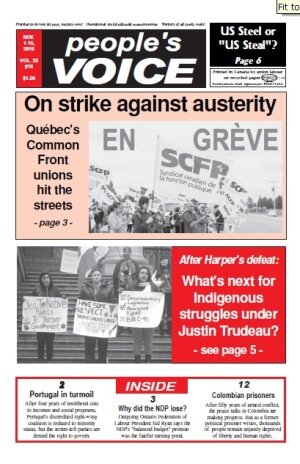
People’s Voice November 1-15, 2015
Volume 23 – Number 18 $1
1) ELECTION 2015 - IMPORTANT VICTORY, NEW CHALLENGES
2) COMMON FRONT LAUNCHES ROTATING STRIKES ACROSS QUEBEC
4) TRUDEAU’S INDIGENOUS POLICY: GRASSROOTS PRESSURE NEEDED
5) THE RCMP: A NATIONAL DISGRACE - Editorial
6) UNFAIR ELECTIONS MUST CHANGE - Editorial
7) WHY SHOULD MINORITIES IN CANADA AND INDIA FEEL UNLOVED?
8) WHO ARE THE POLITICAL PRISONERS IN COLOMBIA?
9) PORTUGAL: PRESIDENT ASKS RIGHT TO FORM GOVERNMENT DESPITE LEFT MAJORITY
10) PRESIDENT OF INDIA FACES DEMONSTRATORS IN PALESTINE
11) MUSIC NOTES, by Wally Brooker
12) RUSSIAN INTERVENTION EXPOSES COALITION LIES
PEOPLE'S VOICE NOVEMBER 1-15, 2015 (pdf)
|
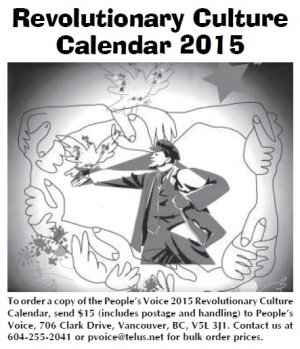
To order a copy send $15 (includes package and handling) to People’s Voice, 706 Clark Drive, Vancouver, BC, V5L 3J1. Contact us at 604-255-2041 or pvoice@telus.net for bulk order prices. |
|
People's Voice deadlines: November 16-30 December 1-31 Send submissions to PV Editorial Office,
|
|
|
REDS ON THE WEB
http://www.communist-party.ca
peoplesvoice.ca
www.ycl-ljc.ca
www.solidnet.org
|
People's Voice finds many "Global Class Struggle" reports at the "Labour Start" website, http://www.labourstart.org/. We urge our readers to check it out! |
* * * * * *
Central Committee CPC
290A Danforth Ave Toronto, Ont. M4K 1N6
Ph: (416) 469-2446
fax: (416) 469-4063 E-mailmailto:info@cpc-pcp.ca
Parti Communiste du Quebec (section du
Parti communiste du Canada)
5359 Ave du Parc, Montréal, Québec,
H2V 4G9
B.C.Committee CPC
706 Clark Drive, Vancouver, V5L 3J1
Tel: (604) 254-9836
Fax: (604) 254-9803
Edmonton CPC
Box 68112, 70 Bonnie Doon P.O.
Edmonton, AB, T6C 4N6
Tel: (780) 465-7893
Fax: (780)463-0209
Calgary CPC
Unit #1 - 19 Radcliffe Close SE
Calgary AB, T2A 6B2
Tel: (403) 248-6489
Ottawa CPC
Tel: (613) 232-7108
Manitoba Committee
387 Selkirk Ave., Winnipeg, R2W 2M3
Tel/fax: (204) 586-7824
Ontario Ctee. CPC
290A Danforth Ave., Toronto, M4K 1N6
Tel: (416) 469-2446
Hamilton Ctee. CPC
265 Melvin Ave., Apt. 815
Hamilton, ON.
Tel: (905) 548-9586
Atlantic Region CPC
Box 70 Grand Pré, NS, B0P 1M0
Tel/fax: (902) 542-7981
* * * * * *
News for People, Not for Profits!
Every issue of People's Voice
gives you the latest
on the fightback from coast to coast.
Whether it's the struggle for jobs or peace, resistance to social cuts,
solidarity with Cuba, or workers' struggles around the world,
we've got the news the corporate media won't print.
And we do more than that
- we report and analyze events
from a revolutionary perspective,
helping to build the movements for justice and equality,
and eventually for a socialist Canada.
Read the paper that fights for working people
- on every page, in every issue!
People's Voice
$30 for 1 year
$50 for 2 years
Low-income special rate: $15 for 1-year
Outside Canada $50 for 1 year
Send to: People's Voice, 706 Clark Drive, Vancouver, BC, V5L 3J1
You can call the editorial office at 604-255-2041
<pvoice@telus.net>
REDS ON THE WEB
www.communist-party.ca
peoplesvoice.ca
www.ycl-ljc.ca/
http://solidnet.org/
http://www,rebelyouth-magazine.blogspot.com
(The following articles are from the November 1-15, 2015, issue of People's Voice, Canada's leading socialist newspaper. Articles can be reprinted free if the source is credited. Subscription rates in Canada: $30/year, or $15 low income rate; for U.S. readers - $45 US per year; other overseas readers - $45 US or $50 CDN per year. Send to People's Voice, c/o PV Business Manager, 706 Clark Drive, Vancouver, BC, V5L 3J1.)
1) ELECTION 2015 - IMPORTANT VICTORY, NEW CHALLENGES
Statement on the October 19 federal election, from the Central Executive Committee, Communist Party of Canada
The outcome of the October 19th federal election which drove the Harper government from power marked a significant victory for the working class, for indigenous peoples, for women, youth and students, for the unemployed and underemployed, and for the LGBTiQ communities. It was a victory for all those dedicated to peace and disarmament, for immediate action to combat climate change, and to the struggle for social equity and social justice. After almost a decade of Conservative rule, a large majority across Canada used their franchise to ensure that the Tories’ tenure in office came to a definitive end.
The strong desire to unseat the Harper Conservatives was reflected in a substantial increase in voter turnout at the polls. Participation reached 68.5% – the highest since 1993 – especially among youth and in First Nations communities, in some cases more than doubling previous turnout rates.
The electoral demise of the Conservatives had been anticipated for some time. The imposition of a vicious austerity agenda at home, together with increased militarism and pro-war, imperialist policies abroad, had turned a substantial majority of the people against them. The intensified attack on public and social services, and the failure to create full-time, well-paying employment, to prevent job losses and plant closures and to stimulate growth, had increased poverty and widened disparities between the bloated balance sheets of big Capital on one hand, and the economic hardships facing working people, on the other. Other important issues, including the Tories’ assault on the rights of labour (strike-breaking injunctions, C-377, etc.) and on democratic rights and civil liberties (C-51), its racist treatment of Aboriginal peoples, and its abysmal record on protecting the environment and fighting climate change, also contributed to the growth of anti-Conservative opinion.
Nevertheless, there were concerns within the anti-Harper camp that due to the distorted “first-past-the-post” electoral system, the redrawing of electoral boundaries, and the government’s attempts at voter suppression through changes imposed by the (Un)Fair Elections Act of 2014, the Tories might still manage to survive, depending on how the vote split among the mainstream opposition parties. The Conservatives also had swollen coffers with which to outspend the others during the record-long 78-day campaign period that they had arranged precisely for that purpose.
Despite these advantages, the Harper Tories were unable to swing momentum to their advantage. In a desperate bid to cling to power, the Conservatives then resorted to a crude, racist fear-mongering campaign, claiming that Canada must close the “floodgates” against refugees who would overwhelm our shores and undermine Canadian society. They incited Islamophobia among sections of the population by reviving the bogus niqab issue, and announcing the establishment of a snitch-line to inform on those guilty of “barbaric cultural practices” not in tune with the values of “old stock” Canadians.
In the end, those sordid tactics failed to stem the tide of defeat. Still, the Conservatives managed to hold onto a core base of 30% support among the electorate, and were overwhelmingly endorsed by the corporate-controlled media.
More alarming is the fact that overtly racist positions have now intruded into public political discourse across the country, just as it has been elevated into the “mainstream” in many European countries by ultra-right and neo-fascist parties and groups. No doubt the Conservative party – now relegated to the Opposition benches – will use its ruling class connections, its base among so-called “social conservatives”, and its majority in the non-elected Senate, to undermine attempts to reverse the reactionary and imperialist policies imposed over the past decade.
As events turned out, it was not the social democratic NDP, but rather the Liberal Party under Justin Trudeau which became the main beneficiary of the electoral backlash against the Tories. The Liberals ended up capturing 147 additional ridings, giving that party a comfortable majority in the new Parliament with 184 out of 338 seats. They swept the Atlantic Provinces and the Far North, and captured new seats in virtually every major urban centre, especially in the Greater Toronto area, on the island of Montreal and B.C.’s Lower Mainland where they won almost all ridings.
The Liberal gains came at the expense of both the ruling Conservatives and the New Democrats, whose party has now lost its “Official Opposition” privileges and been reduced to third party status in the House of Commons.
As the Ontario Liberals did last year, the Trudeau Liberal victory came by skillfully exploiting the popular desire for change, positioning themselves as the only party which could ensure the defeat of Harper and his cronies. They out-maneuvred the NDP, promising “real change” by shedding (actually just postponing) Harper’s austerity agenda in favour of stimulus spending, and by pledging to reverse many unpopular decisions of the previous government (e.g., the increase of retirement age from 65 to 67, the end of home delivery by Canada Post, budget cuts to CBC, etc.). The Liberals successfully postured as the only “real” alternative among the mainstream political parties.
This ruse is belied by the reality that the Liberal Party remains a thoroughly bourgeois, big business party; it has not changed its political colouring or class orientation. It remains committed to neoliberal economic doctrine at home, and to an imperialist, pro-war foreign policy abroad. The failure of the other opposition parties to fully expose the false character of the Liberal “alternative” is rooted in the fact that both the NDP and the Greens essentially share this bourgeois, status quo consensus.
The dismal campaign of the NDP, and the resulting collapse of its electoral support (both in terms of seats and popular vote), was particularly striking. At the beginning of this 78-day campaign, the NDP was at the top of the polls, and widely expected to capture the bulk of the anti-Harper vote. But instead of advancing a clear and comprehensive alternative, Thomas Mulcair and his backroom strategists presented a tepid platform of minor reforms, but one essentially designed to reassure ruling capitalist circles that the NDP posed no serious threat to their interests. They even offered increased “investment incentives” to large corporations and major tax cuts to small business, and pledged continued support for military spending and to NATO. This approach failed miserably to galvanize support among working people looking for a real break from the pro-corporate and pro-war agenda of the Harper Tories.
The turning point triggering the NDP’s decline came when Mulcair announced the NDP’s intention to “balance the books” in every annual budget, and that its commitment to balanced budgets would trump all other financial considerations and allocations. Not only did this policy shift signal that a Tony Blair-style NDP government would continue the Tories’ neoliberal austerity program (widely dubbed as “Harper-lite”); it also reinforced prevailing bourgeois propaganda in favour of “fiscal restraint”, and allowed the Liberal party (and also the Greens) to out-flank the NDP on the left.
This rightward policy shift of the NDP is hardly new, nor particularly surprising; indeed, like most other social democratic formations, the NDP has been gradually repositioning itself toward the “centre” of the bourgeois political spectrum for several decades, discarding its advocacy of “ballot-box socialism” and jettisoning many of its traditional social democratic policies. It has distanced itself from the labour movement and instead appealed to the ‘middle strata’ of professionals and small business people (i.e., the petty bourgeoisie), while accommodating the interests of monopoly capital.
The NDP’s rightward shift during this campaign however was especially pronounced, leading many – even long-time supporters and party members – to abandon the party in favour of a more “left”-sounding Liberal party. As polling results worsened during the final weeks of the campaign, the anti-Harper vote strategically migrated elsewhere. This was especially the case in Quebec, where the NDP lost over a half-million votes, primarily to the Liberals.
What Next?
Now that the initial euphoria over the defeat of the Conservatives is receding, the labour movement, the left and democratic forces need to reorient on contending with a new Liberal majority in Ottawa. Liberals have a notorious tradition of campaigning from the left, and governing from the right. The main challenge today will be to mobilize the popular forces to pressure the new government to implement promises made during the campaign, and to make further, more advanced demands for fundamental change that serve the interests of working people, the environment, and the cause of peace and disarmament.
The Trudeau Liberals committed to a long list of policy changes on the campaign trail, including: to end Canada’s combat mission in the “war on ISIL” in Iraq & Syria; to raise taxes on the wealthy; to launch major infrastructe projects; to revamp child benefits; to restore home mail delivery; to increase the flow of Syrian refugees; to set ambitious emission-reduction targets; around pension reform; to introduce electoral reform, replacing the “first-past-the-post” system; to restore funding to CBC; to repeal Bill C-24 which created two classes of citizenship; and not least, to launch a full public enquiry into the 1,181 missing and murdered Aboriginal women across Canada.
Experience teaches however that in the realm of bourgeois politics, there is inevitably a great divide between what people expect to get, and what they actually end up receiving. It is therefore imperative to re-energize and strengthen the mass extra-parliamentary movements of the people to hold the Liberals’ “feet to the fire” to demand that these commitments are met in full.
This is particularly the case around the issue of democratic electoral reform and the fight for proportional representation (PR). Measures are also urgently needed to reduce campaign spending by political parties, both during and between elections, and to repeal the anti-democratic changes imposed by C-23 (the Conservatives’ “Fair Elections Act”).
Other crucial battles also need to be waged, including the struggle to defeat the dangerously pro-corporate Trans Pacific Partnership (TPP) agreement which must be ratified by every provincial legislature; the continuing campaign to repeal, rather than superficially amend, the anti-democratic C-51 (anti-terrorist law); the fight to repeal anti-labour legislation; the campaign to cut military spending and to exit NATO, etc.
In many respects, the objective terrain to win these and many other democratic, economic and political demands has improved with the demise of the Harper government. Resistance however will not be built by relying on spontaneity, but rather through a conscious political and organizational struggle to invigorate the extra-parliamentary movements, and an ideological struggle to shed illusions about the bourgeois role and character of the Liberal government.
The Communist Campaign
Overall, we can be very pleased with the efforts mounted by our Clubs, local campaign committees and our 26 candidates during this election. We take this opportunity to acknowledge the excellent work of our candidates, and to thank them and all of our members, friends and supporters who contributed to our electoral work over the past several months.
Our Party realized from the outset that this would a difficult campaign to wage, considering the obstacles facing us. Once again, the mainstream corporate media virtually blacked out coverage of our party and its candidates. Once again, our size and meager resources limited our ability to reach a larger audience with our platform and political perspective. Once again, our candidates were excluded from local all-candidates debates in a number of instances. And the “first-past-the-post” system, combined with an intense desire to defeat the Conservatives and the impact of campaigns – at least among some sections of voters – to vote strategically to achieve that end, made it very difficult to increase the size of our vote at the polls. Despite these circumstances however, we made some modest but notable gains, especially in Vancouver East, Vancouver Kingsway, Calgary Forest Lawn, and Davenport, where our candidates won very respectable vote counts.
While fighting for every possible vote, our Party’s objectives were not primarily focused on the vote tally itself. Rather, our main political goals were: (1) to sharpen the political criticism of the Harper/Conservative record, and to help build momentum to ensure their defeat; (2) raise substantive issues and alternative policies and a new direction away from austerity and war towards peace and jobs, and curbs on corporate power; and (3) to expose the systemic crisis of capitalism itself and advance the socialist alternative, and to build the ranks of our Party and the YCL in the process.
In our view, the Party was quite effective in achieving these goals. At public meetings, through increased door-to-door canvassing, and a much improved use of social media, we succeeded in reaching many more people and in injecting our ideas into the political debate. The task now will be to build upon these advances, to continue to increase our visibility, and to grow our party, press and YCL.
2) COMMON FRONT LAUNCHES ROTATING STRIKES ACROSS QUEBEC
PV Montreal Bureau
The Front Commun (Common Front) of public sector trade unions in Quebec stepped up workplace actions in late October with a rotating strike across the province, as negotiations with the Couillard Liberal government remain stalled. The actions are the first in a sequence of escalation including one-day strikes and walkouts.
The Front Commun is a long-standing tactic of public sector unions of Quebec going back to the 1970s. This year’s alliance brings together labour organizations representing more than 400,000 workers in the health systems and social services, education, higher education and the public service of Quebec. The rotating strike involves teachers, care professionals, professionals, technicians, support and administrative staff, as well as workers and officials in health institutions, social services, school boards, colleges, government agencies and the public service.
The strike actions follow one of the largest recent mobilizations of trade unionists in Quebec and Canada at the beginning of October. That’s when 150,000 people from across Quebec filled the streets of Montreal, rallying behind the banner of the Front Commun and against austerity cuts. The following week over a hundred unionists occupied the offices of the tax and financial advisory firm KPMG, to highlight the issue of corporate tax evasion and massive bank profits.
For its part, the government appears to be digging in its heels. The workers’ contracts expired at the end of March and negotiations remain at a deadlock. Members recently gave their unions a six-day strike mandate which will initially impact all regions of Quebec over a two-week period.
The main sticking points include a package of austerity cuts imposed on the public sector, including a two-year wage freeze and pension cuts. If negotiations remain stuck, an additional two day strike is planned for November 9. A Quebec national-wide three-day strike is planned on December 1, 2, and 3. Speaking earlier to the press, union officials said they hoped the strike will be like a “giant toothache” for the government.
"It's the intransigence of the government forcing us to use the strike as a last resort,” Daniel Boyer, president of the FTQ (Quebec Federation of Labour) said in a media release. “We used, to date, all the means at our disposal; we have gathered more than 150,000 people in the streets of Montreal, we have shown openness and good faith at the bargaining table, but despite this, government negotiators still have no mandates to advance the negotiations."
"The government is showing an alarming irresponsibility,” said Jacques Létourneau, president of the CSN (Confederation of National Trade Unions). “They are proposing a totally unrealistic financial framework which will result in massive cuts in all our public networks. Meanwhile, the government is carrying out unprecedented attacks on the working conditions of its employees which not only undermine their ability to deliver quality services, but might cause dramatic loss of expertise in our public networks. The entire population of Quebec who would suffer the consequences. That's why we are on strike starting tomorrow: to stop this demolition, caused by the Liberal Party, now."
In its briefings on negotiations the Front Commun have highlighted a series of areas of particular concern: wages, pensions, pay equity, regional disparities, as well as work organization and quality of work life. Other issues including outsourcing and privatization, job security, renewal of the workforce, and professional autonomy.
Speaking to People’s Voice, Pierre Fontaine leader of the Parti Communiste du Quebec, noted that the government has proposed a two year wage freeze, followed by one percent by year for the remaining three years. Fontaine agreed with the Front Commun’s assessment that this proposal will have a harsh impact on their members. Because of successive neo-liberal cutbacks, the Front Commun cites a growing pay differential between Quebec provincial employees and that of federal and municipal workers in the rest of Canada.
“But perhaps more importantly, while a certain perception exists that public sector workers receive better wages than their counterparts in the private sector, it is now proven by official government statistics that public sector wages, for comparable work, are seven percent below the private sector,” Fontaine said. “If the government’s current proposal for a wage freeze is adopted, the gap will widen to 15 percent.”
“Compared to Ontario, Quebec was relatively industrially under-developed because of national oppression,” Fontaine added. “With the Quite Revolution, the public sector was massively and quickly expanded. At the same time, in the 1960s, the workers were organized. Like negotiations in the manufacturing sector in Ontario, such as auto, which have historically influenced wages for the rest of the working class across the province, public sector negotiations in Quebec have been similarly significant.
“To this day, the public sector in Quebec has a higher rate of unionization than the private sector. Almost all public sector workers are in a union. This compares to no more than twenty percent in the private sector. The pattern of negotiations and what is adopted by the public sector indirectly effects the negotiations for all workers across the province, almost like national-level negotiations as exists in some countries.
“Unless the Front Commun is able to reverse this trend with its current strike, there will be a significant downward pressure on the wages of all the working class in Quebec,” Fontaine said. “This is what is at stake and why, together with the question of the dangerous reduction of public services, the PCQ is calling for strong and broad public support of the Front Commun strikes this autumn.”
3) US STEEL OR US STEAL? By Sam Hammond, Hamilton
CSI - Crime Scene Investigation.
Imagine, sisters and brothers, a Crime Scene Investigation where the investigators wear blindfolds supplied by the perpetrators, who themselves are ventriloquists for a chorus of second rate actors wearing legal robes. Meanwhile, the already violated victims are held in reserve waiting for the final degradation, the next stroke, the final cut. The victims are prisoners of the bottom-feeding speculators of the casino economy, the destroyers of real economic development.
The crime scene is southern Ontario, the areas of Hamilton and Nanticoke; the perpetrators are US Steel, the neo-con agenda and the Harper Tories. The actors are a rogue’s gallery of lawyers, judges, politicians, and compliant wordsmiths - the cheering sections of the capitalist state. The victims are 20,000 surviving pensioners, a few thousand still employed workers, the already dead and maimed, and every tax-paying Canadian household. What a cast!
The epic began in 2004 when Stelco, Hamilton’s largest steel producer with a subsidiary plant in Nanticoke close by, applied for bankruptcy protection. This was blatant fraud, because the assets far exceeded the liabilities. The fiasco dragged on for two years, during which time insider manipulation and outright theft were sanctified by the courts, in a gambit to wipe out the shareholders, re-issue shares and put the company on the market.
The vulture capitalists had a feeding frenzy, wiping out the shareholders, bankrupting some of the creditors, charging exorbitant management and consulting fees for their efforts, and finally engineering a sale to United States Steel in 2007. During this farce, Hamilton’s second historic steel plant, Dofasco, was sold to Arcelor-Mittal, a Euro-Asian conglomerate. The only shining lights were the Steelworkers Locals which tenaciously fought the good fight, protecting their contracts, their pensioners and everything that had been won over the generations since unionization in 1946.
When the smog lifted there were a lot of rich speculators and trough feeders. The entire southern Ontario steel industry was foreign owned, the European-Asians had a foot in NAFTA, and US Steel had a purchase agreement with the federal government guaranteeing jobs, investment and production. The American and Euro-Asian procurers had gained control of Canadian iron ore deposits and access to cheap power at the public expense. The unionized Steelworkers had fought to a draw and protected their contracts and pensions. Two billion dollars had changed hands. End of Act 1.
Act 2 opens with US Steel reneging on every aspect of the sales agreement and engineering three lock-outs to force concessionary bargaining on the union. Not only did steel production cease during the lock-outs (a violation of the purchase agreement), but the blast furnaces were shut down and steel production ended in Hamilton after the labour disputes were settled. US Steel raffled off its rolling mill to a German firm that locked out its unionized workers, who are now on the tail end of a three year dispute. The company then began a long sob story of lost profits to justify its next moves. Of course it is impossible to make steel profitable when you cease producing it. The Feds finally sued in 2008-2009, but on the eve of a certain court victory to enforce the original sale agreement, the Harper government intervened, withdrew the court challenge and brokered a secret deal which can only be made public if US Steel agrees.
Act 3. US Steel creates a wholly owned subsidiary (US Steel Canada, USSC) and loads it with debt to the parent company, which becomes Debtor-In-Possession (DIP), and starts hatching plans to rob the subsidiary blind before dumping it somehow. Along the way, another vulture investment firm, Brookfield Capital Partners, who were involved in the original Stelco fiasco, bought their way back in, and with a loan of $150 million become the new DIP, collecting 11% on the loan and a service fee of $150,000 per month. US Steel then files for Bankruptcy Protection for US Steel Canada, and submits a restructuring plan to the Superior Court.
On Friday, October 9, 2015, the Superior Court gave US Steel everything they asked for. Prior to the decision, Justice Herman Wilton-Siegal said it was one of the hardest decisions he had been called upon to make. That is strange because the decision can be summed up in one word, “YES”. Yes to everything.
Here is what “YES” means.
Yes to approval of a “Business Preservation Plan”, allowing USSC to stop paying municipal property taxes, special pension contributions and supplements, pensions, health benefits for retirees, salary continuance for employees who left their jobs under special agreements, payments to the provincial Pension Benefits Guarantee Fund, and some payments to its parent company U.S. Steel Corporation
Yes to approving Brookfield Capital Partners as the new DIP, including their fees.
Yes to plunder, Yes to impoverishment, Yes to an attack on pensioners and their medical necessities, Yes to cheating the municipalities of taxes, Yes to free water, Yes to free sewage treatment, Yes, Yes, Yes.
Can any sane person not see that this is not the act of a bandit, but the essence of capitalism? A glimpse of the future? De-industrialization, corporate domination of the courts, corporate dictate to Parliament? And this is only the beginning. CETA and the TPP have not yet been implemented; the worse is to come and keep coming. This is only a warm-up to the main event.
Canada is rich in resources - an abundance of iron ore, precious metals, coal and energy. US Steel Canada owns currently 813 acres of real property located on Hamilton Harbour, coke ovens, assets used for ironmaking, steelmaking and finishing, and other operating assets and business operations located in Hamilton. Another 6,600 acres of real property are located in nearby Nanticoke, along with coke ovens, assets used for ironmaking and steelmaking, hot rolling, and pickling, and other operating assets and business operations. The Nanticoke plant is the most modern in North America. Why are these facilities idle while Canada imports 60% of our steel consumption?
A crucial test for Justin Trudeau and his majority government is here and waiting. Will they rip up the secret Harper deal with US Steel, put a freeze on all assets until workers and pensioners are guaranteed their wages and benefits, prevent the shifting of production to US plants, and develop a made in Canada Industrial Strategy? The only sensible thing to do is seize the company and its assets, under public ownership and control. If not, these plants will be dissected, dismantled and sold in bits and pieces, shifting the environmental cleanup disaster to the taxpayers.
The clock is ticking. The time to act is now.
4) TRUDEAU’S INDIGENOUS POLICY: GRASSROOTS PRESSURE NEEDED
People’s Voice Commentary
The October 19 federal election was the longest campaign since the 1870s, and the most expensive in Canada’s history, thanks to electoral law changes which allowed the major parties to spend tens of millions. Interestingly, voter turnout rose sharply, despite strategies by the ousted Conservatives to make it more difficult to cast a ballot. It remains to be seen whether the new Prime Minister will live up to his promise to reform the electoral system, but on this occasion the mood for change among millions of people swept away the Harper government’s attempts to entice their own base to vote while discouraging the rest of the population.
One factor in this outcome was an unprecedented level of participation by aboriginal voters, including First Nations, Metis and Inuit peoples. In some indigenous communities, ballots ran out on voting day, because Elections Canada underestimated the likely turnout. More First Nation, Métis and Inuit candidates ran for office than ever before - over 40 for the major parties, and many more for other parties, including half a dozen for the Communist Party of Canada. A record ten of these candidates were elected, including new Vancouver Granville Liberal MP Jody Wilson-Raybould, Regional Chief of the BC Assembly of First Nations, who may be named to Trudeau’s cabinet.
One issue raised repeatedly during the campaign was the demand for a public inquiry into the tragedy of over 1200 murdered and missing aboriginal women and girls over the past 35 years. Stephen Harper stubbornly rejected this demand, which was backed by virtually every indigenous group in Canada and backed by all other political parties, provincial governments, and even police chiefs.
Now, Justin Trudeau says he will launch such an inquiry within 100 days. In fact, he pledged to implement all of the 93 recommendations of the Truth and Reconciliation Commission, such as full acceptance of the UN Declaration of the Rights of Indigenous Peoples, which states "Indigenous Peoples have the right to the lands, territories and resources which they have traditionally owned, occupied or otherwise used or acquired."
During the campaign, Trudeau spoke to the Assembly of First Nations, took part in APTN's "Virtual Town Hall" broadcast, and responded to questions from the Ontario Federation of Indian Friendship Centres. He recognized the importance of the Two Row Wampum, the historic treaty signed by the Haudenosaunee (Iroquoian) people and the British colonizers.
He promised to review all Harper-era legislation on First Nations, and repeal those which contravene Section 35 of the Constitution respecting aboriginal and treaty rights. If he follows through, this should mean an end to the Harper government's Indian Act amendments, and much more.
He committed to closing the gap between aboriginal and non-aboriginal peoples in education, and advancing housing, health, policing, and child welfare issues, through a renewed Kelowna Accord effort. Specific promises included clean drinking water for aboriginal communities, improved food security in northern areas, action to tackle the root causes of urban homelessness, a rigorous environmental assessment process, addressing the economic and legal concerns of the Metis nation, and building the Freedom Road to Shoal Lake #40 in Manitoba.
But as many have pointed out, federal Liberal governments have often broken promises given to aboriginal peoples. Justin’s late father Pierre committed to a "just" new direction on Indian policy, but instead his government delivered the 1969 white paper aimed at assimilation. In 1993, the Jean Chretien Liberals campaigned for an Aboriginal rights platform, which was then completely dropped. While the Harper Tories were widely condemned for the funding cap which has reduced resources for aboriginal communities over the past two decades, this cap was first imposed by the Chretien government.
Given this history, aboriginal peoples across Canada are watching with great interest. Will the new Prime Minister act on his many promises, and engage in full and respectful consultation? Or will the Liberals find excuses to delay, water down and forget these statements?
One thing is certain: relying on Justin Trudeau’s personal intentions and fine words is not enough. A combination of pressure from indigenous grassroots movements such as Idle No More and from the official organizations such as the AFN and the Metis National Council will be needed to hold the PM’s feet to the fire.
5) THE RCMP: A NATIONAL DISGRACE
People’s Voice Editorial
An investigation into the RCMP’s treatment of indigenous woman and girls in northern BC will present its interim findings this month, dealing with allegations around excessive use of force, rape, and mishandling of missing-persons cases. The Civilian Review and Complaints Commission, the civilian watchdog that oversees the RCMP, began its probe over two years ago in response to a 2013 Human Rights Watch report raising accusations of strip searches, attacks by police dogs, and widespread sexual abuse.
Such accusations, unfortunately, are nothing new for the RCMP, or indeed for provincial and municipal police forces in Canada. But this particular report should make it clear yet again that such abuses are not the fault of “a few bad apples” - they are a product of the colonial capitalist power structures which are the framework of the Canadian state. The underlying impulse behind the formation of Canada has always been the forcible theft of the lands and resources of its original inhabitants, a process which has historically been justified by the racist ideology of white supremacy.
Anyone who believes the “few bad apples” concept should read “An Unauthorized History of the RCMP,” the classic book by Lorne Brown and Caroline Brown, which provides ample detail about the Mounties’ true record of smashing aboriginal resistance, breaking strikes, infiltrating radical movements, etc. In recent years, the viciously misogynist nature of this paramilitary organization has been fully exposed by the RCMP’s reluctance to take serious action on the crimes against aboriginal women and girls, and by the lawsuits filed by hundreds of female former officers who faced brutal sexist harassment and abuse.
It’s time to discard the myth of the red-coated good guys who always get their man. This police force is a menace to the peoples of Canada, and their musical ride should be shut down permanently.
6) UNFAIR ELECTIONS MUST CHANGE
People’s Voice Editorial
Yet another unfair election is over, and once again, the only party with real power to change things also has the least incentive to make democratic electoral reforms. That’s because Justin Trudeau’s Liberals won a comfortable 184-154 majority over the combined opposition parties, despite receiving only 39.5% of the popular vote. Meanwhile, the NDP received almost 3.5 million votes, half of the Liberal total, but less than one quarter as many seats (44). The Green Party’s 606,000 votes elected just one MP, while the Bloc Quebecois got 819,000 votes and enters the next parliament with 10 seats.
Even these numbers are warped, since the first-past-the-post system encourages voters to pick candidates who might not share their views and policies. Both the NDP and the Greens were affected by “strategic voting”, as many people cast a ballot for Liberals deemed more likely to defeat the Harper Tories.
The lack of proportional representation also skews downward the level of support for smaller parties, including the Communist Party of Canada, which has elected MPs and provincial members in the past. If casting a ballot for the Communists would help to elect some candidates, the results might resemble the Student Vote initiative, which usually sees about 3% of students vote Communist where the party is on the ballot. Under a full proportional representation system, that could translate into about ten seats in Parliament.
The new PM campaigned on a promise to end the “winner take all” system, but that won’t happen without mass pressure from Canadians who want to ditch ”first-past-the-post” in favour of proportional representation. Other democratic reforms are also necessary, such as much lower spending limits and fair access to the mass media for all parties. Let’s make the best of it what might be a small window of opportunity to press for electoral reform.
7) WHY SHOULD MINORITIES IN CANADA AND INDIA FEEL UNLOVED?
By Baldev Padam
It isn't easy to interpret emotions in words, or to record the same as an entry in a journal, because emotions can't be rolled up and kept on book shelves.
After landing here, like so many others, I haven't lost the love for India, the country of my origin. But the warmth, care and attention that Canada's affable society provided me and my family, though not easy to explain, is unique, something both temporal and spiritual. We have come to love Canada as our new home!
But that wasn't the story always. Our ancestors who landed here earlier weren't always welcomed this way.
Canada became a favourite destination for South Asians after Punjabi soldiers in the British Army, travelling through Canada after celebrating Queen Victoria's Diamond Jubilee in London in 1897, narrated their voyage back home. Their description of a new country's majestic landscape, its rich vegetation and favourable climate prompted many to make travelling plans.
During 1904-1908, some five thousand, most of them Sikhs, landed in BC and did labouring jobs in lumber, forestry and railway construction. Chinese workers were already there, but a strong anti-Asian feeling prevailed among many whites. Racism and injustice for Asians were a fact of life. A Sikh, easily identifiable by his turban and beard, was unwelcome at shops or even in beer parlors.
The dislike for the entire South Asian Community reached its nadir when Indian natives, subjects of the same crown, were disenfranchised by the Canadian government. The episode of the Komagata Maru, which sailed from India to challenge Canada’s policy of South Asian exclusion, is tragic to recall.
But with the fall of imperialism in Asia, the scenario changed. Canada now accepts qualified professionals, entrepreneurs, skilled or unskilled workers and their dependents as immigrants from all continents. These migrants bring along a variety of languages, cuisines, cultures, faiths and dress-codes that at times raise some eyebrows here.
Nevertheless, all Canadians (except for the First Nations) are immigrants here, and this land is close to their hearts.
Under the circumstances it looks awkward to mention that the approaches towards minorities of Canada's now defeated PM Stephan Harper and that of Indian PM Narendra Modi were not dissimilar.
During the election, Stephan Harper's Conservative government raised the issue of niqab (the veil which some Muslim women wear in public), calling it against “Canadian values”. Even after the Supreme Court ruling in favour of niqab-wearing, Harper remained determined to enact a law against it, if returned to power.
Similarly, Modi, his Indian counterpart, is labouring hard to win the Bihar provincial poll after the BJP, his Hindu rightist party, miserably lost the Delhi Assembly elections to the Opposition. To avoid a defeat, this time his party raised the bogey of beef eaten by Muslims to isolate them and win the votes of Hindus (cow worshippers').
To garner more support of Hindus and to terrorize the Muslim minority, a plan hatched by their activists was executed. In Dadri, a crowd of the majority community lynched a 52-year-old Muslim, Mohammad Akhlaq, on suspicion of slaughtering a cow, eating and keeping its meat in his fridge. His 22-year-old son also suffered severe injuries in the attack. It has now been reported by media that lab tests found that the meat in Akhlaq's house was mutton and not beef. But as always the fanatics kill truth before they kill a man!
Even before the niqab became an election issue here, the Tories had passed Bills that infringed the citizenship rights of immigrants and the long-established privacy rights of labour unions. The Conservatives must have thought that such measures, and also keeping Syrian refugees out of Canada, would bring them support. Instead, posterity will find Harper languishing in the dustbin of history for defacing Canada's image as the best place to live in this world.
But he isn't alone in alienating minorities in order to win votes. Narendra Modi won last year's elections with a hypothetical development agenda on his lips and a plan in his mind to turn India into a Hindu nation. These days he is overseeing the slow but sure dismantling of India as a secular state, replacing history with mythology and facts with fiction. Minorities feel insecure, and rationalists, human rights activists and intellectuals who oppose such measures are being shot dead as “Hindu baiters”. India's PM keeps harping on imaginary achievements of his foreign trips while India burns!
Having said this, let us wish that the hopes and aspirations with which immigrants land in Canada aren't belied by its rulers. Let us hope Canada's new government respects the rights of aboriginal peoples, labour unions, and not least, of the environment.
Let us hope that India, which was divided on communal lines in 1947, doesn't lose its sheen as a secular state and face fascism in the 21st century.
8) WHO ARE THE POLITICAL PRISONERS IN COLOMBIA?
By Liliany Obando, September 16, 2015
Political prisoners do exist in Colombia. In the current context of peace negotiations between the government and the FARC-EP guerrillas, and prior to the eventual beginning of talks with the National Liberation Army (ELN), recognition of such is absolutely necessary. It would be incomprehensible if an agreement to end the conflict does take place while thousands of political prisoners still remain behind bars, not to speak of those who were convicted unjustly – the convicted innocent – and who did not have the possibility of their cases being reviewed and, in this way, to be remedied, late though it may be.
Data on the extreme violence of Colombia’s long, internal armed conflict suggest that the condition of those imprisoned today as political prisoners is becoming more and more complex. It’s not a matter exclusively of those men and women who joined the insurgencies as combatants and who are defined as prisoners of war under international law, but rather of the great majority of Colombian political prisoners who are drawn from the non-combatant majority population. They are political prisoners of conscience and political prisoners in connection with the internal armed conflict. The latter belong to the unarmed political opposition. They are defenders of human rights, critical thinkers, or take part in social movements, labour unions, the student movement, small farmer organizations, and groups representing indigenous or African- descended Colombians.
This tragic reality, among others, is quite understandable as the result of a politics that distorts the idea of political crime and converts the universal right of rebellion into a crime. And the latter is used as a weapon for persecuting those in the opposition, whether they are under arms or are legal. In this way thousands of political prisoners are not even being tried or sentenced for political crimes as strictly defined like rebellion, sedition, rioting, and crimes related to these as established by the Colombian criminal justice system. Instead they face charges that are beyond the realm of political crime and quite separate. We are speaking of common crimes like terrorism, kidnapping, forced displacement, forced recruitment of minors, and narco-trafficking etc. Additionally, through false allegations of this last crime, that of narco-trafficking, some political prisoners have ended up being extradited to the United States, although the Colombian Constitution prohibits extradition for political crimes.
This goes to show that we are looking upon a panorama in which students and academicians are seriously portrayed as being terrorists, labour union leaders as financiers of terrorism, and innumerable rural people and social justice activists as narco-traffickers. But also there are hundreds of political prisoners, prisoners of war actually, who, many of them, are suffering from severe mutilations incurred at the time they were captured, or terminal illnesses that clearly deserve treatment in accordance with international humanitarian law. Others of them are facing lengthy judicial processes and sentences as they exist under inhuman conditions. Many of the female political prisoners are mothers, some having been armed combatants, others not. Furthermore, several are single - mother heads of families, a situation carrying special requirements that are almost always ignored. And many of them have children with them in prison who are less than three years old. For them, the penitentiary and incarceration system and the judicial apparatus operate in favour of men. Justice is differentiated by gender and despite various laws gained for women by women, justice in practice is non-existent.
Not all political prisoners find themselves deprived of freedom inside prison walls. Some, a few, live under detention in their own homes and others in prison homes, and although their conditions are substantially improved compared with those living under degrading prison conditions, deficiencies and perversions of the judicial system do remain.
But also there are the former political prisoners who are at partial liberty: those free having completed their terms, free provisionally, and free on various conditions. The ones in this situation suffer harassment, stigmatization, persecution, impediments to judicial benefits they’ve earned, and lack of opportunities to rebuild their lives.
However, it’s necessary to understand also that, especially in the case of political prisoners, sentences aren’t limited to being physically deprived of freedom. Accessory penalties are imposed also, like removal from public office, or administratively being declared unfit to fill this type of office, or being required to pay onerous fines. A “victims’ unit” usually imposes such fines, and thus victims are converted into victimizers.
All of this is backed up by a judicial apparatus that applies criminal law to political opponents as if to an enemy and a prison society that is a result, among others, of manipulation by the official mass media. Each of these ends up being useful to legislators who, on the one hand, approve more punitive laws and new penal standards and who, on the other, justify the de facto denial of basic principles in the implementation of justice, among them due process, presumption of innocence, and technical defence etc. Taken together, they make the situation of thousands of Colombian political prisoners more onerous.
As if this overview did not suggest enough difficulties, even now - and as a result of such difficulties - a really accurate census of how many political prisoners there are, prisoners of conscience and prisoners of war alike, does not exist. The institutions base their census almost exclusively on who is being processed for the crime of rebellion. Among the organizations defending political prisoners, and among the political prisoners themselves, there is no consensus in regard to how many there really are. Some partial counts do exist – they vary according to the type of political or social organization - but there is no unified national census of all political prisoners. Some organizations speak of 4,500 political prisoners drawn from both armed combatants and civilians, and others mention around 9500. The FARC-EP spokesperson Iván Márquez holds that of the total number of political prisoners, around 90 percent are people who are non-combatants or prisoners of conscience. In other words, political prisoners of war add only 10 percent to the grand total.
That’s why it’s so important that a census or a sufficiently rigorous report on the situation of political prisoners exists within the framework of any agreement on justice for the situation of political prisoners. And such a tally must be sufficiently inclusive so that none of the political prisoners or ex-political prisoners who are convinced they were unjustly convicted can be excluded from alternatives being considered in an agreement between the parties on justice. They may be called pardons, amnesties, revision, or whatever may end up being approved. That is an urgent task and requires a great effort of collective formulation.
A good end of the conflict requires not only that political prisoners, combatants, and collaborators of the insurgencies regain their freedom, but also – and especially – that thousands of political prisoners of conscience and prisoners for reasons related to the conflict are freed also. The entire society must furthermore be prepared to receive them in constructive and positives ways as part of a scenario where construction of a Colombia in peace is taking place. Opening up discussion and tolerating differences are part of that.
*For the purposes of this article, we speak of political prisoners as representing the full gamut of persons who, as the result of political motivation, have been deprived of their liberty due to their thinking, their legal political actions, or their resort to arms.
*Liliany Obando is a sociologist, a defender of human rights and former political prisoner.
9) PORTUGAL: PRESIDENT ASKS RIGHT TO FORM GOVERNMENT DESPITE LEFT MAJORITY
Based on files from the Morning Star (www.morningstaronline.uk), October 23-24, 2015
Portugal’s left has reacted angrily after President Anibal Cavaco Silva asked pro-austerity parties to form a minority government.
The outgoing coalition of the Social Democratic Party (PSD) and the CDS People’s Party lost its parliamentary majority in the October 4 elections, dropping 11% in votes and 22 seats, reduced to 107 out of 230.
Prime Minister Pedro Passos Coelho’s government became unpopular after it implemented an EU-dictated programme of savage austerity cuts in return for a 78 billion Euro debt bailout.
The opposition includes the Socialist Party (PS), which gained 12 seats, up to 86; the Left Bloc (BE), up 11 to take 19 seats; and the Democratic Unity Coalition (the Portuguese Communist Party and the Ecologist Party) which gained one new seat, up to 17. With a total of 122 seats, this group of parties is willing to form a coalition administration.
But on the evening of Oct. 22, the President asked the PSD-CDS alliance to form a minority government, flying in the face of the popular mandate for a new government. He claimed he could not give power to parties opposing Portugal’s membership of the euro - a reference to the Communists and Left Bloc.
“Out of the EU and the eurozone, Portugal’s future would be catastrophic,” Cavaco Silva claimed, insisting that Portugal risked losing what it had gained after four years of belt-tightening.
Passos Coelho, who leads the PSD, began forming his new cabinet the next day. But the opposition vowed to use their majority to bring down his government by voting against its four-year policy plan.
The government has said more austerity measures are needed on top of four years of cuts to pay, pensions and public services which, along with tax rises, have provoked mass strikes and protests.
PS secretary-general Antonio Costa accused the president of triggering “a pointless political crisis.” He said Cavaco Silva’s decision was “unacceptable” and only postponed the inevitable victory of the left.
PCP parliamentary group president Joao Oliveira said the decision showed an “absolute contempt” for the will of the Portuguese people. He added that it revealed the president’s “total lack of impartiality” and disrespect for the constitution.
The president’s hostility to authorising a government dedicated to easing austerity is backed by other eurozone politicians.
Spanish Prime Minister Mariano Rajoy claimed that a government led by PS and backed by the BE and PCP “would be the first time in Portugal’s democratic history that the party which won the elections does not govern.”
His fellow conservative German Chancellor Angela Merkel voiced her opinion that a left-of-centre coalition in Portugal would be a “very negative development.” Germany played a key role in demanding that the Syriza-led government of Greece surrender to the forces of austerity last summer, despite the opposition of a majority of Greek voters. Neoliberalism is the EU official doctrine and any administration that seeks to buck the trend will find all the bloc’s institutions and government leaders ranged against it.
Like Greece, Portugal has suffered because of eurozone economic and monetary policies designed to benefit Germany. Nearly half a million people have left the country since the 2011 election in search of a better life, leaving behind a 12 per cent jobless rate, a fifth of the population existing below the poverty line and national debt equating to 125 per cent of annual GDP.
Further austerity will worsen working people’s living standards, which is why Portuguese voters plumped for something different from the outgoing government’s menu of tax increases and cuts in pay, pensions and vital public services.
Doubts still remain about the sincerity of PS anti-austerity protestations given that party’s previous role in reducing workers’ pensions in 2011 in response to creditors’ demands. But the gains of the left parties reflect a clear popular demand to ditch the bankers’ austerity agenda.
10) PRESIDENT OF INDIA FACES DEMONSTRATORS IN PALESTINE
By B. Prasant, PV correspondent in India
The recent demonstrations that Indian President Pranab Mukherjee had to face exposed the country’s foreign policy for what it is worth. Mukherjee had gone to East Jerusalem on October 13 to inaugurate the India-Palestine Centre for Excellence in Information and Communications Technology (ICT) at the Al-Quds University. Earlier, the government of Israel had “privileged” the President of India with the honorific of “knight of peace.” Israeli Prime Minister Netanyahu was present on the occasion.
As soon as Mukherjee had climbed the dais and approached the decorated podium at the Al-Quds University, several hundred placard-waving students started to raise slogans, calling upon Mukherjee to ‘go back.’
The students also questioned him about the political intent of Indian foreign policy, pointing out that India was now openly siding with Israel, especially on the issue of the latest clashes taking place in areas of East Jerusalem.
The students asked Mukherjee to compel the Indian government to condemn the killing of Palestinians at the behest of Israel. Slogans were also raised against Zionism and the brutalities perpetrated by Israeli forces on the Palestinians.
Al-Quds University is situated right beside the stretch of illegal construction work that Israel has undertaken for some years. The present right-wing Indian government, which has warm relations with Israel, has remained silent on all issues affecting the Palestinian cause.
In criticising India for its pro-Israel foreign policy, the students were also critical of the Palestinian government for its lack of direction and proper leadership. They were also critical of the political outlook of Mahmoud Abbas (Abu Mazin).
Subsequently, all Mukherjee’s programs were cancelled, including the inauguration of a secondary school in East Jerusalem. Elsewhere, Israel chose to confiscate the quartet of “communication devices” that the Indian President wanted to gift to the ICT. The reason given was that the devices operated at a frequency not to the liking of the Mossad and the Israeli defence ministry.
The picture was never this bleak earlier. During the post-independence Cold War decades, as a leading nation of the non-aligned movement, India had always condemned Zionism and supported the Palestinian cause, having been one of the first nations to recognise the Palestinian state in 1988. Much earlier, in 1974, India recognised the Palestine Liberation Organisation as the sole representative of the people of Palestine. In 1996, India set up an office of its permanent representative at Ramallah in the Palestinian West Bank.
The bend in Indian foreign policy towards the Middle East came when a hard Hindu right government of the BJP (backed by its ideological core of Hindutva in the form of the Rashtriya Swayyam Sevak Sangh or the RSS) came to office for several tenures in the last decade before Modi’s sweep to office in 2014. At that point, the BJP government chose to simply look away from the struggles of the Palestinian people and started to back, to the hilt in the international fora, Israel and its policies, with appropriate adjustments made to bi-lateral dynamics.
Subsequent to his visit to east Jerusalem, on his return to India, Pranab Mukherjee noted with some bitterness that while he was unable to enunciate political viewpoints during his present incumbency, he would nonetheless issue a warning that if India was allowed to be misled, Indian civilisation itself would be in grave danger.
11) MUSIC NOTES, by Wally Brooker
Buffy Sainte Marie wins Polaris
Buffy Sainte-Marie is the winner of the 2015 Polaris Prize, given annually to the best full-length Canadian music album. The $50,000 award is based upon artistic merit, regardless of genre, sales, or record label. Sainte-Marie's recording, “Power in the Blood”, was released last spring to wide acclaim for its brilliant synthesis of rock, folk, electronics, and indigenous traditional music. The lyrics are both timely and timeless, reflecting contemporary issues through the prism of her spiritual and political convictions. There is truth in her vibrato-rich voice, still compelling after all these years. Buffy Sainte-Marie was born in 1941 on the Cree First Nation in Qu'Appelle Valley, Saskatchewan. After achieving international acclaim during the folk boom of the sixties, she sustained her career as a musician, and became an accomplished visual artist and educator. Throughout her career she has been a consistent champion of indigenous rights, the environment, and equality. It's interesting that she beat out mega-selling Canadian hip-hop superstar, Drake, for the prize. Kudos to the Polaris Prize judges for picking a truly worthy winner. For more info: http://buffysainte-marie.com.
Roger Waters pens open letter to Bon Jovi
Former Pink Floyd bassist and prominent BDS campaigner Roger Waters published an open letter to American rock band, Bon Jovi, prior to their Oct. 3 concert in Tel Aviv. The letter, published at Salon.com, accused lead singer Jon Bon Jovi and his band-mates of choosing to be complicit with Israeli crimes. Waters' letter was a response to a September interview in the Israeli daily Yedioth Ahronoth, wherein the singer declared his enthusiasm for the visit. Asked about Roger Waters and the BDS campaign, Bon Jovi replied “it doesn't interest me.” Here are a few snippets from Waters' open letter: “You stand shoulder to shoulder with the settler who burned the baby, the bulldozer driver who crushed Rachel Corrie, the soldier who shot the soccer player’s feet to bits, the sniper who emptied his clip into the 13-year-old girl, and the Minister of Justice who called for genocide. You had a chance to stand on the side of justice with the pilot who refused to bomb refugee camps, the teenager who chose eight prison terms over army service, and the prisoner who fasted for 266 days.”
Neil Young gives Blue Dot Campaign $100K
Canadian rocker Neil Young slammed the dismal environmental record of the Canadian government at an Oct. 6 press conference in Vancouver. With scientist and broadcaster David Suzuki at his side, the 69-year-old musician announced that he was donating $100,000 to the Suzuki Foundation's Blue Dot Campaign. Launched last year, the Blue Dot Campaign calls for enshrining the right of Canadians to live in a healthy environment in the Charter of Rights and Freedoms. Young said “the Blue Dot movement actually gives people who care about the earth, and the way they live, a platform, a legal platform, that is possible to use as a tool when taking on the aggression of the multinational corporations in their quest for more cash at the expense of the environment and our life – and all life.” The Blue Dot was chosen by the Suzuki Foundation to symbolize the earth as seen from outer space. Since it was founded last year the campaign has been accompanied by an ongoing tour featuring Suzuki with a host of artists and prominent Canadians, including Young, Margaret Atwood, Bruce Cockburn, Feist, Stephen Lewis and Robert Bateman. For more info: www.bluedot.ca.
“He Ain't Dead”: Remembering Joe Hill
November 19th marks a day to remember the legendary working-class troubadour Joe Hill. On this day in 1915, one hundred years ago, the 33-year-old Swedish immigrant was executed by a firing squad in the prison yard of the Utah State Penitentiary. He'd been accused on circumstantial evidence of killing a Salt Lake City grocer. Hill's trial was an international cause-célèbre, with even President Woodrow Wilson calling for clemency. But the mining bosses were looking for a union activist scapegoat, so he was convicted and shot. Joe Hill was a militant with the Industrial Workers of the World. The union arranged for his body to be transported to Chicago for the funeral, which was attended by 30,000 mourners. Conveniently, the bulk of the court records of his trial disappeared. It took until 2011 to establish conclusive proof of his innocence (see William M. Adler's 2011 book “The Man Who Never Died”). Joe Hill's noble spirit and stirring songs have been embraced by working people everywhere. “The Preacher and the Slave”, “Casey Jones”, “Where the Fraser River Flows”, and “There is Power in a Union” are just a few of his many enduring anthems. One of many observations of the centenary of Joe's death will take place at the Hirut Restaurant, 2050 Danforth Avenue, in Toronto on November 19, starting at 7:30. Call 416-556-3513 for more information.
12) RUSSIAN INTERVENTION EXPOSES COALITION LIES
By Felicity Arbuthnot, globalresearch.ca
How speedily the lies of the “international community” in general and those of the US and UK in particular about the Syrian situation are unravelling since the participation of Russia.
Take UK Prime Minister David Cameron. On September 24 last year he addressed the United Nations, committing British aircraft to targeting IS/ISIL/ISIS in Iraq adding unequivocally that there would be no similar action in Syria and absolutely no “boots on the ground.”
Referring to Iraq he added that the West should not be frozen by “past mistakes.” If Iraq is a “mistake,” heaven alone knows what a catastrophe would look like.
Cameron of course was being economical with the truth. In 2013 Parliament voted not to be involved in Syria, making Cameron the first Prime Minister in 200 years to lose a Parliamentary war vote. It would anyway have been another illegal action, since they had not been invited by the Syrian President or government and had no UN mandate. However, in July this year it transpired that pilots of Britain’s Air Force have been “embedded” with US and Canadian Air Squadrons and been involved in flying: “intelligence, surveillance, reconnaissance and strike missions …” according to the Ministry of Defence.
On September 7 Cameron also announced that a British drone strike in Syria had killed two UK citizens fighting with ISIS. What an irony, the UK has enjoined wiping out entire nations having accused their leaders of “killing their own people”, terrorists or not, now Cameron kills his “own people” in what Michael Clarke, Director General of London’s hawkish Royal United Services Institute has called a “targeted assassination”.
Those killed were : “… targeted in an area that the UK does not currently regard, legally, as an operational theatre of war for UK forces”, Clarke commented, adding: “The government insisted that, unlike CIA drones, they were never used for targeted assassinations in territories where we were not militarily engaged.” Another government lie pinned.
As for “no boots on the ground”, another seemingly whopping untruth. As Stephen Lendman has written: “On August 2 The Sunday Express revealed: ‘SAS dress as ISIS fighters in undercover war on jihadis’ expanding that: “More than 120 members belonging to the elite regiment are currently in the war-torn country covertly dressed in black and flying ISIS flags, engaged in what is called Operation Shader – attacking Syrian targets on the pretext of combatting ISIS.”
A mirror image of Basra, Iraq, exactly ten years ago, September 2005, when British Special Forces, dressed in Arab clothing, were arrested by Iraqi police in an explosive laden car. Had the car detonated, “Iraqi insurgents” would, of course, have been blamed. The British military demolished the police station in order to free the would-be bombers. How many were not caught and “insurgency” for which Iraqis were blamed, killed, tortured, was actually “made in Britain” and the US, as Syria now?
In August it was reported that SAS troops in Syria “dressed in US uniforms, joined US special forces” in the assassination of alleged ISIS financier Abu Sayyaf and the kidnapping of his wife (Independent, August 10). It appears the British government only ever acts with, or at US behest, whilst sidelining its own Parliament.
Moreover: “Around 800 Royal Marines and 4,000 US counterparts were on standby to intervene on short notice if ordered”, wrote Lendman.
No wonder the Russians are being castigated for targeting the wrong kind of terrorists. In addition to being non-discriminatory and regarding a terrorist as simply that, they might also take the black flag waving SAS soldiers in fancy dress as terrorists. A “tangled web”, indeed.
Russian Foreign Minister Sergey Lavrov is anything but selective about the head chopping, culture erasing monsters besieging Syria – CIA trained or not – stating last week: “If it looks like a terrorist, if it acts like a terrorist, if it walks like a terrorist, if it fights like a terrorist, it’s a terrorist, right?”
In a response which stunningly illuminated Washington’s selective stance towards terrorism US Secretary of State, John Kerry stated: “What is important is Russia has to not be engaged in any activities against anybody but ISIL, That’s clear. We have made that very clear.” Breathtaking, it is for the Syrian government to specify the parameters.
The US and UK of course are both bombing and supporting insurgents entirely illegally in Syria, having no UN mandate and no request from the country’s governing body. Did Kerry even blush when Lavrov remarked – over the unspoken questions as to whether Russia would extend its air coverage to terrorist groups in Iraq – that they had no such plans: “We are polite people, we don’t come if not invited”, he said.
Vladimir Putin had said: “We have … an invitation and we intend to fight against terrorist organisations and them only”, possibly referring to allegations that the US has been targeting Syrian government sites and military personnel.
Russia’s diplomatic envoys were reasonably polite to the US too. Before embarking on air strikes, according to US State Department spokesman John Kirby: “A Russian official in Baghdad this morning informed US Embassy personnel that Russian military aircraft would begin flying anti-ISIL missions today over Syria. He further requested that US aircraft avoid Syrian airspace during these missions.”
Russia had, in effect given the US one hour’s notice to leave Syria. The US speedily responded with a report of Russian attacks causing civilian casualties. Sadly it transpired that at the time of the reported attacks, Russian planes had not yet left the ground. By October 2, it seems panic had set in amongst the “US led coalition” which: “ … released a joint statement calling on Moscow to immediately cease attacks on the Syrian opposition and to focus on fighting ISIS.” (UK Guardian October 2, 2015.)
The statement was issued by France, Turkey, the United States, Germany, Qatar, Saudi Arabia and Britain.
However the US cat had already escaped from the Pentagon bag and made its way to no less than the Wall Street Journal which, the previous day had a header: “Russian Airstrike in Syria Targeted CIA-Backed Rebels, US Officials Say.”
“One area hit was location primarily held by rebels receiving funding, arms, training from CIA and allies.” Oooops.
Michel Chossudovsky has succinctly unravelled the unholy morass of the various groups coupling his piece with the WSJ story:
“Affiliated to Al-Qaeda, Al Nusra is a US sponsored ‘jihadist’ terrorist organisation which has been responsible for countless atrocities. Since 2012, AL-Qaeda and Al Nusra – both supported by US intelligence – have been working hand in glove in various terrorist undertakings within Syria.
“In recent developments, the Syrian government has identified its own priority areas for the Russian counter-terrorism air campaign, which consists essentially in targeting Al Nusra. Al Nusra is described as the terrorist arm of the Free Syrian Army (FSA).
“While Washington has categorised Al Nusra as a terrorist organisation (early 2012), it nonetheless provides support to both Al Nusra and its so-called ‘moderate rebels’ in the form of weapons, training, logistical support, recruitment, etc. This support is channelled by America’s Persian Gulf allies, including Qatar and Saudi Arabia as well as through Turkey and Israel.”
At the Russian intervention, US Ambassador to the UN, Samantha Power took to Twitter, stating: “We call on Russia to immediately cease attacks on Syrian opposition and civilians.” Such action, she warned: “will only fuel more extremism and radicalisation.” Chutzpah outdone – until 2003 and the US-UK blitzkrieg there were no US sponsored organ eating, dismembering lunatics. Syria and Iraq were two of the most secular countries in the region.
Syria, from lies, to heartbreak, to cultural destruction has become a microcosm of the demented, ridiculous “war on terror”. The lies and subterfuge to justify the horror have become more desperate but only the most obtuse can avoid noticing that terrorists R US.