|
|
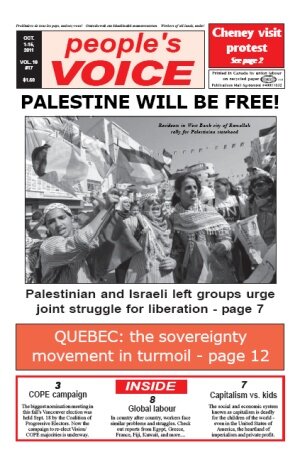
October 1-15 , 2011
Volume 19 - Number 17
$1
Prolétaires de tous les pays, unissez-vous!
Otatoskewak ota kitaskinahk mamawestotan!
Workers of all lands, unite
1) QUEBEC SOVEREIGNTY MOVEMENT FACES CRISIS
2) A SYSTEM IN CRISIS WITH NO SOLUTIONS
3) COPE KICKS OFF 2011 CIVIC CAMPAIGN
4) WHY IT'S IMPORTANT TO PROTEST CHENEY'S VISIT
5) B.C. FAMILIES FIGHT COMMUNITY LIVING CUTS
6) FLAWED CPCCA REPORT PUSHES BAN ON CRITICISM OF ISRAEL
7) SALUTE TO PALESTINE! - Editorial
8) STOPPING HARPER'S STEAMROLLER - Editorial
9) LESSONS FROM OUR HISTORY
10) MUSIC NOTES
11) CAPITALISM IS BAD FOR CHILDREN
12) "WE NEED A JOINT STRUGGLE FOR LIBERATION"
13) "THEY FOUGHT TIRELESSLY FOR WORKING PEOPLE"
14) WHAT’S LEFT
15) CLARTÉ (en français)
16) THE SPARK! (Theoretical and Discussion Bulletin of the Communist Party of Canada)
17) INTRODUCING MARX
PEOPLE'S VOICE OCTOBER 1-15, 2011 (pdf)
|
|
|
|
The Spark!The Spark! The latest issue of The Spark! theoretical journal, is now on sale for $5 at Communist Party offices (see p. 8) or People’s Co-op Books, 1391 Commercial Drive, Vancouver. Articles include
plus reviews, editorials, and more.
|
|
|
Theoretical and Discussion Bulletin of the Communist Party of Canada |
|
|
People's Voice deadlines: OCTOBER 16-31 NOVEMBER 1-15 Send submissions to PV Editorial Office,
|
|
REDS ON THE WEB |
|
People's Voice finds many "Global Class Struggle" reports at the "Labour Start" website, http://www.labourstart.org/. We urge our readers to check it out! |
* * * * *
People's Voice
Canadian Publications Mail Sales Product Agreement #205214
ISSN number 1198-8657
People's Voice is published by
New Labour Press Ltd
PV Editorial Office
706 Clark Drive,
VANCOUVER, B.C. V5L 3J1
Phone:604-255-2041
Fax:604-254-9803
email: pvoice@telus.net
Editor: Kimball Cariou : Business Manager: Sam Hammond
Editorial Board: Kimball Cariou, Miguel Figueroa,
Doug Meggison, Naomi Rankin, Liz Rowley, Jim Sacouman
* * * * * *
Letters
People's Voice welcomes your letters
on any subject covered in our pages.
We reserve the right to edit for length and clarity,
and to refuse to print letters which may be libellous
or which contain unnecessary personal attacks.
Send your views to:
"Letters to the Editor",
706 Clark Dr., Vancouver, BC V5L 3J1,
or pvoice@telus.net
People's Voice articles may be reprinted without permission,
provided the source is credited.
* * * * * *
The Communist Party of Canada, formed in 1921,
has a proud history of fighting for jobs, equality, peace,
Canadian independence, and socialism.
The CPC does much more than run candidates in elections.
We think the fight against big business and its parties
is a year-round job,
so our members are active across the country,
to build our party and to help strengthen people's movements
on a wide range of issues.
All our policies and leadership
are set democratically by our members.
To find out more about Canada's party of Socialism,
give us a call at the nearest CPC office.
* * * * * *
Central Committee CPC
290A Danforth Ave Toronto, Ont. M4K 1N6
Ph: (416) 469-2446
fax: (416) 469-4063 E-mailmailto:info@cpc-pcp.ca
Parti Communiste du Quebec (section du
Parti communiste du Canada)
5359 Ave du Parc, Montréal, Québec,
H2V 4G9
B.C.Committee CPC
706 Clark Drive, Vancouver, V5L 3J1
Tel: (604) 254-9836
Fax: (604) 254-9803
Edmonton CPC
Box 68112, 70 Bonnie Doon P.O.
Edmonton, AB, T6C 4N6
Tel: (780) 465-7893
Fax: (780)463-0209
Calgary CPC
Unit #1 - 19 Radcliffe Close SE
Calgary AB, T2A 6B2
Tel: (403) 248-6489
Ottawa CPC
Tel: (613) 232-7108
Manitoba Committee
387 Selkirk Ave., Winnipeg, R2W 2M3
Tel/fax: (204) 586-7824
Ontario Ctee. CPC
290A Danforth Ave., Toronto, M4K 1N6
Tel: (416) 469-2446
Hamilton Ctee. CPC
265 Melvin Ave., Apt. 815
Hamilton, ON.
Tel: (905) 548-9586
Atlantic Region CPC
Box 70 Grand Pré, NS, B0P 1M0
Tel/fax: (902) 542-7981
http://www.communist-party.ca/
* * * * * *
News for People, Not for Profits!
Every issue of People's Voice
gives you the latest
on the fightback from coast to coast.
Whether it's the struggle for jobs or peace, resistance to social cuts,
solidarity with Cuba, or workers' struggles around the world,
we've got the news the corporate media won't print.
And we do more than that
- we report and analyze events
from a revolutionary perspective,
helping to build the movements for justice and equality,
and eventually for a socialist Canada.
Read the paper that fights for working people
- on every page, in every issue!
People's Voice
$30 for 1 year
$50 for 2 years
Low-income special rate: $15 for 1-year
Outside Canada $50 for 1 year
Send to: People's Voice, 706 Clark Drive, Vancouver, BC, V5L 3J1
You can call the editorial office at 604-255-2041
REDS ON THE WEB
http://www.communist-party.ca/
http://www.ycl-ljc.ca/
http://www.solidnet.org/
(The following articles are from the October 1-15, 2011, issue of People's Voice, Canada's leading communist newspaper. Articles can be reprinted free if the source is credited. Subscription rates in Canada: $30/year, or $15 low income rate; for U.S. readers - $45 US per year; other overseas readers - $45 US or $50 CDN per year. Send to People's Voice, c/o PV Business Manager, 706 Clark Drive, Vancouver, BC, V5L 3J1.)
1) QUEBEC SOVEREIGNTY MOVEMENT FACES CRISIS
Special report to the Central Committee, Communist Party of Canada, Aug. 27-28, 2011
The defeat of the Bloc Québecois in the federal election has lit a powder keg within the Parti Québecois and the sovereignty movement. The broad consensus around the strategy of "sovereignty governance" proposed by PQ leader Pauline Marois and adopted at the PQ convention in April 2011 has now evaporated. This current crisis, which has in fact been brewing below the surface ever since the sovereignty camp's defeat in the 1995 referendum, burst into the open with the resignation of five PQ MNAs in early June, barely a month after the federal election. These resignations immediately provoked, both within and outside the PQ, a protest movement against the strategy endorsed by the convention.
This strategy, similar to the one adopted by PQ under the leadership of Pierre‑Marc Johnson in the mid-80s, is to gradually repatriate powers from Ottawa to Québec, while deferring indefinitely a new referendum on Québec independence, the raison d'etre of the party. This strategy is actually a compromise to prevent the party from being torn between its two main trends, ensuring that both remain at the head of the sovereignty movement if and when it forms a provincial government. To accomplish this, the PQ must adopt policies capable of winning the support of the bourgeoisie.
Meanwhile, the Coalition for the Future of Québec created earlier this year by two capitalists, former PQ minister Francois Legault and a former Liberal adviser, Charles Sirois, is recruiting heavily in the ranks of the PQ and is becoming a serious threat. Polls show that this coalition, which for the most part is associated with the line put forward by former Premier Lucien Bouchard in his 2005 "lucid" manifesto, could well sweep Québec in the next election if it turns itself into a political party. The PQ would be relegated to third place behind the completely discredited Liberals.
This Coalition reflects the views of the big bourgeoisie in Québec and has won the open support of some of its most important elements, such as the Lemaire family (Paper‑Cascade), Marcel Dutil (Canam‑Manac) and Jean Coutu (pharmacies) as well as others ‑ most of the same elements which in the past had also supported the rise of the ADQ. It is further supported by several forces from the far-right, as Eric Caire, who had run for the ADQ leadership on the platform that the ADQ was not far enough to the right.
Like the "lucid" Lucien Bouchard, the Coalition proposes to `table' the national question for at least the next ten years. The real reason for this strategy is that the bourgeoisie wants to prioritize the "class struggle" against the working class and its interests. This desire is reinforced by the economic crisis.
Indeed, the program it offers of dismantling the so‑called "Québec model" of social benefits is not conducive to establishing the necessary collaboration of classes required for the realization of the sovereignty of Québec. In addition, the Coalition believes that the slogan of sovereignty undermines the unity of the Québec bourgeoisie itself, unity which is needed to fight the working class and popular forces. Finally, the bourgeoisie needs a new political vehicle because the current Charest Liberal government is so discredited.
On the other hand, the so‑called "hardcore" separatists, including many elements outside the PQ, see this crisis as an opportunity to strengthen their position within the sovereignty movement and remove the monopoly of its PQ leadership. For example, a New Movement for Québec (NMQ) has just been created at an August 21 gathering of separatist forces. 450 people attended, including three resigned PQ members, other former PQ deputies, representatives of SPQ libre, etc. Other elements outside the PQ, such as former FLQ members, representatives of the Québec Network of Strength (QPP) and members of Québec Solidaire also participated. Other groups are also involved in public debate for a spot at the helm of the movement, like the new Independence Party, Gilbert Paquette, a former PQ member who in 2007 launched a movement called "Focus on Independence", Option Québec, the new party led by Jean‑Martin Aussant (another PQ MNA who resigned in June; this party was formally launched on Sept. 20 as Option Nationale), and even André Parizeau and his nationalist group.
Their positions largely reflect the view of a petty bourgeoisie eager to maintain class collaboration to achieve sovereignty at the earliest possible date. They strongly criticize Legault for his "betrayal" of the sovereignty cause, and the PQ due to its inconsistency in its promotion. One proposal that receives a lot of support among this group is "the convening of the Estates General of the sovereignty movement" where all the separatist forces, including the PQ, would be required to negotiate the terms of a new strategic alliance. The PQ immediately rejected this proposal stating that it alone must define such guidelines.
The PQ says that "the new movement for Québec" is "populated by" a lot of extremists and radicals" and is therefore reluctant to join it in any way whatsoever.
This crisis is certainly the worst experienced by the PQ and threatens its very existence. It could result in a significant redeployment of political forces in Québec.
2) A SYSTEM IN CRISIS WITH NO SOLUTIONS
Excerpts from the Main Political Resolution adopted by the Central Committee, Communist Party of Canada, Aug. 27-28, 2011
The political, economic and social situation in our country can only be fully understood if viewed in the wider context of the deepening systemic crisis of capitalism as a whole ‑ both domestically and internationally. Capitalism is mired in irreconcilable contradictions which are maturing rapidly, reflected in growing economic volatility and political instability around the world. In their desperate attempts to shore up their economic interests and maintain political hegemony, ruling capitalist classes are reverting to an extreme right‑wing, reactionary agenda ‑ an intensified assault on the economic conditions of the working class; the accelerated dismantling of public services and programs; a sharpening attack on labour and democratic rights; the increasing promotion of racism, sexism and anti‑communism; and a stepped up drive to militarism and war. While the pace and intensify varies from country to country, the essence and direction of this reactionary drift is evident in all capitalist states, including Canada.
This systemic crisis, and the attendant policies which the ruling classes are imposing in the hope of resolving it in their favour, are continuing to erode the living standards and quality of life of the masses of working people everywhere, and especially in the so‑called "Third World". The social divide between the super‑rich and the vast majority of the people ‑ most of whom 'sell' their labour‑power in order to survive ‑ is growing by leaps and bounds. Household debt levels are ballooning; young people are being denied the hope of a reasonable future; the 'wage gap' between women and men is once again growing; poverty and insecurity is swelling among seniors and pensioners, many of whom are compelled to compete with young workers for the worst jobs available just to survive; and an ever‑larger segment of the working class is being permanently marginalized, forced to survive on part‑time, temporary and precarious forms of employment, or driven into the 'shadow economy'...
The rollercoaster ride on global stock markets witnessed over the past several weeks has been chalked up to 'investor uncertainty' about the world capitalist economy and concern that leading economies will slip into another recession. Such fears are not without basis; indeed another recession/depression ‑ or more correctly, a continuation of the same economic crisis which broke out in 2007‑08 (which we have more accurately called "phase two" of the same crisis) ‑ is a virtual certainty. Stagnant and even 'negative' growth in the leading imperialist economies (Germany, France, the U.S., etc.), high consumer/household debt levels and correspondingly poor consumption figures, persistently high levels of unemployment, and the real prospect of government defaults in so‑called "sovereign debt" payments in a number of European countries (Greece, Spain, Italy, Ireland, Portugal, and even possibly France and the U.S.) have sent finance capitalists scurrying for cover.
But a narrow focus on market jitters over another economic downturn conceals more fundamental structural contradictions in global capitalism, flowing from the long‑term consequences of neoliberal economic policies, and the intensifying struggle for markets by imperialism and also emerging economies such as Brazil and China.
Back in the 1970s the rate of profit began to fall precipitously for monopoly capital, dragging down growth rates in the U.S. and other leading capitalist countries as well. In order to arrest and reverse the decline in profit rates, monopoly (through the auspices of the State) introduced neoliberal policies ‑ 'free' trade, deregulation, privatization, etc. ‑ first in Britain under Thatcher and the U.S. during the Reagan years, and then throughout the advanced capitalist economies and beyond. The 'free trade agenda' was never primarily about freeing up the international movement of goods and commodities, but rather about radically increasing the mobility of capital flows across borders, thus increasing the grip of foreign finance capital with devastating consequences throughout the neo‑colonial world.
That the banking and the financial service sector began to expand rapidly following the introduction of neoliberal policy was hardly coincidental. This sector has overtaken basic industry and manufacturing and non‑financial services (where value is actually produced) in virtually all of the advanced capitalist economies today. Neoliberalism was the structural instrument facilitating the movement of capital from 'value‑producing' to non‑value producing" (parasitic) forms of investment.
Neoliberal policy ‑ the economic dogma sometimes referred to as the 'Washington consensus' ‑ was a big success for monopoly interests. It not only accelerated the concentration and centralization of capital on an international level; it also temporarily reversed the decline in the rate of profit, leading some 'neo‑' and 'post‑Marxists' to mistakenly argue that Marx' famous Law of the Tendency for the Rate of Profit to Fall no longer held true. Of course the increase in the aggregate rate of profit during this period was highly misleading, because it included a growing share of 'fictitious capital' based on market and currency speculation, artificially inflated stock prices, and security and equity investments and hedge funds built on an unsustainable pile of public and private debt.
This house of cards began to fall apart in 2007‑08, and it is far from over. The massive government bail‑out packages over the past three years protected the financial holdings of monopoly capital, but at the expense of running up massive levels of public government debt. One left‑wing economist, Richard D. Wolff, commented recently on the sick irony of all this:
"Capitalist governments bail out big business by going into deep debt. And who do they borrow these funds from, that they must now pay back with interest? Big business ‑ the same monopoly capitalists that they bailed out in the first place."
Now, these same finance capitalists are worried that their security holdings in government bonds are not so secure after all, if governments are forced into default. Hence the unanimous and strident demand from 'the market' (i.e., finance capitalists) that governments cut 'discretionary spending' (a euphemism for healthcare, education, public sector wages, pensions, etc.) to the bone so that governments can meet their credit obligations and avoid default. The contradiction however (which even bourgeois economists are forced to concede) is that cutting 'entitlements' and other government programs ‑ as seen, for instance, in the vicious austerity measures imposed in many European countries over the past year under pressure from EU and IMF mandarins ‑ has stymied economic recovery, and further 'restraint' will contract demand even further, sending economies into a deeper downward spiral.
The worsening global economy has ignited a fierce debate within bourgeois circles about how to extricate themselves from the crisis, preserving their interests intact. All of the traditional fiscal and monetary economic 'tools' ‑ interest rates changes, currency devaluation, stimulus spending, etc. ‑ have been tried without success. Even the relatively buoyant Chinese and other Asian economies have failed to stem the global downturn, centered in the U.S. and EU imperialist blocs. The only rationale option which could hypothetically stimulate growth and reduce unemployment would involve a radical redistribution of wealth from the banks, corporations and the super‑rich (who are awash with cash) to the working class ‑ directly in the form of significantly higher wages and benefits, and/or indirectly through a great expansion of public services and programs benefitting working people, financed through substantial tax increases on corporate profits, and increased taxes on personal fortunes of the wealthy elite. But this is the one 'reform' which the ruling class will not contemplate (although some mega‑capitalists like Warren Buffett, embarrassed by the voluminous size of their richesses, have offered to pay higher taxes... for a while).
Their only remedy (sic) therefore is to intensify the exploitation of the working class (and working people in general) to maintain the transfer of wealth into their already swollen coffers, to further inflate the debt 'bubble', to ramp up the repressive security apparatus to quell spontaneous outbursts of discontent (as witnessed recently in London and other English cities) and especially organized class resistance and struggle, and to the accelerate the growth of militarization and war. Canadian finance capital has also embraced this agenda, and has mandated the Harper Conservatives to oversee its imposition on the working class of our country.
But this sharpening capitalist offensive is being met by increasing working class resistance and struggle around the world. The clearest example of this is of course Greece where the KKE‑led Militant Workers Front (PAME) has been in the forefront of numerous demonstrations and general strikes. But mass struggles are erupting elsewhere as well. Indeed, there were more general strikes around the world in 2010 than ever before in history. And in addition to these workers' actions, there has also been a big increase in anti‑government mobilizations by youth and students in a number of countries, such as those in Britain last November and more recently in Chile. The deepening crisis is spurring an upsurge in mass action around the world.
The current situation brings into sharp relief the most fundamental contradiction of capitalism ‑ that is, between the increasing social character of production, and the private appropriation of the wealth it produces ‑ and the bankruptcy of social‑democratic, reformist `solutions' aimed at ameliorating the impact of its excesses while preserving intact this crisis‑ridden system.
3) COPE KICKS OFF 2011 CIVIC CAMPAIGN
PV Vancouver Bureau
A turnout of almost 1,000 Coalition of Progressive Electors members and supporters (by far the largest nomination meeting in this year's Vancouver municipal campaign) met on Sept. 18 to pick nine candidates to field in the Nov. 19 civic election.
"We're not only proud of our new slate of amazing candidates," said COPE External Chair Marcus Youssef after the event, "but we're also proud to be the only Vancouver party to see contested nominations."
COPE members voted in Ellen Woodsworth, Tim Louis, and R.J. Aquino as their council candidates, and Brent Granby and Donalda Greenwell‑Baker for Parks Board. For school trustee, the members picked incumbents Jane Bouey (Vice-Chair of the Vancouver School Board), Allan Wong, and Al Blakey, and first-time candidate Gwen Giesbrecht.
The surprise of the afternoon was the defeat of veteran city councillor David Cadman, who finished fourth in the race for three nominations. Cadman, a prominent leader of the global movement for urban environmental sustainability, often missed council meetings due to his international travel, a factor which may have cost him some support from COPE members.
COPE also announced co‑managers Kate Van Meer Mass and Nathan Allen for the upcoming campaign. "Kate and Nathan are seasoned organizers and have already hit the ground running," said Youssef. "We have a great slate of candidates, a great campaign team, and a great message. We want to build a Vancouver for Everyone and we've committed to work with all progressives to do just that because that's what the residents of Vancouver want us to do. We won't let them down."
By the terms of their electoral cooperation agreement, COPE and Vision Vancouver will support each other's candidates on a joint slate. The unity campaign has the strong backing of the Vancouver and District Labour Council.
Vision Vancouver's slate of candidates includes Mayor Gregor Robertson, incumbent city councillors Andrea Reimer, Raymond Louie, Geoff Meggs, Tim Stevenson, Heather Deal and Kerry Jang, as well as newcomer Tony Tang.
For park board, Vision has nominated incumbents Constance Barnes, Sarah Blyth, and Aaron Jasper, plus Trevor Loke and Niki Sharma. Vision's school trustee candidates are School Board Chair Patti Bacchus, incumbents Ken Clement and Mike Lombardi, and newcomers Rob Wynen and Cherie Payne.
In another twist to the campaign, about 20 members of Vancouver's dwindling Civic Green Party met recently to nominate three candidates. The Greens have formed an alliance with the right-wing NPA, which left spots open for them at city council, park board and school board. Several prominent Green Party activists have quit in dismay to join COPE, which they see as more compatible with a progressive environmental outlook.
Ironically, the NPA campaign is boasting an influx of donations from big business, including the forestry and mining sectors, where corporate interests have devastated much of the west coast landscape. The chief NPA fundraiser is Peter Armstrong, head of the Rocky Mountaineer rail service which locked out its on-board attendants back in June. During the summer, the Vision and COPE city councillors sent a letter to the company condemning the use of strikebreakers in the labour dispute.
4) WHY IT'S IMPORTANT TO PROTEST CHENEY'S VISIT
The fall book-signing season took a strange turn when accused war criminal Dick Cheney was invited to speak to a $500 dinner held by the Le Bon Mot Book Club at the upper-crust Vancouver Club. The city's broad-based peace coalition, StopWar, quickly called a news conference and a rally to protest the visit by the former U.S. Vice-President.
At the Sept. 23 news conference, Vancouver Kingsway NDP MP Don Davies, the official opposition critic for immigration, demanded that Immigration Minister Jason Kenney bar Cheney from entering Canada. Three days later, hundreds turned out at the Vancouver Club, chanting "arrest Cheney" and blocking entry for many of the ultra-rich guests.
The following commentary from Rabble.ca on the Cheney visit is by protest spokesperson Derrick O'Keefe, who is co-chair of StopWar and a member of the Canadian Peace Alliance executive.
Dick Cheney is a war criminal. We intend to organize a "welcome" for him here in Vancouver befitting a person with such a record. We do this not just for catharsis or out of our own anger at the policies that Cheney carried out while he was in power with the Bush administration, but also we do this out of a sense of responsibility to international law and historical justice.
An injury to one is truly an injury to all. That is a slogan that motivates our actions here in Vancouver in protesting Cheney's upcoming presence. And Cheney has caused significant injuries, to say the least. His record includes hundreds of thousands dead in an illegal war in Iraq, and countless thousands tortured.
A familiar talking point of the current U.S. administration tells us "look forward, not backward" to justify their failure to prosecute Cheney and other criminals from the Bush administration. But looking backward honestly and fully is the very basis of law, of justice, and of a self‑respecting society. Therefore we also seek to hold Cheney accountable because it will help the fight for a more just society in the United States.
In our effort to hold Cheney to account and have him arrested for war crimes, the peace movement wishes to address a few different audiences:
First, to Dick Cheney, we say: Rethink your visit to Vancouver. This really is not your kind of town ‑ in the 1980s we had hundreds of thousands marching against nuclear weapons, and in the lead up to the Iraq war we had monthly marches of tens of thousands of people. This is not a wise place for you to make your first trip outside of the United States on this book tour. People here are steadfast in their opposition to war and torture, and to demanding that you are arrested for war crimes.
To the organizers of this book club event: you call yourselves "le bon mot" book club, but there is nothing witty about your name. Le mot juste for your honoured guest is criminal. We know that the founder of your book club, Leah Costello, is an active member of the West Vancouver Electoral District Association of the Conservative Party of Canada. We feel that the local Conservatives and indeed the governing party in Canada should be made to answer serious questions about their hosting and welcoming Dick Cheney. Is Dick Cheney a figure that Conservatives in Canada are proud to host? Perhaps he is, but that should concern us all.
To all elected officials in Vancouver, at the provincial level and at the federal level: Canadian law is clear, and international law is clear. You have a responsibility to act and to bar Cheney or ‑ better yet, I would say ‑ to arrest him here in Canada.
To our fellow citizens of Vancouver: Let's not quietly allow this city and this country to become a safe haven for war criminals. Let's not quietly allow Cheney to waltz into town to have his book event...
5) B.C. FAMILIES FIGHT COMMUNITY LIVING CUTS
PV Vancouver Bureau
The families of developmentally disabled people in British Columbia are fighting back against funding cutbacks and policy shifts which seriously jeopardize the future of many individuals. The situation is starting to make "Families First" Premier Christy Clark look like a complete hypocrite, contributing to her slide in opinion polls.
Much of the dispute centres on Community Living BC, the crown agency which provides support to more than 13,600 adults with developmental disabilities. Provincial underfunding has seriously deprived CLBC of the money to cover urgent health and safety needs.
CLBC cost-cutting measures include closures of about 60 group homes, often considered by families as the best living arrangement for developmentally disabled adults, in favour of private homeshare arrangements. This shift is called an "expansion of options" by the Liberal government, but the personal impact is often deeply traumatic. Many disabled adults have been deprived of close friends and trained staff support, and left instead in homes where their well-being is not a top priority.
Students enrolled at the Consumer and Job Preparation Progam at Douglas College in New Westminster were abruptly informed in mid-September that funding for their one-year course would be cancelled effective Dec. 31. This $130,000 cut to a program which has been in place for 27 years affected 12 students immediately, and another 18 on the waiting list for next year.
In yet another scandal, more than two dozen people employed at a Maple Ridge recycling plant were told that CLBC cuts would leave them without jobs at the end of 2011.
Within days of these two announcements, public anger compelled CLBC and the Liberal government to retreat, promising funding would continue. But the fumbling response by Social Development Minister Harry Bloy has added to the public perception that he is utterly incompetent. Bloy was the only MLA to back Christy Clark's campaign to replace Gordon Campbell as Liberal leader, and his cabinet post is widely regarded as payment for political services.
On Sept. 14, Bloy claimed to have found an extra $8.9 million to help developmentally disabled people. But family groups and opposition New Democrat MLAs said the money does little to help those struggling after group home and service cuts.
"It's discouraging," said Faith Bodnar, chief spokesperson for the B.C. Community Living Action Group. "It's a start, but it is an immediate Band‑Aid rather than a solution. We need the government to give a much more substantial lift."
A BC-CLAG analysis of CLBC projections shows that at least $70 million is needed immediately to address the existing support backlog. Each year, hundreds of youths with developmental disabilities reach the age of 19 and turn to CLBC as they age out of supports funded by the Ministry for Children and Families. Yet the CLBC operating budget remains static from 2010 through 2014 at $681 million annually.
The increasing gap has severely strained CLBC's system of community-based residential and support services, resulting in a growing number of crises as highly vulnerable young adults and families struggle to cope. The CLBC's "service redesign" initiative has included forcibly transferring group home residents to lower cost alternatives, saving the government $20 million per year.
For more information, visit www.clbcstopthecuts.org or http://communitylivingaction.org.
6) FLAWED CPCCA REPORT PUSHES BAN ON CRITICISM OF ISRAEL
PV Vancouver Bureau
On July 7, after a long delay, the so-called "Canadian Parliamentary Coalition to Combat Antisemitism" (CPCCA) released the report of its inquiry. Canadians for Justice and Peace in the Middle East (CJPME) has issued a detailed critique of "grave misrepresentations" by the CPCCA, which includes Conservative, Liberal and NDP MPs, but is not an official Parliamentary group.
The CPCCA Report argues that antisemitism is on the rise, both in Canadian society generally, and particularly on campuses. But after a review of the testimony, the CJPME found that most of the senior Canadian law enforcement officials who appeared before the inquiry stated that antisemitism in their respective provinces and cities was either not on the rise, or had in fact dropped.
All 12 university administrators who appeared before the Inquiry testified that antisemitism was not a problem on their campuses. Yet such testimony was ignored or even distorted in the Report to make it appear as if the opposite was the case.
"It is upsetting and unethical that the CPCCA's Report essentially ignored the most authoritative testimony presented to it," said CJPME director, Thomas Woodley. "In general, the work of the Inquiry does not seem credible, as it sought to highlight only those voices which supported its premises, while ignoring all contrary voices."
Although the Inquiry claimed to have received 200 written submissions, less than half of those are acknowledged in the Report, or on the CPCCA website. At least one Panel member refused to put her name on the report; Liberal MP Joyce Murray told Embassy Magazine that CPCCA members were never brought together to discuss the Report or consider revisions.
The CPCCA decided to hear from selected persons and groups, mainly representing pro‑Israel organizations. Groups and individuals who challenged the assumptions of the CPCCA were, in the main, excluded from the Inquiry, and the Report refuses to acknowledge their submissions.
As the CPJME notes, "the principal aim of the CPCCA, apparent from its initial news releases, comments made by members of the Inquiry Panel throughout its hearings, and in its final Report, is to widen the definition of antisemitism to include criticism of Israeli government practices and policies, particularly those that have come to be labelled `Israeli Apartheid'".
The key recommendation of the Report is that Canada should adopt the European Union Monitoring Centre on Racism and Xenophobia ("EUMC") Working Definition of Antisemitism. As the CPJME says, "This definition, drafted in 2005, has no official status; has been adopted by no government and was, in fact, drafted by a prominent member of an extremist pro‑Israel lobby group, the American Jewish Agency." Such a definition would effectively outlaw almost any criticism of Israel in Canada.
This appears to be the direction of the Harper Tory government. Federal cabinet ministers John Baird and Jason Kenney recently signed the Ottawa Protocol on Combating Antisemitism, one of the steps suggested by the CPCCA report. Legislation relating to criticism of Israel is also expected by the CPJME and other groups which have been active in defense of free speech.
People's Voice Editorial
The next step in the long Palestinian struggle for freedom and independence has been taken with the historic speech by President Mahmoud Abbas at the United Nations on Sept. 22. Debate within the Security Council on Palestine's application for U.N. membership is expected to begin soon.
But shamefully, Canada remains among the tiny handful of countries which want to block any progress in this direction. Just days after the powerful words of President Abbas, Canadian Foreign Affairs Minister John Baird told the General Assembly that Canada would vote "no" to Palestine's application. Baird parroted the words of Israeli PM Netanyahu, demanding that the Palestinians to return to talks without preconditions. In other words, Palestine must continue to suffer the loss of the remaining shreds of its historic territories, as the inexorable expansion of Israeli settlements create a fait accompli in the occupied territories.
It remains to be seen how the process at the U.N. will play out. Enormous pressure by the U.S. administration may force several Security Council members to abstain, and the Palestinian statehood bid must then gain more support within the General Assembly to proceed.
But sooner or later, the state promised to Palestinians in 1948 will be achieved, and the era of Israeli occupation and apartheid will come to an end. The people of Palestine will win a truly viable, independent state, based on the pre-1967 borders, with East Jerusalem as its capital, and the right of Palestinians to return to their stolen homes. Nothing less is acceptable.
Here in Canada, if the Harper Tories have their way, speaking in these terms may soon become classified as the criminal act of hate speech. But we reject any legislated attempt to silence criticism of the apartheid policies of Israel, and we continue to express our solidarity with the heroic people of Palestine.
8) STOPPING HARPER'S STEAMROLLER
People's Voice Editorial
The post-election warnings of Stephen Harper's agenda are coming true in spades, from the Tory assault on collective bargaining rights, to the signals of an "austerity package" aimed at gutting social programs. The Canadian Wheat Board is being destroyed (illegally!), and the Tories are preparing a formal review of foreign policy, with the goal of further undermining Canadian sovereignty and promoting global capitalist integration. Canadian military bases are being established in several countries, and the NATO occupation of Libya has begun with the fervent support of the Harper government.
One of the most frightening steps by the new Tory majority is the Omnibus Crime Bill. Among other things, this legislation will impose mandatory minimum sentences, end pardons for serious crimes, expand the capacity of the state to conduct surveillance and access private information, and reinstate so-called "anti‑terrorism" provisions that expired back in 2007, including three‑day detentions without cause, known as "preventative arrests."
Aimed at criminalizing youth and Aboriginal peoples, this legislation has a distinct racist edge. Civil liberties groups condemn these serious violations of constitutional rights and freedoms, and Budget watchdog Kevin Page estimates that the measures will increase the Corrections Canada budget by one billion dollars a year, adding thousands of new inmates to the federal prison system.
In short, this government is hell-bent on removing civil liberties and democratic freedoms, despite the fact that they won less than 40% of votes in the recent federal election. This steamroller won't be stopped by speeches in the House of Commons; only a massive, Canada-wide fightback in our streets, communities, workplaces and campuses can block the Tories. The leadership of the labour movement must assume its responsibility help launch such a fightback... before it's too late.
Resolution adopted by the Central Committee, Communist Party of Canada, Aug. 27-28, 2011
This year marks the 90th anniversary of the birth of the Communist Party of Canada. From its founding convention held in a barn in Guelph, Ontario in 1921 until today, we have striven to remain true to our guiding principles and theory, and to realize them in our daily activities and struggles ‑ as a revolutionary party of the working class of Canada, based firmly on Marxism‑Leninism and proletarian internationalism.
As we celebrate this anniversary, we remember the many contributions and achievements of our Party over those ninety years. Whether it was in organizing the unorganized, forging most of the industrial and public sector unions which exist today in our country; building and leading the farmers' movements for survival and dignity; organizing the ranks of Canada's unemployed during the Great Depression, launching the famous On‑to‑Ottawa Trek; mobilizing thousands of young volunteers to fight against fascism in Spain and later across Europe during WWII; building the peace & disarmament movement in the post‑war years; leading the historic struggle within the labour movement in English‑speaking Canada to recognize the national rights of Quebec; helping to forge the pan‑Canadian student movement in the 1970s; helping to build broad movements for civic reforms, universal health care, and defense of Canadian sovereignty; all of these and many other episodes in our history we remember with pride.
And we remember too that our revolutionary activities were carried out in circumstances of unrelenting hostility and attacks from Canada's ruling capitalist class and its state. The periods when our Party was forced to work under conditions of illegality; when Tim Buck and other Party leaders and members were convicted and imprisoned; the McCarthy‑style witch hunts which targeted our members and supporters and Communist‑led unions; the secret ProFunc plans of the Canadian State to round up and incarcerate thousands of Communists and their families; the constant ideological, propaganda and physical attacks against our Party (from both the right and 'left') because it refused to succumb to anti‑Sovietism ‑ we remember all of those difficult days, and honour the memory of those comrades who endured such outrages with courage and resolve. We came to understand ‑ both at a theoretical level and through those real‑life experiences as a Party ‑ that the class purpose of those political and ideological attacks was not only to weaken and diminish our ranks, and to isolate the Communists from our living ties to the working class; it was also done in the hope of shaking Communists from our class bearings and pressuring the Party to abandon its revolutionary theory.
It is in this context that we mark another anniversary of sorts this year ‑ it has been two decades since the inner‑party struggle which almost liquidated our Party. In the late 1980s, George Hewison assumed the Party leadership and shortly thereafter a motley group of right opportunists, careerists and Trotskyists gradually gained ascendency within the Central Committee of the CPC. They were able to do so by concealing their liquidationist agenda and by taking advantage of confusion and disorientation within Party ranks due to developments in the former Communist Party of the Soviet Union (CPSU) where under Gorbachev's stewardship the clouds of counter‑revolution were gathering. In due course, the Hewison clique set about dismantling our Party piece by piece, starting with the dissolution of the Young Communist League and layoffs of Party cadre, and then the closure of the party's print shop and publishing house, and progressive bookstores across the country.
As their liquidationist project gained momentum, this group began to openly break with the ideological principles and political line of our Party. They began negating the history of our Party (and that of the international communist movement in general) as having been "sectarian", "vanguardist" and "doctrinaire". They advanced reformist ideas about "incremental change" in place of, and as a substitute for, the concept of revolutionary transformation from capitalism to socialism‑communism. They decreed that "imperialism" was an outdated concept (!) which no longer characterized "post industrial capitalism". And they attacked democratic centralism, the organizational principle of our Party, and set about dismantling Party clubs and other organizational structures. Over time, their denunciations of "Stalinism" led to attacks on Leninist ideas, and ultimately to a refutation of the postulates of Marxism itself. And they proposed that the Party change its name, dropping all reference to 'communist' from our banner.
Behind the scenes, this liquidationist faction began holding secret meetings with social democrats and 'independent leftists' to dissolve the Communist Party with the goal of forming a new 'united party of the socialist left', using party assets to finance their new venture.
Following the 1990 Convention, opposition to the increasingly obvious abandonment of Marxist theory and practice by the Hewison leadership grew across the country. When detailed evidence surfaced of their secret plans to dissolve the Party and steal its assets, and as expulsions of members began, the majority of the party membership demanded an emergency Canada‑wide convention to resolve the issue. But the liquidators refused and instead set about dissolving party clubs and provincial committees that opposed their conspiracy. Members were told to sign loyalty oaths to Hewison et al or else face a refusal to renew their memberships.
Ultimately however the membership defeated their plans and saved the Communist Party from destruction, but at a heavy political, organizational and financial cost.
Ours was not the only Communist Party to go through such a convulsive experience; other parties around the world went through similar and sometimes worse trials during those difficult years. To our south, a liquidationist faction attempted to gain control of our sister party the Communist Party USA, but were successfully beaten back.
The lessons drawn from that painful episode in our history are important for the Communists in Canada ‑ veterans and new members alike. But they are lessons which can also be useful to Communists internationally, in our common struggle for social emancipation, for an end to class exploitation and oppression ‑ for socialism.
It is in this context that we now comment on recent developments and debates which have been taking place in our neighbouring party, the CPUSA. For several years now, our Central Committee has received inquiries from many concerned members about political and organizational changes in that party, and the renunciation by leading cadres of such fundamental Marxist concepts as "the dictatorship of the proletariat", "democratic centralism" and "proletarian internationalism."
The concerns raised have dealt with a number of interrelated issues, such as various statements issued by the CPUSA dealing with international questions, especially on the Palestinian struggle, and on the U.S. wars of occupation in Iraq and Afghanistan; on trade union policy which many feel is insufficiently critical of class collaborationism in the leadership of the AFL‑CIO (which has a direct bearing on Canada given the large presence of AFL‑CIO affiliates in the Canadian Labour Congress); on the assessment of the role and class position of the Obama Administration and the Democratic Party and the absence of any independent electoral presence of the CPUSA in its own name; on various pronouncements by leading figures of the CPUSA on changing the party name, in describing the multi‑trillion dollar government bail‑outs as "a dose of socialism", etc.; and in organizational decisions to cease the print editions of People's Weekly World and Political Affairs, the layoffs of Party and YCL organizing staff, the internet‑based 'open door' approach to party recruitment, etc.
Although deeply concerned about many of these developments, our Central Committee has until now refrained from comment. However, in light of the publication earlier this year of the article "A Party of Socialism in the 21st Century" by CPUSA Chair Sam Webb, our Central Committee finds it necessary to clarify our Party's views on certain critical questions which have been raised. Although the various theses presented in this article refer, in the first place, to a proposed reorientation of the CPUSA itself, its title and text read as if these ideas should form the 'template' of the political approach of Communist parties in general, or certainly at least in other advanced capitalist countries such as Canada. This assumption was confirmed when comments from other fraternal parties were actively solicited by the CPUSA, a highly unusual practice.
We are aware of the formal responses given to this article by the Communist Parties of Greece (KKE) and Mexico. Our Party is in substantive agreement with the main criticisms of this document expressed by these two parties. We consider that the political line advanced in "A Party of Socialism in the 21st Century" constitutes a fundamental departure from Marxist‑Leninist theory and practice. The pursuit of such an approach will objectively lead to the liquidation of the CPUSA as a revolutionary party of the working class in that country.
Based on our 90 years of struggle, on our Party program "The Road to Socialism", our Constitution, and on the decisions reached our conventions, the Communist Party of Canada understands its nature and role, and undertakes its political activities, as guided by the following general considerations and conclusions (among others):
* that the main contradiction underlying capitalism in Canada today remains the class contradiction, reflecting in the class struggle between the two main classes ‑ the ruling capitalist class (especially its core, monopoly capital) and the working class of our country, a contradiction which can only be resolved through the revolutionary transformation of our society from capitalism to socialism.
* therefore that as a revolutionary party, the main task of the CPC is to defend and advance the long‑term interests of the working class in pursuit of this ultimate objective, and "strives to be the leading political party of the working class, of all who labour by hand and brain... [a party which] arises out of the working class and is an organized political detachment of that class... [and which] has no interests separate and apart from those of the working class as a whole."
* that our Party supports the struggle for immediate reforms to improve the conditions of the working class and the people under capitalism, and seeks unity with all other forces which support and will fight for such advances; at the same time, our Party never loses sight of the ultimate goal of socialism nor the fact that there can be no other course to socialism other than through the revolutionary overthrow of the existing order. In this regard, we consider a correct understanding of the dialectical relationship between reform and revolution to be of paramount importance;
* that in pursuing the broadest possible unity with other class and social forces to achieve immediate advances, it is absolutely imperative for our Party to studiously safeguard its independent role as a revolutionary party of the working class and oppose tendencies or pressures ‑ either from within or without our ranks ‑ to efface or submerge our independent role. The CPC considers it vital that it speak directly, visibly and openly in our own name, and engage in ideological struggle ‑ the 'battle of ideas' ‑ against bourgeois, reformist and class collaborationist concepts that weaken, disarm and divide the movement;
* that the "world outlook of [our] Party is based on Marxism-Leninism, which embodies the theory of scientific socialism first developed by Karl Marx, Frederick Engels and V.I. Lenin. Marxism-Leninism is not a dogma; it is a living, developing theory, tool of analysis and guide to action. It incorporates the concentrated experience of all the struggles of the working class, both in Canada and around the world" [from Chapter 8 of our Party Program "Canada's Future is Socialism"];
* that the CPC is imbued with a proletarian internationalist outlook, reflected in both our struggle to achieve socialism in Canada, and in our active solidarity with anti‑imperialist and revolutionary struggles, and efforts to build socialism around the world. A critical aspect of our internationalist responsibility is the ideological struggle against bourgeois slanders and distortions of the history of the international working class movement and its efforts to forge socialism, both in the past and in the present day; and
* that in terms of our organizational principles as a Communist Party, these "are determined by its political aims... to guide the working class to the achievement of these aims, and to lead the people's struggle, the Party must be founded on firm ideological, political and organizational unity, and on the continuous organized activity of its members in close contact with the working people, knowing their views and needs, and able to explain Party policy. Democratic centralism is the organizational principle which ensures this." [from our Party Constitution]
This is where we stand, and these are the principles which we unwaveringly defend.
10) MUSIC NOTES, by Wally Brooker
Celebrating Woody's centennial
Preparations are underway for the celebration of legendary troubadour Woody Guthrie's centennial in 2012. The great folksinger died of Huntington's Disease in 1967, leaving an indelible mark on generations of musicians and activists. A host of concerts, programs and special events are being planned by the Grammy Museum, in partnership with the Woody Guthrie Archive and the Guthrie family. The first of many events leading up to the centennial is the September release of Note of Hope, an album conceived by Woody's daughter Nora and produced by Grammy award-winning bassist Rob Wasserman. Note of Hope features unpublished writings of Woody Guthrie, set to music by a stellar cast of performers including Jackson Browne, Ani DiFranco, Nellie McKay, Lou Reed and Pete Seeger. The first official Canadian event to celebrate the Guthrie centennial takes place in Markham, Ontario on Oct. 2 with (appropriately enough) Jerry Gray and the Travellers. For more info: www.woody100.com.
Bagpipes and guitars in Wisconsin
Musician‑activist Tom Morello, co‑founder of Rage Against the Machine, was treated to a hero's welcome by the bagpipers of Fire Fighters Local 311 when he returned to Madison for a Labour Day show last month. In February, Morello inspired tens of thousands with his appearance in front of the Wisconsin state legislature. The militant rocker was one of the first nationally-known performers to join the protest against right‑wing extremist governor Scott Walker. The fire fighters' bagpipers were there too, defending labour rights and local democracy. Morello's new album World‑Wide Rebel Songs celebrates contemporary street protests from Madison to Cairo. Proceeds go to non‑profit media that expose corporate abuse and highlight union struggles. His "Justice Tour" will travel this fall to the battleground states of Ohio and Michigan. For more info: http://nightwatchmanmusic.com/.
Palestine solidarity update
There are always new initiatives to report about musicians acting in solidarity with Palestine. This month we have two noteworthy items. The first involves klezmer music, a genre with roots in the Jewish ghettos of Eastern Europe. Its popularity has surged in recent decades, so it's encouraging to learn about the compilation album Klezmer Musicians Against the Wall. Most of the bands included are American, but there are also a few from Germany and Israel/UK in the mix. Proceeds go to two worthy initiatives supporting Palestinian children. It's available at iTunes. Learn more at http://kmaw.net.
Our second item concerns a young New Orleans group called Tuba Skinny. This talented traditional jazz band was scheduled to play at the Red Sea Jazz Festival August 21st. When asked to cancel by the Israeli group Boycott From Within, members of the band discussed the information they'd received and promptly cancelled their show. Read their impressive statement at http://electronicintifada.net.
Growing call to boycott Fender
Fender Musical Instruments, the world's largest guitar manufacturer, is under criticism for its outsourcing of sweatshop labour and its de facto support of Arizona's anti-immigrant law SB 1070. Fender has its headquarters in Arizona, which has legislated a climate of fear among Latino families, causing many to flee the state. The racist legislation has prompted an international boycott, but Fender has refused to speak out against it. Moreover, the company continues to defy an international boycott of Cort Guitars, the anti‑union South Korean instrument manufacturer which supplies them with parts. Dozens of prominent musicians (e.g. M.I.A., Kanye West, Steve Earle, Ry Cooder) have signed on to the boycott of Arizona thanks to the efforts of The Sound Strike, a coalition of artists founded by rock musician Zack de la Rocha. For more info visit http://thesoundstrike.info and http://cortaction.wordpress.com.
El Sistema comes to Canada
Venezuela's celebrated music education program El Sistema is coming to Canada. Founded in the 1970s and taking off under the enthusiastic patronage of the Hugo Chavez administration, the program encompasses 125 youth orchestras. More impressive is the fact that of the 350,000 children enrolled in its programs, 90% are from poor socio‑economic backgrounds. The social and cultural benefits of El Sistema are so convincing that the model is being adopted in other countries. Toronto philanthropist Robert Eisenberg and violinist‑educator David Visentin officially launched Sistema-Toronto in the west‑end Parkdale neighbourhood in September. Other programs now underway in Ottawa and New Brunswick. When founder José Antonio Abreu and his famous student, conductor Gustavo Dudamel, arrive in Toronto this month to be feted by the Glenn Gould Foundation, the prospects for music education in Toronto should get pretty interesting. But it remains to be seen if El Sistema can deliver results as spectacular as in Venezuela, where the ministry of social services covers 90% of its operating expenses. For more info: http://sistema‑toronto.ca/.
11) CAPITALISM IS BAD FOR CHILDREN
By W.T. Whitney, Jr.
U.S. children are threatened, especially poor, Black, and Hispanic children. Hazards mount in tandem with child poverty, as wealth ends up in fewer and fewer hands. Capitalist rule makes children victims of class war.
The Children's Defense Fund's (CDF) report "The State of America's Children 2011" presents data on child poverty, health and educational outcome, juvenile justice, family structure, housing, and exposure to violence.
Findings are correlated with children's ethnic origins. That emphasis takes on additional meaning from the suggestion of Vicente Navarro and others that race often serves as proxy for class. Child poverty increased 28 percent between 2000 and 2009 ‑ 10 percent between 2008 and 2009. While one in 10 white children were living in poverty that year ($22,050 for a family of four), one in three Black and Hispanic children were poor. Of 15.5 million poor children under age 18 ‑ 20.7 percent of all children ‑ 11.9 percent were white, 35.7 percent Black; and 33.1 percent Hispanic. For children under five, comparable figures were 14.7 percent, 41.9 percent, and 35 percent respectively. By contrast, 8.9 percent of persons over 65 were poor.
The CDF report relies upon statistical associations between poverty and race and harm to done to children. For example, the U.S. infant mortality rate (IMR), the number of babies dying during their first year out of 1000 births, registered 6.75 in 2007 (the last year for which finalized statistics are available). The IMR for white babies was 5.64; for Black infants, 13.24; for Hispanic babies, 5.71. The United Nations reports the U.S. IMR, averaged over five years, ranked higher, i.e. less favourable, than 45 other countries.
The U.S. percentage of low birthweight babies has recently doubled. Mothers of Black and Hispanic babies are more than twice as likely as white mothers to lack basic prenatal care. Because of discrimination and bureaucratic hurdles, eligible Black and Hispanic children go without health insurance at rates almost three times those of white children.
Children suffer from loss of their mothers. Amnesty International recently reported that the United States ranks 41st in maternal mortality, a measure of women dying during pregnancy or shortly thereafter. Between 1987 and 2006, the U.S. rate doubled, from 6.6 to 13.3 deaths per 100,000 births. AI blames discrimination, poverty, and deficiencies in medical care. The risk of African‑American women dying during childbirth is four times that of white women.
Only 60 percent of Black and Hispanic students graduate from high school; 81 percent of white students do. Almost 80 percent of minority students function well below grade level in reading and math. Homeless preschool children are up 43 percent over two years. Black, Hispanic, and American Indian youth make up two thirds of those entering the juvenile justice system.
In 2009, 80 percent of U.S. families controlled only 12.8 percent of all private wealth, down from 18.7 percent in 1983. By contrast, a mere one percent of households owned 35.6 percent of private wealth, the result in part of a 281 percent income hike between 1979 and 2007. Down the ladder, 19 percent of families controlled 51.6 percent of non‑institutional net worth. In 2007, white families claimed $143,000 in median net worth; Black households $9300; and Hispanic families $9100.
The wealthy run the show. Citing admittedly non‑exact data, The Center for Responsive Politics reports in 2009 that 79 of 100 senators and 229 of 435 representatives were millionaires. President Obama was worth $4.96 million, Secretary of State Hillary Clinton, $31.24 million. The average senator's 2008 net worth was $13.99 million, that of House members, $4.67 million.
What, one asks, is the U.S. government doing about a humanitarian crisis? In 2009, U.S. births totaled 4.1 million, with 26,531 infant deaths. If families then could have benefited from Cuba's IMR - 5.0 that year, 4.5 currently - 20,100 babies would have died and 6431 babies would have lived. In 2009, 609,552 African American babies were born, of whom 8,356 died. Had Cuban standards for infant survival prevailed, 3,045 would have died and 5331 would have lived. That's an annual loss matching multiple Twin Tower disasters. The totality of grief and hardship afflicting U.S. children extends, of course, beyond these dramatic numbers.
U.S. rulers look to the future, but not to a future for children, which depends entirely on thriving in the here and now. They would fight wars without end, free grandchildren of government debt, educate to compete, keep seniors from freeloading, and they speak of jobs. They quashed the idea of universal health care. Too bad: some of the babies and mothers would have survived. Instead, millionaires and their hangers‑on shore up the military industrial complex and subject working people to fear and divisions.
With children under siege and many of them dying preventable deaths, the time for action and organization is now. Marxists, experienced in the history of class conflict, are surely fit to educate and lead in this struggle and many others. Socialists, including self‑proclaimed Marxists, need no longer to wait around to be admitted into establishment circles, or for stages of struggle to evolve. They should break off from capitalist power brokers and an ideology of greed. Victims cry out.
A leading option for socialists is independent political action, initially education and agitation. Struggle for the children is one of many inviting scenarios. The fate of children teaches about the realities of class antagonism. Fighting for their survival becomes a crash course on combativeness. Inquiry into and advocacy for programs serving children's needs prepares socialists for the time of assuming responsibilities.
12) "WE NEED A JOINT STRUGGLE FOR LIBERATION"
In an unprecedented event, a large group of left-wing Palestinian and Israeli parties, unions and civil society groups has issued a joint statement in support of the Israeli struggle for social justice, and against the Israeli state's occupation of Palestine. The signatories demand unity in the struggle against occupation and racism.
This development follows the launch over the past summer of the J14 social justice movement in Israel, a broad campaign against the high cost of housing and other necessities. In the course of the huge J14 rallies, some reactionary forces attempted to turn the struggle into a demand to expel Palestinians from Israel, on the grounds that this would solve the housing problem for Jewish Israelis. This racist, divisive tactic was defeated by the united response of left and progressive groups in both communities.
Perhaps for the first time in regional history, official Palestinian parties and NGOs are showing their support for an Israeli civilian struggle against neo‑liberalism and capitalism.
Alongside their general statement of support, signatories mentioned the influence Arab revolutions have had on the Israeli movement, and stressed the importance they see in the ground-breaking widespread cooperation between Jewish and Arab citizens of Israel.
In addition, the signatories call upon J14 to connect their struggle with the one against the illegal settlements and the occupation, and to stop Israeli governments from attempting to sideline the struggle in the face of "outside security threats" such as the upcoming vote on recognition of Palestinian statehood at the United Nations.
Beyond these messages of support, the statement reaffirms the signatories' commitment both to the Palestinian Authority's attempt to gain UN recognition for a Palestinian state, and to the joint popular struggle against the occupation. Yet another notion on the agenda is the message of solidarity with all peoples of the region who are currently fighting for freedom and independence from totalitarian regimes.
The full statement of this historic text reads as follows:
Together for putting an end to occupation and racism, in support of the struggle of the Palestinian people to attain their national rights and against national and social oppression.
Even in light of the encouraging developments in the Middle East, the wave of social protests and the awakening of the peoples' struggles for freedoms and the right to live in dignity, the Palestinian people still live under the yoke of the Israeli occupation, despite their persistent and ongoing struggle for freedom. The international community, for its part, demonstrates its helplessness and does not lend a hand to support the Palestinian struggle for liberation and justice.
The protest movements and the winds of change blowing in the Arab world have aroused excitement throughout the world amongst freedom seekers, encouraging many to adopt the model of popular struggle. These protest movements have had a deep impact on various groups in Israel, amongst both Jews and Palestinians, and made an important contribution to the rise of the popular protest movement within Israel for social justice.
Moved by our aspiration to attain a just and fair peace in the region, a peace that is truly essential for the peoples of the region and can assist in promoting the struggle for justice and progress for everyone, we - Palestinian and Israeli social and political forces, representatives of women's associations and young people from both sides of the Green Line - emphasise the need for a joint struggle, with the goal of liberating the peoples of the region from colonialism and hegemony, particularly that of Zionism, halting the occupation and Israeli military aggression and supporting the just struggle of the Palestinian people for fulfilment of its right for self‑determination in accordance with the decisions of the international community.
We look forward to the liberation of all the region's peoples from dictatorship, ruling tyranny and from all forms of national, social and economic oppression. Therefore, we the signatories on this document, emphasise:
1. We support the Palestinian September initiative in the United Nations, the body which carries responsibility for laying the foundations of peace internationally, in order to demand full membership for Palestine in the UN and recognition of a Palestinian state in the borders of 4 June 1967 with East Jerusalem as its capital, and to strengthen the efforts to end the occupation of the Palestinian people's lands, with preservation of the right of the Palestinian people to oppose the occupation and the right of return of the refugees in accordance with United Nations Resolution 194. In this context, we emphasise that the Palestinian Liberation Organisation (PLO) is the sole and legitimate representative of the Palestinian people, deriving its legitimacy both from the Palestinian people in the homeland and exile and from the recognition it received from the Arab League and the United Nations.
The UN initiative is a legitimate step. The United Nations must fulfil its responsibility to realize its responsibility to establish peace and justice on the international level. This is a step that strengthens the rights of the Palestinian people and in no way represents a threat to Israel, despite the great efforts of the Israeli government to present this step to the Israeli people as a declaration of war or harming the legitimacy of the existence of Israel.
2. We understand that one of the primary reasons for the social and economic distress of citizens in Israel, in addition to the capitalist economic policies, is the continuation of the occupation and excessive security budgets, which Israel's government seeks to justify as needed for defending the security of the settlements on the one hand and the state borders on the other. We therefore believe that an end to the occupation and establishment of a fair and just peace are essential for a life of peace and welfare.
We welcome the participation and integration of the Palestinian population in Israel in the social protest. This is an important opportunity to present before various groups within Israeli society the distresses of the Palestinians and the injustices caused to them, so that these groups can take responsibility in the struggle against the marginalizing policies and on‑going discrimination against the Palestinians in Israel, for putting an ending to confiscation of lands and full equality, and an end to the occupation of the Palestinian lands that were occupied in 1967. We warn again the familiar attempts by the occupation government to evade the crises and its internal crises and the pressure of the protest waves through the politics of fear which point to an external threat: Whether by presenting the Palestinian appeal to the UN as a "danger" or by military actions, as we have witnessed in the past few days in light of the harsh escalation in bloodletting of the Palestinian people in Gaza.
3. We recognize the right of the Palestinian people, living under occupation, to make use of all the legitimate forms of resistance in accordance with international norms for removing of the occupiers from its land and for self‑determination. In this context, we emphasise the importance of the joint popular struggle of Palestinians and Israelis. A popular joint struggle is one of the central guiding principles in the struggle against the occupation, the settlements, racism, colonialism, against policies of exclusion, weakening, impoverishment, and racist separation within Israel.
SIGNATORIES: Association of Palestinian Democratic Youth (Palestine); Association of Progressive Students (Palestine);
Communist Party of Israel; Democratic Front for the Liberation of Palestine (Palestine); Democratic Front for Peace and Equality - Hadash (Israel); Democratic Teachers' Union (Palestine); Democratic Union of Professionals in Palestine (Palestine); Democratic Women's Movement in Israel (Israel); National Campaign for Return of the Bodies of Arab and Palestinian Martyrs Captured by the Israeli Government (Palestine); Palestinian People's Party (Palestine); Popular Campaign for the Boycott of Israeli Products (Palestine); Progressive Workers' Union (Palestine); Tarabut‑Hithabrut - Arab-Jewish Movement for Social and Political Change (Israel); The Alternative Information Center (Palestine/Israel); Union of Palestinian Farmers' Unions (Palestine); Union of One World for Justice (Palestine); Union of Palestinian Working Women (Palestine); Workers' Unity Bloc (Palestine).
13) "THEY FOUGHT TIRELESSLY FOR WORKING PEOPLE"
As part of a People's Voice tribute to this year's 90th anniversary of the Communist Party of Canada, this is a brief sketch of the unique lives of William (Bill) and Mary Kardash, long-time elected officials in Winnipeg, who combined electoral and extra-parliamentary struggles for a better world for over seven decades.
Born in 1912 in Hafford, Saskatchewan, Bill Kardash joined the Communist Party during the terrible years of the Great Depression. This area, north of Saskatoon and east of the Battlefords, was a hotbed of radical activity, and Kardash became an organizer for the left-wing Farmers' Unity League.
With the outbreak of the Spanish Civil War in 1936, he joined the Mackenzie-Papineau Battalion, serving in the tank corps of the anti-fascist International Brigades. Wounded at the battle of Fuentes de Ebro (October 1937), Kardash lost a leg and returned to Canada. Back home he began a speaking tour to build solidarity with Republican Spain.
Touring the prairies at the same time was Mary Kostaniuk, on behalf of the Ukrainian Labour-Farmer Temple Association, the left-wing organization in the Ukrainian-Canadian community. The paths of the two sometimes crossed, and on occasion Mary's meetings were cancelled due to the tremendous interest in Kardash's tour. But they never met until both were in Winnipeg, in the spring of 1939. Later they joked about "who had chased whom" across the country! They married in March 1940, and had two children, Ted and Nancy.
In that period, Manitoba combined single-member rural constituencies with multi-member urban ridings. Using a transferable vote system, Winnipeg voters elected ten MLAs in 1941, including Bill Kardash, on the ballot as a Workers Party candidate, since the CPC was banned. He was re-elected in 1945 for the Labour Progressive Party, as the Communist Party was renamed to function legally. Kardash was victorious again in 1949 and 1953, campaigns in which Winnipeg North elected four MLAs. In 1953, he had the first-ballot support of over 18% of the riding's voters.
Then Manitoba moved to a single-member first-past-the-post system for all ridings, and boundaries were manipulated in Winnipeg to split up Kardash's support. Running in the Burrows riding, he took 22% of the total, but finished second to the CCF candidate.
During his 17 years as a Communist MLA, Bill Kardash was a determined and relentless fighter for the interests of the working class in Winnipeg and internationally. When U.S. imperialism turned up the Cold War heat, he never flinched in his advocacy of socialism and world peace.
One episode from 1947 illustrates the tenor of Cold War politics. Berry Richards, a radical CCF MLA who was once suspended from his party for urging a coalition with other left‑wing parties, rose in the Legislature to warn that "Canada is being sucked into United States' ... militarism and is in grave danger of losing her sovereignty." Noting that a US plane had been "stunting" only 60 feet over houses in The Pas, he demanded that American troops at the Fort Churchill military base be forced to leave. A few days later, Bill Kardash seconded the motion. The daily Winnipeg Tribune asked where Richards and Kardash were getting their ideas. "Maybe," wrote the Tribune, "it's something they ate - probably caviar."
An MLA salary in those days was not enough to support a family, and Bill Kardash also worked at the People's Co-op Dairy, serving as general manager from 1948 until 1982 when he retired. Throughout his life, he remained active in the Ukrainian community and in campaigns for peace and on behalf of veterans of the Mackenzie‑Papineau Battalion.
Born in Winnipeg in 1913, Mary Kardash was equally involved in progressive movements and struggles, particularly the Association of United Ukrainian Canadians, and the Congress of Canadian Women, affiliated to the Women's International Democratic Federation.
During the post-war years, Communists were a leading force in Winnipeg's Labour Election Committee (LEC), which ran progressive candidates for city council and school board. Many LEC candidates were elected, including communists such as Andrew Bileski and Joe Zuken.
In 1950, Mary Kardash ran her first campaign for School Board, trying several times until winning in 1960. She was re-elected until 1970, and then again from 1977 to 1986, topping the polls three times. As a school trustee, Mary was a tireless fighter for a high-quality education for all children, especially those from low-income families. She was on the cutting edge of struggles for school breakfast programs, better child care, and many other reforms. Her efforts focused particularly on working with Aboriginal groups to tackle the poverty faced by thousands of Aboriginal children in Winnipeg. The St. Cross Child Care Centre of Winnipeg was renamed the Mary Kardash Child Care Centre in her honour in 1995.
One of the final political contributions of this remarkable couple came in the early 1990s, when the Communist Party of Canada faced an attempt by the leadership of that time to liquidate the Party. Bill and Mary stood by their comrades across the country, successfully resisting this attack and then helping to begin rebuilding the Party in Winnipeg.
Even political rivals of the Kardash's had to acknowledge their huge contributions to the lives of working people in Winnipeg. One was MLA (and later Manitoba Premier) Gary Doer, who expressed his condolences in the Legislature when Bill Kardash died in 1997: "Truly, it can be said that Mary and Bill were political and social powers in the north end of Winnipeg, people that fought tirelessly for working people and their families. Together, whether it was on the school boards through Mary, or Bill in this Legislature, they fought on behalf of poor people every hour of the day."
Vancouver, BC
COPE Election Office, now open at 585 E. Broadway. To volunteer for the campaign, drop in or call 604-255-0400.
People’s Co-op Books AGM, Friday, Sept. 30, 7 pm. For membership and info, visit the store, 1391 Commercial Drive.
Will The Real Terrorist Please Stand Up?, Saul Landau’s new film (see this page for details), Wed., Oct. 5, 6:40 pm and Fri., Oct 7, 3:00 pm at Empire
Granville 7 Theatre; Tue., Oct. 11, 1:30 pm at Pacific Cinematheque (1130 Howe). Sponsored by Canadian-Cuban Friendship Association.
Left Film Night, 7 pm, Sun., Oct. 30, Centre for Socialist Education, 706 Clark Dr. Free admission, call 604-255-2041 for details, or see our next issue for information.
Saskatoon, SK
Indigenous Young Women: Speaking our Truths, Nov. 18-21 conference. Info: 1-888-948-1112 or Natasha@girlsactionfoundation.ca, or google “Girls Action Foundation”.
Ottawa, ON
David Rovics concert, University of Ottawa Alumni Auditorium, Sunday, Oct. 2, 7 pm. Tickets $10-$20 sliding scale, proceeds to Canadian Boat to Gaza. For info email Larry at cpccarleton@yahoo.ca. Co-sponsored by Rosa Luxembourg and Carleton University CPC clubs, Young Communist League, Students for Palestinian Human Rights (U of Ottawa), Students Against Israeli Apartheid (Carleton U), Independent Jewish Voices, Exile, and others.
Toronto, ON
3rd Annual International Festival of Poetry of Resistance, opening dinner and programme Friday, Oct. 14, 5 pm, Steelworkers Hall, 25 Cecil St. For info on full weekend of events, see story on page 10.
Michael Parenti forum, hear the author of The Face of Imperialism, Tue., Nov. 1, time and place TBA. Parenti will also speak in Guelph (Nov. 2) and Hamilton (Nov. 3). For details, contact PV Ontario Bureau, 416-469-2446.
St. Catharines, ON
What are our real choices?, forum with Saleh Waziruddin (Communist candidate in St. Catharines) and Liz Rowley (Ontario CP leader), Sat., Oct. 1, 2 pm, St. Catharines Library Bankers Room, 54 Church St.
Brampton, ON
Meet the candidate, discuss the politics, with Brampton-Springdale Communist candidate Liz Rowley, Sunday, Oct. 2, 2 pm, Soccer Centre Community Room 2, 1495 Sandalwood Parkway East. Call 416-469-2446 for info.
Montreal, QC
Palestinians And Jews United, boycott/disinvestment/sanctions picket, every Saturday, 1-3 pm, outside Israeli shoe store “NAOT”, 3941 St- Denis Street.