|
|
October 1-15, 2013
Volume 21 – Number 16
$1
Prolétaires de tous les pays, unissez-vous!
Otatoskewak ota kitaskinahk mamawestotan!
Workers of all lands, unite
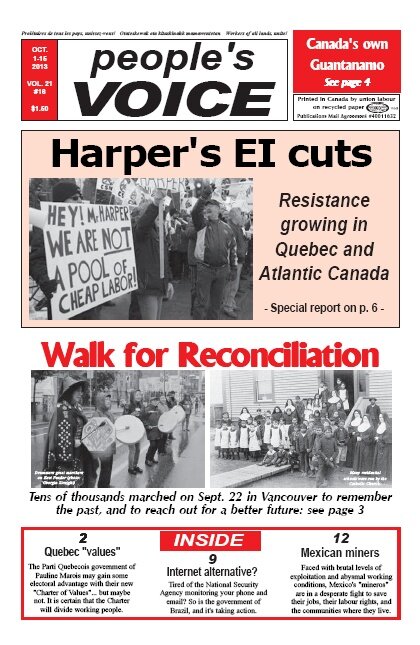
1) WALK FOR RECONCILIATION DRAWS TENS OF THOUSANDS
2) NO TO DIVISIONS! YES TO WORKING CLASS UNITY!
3) DEMONSTRATORS DEMAND PUBLIC AUTO INSURANCE
4) THE FIGHTBACK AGAINST E.I. CUTS CONTINUES
5) CANADA'S IMMIGRATION GUANTANAMO - Editorial
6) U.S. AND ISRAEL MUST ALSO DISARM - Editorial
7) ECONOMIC WINNERS AND LOSERS
8) MEXICAN MINERS: FIGHTING TO STAY HOME
9) BRICS CABLE TO PROVIDE GLOBAL INTERNET ALTERNATIVE
10) ENVIRONMENT CRISIS: CAN CAPITALISM COPE?
12) MUSIC NOTES, By Wally Brooker
14) WHO REFUSES TO PUBLISH REPORT ON IRAQ
PEOPLE'S VOICE OCTOBER 1-15, 2013 (pdf)
People’s Voice 2013 Calendar
”Ideas of Revolution”

|
People's Voice deadlines: October 16-31 November 1-15 Send submissions to PV Editorial Office,
|
REDS ON THE WEB
http://www.parti-communiste.ca/
peoplesvoice.ca
www.ycl-ljc.ca
www.solidnet.org
|
People's Voice finds many "Global Class Struggle" reports at the "Labour Start" website, http://www.labourstart.org/. We urge our readers to check it out! |
* * * * *
People's Voice
Canadian Publications Mail Sales Product Agreement #205214
ISSN number 1198-8657
People's Voice is published by
New Labour Press Ltd
PV Editorial Office
706 Clark Drive,
VANCOUVER, B.C. V5L 3J1
Phone:604-255-2041
Fax:604-254-9803
email: pvoice@telus.net
Editor: Kimball Cariou : Business Manager: David Au
Editorial Board: Kimball Cariou, Miguel Figueroa,
Doug Meggison, Naomi Rankin, Liz Rowley, Jim Sacouman
* * * * * *
Letters
People's Voice welcomes your letters
on any subject covered in our pages.
We reserve the right to edit for length and clarity,
and to refuse to print letters which may be libellous
or which contain unnecessary personal attacks.
Send your views to:
"Letters to the Editor",
706 Clark Dr., Vancouver, BC V5L 3J1,
or pvoice@telus.net
People's Voice articles may be reprinted without permission,
provided the source is credited.
* * * * * *
The Communist Party of Canada, formed in 1921,
has a proud history of fighting for jobs, equality, peace,
Canadian independence, and socialism.
The CPC does much more than run candidates in elections.
We think the fight against big business and its parties
is a year-round job,
so our members are active across the country,
to build our party and to help strengthen people's movements
on a wide range of issues.
All our policies and leadership
are set democratically by our members.
To find out more about Canada's party of Socialism,
give us a call at the nearest CPC office.
* * * * * *
Central Committee CPC
290A Danforth Ave Toronto, Ont. M4K 1N6
Ph: (416) 469-2446
fax: (416) 469-4063 E-mailmailto:info@cpc-pcp.ca
Parti Communiste du Quebec (section du
Parti communiste du Canada)
5359 Ave du Parc, Montréal, Québec,
H2V 4G9
B.C.Committee CPC
706 Clark Drive, Vancouver, V5L 3J1
Tel: (604) 254-9836
Fax: (604) 254-9803
Edmonton CPC
Box 68112, 70 Bonnie Doon P.O.
Edmonton, AB, T6C 4N6
Tel: (780) 465-7893
Fax: (780)463-0209
Calgary CPC
Unit #1 - 19 Radcliffe Close SE
Calgary AB, T2A 6B2
Tel: (403) 248-6489
Ottawa CPC
Tel: (613) 232-7108
Manitoba Committee
387 Selkirk Ave., Winnipeg, R2W 2M3
Tel/fax: (204) 586-7824
Ontario Ctee. CPC
290A Danforth Ave., Toronto, M4K 1N6
Tel: (416) 469-2446
Hamilton Ctee. CPC
265 Melvin Ave., Apt. 815
Hamilton, ON.
Tel: (905) 548-9586
Atlantic Region CPC
Box 70 Grand Pré, NS, B0P 1M0
Tel/fax: (902) 542-7981
http://www.parti-communiste.ca/
* * * * * *
News for People, Not for Profits!
Every issue of People's Voice
gives you the latest
on the fightback from coast to coast.
Whether it's the struggle for jobs or peace, resistance to social cuts,
solidarity with Cuba, or workers' struggles around the world,
we've got the news the corporate media won't print.
And we do more than that
- we report and analyze events
from a revolutionary perspective,
helping to build the movements for justice and equality,
and eventually for a socialist Canada.
Read the paper that fights for working people
- on every page, in every issue!
People's Voice
$30 for 1 year
$50 for 2 years
Low-income special rate: $15 for 1-year
Outside Canada $50 for 1 year
Send to: People's Voice, 706 Clark Drive, Vancouver, BC, V5L 3J1
You can call the editorial office at 604-255-2041
REDS ON THE WEB
http://www.parti-communiste.ca/
http://www.ycl-ljc.ca/
http://www.solidnet.org/
(The following articles are from the October 1-15, 2013, issue of People's Voice, Canada's leading communist newspaper. Articles can be reprinted free if the source is credited. Subscription rates in Canada: $30/year, or $15 low income rate; for U.S. readers - $45 US per year; other overseas readers - $45 US or $50 CDN per year. Send to People's Voice, c/o PV Business Manager, 706 Clark Drive, Vancouver, BC, V5L 3J1.)
1) WALK FOR RECONCILIATION DRAWS TENS OF THOUSANDS
By Kimball Cariou
Tens of thousands of people walked four kilometers in chilly autumn rain through Vancouver on Sept. 22, the culmination of a "Week of Reconciliation" marking the tragedy of residential schools in Canada. The events coincided with the Vancouver leg of hearings conducted by the Truth and Reconciliation Commission (TRC), giving survivors of the schools an opportunity to speak about their experiences.
Estimated by the mass media at up to 70,000 people, the Sept. 22 Walk was likely the single largest demonstration in solidarity with Aboriginal peoples in the history of Canada. Led by First Nations drummers, elders and school survivors, the huge march was underway for over half an hour before participants at the back could even begin walking across the Georgia Viaduct from the downtown core.
The Walk was the concept of Chief Robert Joseph, Hereditary Chief of the Gwawaenuk First Nation and founder of Reconciliation Canada. The Vancouver events were organized by Reconciliation Canada, a collaboration between the Indian Residential School Survivors Society and Tides Canada.
"Over time, it's going to pave a new way forward," Chief Joseph told The Tyee news site. "That's the emphasis, not to forget about the sad and tragic history of residential schools. We'll always, for a long time, continue to struggle for equality and justice, and move away from the harm... We have to begin with courage [and] work on it every day, step by step. It's better than staying where we are: broken."
Starting with no logistical support or funds, Chief Joseph's idea gathered wide backing over the last year, from First Nations, churches, and other sectors of society. This included support from the city of Vancouver and other government bodies, but more controversially, from several corporations such as the Royal Bank and BC Hydro.
In the end, local indigenous organizer Kat Norris reflected the views of many grassroots activists about the Reconciliation Walk. Norris shared concerns about involvement by corporations which profit from the theft of indigenous territories. But in a YouTube video, she concluded that the event was enormously significant for the survivors of the residential schools. That perspective was visible during the Walk, as deeply-moved participants cheered and wept at the sight of the kilometer-long crowd of First Nations people and community allies.
An estimated 150,000 Aboriginal children were taken forcibly into the residential schools from the 1870s to 1996, usually kept from using their own languages and rarely seeing their families. Many suffered physical, emotional and sexual abuse, and it has been estimated that several thousand died in these institutions. Government apologies and some monetary reparations have been won, but this assimilationist policy inflicted terrible suffering on Aboriginal nations across the country.
The keynote speaker to kick off the Walk was Bernice King, the daughter of U.S. civil rights leader Martin Luther King Jr.
"My father said something very powerful about progress," King told the crowd. "He said, human progress is neither automatic, nor inevitable. Even a superficial look at history reveals that no social advance rolls in on the wheels of inevitability. Every step towards the goal of justice requires sacrifice, suffering and struggle."
A Baptist minister herself, King was among the speakers recently in Washington DC, where thousands gathered to mark the 50th anniversary of her father's famous "I have a dream" speech.
The federal Truth and Reconciliation Commission was set up in 2008 as part of a settlement between the Canadian government, victims, and churches which operated residential schools. The final TRC hearings will be held in Edmonton, and the Commission is scheduled to issue a final report at the end of 2014.
|
|
2) NO TO DIVISIONS! YES TO WORKING CLASS UNITY!
Statement of the Parti comuniste du Québec on the Charter of Québec Values
Debates are raging in Québec over the "Charter of Québec Values"which the Parti Québécois government officially made public on Sept. 10, but whose content had been published for the most part by the media several days previously.
In all likelihood, the government itself orchestrated these leaks in the media, to evaluate the impact that the project would have with the electorate. Last May, the Government conducted a survey which showed the support of a majority of citizens for a framework of "reasonable accommodations. "On that occasion, the minister responsible, Bernard Drainville, announced that the "secular charter"promised during the previous election campaign would instead become one of "Québec values."
Essentially, the project contains five propositions revolving around two principal aspects: the establishment of tags to manage requests for religious accommodations and, secondly, the declaration of neutrality of the State, in particular prohibiting all public employees from wearing "ostentatious "religious symbols.
In the latter case, it is proposed to allow CEGEPS, universities, health and social service establishments and municipalities to be exempt from this ban, during a transitional period of two five‑year terms. However, this aspect remains by far the most controversial because it violates fundamental rights.
Moreover, while the project intends to ensure the religious neutrality of the State, it allows a multitude of Catholic symbols, considered part of the patrimony of Québec. So, the crucifix that pro‑fascist Premier Maurice Duplessis placed in 1936 in the National Assembly to illustrate the close relationship between the State and the Catholic Church, would paradoxically remain.
A petty electoral calculation
The PQ minority government is desperately looking for a parliamentary majority. During the last election campaign, in the context of student protests over tuition hikes, the PQ was forced to focus more on the left of the political spectrum, making many promises along the lines of popular demands: abolition of Bill 78, cancellation of the tuition increases, abolition of the health tax and electricity rate increases, higher taxes on the rich and increased royalties on natural resources, etc.
The PQ went in this direction only because the space on the political right which it had tried to occupy was already too crowded, on the one hand by the Liberal Party and secondly, by the Coalition for the future of QuΘbec (CAQ), which had delighted its nationalist right supporters.
However, once in power, citing their minority status, the PQ was quick to betray almost all promises one after another, and to show their true colours by adopting a very austere budgetary policy. Far from worrying about women's rights as the PQ claims with this Charter, it has instead attacked public health and education services, penalizing mainly women. The PQ has also attacked the most deprived by decreasing the social assistance benefits of persons aged 55 to 57, as well as families with children under five years. Of course, many of those who had elected the PQ are disappointed.
On the other hand, led by Philippe Couillard, the Liberal Party had largely recovered in the polls, while the CAQ declined, creating a situation which is very threatening for the PQ.
The PQ made the opportunistic calculation that the launch of its Charter of Values would allow it to gain support from voters on the right, particularly those who previously voted for the CAQ and the ADQ, and who fear for their national identity. Without openly admitting this, the PQ expects to benefit from the latent feelings of intolerance, xenophobia and islamophobia which exist in some segments of the population.
Currently, there is no real problem in connection with religious accommodations that is urgent to resolve, or any concrete threat to the Québec identity from religious symbols worn by people from cultural communities. It is clear to the majority of the people that the PQ is electioneering.
A campaign on the skids
Initially, after the first leaks in the media, the PQ appeared to have won this bet. Opinion polls were largely favourable to its project. Once launched by the Government, the debate unfortunately allowed, in a way, certain manifestations of racism, sometimes in the street, but more often in social media.
But, there is also a mobilization of those who oppose this Charter, including many intellectuals, professors and famous artists, such as Richard Desjardins, Dan Bigras or Michel Rivard; the ex‑student leader, Gabriel Nadeau‑Dubois; organizations such as the Federation of Women of Québec, the League of Rights and Freedoms, or the Fédération autonome de l'enseignement, a teachers union.
While supporting the principle of secularism, Québec Solidaire opposes the prohibition on the wearing of religious symbols by public employees: "We do differentiate between the religious neutrality of the institutions and individuals"said QS co‑leader Francoise David.
Other opponents are people very well‑known in the sovereignist movement, such as Bloc Québecois MP Maria Mourani, Francois Leblanc and Patrick Marais (former top advisors to Gilles Duceppe), former Bloc Québecois MP Jean Dorion, writer Yves Beauchemin, the well known author and former PQ candidate, Robin Philpot, and philosophy professor Michel Seymour, the former president of Intellectuals for Sovereignty, etc.
Another organization opposing the Charter is Amnesty International Canada-francophone. General Director Béatrice Vaugrante, fearing stigmatization and isolation of some women, questioned the necessity to "substitute for a supposed constraint to wear a religious symbol, the State constraint not to wear it".
All this democratic opposition has begun to seriously reduce support for the project, considered repressive and divisive. According to the latest survey, there would be as many opponents as supporters.
The expulsion of Maria Mourani from the Bloc Québécois because of her opposition to the Charter has sent a serious shock wave through sovereigntist ranks. The PQ pretensions to carry out "an open debate"were exposed, but in doing so, the PQ may have permanently alienated much of cultural communities, as well as their eventual support for the project of Québec sovereignty.
On the other hand, support which a xenophobic and racist right could bring to the draft Charter does not necessarily or automatically translate to votes for the PQ. A part of this right is federalist and opposes Québec sovereignty (for example, supporters of Stephen Harper's Conservative Party).
According to some statements by representatives of the government, it would be willing to consider trade‑offs on the prohibition of ostentatious religious symbols by public sector employees.
But at the same time, the government seems to manoeuvre for the electoral battle. It has appointed four ardent partisans of the Charter of Values to the Board of Directors of the Council of the Status of Women on the eve of that body taking a position. However, opinions were divided on this Council, and these appointments were publicly denounced by its President Julie Miville‑DechΩne as a downright takeover by the Government of the body, which is supposed to enjoy a degree of independence to be able to fulfil its advisory mission. In addition, there are some indications that logistical preparations for elections this fall have been ordered by the authorities.
Québec bashing in the Canadian media
As soon as leaks about the PQ project came out in the Québec media, there was an outcry in the media in the rest of Canada to denounce it. Accusations of intolerance, racism, or even of fascism have been launched, conveying chauvinistic prejudice against Québec.
This is not new. During the 1940s, the Communist intellectual Stanley Ryerson in his book French Canada denounced "the calumny to the effect that French Canadians as a people are indifferent or inimical to democracy is refuted by the historic record. The democratic tradition is deep‑rooted in the consciousness of the Québec people."
Shortly before, on July 26, in a court case involving the language rights of francophones in British Colombia, the Supreme Court of Canada issued a decision confirming the position of the lower courts, to the effect that it is not allowed to file documents only in French in the courts of this province; they must also be translated into English. The Court also ruled that using only English in those courts is not contrary to the Canadian Charter of Rights and Freedoms.
Nevertheless, in the Canadian media, this decision passed virtually under the radar. One can imagine the fury triggered by a similar decision in Québec against the English language. This double standard perfectly illustrates the great injustice that reigns in this country against Québec. Unequal Union, as Ryerson called it.
It is precisely this unjust and unequal treatment within Canada which causes the Québecois to fear for their identity. The dominant status of English Canada at the expense of the other nations in Canada is the starting point of the national discords which weaken the struggle of working people against the domination of monopoly capital.
Yes to secularism, no to the prohibition against wearing of religious symbols!
The PQ practices essentially the same strategy: divide and rule. If its attempt to win a parliamentary majority on the basis of this Charter of Values turns people against each other, it will be able to strengthen its attacks against the working class, and accelerate the implementation of its social cuts and austerity programme.
The Communist Party instead seeks to unite the working class so that it can withstand the attacks of the bourgeoisie, and to struggle against capitalism and for socialism. It is through the development of the class struggle, under the conditions of capitalist society, that workers manage best to overcome their religious beliefs and join the fight for socialism.
The Communist Party is of the opinion that religion and the churches of all kinds are fundamentally reactionary, and serve to defend the exploitation of the working class. We are unequivocally in favour of state secularism. Public institutions must display neutrality towards religions. So, it is important that the crucifix be removed from the National Assembly if it wants to qualify for the secularism of the State.
However, the Communist Party supports the freedom of conscience and the democratic right of individuals to practice their religions or to have none. We oppose coercion and advocate an approach relying on persuasion and education. In this sense, the Communist party categorically opposes the prohibition on wearing religious symbols by public employees as proposed by the PQ, which really does nothing, since, as Frederick Engels said, "persecution is the best way to strengthen adverse convictions,"to heighten interest in religion, and to make its actual decline more difficult.
"New immigrants form a considerable portion of Canada's labour force. Immigrant workers continue to suffer from acute discrimination, arising in the main from capitalist exploitation and attitudes of national chauvinism. From its foundation the Communist Party has struggled to end discrimination against immigrant workers, working to expose how capitalism generates racism and national chauvinism, profits from low wage areas, and divides the working class to hold back the overall struggle."*
The Communist Party calls for the adoption of a new constitution which would "prohibit the violation of the civil liberties of immigrants. It would outlaw racism and discrimination. It would assure the democratic, cultural and language rights of the non‑French, non‑English ethnic groups in Canada. A new constitution must embody a Bill of Rights, and a Bill of Rights for Labour, to provide guarantees of trade union and democratic rights which apply to the people of all nations within the Canadian state. These guarantees must ensure economic, social, cultural and linguistic equality, the right of assembly, the right to organize and strike, the habeas corpus right not to be arbitrarily deprived of one's liberty, the right to a job, to freedom of movement, to health, to education, to housing. The rights of women, youth and children must be guaranteed."*
"A new constitution should unify social legislation to provide equal opportunity and high standards in all of Canada while respecting the sovereignty of Québec, and the right to self-government of the Aboriginal peoples."*
The Communist Party also proposes a voluntary and equal partnership of Québec and English Canada, including the right to secede, guaranteeing the full participation of Aboriginal peoples to protect and develop their inherent national rights, including the right to genuine "self‑goverment", a right of veto against any change that would affect their constitutional status, and the right to accelerated economic, social and national development.
"This fight for constitutional change is crucial to the overall struggle for democracy, social advance and for socialism. Uniting the working class across the country will not be possible without combating national oppression and fighting to achieve a new, equal and voluntary partnership of Canada's nations."*
( Excerpts from the program of the Communist Party of Canada and the Communist Party of Québec, Canada's Future is Socialism!)
|
|
3) DEMONSTRATORS DEMAND PUBLIC AUTO INSURANCE
PV Ontario Bureau
BRAMPTON ‑ Over 60 demonstrators came out to Liberal MPP Linda Jeffrey's office Sept. 22 to demand the Ontario government bring in public auto insurance.
Organized by the GTA West Club of the Communist Party, the demonstration heard from Surjit Sahota, Secretary of the Indo Canadian Workers Association and Liz Rowley, Leader of the CPC (Ontario). Sahota pointed out that Brampton had the highest car insurance rates in Canada. No fault insurance, introduced in 2010, did not lower rates. But it did dramatically lower coverage for injured drivers, many of whom have been forced to sue their insurance companies to get the benefits they need, and paid for.
Liz Rowley said the sky‑high premiums and low coverage was all about profits.
"In 2012, insurance company profits were $4.4 billion, up 24% over 2011. Those profits came from the high premiums and slashed benefits that the McGuinty Liberals brought in with no fault insurance," she said. "Ontario's rates are higher than all other provinces because the insurance companies are allowed to build in a 12% profit on every single policy they write. Eliminate the greedy insurance companies, and Ontarians can have affordable public auto insurance ‑ which has been in place in BC, Saskatchewan, Manitoba and Quebec for more than 40 years. It's time the government got out of bed with the insurance companies and delivered public auto insurance. They're 40 years late and the public's paying the price."
GTA West Club spokesperson Harinder Pal Singh Hundal told Punjabi media that the club wanted to build a broad ad hoc committee for public auto insurance, involving everyone in Brampton who was fed up with being fleeced.
"We need to take united action now", he said, as demonstrators chanted "What do we want? Public insurance! When do we want it? NOW!"
In last spring's budget, in exchange for NDP support, the Liberals agreed to an NDP demand for a 15% reduction in auto insurance rates within 12 months. The Liberal minority government depends on NDP support to stay alive.
In the interim, the Insurance Bureau of Canada unleashed a massive campaign to block the reduction, arguing that extensive insurance fraud by drivers, not profits, is driving sky‑high rates. The Tories are leading the attack in the Legislature.
But it's not just Brampton. Ontario drivers pay the highest insurance rates in Canada. What's so special about Brampton, except than it's home to one of the largest South Asian communities in Canada ‑ a population the Tories recently attacked as job‑stealers?
"The biggest fraudsters are the insurance companies", said Rowley, "aided and abetted by the Tories and the government."
Premier Kathleen Wynne said in August that this "complex" problem can't be done in a year. In fact, estimates are that average rates, not all rates, will fall by 3% to 5% by January 2014. As Rowley said, "This could take five years, or maybe never".
The Premier says she does not want to create a situation where people can't get insurance because the industry says "You're pushing us too hard, we just won't write insurance for certain parts of the population."
"That's extortion" said Rowley, "and for that reason alone the government should move over to public insurance."
Rowley praised Brampton NDP MPP Jagmeet Singh for his diligent work exposing the insurance companies' profiteering.
"But the solution isn't a rate cut that will have to be fought and re‑fought every year," she argued. "The solution is public auto insurance ‑ a policy the NDP used to advocate, but has abandoned." Citing a report from the right‑wing Fraser Institute which stated the average cost of auto insurance is $1,281 in Ontario with private insurance, and $642 in Quebec with public insurance, Rowley said the choice was clear.
"We'll be back" she said, "and next time we'll be headed for Queen's Park. There's an election coming and a minority government that's flailing. The Liberals and NDP can help themselves by helping Ontario's nine million drivers."
|
|
4) THE FIGHTBACK AGAINST E.I. CUTS CONTINUES
From http://rebelyouth-magazine.blogspot.ca
Public pressure against the Harper Conservative government's recent Employment Insurance (EI) reforms will continue this fall, as labour and community activists move forward with one of the more dynamic and united union‑led fightbacks Québec, New Brunswick and Nova Scotia have seen in recent years.
While the protest movement developed over the past year in response to a "double round" of EI cuts effecting the whole country, they've spread like wild‑fire especially across French-speaking Acadien and Québécois cities and towns, and even villages.
This is because the double round of attacks to EI by the Harper Tories after the 2012 federal budget is disproportionately impacting workers in seasonal industries. It is a reality linked with long‑standing questions of the economic underdevelopment across Canada and social inequalities faced by the French‑speaking national communities.
Three tiers
The first round of cuts were implemented in January, when Service Canada divided the unemployed into three "tiers" or categories of "users" ‑ based no longer just on paid experience in the workforce (not `under the table' work), but also experience with collecting EI.
Workers with no history of collecting EI make tier one, "repeat occasional users" fit into tier two, while "regular users" are tier three. Workers' ability to launch appeals was also effectively scaled‑back, and special measures for seasonal economies have been unilaterally cancelled.
EI Harder to get
The cuts push those who have needed EI before, or remain unemployed for longer than a few months, to accept any work they can find ‑ even if it is 70% lower than their previous pay and an almost an hour drive (one‑way) from the worker's home.
The second round, implemented in April, drastically reduces eligibility for EI. As Toronto Star columnist Carol Gore wrote (April 10), "the essence of this change is that the government has pushed the threshold to qualify for the most generous form of EI treatment out of reach for most Canadians."
Even before the cuts, maximum weekly benefits had shrunk from $604 in 1996 to an average of just $335 per week in 2012. Less than 40 per cent of unemployed workers, and even fewer women, actually qualify for EI.
National Question
While the cuts to the Employment Insurance system hit all workers across Canada, they are designed to have a particular punch in areas where workers can only find seasonal employment.
As Guillaume Bourgault‑Coté writing in the newspaper Le Devoir (May 30) showed, while only 27.3% of EI claimants were considered "tier three" or "frequent users" according to the new definitions, 72% of frequent users across Canada were in Québec and the four Atlantic provinces.
"Québec alone provides 160,000 of the total 387,000 providers of this group (which is a little over a third of all the unemployed people in Québec)," Bourgault‑Coté wrote, drawing from a 2012 report on EI Monitoring and Assessment. While Atlantic frequent users represent between 42.8% (Nova Scotia) and 61.4% (Newfoundland) of all claimants, Alberta has just 8.9% of frequent claimants, the lowest rate in the country.
The statistics show the overlap between regions with a high Acadien and Québécois population, where there is long‑standing economic underdevelopment, and those impacted by EI. Perhaps it is not surprising that these are the communities where the fightback has been the strongest.
East Coast protest movement
A wave of actions took place across New Brunswick and Nova Scotia last winter and into the spring. Quiet towns and tiny villages across New Brunswick's Acadian peninsula, including Campbellton, Inkerman, Tracadie‑Sheila, and Miramichi saw large crowds of angry residents up in arms against the EI reforms. Up to six hundred workers and families blocked traffic and, in some cases, occupied Service Canada offices.
Larger centers such as Shediac, Moncton, Fredericton, and Saint‑Quentin also saw protests as did a number of communities across Nova Scotia including Sydney, Antigonish, Truro, Bridgewater, and Halifax.
"What Ottawa seems to disregard is that rural communities are almost devoid of year‑long employment industries," Michel Richard, an organizer with the Maritime Fishermen's Union and spokesperson for a New Brunswick coalition against the EI reforms, told CBC News.
Work seasonal, not workers
Last year, EI usage in New Brunswick averaged 35,019 workers. Some months as many as 45,830 workers were reported to be collecting.
"We have to demystify this myth that there are seasonal workers; it is a derogatory way of speaking because these workers actually depend on seasonal work because so many activities in the Atlantic rural areas, the fisheries, agriculture, etc. are seasonal. It is the work that is seasonal," Richard told another news source.
"The government has never shown any interest in building infrastructure in rural and coastal areas so that there can be work all year long" he said, noting that depletion of fishing stocks had led to a reduced fishing season.
Petition strikes a chord
When Acadien Guy Lanteigne started an online petition from his New Brunswick home, he hardly expected it to reach 34,000 Canadians coast to coast.
But Lanteigne's petition quickly earned the support of a wide range of community groups in New Brunswick including the Association of Francophone Seniors, the Association of Francophone Municipalities, the Union of Municipalities, the Francophone Literacy Association, and the Acadian Society, as well as labour support including the New Brunswick Federation of Labour.
All four provincial governments in the Atlantic, including two Conservative ones, have gone on record with some form of opposition to the federal Conservative EI reforms. The Atlantic Episcopal Assembly of Catholic Bishops also issued an open letter in May expressing "our understanding, our support and our solidarity in this struggle for a more compassionate, equitable and fair system of [EI] assistance."
Major fightback in Québec
Even larger demonstrations have taken place in Québec. Every city in that province has seen some form of action opposing the EI reforms. Almost a hundred citizens' assemblies on EI have taken place drawing over 10,000 participants.
The biggest anti‑EI reform mobilization was held in Montréal to mark May Day. The march drew over 50,000 people into the streets. Although relatively under‑reported by the corporate media outside of Québec, the demo was likely the largest mass protest in Canada since the Québec student strike.
Organizing continued this past summer. The education group Mouvement Action‑Chomage de Montréal (Montreal Unemployment Action Movement) recently convened an early‑September planning meeting to strategize for the days ahead, when the impact of the reforms will begin to be felt, with plans for continued action including occupations of government buildings and political offices.
The whistle blower
When Sylvie Therrien took her job at Service Canada, she never intended to be a whistle blower. Now she is suspended without pay and subject to a witch‑hunt by the government, all because she leaked documents that put wind in the sails of the Employment Insurance fightback.
Therrien's leak, coming after months of actions in these communities, exploded like a small bomb by scandalizing the public that Service Canada had placed quotas to find $485,000 in "savings" by denying EI claims.
Pressure tactics included checking addresses, bank accounts, medical documents, physical appearances, and even banging on the door of claimant's homes demanding an interrogation‑style interview with twenty‑three questions.
More scandals
Québec organizers have exposed other scandals involving EI, including the case of a man whose active claim was terminated after Service Canada unsuccessfully called his house several times, to see if he was working. The problem is, each time Service Canada called, he was at a local job‑search workshop organized by the government.
Now the worker is weaving his way through the new appeals process, trying to win back his claim. But as part of the EI reforms the Tories have abolished the old Employment Insurance Boards of Referees, which included a representative from business and labour, as well as a chairperson.
Already, as the Canadian Press (May 21st) found recently, "as many as one of every five chairpersons on the Employment Insurance Boards of Referees gave money to political parties, riding associations and election candidates while they served on the tribunal," breaking the rules of impartiality and bringing in $37,000 in donations in total to the Conservative Party.
It seems like the patronage story has been repeated with the new one‑person Social Security Tribunal.
Out of the 46 full‑time members, "Six are failed Conservative candidates, one is a failed federal Progressive Conservative candidate, some have unsuccessfully run for Conservative nominations, some have been on the executive of Conservative riding associations, some have run for conservative parties at the provincial level, and others have donated to the federal party," the Globe and Mail (May 26th) reported.
Critics point out that these are the people, mostly Conservative men, who now make the decision whether workers receive Employment Insurance ‑ or are "thrown to the lions" without any social support.
Broad coalition growing
All these scandals are helping fuel public anger in Québec against the EI reforms. The broad coalition Le Mouvement Autonome et Solidaire des Sans‑emploi (the Independent and United Movement of the Unemployed or MASS) held its general assembly this past July.
"The addition of two new member groups [into the coalition] reflects the desire of working people and the unemployed to fight together against these unfair reforms, which will have negative consequences on the entire world of work," Marie‑Hélene Arruda, spokesperson of the MASS coalition told the general assembly. "The unemployed groups, trade unions and civil society organizations have closed ranks to express their opposition and speak with a united voice against the [Harper Conservative] government which instead, opts for division of `the good' and `the bad' unemployed."
Class impact
The comments by the MASS underscore the wide‑ranging class impact the Tories "slash‑and‑burn" cuts have beyond just those who are unemployed, either regularly or occasionally, or just those in Québec and Atlantic Canada.
"In the current economy, we are told, it is unlikely that you will make it through your life without being laid‑off and have to search for a new job. In fact, we are told that this will [actually be] rather regular," Graham Cox wrote on the news site rabble.ca recently.
"The reason for this is not that we are all bad workers, but rather because that is the nature of capitalism. The economic system imposed on us has brought with it a reduction in secure employment and a massive increase in precarious work," wrote Cox, a research director with the Canadian Union of Public Employees (CUPE).
Women also hit hard
Earlier this year, CUPE released a brief stating the EI reforms will have a greater impact on women. The CUPE study used Statistics Canada's economic dependency profile estimating the economic impact of social welfare, pensions, and unemployment benefits.
Women collect unemployment benefits for considerably longer periods of time than men across the country (for example 30 weeks in Manitoba and Saskatchewan compared to 19 weeks for men). Thus for the EI reforms for frequent users of the unemployment insurance system, the so‑called "third tier" workers, women will be most impacted.
Underdevelopment
The CUPE research briefing note from March 2013 shows that lowest number of insurable hours for both men and women EI recipients is in Atlantic Canada and Québec. This indicates the degree of precarious and seasonal work in these regions.
For generations, families have put food on the table from work in fishing, agriculture and forestry in these regions which are seasonal employers. But other jobs like construction, tourism, public administration, and even education have seasonal lay‑offs.
"The government has never shown any interest in building infrastructure in rural and coastal areas so that there can be work all year long. Still these seasonal sectors are economic engines in our rural areas," Michel Richard told news media.
Punished by EI
This underdevelopment of the economy in the Atlantic and large parts of Québec is, of course, no fault of the local workers. Nevertheless, government EI has become an essential subsidy to big capital in these regions to keep their work force afloat on "the pogey".
Québec and Atlantic male workers, as well as BC and Atlantic women workers, have just over 1650 insurable hours on average, and Québec women rank lowest in the country, at 1600 insurable hours according to CUPE.
This compares to just under 1700 hours for BC male workers, just over 1800 hours for both men and women in Ontario, and well over 1800 for men and women workers in Manitoba, Saskatchewan and Alberta.
Now, with the limitations imposed through the "three‑tier" system, these so‑called "repeat users" will have to accept any work they can find ‑ even if it is 70% lower than their previous pay and an almost an hour drive (one‑way) from home.
Social future of crisis
The "punishment" is made all the harder by comments like those of the current Minister of Finance, Jim Flaherty.
Speaking in Parliament, Flaherty said in May of last year that there were no bad jobs. "I drove a taxi, I refereed hockey, you do what you have to do to make a living." As the editor of a Langley, BC, newspaper said "If we could burn stupid like oil, we could run every car in Canada for a month on his latest remarks."
Flaherty's parliamentary biography also states he went to a private boys high school before graduating from the Ivy League Princeton University and then Osgoode Law school. His first career in politics was as a cabinet minister in the notorious Mike Harris Ontario Conservative government when, the news archives show, he proposed to solve the homelessness crisis in Ontario by making homelessness illegal.
The Star's Carol Goar wrote last April, "No doubt these measures will sharpen the private sector's competitive edge. [However] Over time, they will erode Canada's standard of living and reduce the resilience of its workforce."
In these times of capitalist economic crisis, it is becoming clearer that the destruction of programs like EI and the impoverishment of working people who create all the wealth in society, is in fact exactly what makes "the sharp competitive edge" of the private sector.
|
|
5) CANADA'S IMMIGRATION GUANTANAMO
People's Voice Editorial
On Sept. 18, over 180 immigration detainees in Lindsay, Ontario's Central East Correctional Centre began protests against their detention conditions. The detainees were recently moved from other prisons in the Greater Toronto Area, further from families and legal support. Some began a hunger strike which has since ended, but other actions continue.
Their demands are simple: better access to medical care, social workers and legal services, cheaper phone calls, better food, an end to constant lockdowns, transfers nearer to families and resources. Some are designated as "high security" based on flimsy grounds, such as an arrest that has not led to conviction. Some have been in jail for over seven years because Canada has no limit on how long someone can be held prior to deportation.
Here are some further facts, from the group No One Is Illegal. Between 2004 and 2011, 82,000 people were locked up in immigration detention in Canada, plus at least another 25,000 since then. In 2012, 289 of these detainees were children, some under the age of ten. About one-third of immigration detainees are held in maximum security provincial prisons, some unable to leave their cells for 18 hours a day. It costs taxpayers over $50,000 annually to hold such prisoners. Immigration detention centres are a $50 million business, run in partnership with private companies like G4S, Garda and Corbel Management. In Toronto alone, G4S and Corbel were paid $19 million between 2004 and 2008.
In the last ten years, the number of people without full status (refugee claimants, temporary workers, etc.) has increased by 60% but permanent residency visas have stayed constant. Refugee acceptance rates are less then 25%. Migrants denied full status have to live without papers, services, justice or dignity, in daily fear of detention. Those arrested are locked up in brutish conditions awaiting forced deportations.
There is nothing humane about this racist system - Canada's own shameful mass Guantanamo must be ended now!
|
|
6) U.S. AND ISRAEL MUST ALSO DISARM
People's Voice Editorial
The contradictions, hypocrisy and outright lies of the U.S. push for war against Syria just keep piling up. But so far, it appears that the world isn't buying Uncle Sam's snake oil.
One of the most appalling aspects of this situation is that the country beating the drums about "red lines" is responsible, directly or indirectly, for many of the deadliest attacks on civilians of the last century. A partial list includes the nuclear bombing of Hiroshima and Nagasaki, the use of depleted uranium weapons in Iraq, the "agent orange" defoliation campaign which is still poisoning Vietnam, and much more.
Today, the U.S. is still threatening to bomb Syria if that country isn't quick enough to destroy its stockpile of chemical weapons. Yet the United States keeps foot-dragging on moves to eliminate its own deadly arsenal. The Pentagon still has about 2,611 tons of mustard gas in a facility in Colorado, and 524 tons of a spectrum of chemical weapons - including deadly nerve agent Sarin - in a facility in Kentucky.
As a ratifier of the Chemical Weapons Convention treaty, overseen by the Organization for the Prohibition of Chemical Weapons at the Hague, the U.S. agreed in 1997 to destroy its chemical weapons stocks within 10 years. Now, U.S. officials say they need another decade. International weapons inspectors have been stymied several times in their efforts to speed things up. Just as ominous, the U.S. remains silent on Israel's refusal to ratify the Convention, even though Israel has also used such weapons against civilians.
Every rational person wants to see these terrible weapons permanently destroyed. But to be effective, universal disarmament must be truly universal. The U.S. and its closest allies cannot be allowed a free pass, especially given their track record as global bullies.
|
|
7) ECONOMIC WINNERS AND LOSERS
* Operating profits reported by corporations in Canada have edged down slightly this year, but remain at historic levels. Statistics Canada reported in August that corporations earned $72.2 billion in operating profits in the second quarter of 2013. That marked a decline of 0.8% from the previous quarter, which was a drop of 2.8% from the final three months of 2012. These figures point to a total of some $290 billion for this calendar year, the highest in Canadian history. Just as significant, the 2013 numbers are a huge jump over just four years ago; in 2009, total corporate operating profits were in the $200 billion range, following the fiscal meltdown of September 2008.
* In the winner‑take‑all world of corporate capitalism, on Sept. 20 BlackBerry stock closed down $1.74, a drop of 16%, to $9.08 on the TSE. The company expects to post a loss of US$950 million when it reports second‑quarter earnings. But the real victims are BlackBerry employees, 4,500 of whom will be laid off as the company tries to cut operating costs by 50% by next June.
* Canadians who lose their jobs are less likely to get EI benefits than at any other time on record. StatsCan says the number of EI recipients fell by 2.1% in July, to just under 504,000, similar to the numbers before the labour‑market downturn in 2008. Unfortunately, the total number of jobless is still 300,000 higher. There are nearly 1.4 million unemployed people in Canada today, versus 1.1 million in September 2008, when the collapse of Lehman Brothers triggered the global financial crisis. According to Erin Weir, an economist for the United Steelworkers, the proportion of unemployed Canadians receiving regular EI benefits was 36.5% in July, the lowest on record. As recently as 2007, 45% of unemployed qualified for EI benefits. Weir also noted that the number of Canadians applying for the first time for EI, or renewing their EI benefits, jumped by 3.4%, suggesting the job market weakened even as EI benefits rolled out to fewer people. The Harper government toughened EI rules earlier this year, creating more complex standards to keep benefits and a new requirement that beneficiaries who have used EI frequently have to take any job available to them and accept as much as a 30‑per‑cent pay cut.
|
|
8) MEXICAN MINERS: FIGHTING TO STAY HOME
By David Bacon, September 9, 2013, In These Times
When Mexican unions assert the right of their members to continue living in the towns and cities where they've resided for generations, even indirectly, they quickly come into conflict with the federal government, as they have in Sonora close to the U.S. border and in Mexico City itself. Nowhere is this result ‑ displacement produced by the suppression of labour rights ‑ as evident as it is in Cananea, a mining town just south of the border.
In 2010, Manny Armenta, a representative of the U.S. union for metal miners, the United Steelworkers, led strikers' wives and children to safety in the middle of an armed assault by federal police on the miners' strike there. He'd just arrived from Arizona on one of his many trips bringing food and money to the strike. On the evening of June 7, the federal government sent two thousand police and soldiers into this small mining town ‑ more than two for every striker. As darkness fell and helicopters clattered overhead, they charged the mine gate in riot shields and batons, filling the streets with tear gas. Miners retreated to the union hall with their families, and the police followed, barricading the doors and lobbing more tear gas inside. The union's leaders were already in hiding ‑ the police had arrest warrants for them all. Armenta helped lead women and children down fire escapes and up through the basement to safety in the darkness.
Two months earlier the Arizona legislature had passed the notorious anti‑immigrant law, SB 1070. Armenta, who's spent more time in Cananea than at home in Arizona over the last five years, was upset by what he viewed as the hypocrisy and cruelty in routing miners' families on one side of the border, and then criminalizing those who cross it on the other. "Especially in Arizona with the new law, all we hear about is illegal immigrants," he charged bitterly. "What do they think will happen here? Where do they think all the miners will have to go?"
That same day, police moved on the widows of 65 miners who died in an explosion on February 19, 2006, at the Pasta de Conchos coal mine in Coahuila. Five days after the explosion, Grupo Mexico, the mining and railroad giant that owns both the Pasta de Conchos and Cananea mines, abandoned rescue efforts. The company closed the coal mine for good, with the trapped miners still inside. Grupo Mexico and then Mexican labour secretary Francisco Salazar refused to make any further attempts to recover their bodies. Nevertheless, miners' widows camped at the gates for years afterward, asking for their husbands' remains. The same day that police fought copper miners in Cananea, other cops drove the women away from the closed coal‑mine entrance in Nueva Rosita.
Both the Cananea strike and the widows' protests highlight extremely unsafe conditions in Mexican mines. At Cananea, silicosis‑causing dust from crushed copper ore rises to miners' knees inside the buildings. Grupo Mexico disconnected the dust extractors several years before the strike, in retaliation for earlier protests. At Pasta de Conchos, dozens of uncorrected violations for dangerous methane buildup preceded the 2006 explosion.
The Cananea strike involves issues beyond health and safety, however. The Mexican Union of Mine, Metal, and Allied Workers, or Mineros, used to be a loyal ally of the old Institutional Revolutionary Party (PRI), which governed Mexico for seventy years.
But Napoleon Gomez Urrutia, the Mineros' general secretary, took over the union in 2001 from his father, a PRI stalwart. Gomez Urrutia had much more militant and democratic ideas than his predecessor. He quickly forced employers, including Grupo Mexico, to concede much higher wage increases than those mandated by then-president Vicente Fox. Gomez helped defeat Fox's reform of Mexico's labour laws, a proposal recommended by the World Bank. After the Pasta de Conchos explosion, he accused Grupo Mexico of "industrial homicide."
The government reacted violently. It accused Gomez of corruption, forcing him to flee to Canada to avoid arrest, where he's lived since, given sanctuary by the United Steel Workers. A government‑backed effort to install a pro‑company leader to head the union was twice rejected by workers, who reelected Gomez even while in exile. All the legal actions against him led instead to his exoneration, but the government still threatened to jail him if he returned to Mexico.
In June 2007, Section 65 of the Mineros went on strike at the Cananea mine over safety conditions. The following January, after police beat dozens of strikers in an attempt to break the strike, twenty‑five thousand Mineros members struck in protest in ten mines and at the huge steel mill in Lazaro Cardenas, Michoacan, where two workers were shot and killed. In 2010, dozens more were beaten when they shut the mill down again and marched in the streets.
The government‑dominated labour board (Junta Nacional de Conciliacion y Arbitraje, or JNCA) repeatedly declared the strike at Cananea legally "nonexistent," a decision allowing Grupo Mexico to fire the strikers and install a company union. The family of German Larrea, which owns Grupo Mexico, was a major contributor to the campaign of former president Felipe Calderon, and the president and his party control the labour board. After Calderon's election in 2006, the secretary of labour recognized a new, company‑dominated union for miners. A rump election and the firing of fifteen hundred workers at another giant copper mine in nearby Nacozari allowed Grupo Mexico to sign a labour contract with this company union. This was followed by similar moves at several other mines.
Strikers at Cananea were trying to prevent a similar fate in their mine. "The government and the Larreas are making history, but backwards," the Mineros responded after the federal assault on Cananea, "trying to return to an era when we had no right to strike or right to industrial safety."
According to the Mineros, Calderon's labour secretary, Javier Lozano, held meetings with mine owners before bringing the police into Cananea. He offered them government recognition of the pro‑company union as a way for them to get out of contracts with the Mineros. The Chamber of Mines, in turn, hosted a banquet in Calderon's honour.
In May 2010, just before the assault in Cananea, Calderon was also feted at a state dinner at the White House. Steel union leaders met with Obama administration officials, asking them to tell Calderon that the United States wouldn't tolerate an attack on the miners. AFL‑CIO president Richard Trumka and Canadian Labour Congress president Ken Georgetti wrote to Washington and Ottawa with the same demand. According to Armenta, officials "assured us they were not turning their heads away. That was totally false." Seventeen days after the banquet, police attacked the copper strikers.
Armenta believes the assault on Cananea miners was the consequence, not just of Calderon's anti‑labour policies but also of tacit U.S. support for them. "Our government continues to give the Mexican government millions and millions of dollars, saying it will be used to fight drugs. But we see here clearly that this money is going to fight workers and progressive people. Our own government is creating this problem," Armenta says. "I condemn the Mexican government and Grupo Mexico. But I also condemn the US government for allowing this to happen, for not taking any action."
Smashing the strike led to the same massive firings that followed an earlier lost strike in 1998, and the destruction of the union in Nacozari in 2006. Waves of desperate miners, unable to find other work in their tiny mining communities, crossed the border into the United States as undocumented workers. In both Nacozari and Cananea, displaced people from southern Mexico were used as a new migrant workforce to replace fired union members, while the miners who'd lived in those border communities for decades became displaced themselves.
(David Bacon is a writer, photographer and former union organizer. His website is at dbacon.igc.org.)
|
|
9) BRICS CABLE TO PROVIDE GLOBAL INTERNET ALTERNATIVE
PV Vancouver Bureau
The President of Brazil, Dilma Rousseff, has announced the creation of a world internet system independent from the US-based internet founded in the 1980s.
The announcement follows the news of U.S. National Security Agency (NSA) spying on an enormous scale, including monitoring communications among Brazilian and Mexican government officials. Rousseff has demanded an apology, and cancelled plans for an Oct. 21 summit in Washington with President Barack Obama. The scandal will likely strengthen the determination of many other countries to challenge the economic, political and military hegemony of "Uncle Sam" and the NATO alliance.
President Rousseff has ordered a series of measures aimed at greater Brazilian online independence and security following revelations that the NSA intercepted her communications, hacked into the state‑owned Petrobras oil company's network and spied on Brazilians who entrusted their personal data to U.S. tech companies such as Facebook and Google.
Even before these stunning developments, the alternative infrastructure for a new global internet was under construction. The BRICS cable will link Vladivostok (Russia) to Shantou (China), Chennai (India), Cape Town (South Africa) and Fortaleza (Brazil), and from there to Miami, Florida. Brazil is also said to be preparing for an undersea fibre optic cable to Europe.
According to the www.bricscable.com website, the project is a 34,000 km, 2 fibre pair, 12.8 Tbit/s capacity, fibre optic cable system. The estimated "ready for service date" is mid-to-late 2015.
The BRICS countries comprise 45% of the world's population and 25% of global GDP. With faster growth rates than the U.S. and other major capitalist powers, the BRICS group together create an economy the size of Italy every year, generating "profound new opportunities in global geopolitics and commerce."
The BRICS Cable will interconnect with regional and other continental cable systems in Asia, Africa and South America for improved global coverage. For example, it will provide internet access to 21 African countries, giving them greater access to the BRICS economies.
Currently most of Brazil's global internet traffic passes through the United States. Brazil is not proposing to bar its citizens from US‑based Web services, but wants their data to be stored locally to protect them from NSA snooping. Rousseff is pushing for the United Nations to adopt new international rules on privacy and security in hardware and software.
Ironically, some U.S. observers have expressed fears that the new internet could be a "potentially dangerous first step" toward fracturing a global network built with "minimal interference by governments."
That outlook is based on the argument that U.S. spying on electronic communications is not "government interference." It's a convenient assumption, but hardly likely to convince the countries which are being spied upon by Washington.
Still, there are questions about whether the BRICS Cable can prevent U.S. and other international spies from monitoring communications. The NSA has reportedly tapped into undersea telecoms cables for decades, leading some observers to warn that without significant changes to U.S. policies, such activities will probably continue.
|
|
10) ENVIRONMENT CRISIS: CAN CAPITALISM COPE?
By Johan Boyden
Oil spill creates toxic legacy. Government accused of muzzling scientists on climate change. Invasive species threaten wildlife. High cancer in Natives linked with tar sands: study. Global warming causing storms, freak weather. Park privatization bad for environment, union says.
These kinds of headlines are all too common in the media today. Both in Canada and around the world, society is facing increasingly dangerous environmental crises.
It seems almost everyone agrees, at least in words, that not enough is being done to really turn the problem around. If anything, matters are getting worse.
Much of what scientists predicted and modeled about climate change ten or fifteen years ago is not only beginning to come true, but in some cases is proving to be an under‑estimate.
Many more people die in Canada today of illness related to air pollution are murdered. Yet while violent crime rates drop, governments expand funding for police and prisons while dismantling many environmental regulations.
And while there still seems to be money for fighter jets, bombs and war, under "austerity" budgets no funds are available for children's playgrounds, parks for camping and nature ‑ or even water filtration plants for over a hundred Aboriginal Reserve communities across the country.
Has it become too much just to ask that we live in a safe and healthy environment? Why are we always being told we must choose between the environment and jobs?
Despite expensive "smoke and mirrors" corporate campaigns to change public opinion, millions of people in Canada are correctly blaming big business as the major culprit for environmental disasters.
The destructive policies of the Harper Conservative government have in many ways put a face to the attack against the environment.
Readers of People's Voice share the very real concern of Canadians about these issues.
Positively, growing numbers of labour activists, environmentalists, and other progressive‑minded people are also calling for a new direction, to put Canada back to work while taking comprehensive action on the environmental problems.
As the so‑called "economic recovery" drags on, ideas about creating new jobs, such as building tens of thousands of units of green affordable housing, and developing alternative energy industries, have growing traction.
Even the big corporate political parties pay lip service to such ideas. What is lacking is the political vehicle of a broad people's coalition to bring about such an alternative, democratic and pro‑environmental agenda.
Is such a movement possible? Yes. Most of the major new social protest movements in Canada covered in our pages make a strong connection with environmental struggles (Occupy, the Quebec Student Strike, and Idle No More), or put the environment centre‑stage (like the anti‑pipeline movement).
The noise coming from the streets today, especially from young people yelling at the top of their voices, is that enough is enough. This is the sound of a brave call linking the rights of people and nature ‑ not poverty, war and capitalist greed.
We need to make that call much louder and more powerful, resonating through the land, urging united mass action for a democratic, pro‑environmental and pro‑peace agenda.
This article is the first in a series presenting an extended discussion about building mass action for an alternative agenda that puts nature before profits.
The article series grew out of a short presentation I made to a week‑long training camp of labour, youth, student, peace and environmental activists about building a united fight back against austerity, the Harper Conservatives, and corporate rule organized by the Communist Party of Canada.
We made the case why labour should be at the core of the environmental fight back, the toxic relationship between capitalism and the environment, and the need for a socialist alternative.
"Reds" have a long and relatively proud history struggling on "green" issues. It is, we think, only "natural" that these voices have long been part of the chorus of calls concerned about the world environmental crisis.
Sustainability, to draw from the UN definition, is about "meeting the needs of the present without compromising the ability of future." Life itself has shown that capitalism is a highly destructive system which in many ways even threatens the existence of many animal species including our own. Capitalism cannot meet the needs of today, let alone tomorrow.
In reality, therefore, capitalism has no future. Could it be that real sustainability means ending oppression and exploitation, winning real democracy, peace and a socialist future for Canada? These are questions we hope to discuss in coming issues.
|
|
By Bjorn Carey, Stanford Report 2013, http://news.stanford.edu/news
The planet is undergoing one of the largest changes in climate since the dinosaurs went extinct. But what might be even more troubling for humans, plants and animals, is the speed of the change. Stanford climate scientists warn that the likely rate of change over the next century will be at least 10 times quicker than any climate shift in the past 65 million years.
If the trend continues at its current rapid pace, it will place significant stress on terrestrial ecosystems around the world, and many species will need to make behavioural, evolutionary or geographic adaptations to survive.
Although some of the changes the planet will experience in the next few decades are already "baked into the system", how different the climate looks at the end of the 21st century will depend largely on how humans respond.
The findings come from a review of climate research by Noah Diffenbaugh, an associate professor of environmental Earth system science, and Chris Field, a professor of biology and of environmental Earth system science and the director of the Department of Global Ecology at the Carnegie Institution. The work is part of a special report on climate change in the current issue of Science.
Diffenbaugh and Field, both senior fellows at the Stanford Woods Institute for the Environment, conducted the targeted but broad review of scientific literature on aspects of climate change that can affect ecosystems, and investigated how recent observations and projections for the next century compare to past events in Earth's history.
For instance, the planet experienced a five degree Celsius hike in temperature 20,000 years ago, as Earth emerged from the last ice age. This is a change comparable to the high‑end of the projections for warming over the 20th and 21st centuries.
The geologic record shows that, 20,000 years ago, as the ice sheet that covered much of North America receded northward, plants and animals recolonised areas that had been under ice. As the climate continued to warm, those plants and animals moved northward, to cooler climes.
"We know from past changes that ecosystems have responded to a few degrees of global temperature change over thousands of years," said Diffenbaugh. "But the unprecedented trajectory that we're on now is forcing that change to occur over decades. That's orders of magnitude faster, and we're already seeing that some species are challenged by that rate of change."
Some of the strongest evidence for how the global climate system responds to high levels of carbon dioxide comes from paleoclimate studies. Fifty‑five million years ago, carbon dioxide in the atmosphere was elevated to a level comparable to today. The Arctic Ocean did not have ice in the summer, and nearby land was warm enough to support alligators and palm trees.
"There are two key differences for ecosystems in the coming decades compared with the geologic past," Diffenbaugh said. "One is the rapid pace of modern climate change. The other is that today there are multiple human stressors that were not present 55 million years ago, such as urbanisation and air and water pollution."
Diffenbaugh and Field also reviewed results from two‑dozen climate models to describe possible climate outcomes from present day to the end of the century. In general, extreme weather events, such as heat waves and heavy rainfall, are expected to become more severe and more frequent.
For example, the researchers note that, with continued emissions of greenhouse gases at the high end of the scenarios, annual temperatures over North America, Europe and East Asia will increase 2‑4 degrees C by 2046‑2065. With that amount of warming, the hottest summer of the last 20 years is expected to occur every other year, or even more frequently.
By the end of the century, should the current emissions of greenhouse gases remain unchecked, temperatures over the northern hemisphere will tip 5‑6 degrees C warmer than today's averages. In this case, the hottest summer of the last 20 years becomes the new annual norm.
"It's not easy to intuit the exact impact from annual temperatures warming by 6 C," Diffenbaugh said. "But this would present a novel climate for most land areas. Given the impacts those kinds of seasons currently have on terrestrial forests, agriculture and human health, we'll likely see substantial stress from severely hot conditions."
The scientists also projected the velocity of climate change, defined as the distance per year that species of plants and animals would need to migrate to live in annual temperatures similar to current conditions. Around the world, including much of the United States, species face needing to move toward the poles or higher in the mountains by at least one kilometre per year. Many parts of the world face much larger changes.
Some climate changes will be unavoidable, because humans have already emitted greenhouse gases into the atmosphere, and the atmosphere and oceans have already been heated.
"There is already some inertia in place," Diffenbaugh said. "If every new power plant or factory in the world produced zero emissions, we'd still see impact from the existing infrastructure, and from gases already released."
The more dramatic changes that could occur by the end of the century, however, are not written in stone. There are many human variables at play that could slow the pace and magnitude of change - or accelerate it.
Consider the 2.5 billion people who lack access to modern energy resources. This energy poverty means they lack fundamental benefits for illumination, cooking and transportation, and they're more susceptible to extreme weather disasters. Increased energy access will improve their quality of life - and in some cases their chances of survival - but will increase global energy consumption and possibly hasten warming.
Diffenbaugh said that the range of climate projections offered in the report can inform decision‑makers about the risks that different levels of climate change pose for ecosystems.
"There's no question that a climate in which every summer is hotter than the hottest of the last 20 years poses real risks for ecosystems across the globe," Diffenbaugh said. "However, there are opportunities to decrease those risks, while also ensuring access to the benefits of energy consumption."
|
|
12) MUSIC NOTES, By Wally Brooker
Jara family sues alleged killer
On the 40th anniversary of the military coup that overthrew the socialist government of Salvador Allende, Joan Jara, widow of folk singer Victor Jara, launched a civil suit in the U.S. against a former Chilean army officer who she claims tortured and murdered her husband. The lawsuit, which will be heard in a federal courtroom in Jacksonville, Florida, accuses former army lieutenant Pedro Barrientos Nunez of ordering soldiers to torture Jara, and then personally executing him will a bullet to the back of the head. Barrientos is one of a group of officers who face criminal charges in Chile for the singer's murder. He left Chile in 1989 and now lives as a U.S. citizen in Deltona, Florida. Barrientos is charged with torture, extrajudicial killing, and crimes against humanity. For information see journalist Amy Goodman's interview with Joan Jara on the Sept. 9 episode of the daily online news show Democracy Now! (www.democracy.org).
Portuguese soprano protests austerity
Opera singer Ana Maria Pinto has become a prominent figure in Portugal's anti‑austerity movement, lending her soaring voice to numerous protests. It began last year, when the singer was in Lisbon to attend President Anibal Cavaco Silva's Republic Day address to the nation. At the 18th‑century courtyard where the ceremony was held, Pinto found herself among a crowd of locked‑out protesters. The President had broken with protocol, allowing only invited dignitaries inside the courtyard. Towards the end of his speech the gates were opened and the protesters (Pinto included) rushed in. As the singer describes it, she immediately filled her lungs and burst into song, drowning out the President and confusing dignitaries who thought that an opera singer must be a part of the ceremony. Pinto has become a regular at anti‑austerity protests, singing solo and leading sing-along's of songs of struggle, including two classic anti-fascist songs by the Portuguese communist composer Fernando Lopes-Graca: "Acordai (Wake Up)" and "Firmeza (Firm)". For more info: www.npr.org.
Yellow Ribbons for the Cuban 5
Several prominent Cuban musicians, including singer-songwriter Silvio Rodriguez, have recorded a music video of the 1973 Tony Orlando hit "Tie a Yellow Ribbon 'Round the Old Oak Tree". It's part of a world‑wide solidarity campaign to mobilize support for the release of Gerardo Hernandez, Ramon Labanino, Antonio Guerrero, and Fernando Gonzalez, the remaining imprisoned members of the Cuban Five. September 12 was the 15th anniversary of their arrest in Florida on trumped‑up espionage charges. The fifth member, René Gonzalez, who was released earlier this year, launched the campaign in Havana with a televised appeal to the nation. Gonzalez urged Cubans to fill the country with yellow ribbons, describing the action as "a message from the Cuban people to the American people, via a symbol which, in the U.S. environment, is a symbol of love". The campaign continues until Oct. 6. To watch the video (sung in English with Spanish sub‑titles) visit www.thecuban5.org.
Rovics returns to Toronto and Ottawa
The outstanding progressive singer‑songwriter David Rovics returns to Ontario this month for two concerts. On Oct. 11 he'll be in Toronto at the United Jewish People's Order's Winchevsky Centre. Next day he'll be in Ottawa, headlining a benefit for the Marvin Glass Memorial Solidarity Fund at the Melkite Catholic Church. The globetrotting activist has recently been in Hawaii, Japan, Australia and New Zealand. His keen observations on local culture and politics can be found in his "Songwriter's Notebook" blog. Check out his Aug. 25 entry "Travels in the Occupied North Pacific" at www.songwritersnotebook.blogspot.ca/. As with most of his recordings, Rovics' two new albums, Into a Prism and Everything Can Change can be downloaded from his website on a pay‑what‑you‑can basis (http://davidrovics.com).
For concert details see the "What's Left" listings in this paper.
Sweet Honey celebrates 40 years
Sweet Honey in the Rock, the internationally‑acclaimed African‑American women's acapella group, is celebrating 40 years of music making. The group was founded in 1973 by noted civil rights activist and singer Bernice Johnson Reagon (who retired in 2004). While experiencing various personnel changes over the years, Sweet Honey in the Rock has maintained its high artistic standards and its commitment to women's rights, racial equality, peace and social justice. Despite many awards it has remained an "indy" group, so it's no surprise that it has launched a crowd funding campaign to raise $35,000 to help offset production costs for the upcoming anniversary "Forty and Fierce" tour. A career retrospective double CD is also in the works. After 40 years, Sweet Honey in the Rock remains artistically vital and relevant. Visit YouTube for a brilliant 2008 performance of Bernice Johnson Reagon's "Ella's Song" (a tribute to African‑American activist Ella Baker). For more info: http://sweethoneyintherock.org/.
|
|
Jules Paivio, the last surviving Canadian who fought in the Spanish Civil War of 1936-39, died on Sept. 4 at the age of 96. Born near Port Arthur (now Thunder Bay) in April 1917 and raised in Sudbury's working-class Finnish community, Paivio was among more than 1,600 Canadians who joined the Mackenzie-Papineau Battalion. In all, some 36,000 International Brigade volunteers went to Spain to defend its democratically elected republican government. For over two years, they fought shoulder to shoulder with the people of Spain against a fascist revolt led by Generalissimo Franco, who had the support of planes, tanks, and soldiers supplied by Hitler Germany and Mussolini's Italy.
In the spring of 1938, Paivio was captured by Italian troops in the hills west of Gandesa and lined up with his comrades to be shot. He was saved by a passing Italian officer looking for prisoners to exchange, and spent the rest of the war in a state of semi‑starvation in a fascist concentration camp. Upon their return, the Mac-Paps were widely regarded as heroes for their sacrifices to stop fascism in Europe, but shunned by successive Canadian governments, and targetted by RCMP Cold War tactics. Even though Canada fought on the Allied side against fascism in World War II, the contribution of the Mac-Paps has never been formally recognized. The Canadians who died in the Spanish Civil War are not included in the Books of Remembrance in the Peace Tower, and they are not commemorated in Remembrance Day services. Those who survived the war in Spain were never entitled to veterans' benefits.
Paivio himself served in the Canadian Army in the Second World War, training soldiers in map-reading. He graduated from the University of Toronto in architecture in 1952, and later became a professor and administrator at Ryerson University. Upon retirement he continued his dedication to progressive causes, including Veterans Against Nuclear Arms (VANA).
Paivio and other Mac-Pap veterans remained in contact with each other, helping to organize campaigns to erect monuments in Ottawa and Victoria to honour the Canadians who fought in Spain. Last year, he was awarded Spanish citizenship. Eudaldo Mirapeix, Spain's ambassador to Canada when the citizenship process began, said that through Jules, Spain was honouring all the Canadians who came to help his country during its darkest days.
As the Brigades prepared to leave Spain in 1938, they were addressed by the famous Spanish Communist leader Dolores Ibarruri, known as La Pasionaria, who said, "They gave up everything - their loves, their countries, home and fortune, fathers, mothers, wives, brothers, sisters and children." La Pasionaria called the volunteers a heroic example of democracy's universal solidarity. "You can go proudly," she said. "You are history. You are legend."
Jules Paivio was truly such a legend. He and his comrades will never be forgotten!
|
|
14) WHO REFUSES TO PUBLISH REPORT ON IRAQ
By Denis Halliday, www.globalresearch.ca, Sept. 13, 2013
The World Health Organisation (WHO) has categorically refused in defiance of its own mandate to share evidence uncovered in Iraq that US military use of Depleted Uranium and other weapons have not only killed many civilians, but continue to result in the birth of deformed babies.
This issue was first brought to light in 2004 in a WHO expert report "on the long‑term health of Iraq's civilian population resulting from depleted uranium (DU) weapons". This earlier report was "held secret", namely suppressed by the WHO:
The study by three leading radiation scientists cautioned that children and adults could contract cancer after breathing in dust containing DU, which is radioactive and chemically toxic. But it was blocked from publication by the World Health Organization (WHO), which employed the main author, Dr. Keith Baverstock, as a senior radiation advisor. He alleges that it was deliberately suppressed, though this is denied by WHO. (See Rob Edwards, WHO `Suppressed' Scientific Study Into Depleted Uranium Cancer Fears in Iraq, The Sunday Herald, February 24, 2004)
Almost nine years later, a joint WHO‑Iraqi Ministry of Health Report on cancers and birth defect in Iraq was to be released in November 2012. "It has been delayed repeatedly and now has no release date whatsoever."
To this date the WHO study remains "classified".
According to Hans von Sponeck, former Assistant Secretary General of the United Nations, "The US government sought to prevent the WHO from surveying areas in southern Iraq where depleted uranium had been used and caused serious health and environmental dangers." (quoted in Mozhgan Savabieasfahani, Rise of Cancers and Birth Defects in Iraq: World Health Organization Refuses to Release Data, Global Research, July 31, 2013)
This tragedy in Iraq reminds one of US Chemical Weapons used in Vietnam. And that the US has failed to acknowledge or pay compensation or provide medical assistance to thousands of deformed children born and still being born due to American military use of Agent Orange throughout the country.
The millions of gallons of this chemical dumped on rural Vietnam were eagerly manufactured and sold to the Pentagon by companies Dupont, Monsanto and others greedy for huge profits.
Given the US record of failing to acknowledge its atrocities in warfare, I fear those mothers in Najaf and other Iraqi cities and towns advised not to attempt the birth of more children will never receive solace or help.
A United Nations that is no longer corrupted by the five Permanent Members of the Security Council is what is needed.
(Denis Halliday was the United Nations Humanitarian Coordinator in Iraq during 1997‑1998. After a 34‑year career at the United Nations, where he had reached Assistant Secretary‑General level, Halliday resigned over the economic sanctions imposed on Iraq, characterizing them as "genocide".)
|
|