|
|
September 1-15 , 2011
Volume 19 - Number 15
$1
Prolétaires de tous les pays, unissez-vous!
Otatoskewak ota kitaskinahk mamawestotan!
Workers of all lands, unite
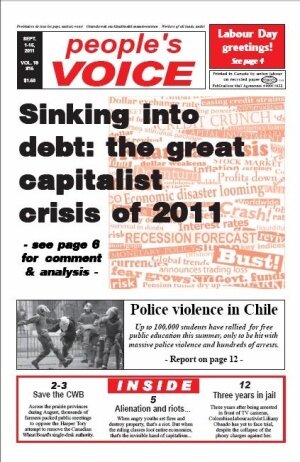
1) TORY DRIVE FALTERS IN ONTARIO ELECTION
2) MY CANADA INCLUDES THE WHEAT BOARD
3) LABOUR-FARMER UNITY NEEDED TO SAVE WHEAT BOARD
4) TRAGIC ANNIVERSARIES: 1973 and 2001
5) EGYPTIAN SPRING, ENGLISH SUMMER
6) LAYTON, TURMEL AND QUEBEC - Editorial
7) LABOUR DAY GREETINGS! - Editorial
8) COPE STRENGTHENS VANCOUVER HOUSING STRATEGY
9) STOP THE WITCH HUNT AND SMEARS IN TORONTO
10) THE CLASS NATURE OF THE DEBT "CRISIS"
11) WFDY MEETING HITS BACK AT CAPITALIST CRISIS
12) INDIAN COMMUNISTS DEBATE TAMIL ISSUE
13) MUSIC NOTES, By Wally Brooker
14) COLOMBIAN UNIONIST MARKS THREE YEARS IN JAIL
15) HUGE PROTESTS DEMAND FREE EDUCATION IN CHILE
16) BUILDING BROAD YOUTH STRUGGLES
17) WHAT’S LEFT
18) CLARTÉ (en français)
19) THE SPARK! (Theoretical and Discussion Bulletin of the Communist Party of Canada)
20) INTRODUCING MARX
PEOPLE'S VOICE SEPTEMBER 1-15, 2011 (pdf)
|
|
|
|
The Spark!The Spark! The latest issue of The Spark! theoretical journal, is now on sale for $5 at Communist Party offices (see p. 8) or People’s Co-op Books, 1391 Commercial Drive, Vancouver. Articles include
plus reviews, editorials, and more.
|
|
|
Theoretical and Discussion Bulletin of the Communist Party of Canada |
|
|
People's Voice deadlines: SEPTEMBER 16-30 OCTOBER 1-15 Send submissions to PV Editorial Office,
|
|
REDS ON THE WEB |
|
People's Voice finds many "Global Class Struggle" reports at the "Labour Start" website, http://www.labourstart.org/. We urge our readers to check it out! |
* * * * *
People's Voice
Canadian Publications Mail Sales Product Agreement #205214
ISSN number 1198-8657
People's Voice is published by
New Labour Press Ltd
PV Editorial Office
706 Clark Drive,
VANCOUVER, B.C. V5L 3J1
Phone:604-255-2041
Fax:604-254-9803
email: pvoice@telus.net
Editor: Kimball Cariou : Business Manager: Sam Hammond
Editorial Board: Kimball Cariou, Miguel Figueroa,
Doug Meggison, Naomi Rankin, Liz Rowley, Jim Sacouman
* * * * * *
Letters
People's Voice welcomes your letters
on any subject covered in our pages.
We reserve the right to edit for length and clarity,
and to refuse to print letters which may be libellous
or which contain unnecessary personal attacks.
Send your views to:
"Letters to the Editor",
706 Clark Dr., Vancouver, BC V5L 3J1,
or pvoice@telus.net
People's Voice articles may be reprinted without permission,
provided the source is credited.
* * * * * *
The Communist Party of Canada, formed in 1921,
has a proud history of fighting for jobs, equality, peace,
Canadian independence, and socialism.
The CPC does much more than run candidates in elections.
We think the fight against big business and its parties
is a year-round job,
so our members are active across the country,
to build our party and to help strengthen people's movements
on a wide range of issues.
All our policies and leadership
are set democratically by our members.
To find out more about Canada's party of Socialism,
give us a call at the nearest CPC office.
* * * * * *
Central Committee CPC
290A Danforth Ave Toronto, Ont. M4K 1N6
Ph: (416) 469-2446
fax: (416) 469-4063 E-mailmailto:info@cpc-pcp.ca
Parti Communiste du Quebec (section du
Parti communiste du Canada)
5359 Ave du Parc, Montréal, Québec,
H2V 4G9
B.C.Committee CPC
706 Clark Drive, Vancouver, V5L 3J1
Tel: (604) 254-9836
Fax: (604) 254-9803
Edmonton CPC
Box 68112, 70 Bonnie Doon P.O.
Edmonton, AB, T6C 4N6
Tel: (780) 465-7893
Fax: (780)463-0209
Calgary CPC
Unit #1 - 19 Radcliffe Close SE
Calgary AB, T2A 6B2
Tel: (403) 248-6489
Ottawa CPC
Tel: (613) 232-7108
Manitoba Committee
387 Selkirk Ave., Winnipeg, R2W 2M3
Tel/fax: (204) 586-7824
Ontario Ctee. CPC
290A Danforth Ave., Toronto, M4K 1N6
Tel: (416) 469-2446
Hamilton Ctee. CPC
265 Melvin Ave., Apt. 815
Hamilton, ON.
Tel: (905) 548-9586
Atlantic Region CPC
Box 70 Grand Pré, NS, B0P 1M0
Tel/fax: (902) 542-7981
http://www.communist-party.ca/
* * * * * *
News for People, Not for Profits!
Every issue of People's Voice
gives you the latest
on the fightback from coast to coast.
Whether it's the struggle for jobs or peace, resistance to social cuts,
solidarity with Cuba, or workers' struggles around the world,
we've got the news the corporate media won't print.
And we do more than that
- we report and analyze events
from a revolutionary perspective,
helping to build the movements for justice and equality,
and eventually for a socialist Canada.
Read the paper that fights for working people
- on every page, in every issue!
People's Voice
$30 for 1 year
$50 for 2 years
Low-income special rate: $15 for 1-year
Outside Canada $50 for 1 year
Send to: People's Voice, 706 Clark Drive, Vancouver, BC, V5L 3J1
You can call the editorial office at 604-255-2041
REDS ON THE WEB
http://www.communist-party.ca/
http://www.ycl-ljc.ca/
http://www.solidnet.org/
(The following articles are from the September 1-15, 2011, issue of People's Voice, Canada's leading communist newspaper. Articles can be reprinted free if the source is credited. Subscription rates in Canada: $30/year, or $15 low income rate; for U.S. readers - $45 US per year; other overseas readers - $45 US or $50 CDN per year. Send to People's Voice, c/o PV Business Manager, 706 Clark Drive, Vancouver, BC, V5L 3J1.)
1) TORY DRIVE FALTERS IN ONTARIO ELECTION
PV Ontario Bureau
Tim Hudak's drive to win a majority in Ontario hit a snag in August. New polls show the Tories lost some support after an anti‑abortion group publicized a petition Hudak had signed opposing abortion rights and demanding the de‑funding of insured abortion services.
While ultra‑conservatives were crowing, the public was not amused. For the first time the juggernaut seems to be stalled.
As well, the shenanigans at Toronto City Hall by Mayor Rob Ford and his right‑wing majority have started a big movement to stop the cuts proposed by KPMG, brought in to audit the books and "find the gravy". Not surprisingly, there is no gravy. KPMG's proposed cuts include complete privatization of garbage and other municipal services, sell‑off of city owned housing and old-age homes, elimination of 2,000 subsidized child care spaces, an end to support for the city's vibrant arts and culture scene including Caribana and Pride events, and the closing and/or privatization of some public libraries, among other things. Increased user fees and property taxes are also on the table, as Ford manipulates the city's chronic revenue shortfalls to make the case for "smaller government".
Behind privatization is the attack on unions who deliver the services in Toronto. Collective agreements for nearly 24,000 inside and outside workers expire Dec. 31, and the Ford administration has announced massive layoffs if city workers don't take the exit packages offered.
Margaret Atwood jumped into the fray to defend libraries and public services, mobilizing her 250,000 Twitter followers to do the same. The July deputations to City Council numbered about 300, though only 166 were actually heard in a marathon meeting that finally adjourned at 7 am the next morning.
Georgio Mammoliti ‑ a member of Ford's Executive Committee and its attack dog ‑ accused deputants of all being communists. Then he upped the ante, accusing "6 or 7" City Councillors of being Communist Party members who take their direction from regular lunches with CPC( Ontario) leader Liz Rowley.
The CPC (Ontario) called Mammoliti's red-baiting "a witch-hunt aimed to intimidate widespread and growing public opposition to the levelling of public services and programs in the city, and to frighten Councillors into silence and stampede them into voting for deep cuts and privatizations against the demonstrated wishes of the public."
The answer to Mammoliti and the Ford administration is to galvanize public opposition, reject red‑baiting, and defeat the cuts.
A massive demonstration will take place at City Hall on the eve of the September budget vote. Meantime, mass lobbying to pry Councillors away from Ford's budget cuts is underway. The Labour Council, OFL, CUPE, One Toronto, and a bevy of community and democratic organizations are involved in the budget fight, as well as in the bigger battle: will Toronto be a city with or without services, social housing, child care, old age homes, public transit, and unionized municipal workers?
Last fall's love affair with the right‑wing populist Mayor and his cronies is over, as the real agenda emerges in startling Tory blue clarity.
At Ford's annual August BBQ, special guest Stephen Harper said he hoped to "complete the hat trick" and turn Ontario Tory blue in the Oct. 6 election. It's starting to dawn on electors across the province that voting Tory may not be such a good idea.
A wise conclusion. Among other things, the Tories promise to bring "law and order" to Ontario with new super‑jails, a two‑strike law, prisoner chain gangs to do the jobs of public sector workers, a lifetime ban on welfare recipients convicted of fraud, new police powers to remove Aboriginal people by force from land reclamation sites, social program and public service cuts, and a new law to prohibit unions from engaging in political and social action.
The Communist Party has identified the Tories as the main danger to working people in this campaign. Although the public is justly angry at the Liberals who have delivered for the corporations and the wealthy while living standards for working people collapse, "voting Tory to punish the Liberals would be jumping out of the frying pan into the fire".
The Communist Party says the best outcome in these circumstances is the election of a minority government with a strong left ballast, including Communists who will fight for policies to curb corporate power, create jobs and raise living standards, reverse the HST and introduce progressive tax policies and tax relief for working people, and expand civil, social, labour and democratic rights.
2) MY CANADA INCLUDES THE WHEAT BOARD
By Darrell Rankin
More than two thousand wheat and barley farmers attended meetings across the prairies in August to discuss the fate of the Canadian Wheat Board.
They came despite a threat by the Harper Conservatives to ignore the wishes of more than 68,000 farmers should they vote in a plebiscite to keep the CWB as a single‑desk, farmer‑run marketer.
The CWB directors will announce the results of the plebiscite on September 9. Now the main issue is to maintain the momentum and to stall legislation to kill the CWB.
The meetings were organized to give farmers a chance to hear from the elected directors and to express their views. Those attending were overwhelmingly in favour of keeping the CWB's single-desk mandate.
"People around the world will shake their heads if the Harper government destroys the Wheat Board," said one farmer in Camrose, Alberta.
Agriculture minister Gerry Ritz met with CWB chair Alan Oberg in May, revealing the Conservatives want to "take their political lumps" early in their mandate, well before the next election.
This is a critical time to build a broad coalition of popular forces to defend the Wheat Board. If all the coalitions and trade unions that defend sovereignty and Medicare, the CBC and other important Canadian institutions together say "My Canada includes the Wheat Board," that will be a huge step in blocking the dictatorial Conservative plan.
The effort should reach out to all groups that are largely self‑governing, including professional groups that defend the right to decide how their industry is governed, and in which farmers play a role, even the Canadian Legion.
For the Conservative Party, this finishes its 19th century "National Dream" to colonize Western Canada and build a protected, agro‑industrial economy. Ending the CWB would be a monumental sellout to the giant, mainly U.S.‑owned corporations that dominate the global grain trade. It would also rid the Conservatives of a democratic group of farmers who could be part of the effort to build a more just society in Western Canada.
Within the Conservative Party, the voice of farmers is gone, replaced by resource and energy corporate interests which see no value or importance in Canadian agriculture, including their prairie heartland. The millions here and abroad who depend on Canadian wheat have a different view.
3) LABOUR-FARMER UNITY NEEDED TO SAVE WHEAT BOARD
The Communist Party is urging a broad and strong fight to defeat the dictatorial Conservative Party plan to demolish the Canadian Wheat Board. Thousands of farmers turned out at meetings across the prairie provinces during August, most expressing their opposition to the Harper government's drive to gut the CWB by 2012.
In an Aug. 14 statement, the Party's Central Executive said that "Strong Labour‑Farmer unity is needed now to save the family farm, to protect Canadian food sovereignty and to help end the domination of the global grain trade by the handful of corporations now responsible for mass famine and death throughout the world.
"Destroying the Canadian Wheat Board as a single‑desk seller of wheat and barley will be a fatal blow to thousands of family farms in Western Canada. It will accelerate the growth of mega‑corporate farms at the expense of smaller farms.
"Most importantly, the main beneficiaries are the handful of corporations which now dominate the global grain trade. Removing the democratically‑run CWB from the global grain trade will be an added incentive for global grain corporations to act as a monopoly‑cartel with price‑setting and hoarding of stocks.
"These corporations put profit ahead of the starving and malnourished millions. Cereal grain consumer prices are at a record high this year, matching those of 2008/09 when the top five grain corporations made a combined $266 billion profit, a year with food hunger riots in 26 countries.
"The main fight now is to save the Canadian Wheat Board. But should the Harper Conservatives value their corporate accomplices more than millions of newly roused and informed voters in Western Canada, we will support efforts to establish provincial marketing boards in provinces such as Manitoba that support democracy for farmers.
"The Communist Party welcomes the petition launched by the Manitoba government defending the Canadian Wheat Board. The government should state it is ready to replace the CWB at the provincial level should the Conservatives succeed in carrying through their threat. It is not enough to point an accurate finger of blame if you have the power to make real change.
"In this hour of need for the family farm and global food security, the labour movement must step forward. Since the defeat of Farmer‑Labour governments in Canada in the 1920s, the family farm has been under constant attack by the growing monopoly corporate price‑cost squeeze and government policies such as ending the Crow Rate transportation subsidy.
"As a Party that has been part of the struggle for 90 years, we say the need for labour‑farmer unity has never been greater.
"If you are a doctor or a lawyer or any other professional, governments mainly leave it up to you and your colleagues to figure out what happens in your industry. Not so with farmers. That is because an enormous amount of money made from agriculture ends up in the pockets of the big corporations.
"Farmers are working people, many with jobs off the farm. Sometimes these jobs are unionized. Since commercial farming started in Western Canada, farmers have been the target of corporate plundering, at times sparking strong resistance by farmers.
"After the First World War the Progressive and other farmer political parties won power across Western Canada and in Ontario. These governments were supported by Labour politicians and became genuine Farmer‑Labour governments which enacted measures that still protect farmers and Labour today.
"Such unity today will bring similar needed advances. This is the time to return to a strategy that worked in the past. It is the only strategy that has ever worked!
"The labour movement knows what it would be like if the federal government ripped up every collective agreement in Canada on the grounds that workers need to market their skills to a wider variety of employers. Many labour bodies have passed resolutions of support for the CWB and single‑desk selling.
"This is a strong basis for unity in the fight for the Canadian Wheat Board.
"The enormous fraud and rigging by the Conservative government in past Wheat Board related votes should never be repeated. This is a government that betrays its agenda by dropping smaller farmers from the voter rolls. It is a government that is moving to `One Corporation ‑ One Vote' at home and `One Tank, One Vote' abroad.
"We support the idea of `One farmer ‑ One Vote' and votes for those who work the soil. Why should farm corporations be on a voter roll? We do not allow corporations the vote in other elections. All who work the soil should be able to vote on marketing issues."
4) TRAGIC ANNIVERSARIES: 1973 and 2001
People's Voice commentary
This issue of People's Voice marks the anniversary of two highly significant events which took place on September 11: the U.S.-backed fascist coup against Chile's Popular Unity government in 1973, which destroyed democracy and killed thousands in that country, and the terrorist attacks within the United States itself in 2001.
In each case, the progressive and democratic movements in Canada responded immediately, to mobilize solidarity and warn of the dangers posed by these events. Rallies and protests across Canada in the fall of 1973 condemned the Pinochet coup, helping to force the Liberal federal government to allow many exiles to escape the fascist terror which engulfed Chile.
Over the past 38 years, during the military dictatorship and then decades of neoliberal governments, Canadians have continued to express solidarity with the people's movements in Chile. We have also learned much from the courageous struggles of the Chilean people for social justice and human rights. The Chilean community in Canada, today estimated at some 50,000, has made a contribution far beyond its size to the movements for social change in this country. On September 11, we join in paying tribute to President Allende and his comrades, whose defiance of U.S. imperialism during the Popular Unity years of 1970-73 became a beacon to the peoples of the world.
The mainstream media will instead focus on the 2001 attacks against the World Trade Centre and the Pentagon. Once again, the official message will be that the 3000 who died in those attacks were heroic victims of terrorism, while the millions killed and wounded by the U.S. and its allies in Iraq, Afghanistan, Pakistan and Palestine over the past decade are ignored.
One result of the events of Sept. 11, 2001, was a massive flowering of anti-war and anti-racism movements. A wide range of forces - trade unions, faith groups, social justice organizations, students, women, racialized communities and many more - came together in the days and months after 9/11 to resist the drive towards war, racism and fascism. The largest single day of public action in human history took place on Feb. 15, 2003, as some 15 million people took to the streets around the world to condemn the build-up for war against Iraq.
But the post-9/11 years have been a decade of aggressive attacks by imperialism. Faced with deepening economic and social crises, and by mounting popular opposition, the U.S. and the other imperialist powers have increasingly resorted to war and repression.
Unfortunately, many social democratic parties and governments succumbed to this reactionary agenda. But some political forces stood by their principles, despite intense pressures to retreat or keep silent.
A look back at the immediate response to 9/11 by the Communist Party of Canada is highly revealing. On Sept. 12, as the forces of fascism and war demanded full support for U.S. imperialism, the CPC issued a public statement condemning the demands for "retaliatory attacks" and removal of civil liberties.
Like its fraternal parties in other countries (such as Cuba), the Communist Party of Canada condemned the Sept. 11 attacks, expressing sorrow and grief. "Acts of terrorism undermine the struggle for progressive change," the CPC pointed out. "They sideline and neutralize the mass movement, create fear and disorientation in the broad people's fightback, and provide imperialism and reaction with a powerful pretext to intensify repression."
At the same time, the CPC stressed the reality of "growing anger and resentment around the world. Three‑quarters of humanity
are forced to tolerate the rampaging spread of mass poverty, economic plunder and social disparity in their respective countries; and they must do so under conditions imposed upon them by a handful of dominant imperialist powers led by the United States, and including Canada and the other leading capitalist countries. When countries and peoples have refused to succumb to dictates from Washington, they have fallen victim to U.S.‑organized state terrorism, from Cuba and Chile to Iraq and Yugoslavia..."
The CPC warned against the "grave danger that ... the U.S. Administration will launch so‑called `retaliatory' attacks against certain countries or movements around the world. We call upon the peace forces across Canada and throughout the world to mobilize to prevent a unilateral military response by the U.S., and instead to demand a political solution to this festering problem..."
"The CPC will strongly oppose any attempt internationally or domestically to use this tragic episode as a justification to limit democratic rights including the rights to assembly, privacy, legal due process or extend repression against the people," the statement continued. "The Communist Party condemns tendencies in the mainstream press to `scapegoat' Arab Canadians in the wake of these terrorist acts, and will strenuously combat any and all attempts to victimize or marginalize any national, ethnic, religious or political minority or community in Canada. We call on all labour, progressive and democratic forces to defend democracy and the cause of peace, and oppose all attacks on these principles in the name of 'fighting terrorism'."
As the Communists warned, less than a month later, Canada joined the United States in launching the deadly occupation of Afghanistan, which has extended to the horrific "drone war" against Pakistan. While public opinion blocked the Chretien Liberals from full participation in the 2003 invasion of Iraq, Canada gave logistical and tactical assistance to this U.S./British war. Canada also gives full support to the brutal Israeli occupation of Palestinian territories. In total, these bloody military campaigns have cost over a million lives.
Back in Canada, the years since 2001 have seen a relentless push to restrict civil liberties and free speech, and to build up the state's military, espionage, prison and policing systems.
On September 11, Canadians will have much to consider. This is not a day to praise our "heroic troops". It is a day to demand to bring the troops home, to protect and expand democratic freedoms, and to reverse the accumulation of wealth and power conducted by the ruling class under the cloak of "fighting terrorism."
5) EGYPTIAN SPRING, ENGLISH SUMMER
By Sam Hammond
In the wake of uprisings and riots this year, from Cairo to London, there has been much talk of alienation.
Most people think that alienation is the result of neglect. That can indeed be the case, such as an indifferent parent or a negligent friend. But social alienation in its most general sense is a phenomenon with roots in the relations of class and strata within exploiting society.
A stand‑alone feature of exploiting societies, basic alienation is the separation of the producers from the products of their labour. Slave, serf or worker, only the form changes.
If this is so, then there must be "alienators" and "alienated", each with a class identity. Social strata can and do form sections of classes, are classless, or can bridge classes with feet planted on either side, in a fluid, shifting, economically propelled movement from acquisition to dispossession.
The separation of human beings from what they produce requires a complex package of historically developed instruments of economic coercion, fear, imposed ignorance, and a set of laws enforced by the ruling class instrument, the state.
To maintain this kind of control and alienation in capitalist society, and also to have a domestic market, the exploiting class must pay wages to purchase the labour power of the working class, so it can purchase its means of subsistence back from them. Simply stated, re‑purchasing what you have produced and what has been expropriated from you.
This very simple and correct analysis is the basis of the finite social relationships and complexities of modern imperialism, and the complex expressions of alienation between classes and strata in society. It is also true that the producers can never buy back all that they produce, so as a market they are too small to sustain their capitalists. Witness the historical appearance of colonialism and imperialism to capture cheap labour and expanded markets.
Because of the phenomena of relative "overproduction" and "financialization" under advanced imperialism, the alienation of youth is escalating at a completely predictable pace. The irreconcilable contradiction that defines capitalism - the inability of the masses to purchase the goods they produce - has almost destroyed the "real" economy of manufacturing and commodity production.
Real wealth can only come from a real economy. The transfer of investment in real production to the trading in paper, in interest, in the purchase and sale of debt itself, has brought us to this stage of imperialism, to privation, hunger, disease and war. Hundreds of millions of workers have become surplus, unwanted humanity with no hope, no future and no purchasing power.
When millions of workers are surplus, the most experienced are maintained as a reserve core, and some youth are recruited for "McJobs" at less than subsistence wages. Even fewer are highly trained and well rewarded technicians. The majority are in the surplus pool. For older workers this is where they have arrived.
To understand the intensity of the alienation of youth and its "so‑called" anti‑social behaviour, it must be understood that millions of youth do not arrive at unemployment, privation, homelessness and social redundancy; they start there. The hopelessness of being born into a world that has no real place for you does not breed compliance, social responsibility and worship for the laws of the capitalist state. You cannot alienate, subjugate, disenfranchise, disallow and demean people, then expect them to behave like ladies and gentlemen at a bourgeois tea party.
Millions of youth have been alienated from the means of production itself, from the mainstream of social existence, even from the class that most of their parents belong to. This is not the alienation of parental neglect, but the objective disposal by the ruling classes of surplus labour, the expulsion of our own children from the economic lever, strength and nurturing that working people employ in their mutual struggle to survive.
This is a dangerous separation, because classless people quickly lose the culture of class consciousness and the pragmatism of class unity and struggle. Add to this strata of classless youth the elements of the ruined petty bourgeois, the victims of cannibalistic monopoly capital who have no cultural loyalty to the workers and no tradition of disciplined struggle. The mix can produce exactly what we are witnessing in England, or the more disciplined struggles of the Chilean students, the Greeks, the Egyptians or the heroic Palestinians.
It all depends on time, place and the class forces at work: who leads and who follows.
The hypocrisy of the English Prime Minister, miffed about a shortened holiday, lecturing about social responsibility and the preservation of property, is laughable. Witness the selected flunky of the ruling class, backed by the media lecturing the victims on their social behaviour.
The British capitalist class and their bankers, like their compatriots everywhere, have plundered the coffers of their own state to the point of bankruptcy. With their imperialist partners (including Canada), they have stolen and privatized the property of the people and killed millions all over the world, in a bloodbath of lies, murder and greed. While overseeing this, they languish in their spas, attend royal shindigs, indulge in orgies of drugs and privilege. From pulpit and platform they scream and shudder in fear of the stirrings of a generation that might not be governable.
Their answer is to release the paramilitary forces they have been preparing, and the army if necessary, to extend their rule during periods of social awakening. The symbol of their repression, recruited from our ranks, wears helmet, bullet-proof vest, body armour, gun belt, Plexiglas shield and truncheon. The symbol of revolt is the hoodie.
The state will temporarily prevail in this one‑sided contest, because they are at war with a strata and not a class. But the explosion is inevitable. Even if the activities of the rioters range from craven to heroic, objectively the responsibility lies with the bourgeois state that itself is doomed, unable and unwilling to provide subsistence and dignity to millions of young people.
It is not acceptable to sit in judgment of those who plunder and burn at home while honouring those who do so as an instrument of imperial policy on a grander scale in the third world. After all, they do not cannibalize like their masters. The spread of their activities from city to city, described as a plague by hired wordsmiths of capital, is really an act of youth solidarity. It is completely logical for the struggle to expand. The capitalists globally are not in a panic yet, but if they had any brains they would be.
What is needed everywhere is the leadership of the working class to give tactics, strategy and discipline to this struggle. This requires an objective and a program of escalating demands that can be fought for and organized around, eventually making the possibility of a socialist world not utopian but real. To adjust demands to what the capitalists say is available will leave the youth where they are now: surplus humanity. To comply is to be recruited to the parameters of the state and become an accomplice in the control mechanism.
The corporations can do this with social democrats, but never with communists. The responsibility for this leadership rests historically with the working class and their most organized section, the unions. The responsibility for injecting this consciousness of historical necessity into the class struggle rests with the Communist Parties.
6) LAYTON, TURMEL AND QUEBEC - Editorial
People's Voice Editorial
The sudden death of Opposition Leader Jack Layton has shocked Canadians. While we frequently disagreed with Mr. Layton, he was seen by millions of NDP supporters as a voice for working people in a Parliament dominated since Confederation by the parties of big business. We extend our condolences to his family and colleagues at this difficult moment.
A review of the NDP's record under Jack Layton may come later, but this is a suitable time to comment on the reaction to his final decision - the appointment of popular Québec trade unionist Nicole Turmel as interim NDP leader. The election of 59 NDP MPs in Québec did not reflect a truly fundamental shift in the outlook of working people, since the NDP and the Bloc Québecois have long shared many elements of a social democratic approach. Coming on the heels of the NDP's remarkable gains in Québec, Layton's move showed a desire to hold these advances in the next campaign.
However, some of the response to Turmel's appointment in English-speaking Canada has been appalling, to be blunt. Even as the NDP grapples with the "national question" - the reality that Québec constitutes a nation within the Canadian state - narrow-minded Anglo chauvinism has reared its ugly head. Turmel is a "closet separatist", howls the corporate media, pointing to her former memberships in the BQ and the left-wing Québec Solidaire party. The fact that Turmel also held an NDP card for many years is ignored, as is the complex debate within the QS, which is home to a wide range of views on solutions to the national question.
Such McCarthy-style attacks against those who do not share the Tory/Liberal federalist view of Canada have no place in a genuine, democratic debate; those screeching the loudest are selling out Canadian sovereignty to Yankee imperialism. The people of Québec (and the Aboriginal peoples) have the right of national self-determination - and also the democratic right to take part in Canadian political struggles. Period.
7) LABOUR DAY GREETINGS! - Editorial
People's Voice Editorial
Many working people across North America will emjoy a well-deserved break on Labour Day. In the unceasing struggle between workers and bosses, every statutory holiday is a small but important victory against employers who seek to lengthen working hours in their drive to increase exploitation and profits.
But Labour Day also has a political side, even though its origins lie in attempts to undermine celebrations of May First, the international day of the worker. Many Labour Day picnics and parades express solidarity with workers engaged in strikes and other struggles against the bosses.
This year's Labour Day is a moment to weigh up the serious battles which lie ahead. The attack on the Postal Workers by Stephen Harper's Tory majority shows that working people face four years of escalating corporate/government assaults on labour rights. The aim of the Harper Tories is to smash the ability of workers to resist the corporate agenda in the workplace and in the legislative arena. Their ultimate goal is to lower union density in Canada from the current levels of around 30%, closer to the 10% in the United States.
Our response must be to build broad unity of organized labour with its allies: unorganized and unemployed workers, farmers, Aboriginal peoples, the movements of students, women, immigrants and seniors, anti-war and environmental groups, the Communists and other progressive forces, and other sections of the people fighting back against neoliberal policies. Only a fightback which draws all these forces into joint action can block the Harper Tories, and open the door to a wider struggle for a real People's Alternative to the corporate agenda.
8) COPE STRENGTHENS VANCOUVER HOUSING STRATEGY
PV Vancouver Bureau
Debates this summer over a proposed ten-year housing and homelessness strategy for Vancouver highlighted both differences and points of agreement between the city's Coalition of Progressive Electors and the governing Vision party. The two groups have adopted an electoral cooperation agreement heading into the Nov. 19 civic election, hoping to block the right-wing Non-Partisan Alliance from regaining control of City Council and School Board. If they succeed, it would mark the first time in nearly 30 years that the NPA has been defeated in consecutive elections.
Housing remains a critical issue facing the Metro Vancouver region. The most recent homeless count, conducted in March 2011, found that 1872 homeless people were in the "sheltered" category across the region, up from 1086 on the same day in 2008. Another 731 were "unsheltered", down from 1532 in 2008. The overall total dropped slightly, reflecting efforts by local governments to increase temporary shelter spaces, but the underlying problem has not been resolved.
Homelessness advocates were encouraged by the recognition in a July staff report to Vancouver city council that housing affordability needs to be tackled from the supply side. The report notes that while about 30,000 market rate rental units were built in the 1960s, only 6160 units were built in the past decade. The report calls for the creation of 40,000 new rental units by 2021, 8900 of which would be subsidized housing.
This would help address the reality that Vancouver is one of the most unaffordable housing markets in the world. Housing ownership now takes 60-80% of an average household's income, far beyond the means of most working people in the city.
Responding to the staff report, COPE City Councillors Ellen Woodsworth and David Cadman warned that key parts of the plan must be strengthened.
"This report represents a good first step," said Woodsworth, adding that key initiatives to drive affordability were lacking. "Working class families, seniors, and young people just can't afford to live in Vancouver any more. Where's the discussion around policies and measures to find solutions for them?"
"If this is going to be an aggressive plan to return real affordability to our city, we need to know how tools like inclusionary zoning and a city‑run housing authority could work here," said Cadman. "Imagine a Vancouver without families, without a working class, without artists, and without seniors. That is exactly where we're headed unless we do something bold today."
Woodsworth called for Vancouver to lead a charge with other large cities to call for a joint federal, provincial, municipal campaign on housing issues. "This is the biggest homelessness and affordability crisis seen since the great depression. We need to treat it with all the urgency this situation demands."
On July 28, City Council passed two key amendments to the ten-year plan, put forward by Woodsworth and Cadman.
"We needed to see a real commitment to investigate innovative policies that drive affordability," said Cadman. "We've done just that today with Council agreeing to look at inclusionary zoning, a city run housing authority, and increased funding for land purchases."
Cadman's amendment also directs staff to compile best practices for dealing with the preservation and creation of affordable housing from other jurisdictions, such as Toronto, New York, and London.
Woodsworth successfully called for Mayor Robertson as newly elected chair of the Big Cities Caucus to take a leadership role on a national housing campaign.
"We've been hearing for years how we as a city cannot get this job done without long‑term Federal and Provincial funding commitments," said Woodsworth. "This amendment is the first step in seeing that happen."
Both councillors said the July 28 meeting shows the strength of cooperation and thoughtful discourse that has become the hallmark of COPE's approach to major challenges facing the city.
However, NPA councillor and mayoralty candidate Suzanne Anton voted no to the strategy. "First it was `no' to bikes, then `no' to the environment," said Woodsworth, commenting on Anton's voting record. "Now it's `no' to affordable housing. It's shocking."
9) STOP THE WITCH HUNT AND SMEARS IN TORONTO
Statement from the Communist Party (Ontario), Aug. 15, 2011
The Communist Party is considering legal action, including a complaint to the Ontario Human Rights Tribunal regarding Toronto City Councillor George Mammoliti's witch‑hunting at City Hall, and his attack on the public's right to free political expression and association - rights guaranteed under the Charter of Rights and Freedoms.
Mammoliti is a member of Mayor Rob Ford's Executive and an aggressive advocate for Ford's agenda of privatization and confrontation with the city's labour and democratic movements.
Mammoliti has attacked more than 300 City Hall deputants, asserting they were members of the Communist Party, after they stayed through the night and into the early hours to oppose the KPMG proposals to eliminate "gravy", including the closure of libraries, old age homes, 2,000 subsidized child care spaces; ending funding to cultural and arts groups including Caribana and Pride events, ending AIDS related funding, increasing transit fares and reducing service, and more.
Mammoliti has attacked Councillors who also oppose the cuts, alleging they are members of the Communist Party and that opposition to the KPMG cuts stems from Communist Party membership.
While the Communist Party is opposed to the cuts and is fighting them, opposition to this agenda includes members of almost all parties, save the Tories, and people who are not members of any party. Suggesting otherwise is a smear - something Mammoliti is expert at.
This is a witch‑hunt aimed to intimidate widespread and growing public opposition to the levelling of public services and programs in the city, and to frighten Councillors into silence and stampede them into voting for deep cuts and privatizations against the demonstrated wishes of the public.
Mammoliti is attempting to do what Joe McCarthy did in 1950s USA - crush free speech and free political association in an effort to crush opposition to this administration's far‑right political direction... Red‑baiting is part and parcel of this administration's attack on public services and on labour and democratic rights. It's a package. It's a dangerous combination that threatens all Toronto residents, and must be challenged.
With this in mind, the Communist Party is exploring legal action including a complaint to the Ontario Human Rights Tribunal, and is urging the labour and democratic movements and all those who support democratic and civil rights to speak up and demand an end to the witch hunt.
10) THE CLASS NATURE OF THE DEBT "CRISIS"
By Anna Pha, from the Guardian, weekly newspaper of the Communist Party of Australia (abridged)
The world's largest financial institutions are waging an all out assault on what is commonly referred to as the welfare state, on the sovereignty of governments, on democratic and workers' rights. The vehicle being used to slash welfare payments and pensions, cut health and other services, sack public servants, reduce their wages and working conditions is the "debt crisis".
Governments that have amassed large debts are now being stood over by global financial monopolies (the most powerful, corrupt, speculative and parasitic form of capital) to wind them back. They are being subjected to credit squeezes and threatened with downgradings by private, unaccountable rating agencies. In the US, the approval of Congress was required to extend the government's debt limit or face defaulting on loans.
The European Central Bank, the International Monetary Fund, financial institutions and the ratings agencies are placing demands on Greece, Ireland, Portugal, Spain and Italy to make savage budget cuts to social spending. Belgium looks set to be the next country in line for the same treatment. Not all governments needed much pressure: the stand‑over tactics provided the excuse they needed to sell highly unpopular austerity programs to unwilling electorates.
The battle and concessions made to gain US Congress approval to increase the limit on US government borrowings has strong parallels with developments in the European Union. Questions are being raised as to how hard Obama really fought what appears to have been a highly stage‑managed crisis.
There is no doubt a number of these governments have accumulated large debts which have become a drain on the public purse to continue servicing. In part, the debts are due to the multi‑billion dollar bailouts of financial institutions and corporations during the global financial crisis and subsequent economic crisis. According to Michael Hudson, the US government has spent US$13 trillion in financial bailouts since Lehman Brothers failed in September 2008. ("The debt ceiling set for progressive repealing", Global Research, 29‑7‑2011)
But the bailouts are not the only contributing factor. Military budgets have remained quarantined from serious cuts, in particular in the US where 48 percent of the annual budget is drained by military spending and servicing debt on it. The governments of all of these countries have pursued neo‑liberal economic policies, privatising public enterprises and providing the corporate sector with generous handouts. Privatisation has resulted in loss of income. They have also set about cutting the taxation of corporate profits and incomes of the rich.
It is no accident that the actions being directed by the financial institutions and ratings agencies, without exception, fail to address the causes of government indebtedness and focus on austerity measures.
The very agencies that caused the global financial crisis, that governments bailed out, are now standing over governments to make pensioners, workers and their families pay yet again. Private debt was converted into public debt during the crisis, and now the public are expected to repay it to the criminals who brought on the crisis. Pension and other cuts will see millions impoverished, homeless, jobless and with no access to basic health care.
Instead of increasing the taxation of corporate profits and the rich and cutting military expenditure (which would make the world a safer place), cuts are being imposed on ordinary working people and their families. The cuts are highly contractionary. They will reduce the spending power of workers and pensioners, and will only drive economies deeper into recession with many more workers losing their jobs.
Every one of these governments has other options to reduce their debts. Yet they are putting up little or no resistance. Consistent with their adherence to neo‑liberalism, they are all too readily bowing to the market gods.
The standover tactics of financial institutions, dictating to elected governments how much to repay and what cuts to make, is an outright attack on the sovereignty of nation states and a further restriction on their democratic processes.
The sovereignty of nation states has already been severely undermined by free trade agreements, privatisation of key public assets and financial deregulation. Capital is becoming bolder and more direct in its global domination and dictatorship. For decades the International Monetary Fund and World Bank have dictated economic policy to Third World countries. Now, it is the turn of Western industrialised nations, as capital continues to wind back social security and public services, including health and education. It constitutes a massive transfer of public wealth to the private sector.
The "debt crisis" assault is the next big step in a process commenced under Thatcher, Reagan and in Australia by Hawke and Keating. It has been pursued by successive social democrat and conservative governments. Social democracy has been used to play a key role, taking the "hard decisions", because of its ability to contain resistance by the labour movement. If the Republicans in the US or conservative parties had attempted to bring in the same neo‑liberal, attacks on people's past gains, there would have been far stronger opposition.
In Australia, the major deregulatory and privatisation moves were made by Labor not Coalition governments. Labor also commenced the process of destroying the centralised award system governing wages and working conditions. Its reforms paved the way for the first individual employment contracts and non‑union agreements. The Howard government met strong resistance to its WorkChoices, but Labor's failure to repeal WorkChoices (only making minor changes) or abolish the Australian Building and Construction Commission have not met with the same degree of opposition.
The struggles against the anti‑people, budgetary cuts have reflected the strength of left forces in the labour movement, in particular the strength of communist parties.
Under the leadership of the communist‑led All Workers Militant Front (PAME) and the Communist Party, millions of people have been brought out onto the streets against the cuts across Greece. It has not been left to the parliamentary arena.
Communist Parties in Greece, Portugal and other EU countries are fighting for expansionary economic policies based on job creation, higher wages and pensions, nationalisation, controls on foreign finance and imports. They are calling for reductions in military budgets, an end to involvement in overseas wars. They are looking at increasing the taxation of financial institutions and other corporations. Their policies are expansionary, pro‑people and pro‑environment, and involve the abandonment of neo‑liberalism.
11) WFDY MEETING HITS BACK AT CAPITALIST CRISIS
Special to PV
This summer, youth organizations from across the European and North American region of the World Federation of Democratic Youth (WFDY) gathered in Berlin to assess the struggles of the youth and prepare for the upcoming WFDY general assembly in Portugal.
Sixteen youth organizations, including the YCL‑LJC Canada, discussed current events and struggles in their respective countries and how they see the international situation developing.
The meeting condemned the NATO attacks on Libya, as well as the imperialist manoeuvres against the government of Syria. It also paid close attention to the mass resistance of the progressive forces against the economic crisis.
"The current aggression forced upon the working class by transnational capitalism, under the pretext of liquidity attacks on the European public sector, was one of the main matters of discussion," Carlos Bracons told People's Voice. Bracons attended the meeting as a representative from the YCL‑LJC Canada.
"The delegates from Greece, Portugal and Spain enumerated in detail the widespread theft of public assets by capitalism and imperialism, and the associated social spending cuts aimed to push workers out of the public health and education system in order to privatize health care, pensions, and post‑secondary education," he said.
Most of the measures described by the youth organizations did not aim to reduce the public deficit but "to please big capital and the forces behind the speculative attacks on debt titles," Bracons said, adding that "the governments sided with big capital, over-indebting themselves for years by recklessly wasting money on weaponry, the Olympic Games, and various other non‑profitable infrastructures. This is now giving grounds to the current attack on democracy and the welfare state."
A final statement by the WFDY following the meeting said "In the context of the crisis of the capitalist system, in practically all countries the situation is similar: under the excuse of the `lack of money' or `deficit reduction', workers and young people are having their rights destroyed, facing the privatization of education, the increase of unemployment and the generalization of precarious, temporary and flexible forms of work."
The YCL‑LJC described the dangerous outcome of the last Canadian federal election and the struggles of the YCL in response. Delegates were interested in learning about the fight‑back in Canada, especially NAFTA, the privatization of education and the recent lockout of Canada Post workers.
The group decided to support several days of action in favour of Free Public Education, against the imperialist war in Libya, and against the liquidity blackmail that big business is carrying out in Europe and, in a different fashion, the USA. It also admitted a Russian left youth group and COMAC, the youth of the Workers Party of Belgium.
The meeting was hosted by the SDAJ (Socialist German Worker's Youth) of Germany, who toured the delegates around important places of resistance against fascism in Berlin. "Many of the delegates were astonished to learn about the attacks today by anti‑communist groups against left‑wing organizations in Berlin. The windows of many groups' buildings are repeatedly smashed and spray‑painted with fascist graffiti," Bracons said.
An Asian Pacific regional meeting of WFDY was held in Vietnam in June, focusing on the problem of the environment and sustainable development. A regional meeting of North Africa and Middle East affiliates took place in April in Egypt, and focused on the developments in that region.
The 18th General Assembly of the World Federation of Democratic Youth will take place this November. Hosted by the Portuguese Communist Youth under the slogan "Fortify WFDY, strengthen the anti‑imperialist struggle, for a world of peace solidarity and revolutionary social transformation!", the meeting will review the past four years' work and elect a new leadership. The YCL‑LJC encourages all Canadian youth to bring proposals to take with us to the General Assembly.
12) INDIAN COMMUNISTS DEBATE TAMIL ISSUE
An urgent political solution is still needed to protect the right of Sri Lankan Tamils to live with dignity and equality; this was the conclusion of a special convention held by the Tamil Nadu state committee of the Communist Party of India (Marxist) in late July.
The CPI(M) and the Communist Party of India received 1.6 million votes in last May's elections in Tamil Nadu, about 4.4% of the total. The two parties are part of the AIADMK coalition which swept that election. Sri Lanka's Tamils were largely brought from Tamil Nadu by the British as labourers, only to endure historic discrimination as a minority on the island.
At the CPI(M) convention, Prakash Karat, the party's general secretary, noted that the armed conflict ended two years ago, but the Sri Lankan government has failed to tackle the problems of the defeated Tamils. Instead, President Rajapakse has used delaying tactics while strengthening the process of militarisation.
Referring to the atrocities committed on innocent people during the last phase of the armed conflict, Karat demanded a high level enquiry with authority to hold accountable the responsible authorities. However, the Sri Lankan government is in a "denial mode", even though a UN panel report has reported on atrocities committed by both sides.
During the last phase of the armed conflict, more than 40,000 innocent Tamils were killed by the Lankan army, which bombed hospitals and even Red Cross vehicles. More than 5000 youth are still held by the army, and over 60,000 persons are in relief camps. The UN report has also noted human right violations by the Tamil Tigers (LTTE), such as the use of innocent people as human shields.
At this juncture, Prakash Karat pointed out, a key question concerns the rehabilitation and resettlement of Sri Lankan Tamil refugees who are unable to return to their homes. The major barrier to settlement is the failure to dismantle emergency rule in the affected areas, where the army plays an important role in the administration.
This issue has become a concern for all democratic forces in India and Sri Lanka, said Prakash Karat, stressing the need for a fresh approach based on genuine autonomy. He called on India to press the Sri Lankan government to fulfil its commitment for a political solution, and urged the Sri Lankan government to immediately take up measures for rehabilitation and resettlement, demilitarisation, and ending emergency rule.
The leader of the Tamil National Alliance (which recently won local elections in Northern and Eastern regions of Sri Lanka), and a member of the Sri Lankan parliament, Suresh Premachandran, also addressed the CPI(M) delegates.
Premachandran gave a chilling account of atrocities committed by the Lankan armed forces in the last phase of the armed conflict against the LTTE when the media was not permitted in the war zone. Since then, the armed forces have started encroaching the land, leaving many families with no livelihood. More than 100,000 families are to be resettled, and there is no information about many Tamils abducted during the armed conflict.
Prakash Karat announced that on August 9, mass rallies in Tamil Nadu will call for a democratic political solution. There will also be demonstrations outside the parliament in New Delhi, and the CPI(M) will discuss this issue at its upcoming Central Committee meeting.
A special resolution adopted by the CPI(M) convention stresses that "right from 1948, Sri Lankan governments have practised a discriminatory approach against the Tamils." The resolution calls for "an independent and honest inquiry of international standard" into the human rights violations and war crimes; the release of all Tamil youth being illegally held; the merger of the Northern and Eastern provinces with greater autonomy; equal treatment regarding language and religion; and a federal system of government to replace the presidential system.
13) MUSIC NOTES, By Wally Brooker
Rovics to play Ottawa Tahrir Benefit
Revolutionary singer‑songwriter David Rovics, one of the outstanding troubadours in the USA these days, will give a concert at the University of Ottawa's Alumni Auditorium Oct. 2 to raise funds for the Canadian Boat to Gaza. Rovics is an activist musician who tours constantly, playing for audiences large and small at cafes, pubs, universities, churches, union halls and protest rallies. His music has been featured on Democracy Now!, BBC and Al‑Jazeera. The 200+ songs he makes freely available on the web http://davidrovics.com have been downloaded more than a million times. Among the concert's sponsors are the Communist Party of Canada (Rosa Luxembourg Club), Carleton University CPC, the YCL, Students for Palestinian Human Rights (University of Ottawa), Students Against Israeli Apartheid (Carleton University), Independent Jewish Voices, and the Ottawa anarchist group Exile. Tickets are $10‑$20 (sliding scale). The show starts at 7 pm. For more info e‑mail Larry Wasslen at cpccarleton@yahoo.ca.
Gary Cristall's folk music history
The history of folk music in this land is closely connected to the struggles for labour rights, social justice, and peace. Vancouver folk music historian and long‑time impresario Gary Cristall has been tracing these connections through such projects as his 2008 five‑part CBC radio series "The People's Music" and his ongoing project to write the definitive history of folk music in English Canada. Last April "Music Notes" carried a story about one of the fruits of Cristall's research: his discovery and release of historic recordings by the outstanding '60s Ukrainian‑Canadian folk group The Milestones. An outline and preliminary draft of some chapters of "A History of Folk Music in Canada" is online. Cristall invites people with stories and memorabilia to contact him and help tell the story of the people's music. Visit http://folkmusichistory.com/.
Media watchdog rules Israel "apartheid"
A ruling by South Africa's Advertising Standards Authority (ASA) has dismissed complaints against a radio ad which called for a boycott of Israel and compared the Zionist state to apartheid South Africa. The ruling referred to a message broadcast on a South African Broadcasting Company station by Dave Randall, lead guitarist of the U.K. band Faithless, in support of South African Artists Against Apartheid. The ASA rejected the complaint registered by the South African Jewish Board of Deputies that Randall's message is "false propaganda." Reggae DJ The Admiral, a member of South African Artists Against Apartheid, welcomed the ruling: "The ASA decision is significant due to our own history of apartheid. The decision sends a clear message to the Zionist lobby that the time has come for an end to the baseless accusations of `discrimination' and `hate speech' whenever criticism of Israel is voiced." Visit www.southafricanartistsagainstapartheid.com/.
Harlem in Vogue: Langston Hughes
Before there was Gil Scott‑Heron, rap and hip‑hop, there was jazz poetry. This hybrid art genre was popularized in the 1950's by "Beat" poets like Jack Kerouac and Kenneth Rexroth, but those artists were working in a field first explored by the great African‑American poet Langston Hughes (1902‑1967). A generation earlier Hughes had been one of the central figures of the "Harlem Renaissance". He went on to become one of the leading artist-intellectuals of the American left during the New Deal era and beyond. Harlem in Vogue: The Poetry & Jazz of Langston Hughes (Fingertips, 2011) is a double CD of considerable artistic and historical significance. It makes available once again the brilliant jazz‑poetry recordings Hughes made in the late fifties with orchestras led by composer‑critic Leonard Feather and bassist Charles Mingus. For information visit http://fingertipsrecords.com/.
Jazz great Ahmad Jamal a terrorist?
Eighty‑year‑old African‑American pianist Ahmad Jamal, a native of Pittsburgh and long‑time jazz luminary, came under suspicion in June. US authorities mistook him for Jamal Ahmad Mohammad Al Badawi, a fifty‑year old Yemeni wanted by the FBI for helping to plan the USS Cole bombing, which killed 17 American sailors back in 2000. US authorities froze the $10,000 that the Festival da Jazz in St. Moritz, Switzerland, was to pay the pianist in advance of his July 16 concert. Ahmad Jamal changed his name from Frederick Russell Jones when he converted to Islam in 1952. He is a recipient of the National Endowment for the Arts Jazz Masters Award and is Duke Ellington Fellow at Yale University. More than a matter of mistaken identity, it's a case of racial and religious stereotyping, not to mention ignorance of one of America's defining art forms. Organizers of the Festival da Jazz responded by inviting US federal agents to attend their concerts as guests of honour, but apparently the Justice Department has declined the offer.
14) COLOMBIAN UNIONIST MARKS THREE YEARS IN JAIL
By Kimball Cariou
A Colombian trade union activist well-known to many Canadians has passed the three-year mark in a Bogota prison. Liliany Obando, who has toured several countries to speak out against human rights abuses in her homeland, has yet to face trial, and the "evidence" against her is utterly discredited. But she and 7500 other political prisoners remain jailed by a regime with close ties to Canada's Conservative government.
In a powerful statement released on August 8, the third anniversary of her imprisonment, Liliany Obando vividly describes her ordeal: "I am a woman among more than 7,500 Colombian political prisoners, both men and women, who suffer and resist with dignity the harshness of a judicial system, prisons and a state that denies us and disqualifies us, calling us `terrorists' and which seeks to annul us as individuals and break us as social and political activists."
Obando is one target of the so-called "FARC-politics" legal assault, which accused a wide range of democratic and labour activists of being supporters of the Revolutionary Armed Forces of Colombia (FARC).
"This personal nightmare", as Obando describes it, began on March 1, 2008, when the armed forces of Colombia unleashed Operation Phoenix on Ecuadorian territory. This operation, in violation of international law and the sovereignty of Ecuador, massacred insurgents including a leading FARC member, Raul Reyes, as well as several Mexican students.
Computers, removable hard drives and USB sticks were seized by the Colombian soldiers. These materials were turned over to prosecutors, but only after thousands of electronic files were manipulated. The files became the basis for the "FARC-politics" charges.
As Obando writes, "To my surprise, I heard my name on the lips of prosecutor Iguaron next to those of renowned personalities from politics, academia and journalism. Among those mentioned were Polo Democratico Alternativo [Democratic Pole] congress members Gloria Ines Ramirez and Wilson Borja, Liberal Party Senator Piedad Cordoba, former minister Alvaro Leyva Duran, journalists Carlos Lozano Guillen, William Parra and Lazaro Viveros, the American academic James Jones and the Venezuelan parliamentarian Amilcar Figueroa... The common factor among those who were included in this line was the commitment taken up in the different areas of work of each one of us, some of us from the political opposition, to the defence of human rights, the search for scenarios of peace and humanitarian accords.
"...My life until then had passed between my professional work as a sociologist, my commitment to defending human rights, women's and labour rights, my membership in the left as a political option; my academic pursuits in the Masters in Political Studies at the National University of Colombia (I was preparing my graduate thesis), and raising my children (4 and 15 years) as a single mother...
"On August 8, 2008, while reading news online one item caught my complete attention ‑ it was regarding the arrest warrant issued against me. Hours later my home was raided and I was led into the cells of the DIJIN and then to the Women's Prison in Bogota where I remain still, 36 months later, with the status of CHARGED, waiting for justice to be done in my case and a clear abuse of pre‑trial detention.
"In the raid, heavily armed police (DIJIN) succeeded in intimidating my elderly mother and my little children. At the site, they seized documents, including some belonging to my mother and children, which are among the evidence being used against me.
"Leading the raid was the same captain of the DIJIN, Ronald Hayden Coy Ortiz, who had participated in Operation Phoenix. He sarcastically said to me among other things, it would make me famous, nationally and internationally, while other police filmed everything around me, including my family members and myself from all angles...
"The prosecutor laid charges of rebellion and managing resources for terrorist purposes against me, based on the alleged information obtained from the computing devices of the late leader of FARC, Raul Reyes. Charges I did not accept and consciously I prepared to subject myself to a trial to prove my innocence. The prosecutor then decided to issue a security measure against me by placing me in a prison facility. I was denied the benefit of home detention despite having fully demonstrated my status as a single mother. Later I would be denied the benefit a further nine times, being considered a `danger to society' ‑ something that does not happen to white collar criminals who are granted this benefit without any obstacle..."
On May 18, 2011, Colombia's Supreme Court of Justice (Criminal Division) issued a writ in the case against former congressman Wilson Borja, declaring that the physical evidence obtained in Operation Phoenix has no legal validity in any of these cases. On August 1, the Criminal Chamber of the Supreme Court of Justice unanimously upheld the May 18 ruling.
Based on the ruling, Prof. Miguel Angel Beltran was released on June 3, and the extradition to Colombia of communist leader Manuel Olate was stopped. But judges have rejected applications for Obando's release.
As she writes, "Fortunately, since many people unfairly linked to this process have been acquitted, only Joaquin Becerra and I are still deprived of our freedom. Meanwhile my days are spent in a high security cell isolated from the rest of my fellow political prisoners, but with dignity, high morale and standing tall. We continue to fight for the freedom of all Colombian political prisoners. Someday it will be possible, and I will continue working freely once more for a truly democratic country enjoying political inclusion, social justice and peace."
She concludes by thanking "each and every one" of her supporters and members of her family, signing off as "Liliany Obando, political prisoner; survivor of the genocide against the Patriotic Union."
(To read the full text of Liliany Obando's statement, visit the website of the International Network in Solidarity with Colombian Political Prisoners, www.inspp.org.)
15) HUGE PROTESTS DEMAND FREE EDUCATION IN CHILE
PV Vancouver Bureau
Students and their supporters have taken to the streets of Chile this summer to demand state‑funded high‑quality education for all. On August 9, 100,000 students, teachers and copper miners marched peacefully in Santiago and elsewhere for the fifth time in two months to demand that President Sebastian Pinera's right‑wing administration scrap tuition fees and establish a "free and equal" education system.
Five days earlier, police attacked a banned march and arrested nearly 900 young protesters. The arrests sparked riots and attempts by protesters to break through police barricades blocking the way to the presidential palace. Officers unleashed tear gas into huge crowds and later deployed tanks armed with water cannons.
"The results have shown one more time that the organisers do not have control of the marches," Chilean Interior Minister Rodrigo Hinzpeter declared. But the overwhelming majority of protesters had heeded organisers' call to march in a "massive, peaceful manner."
Writing in the Australian Green Left Weekly, one journalist described the scene: "As I walked out of the tercera comiseria (police station) on August 4, it hit me what had transpired on this incredible day. All I could hear were the sounds of the cacerolazo, people beating pots and pans in protest, every street corner occupied by protesters who had erected barricades and lit bonfires. The echo of an updated song from the time of the Pinochet dictatorship sounding through the streets. The police, who spent most of the day throwing tear gas canisters and beating the shit out of people, could only look on as the people took control of the streets. The central store of La Polar, a giant chain of department stores implicated in a huge fraud of investors and customers, had been burnt to the ground."
The student revolt has been building since May. At one point, more than 180 schools and university campuses were occupied by students, who were often violently evicted by police and security forces.
Officially, Chile claims to enjoy the best education system in the region. In 2009, the country was first among Latin American states in the OECD's PISA rankings, which compare educational standards. But of the 65 countries that participated in the PISA tests, Chile ranked 64th in terms of segregation across social classes in its schools and colleges. Only Peru has a more socially divided system, described as "educational apartheid". Over half the schools in Chile, and most of the universities, are privately‑run.
The student struggle has seen protests every Thursday, as tens of thousands of schoolchildren and university students take to the streets. Tactics have been diverse, from a mass kiss‑in for education, to unfurling a huge Chilean flag with "free education" written on it during a key soccer match, to putting up barricades and burning tires in the middle of Santiago's morning traffic.
Hoping to crush the movement, the government banned the August 4th march called by the FECH (Student Federation of La Universidad de Chile), which announced the march would go ahead. Interior minister Rodrigo Hinzpeter declared that if anyone died or was injured, it would be the fault of FECH President Camila Vallejo.
Police were deployed to prevent students from gathering along the Alameda, the main street of Santiago, even preventing anyone who looked like a student from taking the subway at key stations. Many students and onlookers were beaten and arrested. For six hours, pitched battles were fought around the city centre.
Organised public‑sector staff and copper miners have announced their intention to launch industrial action in support of the students' demands.
In July, as his approval rating fell to 26%, President Pinera announced a massive reshuffle of the cabinet. But protest actions sparked by poverty and inequality keep growing, and demonstrations have become a daily occurrence in Santiago.
Starbucks baristas recently held a two-week hunger strike. In late July, a group of commuters, mainly builders and domestic workers, took over buses to protest against price hikes which force many to pay US$320 for monthly passes. Environmentalists have marched against a plan to build a big hydro‑electric plant in Patagonia. Copper miners have staged major strikes. Gay rights campaigners have stepped up demands for full equality. Transport workers have protested about job insecurity. Farmers have rallied about the impact of the strong Chilean peso on exports.
The era of economic growth under the neoliberal model has also meant a vast widening of the gap between working people and the rich in Chile. The upsurge in protests signals that the Chilean people are renewing their radical political traditions.
16) BUILDING BROAD YOUTH STRUGGLES
Comment by Johan Boyden, General Secretary of the Young Communist League
The other day, I was talking with a passionate youth activist about Walmart, which first invaded Canada with the 1994 purchase of the Woolco chain, closing all non‑union stores. Since then, Walmart has been locked in a hard battle with the labour movement. There are now over 200 Walmart discount stores and 124 "Supercenters."
In many cases, not only does the labour movement try to organize Walmarts, but also to block construction of new stores, working with coalitions of local activists, community groups and small business owners. For a time, these campaigns were a flashpoint issue in the youth and student movement. After all, as a moral representative of monopoly capitalism, Walmart is a weak link.
But in these campaigns, could there be a danger for labour and working‑class people?
Sooner or later, the point is made that shopping at Walmart is not such a good thing. Youth and students, often brave but with limited experience, can be sucked into the idea that Walmart shoppers are ignorant but complicit schmucks.
Never mind that the cost of living is going up while wages stagnate. The anti‑working class idea slips in that Walmart shoppers are also the problem. Why don't they just buy local!
On the other hand, how often have these small business owners advocated for working class issues like raising the minimum wage? When the Postal Workers' negotiations broke down over pensions, wages and benefits, the Canadian Association of Small Business wrote an open letter to Canada Post urging the crown corporation to stand firm in their reactionary bargaining positions.
And what about rightward thinking social democrats in such coalitions, who invariably try to bring the unity of the movement down to the bottom line demands, at the expense of working people?
So the call for caution when working people fight with other groups, strata or classes in society, like small business, is not unjustified. Maybe truly progressive youth activists should restrict or focus our alliance work to just trade unions?
It might seem a logical application of Marxist analysis to identify the working class forces within a movement, and propose that they be pitted against the non‑working class elements. The mistake, however, often made honestly and with good intentions, is to confuse the class with the movement.
Marxists define a person's class according to the individual's relationship to the means of production: do they own the tools, equipment, machinery, natural resources, etc. used in making goods and services?
The working class majority do not own any means of production and must work for a living. Those who own the economy, and can survive without working themselves, are the capitalists. But these two main classes are not the only ones ‑ there are also intellectuals, professionals, small business owners, farmers, etc.
Today, it is difficult to find a people's struggle, other than the labour movement, which is not in some way a class mix. As big business dominates all aspects of social life, and attacks even basic democratic rights, most struggles are "cross‑class" ‑ the peace movement, the student movement, or the women's movement.
A movement has a specific grievance and goal. Because of its diverse identity (in terms of age, gender, ethnicity, nationality, etc.) the working class embraces all progressive movements. The interest of the working class ultimately includes its liberation from and the defeat of capitalism by socialism.
Moreover, the working class learns from such alliances. Few progressive movements can truly win a profound victory over capital without socialism ‑ even if the movement itself does not advocate for socialism. Rather this is the role of voices like the communists, who put forward an immediate agenda for unity and struggle ‑ to help overcome organizational shortfalls, to build unity by convincing people to set aside minor differences and just sweat the big stuff, to help create the political will for action, and to side with the working people.
In practice, the sectarian route ‑ extending the class war into the people's movements ‑ would be disastrous. It would undermine the fighting unity of these forces, orienting the struggle inward instead of against the main enemy.
Campaigns like the Young Communist League's "Charter of Youth Rights" branch out in the opposite direction, seeking the kind of broad, powerful unity that is needed to defeat the Harper government and win a new, progressive direction for Canada.
Burnaby, BC
An evening of your favourite songs, with musicians Tom Hawken, Linda Chobotuck and Joyce Holmes, plus full turkey dinner and dessert, Sat., Sept. 24. Doors 6:30 pm, Program 8 pm, 5435 Kincaid Street. Info and RSVP Anna 604-294-6775. $20/person, kids under 12 $10, limited seating. Proceeds: Burnaby Club.
Vancouver, BC
Labour Day Festival, 11-3, Monday, Sept. 5, Robson Square. For information on Labour Day events across the province, contact BC Federation of Labour, 604-430-1421 or www.bcfed.ca.
COPE policy and nomination meeting, Sunday, Sept. 18, registration starts 8:30 am, Coast Plaza Hotel, 1763 Comox St. For information ph. 604-254-
0400 or www.cope.bc.ca.
Annual Women’s Housing March, Sat., Sept. 17, 1:30 pm, from Cordova and Columbia, organized by Downtown Eastside Women Centre Power of Women Group.
Left Film Night, returns with “GASLAND”, documentary on the impact of natural gas “fracking” industry, 7 pm, Sun., Sept. 25, Centre for Socialist
Education, 706 Clark Dr. Free, call 604-255-2041 for info.
Saskatoon, SK
Indigenous Young Women: Speaking our Truths, register by Sept. 9 deadline for this Nov. 18-21 conference. Info: 1-888-948-1112 or Natasha@girlsactionfoundation.ca, or google “Girls Action Foundation”.
Winnipeg, MB
Radical BookFair & DIY Fest, Friday Sept. 23, 7 pm, panel discussion in Mondragon, and music show. Sat., Sept. 24, 11 am-5 pm, book tables on Albert St with workshops in nearby spaces. Sun., Sept. 25 fundraising brunch in Mondragon plus book tables on the street noon to 4 pm, DIY
workshops in nearby spaces.
Toronto, ON
STOP FORD'S CUTS, Sat., Sept. 10, 1 pm, Dufferin Grove Park, 875 Dufferin (north of College). Mass meeting to lay out a People’s Declaration set of demands to deliver to City Hall. Monday, Sept. 26, 5:30 pm, rally at City Hall to defend communities, public services, and good jobs!
Meet the Communist Candidates in Ontario, "People Before Profits" election rally, Sat., Sept. 17, 7 pm, GCDO Hall (290 Danforth Ave., Chester Subway). Food, cash bar, music, everyone welcome. 416-469-2446 for info.
Globalization and world inequality, ten-week study course, Mondays, 7-10 pm, Sept. 27-Dec. 6 at the Labour Education Centre (LEC), cost $120, for info visit www.laboureducation.org or www.mlec.org.
Montreal, QC
Palestinians And Jews United, boycott/disinvestment/sanctions picket, every Saturday, 1-3 pm, outside Israeli shoe store “NAOT”, 3941 St- Denis Street.