|
|
September 1-15 2012
Volume 19 – Number 14
$1
Prolétaires de tous les pays, unissez-vous!
Otatoskewak ota kitaskinahk mamawestotan!
Workers of all lands, unite
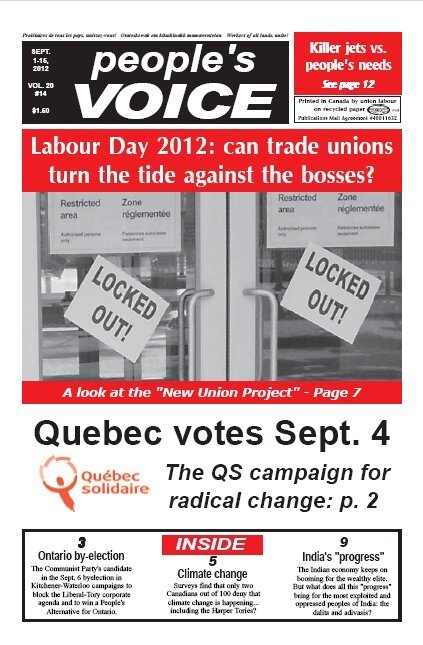
1) LABOUR DAY 2012: A MOMENT OF TRUTH FOR LABOUR?
2) CAW PRESIDENT ISSUES MILITANT CALL TO ACTION
3) CRUCIAL QUEBEC VOTE ON SEPT. 4
4) CP CALLS FOR SINGLE, SECULAR, QUALITY PUBLIC SCHOOL SYSTEM IN ONTARIO
5) SASKATCHEWAN LABOUR RIGHTS UNDER FIRE
6) THE POISON OF WHITE SUPREMACY - Editorial
7) STOP THE ONTARIO WAGE FREEZE - Editorial
8) STUDENTS OF CANADA - RISE UP!
9) FLANAGAN NATIONAL PETROLEUM OWNERSHIP ACT: STOP BIG OIL LAND GRAB
10) CLIMATE CHANGE: BELIEVE IT OR NOT...
11) THE SYRIAN CONFLICT MUST BE RESOLVED BY THE SYRIAN PEOPLE THEMSELVES
12) AFGHANISTAN WAR GIVES WAY TO PLUNDER
13) TORONTO TRIBUNAL TO DEMAND JUSTICE FOR CUBAN FIVE
15) WHAT DOES INDIA'S PROGRESS MEAN TO DALITS AND ADIVASIS?
16) HOW MUCH IS ONE KILLER AIRPLANE WORTH?
18) THE SPARK! (Theoretical and Discussion Bulletin of the Communist Party of Canada)
PEOPLE'S VOICE SEPTEMBER 1-15, 2012 (pdf)
|
People's Voice deadlines: September 16-30 October 1-15 Send submissions to PV Editorial Office,
|
|
REDS ON THE WEB |
|
People's Voice finds many "Global Class Struggle" reports at the "Labour Start" website, http://www.labourstart.org/. We urge our readers to check it out! |
* * * * *
People's Voice
Canadian Publications Mail Sales Product Agreement #205214
ISSN number 1198-8657
People's Voice is published by
New Labour Press Ltd
PV Editorial Office
706 Clark Drive,
VANCOUVER, B.C. V5L 3J1
Phone:604-255-2041
Fax:604-254-9803
email: pvoice@telus.net
Editor: Kimball Cariou : Business Manager: Sam Hammond
Editorial Board: Kimball Cariou, Miguel Figueroa,
Doug Meggison, Naomi Rankin, Liz Rowley, Jim Sacouman
* * * * * *
Letters
People's Voice welcomes your letters
on any subject covered in our pages.
We reserve the right to edit for length and clarity,
and to refuse to print letters which may be libellous
or which contain unnecessary personal attacks.
Send your views to:
"Letters to the Editor",
706 Clark Dr., Vancouver, BC V5L 3J1,
or pvoice@telus.net
People's Voice articles may be reprinted without permission,
provided the source is credited.
* * * * * *
The Communist Party of Canada, formed in 1921,
has a proud history of fighting for jobs, equality, peace,
Canadian independence, and socialism.
The CPC does much more than run candidates in elections.
We think the fight against big business and its parties
is a year-round job,
so our members are active across the country,
to build our party and to help strengthen people's movements
on a wide range of issues.
All our policies and leadership
are set democratically by our members.
To find out more about Canada's party of Socialism,
give us a call at the nearest CPC office.
* * * * * *
Central Committee CPC
290A Danforth Ave Toronto, Ont. M4K 1N6
Ph: (416) 469-2446
fax: (416) 469-4063 E-mailmailto:info@cpc-pcp.ca
Parti Communiste du Quebec (section du
Parti communiste du Canada)
5359 Ave du Parc, Montréal, Québec,
H2V 4G9
B.C.Committee CPC
706 Clark Drive, Vancouver, V5L 3J1
Tel: (604) 254-9836
Fax: (604) 254-9803
Edmonton CPC
Box 68112, 70 Bonnie Doon P.O.
Edmonton, AB, T6C 4N6
Tel: (780) 465-7893
Fax: (780)463-0209
Calgary CPC
Unit #1 - 19 Radcliffe Close SE
Calgary AB, T2A 6B2
Tel: (403) 248-6489
Ottawa CPC
Tel: (613) 232-7108
Manitoba Committee
387 Selkirk Ave., Winnipeg, R2W 2M3
Tel/fax: (204) 586-7824
Ontario Ctee. CPC
290A Danforth Ave., Toronto, M4K 1N6
Tel: (416) 469-2446
Hamilton Ctee. CPC
265 Melvin Ave., Apt. 815
Hamilton, ON.
Tel: (905) 548-9586
Atlantic Region CPC
Box 70 Grand Pré, NS, B0P 1M0
Tel/fax: (902) 542-7981
http://www.communist-party.ca/
* * * * * *
News for People, Not for Profits!
Every issue of People's Voice
gives you the latest
on the fightback from coast to coast.
Whether it's the struggle for jobs or peace, resistance to social cuts,
solidarity with Cuba, or workers' struggles around the world,
we've got the news the corporate media won't print.
And we do more than that
- we report and analyze events
from a revolutionary perspective,
helping to build the movements for justice and equality,
and eventually for a socialist Canada.
Read the paper that fights for working people
- on every page, in every issue!
People's Voice
$30 for 1 year
$50 for 2 years
Low-income special rate: $15 for 1-year
Outside Canada $50 for 1 year
Send to: People's Voice, 706 Clark Drive, Vancouver, BC, V5L 3J1
You can call the editorial office at 604-255-2041
REDS ON THE WEB
http://www.communist-party.ca/
http://www.ycl-ljc.ca/
http://www.solidnet.org/
(The following articles are from the September 1-15, 2012, issue of People's Voice, Canada's leading communist newspaper. Articles can be reprinted free if the source is credited. Subscription rates in Canada: $30/year, or $15 low income rate; for U.S. readers - $45 US per year; other overseas readers - $45 US or $50 CDN per year. Send to People's Voice, c/o PV Business Manager, 706 Clark Drive, Vancouver, BC, V5L 3J1.)
1) LABOUR DAY 2012: A MOMENT OF TRUTH FOR LABOUR?
Commentary from the Central Trade Union Commission, Communist Party of Canada
In January of this year, the Canadian Auto Workers Union (CAW) and the Communications, Energy and Paperworkers Union of Canada (CEP) launched a discussion paper, "A Moment of Truth for Canadian Unions", meant to make public and transparent their merger talks. It is interesting and noteworthy that although this paper posed the fundamental problems affecting both unions it went much further in analyzing the crisis of labour in North America.
The general state of alarm in some areas of the Canadian labour movement, even though it is not yet universal, is a direct response to the neo‑liberal, anti‑labour environment which began during the Ronald Reagan/Margaret Thatcher ascendency in the 1980s. This corporate offensive against workers and their unions has continued to intensify ever since.
Who can forget the humiliation of the leader of the U.S. Air Traffic Controllers, led away in manacles after 11,000 of his members were fired and his union disbanded? Who can forget the 180,000 British miners under Scargill who lost a year long struggle, suffered the reduction of their mines/workplaces from 170 to 17, and were abandoned by the opportunist sections of the trade union movement nationally and internationally? That historic abandonment is part of the present malaise and requires further exposure.
These were the opening salvos of an offensive against labour internationally that has escalated to a level in Canada where the federal and provincial governments intervene, representing the corporate agenda directly using parliament, legislatures and the courts as their instruments. The right to strike, the certification process, labour standards legislation, the closed shop, collective bargaining and even the right to belong to a union are slipping away under tons of arbitration, so‑called mediation and legislation. The International Labor Organization and the United Nations have cited Canada in 17 areas of violation to the Universal Declaration of Human Rights and the Right of Assembly.
Unfortunately, too many labour leaders have slept through thirty years of this offensive, or treated it as a spectator sport. Some have ridden into battle with a white flag, facing backwards on their steeds, more concerned with what was behind them than what was in front. Most unions have engaged in raiding to build their economic base and replace losses at the expense of unity. Most have abandoned sector organizing in favour of merger, amalgamation, raiding or capture.
The trend has been for every major organization to become a mini-labour centre, organizing and expanding only in the area of least resistance. In seeming contradiction, some of these, perhaps most, have fought well at times.
It becomes obvious then that both the problems and the solutions can be found by studying spontaneous practical experience. The contradictions must have a conscious resolution which will determine, to whatever degree it succeeds, labour's revitalization and renewal.
Workers, and many of their leaders, have shown the ability and the will to resist, fighting serious and courageous engagements through strikes and lock‑outs. They have consistently lost ground and have been forced to retreat, or to declare the tattered remains of collective agreements a victory because they at least prevented absolute collapse. These retreats may appear to be a rout, but they also have, in a very real sense, the potential to become the staging ground for a counter offensive and a compliment to those who have stood, those who have defended. Resistance itself becomes the most important component of fightback, providing that experience shapes effective defense, new tactics, response, political maturity and counter‑stroke.
It is apparent that these are the problems that the CAW‑CEP initial discussion attempted to address. The decline in private sector union density to an all‑time low of 6‑7% in the US and 16‑17% in Canada (down from 33% in 1980) definitely puts the handwriting on the wall.
It also has opened up the door for an offensive of absolute destruction against the public sector in the US, where the goal is not only the removal of the union but the removal of the right to organize and belong. If the private sector decline is not reversed in Canada, the attack against both sectors will intensify until the private sector becomes a negligent influence in the working class.
The public sector will stand alone without the allies it needs, without the strength of industrial unionism that paved the way for its emergence.
The initial discussion paper, the work of the joint CAW‑CEP committee, the transparency and the involvement of membership in both unions, has given birth to a unique document called "Towards a New Union, CAW CEP Proposal Committee Final Report". Many fine studies have sounded the alarm to labour, emanating from progressive academics, publications, labour studies programs and individual trade unionists. All these probably have complemented the CAW‑CEP committee efforts, but the document is first and foremost a set of proposals and analyses from the labour movement and trade union thinkers. In that sense it is unique and long overdue.
The document identifies priorities: social unionism and political involvement in new ways; special attention to Aboriginal, gender, social justice and extra-parliamentary movements; recruiting the unemployed, students, pensioners, and creating status for them within and parallel to the traditional bargaining and representation of the union. The document identifies the main enemy as capitalism, and talks of the working class, not the illusory "middle class" so popular in social democratic dogma. It also recognizes the national status of the Quebec working class and its organizations, as well as identifying with the Quebec student struggle, the Occupy Movement everywhere, and the need for world peace.
The differences of the two unions, their ideological clash during the 1990s over the Ontario Days of Action (when CAW championed militant mobilization and CEP was one of the "Pink Paper" unions advocating withdrawal behind plant gates and handing the workers fate into NDP parliamentary hands), seems to have disappeared into what could be hopefully the emergence of a much needed class struggle ideology. But conversely, the issue of affiliation to the NDP is still an open question and is recommended to be left to the founding convention for the delegates to decide.
This poses a real danger, because the underlying question is not affiliation, but rather what ideology will determine relationships to the NDP and other political parties, and on what terms. The historical problem of Canadian labour since the McCarthyite decimation of the left has been the social democratic abandonment of socialism and its acquiescence globally to neo‑liberalism, free market economics and the odious concept of the "labour market". The dominance of social democratic reformist ideology in the labour leadership has kept the movement in neutral. For too long the tail has been wagging the dog.
The working class and the labour movements in many other countries are grappling with similar problems and contradictions during this difficult period. In some countries, trade unions are engaged in militant mass struggles against the corporate assault and the neoliberal policies of both right‑wing and social democratic governments. There is still no effective, coordinated international fightback, but the global capitalist offensive compels workers in all countries, including Canada, to consider new forms of organization and resistance, going beyond the narrow confines of individual trade unions and state borders.
Nevertheless, the document "Towards a New Union" is a step forward, and the contradictions left to be solved are transparent and publicly placed. This is a debate that can and must take place as the two unions seek to grapple honestly with the needs of all the working people and the future of our country.
This Labour Day 2012, we are confident that working people in Canada will welcome all the emerging forces of resistance to the neo‑liberal agenda, and struggle for a world of peace and ecological safety, health and prosperity, not a world of hunger, disease, exploitation and war, a place to live and prosper, not a place to suffer and die.
2) CAW PRESIDENT ISSUES MILITANT CALL TO ACTION
By Liz Rowley
In a militant speech to a sea of delegates attending the CAW's Constitutional and Collective Bargaining Convention, held August 20‑24 in Toronto, President Ken Lewenza laid out the breadth and depth of the neo‑liberal attack on Canadian workers. "Global capitalism is long past its best before date," said Lewenza, inviting progressives and democrats across Canada to "join the family of the labour movement to change the course of Canada".
"Another world is possible, and that's not empty rhetoric ‑ it's a call to action for working people across Canada", he said. "We are in the early days of a popular movement that will redefine our country, and the same is true for countries around the world".
Lewenza pointed to the "Arab spring", the Occupy movement, the Quebec students' protest, the labour fightback in Wisconsin, the NDP's rise to Official Opposition, Canadian scientists and doctors who are confronting the Harper government's environmental and refugee health care policies, refusing to be muzzled.
The CAW leader cited the loss of 800,000 manufacturing jobs in Canada in the last decade, and the vicious attacks on wages, pensions and jobs at Vale, US Steel, Rio Tinto, and Alcan, as well as in the public sector with austerity budgets at every level. Corporations and right‑wing governments are aiming now to break the unions in Canada, said Lewenza, the way they've broken them in the US starting with Ronald Reagan's firing of 13,000 striking air traffic controllers in 1981.
Pointing to the Hudak Tories, who are campaigning to eliminate the Rand formula and the closed shop in Ontario (labour laws won with the historic 1945 Ford strike in Windsor), to Premier Brad Wall whose reactionary Saskatchewan Party is campaigning to do the same in that province, and to Liberal Premier Jean Charest, who criminalized dissent in Quebec with Bill 78, Lewenza warned that "they've declared war on workers... The fight will intensify, but we are determined to win."
The way forward, he said, is through social unionism and the merger of the CAW and the CEP, to create a new union that would be "Canadian, democratic, progressive, a social union, with strong local unions".
The proposal is the focus of the CAW's historic 2012 convention, and of the CEP's convention this fall. The new union would be formed next year, if the two conventions vote to support the proposal.
Lewenza also called for the creation of "a publicly‑owned national development bank to direct spending toward real investments in key sectors and regions. We need to tame the uncontrolled power of private banks to control the flow of credit and set interest rates. And we need to assert public control over the financial sector."
Speaking about the union's relationship with the NDP, Lewenza said this would be settled at the new union's 2013 convention, but noted criticisms of the NDP including that it has been "galloping to the centre". He also said that political action cannot be left to the NDP, and that putting people into the streets was crucial to future victories.
At the end of the first day, delegates seemed gripped with the seriousness of the challenges facing their union, and the Canadian labour movement, and were clearly supportive of the direction their union proposes.
CUPE national President Paul Moist topped off the day with a strong endorsement of the proposal, and called for a united and fighting labour movement that would build strong links of solidarity with communities. "You can count on CUPE anywhere in Canada to support you" he said.
(Look for a full report in our next issue.)
3) CRUCIAL QUEBEC VOTE ON SEPT. 4
By Johan Boyden, Montreal
As Québec approaches a crucial election on September 4, the majority of students have voted to halt their long‑lasting strike mobilization that helped trigger the vote.
About 60,000 students remain on strike according to the militant student union la CLASSE (as of Aug. 21). Most strike votes saw long and intense debates about strategy and tactics. On most campuses, between twenty and forty per cent of students supported continued strike action.
In explaining the vote, the CLASSE pointed to the intense pressure faced by students. Repressive Bill 78 is now Law 12, which bans any kind of strike action (even symbolic) imposing harsh fines both on students, their unions, teachers, and post‑secondary institutions that don't obey the law. Many schools told students that if they voted for a continued strike everyone would receive a failing grade for the semester.
There is also concern that continued strike action might backfire and actually help the Charest Liberals' "law and order" platform. Polls indicate the Liberals' major challenge is from the pro‑business Parti Québécois headed by Pauline Marois. In third place is Francois Legault's ultra‑right Coalition for Québec's Future (CAQ).
The big parties have tried to focus on corruption, economic development with Plan Nord, and the continued debate about secularism and "reasonable accommodation." But the pressure of the spring's massive popular student struggle refuses to go away.
The progressive party strongly identified with the cause of the students, labour and social movements is Québec Solidaire (QS). As one of its star ideas, QS would "eliminate all fees charged to students and their parents when attending any public or parapublic institutions from preschool to university."
The QS, led by co‑spokespeople Dr. Amir Khadir (elected provincially in Mercier) and feminist activist Francoise David, hopes to pick up seats in the vote. Québec Solidaire is the party with the most women candidates (62 female and 62 male; only 28.1% of all candidates in this election are women), and the party's website lists fourteen candidates who are trade unionists.
The QS platform advocates many immediate demands that are similar to the policies of the Communist Party of Canada, including:
* Create a universal public drug insurance plan and "Pharma-Québec", a public pharmaceutical acquisition and production centre, and stopping privatization of health care;
* Amend anti‑scab legislation to prevent all indirect use of employees by the employer involved in a labour dispute as well as the use of production by alleged volunteers, and ban both lockouts and recourse to injunctions against picketing;
* Plant‑closure legislation, including financial penalties, forced payment of pensions, and the nationalization of solvent companies converting them to workers' cooperatives.
‑ Opposition to the Comprehensive Economic Trade Agreement (CETA) and the North American Free Trade Agreement;
‑ Reinforce and re‑establish a progressive tax system, with exceptions for the lowest income brackets, and introducing tax brackets for corporations, as well as reducing tax incentives and eliminating tax loop‑holes.
‑ Nationalize the strategic resources for which Québec has extraction and exploitation technical expertise, especially certain raw materials and energy‑related resources.
‑ Electoral reform including mixed‑member proportional representation.
Broad but consistent emphasis is put on social justice and equity issues. The QS platform calls to create 40,000 new childcare spaces, shifting private facilities into the public sector, and expanding the hours during which childcare centres operate, to support parents working in non‑standard jobs.
QS calls for the Québec National Assembly to pass and apply, without conditions, the United Nations Declaration on the Rights of Indigenous Peoples.
The platform proposes 50,000 new universally accessible social housing units (public, cooperative, or communal), a guaranteed minimum income starting at $12,000 a year, and a universal Québec pension plan.
A Québec Solidaire government would advocate reducing greenhouse gas emissions by at least 40% compared to 1990 levels by 2020 and by 95% by 2050. Proposals in this direction include nationalizing wind power, expanding public transit and electrifying transit, banning the exploration and production of fossil fuels (oil, shale gas) and working towards the abandonment of fossil energy consumption by 2030.
The party calls for a food sovereignty policy that will favour sustainable development of resources, and protect access to clean water as a right.
Like the Communist Party, the QS calls to strengthen enforcement of the Charter of the French Language in all work environments, countering the current direction of increasing exceptions to this law that have allowed a growing number of workplace orders to be again given in English.
However, QS places a different emphasis on the question of Québec's future. The Communist Party of Canada has a long history of defending Québec's right, as a nation in Canada, to sovereignty and self‑determination, up to and including the right of separation. The CPC proposes a new equal partnership of the Aboriginal peoples, Québec and English-speaking Canada in a confederal republic, with a new constitution enshrining the right to sovereignty.
QS also rejects the status‑quo of federalism and proposes a strategy that is more or less complimentary: an elected constituent assembly to be convened so that Québec would democratically decide its own future and draft a new constitution.
However, like the majority of the left in Québec (but not the CPC), QS sees this process as a road to independence. More than in previous campaigns, QS sometimes comes close to putting this as an objective in itself (as does the PQ), not as a way to social progress which is the party's stated policy. The CPC points out the danger to Québec from US imperialism, and instead calls for an equal and voluntary partnership of the working class and its allies in both Québec and English‑speaking Canada, united in the struggle for social transformation. Despite this difference, the choice for those looking for a strong left party is clear. (The QS program is available in English at www.quebecsolidaire.net/wp‑content/uploads/2012/08/QS‑Plateforme‑2012‑anglais‑.pdf.)
Québec`s election law severely restricts interventions by organizations not officially registered as third parties. The Liberals have demanded investigation of student groups. One blogger has been forced to take down her site because it was critical of the ruling party, and a labour union central has removed videos critical of the Liberals.
The Communist Party of Québec (PCQ), which is fighting to regain its provincial certification, is also in this position. The PCQ has issued a statement critically examining the flaws of strategic voting and the connection between electoral struggle and struggle on the streets.
Marianne Breton Fontaine, who ran for the Communist Party of Canada in the last federal election, is a candidate under the Québec Solidaire banner in Acadie. This riding is currently held by the Liberal Minister of Culture who waded into the student struggle last spring, accusing a famous soft‑spoken Québec storyteller of endorsing "violence and terrorism" by wearing the red square.
4) CP CALLS FOR SINGLE, SECULAR, QUALITY PUBLIC SCHOOL SYSTEM IN ONTARIO
Kitchener-Waterloo Communists have nominated provincial party leader Elizabeth Rowley to contest the Sept. 6 by‑election in that riding.
Rowley, who was an East York Public School Trustee during the Mike Harris years, told campaign supporters at an August 15 event in Kitchener that the Liberals are no different from the Tories when it comes to attacking teachers, students and school boards.
"Their real aim," said Rowley, "is to slash wages and jobs, dismantle and privatize public education, and eliminate School Boards ‑ and local democracy ‑ altogether."
Rowley continued, "Deliberate and illegal interference in negotiations between School Boards and the unions representing teachers and educational workers is an attempt to create a crisis so that the Liberals, with the Tories' support, can legislate a wage freeze and implement the massive cuts and privatizations called for in the Drummond Report and enabled in the spring budget. "What is happening here is a demonstration of why voters should reject both Liberal and Tory agendas for Ontario, and deny the Liberals a majority. Their interference is anti‑democratic, anti‑labour and pro‑corporate. Free collective bargaining is a basic democratic right, and all employers must respect it ‑ especially governments.
"Working people need strong social programs, strong public and post‑secondary education systems, a strong public healthcare system, and good jobs. A real recovery in other words ‑ a People's Recovery.
"A single, secular, quality public school system, open to all regardless of religion, national or ethnic origin, or sexual orientation, is long overdue. The current system is discriminatory, divisive, and an unnecessary and wasteful duplication of services. "The Communist Party has campaigned for a single, secular, quality public school system since 1921. We were the only party to oppose the extension of full funding by the Davis Tories in 1985. Ontario is now the only province with full public funding for religious schools. The United Nations Human Rights Committee has condemned this discrimination. The time has come to fix this, by gradually withdrawing funding and transitioning Catholic schools into the public system."
Elizabeth Rowley's campaign platform contains a 10 point Prescription for a People's Recovery, based on creating jobs, raising wages and incomes, expanding social programs, strengthening labour and democratic rights, justly settling Aboriginal land claims, and doubling the corporate tax rate and reversing corporate tax cuts as the centrepiece of progressive tax reform based on ability to pay.
(For more information, contact the Communist Party at 416-469-2446)
5) SASKATCHEWAN LABOUR RIGHTS UNDER FIRE
PV Manitoba Bureau
The irony of asking workers how to better regulate their limited rights at a time of complete lawlessness by the corporations, banks and wealthy seems totally lost on the government of Saskatchewan.
The process to review every labour law is deeply flawed. Premier Brad Wall's government allowed only ninety days for people to comment. There were no public hearings.
Few people bothered to participate. About 2,000 groups or people made a submission, including the Communist Party (see box). Replying to the CPC's letter, Premier Brad Wall's office explained that the review's aim is to "modernize, simplify and amalgamate labour legislation as well as explore the creation of a Saskatchewan Employment Code."
"We'll see what come out the other end this fall," said Darrell Rankin. His letter for the Party's trade union commission calls the review "a thinly‑veiled effort to set the stage for a massive attack on unions and workers' rights."
The official opposition NDP's submission focuses only on the flawed process, yet they are holding their own hearings across the province over 20 days (and accepting internet and mail submissions for an undeclared period).
"What we thought was we'd do our own consultations," provincial NDP president Cory Oxelgren said. "The party wanted to do something in parallel, so we're doing a website to get some people's opinions and lay it out there."
6) THE POISON OF WHITE SUPREMACY
People's Voice Editorial
The massacre of six people at a Wisconsin Sikh temple by an active white supremacist is a sobering reminder that racism remains a deadly poison in the 21st century. Despite claims that we have moved into a "post-racial" era, both individual and systemic racism are deeply embedded in our "civilized" society. While governments spend billions of dollars on security and surveillance to track critics of pro-corporate policies, violent fascist and anti-immigrant movements openly attack members of racialized communities and anti-racist activists (and sometimes even their fellow neo-nazis!) with virtual impunity. The Wisconsin killer was a former U.S. soldier, proving again that NATO's armed forces are a hotbed of virulent racism.
And the problem goes much deeper. Both Canada and the U.S. emerged through the seizure of indigenous lands and the genocidal treatment of First Nations right up to the present, openly justified by the racist ideology of the supposedly "more advanced" European colonizers. Canada became a major capitalist power through the exploitation of millions of immigrants. Not much has changed, as seen by the Harper Tories' campaign to demonize "undesirable" migrants such as Roma refugees, while expanding temporary foreign worker programs which turn migrants into second-class people with lower wages and few legal rights.
This trend is likely to continue as the global capitalist economic crisis gets worse. Scapegoating is a perennial ruling class tactic to divide workers' collective resistance against pay cuts and attacks on social programs and labour rights. The left and progressive movements must respond by stepping up our anti-racist struggles, against both the violent neo-fascists, and the Harper Tories who put the official government stamp of approval on institutional, systemic racism.
7) STOP THE ONTARIO WAGE FREEZE
People's Voice Editorial
Ontario's McGuinty Liberal government is preparing to recall the Legislature to impose an "emergency" two year wage freeze and benefit cuts on teachers and educational workers, despite the fact that negotiations continue with no signs of any imminent work stoppage. As usual, bargaining between School Boards and the unions will continue if current agreements expire.
But the Liberal minority in Queen's Park has been whipping up public fears of a work stoppage in early September, to justify their illegal intervention and subversion of free collective bargaining in education.
The real decision to cut wages was made by the Liberals' spring budget, supported by the Tories, and unopposed by the NDP. All three parties agreed this was reasonable to eliminate the province's $15 billion deficit created by the bailout of the banks and corporations in 2008, on top of 30 years of massive corporate tax cuts. "Creating a crisis" in education worked for the Tories in 1995. The Liberals hope it will work again in 2012.
Meanwhile, Tory leader Tim Hudak wants to transform Ontario into a right to work jurisdiction, like Indiana: an end to the closed shop and dues check‑off, and tight restrictions on the social and political activities of unions. And the NDP says it will oppose the wage freeze legislation. So why did they vote for the cuts in the first place? The Liberals and Tories have few differences when it comes to attacking labour, and to the dismay of the public, the NDP hasn't got nearly enough.
The Communist Party is calling for a massive protest against the Liberal legislation, which could pass with Tory support. Only mass action by labour and its allies, and the We Are Ontario Coalition, can stop this legislation in a minority Legislature.
8) STUDENTS OF CANADA - RISE UP!
Commentary by the Young Communist League of Canada about the student struggle in Canada, and especially Ontario today.
The unity and militancy of the Quebec student struggle has begun to shake the rest of Canada. Across the country, the youth and student movement has been inspired and emboldened by the struggle in Quebec. Many have correctly concluded that the best form of solidarity is to step‑up a united fight back at home.
The Young Communist League of Canada supports this growing mobilization, made stronger by work like the Casserole Night in Canada protests that heard pots banging from Antigonish, Nova Scotia to Victoria, British Columbia; and here in Ontario, by solidarity tours like that organized by the Canadian Federation of Students‑Ontario and the Toronto student strike workshops which drew in over a hundred eager participants.
Now is the time to start building a broad, militant and united fight back for accessible education, which is in crisis in our province:
* fees in Ontario are 23% higher than the cross‑Canada average
* college tuition has outstripped inflation by 378%
* university tuition has outstripped inflation by 509%
* students graduate with an average debt of $37,000
The McGuinty Liberal government has just announced dangerous plans to compress four year degrees into three. In Canada and around the world we are seeing a new kind of education system where we pay more and learn less. As all students scramble to find work and pay our bills in an economic crisis of capitalism, indigenous peoples, women, and racialized communities face growing barriers to post‑secondary education. International students are exploited as "cash‑cows".
In place of accessible education, we are being told to lower our expectations and accept a life of debt and unemployment.
Books not bombs
The McGuinty Liberals' sham 30% tuition grant promised to students in the last election is woefully inadequate. Two‑thirds of students aren't eligible. We are told by the government there is not enough money to pay for "luxuries" like education and that we must tighten our belts.
But if billions of dollars can be spent on corporate tax breaks and fighter jets, why is there no money to spend on education? Free education for Canada would be $5 billion annually. Harper`s annual military budget? $25 billion.
We must see what the government cuts to education really are ‑ an ideological war being waged against students in tandem with attacks on the working class majority.
Unity and resistance is the way forward
It is tempting to reduce the student struggle to a question of magic leaders ‑ or magic structure. Of course, leadership that understands its duty, listens to members, and shows uniting ways forward is very helpful ‑ as is a democratic approach as expressed by mass all‑campus or department level meetings of students (General Assemblies), and especially when the students themselves not only make the decisions but also carry them out.
On the other hand, the main problem students face is not a question of personalities or decision‑making process: it is the political problem of unity and militancy or bringing together the broadest and most powerful unity of students and their allies, behind a militant political strategy to win access to education.
The vast majority of students already see education as socially positive and support lower fees and greater access. In order to turn this sentiment into a visible force, hard work is required, convincing our campuses of the demand that access to education is a right, and of the urgency and necessity for united and growing strategy. United struggle is the only effective path for students to win.
The way forward for the student struggle must be to place front‑and‑center the question of a broad, powerful and united fight back with an escalating action plan that reaches beyond access to education and ultimately demands free education. The passive tactics of lobbying, post cards and petitions, isolated or one-day-a‑year actions, and campaigns centered on media outreach rather than mass mobilization are simply not enough.
As the most progressive student union in English‑speaking Canada, the Canadian Federation of Students (CFS) is in the best position to build such a plan and win the students of Ontario to a program of united struggle. To its credit, not only reduced fees but free education is the policy (at least on paper) of the CFS.
This strong mandate has to be put into action now. There is no contradiction between respecting the autonomy of local campuses and the CFS organizing and making a political battle to win students into struggle ‑ in fact, the opposite.
On the other hand, everywhere reactionary students have won campuses to ditch the CFS, the campus has shifted to the right and political inactivity. If we got rid of the CFS, students would wake up with a big hangover and just have to rebuild.
Many campuses are controlled by right‑wing student unions in Ontario, and the Ontario Undergraduate Student Alliance and the Canadian Alliance of Student Associations support tuition increases. Everywhere progressive students must re‑double their efforts to win their campuses back from these forces, linked to reactionary political parties like the McGuinty Liberals and Harper Tories.
The vast majority of students view education as socially positive, and strongly support greater access and lower fees!
There is also a new breeze in the air. Emboldened by youth protest internationally, more students are taking up the call of accessible, quality, public not‑for‑profit education from cradle to grave and challenging the policies of big business and their governments.
The neoliberal agenda is being implemented internationally, therefore we must also recognize this international reality in our local struggle. The same struggle is being waged by students in Chile, South Africa, Germany, Britain, Greece, Spain - and Quebec! Across the globe, students are fighting back!
Student strike, people's struggle!
Hundreds of thousands of students in Quebec have mobilized over the last semester, despite violent police repression and the suspension of democratic rights, using the strongest tactic to put moral pressure on the government - a student strike - and in doing so, have shown that a broad, mass, united struggle is by far the most effective strategy.
The Quebec students have won strong support from labour, community groups and the people. Despite the Mulclair NDP's silence, the sound of casseroles are clanging across Canada!
Key parts of the escalating mobilization in Quebec include (1) campus "mobilization committees," which operate under the regular direction of student General Assemblies, as well as (2) militant and relatively united leadership by student unions, and (3) an escalating action plan that the grassroots membership and all levels of activists feel they are democratically driving forward. Quebec also shows that the demand for free education can open mass, democratic debate about people's alternatives and social transformation.
Mass mobilization and cooperation between students and other movements, especially labour, is the only way we can effectively defeat corporate and government attacks on education. Ontario students cannot afford to wait to find the best direct democratic structure or for spontaneous opportunities, or the next election to fight back. Every month, every week we delay organizing has a cost.
Get organized, fight back!
Show solidarity ‑ wear a red square!
* Get vocal ‑ demand accessible education as a right, not a privilege!
* Get involved ‑ help build or grow a local action or mobilization committee
* Support and attend General Assemblies, student elections, and build your student union
* Demand an escalating plan of action for a broad and united fight back
* Open a broad democratic debate about free and emancipatory education.
Free education should be federally funded. Cut military spending by 75%! The YCL also supports the Post‑Secondary Education Act, not least as the Feds and Premiers negotiate transfer payments currently. But unity with the Quebec student movement and Aboriginal students (for whom access to education is also a treaty right continually denied) must be found on a new basis of justice and equality of nations, not Canada`s existing Constitution.
The YCL thinks that a bold counter‑offensive is necessary. We propose a Charter of Youth Rights as a basis to bring together the youth movement behind a social vision of a better Canada.
Ultimately, we can and must win a future that guarantees free education, peace, equality, ecological sustainability, and real democracy - which we call socialism!
9) FLANAGAN NATIONAL PETROLEUM OWNERSHIP ACT: STOP BIG OIL LAND GRAB
Dr. Pamela D. Palmater is a Mi'kmaw lawyer, who teaches Indigenous law, politics and governance at Ryerson University. This commentary is excerpted from her Aug. 7 blog posting at www.indigenousnationhood.blogspot.ca.
By now most of you have heard about the Harper government's intention to introduce legislation that will turn reserve lands into individual holdings called fee simple. The legislation has been referred to as the First Nation Property Ownership Act (FNPOA). Some media outlets have referred to it as "privatization" but what the legislation would really do is turn the collective ownership of reserve lands into small pieces of land owned by individuals who could then sell it to non‑First Nations peoples, land‑holding companies and corporations, like Enbridge for example....
Here are some of the questions asked of me by the media and my answers in very brief form:
1. First Nations hate the Indian Act, why would they object to Harper amending or repealing the Act?
The abolishment of the Indian Act was the central feature of the 1969 White Paper ‑ the federal policy that would assimilate "Indians" once and for all. It is up to First Nations to decide when and how they want to amend or repeal the Indian Act ‑ Canada has done enough damage under the guise of "what is good for the Indians".
Harper specifically promised at the co‑called Crown‑First Nation Gathering that: "To be sure, our Government has no grand scheme to repeal or to unilaterally re‑write the Indian Act". This legislation would be a significant and unilateral amendment to the Indian Act.
2. But First Nations can't access mortgages or start businesses without owning land in fee simple?
That is simply not true. Individual band members have been working with their First Nations and the major banks to obtain mortgages to build homes on reserve for many years. Many band members and bands have also been able to receive loans from banks to start businesses without leveraging their homes. One must also remember that owning a home doesn't mean you can open a business on your land ‑ there are zoning and other laws on reserve as there would be in any neighbourhood.
3. But Canadians get to own land in fee simple?
Canadians have the option to own land in fee simple only if they are wealthy enough to buy land or qualify for a mortgage. Thousands of First Nations people also own land in fee simple all over the country. Some First Nations people also hold land via Certificate of Possession on reserve which is very similar to fee simple, except that it can't be sold to non‑First Nations people.
4. But if First Nations could own land in fee simple, wouldn't that cure the housing crisis?
This ability to own land in fee simple has not cured homelessness in Canada and in fact, it is on the rise. The ability to hold reserve lands in fee simple would not qualify any individual for a mortgage. Part of getting a mortgage is being able to get insurance ‑ who would insure a mold‑infested, asbestos‑contaminated home without running water or sanitation services? This sounds like more of a cure for the economy and mortgage lenders than it does for First Nations.
5. But commentators have said this would cure First Nation poverty?
The origins of the current crisis of poverty in First Nations are in the theft of our lands and resources, the genocide committed against our people, the federal strangulation of our governments and the refusal to properly recognize and provide space for our treaty, Aboriginal, and inherent rights and laws. Fee simple has nothing to do with it. There is absolutely no evidence that fee simple ownership has cured poverty. In fact, the studies have shown that the chronic underfunding of essential social services by the federal government is the primary cause of the current levels of poverty in First Nations.
6. But Manny Jules and eight other First Nations want this legislation?
With all due respect, Manny Jules heads a federal government organization ‑ he is not a First Nation leader or community spokesperson. If there are a handful of First Nations who truly want to divide their reserves into individual parcels of fee simple lands, they can do so via current processes under the Indian Act or self‑government negotiations for example. There is no way that eight First Nations should set national law or policy for 633 First Nations. Treaty implementation and the resolution of land claims are far more critical to First Nation well‑being.
7. But isn't the legislation optional? What's the harm?
With INAC, even optional laws and policies are never truly optional. Once the government decides it wants First Nations to behave in a certain way, they use a series of financial and political incentives and punishments to ensure First Nations act as the government deems appropriate....
Plus, the element of volunteerism does not apply in a situation of duress. Is it truly optional to sell one's land if one is already impoverished and suffering from a lack the basic necessities of life? Even Manny Jules admitted that one of the challenges of this bill is that all reserve land could be lost.
Jules wants First Nations people to prove to banks that they are "worthy" of owning a home. WOW!....
There is simply nothing good about this bill and much to be lost from it. People need to stop coming up with ideas about how to "fix" us as we always end up worse off for it.
Canadians are not required to understand or even support our inherent, treaty, domestic and international rights ‑ they just have to accept that this is the law, not unlike any of the laws they cherish.
Canada needs to stop trying to assimilate us and instead focus on fulfilling its legal and treaty obligations instead of trying to find ways around them. I think we have suffered enough ‑ let us go about the hard job of healing and rebuilding our Nations and enjoy our fair share of what is ours.
10) CLIMATE CHANGE: BELIEVE IT OR NOT...
By Kimball Cariou
One of the world's most influential climate change skeptics has now declared that climate change is real, and caused entirely by humans. Physics professor Richard Muller, the founder of the Berkeley Earth Surface Temperature project, has proclaimed himself a "converted skeptic."
New findings from Muller's project assert the earth's average land temperature rose by 1.5 degrees Celsius over the past 250 years almost entirely due to greenhouse gas pollution. Climate change is real, he wrote, and humans are "almost entirely the cause."
Muller's turnabout is a major setback to climate change skeptics such as the billionaire brothers, Charles and David Koch.
The Berkeley Earth Surface Temperature project received $150,000 from Charles Koch. The Koch brothers have also given $500,000 to the right‑wing Fraser Institute, well‑known for its ties to high‑profile climate change skeptics.
Only two per cent of Canadians who responded to a new opinion poll believe climate change is not occurring, according to a recent Canadian Press article.
The findings are in a survey of 1550 people conducted in early June by Insightrix Research, for IPAC‑CO2 Research Inc., a Regina-based centre that studies carbon capture and storage.
"Our survey indicates that Canadians from coast to coast overwhelmingly believe climate change is real and is occurring, at least in part due to human activity," said centre CEO Carmen Dybwad.
Almost one‑third (32 per cent) said they believe climate change is happening because of human activity. Another 54 per cent believe it's because of human activity and partially due to natural climate variation. Nine per cent blame natural climate variation, and only two per cent deny that climate change is occurring at all.
According to the survey, Prairie respondents are least likely to believe that climate change is occurring due to human activity, while residents of Quebec, Atlantic Canada and British Columbia are most likely to hold this belief.
In related news, the Greenland ice cap was melting at a record pace with a month left to go in the summer season. Researchers at New York's City College said in August that the ice cap had already set records for the extent of melting over its surface and the amount of ice exposed to warming air temperatures.
Greenland's ice cap and Arctic sea ice are considered to play an important role in regulating climate over the rest of the planet.
11) THE SYRIAN CONFLICT MUST BE RESOLVED BY THE SYRIAN PEOPLE THEMSELVES
Statement of the Central Executive Committee, Communist Party of Canada, August 20, 2012
The crisis in Syria continues to deepen with every passing day. Thousands have been killed or injured, including countless civilians caught in the crossfire between armed opposition groups and government forces. Thousands more have been displaced from their towns and villages and forced into internal or foreign exile by the fighting. In this very real sense, the situation has become a human and social tragedy of the first order.
But what is actually taking place in Syria? Who is really provoking the violence and prolonging the agony of the Syrian people?
The Western corporate‑controlled media would have us believe that the root cause of the conflict is the "tyrannical" government of President Bashar El‑Assad which clings to power at any price, willing to sacrifice the health and security of its own people. This "big lie" is central to the intensifying propaganda campaign to vilify El‑Assad in order to conceal the role of reactionary and clerical forces bent on destabilizing and ultimately overthrowing the current government and seizing power for themselves. And if necessary, this demonization campaign will be used as a pretext for imperialist military intervention and occupation to directly impose "regime change", as was done in Iraq and most recently in Libya.
The global media offensive against Syria is only one aspect of a multi‑faceted imperialist strategy to crush (and possibly dismember) the Syrian state. The broader objective is to fashion a "New Middle East" of weak and pliant Arab states under the domination of U.S. and European imperialist powers and their local gendarme in the region, the expansionist state of Israel. This would guarantee unfettered access to the petroleum and other natural resources of the region, and extend imperialist geopolitical hegemony into the "underbelly" of Asia, further encircling both the Russian Federation and China.
Undermining the Syrian state is pivotal in achieving this imperialist ambition. Due to its central location in the region, its secular character and socially progressive policy orientation, and its firm solidarity with the just struggle of the Palestinian people and its opposition to the expansionist policies of Zionist Israel, Syria has long been in the cross‑hairs of U.S. imperialism. For their own reasons, reactionary Arab regimes ‑ especially Saudi Arabia and Qatar ‑ as well as Turkey are also anxious to weaken and crush Syria.
"Regime change" in Damascus and its replacement with a more pliant, pro‑imperialist regime would compound this catastrophe for the Syrian people. It would also dramatically alter the regional balance of forces, weakening the anti‑imperialist forces, and serving as a prelude ‑ and launching pad ‑ for NATO/Israeli aggression against neighbouring Iran, the most powerful state in the region.
When anti‑government protests erupted in Syria last year, U.S. imperialism and its local and regional backers seized the opportunity to launch its "tried and true" destabilization campaign, using popular discontent (and the at times crude methods used by local Syrian officials to quell the protests) as a cover to move into action. Many Syrians were justifiably angry at the impact of neoliberal "reforms" which weakened national production, increased unemployment, and widened social and economic disparities between the mass of working people and national and foreign capitalists, aided by weak, misguided and sometimes corrupt government officials.
But legitimate opposition voices were quickly either co‑opted or shunted aside by hardcore, heavily foreign‑financed and armed gangs determined to make Syria ungovernable. Terrorist attacks to spur further government crackdowns, sectarian violence to incite distrust and enmity between the Sunni majority and the Alawite and other minorities, the smuggling of heavy weapons and even mercenaries from abroad, and finally open calls for direct foreign intervention in violation of Syria's national sovereignty ‑ this has been the orchestrated game plan carried out by the "internal opposition".
Meanwhile the misnamed "Friends of Syria" ‑ the cabal of U.S. and other imperialist powers, the reactionary and despotic Arab regimes, and the counter‑revolutionary Syrian National Council ‑ have dismissed every attempt of the Assad government to dialogue with the "opposition", to achieve a ceasefire under the Kofi Annan peace plan, or to introduce constitutional reforms ending the state of emergency and opening the way for more open parliamentary elections. Instead, they have forced through several rounds of anti-Syrian sanctions at the UN Security Council, and have denounced Russia and China for vetoing strident and dangerous resolutions which would have give a green light for foreign imperialist aggression under the sanction of the United Nations, as was done in March 2011 against Libya.
The Harper government has played a particularly despicable role in this sordid affair, beating the drums for sanctions and war on Syria. Unfortunately, the main opposition parties in Canada's parliament ‑ the Liberals and NDP ‑ have done little better. Indeed, all three parties have thrown in their lot with the imperialist conspiracy against Syria, arguing in favour of "humanitarian interventionism" and the "responsibility to protect" (R2P) as a justification for yet another aggression.
The Communist Party of Canada fundamentally rejects the building war hysteria over Syria and Iran, and warns that such military adventurism could well lead to a dangerous conflagration throughout the Middle East region, and beyond. We call for the full respect of Syrian national sovereignty and independence, the removal of sanctions, the immediate halt to all covert financial and military support to the Free Syrian Army and other armed groups inside Syria, and the renunciation of a military "solution", in favour of a ceasefire by all combatants and peaceful national dialogue to restore peace to that troubled country.
Stop the meddling! End the sanctions! Prevent a new, dangerous war! Respect Syria's national sovereignty! The Syrian conflict must be resolved by the Syrian people themselves!
12) AFGHANISTAN WAR GIVES WAY TO PLUNDER
By Manuel E. Yepe, a CubaNews translation, edited by Walter Lippmann
Resembling the starting shot for any of the recently concluded Olympic competitions, in Washington, the Department of Defense (DOD) announced what can be seen as the starting signal for plunder in the war of the United States against Afghanistan.
The DOD informed that U.S. "foreign aid" agencies are now ready to guarantee comprehensive tasks to locate and identify potential deposits of copper, gold, iron and other high value minerals in Afghanistan.
On July 30, the US Armed Forces Press Service released via the Internet that DOD officials and the U.S. Geological Survey (USGS) had met at the US Embassy in Afghanistan to reveal what was identified as "a treasure map" of the mineral resources in the Asian nation.
At the meeting, the representative of the DOD's Task Force for Business and Stability Operations (TFBSO) shared the rostrum with USGS Director Marcia McNutt, who described the new technology that made possible the study of more than 70% of the country's surface and the identification of potential high‑value deposits of copper, gold, iron and other minerals.
Since 2009, TFBSO has been financing USGS works including the operation ‑ with the help of NASA ‑ of an airborne hyperspectral image reproducing instrument that maps on the surface the mother lodes of natural resources under the rough and mountainous geography of Afghanistan.
It was explained that "TFBSO is a DOD organization charged with helping to spur and grow the private‑sector economy in Afghanistan ... and clearly, the mineral and oil and gas extractive areas are critical to that effort."
A work by journalist Brandon Turbeville, published on the alternative digital publication Activist Post, explains that such geological mapping of the "hidden" treasure ‑ one of the main reasons for the invasion, occupation and death of so many thousands of people ‑ "opens up the bidding process for private companies who are no doubt salivating as they wait in the wings for their opportunity to gobble up the natural wealth of the impoverished and war‑torn nation."
However, according to Turbeville, the term "hidden" is only a matter of perspective because "while the mineral, oil, and gas reserves might have been hidden from the vast majority of the world's population, they were anything but that to the major governments that rule over them.
Evidence of this is in the DOD press release which admits that the US obtained data about the work of a Soviet mission that was "helping" the Afghan government with geological investigations that took place over 10 years in the 1960's.
With the argument that the information obtained from the Soviets is too outdated, the US justified its interest and expressed urgency to obtain new geological information.
Turbeville offers abundant information about the state‑of‑the‑art technology the USGS and other US agencies are using to map the Afghan treasure trove.
He explains that hyperspectral data uses the reflectance of light and is based on the fact that different minerals reflect light in different wavelength bands. Every mineral has its own signature or fingerprint.
He says that modern hyperspectral instruments "can be used in a place where there's no vegetative cover, and Afghanistan happens to have almost no vegetation and this technology can be applied advantageously to reveal at the surface the mother lode of resources."
As for what has been found, the USGS stated that, "We have identified world‑class copper, gold, iron ore and rare earth deposits that no one knew were there." (Turbeville says the reader would be well‑advised to ignore the "that no one knew were there" part of the statement).
Positing that the corporations that gather for the feast will have to invest billions of dollars before a single pound of mineral is extracted, Washington ‑ always the arrogant occupier ‑ imposes conditions on the Afghan government that will burden the country's economy with huge expenditures on roads, power lines and other infrastructural works. At the same time it demands legal, labor and revenue systems to meet the expectations of Western investors.
13) TORONTO TRIBUNAL TO DEMAND JUSTICE FOR CUBAN FIVE
Danny Glover is just one of many prominent public figures who will attend a major Cuban Five solidarity event in Toronto later this month, according to organizers of the "Breaking the Silence People's Tribunal & Assembly."
Almost 14 years ago, the Cuban Five - René Gonzalez, Gerardo Hernandez, Antonio Guerrero, Ramon Labanino and Fernando Gonzalez - were wrongly convicted in a Miami courtroom of "conspiracy to commit espionage" against the U.S. on behalf of the Cuban government. The five Cubans have been held in separate prisons, often in solitary confinement.
Yet the Cubans never threatened U.S. security, and never conspired to commit espionage. They were on a mission to monitor and report on violent groups in Miami that are well known by the U.S. government to be responsible for terrorist acts.
For more than 50 years, hundreds of attacks have been launched against Cuba by these extreme right‑wing groups, whose aim is the violent overthrow of the Cuban government. Their campaign of bombings, assassinations and other attacks has left 3,478 Cubans dead and 2,099 seriously injured.
The Cuban Five were peacefully trying to do what U.S. authorities have refused to do ‑ prevent terrorism. This horrific injustice has provoked an unprecedented campaign around the world to demand that their convictions be overturned and that they be granted immediate release.
As part of this international effort, a number of trade unions and solidarity groups from across Canada, in coordination with the Canadian Network on Cuba and La Table de concertation de solidarité Québec‑Cuba, are convoking the Peoples' Tribunal & Assembly on September 21‑23, at Toronto City Hall.
The Tribunal will launch an appeal to win justice for the Cuban Five, and attempt to break the silence of the mainstream media about this case. Delegates will also map out the next steps of a broad and united public campaign.
Actor, producer and humanitarian, Danny Glover has been on screen, stage and television for more than 25 years. He appeared in the blockbuster Lethal Weapon sequels, the critically acclaimed feature, Dreamgirls and Po' Boy's Game and may be seen in Honeydripper and Be Kind, Rewind. He has gained respect for his community activism and philanthropy, serving as a Goodwill Ambassador for the United Nations. He earned Emmy nominations for his performances in Mandela, Lonesome Dove, and Freedom Song.
Other participants from the U.S. include Saul Landau, a scholar, author, commentator whose films have won numerous awards, and Cindy Sheehan, who became an internationally known peace and social justice activist after her son Casey was killed in Iraq in 2004.
From Cuba, the conference will hear from two relatives of the Five. Adriana Pérez, the wife of Gerardo Hernandez, has not been allowed a U.S. visa for the last thirteen years of her husband's imprisonment. Elizabeth Palmeiro is the wife of Ramon Labanino, who has been denied a retrial and remains in a U.S. jail after his life sentence was vacated and replaced by a sentence of thirty years.
Other Cuban delegates will include Rodolfo Davalos Fernandez, member of the National Union of Jurists of Cuba and a renowned human rights lawyer; Raymundo Navarro, a medical doctor who is also a leading member of the Cuban Confederation of Trade Unions (CTC), and an elected deputy to the National Assembly (the Parliament of Cuba); and Esperanza Luzbert, Director-North America for the Cuban Institute of Friendship with the Peoples (ICAP).
Other guests and participants will include:
* Livio Di Celmo, a victim of terrorism against Cuba (Montréal)
* Gloria La Riva, US National Committee to Free the Cuban Five
* Libby Davies, NDP MP, Vancouver East
* Tony Woodley, UNITE trade union, UK
* José Pertierra, lawyer, Washington, D.C.
* Denis Lemelin, National President, Canadian Union of Postal Workers
* Marie Clarke Walker, Canadian Labour Congress
* Isaac Saney, professor, Dalhousie University, Halifax
* Arnold August, writer, Montréal
* Bernie Dwyer, documentary film producer, Ireland
* Dra. Digna Castaneda, Cuba
* Julian Rivas, journalist, Venezuela
* Wes Elliott, Grand Chief, Grand River Territory
* Keith Bolender, journalist and author, Toronto
* Richard Klugh, lawyer for the Cuban Five, USA
* Ken Neumann, National Director for Canada, United Steelworkers
* Stephen Kimber, professor of Journalism, University of Kings College, Halifax
* Alicia Jrapko, International Committee for the Freedom of the Cuban 5, USA
* William Sloan, civil rights lawyer, Montréal
For more information, including details about registration, go to www.freethe5peoplestribunal.org or contact the Organizing Committee at tribunal.five@gmail.com.
14) MUSIC NOTES, by Wally Brooker
Three Little Birds fight apartheid
In June Ottawa folk group Three Little Birds appeared on CTV's Morning Live in Ottawa and sang "Apartheid," a song they'd written about media censorship, the occupation of Palestine and the discriminatory practices of the Israeli state. A month later, after a clip was posted online, pro‑Israeli group Honest Reporting Canada described the song as "hateful" and appealed to its readers to send protest letters to CTV. Three Little Birds defended themselves with calm assurance. "We do not use the term apartheid lightly," said band member Angela Schleihauf, citing internationally recognized definitions of the term. "Apartheid" was a response to the banning of a poster at Carleton University that commented on Israel's massacre of 1400 Palestinians during its attack on Gaza in 2008-2009. To view the performance on YouTube search "Three Little Birds CTV." To send a letter in support of the band visit http://seriouslyfreespeech.ca.
Pussy Riot exposes Russia's courts
The trial of three members of feminist punk rock collective Pussy Riot has drawn attention to Russia's compromised legal system. Last February the women were part of a one‑minute anti‑Putin protest in Moscow's main cathedral. No damage was done, no one was hurt, and the performers allowed themselves to be peacefully escorted from the nearly‑empty cathedral. In March they were charged with "hooliganism" under laws that carry stiff prison sentences. On August 17 they were sentenced to two years in jail. Although Russia is a secular state prosecutors referred to them as "blasphemers." Lawyers representing "injured" church employees testified that feminism is incompatible with the Orthodox faith. The defendants declared that their action, staged just before Russia's widely‑criticised presidential elections, was a political protest against Moscow Patriarch Kirill's endorsement of Putin. Their lawyer promises an appeal to the European Court of Human Rights. For info: http://freepussyriot.org.
Le Chiffon Rouge comes to Quebec
Le Chiffon Rouge, a popular song by French singer-songwriter Michel Fugain (b. 1942) and lyricist Maurice Vidalin (1924‑1986), has been appropriated by Quebec activists for use as a resistance anthem. A new video created and posted on YouTube by Montreal artist Patrick Diotte effectively combines footage of this year's student struggles and the fight against the Charest regime's Bill 78 with the stirring 1977 anthem. Le Chiffon Rouge receives regular YouTube homage in France. Judging by the massive number of hits, it remains extremely popular in that country. Here's a rough translation of the chorus: "Your heart clings to a piece of red cloth / a blood red flower / if you really want things to change, arise! / for it is time." For the Quebec video search for "Printemps 2012‑Quebec‑Le Chiffon Rouge." For an inspiring French video look for "Michel Fugain‑Le Chiffon Rouge." If you'd like a fun way to learn the song search for "Le Chiffon Rouge‑Fugain Karaoké."
Toronto's Sudanese drum for freedom
More than a dozen drummers, led by prominent Sudanese-Canadian musician Waleed Abdulhamid, were the focal point of a July 29th rally by 200 members of Toronto's Sudanese community against the dictatorship of President Omar al‑Bashir. Since June more than 2000 activists have been arrested by Bashir's police. The rally began at Nathan Phillips Square with drumming. Later, participants paraded through the downtown area chanting and carrying signs calling for democracy and human rights, with the powerful drum corps alerting Saturday afternoon crowds to the procession headed their way. Afterwards, back at Nathan Phillips Square, speakers called upon Canadians for assistance in the struggle to free political prisoners and bring peace and democracy to Sudan. The rally, one of many held around the world, was sponsored by the Solidarity Committee for Sudan Revolt (SCSR‑Canada). For more information visit www.somood.org or e‑mail saeedsudan@yahoo.com.
Madonna versus Marine Le Pen
Superstar Madonna has maintained her lofty status in the world of pop music not only for staging spectacles, but also for her ability to generate controversy. While her politics are basically liberal (she was criticised in this column for performing in Israel this summer), Madonna's recent broadside in Paris against far‑right National Front leader Marine Le Pen deserves kudos. At her July 14th Bastille Day concert, attended by 70,000 fans, the singer projected a rapid succession of collage images that included Le Pen with a swastika imposed on her forehead. Seconds later a Hitler‑style moustache appeared on the face. The National Front leader, who received almost 18% of the vote in the recent presidential election, has threatened to sue Madonna for defamation. It's the height of hypocrisy, since the NF constantly defames people of colour, immigrants and minorities, especially Muslims. Madonna's stage video can be found on YouTube. Look for "Madonna ‑ Nobody Knows Me Official Backdrop."
15) WHAT DOES INDIA'S PROGRESS MEAN TO DALITS AND ADIVASIS?
By Gurpreet Singh
Despite economic development and technological growth, Indian society continues to be plagued by the orthodox and barbaric caste structure which has marginalized Dalits, a section considered untouchable, and also its aboriginal population known as Adivasis.
Although Indian law bars untouchability as a crime against humanity, the practice has gone on for centuries. Some recent incidents of physical attacks on Dalits accused of violating the practice or other forms of unwritten rules prohibiting them from enjoying equal rights, like access to temples, community kitchens or drinking water, are sufficient to prove that the age old curse has refused to die in the face of slogans like "India Shining" or "Feel Good".
Likewise, Adivasis continue to endure all forms of exploitation at the hands of the governments and multi-national corporations who are more interested in dislocating them to grab the natural resources in the tribal belts. Very recently they have been barred from carrying their traditional weapons, like sickles and bows and arrows in public places in Chattisgarh state. The government argues that these weapons are frequently used by Maoist insurgents against the police. Maoist militants remain active in the tribal areas. However, disarming Adivasis by taking away their right to carry traditional arms means stripping them of their right to livelihood, as tribal people need them for hunting and food gathering.
That development in India is only a sham can also be judged from the fact that many Dalits are forced to earn their livelihood by manual scavenging. Thanks to lack of sewerages and alternative jobs, this profession remains alive even after being outlawed long ago. The hypocritical Indian society, which should have been thankful towards people who served them by manually cleaning their waste, despises them, let alone showing any remorse for forcing such vulnerable and poor people into this menial trade in the first place.
The Adivasis are forced to live without sufficient food and medicines due to lack of public services in their areas. Adivasis are malnourished and have a lower life expectancy rate. If the Indian establishment feels threatened by Maoist insurgents, it should look into the factors that provide them with potential recruits from among these oppressed classes and castes. It is not surprising that many places in Maoist infested districts of India have witnessed oppression against these two groups. It's a shame that the country that hosted the 2010 Commonwealth Games and now plans to send a mission to Mars has virtually denied the existence of such people.
Caste based discrimination has its roots in the ancient Hindu mythology, but even the modern religious groups like Sikhism are not immune to the problem. The Sikh clergy recently acknowledged that casteism is practised by many Sikh temples both in India and abroad. The clergy also warned the followers of Sikhism against practising it, even though this ugly reality has prevailed within the community for years.
Indian society and the establishment should shed pretences and take a radical step to eradicate casteism and discrimination now, or be prepared for an uprising by the new generation of Dalits and Adivasis who will eventually learn to assert themselves. This structural violence and oppression has denied "untouched" India the virtues of development and progress.
Unless this "untouched" segment gets its due share, all development models produced domestically or imported from outside will fail drastically. It is a separate matter if the casteist policy makers or institutions do not want to see a fair distribution of wealth and rights. Maybe they are waiting for another Occupy Movement or an Arab Spring in the form of Dalit or Adivasi Rebellions which may one day occupy all the pillars of society which have benefited from this systematic exploitation.
16) HOW MUCH IS ONE KILLER AIRPLANE WORTH?
We reprint in this issue the first half of a commentary by Katie Hyslop, who reports on youth and education issues for The Tyee Solutions Society. The second half will appear in our Sept. 16-30 issue. The full article appears online at http://thetyee.ca/News/2012/08/13/F35‑Worth/.
Two years ago the federal government announced its intent to purchase 65 F‑35 Lightning II Joint Strike Fighter aircraft for the Canadian military. The Department of National Defense justified the $9‑billion expense as part of the Conservative government's plan to renew military infrastructure, and "defend against the threats of the 21st century at home."
In 2011 Parliamentary Budget Officer Kevin Page took another look at the purchase, and put the lifetime cost of the planes at over $29 billion ‑ about $450 million per plane, including the upgrades and maintenance required over a 30‑year period. That's in 2009 numbers, though, meaning the total in 2012 dollars is $475 million.
It may go higher. A contract outlining a set fee for the planes has yet to be signed. And Page reported significant delays in the planes' production, increasing costs that meant prices could be subject to change. The government claims Page's estimate is inflated, but has handed responsibility for the acquisition over to the Department of Public Works and Government Services from the Department of Defense. A House of Commons committee is now re‑analyzing the procurement numbers and hopes to reveal a new official cost in the fall.
But let's take the Parliament's Budget Officer, a man enlisted for his ability to understand numbers, at his word: let's say one F‑35 Lighting II Joint Strike Fighter will cost Canadians $475 million.
We want our Canadian pilots to be well equipped (although there's a lively debate over whether the single‑engine F‑35 meets that test in the Canadian arctic). But so often we hear that just a little money would keep the lights on in this community service or that social program. Three million Canadians live below the low‑income cut‑off line. As many more again are at risk of being without shelter.
That prompted us to wonder: What if we only bought 64 planes instead of 65? What if we targeted the other $475 million at some of the harms not just threatening but often defeating millions of Canadians, "in the 21st century at home?" What other kinds of security could the price of a single jet plane buy?
We asked economists, anti‑poverty organizations, and social policy thinkers for a wish list of what $475 million could buy in the way of programs to help neutralize the risk of low‑income Canadians breaching our social safety net and falling into homelessness and a life of poverty. Here's just a sampling of what that money, deployed for civilian instead of military causes, could afford.
A room of one's own
In 2010, urban health think tank the Wellesley Institute estimated that 3.1 million Canadian households were "housing insecure," meaning they spent more than 30 per cent of their income on shelter. At the same time, about 300,000 people were visibly homeless at least once that year, while as many as 900,000 were "hidden" homeless: staying with friends or family, sleeping on couches.
Megan Yarema, director of education and outreach with the national charity Canada Without Poverty, estimates that for an extra $2 billion the federal government could create or repair enough social housing to give secure accommodation to every Canadian. But that would also mean foregoing four new planes. So how much housing could the $475 million price of a single plane buy? Spread across the country, perhaps not a great deal. According to the Wellesley Institute, a new unit of social housing in Canada would cost on average $180,000. Spread across 10 provinces and three territories, $475 million would only cover 203 units of housing each, whereas B.C. alone needs 2,000 new units of social housing right now to meet needs.
That average price doesn't take into account larger units for families with more than one or two kids, either. Bigger units would cost more, bringing the total number of people helped below 150 ‑ or a few more "if cities already had land," Yarema says, "as that would bring down the cost."
Targeted in one place, however, $475 million could do rather more. It might, for example: put a roof over the head of every homeless person in Victoria, with money to spare to operate its supportive housing for almost 27 years; provide 4,750 new social housing units for employable homeless in Alberta, a province that needs 8,000 new affordable housing units to end homelessness. The same $475 million could build 3,167 new houses on Aboriginal reserves, which sounds like a lot but would in fact address only four per cent of the identified housing need there.
Even a small investment in housing can make a difference though. The Community Social Planning Council estimates that each new unit of social housing in B.C. will cost $200,000 to build. But the federal government has all but retired its social housing program, spending less and less over the past 20 years, while the B.C. government has been notoriously slow in breaking ground on new social housing.
This leaves non‑profits searching for ways to secure housing for those in need. But without equity of their own, borrowing to build social housing means mortgage payments that may be too high for affordable rental rates. Alice Sundberg of Vibrant Surrey Poverty Reduction Society says if the federal government put $475 million into providing non‑profits with capital grants of $50,000 per unit for housing ‑ and the provincial government matched it ‑ non‑profits could leverage the support to build 9,500 new units.
"You'll have 50 per cent of the equity that you'll need for your units," Sundberg told The Tyee Solutions Society.
"What governments are really trying to avoid are these long‑term commitments to pay a (rental) subsidy for a term of the mortgage. So if they can instead provide a capital grant, it allows the society to leverage more dollars and still provide affordable rent. Then there's no further requirement of the government to be involved."
Put that in context: one foregone fighter jet could end housing insecurity for almost 70 per cent of the 13,500 families and individuals on BC Housing's wait list ‑ more than 1,000 of them listed as a priority because of homelessness, medical need or other emergency situations.
And Sundberg isn't talking about people with addiction or mental health issues that require extra support, like life skills training, 24‑hour onsite staff or meal programs. Rather, she says, "it's [housing for] people who can live in the community. Many of them are working poor," who can't afford clean and safe shelter suitable for their individual or families' needs.
Taking care of children
Stable housing gives families a chance to disrupt the cycle of poverty. But in order to stay out of poverty, families also need an adequate income. For parents of young children without affordable childcare, that's hard to achieve.
Childcare spaces are a scarce commodity in B.C. Families shell out anywhere from $600 to $2,000 a month for childcare of varying quality. The Canadian Centre for Policy Alternatives is asking Ottawa to invest $2.3 billion this year alone to meet national childcare needs. The Coalition of Childcare Advocates of B.C. meanwhile puts the additional cost to taxpayers of introducing good quality, affordable childcare here for one to 12 year‑olds, at $1.2 billion over five years.
If B.C. were to adopt a provincial childcare strategy for just three to five‑year‑olds, into which government put $4 for every $1 that parents were required to pay, $475 million would keep more than 45,238 children in care spaces for a year or support two years of care for 22,619 children.
The investment would pay for itself, Yarema says. "Publicly funded childcare not only helps families economically, but it also allows more women to enter and stay in the workforce," she said. "In Quebec, where a universal childcare program is in place, labour force participation of women has increased. This means more financial stability for families and more money into the economy."
Vancouver, BC
Labour Day Picnic, Monday, Sept. 3, 11:30-4, at Trout Lake Park picnic area. Featuring music by Chilliwack and the Carnival Band, information booths, games and more. Sponsored by CUPE-BC and USW.
La Pena Latinoamericana, 8 pm, Aug. 31, Sept. 28, and last Friday evening each month, 706 Clark Drive, $10 admission, all welcome, organized by La Trova Nuestra.
COPE Membership Meeting, 1:30-4, Sunday, Sept. 9, Killarney Community Centre,6260 Killarney St. (49th at Kerr), and the annual COPE Summer BBQ, Wednesday, Sept. 19, at Vancouver Rowing Club. Visit www.cope.bc.ca for full details.
Left Film Night, free admission, Sunday, Sept. 30, 7 pm, at the Centre for Socialist Education, 706 Clark Drive. See next issue for details, or ph. 604-255-2041.
Winnipeg, MB
Four Directions Walk planning meeting, Tuesday, Sept. 11, 7 pm at Workers Organizing Resource Centre, 280 Smith St.
5th Annual Winnipeg Radical Bookfair, Sept. 21-23, on Albert St. and in the A-Zone Building at 91 Albert, with a Car-Free Day streetfest planned for Saturday, Sept. 22. more info available at winnipegbookfair.blogspot.com
Toronto, ON
Breaking the Silence: People’s Tribunal & Assembly, Justice for the Cuban Five, at City Hall, Sept. 21-23. For full details, see page 9 and visit
Montreal, QC
Palestinians And Jews United, boycott/disinvestment/sanctions picket, every Saturday, 1-3 pm, outside Israeli shoe store “NAOT”, 3941 St-Denis Street.