|
|
February 15-29, 2012
Volume 19 - Number 3
$1
Prolétaires de tous les pays, unissez-vous!
Otatoskewak ota kitaskinahk mamawestotan!
Workers of all lands, unite
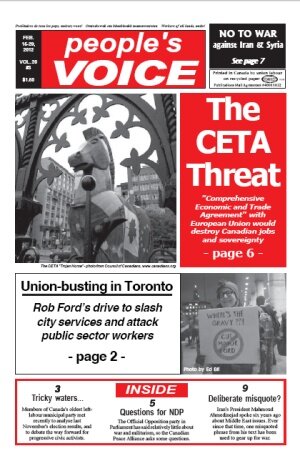
1) TORONTO OUTSIDE WORKERS VOTE ON TENTATIVE DEAL
2) COMMUNISTS DEMAND TAKEOVER OF CATERPILLAR'S ELECTRO-MOTIVE PLANT
3) CETA TALKS: WHAT'S THE BIG HURRY?
4) LESS THAN PROMISED FROM CLBC REVIEW
5) PEACE ALLIANCE RAISES MILITARISM ISSUES WITH NDP
6) THE REAL ISSUE: JOBS OR PROFITS - Editorial
7) FASCIST CANCER STILL SPREADS - Editorial
8) TRICKY CHALLENGES FOR VANCOUVER CIVIC ACTIVISTS
9) MLA SETS EXAMPLE BY WADING INTO LIVES OF THE POOR
10) ACT TO PREVENT WAR AGAINST IRAN AND SYRIA
11) U.S. UNIONS TURN TO POLITICAL PRISONERS AND PEACE
12) THE MISQUOTE PAVING THE ROAD TO ANNIHILATION
13) CELEBRATING THE ARTISTS (AND EVADING THE ISSUES?)
14) FREE-MARKET MEDICINE: A PERSONAL ACCOUNT
15) WHAT’S LEFT
16) CLARTÉ (en français)
17) THE SPARK! (Theoretical and Discussion Bulletin of the Communist Party of Canada)
18) INTRODUCING MARX
PEOPLE'S VOICE FEBRUARY 15-29, 2012 (pdf)
|
People's Voice deadlines: March 1-15 March 16-31 Send submissions to PV Editorial Office,
|
|
REDS ON THE WEB |
|
People's Voice finds many "Global Class Struggle" reports at the "Labour Start" website, http://www.labourstart.org/. We urge our readers to check it out! |
* * * * *
People's Voice
Canadian Publications Mail Sales Product Agreement #205214
ISSN number 1198-8657
People's Voice is published by
New Labour Press Ltd
PV Editorial Office
706 Clark Drive,
VANCOUVER, B.C. V5L 3J1
Phone:604-255-2041
Fax:604-254-9803
email: pvoice@telus.net
Editor: Kimball Cariou : Business Manager: Sam Hammond
Editorial Board: Kimball Cariou, Miguel Figueroa,
Doug Meggison, Naomi Rankin, Liz Rowley, Jim Sacouman
* * * * * *
Letters
People's Voice welcomes your letters
on any subject covered in our pages.
We reserve the right to edit for length and clarity,
and to refuse to print letters which may be libellous
or which contain unnecessary personal attacks.
Send your views to:
"Letters to the Editor",
706 Clark Dr., Vancouver, BC V5L 3J1,
or pvoice@telus.net
People's Voice articles may be reprinted without permission,
provided the source is credited.
* * * * * *
The Communist Party of Canada, formed in 1921,
has a proud history of fighting for jobs, equality, peace,
Canadian independence, and socialism.
The CPC does much more than run candidates in elections.
We think the fight against big business and its parties
is a year-round job,
so our members are active across the country,
to build our party and to help strengthen people's movements
on a wide range of issues.
All our policies and leadership
are set democratically by our members.
To find out more about Canada's party of Socialism,
give us a call at the nearest CPC office.
* * * * * *
Central Committee CPC
290A Danforth Ave Toronto, Ont. M4K 1N6
Ph: (416) 469-2446
fax: (416) 469-4063 E-mailmailto:info@cpc-pcp.ca
Parti Communiste du Quebec (section du
Parti communiste du Canada)
5359 Ave du Parc, Montréal, Québec,
H2V 4G9
B.C.Committee CPC
706 Clark Drive, Vancouver, V5L 3J1
Tel: (604) 254-9836
Fax: (604) 254-9803
Edmonton CPC
Box 68112, 70 Bonnie Doon P.O.
Edmonton, AB, T6C 4N6
Tel: (780) 465-7893
Fax: (780)463-0209
Calgary CPC
Unit #1 - 19 Radcliffe Close SE
Calgary AB, T2A 6B2
Tel: (403) 248-6489
Ottawa CPC
Tel: (613) 232-7108
Manitoba Committee
387 Selkirk Ave., Winnipeg, R2W 2M3
Tel/fax: (204) 586-7824
Ontario Ctee. CPC
290A Danforth Ave., Toronto, M4K 1N6
Tel: (416) 469-2446
Hamilton Ctee. CPC
265 Melvin Ave., Apt. 815
Hamilton, ON.
Tel: (905) 548-9586
Atlantic Region CPC
Box 70 Grand Pré, NS, B0P 1M0
Tel/fax: (902) 542-7981
http://www.communist-party.ca/
* * * * * *
News for People, Not for Profits!
Every issue of People's Voice
gives you the latest
on the fightback from coast to coast.
Whether it's the struggle for jobs or peace, resistance to social cuts,
solidarity with Cuba, or workers' struggles around the world,
we've got the news the corporate media won't print.
And we do more than that
- we report and analyze events
from a revolutionary perspective,
helping to build the movements for justice and equality,
and eventually for a socialist Canada.
Read the paper that fights for working people
- on every page, in every issue!
People's Voice
$30 for 1 year
$50 for 2 years
Low-income special rate: $15 for 1-year
Outside Canada $50 for 1 year
Send to: People's Voice, 706 Clark Drive, Vancouver, BC, V5L 3J1
You can call the editorial office at 604-255-2041
REDS ON THE WEB
http://www.communist-party.ca/
http://www.ycl-ljc.ca/
http://www.solidnet.org/
(The following articles are from the February 14-29, 2012, issue of People's Voice, Canada's leading communist newspaper. Articles can be reprinted free if the source is credited. Subscription rates in Canada: $30/year, or $15 low income rate; for U.S. readers - $45 US per year; other overseas readers - $45 US or $50 CDN per year. Send to People's Voice, c/o PV Business Manager, 706 Clark Drive, Vancouver, BC, V5L 3J1.)
1) TORONTO OUTSIDE WORKERS VOTE ON TENTATIVE DEAL
By Liz Rowley
On Feb. 5, the City of Toronto and Local 416 CUPE announced a tentative agreement that 6,000 outside workers will be asked to ratify. The terms had not been made public at PV press time, but the city's Feb. 2 final offer included a base wage increase of 1.75% in 2015, preceded by three lump sum payments of 1.25% in the first year; 1.50% in the second year, and 1.75% in the third year; job security provisions would only apply to permanent employees with 22 years or more of seniority; the city gets the unilateral right to make shift changes; plus reductions in sick days and in optical and dental benefits.
The union had offered in January to roll over the existing collective agreement, effectively freezing wages for three years. Local 416 President Mark Ferguson said the union did not want to strike, and wanted to negotiate a settlement and continue to deliver uninterrupted city services to residents. On the crucial issue of job security, which Mayor Rob Ford has called "jobs for life", the union offered to give up job security for employees with five years seniority or less.
A mass campaign by Ford and the right‑wing on Council, together with the business and financial sector, has vilified the 30,000 unionized city workers for months with lies and distortions, suggesting that they live the life of Riley, with high wages, perks galore, and the hash‑tagged "jobs for life".
The reality is that about 15,000 city workers are part‑timers, most without any benefits, and many paid not much over the minimum wage.
Deep budget cuts and contracting out of garbage collection in the western half of the city had already factored in hundreds of job losses. Local 416 warned that the City was pushing for a lock‑out and aimed to gut their collective agreement. Ferguson called it union‑busting.
On Feb. 3, the City announced it would impose new terms and conditions of work starting at 12:01 am on Feb. 5, when the old contract was no longer legally in force. The new terms and conditions would be those laid out in the City's final offer. But at 8 am on the 5th, after extending bargaining through the night, the tentative agreement was announced.
Nothing is settled until the 6,000 members of Local 416 debate the details of the tentative deal, and cast their vote for or against. Their decision will set the pattern for bargaining with the three other Toronto Locals, and the overall results will ripple through municipalities across the country.
If they reject, CUPE members will almost certainly be on the picket lines within days, either on strike or locked out, where they could be joined by other Locals within a couple of weeks.
Either way, their decision will impact on the 24,000 city workers still in bargaining, including Local 79 (inside workers), the much smaller Local 4849 (Public Library Workers), and a fourth local representing about 100 workers.
If Local 416 votes to accept, the city will present the deal as the pattern the other Locals want to overturn. If they reject, the ante goes up for a united and coordinated fight by all the city Locals, who could be pounding the pavement together for a while.
Maureen O'Reilly, President of Local 489, said she doesn't want the Toronto Public Library to be turned into Walmart: "I'm facing a 17% staff cut. Fifty percent of my members are part‑time workers, many of them with no benefits, and some of them with low‑paid work. I don't want the TPL to become the Walmart of public libraries."
During the City Budget fight, the Mayor and his brother Councillor Doug Ford vowed to close library branches "in a heartbeat", but were forced to settle for reduced hours and staffing. Mass public opposition and author Margaret Atwood were crucial in defeating the worst of the cuts, which is encouraging for Library workers, who were seeking conciliation as PV went to press.
Local 79 was still in talks, but all Locals reported that the City was refusing to negotiate key issues pending a final settlement with the outside workers.
So far the Mayor is declaring it a "great day ‑ a fantastic day ‑ for taxpayers", by which he means the banks and financial institutions infesting the downtown core, and the big corporations in the suburbs. Deputy Mayor Doug Holyday claims the deal was achieved as a result of the city's hard bargaining positions. But homeowners and tenants are about to lose many more services if the Mayor has any more "great, fantastic days".
There needs to be a united front of labour and its allies around these Locals, tying their rights and living standards to the level of good services in the city. The budget battles brought the public out in droves, once they understood what they were about to lose.
A January poll showed that 84% of those surveyed want the city to maintain or increase spending on services over the next four years. That link has its opposite which must be exposed: contracting out and privatization, which is all about profits and getting less while paying more.
Doug Ford himself said he (and Mayor Rob) wanted to contract out everything that wasn't nailed down in Toronto. This is how they're doing it. Stay tuned.
2) COMMUNISTS DEMAND TAKEOVER OF CATERPILLAR'S ELECTRO-MOTIVE PLANT
TORONTO, Feb. 5, 2012 - The Communist Party of Canada (Ontario) is demanding that the provincial government take over the Electro‑Motive Diesel plant in London, Ontario, owned by the super‑profitable transnational Caterpillar Corporation, immediately seize control of machinery and equipment at the plant, and run the operation as a crown corporation with the existing workforce.
Further, the provincial government should hit Caterpillar with the full force of the law for bargaining in bad faith and skirting labour laws with its threat at the opening of negotiations to close the London plant if unionized workers refused a 55% wage cut, followed by the Feb. 3 announcement that the plant was closing. Allowing this company to pull up stakes and depart without a strong and immediate reaction from governments makes a mockery of free collective bargaining and Canadian sovereignty and independence. The CPC (Ontario) is also demanding the federal government use all of the levers at its command to stop Caterpillar from closing the London plant and moving operations out of Canada, starting with enforcement of every provision in the Investment Canada Act, and recall the $5 million in corporate tax breaks this company received from Harper in 2008. The federal government must act to protect Canadian workers, Canadian jobs and our industrial and manufacturing base, and Canada's sovereignty and independence.
With quarterly earnings up 58% and record breaking profits reaching an astonishing $5 billion, a big chunk of it connected to the acquisition of Electro‑Motive Diesel, there is absolutely no justification for Caterpillar to close this plant, tossing workers and their families overboard. The only reason for closing the London operation is to re‑open in Muncie, Indiana where union-busting right to work legislation has just been passed, ensuring that workers at the Muncie plant will have no union and will be compelled to work for $16.50 an hour, with few if any benefits or pension.
This is all about union‑busting, getting around Canada's labour and investment laws, closing down the competition and harvesting EMC's design and tech secrets, increasing Caterpillars already enormous super‑profits and extending its monopoly control over locomotive production and sales in North America.
We fully support the CAW's decision to occupy Caterpillar's EMC plant in London, in its continuing efforts to protect and defend the interests of EMC workers.
Furthermore, this voracious Caterpillar is doing these things, because it can. What's astonishing is that the provincial and federal governments would stand by and let them do it. Provincial Economic Development Minister Brad Duguid's statement that while his thoughts are with the workers, he understands Caterpillar's obligation to its stockholders is enough to demand his resignation. If he can't tell the difference between the public interest and corporate profits, he should resign now.
Further, the Premier's belated call on the federal government to do something is little more than a sound bite designed to get the Liberals' minority government - under pressure from the Mayor and people of London and the labour and social justice movements ‑ off the hook. They need to do much more than that. The NDP should use its numbers in the Legislature to call for nationalization to stop the Fat Cat and to keep the plant running and the jobs here in Ontario.
The Legislature should also adopt plant closure legislation with teeth to force corporations to appear before public tribunals and show just cause before any closure is permitted. The Tribunals should have the legal teeth to stop a closure, levy fines, and even jail terms where warranted.
Workers' rights to belong to a union (free association) are protected in Canada's Charter of Rights, and must be protected by the province as well as the federal government.
Provincial Tory leader Tim Hudak is blaming the Liberals' tax policies for the loss, but in fact Ontario's corporate taxes are already well below rates in the US.
This is not so much about (low) corporate taxes, as it is about Canadian sovereignty, jobs, and workers' rights to a living wage, to benefits and pensions, to belong to a union, and to free collective bargaining. These have all been lost in the US right to work states, and they're under sharp attack right now in Ontario and across Canada.
3) CETA TALKS: WHAT'S THE BIG HURRY?
PV Vancouver Bureau
Like a freight train racing downhill without brakes, the "Comprehensive Economic and Trade Agreement" negotiations between Canada and the European Union (EU) are picking up speed, yet most Canadians have little idea of CETA's potential impact on our lives. Groups like the Canadian Union of Public Employees and the Council of Canadians are trying to stop CETA before it's too late, but a ninth round of negotiations has been completed. The federal government says that "significant progress has been made across the board, including the areas of goods, services, investment, government procurement and many others. The negotiating text is now well-advanced, with many chapters closed or parked pending further development, and issues in the remaining chapters narrowed down to key differences where solutions are now being actively explored."
Stressing their goal of "resisting protectionist pressures in challenging economic times," the Harper Tories want to wrap up talks quickly, with the aim of concluding CETA this year.
What's the big rush? It's all about money, markets, and profits. With a population of 500 million and a GDP of $17 trillion, the EU member states represent Canada's second largest trading partner. In 2010, EU countries bought $49.2 billion in Canadian exports of goods and services, and imports from the EU to Canada were $55.3 billion. The EU is also the second largest source of foreign direct investment in Canada, totalling $146.9 billion at the end of 2010. Canadian investment in the EU reached $145.2 billion in that year, or 23.5% of Canada's direct investment abroad.
Canada and the EU announced plans in 2009 for a "free trade" type of agreement, even more comprehensive than the Canada-US deals which removed most restraints on the cross-border flow of capital and profits.
While the Harper government claims to "appreciate the input of all Canadians" in this process, only the business sector has actually been consulted. Working people who will pay the price through lower living standards, lost jobs, and increased environmental degradation have been kept completely out of the loop. Here are some examples of the potential impacts.
Failure to protect water services
Recently leaked documents show that Canada and the provinces have failed to protect drinking water and wastewater services from trade rules that would encourage and lock in privatization.
The documents, made public by the Quebec Network on Continental Integration (RQIC) and the Trade Justice Network, show Canada's initial services and investment offers to the EU. They list policy areas or sectors that are to be spared from "liberalization," (deregulation or re‑regulation on market‑based terms favourable to multinational investment). Water services are not on the list, which means they are automatically included in the deal.
"The two biggest private water utilities in the world are European and eager to use CETA to gain access to Canada's still public water systems," says Maude Barlow, national chairperson with the Council of Canadians. "Harper's message to these companies is that Canada is `open for business' when it comes to water privatization. The very notion of water as a public good and a human right is at stake."
"Canadians hold a great deal of trust in publicly owned, operated and delivered water and sanitation systems," says CUPE National President Paul Moist. "Water and other essential services like health care, public transit, postal services and energy are vital to our communities. If European negotiators are prepared to protect those sectors why isn't Canada? We need to debate this deal right now."
CUPE and the Council of Canadians are asking that provincial governments correct their mistake by fully excluding drinking water and wastewater services from trade offers. The organizations also urge the provinces to withhold support for the CETA negotiations until the public and opposition parties have had a chance to study and make revisions to these offers and the broader Canada‑EU agreement. There could be many other areas, for example public transit, health care, education, etc., which should be protected but which the provinces have not carved out of the CETA.
Hidden threats to municipalities
Toronto councillors and community groups hauled a giant Trojan Horse in front of City Hall on Jan. 26 to warn about the hidden dangers of CETA.
"This agreement with the EU has far reaching implications for city policies and could hurt our ability as councillors to promote local jobs or small business, create incentives for investment in Toronto, protect the environment or otherwise use public spending as a way to stimulate growth," said Councillor Glenn de Baeremaeker.
"From what I can see, the CETA would be all risk and little reward for Toronto," said Councillor Kristyn Wong‑Tam. "We're here to ask the executive committee to support the idea of trying to exclude Toronto from any unnecessary limits in the EU deal on how we make policies to benefit our community."
Wong‑Tam and de Baeremaeker spoke in support of a motion recommending that City Council request the Province of Ontario to issue a clear, permanent exemption of Toronto from the CETA, and "protect the powers of municipalities, hospitals, school boards, utilities, universities and other sub‑federal agencies to use public procurement, services and investment as tools to create local jobs and otherwise support local economic development."
As a participant in the CETA negotiations, Ontario has made promises to open certain sectors and to bind certain municipal governments and other provincial agencies to procurement rules that would forbid buy local or "Buy Canadian" requirements or any other preferences for small businesses on some contracts.
The Trojan Horse appeared before the gates of Parliament in Ottawa during the last round of CETA negotiations in October 2011. It has also joined a protest outside the Quebec National Assembly demanding transparency and debate before the deal is signed. In each case, the Horse represents the hidden dangers inside what is being misleadingly called a trade agreement.
Already over 20 municipal governments have requested to be excluded from the EU deal.
Trampling the Investment Canada Act
The federal government has been accused of ignoring Canadian law and approving the takeover of Canadian book publisher McClelland & Stewart by a multinational corporation, to help clear obstacles for CETA.
"It would seem that the government is running roughshod over the Investment Canada Act in order to smooth the way for CETA talks to be concluded," says Maude Barlow. "If the government denies the takeover, the issue will become an impediment to conclusion of the CETA talks, since Bertelsmann AG, owner of Random House and its affiliates, is the world's largest trade book publisher and an influential German company."
Questions remain about the legality of the McClelland & Stewart takeover, approved behind closed doors by Minister of Canadian Heritage and Official Languages James Moore. Reports indicate Moore was approached by Random House to seek an exemption from provisions of the Investment Canada Act which require a review of foreign takeovers of Canadian publishing firms to ensure these are of "net benefit to Canada."
"This development highlights the reason we need a complete cultural exemption from the CETA," says Garry Neil, Executive Director of the Council of Canadians. "The federal government should force Random House to offer the 75 percent stake in McClelland & Stewart previously held by the University of Toronto to the highest Canadian bidder."
Established in 1906, McClelland & Stewart has published books by Maude Barlow, Margaret Atwood, Farley Mowat, Margaret Laurence, Pierre Berton, L.M. Montgomery, Michael Ondaatje, and many other Canadian authors.
4) LESS THAN PROMISED FROM CLBC REVIEW
By Kimball Cariou
Last August, British Columbia's Liberal government secretly initiated an internal review of Community Living BC. Now available (only on request!), the 139-page Queenswood Consulting report is being used by Premier Christy Clark as a prop to announce minor tinkering with CLBC, which provides services to developmentally disabled adults. As often happens, the mainstream media has accepted the Premier's claim that the government is boosting CLBC funding by $40 million, rather than the actual figure of $9 million.
Fortunately, the Queenswood report has been analysed by Dawn Steele of Moms on the Move, a grassroots group which advocates for the disabled and their families. (See http://momsnetwork.ca)
One example is the statement that "a more cost-effective model" of service delivery would be made possible by switching from the Ministry of Children and Families to CLBC, with options like "individualized funding, increased role of families, and an increased use of generic and community services."
As Steele points out, "contrarian" groups warned that the "grand promises and visions" announced by the Liberals were a smokescreen for cuts to funding. This is proven in figures contained in the Queenswood report, particularly the impacts of a review of contracts following the switch to CLBC.
Here is an excerpt: "As of August 2011, 696 reviews of staffed residential and community inclusion program contracts had been completed, with another 888 contract reviews still in process. The total amount of savings identified in completed reviews stood at $24.87M (on contracts with a total value of $145.45M)... (As a result) 64 homes have closed in staffed residential services, with 169 people moving into different residential arrangements. In community inclusion service contracts, 33 locations have closed. Where the existing service continued, 166 contracts had no reduction in funding, while 301 had funding reduced. Along with the 888 reviews still underway (estimated savings: $16.05 M on total contract values of $234.63M)... There is not yet an estimate of potential savings with respect to the 1,303 reviews still pending."
In plain language, the province has slashed spending on the most disadvantaged adults in B.C. by at least $40 million, with over 1300 reviews still pending. These savings have been achieved by cutting supports for many individuals, and by closing 64 staffed residential group homes.
Some pundits have quoted the Queenswood finding that waiting lists for services for the developmentally disabled are shorter than stated by advocates and community groups. But the actual demand is far higher than the report shows. Many families involved with CLBC have been told by staff that there is simply no point in trying to place relatives on lengthy waiting lists.
The following quote illustrates this point: "Beginning in the summer of 2009, CLBC... increased efforts to manage and address unrealistic client and stakeholder expectations." In other words, don't bother asking for help which will never arrive.
The government does aim to provide corporations with cheap labour. As the Queenswood report says, "...CLBC estimates (very roughly) that about 50% of its current clientele is employable, but have grown up in a system that assumes they will not work, and fails them by not teaching relevant skills and abilities.... CLBC is now exploring ways of promoting employment readiness and employment support services."
Many developmentally disabled adults (those with IQs below 70, autism/Downs, serious health issues, and no verbal ability) would love to have proper training and a decent job. The reality is that 112,000 unemployed British Columbians are currently chasing just 26,400 vacant jobs, according to Statistics Canada (which also notes that the vacancies are largely in mining, quarrying, and oil and gas extraction).
The internal report echoes the government's view that "in the context of increasing demands and scarce resources, governments must address daunting financial restraints in a different manner."
The message is clear: "Don't expect us to raise taxes on the rich and the corporations to improve social programs. Stop whining, get over to Burger King and work for minimum wage, or else just stay home and watch TV."
So much for life in "The Best Place On Earth" - as the B.C. Liberals call British Columbia.
5) PEACE ALLIANCE RAISES MILITARISM ISSUES WITH NDP
With the federal NDP leadership vote coming up on March 24, the eight candidates have largely avoided the issues of war and militarism, where their party has a mixed record. Fortunately, the Canadian Peace Alliance has sent several important questions to the candidates. This welcome initiative may help raise these crucial issues at a time when the NDP is the Official Opposition in Parliament, and hopes to win the next federal election expected in 2015. People's Voice will report on the responses from the leadership candidates.
1) Military Spending - The CANADA FIRST DEFENCE STRATEGY earmarks $480 billion for military spending by 2025. This is the largest increase in military spending since WWII and makes Canada the 13th largest military spender in the world. Simultaneously, the government of Canada is calling for austerity and plans an $11 billion cut to public services in their next federal budget. The Canadian Peace Alliance has launched a campaign called Peace and Prosperity ‑ NOT ‑ War and Austerity to redirect that spending.
Question: What would you do to counter this imbalance and call for a redirection of money, allocated for the military to public services, health, veteran rehabilitation, education and environmental programs?
2) Afghanistan - The Government of Canada has extended Canada's troop presence in Afghanistan until 2013. This is the third time they have extended Canada's participation in the war. In poll after poll, the majority of Canadians have shown that they want all of our troops removed from Afghanistan now.
Question: What would you do to as leader of the opposition to raise this issue and to call for the immediate removal of all Canadian troops including troop trainers from Afghanistan?
3) Sanctions and war on Iran - There are signs that the US, Israel and other NATO countries not only are planning a fifth round of severe sanctions but also a possible nuclear military attack on Iran's nuclear facilities. Any use of military force against nuclear installations in Iran will be dangerous and illegal under international law. As was the case with Iraq, sanctions and war created a humanitarian crisis with more than 1.5 million dead and a country in ruins.
Question: Would you oppose further sanctions and a military attack on Iran?
4) Civil Liberties - The Conservative government has a record of attacking those who dissent ‑ in particular, criminalizing Muslims as so‑called "Islamists" and criminalizing Aboriginal people who try to assert control over their traditional territories. Now the government has said it will reintroduce anti‑terror legislation which had expired in 2007 including clauses in bills C‑36 and C‑42 which suspend the rule of law and allow for people to arrested and detained without charge.
Question: What would you do to stop the Conservative plan to set back civil liberties in Canada and work to rescind those elements of bills C‑36 and C‑42 that have been extended?
5) NATO ‑ The NDP is on record calling for Canada to withdraw from NATO. Canada's NATO membership has resulted in our armed forces being embroiled in conflicts, such as the war in Libya, during which NATO far exceeded its regional and military mandate. The Libya mission, under NATO, morphed from a call for a limited mission into an aggressive war for regime change.
Question: Do you think Canada should continue to be part of NATO? If yes, why? If no, why?
6) THE REAL ISSUE: JOBS OR PROFITS
People's Voice Editorial
With the next federal budget looming, the question must be asked: will the Harper Tories put jobs or profits first?
The so-called "recovery" from the crisis of 2007-08 is sputtering to a halt across the capitalist world, including in Canada. Yes, stock prices and corporate revenues have rebounded, but the ominous signs of slowdown are mounting, including an alarming loss of full-time employment.
Officially, unemployment in Canada ticked up to 7.6% in January, significantly higher than the 6% levels in mid-2008. This figure only includes the 1.4 million who are "actively looking" for work. Add in those waiting for a recall from a previous employer, who have given up looking for non-existent jobs, or who are stuck working part‑time, and the real unemployment level would soar to 10.6%, or some two million people.
Back in 2008, only 12% of unemployed workers spent six or more months looking for a job. By 2011, 21% cent were in this category. The average length of an unemployment spell has jumped from 14.8 weeks to 21.1 weeks. Why? According to Statistics Canada, the ratio of unemployed people to job vacancies stood at 3.3 to 1 last fall. If every job opening was filled tomorrow, over 1.5 million Canadians would still be looking for work.
Several policy options could address this crisis. One is an emergency plan to build low-income housing across the country. Another would be to shorten the work week with no loss in take-home pay. A third idea would be to roll back post-secondary tuition rates and increase education and training for jobless Canadians. Number four: start processing raw materials here in Canada, instead of exporting jobs.
But the Harper Tories, as hardline ideologues of unregulated capitalism, will use their budget to help the bosses inflate profits at the expense of working people. As the saying goes, "Tory times are hard times." It will take a big dose of "people power" to save the country from their disastrous agenda.
7) FASCIST CANCER STILL SPREADS
People's Voice Editorial
For years, police forces and governments in Canada have chosen to ignore violent racist hate groups across the country, or even to make sickening comparisons between these fascists and the anti-racists who courageously expose their activities. But recent events make it more difficult to cover up for thugs like the "Blood and Honour" gang.
Three "alleged" ("self-proclaimed" would be more accurate) white supremacist hate group members are on trial in British Columbia, charged with the burning of a Filipino man and assaults on Black, Hispanic and Native people. These violent crimes coincided with the increased visibility of "white power" fascists on the streets of Vancouver and nearby cities.
At the same time, the names and addresses of 74 white supremacists in Canada (and many more in other countries) were recently leaked by anti-racist computer hackers in Europe. The hackers revealed emails, secret websites and blogs, photos of children giving Nazi salutes, confidential legal documents and displays of Hitler tattoos.
This will not surprise our readers, who are well aware of crimes by Blood and Honour supporters such as the series of bloody attacks against Calgary anti-racists Jason and Bonnie Devine.
If hackers in Europe and activists across Canada can identify the dangerous fascists in our midst, why are the police so slow to act? Will the trials in Vancouver mark the end of efforts to bring these criminals to justice? Or will the authorities be compelled to make a serious effort to eradicate this cancerous tumour within Canadian society? The answer may depend largely on our ability to mobilize against the white supremacist threat.
8) TRICKY CHALLENGES FOR VANCOUVER CIVIC ACTIVISTS
PV Vancouver Bureau
The call by the Coalition of Progressive Electors for municipal election reforms is a good example of the role that Canada's oldest left civic party can play, even without a sitting member on city council.
Elections in Vancouver have become the most expensive in Canada, topping $5 million last fall, or more than seven dollars per resident. In the last three campaigns, the right-wing NPA and the centrist Vision Vancouver have spent millions, making it increasingly difficult for COPE and smaller parties and independents to mount a serious challenge.
Unfortunately, the "Vancouver Charter" gives the province legal authority over Vancouver municipal election regulations, allowing previous governments to ignore referendum votes in favour of a ward system.
While COPE supports the general thrust of a motion by Vision to ask the government to amend the Charter, it also proposes giving teeth to the request, by making it much more detailed. This could prevent attempts by larger parties to find loopholes in new regulations. Another option, COPE argues, could be an informal agreement among civic parties.
There are other key issues during Vision's second term at City Hall, such as taxation. After three years of following the direction of the 2005-08 NPA administration, which began shifting an increased share of the tax load from businesses to homeowners, Vision has changed gears. For the 2012 budget, Mayor Robertson's party plans to reduce the scale of this shift, which was highly unpopular with homeowners.
Relations with the city's workforce, represented by CUPE and other unions, will also be on the agenda. The labour movement remains an important backer of both Vision and COPE. Robertson and his fellow councillors (unlike Rob Ford's regime in Toronto) hope to avoid any confrontation when collective agreements come up for renewal.
Significant debates will revolve around the crucial issues of development and housing. Vancouver's director of planning Brent Toderian was removed on Jan. 31, sparking intense speculation. Some wonder if Toderian was seen as too abrasive by certain developers - some of whom also support Vision. The Mayor, however, says a change was necessary to focus on the city's housing crisis.
While some of the steps taken by Vision have reduced the numbers of homeless people on the streets, there are still thousands of residents surviving in shelters or tiny, dirty rentals. A project to redevelop the Little Mountain lands - the site of Vancouver's first social housing after World War Two - has done little to reassure housing advocates. The latest plan calls for 234 social housing units among 1800 condos, finally replacing the homes bulldozed several years ago. But this would not mean any net gain in affordable housing for the poor.
These issues were on the minds of about 100 COPE members at the party's Jan. 22 consultation, which reviewed the 2011 campaign and discussed the way forward. Those present were unanimous about making electoral reform an urgent issue.
There was also agreement that COPE must focus on building grassroots alliances, working with community groups to advance progressive policies at City Hall and School Board. Most thought it was too early to adopt an electoral tactic for 2014.
But there were differences over COPE's approach to other civic parties. Some argued that the Toronto experience shows that the main danger to working people at the municipal level is the emergence of mayors and councillors linked to the Harper Tories. These far-right forces are behind the drive to slash local services and to impose lower wages and benefits on civic employees. In Vancouver, this means the NPA, which was defeated last November by the Vision/COPE slate - although Vision reaped the benefits.
Others argued that Vision is the real enemy of working people in Vancouver. One panellist bluntly called Vision "part of the one percent", while COPE represents the "99%". This was a direct condemnation of the labour movement and forces on the left, such as the Communist Party, which have supported electoral unity of left and centre forces to block the NPA.
COPE's annual meeting on Feb. 19 (2 pm at the Ukrainian Church, 354 W. 10th) will elect a new executive. With only one elected official (school trustee Alan Wong), COPE will mainly be an oppositional force during this term. But an all-out war against Vision could alienate COPE from thousands of voters who see the Mayor's majority as a positive alternative to the NPA threat. The new COPE executive will have to steer a careful course through these tricky waters.
9) MLA SETS EXAMPLE BY WADING INTO LIVES OF THE POOR
By Gurpreet Singh
As the occupy movement against one percent super rich and in solidarity with 99 percent of the working class and downtrodden continues across North America, a New Democrat MLA from British Columbia, Jagrup Brar, has set an example by wading into the lives of homeless and poor.
Brar accepted a challenge from an anti-poverty advocacy group called Raise the Rates and lived on $610 during January. That's the amount a person surviving on B.C. welfare gets. Raise the Rates had thrown a challenge before the BC MLAs to survive on this meager amount for a month.
Brar was the second MLA to accept the challenge after Emery Barnes, who survived on the welfare money 25 years ago. Incidentally, both men were from visible minority groups. Whereas Barnes was black, Brar is an Indo-Canadian.
As part of the challenge, Brar resided among the homeless and needy both in Surrey and in Vancouver. At his Surrey room where he stayed during the first half of January, visitors were greeted by the picture of Barnes, who became a role model for Brar during the experiment. While doing so Brar gained first hand experience of what it means to be poor in a province that government ads claim to be the best place on earth.
In his hometown of Surrey, Brar had to survive on Food Bank and met with a number of people without jobs, homeless, single mothers and refugees. A big map dotted with population relying on Surrey Food Bank also welcomed visitors at his small room. The only washroom in the building was shared by other occupants. The room rent was about $400. Another room offered to him for $300 was as big as a closet but wasn't available immediately.
The life in Vancouver's Downtown Eastside was worst where Brar lived among 55 single room occupants. The building has five floors with 11 single rooms on every floor for each individual. They all shared one washroom, and each individual was required to take care of personal hygiene. The room rent was $410 a month and Brar lived on free food served by a Church next door. "Nobody can survive on such a small amount when the lion's share of the welfare money is spent on renting a room", he said in an interview with this reporter at his stinky and suffocating room which had a broken fridge.
The line up at the free lunch and dinner at Church and a long wait for one's turn to get a shower takes a lot of time from the schedule of a poor person who is on a job hunt. Brar came to understand closely how the myths about these people have demonized the poor in the mainstream media. He wrote his daily experiences in a diary and took notes of the testimonies of the people he met.
Within his own Indo-Canadian community such myths continue to prevail and Brar was also attacked by many callers during open line radio talk shows. "Many Indo Canadians think that this is the problem of the mainstream whereas I also came across many Punjabis on welfare. The Indo-Canadians don't know this because those on welfare in our community are scared to tell the truth and do not share their stories with others fearing humiliation and ridicule."
At the end of this journey Brar broke financially. What gave him strength was a greeting card from his daughter Noor hanging from one of the walls. Though he was aware that it was not real for him, as he would eventually return to his normal and comfortable lifestyle, yet he faced occasional hardships. He refused to accept a samosa from a kind-hearted landlord at his temporary home in Surrey. He barged into Brar's room when a media interview was in progress. "I am supposed to kill my urge and not to accept such luxuries. Others might accept them but I can't and that makes this experience real for me."
The occupy movement was partially sparked by the vacuum caused by lack of leadership. Only more humanist politicians like Brar can reassure people who are disappointed and disillusioned with the system. While some critics accuse Brar of trying to take political mileage out of this experience, they are missing a point that politicians cannot survive by ignoring the strength and expectations of the voters. What is important to remember is whom the politicians are trying to please? The elite and the corporate or the poor and needy? If a good deed is performed to attract votes, it is better than trying to attract votes by performing a bad deed.
10) ACT TO PREVENT WAR AGAINST IRAN AND SYRIA
By Darrell Rankin
The Middle East is the epicenter of the militarization of relations between China and Russia on one side and NATO's imperialist, or advanced capitalist countries, on the other. Imperialist countries which twice plunged the world into war in the last century are getting ready for round three. The arms race is growing around the globe and the battle lines are getting clearer.
Even without considering the potential for a new global war, fear and tension are flowing from the threat of smaller wars of regime change and occupation in Iran and Syria. Positions are hardening on both sides of the intervention issue. So far, China and Russia will veto any UN Security Council resolution that may trigger military action, but that may not be enough.
It may be only a matter of weeks or months before imperialism targets Syria or Iran, adding to its list of imposed regime changes which are not approved by the UN. For the Security Council to even talk about military action against sovereign countries signals that imperialism (NATO and Japan) dominates world politics. And if imperialism acts outside the UN, as in Yugoslavia, Afghanistan, Iraq, Haiti and Libya, it is another nail in the coffin to the actual words of the UN Charter.
Imperialism: source of the war danger
Protecting civilians is a monstrous argument for starving, bombing and invading a country. So what is really behind imperialism's rising bloodlust?
Arrogance cannot fully explain imperialism's growing dependence on its enormous military potential. The answer to the problem is that capitalism is in deep trouble and the most reactionary forces in all imperialist countries are preparing to use war as a way to wipe out all resistance at home and abroad.
If we are to believe our corporate media, the U.S. military will enjoy early and sudden success in a future limited war. After all, the U.S. succeeded in Iraq and very quickly in Libya, the troop surge is helping in Afghanistan, and no one else has the same high quality of weapons, trained troops and leadership. Vietnam was then; this is now.
The main brake to prevent these wars is still public opinion in the imperialist world, filtered through considerations like Obama's chances for re‑election. The governments that are most pro-war such as Canada, Israel, France and Britain are acting like they are immune to public opinion, making the task of strengthening the peace movement harder and more urgent.
War spells danger and ruin to workers of all lands
We need to realize that war is placing all civil rights and democracy on the chopping block. Under a dictatorship, it is easier to impose the full burden of capitalism's great problems on the working class, farmers and small capitalists. In the global capitalist system, war protects and hikes corporate profits. Imperialist war crushes popular and revolutionary movements whose aim is to solve unemployment, famine and climate change.
Every new war creates more difficulties to begin shifting the balance of forces against imperialism. Wars are extremely unpredictable; adding to the list of current wars is a straight path to a new world order of corporate fascism.
Despite the foolish belief in quick and predictable success, hundreds of thousands and possibly millions of Iranian and Syrian lives would be lost in a serious war, especially if the countries are occupied. We should recall Hitler's expectation that Britain would surrender after a drastic bombing campaign. It was unrealistic and the Nazis had to conclude Britain would surrender only if it was fully occupied.
Western imperialist countries should draw the obvious conclusion that a war of regime change will not be easy and will involve lengthy occupations. But their whole scenario is based on flawed strategic concepts ‑ fast wars and victory through air power and powerful new weapons. The West will have to pay a large military, economic and political price, even if they are restricted to a serious bombing campaign. The stakes for people in Iran and Syria are incredibly higher.
In Canada, the labour movement and all people must act now to prevent imperialist aggression, at home and abroad.
To avoid war, we need the strengthened coordination and unity of non‑aligned and developing countries, larger sections of the international working class movement, the resistance in imperialist countries, and communist and working class parties, including the left social democratic variety who should reject the further appeasement of imperialism's drive to war. The global anti‑war, anti‑imperialist movement must be strengthened.
Every new war makes creating international unity more difficult.
More wars, more uncertainty
Each new war of occupation by imperialism carries the seeds of a more general war, a violent continuation of its efforts to dominate and exploit all sovereign countries which do not bend to its will. In addition to the expansionist aims of all imperialist countries, there is also the counter‑revolutionary purpose of imperialist war and aggression. Each has its own dangers.
Imperialism's increased aggression to divide the world builds rivalries that may erupt into another inter‑imperialist war. More immediately, the spread of war in the Middle East is the greatest enemy of the Arab Spring revolutions and the genuine aspirations of the broadest masses of people.
Imperialism's flawed strategic concepts for war against Syria or Iran add to the unpredictability of the outcome. Several recent wars are spreading to new countries; for example, the Afghanistan war is spreading to Pakistan. Pro‑NATO Libyan armed groups say they will move to Syria.
Most western imperialist countries see attacking Syria as a stepping stone for war against Iran, but Israel wants Iran to be the first target. Either way, Israel's position towards Syria is clear. An official state of war has always existed between the two countries. Equipped with a strict reading of the United Nations Charter, Syria has always viewed Israel as an illegal, imposed state.
In the Arab League, recent votes on both Syria and Libya show that Saudi Arabia and the small emirates dominate the leadership, with the support of Egypt's military regime and other anti‑popular governments.
Last year's Arab League vote to suspend Syria as a member was a clear invitation for imperialism to target the country. The vote fell short of formal support for war because such a move is opposed by the broad working masses. So why are most Arab League members ignoring the war danger and aligning themselves with the most pro‑war countries in the region, including Turkey, which is a base for anti‑Syrian forces, and Israel?
The national bourgeoisie in the Arab League are more afraid of the growing popular unrest than of a war instigated by imperialism against Syria and Iran. They do not fully realize the threat that spreading imperialist occupations brings to the sovereignty of all Arab League countries.
At the expense of their own sovereignty, the Arab national capitalist classes are united in the expectation that a limited war against Syria would help them crush the Arab Spring and remove the threat of fundamental democratic and social change. Until the anti‑imperialist forces in the region gain strength and effectively support each other, the sovereignty of Iran, Syria and all Arab League countries is in danger or, in the case of the Palestinian people, is completely submerged.
The lack of popular support in Arab countries for using war to promote democracy and progress also explains why imperialism is resorting to sudden, blitzkrieg‑style operations. For example, Libya was a sudden war associated with a barrage of propaganda that helped stop opposition from developing. However, the expectation of sudden victory can easily be dashed when met by firm resistance.
Build the anti‑war movement
With the most powerful imperialist countries close to launching new wars in the Middle East, the anti‑war forces need to be strengthened quickly. The corporate media and governments are carrying out a frenzied drive to justify the need for regime change, dismissing the ability or actual wishes of the Syrian and Iranian peoples to manage their own affairs.
Yet there are weaknesses and potential divisions in imperialist circles, which may help the anti‑war movement. NATO may not achieve consensus on a decision to attack Iran or Syria, preventing its official participation. So only a handful of NATO countries and Israel are likely to participate. About Syria, Israel could stay out of a fight if the outcome could jeopardize its continued occupation of the country's Golan Heights.
The parties of the Socialist International, such as the NDP in Canada, are making a monumental mistake by lining up to support aggression against Syria and Iran. Opposition to war in all NATO countries will grow one way or the other and become much sharper than over Libya. In the end, the rise of anti‑war forces will deal a heavy blow to the Socialist International by exposing social democracy's bankrupt collaboration with imperialism.
The anti‑war movement must be strengthened throughout the imperialist camp, especially in Canada and the U.S. Although no serious divisions exist now in the U.S. Congress or in our parliament, these must be encouraged, including in the ranks of the NDP, a situation which will help mobilize protests and opposition outside parliament.
Protests must become large enough to block Canada's entry into a new imperialist war. The NDP and the labour movement have said virtually nothing about the looming war danger. Monte Solberg, a former Reform/Conservative MP, studied the NDP's position and wrote last fall that "the little Iran problem didn't merit a single mention" in the party's statements, speeches and media releases (Toronto Sun, November 13, 2011).
Yet the NDP's actual position supports the Harper government's war effort against Syria and Iran. Asked to comment on the Conservative government's decision to send a warship to the Mediterranean for possible use against Syria, the NDP foreign affairs critic said "I don't have a strong opinion about that" and urged "tougher pressure" on the Syrian government (Toronto Sun, November 21, 2011).
By focusing only on the Syrian government, the NDP has an unbalanced approach to resolve the country's civil conflict, has no real objection to sending military forces into the region that could invade or attack Syria, and lists sanctions as the only diplomatic remedy. The way is left open for the NDP to conclude at a later date that sanctions are not working, so it's time for foreign intervention. The NDP policy on Syria indicates how it will behave towards Iran.
Peace groups have made some good statements and some are starting to mobilize and build alliances against a new war. More attention needs to be paid to parliament, where there has been no serious debate yet on Syria or Iran (if it will happen at all before a war), but it is important to prepare and lobby as if a debate might happen soon. It is important to pressure all opposition parties to reject a war and at least force a debate.
Despite the war mongering, broadly‑supported efforts against war can and must grow, at the local and cross‑Canada levels (days of action, meetings, open letters, etc.). Waiting for a war to start is the wrong approach. All peace groups should be working on this. There needs to be more effort to pin down the positions of NDP leadership candidates on the issue of intervention against Syria and Iran. There should be immediate work to strengthen opposition to war in the labour movement and in all popular activities to raise the need to oppose war, well beyond International Women's Day and May Day.
War can be prevented.
(Darrell Rankin is the Manitoba leader of the Communist Party of Canada, and a longtime anti-war activist.)
11) U.S. UNIONS TURN TO POLITICAL PRISONERS AND PEACE
By W.T. Whitney Jr.
Increasingly, politically‑motivated incarceration threatens Colombian unionists, human rights workers, and political activists. They are already too familiar with killings and disappearances at the hands of armed enforcers. International solidarity with victims has grown over recent decades, with the labour movement taking on a prominent role in defending human rights in Colombia. British trade unions have been instrumental in bringing the fact of 7500 Colombian political prisoners to the world's attention.
Some time ago, the U.S. and Canadian United Steelworkers union (USW) combined with the British union known as Unite the Union (itself the merger between British Amicus and Transportation & General Workers Unions) to establish the world's largest union, with 3.4 million workers, known as Workers Uniting. The planning agreement for that merger, signed in Ottawa in 2007, outlined five overall objectives. One identified, "Projects [that] might include, but are not limited to, support of Columbia's trade union movement in the face of continued attacks on labor and human rights." (Other projects would involve "partner unions in Africa," ship breakers in India, and outreach in China.)
British unions created the Justice for Colombia group, notable for pushing Colombian authorities to honour prisoners' rights, and the USW has joined the Justice for Colombia group as well. One of the priorities for Justice for Colombia and Workers Uniting is the freeing of political prisoner David Ravelo, and they have called on the Colombian government ‑ as well as its chief military patron, the U.S. ‑ to "take all measures necessary to protect his life and the life of his family."
As USW Senior Counsel Daniel Kovalik explains, "Mr. Ravelo, a human rights activist with CREDHOS (a partner of Christian Aid) in Barrancabermeja as well as a former leader of the Patriotic Union - a political party which has suffered literally thousands of assassinations over the years - has been held in jail, without charge, for 14 months now." Kovalik explains that "before being sent to prison, Mr. Ravelo received numerous threats against his life."
Ravelo once publicized a video showing ex‑President Alvaro Uribe hobnobbing with paramilitaries. He had directed the local branch of the Movement of Victims of State Crimes, helped build the left‑leaning Alternative Democratic Pole electoral coalition, and once served as Barrancabermeja city councillor. He belonged to the Communist Party's Central Committee. The Catholic Church honoured Ravelo for 35 years of dedication to human rights. Interviewed in April 2011, he explained, "They are getting even for my longstanding, relentless work in defense of victims and for my unbreakable position against injustice."
The pretext for Ravelo's detention was conspiracy alleged in the murder 21 years ago of mayoral candidate David Nunez Cala. That accusation came from imprisoned paramilitary chieftain Mario Jaimes Mejia, who reportedly is seeking a reduced sentence.
USW solidarity with Colombian political prisoners, via Workers Uniting, is no surprise. The USW had long opposed the recently approved U.S.‑Colombia free trade pact, condemned Drummond Corporation's impunity in the deaths of coal mine workers, and sued Coca Cola for complicity in the murders of unionists employed by Colombian affiliates.
USW Senior Counsel Dan Kovalik has travelled to Barrancabermeja and met with CREDHOS on several occasions. Questioned via email in connection with this article, he replied:
"We are working in close conjunction with Justice for Colombia in Great Britain on the political prisoners campaign. While there may be 7500 political prisoners and prisoners of conscience in Colombia, Mr. Ravelo's case is particularly compelling as he is a leading human rights advocate being held without charge. We believe that his release would be a crucial part in the effort to begin releasing the thousands of political prisoners in that country."
Kovalik added: "The U.S. labour movement has been unanimous in its opposition to U.S. military assistance to Colombia since 2000 in light of its abysmal labour and human rights practices which, among other things, has claimed the lives of over 2900 unionists - a figure unprecedented in the world. I believe that an important step now is for U.S. unions to join the voices of labour, human rights and other social groups in Colombia who are calling for a peaceful, negotiated settlement to the armed conflict in that country. That is probably the greatest contribution we can make to Colombia at this time, and the release of political prisoners is a key step in this direction."
12) THE MISQUOTE PAVING THE ROAD TO ANNIHILATION
Special to PV
The preparations for military aggression against Iran echo the build-up to the devastating and illegal war against Iraq. The parallels include wild accusations of "weapons of mass destruction," claims that the target country is planning to attack its neighbours, and a massive propaganda campaign to demonize the leaders and people of each country.
The latter tactic proved effective on two occasions in Iraq, before the first Gulf War of 1991, and again during 2002-2003. While anti-war actions were broad and powerful in both cases, the pro-war camp argued that Saddam Hussein was a modern day Adolph Hitler who "must be stopped." This lie distracted many from seeing the real threat posed by the most reactionary sections of the U.S. ruling class, who were preparing (like Nazi Germany) to commit the ultimate war crime of unprovoked military aggression.
One of the most frightening aspects of the current situation is the similar accusations hurled at the leaders of Iran. Most recently, Canada's foreign minister John Baird compared statements by Ayatollah Ali Khameini to Hitler's infamous book Mein Kampf.
This just the latest in a years-long string of unsupported accusations that the Iranian leadership says that "Israel must be wiped off the map." Despite ample proof that these words were never uttered, they are presented daily in the North American mass media as "proof" of the need for preventive war against Iran.
This dangerous rumour was demolished convincingly by Arash Norouzi, in a Global Research commentary first published on Jan. 20, 2007, but it bears repeating today.
On Oct. 25, 2005 at the Ministry of Interior conference hall in Tehran, newly elected Iranian President Mahmoud Ahmadinejad delivered a speech titled "The World Without Zionism". Large posters surrounding him displayed this title in English. Below the title was a graphic depicting an hour glass containing planet Earth at its top. Two small round orbs representing the United States and Israel are shown falling through the narrow neck of the hour glass.
As Norouzi points out, the "quote" in question was itself a quote from the late Ayatollah Khomeini, the leader of the Islamic Revolution of 1979. Ahmadinejad's quote is not only unoriginal, but represents a viewpoint in place before he ever took office.
Ahmadinejad's actual words in Farsi were: "Imam ghoft een rezhim‑e ishghalgar‑e qods bayad az safheh‑ye ruzgar mahv shavad."
One word in this sentence may sound familiar to English-speakers: rezhim‑e is the word "regime", pronounced like the English word with an extra "eh" sound. Ahmadinejad did not refer to Israel the country, but the Israeli regime, using the phrase "rezhim‑e ishghalgar‑e qods" (regime occupying Jerusalem).
Nor was the word "map" used on this occasion. The Persian word for map, "nagsheh", is not contained anywhere in his original Farsi quote, or in his entire speech. Nor was the western phrase "wipe out" ever said. Yet we are led to believe that he threatened to "wipe Israel off the map", despite never having uttered the words "map", "wipe out" or even "Israel".
Translated directly to English, the full quote reads: "The Imam said this regime occupying Jerusalem must vanish from the page of time".
Here is a word by word translation: Imam (Khomeini) ghoft (said) een (this) rezhim‑e (regime) ishghalgar‑e (occupying) qods (Jerusalem) bayad (must) az safheh‑ye ruzgar (from page of time) mahv shavad (vanish from).
In his speech, Ahmadinejad declared that Zionism is the West's apparatus of political oppression against Muslims. He said the "Zionist regime" was imposed on the Islamic world as a strategic bridgehead to ensure domination of the region and its assets. Palestine, he insisted, is the frontline of the Islamic world's struggle with American hegemony, and its fate will have repercussions for the entire Middle East.
As Norouzi elaborates, Ahmadinejad has often avoided giving a direct answer when questioned about the controversial statement, preferring to focus on the Palestinian struggle for self-determination.
However, this "misquote" has been deliberately repeated ad infinitum to justify military aggression. War by the U.S. and Israel (and likely Canada) against a well-armed Iran would be far more catastrophic than the attack against Iraq, which left an estimated one million dead and a country in ruins.
Canadians must tell our own government - and the opposition parties, which refuse to take a consistent anti-war position - that we are not willing to support yet another criminal war in the Middle East, especially one based on outright lies.
13) CELEBRATING THE ARTISTS (AND EVADING THE ISSUES?)
By Wally Brooker
Musical genres such as folk, blues, jazz, classical and world music, are in part valued because they offer an alternative to the glut of musical distractions disseminated by the mainstream (i.e. monopoly capitalist) entertainment industry. Professional musicians and the enterprises that support them (recording companies, performance venues, festivals etc.), are driven to carve out niches in the competitive world of the cultural industries.
One tactic is the genre‑oriented award show, which provides recognition to artists and other players in a given segment of the music business. Whereas the mainstream Canadian music industry has been represented for decades by the glitzy JUNOs, niche music awards are a relatively new phenomenon.
Take the Canadian Folk Music Awards, for example. The CFMA acknowledges that folk music takes on many forms and that contemporary artists are expanding the genre. It rightly aspires to recognize achievement in all the styles found within the multicultural world of Canadian folk and roots music.
A glance at its sponsors provides an outline of the "industry." Prominent among the patrons are the copyright collective SOCAN (the Society of Composers, Authors and Music Publishers of Canada), two government‑funded arts agencies (the Canada Council and FACTOR), and the inevitable bank (TD in this case). However, the initiative and driving force comes from long-established non‑profit folk festivals (Mariposa, Ottawa, Edmonton, Calgary), as well as the Ontario Council of Folk Festivals, several folk clubs and music stores, a music magazine, an indy record company and a summer folk music and dance camp.
The CFMA's seventh annual awards gala, held at Toronto's Isabel Bader Theatre on Dec. 4, was hosted by CBC radio personality Shelagh Rogers and Quebecois musician Benoit Bourque. The bilingual format was refreshing. Rogers and Bourque spoke their lines without translation and occasionally slipped into good‑natured "franglais". Welcome too was their acknowledgement that the awards were being held on the traditional land of the Mississauga First Nation of Port Credit.
Awards were presented in 20 categories, the spaces between filled with a talented lineup of performers. The full‑house (about 400 people) was impressive when compared to Canada's National Jazz Awards, cancelled after 2009 largely due to poor attendance. Musicians gathered around the "folk and roots" banner appear to have more cohesion, perhaps because they reflect stronger elements of Canadian nationalism (with a multicultural twist) than in the jazz community.
The selection of gala performers showed that organizers were attentive to regional and cultural diversity as well as artistic accomplishment. Veteran Vancouver blues singer Jim Byrnes and guitarist‑producer Steve Dawson led things off with some down and dirty blues. Maritimes singer‑songwriter Rose Cousins, like Byrnes a previous CFMA winner, held the audience spellbound with her mix of sad songs nicely offset by an engaging comic banter. Toronto's African gospel acapella group Soul Influence impressed with its sophisticated arrangements and tight harmonies. Neo‑traditional Quebecois ensemble De Temps Antan generated strong audience response with a game performance that transcended audio difficulties. Ever‑popular Celtic singer Loreena McKennitt, accompanying herself on piano and harp, and joined by guitarist Brad Hughes and violinist Hugh Marsh, was entrusted with the finale.
The big winners, with two CFMAs each, were Nova Scotian Dave Gunning (Traditional Singer and New/Emerging Artist), whose songs frequently evoke working‑class experience; Quebecois ensemble Genticorum (Ensemble of the Year and Traditional Album for Nagez Rameurs); and Bruce Cockburn (Contemporary Soloist and Contemporary Album for Small Source of Comfort).
Indo‑Canadian singer Kiran Ahluwalia (World Solo Artist for her album Am Zameen: Common Ground), paid tribute to the folk festival in her acceptance speech: "I learned to play music in India," she told the crowd, "but I learned to collaborate musically at the festivals in Canada, and to not be afraid of different styles and genres, to know that I had something to offer."
Amid all the hoopla, this observer was struck by the absence of a defining characteristic of the music. Outspoken concern for social justice and opposition to militarism, as folk music historian Gary Cristall pointed out in his 2008 CBC Radio series "The People's Music", was an important feature of the Fifties and Sixties. Groups like The Travellers and The Milestones arose out of left‑wing organizations and unions. Singers like Bonnie Dobson ("Morning Dew") and Buffie Sainte‑Marie ("Universal Soldier") were passionately anti‑militarist. Does the "people's music" still exist in today's folk and roots music community?
In an age of economic and environmental crisis, attacks on the working‑class and unpopular imperial wars, but with growing protest including the "occupy" movement, how is it that the awards ceremony of the "people's music" fails to reflect the temper of our times? The Canadian folk music scene appears to be self‑involved, perhaps a little complacent, even calculating, as if in fear of provoking a right‑wing federal government and jeopardizing the flow of its share of arts funding.
One award winner's album did carry political overtones, but you wouldn't have known it, because its aggressive political content was ignored at the ceremony: Bruce Cockburn's "Small Source of Comfort." Canadians have been inspired by Cockburn's political stands, notably his 1980s work that exposed the complicity of the IMF and World Bank in perpetuating underdevelopment, and the criminal U.S.‑sponsored counter‑revolutions in Central America. It's disappointing that this talented musician openly supports Canada's role in the U.S.‑NATO imperial war in Afghanistan.
CFMA judges honoured an album with an instrumental piece called "Comets of Kandahar" that perversely likens a celestial phenomenon ‑ historically replete with mythical portent ‑ to the glowing tailpipe cones of NATO jet fighters in the evening sky. Another song, "Each One Lost," displays a compassion for fallen Canadian soldiers that's sullied by a chauvinistic declaration: "some would have us bow in bondage to their dreams of little gods who lay down laws to live by." To this insult Cockburn condescendingly adds "all of these inventions arise from fear of love and open‑hearted tolerance."
Cockburn's pro‑imperialist drift is a barometer of our current malaise. It reflects the contradictions within the contemporary Canadian peace movement as well as the opportunist drift of the NDP towards collusion with an aggressive military bloc. There is urgent need for a wider conversation about Canada's commitment to the NATO war machine. Otherwise there will be many more ramp ceremonies for Canadian soldiers, not to mention countless grieving relatives of the victims of our firepower. A folk music community that reaffirmed its historic roots in the fight for peace and social justice would play a significant role in that conversation.
14) FREE-MARKET MEDICINE: A PERSONAL ACCOUNT
By Michael Parenti
When I recently went to Alta Bates hospital for surgery, I discovered that legal procedures take precedence over medical ones. I had to sign intimidating statements about financial counseling, indemnity, patient responsibilities, consent to treatment, use of electronic technologies, and the like.
One of these documents committed me to the following: "The hospital pathologist is hereby authorized to use his/her discretion in disposing of any member, organ, or other tissue removed from my person during the procedure." Any member? Any organ?
The next day I returned for the actual operation. While playing Frank Sinatra recordings, the surgeon went to work cutting open several layers of my abdomen in order to secure my intestines with a permanent mesh implant. Afterward I spent two hours in the recovery room. "I feel like I've been in a knife fight," I told one nurse. "It's called surgery," she explained.
Then, while still pumped up with anesthetics and medications, I was rolled out into the street. The street? Yes, some few hours after surgery they send you home. In countries that have socialized medicine (there I said it), a van might be waiting with trained personnel to help you to your abode.
Not so in free‑market America. Your presurgery agreement specifies in boldface that you must have "a responsible adult acquaintance" (as opposed to an irresponsible teenage stranger) take you home in a private vehicle. I kept thinking, what happens to those unfortunates who have no one to bundle them away? Do they languish endlessly in the hospital driveway until the nasty weather finishes them off?
You are not allowed to call a taxi. Were a taxi driver to cause you any harm, you could hold the hospital legally responsible. Again it's a matter of liability and lawyers, not health and doctors.
One of the two friends who helped me up the steps to my house then went off to Walgreen's to buy the powerful antibiotics I had to take every four hours for two days. I dislike how antibiotics destroy the "good bacteria" that our bodies produce, and how they help create dangerous strains of super‑resistant bacteria. I kept thinking of a recent finding: excessive reliance on medical drugs kills more Americans than all illegal narcotics combined.
So why did I have to take antibiotics? Because, as everyone kept telling me, hospitals are seriously unsafe places overrun with Staph infections and other super bugs. It's a matter of self-protection.
Two days after surgery I noticed a dark red discoloration on my lower abdomen indicating internal bleeding. I was supposed to get a follow‑up call from a nurse who would check on how I was doing. But the call might never come because the staff was planning a walkout. "We have no contract," one of them had told me when I was in the recovery room. So now the nurses are on strike ‑ and I'm left on my own to divine what my internal bleeding is all about. What fun.
Fortunately, it didn't turn out that way. A nurse did call me despite the walkout. Yes, she said, it was internal bleeding, but it was to be expected. My surgeon called later in the day to confirm this opinion. Death was not yet knocking.
A few days later, there were massive nurses strikes on both coasts. Among other things, the nurses were complaining about "being disrespected by a corporate hospital culture that demands sacrifices from patients and those who provide their care, but pays executives millions of dollars." (New York Times, 16 December 2011). One cold‑blooded management negotiator was quoted as saying, "We have the money. We just don't have the will to give it to you".
As for the doctors, both my surgeon and my general practitioner (GP) are among the victims, not the perpetrators, of today's corporate medical system. My GP explained that it is an endless fight to get insurance companies to pay for services they supposedly cover. Feeling less like a doctor and more like a bill collector, my GP found he could no longer engage in endless telephone struggles with insurance companies.
There are 1,500 medical insurance companies in America, all madly dedicated to maximizing profits by increasing premiums and withholding payments. The medical industry in toto is the nation's largest and most profitable business, with an annual health bill of about $1 trillion.
Along with the giant insurance and giant pharmaceutical companies, the greatest profiteers are the Health Maintenance Organizations (HMOs), notorious for charging steep monthly payments while underpaying their staffs and requiring their doctors to spend less time with each patient, sometimes even withholding necessary treatment.
I am without private insurance. And my Medicare goes just so far. Like many other doctors, my GP no longer accepts Medicare. For a number of years now, Medicare payments to physicians have remained relatively unchanged while costs of running a practice (staff, office space, insurance) have steadily increased. So now my GP's patients have to pay in full upon every visit - which is not always easy to do.
Our health system mirrors our class system. At the base of the pyramid are the very poor. Many of them suffer through long hours in emergency rooms only to be turned away with a useless or harmful prescription. No wonder "the United States has the worst record among industrialized nations in treating preventable deaths" (Healthcare‑NOW! 1 December 2011).
Too often the very poor get no care at all. They simply die of whatever illness assails them because they cannot afford treatment. An acquaintance of mine told me how her mother died of AIDS because she could not afford the medications that might have kept her alive.
In Houston I once got talking with a limousine driver, a young African‑American man, who remarked that both his parents had died of cancer without ever receiving any treatment. "They just died," he said with a pain in his voice that I can still hear.
Living just above the poor in the class pyramid are the embattled middle class. They watch medical coverage disappear while paying out costly amounts to the profit‑driven insurance companies. I was able to get surgery at Alta Bates only because I am old enough to have Medicare and have enough disposable income to meet the co‑payment.
For my out‑patient operation, the hospital charged Medicare $19,466. Of this, Medicare paid $2,527. And I was billed $644. The hospital then writes off the unpaid balance thus saving considerable sums in taxes (amounting to an indirect subsidy from the rest of us taxpayers). Had I no Medicare coverage, I would have had to pay the entire $19,466.
I was informed by the hospital that the $19,466 charge covers only hospital costs for equipment, technicians, supplies, and room. So besides the $644, I will have to pay for any pathologists, surgical assistants, and anesthesiologists who performed additional services. I am waiting for the other shoe to drop.
How much does my surgeon earn? Not much at all. He gets about $400 to $500 for everything, including my pre‑op and post‑op visits and the surgery itself, an exacting undertaking that requires skills of the highest sort. He also has to maintain insurance, an office, an assistant, and an increasing load of paperwork.
My surgeon pointed out to me, "If you ask people how much I make on an operation like yours, they will say $4000 to $5000, and be wrong by a factor of ten." He noted that in a recent speech President Obama criticized a surgeon for charging $30,000 to replace a knee cap. "The surgeon gets a minute fraction of that amount," my doctor pointed out.
To make matters worse, there is talk about cutting Medicare payments to physicians by 27 percent. If this happens, it is going to be increasingly difficult to find a surgeon who will take Medicare. Still worse, the private insurance companies will join in squeezing the physicians for still more profits.
I was able to meet my payment ($644) not only because my operation was heavily subsidized by Medicare but because it was a one‑day "ambulatory surgery." I don't know how I would fare if I had to undergo prolonged and extremely costly treatment.
So much for life in the middle class. At the very top of the class pyramid are the 1%, those who don't have to worry about any of this, the superrich who have money enough for all kinds of state‑of‑the‑art treatments at the very finest therapeutic centers around the world, complete with luxury suites with gourmet menus.
Among the medically privileged are members of Congress and the U.S. president. They pay nothing. They are treated at top‑grade facilities. They enjoy, how shall we put it, socialized medicine. No conservative lawmakers have held fast to their free‑market principles by refusing to accept this publicly funded, medical treatment.
John Mackey, CEO of Whole Foods, cheerfully announced that medical care is not a human right; it should be "market determined just like food and shelter." Nobody has a higher opinion of John Mackey than I, and I think he is a greed‑driven, union‑busting bloodsucker. Nevertheless I will give him credit for candidly admitting his dedication to a dehumanized profit pathology.
The U.S. medical system costs many times more than what is spent in socialized systems, but it delivers much less in the way of quality care and cure. That's the way it is intended to be. The goal of any free‑market service ‑ be it utilities, housing, transportation, education, or health care ‑ is not to maximize performance but to maximize profits often at the expense of performance.
If profits are high, then the system is working just fine ‑ for the 1%. But for us 99%, the profit lust is itself the heart of the problem.
Michael Parenti's recent books include: The Face of Imperialism (2011); God and His Demons (2010); Contrary Notions: The Michael Parenti Reader (2007); The Assassination of Julius Caesar (2004). For information, visit: www.MichaelParenti.org.
Peace Congress tour
NATO and the danger of war, speaking tour by Dave McKee, President of Canadian Peace Congress, in Victoria (Feb. 27), Surrey (Feb. 28), North Vancouver (Feb. 29), and Edmonton, Calgary, Regina. For details, call 416-535-6586.
Freedom Waves tour
Report Back on Freedom Waves to Gaza,
forums with David Heap and Ehab Lotayef,
Canadians on the Tahrir which was seized by Israeli forces last November.
Events in
*Halifax (5 pm, Feb. 15, Just Us Cafe 2nd Floor),
*Sackville University (Feb. 16, 1 pm, Bennett Lecture Hall),
*Fredericton (Feb. 16, 7:30 pm, UNB Carleton Hall Rm. 139),
*Moncton University (Feb. 17, 7 pm, Centre Aberdeen),
*Saint John (Feb.18, 1 pm, 1 Bayard Dr.),
*Vancouver (Feb. 18, 7 pm (VPL, 350 W. Georgia),
*Nanaimo (Feb. 19, 1:30 pm, Bowen Park Complex),
*Victoria (Feb. 19, 7:30 pm, UVic Hickman Bldg. Rm. 105).
Tour organized by the Canadian Boat to Gaza, visit www.tahrir.ca for full details.
Victoria, BC
History Has Not Ended, forum and entertainment with musical duo Tapestry, singer Art Farquharson, BC Communist leader Sam Hammond, Gilberto Mayen, and Kevin Neish, Friday, Feb. 24, 8 pm, 1923 Fernwood Road. Organized by Central America Support Ctee., FMLN Ctee, Scottie Neish Club (CPC).
White Rock, BC
Social Justice Film Festival,
Feb. 24 (7 pm) and 25 (starting 10 am), at First United Church. By donation, details at www.whiterocksocialjusticefilmfestival.ca.
Surrey, BC
NATO and the danger of war, with Peace Congress President Dave McKee, Tue., Feb. 28, 6:30 pm, Strawberry Hill Library, 7399-122 St. For info, email shazkhan1@hotmail.com, or call Nazir, 604-940-0420.
Vancouver, BC
COPE Annual Meeting, Sunday, Feb. 19, 2-4 pm, 154 E. 10 Ave. (Ukrainian Church). Afghanistan: the war is not over, film “Tour of Duty” and discussion, Sun., Feb. 19, 6 pm, Rhizome Cafe, 317 E. Broadway, organized by StopWar coalition.
COPE Winter Gala, Wed., Feb. 22, 7 pm, at Performance Works. Tribute to outgoing COPE members of City Council, School Board and Park Board. Tickets at www.cope.bc.ca, phone 604-255-0400.
Left Film Night, 7 pm, Sun., Feb. 26, Centre for Socialist Education, 706 Clark Drive. Admission by donation, call 604-255-2041 for details.
Winnipeg, MB
Forum on Enbridge Pipeline, Thurs., Feb. 16, 7 pm, Richardson College (U of Winnipeg). Organized by Manitoba Eco-Network, Green Action Centre, Climate Change Connection, Council of Canadians, and others.
Toronto, ON
Annual Norman Bethune Dinner, Sat., Feb. 25, 7 pm, at 290 Danforth Ave. Tickets just $5, available across Canada from supporters of media sponsor People’s Voice. Door prize: allinclusive trip for two to Cuba! Info: 416-469-2446.
Dinner and Evening in praise of Dave Rigby, Sat., March 17, mark your calendar now! Auspices: Central Committee, CPC. For tickets and info, call 416-469-2446.
Montreal, QC
Palestinians And Jews United, boycott/disinvestment/sanctions picket, every Saturday, 1-3 pm, outside Israeli shoe store “NAOT”, 3941 St-Denis Street.