|
|
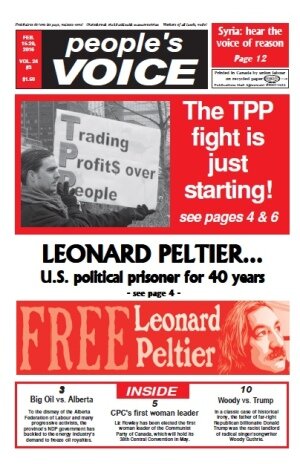
People’s Voice February 15-29, 2016
Volume 24 – Number 3 $1
1) COMMUNIST PARTY OF CANADA ELECTS FIRST WOMAN LEADER
2) CONVENTION PLANS, LEADERSHIP CHANGES AT COMMUNIST PARTY CC MEETING
4) GOVERNMENTS MUST REJECT TPP: STEELWORKERS
5) TPP LEGISLATIVE FIGHT LOOMS
6) THE TPP IS NOT A DONE DEAL - Editorial
7) A TALE OF TWO MONUMENTS - Editorial
8) BIG OIL WINS AGAIN IN ALBERTA ROYALTY REVIEW
9) ALBERTA NDP REFUSES TO CHALLENGE ENERGY INTERESTS
10) PETITION DEMANDS TO END BC HEALTH PREMIUMS
11) CLC CALLS FOR URGENT REFORMS TO EMPLOYMENT INSURANCE
12) TPP AND FOOD SOVEREIGNTY DON’T MIX
13) LEONARD PELTIER: 40 YEARS A U.S. POLITICAL PRISONER
14) WHY RETIREMENT AGE MATTERS
15) AYOTZINAPA INVESTIGATION CONTINUING
PEOPLE'S VOICE FEBRUARY 15-29, 2016 (pdf)
|
People's Voice deadlines: March 1-15 March 16-31 Send submissions to PV Editorial Office,
|
|
|
REDS ON THE WEB
http://www.communist-party.ca
peoplesvoice.ca
www.ycl-ljc.ca
www.solidnet.org
|
People's Voice finds many "Global Class Struggle" reports at the "Labour Start" website, http://www.labourstart.org/. We urge our readers to check it out! |
* * * * * *
Central Committee CPC
290A Danforth Ave Toronto, Ont. M4K 1N6
Ph: (416) 469-2446
fax: (416) 469-4063 E-mailmailto:info@cpc-pcp.ca
Parti Communiste du Quebec (section du
Parti communiste du Canada)
5359 Ave du Parc, Montréal, Québec,
H2V 4G9
B.C.Committee CPC
706 Clark Drive, Vancouver, V5L 3J1
Tel: (604) 254-9836
Fax: (604) 254-9803
Edmonton CPC
Box 68112, 70 Bonnie Doon P.O.
Edmonton, AB, T6C 4N6
Tel: (780) 465-7893
Fax: (780)463-0209
Calgary CPC
Unit #1 - 19 Radcliffe Close SE
Calgary AB, T2A 6B2
Tel: (403) 248-6489
Ottawa CPC
Tel: (613) 232-7108
Manitoba Committee
387 Selkirk Ave., Winnipeg, R2W 2M3
Tel/fax: (204) 586-7824
Ontario Ctee. CPC
290A Danforth Ave., Toronto, M4K 1N6
Tel: (416) 469-2446
Hamilton Ctee. CPC
265 Melvin Ave., Apt. 815
Hamilton, ON.
Tel: (905) 548-9586
Atlantic Region CPC
Box 70 Grand Pré, NS, B0P 1M0
Tel/fax: (902) 542-7981
* * * * * *
News for People, Not for Profits!
Every issue of People's Voice
gives you the latest
on the fightback from coast to coast.
Whether it's the struggle for jobs or peace, resistance to social cuts,
solidarity with Cuba, or workers' struggles around the world,
we've got the news the corporate media won't print.
And we do more than that
- we report and analyze events
from a revolutionary perspective,
helping to build the movements for justice and equality,
and eventually for a socialist Canada.
Read the paper that fights for working people
- on every page, in every issue!
People's Voice
$30 for 1 year
$50 for 2 years
Low-income special rate: $15 for 1-year
Outside Canada $50 for 1 year
Send to: People's Voice, 706 Clark Drive, Vancouver, BC, V5L 3J1
You can call the editorial office at 604-255-2041
<pvoice@telus.net>
REDS ON THE WEB
www.communist-party.ca
peoplesvoice.ca
www.ycl-ljc.ca/
http://solidnet.org/
http://www,rebelyouth-magazine.blogspot.com
(The following articles are from the February 15-29, 2016, issue of People's Voice, Canada's leading socialist newspaper. Articles can be reprinted free if the source is credited. Subscription rates in Canada: $30/year, or $15 low income rate; for U.S. readers - $45 US per year; other overseas readers - $45 US or $50 CDN per year. Send to People's Voice, c/o PV Business Manager, 706 Clark Drive, Vancouver, BC, V5L 3J1.)
1) COMMUNIST PARTY OF CANADA ELECTS FIRST WOMAN LEADER
For the first time in the history of the Communist Party of Canada, a woman has been elected as its top leader. Liz Rowley was elected by the CPC's Central Committee, which met in Toronto on the Jan. 30-31 weekend. The long-time Ontario provincial leader, she takes over the federal position following the resignation of Miguel Figueroa, who stepped down due to health reasons after serving in this office for 23 years.
The CC expressed its deepest appreciation to Miguel Figueroa for his many contributions to the work of the Communist Party and the people's movements going back to 1977, when he joined the CPC as a student activist at Dawson College in Montreal. During the years 1978-1985, he was the party's Greater Vancouver organizer. In that capacity, he played an important role in building the annual "End the Arms Race" demonstrations which brought tens of thousands into the streets for nuclear disarmament, and also in strengthening COPE, the broad left-centre municipal reform alliance based on the labour movement, community groups, Communists, NDPers and many other progressives. After that, he served from 1986 to 1992 as Atlantic region Party leader, based in Halifax, where he chaired the Union Organizing Drive Committee which ultimately brought over 800 part-time sessional professors and teaching assistants at Dalhousie University into CUPE. Starting in the late 1980s, he was a key figure in the struggle to prevent an attempt by some of its elected leaders to liquidate the CPC. This successful resistance was followed by the Party's 30th Central Convention in December 1992, which elected Figueroa as leader. Just months later, draconian amendments to the Election Act were adopted by Parliament, effectively banning the Communist Party of Canada and making it nearly impossible for smaller parties to engage in federal elections. Miguel Figueroa was the key public spokesperson for the ten-year campaign to repeal this undemocratic legislation, which was overturned by the Supreme Court's historic 2003 ruling in the case of Figueroa v. Attorney-General of Canada. Over his 23 years as CPC leader, Figueroa led the Communist Party through eight federal election campaigns, touring and speaking across the country. He was also a prominent figure at the annual International Meeting of Communist and Workers' Parties, representing the CPC at many of these gatherings.
Announcing his resignation, Figueroa told the CC that he intends to remain active in the Party, taking on other assignments and responsibilities. The upcoming 38th Central Convention of the CPC will feature a tribute to Miguel Figueroa as a highlight of the weekend's agenda.
Liz Rowley is well-known across Canada for her many years of activity in the Communist Party and in a wide range of people's movements. She joined the CPC in the late 1960s, and was the Party's youngest candidate in the 1972 federal election, in the university-based riding of Edmonton Strathcona. She has been a Party organizer and leader in Ontario since 1975, and a member of the CEC since 1978. Living in Hamilton during the 1980s, she was deeply involved in many struggles by the trade union movement to defend jobs, living standards, labour rights, women's equality, social programs and Canadian sovereignty, all of which became the target of a vicious neoliberal assault against working people. Moving to Toronto to work as the Ontario leader of the Party, she became a powerful grassroots spokesperson in the "Days of Action" fightback against brutal cutbacks imposed starting in 1995 by the Mike Harris Tories, and was elected a Public School Trustee in East York. Liz Rowley has been an outspoken participant in many important battles for the rights and interests of working people in Ontario, around such issues as defence of public education, affordable vehicle insurance, the fight against plant closures, and much more. She has been a prominent spokesperson of the CPC's electoral campaigns, and for the Party's call for a broad People's Coalition to open the door to fundamental progressive change in Canada. Along with Miguel Figueroa, she was instrumental in the membership struggle to block the liquidation of the CPC during the difficult years before its 30th Central Convention.
Over the coming few months, Liz Rowley will be meeting with CPC members across the country, attending provincial Nominating Conventions which will elect delegates to the 38th Central Convention. People's Voice will keep readers informed about upcoming public events where Rowley will speak.
2) CONVENTION PLANS, LEADERSHIP CHANGES AT COMMUNIST PARTY CC MEETING
Special to PV
Big challenges were on the table for the Central Committee of the Communist Party of Canada, when it met Jan. 30-31 to launch preparations for the party's upcoming 38th Central Convention in Toronto. The centrepiece of the meeting was the Draft Political Resolution for the May 21-23 convention, a document which will be debated by members at club meetings and provincial gatherings over the next three months.
The meeting also discussed ongoing work to increase the party's membership base, and leadership changes. For the first time since 1992, the Party now has a new central leader. Following the resignation of Miguel Figueroa, the CC elected Liz Rowley to the position. The long-time Ontario leader, Rowley becomes the first woman to lead the CPC (see sidebar article for more details.)
The 22-member CC is the party's leading body between conventions, tasked with guiding the activity of Communists across the country amid a rapidly changing political landscape. This was the CC's first meeting since the historic defeat of the far-right Harper Tories last October. A large part of the agenda was devoted to analysing that election outcome, which the CPC calls a major victory for the working class.
After ten years of a relatively straightforward battle against the most reactionary sections of the ruling class which backed the Harper Tories, a very different and complex political environment has emerged. In certain respects, says the Resolution, "the objective terrain to win important democratic, economic and political demands has improved with the demise of the Harper government. This will not be achieved by relying on spontaneous resistance struggles, but rather through a conscious political and organizational effort to invigorate the extra-parliamentary movements, and an ideological struggle to shed illusions about the bourgeois role and character of the capitalist state." The first in-depth discussion at the CC meeting was around the increasingly dangerous international situation. "As the systemic crisis of capitalism continues to deepen, and the effects of the 2008 economic meltdown continue to be felt, imperialist states and organizations are becoming increasingly aggressive," warns the opening section of the Resolution. "The standoff between nuclear armed states in Ukraine and the expanding war in Syria are powderkegs that threaten disaster. Millions upon millions of people in all parts of the world are being forced into poverty, hunger, homelessness and displacement. But this is also a moment of rising working class and popular resistance. In all countries, albeit unevenly and with different characteristics, we see increased unity and mobilization. From mass demonstrations to general strikes to online campaigns, people are using many different vehicles to advance these struggles."
The document goes on to provide a detailed overview of the international scene, from the complicated struggles by the working class in Latin America against the return of right-wing, austerity policies, to solidarity with the Palestinian people, opposition to fascist and racist movements in many countries, and much more.
Turning to the domestic situation, the Draft Political Resolution notes that "on the fundamental economic and class issues, the Liberals refuse to consider increased corporate taxes, and they are pushing the TPP and other corporate deals. They have no plans to expand Medicare, pensions and universal social programs, to guarantee labour rights, or to consider nationalization or restoration of privatized public assets. While dropping the former government's hostility to action around climate change, the Liberals support the energy monopolies' push for tar sands expansion and fossil fuel exports. They aim to establish nation-to-nation relations with First Nations and Metis, but oppose nation-to-nation relations with Quebec. They will not pull out of NATO or reduce military spending, and remain committed to the imperialist concept of `humanitarian intervention.' In other words, the Liberal pledge to corporate Canada and the transnationals operating in this country is that reforms will be limited to certain social and democratic issues which have sparked major popular mobilizations. The Trudeau government will not interfere with the drive by big capital for maximum profits, and its neo-Keynesian budget proposals will not reverse the basics of austerity."
One of the most in-depth discussions at the CC examined new "democratic socialist" parties and movements, such as Syriza (Greece), Podemos (Spain), the election of Jeremy Corbyn as UK Labour Party leader, and Bernie Sanders; campaign to win the Democratic nomination for US President. These cases, the Resolution says, are a reaction to the rightward shift of traditional social democratic parties, but fail to acknowledge that the history of social democracy is intertwined with the fatal flaws of anti-communism and class collaboration, which "cannot be rectified by new incarnations of social reformism."
The document also contains a detailed analysis of politics in Quebec, where the labour and student movements have conducted major struggles in recent years, and where the left-wing Quebec Solidaire party now has three seats in the National Assembly.
The CC also considered new strategies to help build stronger popular mobilizations against the corporate agenda. In the months ahead, the Communist Party will be raising a clarion call to stop ratification of the TPP, which was signed in New Zealand on Feb. 4 but must still be ratified to take effect. The Communist campaign will include street tables and petitions, support for statements and resolutions at union locals and labour councils, and other creative tactics to raise awareness of this urgent issue.
The Communist Party's Central Organizer, Johan Boyden, presented detailed reports on the CPC's ambitious campaign in the federal election, including the nomination of 26 candidates across the country. One positive outcome of this campaign, said Boyden, was the formation of a new CPC club in St. John's, Newfoundland, where a Communist was on the ballot for the first time.
Excerpts from the Draft Resolution will be printed in upcoming issues of People's Voice. Readers will also be able to read the complete documents online, at www.communist-party.ca.
Statement from the Kamloops Club of the Communist Party of Canada (abridged)
The Kamloops Club of the Communist Party of Canada stands in absolute opposition to the AJAX Mine development as proposed by the KGHM mining corporation.
There are many problems with the AJAX proposal. Our greatest concern, which has largely gone unmentioned, lay in the economic model and false assumptions by which the project is being promoted.
Like most colonial exploitation projects, the people who live closest are the ones at greatest risk of harm, while investors who live elsewhere will be in the greatest position to reap the benefits. More specifically, those who are the most financially vulnerable, who cannot easily relocate from the ensuing pollution onslaught, will not have a choice in the matter, while the investor class, upon seeing a slightly greater return-on-investment in another corporation, will absolve themselves of all “responsibility” to the community and move their money elsewhere – all-the-while never having to live anywhere near the AJAX Mine.
Corporations are not people. There is no connection between the KGHM Corporation and the community of Kamloops. KGHM has hired some high profile, somewhat local, figures to put a face on their corporation, but these individuals were obviously not hired for their knowledge of the mining industry – they were hired to ease the discomfort people generally feel about faceless corporations.
KGHM may dissolve one day, or it may live for a thousand years, with CEOs and corporate shills doing their dirty work along the way, but KGHM does not have a conscience or a heart. KGHM is responsible to its shareholders and no one else. No one should expect that KGHM would ever put the needs of Kamloopsians ahead of the need of their investors – this is the sad fact behind corporate governance and its regulatory obligations to shareholders for the maximization of profits. There is no such thing as “good will” or “humanity” when it comes to the bottom line, especially not in the mining industry.
It’s true that corporations will throw money around and do much influence-peddling to win over desperate members of the community, or to bolster the accounts of certain influential charities, or even politicians and political campaigns. But these efforts are part of the corporation’s efforts to, some day, turn that political capital into profits by way of a project that would otherwise not likely ever gain the support of the local political class. Such peddling might sway fence-sitters to their side, or, it might convince skeptics to stay quiet. Many community members have expressed a desire to “wait-and-see” or simply stay quiet because they have already been co-opted into the KGHM camp via the many donations KGHM has made to their favourite charitable organizations, or, in some cases, the direct assistance they’ve provided to “mine friendly” and “development friendly” politicians.
Mining donates more to the BC Liberal Party than any other industry... It’s not by chance that the BC Liberal Government has been instrumental in dismantling the social safety net and making it harder and harder for working class British Columbians to survive. Such dire situations create a wonderful opportunity for corporations like KGHM to walk into a community and throw millions around in donations to desperate community groups: buying their silence along the way. The return on such a small investment could ultimately result in the approval of a multi-billion dollar project.
By absolving themselves of their governmental responsibilities the Liberals actively foster the desperation that big corporations need in order to maximize profits on the backs of “desperate” communities. This desperation is easy to hear in the claims of mine proponents who routinely say, “Kamloops needs this mine”, or “we need growth”, or “we need these types of good-paying jobs”, or “we’re losing our kids to places with better paying jobs”. These pleas are commonly heard opposite the health concerns raised about the mine, as though Kamloops were so desperate that it should simply stop worrying about all the negative health, environmental and economic problems this mine will bring, “…because growth and jobs (no matter how poorly arranged) is all that can save communities like Kamloops…”. Such arguments arise out of the economic fear-mongering that the resource extraction industries are famous for...
AJAX will grossly violate the ecological integrity of the unceded territories of the Tk’emlups and Skeetchestn First Nations, as well as threaten the waterways which run through many other First Nations territories in BC. AJAX supporters claim that mining accidents are seldom, which may be true, but they do still happen, and some, like the Imperial Metals disaster at Mt. Polley, are catastrophic to the surrounding area, and much worse when posited near an urban centre.
There is absolutely no way to make any use of the mined area while mining is still occurring, which obviously violates a fundamental understanding between the Crown and First Nations – that the land would be available for the continued use by First Nations in the ways they’ve always known. Given the boom and bust cycle of the copper industry, with regular start-ups and shut-downs, AJAX could operate on-and-off for many more years, possibly decades, before any reclamation efforts are made. In addition to the direct restricted use of the land being mined, there will be negative impacts on the air, land and water near the mine. Even the blasting noise from the mine will negatively impact the livability of the surrounding areas.
Issues around mineral “rights”, as exercised by corporations like KGHM, and the fact that most of BC exists on unceded territories, provide a significant legal backdrop which must be respected; activities that negatively impact the long-term use of any area should be ceased until an understanding is achieved with all affected First Nations regarding the use of their unceded territories.
Putting aside the First Nations territorial claim for a moment, there is still no need for this project, or any like it, under the direction of far-off corporations with all the wealth being extracted from the land under us and deposited into the accounts of corporate investors all over the world. Our provincial and federal governments have every right, and obligation, to nationalize the entire mining industry and ensure that any and all profits are put towards the socially conscientious needs of our society.
The royalties received by the provincial government, from extracted resources such as copper, are simply not good enough compensation. Under the current regime the minute revenues generated by royalties are not even listed in the BC government’s own budget charts, and you almost never hear the mining industry talk about royalties, because even they know they’re embarrassingly low. Mine workers make a good wage, but why shouldn’t the rest of society also benefit from the resources to ensure we have our basic rights met, such as housing, food, education, and health services. Of course, capitalists absolutely revile the nationalization of any industry; how will the capitalist make a living when there are no more workers or resources to exploit?
Many high-profile and prominent members of our community have already spoken against this development: union leaders like Richard Boyce, with decades of experience representing mine workers at Highland Valley Copper; the Kamloops Physicians for a Healthy Environment; various faculty of TRU, including scientists and economists; and entire organizations like the Kamloops and District Labour Council, which represents 10,000 union members from all sectors of the work force...
One of the weakest - yet most touted - arguments for building AJAX, is for the sake of jobs. However, KGHM is under no obligation to hire Kamloopsians and possibly not even Canadians. There’s no legal obligation to hire locally; thousands of unemployed Kamloopsians will be competing against tens of thousands of qualified unemployed Canadians from across the country. With the recent influx of industrial workers laid off from the oil patch, not many of whom were from Kamloops to begin with, there will be an over-abundance of available workers with far more industrial experience than the ordinary working class Kamloopsian. KGHM has stated they might even utilize the Temporary Foreign Worker Program, known for exploiting vulnerable workers and denying foreign workers the basic rights afforded to Canadian citizens.
Many locals look to nearby mines like Highland Valley Copper, and likely even know at least one person who works there and makes a very good wage, and then assumes that this will be the case for AJAX workers. But Highland Valley Copper has been operating for many decades, and there are strong, hard fought-for, collective agreements in place between the owners and the workers. KGHM, like every major corporation, will fight tooth-and-nail to keep a union from organizing their workforce.
But we shouldn’t assume that there will even be KGHM “staff” in the way that there are Highland Valley Copper staff. One can look at some of the newest mines in Quebec and Ontario to see what the future of mining offers. Mining in Canada, as presented in the 2011 National Film Board documentary The Hole Story https://www.nfb.ca/film/hole_story/rental, will likely not follow the same workplace model that most industrial workers are accustomed to. There are already a number of major industrial worksites around the world, including in the Alberta oil patch, that have replaced equipment operators with fully automated equipment, thereby replacing hundreds of workers with just a half dozen or so computer programmers. New mines also cut production costs by only having managerial staff and a handful of administrative staff and then have all other work performed by contractors. Of course, contracting out all your operations also means that work, for the contractor and his crew, may last for a few weeks at a time, or a few months at a time, or maybe a few years, depending on how well your competitors can underbid you. The natural progression for such business practices is to drive wages lower and lower for the sake of “competitiveness” and “flexibility”, which is great when you’re an investor, but terrible if you’re looking for a regular pay cheque.
The other natural consequence of this irregular workforce employment is that locals who thought they might be able to rent out a suite long-term, or even sell their property to a mine-worker, will not be able to count on such sales, nor on the regularity of having their suite rented, or at least not for very long. And, given that the majority of workers hired to operate AJAX will be from out-of-town, significant long-term growth and investment in Kamloops should not be counted on. The reality is that most folks who move to a new community merely for work, will leave very quickly once that work ends or once a better job appears; this is the well-known cycle for resource extraction industries. We already know that AJAX is not a sustainable project and has a very short expected lifespan of 23 years of operation; whatever growth which might occur from the import of 400 or so workers to our community will be lost every time the mine shuts down and the workers all go back home.
The “ripple effect”, in regards to the concept that each mining job leads to the support of seven other jobs around town, has also largely been discredited by economists, as chronicled in a recent CBC episode of Ideas www.cbc.ca/radio/ideas/it-s-the-economists-stupid-1.3219471.
The two economists, Dr. Julie Nelson and Dr. Richard Denniss, who lead the discussion on this episode, lambaste much of the propaganda that the mining industry relies on to promote their projects. They state that economists and consultants hired by the mining industry routinely fabricate numbers, make gross assumptions while presenting them as facts, and inundate ordinary community members with murky data... because the facts are rarely in the mine’s favour. The purpose is to place doubt in their opponent’s positions; if they succeed in creating confusion and ambivalence, they’re already doing a lot better in the propaganda war than if everyone were simply presented the crystal-clear facts.
There is great opposition to this project from within Kamloops’ municipal boundaries, and, should that opposition create enough influence on its own, we may see this project rejected by the provincial government regardless of reassurances about environmental safeguards. Without said community opposition, however, it’s easy to see who wields the greatest political clout in this scenario.
The Kamloops Club of the Communist Party of Canada stands in solidarity with all the citizens of Kamloops who oppose this dangerous project and reject the argument that we are so desperate that we must sacrifice the health and ecological longevity of our community for the sake of a short-term project with dubious economic benefits.
4) GOVERNMENTS MUST REJECT TPP: STEELWORKERS
Last December, Canadian and U.S. leaders of the United Steelworkers (USW), North America’s largest industrial union, called on the governments of both countries to reject the Trans Pacific Partnership (TPP) trade deal.
The USW’s International Executive Board adopted a formal resolution which forms the basis of a fully engaged TPP rejection campaign in each country.
“The TPP will only continue the failed trade policies of the past that have valued corporate profits, wherever obtained, over the interests of job and opportunity creation here at home. The USW will put every effort into defeating the TPP,” the resolution states.
“Our members and all working families in our countries cannot afford more bad trade policies, flawed enforcement and misplaced priorities from which they have suffered for far too long from previous trade deals,” said Ken Neumann, USW National Director for Canada.
“Working people need trade policies that lift wages up, rather than pushing them down. We need trade deals that reduce our trade deficits and promote domestic manufacturing and job creation, rather than more outsourcing and offshoring. We need policies that will reverse the widening gap of income inequality,” Neumann said.
The TPP threatens Canadian jobs by facilitating greater offshoring in the auto and manufacturing sectors, in value-added processing of mining and forestry resources, and in the telecommunications sector, Neumann added. “Our governments must reject the TPP and send it back to the negotiating table.”
Excerpts from USW International Executive Board Resolution on TPP
The United Steelworkers union (USW) is the largest industrial union in North America representing 1.2 million active and retired members in the United States and Canada with members working in virtually every tradable sector from mining and metals, glass and rubber, paper and forestry, automotive and aerospace products and countless other areas....
For workers in manufacturing and the communities that depend upon their success, the agreement would be particularly devastating because it fails to address some of the most important challenges that have decimated the manufacturing sector in recent years.
Rules of origin for autos and auto parts in the TPP would be particularly devastating to USW members because the standards would further diminish the percent of a car’s content, by value, which must come from TPP countries in order to benefit from TPP preferential trade protections: The North American Free Trade Agreement set the standard at 62.5 percent; the US-Australia FTA lowered that to 50 percent; the recent U.S.-Korea FTA cut the standard to 35 percent, and the TPP further slashes it to 45 percent, allowing 55 percent of a car’s content, by value, to come from China and still be stamped “Made In America or Canada” and receive TPP benefits.
Negotiators may have worsened this rule of origin problem for USW members who work in the auto parts, glass and other industries by including a provision that would allow auto body parts made of steel or aluminum, and possibly glass and other products, to be considered “domestically” produced with only minimal changes, thus in effect reducing the 45 percent content threshold identified in the text to as low as 30 percent or 35 percent, thereby ensuring that production in this vital sector will continue to be offshored and outsources.
The TPP would facilitate the export of unprocessed raw materials, particularly from Canada’s forestry and mining sectors, because the trade agreement would render it more difficult for governments to implement job creation strategies to process raw materials domestically...
The TPP fails to utilize the standards embodied in the International Labour Organization (ILO) conventions to ensure that workers’ rights are implemented across every workplace and subject to effective enforcement. The TPP fails to meet the promise that it would be a “high-standards, 21st Century trade agreement” in the area of workers’ rights, representing not only a missed opportunity but also limiting the ability of workers to share in the very prosperity that they will be working so hard to create for multinational firms through their labour.
TPP countries would be required to adopt laws to provide for a minimum wage, but that wage may be only pennies an hour to be acceptable under the TPP. The TPP fails to adequately define basic standards for workers’ rights and allows labour standards to be open to continuing redefinition that multinational corporations view as fair and appropriate so that their executives, boards of directors and shareholders can profit at workers’ expense...
5) TPP LEGISLATIVE FIGHT LOOMS
By Emile Schepers, People’s World
On February 4, the United States and 11 other nations which have been negotiating to create the Trans Pacific Partnership (TPP) finally agreed on and approved a final version, which must now be approved by their respective legislatures. In the United States, there is going to be a fight about this, in the context of national elections.
Back on June 24 of last year, the US Senate had approved fast track authority for the government to negotiate the treaty by a vote of 60 to 37, with three “not voting”. Forty seven of the “yea” votes were cast by Republicans, and 13 were Democrats. Of the “nay” votes, five were Republicans, two were independents (Sanders of Vermont and King of Maine), and 30 were Democrats. The senators not voting were two Republicans and one Democrat.
The fast track vote came after an intense pressure campaign, with business interests and the White House weighing in strongly in favour of approval and organised labour and other grassroots constituency groups lobbying hard against it. The approval of “fast track” means that the Senators will only have a chance to vote the finished and signed treaty up or down, and will not be able to present amendments and modifications. Labour and its allies have made clear that they intend to fight hard for disapproval. Opposition to the TPP has been a major feature of the electoral program of Senator Bernie Sanders, and Hillary Clinton has more recently begun to express doubts.
The other countries that agreed to the TPP on February 4 include: Canada, Mexico, Peru, Chile, Malaysia, Australia, Brunei, Japan, Singapore, Vietnam and New Zealand. Colombia will probably join, and Indonesia is studying the possibility of doing so. In all cases except Malaysia, there also has to be a process of legislative approval which may take a while. And in most of these countries, as in the United States, there have been strong objections to the TPP from many sectors, especially from labour unions and the political left.
When the treaty was signed in Auckland, New Zealand, labour unions there carried out militant demonstrations against it, and sharply criticised their country’s prime minister, John Key, for agreeing to it. Criticisms from labour and the left occurred in several other participating countries. Nobel Prize-winning economist Joseph Stiglitz has said the agreement will result in more race-to-the-bottom wages and labour conditions, contrary to what President Obama has promised.
In Chile, the negotiations to participate in the TPP were initiated by the previous government of right-wing President Sebastian Pinera. The current president, Michelle Bachelet of the Socialist Party, has decided to continue with the process, but her doing so has been controversial. On the day of signing, the newspaper of the Communist Party of Chile, El Siglo (the Century), carried an article entitled “Criticisms of the TPP are Growing”.
“Defenders of the agreement claim that with more opening to trade, more dynamism will be injected into the economy. Meanwhile opponents of the TPP claim that the agreement will only benefit multinational enterprises to the detriment of the smallest ones and will affect sensitive areas such as health or agriculture, severely wounding the sovereignty of the country.
“After signing the agreement, the Chilean Parliament will have two years to vote in favour or against it; presumably it will be sent [to the Parliament] in March. This is the point at which the government will confront an important division, as some of the governing [coalition’s] parliamentarians have indicated that they will reject the controversial treaty.”
The article goes on to quote Communist Party Deputy Camila Vallejo, who is a high profile grassroots leader in Chile because of the role she has played in protests demanding educational reforms: “I am not willing to contribute to mortgaging our sovereignty in this way and I will vote against the TPP, but I think it is essential to have a citizen mobilisation so that the government backs off its [pro TPP] position and the Parliament rejects it”. The Communist Party, a powerful force in Chile, is part of Bachelet’s governing coalition.
Similar criticisms are being raised against their government’s agreement to the TPP in Australia, Mexico, Peru, and other countries.
People in the United States should realise that the criticisms of the TPP that are being made in the other countries are parallel to the complaints expressed by labour and other groups in the US.
All are worried that their nations’ sovereignty will be subordinated to the interests and power of billionaire multinational corporations. Since many such corporations are headquartered in the United States, and since the United States government is a major promoter of the TPP, the agreement is also seen as favouring the United States’ interests to the detriment of smaller and poorer countries.
In all countries, including the United States, there is worry about terms in the TPP that could allow multinational corporations to sue to interfere with environmental, labour and consumer protection legislation in the future that could be seen as interfering with the “future profits” of the corporations.
Future nationalisation of industries not already under government control would be prohibited on pain of severe financial penalties. Prices of life saving drugs would be kept high to serve the interests of the big multinational pharmaceutical companies. Democracy would take a hit, because communities could not vote to protect themselves from the depredations of the multinationals.
Several countries, including Peru, have already had to pay big penalties under existing “free trade” deals because local peasant communities mounted protests which prevented multinational corporations from trashing their farmlands through environmentally harmful mining operations. Nowhere are workers convinced that the TPP will lead to “more jobs”, the opposite seems much more likely.
The Obama administration has advertised the TPP as a way of countering China’s economic and commercial power. But many people in the other countries would like to continue to have the option of building trade relations with China and other countries not in the TPP, and fear the TPP will impede them from doing so.
So there is not only going to be a fight about this in the United States Congress and the streets, but in all the other participating countries as well. The TPP can still be turned into a lesson in worldwide labour and people’s solidarity, if activists start making connections and contacts across borders right away, and continue to protest and lobby against this awful agreement.
People’s Voice Editorial
Every time the transnational corporations and politicians announce plans for a new “trade agreement,” the media propaganda machine pumps out a contradictory message: “everyone supports this deal”, and also that “resistance is futile.” If corporate globalization really has complete public support, why would there be any resistance? And if there is such resistance, shouldn’t it be obvious that support is far from unanimous?
Despite the hoopla around the Feb. 4 signing of the Trans-Pacific Partnership (TPP) in New Zealand, this 12-nation corporate rights deal is far from a fait accompli. Thousands rallied in Auckland outside the ceremony, a signal that huge protests will emerge against the necessary ratification of the TPP in each country. Our view is that massive citizen action can block the TPP, just as the Multilateral Agreement on Investment, the FTAA and other deals have gone down to defeat.
We need to build up opposition in the streets, in the labour movement, on campuses, and through social media. The TPP puts strict limits on regulation of corporate activity, allows Big Pharma to extract huge profits at our expense, permits the sharing of vital personal information across borders, and helps investors win “compensation” when environmental or public health policies interfere with profits. This deal was negotiated behind closed doors, by representatives of the 1%, for the profits of the 1%. Far from “improving the economy”, the TPP will give corporations vast new powers to slash jobs, and to force governments to cut business taxes and public spending.
The struggle to prevent Parliament from ratifying the TPP will be the defining issue of the new Liberal government’s term in office. Let’s put this fight on the agenda for every union local, labour council, and community group across the country. There’s no time to lose!
People’s Voice Editorial
Just after the new federal government announced that it intends to stop throwing taxpayer dollars at the anti-communist mega-monument planned by the recently defeated Harper Tories and their fascist buddies, Heritage Canada jumped back into this mess with an online consultation on “Design Considerations for the Memorial to the Victims of Communism – Canada, a Land of Refuge.”
In an appalling exercise in appeasing the ultra-right groups which want Canadians to pay for this monstrosity, the Heritage Canada survey asks participants to “identify important visitor experiences of the Memorial,” to be built “on a site in downtown Ottawa that is between 200 and 500 square metres.”
Not surprisingly, none of the prefabricated survey answers allow respondents to demand that zero square metres of public space be allocated for this neo-fascist project. There is a blank at the end to express personal views, and we urge readers to continue speaking out against the monument. People’s Voice will also publicize actions later this year to resist the spread of fascist ideology, such as the annual so-called “Black Ribbon Day”, another attempt to rehabilitate the reputations of traitors who sided with Hitler’s armies during the Second World War.
We are, however, delighted by the news that Russian activists are requesting permission to install a monument near the US embassy in Moscow “dedicated to the genocide of American Indians.” The activists have launched a petition in support of the monument on the change.org website, pointing out that “despite assuming the position of a ‘global policeman’ the United States still refuses to accept the responsibility for killing over 15 million Native Americans.” The petition says the monument would be dedicated to “the memory of American Indians who perished as heroes in the unfair war with treacherous invaders.” Look for the petition online!
8) BIG OIL WINS AGAIN IN ALBERTA ROYALTY REVIEW
By Kimball Cariou
A wide range of critics have already slammed the Alberta NDP government’s decision to accept a review panel’s recommendation for a decade-long cap on royalty rates paid by oil and gas companies.
In a scathing commentary in the Tyee (http://thetyee.ca/News/2016/02/02/Alberta-Royalty-Review-Disaster/), energy and environment researcher Andrew Nikiforuk calls the move “a capitulation to Big Oil and its financial backers.”
Conducted by pro-corporate appointees, the panel claims that the collapse in global oil prices leaves Alberta with no room to increase royalty rates, which paid by the companies to the legal owner (the province, in this case) for the right to develop the resource.
One key reason for last year’s defeat of the Tory government of Alberta was its policy of consistently lowering royalty rates to among the lowest in the world, while saving almost nothing for future generations. Working people finally revolted against this blatant fiscal mismanagement, electing the NDP’s Rachel Notley in hopes of reversing this trend.
In opposition for decades, the NDP had often been critical of low royalty rates, particularly when the province went through periodic revenue droughts and brutal cuts to public services. During the campaign, Notley had promised to commission a review of the issue.
Since then, the energy industry and right-wing forces have gone on the offensive, blaming the new government for the province’s fiscal shortfall and claiming that increased royalty rates would destroy the economy. In this situation, the review concluded that the "current share of value Albertans receive from our resources is generally appropriate."
The review calls to maintain current royalty rates for wells drilled before 2017, and to set a generic five per cent rate for all new oil and gas wells drilled after 2017. Nikiforuk calls this “equivalent to grading and selling all cuts of beef as hamburger.”
Unless a major public campaign to defeat this approach succeeds, this policy would lower Alberta's royalties by another billion dollars a year, according to Jim Roy, a former senior advisor on royalty policy for Alberta Energy.
Alberta's total royalty revenues from hydrocarbons in the 2015/16 fiscal year were $2.8 billion, far below the level of $10 billion or more during the boom years, when oil and gas corporations racked up tens of billions in profits annually.
Many industry observers point out that frozen rates will only encourage more production and investment, and lower oil prices. This seems obvious, since the current prices are linked to massive overproduction by Canadian bitumen producers and U.S. oil shale fracking. Since 1998, tar sands oil production has gone from nearly 800,000 barrels a day to more than 2.3 million barrels, thanks in large part to low royalties and government incentives and subsidies.
But the review was not conducted by independent analysts. Two key panel members work for firms which invest billions in the energy industry: Dave Mowat, president of the Alberta Treasury Branch and Peter Tertzakian, managing director of Arc Financial Corp.
Jim Roy’s view is that their plan “appears to be to increase Alberta production at the maximum possible rate despite low prices… This strategy may help American consumers, but does not help Alberta owners."
The province’s most recent royalty review, held in 2007 at a time of high oil prices, actually cost the Alberta treasury more than $12 billion revenue, according to Roy's analysis, reported in The Tyee last year.
Economist Mark Anielski has reported how the province would have benefited if it had stuck to the royalty regime implemented by Peter Lougheed, the Conservative Premier elected in 1971: "Had Alberta maintained a 30 per cent royalty rate on the share of the value of the oil and gas produced between 1971 to 2014, Albertans would have generated $471.4 billion in oil and gas royalties. Had 50 per cent of these royalties been invested in the Alberta Heritage Savings and Trust Fund with annual average return of five per cent per annum we would now have an investment account worth over $481 billion."
At present, the Heritage Fund holds less than $20 billion.
No wonder that even friends and supporters of the NDP are speaking out. In an interview with the Calgary Sun, Alberta Federation of Labour president Gil McGowan said, "Some people say the NDP have come face to face with reality. I say what happened can best be described as the government being captured by industry... I honestly think the government has made a profound political mistake. We don't believe progressive governments have to become conservative to deal effectively with economic issues or to succeed politically. That’s a fallacy."
To accusations of calling for a “money grab” while the economy is suffering, McGowan responded, "No one on the left or the right in Alberta is suggesting the government engage in a cash grab at this time when prices are near historic lows."
But the AFL president is angry that virtually none of the labour movement’s concerns or suggestions are reflected in the royalty report: "Those ideas were passed over in favour of a plan that could have been introduced by a PC or Wildrose government."
McGowan stressed that the AFL had consulted well-known energy economists to "put forward a case for creative, progressive alternatives to the ones put forward by the oil industry and assorted conservative parties. We had high hopes at least some of those progressive alternatives would have found their way into the final report." That did not happen. Now, it remains to be seen whether the Notley government, already besieged by far right critics, can survive after alienating much of its own political base.
9) ALBERTA NDP REFUSES TO CHALLENGE ENERGY INTERESTS
By Naomi Rankin, Communist Party-Alberta leader
If anyone in Alberta thought that electing an NDP government was all they needed to do to fix the economy, they had a rude awakening in the royalty review report finally issued by the NDP appointed committee. This is a document that could have been accepted by any Tory government in the last 40 years, or the Socreds before that, making no challenges to illogical economic assumptions that have guaranteed oil and gas corporate profits at our expense – except that the Tories might have felt obliged to engage in more window dressing of the blatant surrender to the big oil and gas operators.
Not only does the report not call for any increase in royalty rates right now, it recommends lowering the rates for all categories of new production into the indefinite future, no matter what the price of oil or gas or the condition of the economy.
Simple capitalist Economics 101 would tell us that it's not a good idea to subsidize increased production when the price of oil and gas is low. Increasing production would just contribute to further downward pressure on prices. Instead, a sensible capitalist government would seize the opportunity to use low-cost oil and gas as inputs to secondary processing and manufacturing, to begin the process of diversifying our economy. A more diverse economy would free us from the boom and bust dependence on one category of commodities, and would incidentally improve the health of democracy in Alberta, even it did no more than increase the diversity of capitalist interests.
If we ignore the enormous carbon footprint of Tar Sands production, some of our potential customers are not so cavalier. Whether or not they care about the environment, oil and gas consuming countries have a vested interest in developing alternate forms of energy, just to improve their balance of payments and the profitability of their domestic economies. They will not only remove themselves as customers, but get a head start in research and development of the new economy. Continuing to rely on oil and gas exports as the only driver of the Alberta economy is short-sighted, even from a corporate point of view.
The best that can be said for Notley and her government is that they are consistent. When they campaigned on a program of continuing to rely on oil and gas exports, it was not just opportunistic rhetoric.
Luckily for working people in Alberta, Gil McGowan, president of the AFL, has come out strongly criticising the report. What is needed now, as much as under any Tory regime, is a campaign for an alternate economic plan of maximizing our share of the value of existing production, green diversification, and improved social spending, that can unite trade unionists, First Nations, environmental activists and even independent business. There's still a possibility of people's power outweighing corporate power.
10) PETITION DEMANDS TO END BC HEALTH PREMIUMS
PV Vancouver Bureau
As of Feb. 9, over 65,400 British Columbians have signed an online petition to scrap one of the most regressive and unfair taxes collected by any provincial government in Canada. Launched in early January by Michelle Coulter, a resident of Ucluelet on the west coast of Vancouver Island, the petition demands the elimination of Medical Service Premiums (MSP).
British Columbia is the last province to collect such flat tax premiums, which vary based on the size of a family. Single persons pay $75 per month, families of two pay $136, and a family of three or more pay $150. Those who earn less than $30,000 have to apply for assistance to pay a smaller amount. Families who earn $30,000 annually pay exactly the same amount as families with incomes in the millions of dollars.
The petition was in response to the latest increase in MSP rates, which have jumped a staggering 39% since 2009. The annual premium of $900 ($75 per month) is now a tax totalling 3 percent of the income for a single person earning $30,000, but just 0.3 per cent of a single person who earns $300,000.
This regressive tax has been pumped up regularly by the BC Liberal government, starting with a 50% increase in 2002. Since then, the MSP has become a major source of provincial revenue. In the 2014/2015 budget, revenue from MSP premiums was about $2.27 billion, compared to corporate income tax revenue estimates of $2.35 billion.
The BC Health Coalition and other critics have long argued against the injustice, complexity and bureaucracy added by this additional tax collection system.
Now, the opposition parties are urging major changes. Both Green Party leader Andrew Weaver and NDP leader John Horgan are calling on Premier Christy Clark to eliminate MSP premiums and follow the system adopted by many other provinces, by financing health care from income taxes.
The premier’s initial response to the wave of public anger was to claim that she’s trying to find a way to make the collection of MSP premiums “work for everyone,” with details expected in the upcoming provincial budget.
But BC Liberal budgets are infamous for finding ways to put the tax burden on low and medium income people, while giving huge breaks to the corporations and the wealthy.
For example, tax transfers to individuals - programs like the sales tax credit, the early childhood tax benefit, the low income climate action benefit, the seniors home renovation tax credit – cost the BC government $460 million annually. That compares to $516 million in tax credits to corporations, according to research from the BC office of the Canadian Centre for Policy Alternatives.
Starvation-level social assistance and disability rates in BC have been frozen since 2007, at $610 and $906 per month respectively. There has been no change, even after the bi-partisan committee of MLAs who conducted last year’s pre-budget consultations unanimously recommended increases.
The most recent BC budget won kudos for ending the claw-back on child support payments for single parents on welfare, a move which put an estimated $13 million in the hands of some of the poorest British Columbians. But the same budget gave the richest 2% of British Columbians $227 million - 17 times more - simply by phasing out the $150,000 tax bracket.
11) CLC CALLS FOR URGENT REFORMS TO EMPLOYMENT INSURANCE
Canada’s largest labour organization says the latest job numbers from Statistics Canada highlight the need for economic stimulus and reforms to the Employment Insurance (EI) program.
The job market was stagnant in January and unemployment rose to 7.2 percent. In Alberta, unemployment rose to 7.4 percent, the first time it has been above the national average since 1988.
Over the past year, unemployment has risen by 123,000 workers across the country: more than half of these (69,000) are in Alberta. Most job creation has been in Ontario, while other provinces continue to struggle with slack labour markets.
Self-employment has grown twice as fast (1.3 percent) as employment (0.6 percent). Private sector job growth continues to be weak, adding only 30,000 jobs over the past 12 months, up just 0.3 percent. Two sectors account for most job growth over the last year - health care and social assistance added 90,000 positions, and professional, scientific, and technical services added 38,000 positions.
“These job numbers and the slow economic growth we’re seeing now demonstrate the need for the kind of immediate stimulus that would come from urgently needed fixes to the employment insurance program,” said CLC president Hassan Yussuff.
The Liberal government has promised to review and improve the program, but Yussuff says urgently needed reforms can be immediately implemented.
“Fewer than 40 percent of unemployed Canadians – and fewer than 37 percent of unemployed Albertans – are receiving EI,” said Yussuff. “Part of the problem is that workers run out of benefits before they can find a new job.”
The immediate reforms the CLC hopes to see include:
- Temporarily extending EI benefits for an additional five weeks to help displaced workers who risk exhausting their benefits while hunting for hard-to-find jobs. This would be especially helpful in hardest hit regions where jobs are especially scarce.
- Returning to the previous definition of “suitable employment” and restoring the “best 14 weeks” pilot programs that created a single national standard for determining benefit levels.
- Eliminating the eligibility requirement of 910 hours of insured employment for new entrants and re-entrants to the labour market to make access to EI fairer, especially for young workers and new Canadians.
- Hiring staff to make up for years of devastating cuts under the Conservatives to help eliminate unacceptable delays faced by workers trying to get benefits approved, decisions on appeals, or questions answered.
- Implementing the election promise for an increase of $200-million in funding for provincial literacy and essential-skills training aimed at those who don’t qualify for EI. While it’s not part of EI, it would help where it’s needed most.
“It takes time for infrastructure spending to kick in and create jobs, so let’s act now to stop penalizing unemployed workers, get them the benefits they paid into and so urgently need, and help them start contributing to their local economies again,” said Yussuff.
12) TPP AND FOOD SOVEREIGNTY DON’T MIX
Commentary from the National Farmers’ Union
Trade deals like TPP are only superficially about trade – they are ultimately designed to limit the authority of national governments over their own economies and to expand the scope and power of multinational corporations. These deals contain ratchet mechanisms, such as Investor State Dispute Settlement (ISDS), that make it difficult, if not impossible, for countries to roll back concessions and reclaim democratic control in the future. The Canadian government would abdicate much of its jurisdiction over important areas of public policy and put these powers into corporate hands by signing on to the TPP and other trade deals.
Agriculture is always contentious in these negotiations, as many countries believe it is essential to ensure that their own farmers can produce the food to feed their people. Often food carries important cultural values as well. The NFU is a member of La Via Campesina (LVC), the international organization of small farmers. In the early 1990s, LVC stood opposed to World Trade Organization (WTO) negotiations around agriculture, called for the exemption of agriculture and food from talks, and proposed instead its new concept “Food Sovereignty” as the proper guiding principle. Today, Food Sovereignty has been embraced around the world, including by the NFU, and we say trade deals and Food Sovereignty don’t mix.
Destabilizing Canada's Supply Management system
Supply Management rests on three pillars: production discipline, import controls and cost-of-production pricing. All three are interlocked, so that weakening one pillar weakens the whole system. In the first five years of the TPP agreement, the TPP countries would gain tariff-free access to 3.25 per cent of Canada’s current dairy market, 2.3 per cent for eggs, 2.1 per cent for chicken, two per cent for turkey and 1.5 per cent for broiler hatching eggs. In subsequent years tariff-free access to these markets would increase.
The side letter with Australia says "Canada confirms that Australian dairy products, including those imported under HS Chapter 3504 such as milk protein concentrates, can be utilised in dairy processing in Canada to the fullest extent possible, including in cheesemaking"
The side letter with the United States commits both countries to immediately begin assessing the equivalency of each other's pasteurized fluid milk food safety regulations, with the assessment to be done by the end of 2017.
TPP market concessions add on to those given previously through the WTO, and, if ratified, CETA. Each has chipped away at Canadian farmers’ share of our own domestic market by increasing the amount of tariff-free imports allowed.
TPP members USA, New Zealand and Australia have embraced an export-oriented approach to dairy, resulting in extended losses for farmers because the world price is quickly depressed as a result of over-production. Instead of disciplining their producers to match demand, these countries aim to sell more milk by prying open Canada's market. However this will not solve their problem, because selling more at prices that below the cost of production will simply increase the volume of their losses.
TPP and Bovine Growth Hormone
In the 1990s the National Farmers Union, the Dairy Farmers of Canada, the Council of Canadians and numerous other citizens groups, as well as whistle-blower Health Canada scientists and their union, worked hard to keep the genetically engineered cow growth hormone rBGH (recombinant Bovine Growth Hormone – rBGH, also known as recombinant Bovine Somatotropoin – rBST) from being approved for use in Canada’s dairy herds.
The Senate Agriculture and Forestry Committee held hearings on the issue in 1998; and in 1999, recommended that Canada take a precautionary approach in regulating the drug.
Monsanto unsuccessfully appealed the government’s decision not to approve the drug, which it sells in the USA under the brand name Posilac.
On October 4, 2015 Canadian negotiators of the Trans-Pacific Partnership opened the back door to rBGH by agreeing to allow bulk imports of fluid milk from the USA. At least 3.25% of the Canadian dairy market would be open to TPP countries, with the USA being the only practical source of fluid milk. The TPP agreement would require at least 85% of this imported milk to be processed in Canada. The American regulatory authority allows rBGH to be used in US dairy herds, and it does not require labelling of milk produced with the use of rBGH. It is highly unlikely processors would segregate imported milk into separate batches and package it with labels that indicate it was from the USA.
The TPP goes against the Canadian people’s clear direction -- several years of concerted effort and Parliamentary debate determined that the Canadian dairy sector and the public did not need or want to have our milk produced with the use of rBGH.
13) LEONARD PELTIER: 40 YEARS A U.S. POLITICAL PRISONER
Statement of Leonard Peltier, February 6, 2016, the 40th anniversary of his arrest in Canada and subsequent imprisonment by the U.S. state
Greetings friends, supporters and all Native Peoples.
What can I say that I have not said before? I guess I can start by saying see you later to all of those who have passed in the last year. We Natives don't like to mention their names. We believe that if we speak their names it disrupts their journey. They may lose their way and their spirits wander forever. If too many call out to them, they will try to come back. But their spirits know we are thinking about them, so all I will say is safe journey and I hope to see you soon.
On February 6th, I will have been imprisoned for 40 years! I'm 71 years old and still in a maximum security penitentiary. At my age, I'm not sure I have much time left.
I have earned about 4-5 years good time that no one seems to want to recognize. It doesn't count, I guess? And when I was indicted the average time served on a life sentence before being given parole was 7 years. So that means I've served nearly 6 life sentences and I should have been released on parole a very long time ago. Then there’s mandatory release after serving 30 years. I’m 10 years past that. The government isn't supposed to change the laws to keep you in prison — EXCEPT if you're Leonard Peltier, it seems.
Now, I'm told I'll be kept at USP Coleman I until 2017 when they'll decide if I can go to a medium security facility — or NOT. But, check this out, I have been classified as a medium security prisoner now for at least 15 years, and BOP regulations say elders shall be kept in a less dangerous facility/environment. But NOT if you're Leonard Peltier, I guess.
As you'll remember, the history of my bid for clemency is long. My first app was with Jimmy Carter. He denied it. Ronald Reagan promised President Mikhail Gorbachev that he would release me if the Soviet Union released a prisoner, but Reagan reneged. George H.W. Bush did nothing. The next app was with Bill Clinton. He left office without taking action even though the Pardon Attorney did an 11-month investigation (it usually takes 9 months) and we were told she had recommended clemency. George W. Bush denied that petition in 2009. And in all of the applications for clemency, the FBI has interfered with an executive order. That's illegal as hell!
Today, I'm facing another dilemma — an abdominal aortic aneurysm (AAA). It's the size of an AAA battery. The doctor told me if it bursts, I can bleed to death. It's also close to my spine and I could end up paralyzed. The good news is that it's treatable and the operation has a 96-98 percent success rate. BUT I'm in a max security prison. We don't get sent for treatment until it is terminal.
As President Obama completes the final year of his term, I hope that he will continue to fight to fulfill his promises, and further the progress his Administration has made towards working in partnership with First Peoples. It gives me hope that this President has worked hard to affirm the trust relationship with the Tribal Nations. With YOUR encouragement, I believe Obama will have the courage and conviction to commute my sentence and send me home to my family.
Looking back on the 40 years of efforts on my behalf, I am overwhelmed and humbled. I would like to say thank you to all the supporters who have believed in me over the years. Some of you have been supporters since the beginning. You made sure I had books to read and commissary funds to buy what I may need to be as comfortable as one can be in this place. You made donations to the defense committee so we could continue fighting for my freedom, too. You all worked hard — are still working hard — to spread the word about what is now being called the most outrageous conviction in U.S. history. There are good-hearted people in this world, and you're among them. I'm sorry I cannot keep up with answering all of your letters. But thanks for the love you have shown me. Without it, I could never have made it this long. I'm sure of it.
I believe that my incarceration, the constitutional violations in my case, and the government misconduct in prosecuting my case are issues far more important than just my life or freedom. I feel that each of you who have fought for my freedom have been a part of the greater struggle of Native Peoples — for Treaty rights, sovereignty, and our very survival. If I should be called home, please don't give up on our struggle.
In the Spirit of Crazy Horse…
Doksha,
Leonard Peltier
#89637-132
USP Coleman I
PO Box 1033
Coleman, FL 33521
14) WHY RETIREMENT AGE MATTERS
By Darrell Rankin, Winnipeg
One of the moves by the Harper regime was to phase in a retirement age of 67, up from 65. It did not affect older workers, who vote in higher numbers. But the measure targeted younger workers.
The profit motive is behind moves to increase the retirement age in many OECD countries.
First, companies with huge pension liabilities (auto, steel, etc) don't want to see it repeated, especially now that workers live well past retirement.
Second, it is an effort to squeeze every last ounce of surplus labour from the better-trained portion of the labour force.
Of course, the move decreases the odds of young and discriminated workers getting hired. So once this older generation of workers is 'used up', good luck youngsters!
For the capitalist “a quick succession of unhealthy and short-lived generations will keep the labour market well supplied as a series of vigorous and long-lived generations,” as Karl Marx noted in 1865.
It is also easy to see that a short-lived worker has less chance of understanding the need for socialism. This explains the drive to impose conditions of19th century capitalism on workers.
There is no doubt that a measure like reducing the retirement age would boost the hiring of young people. Like a shorter work week, it would have the same effect, as would more paid vacations such as for International Women's Day, International Workers' Day and election days, for starters.
It would reduce the agony of all the unemployed, among Aboriginal, women and immigrant workers. In the former socialist countries, women often retired at age 55 and men at 60.
Although equality was entrenched in the USSR's 1977 constitution, the earlier age was affirmative action on the part of socialism to recognize the need to overcome ongoing discrimination against women under socialism, inherited from capitalism.
(In fact, affirmative action was everywhere under socialism. Coal miners retired at age 55, to reduce and mitigate severe occupational health hazards.)
Only a classless, communist society where all democracy deficits are overcome will have no need for legislated affirmative action.
Recent proposals for pension reforms focus on who pays for public pensions, the CPP and OAS. In the end, workers pay for all public pensions - they are deferred personal or social wages. This is because workers are the only human source of wealth in society.
But should women, the new generation and other discriminated groups continue to get lower CPP benefits because of lengthier gaps in work?
Should the working poor live in everlasting poverty from too-low CPP benefits, on the charity of food banks?
Should workers now have to reduce their wages to pay for higher CPP and OAS benefits, in the form of more wage deductions?
No to all the questions! Take the cost from corporate profits! And for discriminated groups, reduce the retirement age and increase their personal CPP benefits!
15) AYOTZINAPA INVESTIGATION CONTINUING
Mexican investigators say that two recently found bodies do not belong to any of the 43 students from the Ayotzinapa teachers' college who disappeared in September 2014 in the southern state of Guerrero.
The bodies were found last month during a search operation between the town of Cocula and Iguala, the city where local police attacked and then abducted the students who they allegedly handed over to a local drug trafficking gang.
Attorney General Arely Gómez informed parents of the disappeared students about the new findings at a private meeting which was also attended by a group of independent experts set up by the Inter-American Commission for Human Rights to follow the case. His office says it has been "determined that the human remains found in Cocula do not belong to any of the 43 students disappeared in Iguala."
The disappearance of the students sparked a national protest movement, fueled by a government investigation which concluded that the victims were incinerated in a garbage dump on the same night they were abducted. Experts provided a detailed critique of that investigation in a report released last September.
Growing pressure on the government eventually led to the relaunching of the official investigation in December. But while the Ayotzinapa case may be moving forward, the numbers of new forced disappearances keep piling up.
Five men and a 16-year-old girl disappeared in the southern state of Veracruz on the Jan. 9-10 weekend in the town of Tierra Blanca. Video footage shows the victims being abducted by state police officers, who were not arrested until relatives of the missing began to make noise in the media.
Mexican and international human rights groups and officials have been drawing attention to the failure of the authorities to resolve the crisis of disappearances that began to take off in the context of the country's drug wars. An Amnesty International report on enforced disappearances in Mexico released on Jan. 14 says there is a lack of skills and political will to solve the problem.
"The investigations do not appear to be aimed at uncovering the truth about what happened, the authorities responses are limited to carrying out actions that contribute little to the inquiry," the report says. "This type of investigation appears to consist of merely going through the motions, and appears to be destined from the outset to lead nowhere."
According to official statistics there are currently about 27,000 missing people in Mexico. An undetermined number are victims of forced disappearance, in which state actors are involved.
(Based on a Vice News report by Alan Hernandez.)