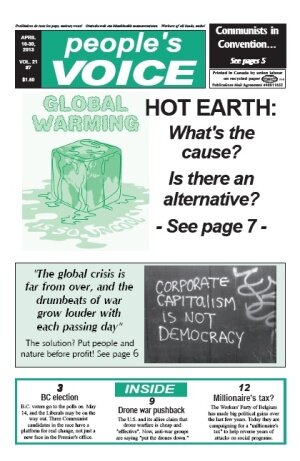
April 16-30, 2013
Volume 21 – Number 7
$1

Prolétaires de tous les pays, unissez-vous!
Otatoskewak ota kitaskinahk mamawestotan!
Workers of all lands, unite

CONTENTS

1) COMMUNISTS HOLD 37TH CONVENTION

2) "THE GLOBAL CRISIS IS FAR FROM ABATING"

3) REJECT "WORKER-VS.-WORKER" DIVISIONS - Editorial

4) SOLIDARITY WITH RAYMOND ROBINSON - Editorial

5) DUMP THE B.C. LIBERALS, FIGHT FOR REAL CHANGE!

6) UFCW HITS TORIES ON RBC SCANDAL

7) THE WOMAN WHO TORE BRITAIN APART

8) MARX IS STILL ALIVE AND CHANGING THE WORLD

9) SAY NO TO THE DRONE WARS: UK PEACE ACTIVISTS

10) KOREAN PENINSULA - WHO IS BEING "BELLICOSE" AND "PROVOCATIVE"?

11) "WE DO NOT ACCEPT THAT A MINORITY KEEPS GETTING RICHER"

12) 1,426 BILLIONAIRES vs. 80% OF GLOBAL POPULATION LIVING ON $10 A DAY!

13) HOT EARTH: IS THERE AN ALTERNATIVE?


PRINTER FRIENDLY ARTICLES

PEOPLE'S VOICE APRIL 16-30, 2013 (pdf)
People’s Voice 2013 Calendar
”Ideas of Revolution”


People's Voice deadlines:

May 1-15
Thursday, April 18

May 16-31
Thursday, June 2

Send submissions to PV Editorial Office,
706 Clark Drive, Vancouver, V5L 3J1, pvoice@telus.net

You can call the editorial office at 604-255-2041


REDS ON THE WEB
http://www.parti-communiste.ca/
peoplesvoice.ca
www.ycl-ljc.ca
www.solidnet.org


People's Voice finds many "Global Class Struggle" reports at the "Labour Start" website, http://www.labourstart.org/. We urge our readers to check it out!


*  *  *  *  *
People's Voice

Canadian Publications Mail Sales Product Agreement #205214
ISSN number 1198-8657
People's Voice is published by
New Labour Press Ltd
  PV Editorial Office
706 Clark Drive,
VANCOUVER, B.C. V5L 3J1
Phone:604-255-2041
Fax:604-254-9803
email:  pvoice@telus.net

Editor: Kimball Cariou : Business Manager: David Au
Editorial Board: Kimball Cariou, Miguel Figueroa,
Doug Meggison, Naomi Rankin, Liz Rowley, Jim Sacouman

* * * * * *
Letters
People's Voice welcomes your letters
on any subject covered in our pages.
We reserve the right to edit for length and clarity,
and to refuse to print letters which may be libellous
or which contain unnecessary personal attacks.
Send your views to:
"Letters to the Editor",
706 Clark Dr., Vancouver, BC V5L 3J1,
or pvoice@telus.net
People's Voice articles may be reprinted without permission,
provided the source is credited.


* * * * * *

The Communist Party of Canada, formed in 1921,
has a proud history of fighting for jobs, equality, peace,
Canadian independence, and socialism.
The CPC does much more than run candidates in elections.
We think the fight against big business and its parties
is a year-round job,
so our members are active across the country,
to build our party and to help strengthen people's movements
on a wide range of issues.

All our policies and leadership
are set democratically by our members.
To find out more about Canada's party of Socialism,
give us a call at the nearest CPC office.

* * * * * *
Central Committee CPC
290A Danforth Ave Toronto, Ont. M4K 1N6
Ph: (416) 469-2446
fax: (416) 469-4063 E-mailmailto:info@cpc-pcp.ca

Parti Communiste du Quebec (section du
Parti communiste du Canada)
5359 Ave du Parc, Montréal, Québec,
H2V 4G9

B.C.Committee CPC
706 Clark Drive, Vancouver, V5L 3J1
Tel: (604) 254-9836
Fax: (604) 254-9803

Edmonton CPC
Box 68112, 70 Bonnie Doon P.O.
Edmonton, AB, T6C 4N6
Tel: (780) 465-7893
Fax: (780)463-0209

Calgary CPC
Unit #1 - 19 Radcliffe Close SE
Calgary  AB, T2A 6B2
Tel: (403) 248-6489

Ottawa CPC
Tel: (613) 232-7108

Manitoba Committee
387 Selkirk Ave., Winnipeg, R2W 2M3
Tel/fax: (204) 586-7824

Ontario Ctee. CPC
290A Danforth Ave., Toronto, M4K 1N6
Tel: (416) 469-2446

Hamilton Ctee. CPC
265 Melvin Ave., Apt. 815
Hamilton, ON.
Tel: (905) 548-9586

Atlantic Region CPC
Box 70 Grand Pré, NS, B0P 1M0
Tel/fax: (902) 542-7981

http://www.parti-communiste.ca/

* * * * * *

News for People, Not for Profits!
Every issue of People's Voice
gives you the latest
on the fightback from coast to coast.
Whether it's the struggle for jobs or peace, resistance to social cuts,
solidarity with Cuba, or workers' struggles around the world,
we've got the news the corporate media won't print.
And we do more than that
- we report and analyze events
from a revolutionary perspective,
helping to build the movements for justice and equality,
and eventually for a socialist Canada.

Read the paper that fights for working people
- on every page, in every issue!

People's Voice
$30 for 1 year
$50 for 2 years
Low-income special rate: $15 for 1-year
Outside Canada $50 for 1 year

Send to: People's Voice, 706 Clark Drive, Vancouver, BC, V5L 3J1
You can call the editorial office at 604-255-2041

REDS ON THE WEB
http://www.parti-communiste.ca/
http://www.ycl-ljc.ca/
http://www.solidnet.org/

(Contents)
(Home)


(The following articles are from the April 16-30, 2013, issue of People's Voice, Canada's leading communist newspaper. Articles can be reprinted free if the source is credited. Subscription rates in Canada: $30/year, or $15 low income rate; for U.S. readers - $45 US per year; other overseas readers - $45 US or $50 CDN per year. Send to People's Voice, c/o PV Business Manager, 706 Clark Drive, Vancouver, BC, V5L 3J1.)


1) COMMUNISTS HOLD 37TH CONVENTION

Special to PV

     Canada's third-oldest political party gathered at the Steelworkers Hall in Toronto over the April 5-7 weekend, amid important signs of growth and renewal. Formed in 1921, the Communist Party of Canada has kept its "eyes on the prize" of socialism for over nine decades, despite periods of intense ruling class repression.

     The 37th Central Convention of the CPC came after two years of a majority Conservative government in Ottawa, but also in the wake of new upsurges of popular opposition to right-wing attacks. Delegates from across the country spoke about the fightback in their own areas, particularly the Occupy actions against economic inequality, the Quebec student strike of 2012, the Ontario Common Front, and most recently, the Idle No More movement which has put the racist character of the Canadian state front and centre.

     Many of the nearly fifty delegates and alternates at the 37th Convention have been deeply involved in these movements, at the front line of resistance against the corporate agenda. A survey of the delegates found that just over fifty percent were trade union members, helping to bring the organized working class into the centre of the fightback. A wide range of delegates were participants in many other movements, including Aboriginal people, women, students, youth, civic reform groups, seniors, racialized communities, civil rights, anti-war, LGBTQ, and more.

     Elected during March at provincial nominating meetings, the delegates came to debate a Main Political Resolution which was the focus of intensive membership study over the past three months. These discussions resulted in over 140 amendments to the Resolution, which became the subject of lively debates on the floor of the Convention. The proceedings were interpreted by a team of professionals and volunteers, to allow delegates to listen and speak in both French and English.

     The amended Resolution, which confirms the CPC as a revolutionary political party based on the ideas of Marxism-Leninism, was adopted unanimously. Over fifty messages of greetings were received from Communist and Workers' parties in other countries, reflecting international recognition of the Canadian party's proud history and revolutionary traditions.

     Delegates also adopted special resolutions on a wide range of topics, and a Plan of Work for building the Communist Party over the next three-year period.

     The final day of the Convention saw the election of a new Central Committee, which will lead the work of the CPC until the 38th Convention in 2016. With 22 members from Nova Scotia to Vancouver Island, the incoming CC includes veteran Communists with decades in the revolutionary movement, as well as nearly one-third first-time members, bringing valuable new experiences and perceptions.

     Miguel Figueroa was re-elected as leader of the CPC, a post he has held since the successful battle in the early 1990s against the attempt by a former leadership group to liquidate the party. The new Central Executive includes Ontario leader Liz Rowley, Quebec leader Pierre Fontaine, People's Voice editor Kimball Cariou, Hamilton trade unionist Sam Hammond, and Jane Bouey, a long-time activist in movements to defend public education, and for LGBTQ and women's equality rights.

     It wasn't all work for the delegates, of course. A Saturday evening banquet drew a packed house of Party members and friends for a delicious meal prepared by the Belogiannis Club of the CPC. Miguel Figueroa gave a toast to the CPC, and musical performers included Toronto's Wally Brooker and Zach Morgenstern, and Victor Pardo from Vancouver. On the final day of the Convention, there was a powerful cultural presentation by author Stephen Endicott, with friends and family members, on his new book, "Raising the Workers' Flag", a ground-breaking study of the communist-led Workers' Unity League of the 1930s.

     Wrapping up on Sunday afternoon, delegates dispersed back to their home provinces. As Miguel Figueroa stressed in his concluding remarks, the Communist Party is united and growing, and ready to tackle the huge challenges facing the working class of Canada in the next three years.

     The Main Political Resolution and other documents of the 37th Central Convention will be posted on the party's website when editing is finalized, at www.communist-party.ca.

Printer-friendly article

(Contents)

(Home)


2) "THE GLOBAL CRISIS IS FAR FROM ABATING"

From the Keynote Address to the 37th Central Convention of the Communist Party of Canada, presented by party leader Miguel Figueroa.

     A central focus of our Political Resolution deals with the deepening crisis of global capitalism, and with the working class and people's fightback against the consequences of that crisis in Canada and around the world. We have been reminded once again that this crisis is far from abating by the recent events in Cyprus over the past several weeks, threatening to plunge the European banking system into yet another round of crisis. Even the Financial Times was forced to admit that the "risks for Europe are significant... The prescription of universal [sic] austerity combined with kid‑gloves treatment of big investors in banks is increasingly toxic to European voters. Leaders have just added fuel to the fire." 

     The Cypriot crisis also brings a much larger issue into focus ‑ the stupendous amounts of "buried treasure" which international finance capital has ferreted away in so‑called tax havens to avoid paying taxes on wealth, of which the Cypriot banks are but the very small tip of the iceberg. According to the Tax Justice Network, the total value of such organized "tax avoidance" has now reached as much as $32 trillion dollars worldwide. Bearing in mind that global GDP is around $78 trillion, this suggests that the super‑rich are hoarding the equivalent of up to 40% of the world's annual output ‑ yet further proof that "austerity" is all about protecting monopoly interests and increasing the accumulation of capital, while making the working class and the people pay for the crisis.

     The other fundamental aspect of the general crisis of capitalism is, as we know, increasing militarization and the drive to war, the drumbeats of which grow ever louder with each passing day. While the imperialist war machine has already rumbled through many countries over the recent past ‑ from Yugoslavia and Afghanistan to Iraq, Libya and most recently in Mali ‑ fresh wars are brewing against both Syria and the DPRK. Indeed a foreign‑sponsored covert war on Syria has been raging for more than two years. Now, both Britain and France, under the "socialist" government of Francois Hollande, are raising the stakes, pressing for overt military assistance to the Free Syrian Army and other armed groups fighting to overthrow the Syrian government.

     Meanwhile, tensions have sharply escalated on the Korean peninsula, as the South Korean regime, Japan, the U.S. and the other imperialist powers including Canada are working overtime to provoke a military conflict with the North. It is naive not to see this dangerous escalation as a consequence of U.S. imperialism's recent strategic "pivot to Asia", the main objective of which is to encircle and "contain" the People's Republic of China. In both cases of Syria and the DPRK, groundless claims are bring advanced that these countries have and are preparing to use Weapons of Mass Destruction (WMDs), and that under the doctrine of "responsibility to protect", direct imperialist intervention "may be required".

     Needless to say, imperialist war in either of these strategic regions could quickly escalate into wider conflicts and possibly more generalized war, with horrific consequences for humanity. We express our solidarity with the peoples and governments of both Syria and the DPRK at this critical moment, and condemn the imperialist campaign to impose sanctions, hatch conspiracies and foment war against these countries. With this in mind, we should resolve to increase our anti‑war efforts, especially within the labour and other people's movements, against any further imperialist aggression ‑ whether it be against Syria, the DPRK, Iran or elsewhere around the globe.

     Let us now turn to the situation within our own country. The Political Resolution ‑ which will be strengthened during the course of our deliberations this weekend ‑ gives a rather comprehensive picture of the crisis as it reflects itself in Canada today, of the austerity agenda being imposed by governments at every level, and of the socio‑economic and political consequences this capitalist offensive is having on the working class, Aboriginal peoples, women, youth and students, farmers, seniors, and so on.

     The recent federal budget shows that there is no let‑up in the intensity of that offensive, despite the hype in the corporate media downplaying its pro‑corporate and anti‑people content. Setting aside the window‑dressing about cheaper baby clothes, hockey skates and hospital parking, the guts of this budget are very clear: (1) a further $4 billion cut from program spending which will eliminate more jobs in the public sector (adding to the 2 million unemployed across Canada) and further erode programs and services for the people; (2) billions more in giveaways and tax incentives for corporate Canada; and (3) an accelerated drive to impose the pro‑corporate CETA trade & investment treaty with the European Union, and to press forward with privatization.

     These austerity policies ‑ which are being applied at the provincial and municipal levels as well ‑ have already proven themselves patently incapable of creating jobs for the unemployed, raising living standards, reducing social disparities and securing the future for working people; on the contrary, they are laying the foundation for an even greater recession and, depending on the impact of the deepening crisis in the global capitalist economy, a full‑blown depression. Indeed, Canada's growth rate ‑ measured in Gross Domestic Product (GDP) ‑ has slowed to 0.2% in each of the last two quarters. This amounts to an annualized growth rate under 1% ‑ essentially zero growth. So much for the Tories' Economic Action Plan!

     Why then do right‑wing bourgeois governments stubbornly persist on this austerity course? Because from their class perspective, such policies actually serve the immediate interests of the big banks and monopolies. Crippling the trade union movement, swelling the ranks of the unemployed, privatizing programs and services, and increasing social insecurity ‑ all these act to drive down the cost of labour‑power and correspondingly increase the rate of profit and the accumulation of capital.

     Only a powerful and united struggle of the workers and their social allies can create a political crisis which will force the ruling class to retreat, and create conditions for the labour and people's forces to go onto the counter‑offensive, to change the balance of class forces in the country, to curb corporate power and open the door to a revolutionary advance to socialism....

Printer-friendly article

(Contents)

(Home)


3) REJECT "WORKER-VS.-WORKER" DIVISIONS

People's Voice Editorial

     The latest example of employer abuse of the Temporary Foreign Worker Program give new reason to abolish the TFWP. The situation is under official review, but it seems that either RBC Investor Services in Toronto, and/or the iGATE Corp. transnational, have violated the terms of the TFWP, which bans the replacement of already‑employed Canadian workers. An estimated 45 employees, many at a point in their careers where it would be difficult to find other work, may lose their jobs.

     Workers need to focus on the key issue here. The Royal Bank raked in an astounding $7.5 billion in profits last year. But never satisfied, capitalists relentlessly maximize profits, squeezing every possible dollar out of employees and customers. For RBC, the chance to dump a few dozen well‑paid employees by offshoring this work was too tempting to resist.

     The story of capitalist expansion in North America is a catalog of similar strategies. For some 200 years, industrial and financial bosses have sought new ways to pit workers against each other, fanning the flames of racism and sexism to create artificial divisions. The aim is to expand what Marx termed "the reserve army of labour," unemployed or under‑employed workers forced by hunger and debt to seek employment for lower wages.

     It must always be stressed that new sections of the working class are also exploited in this process. Workers from every corner of the world have the human right to seek a better life, including in imperialist countries such as Canada. The labour movement is correct to demand that corporations stop flouting the law in their drive to push down wages, and also to help integrate new migrant and immigrant workers into the trade union movement. The RBC case is proof that all‑in unity must be an urgent priority for the labour movement, in order to head off the emergence of racist, fascist, anti‑immigrant forces which have badly weakened the working class struggle in some European countries.

 Printer-friendly article

(Contents)

(Home)


4) SOLIDARITY WITH RAYMOND ROBINSON

People's Voice Editorial

     Although Aboriginal grand elder Raymond Robinson has ended his fast, the issues he raises remain unresolved. Robinson is from Cross Lake in northern Manitoba, where his people were "transferred" by the Conservative government of Prime Minister John A. MacDonald more than a century ago, far from their homeland. Such "transfers" were part of the overall colonisation of indigenous territories in the Americas, for the benefit of transnational corporations involved in resource extraction and profiteering.

     Here in Canada, Aboriginal peoples continue to live in conditions of colonial inequality and poverty, in homes filled with mold and lacking clean water, the targets of police, courts and prisons, their national equality rights still denied by the racist Canadian state. Raymond Robinson began his fast to protest arbitrary Conservative funding cuts for Aboriginal programs, calling for a "nation-to-nation" meeting between AFN Chief Shawn Atleo and Prime Minister Stephen Harper, to address these urgent problems.

     Instead, Aboriginal Affairs and Northern Development Minister Bernard Valcourt offered only to visit Cross Lake if Robinson ended his hunger strike. Valcourt laughed at the proposal for a Harper-Atleo meeting, telling Robinson "that will never happen."

     As bitter enemies of Aboriginal rights since the time of Confederation, the Conservatives can always be expected to stick to a hardline stance. Only a powerful alliance of the working class of all nations in Canada can begin to reverse this racist position and lay the groundwork for a genuinely new, equal and voluntary relationship. For his fearless stand against national oppression, we send our full solidarity to elder Raymond Robinson.

Printer-friendly article

(Contents)

(Home)


5) DUMP THE B.C. LIBERALS, FIGHT FOR REAL CHANGE!

Commentary from the Communist Party of BC

     The May 14 B.C. election campaign comes at a time of capitalist crisis and "austerity" across the planet. Corporate profits are breaking records, while wages and pensions are slashed. The gap between the ultra‑rich and working people keeps getting wider. Social and equality gains won by decades of struggle are being rolled back. Billions suffer poverty, hunger and disease, while the U.S. and its NATO allies waste a trillion dollars a year on militarism and war. Climate change is devastating the environment, while governments block serious action to cut greenhouse gas emissions.

     Here in British Columbia ‑ the "best place on earth" which was stolen from Indigenous peoples and then looted in the mad rush to exploit workers for corporate profits ‑ the story is the same.

     Gordon Campbell's tax cuts shifted billions from the public treasury, into the bank accounts of the wealthy. After spending $6 billion to host the Olympics, B.C. still has the second‑highest child poverty in Canada. More than 200,000 workers are jobless, schools and day cares keep closing, housing costs are astronomical, and thousands remain homeless. The salmon fishery is in crisis, raw log exports have skyrocketed, and "fracking", tar sands pipelines and tankers pose grave environmental dangers. In short, the Liberals have been a three‑term disaster.

     Working people in B.C. face a crucial choice: keep waging defensive battles, or unite and fight back! Our collective resistance against capitalism, militarism, racism and environmental destruction continues every day, in workplaces, schools and neighbourhoods, from the big cities to island communities, the interior and the north. On May 14, we have another chance to resist, this time at the ballot box. We can't let the Liberals and their corporate friends back into office again.

     Many voters see the NDP as the only vehicle to change British Columbia, since Adrian Dix has taken up some important issues and demands. But the NDP deliberately plays down popular expectations, warning us not to demand big changes.

     Electing an NDP government is not enough to reverse the right‑wing policies imposed by Campbell and Clark ‑ and it won't stop the capitalist assault on workers, Indigenous peoples, women, students, seniors and the environment. We need to build a much broader struggle for a "People's Alternative" to corporate greed.

     A vote for a Communist candidate is not "wasted" ‑ it's the most powerful statement you can make on Election Day. Electing even one Communist would give all working people a strong voice in the Legislature. A larger Communist vote will help set the stage for bigger popular struggles no matter which party governs in Victoria. The Communist Party fights for human and planetary survival against the threat of capitalist destruction. We call for socialism, a society in which the economy is owned and democratically controlled by the people, not by private capitalists, in a world where exploitation, hunger, injustice and war have been replaced by human freedom, equality, peace, and genuine environmental sustainability.

     In this election, candidates for the Communist Party of BC are campaigning on a platform for radical change, including:

* restore pre‑2001 tax rates on the wealthy and the corporations, which would add $2 billion annually to provincial revenues.

* adopt Labour Code amendments to protect and enhance the rights to organize, bargain collectively, and strike.

* block "fracking" and tar sands pipelines.

* end raw log exports.

* purchase 1000 new transit buses and institute a $1 single zone fare for the Lower Mainland.

* halt the "Run of the Rivers" giveaway to private interests.

* stop P3 projects and privatization in the health, education and transportation sectors.

* scrap the "Trade, Investment and Labour Mobility Agreement", and demand Canada's withdrawal from the Comprehensive Economic and Trade Agreement with the European Union (CETA), the Trans‑Pacific Partnership (TPP), NAFTA and other globalization agreements.

* build 5000 new social housing units annually.

* restore $250 million annually to the public school system across B.C.

* raise social assistance rates by 50%.

* increase the minimum wage to $18/hour.

* roll back post‑secondary tuition fees, and expand apprenticeship programs.

* abolish MSP premiums and other health care user fees.

* legislate full recognition of Aboriginal title to unceded territories.

* enact a democratic "mixed‑member" proportional representation electoral system.

* guarantee full Labour Code protections for agricultural labourers, migrant workers, and temporary foreign workers.

* direct all School Boards to adopt policies to protect LGBTQ students and staff.

     Candidates for the Communist Party of BC include Peter Marcus (Vancouver‑Mount Pleasant), George Gidora (Delta North), and Kimball Cariou (North Vancouver‑Lonsdale). For more information, contact the CPBC, 604‑254‑9836, or cpinfo.bc@gmail.com.

Printer-friendly article

(Contents)

(Home)


6) UFCW HITS TORIES ON RBC SCANDAL

UFCW Canada, the country's largest private‑sector union, has condemned the Harper government's latest failure to protect workers, while further victimizing Canada's most precarious workforce.

     "This shameful deceit is just another example of how the temporary foreign worker programs were designed to benefit a handful of wealthy companies and Harper's super‑rich corporate friends," says Wayne Hanley, the national president of the United Food and Commercial Workers Union (UFCW Canada).

     "For RBC to claim that this was a supplier's decision displays their lack of corporate governance and is the same kind of toxic, anti‑worker environment the Harper government constantly holds up as their formula for a `successful' Canada. In this Conservative scheme everyone is victimized."

     "Given what we know now, the RBC case is more than just a case of migrant workers being hired to do the work of Canadians," says Hanley. "The workers couldn't have been hired without the employer proving they didn't have Canadians to do the job. That is the case in some sectors, but clearly not here. Either the government turned a blind eye, or the job search data supplied by the employer to show it couldn't find qualified Canadians was bogus. Which is it?"

     "...The system has been broken for decades," says Naveen Mehta, UFCW Canada's director of human rights. "The RBC case is just the latest example of a shameless system without controls, where corporations only do what is right for them."

     In 2012, the number of temporary foreign workers in Canada exceeded the number of landed immigrants. "In some sectors, there may be shortages of Canadian workers able to fill positions but typically, unless they are working in a union environment, the workers brought in to do the work are grossly exploited and often treated like indentured servants," says Mehta. "Any talk by Harper and his government to fix this has been just talk. The reality is they have engineered a program that leads to a low wage economy, where the rights of both domestic and foreign workers are trashed to bolster the corporate bottom line."

Printer-friendly article

(Contents)

(Home)


7) THE WOMAN WHO TORE BRITAIN APART

From the Morning Star, by Peter Lazenby and Roger Bagley

     Margaret Thatcher, the most hated British prime minister of the 20th century, died today (April 8).      Victims of her vicious 1980s onslaught against the working class refused to show any sorrow over the final demise of the frail 87‑year‑old after a stroke. Spontaneous exultation broke out across Britain as news of her death spread like wildfire.

     The strongest waves of satisfaction were in former mining and industrial communities ravaged by Thatcher, and among labour movement activists throughout the land. Following vocal protests, No 10 shelved plans for a state funeral, announcing that she will receive a ceremonial funeral at St Paul's Cathedral.

     Thatcher blighted Britain during her ruthless rule from 1979 to 1990. She once regarded herself as the indestructible goddess of rapacious capitalism, often deploying the royal "We" during her arrogant diatribes.

     Overseas she was a friend to tyranny who attacked Nelson Mandela and the ANC as terrorists but praised mass‑murdering Chilean dictator Augusto Pinochet for "bringing democracy to Chile."

     Communist Party general secretary Robert Griffiths said: "The Thatcher governments inflicted enormous damage on the fabric of British society. Many working‑class communities were torn apart by mass unemployment, poverty, drugs and alcohol abuse as the result of Tory policies. She and her regime waged war against organised labour at home, privatised valuable utilities, locked Britain into the European Union and revived the readiness to engage in imperialist wars abroad."

     Thatcher once branded coalminers striking for their livelihood the real "enemy within" ‑ but Griffiths said she was the "enemy within who faithfully represented the interests of financial big business. She leaves a challenge to the labour movement to rebuild productive industry, restore social justice and regain trade union and other democratic rights."

     Spontaneous celebrations took place in Yorkshire, where 50 mining communities were destroyed by Thatcher and her allies after the strike.

     Mick Appleyard was a miner and elected National Union of Mineworkers (NUM) official at Sharlston, near Wakefield, a typical Yorkshire mining village whose economy was totally dependent on the pit ‑ and which was wrecked by its closure after the historic 1984‑5 strike.

     "She killed my village," he said. "Sharlston is now a low‑wage, menial wage economy, for those who are lucky enough to find jobs. Our young people are on the streets. There's nothing for them. They turn to drugs and drink because there's nothing else."

     And NUM general secretary Chris Kitchen, who was a young miner during the strike, said: "She deserves no respect from the NUM, or any of the working people she put on the dole. It's a shame her policies have not died with her ‑ the ones Cameron is continuing. She will never be forgiven for the disaster she inflicted on the mining industry, on our communities, and on the miners."

     Email networks were swamped with the announcement of celebrations, including events in central Leeds, Sheffield and Manchester.

 Printer-friendly article


8) MARX IS STILL ALIVE AND CHANGING THE WORLD

By Manuel E. Yepe, www.walterlippmann.com/docs3747.html,

CubaNews translation, edited by Walter Lippmann

      "Karl Marx was supposed to be dead and buried. With the collapse of the Soviet Union and China's Great Leap Forward into Capitalism, the class conflict that Marx believed determined the course of history seemed to melt away in a prosperous era of free trade and free enterprise."

     This simple idea was the world scenario according to the assumptions and descriptions of U.S. corporate media, but the stubborn reality has forced other analyses like the one made by Michael Schuman, published in TIME magazine on March 27, which begins with the paragraph above.

     What the article calls China's Great Leap Forward into Capitalism is in fact the economic miracle through which the Asian giant has achieved the highest record of poverty reduction in human history, based on a development strategy in its socialist project that makes use ‑ with a wider scope and intensity than in the past‑ of the tools of the market, individual initiative and foreign investment, as well as the possibilities and long reach provided by globalization.

     The article in TIME says that although Marx's theory on the "dictatorship of the proletariat" didn't quite work out as planned, one would have to accept that, in the light of today's widening inequalities, what Marx had predicted is just, and class struggle is back all over the world.

     TIME acknowledges that in the U.S. the rich are getting richer while the middle class and the poor are paying the price. It warns that with the global economy is in a protracted crisis, and workers around the world burdened by joblessness, debt and stagnant incomes, Marx's biting critique of capitalism - that the system is inherently unjust and self‑destructive - cannot be so easily dismissed. The future points to a heightened conflict between the rich and the working classes, suggests the U.S. corporate magazine.

     "Workers of the world are growing angrier and demanding their fair share of the global economy. From the floor of the U.S. Congress to the streets of Athens to the assembly lines of southern China, political and economic events are being shaped by escalating tensions between capital and labor to a degree unseen since the communist revolutions of the 20th century."

     "Tensions between economic classes in the U.S. are clearly on the rise. Society has been perceived as split between the "99%" (the regular folk, struggling to get by) and the "1%" (the connected and privileged superrich getting richer every day)," the U.S. publication states.

     In a Pew Research Center poll released last year, two‑thirds of the respondents believed the U.S. suffered from "strong" or "very strong" conflict between rich and poor, a significant 19‑percentage‑point increase from 2009, ranking it as the No. 1 division in society.

     The article in TIME warns that the class conflict has dominated American politics and believes that "the partisan battle over how to fix the nation's budget deficit has been, to a great degree, a class struggle. Whenever President Barack Obama talks of raising taxes on the wealthiest Americans to close the budget gap, conservatives scream he is launching a "class war" against the affluent."

     It also supports its statements with the fact that Obama based a big part of his re‑election campaign on characterizing the Republicans as insensitive to the working classes.

     There are signs that the world's labourers are increasingly impatient with their feeble prospects. Tens of thousands have taken to the streets of cities such as Madrid and Athens, protesting stratospheric unemployment and the austerity measures that are making matters even worse.

     The article in TIME reminds us that the U.S. and European political left was dragged rightward since the free‑market onslaught of Margaret Thatcher and Ronald Reagan, but points out that it is beginning to devise a credible alternative course.

     The essay concludes by saying that Marx not only diagnosed capitalism's flaws but also the consequences of those flaws. "If policymakers don't discover new methods of ensuring fair economic opportunity, the workers of the world may just unite. Marx may yet have his revenge."

Printer-friendly article

(Contents)

(Home)


9) SAY NO TO THE DRONE WARS: UK PEACE ACTIVISTS

Anti-war activists in many countries are increasingly speaking out against "drone wars". Chris Cole from Drone Wars UK outlines why the peace movement must confront the rise of the drones.

     The rise in the use of armed unmanned drones of the past few years has been incredible. Between 2004 and 2007 there were just nine drones strikes in the world. Three years later there were at least 110 drone strikes in Pakistan alone, and recently released USAF figures show there have now been more than 1,000 US drone strikes in Afghanistan, with those numbers set to rise dramatically.

     The UK too has been operating armed Reaper drones in Afghanistan and has launched at least 350 drone strikes there, while Israel too have been using drones to launch strikes in Gaza and Egypt.

     Drones have become the latest way to wage war. While supporters claim that drone strikes are "risk free", "precise" or "pin‑point accurate", the reality is that thousands of people have been killed in these strikes.

     In Pakistan, due to the presence of local media we have some idea about the impact of drones. Reliable figures compiled by the Bureau of Investigative Journalism show that between 2,500 and 3,500 people have been killed in drone strikes in Pakistan since 2004. While the US claims that few of these are civilians, the Bureau reports that at least 450‑900 of these are identified civilians, including around 200 children. It is likely that many more are in fact civilians.

     In Afghanistan, where British and US drones operate, it is not publicly known how many people have been killed. The UK claims that only four civilians have been killed in all their 360 drone strikes, while insisting they do not actually know how many people have died in total.

     A recent Human Rights Watch (HRW) report found that Israeli drones had killed Palestinian civilians and violated the laws of war.

     Why are drones so dangerous?

     Armed drones are operated by remote control often from thousands of miles away. Pilots sit in air‑conditioned trailers and operate drones in the skies above Afghanistan or Yemen for example, via satellite links. Using hi‑tech cameras and other sensors young men and women engage in eight‑hour shifts of warfare, looking for "suspicious activity" before launching Hellfire missiles or 500 pound bombs on unsuspecting targets far below. With their shift over, the pilots head home, perhaps picking up the kids up from school on the way, before settling down to play the latest XBox war game. War is truly becoming like a video game.

     While supporters of drones argue they are no different to other aircraft, the reality is that drones lower the threshold when it comes to warfare. Firstly, as there is no risk to "our boys" political leaders will be able to launch military intervention at little or no political cost. Although we are early in the drone war era, the US for instance has already used armed drones in Iraq, Afghanistan, Pakistan Yemen, Somalia, and Libya. There have also been airstrike in Mali and the Philippines that have the hallmarks of US drone strikes but these have not been confirmed.

     But drones also turn the whole world into a battlefield where nowhere is safe. Far away from any front the US uses drones to assassinate those it sees as threats to its security and interests, choosing to ignore international law and international condemnation. But drones are also expanding the battlefield even within conflict zones, as politicians and military commanders have such faith in the perceived accuracy of these unmanned systems that they are much more willing to use them in civilian areas. In short drone are "normalising" war and simply making war more likely.

     Currently RAF pilots operate Britain's armed drones over Afghanistan from a US base just outside Las Vegas in Nevada. From this Spring however, push‑button warfare will have a new home as the UK will begin controlling their armed Reaper drones from RAF Waddington in Lincolnshire.

     To protest this latest step in the drone wars, Stop the War, CND, War and Want and the Drone Campaign Network are calling on people to march on RAF Waddington on April 27. We want to raise our voices to say a loud and clear "No to the Drone Wars". We will gather at Lincoln Train Station at Noon and march to the base for a rally at 2 pm. Please do come and urge others to come too. Now is the time to stop the rise of the drone - before it's too late.

Printer-friendly article

(Contents)

(Home)


10) KOREAN PENINSULA - WHO IS BEING "BELLICOSE" AND "PROVOCATIVE"?

From The Guardian, weekly of the Communist Party of Australia, April 10, 2013

     "Bellicose" and "provocative" - those are the words used over and over by the capitalist media to describe the actions the Democratic People's Republic of Korea and statements by its leadership in recent times. Scarcely any context is given to explain developments in the strained relationship between the DPRK, its South Korean neighbour and the USA. What little that is provided amounts to speculation about what might be in the mind of the new leader of the country, Kim Jong‑un. "Maybe the young leader is trying to assert his authority in the eyes of the military." "Maybe he wants to distract the population from the economic problems of the DPRK," and so on, and so forth without any reference to facts.

     The corporate media can always be relied on to stoke the fires of hatred. Items carrying unconvincing claims of camps containing hundreds of thousands of starved and tortured political prisoners are being published again. Reports about parents eating their children in a supposedly ongoing famine have resurfaced. The notion that Communists eat babies was first trotted out at the time of the Russian Revolution and has never completely been retired. And, of course, the country is "isolated", "paranoid" and "Stalinist" in the eyes of an increasing tabloid‑style corporate media.

     Imperialism's media/industrial complex has no interest in informing the public to allow it to make considered judgements. It is partisan; its objective is to tarnish any alternative to capitalism in the eyes of exploited people and to justify the crushing of any successful attempt to break free of imperialism's grip. Invasions have been planned and tried but, short of military attack, socialist countries have always been subject to punishing trade and diplomatic restrictions. In some cases, such as Cuba and the DPRK, they have been extreme and deadly. The reaction to this aggression against these usually small states is then provided as evidence of "isolation" and "paranoia".

     The history of the DPRK is the classic example of a US‑led campaign to stand truth on its head. Despite the presence of tens of thousands of US troops on its borders with terrifying military equipment including nuclear weapons, despite regular, provocative joint military exercises with its South Korean client state, despite the vivid memory of the carpet bombing, napalming and germ warfare against the DPRK during the war of 1950-1953 and the loss of five million lives, the leadership of the country has consistently called for:

* A peace treaty to formally end the war

* Reunification of the country divided by the US in 1945

* An end to the US occupation of the south and the annual, month‑long joint military exercises

* Bilateral talks to ease tensions between the US and the DPRK

     These calls for peace have been persistently rejected. Fraught six‑party talks aimed at removing the DPRK's nuclear deterrent were imposed instead. The US/South Korean "war games" have become more and more threatening since the passing of late leader Kim Jong‑il.

     The change of posture also coincides with US President Obama's announcement of a military "pivot" towards Asia with its ultimate military objective of China. The latest manoeuvres included scenarios for the "pre‑emptive" invasion of the DPRK. Nuclear weapons capable B‑52s and the B‑2 stealth bombers have dropped inert bombs less than 30 kilometres away from the North/South border in mock bombing runs on the DPRK.

     This is the context of the DPRK's decision to deploy missiles, mobilise its troops, call for foreign diplomats to leave the country for their own safety and to cut communications with the South Korean government of President Park Geun‑hye, who just so happens to be daughter of General Park Chung‑hee, the late, ruthless dictator of South Korea. The defiant statements emanating from Pyongyang are being portrayed by many as the utterly unprovoked taunts of a "rogue" regime.

     It is worthwhile asking what the response would be if the situation were reversed - if a socialist country moved state of the art military equipment close to the borders of the US. The last time that happened - during the Cuban missile crisis - the US moved the planet as close to a nuclear winter as it has ever come. So, when the government of the DPRK issues strongly worded statements in response to the mobilisation of masses of troops and huge quantities of war‑fighting materiel right up to its border, it's worthwhile asking, who is really being "bellicose" and "provocative"? Who is really engaging in "sabre rattling"?

Printer-friendly article

(Contents)

(Home)


11) "WE DO NOT ACCEPT THAT A MINORITY KEEPS GETTING RICHER"

Excerpts from an interview by Solidaire, with Peter Mertens, chair of the Workers' Party of Belgium (PTB)

The PTB made important gains in municipal and provincial council elections held in October 2012. What is the membership of the PTB?

Peter Mertens: We have now reached 6,811 members. In 2012 more than two thousand members joined, the largest increase in our history. Also many new branches were started. This has led to unbelievably much more energy and experience in the party. We have an enormous challenge to give everyone a place within the party, to keep the party active, to keep the party Marxist, but also to cope with the challenges of the crisis.

     Since the government has already adjusted its planning to a growth figure of almost zero. It is expected that the closure of Ford Genk and ArcelorMittal Liege is only the beginning of a new wave of layoffs and restructurings. (NOTE: Since the interview, Caterpillar Gosselies has fired another 1400 Belgian workers). At the same time, the government takes measures to further decrease social protection, social security and public services, at a moment when more and more people need them because of the crisis.

This means there is a task for the PTB here.

Peter Mertens: Yes, in 2013 we want to strengthen the social struggle movement with all our sections. The crisis is used by the establishment to drive back the working class: socially, economically, democratically, but also morally. We have to build new power relations. And that means that we work everywhere to have debate and discussion. That means that we also help people to organize, from within small subcontractors up to big enterprises and offices, from abandoned neighbourhoods to the bustling city life.

     People should have the courage to say "no", that is the first act of opposition. "No" to cutbacks of post offices, social housing, neighbourhood libraries or public space. "No" to the attack on purchasing power, to wage freezes, hyper-flexibility and underpaid jobs. We need a large counter-movement which exerts pressure from below to steer society in another direction.

Other parties sometimes say: with the crisis, it is not difficult for the PTB to attract so many new members. Is this a valid argument?

Peter Mertens: I am not so sure about this. Take a look at Germany. The German model of low wages and hyper-flexible jobs is not automatically pushing the whole working class to the Left, is it? Whether the Left will grow stronger as a result of the disagreement about neoliberal policies, depends on the activity of the Marxist party. Is it working well? Is it succeeding in informing and organizing the people? That is the most important issue.

     Well yes, a lot of people see that the SP.A and PS (Flemish and Walloon social‑democratic parties) in the present government are taking measures against the workers' movement. Less people still feel themselves at ease with these parties. When prime minister Di Rupo is promoting (extra tax reductions for enterprises) at the World Economic Forum in Davos, while one of the biggest profiteers of that system, ArcelorMittal, is planning to shut down in Liege part of a modern steel plant, this does not need much further explanation.

     Also more and more volunteers and members of the large Christian workers' movement are turning to us. They observe that participation in the capitalist logic of the big banks has eaten away their cooperative savings...

The party is growing, more members are joining. Is the PTB able to immediately give all these new forces a place?

Peter Mertens: This growth is absolutely necessary for us. If we want to go against the increasing turn to the Right, then we need a strong force, a well‑based party. The party had to innovate and look for renewed sources, no one can deny this. We have the duty to be not a bystander but an actor in society, a living party that can exercise influence on what is happening.

     But OK, the people now joining the PTB do not automatically know our party program or vision, let alone that all of them would have a profound knowledge of today's Marxism. For this reason we will take the necessary time in 2013 to strengthen the education at all levels, to reinforce the backbone of our party. You can be tactical and flexible, but you need a backbone. Or else your flexibility will be that of a rag doll. We continue with the enlargement of the PTB, but on the other hand we want to give much time to the guidance and education of new members who want to further develop as active members of the PTB.

In the media the success of the PTB is sometimes compared to foreign examples: the SP in the Netherlands, Syriza in Greece, Melenchon in France. Is any comparison possible?

Peter Mertens: It seems logical to me that in this time of crisis, there is some space created to the left of social democracy, for social democracy in Europe has totally sold itself to capitalism and has no longer any ambition to build a socialist society. That is already the case for quite a long time. Now this space can be filled by many different ways. Naturally, our way of organizing the opposition and our vision of society is closer to, say, the Communist Party of Portugal than to certain other parties. That is a fact. But that does not mean that there are no areas in which we can cooperate with them, or learn from them.

At the World Economic Forum, CEOs, bankers and heads of government said the huge gap between rich and poor has grown "problematic". The OECD states that multinationals evade too many taxes. Are these signs that capitalists are coming to the understanding that matters cannot continue the way they do?

Peter Mertens: No. Naming a problem does not mean that you want to solve it. I think they have been forced to name it because by now they are about the very last on earth to recognize the problem.

     They declare they want to reduce this contrast, then they take a number of symbolic measures, but in the meantime they strengthen all fundamental mechanisms leading to this gigantic gap. Take for instance fiscal measures. All around the world the highest tax rates are being lowered, and under the pressure of the multinationals, corporate taxes are being reduced. Luc Bertrand, CEO of Ackermans & van Haaren, is allowed to say that we have a "Marxist government" in our country, but his enterprise only pays 0.002 percent in taxes. And even that is considered too much. Each year, the government loses billions of euros as a result of this neoliberal fiscal revolution, money that gets saved from public services. Social houses are no longer renovated, bus lines are abolished, the waiting lists for care are getting longer.

     We are facing a systemic problem, a problem of capitalism itself. The mechanism of competition requires ever higher productivity, and a greater share of the market, which leads to an attack on wages and on labour conditions, and causes a decrease of the people's purchasing power.

So what is the purpose of those symbolic measures capitalists want to carry out?

Peter Mertens: In government circles it is clearly said: we are forced to take a number of symbolic measures to keep the population satisfied. Many economists have said in financial papers that they do not understand why the population remains so calm under such draconian measures. There is a real fear of social unrest on a large scale. And with reason, when you look at what is happening in Europe. After five years of economic crisis, in 2013 we will once again go into a recession. 26 million people in the European Union are now jobless. Entire population groups are condemned to poverty. One out of four young people has no job. And for those with a job, conditions are often not much better. 8.7 percent of Europeans with a job cannot make ends meet. Those are working poor. In Germany this number even reaches 22 percent, one out of five!

     On the other side you have an awesome accumulation of wealth in the hands of a few people. Someone like Bernard Arnault (the richest man of Europe) was able to add $8.1 billion to his account last year. He has a personal fortune of $28.8 billion. This situation, where a minority of a minority is allowed to enrich themselves, causing huge damage to the common interest, is not democratic. That is no democracy, but an oligarchy, where wealth means power.

Against that accumulation of capital, the PTB proposes a millionaire's tax. Is that the miracle solution?

Peter Mertens: No. We have our vision of the future society, but you also need political levers to go in that direction. Bruno Tobback (chair of the Flemish social‑democratic party) said: "Mister Mertens wants to introduce the millionaire's tax in order to solve the crisis." Well, nothing is farther from the truth. The millionaire's tax will not solve the crisis, but the millionaire's tax is needed more than ever for other reasons, in order to lower a bit the over‑enrichment of the 200 richest families in our country. Their fortune grew by a third over the last two years. On families as de Spoelberch (InBev) or Frere (financial and industrial capital), which control our country and take the lion's share of the wealth, we can impose a kind of refunding tax.

     The millionaire's tax yields 9 billion euros a year, with which you can create new jobs. Necessary projects which are not carried out now, such as the construction of schools, the employment of new teachers and nurses, the development of public transport... With that 9 billion euros, 100,000 new stable jobs could be created. So the standard would be stable jobs, instead of underpaid hyperflexible mini‑jobs, as in Germany. Those 200 richest families would not even miss anything. Therefore it is no exaggerated measure. The alternative is that the ordinary working people - working, unemployed and undocumented people - will have to bring in everything to pay for the crisis.

The reactions from other parties are unanimous: the millionaire's tax is unrealistic.

Peter Mertens: Here we see two visions clashing: the realism of one side is not the realism of the other side. We consider as unrealistic the fact that people who have worked their whole life have to manage now with a tiny pension. We deem it unrealistic that people who are fired by Opel, Crown Cork, Ford, ArcelorMittal or elsewhere are pushed under the poverty threshold. We consider as unrealistic a wage freeze, while the multinationals' profits are skyrocketing...

     Every poll concerning this question shows that between 75 and 80 percent of the Belgian population supports the idea of a millionaire's tax. So there is a large support base, but it is not to be found in parliament. But that does not matter. For the ban on child labour there was no support base in parliament either. And yet it has become reality. Why? Support did exist among the working population, putting enormous pressure from below. So we will have to act this way again for the millionaire's tax.

     (We will publish further excerpts from this interview in our next issue.)

Printer-friendly article

(Contents)

(Home)


12) 1,426 BILLIONAIRES vs. 80% OF GLOBAL POPULATION LIVING ON $10 A DAY!

World Federation of Trade Unions Secretariat

      The 1,426 billionaires of the world are celebrating their rankings at the Forbes Magazine's 2013 List of Billionaires, having gathered a total net worth of $5.4 trillion, an actual $800 billion increase since last year.

     Let us remind ourselves that these riches could not have been accumulated without the most vital means of production: the labour force. No brilliant idea could have been implemented, no new product could have been produced, no machine could have been built, no means of transport could have moved without the workers. Without the sweat and blood of the workers in the ships, the mines, in the construction sites and the industries nothing would happen.

     These billionaires are only appropriating the product of the social work and exploiting the natural resources that belong to the people.

     However, while these billionaires are celebrating in their jets and swimming pools, 80% of the population live with under $10 a day, and actually 50% of the population live with $2.50! Many millions of them live in slums, are still illiterate, lack sufficient access to clean water and adequate medical services.

     These billionaires and many more millionaires are fighting their part in the class struggle: with their hard efforts to control the governments, the IMF, the World Bank, by organizing wars, by trying to corrupt and manipulate the trade union movement.

     Let us fight our part with more determination, strengthen the class oriented trade union movement and grow our struggles for the satisfaction of the contemporary needs of the workers and the popular strata.

Printer-friendly article

(Contents)

(Home)


13) HOT EARTH: IS THERE AN ALTERNATIVE?

Excerpts from HOT EARTH, published by the Communist Party of Australia, www.cpa.org.au

     Scientific and technological progress under capitalism is used to make profits by exploiting people and nature. This has been the major contributor to the environmental and global economic crises we now face.

     In capitalism today, the future does not amount to much. Profits come increasingly from financial manipulation and corporate profits are geared towards short‑term profit making.

     Capitalism has brought humankind to the edge of catastrophe. It is an unsustainable system.

     Every environmental struggle - on the job or in communities -

comes up against corporations that own the factory or mine the

mineral deposits. This ownership and the vast wealth of these corporations give them the power to oppose changes to protect the environment.

     The power of corporations is defended by governments which support corporate interests. This is often done behind declarations that environmental protection measures will not be allowed to damage the economic interests of the country - meaning, of course, the economic interests of the capitalist ruling class.

     It is sometimes suggested that the environmental crisis is so serious that it transcends class. It has been called "a common crisis" which affects everyone equally, and requires social divisions to be set aside for the "common good".

     Nothing could be farther from the truth. The crisis is certainly common to all who live on earth, but it does not affect all equally, nor can it be solved by "common action" for two simple reasons - those whose actions have caused the crisis possess political power and show little inclination to change their present course towards disaster.

     The majority of the human population who oppose the dangers are not politically powerful enough yet to take the necessary actions.

     The need for a sustainable environment is overpowering. However, within the capitalist system it is impossible. The continual growth demanded by capitalism undermines policies aimed at reducing carbon emissions.

     Government support for market based policies has stifled almost all voices that question this policy and effectively ruled out the planning, regulation and legislation which are essential to ensure a sustainable future.

     However, environmental struggle within the system is necessary. Measures to keep the situation from worsening are urgent. What we cannot afford to do is to go down the wrong path.

     Climate change cannot be stopped by doing five per cent or even 25 per cent of what is necessary. If we trigger tipping points, the heating process will gather its own momentum and there will be nothing we can do to stop it. Doing too little to avoid those tipping points is equivalent to doing nothing.

     Difficult political and social choices will have to be made. Who will make those choices, and how? Will working people be the victims of change or will we fight and win changes which will benefit us and our children?

     Fundamental change is needed to meet the global environmental threats. Fundamental change means economic and social change, and a new politics built on the new economic base.

     We have only ten to 15 years to address the crisis of climate change and to prevent catastrophe. What humanity does now will determine the future of planet Earth.

What is global warming?

     The overwhelming scientific consensus is that global warming and climate change are caused by human activities that emit "greenhouse gases" such as carbon dioxide, methane, nitrous oxide and others into the atmosphere.

     The Union of Concerned Scientists put it this way: Think of a blanket, covering the Earth. When carbon dioxide and other gasses are released into the atmosphere, they act like a blanket, holding heat in our atmosphere and warming the planet.

     The rising concentration of these gasses, primarily as a result of capitalist forms of production, has driven an unprecedented increase in average global temperatures in recent years.

     Corporations are pouring carbon dioxide into the atmosphere much faster than plants and oceans can absorb it. These gases persist in the atmosphere for years, meaning that even if emissions were eliminated today, it would not immediately stop global warming or climate change.

     Earth has experienced warming and cooling cycles roughly every hundred thousand years. However, these changes have occurred over the span of several centuries. Today's changes have taken place over the last 100 years or less.

     Every country emits greenhouse gases. The level of responsibility to reduce emissions should not be assessed on total emissions, but rather on the per capita emission rate and level of development of each country.

What causes global warming?

     In February 2007 the 300‑member Intergovernmental Panel on Climate Change (IPCC) released a report, based on the work of some 2,500 scientists in more than 130 countries, which concluded that humans have caused all or most of the current planetary warming.

     The primary cause of global warming is human activity, most significantly the burning of fossil fuels to drive cars, generate electricity, and operate our homes and businesses.

     Most greenhouse gas emissions come from the burning of fossil fuels for energy. When oil, gas or coal burns, carbon contained within it combines with oxygen in the air to create carbon dioxide.

     Many industrial processes such as aluminium, cement and liquid natural gas production and coal mining produce greenhouse gases.

     Deforestation (land clearance and logging) is another major contributor. Plants take up carbon dioxide from the air during photosynthesis. When land is cleared, the stored carbon is converted back to carbon dioxide. Denuding land of trees also causes erosion and flooding.

     When forests are burned, they release huge amounts of carbon into the atmosphere. When the forests are gone, they can no longer absorb CO2.

     In 1987 alone 8 million hectares of the Amazon Basin were denuded of forest. The devastating floods in Bangladesh were partly the result of forest being stripped away from the foothills of the Himalayas.

     Animals, particularly sheep and cattle, produce large amounts of methane. Some fertilisers also release nitrous oxide, which is another greenhouse gas.

     Carbon dioxide and methane are released during the decay of food, vegetation and paper dumped in landfills. The same thing occurs when sewage wastes break down.

Is global warming a real threat?

     Changing climatic conditions have already contributed to an alarming rise in extinction of species and extreme weather events.

     Overloading our atmosphere with carbon has far‑reaching effects for people all around the world - more extreme storms, more severe droughts, deadly heat waves, rising sea levels, extreme bushfires and more acidic oceans, all of which affect the food chain.

     An April 2007 IPCC report warned that global warming could lead to large‑scale food and water shortages and have catastrophic effects on wildlife.

* Recent studies show that sea levels could rise by half a metre or more. Rises of just 10 centimeters could flood many South Seas islands and swamp large parts of Southeast Asia.

* Some hundred million people live within one meter of mean sea level, and much of the world's population is concentrated in vulnerable coastal cities.

* Glaciers around the world could melt, causing sea levels to rise while creating water shortages in regions dependent on runoff for fresh water.

* Strong hurricanes, droughts, heat waves, wildfires, and other natural disasters may become commonplace in many parts of the world.

* The growth of deserts may cause food shortages.

* More than a million species face extinction from disappearing habitat, changing ecosystems, and acidifying oceans. The loss of forests and other wild lands extinguishes species of plants and animals and drastically reduces the genetic diversity of the world's ecosystems. This process robs present and future generations of genetic material with which to improve crop varieties, to make them less vulnerable to weather stress, pest attacks and disease.

     The loss of species, many not yet studied by science, deprives us of important potential sources of medicines and industrial chemicals. It removes forever creatures of beauty and parts of our cultural heritage, and triggers further losses of plant and animal species as finely balanced ecological systems are broken up.

     Current evidence suggests that the Arctic Ocean could become ice free in summer as soon as 2013. With the Arctic summer sea ice melting, the disintegration of the Greenland ice sheets becomes largely unavoidable, threatening to raise the sea level by five metres or more within this century.

     About half the world's 50 largest cities would be at risk and hundreds of millions of people would become environmental refugees.

     With the disappearance of the Arctic summer sea ice, the Arctic Ocean will absorb more heat, threatening global warming of 2.7 degrees. This would take our world dangerously close to the 30 degree threshold which would amount to a global collective suicide by humanity, driven not by the people but by capitalist corporations.

What can be done?

     Burning fossil fuels has fired the engines of capitalism's exponential growth. The inescapable drive of capitalism for economic growth, accumulation and profit means the system is unable to comprehensively deal with the climate crisis. Capitalism has always failed to provide hundreds of millions of people with food, education and health care. With the climate crisis, it will eventually fail all humanity.

     However, the power of the corporations, their immense wealth and political power, can be constrained. With a massive mobilisation of working people we can begin to take steps towards environmental sustainability and towards the social transformation necessary to complete this process. We have perhaps two decades to achieve this in order to save our planet and humanity.

A new approach

     Solving the climate crisis means changing how, how much and what humans produce and consume.

     Sustainable development must be based on renewable energy sources. The sun, wind and tides can create clean, safe power that will never run out. Renewable energy means new investment, new industry and many new jobs.

     Sustainable development requires policies that replace privatisation, deregulation and market mechanisms with regulation, controls on monopolies, planning and an expanded public sector.

     This requires a new kind of government, one which is made up of representatives of the people, a government prepared to challenge the power of the monopolies in the interests of the people and the environment.

     A planned transition from fossil fuels to sustainable energy requires public control of energy infrastructure. Public ownership, democratic control and planned development are essential.

     The rights of local communities to democratically determine the sustainable use of their food, water and energy use based on sufficiency and equity must be secured.

     Destruction of the environment is a crime which threatens the future of humanity.

     The struggle for sustainable development is in essence a struggle to restrain and restrict capitalist corporations and to compel an end to environmentally damaging production processes.

It is a struggle to fulfil human needs through more creative, democratic and ecologically respectful practices. The contrast with uncontrollable capitalist growth is stark.

Printer-friendly article

(Contents)

(Home)