|
|
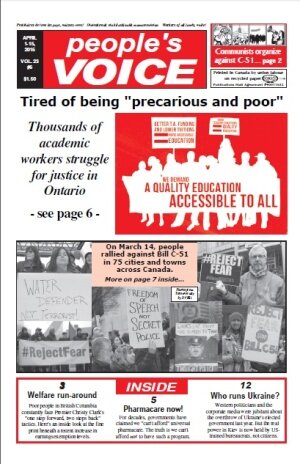
April 16-30, 2015
Volume 23 – Number 7 $1
Prolétaires de tous les pays, unissez-vous!
Otatoskewak ota kitaskinahk mamawestotan!
Workers of all lands, unite
Kimball Cariou on Bill C-51:
collective punishment
People’s Voice April 16-30, 2015
Concise Version
1) QUEBEC ANTI-AUSTERITY BATTLE HEATING UP
2) AN HISTORIC WIN AT YORK UNIVERSITY
3) COMMUNISTS ENTER ALBERTA ELECTION
4) CAMPAIGN TO STOP C-51 CONTINUES
5) HANDS OFF VENEZUELA, PRESIDENT OBAMA - Editorial
6) CSIS MUST BE DISMANTLED - Editorial
7) THE UNION-PEARSON EXPRESS: PUBLIC TRANSIT FOR THE RICH?
8) CLC WARNS C-51 THREATENS FREEDOMS
9) THERE IS STILL NO ALTERNATIVE: SCRAP BILL C-51
10) NO TO THE EXPANDED CANADIAN MILITARY MISSION IN IRAQ AND SYRIA
11) YEMEN: ECHOES OF 1930s AGGRESSION
12) CAPITALISM, ENVIRONMENTAL CRISIS, AND SOCIALISM
13) MULCAIR ENDORSES ANTI-COMMUNIST MONUMENT
PEOPLE'S VOICE APRIL 16-30, 2015 (pdf)
|
To order a copy send $15 (includes package and handling) to People’s Voice, 706 Clark Drive, Vancouver, BC, V5L 3J1. Contact us at 604-255-2041 or pvoice@telus.net for bulk order prices. |

|
People's Voice deadlines: May 1-15 May 16-31 Send submissions to PV Editorial Office,
|
REDS ON THE WEB
http://www.parti-communiste.ca/
peoplesvoice.ca
www.ycl-ljc.ca
www.solidnet.org
|
People's Voice finds many "Global Class Struggle" reports at the "Labour Start" website, http://www.labourstart.org/. We urge our readers to check it out! |
* * * * *
People's Voice
Canadian Publications Mail Sales Product Agreement #205214
ISSN number 1198-8657
People's Voice is published by
New Labour Press Ltd
PV Editorial Office
706 Clark Drive,
VANCOUVER, B.C. V5L 3J1
Phone:604-255-2041
Fax:604-254-9803
email: pvoice@telus.net
Editor: Kimball Cariou : Business Manager: Hassan Azimikor
Editorial Board: Kimball Cariou, Miguel Figueroa,
Doug Meggison, Naomi Rankin, Liz Rowley, Jim Sacouman
* * * * * *
Letters
People's Voice welcomes your letters
on any subject covered in our pages.
We reserve the right to edit for length and clarity,
and to refuse to print letters which may be libellous
or which contain unnecessary personal attacks.
Send your views to:
"Letters to the Editor",
706 Clark Dr., Vancouver, BC V5L 3J1,
or pvoice@telus.net
People's Voice articles may be reprinted without permission,
provided the source is credited.
* * * * * *
The Communist Party of Canada, formed in 1921,
has a proud history of fighting for jobs, equality, peace,
Canadian independence, and socialism.
The CPC does much more than run candidates in elections.
We think the fight against big business and its parties
is a year-round job,
so our members are active across the country,
to build our party and to help strengthen people's movements
on a wide range of issues.
All our policies and leadership
are set democratically by our members.
To find out more about Canada's party of Socialism,
give us a call at the nearest CPC office.
* * * * * *
Central Committee CPC
290A Danforth Ave Toronto, Ont. M4K 1N6
Ph: (416) 469-2446
fax: (416) 469-4063 E-mailmailto:info@cpc-pcp.ca
Parti Communiste du Quebec (section du
Parti communiste du Canada)
5359 Ave du Parc, Montréal, Québec,
H2V 4G9
B.C.Committee CPC
706 Clark Drive, Vancouver, V5L 3J1
Tel: (604) 254-9836
Fax: (604) 254-9803
Edmonton CPC
Box 68112, 70 Bonnie Doon P.O.
Edmonton, AB, T6C 4N6
Tel: (780) 465-7893
Fax: (780)463-0209
Calgary CPC
Unit #1 - 19 Radcliffe Close SE
Calgary AB, T2A 6B2
Tel: (403) 248-6489
Ottawa CPC
Tel: (613) 232-7108
Manitoba Committee
387 Selkirk Ave., Winnipeg, R2W 2M3
Tel/fax: (204) 586-7824
Ontario Ctee. CPC
290A Danforth Ave., Toronto, M4K 1N6
Tel: (416) 469-2446
Hamilton Ctee. CPC
265 Melvin Ave., Apt. 815
Hamilton, ON.
Tel: (905) 548-9586
Atlantic Region CPC
Box 70 Grand Pré, NS, B0P 1M0
Tel/fax: (902) 542-7981
* * * * * *
News for People, Not for Profits!
Every issue of People's Voice
gives you the latest
on the fightback from coast to coast.
Whether it's the struggle for jobs or peace, resistance to social cuts,
solidarity with Cuba, or workers' struggles around the world,
we've got the news the corporate media won't print.
And we do more than that
- we report and analyze events
from a revolutionary perspective,
helping to build the movements for justice and equality,
and eventually for a socialist Canada.
Read the paper that fights for working people
- on every page, in every issue!
People's Voice
$30 for 1 year
$50 for 2 years
Low-income special rate: $15 for 1-year
Outside Canada $50 for 1 year
Send to: People's Voice, 706 Clark Drive, Vancouver, BC, V5L 3J1
You can call the editorial office at 604-255-2041
<pvoice@telus.net>
REDS ON THE WEB
www.communist-party.ca
peoplesvoice.ca
www.ycl-ljc.ca/
http://solidnet.org/
http://www,rebelyouth-magazine.blogspot.com
1) QUEBEC ANTI-AUSTERITY BATTLE HEATING UP
By Johan Boyden
Mobilizations to stop the austerity measures of Philippe Couillard’s Quebec Liberal government got a boost in late March, after a meeting of the Front Commun, the Common Front of Quebec public sector trade unions. Then the student movement brought over 70,000 protesters into the streets on April 2, its largest mobilization since the 2012 strike.
In late March, the Liberal budget presented by Couillard’s finance minister Carlos Leitao ended any illusions that negotiations could lead to a victory for public sector unions. Calling the budget “austerity at light speed,” and a gift to big business, the labour movement condemned the proposals including a two-year wage freeze. On March 31 the Front Commun concluded further negotiations would be a dead-end and began mobilizing for a strike.
Starting from April 1, Quebec labour law requires that the Front Commun unions undertake three months of negotiations in each sector and workplace before they can actually strike. During this time, core essential services will be defined through a series of complicated, intricate formulations. In parallel, the Minister of Labour will also have to formally appoint a mediator before there can be a strike.
Student action
At the same time, a series of student actions have taken place, with twice-daily mobilizations by thousands in the streets. A broad range of departments are in action, such as medical students. Some colleges have been on strike for two weeks.
The Liberals apparently demanded the police forces bring down a fist on these demonstrations, culminating in one young woman, Naomi Trudeau-Tremblay, being shot at point blank range in the face with a tear gas canister. In the wake of public outrage, police activity has been more cautious. The Universities are now bringing injunctions against the strike and expelling student activist leaders.
Nevertheless, on April 2, about 160,000 students declared a strike (including some English-language schools like Vanier College and McGill Law Students Association).
About 75,000 students flooded the streets of Montreal in another long march through the city. Protestors were joined by labour, Quebec Solidaire, other social groups including the Parti Communiste and the Ligue de la jeunesse communiste du Québec.
Which way forward?
Many union leaders appear somewhat reluctant to adopt the strategy of a political strike, which could potentially lose control of their negotiations by politicizing them. “The more social democratic leadership of labour does not seem so upset that the students have been pushing ahead quickly to action - as it has accentuated the cleavages between the unions and students,” Pierre Fontaine told People’s Voice.
Fontaine, a long time trade unionist and the leader of the Parti Communiste du Quebec, noted that many sections of the students take the same view.
“They are, you could say, two sides of the same coin,” he said. “That is not to say the students have unjustified suspicions about uniting with labour,” he added, noting it appears that some anarchist voices within the students “desire to keep the leadership of the protest movement, irrespective of the political conditions and the workers current demands.”
In reality, however, Fontaine said, “the public sector union negotiations are the core part of the austerity fightback and the working class will not be able to defeat austerity without winning these negotiations.”
In this situation, the working conditions fixed by collective agreement are important tools of working people against austerity. “The Liberal government is seeking to wipe out these obstacles, and there is a clear link between these tools and the broader struggle,” Fontaine said.
In 2012, the common denominator of mass protest was tuition fees. This issue developed into a political struggle. In 2015, Fontaine said, the common denominator is wages. “The government is very afraid of a repeat of the Common Front of the 1970s,” he added, recalling that it was widely recognized at the time how the struggle of labour had become a political struggle.
Strategic differences
All this time the students had not resolved the more long-term strategic goal of their actions. One proposal came forward to make a “strategic retreat,” continuing street actions but going back to class to pick up the student strike actions in the fall with labour.
Opponents, including voices like Printemps 2015 who aim to recreate the spirit of 2012, condemned the “retreat” as over-generously trusting labour to put up a militant fight. Many supporters are in student unions from metropolitan Montreal, where most of the action is taking place.
Proponents of the “strategic retreat” include the 2014-2015 semester executive of the Association of Student Union Solidarity (ASSÉ), who argued that without labour the students will be acting in isolation and their momentum, as in 2012, could fall apart in the summer when the current school semester concludes.
By the end of the first week of April, the CSN Montreal had convened a general assembly, and ASSÉ concluded a weekend-long congress. Both meetings hammered out tactics and strategy, with sharp differences of opinion coming forward.
By the evening of April 6, the news came out that not only had ASSÉ’s entire executive resigned but the congress subsequently also “symbolically removed” them. Acting spokesperson Hind Fazazi, who will work in an interim leadership role until another congress at the end of April, announced continued pressure tactics and the strike. (Her acting press secretary will be Maxence Valade, who lost an eye from police brutality in 2012.)
While the student strategy is certainly consequential, it appears labour remains the decisive factor for this anti-austerity battle. More and more, the movement is talking about revenue sources such as more progressive taxation, reinstating capital tax for banks and financial companies, and increasing the corporate tax rate.
But when embarking in late March on a potential fall strike plan, the Front Commun objectively is calling for a political strike.
2) AN HISTORIC WIN AT YORK UNIVERSITY
By Sam Hammond
In the previous issue of People’s Voice, we were forced to leave our reporting of the massive TA and GA strikes at U of T and York Universities in mid-stroke. At our publishing deadline, the spotlight was on the U of T, while negotiators at York, although engaged as we will see, were relatively silent.
On March 20, about 1600 strikers from U of T voted by a narrow 50-vote majority to put the administration’s latest offer to a ratification vote. The offer was not recommended because the negotiating committee was not unanimous. Over the weekend of voting on March 21-22, the offer was turned down by a narrow majority of 112 votes. Clearly the struggle was polarizing not only the negotiators, but the membership as well. The next offer of accepting binding arbitration was recommended by the negotiating committee, and accepted by a healthy majority on March 26. The strike was over, but not the struggle. You might safely say that the militant members of CUPE Local 3902 had fought the U of T to a dead heat, a significant accomplishment.
At York University, where CUPE Local 3903’s 3,700 members walked off the job on March 3 and turned down previous tentative offers, there was a landmark breakthrough that has been described from “significant victory” to “York U capitulation”.
Directly from the Union’s webpage we quote….
“The Employer has agreed to tuition offset language, indexed to 2012 rates. This means that if tuition fees for domestic or international students rise above 2012 rates – which are the same as the 2005 rates – the University will increase funding for all in-program and incoming students to offset the tuition fee increase.
“It also means that the international students will receive increased funding equal to the amount of the recent international student fee increases. In brief, this means the Employer has agreed to the substance of the Union’s tuition indexation proposal.
“The Employer has agreed to make LGBTQ an employment equity group, and agreed to the Union’s proposal to meet with the Union at the Employment Equity Committee within three months of ratification to begin the implementation process.
“For Unit 3, the Employer has agreed to increase summer minimum funding from $1,750 to $3,000, in addition to previously agreed-to Graduate Financial Assistance and wage increases. This represents a further increase of $750 over the Employer’s last offer, an increase of over 70 per cent.
“On the question of the back-to-work protocol, the Employer has agreed to pay all Unit 1 and Unit 3 members 100 per cent back pay for the time on strike.”
And further from Local 3903, “The last three weeks of our struggles have been an incredible source of energy: undergraduates, other unions on campus, and many social justice organizations have walked the lines with us; our Unit 2 (contract faculty) members have continued to support their Union comrades; the media has started to take seriously the problems in the University sector; our comrades at CUPE 3902 at the University of Toronto marched for four hours between our two campuses in an act of extraordinary solidarity.”
Solidarity. The essential ingredient, the catalyst of determination. Despite being instructed to resume teaching, some professors in departments such as film, political science, environmental studies, sociology and equity studies had refused to work until all striking workers had a deal.
The students and their organizations were solid. There was a proliferation of “open letters” of support from faculty and even administrators, and even some fair media coverage.
What was won at York will certainly be a dilemma for the “impartial” arbitrator at U of T, as the solidarity goes full circle and puts the spotlight back where it began. It is hard to analyze just how profound this victory is. The solidarity that fuelled it was not the stuff of idealistic altruism, but rather a pragmatic reaction to the attack on post-secondary education by the same neo-con agenda that is rapidly dismantling our social services and privatizing everything that moves.
Part of the newly negotiated York University agreement stipulates that the Union and the University will collaborate on joint submissions on funding to the Ontario government. Why would this be so important as to warrant formal language in a Union agreement?
From the Globe and Mail of March 12: “Employers and industry groups will be included in negotiations leading to a new funding formula for universities in Ontario, the provincial government announced Thursday… Late last summer, Ontario signed strategic mandate agreements with each of the province’s 44 universities and colleges, deals aimed at focusing each school on its strengths and reducing duplication across the system. Everything, including how tuition is set, will be on the table as part of the funding review, ministry officials said.”
“Employers and industry groups”, wow! They will now sit at the table and decide on “strengths”, “reducing duplication”, “how tuition is set” and “funding review”. This is the “lean and mean” doublespeak of austerity, cutbacks and the acceleration of assembly-line training, and research for corporate needs. No wonder academics are alarmed. God forbid there should be extravagant duplication of Tolstoy or Mark Twain when important research on good money-makers like fracking are needed. Gender studies, First Nations' languages, equity? How wasteful.
Beneath the ivy-clad image of gothic archways and smooth waters of tranquil meditation, there exist the violent undercurrents of struggles for and against the neo-liberal corporate agenda as it penetrates the universities. The struggle for that agenda is expressed in the Globe and Mail quote. The struggle against it is expressed by the unionized TA’s, GA’s, and Contract Faculty, in solidarity with the most progressive academics at all levels, the labour movement, First Nations and social justice groups.
Hurrah for CUPE and for this historic win at York University.
3) COMMUNISTS ENTER ALBERTA ELECTION
PV Alberta Bureau
Alberta politics are heating up this spring, with a May 5 provincial election now underway.
While pundits differ in their readings of the past year, it has been something of a rollercoaster ride for the two big right-wing parties, the Conservatives and Wildrose, allowing new space for the Liberals and especially the New Democrats. On the left, the Communist Party-Alberta is also gearing up to run two candidates asking the main social and ecological question facing the province: who owns and controls the oil and gas sector of Alberta’s economy?
Tory Dynasty vs Wildrose
Just three years ago, Alison Redford helped win another re-election victory for the Conservatives. In power without interruption since 1971, the party has a proven track record of fully supporting its friends in big business. But in the last few years a new right-wing challenger emerged in the form of the Wildrose Party, whose ranks include Western regionalists, Christian fundamentalists, homophobes, libertarians as well as other far-right voices.
The Tory dynasty has also seen the two major cities, Edmonton and Calgary, increase in population and change in social character through immigration and the weakening of ties to Alberta's agricultural roots. This is reflected in the relative strength of Liberal support in corporate headquarter Calgary, and NDP support in the somewhat more industrial Edmonton.
Enter the bank manager
In March 2014, Redford resigned amid scandals and was replaced by Jim Prentice as party leader and Premier. People’s Voice readers will no doubt remember Prentice as a former Harper Conservative MP who left federal politics in 2010 to act as an executive for the CIBC bank.
Last November and December, twelve Wildrose MLAs, including their leader, crossed the floor to join the Conservatives. The move provoked widespread indignation on the right, which together with disenchantment over the latest provincial budget was enough to bring the remnant Wildrose party neck and neck with Tories in the most recent polls.
Prentice postponed a winter budget sitting due to falling global oil prices, and floated the idea of a sales tax. In fact, the budget tabled in March does contain some minor tax increases (including a so-called “Waiting Room tax”) but mainly reflects the upside-down logic that the province faces a spending crisis, not a revenue problem, cutting over a billion just from health care alone.
CP Alberta candidates
Coming out solidly against these neo-liberal cuts will be the Communist Party–Alberta, running two candidates with a people’s agenda platform.
Naomi Rankin, the party's provincial leader, will run in Edmonton Mill Woods. Rankin is a retired computer programmer who has been a political activist in peace, women's and social justice groups since she was a teenager.
Joining her in the campaign is Bonnie Devine, in the working class riding of Calgary East. A telecommunications worker, Devine is the past-president of her union local and a prominent anti-racist activist.
“Conservative governments have failed to charge normal royalties on resources, and they have cut corporate taxes again and again, as well as replacing progressive income tax with a flat tax favouring the rich,” the Alberta CP’s election platform says. In the opposite direction, the Communist platform proposes quality, affordable social housing; restoring public funding to health care and rolling back privatization; a universal, accessible, affordable, and public childcare program; as well as free post-secondary education.
“People across Alberta are justifiably outraged by the opportunism of the right wing parties and their squandering of Alberta's wealth over the past decades,” Naomi Rankin told People’s Voice. “Albertans shouldn’t be forced to choose between the parties of big business,” she said, adding that the Tories operate a “take the money and run” economy.
Figuring large in the Communist platform are the needs of people and nature, such as progressive taxation; job creation by diversifying the economy and expanding public ownership; labour and workers rights; expanded equality and democratic rights for all Albertans; a new financial deal for cities; support for family farms; and a safe and healthy environment.
Alberta needs to “move away from dependence on resource extraction to valued added processing,” “bring the energy industry under public control,” and “Halt new development of the Athabasca bituminous tar sands, phasing-out these operations with jobs guaranteed for workers at equivalent wages and benefits,” the platform says. It also proposes free public municipal Wi-Fi services for cities, and lower utility rates with ecology pricing that rewards conservation.
People’s Voice will feature more reports about the election campaign. The Alberta CP’s website is online now and being updated, at www.communistparty-alberta.ca.
4) CAMPAIGN TO STOP C-51 CONTINUES
PV Montreal Bureau
After the Conservatives’ proposed amendments, the Communist Party campaign against Bill C-51 is continuing with mobilizations for the second round of cross-Canada demonstrations on April 18, and a Stop C-51 speaking tour in British Columbia.
The BC tour will feature CPC central organizer Johan Boyden at events in Surrey, Kamloops, Kelowna and North Vancouver, together with People’s Voice editor Kimball Cariou in Vancouver, Victoria and Nanaimo. Local community organizers will speak at some of the events. (Readers can phone the PV office at 604-255-2041 for details.)
Calling the Bill “a war on democratic rights,” Boyden said the amendments show that public pressure works. “The Tories are warming up the Senate machine to fast-track the Bill,” he said, describing a pre-study process usually reserved for money bills with time-sensitive provisions.
“They are trying to pass the bill before it draws more attention,” he said, noting the Communist Party is fully supporting the April 18 actions, and making the link between Harper’s reactionary domestic policies and a foreign policy agenda of imperialist war.
One recent tour event took place in Montreal, where retired refugee and immigration lawyer Bill Sloan spoke after a showing of a new film called “The Secret Trial Five,” in which he is one of many people interviewed.
The film, which looks at the human impact of the so-called “War on Terror,” is a sobering examination of the Canadian government’s use of security certificates. This Kafkaesque tool allows for indefinite detention without charges, based on evidence not revealed to the accused or their lawyers. Security certificates have been used to detain five men for nearly 30 years combined.
“The powers [in Bill C-51] are open to abuse, and the police are known to abuse powers,” Sloan said, describing the legislation as “based on the same national security concept as was applied in the South American dictatorships in the 60s and 70s.”
As an international human rights activist, Sloan has visited many countries in Latin America, Africa and Asia. In 2001, as President of the American Association of Jurists, he testified at a parliamentary committee about Bill C-35, concomitant legislation to the first anti-terrorism law, Bill C-36.
“The first draft of Bill C-35 in 2001 [which was significantly amended in committee] would have given police similar kinds of powers we are seeing today in Bill C-51,” Sloan said, such as preventative arrest and increased surveillance powers.
Both anti-terrorism bills came in shortly after the events of 9/11, and the Quebec City protests at the Summit of the Americas in April 2001. Sloan was involved in defending activist Jaggi Singh and others detained at Orsainville prison after the massive anti-FTAA protests.
“When I visited inmates during the Summit of the Americas, every morning I would note the signatures of three FBI agents [who] spent their day interrogating people,” he told the parliamentary committee.
All this legislation owes its legal heritage to what Sloan called “the Brazilian doctrine - where everything is justified for national security, with a very wide and over-broad definition.”
He notes that C-51 could be described as building a kind of ante-chamber leading to fascism. “Of course, there are gradations,” he says. “It starts off with dirty tricks, then some go a little bad. But we already have cops abusing power and killing people.”
Sloan pointed to recent events in Newfoundland, where an investigation by the Premier’s protection squad led to the shooting death of Don Dunphy, who had made a vague violent threat on twitter. Dunphy described himself on twitter as “a crucified injured worker from NL Canada where employers treat injured like criminals.”
“If you give the police more power, they are not going to do less,” Sloan said, arguing that C-51 will create an organizational basis for the most dangerous and reactionary elements in the police forces, which are currently somewhat isolated, to further consolidate, coordinate and recruit.
Sloan’s message echos that of the Ligue des droits et libertés. In an interview with People’s Voice last month, Dominique Peschard, spokesperson of the Ligue, said the law violates both the Canadian and Quebec Charters, based on the international covenants for social and political rights.
“Acts which are prejudicial to the security of other states are also included in the bill. So people who promote the Boycott, Divestment and Sanctions campaign for Palestine, which the Canadian government has already said is a threat to Canadian security: does that mean that these people will be subjected to this law?” Peschard asked.
Former student leader Gabriel Nadeau-Dubois told the Canadian Press that Bill C-51 could have had a serious impact on the morale of the 2012 student strike, noting that the police crossed the line many times during that social protest movement. Québec Solidaire, the Parti Québécois, and Liberal Premier Philippe Couillard have also criticised the Bill. Last month the Parti Communiste du Québec was the only political party to sign on to a declaration of about 100 labour and community groups in Québec against C-51.
5) HANDS OFF VENEZUELA, PRESIDENT OBAMA
People’s Voice Editorial
World public opinion increasingly condemns President Barack Obama’s March 9th Executive Order declaring Venezuela “an unusual and extraordinary threat to U.S. national security.” In Venezuela itself, a huge campaign is underway to collect 10 million names urging repeal of this Order, and people in other countries (including Canada) are signing this appeal in solidarity. A powerful statement issued by the Community of Latin American and Caribbean States (CELAC), which represents all 33 countries in the region, calls for reversal of the Executive Order. The United Nations G77+China group of 134 countries has urged the U.S. government to open a dialogue with Venezuela based on respect for sovereignty and self-determination. The Union of South American Nations (UNASUR) representing 12 South American states, the Bolivarian Alliance of the Peoples of Our America (ALBA) representing 11 Latin American and Caribbean nations, and the Common Market of the South (MERCOSUR) have also issued powerful condemnations. Many parliamentarians have made similar statements, including over 100 British MPs (but sadly, none from Canada!).
Even prominent members of the Venezuelan opposition have spoken out. Henry Falcon, the governor of Lara State, told the U.S. President, “Let me express to you clearly that Venezuela can’t be considered a threat to any other nation on the planet. We have serious internal problems but we will solve them between Venezuelans.”
At the Summit of the Americas in Panama City on April 9-10, this issue will be at the top of the agenda. The days when the White House could topple or “elect” Latin American presidents with a casual flick of a finger are over. Canadians should pressure the Harper government to apologize for its attacks against Venezuela, and join the rest of the hemisphere in demanding that Washington respect the sovereignty and self-determination of other countries.
People’s Voice Editorial
As opposition builds against the Harper government’s Bill C-51, supporters of this police state legislation increasingly fall back on a few tattered lines from the PM’s message box. Perhaps the most common tired justification is that CSIS needs to break the shackles of “red tape” and “bureaucratic oversight.” It’s an argument straight out of reactionary U.S. movie and TV dramas, where highly-principled federal agents make sad but necessary decisions to torture and murder suspects for the greater good.
The Harperites and their U.S. allies steadfastly maintain that to “protect freedom” the state must use an ugly combination of torture, drone missile executions, massive surveillance of all forms of communication, suspension of civil liberties, and thuggish threats against critical voices. Real life, of course, is very different. Overwhelming evidence going back centuries indicates that torture almost never yields reliable intelligence information, and that regimes which rely on this tactic base their actions on falsehoods.
The latest revelations about Canadian citizen Maher Arar are convincing proof that the fascist security agenda is utterly flawed. Former CIA officer John Kiriakou has shed new light on this tragic episode in a media interview, indicating that he and others correctly warned that the agency was punishing an innocent man. The Arar affair ultimately resulted in a public inquiry, and a $10-million payout from the federal government for its shameful participation in his arrest, rendition and torture.
But many other victims have yet to win justice. Under Bill C-51, the net will be cast even wider, by gangs of unmonitored secret agents. Those who argue that we simply need “better oversight” are either completely naive, or are cynically covering up for the security establishment. C-51 must be defeated (or rescinded as soon as possible) and CSIS itself must be dismantled to protect our civil liberties and democratic freedoms.
7) THE UNION-PEARSON EXPRESS: PUBLIC TRANSIT FOR THE RICH?
By David G., Toronto
Metrolinx, the Ontario provincial transit agency, has unveiled the new Union-Pearson Express (UPE) train, which will run from Pearson International Airport to Union Station in Toronto. Service will start in May, a month before the Toronto 2015 Pan-Am Games, which are already controversial for overspending problems and the lack of proper infrastructure.
The Games will cause traffic jams across Toronto, affecting the city's aging infrastructure. Recently, the TO2015 executive CEOs have been found guilty of overspending their budget, after Ontario taxpayers’ money went for expensive limousine rides and luxuries such as designer shirts. This is one of many controversies that the TO2015 committee got itself into in the recent months.
The UPE will run every 15 minutes, taking passengers from Union Station to Pearson in just 25 minutes. But here is the catch: an adult one-way ticket will be $27.50 ($19 if you have a Presto card). Approved by the Wynne government in December 2014, these are the most expensive ticket prices for an airport express in North America. The Canada Line linking Vancouver’s airport to downtown, built in 2010, costs $9 one-way. The Airport rail link in Chicago costs $5 one-way.
This has outraged many Torontonians, since transit prices and the cost of living here have skyrocketed over the past decade. The CBC recently reported a poll showing that two-thirds of Torontonians think the price for the new UPE train is too expensive. NDP MPP Cheri DiNovo has criticized the UPE, saying that “it should not be an executive boutique for business travellers”. Why did the Ontario Liberal government and Metrolinx pour $456 million into a transit line for the privileged elite? Because according to Metrolinx, “business travellers are the demographic”.
This ignorant, one-sided statement and fails to mention that the vast majority of residents in the Toronto area who take public transit are, like myself, people of all kinds who travel everyday on buses, subways and streetcars.
What demographic group does the Union-Pearson Express serve? This Liberal boondoogle obviously doesn't serve the people who regularly use public transit. This express line doesn't serve the workers at Pearson Airport who make minimum wage, nor will Metrolinx give them any discount for the UPE. According to union reps at Pearson, between 10,000 to 15,000 airport workers live in Toronto. Martin Smith, President of CUPE Local 4047 says that “if the fares aren't affordable, the public will not use the Union-Pearson express.”
The prices for the Union-Pearson Express are unjustifiably expensive for the majority of the people in Toronto. This will not benefit anyone except the wealthy. The Communist Party will continue to fight for affordable transit everywhere in Canada, by demanding reduced fares!
8) CLC WARNS C-51 THREATENS FREEDOMS
The Canadian Labour Congress says that Bill C-51“threatens to undermine the very freedoms the government claims it wants to protect.”
“Canadians agree that terrorism is a threat and the government has a responsibility to safeguard public safety, but it has not justified why it cannot do that using the existing criminal code,” said CLC president Hassan Yussuff in a statement prior to his March 25 appearance before the House of Commons Public Safety Committee. “This bill appears to be more about political posturing ahead of a political election than it is about better protecting public safety and our democracy.”
What’s worse, he said, the bill is being rushed through without adequate debate and consultation.
“We are alarmed that the government has blocked Canada’s Privacy Commissioner and former Prime Ministers from testifying before the parliamentary committee hearing evidence on the bill,” said Yussuff.
The CLC represents 3.3 million workers and an increasingly diverse membership that includes workers from Muslim and other communities who are being targeted by this bill and the rhetoric being used to promote it.
“We remember too well how after the attacks of 9/11, CSIS and the RCMP harassed many Muslims and workers from other racialized communities in their workplaces, resulting in job losses and harassment by employers and co-workers,” said Yussuff. “We are opposing this bill on behalf of those communities and because if passed into law it will compromise the rights of all our members and all Canadians,” he added.
The Labour Congress has presented a list of “what’s wrong with Bill C-51", including:
* It goes well beyond working to stop genuine security threats, giving CSIS and the RCMP far-reaching new powers, lowering the threshold for preventative arrest and expanding the notion of what constitutes a threat to national security.
* It leaves peaceful work stoppages, wildcat strikes, and other forms of nonviolent civil disobedience that may be deemed unlawful, susceptible to far-reaching interference and disruption by the RCMP and CSIS. Think of the peaceful yet “unlawful” activism that won women the right to vote in Canada, ended racial segregation in the US and defeated Apartheid in South Africa.
* It exacerbates an already serious lack of oversight and review of CSIS, the RCMP and other agencies tasked with national security work.
* This bill introduces a new criminal offense for “advocating” or “promoting” the commission of a terrorism act – terms that could be interpreted very subjectively. This could impact freedom of speech, freedom of opinion, freedom of the press and academic freedom.
* It allows CSIS to contravene the Charter of Rights and Freedoms and other Canadian laws.
9) THERE IS STILL NO ALTERNATIVE: SCRAP BILL C-51
Statement by the Central Executive Committee, Communist Party of Canada, March 31, 2015
Growing public pressure has compelled the Harper Conservative government to make a handful of minor amendments to Bill C-51, while rejecting all changes proposed by the opposition parties in Parliament. This tactical retreat shows that further mass opposition outside Parliament can help slow the anti-democratic and pro-war “security state” agenda of this government. The Communist Party of Canada maintains that these amendments are completely inadequate, and that Bill C-51 remains fundamentally flawed and must be scrapped.
Until now, the Conservatives had denied any need to modify C-51. Clearly they did not expect such an impressive range of public opposition, including from significant parts of the ruling class who are uncomfortable with the Conservatives’ sharp shift towards authoritarianism.
While the minor amendments are designed to allay the fears of a few critics, the underlying assumptions behind the Bill remain in place. The Conservative amendments do not affect the most dangerous aspects of Bill C-51, which empower the state and its repressive and spying apparatus much wider authority to track opposition voices, and to treat Charter rights as secondary to so-called security concerns. In particular:
Removing the word “lawful” from the section listing exemptions to the new counter-terror measures will not stop the RCMP and CSIS from monitoring protests. The Toronto Star revealed on March 29 that the Government Operations Centre received reports on more than 160 protests, community events, and demonstrations between May 2014 and February 2015;
Clarifying that CSIS agents (newly empowered to “disrupt” potential threats) will not be able to make arrests, does not change the reality that this mandate creates a basis for the most reactionary elements within police forces to inflict actions such as those taken at a March 27 student protest in Quebec, where Naomi Trudeau-Tremblay was shot at point-blank range with a tear gas canister;
The “disruption” power allows almost any “dirty trick” to be carried out by CSIS, and there is little question that these powers will be abused. The powers include detention, which is most likely to be used to “detain” people abroad - and, if the political will exists, also in Canada.
Despite the government’s claims, this legislation is really not about ISIS, or about stopping terrorism and preventing “radicalization”. Bill C-51 must be understood in the context of labour militancy against austerity measures, the student strikes in Quebec, struggles against tar sands extraction and fracking, grassroots movements such as Idle No More and Occupy, and growing interest in revolutionary alternatives to capitalist crisis, including the Communist Party and the Young Communist League, which have been targets of state repression on many previous occasions. This legislation is intended to move Canada in a reactionary and even fascist direction, by legalizing state terrorism, at home and abroad.
In our view, C-51 must be seen in the broader context of the increasingly reckless, aggressive policies of the Canadian state to engage in wars and occupations which will have unpredictable and very destabilizing long term global impacts. A clear example is the extension of the “mission” in Iraq, which will involve a protracted ground war, and expands Canadian bombing missions into Syria.
The Conservatives must be made to pay a severe political price for enacting these reactionary laws. The people’s forces should take inspiration from the broad outpouring of criticism against Bill C-51, and the resulting achievement of some push-back. Now is the time to step up this urgent fight, and to go further. We call on the people’s forces to continue mass education of the public on these issues, and to build popular protest and visible opposition, especially around the next Day of Action which will take place on April 18.
No Pasaran, Bill C-51!
10) NO TO THE EXPANDED CANADIAN MILITARY MISSION IN IRAQ AND SYRIA
Statement by the Central Executive Committee, Communist Party of Canada, March 31, 2015
The Communist Party of Canada condemns the Harper government’s one-year extension of Canada’s participation in the latest imperialist war in Iraq, which will expand this military mission into neighbouring Syria without the agreement of the elected government of that sovereign country. This is a clear violation of international law and the UN Charter. As with previous military actions in Korea, Yugoslavia, Afghanistan and Libya, this move is yet another undeclared war.
As our Party and others predicted last fall, this mission quickly went far beyond the so-called “bombing and training role” to include direct combat operations. Clearly, this extension shows that Canada is on the way to another disastrous Afghanistan-style war of occupation, ultimately costing billions of dollars and thousands of Iraqi and Syrian lives. The federal government recently claimed that the mission had cost $122 million as of February; this understated figure of about $30 million per month does not include many related expenses, but does indicate that the cost of the expanded mission can be expected to go far higher.
Predictably, the Tories call this a “humanitarian” war to “protect the women and children”. But there is overwhelming evidence that the “Responsibility to Protect” doctrine has instead inflicted enormous damage upon civilian populations. The long list of R2P victims include the thousands killed in NATO’s bombing of Yugoslavia in 1999, countless Afghan civilians, and the million or more Iraqis dead in the wake of the 2003 US-UK invasion.
Four years after “Operation Freedom Falcon” in Libya, violent social, economic and political crises have resulted from the illegal bombing and “regime change”. As imperialism plunders the country’s energy resources, war hawks are now openly discussing a second intervention against ISIS-linked groups in that country.
In Iraq and Syria, Canadian troops are helping to further imperialism’s so-called ‘New Middle East strategy’ which aims to turn the entire region into a patchwork of weak and compliant mini-states kept in check, in part, by its local ally Israel, with Turkey, Saudi Arabia and Qatar as secondary, supportive powers.
Involving Canada in the modern day crusades led by US imperialism and other NATO allies only deepens regional conflicts and humanitarian crises. The most significant terrorist threat today is posed by the U.S., British, Canadian and other governments, which have killed millions of innocent people with a vast range of deadly modern weaponry, ranging from Cruise missiles to drone bombs. These are the same imperialist powers which count the reactionary fundamentalist regimes of the oil-rich Gulf states and Saudi Arabia as close and valued allies.
It was US imperialism which encouraged and financed the Taliban, Al Qaeda, ISIS and other such groups for its own ends, only to later whip up fear and hatred against these same reactionary forces. This cynical game of switching “allies” and “enemies” brings enormous profits to the military-industrial corporations, but only death and destruction to working people.
The Communist Party of Canada rejects the “Responsibility to Protect” doctrine as a cover for direct imperialist intervention and military aggression in the Middle East and other regions. We demand Canada’s complete withdrawal from NATO and US-led military interventions, starting with the expanded war in Iraq and Syria. We call upon the labour and democratic forces, and especially the anti-war movements, to step up opposition to the Harper government’s war-making, and to help win a new foreign policy of peace and disarmament, just political settlement of armed conflicts, respect for national sovereignty, withdrawal from NATO, an end to imperialist military alliances and interventions, and for universal global nuclear disarmament.
11) YEMEN: ECHOES OF 1930s AGGRESSION
By Finian Cunningham, March 31, 2015, Information Clearing House
Both the Arab League and the United Nations have fully transformed themselves into the ill-fated League of Nations that more than 70 years ago disgraced itself into oblivion when it failed to condemn foreign aggressions that eventually led to the cataclysm of World War Two.
As delegates gathered in Egypt’s resort city of Sharm el-Sheikh for the Arab League on the March 28-29 weekend, nearly half of its member states were at the same time openly engaged in an aerial blitz on one of the League’s weakest countries – Yemen.
Far from issuing any misgiving, or appeal for restraint, the League fully endorsed the onslaught on Yemen and even went on to call for a new “unified military force” to repeat the action in other countries where a “security risk” is deemed. This is a cart blanche for further foreign military interventions bypassing the United Nations Security Council. In other words, it is open season for lawless aggression.
With a population of only 24 million and half of them living in poverty, Yemen is one of the poorest countries in the Arab region. It is also one of the founding members of the Arab League, which was formed in 1945 at the end of the Second World War.
Scores of Yemeni civilians, including children, have been killed in a massive bombing campaign led by Saudi Arabia and co-ordinated by the United States. The bombing coalition of 10 countries include Egypt, North Sudan, Morocco and the Persian Gulf Arab states of Qatar, United Arab Emirates, Kuwait and Bahrain. More than 200 fighter jets from those countries have been reported carrying out air strikes on the Yemeni capital, Sanaa, as well as on the southern port city of Aden and surrounding countryside.
Saudi Arabia and other Sunni Arab countries claim that the Houthi-led uprising in Yemen is being orchestrated by Iran. But the claims are far from substantiated and most likely trumped-up for self-serving reasons of providing justification for what is otherwise simply criminal aggression toward Yemen. The Washington Post reported: “The Saudis and their allies think [sic] that the Shiite rebels are backed by Iran and that Tehran is trying to exert control over a country [regime] that has been an ally of Riyadh and Washington.” The latter factual detail about the erstwhile Yemeni regime being an ally of Riyadh and Washington is the real key to the latest Saudi-led offensive, not the speculative hearsay about Iran.
So, Yemen is being bombed and civilians are being massacred merely because the Saudis and their allies “think” that Iran is somehow involved. No proof, no legal case, just bombs away.
The Houthis are a Shia sect and reportedly maintain friendly political, diplomatic relations with Shia Iran. But both parties categorically deny any military involvement. Rather, the Houthis, also known as Ansarullah, appear to be the vanguard of popular rebellion against the ousted Yemeni regime that was long-supported by Saudi Arabia and the US. On March 25, the deposed president Abdel Rabbo Mansour Hadi fled the country to take refuge in Saudi Arabia. Even if Iran was supporting the Houthis that still does not legitimise an all-out bombing of Yemen led by a consortium of Arab monarchies armed and guided by the US.
In Sanaa, family homes, shops and offices have been demolished during hundreds of sorties by warplanes as the Saudi-led coalition pounded the city on nightly raids. Yemen’s international airport was so badly hit it is no longer functioning, thus cutting off the country. A naval blockade by Saudi, Egyptian and US warships has also severed Yemen’s access to the Red Sea to its west. While in on the southern coast, in Aden, bodies of civilians were reportedly strewn on streets as hospitals filled up with the wounded, and as US warships patrolled the Gulf of Aden.
Against this background of slaughter, the Arab League endorsed the Saudi-led military attacks. Saudi King Salman told the summit that the bombing campaign would continue until Houthi rebels are defeated. Meaning there is no end in sight to the onslaught. Indeed, it is now anticipated that the extensive aerial bombardment and naval siege is paving the way for a massive ground invasion of 150,000 Saudi troops mobilised along the northern Yemeni border.
Attending the Arab League convocation, and royally received, was the discredited president of Yemen, Mansour Hadi. He called on the Saudi military coalition to not relent in its strikes against his own country until the Houthi “Iranian stooges” are crushed. The irony is that Mansour Hadi is widely excoriated within Yemen, and not just by the Houthis, as a stooge of Saudi Arabia and Washington. His steadfast refusal to deliver on popular demands for a democratic transition in Yemen over the past three years led to the Houthis seizing the capital and government institutions at the end of 2014.
The latest Saudi-led military intervention in Yemen, overseen by Washington, has been condemned by Iran, Russia and China.
But the United Nations has shown lamentable passivity in the face of this foreign aggression on Yemen. Speaking at the Arab League summit, UN secretary general Ban Ki-Moon failed to make any condemnation of the aerial bombardment of that country.
“It is my fervent hope that at this Arab League summit leaders will lay down clear guidelines to peacefully resolve the crisis in Yemen,” said Ban Ki-Moon with a complacency bordering on cynicism. He urged Arab members to engage in peace talks supposedly brokered by his special envoy, Jamal Benomar. This was said while Saudi Arabia and others were openly vowing to continue their blitzkrieg.
The naked aggression on Yemen, with the complicity of the US and European capitals, is perhaps the nadir for the Arab League and the United Nations. The descent of these organisations into disgraceful irrelevance has been decades in the making. The despicable transformation into tools of aggression is now clear in the eyes of the world.
The UN and the Arab League have remained silent while the US and its allies launched war after war on countries over the past two decades, most notably on Iraq during the 1990s and 2000s, which resulted in over one million dead, mainly civilians. Worse, the UN and the Arab League stand accused of complicity by giving Washington a de facto green light – and on some occasions logistical support – to wage its wars across the Middle East.
In 2011, the Arab League expelled Libya and Syria, even though these countries were being subjected to US-NATO aggression, along with the collusion of Saudi Arabia and other Gulf Arab states, including Qatar and the United Arab Emirates. Libyan leader Muammar Gaddafi, who was murdered by NATO-assisted and Gulf-financed extremists in 2011, denounced the Arab League before his death as “finished”.
Syria, as with Yemen, was one of the founding members of the Arab League, yet the government of President Bashar al Assad remains to this day suspended from the 22-member organisation. The Syrian government’s seat has been given over to the Western-backed Syrian National Council which is comprised of non-entity exiles who have no popular mandate within Syria.
The League is thus nothing more than a self-serving talking shop dominated by Saudi Arabia and the other oil-rich Gulf Arab kingdoms. As client regimes of Washington, that in turn makes the League a tool of the US to give a thin cover for its imperial predations in the Middle East and North Africa. Ironically, one of the founding principles of the Arab League is to protect the “sovereignty and independence” of its members.
Ominously, the lawlessness and outright aggression that has gripped international affairs – with the latest manifestation in the collective bombing of Yemen – is reminiscent of the 1930s.
That perilous period saw a series of international aggressions carried out by fascist powers with impunity. The League of Nations – a forerunner of the United Nations – facilitated these aggressions through its shameful silence and connivance. When Japan annexed large swathes of China’s Manchuria in 1931, the League of Nations, including the US, Britain and France, largely turned a blind eye. As they did when fascist Italy bombed its way into Abyssinia (Ethiopia) in 1935-36, Franco’s Spain subjugated Catalonia in 1938, and Hitler’s Nazi Germany annexed Austria and Czech Sudetenland, also in 1938.
The complete breakdown in any semblance of international law during the 1930s and the rise of state-sponsored gangsterism paved the way for the Second World War.
A similar process of degeneration is also well underway in the present day, led largely by the US and its coterie of allies among the NATO alliance and oil-rich Arab dictatorships. Iraq, Afghanistan, Libya, Syria, Ukraine and Yemen are but some of the evil fruit from the poison that is coursing through international relations. And yet, ludicrously, Washington accuses Putin and Moscow of behaving like Hitler with a malign 20th Century atavism.
That a defenceless, impoverished country such as Yemen can be openly bombed by hundreds of US-supplied F-15 fighter jets – and for that criminality to be widely endorsed – is a sure sign that the world is once again sliding into the abyss of rampant criminality and the possibility of a more catastrophic all-out war.
12) CAPITALISM, ENVIRONMENTAL CRISIS, AND SOCIALISM
By Zoltan Zigedy, zoltanzigedy@gmail.com
A hundred years from now, humans may remember 2014 as the year that we first learned that we may have irreversibly destabilized the great ice sheet of West Antarctica, and thus set in motion more than 10 feet of sea-level rise. Meanwhile, 2015 could be the year of the double whammy - when we learned the same about one gigantic glacier of East Antarctica, which could set in motion roughly the same amount all over again. Northern Hemisphere residents and Americans in particular should take note - when the bottom of the world loses vast amounts of ice, those of us living closer to its top get more sea level rise than the rest of the planet, thanks to the law of gravity... (Washington Post, March 16)
The latest findings on climate change reported by the Washington Post mark another step on the path toward environmental catastrophe. Apart from philistines, apocalyptists, and other celebrants of ignorance, people understand that the growing degradation of our planet promises pain in the short run and disaster beyond. When humans first emerged on the planet, the environment, the climate, and other features of the natural world presented seemingly insurmountable obstacles to survival. The pre-history and early history of humankind was a tenuous struggle to construct bulwarks against natural calumny and a desperate effort to exploit nature's meagre offerings.
Nearly two hundred thousand years after the appearance of homo sapiens, circumstances have turned full circle. Humanity has found the means to dominate nature (though far from in a humanitarian way), but with seemingly little regard for the sustainability of the human project. Today, the formerly vulnerable species threatens to render the earth inhospitable to itself, a kind of mindless suicide by the only species that genuinely claims to own a mind.
For those determined to avoid this suicidal path, locating the cause and finding solutions is an urgent task.
Is “Progress” or “Growth” the Enemy?
It is fashionable in some quarters to locate the cause of the environmental crisis in the insatiable lust for “progress,” a term as elusive as it is imprecise. Harking back to the sixties and the “counter-culture” era, many envision a world where consumerism and the fetish for the new are banished in favour of a simpler life style and intellectual, spiritual, or artistic values. There is much to admire in a commitment to modest consumption and arrested acquisitiveness.
However admirable this may be as a personal choice, it is extremely short-sighted social policy. Certainly, the upper-middle classes of the developed countries could benefit the environment by exiting the insane competition for larger houses, more luxurious cars, and the latest techno-gizmo. Unquestionably, the mindless quest for more and better is neither admirable nor sustainable. But before we condemn progress or growth, we must recognize that more is at stake in rejecting progress or growth than thwarting rampant consumerism in the US and Europe or the vulgar excesses of the upper classes.
Apart from consumption madness, billions of the world's population lack even the basics of sustainable life. They barely survive in the midst of poverty, disease, and inadequate shelter, food and water. Until the material means to rectify the sorry, inhuman plight of billions is available, progress and growth must be an imperative. To callously deny them a future out of scorn for hyper-consumerism is petty and, paradoxically, selfish. They cannot be made the scapegoat for Western privileged waste and excess. Those who so easily condemn progress or growth are shamefully blind to the inequities of class, race, and nationality.
Prospective solutions come in many forms and many shades. Individual solutions are useful and defensible provided that they do no deny the disadvantaged the opportunity to achieve standards of living reasonably commensurate with the standards of the more privileged. For example, asking people without access to modern appliances to curtail usage of inefficient technologies is both irrational and unjust. Equality of sacrifice in the face of vast economic inequities cannot be the solution to environmental degradation. While recycling, re-use, and other personal conservation projects are necessary and meaningful, they are incapable of sufficiently slowing the global expansion and exhaustion of resources. Nor do individual, personal solutions offset the major sources of environmental destruction: corporations and governments.
Conventional policy solutions cluster around market-based and regulatory approaches to the environmental crisis.
Most environmental activists see the failure of either market-based or regulatory measures as a failure of political will. They believe that politicians and political movements have yet to recognize the dire consequences we face by ignoring the environmental crisis. While this may be true, it fails to recognize the acute limitations of market-based and regulatory solutions and the impossibility of their effectiveness in a global capitalist economy.
The political will is not absent because of ignorance, but because the political system is owned and nourished by the capitalists. Moreover, the global economy - overwhelmingly a capitalist economy - is fuelled by profits and profits alone. And profits are sustained and expanded by turning everything material or immaterial into a commodity. As a commodity, nature's resources hold no value other than what can be attached to the pursuit of profit.
It is the exploitation of human and natural resources - labour and nature's bounty - that is the grist for profit's mill. And capitalism puts profits ahead of nature as well as ahead of people. Both history and the logic of capitalist accumulation and expansion demonstrate the inevitability of waste and destruction. Only when environmental degradation impedes the process of accumulation and profit expansion will the capitalist system respond to the crisis; environmental scientists tell us that will be too late.
And that is precisely the point acknowledged by Naomi Klein in her recent book, This Changes Everything: Capitalism vs. the Climate. Klein's anti-capitalism, like so many versions associated with the social democratic, soft-left, has been somewhat fuzzy, vacillating between rejecting the neo-liberal incarnation of capitalism and something elusive, but more daring. But her current thinking is sharper, though still short of an endorsement of a coherent vision of socialism. She concedes: “But because we have waited as long as we have, and we now need to cut our emissions as deeply as we need to, we now have a conflict not just with neoliberalism, but a conflict with capitalism because it challenges the growth imperative.” (quoted in Monthly Review, Notes from the Editors, March, 2015). For this, Klein has been criticized widely by her liberal readers still anchored in fealty to capitalism.
The editors of Monthly Review perceptively point out that “Klein’s argument here is irrefutable. To be sure, in criticizing neoliberalism for removing the tools needed to address climate change she deftly avoids the issue of whether capital as a system could ever have seriously mitigated the problem.” (op. Cit.)
Capital cannot mitigate the problem.
The MR editors go on to persuasively argue:
Klein is realistic and radical enough to realize that her recognition of this necessity, together with her readiness to act on it, puts her and the entire left climate movement that she represents in conflict with capital as a system—and not just with its most virulent form of neoliberalism. It is, as she says, a “two stage argument,” and we are now in the second stage. There is no avoiding the fact that the logic of capital accumulation must give way if we are to have a reasonable chance of saving civilization and humanity. (op. Cit.)
For “the entire left climate movement” to move beyond individual solutions, market-based answers, regulation, rejection of neo-liberalism, and even capitalism, the movement must define and embrace another goal. What would it be?
Only a system that will replace the logic of profit-before-all with the broad interests of humanity can answer the question. Only a system that can supplant the anarchy of production and distribution with rational planning could count as an answer. Only a system that can substitute forward-looking public ownership for individual short-term self-interest will cope with the crisis. And only a system that erases the existing extreme inequalities associated with capitalism and imperialism can meet our need to bring social justice to the disadvantaged.
As reluctant as much of the left is to utter the word, the answer is quite simply: socialism.
The Unseen Elephant in the Room
Lost on most of the environmental movement, including the “left climate movement,” is the role of imperialism in stoking the environmental crisis. According to Wikipedia:
The United States Department of Defense is one of the largest single consumers of energy in the world, responsible for 93% of all US government fuel consumption in 2007... In FY 2006, the DoD used almost 30,000 gigawatt hours (GWH) of electricity, at a cost of almost $2.2 billion. The DoD's electricity use would supply enough electricity to power more than 2.6 million average American homes. In electricity consumption, if it were a country, the DoD would rank 58th in the world, using slightly less than Denmark and slightly more than Syria (CIA World Factbook, 2006). The Department of Defense uses 4,600,000,000 US gallons... of fuel annually, an average of 12,600,000 US gallons... of fuel per day.
Add to this total the electricity and fuel usage of the rest of NATO, Japan, Russia, The Peoples Republic of China as well as those belligerents constantly at war with imperialism and you have uncountable and socially unnecessary waste of natural resources as well as ecological destruction.
Count the hundreds of military bases - outposts for imperialism - that devour resources better employed in a war to protect the environment.
Add to this total the unceasing pollution, the destruction of natural and man-made structures, the spoilage of land and water, etc. that accompany the endless use of devastating weapons.
The full effects of militarism and imperial aggression stagger the imagination. Pentagon estimates of the production and maintenance of one weapons system alone - the F-35 - have been reduced to over three-quarters of a trillion dollars - an enormous unmentioned cost to the environment.
Unfortunately, far too many environmentalists are more cognizant of the environmental damage of littering than they are aware of the enormous threat to the environment of imperial design and endless war. Joining the anti-imperialist, anti-war movement, fighting for an end to militarism, is potentially a far more effective way to reverse the ecological wounds that threaten the planet than the entire bundle of liberal and social democratic panaceas that currently dominate the discussion in the environmental movement: Prius, yes, but Predator drones, no.
As the environmental movement matures, it must embrace the socialist option. It must stand resolutely against militarism and its threat to the environment. No other stance will deflect “civilization” from its determined march toward self destruction. Authentic, militant environmentalism comes with partisanship for socialism and anti-imperialism.
13) MULCAIR ENDORSES ANTI-COMMUNIST MONUMENT
By Darrell Rankin, Leader, Communist Party of Canada-Manitoba, in response to NDP leader Thomas Mulcair's support letter for the proposed "Memorial to the Victims of Communism" in Ottawa.
NDP leader Thomas Mulcair's support for the Tory government's anti-communist monument in Ottawa is a contemptible attack on the working class's most staunch and militant fighters and on anyone who shares the aim of achieving a socialist society.
Anyone familiar with socialist ideas knows they do not victimize anyone. When workers start building a new society, socialists know it takes a great deal of work to overcome capitalism’s barbaric legacies and to wield power well and with confidence.
We know that capitalist ideas can taint and overthrow socialist governments.
Capitalists ought to know. They mismanaged their affairs and lost power several times while toppling the feudal aristocracy two centuries ago.
Frederick Engels wrote about the French revolution that the bourgeoisie “lost confidence in their own political capacity, (taking) refuge first in the Directorate, and, finally, under the wing of the Napoleonic despotism…. It seems a law of historical development that the bourgeoisie can in no European country get hold of political power – at least for any length of time – in the same exclusive way in which the feudal aristocracy kept hold of it during the Middle Ages” (1875; 1892).
In my view, people who suffered discrimination or violence in a socialist society really ought to blame the legacy of capitalism and the ideological poisons it has honed.
Engels wrote at a time when capitalists strove to take and hold on to power. Today, however, they are working exclusively to stay in power and dampen the revolutionary ambitions of the working class, the class destined to end the class struggle through the creation of a socialist society.
Capitalism continues to grow ripe and rotten. Every crisis spawns outbursts of anti-communism. This perfectly explains why anti-communism is more and more a deceptive cloak for capitalism's worst reactionaries and warmongers, from Czarist Russia to U.S. McCarthyism and Apartheid South Africa.
The Tory attempt to revive this vile canard deserves – and is starting to receive – a sharp rebuke by Canada's democratic and labour movements, not a fawning endorsement by the NDP that drives a sectarian stake into the working class.
The world's reactionaries have written many obituaries for communism since Marx and Engels wrote the Manifesto for our party in 1848.
Their descendants today will never kill communism because they cannot kill the entire working class from which we spring. It did not work for Hitler and it won't work today for Ukraine's pro-Nazi regime and the most rabid and militarist circles in U.S. and Canadian imperialism.
In the Communist Party of Canada, we are proud of our contributions to working class and democratic struggles. And we will never give up until the working class achieves a socialist society and everything socialism offers humanity.
Mr. Mulcair degrades both himself and the working class by standing behind the Tory crusade against communism.
This Tory crusade is carried out in the same sectarian and reactionary spirit as those against Muslims and other discriminated groups, except it is directed against the working class as a whole.