|
|
June 16-30, 2011
Volume 19 - Number 12
$1
Prolétaires de tous les pays, unissez-vous!
Otatoskewak ota kitaskinahk mamawestotan!
Workers of all lands, unite
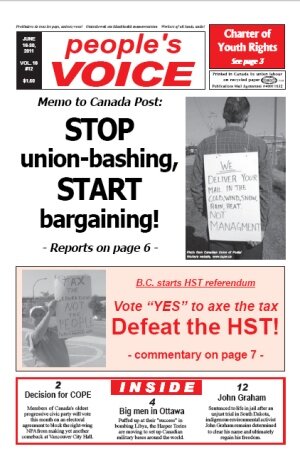
1) CANADA POST: NEGOTIATE A FAIR COLLECTIVE AGREEMENT WITH CUPW
2) VOTE "YES" TO AXE THE TAX! DEFEAT THE HST!
3) "CHARTER OF YOUTH RIGHTS" CAMPAIGN GAINS MOMENTUM
4) COPE MEETS JUNE 26 TO LAUNCH CIVIC CAMPAIGN
5) THE "BIG PLAYER" ENTERS THE GAME - Editorial
6) FOR OUR FUTURE: STAND WITH CUPW - Editorial
7) WHICH IS THE REAL TARSANDS HOAX?
8) MUNICIPALITIES NEED STABLE FUNDING AND FAIR TAXES
9) WHY WE ALL MUST SUPPORT OUR POSTAL WORKERS
11) JOHN GRAHAM CONTINUES STRUGGLE FOR JUSTICE
12) NEW DEVELOPMENTS IN COLOMBIAN REPRESSION CASES
13) SLIM EVANS: RED LABOUR ORGANIZER
14) QUIT FRACKING AROUND, WARNS GASLAND
16) CLARTÉ (en français)
17) THE SPARK! (Theoretical and Discussion Bulletin of the Communist Party of Canada)
18) INTRODUCING MARX
PEOPLE'S VOICE JUNE 6-30, 2011 (pdf)
|
|
|
|
The Spark!The Spark! The latest issue of The Spark! theoretical journal, is now on sale for $5 at Communist Party offices (see p. 8) or People’s Co-op Books, 1391 Commercial Drive, Vancouver. Articles include
plus reviews, editorials, and more.
|
|
|
Theoretical and Discussion Bulletin of the Communist Party of Canada |
|
|
People's Voice deadlines: July 1-31 August 1-31 Send submissions to PV Editorial Office,
|
|
REDS ON THE WEB |
|
People's Voice finds many "Global Class Struggle" reports at the "Labour Start" website, http://www.labourstart.org/. We urge our readers to check it out! |
* * * * *
People's Voice
Canadian Publications Mail Sales Product Agreement #205214
ISSN number 1198-8657
People's Voice is published by
New Labour Press Ltd
PV Editorial Office
706 Clark Drive,
VANCOUVER, B.C. V5L 3J1
Phone:604-255-2041
Fax:604-254-9803
email: pvoice@telus.net
Editor: Kimball Cariou : Business Manager: Sam Hammond
Editorial Board: Kimball Cariou, Miguel Figueroa,
Doug Meggison, Naomi Rankin, Liz Rowley, Jim Sacouman
* * * * * *
Letters
People's Voice welcomes your letters
on any subject covered in our pages.
We reserve the right to edit for length and clarity,
and to refuse to print letters which may be libellous
or which contain unnecessary personal attacks.
Send your views to:
"Letters to the Editor",
706 Clark Dr., Vancouver, BC V5L 3J1,
or pvoice@telus.net
People's Voice articles may be reprinted without permission,
provided the source is credited.
* * * * * *
The Communist Party of Canada, formed in 1921,
has a proud history of fighting for jobs, equality, peace,
Canadian independence, and socialism.
The CPC does much more than run candidates in elections.
We think the fight against big business and its parties
is a year-round job,
so our members are active across the country,
to build our party and to help strengthen people's movements
on a wide range of issues.
All our policies and leadership
are set democratically by our members.
To find out more about Canada's party of Socialism,
give us a call at the nearest CPC office.
* * * * * *
Central Committee CPC
290A Danforth Ave Toronto, Ont. M4K 1N6
Ph: (416) 469-2446
fax: (416) 469-4063 E-mailmailto:info@cpc-pcp.ca
Parti Communiste du Quebec (section du
Parti communiste du Canada)
5359 Ave du Parc, Montréal, Québec,
H2V 4G9
B.C.Committee CPC
706 Clark Drive, Vancouver, V5L 3J1
Tel: (604) 254-9836
Fax: (604) 254-9803
Edmonton CPC
Box 68112, 70 Bonnie Doon P.O.
Edmonton, AB, T6C 4N6
Tel: (780) 465-7893
Fax: (780)463-0209
Calgary CPC
Unit #1 - 19 Radcliffe Close SE
Calgary AB, T2A 6B2
Tel: (403) 248-6489
Ottawa CPC
Tel: (613) 232-7108
Manitoba Committee
387 Selkirk Ave., Winnipeg, R2W 2M3
Tel/fax: (204) 586-7824
Ontario Ctee. CPC
290A Danforth Ave., Toronto, M4K 1N6
Tel: (416) 469-2446
Hamilton Ctee. CPC
265 Melvin Ave., Apt. 815
Hamilton, ON.
Tel: (905) 548-9586
Atlantic Region CPC
Box 70 Grand Pré, NS, B0P 1M0
Tel/fax: (902) 542-7981
http://www.communist-party.ca/
* * * * * *
News for People, Not for Profits!
Every issue of People's Voice
gives you the latest
on the fightback from coast to coast.
Whether it's the struggle for jobs or peace, resistance to social cuts,
solidarity with Cuba, or workers' struggles around the world,
we've got the news the corporate media won't print.
And we do more than that
- we report and analyze events
from a revolutionary perspective,
helping to build the movements for justice and equality,
and eventually for a socialist Canada.
Read the paper that fights for working people
- on every page, in every issue!
People's Voice
$30 for 1 year
$50 for 2 years
Low-income special rate: $15 for 1-year
Outside Canada $50 for 1 year
Send to: People's Voice, 706 Clark Drive, Vancouver, BC, V5L 3J1
You can call the editorial office at 604-255-2041
REDS ON THE WEB
http://www.communist-party.ca/
http://www.ycl-ljc.ca/
http://www.solidnet.org/
(The following articles are from the June 16-30, 2011, issue of People's Voice, Canada's leading communist newspaper. Articles can be reprinted free if the source is credited. Subscription rates in Canada: $30/year, or $15 low income rate; for U.S. readers - $45 US per year; other overseas readers - $45 US or $50 CDN per year. Send to People's Voice, c/o PV Business Manager, 706 Clark Drive, Vancouver, BC, V5L 3J1.)
1) CANADA POST: NEGOTIATE A FAIR COLLECTIVE AGREEMENT WITH CUPW
Instead of tearing down Canada's mail delivery system and attacking the postal workers who provide this vital public service, the federal government and Canada Post must be compelled to negotiate a fair collective agreement with the Canadian Union of Postal Workers, says the Communist Party of Canada.
In a news release issued on June 1, the Communist Party's Central Executive Committee said, "Through their reckless actions, Canada Post management and the Harper Tories are on the brink of forcing the shutdown of postal delivery."
"For seven months, instead of engaging in serious bargaining, Canada Post has stubbornly insisted on huge contract rollbacks. The company demand for a 22% cut in pay for new hires, its drive to gut the sick leave program won through difficult bargaining in previous agreements, and many other concessionary proposals, have nothing to do with preserving the financial viability of Canada Post. If the company was serious about this claim, it would have acted on the many valuable proposals raised in recent years by CUPW to improve the postal service for Canadians. Indeed, Canada Post has turned a profit every year for the past 16 years - hardly a picture of impending financial crisis and ruin!
"The negotiating position of Canada Post has the fingerprint of the Harper government and its pro-corporate, anti-worker policies all over it. This attack is part of a much wider corporate/government assault on the overall wages, pensions and working conditions of both public and private sector employees across Canada, indeed across the entire capitalist world. This is yet another example of the corporate drive to boost profits by slashing the wages and pensions of working people.
"Despite claims to the contrary, the shutdown of Canada Post operations as a result of management intransigence would deal a harsh blow against thousands of small businesses and their employees across the country. For the company to make dismissive comments that `there's plenty of time to negotiate' - as Jon Hamilton, Canada Post's director of communications, told CBC on May 30 - is a slap in the face for both customers and postal workers.
"The very next day, after CUPW tabled serious new proposals to avert a shutdown, a Canada Post bargaining committee took less than ten minutes to reject the union's final offer in its entirety. This rejection signals that Canada Post and the Harper Tories are spoiling for a fight, hoping for an opportunity to inflict major damage on the labour movement and on working people across Canada. We can expect to see an escalation of intense and hateful attacks on postal workers by right-wing politicians and the corporate media. The aim of these anti-labour forces is to whip up anger against postal workers, to divide working people and set the stage for the break-up of Canada Post and the full privatization of this crucial public asset. The end result of this strategy can only be a much poorer mail system, higher costs for customers, lower wages and more dangerous working conditions, and bigger profits for the private corporations which seek to take over all postal delivery operations in Canada.
"The Communist Party demands that instead of making outrageous statements about the potential costs of paying decent wages to postal workers, the management of Canada Post withdraw its anti-worker demands and bargain a fair collective agreement with its employees. Instead of encouraging Canada Post to continue down this dangerous path, the Harper government must be compelled to live up to its responsibilities to guarantee affordable and reliable mail service to Canadians in all regions, in rural and urban areas alike."
2) VOTE "YES" TO AXE THE TAX! DEFEAT THE HST!
Statement by the Communist Party of British Columbia, June 2011
The BC Campbell Liberals, in cahoots with the Harper Tories, conspired secretly prior to the May 2010 provincial election to construct a monumental tax scam. Their HST is shifting billions of dollars from the public purse and consumer pockets into the corporate purse. The federal Tories paid the BC Liberals a $1.6 billion bribe to do what they promised they would never do. While they were promising during the election campaign not to implement the HST, they were arranging how to do it.
This is how the swindle works.
BC businesses that formerly paid PST and were rebated GST now enjoy a "Harmonized" rebate of both the GST and the PST. BC corporations pay the HST up front and then get a 100% rebate. The working public pay both taxes on an enlarged base of taxable items. Billions going into corporate bank accounts and billions coming out of the income of working families.
In the tradition of Gordon Campbell, new boss, same gang.
Christy Clark has inherited the BC Liberal tradition of broken promises, hidden agendas and outright lies. The smashed HEU contracts, smashed teachers' contracts on class size and composition, tax cuts for corporations and the wealthy in 2001, 2005 and 2009, and the criminal sale of BC Rail, set the Liberal operating procedure for sellout of the public's interest, and the largest transfer of wealth into the corporate pockets in BC history.
On the eve of the HST referendum, Clark has introduced schemes to bribe people with their own money to vote "NO" against scrapping the HST. She has promised that if voters keep the HST, she will reduce it to 11% by July 12, 2012 and a further drop to 10% by July 2014. To compensate for the lost revenue, she will temporarily increase corporate taxes and eliminate scheduled small business subsidies.
Christy Clark has no control over the federal part of the HST. Her promises are a continuation of the Liberal method - promise one thing and do the opposite. She is desperately trying to put out the fire and win support for the HST, with promises that are only hot wind.
Cash Cows and Pork Barrels
The HST is a "value added tax", a cash cow and pork barrel for provincial and federal governments. In other countries with VAT taxes, the rates have been hiked at government whim ? in England to 17.5% in 2010, and in France now up to 19.6% on food. The federal implementation bribe was paid for the future ability to squeeze more out of the public and rebate it to the corporations. On top of the HST scam, MSP premiums are scheduled to rise 6% per year, while health care cuts continue.
The defeat of the HST is the first step in the fight for Progressive Tax Reform.
We need progressive tax reform based on the ability to pay, tax reform that will shift the load off working families and put it on those reaping the profits from our resources - the corporations and the wealthy.
In December 2010, the Liberal Finance Minister Colin Hansen said, "We have reduced taxes to some of the lowest levels in the country, and when combined with planned federal tax rate cuts, by 2012, the corporate income tax rate in BC will be the lowest of the G-7 nations." In the 1960s, the corporations paid 50 cents of every tax dollar in Canada. Now they pay pennies and the working people pay more and more.
The Communist Party of British Columbia calls for urgent measures to win progressive tax reform:
* Axe the HST as a first step in the elimination of the GST and PST.
* Reverse the Campbell Liberal corporate tax cuts, which cost the treasury over $800 million annually.
* Restore the corporation capital tax.
* Introduce wealth and inheritance on estates over $500,000.
* Eliminate taxes on incomes under $35,000.
It is time to put BC back to work, using a reformed tax base to build affordable housing, provide publicly-financed post secondary education, do away with MSP premiums, increase education funding and attack the child poverty and homelessness that is a stain on this province.
The Communist Party of British Columbia urges a strong YES vote to "axe the tax" and defeat the HST!
(Issued by the Communist Party of British Columbia, cp.info@gmail.com, 604-254-9836)
3) "CHARTER OF YOUTH RIGHTS" CAMPAIGN GAINS MOMENTUM
How does the youth and student movement fight back in the time of the Harper majority government? How do we evaluate the experience and role of young people in the election, as well as the broader labour and people's struggles across Canada and around the world?
"The Harper majority is catastrophic for youth and students, already facing record high unemployment, skyrocketing student debt, and many other social problems" Young Communist League General Secretary Johan Boyden recently told People's Voice. "Despite pro-corporate pundits trying to calm the people with soothing words that Harper's new majority will lead him to an approach of `balance,' we've already seen what the Conservatives will do."
"Harper's budget will bring in severe cutbacks. They don't need to do it all at once; there will be many occasions for ramming through the agenda of more poverty, police, prisons, war and crimes against the environment. In the last year of their mandate, for example, the Canada Health and Social Transfer expires," he said.
According to Boyden, there is no mandate for this agenda from the Canadian people, especially the youth who massively oppose the Conservatives. He pointed to flash demonstrations that came together immediately after the election, organized by youth and students against the Harper majority, as well as polls showing that youth overwhelmingly voted against Harper and often for the New Democrats.
"Another indication of the mood of youth is the high-school programme Student Vote," he said. "This isn't necessarily an accurate picture - in some regions only private schools participate - but students would have returned a larger number of non-?big business party candidates (NDPers and Greens) and a Conservative minority."
In places where the Communist candidate was allowed to speak directly to students, their Student Vote was "significantly higher, catching the support often of several hundred students."
In a post-election statement, the YCL noted the increasing barriers to youth voting, while the big parties offer little of substance to young people like peace or free education. "Youth vote turnout was apparently, like the general turnout, not significantly higher - despite comedian Rick Mercer's Maple-leaf enwrapped non-partisan `Vote Mobs' on campuses and much hype about social media," the statement said.
The YCL also welcomed the NDP's victory as official opposition, the new young Quebec NDP MPs in Ottawa, the higher number of women in parliament, and the election of the first Green MP. However, these parties do not consistently challenge corporate rule and the military-industrial complex.
Boyden noted that YCLers have been out campaigning for the Charter of Youth Rights at the Canadian Labour Congress in Vancouver and the RebElles conference in Winnipeg, and have already collected the contacts of over a hundred youth and student activists who want to participate in developing the campaign.
"We are hearing some youth who are very wedded to the NDP saying `the election results are great! Maybe we'll form government next.' This is a mis-read," said Boyden.
"The other sense is danger. Naturally, many youth have noticed that the NDP basically jettisoned the progressive planks of its platform and so there is also a sense of disempowerment. Whatever you think of the NDP, they cannot block the Tory agenda because of `the math' in Parliament. The main struggle is very clearly out of parliament and on the streets. And social democracy in Canada, as in Europe, is increasingly dressed-up in neo-liberal gear. We can't fall into the analytical trap of defining the strategy and tactics of the left and the youth and student movement in terms of the NDP. The unity and orientation of the people's movements is what is key to moving forward," Boyden said.
As a youth and student movement "we need to fight the cultivated sense of cynicism that holds hundreds of thousands of youth back from participating in organized struggle," he told PV.
"The idea of the Charter of Youth Rights is to present a militant agenda that relatively disparate forces in the youth movement can unite behind - from the struggle for accessible education in BC, to young Postal workers about to go on strike, to the youth organizing for a National Aboriginal Day of Action in Winnipeg, to the young women marching to stop violence against women, to the thousands of youth who casually walked through Montreal's anarchist bookfair, searching for radical perspectives, or the participants of Nova Scotia youth pride events in Halifax - and from there seek to involve many more youth."
Johan Boyden and two other prominent youth activists - Marianne Breton Fontaine and Stephen Von Sychowski - will speak at a June 22 forum at the Centre for Socialist Education, 706 Clark Drive, Vancouver. For details, call 604-255-2041. For more information, visit http://www.youthcharter.ca or check out the latest issue of Rebel Youth magazine.
4) COPE MEETS JUNE 26 TO LAUNCH CIVIC CAMPAIGN
PV Vancouver Bureau
Vancouver's civic election is already underway, five months before voters head to the polls on Nov. 19. Two of the city's three major parties have nominated candidates, and the Coalition of Progressive Electors (COPE) will meet this month to start up its preparations. (That meeting begins at 2 pm, Sunday, June 26, at the Japanese Hall, 487 Alexander Street.)
Hoping to make a comeback, the right-wing Non-Partisan Alliance has nominated its sole city councillor, Suzanne Anton, for mayor. Several NPA council candidates are getting regular corporate media coverage for their attacks against the Vision majority on city council, and Anton herself is a popular figure, especially among upper-income voters. The NPA has hired a big-time corporate fundraiser to help pull together a multi-million dollar campaign.
So the NPA, which crashed and burned twice in the past decade (the 2002 and 2008 elections) is back in the race. Formed as a big business coalition to keep the left out of City Hall, the NPA has dominated Vancouver politics for most of the past 70 years. On several occasions, most recently in 2005, the NPA has taken advantage of divisions among centre and left forces to regain office. Suzanne Anton is no Rob Ford, and Vision mayor Gregor Robertson has gone out of his way to keep friendly relations with Victoria, but the provincial Liberal government would certainly prefer a friendly NPA administration in Vancouver.
The cooperation agreement signed in May between the centrist Vision party and COPE is designed to block that possibility. Despite some sharp differences between the two parties, both are well aware that an electoral alliance is necessary to defeat the NPA.
The 50,000-member Vancouver and District Labour Council and key unions in the civic field are focused on stopping the NPA, which locked out CUPE municipal employees for months in a bitter 2007 labour dispute. Without Vision/COPE cooperation, the labour movement would have little reason to put valuable funds and campaign workers into the civic campaign - especially if a provincial election takes place earlier in the fall as expected.
A loss of labour support would be particularly difficult for COPE, which was formed in 1968 by the Labour Council and a wide range of social justice allies. After tilting towards Vision in 2005 and 2008, the labour movement has slowly been moving back in COPE's direction.
For all these reasons, it appears likely that COPE members will ratify the agreement at their June 26 AGM, just as they gave 90% backing to a ballot alliance with Vision during the 2008 campaign. The agreement sets out candidate numbers for each party on a common slate (7 Vision and 3 COPE for city council, 5 Vision and 4 COPE for school board, 4 Vision and 2 COPE for park board).
The agreement also commits the parties to develop joint positions on a few key issues, such as housing and homelessness at the city council level.
On other issues, the parties are free to stake out their own positions, which will overlap in many areas and diverge in others. COPE, for example, will continue to argue against the ongoing shift of the local taxation burden, which has increasingly been placed on homeowners to give the business sector a break.
Matters are simpler at the School Board level, where the four Vision and three COPE trustees have worked closely for the past three years. Led by VSB chair Patti Bacchus (Vision) and vice-chair Jane Bouey (COPE), the progressive majority on the Board has been a powerful voice against Liberal underfunding of public schools across British Columbia.
If the agreement is adopted by COPE members, the stage will be set for COPE's own nomination meeting in September. Assuming that COPE council incumbents David Cadman and Ellen Woodsworth receive the support of most members, that meeting may see a sharp struggle for the third COPE council spot.
One candidate seeking a COPE nomination is R.J. Aquino, a popular figure in the progressive Filipino community. Another is former councillor Tim Louis, who is widely seen as a more aggressive critic of Vision than of the NPA. Union activists speaking to People's Voice have stated that if Louis is nominated, it will be nearly impossible for COPE to win serious labour support for its campaign.
(The August issue of PV will report on the COPE AGM and other civic election developments.)
5) THE "BIG PLAYER" ENTERS THE GAME
People's Voice Editorial
Somehow it was never spoken of during the recent federal election, but the Harper Tories now admit they are setting up Canadian military bases around the world. Why? It's just "prudent planning", claims Defence Minister Peter MacKay.
Waxing eloquent about the burdens and responsibilities of a 21st century imperialist power, MacKay says Canada must "look out into the future (to) anticipate where and when we will be needed... The focus of the planning is our capability for expeditionary participation in international missions... We are big players in NATO. We're a country that has become a go-to nation in response to situations like what we're seeing in Libya, what we saw in Haiti... We are constantly working within that paradigm of countries, to see where we can bring that niche capability to bear. It's part of planning and preparation, in conjunction with our equipment needs."
Le Devoir reports that the Canadian Forces are already negotiating to set up bases in Germany, Jamaica, Kuwait, Senegal, Kenya, Tanzania, Singapore and South Korea.
Why wasn't this historic expansion of Canadian military power raised during the campaign? Did the Harperites fear a voter backlash? After all, the Tories received the backing of just 39% of Canadians who voted. Another one or two percent less would have left them with another minority.
Now, Canadians face a government determined to keep ramping up the military, at the expense of people's needs at home and abroad. One of Harper's first actions after May 2 was to buy another $130 million worth of bombs to kill Libyans.
As for being "big players" and "go-to guys," a better phrase might be "hired guns." The burden of the world's biggest military machine weighs heavily on the U.S., and the PM is eager to volunteer the people of Canada to help shoulder the load.
It's time to retool the anti-war movement to meet this militarist threat - and to demand that the Opposition parties take a stand against the unchecked expansion of Canadian imperialism.
6) FOR OUR FUTURE: STAND WITH CUPW
People's Voice Editorial
The struggle by the Postal Workers for a fair collective agreement is no ordinary bargaining dispute. It is the latest episode in a campaign to drive down the wages and working conditions of the entire working class. Once again, right-wing politicians and media talking heads are frothing at the mouth about "overpaid" workers, "generous" sick leave plans, "inflated" pensions. Coming from people who have widened the income and wealth gap in Canada to historic proportions, these accusations are absurd. But repeated often enough, with sufficient volume, blatant lies can take on a dangerous aura of authenticity.
As with other recent public sector strikes, the bosses hope to sow petty jealousies to sap our ability to unite against a common enemy. Yes, $24 per hour is a decent wage, and postal workers do enjoy some hard-won sick leave and pension benefits. But why shouldn't workers who perform a tough job under difficult weather conditions earn enough money to live relatively comfortably, instead of sinking into poverty?
Every attack on the wages and benefits of postal workers needs to be countered with the truth that millionaire shareholders and CEOs in this country are laughing all the way to the bank. Corporate profits will likely hit $250 billion this year, while 1.4 million workers are jobless and millions more face a scary future.
If two-tier wages and benefits are imposed at Canada Post and across the country, the entire working class will see its conditions sink through the floor within the next generation. A defeat for CUPW in this battle may open the floodgates for such an all-out assault. We cannot afford to lose this fight. We must stand with CUPW, on the picket lines, in our everyday conversations with friends and fellow workers, in the wider arena of public opinion. Our future depends on it.
7) WHICH IS THE REAL TARSANDS HOAX?
By Kimball Cariou
There was a minor uproar at the end of May, with the release of a video clip claiming that Peter Jackson, director of the Lord of the Rings trilogy, would supposedly use the Alberta tar sands to film part of his upcoming feature The Hobbit. Apparently these scenes would be set in Mordor, the bleak and terrifying region of Middle Earth ruled by Sauron.
To LOTR fans (true confession: I have read both the trilogy and The Hobbit several times), the story sounded strange. The Hobbit does include chapters in dark forests and deep mines, but not Mordor. In the end, the whole thing was exposed as a hoax, designed to draw attention to the environmental and human damages caused by the tar sands projects.
Did the hoax work? Or did it make environmentalists seem willing to lie to achieve their goals? I have my own opinion, but I leave it up to readers to decide for themselves.
Somewhat lost in the debate was a far more chilling deception, carried out by the Harper Conservatives. According to Postmedia News reports, the federal government deliberately excluded data showing a 20 per cent increase in annual pollution from the tar sands industry in 2009.
The data was kept out of a report on climate change and Canada's greenhouse gas emissions submitted to the United Nations. The report showed a six per cent drop in annual emissions for the entire economy from 2008 to 2009, but does not directly note the extent of emissions from the oilsands production, which is greater than the amount of all the cars driven on Canadian roads.
The data also indicated that emissions per barrel of oil produced by the sector are increasing, despite advertising claims made by the industry.
"The oilsands remain Canada's fastest-growing source of greenhouse gas pollution, and they're the subject of a huge amount of attention and scrutiny in Canada and internationally," said Clare Demerse, director of climate change at the Pembina Institute, an Alberta-based environmental research group. "So it's very disappointing to see Environment Canada publish a 500-page report that leaves out these critical numbers - especially when last year's edition included them."
According to Environment Canada estimates, the tar sands industry was responsible for about 6.5% of annual greenhouse gas emissions in 2009, up from five per cent in 2008. Emissions from this industry have climbed about 300% since 1990, effectively cancelling out reductions by other economic sectors.
The report says the 6% decrease in overall emissions is partly due to the recent economic crisis, and also to a reduction of coal-fired electricity in Ontario.
An Environment Canada spokesperson told Postmedia that "some" of the missing information was still available in other reports, and argued that reporting requirements for the UN Framework Convention on Climate Change (UNFCCC) are divided into "broad, international sectors." But the department did not say which politicians or bureaucrats decided to exclude the tar sands emission numbers.
According to Greg Stringham, vice-president of oilsands and markets at the Canadian Association of Petroleum Producers, "We report the information to them, and they choose to pass it on - they must pass it on the UN. But then they choose how to disclose it and put it out there."
Last fall, media reports revealed that the Harper government had set up a partnership with the Alberta government, the industry and several federal departments to fight emission-reduction policies from other countries that target the tar sands. The latest news indicates that the Tory lobbying and public relations strategy continues to delay international action to fight climate change.
8) MUNICIPALITIES NEED STABLE FUNDING AND FAIR TAXES
Canada's largest public sector union says cities and towns across the country face unprecedented pressure and demand for investment in infrastructure, social services, immigrant settlement, social housing, public transit and child care services. But, says CUPE, municipalities are limited in their ability to generate revenue and face significant barriers when trying to properly meet these critical needs.
In a June 1 statement, CUPE says that many factors are contributing to the crisis in municipal financing. Federal government stimulus funding is coming to an end, as is more than $1.5 billion annually in other federal funding programs for municipal infrastructure and housing.
Infrastructure funding is set to decline in coming years, while communities face existing and new demands such as stronger environmental standards, climate change and growing social needs.
Canadian communities continue to struggle with an infrastructure deficit of more than $120 billion, while relying on regressive property taxes and user fees for more than 75 per cent of their revenues. As a result, Canadians face some of the highest rates of property tax in the world. In contrast, most European and U.S. cities have access to revenues from income and sales taxes.
CUPE says that municipalities need stable, predictable and increasing revenues to deliver on their growing responsibilities. The union argues that to improve its major funding programs for municipalities, the federal government should take several steps:
* renew the $1.2 billion a year Building Canada Infrastructure Fund, but eliminate the requirement to consider wasteful financing through public private partnerships;
* renew and expand federal funding for homelessness and affordable housing;
* commit $400 million a year to revitalize public urban transit systems;
* index federal gas tax funding to keep up with inflation and economic growth; and
* introduce a new national clean water fund to pay for the federal share of the $20 billion cost of meeting new federal wastewater standards.
"Privatization and public private partnerships may be tempting for municipalities because they either offer a quick buck through asset sales or lower up-front costs for capital investments," warns the union. "But public private partnerships lock governments into much more expensive deals that heap debt onto future years. This is a penny-wise, pound foolish approach because these revenues and savings come at a major cost: reduced revenues and higher costs in future years. In particular, they make no sense when governments can borrow at a much lower rate than private investors. The federal P3 Fund should be eliminated and the money should be redirected to projects which keep community assets public."
9) WHY WE ALL MUST SUPPORT OUR POSTAL WORKERS
Posted on May 29, by David Bush, http://halifax.mediacoop.ca/blog/david-bush/7373
In all honesty it is as simple as this: You want to fight Harper? Then support the posties! Any day now, 45,000 postal workers could be on strike or be locked out from their job by their employer, Canada Post Corporation (CPC). The Canadian Union of Postal Workers (CUPW) and CPC have been in negotiation since October. The two sides are at fundamental odds over working conditions, the future of the postal service, and the treatment of new workers.
The CPC, a crown corporation, has been profitable for the last 16 years. In its last reported year, 2009, CPC registered a net profit of 281 million dollars from a total revenue of 3.1 billion dollars. Mail volumes fell in 2009, largely due to the economic downturn, but remained well above what they were 10 years ago. According to CPC, in 2009 "the negative pressure on revenue growth was mitigated by cost containment and operational efficiencies along with an unplanned non-cash reduction in employee future benefits expense."
Thus, despite an 8 percent reduction in mail volumes in 2009, CPC was able to make profits by reducing worker's benefits and denying health and safety concerns of their employees (Postal workers make up about 6% of the federal workforce but account for 20% of federal workforce injuries). And even though CPC recorded its most profitable year in 2009, "Canada Post did not pay a dividend to the Government of Canada in 2009 due to the company's financial challenges and the need for significant capital reinvestment to modernize the postal system. "
This reinvestment was the spending of 2 billion dollars to purchase new sorting machines, reorganize routes, and reduce "inefficiencies" in the postal service. This capital reinvestment is referred to as the Modern Post. The Modern Post is an attempt by the CPC to reduce the size of its workforce, weaken the power of CUPW, and increase the productivity among workers while reducing wages and benefits to those very same workers.
During negotiations the CPC has insisted on creating a two-tiered workplace where new workers will: get paid around 30% less than current employees, will have a defined pension plan where they bear all the risk, longer hours, less job security and less paid leave. This is an obvious ploy to weaken the union by creating resentment among new members and by setting up a precedence for all members wages and benefits to be reduced in future bargaining.
The CPC is also trying to implement working conditions that defy any standard of health and safety. They want letter carriers to carry double bundles in one arm when they are delivering mail. For those of you who are not letter carriers, this means two huge satchels on your side, a scanner gun, a heavy bundle of mail in your hand, and a heavy bundle of mail on that same forearm. This is just plain dangerous, especially with longer routes and inclement weather. In places where they have tried implement this change, letter carriers simply refused to work under such conditions and went out on a wildcat strike.
The CPC is also trying to end sick leave as it is known. They want to replace sick days with a Short-Term Disability (STD) plan. The STD plan pays 30 percent less than sick days, and there is a lag of seven days before you can file for STD plan coverage in which you have to use personal days. Your claim is then subject to Manulife's approval. So why is the postal worker's struggle important for us non-postal workers?
First off, CUPW is the most progressive union in Canada. It has been at the forefront of many progressive struggles. It was the first national union to pass a boycott, divestment and sanction resolution against the state of Israel for its illegal occupation of Palestine. CUPW was also the first Canadian union to pass a boycott resolution against South African apartheid. It has also taken stances against the Iraq war and the Afghan war as well as taking stances against NAFTA and the FTAA. CUPW is also a major reason that maternity leave exists at all in Canada. In 1981, as a result of a 42-day strike, CUPW successfully negotiated 17 weeks of maternity leave paid at a rate of 93% of wages. This was a major breakthrough for all workers as the government and other major employers were forced to provide maternity leave and improve on it.
The defeat of the postal workers would be a major blow to the Canadian labour movement which is also facing huge jobs cuts on the federal level. If the CPC were victorious other major employers would implement many of CPC's rules regarding sick leave and wage rollbacks and two-tier workplaces. This would be disastrous for all workers, whether they are unionized or not.
The CPC and the Harper government want to privatize our postal system. The CPC over the years has been whittling down the services provided by the postal system. They have reduced rural service, replaced door-to-door service with community mail boxes and have gotten rid of banking services. An expanded postal service would create more jobs and provide more services in our communities.
Our society has become more and more unequal. As the Canadian Centre for Policy Alternatives', Linda Mcquaig and others, have noted, the top-earning 1 per cent of Canadians almost doubled their share of national income, from 7.7 per cent to 13.8 per cent, over the past three decades. Things are only set to get worse under Harper. Workers, both unionized and non-unionized face a future of precarious job security and working conditions. Migrant labourers, women and people of colour will be facing even worse conditions as the Harper government will cut services, increase the security apparatus and institute a regressive regime that will police borders, bodies and dissent with the utmost cruelty.
This will be done in the service of a system, capitalism, which serves only those who already have power and wealth beyond the wildest imagination of most people in our society.
We are facing a choice in our society. Do we want to live in a place where managers and bosses aim to squeeze out as much profit from our labour and our communities just so a few people can have a third home and a second yacht- Or do we want to live in communities based on social solidarity, where if someone is down and out we help them out as equals and we look out for one another?
So we must support our postal workers with as much effort as we can muster. If they are handed a defeat by the Harper government we will all eventually feel it. So please. Lets organize and support postal workers in our communities as best we can. Whatever differences we may have, politically or personally, let's put those aside so we can rally around this important struggle. Put your trust in the postal workers and let's focus on build community mobilization for this cause.
By practising solidarity with our postal workers, by talking to our friends and neighbours, by building links in our communities around common struggles we can further build our capacity to resist attacks on those very communities. Also, through struggle we can build a better political analysis based on concrete realities that will help hone future political strategies to fight for a better world.
Together we can win this fight!
How You Can Help:
* Educate yourself on the issues
* Talk to your friends, neighbours, and family about the issues
* Put a sign of support in your window, then go to your neighbour and ask if they will do the same
* Write into your paper, call your radio station, comment online and demand they get their facts straight and let them know you are with the posties
* Find groups organizing in your community, coordinate actions with them such as: canvassing neighbourhoods, having an information picket, leafleting events, putting up posters, making banners, organize teach-ins, film nights, organizing picket line support, coordinating community food servings, etc.
If there is no group in your community organizing, then start one...
Their struggle is our struggle! An injury to ONE is and an injury to ALL!
For materials (posters and pamphlets) you can use in your communities visit http://www.supportpostalworkers.wordpress.com.
10) "THE HST CANNOT BE FIXED"
By Jim Sinclair, Vancouver Sun June 3, 2011
During the leadup to the 2009 provincial election, instead of campaigning on their plan to introduce the harmonized sales tax, the Liberal government and its MLAs denied they were even considering it. But with the ballots barely counted, the Liberals announced they would proceed with the largest and most unfair tax shift in the province's history.
Incensed at being lied to and having their taxes increased to fund tax cuts for corporations, British Columbians rebelled. When the dust settled, the people won Round One. A grassroots movement spread across the province, forcing a referendum on the issue.
The people won Round Two in November 2010, when Gordon Campbell was forced to resign as premier.
Today a desperate Liberal party led by newly elected Premier Christy Clark is scrambling to win Round Three by spending millions of taxpayer dollars to convince British Columbians the HST is good for them.
Let's be clear: The HST can't be fixed. The changes promised by Clark are a cynical attempt to buy British Columbians with their own money and, more importantly, dropping the tax by two points will cause a major revenue crisis leading to more cutbacks of schools, hospitals and government services.
Clark knows this is true - she said so herself.
"We aren't going to be talking about trying to reduce it by a point or two before the referendum. I think people will see that as buying them with their own money," Clark stated on March 21, adding that the province will either have a $1.6-billion bigger deficit or $1.6 billion less to spend on heart operations, special needs teachers, school facilities, hospital emergency rooms.
She is right on both counts, but she did it anyway. However, the cost to citizens of the HST goes beyond creating bigger deficits or extreme cuts to public services.
This tax is fundamentally flawed because it takes billions of dollars from working families and gives those dollars to B.C.'s largest corporations.
Despite the convoluted question on the referendum, the real choice is between the HST and the provincial sales tax. If British Columbians vote Yes to reject the HST and reintroduce the PST, the government will receive an estimated $6.4 billion from the PST in 2014-15 to pay for public services. Based on historical data, corporations will pay about $2.6 billion and citizens will pay $3.8 billion. Corporations and citizens share the responsibility and the tax will not apply to hundreds of essential purchases.
If British Columbians vote No and keep the HST, the government will receive in 2014-15 about $5.3 billion from the tax, paid entirely by British Columbians and their families. Not only will this create a huge shortfall in revenue (as predicted by the premier) but corporations will pay virtually nothing. This is unfair.
Clark's HST will still have British Columbians paying $1.4 billion more in taxes in 2014-15, but the provincial budget will be more than $1 billion short to pay for public services. Citizens pay more money and get fewer services. This makes no sense.
Yes, Clark announced a "temporary" increase in corporate taxes from 10 per cent to 12 per cent, but that will generate only a small portion of what the HST will save them. And don't forget, since the Liberals took power, the tax on corporate profits has been cut from 16.5 per cent to 10 per cent. The result has been a windfall of nearly $8.5 billion since 2001. Corporate profits also increased 60 per cent during the same period.
Did all those corporate tax cuts crete jobs- Unfortunately, no. Corporations took the money and ran ? closing mills and factories at a record pace, leaving us with 28,000 fewer manufacturing jobs today than at the beginning of the Liberal regime.
Don't be fooled by the Liberals or the upside-down question. Vote Yes to scrap the HST, vote Yes to the PST, vote Yes for fair taxes and vote Yes to properly fund public services for all British Columbians.
(Jim Sinclair is president of the B.C. Federation of Labour.)
11) JOHN GRAHAM CONTINUES STRUGGLE FOR JUSTICE
Special to PV
Refusing to give up despite his conviction in an unfair trial, Tuchone native John Graham is carrying on his struggle for justice, supported by his family and friends. A May 15 statement issued by Graham from his South Dakota jail cell says that his lawyer has filed appeals of the conviction and life sentence.
Last December 10, a jury found Graham guilty in the death of American Indian Movement (AIM) member Anna Mae Aquash, the victim of an execution-style killing in South Dakota.
Graham, originally from Yukon, and Nova Scotia-born Aquash worked closely together in AIM before her murder 35 years ago. During that period, the FBI and pro-business elements of the Pine Ridge Indian Reservation were conducting a war against AIM members and other "traditionals". Dozens of people were killed during the mid-1970s by cops and goon squads, but those deaths have never been given serious police attention.
One common FBI tactic, used in other operations against progressive and radical movements, was known as "snitch-jacketing." This refers to spreading rumours that individuals were informants, a tactic which often created serious divisions. It appears that Anna Mae Aquash, seen by the U.S. state as a powerful figure within AIM, may have been a target of this tactic. The circumstances of her death may also point to a more direct form of involvement by FBI undercover agents. In either case, the murder and later events fanned suspicions within the AIM leadership.
One obvious factor in the Bureau's long campaign to destroy AIM is the 1975 killing of two FBI agents during a disastrous raid at the Jumping Bull ranch in South Dakota, where AIM members and traditionals were staying to avoid the violence sweeping the area. AIM leader Leonard Peltier was convicted in these deaths, following his extradition from Canada and a kangaroo-court trial. Peltier remains in prison to this day, despite revelations that evidence against him was fabricated.
The FBI was determined to get revenge against AIM. Since then, a tangled web of lies, accusations and betrayals has accumulated. Aquash told friends that she had refused an FBI offer to testify against Peltier, who himself rejected promises of freedom in return for testifying that Graham was responsible for the murder of Aquash. Graham says that while living back in Yukon, on four occasions police threatened that unless he testified that AIM leaders were implicated in the murder of Aquash, he would himself face charges.
Those charges were brought against Graham a decade ago. His attempts to fight extradition failed when the Canadian government refused to lift a finger to protect his legal rights.
In 2004, Arlo Looking Cloud, a man with a long history of substance abuse, was convicted of murder for aiding in the murder of Aquash. He received a life sentence with a chance of parole in 2013. Last year, Richard Marshall was acquitted on the charge of supplying the gun that killed Aquash. Looking Cloud testified against both Marshall and Graham.
Another former AIM member, Thelma Rios, pleaded guilty in November 2010 to charges of aiding and abetting, for which she received five years of probation and no jail time. Rios claimed that John Graham took Aquash from Denver and killed her in the hills of South Dakota.
Observers at the Graham trial say it was "riddled with inconsistencies." Witnesses contradicted each another about the kidnapping in Denver, for example, but these were dismissed by the prosecution as a problem of "degraded memory." The case was based on verbal testimony, not material evidence.
Several witnesses had strong FBI connections. Darlene Ecoffey (formerly Kamook Banks) is the wife of Robert Ecoffey, the lead investigator of Aquash's murder and present superintendent of the Bureau of Indian Affairs on Pine Ridge. Ecoffey has admitted to being paid over $40,000 for her activities as an FBI informant. Angie Janis, who claimed she was at the house in Denver when Anna Mae was "kidnapped", works as a secretary at the Pine Ridge BIA. Her boss is Robert Ecoffey. Testimony was also heard from other FBI and BIA agents.
The defense rested its case without calling a single witness. Defense lawyer John Murphy twice asked Judge Jack Delaney to dismiss the charges against Graham, arguing that prosecutors had not proven their case. But his motions were denied.
The May 15 statement by John Graham reads:
"After a week long trial and several inconsistent and contradicting prosecution witnesses, and the defense calling no witnesses, a South Dakota jury found me NOT GUILTY OF PREMEDITATED 1975 MURDER OF ANNA MAE AQUASH. After totally contradicting testimonies about the alleged kidnapping from Denver the same South Dakota jury found me guilty of the lesser charge of felony murder kidnapping. In felony murder cases the prosecution does not have to prove that the accused actually killed anyone. Instead the accused is found criminally liable for any deaths that occurred during or in furtherance of a felony. In this case the felony is the kidnapping charge. The murder having taken place in 1975, more than 35 years ago, the many contradictions in testimony were explained by the prosecution as a problem of degraded memory. Their entire case rested on verbal testimony without a shred of material or factual evidence. My defense motion for dismissal of charges, because the prosecution failed to prove their case, was denied by judge Jack Delaney. Felony murder carries the same sentence as premeditated murder so the judge had no alternative but to sentence me to life with no possibility of parole. My lawyer filed an appeal on both the sentence and conviction. The trial transcript will be posted on my website in the very near future."
For more information, see these websites: http://ourfreedom.wordpress.com, http://www.grahamdefense.org.
12) NEW DEVELOPMENTS IN COLOMBIAN REPRESSION CASES
Based on reports by W. T. Whitney, Jr. and files from the Popular Tribune website of the Communist Party of Venezuela
The jailing in Colombia of Swedish journalist Joaquin Perez Becerra stands as a heavy indictment of Venezuelan President Hugo Chavez and of a Colombian regime notorious for terrible class-based repression, a Red scare of titanic dimensions, and a major role as imperialist enabler in Latin America.
Joaquin Perez Becerra landed in a Bogota prison on April 25. The director of the left-oriented Anncol website (News Agency for the New Colombia) in Sweden had flown from Europe to Caracas two days earlier. Venezuela President Hugo Chavez complied with the request of Colombia counterpart Juan Manuel Santos that Perez Becerra be seized and delivered to Colombia. Santos indicated that INTERPOL had issued a "Red Notification" on Perez Becerra, whom Colombian sources say acted as a European agent for the leftist Revolutionary Armed Forces of Colombia (FARC).
Joaquin Perez Becerra was serving as city councillor in Corinto, Valle del Cauca, when he fled to Sweden in 1993 to save his life. He gained political asylum the following year and Swedish citizenship in 2000. Despite his having given up Colombian citizenship, Venezuelan and Colombian officials dealing with Perez refer to him as Colombian. They have refused to allow lawyers and Swedish councillor officials to visit him.
Perez Becerra had gained office as a candidate of the Patriotic Union (UP) electoral coalition, formed by FARC (Revolutionary Armed Forces of Colombia) insurgents, communists, and others who entered electoral politics in 1985. By 1993, when Perez' first wife was murdered, UP candidates were winning victories, but others among them and elected officials were being killed, mostly by paramilitaries. The continuing massacre has taken 5000 lives.
Joaquin Perez Becerra's fate has triggered a flood of protests. For many, President Chavez' action signifies complicity with the Colombian regime's excesses. The journalist's capture and detention, they say, betokens continued persecution of UP activists.
In a May 3 article on its Popular Tribune website, the Communist Party of Venezuela (PCV) maintains that the seizing and delivery of Joaquin Perez Becerra to the Colombian government was "illegal and politically misguided."
On April 24, a group of leaders of the PCV, Venezuelan political personalities, and lawyers went to the headquarters of the Bolivarian National Intelligence Service to monitor compliance with international and Venezuelan law in this case.
The delegation found that "the detained journalist was being kept incommunicado from family members and his lawyers, in violation of the national Constitution. Nor was consular notification allowed, which is established in international treaties for citizens of other nationalities." A habeas corpus plea by the lawyers for the prisoner's release was denied by a judge.
On April 30, President Chavez said that he "gave the order because Perez Becerra was being sought by INTERPOL" and that "The only alternative that I had was to deliver him to the government that wanted him."
But as the PCV points out, INTERPOL's official website indicates that any "Red Notification" should be accompanied "by a petition that the person being sought be detained for the sake of extradition," not immediately handed over. Further, the Venezuelan Penal Code states that "extradition of a foreigner cannot be conceded for political crimes" and that such a request must be decided by the country's Supreme Judicial Tribunal.
Other sections of the Penal Code spell out the necessary processes of oral hearings and appeals, and the right of detainees to effective judicial protection.
Further, the UN Convention on the status of refugees, of which Venezuela is a signatory, explicitly says that "No contracting state may, when expelling or returning a foreigner, place a refugee inside frontiers of territories where his life or liberty is, in any way, in danger."
Despite their sharp criticism of this case, the Politbureau of the Venezuelan Communist Party stresses that they "recognize and value highly" the leadership of President Hugo Chavez to the Venezuelan people and the world revolutionary movement.
Meanwhile, the main "evidence" used by the Colombian state in its persecution of a wide range of opponents may be nullified. In an astonishing development, Colombia's Supreme Court of Justice has disqualified "archives" from laptop computers said to belong to assassinated FARC guerrilla chief Raul Reyes. As a result of the Court's May 19 decision, judicial processes based on these archives may collapse.
Reyes was killed when his encampment was bombed on March 1, 2008, 1.7 miles inside Ecuadorian territory. After Colombian planes launched several missiles at the camp, a fleet of Blackhawk helicopters fired rockets and machine guns. Special forces contingents then killed several wounded guerrillas, and four Mexican students. The fact that the laptops "survived" the bombardment that killed 25 guerrillas has been seriously questioned by experts. But the logic behind the Court decision is that the three laptops and USB memories remained in the power of special forces commandos over three subsequent days, and not in the hands of the judicial police.
Ex-Colombian President Alvaro Uribe and Defense Minister Juan Manuel Santos (now president), delivered copies of the computer disks to the British Center for Strategic Studies. This Institute, know to have ex-CIA agents within its leadership, quickly claimed that the laptops showed that Hugo Chavez and Ecuadorian President Rafael Correa had direct ties with FARC guerrillas.
INTERPOL's own investigation found that more than 48,000 archives on the computers had been removed, transferred, changed, or erased. Several archives were dated 2014 and other years.
Further, Raul Reyes' supposed computer files are not emails, but are Word Office documents, as attested to by an army captain two years ago. These Word documents were accepted by a judge in the judicial process against Joaquin Perez Becerra.
The May 19 ruling halted the investigation of Wilson Borja, a former Congress member of the Alternative Democratic Pole (Polo). Borja had allegedly maintained ties with the FARC, an accusation based on the tainted "evidence" in the Reyes laptops. If the decision of the Supreme Judicial Court takes effect more widely, Perez Becerra could be released, and other legal actions against "FARC-politica" prisoners may collapse. The ruling may affect the case of Senator Piedad Cordoba, a peace and human rights activist who was expelled from Colombia's Congress after accusations that the computers "proved" her collaboration with the FARC.
13) SLIM EVANS: RED LABOUR ORGANIZER
This year, to mark the 90th anniversary of the Communist Party of Canada's foundation in 1921, People's Voice is printing a series of articles on the party's history and prominent members.
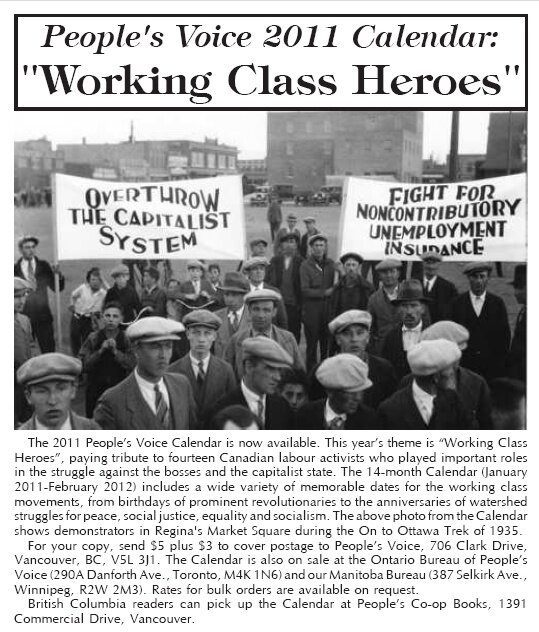
Arthur H. "Slim" Evans is best known as the main organizer and leader of the On To Ottawa Trek of 1935. For his decades of organizing efforts, Slim Evans was repeatedly charged and jailed, but was widely hailed as an outstanding champion of workers' rights.
Born on April 24, 1890 in Toronto, Slim Evans left school at 13 to help support his family. He sold newspapers, drove a team of horses and learned the carpentry trade. Like many others, Evans came west in 1911, working at various jobs on the prairies, before heading to Minneapolis and then Kansas City. There he joined the Industrial Workers of the World, and was sentenced to three years imprisonment for participating in a free speech fight, having read aloud the Declaration of Independence at a rally. "All I did was read it. I was too shy and too nervous at that time to make up any speech of my own," he said later.
Evans was released in 1912 after leading a jail strike of political prisoners. In 1913 he was shot in the leg at the infamous Ludlow Massacre of striking Colorado coal miners. During five years across the western USA, he worked with many labour giants including "Big Bill" Haywood, Frank Little and Joe Hill.
In 1916, Evans returned to Canada, doing farm work, carpentry, and then becoming a miner. He was active in the One Big Union, the Canadian equivalent of the IWW, and volunteered to help organize coal miners in the Drumheller Valley region of Alberta. The Drumheller miners walked out in solidarity with the Winnipeg General Strike of 1919. Rejecting the United Mineworkers of America which had failed to help them, the miners also demanded recognition of the OBU. The mineowners, the Alberta government, and the UMWA fought back, and the OBU was defeated after a lengthy battle. Evans was later sentenced to three years in prison, on trumped-up charges of using UMWA funds to fund a wildcat strike without permission. The truth was that he had used union funds to feed striking miners rather than send it as "per capita" to UMWA headquarters.
Evans was released in March 1925, after one year in the Prince Albert Penitentiary. A petition to the Minister of Justice with over 8700 signatures of miners and other supporters from across B.C. and Alberta was the cause of his early release.
By this time, the OBU had nearly disappeared, but Evans remained a prominent labour activist, working at a variety of different jobs. He also built a home for his family, at 17 E. 42 Avenue in Vancouver.
In 1926, Evans joined the Communist Party of Canada. As he said later, "I believe I was a communist right from the first time I started to travel through the country and saw conditions in the various mining camps and the rotten conditions that prevailed there."
The onset of the Great Depression saw conditions become much worse. Millions were jobless and hungry. In 1932 Evans helped organize the BC section of the National Unemployed Workers Association, fighting to win increased rates for relief work. Later that year, he began organizing the coal miners of Princeton into the Mine Workers Union of Canada, an affiliate of the Communist-led Workers Unity League. Police and the Ku Klux Klan cooperated to break the Princeton miners' strike for higher wages, and Evans was imprisoned for 18 months in Oakalla penitentiary. The authorities also evicted his family from the house on 42nd Avenue when they were unable to pay the mortgage. Another huge labour campaign finally won Evans' release in 1934, just as the struggle of the unemployed began to boil over.
Thousands of unemployed men in the "slave camps" run by the federal government joined the WUL-affiliated Relief Camp Workers Union. BC members of the RCWU voted in April 1935 to strike for "work and wages." For two months, the strikers conducted a powerful campaign for their demands in Vancouver, and then voted to take their struggle directly to Ottawa. Riding the freights, they reached Regina, where Prime Minister R.B. "Iron Heel" Bennett invited the union to send a delegation to present their grievances. Slim Evans headed the eight-member delegation, which was subjected to a verbal attack by Bennett. Evans called Bennett a liar, and the delegation headed back to Regina, where a brutal RCMP attack halted the Trek on July 1, 1935.
But stopping the Trek did not change the course of history. The slave camps were soon shut down, Bennett's Tories suffered a massive defeat, and workers began winning gains such as unemployment insurance. Evans and others were charged under Section 98 of the Criminal Code for "membership in an unlawful organization" - the RCWU. But the cases died when the new Liberal government was compelled to repeal Section 98.
Slim Evans continued his labour activities, helping to organize workers at Cominco in Trail, B.C., into Local 480 of the Mine, Mill and Smelter Workers Union. In 1937 he led a campaign for medical funds to support the MacKenzie Papineau Battalion fighting for the freedom of Spain. During World War Two, he was a shop steward of the Amalgamated Shipwrights in the Vancouver shipyards.
Tragically, Slim Evans died on February 13, 1944, from injuries after being struck by a car three weeks earlier. He was buried in Ocean View Park cemetery in Burnaby. His place in Canadian history was regained with "Work and Wages," the most complete collection of information on his life, edited by his daughter Jean Evans Sheils and Ben Swankey, published in 1977 by the Trade Union Research Bureau. Anniversary celebrations of the On to Ottawa Trek held in 1985 and later years have also done much to educate new generations of labour activists about the contributions of this remarkable Communist.
14) QUIT FRACKING AROUND, WARNS GASLAND
GASLAND, written & directed by Josh Fox, International Wow Company, 2010, 140 minutes. Reviewed by Tim Pelzer.
To meet growing demand for fossil fuels, gas companies are using hydraulic fracturing - fracking for short - to extract natural gas from shale rock deposits. This involves shooting a toxic brew of chemicals and water into the ground to shatter shale rock deposits and force up natural gas. As Josh Fox shockingly reveals in Gasland, hydraulic fracturing threatens to destroy ground water and air quality across the US.
Fox takes us on a journey across 34 states where he interviews rural landowners and farmers who signed agreements allowing companies to drill for gas. A common complaint is that they can no longer drink ground water after fracking. One rancher turns on his kitchen water faucet and places a lighter against the rushing water. Suddenly, the faucet turns into a flame thrower, engulfing the sink in flames.
Handing Fox samples of brownish water that came out of their taps, those interviewed complain that they must now buy drinking water. Fox reports feeling weak because the water smells like turpentine. Gas companies refuse to acknowledge the problem and insist water is safe to drink.
Many complain of sickness, headaches, brain damage and tumours. Dr. Theo Colbon reveals that fracking fluid consists of 500 chemicals, many of which are toxic, leading to brain damage and tumours.
Gas companies have blighted vast stretches of the US landscape with thousands of grey drilling rigs, pipelines and containment tanks. Instead of being removed for safe disposal, waste water is either dumped onto fields or left in open pits, contaminating underground water. Gas equipment and evaporating fracking fluid release toxic chemicals and ozone into the air.
Now gas companies want to drill for gas around watersheds used for drinking water by New York City.
What do the gas companies say about the mess they are leaving behind? All of Fox's requests for interviews are denied.
The US Environmental Protection Agency (EPA) says fracking is not polluting drinking water. However, EPA employee Weston Wilson charges that the agency is ignoring the problem, despite evidence that Americans are being exposed to toxic chemicals.
As Gasland reveals, the former Bush government excluded hydraulic fracturing from EPA regulations protecting clean air and water. The Obama government has pursued the same policy, turning a blind eye to an unfolding environmental disaster.
Gasland is relevant for Canada because gas companies are fracking for shale gas here and pressing to expand operations, despite warning signs that the same disaster is beginning to occur. Quebec has ordered companies to halt fracking until it finishes an environmental assessment study, after provincial inspectors found leaks in 19 of 31 gas wells.
In Alberta, landowner Jessica Ernst has filed a $33 million lawsuit against Encana Corp. and provincial regulatory bodies, claiming that nearby drilling is responsible for contaminating her water with enough methane that it can be set on fire. Ernst said that "I'm not the only one. There are many others that this has happened to, and my story is not unique."
Canadians need to see what is in store for us if provincial and federal authorities give the green light to widespread fracking. Gasland, with its innovative production values, camera footage and music score, is one of the best new documentaries on environmental issues to come out in recent years.
15) WHAT'S LEFT
Vancouver, BC
Summer Solstice BBQ, Coalition of Progressive Electors, Tue., June 21, 6:30-11 pm, Vancouver Rowing Club, 450 Stanley Park Drive, for tickets call 604-255-0400.
Youth Fighting Back Under A Harper Majority, forum on Charter of Youth Rights, Wed., June 22, 7:30 pm, Centre for Socialist Education, 706 Clark Drive. Speakers: Johan Boyden (Young Communist League leader), Marianne Breton Fontaine (Montreal student activist), Stephen Von Sychowski (BC young worker activist). For info, 604-255-2041.
Special General Meeting of COPE (Coalition of Progressive Electors), Sunday, June 26, Japanese Hall, 487 Alexander St. Registration 2 pm, meeting 3 pm, members will vote on electoral agreement for the municipal election.
Winnipeg, MB
30th Annual Peace Walk and First Annual International Peace Festival, Sat., June 18, at Vimy Ridge Park. 11 am - Craft tent and banner making. 12:00 Assemble, 12:30 Walk begins. 2 pm - Program continues at Park.
Dangers and Challenges of the Conservative majority: Strategy and action to defeat the Harper agenda. Thur., June 23, 7 pm, People’s Voice forum with speaker Darrell Rankin. Information: 586-7824.
Toronto, ON
Davenport Club Annual People’s Voice BBQ, 2-5 pm, Sat., July 9 (rain or shine), $20/person, $10 low waged & students, children under 12 free. 58 Albany Ave. (first street east of Bathurst, north of Bloor). To help us prepare better, let us know if you are coming, ph. 416-536-6771.
Montreal, QC
Palestinians And Jews United, boycott/disinvestment/sanctions picket, every Saturday, 1-3 pm, outside Le marcheur, at Duluth & St. Denis. Tribute to Oscar Chavez, Sat., June 25, 1 pm, at the Hotel Lord Berri, 1199 Berri St. (near metro Berri UQAM and rue Ste-Catherine).
(Contents)