|
|
June 16-30 2012
Volume 19 – Number 11
$1
Prolétaires de tous les pays, unissez-vous!
Otatoskewak ota kitaskinahk mamawestotan!
Workers of all lands, unite
1) MONTREAL'S REVOLT OF THE CASSEROLES
2) OTTAWA HITS THE STREETS IN SOLIDARITY
3) FEDERAL CUTS COST 22,000 AFFORDABLE HOMES EVERY YEAR
4) FEDERAL OMNIBUS BILL TRIGGERS MASSIVE BACKLASH
5) TORY BUDGET: GOOD FOR MINING, BAD FOR WATER
6) MORE TORY SABRE-RATTLING - Editorial
7) HUMAN SURVIVAL AT STAKE - Editorial
8) C-38 A TURNING POINT, SAYS GRAND CHIEF PHILLIP
9) DEFEND DEMOCRACY: DEFEAT BILL 78
11) COMMUNIST PARTIES WIN 11 SEATS IN SYRIAN ELECTIONS
12) CONSEQUENCES OF ECONOMIC LIBERALIZATION IN IRAN
13) IN THEIR OWN WORDS: NDP PRAISES BRITISH MONARCHY
15) THE SPARK! (Theoretical and Discussion Bulletin of the Communist Party of Canada)
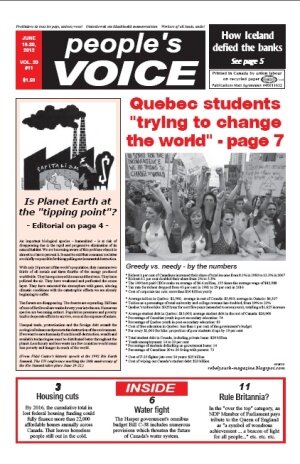
PEOPLE'S VOICE JUNE 16-30, 2012 (pdf)
|
People's Voice deadlines: July 1-31 August 1-31 Send submissions to PV Editorial Office,
|
|
REDS ON THE WEB |
|
People's Voice finds many "Global Class Struggle" reports at the "Labour Start" website, http://www.labourstart.org/. We urge our readers to check it out! |
* * * * *
People's Voice
Canadian Publications Mail Sales Product Agreement #205214
ISSN number 1198-8657
People's Voice is published by
New Labour Press Ltd
PV Editorial Office
706 Clark Drive,
VANCOUVER, B.C. V5L 3J1
Phone:604-255-2041
Fax:604-254-9803
email: pvoice@telus.net
Editor: Kimball Cariou : Business Manager: Sam Hammond
Editorial Board: Kimball Cariou, Miguel Figueroa,
Doug Meggison, Naomi Rankin, Liz Rowley, Jim Sacouman
* * * * * *
Letters
People's Voice welcomes your letters
on any subject covered in our pages.
We reserve the right to edit for length and clarity,
and to refuse to print letters which may be libellous
or which contain unnecessary personal attacks.
Send your views to:
"Letters to the Editor",
706 Clark Dr., Vancouver, BC V5L 3J1,
or pvoice@telus.net
People's Voice articles may be reprinted without permission,
provided the source is credited.
* * * * * *
The Communist Party of Canada, formed in 1921,
has a proud history of fighting for jobs, equality, peace,
Canadian independence, and socialism.
The CPC does much more than run candidates in elections.
We think the fight against big business and its parties
is a year-round job,
so our members are active across the country,
to build our party and to help strengthen people's movements
on a wide range of issues.
All our policies and leadership
are set democratically by our members.
To find out more about Canada's party of Socialism,
give us a call at the nearest CPC office.
* * * * * *
Central Committee CPC
290A Danforth Ave Toronto, Ont. M4K 1N6
Ph: (416) 469-2446
fax: (416) 469-4063 E-mailmailto:info@cpc-pcp.ca
Parti Communiste du Quebec (section du
Parti communiste du Canada)
5359 Ave du Parc, Montréal, Québec,
H2V 4G9
B.C.Committee CPC
706 Clark Drive, Vancouver, V5L 3J1
Tel: (604) 254-9836
Fax: (604) 254-9803
Edmonton CPC
Box 68112, 70 Bonnie Doon P.O.
Edmonton, AB, T6C 4N6
Tel: (780) 465-7893
Fax: (780)463-0209
Calgary CPC
Unit #1 - 19 Radcliffe Close SE
Calgary AB, T2A 6B2
Tel: (403) 248-6489
Ottawa CPC
Tel: (613) 232-7108
Manitoba Committee
387 Selkirk Ave., Winnipeg, R2W 2M3
Tel/fax: (204) 586-7824
Ontario Ctee. CPC
290A Danforth Ave., Toronto, M4K 1N6
Tel: (416) 469-2446
Hamilton Ctee. CPC
265 Melvin Ave., Apt. 815
Hamilton, ON.
Tel: (905) 548-9586
Atlantic Region CPC
Box 70 Grand Pré, NS, B0P 1M0
Tel/fax: (902) 542-7981
http://www.communist-party.ca/
* * * * * *
News for People, Not for Profits!
Every issue of People's Voice
gives you the latest
on the fightback from coast to coast.
Whether it's the struggle for jobs or peace, resistance to social cuts,
solidarity with Cuba, or workers' struggles around the world,
we've got the news the corporate media won't print.
And we do more than that
- we report and analyze events
from a revolutionary perspective,
helping to build the movements for justice and equality,
and eventually for a socialist Canada.
Read the paper that fights for working people
- on every page, in every issue!
People's Voice
$30 for 1 year
$50 for 2 years
Low-income special rate: $15 for 1-year
Outside Canada $50 for 1 year
Send to: People's Voice, 706 Clark Drive, Vancouver, BC, V5L 3J1
You can call the editorial office at 604-255-2041
REDS ON THE WEB
http://www.communist-party.ca/
http://www.ycl-ljc.ca/
http://www.solidnet.org/
(The following articles are from the June 16-30, 2012, issue of People's Voice, Canada's leading communist newspaper. Articles can be reprinted free if the source is credited. Subscription rates in Canada: $30/year, or $15 low income rate; for U.S. readers - $45 US per year; other overseas readers - $45 US or $50 CDN per year. Send to People's Voice, c/o PV Business Manager, 706 Clark Drive, Vancouver, BC, V5L 3J1.)
1) MONTREAL'S REVOLT OF THE CASSEROLES
By Johan Boyden
Over the past two months the picture of Quebec is of a people in motion, a river of struggle and resistance. That river burst its banks in May with the passing of the repressive Law 78. While June has seen (as everyone expected) a slow‑down in the intensity of protests, the resistance has not gone away.
Nor has the police repression abated, evidenced by the arrest of Amir Khadir, member of the National Assembly for Quebec Solidaire, for peacefully marching in a casserole protest. Almost the next morning, around 6:00 am, police raided his house, snatched his student activist daughter and her boyfriend out of bed and paraded them in front of TV cameras, down to the station in handcuffs.
If you wear the red square, like I do, the past few days of the Grand Prix has meant having your bags searched each time you enter the subway and sometimes on the street. (Le Devoir did an investigation and found that, not only were unidentified journalists with red squares searched, but if they asked questions they would be detained at the police station.)
But the spirit of the people has not been dampened. And that resilience is best described through stories about the casserole.
Never seen before
As I unlocked my bike I could just hear it. Bang-bang, clang‑clang, bang, clang, clang. It was exactly 8:01. The casserole had started right on time.
Already I could see a few people, mainly students, wearing the red square, walking out of their front door. In their hands ‑ a big spoon, a soup pot, or a cooking pan.
This is what the word casserole means in French. Any pot used to cook, with a lid. "It is a Quebec tradition," a reporter had confidently claimed the night before on CBC's The National.
"I've never seen anything like this is in my life in thirty years," my next door neighbour who immigrated from North Africa said the same evening, a sense of amazement in his voice.
A cross‑section of society
I was heading home. It was the fourth or fifth night of the casseroles, shortly after the draconian Law 78 outlawed spontaneous mass protest. "It's gone viral" an older activist had told me earlier that morning.
He lived on the opposite side of the downtown. So tonight I was testing that claim by drawing a line, dissecting part of Montreal by bicycle, listening and watching and weaving a route through the side‑streets to get a read on the size of these protests.
The route I chose started in the community of Mile‑End, cut through the fashionable Plateau neighbourhood, then crossed the railway tracks and headed down into the east side and the working class communities of Maisonneuve and Hochelaga.
For people less familiar with a map of Montreal, imagine going from the edge of Burnaby Central Park and down Kingsway into Vancouver, then turning onto Commercial, down to East Hastings. Or, in Toronto, going from Eglinton East down Liard and Pape, through the Danforth and ending on Eastern Avenue. Picture that urban social geography, and imagine people banging pots and pans all along the way.
Two solitudes?
But Montreal has another twist, born of generations of social and national inequality. Half‑way through the town there is an invisible dividing line. On one side the communities speak French, and that's what you hear in the street. On the other side the language is English.
The student movement, numerically and politically, is much stronger among the Québécois(e). But the students have triumphed over this barrier, to everyone's credit. Perhaps it is the strongest social movement to ever do that in Quebec.
The CLASSE student union now releases statements and publications in English. The English‑language universities join the CLASSE in their (weekly!) all‑Quebec national conventions. They have found creative ways to participate in the strike. Before the school session was lost, many departments at McGill and all the undergrads at Concordia had joined the strike for at least some time.
The night demos
The casseroles are perhaps the most dynamic and colourful expression of this solidarity. To understand the casseroles, you have to place them in the context of the whole campaign of the students, the evolution of the struggle from access to education, to a fight against austerity budgets and now, after Law 78, a battle for democracy.
You also have to consider the night demos.
Portrayed as riots on the news outside Quebec, the night demos were born after the first round of negotiations between the students and the Charest Liberals failed. Public anger poured into the streets with spontaneous after‑work protests.
From 8:00 pm onwards, hundreds and then thousands of people snake around in the downtown streets until early in the morning. Some night demos have been reported by the TV station RDI (Radio Canada's Newsworld) as over 10,000. Their size has dissipated greatly as May rolled into hot June, but they continue. Tonight, June 13th, will mark the 50th action.
Cats and mice
To frustrate and shut down these demos, literally hundreds if not thousands of police have taken over Montreal's streets in the night. Traffic police, riot police, undercover cops. Sirens scream. A cavalcade of twenty police cars rushing down the streets is a common sight. They commandeer the public transit, despite the protest of drivers and their union. Looking up at a city bus, you might see it filled with storm‑trooper riot cops clad in paramilitary gear.
Every few nights, around two o'clock in the morning, the riot police will start to charge the demonstration. Pounding their shields, with a helicopter above, they try to split the demo. Then they swoop down. Smashing heads, "kettling," making mass arrests.
But the public is angry, and they have been coming back. Night after night. When Law 78 was passed, the sustained anger grew. Even progressive jurists marched through the streets in their official gowns.
Hands up!
The law itself was a provocation. A few nights after it passed, a bonfire was lit on a street corner. Sitting on a patio not far away, we witnessed the police kettle our entire street block. The police were not content with just putting out the fire.
As a punk band played in the background, the riot cops (some in gas masks) stormed our patio and smashed directly into two bars next door. They scooped people for arrest and deployed sound bombs, while pepper spraying us.
To exit without arrest, we had to leave the chaos of the bar, many people with eyes burning, cross the road and cut through the ground floor of a strip club into a back lane ‑ in single file, our hands up in the air.
The hammer law
In this context of sustained police riots and violence, and literally thousands of arrests across Quebec, the casseroles began. The corporate media has made much of the fact that the casseroles are a non‑violent action, as if the public was criticising the student tactics. In fact they are a direct act of defiance against Bill 78.
Bill 78 not only forces students to return to class. This, in itself, is an attack on basic rights: any act of student strike, even symbolic, can be punished with a year's student fees withheld from a student union for just blocking a day of classes, student associations dissolved, teachers and school administrations punished if they do not enforce the rules, with the minister able to increase her power without consulting the Quebec National Assembly. An open door exists in the legislation to expand these rules to the labour movement.
But Bill 78 also imposes fines in the range of tens of thousands of dollars to forbid the right to assembly and spontaneous protest. Clearly reaching into criminal code and beyond provincial jurisdiction, the law marks perhaps the biggest legal attack on civil liberties in Quebec since the Padlock law and the War Measures Act.
Silence of the lambs?
This is why the approach of the New Democratic Party has been a kind of betrayal through silence.
NDP leader Thomas Mulcair, a Minister of the Environment under the Charest Liberals during the 2005 student protests, and almost all of the Quebec NDP MPs, have refused to wear the red square.
On the edge of Mulcair's riding of Outremont, in Mile End, I start my bike ride. The sky is still sunny, but patches of blue are blocked out by giant storm clouds above the Mont Royal mountain.
Bang, clang, bang!
Mile End is not just home to many McGill and Concordia students but also Greek and Portuguese immigrants and the Hasidic Jewish community.
Sure enough, one of my first sights is a young man in a traditional Hasidic black robe and black cap, banging a pan. This will go down in my memories, along with the image of a nun, standing in her light grey habit just outside the grand doors of a convent, giving a clenched fist salute to a long demo as it paraded past.
By the time I leave the tree‑lined avenues that skirt Park Mont Royal, the pot-bangers have left their door steps. Little groups of five to ten are clustering on the side of the road. They are young and old, women and men. Their clanging draws you in. I turn onto a bike lane, joined by five other cyclists; one starts to ring her bell. Cheers go up. We zip through an intersection and I see a casserole on each corner. It is almost 8:10.
We cross St. Denis at Rachel into the French side of town. The plan of the casserole is to bang and clang by your house and then join an assembly of clangers in your neighbourhood after about twenty minutes. Already a large crowd of almost a hundred people is banging away and spilling into the road.
The pots and pans orchestra
Now skirting Parc la Fontaine, a pots and pans orchestra has erupted. Parents with toddlers in strollers, little boys and girls dancing with wooden spoons. A middle‑aged woman across the street is so enthusiastic that she breaks her spoon and laughs.
People are on balconies, open windows, even rooftops. If they don't have a pot they bang something else. A drum. A watering can. A mail box. Banging and clanging, and clanging and banging.
The orchestra has never disappeared once since I kicked‑off. But now it drifts away as I cross the railway tracks and head through a light industrial area. As I turn down into Maisonneuve the casserole returns on the street corners and out of windows. The Olympic stadium tower looms in front of me. Heavy rain clouds are building.
The Greek disease?
It is not cynical to say that Bill 78 is an election strategy of the Charest Liberal "law and order" government. Smash the summer student demonstrations in the street. Smash their student unions and centers of resistance in September. And call an election for the same month.
Writing in the Globe and Mail, leader Reform Party leader Preston Manning accused Quebec of having "the Greek disease." His formula? High debt, "necessary" austerity, riots in the street.
But Quebec's debt was not caused by its social programmes. It was caused by steadily reduced federal funding. It was caused by tax cuts to corporations and the rich, implemented by both Parti Québécois and Liberal provincial governments. It was caused by structural and systemic problems with the capitalist system.
If you doubt that this is an ideological question, read the report from the bargaining table by the militant student union CLASSE translated on the Rebel Youth blog:
Mia [a government economist] tries to explain the calculation of cost to the government [associated with tuition increases]. The FEUQ demolishes the arguments of Mia and her numbers ‑ it's nice to watch. It becomes clearer than ever that the government's objective is only to increase the students' fees, because it has been demonstrated that the freeze for at least two years was possible. People become enraged. Michelle [Courchesne, Minister of Education] is so angry that she loses her shoe! She tells us that whatever it would take for a year‑long freeze [of tuition], politically the government cannot, [even though] our argument is logical and it stands.
An ideological struggle
The bargaining table report details the compromise agreement that the students are willing to put forward: a tuition freeze of two years, increased bursaries, and a major broad public discussion and debate (Estates General) about the future of public education in Quebec.
The Charest government, however, refused to accept even a one‑year freeze and offered a "poison‑pill" arrangement, where the students and their families pay for their own freeze through the elimination of education tax credits. Ultimately, after over 100 days on strike, the tuition increase would be $1 less. Then the government broke the negotiations.
The social crisis created by this intransigence has polarized the people. In Quebec City and some of the regions, people are denounced in the street for wearing the red square. But in Montreal the mood is of solidarity and support, as I saw when my bike rolled down Pie IX avenue into Hochelaga.
Hochelaga is a poorer neighbourhood, working class for generations. There, in the main intersection of Pie IX and Ontario, a pots and pans demonstration of several hundred was marching along the road. It was the end of my trip, but I joined them as we headed up the street, steadily swelling in size.
Everywhere were children. And I noticed the familiar chants from the night demos had changed ‑ from "La loi matraque! On s'en Tabarnack!" (fuck the hammer law!) and "La loi speciale! On s'en Calice!" (The special law is shit) to "La loi speciale! On s`en Casserole!"
We weaved through a side road. People were leaning out of their windows in every building to cheer us on. We jammed traffic and the drivers beeped their horns in solidarity while the passengers gave us high fives. The sky darkened. It started to rain. Then it began to pour.
A river in the streets
We lost the "baby‑block" but the march continued into the black night, back onto the main road. It was a torrential rain, a pounding rain. Young men took off their shirts and little girls danced in the puddles. Then water couldn't drain into the sewers fast enough. We were marching through a river.
The water poured down so hard I could only just see forward. Suddenly the flashing lights of police cars were up ahead. A black mass appeared before for us ‑ is it the riot cops, come miles out of downtown for us? No, it was another demonstration, joining arms with us from the opposite direction. Almost a thousand people were in the road, in the rain, banging away.
Solidarity is the way
This kind of unity shows the way forward not just for Quebec, but the rest of Canada too. Increasingly, the progressive movements of Quebec and the rest of Canada are paying attention to each other and talking. For the first time, a CLASSE spokesperson addressed the congress of the Canadian Federation of Students.
The question of a united pan‑Canadian strategy is coming forward.
In Quebec, the question is ‑ how do we continue the mobilization? Can we count only on the coming election? The idea of a social and political general strike by labour (and advanced by the Communist Party of Quebec and the Young Communist League) has taken hold in many progressive circles. The strategy is a difficult one for labour, but the experience of Europe shows that the people have no other route than mass struggle. And in this path, we will need to deepen and develop our solidarity across the country.
2) OTTAWA HITS THE STREETS IN SOLIDARITY
By Larry Wasslen, Ottawa
The Student Federation of the University of Ottawa took the lead in organizing a May 29 march in support of the Quebec student strike against tuition increases, with the backing of Ottawa's Solidarity Against Austerity collective as well as trade unions and community groups.
The battle against the Charest austerity regime was sparked in March 2011 when Finance Minister Bachand announced plans to increase tuition fees by $325 annually over five years, beginning September 2012. Last August, student unions and federations began organizing to resist the increases. By November 2011, the Canadian Press reported that "more than 200,000 college and university students voted in favour of `boycotting classes'" a euphemism of the press when referring to the student strike which began on Feb. 13, 2012.
The Ottawa event took on greater importance with the imposition of the anti‑democratic "special law" Bill 78. This law would force demonstrators to inform police of their intent to hold a demonstration, give the intended route and duration of a march of 50 or more people, impose draconian fines on organizations and individuals, and allow the police to declare any demo illegal.
A festive crowd of all ages gathered in Confederation Park, the site of the peaceful Occupy Ottawa protest of 2011. Students with colourful banners and slogans were joined by trade unionists waving union flags, and by social activists from community based groups.
The crowd grew steadily to over 700, with people coming from every direction. By the time Priscillia Lefebvre, a Carleton University grad student and Vice‑President of CUPE 4600, began her opening remarks, the drums, pots and pan symphony was well tuned and ready to go.
Lefebvre reminded us that we were gathered on unceded Algonquin territory, and welcomed everyone who had come to support the "Quebec Uprising", which unleashed thunderous applause. She drew attention to the fact the Quebec students had the lowest tuition fees in the country, the result of years of struggle for accessibility to education. Pointing to the common cause between students and workers in Quebec and in Canada, she asked the crowd if they would take the streets. Again there was thunderous applause, and the cry went out: "Whose streets? Our Streets! A qui les rue? A nous les rues!"
Alex Dugas, spokesperson for the Strike Committee of the University of Quebec/Outaouais, noted that the strike had been going for more than 100 days. He mocked the Charest regime, which had tried to force the students from the streets with Bill 78. The government had wanted the students to go back to school, to learn.
But Dugas exclaimed that the strike has been a great teacher. The students have learned to fight for social justice, democratic rights, and culture.
We have learned, Dugas said, to "say NO to the concept of a university that serves only the interest of a very small minority of powerful people!" The strike had shown the students and the people the face of neo‑liberalism and just who the police were protecting. The crowd erupted with shouts of "Shame! Shame!"
He said that the people gathered for the Ottawa march were in solidarity with locked-out workers, with workers who have lost their jobs to austerity across the country, and with those being forced back to work, the CP Rail workers. He explicitly stated that the student strike had become a popular struggle, a class struggle against the privileged few! Whistles, pots, pans, and drums beat ferociously.
Patrick Smoke, the Aboriginal Representative at the Canadian Federation of Students, explained the 2% cap on federal funding for the Post Secondary Support Program which helps First Nation and Inuit students complete their post-secondary education. More than 10,000 are waiting for funding of any kind, while many go completely without funding.
Smoke highlighted that this was not simply a battle over a 75% increase in tuition fees: "It is about having affordable post secondary education for everyone... not just for the students of today but for all future generations of students."
"Let us continue to resist until the government agrees to our terms," said Smoke, "until the Government has guaranteed to protect post‑secondary for the long term!"
Roxanne Dubois, National Chair of the Canadian Federation of Students, emphasized that governments across the country are abandoning the youth by failing to address the lack of funding in every province. This has resulted in ever increasing tuition fees and a mountain of student debt. Dubois declared that the CFS "was united with students in Quebec in defeating Bill 78, in cancelling once and for all tuition fee hikes."
She concluded with a call to intensify the struggle beyond freezing tuition. "Let us be clear," Dubois explained, "once this [battle] is done our work is not over. We will continue to fight until we get free education in every single province in this country!" The pot and pan symphony erupted in support of this democratic demand.
The final speaker before the march began was Robyn Benson, the newly elected President of the Public Service Alliance of Canada. She underlined that "education is a public service, an investment in our future generations," just as public services provided by PSAC are an investment in "the common good".
"PSAC stands proudly in solidarity with the student movement in Quebec and speaks out strongly against Bill 78," said Benson. "We can take to the streets and we can be heard!"
The crowd then began its march with the slogans, "So So So Solidarity!", and "Whose streets? Our Streets!" Two banners led the militants into the street. The Solidarity Against Austerity banner read "Student Strike: La Lutte Populaire", and the workers' banner supplied by CUPW stated "Capitalism doesn't work for workers! CUPW-STTP."
In a show of defiance, the route of the march through the downtown core of Ottawa was not given to authorities. People in apartments and offices showed their support by waving red items from their balconies, or by banging pots and pans. The demo stopped at the office of "Austerity Harper", so that he could hear the Pan/Drum/Whistle Symphony No. 1 in F major (for fightback). The march proceeded into the market area and across the bridge into Gatineau. Some people on the sidewalks joined the demo while many received and displayed the Red Square patch which has come to symbolize the student strike.
Once in Quebec the march headed for the Palais de Justice where Anne‑Marie Roy, V-P Communications of the Federation of Students at University of Ottawa, and Denis Lemelin, President of the Canadian Union of Postal Workers, again demonstrated the student-working class alliance which has been growing during this battle.
"Everywhere in Canada education is under attack," said Roy, noting that the University of Ottawa budget raises tuition fees yet again, and that 41% of the University's budget comes from tuition fees. How long will it be, she asked, before universities become private institutions?
Denis Lemelin saluted the crowd, saying this is "solidarity in action." He outlined the general attack on democratic and labour rights which has become the hallmark of the Austerity Harper regime, including legislation which has gutted the right to negotiate collective agreements. Lemelin called on the people to take to the streets to defend our rights.
The march continued through downtown Gatineau to demonstrate to the people of Quebec that we are with them in their struggle. It wound its way back across the bridge to the University of Ottawa, where students had organized two demonstrations against the Administration's raising tuition a further 5 per cent.
3) FEDERAL CUTS COST 22,000 AFFORDABLE HOMES EVERY YEAR
PV Vancouver Bureau, with files from an article by Michael Shapcott at www.wellesleyinstitute.com
Canada's housing crisis is getting worse, thanks largely to a steep decline in federal funding.
A recent report from Canada Mortgage and Housing Corporation (CMHC), based on actual results from 2008-2010, and estimates for 2011 to 2016, confirms that the two‑decade erosion of federal affordable housing investments is continuing.
Spending on these investments, including the affordable housing initiative, reached $3.6 billion in 2010, part of the 2009 stimulus budget. However, funding was cut by more than one‑third in 2011, and those cuts will continue through 2016.
The CMHC confirms that the number of households assisted under federal housing programs will be cut by almost 100,000, dropping from 623,700 in 2008 to 525,000 in 2016. That cut of 16% in federally‑subsidized households comes at a time when the after-shocks from the 2008 recession continue to cause deep housing and homelessness distress.
For instance, the affordable housing wait list for the City of Toronto hit an all‑time record of 83,681 households in March of 2012. Toronto's wait list has set a new record every month since the fall of 2008.
By 2016, the federal affordable housing initiative will end, and combined federal housing investments will have been cut to $1.8 billion ‑ a cut of 52% in just six years.
At the same time, the CMHC's net income will rise to $1.6 billion annually by 2016, thanks to revenues from commercial activities such as premiums from the sale of mortgage insurance. Many of the federal housing dollars leverage a dollar or more from provincial and municipal governments, and a dollar or more from affordable housing providers ‑ which adds up to an annual loss of $5.6 billion in affordable housing investments in 2016 and every subsequent year. That cumulative total in lost funding could fully finance more than 22,000 affordable homes annually across Canada.
This trend began in the late 1980s, a factor in the steep rise in homelessness and "precariously‑housed" Canadian families. The Wellesley Institute's Precarious Housing in Canada flipsheet finds that 1.5 million households are in core housing need, and 3.1 million households (about one-quarter of the Canadian total) pay 30% or more of their income on housing.
The health impact of precarious housing is called "Canada's hidden emergency" by the Centre for Research in Inner City Health at Toronto's St. Michael's Hospital, which sets out the data and analysis from Vancouver, Ottawa and Toronto.
The Wellesley Institute charts the erosion of federal housing investments since the late 1980s, including a few upward blips in 2001, 2006 and 2009. Each of these temporary infusions of funding ended, returning to the downward trend.
In 1993, the federal government stopped permanent funding for new affordable housing. Three years later, plans were announced to transfer the administration of housing programs to provincial jurisdiction, and in 1998, Ontario announced a further download of housing to municipalities. By the mid‑1990s, Canada's national housing program launched in 1973 ‑ which generated more than half of the affordable homes across the country ‑ had been completely dismantled.
In 2009, the United Nations Special Rapporteur on the Right to Adequate Housing delivered a scathing final report on his fact-finding mission to Canada. The Special Rapporteur concluded that while Canada has a long history of housing successes, the cuts starting in the late 1980s have effectively prevented Canada from meeting its international housing obligations.
Bill C‑400, a private member's bill to create a plan to meet Canada's housing obligations, was introduced in the Commons in February 2012. A similar bill in the last Parliament drew the support of the majority of MPs, including members of the NDP, Liberals and Bloc Quebecois. The Conservatives opposed the bill; although it passed second reading and amendment at committee, it died on the order paper when Parliament was dissolved for the May 2011 federal election.
More housing news, research and analysis is available at the Wellesley Institute website, www.wellesleyinstitute.com.
4) FEDERAL OMNIBUS BILL TRIGGERS MASSIVE BACKLASH
An estimated 500 businesses and organizations and thousands of individual Canadians joined a collective defence of nature and democracy on June 4, as part of the Black Out Speak Out campaign.
The campaign (known in French as Silence, On Parle) culminated with tens of thousands of Canadians darkening their websites, writing to their elected representatives and speaking out through social media to protest the Harper government's smear attacks on charities, gutting of environmental laws and efforts to silence the voices of concerned citizens.
"Today, hundreds of organizations and individuals - representing millions of citizens - are speaking out in support of two core Canadian values: the protection of nature and democratic discussion," said scientist and activist Dr. David Suzuki. "These values are the foundation of the peace, order and good government that define our nation, yet they are threatened by the federal government's reckless budget bill, C‑38."
Buried in the many provisions of the omnibus budget bill are measures to weaken key environmental laws, such as the Fisheries Act, and the wholesale replacement of the Canadian Environmental Assessment Act with an inferior review process. This would allow the federal cabinet to veto National Energy Board decisions on mega-projects such as the Northern Gateway pipeline. A weakened review process could mean approval of major industrial projects without careful scrutiny or consultation with First Nations, scientists, and citizen groups.
The budget bill also includes $8 million to fund Canada Revenue Agency audits of charities, widely perceived as a move to silence advocacy and free speech on key environmental issues.
"The continued survival of B.C. icons like migratory salmon and steelhead are put at risk through this far‑reaching omnibus bill. It's bad policy and it's bad democracy," stated John Fraser, Conservative fisheries minister in 1984‑5.
Launched May 7, the Black Out Speak Out campaign is a joint effort of Canadian Association of Physicians for the Environment (CAPE), Canadian Parks and Wilderness Society (CPAWS), David Suzuki Foundation, Ecojustice, Environmental Defence, Equiterre, Greenpeace, Nature Canada, Pembina Institute, Sierra Club Canada, West Coast Environmental Law, and WWF Canada. It grew rapidly to include over 400 major not‑for‑profit and social justice organizations, trade unions, scientists, and businesses.
Other supporters include author Margaret Atwood; former Ambassador to the United Nations Stephen Lewis; Grand Chief Stewart Phillip (BC Union of Indian Chiefs); Dr. Andrew Weaver, Nobel Prize‑winning scientist; Oxfam Canada; Amnesty International; Canadian Labour Congress; the federal NDP, Liberal, Green and Bloc Quebecois opposition parties.
5) TORY BUDGET: GOOD FOR MINING, BAD FOR WATER
By Kimball Cariou
One of the earliest critics of the Tory budget presented by Finance Minister Jim Flaherty was the Council of Canadians, whose members took part in the June 4th "BlackOutSpeakOut" campaign across Canada.
The budget is a gift to the mining industry and a curse on the environment, warns the Council, stressing that Bill C-38's amendments to environmental regulation will allow companies to fast-track approval and permitting processes.
A statement from the Council says, "The so‑called `one project, one review' measure aims to bypass current environmental assessment processes and download responsibilities to ill‑equipped provincial governments or do away with them altogether."
In early June, analysts of the legislation reported that the current 6,000 annual federal environmental assessments done across Canada would plummet to about 20 if the legislation is adopted. Gutting environmental protections within the Fisheries Act would be part of this "streamlining and fast‑tracking" process.
The Council of Canadians argues that "in the absence of a national water policy, the Fisheries Act with all its shortcomings is the strongest piece of federal legislation when it comes to the protection of freshwater resources."
Under the Fisheries Act, the federal government prohibits any `deleterious substance' from being discharged into waters frequented by fish, and any works or undertakings that result in the `harmful alteration, disruption or destruction' (HADD) of fish habitat.
Now, the Harper government plans to replace the HADD wording with less extensive language which limits protections to fish that are deemed to be of economic, ecological and cultural value.
"It doesn't take a fish expert to know it's impossible to protect fish while allowing for the destruction of fish habitat," says the Council. "Scientists have also argued that this creates a false notion that there are fish without ecological value."
The potential impacts extend beyond fish populations. Undermining federal environmental safeguards will affect all species and communities dependent on clean freshwater for their well‑being.
For example, in 2010, the destruction of fish habitat was a primary reason for the federal government's rejection of an application by Taseko Mines to develop a copper and gold mine on Tsilhqot'in territory which would destroy Teztan Biny ("Fish Lake"), a pristine British Columbia lake that is also of great cultural and spiritual value to the community.
Companies can seek permission to destroy such a lake due to a regulatory loophole within the Metal Mining Effluent Regulation of the Fisheries Act. The "Schedule 2" loophole has been used by the Harper government to enable metal mining companies to request exemption from prohibitions against dumping deleterious substances into fish‑bearing water or harming fish habitat.
The Metal Mining Effluent Regulation will now be extended to coal and diamond mines, making them eligible to apply for Schedule 2 exemptions.
The Tory budget 2012 aims at encouraging massive expansion in the mineral sector. The federal government estimates $500 billion in investments to the water‑intensive and water polluting mining and energy sector over the next decade.
As the Council notes, "the lifting of environmental restrictions comes at a time when provincial governments are planning to expand mining operations throughout the North. Ontario's `Ring of Fire' is staking tens of thousands of claims throughout the Northern half of the Boreal forest. Quebec's controversial Plan Nord was recently scaled back as a result of strong public opposition. British Columbia plans to forge ahead with the building of eight new mines in the next four years and has introduced its own legislation to `cut red tape' and fast track approval processes for mining projects. And Alberta continues to seek expansion of tar sands production with the full backing of the Harper government. Many in the media have linked the gutting of the Fisheries Act to the Northern Gateway pipeline which would impact fish habitat by cutting across hundreds of streams and rivers in order to transport tar sands oil from Alberta to the BC coast toward foreign markets."
Meanwhile, investors will continue to benefit from public subsidies under the Mining Exploration Tax Credit for Flow‑Through Shares, which has been extended to the end of 2014, costing an additional $100 million in public revenues. The credit benefits speculative investors by reducing the after‑tax cost of exploration, resulting in serious violations of Indigenous rights.
In response to these developments, the Council of Canadians held a well-attended "Shout Out against Mining Injustice" conference in Vancouver in early June.
People's Voice Editorial
The war in Afghanistan remains fresh in the minds of Canadians, including the deaths of thousands of innocent civilians as a result of the NATO occupation. Yet the Harper Conservatives are now trying to soften up public opinion for another war.
This time the target is painted on Syria, a much tougher nut for imperialism to crack than Libya. Despite the tragic events in their country, Syrians are strongly opposed to outside intervention. Small numbers of western troops have already entered Syria to assist the "rebel" forces, and Canada has become a vocal advocate of military action against the elected government of Bashar al-Assad. The Harper government hints that a bombing campaign may be near, and Foreign Affairs Minister John Baird has expelled diplomats from the Syrian embassy in Ottawa.
This sabre-rattling can only encourage the armed opposition to escalate its attacks rather than seeking peaceful, negotiated solutions to the crisis. By openly taking sides in this civil conflict, Canada's hands are already stained with Syrian blood.
The Tory justification for ratchetting up the war threat has been the massacre in the town of Houla. But as military analyst Scott Taylor writes, "the accounts of the Houla incident vary greatly, but the single consensus on the casualty list indicates that more than 100 were killed, including 49 children." Taylor lists other cases in which "the enemy" was demonized using similar accusations later shown to be false.
Unfortunately, while millions of Canadians are appalled at the danger of yet another "regime change" war, our sentiments are not reflected in Parliament. The Harper Tories and the opposition parties must hear a louder chorus of voices condemning the drive to yet another shameful war. This applies in particular to the NDP. Mr. Mulcair's party must be choose: peace or war? Will it speak out against endless NATO interventions, or will it surrender to the Tory militarist agenda?
People's Voice Editorial
While it takes millions of people to achieve real change, a far smaller number can often use their wealth and power to block social progress. In the long run, despite the desperate resistance of imperialism, the working class and its allies have the strength to win crucial advances. But today, the forces for revolutionary transformation of society also face the ticking of the clock towards a fatal buzzer.
The UN Environment Program reports that significant progress has been made on only four of 90 environmental goals adopted at the Rio Earth Summit in 1992. If current patterns of production and consumption of natural resources prevail, unprecedented dangers lie ahead. The concensus among scientists is that the planet is heading towards three degrees Celsius of warming caused by greenhouse-gas emissions by 2100. Natural phenomena triggered by human activity - melting permafrost, the loss of Arctic sea‑ice - will add to the heating trend. According to the scientific journal Nature, life on Earth may be near an irreversible "tipping point", with mass extinctions of species to follow.
At the 1992 summit, Fidel Castro warned that "humankind is at risk of disappearing due to the rapid and progressive elimination of its natural habitat." He put his finger on the culprits - the capitalist societies spawned by colonialism, consuming the vast majority of the planet's resources and spewing out pollution. Tomorrow will be too late, he warned, urging an end to the arms race and action to block ecological destruction.
Survival depends on heeding Fidel's words. Our planet cannot afford endless capitalist exploitation, profiteering, and war. The alternative is a global shift towards a socialist model based on meeting the needs of humanity and the environment. For Canadians, the first step is to dump the Harper Tories, one of the most rabidly anti-environment governments in the world.
8) C-38 A TURNING POINT, SAYS GRAND CHIEF PHILLIP
One of the most powerful voices against the federal omnibus budget Bill C-38 has been Grand Chief Stewart Phillip, president of the Union of B.C. Indian Chiefs (UBCIC).
"Bill C‑38 is absolutely the turning point in the history of this country and the fault line that will determine the future of this country," Grand Chief Phillip told reporters at a Vancouver media conference convened on June 4 by prominent environmental groups. "I urge all Canadians to go and understand that silence is not an option. We all have a duty and an obligation to our grandchildren and their grandchildren to speak out against this legislation."
"We shall not be intimidated," said Grand Chief Phillip. "We shall not be coerced by the Harper's government's drive‑by smear campaigns, those campaigns that are being mounted by his cronies in industry and big oil. We will stand strongly with other Canadians shoulder‑to‑shoulder to defend the pristine beauty of this country."
Jessica Clogg, executive director and senior counsel with West Coast Environmental Law - one of the key groups which organized the BlackOutSpeakOut, told reporters that "Today is a profound moment in the history of our nation for those who hold dear this vast, beautiful land and the democracy that binds us together."
Another participant was David Suzuki, speaking as a private citizen and an "elder". Suzuki urged Canadians to make enough noise that the federal Conservatives back down on some of the legislation, which he said will affect everything from fisheries habitat to the Enbridge Pipeline to the tar sands and the amount of tanker traffic moving through Metro Vancouver.
Former Conservative fisheries minister John Fraser said the bill should be split into several parts and debated separately - a view backed by Stephen Harper in 2004 while he was in opposition when the minority Liberal government introduced their own omnibus bill.
Introduced by Finance Minister Jim Flaherty on March 29, Bill C-38's 450 pages affect everything from Canada's withdrawal from Kyoto to the federal Environmental Assessment process and the Fisheries Act, as well as social policies such as Employment Insurance and pensions.
"I actually get the feeling that they are a little bit nervous about how the public's reacting to the gutting of the Fisheries Act," Gwen Barlee, policy director with the Wilderness Committee, told the Georgia Straight after the event. "I think that is a good thing."
(With files from the Georgia Straight)
9) DEFEND DEMOCRACY: DEFEAT BILL 78
By Darrell Rankin, Manitoba leader of the Communist Party of Canada
As the Liberal Charest government goosesteps over Quebec, it is essential to continue building solidarity to help students to win their entirely reasonable campaign to block an expensive tuition hike. This is not a time to be neutral, as we hear from the NDP!
The massive, illegal protest of up to 250,000 people in Montreal on May 20 gives an idea of the importance of this issue. It is Charest who must back down, or Aboriginal and working class youth right across Canada will continue to suffer from high tuition.
New statements and actions should condemn the reactionary Bill 78, the emergency anti‑protest law. Spread the word and join local actions that are springing up across the whole country in solidarity with the Quebec students!
The true picture of the dramatic struggle in Quebec is being covered up and distorted by the compliant corporate media. Even before the draconian anti‑protest law, students faced truncheons, tear gas, pepper spray, plastic bullets and thousands of arrests, mainly for the "crime" of protesting. Police have inflicted serious injury; courts have imposed heavy fines and criminal records.
The Communist Party and YCL say that the emergency law smells of fascism. Is this reasonable? Here are some important historical realities:
"Before the establishment of a fascist dictatorship, bourgeois governments usually pass through a number of preliminary stages and institute a number of reactionary measures which directly facilitate the accession to power of fascism. Whoever does not fight the reactionary measures of the bourgeoisie and the growth of fascism at these preparatory stages is not in a position to prevent the victory of fascism but, on the contrary, facilitates that victory." (Georgi Dimitrov, 7th world congress of the Communist International, 1935)
"The facts show conclusively that the conditions of which fascism was a product were not limited to the countries where the fascists were temporarily triumphant. It requires little consideration to show that they were not limited to the pre‑war years. They are conditions created by monopoly capitalism and the
determination of the monopolists to maintain the hegemony of finance‑capital in opposition to rising democratic pressure for progressive social change." (Tim Buck, Canada: The Communist Viewpoint, Progress Books, 1948, p. 125)
The Communist Party's view today is informed by decades of fighting fascism. We have never been soft on fascism, unlike the Conservatives. We are speaking as a party that was outlawed in 1931, two years before Hitler outlawed the German CP. We are speaking as a party whose members laid down their lives in the Spanish Civil War, in defiance of Canadian law and the Mackenzie King government's policy of appeasing fascism.
In today's situation, the struggle to defeat Bill 78 is a critical piece of the movement to defend democracy and civil rights across Canada.
By Manuel E. Yepe, a CubaNews translation, edited by Walter Lippmann, June 2012
For four years now, in Iceland ‑ that frosty island part of Europe in the middle of the North Atlantic with a population of barely 300,000 inhabitants ‑ interesting and new things have been happening that do not get corporate western media coverage. This confirms the unrelenting manipulation humankind is subject to due to the control the superpower and its associated oligarchies exert on the news media.
In Iceland there has not been a social revolution, but something almost as serious for the upper financial hierarchy has taken place: a revolution against the tyranny of capitalist banks in a globalized world whose roots inevitably lead to Wall Street.
Thanks to its geothermal power plants, Iceland enjoys great energy independence, but the country has very few additional resources. Its' economy, 40% dependant on fish exports, is very vulnerable. Just like many other European countries, it increasingly accumulated debts with speculating banks so that the country could live above its real possibilities in the neoliberal financial system promoted by the United States which the real economy is now calling to order.
Four years ago, to cope with the effects of a devastating crisis, its government nationalized the main banks in the country. In retaliation, London froze all the assets of 300,000 British customers and 910 million Euros invested in Icelandic banks by UK local administrations and public entities. The island had to use 3,700 million Euros of public money to reimburse these customers.
With a bank debt equivalent to several times its Gross National Product (GNP), Iceland's currency collapsed, its stock market suspended activities and the country went bankrupt.
Massive protests in front of the Parliament building in Reykjavik, the Icelandic capital, forced early elections in 2009 and the resignation of the conservative prime minister and all of his administration.
A draft resolution, widely discussed in Parliament, was meant to burden all the citizens of the island with the reimbursement of the 3,500 million Euros to British and Danish banks through monthly payments over the coming 15 years.
Icelanders returned to the streets demanding a referendum to pass such a law. The president acquiesced and did not ratify the law even when the draft had 44 of the 66 possible parliamentary votes. The referendum was called and the NO to the payment of the debt got 93% of the votes.
After this victory of the Icelandic peaceful revolution, the IMF froze all economic aid to Iceland until the issues of the payment of the debt were solved.
The government ordered an investigation to determine the responsibility for the crisis and the arrests of bankers and high executives began. Interpol issued orders of capture and all the involved bankers left the country.
In this context, an assembly was elected to draw up a new constitution that would include the new lessons learned from the crisis. This would replace the existing one. To draft it, 25 citizens with no political affiliation, in representation of the sovereign population, were chosen from 522 proposed candidates.
This Constitutional Assembly has been working since February 2011 on a Draft Magna Carta from recommendations with the consensus of different assemblies held all over the country. It will then need the approval of the present parliament and of the new parliament after the coming legislative elections.
The economic recovery experienced by the island after being freed from the parasitic burden of the bank debt is seen by the European capitalist cupolas as a dangerous example for "sluggish" countries like Greece and Ireland. Most of all because the recent successes Iceland has been achieving have led many economists to consider it was the collapse of the banks that contributed the most to this progress.
With the crisis resolved through not paying the debt, the Icelandic economy not only did not collapse, but will close year 2011 with a 2.1% growth and a 1.5% in year 2012, a figure that triples that of the countries in the Euro zone.
A great part of this growth is based on production increases, mainly in tourism and the fishing industry. This is in contrast with the image displayed by other European economies in stalemate or decline.
Iceland has shown that by recovering its sovereignty, justice and dignity came along.
The corrupt politicians and bankers have been prosecuted. To reaffirm its independence, Iceland last fall became the first European country to recognize Palestine as an independent nation; something that no country under the yoke of the international capitalist banking system has been able to do.
Manuel Yepe is the former secretary of MOVPAZ, the Cuban Movement for Peace and People's Sovereignty
11) COMMUNIST PARTIES WIN 11 SEATS IN SYRIAN ELECTIONS
By S. Saleh Waziruddin
The first Syrian parliamentary elections under the new constitution, passed by 90% of voters in a referendum with 57% turnout, concluded in May with seat gains for Syria's Communist Parties. The elections had a turnout of 51% (active duty military and police were ineligible) and voters elected 250 representatives from 16 geographic constituencies. The majority of seats are reserved for category "A", required to be workers or peasants as defined by labour laws, and the remaining representatives are elected as category "B" from the other classes.
The Communist Party of Syria (Bagdash) ran 30 candidates (13 in category A) in 15 constituencies and elected eight, an increase of three from the previous parliament. The Communist Party of Syria (Unified) elected three representatives, reporting that its candidates' individual votes amounted to 13% of the total, with the most popular candidate winning 300,000 votes.
Voters cast ballots for individual candidates, but were provided at the polling station with the "National Unity List" with candidates from parties in the National Progressive Front (NPF), which includes the two Communist Parties as well as the Arab Socialist Ba'ath (Renaissance) Party and eight others. Only 41 of those elected were incumbents from the previous parliament, and more than 80 independents were elected.
The results announcement was delayed in some areas because of appeals filed about violations of the election law, and re‑counts were conducted in some polling stations. The Communist Party of Syria (B) reported over 21 violations in Aleppo, including the names of Communist candidates being crossed out from the National Unity List at one polling station. The CPS(B) filed two appeals to the Supreme Constitutional Court about these violations, one of which challenged the right of a winning candidate to be classified in category A because he was a lawyer, although a law professor.
The Communist Party of Syria (U) criticized the new parliament for having only 12% (30) women, whereas previously women made up 18% of the legislature, and said it would have preferred the elections to be held under better circumstances because of the violence in the country which limited the turnout. The CPS(U) criticized some parties for boycotting the election, calling this an inappropriate tactic based on a miscalculation that the government would fall from a boycott, and criticized these parties for continuing to take positions which "hinder every effort to resolve a consensual peaceful solution to the crisis, and encourage terrorist acts and calls for foreign intervention in all candour." The Party also criticized the process of forming the joint electoral list, which in the past included consultation between the parties in the NPF and had the Front's name instead of "National Unity List", but said that it expects the new parliament to be a tool for progress.
A rival coalition called the Popular Front for Change and Liberation (PFCL) is led by Qadri Jamil, one of the drafters of the new constitution. Jamil was elected as an independent but leads the People's Will Party, the legal name of the National Committee for the Unity of Syrian Communists, formed after they were expelled from the CPS(B) under accusations of Trotskyism. The PFCL also includes a 1957 split of the Syrian Social Nationalist Party ("Intifada" or uprising), whose parent party is an NPF member, as well as independent legislators including some trade unionists. The PFLC appealed election results across Syria and has called for nullifying the vote. At the opening of the first session of the new parliament, Jamil rose to a point of order and led a walkout by the PFLC.
Six parties aligned neither with the NPF or the PFCL ran 81 candidates but did not win any seats.
12) CONSEQUENCES OF ECONOMIC LIBERALIZATION IN IRAN
From Nameh Mardom, central organ of the Tudeh Party of Iran, May 21, 2012 (abridged)
Economic liberalization in Iran has had an enormous impact on the livelihood and job security of the working class and other working people. Official reports and data reveal the plight of working people all across the country. Everyday there are new reports of extensive layoffs, prevalence of temporary contracts, and forcefully signed blank contracts.
A report by the Iranian Mehr News Agency on April 27 points out the official approval of the government, giving full authority to state institutions and agencies to lay off workers with less than one year employment: "In the new Iranian year (since March 21st, 2012), some of the state departments have already started to `adjust the workforce'... (There are now) dilemmas of temporary and short‑term contracts, and the loss of job security as a result, and increased pressure of employers on workers... The ratification of the cabinet to allow signing of up to 80% temporary contracts, highlights the trend in the growth in such contracts... A spokesperson of employers said that on average, 40% of public employees have been hired for less than one year, and a few state departments and offices have already announced that they no longer need those employees and no more contracts would be renewed."
According to statistics published by the state institutions of the Islamic Republic, in the past year, more than 100,000 workers have been laid off. The Iranian labour news agency ILNA reported on April 23 that "the general secretary of the `House of Workers' has declared the situation of industries in Iran as critical and said that according to official statistics, 100,000 workers lost their jobs in 1,000 companies."
ILNA also reported on May 1 that "As a result of not paying the planned subsidies to industry, in the last year, 300 manufacturing companies went bankrupt, and in the same period, more than 2,700 businesses were operating under critical conditions; just in the large manufacturing units, more than 12% of contract workers were laid off."
This extensive wave of layoffs and prevalence of temporary contracts and blank contracts that workers are forced to sign (currently encompassing 80% of the entire workforce) has adversely impacted the union movement both quantitatively and qualitatively. The overwhelming majority of experts agree that with the second phase of the so‑called "targeted subsidies" (liberalization of economy and prices) a major portion of the industrial workers will lose their jobs and will be tossed in the long line of the unemployed. This is the root cause of the unpaid wages in almost all of the service and manufacturing industries.
On one hand, the dominance of the parasitic and non‑production economy [importing with oil dollars] will drive the industries to bankruptcy and slump, and with the economic liberalization, the cost of production will increase and therefore the pressure on workers will increase; and on the other hand, the low level of wages is driving millions of working families to the verge of devastation.
Earlier this year, ILNA pointed out the dire situation: "Late last year, the High Council of Labour ratified a (disgraceful) minimum wage, depriving the workers of earning a decent wage. The current wages are under the poverty line. Such wages will choke the manufacturing industry." With the new wave of staggering price increases in recent weeks, the subject of fair wages has once more become a serious and heated debate.
Shargh newspaper reported on May 6 that "With the increased gap between the minimum wage and the subsistence basket of a working family in recent years, with the increasing gap between incomes and expenses, the government's ratified $216/month minimum wage for this year will cover only about 40% of the expenses, and the workers are faced with a $130 shortage which has forced 50% of them to seek a second job. In past years, despite a 9 to 20% increase in the minimum wage of the workers and those who are covered under the Labour Law, in every year, a working family has not been able to balance its expenses and income. Frequent price hikes have exacerbated this situation."
Examination of the official statistics of the "Central Bank of the Islamic Republic of Iran" shows that the actual wages of workers, considering inflation, are much lower than the nominal paid wage... The living standards of the working class and other working people have sharply dropped.
ILNA reported just before May Day 2012: "60% inflation in some consumer items has made the lives of workers much harder. Considering how many days worth of their pay they have to spend just to buy one kilogram of imported frozen meat or a dozen eggs, one could picture the livelihood of workers."
Examining the challenges and difficulties that working people are facing, the direct relation between the dominance of the non‑productive economy and the debilitation of industry, and the exacerbation of the lives of the workers could clearly be recognized. More accurately, in the assessment of the current protest movement of the workers, their demands, the level of organization of workers, and issues like these, the devastating role of the social‑economical policies of the theocratic regime of Iran should not be overlooked or under‑estimated.
As such, a successful struggle for the trade rights and interest of workers without the fight against the anti‑popular policies of the ruling reaction is not possible. In other words, there is an inherent and integral link between the trade unions and the political struggle. For this fundamental reason, the labour movement in Iran needs to strengthen its ranks and brace its ties with the general national struggle of the people.
It goes without saying that the effective union struggle does not happen in a vacuum and is not unrelated to the balance of forces in the political scene, but occurs in the context of the current political developments and class make‑up of society. The secret to success of the labour movement is to pay careful attention to political trends and the struggle against the theocratic tyranny that dominates the political superstructure of the parasitic, brokerage‑based and non‑productive economy and economic relations of the country.
Without a broader alliance in the current union movement, without tying and meshing together the trade and the political struggles, and without an effective confrontation against the socio‑economic policies of the theocratic regime, the current dire situation will continue, and the workers and working people of Iran will remain deprived of their rights and at the same time, be vulnerable to the wide‑ranging attacks of capitalism.
13) IN THEIR OWN WORDS: NDP PRAISES BRITISH MONARCHY
Excerpts from a June 4 speech to the House of Commons by MP Peter Stoffer (Sackville-Eastern Shore, NDP).
Mr. Speaker, I thank the hon. Minister of Citizenship and Immigration [Jason Kenny] for his wonderful grace to our gracious queen, Her Majesty Queen Elizabeth.
... When we look at the history of Queen Elizabeth and her family, it is truly an amazing history to be able to live in the time of her life and see what she has done from June 2, 1952, on to today and for the years to come. She has been a symbol of grace and a symbol of wondrous achievement in what she has done. With her respect for all peoples, all religions, all languages, the Commonwealth, family and, above all, her faith, she has been what I would call a beacon of light and a beacon of hope for all people, not just of the Commonwealth but of the world. She has truly lived her life in the service of her country and the Commonwealth. That is much to the chagrin of many people. People in the United States, for example, would love to have someone like Queen Elizabeth as their head of state, as she truly resembles tradition from long ago.
As someone who was liberated by the Canadian military and her allies, the Brits, the Poles and the Americans, I can say her undying support for the men and women who wear the uniform has been nothing short of absolutely fantastic. Her love and her respect for the men and women of the service and those who become veterans is truly an example that we can all take to understand that democracy is not free, that freedom is not free. It is those men and women who are willing to sacrifice all for king and country and queen and country, and why they do what they do is truly tremendous. Her respect for them is truly tremendous...
Now that she celebrates her 60th year on the throne, it is we as Canadian subjects of the Queen who wish her the very best, long continued health and long continued success. It is we as Canadians who thank the Queen for her service, for she truly has done God's work on the throne of England and the throne of Canada and that of the Commonwealth. She truly has been a symbol of hope, truth, justice, charity and love.
On behalf of our leader and all New Democrats across the country and on behalf of Her Majesty's Loyal Opposition, we say God save our Queen and may she live a long and glorious life. God bless.
Vancouver, BC
Left Film Night, “Made in Dagenham”, on 1968 Ford strike for gender equity, Sunday, June 24, 7 pm, Centre for Socialist Education, 706 Clark. Free, call 604-255-2041 for info.
La Pena Latinoamericana, 8 pm, Friday, June 29, and last Friday evening each month, 706 Clark Drive, $10 admission, all welcome, organized by La Trova Nuestra.
Latin American Dinner, proceeds to PV Fund, 7 pm, Sat., July 7, $15, organized by Sergio Montivero Club CPC.
Toronto, ON
Annual People’s Voice BBQ, 2-5 pm, Sat., June 23 (rain or shine), 58 Albany Ave. (one street east of Bathurst, north of Bloor). Meat and vegetarian dishes, $20/person, $10 for students, low- and unwaged, children under 12 free. Sponsored by Davenport Club CPC, please RSVP to let us know you are coming, 416-536-6771, omayasim@sympatico.ca.
Honouring the Moncada: July 26th Cuban Event and Celebrating the 35th Anniversary of the CCFA Toronto, Sunday, July 29, 11 am-3 pm, buffet brunch, salsa dance lessons, live band & more. Tickets $26 advance, $35 at door, Lula Lounge, 1585 Dundas St. West. Call Liz 416-654-7105 or Sharon 905-951-8499. Sponsored by Canadian-Cuban Friendship Assoc. Toronto, www.ccfatoronto.ca.
St. Catharines, ON
“A Taste of Cuba”, family social afternoon of food, Cuban music and dancing, Sunday, June 17, 2-6 pm, 1760 Ridge Rd, Ridgeway (Ft. Erie). Special Guests: Cuban Ambassador Teresita Vicente Sotolongo, Consul General Jorge Soberon Luis. Cost $10, information and/or RSVP to Dave (905-382-3468), or by email:ccfaniagara@yahoo.ca. Canadian Cuban Friendship Association of Niagara.
Winnipeg, MB
Marxism Course, information or to register, contact the Communist Party, phone 586-7824 or send email to cpcmb@changetheworldmb.ca
Montreal, QC
Palestinians And Jews United, boycott/disinvestment/sanctions picket, every Saturday, 1-3 pm, outside Israeli shoe store “NAOT”, 3941 St-Denis Street.