|
|
June 16-30, 2013
Volume 21 – Number 11
$1
Prolétaires de tous les pays, unissez-vous!
Otatoskewak ota kitaskinahk mamawestotan!
Workers of all lands, unite
1) THAT'S EVEN MORE SCANDALOUS!
2) UNION BUSTERS 'R US - Editorial
3) ANOTHER HEROIC WHISTLEBLOWER - Editorial
4) THE PERILS OF THE PERILS OF INDIFFERENCE
5) REVERSE THE TORY ATTACKS ON EMPLOYMENT INSURANCE
7) SCRAP THE "CHEAP LABOUR" TEMPORARY FOREIGN WORKERS PROGRAM
8) SALUTE THE CONTRIBUTIONS OF DR. HENRY MORGENTALER
9) G8 SUMMIT: WE DESERVE A BETTER KIND OF POLITICS
10) THE GLOBAL ECONOMY: A MIDYEAR SNAPSHOT
11) RESOURCES SECTOR: OBSCENE PROFITS, OBSCENE EXPLOITATION
12) FRANCE MOURNS MURDER OF STUDENT ACTIVIST BY FASCISTS
13) "TURKEY IS WITNESSING A GENUINE POPULAR MOVEMENT"
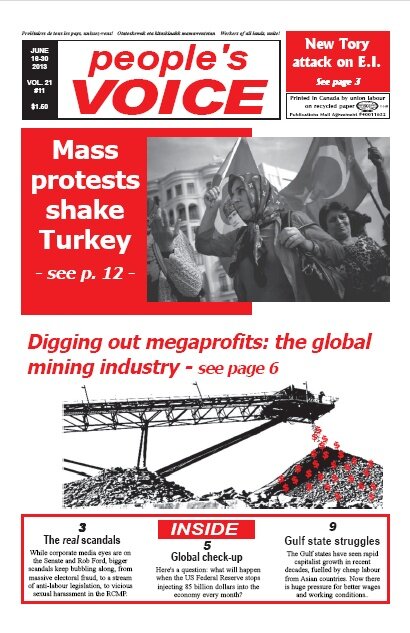
PEOPLE'S VOICE JUNE 16-30, 2013 (pdf)
People’s Voice 2013 Calendar
”Ideas of Revolution”

|
People's Voice deadlines: July 1-31 August 1-31 Send submissions to PV Editorial Office,
|
REDS ON THE WEB
http://www.parti-communiste.ca/
peoplesvoice.ca
www.ycl-ljc.ca
www.solidnet.org
|
People's Voice finds many "Global Class Struggle" reports at the "Labour Start" website, http://www.labourstart.org/. We urge our readers to check it out! |
* * * * *
People's Voice
Canadian Publications Mail Sales Product Agreement #205214
ISSN number 1198-8657
People's Voice is published by
New Labour Press Ltd
PV Editorial Office
706 Clark Drive,
VANCOUVER, B.C. V5L 3J1
Phone:604-255-2041
Fax:604-254-9803
email: pvoice@telus.net
Editor: Kimball Cariou : Business Manager: David Au
Editorial Board: Kimball Cariou, Miguel Figueroa,
Doug Meggison, Naomi Rankin, Liz Rowley, Jim Sacouman
* * * * * *
Letters
People's Voice welcomes your letters
on any subject covered in our pages.
We reserve the right to edit for length and clarity,
and to refuse to print letters which may be libellous
or which contain unnecessary personal attacks.
Send your views to:
"Letters to the Editor",
706 Clark Dr., Vancouver, BC V5L 3J1,
or pvoice@telus.net
People's Voice articles may be reprinted without permission,
provided the source is credited.
* * * * * *
The Communist Party of Canada, formed in 1921,
has a proud history of fighting for jobs, equality, peace,
Canadian independence, and socialism.
The CPC does much more than run candidates in elections.
We think the fight against big business and its parties
is a year-round job,
so our members are active across the country,
to build our party and to help strengthen people's movements
on a wide range of issues.
All our policies and leadership
are set democratically by our members.
To find out more about Canada's party of Socialism,
give us a call at the nearest CPC office.
* * * * * *
Central Committee CPC
290A Danforth Ave Toronto, Ont. M4K 1N6
Ph: (416) 469-2446
fax: (416) 469-4063 E-mailmailto:info@cpc-pcp.ca
Parti Communiste du Quebec (section du
Parti communiste du Canada)
5359 Ave du Parc, Montréal, Québec,
H2V 4G9
B.C.Committee CPC
706 Clark Drive, Vancouver, V5L 3J1
Tel: (604) 254-9836
Fax: (604) 254-9803
Edmonton CPC
Box 68112, 70 Bonnie Doon P.O.
Edmonton, AB, T6C 4N6
Tel: (780) 465-7893
Fax: (780)463-0209
Calgary CPC
Unit #1 - 19 Radcliffe Close SE
Calgary AB, T2A 6B2
Tel: (403) 248-6489
Ottawa CPC
Tel: (613) 232-7108
Manitoba Committee
387 Selkirk Ave., Winnipeg, R2W 2M3
Tel/fax: (204) 586-7824
Ontario Ctee. CPC
290A Danforth Ave., Toronto, M4K 1N6
Tel: (416) 469-2446
Hamilton Ctee. CPC
265 Melvin Ave., Apt. 815
Hamilton, ON.
Tel: (905) 548-9586
Atlantic Region CPC
Box 70 Grand Pré, NS, B0P 1M0
Tel/fax: (902) 542-7981
http://www.parti-communiste.ca/
* * * * * *
News for People, Not for Profits!
Every issue of People's Voice
gives you the latest
on the fightback from coast to coast.
Whether it's the struggle for jobs or peace, resistance to social cuts,
solidarity with Cuba, or workers' struggles around the world,
we've got the news the corporate media won't print.
And we do more than that
- we report and analyze events
from a revolutionary perspective,
helping to build the movements for justice and equality,
and eventually for a socialist Canada.
Read the paper that fights for working people
- on every page, in every issue!
People's Voice
$30 for 1 year
$50 for 2 years
Low-income special rate: $15 for 1-year
Outside Canada $50 for 1 year
Send to: People's Voice, 706 Clark Drive, Vancouver, BC, V5L 3J1
You can call the editorial office at 604-255-2041
REDS ON THE WEB
http://www.parti-communiste.ca/
http://www.ycl-ljc.ca/
http://www.solidnet.org/
Top of Form
(The following articles are from the June 16-30, 2013, issue of People's Voice, Canada's leading communist newspaper. Articles can be reprinted free if the source is credited. Subscription rates in Canada: $30/year, or $15 low income rate; for U.S. readers - $45 US per year; other overseas readers - $45 US or $50 CDN per year. Send to People's Voice, c/o PV Business Manager, 706 Clark Drive, Vancouver, BC, V5L 3J1.)
1) THAT'S EVEN MORE SCANDALOUS!
By Jean Kenyon
Canada's mainstream media have lately been full of Conservative Senators fudging expense claims, the Prime Minister's Office trying to keep it quiet, and a video of a crack‑smoking Rob Ford which has mysteriously disappeared. But while they've been preoccupied with these salacious dramas ‑ and they are of some importance ‑ the media have been under‑reporting some even more scandalous goings‑on.
As Canada Day 2013 approaches, here are my suggestions for Canada's National Scandal Sheet.
1. ELECTION FRAUD GOES UNPUNISHED
On May 24 Judge Richard Mosley found that a campaign of voter suppression occurred in ridings across Canada in the 2011 federal election, as voters who had indicated they were not supporting the Conservative Party received phone calls directing them to non-existent polling stations. Mosley also stated that Conservative MPs in six ridings, where the result was challenged by the Council of Canadians, had sought to obstruct his investigation.
What have been the consequences? No MPs have lost their seats, no one has been named, fined, or jailed, and the media are giving all their attention to the Senate expenses scandal.
The eight voters who brought this suit have decided not to take it to the Supreme Court. Instead the Council of Canadians has launched a petition calling for a public inquiry, and to bring the perpetrators to justice: http://canadians.org/election/petition.html
Meanwhile Chief Electoral Officer Marc Mayrand told a House of Commons committee that Elections Canada needs more powers to compel witnesses to testify. He told reporters that Conservative officials have repeatedly refused to speak to E.C. investigators in the election fraud case.
2. G20 POLICEMAN ACQUITTED
In June 2010, Dorian Barton was peacefully demonstrating in the area designated by Toronto police for G20 protests. As he saw mounted police appear on the scene, he started taking pictures. He never caught the badge number of the officer who stepped forward from a line of police, struck him with a baton, and broke his shoulder with a riot shield. An eyewitness caught the officer's face on camera, but not the actual blows.
Funny that no one in that line of police could identify their colleague. At trial the eyewitness's character was impugned, and the officer was acquitted.
This is the first of a series of trials of G20 police. Personally I'm more worried about the police cracking heads than whether the Toronto mayor may be a crack head.
3. TRUTH AND RECONCILIATION DOCUMENTS NOT DELIVERED
Following Stephen Harper's 2008 public apology for Canada's past practice of forcibly removing Aboriginal children to residential schools, the Truth and Reconciliation Commission was set up to let victims of abuse tell their painful stories ‑ and to create a historical record of the residential schools.
But as the Commission nears the end of its mandate, it is still waiting for millions of documents to be released by the federal government. Library and Archives Canada estimates that to find and digitize them all would take 10 years. Will the Commission's mandate be extended, so the work can be completed? Will it have to go to court to get the documents?
Harper would like to take credit for his public apology, while behind the scenes trying to prevent Canada's true history from being told.
4. HEAD STILL IN THE TAR SANDS
Harper gave a speech to the US Council on Foreign Relations recently, urging approval of the Keystone XL pipeline, which would carry huge quantities of bitumen from Alberta to the US Gulf Coast, leading to further expansion of the tar sands.
Yet Canada's own military has issued two reports stating that climate change will lead to major threats to global security. Not even these voices influence Harper to shift away from his full-speed-ahead promotion of the tar sands. The COFR also grilled Harper on Canada being the only country to pull out of the Kyoto protocol.
And if you needed another reason to hate the tar sands, see this 3‑storey mountain of petroleum coke piled along the Detroit River, on a strip of beach owned by one of the Koch brothers (of Tea Party fame): http://mobile.nytimes.com/2013/05/18/business/energy‑environment/mountain‑of‑petroleum‑coke‑from‑oil‑sands‑rises‑in‑detroit.html
5. CONTEMPT FOR UN ARMS CONTROL TREATY
On June 3, sixty‑one nations signed a treaty to control the international trade in small arms, such as handguns and grenades. But Canada refuses to sign. NDP foreign affairs critic Paul Dewar asked why, pointing out that half a million people die every year because of the illegal trade in small arms, especially in conflict zones like Sudan and Congo.
Our honourable foreign affairs minister's reply? "We don't want to see the NDP and their friends in the Liberal Party try to bring in a long gun registry by the back door."
There's no connection with the long gun registry, and John Baird knows it. Just a sleazy remark. Harper had earlier demonstrated his contempt for the UN talks by sending a Quebec gun dealer as Canada's representative.
6. RCMP COMMISSIONER DISPARAGES HARASSMENT CLAIMANTS
First it was one woman, then 2 or 3, who ventured to speak out about persistent sexual harassment within the RCMP. Now a lawsuit, awaiting class action certification, has gathered the names of 300 current and former Mounties who claim that their workplace was toxic because of sexual harassment and bullying.
RCMP Commissioner Bob Paulson was called to speak at a Senate committee looking into these matters. He picked out some complainants by name, stating that they were women who failed to make advancement in the force and were looking for someone to blame. He singled out two male complainants as being involved in union organizing activities, and therefore not credible. Clearly the culture within the RCMP hasn't changed much.
7. ANTI‑LABOUR BILLS CHASE ONE ANOTHER THROUGH PARLIAMENT
The newest Omnibus budget bill, C‑60, has attracted attention for the way it will threaten the independence of the CBC. Less noticed has been its provision for federal officials to sit in on collective bargaining talks at all Crown corporations, including the CBC. In this way the federal government will exert control over staffing, salary, pensions, and more.
Meanwhile Bill C‑377, passed in the Commons in December, is working its way through the Senate. It will impose complicated accounting procedures on unions, including a requirement to divulge exactly how much staff time they spend on political activities.
As if all this were not enough, a new private member's bill, C‑525, is coming next. It will make it harder to certify a union and easier to decertify, in the federally‑regulated sector (telecommunications, banking, and transportation). And before the end of June, the Conservative party convention is expected to vote on a policy resolution to eliminate dues check‑off and union shops altogether.
This barrage is intentional. Before we can organize to fight back against one assault, two more come at us. Even more scandalous, the Harper Conservatives were not elected with any mandate to target organized labour.
Well, that's the National Scandal Sheet for another week in the life of this disgraceful Harper Conservative government!
People's Voice Editorial
The Tory union‑bashing drive took another step on June 5, when Conservative MP Blaine Calkins (Wetaskiwin) introduced Bill C‑525. This Act aims to overturn decades of hard‑won collective bargaining rights, by changing the certification and revocation sections of the Canada Labour Code, the Public Service Labour Relations Act and the Parliamentary Employees Staff Relations Act.
Masked as giving workers the "choice" of whether to join a union, this private member's bill would actually remove the "card check" automatic certification of bargaining units. Adoption would mean that workers under federal jurisdiction will face the highest barriers to unionization in the country. Employers in the federal sector, on the other hand, would have full scope to intimidate such workers, making it nearly impossible to organize effectively. Just as significant, C‑525 also changes the rules for decertification, so that if a minority of members of a bargaining unit (45%) apply for revocation, a mandatory vote is called. For the unit to remain unionized, the majority of employees in the unit must vote in favour of continued representation, since all "no‑shows" would count against the union. As the Public Service Alliance of Canada warns, "this Bill stacks the deck against workers who wish to be represented by a union."
By sneaking C‑525 in as a Private Members' Bill, the Tories hope to avoid being seen as anti‑labour, despite their notorious record. It appears that the organization promoting these changes is Merit Canada, an employer lobby group which advocates for an end to unions in the construction industry.
The attack on labour rights is reaching a critical stage. Instead of more angry news releases, the Canadian Labour Congress and its affiliates need to get huge numbers of trade uniom members and their allies into the streets. Bill C‑525 can be stopped, but only through mass mobilizations, before another big chunk of labour rights is legislated out of existence.
3) ANOTHER HEROIC WHISTLEBLOWER
People's Voice Editorial
The latest revelations of global U.S. surveillance operations are not surprising, but should serve as a warning. On the day after Sept. 11, 2001, the Communist Party of Canada warned against "any attempt internationally or domestically to use this tragic episode as a justification to limit democratic rights including the rights to assembly, privacy, legal due process or extend repression against the people." Since that time, a wide range of democratic forces have condemned the relentless drive to spy on critics of imperialist policies in the name of "fighting terrorism."
Now, ex‑CIA employee Edward Snowden has leaked the details of U.S. phone and internet surveillance programs. As Snowden told the UK Guardian: "The NSA has built an infrastructure that allows it to intercept almost everything. With this capability, the vast majority of human communications are automatically ingested without targeting. If I wanted to see your emails or your wife's phone, all I have to do is use intercepts. I can get your emails, passwords, phone records, credit cards..."
It is true that such activities require intensive human involvement to take action on raw surveillance data, making the process expensive and complicated. But any official promises to avoid invasion of privacy rights are just so much bafflegab. The U.S. ruling class, with the complicity of right-wing regimes like the Harper Tories, will continue to spy on any movements which pose a serious or potential threat to the global domination of the transnational corporations. In turn, the data reaped from such surveillance will continue to be used to infiltrate, divide and weaken such opposition movements, in particular revolutionary forces which challenge the capitalist system itself.
Like Bradley Manning, Edward Snowden has done the world a tremendous service by blowing the whistle on this nightmare. Everything possible must be done to defend these two heroes.
4) THE PERILS OF THE PERILS OF INDIFFERENCE
As part of his English 30‑1 high school course in Alberta, PV contributor Graham Wilson was assigned to read a speech by Elie Wiesel, on the topic of moral "indifference". In the end, our writer says, the prominent Zionist's speech was little more than a defence of military interventionism, in this case the NATO bombing of Serbia in 1999. Reading the assignment requirements carefully, Wilson came up with this response in opposition to such interventions, receiving a full mark of 5/5.
On April 12, 1999, before an audience of White House dignitaries including then U.S. President and First Lady Bill and Hillary Clinton, Holocaust survivor and Nobel peace prize laureate Elie Wiesel delivered an address titled "The Perils of Indifference". In this speech, he outlined his thoughts on the philosophy of indifference, describing it as "a strange and unnatural state in which the lines blur between light and darkness, dusk and dawn, crime and punishment, cruelty and compassion, good and evil."
He notes how indifference is "more dangerous than anger and hatred", because anger sometimes drives a person to do "something special for the sake of humanity because one is angry at the injustice that one witnesses." He concludes finally that indifference is "always the friend of the enemy, for it benefits the aggressor ‑ never his victim."
There is truth to these words, even in circumstances as seemingly mundane as a national election, where voter apathy and vote suppression is used to maintain domination by hateful and corrupt governments, which dodge hideous scandal after scandal by exploiting public apathy and the will to forget.
Wiesel then goes on to cite the example of the St. Louis, a cargo ship loaded with Jewish refugees from Nazi Germany, which made anchor on the shores of the United States, only to be sent back again. He questioned how President Roosevelt could have let this happen, given documentation showing American awareness of the persecution of the Jews by Hitler's government. He also lists instances of American corporations trading and engaging with Germany's fascist regime, such as U.S. oil which powered the Blitzkrieg into France in 1940. He asks how it is that these agents could have remained silent despite their awareness ‑ how they could have remained indifferent to the sufferings of the many trapped in the Nazi concentration camp system. On these counts, Wiesel is absolutely correct in his assertion that everyone has a moral obligation to raise their voice to evil when apparent, and correct about our obligation to analyze the full results of our own actions.
However, in the concluding passages of his speech he starts to overstep the bounds of promoting awareness and activism, and falls into the trap of imperialist interventionism. He sings the praises of the "joint decision of the United States and NATO to intervene in Kosovo", which he feels to be "justified" as "a lasting warning that never again will the deportation, the terrorization of children and their parents be allowed anywhere in the world". While undoubtedly the violence that struck the area of the former Yugoslavia was horrible to behold, it is considerably ironic for NATO to have felt itself the region's knight in shining armour when it had been using and promoting religious and ethnic tensions in its effort to destabilize the former country's communist regime, which had presided over almost fifty years of relative peace.
Furthermore, the very means of the intervention left much to question, as NATO forces sought to protect, as Wiesel put it, "those refugees, those who were uprooted by a man whom I believe that because of his crimes, should be charged with crimes against humanity" through the large scale aerial bombardment of civilian areas, including factories and television stations, with the predictable resultant `collateral damage'. Even worse was the particular types of armaments used, including cluster bombs and depleted uranium ‑ many of which are still killing to this day, made yet more dangerous by the continuing lack of reconstructed infrastructure. Many have charged that NATO was simply experimenting with weapons while using the people of Serbia as mere guinea pigs, as well as trying to enhance their foothold into a region newly broken away from Russia's influence.
This was not a one=off case either. The same weapons were again used in Iraq and Afghanistan, showing the dark legacy of almost all the "humanitarian interventions" of the past decade.
The latest in Libya has proved perhaps the most embarrassing for NATO forces. The weak central government they set up in Gaddafi's place has failed to check fanatical Islamist elements, leading to the death of the U.S. Ambassador during the consulate attack in Benghazi during September 2012. More catastrophic is the flow of arms to Islamist terrorists elsewhere in the continent ‑ most notably to northern Mali, where the response has been yet another intervention by the French military; who knows what the end result of that will be. If indifference innately denies our humanity, it must be checked by how often action is nothing more than inhumanity in disguise.
Again, Wiesel is correct to note the actions of the United States and others in the build up of Nazi Germany, and right to note their partial responsibility for the horrors that followed.
The message that he failed to grasp is that the solution to war and violence is peace and development, not force and bombing from another power. Respect for the sovereignty of nations and the rights of people to self‑determination is not justified to be violated on the grounds of one‑sided lists of abuses and crimes. The world is not black and white, and justice is not served by narrow‑minded shots in the dark. This is the difference between peacekeeping and war‑making, mediation versus conflagration. Thus this is not a call for indifference, but a recognition that the difference we make must be the right one. Sometimes it is better to do nothing than to do harm, but always it is better to do good than nothing at all. The trick is having the wisdom to avoid indifference by making the correct difference.
5) REVERSE THE TORY ATTACKS ON EMPLOYMENT INSURANCE
Central Committee, Communist Party of Canada, June 1‑2, 2013
The Communist Party of Canada joins with the labour movement, the Catholic Bishops of Atlantic Canada, and many other voices which have condemned the Harper government's moves to sharply limit access to Employment Insurance benefits, especially by seasonal workers in hard‑hit areas of eastern Canada. Protests this spring have included a march by tens of thousands in Montreal, and many other rallies in Québec and the Atlantic provinces.
During 2012, under the demagogic guise of so‑called "reforms to curb abuses", the Tories tightened regulations to make it virtually impossible for many such workers to qualify for benefits. This includes forcing jobless workers in areas of extremely high unemployment to prove that they are actively seeking work, and to accept any job within 100 kilometres of home, even if the pay is just 70 per cent of their previous salary. While the government claims that the changes will save $12.5 million this year and $33 million next year, Human Resources Minister Diane Finley has admitted that no studies were done in advance to gauge the impact of these changes upon workers. Regional EI offices have been given monthly quotas for slashing EI benefits, and there are media reports that government staff are showing up at the homes of jobless workers to snoop on them.
These "savings" impose a deadly burden on working people and their communities. Over five years into the economic crisis which broke out in the fall of 2008, Statistics Canada reported in April that 1,361,700 were officially counted as unemployed, or 7.2% of the total workforce. In the 15‑to‑24 age group, unemployment stood at 14.5%, and 46.8% of young workers are employed only part‑time. The real unemployment figures are much higher, since those who have given up looking for non‑existent jobs are no longer counted in the active workforce.
Even more shocking, only 13% of unemployed workers in the 15‑to‑24 age group were able to able to qualify for Employment Insurance in 2012, a figure which breaks down into a mere 7.0% of unemployed young women and 17% of unemployed male youth. Clearly, by tightening the EI eligibility rules, the Harper Tories have condemned young Canadians to lengthy periods of utter poverty, even though they pay into the EI fund during periods when they are employed. Overall, only 37% of unemployed Canadians qualify for EI benefits, and there are 5 unemployed people for every job vacancy. As if all this was not enough bad news, on April 1, 250 referees who hear 26,000 EI appeals a year were replaced by just 39 people. Despite overwhelming evidence that the EI cuts and the rest of the anti‑working class Tory agenda are creating huge hardships for working people, PM Stephen Harper has outrageously blamed trade unions for "engaging in a campaign of misinformation about changes to the EI program".
Employment Insurance was a major victory for the working class of Canada, achieved thanks to massive and militant struggles during the 1930s by the Communist‑led Relief Camp Workers Union, the Workers Unity League, and other progressive forces, over the stubborn resistance of Conservative PM "Iron Heel" Bennett. Clearly, similar militant struggles are needed today to block the continued attacks on EI and to force governments to put the interests of working people ahead of corporate profits. The Communist Party of Canada will continue to press for broad, united, militant mass action by the labour movement and its allies, to defend EI and to reverse the entire neoliberal agenda of the Harper Tories.
Central Committee, Communist Party of Canada, June 1‑2, 2013
The Harper government has once again attempted to hide legislation in its omnibus budget bill that would profoundly undermine Canadian sovereignty, democracy, culture, and labour rights if it becomes law.
Bill C‑60 requires that the Prime Minister and Cabinet approve salaries, working conditions and collective bargaining positions for CBC unionized employees, giving the Treasury Board the same powers over salaries and working conditions of non‑unionized employees, thereby eliminating the arms length relationship between the government and Canada's public broadcaster that has existed since the CBC was created.
As a result, the CBC will no longer be able to fulfill its mandated role of providing wide‑ranging and objective news and information about events and developments in Canada and globally, on which Canadians depend to form their opinions and views.
The CBC is also mandated to reflect, popularize and help develop Canadian culture, and to strengthen Canadian sovereignty and democracy. Because Bill C‑60 also extends these new Cabinet and Treasury Board powers over three other vital cultural and scientific agencies ‑ the Canada Council for the Arts, the International Development Research Centre, and the National Arts Centre in Ottawa ‑ it is clear that this Bill also intends to attack vibrant Canadian culture.
The government's intent with this Bill, as with the previous years of deep budget cuts, is to turn the CBC into a mouthpiece for its anti‑democratic, neo‑liberal policies of war, austerity, corruption and corporate greed. But C‑60 is also intended to set up the CBC for privatization to commercial interests whose only mandate is to make profits for shareholders.
Since the Tories came into government seven years ago, the entire CBC Board of Directors has been turned over, and stacked with Tory patronage appointments. All but one have made large financial contributions to the Tories, with the current Chair donating the maximum allowed last year. Clearly the Board is tasked with overseeing the destruction of Canada's public broadcaster, setting it up for privatization to the highest bidder.
If Bill C‑60 passes, Canadians will lose an important instrument of democracy, sovereignty and Canadian culture and independence. Further, Bill C‑60 is a direct threat to free collective bargaining in the federal public service and to public sector workers across Canada. It is another page in the Tory government's effort to smash free collective bargaining.
The Communist Party demands that the government immediately withdraw the Bill. We call on the labour and democratic movements, and all those who value Canadian sovereignty, democracy, culture, and an independent Canadian broadcaster, to mobilize to defeat Bill C‑60 and the government at the earliest date possible.
Our Party also salutes the Friends of Public Broadcasting for its efforts to alert Canadians to the threat that Bill C‑60 poses. For our part, we will do everything we can to defeat this Bill by supporting the petition campaign, and by mobilizing Canadians to stop the Bill before the Tories are able to pass it into law.
7) SCRAP THE "CHEAP LABOUR" TEMPORARY FOREIGN WORKERS PROGRAM
Central Committee, Communist Party of Canada, June 1‑2, 2013
Under enormous public pressure, the Harper Conservatives announced in late April that changes would be made to the Temporary Foreign Worker Program (TFWP). But the government has not changed its fundamental strategy to create a larger pool of cheap labour for the benefit of big capital.
Following media revelations that big corporations such as the Royal Bank were deliberately abusing TFWP regulations to replace Canadian workers, the government promised to step up enforcement of rules, such as the requirement that employers seek to hire Canadian employees, and to end the practice of paying migrant workers up to 15% less than other workers. Companies will now have to pay for the cost of processing applications when migrant workers are recruited under the TFWP, a fee which had previously been absorbed by the government, i.e., Canadian taxpayers.
But as the labour movement has noted, much of the change the Harper government has promised is already on the books, without being enforced. Over the past month, new reports have emerged that federal employees are threatened with dismissal if they do not process TFWP applications quickly and with minimal review. Without real and effective monitoring or enforcement, the announced changes will not improve the existing situation.
The fundamental problem is not that the Harper Tories have "failed to listen" to complaints, but rather that the Temporary Foreign Worker Program is a deliberate corporate strategy to funnel foreign workers into poorly‑paid jobs without legal rights, protections or benefits such as parental rights. As our Party's recent Central Convention pointed out, "These super‑exploited workers are at the mercy of employers, and when their services are no longer needed, they must leave the country or face immediate deportation."
The TFWP is one expression of the global drive by big capital to treat workers as disposable profit producers rather than human beings, and to drive down the wages of all workers by increasing the "reserve army of the unemployed" in every capitalist country. The TFWP also gives right‑wing forces an opportunity to divide the working class by promoting anti‑immigrant, racist views at a time of economic crisis and high unemployment.
The Communist Party of Canada calls for the abolition of the TFWP, and instead demands that all migrant workers be provided a path to citizenship, with all the economic, legal and political rights and protections achieved by the working class in Canada. We urge stronger unity of all workers ‑ domestic and foreign‑born, organized and unorganized, employed and unemployed ‑ to fight back against the Tory government's racist agenda and the drive by the corporations to attack wages and working conditions.
8) SALUTE THE CONTRIBUTIONS OF DR. HENRY MORGENTALER
Central Committee, Communist Party of Canada, June 1‑2, 2013
The Communist Party of Canada joins other democratic movements in paying tribute to the many remarkable contributions of Dr. Henry Morgentaler, who passed away on May 29. The women's movement and other equity seeking organizations, such as the Communist Party, have long fought for the rights of women to choose if and when they have children.
Dr. Morgentaler played a historic and pivotal role in that struggle to secure a fundamental human right for women ‑ the right to direct their own lives and destiny by controlling their fertility and bodies. Recognizing the importance and necessity of women's access to safe and legal abortion, Dr Morgentaler openly defied Canada's unjust laws, refusing to perform abortion in secret. For his actions, he was repeatedly jailed and faced countless death threats. His willingness to challenge the law resulted three acquittals by juries in Quebec, and ultimately in a sweeping court victory on January 28, 1988, when the Supreme Court of Canada stuck down the abortion law in its entirety. That case became known as the "Morgentaler decision" and today stands as one of Canada's strongest legal precedents for the advancement of human rights.
A survivor of the Nazi death camps, Dr. Morgentaler also became a powerful defender of civil liberties and democratic freedoms, and passionate supporter of social justice in Canada. As we salute the memory and achievements of Dr. Henry Morgentaler, we also renew our commitment to stand with all supporters of women's equality, to defeat the efforts by anti‑choice forces to roll back history, and to remove the remaining barriers to full access to the entire range of reproductive rights in all parts of Canada.
9) G8 SUMMIT: WE DESERVE A BETTER KIND OF POLITICS
By Ruairi Creaney
The countdown is on to the G8 summit, where the leaders of the world's eight richest countries will convene in Co. Fermanagh [Northern Ireland] to hammer out how meddlesome foreign policies and a destructive economic doctrine known as "austerity" will be implemented over the next 12 months.
The G8 has been accompanied by an imposing mix of propaganda, revealing much about the state of Northern Ireland's obedient local media. The propaganda takes both a positive and a negative form.
On one hand, "business leaders" hail the summit as an enormous boost for the local economy ‑ the silver bullet needed to rejuvenate a rural county long forgotten by policy‑makers. Absurd claims of a tourism boost go largely uncontested in a buttering‑up process intended to encourage the population not to notice the deficit hawks, war criminals and a mafia gangster.
On the other hand, a malicious smear campaign has been orchestrated, lumping entirely peaceful protesters together with dissident republicans and fictional "anarchists" who are said to exist in their thousands. The purpose of this is obvious. People are being intimidated by the threat of arrest and imprisonment if they take part in any counter‑demonstrations.
The "liberal" local justice minister David Ford has set aside an entire wing of the maximum security Maghaberry prison for "rioters" while the Police Service of Northern Ireland (PSNI) has employed the use of surveillance drones. Remarkably no main party in Stormont has so far voiced any concerns. Press releases issued by the PSNI and local government have, predictably, been regurgitated by a local press eager for an easy news story.
In a bizarre front‑page article earlier this month the Irish News reported that "thousands of anarchists" were intending to take over buildings in Belfast during the summit. The scaremongering is blatant.
Yet any analysis explaining why many people feel the need to protest against the G8 is glaringly absent in the vast majority of news reports. Of course, little of this is surprising.
Since the Good Friday Agreement 15 years ago, a new "common sense" has taken hold. The public sector is said to be "bloated" and the only remedy for our weak economy is to lure foreign investment by radically slashing taxes for the rich. The politics of green and orange is overlapped by an economic consensus which contends that "the markets" know best, taxes should be minimal and the role of the state is merely to facilitate the successful operation of private business.
Dublin academic Conor McCabe, author of Sins Of The Father, describes this as the "double transition" ‑ a transition towards both peace and neoliberalism.
"Eastern Europe, South Africa and Northern Ireland," he wrote, "are all unique in terms of the dynamics of their history and geography. What they have in common is that they found themselves as societies in transition at a time when economic thought had solidified around neoliberal principles."
To oppose an administration which has overseen a doubling of unemployment in six years is to oppose the "peace process."
"Sure it's better than the Troubles," is the popular reaction.
The adherence to neoliberalism is clear to be seen in the approach of politicians and mainstream commentators.
"I think this will be a brilliant advertisement for Northern Ireland," gloated David Cameron when the announcement about the summit was first made. "I want the world to see just what a fantastic place Northern Ireland is ‑ a great place for business, a great place for investment, a place with an incredibly educated and trained workforce ready to work for international business."
Northern Ireland is no longer a country ‑ not that I ever accepted that it was. It's a business and should be run as such. The economy should be, above all else, "competitive" ‑ a euphemism for low wages and high profits. So goes the conventional narrative.
Despite this apparent negativity, the G8 summit is an opportunity to challenge this tedious mantra. On Saturday June 15 thousands will pack the streets of Belfast to demonstrate their opposition to the policies of those attending the summit.
On the following Monday another rally will make its way from Enniskillen towards the Lough Erne Hotel where the summit is being held. The smears and intimidation shouldn't discourage anyone from attending either protest.
As well as these demonstrations a four‑day festival of political discussion, comedy and music will take place in Belfast. Organised by activists from ICTU (irish Congress of Trade Unions) Youth and the Belfast Trades Council, the Another World is Possible Festival is an opportunity for discussion, debate and activism. Highlight speakers include George Galloway and Tariq Ali as well as trade union leaders from Nipsa, Unison and Unite.
I feel honoured to have taken part in organising this festival, particularly since we have received solidarity greetings from John Pilger, Noam Chomsky, Richard Wolf and others.
The potential is there to inspire people to become involved in trade unionism and socialist politics who wouldn't otherwise do so.
The festival can begin to challenge the trite politics of Stormont, confront the dogma of "the markets" and build a movement for change. Ignore what is claimed in the media. This is not about damaging property or throwing bricks at the police. This is about the age‑old working‑class principles of action, education, agitation and organisation.
We deserve a better kind of politics ‑ and a better media, for that matter.
If you're angry at unemployment, cuts, bank bailouts, austerity, emigration, the divide‑and‑rule tactics of conservatives, racism, war, imperialism, inequality, the destruction of the environment, lousy wages, overwork, immoral corporations, poverty, hunger or unrepresentative politicians, this festival is for you.
No‑one's political activity should be confined to sitting on an armchair screaming at the evening news. Everyone has the ability to change society.
We don't need to wait on odious sycophants such as Bono and Bob Geldof to raise the issues which affect the bulk of humanity. We have the ability to empower ourselves.
Another world is possible.
(This commentary appeared on June 10 in the UK Morning Star.)
10) THE GLOBAL ECONOMY: A MIDYEAR SNAPSHOT
By Zoltan Zigedy
What happens to the US economy when the Federal Reserve stops printing money to buy mortgage based securities, treasury notes, and other bonds? What happens when that body stops injecting 85 billion dollars into the US economy every month?
These questions torture the economic pundits in the mainstream press.
Contrary to what most believe there has been no recovery. The reports from the other principal global economies have been dismal, recording stagnation or anemic growth. In the mean time, the US economy has been sustained by forced feeding. The Federal Reserve quietly prints notes and takes around 85 billion dollars worth of various securities off the market and parks them on the Fed's balance sheets.
The announced reasons for this action are to keep interest rates low, attracting borrowers, and to thus stimulate business growth and job creation. An unannounced consequence of the 85 billion dollar injection has been a surge in equity markets and housing prices. Since both stock portfolios and home values are the principal components in the psychological "wealth effect" ‑ the subjective, personal sense of financial well‑being ‑ they have spurred the impression of recovery and consumer confidence. Behind this conjured image of recovery, the US economy continues to stagnate and erode.
Whenever the Federal Reserve has suggested that it might slow or end this life‑support, markets have dropped precipitously.
Obviously, the Federal Reserve program, dubbed "quantitative easing," is a back‑door stimulus program. Not a stimulus program of the New Deal type, not public works and public jobs, but more a reclamation of the garbage piled up after the massive, destructive party thrown by the financial sector and a rekindling of the pre‑crisis euphoria. No one in the political establishment, neither Republican nor Democrat, had the stomach for a full‑blown New Deal program, nor did they have any desire to pass even a little of the cost of a fix‑up on to their corporate masters.
So the task of recovery fell in the lap of the Federal Reserve, an ostensibly independent non‑political body. The Federal Reserve is not political, except when it is. While it can't be dictated to by the branches of government, its make‑up of ivy league professors and financial industry veterans guarantees loyalty to corporate moguls. It also keeps an ear open to the powerful as well as the rich. On occasion the Fed even hears the voices from the barricades, but only when they are at the barricades!
It shares that "independence" with the Supreme Court. Like the Supreme Court, the Fed gets occasionally chastised when it either missed or failed to get the message of a ruling class change in policy.
All central banks boast of their independence, but all listen closely for a shift in political favour. The Central Bank of Japan recently demonstrated its fealty to political change. With the election of Shinzo Abe as Prime Minister, the Bank relented to his pressure and began a policy of quantitative easing with the goal of doubling Japan's money supply in two years. Abe, a right‑wing nationalist, advocates purchasing securities and bonds through a speed‑up of the Bank's printing presses, but makes no effort to conceal his real goal: radically reducing the exchange rate of the national currency, the Yen.
Like his foreign policy initiatives, Abe's currency policy is a bold act of aggression, in this case, economic aggression. A weak yen makes Japanese manufacturing products cheaper in global markets, giving Japan a competitive edge against other global manufacturers. The rise of Japanese nationalism has not gone unnoticed by other Asian powers. Chinese demonstrators have trashed Japanese cars in a way reminiscent of similar spectacles in the US decades ago. Japanese automobile sales have dropped sharply in the PRC.
While retaliation may well be on the horizon, the Abe policies have brought a sharp drop in the Yen's value, but also great volatility in Asian equity markets.
Similarly, for all the US Federal Reserve's aggressiveness in printing money, the stock market's surge and the recovery of housing prices have masked serious issues plaguing the real US economy.
[June 2: "Investors have ignored poor economic news as stocks have risen... The Basil, Switzerland based Bank of International Settlements said... that central banks' policies of record low interest rates and monetary stimulus had helped investors `tune out' bad news‑‑ every time an economic indicator disappointed, traders simply took that as confirmation that central banks would continue to provide stimulus." as reported by Fox News.]
Disposable personal income growth is collapsing, for example. Excepting the 2008‑2009 collapse, disposable personal income growth was lower in 2012 than any time since 1959 and is trending even lower in 2013. Not surprisingly, the personal savings rate ‑ a rate that grew dramatically after the frivolity leading to the 2008‑2009 collapse ‑ has now dropped sharply. Clearly, workers are taking home less while reducing their savings to pay the bills. While unsustainable, this tact has buoyed consumer spending.
[May 31: The Commerce Department reported a .2% pull back in consumer spending for April, 2013.]
Manufacturing production in the US has declined for three of the last four months. Caterpillar Inc., a bell weather of the basic manufacturing sector, has witnessed factory orders of machines, calculated on a rolling three‑month average, decline steadily throughout 2012, moving into negative territory at year's end.
Hyper‑exploitation in 2009, in the form of unprecedented gains of productivity growth, pulled the US economy from its nadir. But since 2009, productivity gains have slackened with a substantial decline in the last quarter of 2012 and only a very modest recovery in the first quarter of 2013. Consequently, anemic corporate revenue growth is increasingly crimping earnings, once again threatening the rate of profit.
Pressures on profit are demonstrated by the falling yield on junk bonds. The demand for yield ‑ the never‑ending search for a higher rate of profit ‑ has driven the yield on the riskiest investments lower than at any time in recent memory (a leading high‑yield bond index records a return below 5%, the lowest since records began in 1983!). Conversely, treasury bonds, once popular as a safe haven, are now commanding greater and greater yield despite the fact that the Federal Reserve gobbles them up and removes them from bond markets. Obviously, investors do not want safe Treasuries; investors do want risky junk bonds! The gap between Treasury yields and junk bond yields are narrower than any time since 2007. Are we skating on the same thin ice, the same crisis of accumulation?
Accelerating private debt in Asia suggests that much of the capital seeking higher profit growth rates has landed there. But Asia is not the hot bed of growth that it was a few years ago. The mounting private debt in Asian economies supports risky, speculative projects and services like commercial and residential real estate. With international trade tepid, these once export-leading countries are attempting to sustain growth through speculation and the hope of global recovery.
The new Chinese leadership seems determined to reduce the role of the state sector, market regulation, and public financing, the very factors that allowed the PRC to painlessly weather the global crisis. They are determined to entrust the fate of the economy to global markets. The simultaneous shrinking of government debt and the explosion of private debt underline this policy shift.
[May 31: The Reserve Bank of India reported the lowest annual GDP growth rate in a decade for the end of the fiscal year, March 31.]
The once robust South American economies are also slowing. Exports to the PRC are declining and exports to the EU are on the skids, retarding growth throughout the region. Stagnant growth presents new challenges to the conservative neo‑liberal regimes on the continent as well as the more progressive social democratic governments. Nor do South American economies offer any relief, as they have until recently, to the global economy.
And, of course, Europe is in a depression ‑ a deep and profound depression. The EU as a unity faces both centrifugal and centripetal forces that challenge any policy resolution. Moreover, the major parties - conservative, liberal, and social democratic - have exhausted their policy toolboxes. Until a new road is chosen, the European Union will only drag the world economy towards a similar fate.
[May 31: Eurostat reports the EU unemployment rate reached a new high ‑ 12.2% in April ‑ the highest level ever recorded since euro‑wide tracking began in 1995.]
The global economy faces two stubborn challenges: first, a crisis of accumulation and second, an insufficiency of global demand. They are, of course, inter‑related, continuation of the 2008‑2009 collapse, and immune to conventional treatment. The vast inequalities of wealth and the resultant massive accumulation of capital hungering for investment opportunities (driven by Marx's tendency for the rate of profit to fall) stand at the center of the lingering crisis. Capital continues to seek increasingly risky and unproductive profit schemes, schemes that strangle productive, socially useful (but unprofitable!) activities. At the same time, the crisis has immiserated millions and idled a vast mass of human capital. Left with limited resources and limitless insecurities, these casualties of the crisis have necessarily reduced their patterns of consumption. A shrinkage in global demand followed.
Some still harbour illusions of taming capitalism and slaking its thirst for profit. As the years of crisis continue, it looks more and more like the beast must be slaughtered.
Zoltan Zigedy, zoltanzigedy@gmail.com
11) RESOURCES SECTOR: OBSCENE PROFITS, OBSCENE EXPLOITATION
By Anna Pha, from The Guardian, weekly newspaper of the Communist Party of Australia
Whoever said the class struggle is dead should take another look at the present campaign being waged by the resources sector with the assistance of the mass media. "Resources boom falls to earth", "Growth hit by mining boom end", "We are ill set for exiting boom era", are typical of the flood of headlines. Below the gloom and doom headlines are grim warnings that "Australia's international competitiveness is at risk." And the main culprits, if you are to believe them, are overpaid workers and obstructive trade unions.
Billions of dollars of investment in liquefied natural gas, natural gas and petroleum and iron ore projects have been cancelled. As a result, they claim the Australian economy is at risk if the government does not act immediately and meet their demands.
"We remain optimistic about the Australian investment environment, but it requires significant national leadership to improve our international competitiveness including fiscal stability, increased productivity and industrial relations changes that focus on Australia's long‑term interest," warns Chevron Australia managing director Roy Krzywosinski.
"Our country's attractiveness as a place to do business in a highly globalised industry is slipping due to a combination of rising costs, declining productivity, increasing regulation and new taxes," from the Minerals Council of Australia CEO Mitch Hooke is another typical claim.
The rising costs are wages, capital investment (which has a labour component) and government regulations such as approval processes and environmental protection. They want to operate in a totally deregulated environment where they can carry out drilling and mining anywhere they like, regardless of the impact on local communities, existing businesses and farms, water resources and other environmental consequences.
The reference to "declining productivity", although no such evidence is produced, is boss‑speak for labour costs. They want lower wages, longer working hours, unpaid overtime, loss of penalty rates and other entitlements and short cuts on health and safety. In other words they want to increase the rate of exploitation of workers, which is already the highest of any industry in Australia.
They are also anxious about attempts by trade unions to restrict the use of 457 Visa workers and to prevent their employment conditions undercutting industry standards. Employers have been exploiting them as a vehicle for undermining union negotiated collective agreements and award rates.
The Australian Petroleum Production and Exploration industry organisation claims the cost of wages paid to Queensland Curtis LNG employees, is about 30 percent more than East Africa. That gives an idea of how low they want the wages to go and the sort of employment conditions they are after in Australia.
To achieve their goals, they would like to rid their projects of trade unions and bring back individual employment contracts. The Coalition's Policy to "Improve the Fair Work Laws", a softer sounding rehash of Howard's WorkChoices, promises to deliver for them, in particular its "Individual Flexibility Agreements". They are campaigning for the abolition of the right of entry for trade union officials, outlawing of all strikes, pickets and all other forms of industrial action with harsher penalties.
The anti‑union, building industry police force, the Australian Building and Construction Commission (ABCC), would have its powers increased and extended to cover the Maritime Union of Australia which is active in relation to oil rigs.
With unions out of the way, and a completely deregulated environment, then the sky's the limit when it comes to exploiting workers, gouging Australia's resources and profit‑making.
The complaint about new taxes is a direct reference to the mineral resources rental tax, which was designed by the Big Three mining corporations - Xtrata, BHP and Rio Tinto. It is hardly a burden! It is more about the principle, the hide of a government to introduce such a tax, that they are complaining about. To them it is a dangerous precedent and could always be amended to ensure they really return some of the wealth they extract to the people of Australia who own it.
Another demand from the mining CEOs is a "stable fiscal environment". Essentially they do not want to pay taxes because this eats into profits. They fiercely object to any measures that might close tax loopholes or reduce tax credits. They are also highly critical over the government's failure to carry out previous commitments to further reduce the taxation of their profits.
Every round of corporate tax cuts means less money for the government to spend on social welfare, education and health. These tax cuts hurt people - ultimately they come out of the pockets of students, the unemployed, pensioners, workers and their families. They are all affected whether it be cuts to universities, longer hospital waiting lists, failure to increase the dole, cuts to benefits or lack of public transport.
Just as the wages struggle in the workplace is an economic form of the class struggle so too is the demand for lower taxation of company profits.
The rise in the Australian dollar and falling commodity prices have also contributed to the decline in resource sector profits, but the same CEOs who want to starve workers are not so vocal on this issue. They support deregulation of the financial sector and "free markets". They want workers and the community to pay for the higher dollar and the end of the mining boom so that their obscene profits are maintained and increased.
Some of these companies are making a gross profit of $1 million per worker per annum. Others only half a million.
Gina Rinehart, last year ranked the richest woman in the world, has seen her wealth take a hit as a result of the boom phase of the business cycle taking a downward turn. Her estimated accumulated wealth fell from $29 billion to $22 billion, according to the Business Review Weekly's annual Rich 200 list. No wonder the poor woman has taken up the political struggle to protect her interests!
Fortesque Metals Group Andrew Forrest has seen his fortunes fall by $2.2 billion from $3.85 billion and Clive Palmer down $1.65 billion to $2.2 billion. They too have extended their participation in the class struggle to the political arena. Palmer has set up his own political party - needless to say it is extremely reactionary, with workers, trade unions and environmental protection high on the hit list.
In the coming period, the political struggle will be imperative if trade unions are to defend existing rights and conditions, and the environment is to be saved. It will not be won inside Parliament; it depends on the building of a mass movement and a left and progressive alternative capable of winning wider public support.
12) FRANCE MOURNS MURDER OF STUDENT ACTIVIST BY FASCISTS
By Adrien Welsh
Progressive and democratic‑minded people across France are responding with deep sadness and horror after the death of Clément Méric, student union leader and anti‑fascist activist from the Political Sciences' Institute in Paris. Méric, who was 18 years old, was attacked on the evening of June 5 near the Saint‑Lazare train station, in central Paris, by a group of skinheads linked to a far‑right movement. While police are interrogating some skinheads, the group they could belong to is not yet known.
Méric's death is being considered a "political assassination," as a headline from the progressive French newspaper l'Humanité said, and linked to the tense social climate in the country. The young man was announced brain dead on arrival at the hospital and died shortly after. To honour his life and denounce his murder, rallies and demonstrations were quickly organised across France, bringing together more than 15,000 people.
The right‑wing has responded by again claiming that "there will always be violence" between extreme groups. French communists and progressives, however, argue that this barbarian aggression has to be put in relation to the difficult social situation of France, within which the struggles of working people and the popular classes are developing. For several months now, right‑wing groups have been fomenting anti‑social sentiment around France's new equal marriage laws which would allow same‑sex unions.
The murder also takes place in the context of the worst capitalist economic crisis to hit France since the Second World War. Record numbers of workers are jobless or in precarious work, while the "socialist" or social democratic government of President Francois Hollande is not pursuing substantive alternative measures to remedy the situation. On the contrary, Hollande's government continues on the path of the anti‑social policies outlined by the previous Sarkozy administration.
This constitutes a fertile terrain within which far‑right groups are able to "seed" their poisonous discourse, especially among youth, and often smuggling in fascistic ideas with populist-sounding calls for social vindication or even false but revolutionary‑sounding demands. Over the past weeks L'Humanité has documented numerous attacks on the LGBT community such as at Pride events and gay bars in numerous cities including Tours, Lyon, and Toulouse.
At the same time, the far‑right is increasingly present in the corporate media. The right‑wing Front National (FN) has emerged to become arguably the third‑largest political party in France. The FN is now led by the daughter of its founder, Marie Le Pen, who polled just over 6 million votes in the first round of the 2012 presidential election. Despite her more "Republican" image, Le Pen's anti‑immigration party has an especially close friendship with the extreme right.
French communists note that this tragedy is a disturbing reminder of the far‑right's historical role as a kind of "crash rail" or bumper guard for capitalism. Far from promoting any sort of ideology of social progress, the far right's principal goal is to divide working people in order to prevent such "temptations" as socialism. As for those who really fight the system, like young Méric, we see coldly that the far‑right would take no prisoners.
There are long‑standing calls by the Communist Party of France and the Left Front party to ban and disband these fascist organizations. However, many see the proposals by Hollande's Prime Minister Jean‑Marc Ayrault, who suddenly jumped on this bandwagon and called to "cut into pieces all the far‑right groups," as shamefully opportunist and cynical.
The policies of Hollande's pro‑employer government, after all, actually help reinforce the current difficult situation from which the far‑right groups are profiting. And Hollande could potentially use this threat as a pretext to justify a national‑union government to impose austerity plans invoked by Brussels.
In reality, the opposite direction is needed to fight fascism. In 1944, after the liberation of France from Nazi occupation and the collaborationist Vichy regime, the goal of the Resistance National Committee was to rebuild French society on a new basis which would prevent any proliferation of fascism. Ultimately, as the communists have said for a long time, the solution is to bring down the capitalist system which was also complicit in Méric's death, and build a socialist France
No pasaran!
(Adrien Welsh is a student in Paris and a member of the international commission of the YCL Canada.)
13) "TURKEY IS WITNESSING A GENUINE POPULAR MOVEMENT"
Statement by the Central Committee, Communist Party of Turkey, June 4, 2013
For days now Turkey is witnessing a genuine popular movement. The actions and protests, which started in Istanbul and spread all over Turkey, have a massive, legitimate and historic character. The most important of all is the striking change in the mood of people. The fear and apathy has been overcome and people gained self‑confidence.
The Communist Party of Turkey (TKP) has been part of the popular movement beginning from the first day and mobilized all its forces, tried to embolden the proletarian and revolutionary character of the movement, endeavoured to pervade a mature attitude of discipline, organized numerous actions and demonstrations. In this process, the police forces carried out a heavy assault on our party headquarters in Ankara. All over Turkey, several party members have been injured and arrested. There have been some attempts to abduct our party cadres. But the attempts of provocations against our party were defeated.
Our emphasis on the role of the TKP does not aim to underestimate the spontaneous nature of the movement or contribution of the other political actors. On the contrary, the TKP stressed that this movement has an aspect beyond the impact of any political actor or any kind of political opportunism.
The call of the masses for the government to resign is an absolute truth of this movement. Although it is obvious that a leftist alternative cannot be built "right now", this demand should be expressed loudly. This option for the working people can be generated only through benefitting from the energy that came out at this historical moment. The TKP will focus on this and expose the real meaning of alternatives like "the formation of a national government", which will most likely be put forward to deceive the working masses into thinking that the crisis can be overcome that way.
Without a doubt, the holders of political power will try to calm the people down, institute control and even attempt to use the situation to their advantage. They can have temporary achievements. Even in that case the popular movement would not be wasted. The TKP is ready for a period of stubborn but intense struggle.
In order to act in concert, different branches of the socialist movement sharing similar goals and concerns need to evaluate the rise of this popular movement immediately. The TKP, without interrupting its daily missions and activities, is going to act responsibly regarding this issue and endeavour to create a common ground in line with the urgent demands below.
In order to nullify the plans of the government to classify and divide the popular movement as legitimate and illegitimate, all forces need to avoid steps that might cause damage to the legitimacy of the movement. It is the political power that attacks. The people should defend themselves as well as their rightful action but never fall into the provocation trap of the government.
While the masses are chanting the slogan "government, resign", negotiations limited to the future of the Taksim‑Gezi Park are meaningless. The government pretends not to understand the fact that the old balances have been upset fundamentally and cannot be restored. Everybody knows that the popular movement is not the product of susceptibility towards the trees in the Gezi Park. The anger of the people is over the urban transformation projects, the terror of the market, open direct interventions in different lifestyles, the Americanism and the subordination to the US, the reactionary policies, the enmity towards the Syrian people. The AKP [the governing right-wing Justice and Development Party] cannot deceive the people with a discourse of "we will plant more trees than the ones that we will chop down."
While rolling up our sleeves in order to create an alternative of the working people, the movement needs to lean on certain concrete demands. These demands are valid in the case of the resignation of the government or of Erdogan:
a) The government must announce that the projects that involve the demolishment of the Gezi Park and of the Ataturk Cultural Center are terminated.
b) Those who were taken in custody during the resistance must be released and all charges against them must be dropped immediately.
c) All officials whose crimes against the people are proven by the reports of the commissions formed by the Union of Bar Associations and local bar associations must be relieved of their duties.
d) Attempts to hinder the right of the people to get true news on the developments must be stopped.
e) All prohibitions regarding meetings, demonstrations and marches must be repealed.
f) All de facto or de jure obstacles that block the political participation of the people, including the 10 per cent election threshold and the anti‑democratic articles of the "law on political parties", must be abolished.
g) All initiatives that attempt to impose a monotype life style to all people must be stopped.
These urgent demands will in no case affect our right and duty to continue opposition against the political power. The people's reaction to the government must be reinforced, and efforts must be concentrated to bring about a real alternative in the political scene.
The star and the crescent Turkish flag, intended to be used to provide a shield for reactionary and chauvinist attacks against labourers, leftists, Kurdish people after the fascist military coup of September 12, 1980, has now been grasped by the People from the hands of fascism, and given to the honourable hands of Deniz Gezmis [a famous Turkish revolutionary, executed by the government in 1972] and his comrades, as a flag in the hands of patriotic people.
The People's movement, ever since the beginning, has persistently let down the sinister strategy to play one community against another in Turkey. This attitude must carefully be maintained, leaving no room for chauvinism or vulgar nationalism.
Appealing to our Kurdish brothers and sisters, we had already declared that "There can be no peace agreement with the AKP". There can be no deal with a political power to which its own people have turned their back, and the true face of which has been revealed. Kurdish politics must give up "cherishing hopes of proceeding further with AKP", and become a strong constituent of a united, patriotic and enlightened working people's movement.
Our citizens who have lost their lives through the hands of the police force of the political power, have sacrificed their lives in the name of a just and historical struggle. The people are never going to forget their names, and those who are responsible for their death will pay the price before law.
|
|