* * * * *
People's Voice
Canadian Publications Mail Sales Product Agreement #205214
ISSN number 1198-8657
People's Voice is published by:
New Labour Press Ltd:
706 Clark Drive,
VANCOUVER, B.C. V5L 3J1
Phone:604-255-2041
Fax:604-254-9803
email: pvoice@telus.net
Editor: Kimball Cariou
Editorial Board: Kimball Cariou, MiguelFigueroa,
Doug Meggison, Naomi Rankin, Liz Rowley, Jim Sacouman
* * * * * *
Letters
People's Voice welcomes your letters
on any subject covered in our pages.
We reserve the right to edit for length and clarity,
and to refuse to print letters which may be libellous
or which contain unnecessary personal attacks.
Send your views to:
"Letters to the Editor",
796 Clark Dr., Vancouver, BC V5L 3J1,
or pvoice@telus.net
People's Voice articles may be reprinted without permission,
provided the source is credited.
Send me information on the Communist Party of Canada.
The Communist Party of Canada, formed in 1921,
has a proud history of fighting for jobs, equality, peace,
Canadian independence, and socialism.
The CPC does much more than run candidates in elections.
We think the fight against big business and its parties
is a year-round job,
so our members are active across the country,
to build our party and to help strengthen people's movements
on a wide range of issues.
All our policies and leadership
are set democratically by our members.
To find out more about Canada's party of Socialism,
give us a call at the nearest CPC office.
* * * * * *
Central Committee CPC
290A Danforth Ave Toronto, Ont. M4K 1N6
Ph: (416) 469-2446
fax: (416) 469-4063 E-mail info@cpc-pcc.ca
Parti Communiste du Québec
3961 Av. Barclay, App. 4
Montréal, H3S 1K9
E-mail: pueblo@sympatico.ca
B.C.Committee CPC
706 Clark Drive, Vancouver, V5L 3J1
Tel: (604) 254-9836
Fax: (604) 254-9803
Edmonton CPC
Box 68112, 70 Bonnie Doon P.O.
Edmonton, AB, T6C 4N6
Tel: (780) 465-7893
Fax: (780)463-0209
Calgary CPC
Unit #1 - 19 Radcliffe Close SE
Calgary AB, T2A 6B2
Tel: (403) 248-6489
Regina CPC
P.O. Box 482, Regina, SK S4P 2Z6
Ottawa CPC
Tel: (613) 232-7108
Manitoba Committee
387 Selkirk Ave., Winnipeg, R2W 2M3
Tel/fax: (204) 586-7824
Ontario Ctee. CPC
290A Danforth Ave., Toronto, M4K 1N6
Tel: (416) 469-2446
Hamilton Ctee. CPC
265 Melvin Ave., Apt. 815
Hamilton, ON.
Tel: (905) 548-9586
Atlantic Region CPC
Box 70 Grand Pré, NS, B0P 1M0
Tel/fax: (902) 542-7981
http://www.communist-party.ca/
* * * * * *
News for People, Not for Profits!
Every issue of People's Voice
gives you the latest
on the fightback from coast to coast.
Whether it's the struggle for jobs or peace, resistance to social cuts,
solidarity with Cuba, or workers' struggles around the world,
we've got the news the corporate media won't print.
And we do more than that
- we report and analyze events
from a revolutionary perspective,
helping to build the movements for justice and equality,
and eventually for a socialist Canada.
Read the paper that fights for working people
- on every page, in every issue!
People's Voice
$25 for 1 year
$45 for 2 years
Low-income special rate: $12 for 1-year
Outside Canada $25 US or $35 Cdn for 1 year
Send to: People's Voice, 706 Clark Drive,
Vancouver BC V5L 3J1
The frying pan and the fire
(The following editorial is from the May 16-31/2005 issue of People's Voice, Canada's leading communist newspaper. Articles can be reprinted free if the source is credited. Subscription rates in Canada: $25/year, or $12 low income rate; for U.S. readers - $25 US per year; other overseas readers - $25 US or $35 CDN per year. Send to: People's Voice, 706 Clark Drive, Vancouver, Canada, V5L 3J1.)Working class voters face pressures and difficult choices if a federal election begins this month.
The demand from big business and the corporate media is simple: punish the corrupt Liberals by giving Stephen Harper a majority. But that "choice" would mean jumping from the frying pan into the fire, since a Tory government would mean sharper attacks on democratic rights and social programs, and swifter integration into the U.S. Empire.
The current minority government is far from the worst situation. With the NDP and Bloc Québécois holding a balance of power in Parliament, working people are in a better position to resist the right‑wing policies such as participation in the U.S. "Missile Defense" plan. The limited progress towards a Canada‑wide child care plan, and the Liberal‑NDP deal to delay new corporate tax give‑aways, show that minority governments can be pressured to the advantage of working people.
If an election is called, we need to push politics further to the left, both inside Parliament and in the streets. That means a larger vote for candidates (including Communists) who take a consistent stand in defence of Canadian sovereignty, job creation, democratic and civil rights, social equality, universal social programs, environmental protection, and peace. It means electing a larger bloc of MPs who will stand with the labour and people's movements on these issues, against the demands of transnational capital. That's the best way to help win another minority government which can be forced to listen to public opinion, creating the best conditions to push for progressive policies!
It's official . . .
(The following article is from the May 16-31/2005 issue of People's Voice, Canada's leading communist newspaper. Articles can be reprinted free if the source is credited. Subscription rates in Canada: $25/year, or $12 low income rate; for U.S. readers - $25 US per year; other overseas readers - $25 US or $35 CDN per year. Send to: People's Voice, 706 Clark Drive, Vancouver, Canada, V5L 3J1.)
Carol Wall vs. Ken GeorgettiBy Sam Hammond
April 30th kicked off the 20th year of Toronto's "Mayworks Festival of Working People and the Arts." Running for nine days, the Festival presented many excellent inter‑active, participatory and pro‑active events. On May 3, one of those events, the Action Caucus Forum at Metro Hall, developed into a very exciting meeting.
The air was full of anticipation for the forum. This Mayworks/Action Caucus meeting actually dealt with subject matter concerning two of this year's most significant labour announcements, which were formally scheduled for later in the same week.
First was Jean-Claude Parrot's book launch. My Union, My Life is guaranteed to be an important chronicle and educator for labour activists. As described modestly by Brother Parrot, it is a record of what had to be achieved, what can be achieved and what must be achieved. It is an inspiration to action and a tribute to the achievements of the labour left.
There could not have been a better backdrop for the announcement by Carol Wall that she was definitely a candidate for the Presidency of the Canadian Labour Congress. The meeting broke into applause and the entire evening expanded with enthusiasm. Carol spoke of her own experiences as a trade unionist, her qualifications, but most of all she spoke of the Canadian working people, all of us. She spoke of the onslaught against workers' rights, free trade, and the global corporate agenda, always within the context of the rank and file, the immigrant workers, people of colour, aboriginal workers, women and youth.
Carol Wall is certainly well qualified. A 17‑year veteran of the Toronto Star, she moved through the ranks as a steward, Local officer, counsellor and a representative of her union on various labour bodies. In 1995 she became a National Representative for CEP. In 2000 she was hired as CEP's first Director of Human Rights, and participated in the United Nations World Conference Against Racism held in South Africa in 2001. From 2002‑2003 she was the CLC Executive Vice‑President representing Workers of Colour. Her list of credentials stretches a country mile, but in every instance there is always the grassroots, rank and file priority.
In her own words, "The CLC needs a president who understands and is concerned about the issues that face Canadian workers day to day. A president who is deeply committed to working closely with affiliates, labour councils, Federations of Labour and our social allies to defend workers rights and interests." And further, "I am committed to working with you to return a sense of collective power to the labour movement. We have many of the answers. What we have lacked is leadership and support for moving forward our vision. We need to reach out and draw on our collective wisdom to push forward real reforms and tap our true strength."
Carol Wall is exactly what the Canadian Labour Congress needs. The announcement of her candidacy, even prior to a full blown campaign, has caused a ripple of excitement that will build as it travels across this huge country. The entire working class has a candidate for the presidency of our central labour body. The stakes are high and the fight will be healthy and difficult. The caucuses that seek to dominate and control delegate votes must be cracked, and they will be. It remains to be seen wether they will be cracked enough for a popular democratic vote to give the CLC a new president and a much needed change of priorities.
Please go to Carol Wall's web page www.carolwall.ca to read about her campaign and sign up to get involved. Readers can also contact Jiselle Griffith, 416‑697‑9578.
More winds of change for labour
(The following article is from the May 16-31/2005 issue of People's Voice, Canada's leading communist newspaper. Articles can be reprinted free if the source is credited. Subscription rates in Canada: $25/year, or $12 low income rate; for U.S. readers - $25 US per year; other overseas readers - $25 US or $35 CDN per year. Send to: People's Voice, 706 Clark Drive, Vancouver, Canada, V5L 3J1.)By Sam Hammond
In the May 1‑15 issue of People's Voice, John Humphrey's article re. the Steelworkers Convention was both informative and welcome. The deletion of the infamous anti-communist clause in the USWA constitution gives the newly merged USWA‑PACE (now the USW) a leg up as the largest industrial union set on perhaps an expanded agenda. Certainly one of the brakes has been removed and the vision should be clearer.
This is an important and refreshing phenomenon for communists, but the importance to all workers in North America might not be immediately apparent. The truth is that communists, even though betrayed by the cold‑warrior recruits within labour, were not the most seriously injured or even the main target. The entire working class was neutralized, by degrees, in its drive to organization, solidarity and a class struggle agenda. The dynamic of anti‑fascism and international class solidarity that was forged during the Depression and the war years, giving birth to the modern industrial labour movement in Canada and the U.S., had to be arrested. The cold war utensil of anti‑communism was used to rob the working class of its most advanced ideological and tactical component.
There is a debate raging through American labour, preceding the next AFL-CIO convention, that is very healthy and encouraging to an outside observer. In Canada this spins out in a different way. But even here there is a restlessness and introspection that flows from the same root causes, especially the decline of labour. The decline might not be as spectacular in Canada, but the difference is only by degree. The danger is just as imminent.
The corporate model of trade unionism that appeared when Samuel Gompers did his ideological flip and betrayed the struggles championed by the AFL provided fertile ground for the cold war attack on the left. This attack created weaknesses that allowed collaboration to flourish, and the myth of partnership to replace struggle and program.
Today's decline is the result of the integration of significant sections of leadership into junior partnership with the exploiting class, and separation from the rank and file and the unorganized. This could only happen as a result of a weakened left. A left without communists is a left lacking one of its most powerful ingredients.
Was the USW constitutional deletion of the anti‑communist clause motivated by a desire to correct an historical wrong and resurrect the left? That is unknown, at least to this writer. But what is knowable is the result. For whatever reason, the move was objectively a step in the left direction, and can only complement the pressures for change and rebirth. Perhaps it is a recognition from some elements within the leadership that alliances are necessary for survival in the era of George Bush and beyond. Hopefully that is so.
The re‑consolidation, strengthening and growth of left trade unionism is the most important element in the resurgence of class resistance that is emerging from the confusion of the 1990s. The declaration of Carol Wall as a powerful candidate for CLC President is part of this emergence, as is the USW deletion of the anti-communist clause. April and May were pretty good months this year.
(Sam Hammond is chair of the Communist Party of Canada's Central Trade Union Commission.)
Telus profits up, anti-union drive continues
(The following article is from the May 16-31/2005 issue of People's Voice, Canada's leading communist newspaper. Articles can be reprinted free if the source is credited. Subscription rates in Canada: $25/year, or $12 low income rate; for U.S. readers - $25 US per year; other overseas readers - $25 US or $35 CDN per year. Send to: People's Voice, 706 Clark Drive, Vancouver, Canada, V5L 3J1.)PV Vancouver Bureau
Telus Corp. has reported first‑quarter earnings of $242.2 million during the first quarter of 2005, a jump of 139 per cent since last year. The Vancouver‑based telecommunications firm is trumpeting "exceedingly strong" profits for both Telus Communications and Telus Mobility, along with a rise in consolidated operating revenues, up to $2.0 billion, up almost 10 per cent from the same quarter a year ago.
The results come just days after the company threatened a full‑scale lockout of the Telecommunications' Workers Union, which has appealed to the public for support. In late April, the company imposed a partial lockout, after resisting settlement in a contract dispute stretching back more than four years. The company's "lockout measures" include unilaterally frozen wage increases and vacation entitlements, and suspension of grievance and arbitration actions brought by the union, but not blocking TWU members from going to work.
The latest developments back the TWU's argument that the real goal of Telus is to smash the union, which represents about 13,000 of the company's 25,000 employees. Those figures mean that the company has one "manager" for every worker, allowing it considerable room to pressure its workforce for concessions.
Telus has already cut 6,000 union jobs in recent years, in an ongoing attempt to reduce costs and boost profits. The remaining workers are under heavy pressure to do overtime in excess of the maximum hours of work allowed by the Canada Labour Code.
Besides those hit with job losses, the other main losers have been customers of the company, which grew out of the merger of provincial phone systems in British Columbia and Alberta. For a six-month period in 2004, Telus was in violation of CRTC minimum service standards, becoming notorious for lengthy delays in hook-ups and repairs, and a difficult computerized customer service system. Workers are told to spend less than thirty seconds with customers who do get through the system to find a human voice.
The Canada Industrial Relations Board (CIRB) has found that the company is refusing to give important bargaining information to the union. Most recently, Telus has adopted US-style "labour relations" by attempting to negotiate directly with TWU members, asking them to vote on a company proposal without going through the union bargaining process.
Another CIRB decision added about 3,000 Telus Mobility employees into the bargaining unit. The employer has refused to abide by legal requirements to tell the union who these workers are.
Now, the TWU says it expects a full lockout by the company, using bogus reports of "vandalism" as a pretext.
Bruce Bell, president of the TWU, said on May 2 that "(Telus CEO) Darren Entwistle said quite some time ago that if there was any vandalism out there, that would be the only thing that would take him to a lockout."
The union estimates that a full lockout could last six to nine months, costing each union member $20,000 in lost wages.
The TWU has also expressed concern over legalities of the voting procedures at the Telus Annual General meeting held in Edmonton on May 4.
TWU Business Agent and long time union activist Ron Williams ran for a position on the Board of Directors, to provide some input and try to influence decisions that affect employees' working lives and family responsibilities. Telus employees are the 8th largest group of shareholders, holding some 7.8 million shares.
Holders of proxy shares were advised by Chairperson Brian Canfield that their proxy votes would not be eligible unless they were cast for nominees whose names were in the company information circular. A challenge to Canfield's ruling was defeated at the meeting, even though the circular clearly states: "Your voting instructions provided by paper, telephone or Internet proxy give discretionary authority to the person you appoint to vote as he or she see fit..."
The TWU is urging Telus customers and other union supporters to call their members of Parliament, asking that the federal government force binding arbitration to settle the dispute, or failing that, to appoint an Industrial Inquiry Commission under the Labour Code.
For more information, see the union's website, www.twu-canada.ca.
Record corporate profits in 2004
(The following article is from the May 16-31/2005 issue of People's Voice, Canada's leading communist newspaper. Articles can be reprinted free if the source is credited. Subscription rates in Canada: $25/year, or $12 low income rate; for U.S. readers - $25 US per year; other overseas readers - $25 US or $35 CDN per year. Send to: People's Voice, 706 Clark Drive, Vancouver, Canada, V5L 3J1.)PV Vancouver Bureau
If you work for a corporation, chances are pretty good that your bosses are lying when they claim they can't afford to give you a pay increase.
While official figures show nearly 1.5 million Canadians are out of work, Statistics Canada says that corporations earned a record $204.5 billion in operating profits in 2004, up 18.8% over 2003 levels. The 2004 profit growth was the highest since 2000, largely due to big gains in the first two quarters of the year. Profits were up in virtually all major sectors, buoyed by robust resource prices, consumer spending and higher export demand for Canadian goods.
During the latter part of 2004, the stronger Canadian dollar slowed exports and put a brake on profit gains. On a quarterly basis, fourth quarter profits increased 2.4% to $52.9 billion. Non-financial companies led the way, with operating profits rising 4.4% to $40.6 billion in the fourth quarter. The financial sector saw profits slip from $12.8 billion in the third quarter to $12.3 billion in the final quarter of the year.
Manufacturers earned $49.0 billion in operating profits in 2004, well ahead of the $36.6 billion in 2003, the turbulent year of the big power blackout in Ontario, the SARS outbreak in Toronto, and the mad‑cow crisis in Alberta.
Wood and paper manufacturers earned $6.6 billion in operating profits in 2004, their most profitable year since 2000, thanks to stronger wood prices, growth in lumber exports, and "extensive cost‑cutting measures," a euphemism for speed-up and layoffs.
Record high crude oil prices lifted petroleum and coal producers' operating profits to $9.4 billion in 2004, up 44.3% from the previous high of $6.5 billion earned in 2003 and more than twice the 2002 levels. Operating profits of oil and gas extraction companies climbed 7.2% to $21.6 billion for the year.
Primary metal producers saw operating profits more than double to a four year high of $2.5 billion. The rising demand for steel from China, and strong steel markets from the oil and gas, construction and some manufacturing sectors were factors in this growth. Strong metal prices drove up the operating profits of metal mining companies to $3.9 billion in 2004, more than triple the $1.2 billion earned in the previous year.
Chemical manufacturing profits climbed 35.6% to $7.3 billion in 2004, reflecting higher shipments and improved margins.
Wholesalers posted their highest‑ever results in 2004, as operating profits jumped 13.0% to $15.2 billion. Wholesalers of building materials (+40.6%) and machinery and equipment (+15.4%) turned in the largest gains.
Retail profits surged 25.5% to $14.1 billion in 2004, with retailers of furniture and home furnishings, clothing and department stores and other retailers showing the largest annual profit increases.
Banks and other financial deposit institutions saw record high operating profits of $21.3 billion in 2004, up from $18.2 billion in 2003. Property and casualty insurers saw profits rise to $5.5 billion, up from $3.4 billion in the previous year. Life insurers' profits advanced to $5.1 billion from $4.5 billion in 2003.
A few sectors did see declines in 2004. Motor vehicle and parts manufacturers saw operating profits slide 15.8% to $2.9 billion, as the number of new vehicles sold in Canada declined 3.1% to the lowest level since 1999.
Operating profit margins strengthened a full percentage point in 2004, rising to 8.0% from 7.0% in 2003. The return on average shareholders' equity improved to 11.1% in 2004 from 9.9% in 2003. Both levels were at their highest marks in over a decade.
(The following article is from the May 16-31/2005 issue of People's Voice, Canada's leading communist newspaper. Articles can be reprinted free if the source is credited. Subscription rates in Canada: $25/year, or $12 low income rate; for U.S. readers - $25 US per year; other overseas readers - $25 US or $35 CDN per year. Send to: People's Voice, 706 Clark Drive, Vancouver, Canada, V5L 3J1.)Brief to the Low Wage Community Inquiry, presented by Darrell Rankin, Manitoba leader of the Communist Party of Canada,
May 2, 2005
The Provincial Executive Committee of the Communist Party of Canada welcomes this opportunity to contribute to the discussion on Manitoba's low wage economy.
Large corporations are the real power behind the NDP provincial government, and it is their policies that are creating low wages, mass layoffs, plant closures, impoverishment, and hardship and insecurity for workers.
As the political party that pioneered medicare and unemployment insurance, we have a long record of proposing realistic policies to improve the lives of working people. Our proposals to create higher‑paying jobs and to redistribute income to lower paid workers and the needy are similar to those in the trade union and other people's movements.
So we recognize that it will be important to mobilize public opinion, compelling provincial and federal governments to act on the struggle to improve the conditions of workers in Manitoba.
The Communist Party has always pointed out that past reforms have never gone far enough, that conditions are getting worse for people, and inequality is growing. Wealth and technology are accumulated and used by the ruling capitalist class. It is the large corporations that are to blame for low wages and other growing hardships experienced by workers.
These corporate politicians who promote the idea that the private sector is the engine of economic growth and prosperity are expressing bankrupt views, views that reflect the growing bankruptcy of capitalist politics and economics in general.
For nearly 25 years, pro‑corporate governments have cut unemployment insurance, social assistance and other important parts of Canada's social safety net. A jobless worker is now in a far more precarious position, compelled with greater urgency to find a job.
It used to be that families in Canada had one "bread earner." But by the late 1960s about half of families had a second income. Now a large majority of families have a second or third job, or jobs with overtime.
Families now need two jobs, where before one would be enough, so again working class families are compelled with greater urgency to find a job.
Workers in Manitoba face all of these problems and more, because of the large number of low wage jobs. As much as the provincial government may want to rely on telemarketing and casino employment to create jobs, it is not enough.
Winnipeg's 2,000 telesales reps must live on $22 a day. For 3,000 stock room clerks the figure is $27. For 1,500 general labourers it is $30. As these numbers from the 2001 census show, wages are far too low for many workers.
The fact that it has been necessary to legislate a minimum wage in order to protect those parts of society, largely Aboriginal people, women, youth and immigrants, from super‑exploitation is a shameful indictment of the capitalist system.
The Communist Party proposes to increase the minimum wage to $12 an hour. We figure that the minimum wage was too low in 1976, when it was $10.25 in today's currency. And so the minimum wage today must be above the 1976 level and it must be expanded so that it applies to all workers.
Adopting a measure such as a guaranteed annual income would be positive, especially if it did away with the fact that capitalism uses impoverishment to compel the working class to find jobs.
But increasing the minimum wage and setting a reasonably high guaranteed annual income are not enough.
We propose a 32‑hour work week with no loss in pay, a key job creation policy adopted also by the Manitoba Federation of Labour and the Canadian Labour Congress. We also support a ban on compulsory overtime, four weeks paid vacation, full pensions at age 60 and increased paid family leave.
We propose a tax system that is truly progressive, one that will shift income from corporations and the wealthy to workers, especially to the lowest paid. Canadian corporations earned record high operating profits of $204.5 billion in 2004, but the Manitoba and federal governments are cutting corporate taxes! Enough is enough!
We propose genuine job creation programs such as massive public works to build housing; a publicly‑owned child care system that is of high quality, not‑for‑profit, accessible and affordable; and municipal infrastructure.
We propose strong pay and job equity laws to ensure discriminated workers receive equal pay and access to jobs.
We propose "fair wage" laws that require government‑contracted workers to be hired at union rates of pay.
We propose broadening the social safety net to include free dentistry, free pharmaceuticals and free tuition; social assistance rates above the poverty line; and price controls on food, especially in rural and remote areas.
These measures will create a full‑employment, high‑wage economy. Such an economy and increased corporate taxes would pay for a wide range of social programs.
It used to be that collective bargaining, the 40‑hour work week and two‑week vacations were thought to be unrealistic dreams. Past generations of the working class won these gains and more, including political victories in the last century such as the defeat of fascism in the Second World War, the end of colonialism, and socialist revolutions in several countries.
Manitoba cannot avoid the growing global crises in the capitalist system like impoverishment of workers and war. Capitalism's failures are causing people to search for alternatives to the prevailing economic dogma advanced by pro‑corporate governments.
In the view of the Communist Party, that search will lead to support for socialism as the best way to achieve a far more just society and to reverse the great injuries caused by the increasingly unjust and unsustainable capitalist system.
But most immediately, organized labour and all other people's movements in Manitoba have a major challenge to build support for real change that puts people before profit. We believe that the Communist Party's policies provide a real "People's Alternative" program for a better future.
Full speed ahead for Youth Festival
(The following article is from the May 16-31/2005 issue of People's Voice, Canada's leading communist newspaper. Articles can be reprinted free if the source is credited. Subscription rates in Canada: $25/year, or $12 low income rate; for U.S. readers - $25 US per year; other overseas readers - $25 US or $35 CDN per year. Send to: People's Voice, 706 Clark Drive, Vancouver, Canada, V5L 3J1.)By Johan Boyden
It's a Sunday afternoon, early May and all across the Canada, events are occurring for the 16th World Festival of Youth and Students.
Vancouver, 1:05 pm: "It's sunny, windy and cold out here," Stephen Von Sychowski tells me over a fuzzy cell phone line. Stephen's at a major intersection with a group of youth doing a car wash to raise money for the Festival. They're all part of the British Columbia committee that hopes to send delegates from BC to Venezuela.
Dark clouds rolling over the coastal mountains make it look like it's going to rain. "Ahhh!" Stephen yells into the phone; wind has suddenly blown little white sheets of Festival literature down the street, and a group are chasing the pamphlets in hot pursuit. "Despite the cold we're going to keep washing cars, and these big muddy trucks!" he says. Then: "I've got to go now."
A few hours later, they have raised over $200.
Hamilton, 3:57 pm: Three people in their late teens/early twenties have just logged on to MSN for an on‑line planning meeting. They represent youth from the Young Communist League, a Latin American group, and a university student group. Now it's time to start. Hamilton's committee formed after than Toronto and Vancouver, but a mood of excitement connects the lines. "Hey. So. Whatz the news on getn the union hall??? somebody types.
University of Toronto, 5:48 pm, same afternoon: Toronto is going through an early spring heat wave. The huge windows of an old mansion that has become the International Student Centre are wide open, letting in sunlight, warm air and a flood of students who have decided to enter the building this way instead of the door.
"This is a great turnout," says one of the organizers doing collection, "We've already run out of the food."
A member of Black Youth United, she is excited about the movie and speakers, who will talk about Haiti and Venezuela. Talks and discussion will continue late into the evening on the grand front steps, long after the mansion doors are locked up for the night. Three hundred dollars are raised.
Montreal, 9:34 pm: A young woman is just opening up her email, looking for a copy of the minutes from yesterday's meeting forming a Quebec committee. Technical difficulty. The attachment won't open. But a friend told her about it during the Quebec student strike and she wants more information. "What is this thing in Venezuela? Maybe I'll go to see the Bolivarian Revolution!"
Work to send a delegation of youth from across the nations of Canada is in full swing. As People's Voice reported earlier this year, the World Festival of Youth and Students is the largest progressive youth gathering in the world. It takes place every four years, in a country set by the General Membership of the World Federation of Democratic Youth, and is co‑organized by the International Union of Students.
Festival 2005 is in Caracas, Venezuela. It will be an entire week of music, cultural events, sports, parties, and political workshops. Close to 200 youth and student organizations will attend, from well over 100 countries, bringing together around 10,000 progressive youth from all over the globe.
The festival will be more than a celebration of youth culture. It will be a powerful symbol to the world against imperialism and war. It will be a place for activists, organizers and militants from Asian, Africa, Europe, and the Americas to compare their experiences and build for international solidarity in person. The slogan of this year's festival is: "For Peace and Solidarity, We Struggle Against Imperialism and War."
From April 22 to 24, the 3rd International Preparatory meeting for the Festival was held in Lisbon. It brought together close to one hundred representatives of National Preparatory Committees and youth organizations. The meeting outlined the programme for the festival, which is available at http://usnpc.net/program.html.
Topics of sessions include: cooperation of the youth and student movement at the international level; popular culture of each people; peace, security and a world free from nuclear weapons; Capitalist Globalization; Young Religious People; sustainable development; youth suffering from the repression in their fight for democracy and human rights; Youth Athletes; Neo‑Colonialism; and many others. As well as days to hold opening and closing ceremonies, each day has a theme - Africa, America, Asia and Pacific, Europe, Middle East, and Venezuela.
The Lisbon meeting announced that the main three delegations will be composed of Venezuelan, Cuban and Colombian youth. Delegates will stay in hotels owned by the state, or will be under the responsibility of organizations involved in community programmes (misiones). These community programmes are an integral part of Venezuela's Bolivarian Revolution. The misiones are tackling major social problems such as illiteracy, health (in cooperation with Cuba), working conditions, and the oppression of women and indigenous peoples.
"I'm very excited about the Festival," Omar Sierra, a founding member of the Bolivarian Circles, told the YCL-USA's magazine Dynamic last month. "Festival participants will have the chance to see how Venezuelans are looking for our own model of development; the cooperatives, the local councils, the Barrio Adentro program, the missions, the indigenous development groups, the factories under workers' control. In short, it will be a chance to learn about how we are struggling to carry on the Bolivarian Revolution."
The Festival will take place from August 7 to 15. Events are occurring across Canada to subsidize a delegation of Canadian, Quebecois and Indigenous youth from this country. To sign up, make a donation, or contact a group working in your area on the Canadian delegation, email: youth_venezuela_2005@yahoo.com.
Sixtieth anniversary of victory over fascism in Europe
(The following article is from the May 16-31/2005 issue of People's Voice, Canada's leading communist newspaper. Articles can be reprinted free if the source is credited. Subscription rates in Canada: $25/year, or $12 low income rate; for U.S. readers - $25 US per year; other overseas readers - $25 US or $35 CDN per year. Send to: People's Voice, 706 Clark Drive, Vancouver, Canada, V5L 3J1.)By Darrell Rankin
"If we see that Germany is winning, we ought to help Russia, and if Russia is winning we ought to help Germany, and that way we let them kill as many as possible." ‑ Harry S. Truman, June 23, 1941
By saying the United States might work with Nazi Germany to fight the Union of Soviet Socialist Republics, Senator Truman of Missouri was expressing a popular view in the U.S. ruling class. Truman made his remark to the New York Times days after Hitler launched his brutal and terrible invasion of the USSR with over 3 million soldiers and 3,300 tanks.
Truman's wish was tragically fulfilled. By the end of the Second World War in Europe on May 8, 1945 some 25 million Soviet citizens had perished, half of the war's total dead. Germany's losses were close to six million people, victims both of war and German imperialism's murderous fascist ideology, laced with Aryan racial superiority and anti‑communism.
Like Truman, U.S. imperialism had no great or principled concern to avert a world war. War would allow the U.S. to end up as the world's only superpower. And in common cause with Hitler, war would deal a deadly blow against the world's first socialist state, the USSR.
Many of the finest communists in the twentieth century laid down their lives in the battle against fascism. But Truman ended the war as the president of the United States. Months later he was helping to spark the Cold War and destroy the united front with the USSR that had defeated German fascism.
Revisionist history portrays the U.S. as the most important liberator of Europe and as a firm ally in the struggle against Nazi Germany, a view constantly nurtured by movies, right‑wing politicians and the corporate media. Many young people believe that the USSR was allied with Nazi Germany, or that the U.S., Britain and Canada fought against the USSR in the Second World War.
The truth is that the U.S. and Britain were Germany's main imperialist rivals. Their leaders used the war to weaken both Germany and the USSR, postponing a major "second front" against Hitler until June, 1944. A war that could have ended in 1943 dragged on. Millions more lost their lives on the Eastern Front, a struggle that in intensity and loss is incomparable in all of human history.
According to Victor Falin, a doctor of historical sciences, "If it had not been for (the) delays with the opening of the second front, there would have been 10‑12 million fewer victims among the Soviet people and the allies, especially in occupied Europe. There would not even have been Auschwitz, for it began working actively only in 1944."
It was the USSR that broke Nazi Germany's military might. The USSR emerged from the Second World War with losses greater than any other country, but with the love and political support of people around the world who recognized truthfully the country's leading role in the defeat of fascism.
The world's peoples were saddened and inspired by the sacrifice made by the USSR, which lost the best sons and daughters of its working class. They supported the creation in 1945 of the United Nations, whose charter expresses determination "to save succeeding generations from the scourge of war."
The UN Charter enshrined respect for the obligations of international law, prevention of war, disarmament and the self-determination of peoples. These mainly new fundamental principles of international law were especially appreciated in nations liberated from fascism by the Soviet army and in nations still languishing under the colonialism of the victorious imperialist powers.
This democratic and human legacy of the Second World War was never respected or truly supported by the imperialist countries. Today these same imperialist countries are locked in constant rivalry for markets and resources, they have weapons far more dangerous than in 1945, they are adopting new military doctrines that reject international law, and they have leaders who ought to be tried as war criminals for aggressions against Iraq, Afghanistan, Haiti and a number of other countries.
Much like 1941, Truman's ideas of using war for narrow interests are very alive in all the imperialist countries. Militarism is gaining alongside imperialism's record of crisis and failure. But resistance to the imperialist war danger is growing throughout the world, including in growing sections of the working class in imperialist countries.
Unity, action and support for the great democratic legacies of the Second World War will take the world's peoples away from the imperialist nightmare, a direction especially important for the international working class.
Respect for international law, general disarmament, the prevention of war, and respect for state sovereignty and self-determination of peoples - all these are needed more than ever in a world dominated by imperialist countries, and they show the way forward to a world of peace and far greater justice.
Rumsfeld moves to destabilize Venezuela
(The following article is from the May 16-31/2005 issue of People's Voice, Canada's leading communist newspaper. Articles can be reprinted free if the source is credited. Subscription rates in Canada: $25/year, or $12 low income rate; for U.S. readers - $25 US per year; other overseas readers - $25 US or $35 CDN per year. Send to: People's Voice, 706 Clark Drive, Vancouver, Canada, V5L 3J1.)By Garry Leech
"Why would Venezuela's 32,000‑strong Army need 100,000 new rifles?" U.S. Secretary of Defense Donald Rumsfeld asked recently, suggesting that such a weapons acquisition by the Chavez government could lead to an arms race in the region.
Rumsfeld's reaction to the recent announcement that Russia had agreed to sell 100,000 AK‑47 assault rifles to Venezuela reeked of hypocrisy, given the almost $3 billion in U.S. military aid provided to Colombia over the past six years. The hypocrisy did not end there, however. The Bush administration recently declared that it would sell F‑16 fighter jets to Pakistan, a move many claim will likely destabilize one of the world's most volatile regions.
The U.S. defense secretary erroneously claimed that the Venezuelan Army consists of 32,000 fighters, when it actually has 100,000 regular soldiers and 30,000 reservists. Rumsfeld hinted at the motivation behind his distortion of facts when he stated: "I can't imagine what's going to happen to 100,000 AK‑47s." He was clearly suggesting that the Chavez government would supply these weapons to Colombia's leftist guerrillas. Rumsfeld not only misrepresented the actual size of the Venezuelan military, he also failed to note that Venezuelan troops are currently armed with aging Belgian FAL rifles.
In sharp contrast, the Colombian military is armed with modern Israeli‑made Galil and U.S.‑manufactured M‑16 assault rifles, while also being the recipient of more U.S. military aid than any country besides Israel and Egypt over the past five years. During this time, the Colombian military has received more than 65 Blackhawk and Huey helicopter gunships, established new battalions of elite troops trained and armed by U.S. Army Special Forces soldiers, and has benefited from access to modern and high‑tech U.S. intelligence gathering methods.
If there is an arms race brewing in South America, it is clearly rooted in the massive increase in U.S. military aid to Colombia under the "war on drugs" and the "war on terror." The massive Colombian military build‑up is surely disturbing to the Venezuelan government, since Washington and Bogota were among the first and only governments to recognize the coup regime that briefly overthrew President Chavez in April 2002.
Rumsfeld's comments are just the most recent in a long line of anti‑Chavez rhetoric from the Bush administration intended to destablilize the Venezuelan government. The U.S. State Department's recently released annual human rights report severely criticized Venezuela for violations of human rights. In sharp contrast, it ludicrously praised the human rights performance of Colombia, which is among the world's leaders in massacres, kidnappings, and killings of labour leaders, teachers and human rights defenders. The Uribe administration also far surpasses the Chavez government with regard to the number of arbitrary detentions and the degree of impunity that exists in the country's judicial system.
The International Criminal Court (ICC) recently announced that it is investigating war crimes in Colombia, many committed by the country's military and right‑wing paramilitary death squads. According to Luis Moreno, the ICC's chief prosecutor, "The information received so far indicates thousands of people have been killed, disappeared, kidnapped and forcibly displaced since 1 November 2002." There is no evidence of such gross human rights abuses being committed in Venezuela under President Chavez's rule.
Rumsfeld's suggestion that Venezuela's arms purchases could lead to a regional arms race seems hypocritical and irresponsible in light of the recent U.S. decision to sell F‑16 fighter jets to Pakistan. Such a decision, clearly a reward for Pakistan's support in the "war on terror," can only aggravate tensions between Pakistan and India. Both countries currently possess 744 combat aircraft, but the U.S. sale threatens to disrupt this military balance between nations which have already fought several wars against each other, and which both possess nuclear weapons.
Bush administration officials have hinted that they might offset the new imbalance in combat aircraft by also selling F‑16s to India. Such a cynical approach in South Asia will allow the U.S. military industrial complex to pocket hundreds of millions of dollars that could have been spent to alleviate the high levels of poverty in both India and Pakistan. But this is nothing new. After all, most of the almost $3 billion in U.S. military aid for Colombia over the past six years never left the United States - it went directly to the U.S. companies that built the helicopters and weapons sent to Colombia. In the post‑Cold War era, it is still business as usual for the world's leading weapons exporter. And logically, global instability is an essential requirement for ensuring the continued growth of the arms industry.
...but back in U.S., 40,000 march to abolish nukes and oppose occupation
(The following article is from the May 16-31/2005 issue of People's Voice, Canada's leading communist newspaper. Articles can be reprinted free if the source is credited. Subscription rates in Canada: $25/year, or $12 low income rate; for U.S. readers - $25 US per year; other overseas readers - $25 US or $35 CDN per year. Send to: People's Voice, 706 Clark Drive, Vancouver, Canada, V5L 3J1.)
By Dan Margolis, People's Weekly World Newspaper(Back)
NEW YORK - On May 1, the eve of a world meeting at the United Nations to review the Nuclear Non-Proliferation Treaty (NPT), tens of thousands of people from around the globe marched through the streets here under the slogan "No nukes! No wars!"
Organizers said more than 40,000 people took part in the march from the UN to Central Park. There was a spirit of international solidarity for peace on the stage and in the crowd as New Yorkers and other Americans mixed with people from all over the world.
Japan had a contingent of 1,000 peace activists, trade unionists, mayors and "hibakusha" - survivors of the atom bombs dropped on Hiroshima and Nagasaki 60 years ago.
A recent Associated Press poll showed that two-thirds of Americans believe that no country on earth - including the U.S. - should possess nuclear weapons. The overwhelming American sentiment is in line with global opinion.
"Delegations from peace and disarmament groups from around the world are here to participate in activities organized around the treaty," said Judith Le Blanc, a national co-chair of United for Peace and Justice, which co-sponsored the demonstration with Abolition 2000. "This is a treaty that Bush would like to torpedo, but our brothers and sisters have come here to help protect the agreement."
Le Blanc told the World that the coming together of grassroots, U.S. activists from the movement to end the occupation of Iraq with the movement to abolish nuclear weapons was especially significant, giving the day's actions even greater power.
Leading a delegation of mayors from around the world was the mayor of Hiroshima, Tadatoshi Akiba. "Normally mayors stick to their job of collecting garbage and taking care of education," Akiba said. "But in this case we consider the peril of nuclear war so great that we really have to come here to voice the opinions of the majority of the citizens of the world."
Josep Poblet Tous, the mayor of Vila-Seca, Spain, and a deputy in the Catalan Parliament, said, "We are the only [governmental] group here from Spain. We are cities where the people want a culture of peace and not war. A culture of war is not part of the value system of the people."
Many countries, including U.S. allies, are trying to exert pressure on the U.S. to adhere to the treaty. But non-weapons states say they are increasingly frustrated by Bush's policies.
An 89-nation meeting in Mexico City last month adopted a pre-conference declaration expressing "deep concern" over moves that run contrary to the treaty's disarmament clauses.
The Bush administration plans to develop new nuclear weapons and threatens a nuclear first strike against a host of countries, including non-nuclear states.
"The United States is the major culprit" in the erosion of the NPT, wrote former President Jimmy Carter in a May 2 International Herald Tribune article. Carter said the administration's "indifference" towards nuclear proliferation was appalling.
"While claiming to be protecting the world from proliferation threats in Iraq, Libya, Iran and North Korea, American leaders not only have abandoned existing treaty restraints but also have asserted plans to test and develop new weapons," Carter said.
"It's become quite clear that nuclear weapons have become a much more major part of U.S. policy," Kate Hudson, chair of Britain's Campaign for Nuclear Disarmament and officer of the UK-based Stop the War Coalition, told the World.
"Development of new nuclear weapons and tactical nuclear weapons that can be used in the battlefield makes it much more likely that nuclear weapons can be used in a war," she said.
"The U.S. has used the nuclear proliferation issue as a means for attacking countries, for example, Iraq - where it clearly wanted regime change." The Bush administration is now using the same rhetoric on Iran and North Korea, she said.
A CNN/USA Today/Gallup poll taken over the April 30/May 1 weekend found 57 percent of Americans now say it was not worth going to war in Iraq, a new high.
Pyon Yeonshik of Solidarity for Peace and Reunification in Korea said, "We don't want North Korea to be another Iraq. We are urging Bush to end the pre-emptive strike policy towards North Korea. We have lived for more than 60 years divided, and that is enough. Both north and south Korea are trying to get along well and cooperate. The pre-emptive strike policy of the United States is the root cause of the so-called Korean nuclear problem."
(Home)
Top ten reasons to stop Stephen Harper
(The following editorial is from the May 16-31/2005 issue of People's Voice, Canada's leading communist newspaper. Articles can be reprinted free if the source is credited. Subscription rates in Canada: $25/year, or $12 low income rate; for U.S. readers - $25 US per year; other overseas readers - $25 US or $35 CDN per year. Send to: People's Voice, 706 Clark Drive, Vancouver, Canada, V5L 3J1.)
You know things are bad when Paul Martin, the best Prime Minister that the Bay Street financial oligarchs ever had, seems slightly less scary than Conservative leader Stepen Harper. Here are ten reasons to make sure Harper never makes it to 24 Sussex Drive;(Back)
10 - A Tory majority in Parliament would be filled with far-right MPs grinding their axes against unions, Aboriginal people, women, immigrants, the LGBT community, etc. etc.
9 - If Harper was PM, Canadian solders would be killing and dying in Iraq, not just Afghanistan and Haiti.
8 - Women's reproductive choices would be limited by a "free vote" in Parliament.
7 - Harper's dream of even bigger tax cuts for the rich would severely limit funding for medicare and social programs.
6 - Last year, Harper wrote to more than 20,000 church groups seeking support for his plan to scrap same-sex marriage.
5 - A Harper government would "get tough on crime," except massive white-collar theft and fraud committed by rich guys in suits.
4 - Separation of church and state? Harper copies George Bush, often ending his speeches by saying "God bless Canada."
3 - Harper's key support in the ruling class comes from oil and gas corporations largely based in the U.S.
2 - Harper and his Tories opposed a recent private member's bill to ban strikebreakers from disputes under federal jurisdiction.
1 - Harper quote: "If we get into office, you won't recognize this country." That sounds like a threat, not a promise.
(Home)
(The following article is from the May 16-31/2005 issue of People's Voice, Canada's leading communist newspaper. Articles can be reprinted free if the source is credited. Subscription rates in Canada: $25/year, or $12 low income rate; for U.S. readers - $25 US per year; other overseas readers - $25 US or $35 CDN per year. Send to: People's Voice, 706 Clark Drive, Vancouver, Canada, V5L 3J1.)
A new report from the Toronto Dominion Bank confirms what many working people have long suspected: that wage increases for Canadian workers have been "anemic" for the last few decades. In fact, real after-tax income per Canadian worker rose only 3.6% over the last fifteen years - far less than the 25.5% growth in real GDP per Canadian over the same period.(Back)
The TD Bank found that the cumulative increase in real median hourly wages was 1.1 per cent between 1981 and 2004. The real median hourly wage for university-educated men of a fixed age fell by 5.8 per cent, and a shocking 13.9 percent for non-university-educated men of a fixed age. Also holding age constant, the result is a 4.8 per cent drop in real median hourly wages for university-educated women, and a 4.0 per cent drop for non-university-educated women.
Individual workers generally see their wages increase over time, thanks to rising experience and seniority. But a worker who took a time travel machine from 1981 to 2004 could expect to receive a lower hourly wage today.
The data shows that young and inexperienced workers have suffered the brunt of declining wages. The fastest growth in the incidence of low paying jobs has come in the 17 to 24 age category. Workers of all ages with fewer than two years of job tenure also have lower wages than in the past. In short, says the bank, declining wages have hit the young and inexperienced especially hard.
(Home)
Communists back fuel price protest
(The following article is from the May 16-31/2005 issue of People's Voice, Canada's leading communist newspaper. Articles can be reprinted free if the source is credited. Subscription rates in Canada: $25/year, or $12 low income rate; for U.S. readers - $25 US per year; other overseas readers - $25 US or $35 CDN per year. Send to: People's Voice, 706 Clark Drive, Vancouver, Canada, V5L 3J1.)
Statement from the Communist Party of BC, May 2, 2005(Back)
Over the past few months, prices for fuel, both gasoline and diesel, have risen dramatically in British Columbia and Canada. Around 900 members of the Vancouver Container Truck Association staged a protest truck cavalcade on April 29, winding their way through Greater Vancouver. Their main complaint was a 45% rise in the price of diesel fuel.
In 2004, Canada was a producer of over 3 million barrels of oil per day, making us the world's seventh largest producer. We consume about 65% of that in Canada; the remainder is exported, with the US being the single largest purchaser at 99% of our crude oil exports.
Petro-Canada, founded in 1975 by the Canadian government in an effort to reduce the dominance of US owned oil companies, received significant resources from the government. Throughout the 1990s, the federal government (both Conservative and Liberal) began a deliberate policy to privatize Petro-Canada. The last 20% of shares were sold to private interests in 2004.
The Communist Party has long been on record calling for public, democratic control of our natural resources including oil and natural gas. Under the NAFTA agreement Canada is not allowed to reduce its exports of oil to the US in order to redirect them to Canadian customers. Federally the Communist Party calls for Canada to withdraw from NAFTA and other unfair trade agreements.
At the same time the Communist Party of Canada is aware of the environmental impact caused by the burning of fossil fuels. We demand stronger environmental protection laws, expansion of public transit and other alternatives to private vehicles, and that energy and water conservation must be high priority issues.
We invite like-minded people to join us in our demand for public, democratic ownership of our natural resources, withdrawal from unfair trade deals, and increased environmental awareness and protection.
(Home)
Fidel Castro: "Humanity has a yearning for justice"
(The following article is from the May 16-31/2005 issue of People's Voice, Canada's leading communist newspaper. Articles can be reprinted free if the source is credited. Subscription rates in Canada: $25/year, or $12 low income rate; for U.S. readers - $25 US per year; other overseas readers - $25 US or $35 CDN per year. Send to: People's Voice, 706 Clark Drive, Vancouver, Canada, V5L 3J1.)
From the speech by Commander in Chief Fidel Castro, at the May Day 2005 celebration in Havana, Cuba.(Back)
Listen, hold on for just a bit longer, because today you will be lucky and I won't be speaking at great length. Nature is on our side, look at the breeze and the clouds; everything is on the side of our noble cause...
Faced with the most powerful empire in the history of humanity determined to destroy our identity as an independent nation in the past, and later during the inevitable Revolution, we are here, in this glorious Square, after 46 years of heroic struggle, against which the most perfidious defamation and the most vulgar crimes have crashed.
Ninety miles away from that Power, Cuba is committing, and will continue to commit - don't let there be any doubt about this - the sin of existing...
All their aggressive plots against our people have failed. Here we are, stronger than ever, more united than ever, more determined than ever to continue with the exceptional work of building a more just, more supportive, more humane and more prosperous society, like the Promised Land already within our grasp.
The American government, along with its many other sinister strategies to harm our Homeland, resorted to the vulgar option of adding Cuba to a spurious and cynical list of terrorist countries.
This week that draws to an end today, the State Department republished its updated list. It states, in a perverse and malicious way, that: "Cuba remained actively opposed to the US-led Coalition prosecuting the global war on terrorism".
Why does Cuba have to follow the lead of a corrupt and genocidal government?
Following September 11, 2001 and the atrocious attacks on the Twin Towers, planned and carried out by fanatic leaders financially linked to the dynasty that currently reigns in the White House, individuals who were also trained and used by the United States Special Services, the empire's policy has centred on what it described as a world crusade against the terrorism which, invented by them against Cuba, Vietnam and other countries, has become a world tragedy. The Nazi doctrine of the pre-emptive and surprise attack on "any dark corner of the world" was declared and 60 or more states were grotesquely cited as possible targets - one of these, of course, was Cuba - as our country is first on the list of possible objectives.
No one should be surprised if with the deepest contempt we use the harshest words to qualify such threats, as it was under such pretext they embarked on wars supposedly aimed at fighting terrorism.
On the very September 11, 2001, Cuba warned of the absurdity of this concept and advised that war would never be the solution to the problem.
Reports from the US Counter-Terrorism Centre at this time show that in 2004 there were three times more major terrorist acts (651 compared to 175) than in 2003.
When the American government unjustifiably invaded Iraq, it consciously lied about the existence of weapons of mass destruction. Actually, it was the oil they were after; it was a vulgar war of conquest. All the painful evidence has quashed Bush's hypocritical speech that the world is now a safer place than it was four years ago.
What is the credibility of the shameless scarecrow designed against Cuba by the State Department, which has also made the mistake of giving first place on their list to the least fearful country and the most capable of uncovering their despicable lies?
On top of all this, the government of that country has been foolish enough to say that "the biggest cause for concern is that these States, (including Cuba in first place) have the capacity to produce weapons of mass destruction and other destabilizing technology which could fall into the hands of the terrorists".
This, at the exact time when John Bolton, the deranged author of this folly, is questioned by several of the most important intelligence services of the United States for venting his fury on some honest officials who had the decency to oppose his depraved and untenable lies. Major media outlets and (even more worrying for the extremist, warmongering and genocidal mob) the members of the Senate Foreign Relations Committee are amazed at such shocking behaviour.
The sinister aims of these lies are well known.
In addition to the hysterical behaviour, on April 29 a cable reported that the very distinguished President of the United States had just ordered the Treasury Department to hand over a generous amount of Cuba's frozen assets to meet another lawsuit from the extremist and terrorist Cuban American mob in Miami.
What is truly incomprehensible and inexplicable about the US government's behaviour is that they published the above mentioned State Department document at a time when the current administration is caught up in one of the most embarrassing and sensitive chapters of its terrorist adventures, its aggression and lies against Cuba. Are they stupid ... or what?
The whole world knows that Luis Posada Carriles, the cruelest, most famous terrorist in the western hemisphere, as acknowledged by the most important media outlet in this part of the world, has entered the United States and requested asylum from the government of that country, whose soldiers are dying every day and whose death toll has risen to almost two thousand, in the name of a way against terrorism that was unleashed after the events of September 11, 2001...
Today ... we were speaking of the crime committed on October 6, 1976 in Barbados, with the blowing up of the passenger plane and the loss of more than 70 lives.
Neither can we forget more than 45 years of aggressions, mercenary invasions, piratical attacks, acts of sabotage, a dirty war which, in the midst of an atrocious and pitiless blockade, has taken the lives of thousands and thousands of fellow countrymen, victims of these acts of terrorism. How can the US government, least of all the present administration, accuse Cuba, the victim, and write her first on a list of terrorist nations, when what they should actually do is place her first on a list of victims of imperialist terrorism, for more than half a century! (Cheering)
... Journalists are commenting that Cuba's denunciation of Posada Carriles took the US authorities by surprise, but that they have by now realized the sensitivity of the issue and changed their initial intention of accepting Posada into their country.
Here, one of the distinguished speakers preceding me - it was Schafick - spoke of the "hot potato." Cubans know very well how hot a potato can be when it is taken out of the pot, perhaps out of the pressure cooker; it burns your hands, your lips, your tongue, it burns everything; and there they are, with a specially hot potato that won't cool down, one that we won't let cool down. (Applause)
TV journalists in Miami are saying that the big networks in the United States are on Posada's trail and some of them are very close to finding out his whereabouts. One version of events is that he is hiding out in an exclusive neighbourhood on the outskirts of Miami, in a very expensive house valued at three million dollars. There he spends his time reading, listening to the news and painting, like a new Picasso there in the lair of the Empire whose political and cultural ideal, at least that of the present administration, is to have painters with blood-stained hands and with the barbaric notion: "We put the bomb, so what?", or in that infamous phrase used to describe the case of the young Italian Fabio di Celmo "He was in the wrong place at the wrong time. (Applause)
You can see what 180,000 people working in the Department of Homeland Security, those 22 bodies that cooperate and participate in their anti-terrorism struggle and in the protection of US internal security, have not been able to accomplish; neither have the 15 intelligence agencies working on a budget of billions of dollars; what these have not been able to accomplish or discover, the US media will succeed in accomplishing and discovering.
They also say that the FBI is not keeping watch on the area where Posada is supposedly staying, and that Eduardo Soto, the terrorist's lawyer, has opted to give his statements and public interviews to Hispanic television channels, without realizing that Posada has now become a priority target for the majority of the country's TV channels, that are starting to work towards finding and filming him, and that if the FBI doesn't find him the television networks will...
The US government, blackmailed by the crows it created, has lacked the courage to pursue the only path left to it: the immediate arrest of Posada Carriles, abiding by national and international laws and placing him at the disposition of the Venezuelan Court that must put him on trial. I have already said that Cuba has relinquished its right, just so that they will not have a minimum excuse.
In Venezuela there is a Bolivarian government that is respected worldwide, where there are many journalists. Would that not be the best place to put him on trial, since Cuba won't do it? What excuse can they come up with to avoid sending him there?
We have even proposed that Venezuela is in the best position to do so. We would even accept an international absolutely impartial court, convened in a location where they might agree to try this murderer. This is not even an important individual; the importance of this individual lies in the fact that his presence reveals to the world the immense hypocrisy, the lies, the immoral acts and the cynicism that the Empire uses to dominate the world. This is what's important, let's not forget it. The world demands that injustice be put on trial; the world demands that hypocrisy be put on trial; the world demands that these imperialist methods of deceit and domination, a domination that is harder and harder to maintain on the world, be put on trial...
As I told you recently, the main slogan of the mobilization of this May Day has become; "Humanity has a yearning for justice." You have proven this here today. (Applause and shouts of: "Fidel! Fidel!")
And looking out on this huge, unsurpassable and emotional crowd, I remember that unforgettable October 15, 1976 as if it were today, the moment in which we bade farewell to the victims of that monstrous act of terrorism against the Cuban airliner over Barbados, which made me state: "When an energetic and forceful people, cry, injustice trembles!"
We shall see!
Long live the 30th Anniversary - which we also commemorate today - of the glorious and exemplary victory of the heroic people of Vietnam, a victory that the imperialists should never forget!
Patria o Muerte!
Venceremos!
(Home)
Attack on Iran may be imminent, warns Ritter
(The following article is from the May 16-31/2005 issue of People's Voice, Canada's leading communist newspaper. Articles can be reprinted free if the source is credited. Subscription rates in Canada: $25/year, or $12 low income rate; for U.S. readers - $25 US per year; other overseas readers - $25 US or $35 CDN per year. Send to: People's Voice, 706 Clark Drive, Vancouver, Canada, V5L 3J1.)
Special to PV(Back)
The Bush administration intends to bomb Iran as early as June, according to Scott Ritter, former UN Chief Weapons inspector in Iraq from 1991 to 1998 and a prominent opponent of the U.S. invasion of Iraq in 2003. The Bush administration charges that Iran intends to build nuclear weapons, a charge Iran denies.
In a recent speech, Ritter said "he held up the spectre of a day when the Iraq war might be remembered as a relatively minor event that preceded an even greater conflagration."
Citing a source close to the U.S. Bush administration, Ritter says the Pentagon is under orders to prepare a massive aerial attack in June against Iran in order to destroy the country's nuclear program, although the attack my be carried out later. Ritter documents reasons for his warning, which he declares is being ignored by the U.S. media.
A U.S. policy paper states that the U.S. will wait until June for talks between the European Union and Iran to resolve the issue. "Ultimately only the full cessation and dismantling of Iran's fissile material production efforts can give us any confidence that Iran has abandoned its nuclear weapons ambitions," says the document.
The U.S. tried to oust the lead inspector of the International Atomic Energy Agency after he reported in November 2004 that there is no evidence of an Iranian nuclear weapons program.
Both NATO (since 1999) and U.S. military doctrine (since 2003) include the concept of active "counter-proliferation" - invasions to deny countries possession of weapons of mass destruction. This NATO and U.S. concept flagrantly ignores the most basic international laws respecting state sovereignty and the prevention of war, such as the United Nations Charter.
(Home)
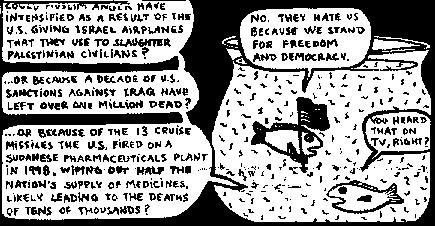
(graphic) You heard that on TV, right?
May Day rally hits privatization in Malaysia
(The following article is from the May 16-31/2005 issue of People's Voice, Canada's leading communist newspaper. Articles can be reprinted free if the source is credited. Subscription rates in Canada: $25/year, or $12 low income rate; for U.S. readers - $25 US per year; other overseas readers - $25 US or $35 CDN per year. Send to: People's Voice, 706 Clark Drive, Vancouver, Canada, V5L 3J1.)
Malaysian workers marked May Day 2005 with a protest against globalization and privatization, which are gradually eroding away their rights and making poor Malaysians poorer.(Back)
According to a report on the CUPE website, thousands of trade union members were joined by many more political and grassroots activists as well as workers from marginalized sectors from across the country. The demonstration's theme was "Globalization erodes workers' rights," with a focus on water and health care privatization.
The Malaysian Trades Union Congress, the main organizers of the gathering, is now under the leadership of committed trade unionists who swept aside the national labour centre's previous leadership, which was widely seen as politically compromised.
For newly elected MTUC president Syed Shahir Syed Mohamud, workers have reason to worry about globalization.
"We are concerned about privatization, the right (which has been taken away) of civil servants to engage in collective bargaining, lack of security of tenure, (the struggle for) a minimum wage, and the occupational safety and health of workers," he told InterPress Service.
(Home)
Taiwan marchers demand labour reform
(The following article is from the May 16-31/2005 issue of People's Voice, Canada's leading communist newspaper. Articles can be reprinted free if the source is credited. Subscription rates in Canada: $25/year, or $12 low income rate; for U.S. readers - $25 US per year; other overseas readers - $25 US or $35 CDN per year. Send to: People's Voice, 706 Clark Drive, Vancouver, Canada, V5L 3J1.)
Supporters of nine labour groups marched on the streets of Taipei at a May 1 rally to demand social and employment reforms.(Back)
Thousands of teachers, labourers, and disabled persons held a two-hour parade, chanting their demands in front of the Ministry of Education and the Legislative Yuan along Zhongshan South Road in Taipei. Riot police barriers prevented them from reaching their ultimate target, the Executive Yuan, where they wanted to submit petitions.
Under the umbrella of the National Teachers' Association, teachers from elementary schools to universities called for the right to form unions, which they have fought for since 1991. Association spokesperson Ke Wen-hsien said the response from the Council of Labour Affairs had been less than satisfactory to date. While officials said that the CLA would side with the teachers, these promises came with conditions, such as a ban on staging strikes.
Ke said, "Forming unions is a basic right for all workers including teachers, and the authority of the unions should not be limited under any conditions. If the teachers accepted the CLA's conditions for forming unions, the agency could limit the authority of other unions one day, which is not acceptable."
The march was led by the national lottery employees union, which represents some 20,000 workers, many of whom are disabled. Hundreds of them paraded in wheelchairs and demanded that the current sales system remain unchanged.
The financial institution that operates the lottery, Taipei Fuybon Bank, wants to take back the sales rights granted to existing retailers and replace them with an organization such as a cooperative association, in which only the employees hired by the association have the right to run the lottery stands, said Chou Sung-lu, secretary-general of the lottery employees union.
"Taipei Fubon Bank's plan will not only deprive the disabled of their right to work but also eliminate their opportunities for employment," Chou said. "Who can make the promise that disabled people will be hired in the cooperative association."
Blocked by police and barriers, one protester asked, "How could I give offense to the Executive Yuan with my wheelchair? What I'm asking for is just the basic right to work and earn a living. I've put lots of money into the lottery stand. What can I do if the sales rights are taken away? Would it be easy for me to get another job?"
Other unions criticized Taipei's new pension system, due to begin on July 1, and measures to promote temporary or contract workers.
(Home)