|
|
May 16-31, 2012
Volume 19 – Number 9
$1
Prolétaires de tous les pays, unissez-vous!
Otatoskewak ota kitaskinahk mamawestotan!
Workers of all lands, unite
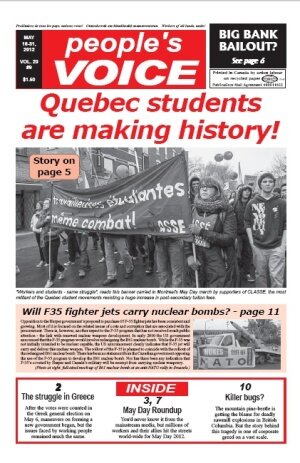
1) QUEBEC STUDENTS ARE MAKING HISTORY
2) MAY DAY CELEBRATED ACROSS CANADA
3) THOUSANDS RALLY FOR MAY FIRST IN USA
4) CANADA'S SECRET BANK BAILOUT REVEALED
5) NEW HOPE, NEW CHALLENGES - Editorial
6) UNEMPLOYMENT AND RESISTANCE - Editorial
7) WHO IS KILLING BRITISH COLUMBIA SAWMILL WORKERS?
8) F-35 FIGHTER JETS LINKED TO NUCLEAR WEAPONS DEVELOPMENT
9) KKE REMAINS IN FRONTLINE OF GREEK STRUGGLES
10) CHAVEZ SIGNS NEW VENEZUELAN LABOUR LAW
11) WORKERS OF THE WORLD MARK MAY DAY 2012
12) LONDON OLYMPICS: IN THE CITY OF DREADFUL NIGHT
13) SPARK #23 PACKED WITH GREAT READING
14) WHAT’S LEFT
15) CLARTÉ (en français)
16) THE SPARK! (Theoretical and Discussion Bulletin of the Communist Party of Canada)
17) INTRODUCING MARX
PEOPLE'S VOICE MAY 16-31, 2012 (pdf)
|
People's Voice deadlines: June 1-15 June 16-30 Send submissions to PV Editorial Office,
|
|
REDS ON THE WEB |
|
People's Voice finds many "Global Class Struggle" reports at the "Labour Start" website, http://www.labourstart.org/. We urge our readers to check it out! |
* * * * *
People's Voice
Canadian Publications Mail Sales Product Agreement #205214
ISSN number 1198-8657
People's Voice is published by
New Labour Press Ltd
PV Editorial Office
706 Clark Drive,
VANCOUVER, B.C. V5L 3J1
Phone:604-255-2041
Fax:604-254-9803
email: pvoice@telus.net
Editor: Kimball Cariou : Business Manager: Sam Hammond
Editorial Board: Kimball Cariou, Miguel Figueroa,
Doug Meggison, Naomi Rankin, Liz Rowley, Jim Sacouman
* * * * * *
Letters
People's Voice welcomes your letters
on any subject covered in our pages.
We reserve the right to edit for length and clarity,
and to refuse to print letters which may be libellous
or which contain unnecessary personal attacks.
Send your views to:
"Letters to the Editor",
706 Clark Dr., Vancouver, BC V5L 3J1,
or pvoice@telus.net
People's Voice articles may be reprinted without permission,
provided the source is credited.
* * * * * *
The Communist Party of Canada, formed in 1921,
has a proud history of fighting for jobs, equality, peace,
Canadian independence, and socialism.
The CPC does much more than run candidates in elections.
We think the fight against big business and its parties
is a year-round job,
so our members are active across the country,
to build our party and to help strengthen people's movements
on a wide range of issues.
All our policies and leadership
are set democratically by our members.
To find out more about Canada's party of Socialism,
give us a call at the nearest CPC office.
* * * * * *
Central Committee CPC
290A Danforth Ave Toronto, Ont. M4K 1N6
Ph: (416) 469-2446
fax: (416) 469-4063 E-mailmailto:info@cpc-pcp.ca
Parti Communiste du Quebec (section du
Parti communiste du Canada)
5359 Ave du Parc, Montréal, Québec,
H2V 4G9
B.C.Committee CPC
706 Clark Drive, Vancouver, V5L 3J1
Tel: (604) 254-9836
Fax: (604) 254-9803
Edmonton CPC
Box 68112, 70 Bonnie Doon P.O.
Edmonton, AB, T6C 4N6
Tel: (780) 465-7893
Fax: (780)463-0209
Calgary CPC
Unit #1 - 19 Radcliffe Close SE
Calgary AB, T2A 6B2
Tel: (403) 248-6489
Ottawa CPC
Tel: (613) 232-7108
Manitoba Committee
387 Selkirk Ave., Winnipeg, R2W 2M3
Tel/fax: (204) 586-7824
Ontario Ctee. CPC
290A Danforth Ave., Toronto, M4K 1N6
Tel: (416) 469-2446
Hamilton Ctee. CPC
265 Melvin Ave., Apt. 815
Hamilton, ON.
Tel: (905) 548-9586
Atlantic Region CPC
Box 70 Grand Pré, NS, B0P 1M0
Tel/fax: (902) 542-7981
http://www.communist-party.ca/
* * * * * *
News for People, Not for Profits!
Every issue of People's Voice
gives you the latest
on the fightback from coast to coast.
Whether it's the struggle for jobs or peace, resistance to social cuts,
solidarity with Cuba, or workers' struggles around the world,
we've got the news the corporate media won't print.
And we do more than that
- we report and analyze events
from a revolutionary perspective,
helping to build the movements for justice and equality,
and eventually for a socialist Canada.
Read the paper that fights for working people
- on every page, in every issue!
People's Voice
$30 for 1 year
$50 for 2 years
Low-income special rate: $15 for 1-year
Outside Canada $50 for 1 year
Send to: People's Voice, 706 Clark Drive, Vancouver, BC, V5L 3J1
You can call the editorial office at 604-255-2041
REDS ON THE WEB
http://www.communist-party.ca/
http://www.ycl-ljc.ca/
http://www.solidnet.org/
(The following articles are from the May 16-31, 2012, issue of People's Voice, Canada's leading communist newspaper. Articles can be reprinted free if the source is credited. Subscription rates in Canada: $30/year, or $15 low income rate; for U.S. readers - $45 US per year; other overseas readers - $45 US or $50 CDN per year. Send to People's Voice, c/o PV Business Manager, 706 Clark Drive, Vancouver, BC, V5L 3J1.)
1) QUEBEC STUDENTS ARE MAKING HISTORY
PV Montreal Bureau, May 8, 2012
As Quebec`s historic student struggle enters its 13th week of strike and constant mobilization, the battle has entered a new round. At the beginning of May the provincial Charest Liberals finally sat down with students and other groups to produce an offer that is now being voted on by students at colleges and universities across Quebec.
But already 18 out of 19 student assemblies have rejected the agreement by significant majorities, suggesting the conflict may be long from over. The Minister of Finance has suggested that ultimately, it may be the voters who resolve this crisis.
Student demonstrations have not slowed down either. For two weeks now, the students have been marching late into the night from 9 pm to 2 am. Hundreds of demonstrators snake through downtown Montreal, tailed and often blocked by muscular units of riot police who seem eager to gas the protestors or even beat them up.
Police violence and aggression has reached a new low. On May 4th, several thousand of students, labour and community groups demonstrated outside the provincial Liberal Party's general council meeting in Victoriaville, a small town about 150 kilometres northeast of Montreal.
Already the meeting had been moved to this more remote location to avoid protest. But in the charged environment a police riot broke out.
"One young student has been blinded, another was between life and death after the police charged and refuse to help him. Police refused to call an ambulance for injured demonstrators," Marianne Breton Fontaine, leader of the Young Communist League in Quebec told People`s Voice.
A distributor of the PCQ's newspaper Clarté saw a woman trade unionist protestor have her teeth knocked out by a police officer.
Video images of police brutality continue to shock on the internet, while the French‑language Quebec media appear disinterested by the alarming level of violence against the student movement.
Each day produces new graphic stories, like a grandmother being arrested at a feminist demo in support of the students. The left wing political party Quebec solidaire has called for a full public inquiry into Victoriaville and Amnesty International is also circulating a petition against the police violence. Quebec provincial police arrested 106 people after the Victoriaville student demonstration, directly from the bus returning to Montreal and Quebec City, at the same time as negotiations were still taking place in Quebec City.
Finally, negotiations
After major public pressure the Charest government finally caved‑in and agreed to negotiate.
"But as the full report of the discussions comes out, it is clear that these negotiations were in fact a psychological warfare doomed to exhaust the participants from labour and students, lasting for almost 24 hours of discussions without any sleep!" Breton Fontaine said.
The government brought in representatives from the university administration as well as the main labour centrals, including the QFL/FTQ and the CNTU/CSN. All four student union centrals were present, with the ASSE being represented directly, not the CLASSE (which is a broader coalition led by the ASSE that has mobilized a large number of unaffiliated unions into its ranks for the temporary period of the strike).
"The government set up a false sense of urgency, but the only real urgency was for Charest to return to his Party's general council meeting in Victoriaville with something concrete to deliver to his supporters," said Breton Fontaine.
Not negotiating in good faith
Even Liberal Party members are now starting to criticize the government's handling of the conflict. At one point in the negotiations, the government told the students that they accepted their demands for a board to oversee the administration of public funds into university, and a two‑year fee moratorium.
This created a sense of victory for the students. But all this was a trick. The government negotiators spoke separately to each of the student negotiators, changed one word at a time, and so diluted the offer. Then the government made the student representatives from each Quebec national association sign the document separately while the offer was changed! The government quickly coordinated with the media to talk about an agreement in principle and to say that the strike was settled. In fact the effort was to divide, and spread mis‑information.
A Pyrrhic victory?
As a result, students and their allies initially reacted with confusion to the offer. On one hand, the student representatives explained to the media and their organizations that all the tuition increases will be compensated by a reduction of institutional fees, and eventually a reduction of the tuition increase if this was not enough.
The minister of education, however, said that the tuition increase was maintained in its totality, and that the students would have to convince the government to cut some of the university budgets if they want to reduce the impact of the tuition increase.
We now know the proposal is for a six-month moratorium on the tuition increase, and the first increase of fees (phased in over seven years up to $1778) will be reduced by less than $150.
Then a committee will be struck, consisting of a minority of participants from students and labour, and a majority from the government, university administrations, and especially from the business community. Students will have to prove where cuts can be made. In fact the committee will have no formal power.
The Young Communist League of Quebec and other progressive voices have described this committee as a Trojan horse for privatization.
In fact, the fees that will be under negotiation are vastly different between institutions, depending on the financial background of the students, and the schools' position with the notorious pecking‑order of Post‑Secondary Education (ie. between the so‑called "red brick" and "ivy league" schools). For example, the Université du Québec en Outaouais in Gatineau charges only $70 for these fees, while McGill in Montreal charges around $1000.
A prairie fire
Meanwhile, students are asking why they fought for so long, sacrificing a session of their education that they paid for, to win such poor results. While many students are beginning to tire,The determination to continue is still among their ranks.
As an example, the night demonstrations have been joined by an increasing number of activists who had not participated in any form of protest before.
Another demonstration is the realization, expressed in the CLASSE newsletter The Ultimatum a few weeks ago, that "The right to education movement has gone beyond the simple issue of tuition hikes - it has made it possible to clearly express that we are fed up of sitting back while our collective future is defined by the demands of the political and economic elite."
This was most clear at the April 22 Earth Day rally which saw almost 300,000 students, environmentalists and labour activists together in a huge show of solidarity.
The spirit of the demonstrations has also spread beyond Quebec, with a student open letter even calling for strike action in Ontario.
A survey of over 2,000 students by the Globe and Mail across Canada said that 62 per cent of postsecondary students would join a similar strike in their own province. Numbers varied from 22 percent support in Alberta to almost 70 percent in Ontario.
The Young Communist League has called to develop an escalating action plan for broad unity of the students across English‑speaking Canada, and has been working hard to pass solidarity resolutions against the police brutality and in support of the Quebec students.
International organizations have also been sending solidarity greetings to Quebec students, including the World Federation of Democratic Youth.
Media disinfo
"The proof that people are recognizing the students are on the front line and an inspiration is, in a way, seen in the corporate media coverage of the demonstrations," Johan Boyden General Secretary of the Young Communist League told People's Voice.
Boyden strongly disagreed with the claim, for example by Rex Murphy on CBC, that what the Quebec students are doing is not a strike but a boycott.
"This is an attempt to further reinforce the idea that education is a commodity or privilege in people`s minds, not a fundamental human right, and also to confuse the link between the students resistance and their implications for working people. We all know that there are fair strikes, rent strikes, general strikes, political strikes etc. - this is a collective social resistance, not an individualized consumer opt‑out," he said. "What we are seeing in Quebec is not only making history, it is showing the way forward - a broad, mass, united peoples' resistance. This is the kind of fightback we need to spread right across the country."
2) MAY DAY CELEBRATED ACROSS CANADA
Special to PV
This year's May Day actions across Canada were larger and more unified than in the recent past, drawing together sections of the trade unions, students, Occupy groups, anti-war and anti-poverty movements, and left organizations. While small compared to many other countries, the actions were a sharp protest against the Harper Tory government's first year as a majority in Parliament, and a powerful show of solidarity with the striking Quebec students.
In Toronto, there was a single May Day demo, bringing together groups which had previously organized two separate marches. An estimated 2,000 took part, representing a wide cross‑section of the left and social activist forces in the city. The march featured a number of banners from unions including CAW, OSSTF, CUPE, and CUPW.
Following the downtown rally and cultural event, about 400 supporters of Occupy Toronto embarked on a peaceful re‑occupation at Simcoe Park across from the Metro Convention Centre. The action temporarily transformed Simcoe Park into a space for education, conversation, and protest. The park was across the street from the annual general meeting of Barrick Gold, whose CEO Aaron Regent is the highest paid CEO in Canada.
Two days earlier, Toronto's United May Day Committee held a lively celebration at the Steelworkers Hall on Cecil Street, where Communist Party leader Miguel Figueroa was among the speakers.
Hundreds of trade unionists and allies rallied in Ottawa, protesting the layoff of thousands of public sector workers in the latest Tory budget.
There were a number of May Day actions in Quebec, with the largest drawing about 4,000 in Montreal, with stronger representation from the Quebec Federation of Labour than in the past, as well as contingents from the CSN/CNTU and various social groups and progressive political parties, especially Quebec Solidaire. While the corporate media ignored this union-backed demonstration, it gave huge coverage to police violence against an evening student rally, and against an anarchist protest earlier in the day.
The Montérégie region held an event honouring the late union organizer Madeleine Parent and the 1946 textile strike. Other Quebec events include a march and cultural event in Quebec City; rallies in Gatineau and Joliette; and a labour-sponsored banquet on the North Shore of Montreal.
About 300 marchers took to the streets of Edmonton on May Day, taking the traditional route down Whyte Avenue on the city's south side. Participating groups included some trade unions, Occupy Edmonton, the Student Worker Action Group (whose members wore the red square in solidarity with students in Quebec), the Communist Party of Canada, and others. Speeches were made by rank and file leaders of the Alberta Union of Public Employees, Postal Workers, and PSAC. Two local NDP MLAs were present, both newly elected in the April 23 provincial election.
Occupy Vancouver and the labour movement joined forces for a rally at the Art Gallery, followed by a march of some 400 to the kickoff of local MayWorks events. Keynote speakers at the rally included BC Federation of Labour president Jim Sinclair, and the Federation's secretary-treasurer, Irene Lanzinger.
About 250 took part in the annual May Day walk in Winnipeg, sponsored by that city's Labour Council since 1980. Unions carrying flags at the rally included PSAC, CUPW, CAW, UFCW, and Steelworkers. Student movement leaders passed out red square badges, in solidarity with the Quebec students.
Other May Day demonstrations were held in Hamilton, Halifax, and Calgary.
3) THOUSANDS RALLY FOR MAY FIRST IN USA
The emergence of the Occupy movement last fall has given a huge boost to May Day celebrations in the United States. After decades on the back-burner, May Day was revived in 2006 by a walkout of immigrant workers across the country, and this year proved that the international day of the worker has returned to stay in the land of its origins.
In New York, according to the People's World website, "Unionists, Occupy Wall Street supporters, immigrants, women, LGBT activists and the disabled filled Union Square from one end to the other on May Day. The message from the stage was loud and clear: `We are the 99%; unions, students and immigrants, all of us together can make a better world!' The New York Labor Chorus sang `Solidarity Forever,' and the crowd roared the chorus `and the union makes us strong'!"
People came from as far away as Delaware and Maryland to join the New York celebration. Homemade signs denounced greed and demanded government funding of human needs.
Bands, puppeteers and dancers led many of the contingents, which included the transit workers union, Teamsters, UniteHERE and The Taxi Workers Alliance ‑ with their cabs. The crowd marched on Wall Street and ended at Battery Park.
In the San Francisco Bay area, PW correspondent Marilyn Bechtel reported that "unions and immigrant rights organizations marked May Day with picket lines, rallies and marches around the region. Unity was the theme, and health care was a prime issue, as janitors, nurses, bus drivers, ferry workers, city workers and immigration reform groups campaigned in an overall framework of rights for the 99 percent."
In San Francisco, hundreds of janitors and their supporters picketed a downtown mall, supporting SEIU Local 87 members waging contract battles with Macy's and Bloomingdales. Some 3,500 janitors are involved in contract talks now underway in the city.
"It's totally unfair that janitors who keep stores and malls in super‑duper shape don't have decent wages and benefits," Local 87 President Olga Miranda said before the rally. "Companies are trying to have janitors pay lots of money for family health care. Many janitors only work part time; some could end up working just to pay for their family health care."
Registered nurses at Sutter Health, members of the California Nurses Association/National Nurses United, held a one‑day strike at 10 facilities in different area cities. The union said some 4,500 nurses and other professionals were affected by the walkout.
Sutter has made over $4 billion in profits since 2007, and pays its CEO $4.7 million a year, but is demanding big cuts from its RNs, including forcing them to work while sick and to pay thousands in increased costs for health care.
Alameda Labor Council head Josie Camacho pledged the backing of the council which represents 100,000 workers. "We know [Sutter] is making tremendous profits off the backs of not just the nurses, but the patients," she said. "We pledge to stand with the nurses as you continue your fight."
Members of the Inland Boatmen's Union held a morning strike, forcing ferry commuters from the North Bay to find other ways into San Francisco.
"We have been negotiating in good faith for one year now," said IBU member Rene Alvarado. "The district says they appreciate workers, but they have shown no appreciation at the bargaining table. We deserve a fair contract and health care for our families and retirees."
Wrapping up the day in Oakland, thousands of immigrant rights campaigners and labour unions gathered in a heavily Latino part of the city and marched five miles to City Hall. Led by Aztec dancers, a marching band and a drum corps, a diverse crowd including immigrants from Africa, Asia and the Middle East as well as from Mexico and Latin America, demanded a fair immigration policy.
4) CANADA'S SECRET BANK BAILOUT REVEALED
When the U.S. housing crisis erupted into a full-blown global economic meltdown in the fall of 2008, Canada was in the midst of a federal election. The fear in people's eyes was evident at all-candidate forums, where voters demanded answers about the sudden drop in the value of their life savings.
The rising panic threatened to upset the careful electoral strategies plotted by Stephen Harper's Conservatives - particularly their claim to be trustworthy stewards of the economy. Since the Conservatives were in office during the first half of the Dirty Thirties, not to mention the 1990 recession which kicked off the "jobless recovery," many saw this as dubious. The old saying "Tory times are hard times," seemed closer to the mark, and the Conservatives were left with another minority.
One tactic used by Harper & Co. was the sweeping statement that since Canada's well-regulated banks were not affected by the crisis, our savings were "safe". Coming from a party which opposes regulation of corporations, this seemed contradictory, but it sent a signal that the Conservatives would not embark on a massive U.S.-style bailout of the banks.
"We have not had to put any taxpayers' money into our financial system in Canada, nor do I anticipate that we'll be obliged to do so," said Finance Minister Jim Flaherty. Then there was this quote from PM Harper: "We have the only banks in the western world that are not looking at bailouts or anything like that..."
However, a new study released by the Canadian Centre for Policy Alternatives (CCPA) exposes this claim as a fabrication. It appears that the previously secret extent of extraordinary support required by Canada's banks during the financial crisis reached approximately $114 billion at its peak. If this truth had been widely known at the time, the October 2008 election might have seen a different result.
The study, by CCPA Senior Economist David Macdonald, estimates that support for Canadian banks amounted to $3,400 for every man, woman, and child in Canada.
"At some point during the crisis, three of Canada's banks - CIBC, BMO, and Scotiabank - were completely under water, with government support exceeding the market value of the company," says Macdonald. "Without government supports to fall back on, Canadian banks would have been in serious trouble."
Between October 2008 and July 2010, says the study, Canada's largest banks relied heavily on financial aid programs provided by the Bank of Canada, the Canada Mortgage and Housing Corporation (CMHC), and the U.S. Federal Reserve - all at the same time.
Both the Federal Reserve and the Bank of Canada offered short-term collateralized loans which peaked at $41 billion and $33 billion respectively. CMHC was buying mortgages directly from the banks after they had been converted to mortgage‑backed securities. By the end of this program, CMHC had purchased $69 billion worth of mortgages.
But the banks were not suddenly losing money, and their executives were certainly not suffering.
Over this aid period, Canada's banks reported $27 billion in total profits, and only two banks saw a single quarter with losses. Meanwhile, their CEOs were among the highest paid in Canada, receiving an average raise in total compensation of 19%. Edmund Clark of TD Bank saw his overall compensation jump from $11.1 million in 2008 to $15.2 million in 2009.
"The federal government claims it was offering the banks `liquidity support' but it looks an awful lot like a bailout to me," says Macdonald. "Whatever you call it, Canadian government aid for the country's biggest banks was far more indispensable than the official line would suggest."
Macdonald calculated the value of government support by researching data provided by CMHC, the Office of the Superintendent of Financial Institutions and the Bank of Canada, as well as quarterly reports of the banks themselves.
But he says that because of government secrecy, the study raises more questions than it answers. He has called on the Bank of Canada and CMHC to release the full details of how much support each Canadian bank received, when they received it, and what they put up as collateral.
"A healthy and resilient banking sector cannot operate under the shroud of secrecy. Details of the massive taxpayer support Canadian banks received should be released in the name of transparency and accountability," says Macdonald. "Financial sector regulation should be strengthened to prevent the need for similar measures in the future."
Readers can download the full CCPA report at www.policyalternatives.ca.
People's Voice Editorial
Recent popular struggles and elections give rise to hopes that the right-wing grip on global politics is being further weakened. But nothing is automatic, and the emergence of positive new trends brings with it a different set of challenges.
The past several years have witnessed a powerful series of general strikes in many countries, more recently bolstered by huge student protests, including in Quebec. Increasingly, working people, students, and their community allies are taking to the streets against profiteering, exploitation and war.
This mood is reflected in varying degrees at the ballot box. Some ultra-right forces have made gains, as have the communist parties and their allies, but voters are rejecting reactionary corporate-backed ruling parties. In France, voters defeated right-wing President Sarkozy, in favour of a centrist Socialist candidate. In Greece, the "social democratic" and right-wing parties which imposed the austerity agenda of big capital suffered massive losses. Britain's ruling "Con-Dem" alliance have met big defeats in local elections. Here in Canada, setbacks inflicted on the BC Liberals, the Wildrose Alliance in Alberta, and Tim Hudak's far-right Tories in Ontario are signals that voters are wary of the dead-end "austerity" road.
But our fight cannot end with the election of "moderate" parties which promise to soften the blows of neoliberalism. Working people desperately need a People's Agenda that includes truly progressive tax reforms and public ownership of the key sectors of the economy, as the basis to create good jobs, wipe out poverty, provide universal health care and education, protect the environment, and end militarism and war forever.
The wheel of history has begun to turn. Our challenge today is to build the powerful, united people's movement that will mobilize millions for these policies, replacing the domination of big capital with the political power of the working class.
6) UNEMPLOYMENT AND RESISTANCE
People's Voice Editorial
The ruling class appears nervous these days, faced with unruly strikes by workers and students, and setbacks at the ballot box. Underlying this unease is a very real objective factor: the continued growth of mass unemployment. Hunger and poverty are on the rise even in the "developed" capitalist countries, eroding the ideological grip of the bosses.
The International Labour Organisation's "World of Work Report 2012" projects that global unemployment will hit 212 million by the end of this year, up 6 million from 2011. Total unemployment in Ireland, the former "Celtic Tiger", is around 550,000 out of a population of six million. In Spain, 5.64 million (24.4%) are jobless. Some 50 million jobs have been lost since 2008, and unemployment is higher in two‑thirds of countries since 2010.
Clearly, the "austerity" drive by big capital and its representatives (including most social democratic parties) has had a very negative impact on workers, while profits are back at pre-meltdown levels. In the U.S., high jobless rates threaten to derail President Obama's re-election, but corporations reported $1.65 trillion in profits for the third quarter of 2010. The richest 1,000 people in Britain increased their combined wealth by 4.7% last year, according to the "Rich List."
None of this is an accident. Mass unemployment benefits the wealthy by holding down wage rates. This basic truth is behind the Harper government's move to reduce access to Employment Insurance, by forcing jobless workers to apply for any available opening, regardless of their qualifications.
So when pro-business politicians talk about "reforms" to "improve the economy," they really mean starving workers into accepting lower-paying jobs. But this agenda also generates anger and resistance, and sooner or later, workers will turn against the entire private profit system.
7) WHO IS KILLING BRITISH COLUMBIA SAWMILL WORKERS?
Empire of the Beetle, by Andrew Nikiforuk, Greystone Books & David Suzuki Foundation, 2011, paperback, 232 pages, ISBN 978-1-55365-510-7. Review by Kimball Cariou.
What does climate change have to do with the deadly explosions which have killed four workers at sawmills in British Columbia? Quite a bit, it appears.
Andrew Nikiforuk's latest book, Empire of the Beetle, is a terrifying investigation into the origins and impacts of the beetle outbreaks which have devastated pine and spruce forests across vast western regions of North America. Since the late 1980s, these rice-kernel sized insects have destroyed over 30 billion trees from Alaska to New Mexico.
For tourists driving through the mountains, or anyone flying over this area, the most immediate effect is visual - huge areas of trees turned rust red, dying on a staggering scale. But for working people who have depended on British Columbia's "Green Gold" to earn a living over the past century or more, the impact is often directly economic. There are many factors behind mill closures and the loss of jobs in B.C.'s forest industry, but the beetle infestation has been one of the most important over the past two decades.
Empire of the Beetle examines this development in astonishing detail, peeling back layer after layer of easy assumptions to dig into deeper truths about the interconnections between the natural environment and human economic activities. While Nikiforuk does not name "capitalism" as the system responsible for shaping the forest industry since the European colonists first seized this chunk of Turtle Island from the First Nations, the main impulse for this process is clearly the maximization of private profits.
From the beginning, the author discovers, the interests of forestry companies trumped all other priorities, often with consequences which unfolded only many decades later. Arguing that the resources of the west were so enormous that industrial-scale logging could never inflict serious harm, the companies were given nearly total freedom to clear-cut entire mountainsides.
Only as time passed did most people begin to understand that early warnings against this policy were correct. The destruction of streams caused by unchecked logging, for example, had a terrible toll on the fishing industry, both for First Nations whose cultures revolved largely around the cycle of the salmon, and for the fishermen and shoreworkers who came to British Columbia in search of a better life.
On an even bigger scale, the "fire suppression" policies adopted by private interests and governments had a disastrous impact on the resource they were intended to "manage".
Interviewing a wide range of scientists, foresters and rural residents, Nikiforuk agrees with the conclusion expressed by ecologist Buzz Holling, who argues that the great beetle epidemics are really no mystery, since they were created by human engineers.
"By suppressing fire in lodgepole and ponderosa forests throughout the West, we took a patchy and diverse forest with trees of all ages and turned it into a boring, middle-aged green mall," writes the author. The result is a more dense forest, composed of smaller trees - "a collection of toothpicks less resistant to drought and more vulnerable to insects and disease. Determined fire suppression guarantees, sooner or later, either catastrophic fire or imperial legions of bark beetles."
Enter climate change, in the form of global warming. When the beetle plague emerged as a serious problem twenty years ago, the common assumption was that the outbreaks would be confined when winter temperatures dropped far enough below freezing. But year after year, winters across British Columbia have rarely been cold enough to kill off large numbers of these remarkable insects.
Nikiforuk has researched centuries of attempts by human beings to protect forests from insect infestations, in Europe and later in North America, mostly without success. His accounts are bleakly humorous, such as bizarre inventions to electrocute bugs hiding inside trees.
But there is nothing funny about the possible deadly effect on B.C. forestry workers. Faced with a drastic shortage of fibre to supply mills, the provincial government has encouraged companies to harvest beetle-infected trees before they crumble into stumps. Workers and industry analysts say that processing these trees creates a finer form of sawdust, with far more potential for the type of explosions which destroyed mills in Burns Lake and Prince George. In other words, the scramble for corporate profits which began over a century ago probably set in motion a series of policy decisions which are killing today's millworkers.
Several immediate measures must be taken to end this slaughter, starting with the installation of more effective technology to remove sawdust from the workplace. An end to the shocking export of high-quality logs from British Columbia would save jobs and make the mills safer. There are also unanswered questions about the effect of speed-up on the type of dust created in sawmills.
But Empire of the Beetle raises even bigger issues for the future of humanity. The negative impacts of industrial expansion on the environment are being grasped by billions across the planet. Human beings cannot live without industry. But this important book shows that our common survival depends on finding ways to quickly reduce these negative impacts. Success will certainly require replacing the economic system of capitalism, which depends on constant expansion to generate private profits, with a new socialist system based on the interests of people and the environment. This is the crucial challenge facing the working class and revolutionary movements in this century.
8) F-35 FIGHTER JETS LINKED TO NUCLEAR WEAPONS DEVELOPMENT
By Dave McKee, President, Canadian Peace Congress
Opposition to the Harper government's proposal to purchase 65 F‑35 fighter jets has been consistent and growing. Most of it is focused on the related issues of costs and corruption that are associated with the procurement. This is critically important - military spending should always be conducted in an open and transparent manner, and it must be justified in the context of broader public spending. In an era of high unemployment, deep cuts to social programs and harsh austerity programs that target working people, Harper's intention of spending billions of dollars on fighter jets is thoroughly offensive, and it needs to be confronted and opposed by the largest possible mobilization of people.
The F‑35 program is driven by the United States military and its NATO allies. In 1997, Canada signed onto the Joint Strike Fighter program, which was developed as a vehicle for the United States to capture international funding for a replacement jet fighter. Canada's initial investment in 1997 was $10 million. In 2001 the JSF contract was awarded to Lockheed Martin, who developed what is now known as the F‑35. By 2010, the international procurement process was underway and Stephen Harper announced that Canada would purchase 65 fighter jets, through an untendered purchase.
Prior to this announcement by the Harper government, the issue of the F‑35 had been discussed at NATO's Parliamentary Assembly (PA), a body that provides an ongoing political exchange between NATO and legislators from its member states. The PA is explicitly oriented toward government policy, working to ensure that legislation and programs of member states are consistent with, and facilitate the implementation of, NATO's priorities. The reports from PA meetings in 2010 suggest some concern that international orders for the F‑35 and, by extension, funding for the project, were below expectation. This is significant, as the United States has been trying, since the economic crisis of 2008, to reduce its financial support to NATO and to offset that by increasing financial support from other members. Harper's purchase announcement is yet another obedient response to NATO and US prodding, this time guaranteed through an undemocratic process.
There is, however, another aspect to the F‑35 program that has not received much public attention, and this is its link with renewed nuclear weapons development. This connection emerged around the same time as Harper's announcement of the Canadian purchase. In early 2010 the US government, as part of its Nuclear Posture Review, announced that the F‑35 program would involve redesigning the B61 bomb. The B61 is a nuclear bomb. While the F‑35 was not initially intended to be nuclear capable, the US announcement clearly indicates that F‑35 jet will carry and deliver this nuclear weapon. The rollout of the F‑35 is planned to coincide with the rollout of the redesigned B61 nuclear bomb.
There has been no statement from the Canadian government opposing the use of the F‑35 program to develop the B61 nuclear bomb. Nor has there been any indication that F‑35's coveted by Harper and Canada's military will be exempt from carrying nuclear weaponry.
Most people in Canada understand that this country is a non‑nuclear weapons state. Public opinion overwhelmingly (almost 90%) favours nuclear disarmament and non‑proliferation. However, the current reality is that through a non‑tendered process, meaning in secret, the Canadian government has committed to purchase 65 military aircraft , and in the process, also fund the upgrade and proliferation of nuclear weaponry.
This one more reason to scrap the proposed purchase of the F‑35, and it points to the urgent need to re‑orient Canada's foreign policy to one that is based on peace, sovereignty and international solidarity.
9) KKE REMAINS IN FRONTLINE OF GREEK STRUGGLES
PV Vancouver Bureau
The May 6 election results in Greece show a reversal of the political scene, according to the initial response of the Greek Communist Party (KKE), especially the interruption of the "rotation" in office of the PASOK (social democratic) and New Democracy (conservative) parties.
"We are moving into a transitional phase where there will be an attempt to create a new political scene with new formations, new figures with a centre‑right orientation or based on a new social democracy that will have SYRIZA at its core, aimed at preventing the rising radicalism of the people..." says the KKE. "There will be an attempt to form a government either from these elections or from the elections to follow, a government made up of all parties, or a government of national unity, or a coalition government aimed precisely at preventing the creation of a majority current that will struggle for change."
The ND announced that it was unable to form a government, passing this constitutional responsibility to the party with the second highest number of votes, the SYRIZA coalition of left groups.
Addressing its members and supporters, the KKE called upon them to "be at the frontline of the struggles in the next days because we have pressing, serious issues which are in progress, such as the collective bargaining agreements, the protection of the unemployed, the bankruptcy of the social security funds, the new measures which amount to 11.5‑14.5 billion euros which will be paid for out of the pockets of the people. We cannot waste any time. The people must not waste time."
Although the votes were scattered in both directions, right and left, said the KKE, the results demonstrate that radical changes will mature in the people's consciousness, in the direction of the communist proposals.
"We consider significant, positive and at the same time a great legacy for the next period the fact that we confronted on our own the pro‑European, pro‑EU forces in their entirety, irrespective of the positions they took concerning the memorandum," noted the KKE. "We fought in order to promote our own alternative proposal which responds to and satisfies the people's interests.... We feel that our responsibilities and our role in relation to the people and their problems must be strengthened and we believe that we will continue to be the irreplaceable force that defends the people's interests."
The KKE won a small increase in votes, rising to 8.5% and 26 deputies elected, from 7.5% and 21 deputies in the previous campaign. This growth was achieved despite many obstacles, since the KKE was the main target of political attacks for its leading role in mobilizing resistance against the "troika" deals.
Clarifying its position on the formation of a new government, the KKE responded to proposals floated by SYRIZA concerning a "government of the left". Everyone can see, the KKE said, that the votes and the seats are not sufficient for such a government. But in the final analysis, the bigger problem is that while SYRIZA has made "general denunciations" of the "troika" memorandum, it has not made clear its programme for a coalition.
As the KKE says, SYRIZA "should not merely denounce the memorandum but return to the people the gains that were abolished before the memorandum ‑ because most of the gains were lost before the memorandum ‑ as well as many others abolished after the memorandum. A government has to manage everything and not merely the unemployment benefit, as was mentioned. It has to manage issues of economy, the stance of the business groups towards the working people, the list of the privatisations adopted in the previous years. It has to handle issues of foreign policy such as the general commitments that arise from the EU, NATO, from the strategic alliance with the USA.... In order to agree with such a government the KKE needs to make a U‑turn, a summersault. It would have to make unacceptable compromises that have nothing to do with the people's interests.... The people do not need this kind of KKE."
10) CHAVEZ SIGNS NEW VENEZUELAN LABOUR LAW
By Rachael Boothroyd, venezuelanalysis.com
On May First, Venezuelan President Hugo Chavez signed into law the country's new labour legislation after a consultation process with the public which lasted nearly five months. Discussion on the law in the national assembly began in 2003.
The new labour law will see the working week reduced to 40 hours and maternity leave increased to 6.5 months. The law also seeks to eliminate private sub‑contracted labour in Venezuela, which the government has previously described as an exploitative practice produced by the neo‑liberal politics of the 1990s.
Recently returned from undergoing radiotherapy treatment in Cuba, Chavez signed the law on national television from the Miraflores Palace, stating that he was carrying out an act of "social justice" for Venezuelan workers at a time when labour rights were being rolled back across Europe and the United States.
"We have a law which will go down in history. That history... tells us that the triumph of the people, of the workers, has never come about without a long process of resistance, of struggle, suffering even. This law, which I will have the honour of signing...is the product of a long process of struggle," he said.
Responding to repeated calls from Venezuelan workers to "revolutionise" Venezuela's existing labour law, last November Chavez promised to pass new legislation via decree before this year's International Workers' Day on May 1st.
Since then, organised workers collectives, unions and political parties such as the Venezuelan Communist Party (PCV), as well as networks such as the "Feminist Spider," have been carrying out workshops across the country aimed at collecting workers' proposals for the law. According to the government estimations, the new law has been written taking into account more than 19,000 proposals submitted from diverse sectors of Venezuela's working population. The government has described the new legislation as a "first law in the transition towards socialism".
Chavez spoke of the differences between the Venezuelan government's socialist policies, which prioritise workers' rights, in comparison with governments in capitalist countries which place profit above human development and well-being.
Workers' collectives have cited the re‑establishment of a retirement bonus, determined by the workers' monthly wage at the time of retirement multiplied by years in service, as one of the greatest gains represented by the new law. The bonus was eliminated in 1997 when Venezuela's labour law was redrafted by the Caldera government in conjunction with big business and under pressure from the International Monetary Fund.
As well as re‑establishing the retirement bonus and backdated pay for all workers retired since 1997, the new law will also reinstate "double" compensation pay in the event of unfair dismissal. This requirement was also eliminated in 1997 and obliges the employer to pay wrongly‑dismissed employees compensation amounting to double their retirement bonus.
The new legislation has also been described by gender groups as a big step forward for women's rights in the workplace, with post‑natal maternity leave being raised from 12 to 25 weeks and increased job security for new parents, who will now be protected from dismissal for two years following the birth of a child.
Chavez went on to announce that a national retirement fund will be set up by the government in order to process payments to workers, with Venezuelan Chancellor Nicolas Maduro confirming that workers will be free to choose whether the monthly sums set aside for their retirement bonus go into the new government controlled fund or into a public or private bank. Chavez also confirmed that a government body will be set up with a view to ensuring that employers comply with the new legislation.
Workers and political organisations celebrated the signing of the legislation as a positive step towards creating a socialist society and dignifying the lives of Venezuelan workers. However, many organisations have also been quick to point out that the labour struggle is now more relevant than ever, arguing that issues such as the rights of informal sector workers and the role of socialist workers' councils have not been adequately addressed within the current legislation.
The Feminist Spider Network's website applauded the new law for opening up new spaces for labour organisation and recognising the central role of workers in creating community wellbeing.
"Today we are happy, but we continue to be combative, because our struggles continue. These struggles have been reflected in universal coverage for social security, the extension of postnatal maternity leave...(and) the extension of job security to two years for new parents," states the network on their website.
Workers such as Raquel Barrios, a public administration worker in Merida State, also praised the new law, and told Venezuelanalysis that it represented "a historic opportunity to show the world that Venezuela is a country where the people are the priority, where the workforce is the motor of this revolutionary process, giving dignity to those who have historically been exploited by capitalism".
According to the international polling agency "Consulting Services," over 80% of Venezuelans also view the law positively, with only 13% taking a negative view.
Businesses will now have 12 months to adapt to the new legislation and implement any changes.
11) WORKERS OF THE WORLD MARK MAY DAY 2012
PV Vancouver Bureau
May Day was marked by actions and rallies involving millions of workers around the world, taking to the streets against exploitation, inequality and war. While the corporate media downplayed the scope of May Day in North America and abroad, focusing almost exclusively on a few confrontations between police and anarchists, the 2012 international workers' day was actually the broadest in many years.
The largest rally was in Havana, where over half a million Cubans took part in the socialist country's annual celebration of working class power. Marchers in Revolution Square carried a sign that said: "To Capitalism We Will Never Return."
But many events attracted hundreds of thousands in other countries. Rallies throughout Asia demanded wage increases, while in Europe the protests condemned government-imposed austerity measures.
Workers turned out in droves in Greece, France and Spain to denounce EU‑mandated austerity, call instead for policies to boost living standards and economic growth.
In Greece, thousands marched through central Athens in disciplined union‑led protests. Members of the communist‑affiliated All Workers Militant Front (PAME) gathered in support of workers from the Hellenic Steel Plant in Elefsina who have been on strike for more than six months. Big rallies were also held in Thessaloniki and Patras.
Tens of thousands of workers rallied in Paris ahead of the May 6 runoff election between right-wing President Sarkozy and Socialist Francois Hollande, who has since become the first victorious candidate backed by the left since 1988.
In Germany, the DGB umbrella union group sharply criticised the EU fiscal treaty that locks EU member states into an austerity straitjacket. The German unions called for a "Marshall Plan" stimulus programme to revive the depressed economies of crisis-hit eurozone nations. The DGB counted more than 400,000 members and supporters at protests and marches in many cities.
"The turnout today reflects the unhappiness of unionists with the German government's crisis policies and the rigid austerity measures in Europe," one DGB leader told crowds in Stuttgart.
In Spain, trade unions estimated that more than one million people joined protests in 80 cities. The largest gatherings were in Madrid and Barcelona, where 100,000 protesters took part. Spanish unions warn of mounting unrest if the right-wing government of Prime Minister Mariano Rajoy pushes ahead with austerity measures to meet its budget‑deficit targets while 5.6 million people - almost a quarter of the work force - are unemployed.
"This is a May Day against the destruction of jobs and in favour of following other alternatives," Candido Mendez, the leader of the UGT, one of Spain's two main labor federations, said on television. The latest spending cuts, he warned, will amount to "the demolition of public services in our country."
Demonstrators in Britain, one of the countries officially in recession, got creative to draw attention. In London, members of the Occupy movement, who were evicted from a camp outside St. Paul's Cathedral in February, released flying tents, lifted into the air by helium balloons, at the Liverpool Street railway station, while union leaders addressed a larger rally in Trafalgar Square.
Around 100,000 took part in rallies in Moscow. President‑elect Vladimir Putin joined the official May Day march through the city centre, while a Communist rally attracted a crowd of over 5,000.
In the United States, unions and Occupy activists staged demonstrations, strikes and acts of civil disobedience.
Thousands of May Day protesters in the Philippines, Malaysia and Taiwan demanded hikes in pay that has fallen behind rising consumer prices, while also calling for lower school fees and expressing a variety of other grievances.
The largest rally in Asia was organised by Indonesian unions. About 10,000 workers massed at Jakarta's main roundabout demanding better pay and job security.
About 8,000 members of a huge labour alliance rallied in Manila, many wearing red shirts and waving red streamers, marching under a brutal sun for four kilometres to the heavily barricaded Mendiola bridge near the Malacanang presidential palace, which teemed with thousands of riot police. The protesters carried a giant effigy of Philippine President Benigno Aquino, depicting him as a dog obedient to foreign capitalists. They carried banners saying "raise our pay now" and "fight for socialism." Among their demands was a call for a $3 daily pay hike.
Protest leader Josua Mata from the Alliance of Progressive Labour also urged Aquino to back legislation against the corporate practices of contracting out operations to save on costs and prevent workers from organizing trade unions.
In Taiwan, several thousand anti‑government protesters marched through downtown Taipei, demanding higher wages, lower school tuition and better conditions for foreign workers.
In Kuala Lumpur, Malaysia, some 500 people rallied, calling for a higher minimum wage than the one announced recently by Prime Minister Najib Razak. Najib's plan for the country's first‑ever minimum wage calls for minimum monthly pay of 900 ringgit ($297) for private‑sector workers in peninsula Malaysia and 800 ringgit ($264) in two poor eastern states. About 3.2 million low‑income workers account for about a third of Malaysia's workforce.
The protesters marched from a market to the headquarters of Maybank, the nation's largest bank, calling for a minimum monthly wage of 1,500 ringgit ($496) a month.
In Hong Kong, more than 1,000 joined a protest march to demand that the city's minimum wage be raised to 33 Hong Kong dollars ($4.25) per hour from HK$28 ($3.60). They also want the government of the southern Chinese financial hub to implement a 44‑hour work week.
In nearby Macau, about 500 people marched for workers' rights and full democracy in the legislature.
Eighty-six students and workers were arrested in the East Timor capital of Dili on May Day, during a march to the Hotel Timor, where workers are in a dispute with the owners and management over wages and arbitrary dismissals. Among the detained were six workers from the Hotel Timor, and many others from the Socialist Trade Union Centre. Two protesters were seriously injured and taken to hospital.
In Fiji, the island's military regime barred the media from reporting on a news release issued by the Fiji Trades Union Congress.
The message from FTUC leader Felix Anthony extended greetings to Fijian workers on the occasion of International Workers Day. Anthony went on to note that "most of the achievements on behalf of workers over past seven decades have now been undone by the draconian decrees that have been imposed on the workers in the last three years... The trying times that we face today, the economical and political situation, the reviews and restructure of Government entities resulting in job insecurity, redundancies, untold hardship and the recurring natural disasters, topped with high inflation have multiplied the degree of everyday challenges for the unions, and for workers and their families. These challenges can only be overcome with workers' solidarity and commitment to the very fundamental purpose of trade unions and its quest for democracy."
The FTUC organized May Day activities to promote labour rights, including requesting workers to wear a Blue Ribbon to mark the day.
May Day saw rallies and protests in many African countries, and official ceremonies in others where the date is a recognized holiday. In Tunisia and Egypt, just over a year after dictatorships were overthrown by popular mass action, demonstrators demanded a range of pro-working class reforms.
Two trade unionists were arrested by police in Swaziland for holding a banner belonging to the Trade Union Congress of Swaziland (TUCOSWA) at a May Day rally. TUCOSWA was banned from holding a rally because the group is not recognised by government in the kingdom ruled by King Mswati III, sub‑Saharan Africa's last absolute monarch. A rally did go ahead in the commercial city of Manzini, but not under the umbrella of TUCOSWA.
Several thousand trade unionists rallied together with President Jacob Zuma at the biggest South African May Day event, held in Botshabelo, outside Bloemfontein. Speakers included South African Communist Party general secretary Blade Nzimande, who is also the country's Higher Education Minister. Nzimande called on the tripartite (ANC-SACP-COSATU) alliance members to rally together to prevent right‑wing parties and organisations from exploiting differences within the ruling alliance.
In his speech, President Zuma focused on historic moments in the workers' struggle against exploitation and apartheid.
Huge celebrations took place across Turkey, where the official name of May 1 is Labour and Solidarity Day.
Members of trade unions and other progressive organizations in Istanbul met in Taksim Square, chanting slogans and carrying posters and banners. The Taksim event started with a solemn ceremony for the victims of Bloody May Day, May 1 in 1977 when snipers opened fire onto the celebrating crowds in Taksim, killing dozens of people. The organizing committee left flowers in front of a monument erected in their memory, following a minute of silence for the victims. The Taksim celebrations featured vibrant speeches, and songs performed by popular artists.
For the first time in Turkey's history, a movement called "Muslim Anti‑Capitalists" joined May 1 celebrations with the left groups in Istanbul. The members of the movement performed prayers in the Fatih Mosque before going to Taksim Square.
Venezuelans celebrated May Day after the signing of an historic new Labour Law expanding the rights and powers of workers. Many caught buses to Caracas for the main march, with others joining smaller marches in cities and towns around the country.
Highlights of the Labour Law include a small reduction in the working week, the outlawing of outsourcing, and longer paternity and maternity leave.
12) LONDON OLYMPICS: IN THE CITY OF DREADFUL NIGHT
By Louise Raw, Morning Star (UK)
Hosting the Olympic Games is supposed to be not just a proud national moment, but also a wealth‑creating event. As money pours into the hosting country, and more directly the city, everyone should benefit. But not if you belong to one of the families living in Brazil's favelas.
An estimated 1.5 million families in the shanty towns around Brazil's major cities Rio de Janeiro and Sao Paulo are literally getting in the way of renovation projects for the 2014 World Cup and 2016 Olympics. Bulldozing of homes in Favela do Metro, Rio de Janeiro, has already begun, with hundreds of families forced to relocate. Human Rights Watch is warning of violations and abuses.
Concerns about treatment of the poor by Brazilian law enforcers are, sadly, nothing new ‑ but who would have suspected that, this time, they were being set an example by a Labour-controlled council here in Britain?
News broke in April that Newham Council had offered a Stoke-on‑Trent housing association the "opportunity" to house up to 500 of Newham's most vulnerable families. Newham's letter said that the private rental sector was "overheating" because of the onset of the Olympic Games and "buoyant young professionals market," and that the council could no longer afford to house tenants on its waiting list ‑ ie the officially homeless.
Surprisingly, Stoke's Brighter Futures Housing Association did not jump at the chance.
"I think there is a real issue of social cleansing going on," said CEO Gill Brown. "We are very anxious about this letter, which we believe signals the start of a movement which could see thousands of needy people dumped in Stoke with no proper plan for their support or their welfare."
Stoke was already overstretched, she said, and experiencing strains on resources which had already led to pressure on local services, the collapse of vulnerable neighbourhoods and the rise of "divisive right‑wing extremism."
Stoke MP Tristram Hunt agreed that an influx of what he calls "Olympic exiles" would be a huge problem.
"The 2012 Games are bringing huge riches into London," he said. "The least those boroughs could do is look after their poor and needy."
But never fear, Boris is here. Mayor Johnson will not, he says, allow the "Kosovo‑style social cleansing" of London. Which might sound a little more convincing had it not been the government Boris supports ‑ in as much as he can ever be said to support anyone but Boris, of course ‑ which caused the problem in the first place, by placing a cap on housing benefit.
When the cap was announced in 2010 concerns were raised that exactly this kind of situation would result. They were ignored.
As Westminster North MP Karen Buck says, Newham's case is the tip of the iceberg ‑ and other London councils are going the same way.
"What is so worrying is not that this is Newham's fault, but that if a very poor borough in east London feels itself so desperate that it has to try and find accommodation as far away as Stoke, what is that telling us about demand? We know from London councils that 88,000 households have private rents above the new limits for housing benefit and in theory these families were meant to find new homes in places like Newham. Obviously, even before the housing‑benefit cuts have really begun to bite we have seen that this policy will unravel."
Those of us in the prime of life will remember Westminster's Dame Shirley Porter, of blessed memory. Porter's housing committee shuffled the homeless and what they saw as other undesirable elements likely to vote Labour ‑ like nurses and students ‑ around the district, forcibly removing many to "safe" Conservative wards.
This ended with the edifying spectacle of young families being forced to live in tower blocks which should have been condemned, including one where birds made nests out of asbestos.
In fact shoving around the poor to suit the plans of the richer has a very long and dishonourable history, which often chimes with developments in that other very bad idea ‑ capitalism itself.
From the 16th century, the movement towards enclosure stole land and traditional rights from the poorest. The needy were literally pushed around, too, before the 1840 Poor Law, when individual parishes were charged with the care of the poor within their parish boundaries ‑ which were tangible and visibly marked.
There are still painted marks on old pillars and beams recording these ancient limits, and stories of drunks, beggars and abandoned mothers‑to‑be being given a short sharp shove over them, making them instantly someone else's problem.
London's poor have been getting in the way of money‑making schemes en masse for centuries, too. Construction of the ultimately unprofitable St Katherine's Dock, in what became the East End, alone displaced 11,300 people and destroyed ancient buildings.
In 1840 the London and Blackwall Railway built train lines through Poplar and Stepney with a spur line to Bow. The building of four miles of track meant the demolition of almost 3,000 existing homes.
If we want to see what happens when the poor are ghettoised and separated from essential resources we need look no further than to the dark history of "outcast London." The East End left behind after the gentry's exodus was described by the writer John Henry Mackay as "a hell of poverty. Like an enormous, black, motionless kraken, the poverty of London lies there in lurking silence and encircles with its mighty tentacles the life and wealth of the city."
Matters were only made worse when the collapse of traditional industries made the area a centre for unemployment and sweated labour. And then waves of Irish migrants fleeing starvation and oppression were also driven onto the unforgiving streets of the city of "dreadful night."
Having little or no capital, most were restricted to poorly paid casual work, which tended to be concentrated in already overcrowded areas. In the East End many able‑bodied Irishmen were forced to join the desperate "call‑ons" at the docks, and search for affordable lodgings for themselves and their families in the dockside slum communities.
There is evidence that some English working men, already struggling hard themselves for a livelihood, regarded Irish incomers ‑ as they often did women workers ‑ with hostility and as an economic threat. As Marx noted: "Every industrial and commercial centre in England possesses a working class divided into two hostile camps, English proletarians and Irish proletarians.
"The ordinary English worker hates the Irish worker as a competitor who lowers his standard of life. In relation to the Irish worker he feels himself a member of the ruling nation and turns himself into a tool of the aristocrats and capitalists of his country, thus strengthening their domination."
I'm sure today's Olympic exiles could expect a better welcome from the people of Stoke than these exiles of Erin, but you don't need to be a political economist of Marx's stature to work out that, when already struggling areas are put under yet more pressure, no good is likely to come of it.
What a pity our expensively educated government is seemingly so immune to the lessons of history.
Louise Raw is the author of Striking a Light: the Bryant & May Matchwomen, available on Continuum Press.
13) SPARK #23 PACKED WITH GREAT READING
Issue #23 of The Spark!, the journal of Marxist theory and discussion, presents several articles on the history of the Communist Party of Canada, which celebrated its 90th anniversary during 2011.
Especially for those who are new to the communist movement in this country, the articles provide a fascinating insight into the rich and varied contributions of the CPC. But even those who already know much of this record will enjoy reading this issue.
"On the beginnings of the Communist Party of Canada," is by Tim Buck, general secretary of the CPC from 1929 to 1962, from the first chapter of his book Lenin and Canada, published in 1970 by Progress Books. In this chapter, Buck traces the story of the radical working class movements of the early 20th century, the militant trade unions to socialist parties which proved a fertile ground for the emergence of the CPC in 1921. Far from an academic observer, Buck was a British-born socialist who threw himself into revolutionary politics when he arrived in Canada as a 19-year-old machinist in 1910. The following decade was a time of intense political and ideological turmoil as the divided Marxists in Canada moved towards a more profound Marxist-Leninist theoretical outlook, and a united communist party.
Ontario Communist leader Elizabeth Rowley contributes a piece on the party's best-known member, Dr. Norman Bethune. Rowley looks at key periods of Bethune's life: early working class experiences, the horrors of war, his training as a skilled surgeon, campaigns for universal health care, and finally his decision to become a Communist and join the struggles in Spain and China for human liberation. The story has been told in books and films, but Rowley does an important service by clarifying some of the misconceptions spread by those who have distorted aspects of Bethune's life.
The Communist Party is also about its grassroots members, the thousands of comrades who have spent 90 years building trade unions and people's movements under difficult conditions. One of those members is Shirley Hawley. Now retired, Hawley was a St. Catharines auto worker who was deeply involved in the CAW and labour struggles in the Niagara Peninsula region of Ontario. Interviewed by Asad Ali, Hawley tells her personal story: a single mother of three who got a job in a union plant, her eyes were opened up when she attended a conference on women's equality held in Moscow. Hawley became a powerful fighter for the interests of her fellow workers, and for the ideals of socialism.
"From Pariahs to Patriots" examines the difficult struggles of Canadian Communists during the Second World War, when the party initially faced repression and concentration camps. The author is Chris Frazer, a labour history professor at St. Francis Xavier University in Nova Scotia, and the former leader of the Young Communist League of Canada.
Much more is packed into the 56 pages of The Spark! Readers can order a copy by mail, for $7 ($5 + $2 shipping), or subscribe at a reduced cost of $15 for three issues. Send cheques to: The Spark!, 290A Danforth Ave., Toronto, ON, M4K 1N6.
Burnaby, BC
Mother’s Day Pancake Breakfast, 10-1, Sunday, May 13, at 5435 Kincaid, $12 ($8 for kids under 12). Organized by Burnaby Club, proceeds to PV Fund, 604-294-6775 for info.
Vancouver, BC
March of Return: March for Palestine, Sat., May 19, gather 2 pm at Clark Park (14th and Commercial), family-friendly march to rally at Grandview Park, organized by Vancouver Coalition to Commemorate Al-Nakba , nakbavancouver@gmail.com.
Radical Bus Tour, guided tour to historic locations linked to labour and people’s movements, Sunday, May 27, leaves 10 am from 706 Clark Drive, $20 includes lunch. Call 604-255-2041 for info.
Left Film Night, “The Big Fix”, documentary on BP Deepwater Horizon oil spill, Sunday, May 27, 7 pm, Centre for Socialist Education, 706 Clark Dr. Free, call 604-255-2041 for info.
People’s Voice Victory Banquet, Sat., June 2, doors open 6 pm, guest speaker Joey Hartman (President of Vancouver & District Labour Council), international buffet, video presentation, live music, tickets $20 (low-income $10), call 604-254-9836.
St. Catharines, ON
“What’s behind the continuing infections in Niagara hospitals?”, People’s Voice forum, Sat., May 19, 2 pm, St. Catharines Library Rotary Room, 54 Church St., with Doug Allan, hospital labour researcher.
Edmonton, AB
Cultural Dinner Celebration for Victor Jara Dance Group, Sat., May 19, 7 pm, Holiday Inn, 4485 Gateway Boulevard (Evergreen Ballroom), to recognize its history and contributions, donation $40, tickets from Panaderia Latina, 5716-19A Ave.,780-462-5295.
Winnipeg, MB
Spring Concert, Sunday, May 13, 2 pm. Ukrainian Labour Temple, info 589-4397.
Woody Guthrie’s 100th Birthday Party, Thur., May 17, West End Cultural Centre. Info Mayworks 998-4748; mayworksmedia@gmail.com.
Marxism Course, information or to register, contact the Communist Party, phone 586-7824 or send email to cpcmb@changetheworldmb.ca
Montreal, QC
Palestinians And Jews United, boycott/disinvestment/sanctions picket, every Saturday, 1-3 pm, outside Israeli shoe store “NAOT”, 3941 St-Denis Street.