May 16-31, 2013
Volume 21 – Number 9
$1

Prolétaires de tous les pays, unissez-vous!
Otatoskewak ota kitaskinahk mamawestotan!
Workers of all lands, unite

CONTENTS

1) LIBERALS WIN B.C. ELECTION

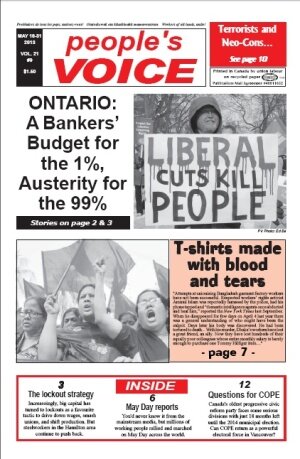
2) ONTARIO: A BANKERS' BUDGET FOR THE 1%

3) A BUDGET OF CRUMBS

4) LOCKOUT: THE ATTACK MODE OF CORPORATE LABOUR RELATIONS

5) TRUTH FROM LIARS - Editorial

6) MORE CLIMATE CHANGE WARNINGS - Editorial

7) TROUBLED WATERS FOR VANCOUVER'S COPE

8) MILLIONS MARCH ON MAY DAY 2013

9) INDIAN ESTABLISHMENT GLORIFIES CONTROVERSIAL FIGURE OVER REAL VANCOUVER HERO

10) MASSIVE PROJECT LEAVES SEOUL NEIGHBOURHOOD AN EMPTY SHELL

11) MADURO GOVERNMENT FACES INTENSIFIED U.S. INTERFERENCE 

12) ON "REFORMS" TO THE TFWP

13) ON THE GROWING WAR DANGER IN THE MIDDLE EAST

14) THE T-SHIRTS MADE WITH BLOOD AND TEARS


PRINTER FRIENDLY ARTICLES

PEOPLE'S VOICE MAY 16-31, 2013 (pdf)

People’s Voice 2013 Calendar
”Ideas of Revolution”


People's Voice deadlines:

June 1-15
Thursday, May 23

June 16-31
Thursday, June 6

Send submissions to PV Editorial Office,
706 Clark Drive, Vancouver, V5L 3J1, pvoice@telus.net

You can call the editorial office at 604-255-2041


REDS ON THE WEB
http://www.parti-communiste.ca/
peoplesvoice.ca
www.ycl-ljc.ca
www.solidnet.org


People's Voice finds many "Global Class Struggle" reports at the "Labour Start" website, http://www.labourstart.org/. We urge our readers to check it out!


*  *  *  *  *
People's Voice

Canadian Publications Mail Sales Product Agreement #205214
ISSN number 1198-8657
People's Voice is published by
New Labour Press Ltd
  PV Editorial Office
706 Clark Drive,
VANCOUVER, B.C. V5L 3J1
Phone:604-255-2041
Fax:604-254-9803
email:  pvoice@telus.net

Editor: Kimball Cariou : Business Manager: David Au
Editorial Board: Kimball Cariou, Miguel Figueroa,
Doug Meggison, Naomi Rankin, Liz Rowley, Jim Sacouman

* * * * * *
Letters
People's Voice welcomes your letters
on any subject covered in our pages.
We reserve the right to edit for length and clarity,
and to refuse to print letters which may be libellous
or which contain unnecessary personal attacks.
Send your views to:
"Letters to the Editor",
706 Clark Dr., Vancouver, BC V5L 3J1,
or pvoice@telus.net
People's Voice articles may be reprinted without permission,
provided the source is credited.


* * * * * *

The Communist Party of Canada, formed in 1921,
has a proud history of fighting for jobs, equality, peace,
Canadian independence, and socialism.
The CPC does much more than run candidates in elections.
We think the fight against big business and its parties
is a year-round job,
so our members are active across the country,
to build our party and to help strengthen people's movements
on a wide range of issues.

All our policies and leadership
are set democratically by our members.
To find out more about Canada's party of Socialism,
give us a call at the nearest CPC office.

* * * * * *
Central Committee CPC
290A Danforth Ave Toronto, Ont. M4K 1N6
Ph: (416) 469-2446
fax: (416) 469-4063 E-mailmailto:info@cpc-pcp.ca

Parti Communiste du Quebec (section du
Parti communiste du Canada)
5359 Ave du Parc, Montréal, Québec,
H2V 4G9

B.C.Committee CPC
706 Clark Drive, Vancouver, V5L 3J1
Tel: (604) 254-9836
Fax: (604) 254-9803

Edmonton CPC
Box 68112, 70 Bonnie Doon P.O.
Edmonton, AB, T6C 4N6
Tel: (780) 465-7893
Fax: (780)463-0209

Calgary CPC
Unit #1 - 19 Radcliffe Close SE
Calgary  AB, T2A 6B2
Tel: (403) 248-6489

Ottawa CPC
Tel: (613) 232-7108

Manitoba Committee
387 Selkirk Ave., Winnipeg, R2W 2M3
Tel/fax: (204) 586-7824

Ontario Ctee. CPC
290A Danforth Ave., Toronto, M4K 1N6
Tel: (416) 469-2446

Hamilton Ctee. CPC
265 Melvin Ave., Apt. 815
Hamilton, ON.
Tel: (905) 548-9586

Atlantic Region CPC
Box 70 Grand Pré, NS, B0P 1M0
Tel/fax: (902) 542-7981

http://www.parti-communiste.ca/

* * * * * *

News for People, Not for Profits!
Every issue of People's Voice
gives you the latest
on the fightback from coast to coast.
Whether it's the struggle for jobs or peace, resistance to social cuts,
solidarity with Cuba, or workers' struggles around the world,
we've got the news the corporate media won't print.
And we do more than that
- we report and analyze events
from a revolutionary perspective,
helping to build the movements for justice and equality,
and eventually for a socialist Canada.

Read the paper that fights for working people
- on every page, in every issue!

People's Voice
$30 for 1 year
$50 for 2 years
Low-income special rate: $15 for 1-year
Outside Canada $50 for 1 year

Send to: People's Voice, 706 Clark Drive, Vancouver, BC, V5L 3J1
You can call the editorial office at 604-255-2041

REDS ON THE WEB
http://www.parti-communiste.ca/
http://www.ycl-ljc.ca/
http://www.solidnet.org/

(Contents)
(Home)


(The following articles are from the May 16-31, 2013, issue of People's Voice, Canada's leading communist newspaper. Articles can be reprinted free if the source is credited. Subscription rates in Canada: $30/year, or $15 low income rate; for U.S. readers - $45 US per year; other overseas readers - $45 US or $50 CDN per year. Send to People's Voice, c/o PV Business Manager, 706 Clark Drive, Vancouver, BC, V5L 3J1.)


1) LIBERALS WIN B.C. ELECTION

PV Vancouver Bureau

     In an election night stunner, the BC Liberals overcame a big NDP lead in the polls to win a fourth straight majority on May 14th. A vicious anti‑NDP attack ad campaign and the enthusiastic support of the corporate media helped Premier Christy Clark win 50 seats out of 85 in the provincial legislature.

     The Liberal share of the popular vote dropped slightly, from 45% in 2009 to 44% in this campaign, and the Premier was defeated in her own Vancouver‑Point Grey riding. But the expected split in the right‑wing vote did not materialize, since the BC Conservatives under John Cummins fell flat with less than five percent. That reflected a calculated move by decisive sections of big capital to unite behind Clark, who was not their favoured choice to lead the Liberals.

     Despite support from younger and low‑ to medium‑income voters, the NDP lost three percent of its 2009 vote share, falling to 39.5% overall. NDP leader Adrian Dix will lead a caucus of 33 MLAs back to Victoria, winning most seats on Vancouver Island and along the north coast. But his party is hotly debating how an apparent 15 to 20 percent lead in the opinion polls evaporated during a one-month campaign, costing them crucial seats in Vancouver and especially neighbouring suburbs. The drop in voter turnout to below 50% could mean that some NDP supporters did not cast a ballot, either because they wrongly assumed the party was cruising to victory, or because the Liberals' negative campaign had some impact.

     The NDP relied heavily on support from trade unions, which have bitterly resisted the Liberals' anti‑working class policies since former premier Gordon Campbell took office in 2001. The labour movement had hoped that a new Dix government would put an end to contracting out and pay freezes for public sector employees, and ease the rules for organizing the unorganized.

     But the NDP held back from substantial promises to improve the lives of working people and the poor. Dix pledged to reverse a small part of Campbell's enormous tax breaks for the corporate sector and upper‑income brackets ‑ but so did Christy Clark, to distance herself from Campbell's legacy. Dix had planned to use some of these revenues for specific "practical changes", including support for badly‑underfunded public schools and post‑secondary education.

     On the other hand, the NDP's promise to raise starvation‑level social assistance rates by a miserly $20 a month ‑ and only after two years ‑ was seen by many poor people and anti‑poverty advocates as a slap in the face. The NDP also failed to present any serious plan to build more low‑income housing, missing an opportunity to win support on a crucial issue.

     For progressives, the $20 social assistance promise summed up Dix's slogan of "change for the better, one practical step at a time." As a result, there was little real enthusiasm about prospects for the poor and jobless under the NDP.

     The Green Party, which elected its first federal MP two years ago in British Columbia, finally made a provincial breakthrough, electing Andrew Weaver in the Victoria riding of Oak Bay‑Gordon Head. Led by Jane Sterk, the Greens won over 15% in several ridings, ending up with eight percent of the province‑wide vote, slightly lower than in 2005 or 2009.

     The Greens tried to capitalize on public resentment against the drive by energy transnationals to use B.C. as a corridor for major exports of diluted bitumen from the Alberta tar sands. A solid majority of British Columbians oppose Enbridge's plans to build a new tar sands pipeline, and Kinder Morgan's application to twin its aging pipeline to a refinery in Burnaby. Both projects would mean massive increases in tanker traffic along the coast, with the strong likelihood of an eventual oil spill disaster.

     As the campaign began, Dix strengthened his party's stand against the projects, sparking accusations of a "flip‑flop" from the Liberals. The Greens argued, with some justification, that they had a more comprehensive environmental platform. Both major parties, the Greens pointed out, support the rapid growth of the province's liquid natural gas industry, which means a big overall increase in British Columbia's greenhouse gas emissions.

     But Dix's strategic decision seemed to pay off when major environmental groups endorsed the NDP late in the campaign, aiming to block the corporate‑friendly Liberals. Yet the NDP actually lost votes over its 2009 results.

     The corporate media twisted the facts to portray the Liberals as "job creators," and Christy Clark was repeatedly shown on TV wearing a hard hat at job sites across the province. The media also demonized the NDP as "tax and spend socialists", despite the party's refusal to challenge big business while in office during the 1990s.

     As the Communist Party of BC's four candidates pointed out, electing the NDP would not have solved the capitalist economic crisis hammering working people across the province. The NDP's recent record here and in other provinces (as in other capitalist countries) shows that social democratic governments tend to wilt under pressure from big capital, sugar‑coating neoliberal policies with the occasional sprinkling of progressive content.

     Speaking to People's Voice on election night, CPBC candidate Peter Marcus (Vancouver‑Mount Pleasant), said "The Liberal victory is a setback for working people who wanted a new government in Victoria. Unfortunately, Adrian Dix's NDP failed to campaign for real change. The labour movement and its allies haven't fought for twelve years against the Liberals only to watch things stay much the same. But the NDP did little to win working people's confidence, by dismissing serious action on poverty reduction, social housing, labour legislation, a higher minimum wage, and reduction of greenhouse gas emissions."

     Look for more analysis of the British Columbia election in our next issue.

Printer-friendly article

(Contents)

(Home)


2) ONTARIO: A BANKERS' BUDGET FOR THE 1%

Executive Committee, Communist Party of Canada (Ontario)

     While Liberal Premier Kathleen Wynne and the media continue to press the idea that her minority government ‑ under pressure from the NDP ‑ delivered a progressive agenda in the May 2 budget, in fact nothing could be further from the truth.

     This is a bankers' budget, written by and for the 1%. Delivered by former banker and current Finance Minister Charles Sousa, under the direction of former banker Don Drummond, it reprises almost the entire list of recommendations in the Drummond Report, starting with the proposal to slash social spending, continue slashing public sector jobs, and legislate across the broader public sector the wage and benefit cuts imposed on teachers and educational workers in January.

     This includes pension reforms that aim to end the defined benefit pensions still common in the public sector, that have already been ripped out of private sector collective agreements. Further, the government has already signed agreements with the 5 biggest public pension plans banning additional contributions that might be required to maintain current pension benefits for retirees. This would result in pension cuts, most likely to occur in the next deep recession.

     The government will "hold" program spending to 1% for the second year in a row. This is below the rate of inflation, and well below the actual costs of providing healthcare, public and post‑secondary education, and mandated social programs and services to Ontario residents. With per capita program spending already the lowest in Canada, the government will further starve these programs, privatize, contract out, and reduce both the quality and quantity of public services to Ontarians. This is the real, anti‑human face of austerity, and the real face of the Liberal government in Ontario.

     While healthcare spending will increase by 2% to boost languishing homecare and long‑term care services, the increase is offset by bed closures, layoffs, and service reductions in hospitals across the province, and cuts in other non‑healthcare programs and services.

     In education, the story is the same with locally elected School Boards being told to sell off land and schools to offset shortfalls in provincial transfer payments. The province will also send in teams to find more 'efficiencies' in Boards' spending, further undermining local autonomy and democracy. There is nothing about the needs‑based funding formula demanded by School Trustee Kathleen Wynne 15 years ago and promised by the Liberals 10 years ago.

     In post‑secondary education, the 30% tuition freeze will continue to be paid for by cuts to other student aid and grants. An undisclosed "new financial framework for tuition" is announced, but precludes real reductions in tuition, or increases to core funding for universities and colleges.

     For youth, the government will strike a panel to study the minimum wage, and will give employers $295 million to hire 30,000 youth and students.

     For seniors, the government will introduce income testing in 2014 for the Ontario Drug Benefit program that provides all seniors over 65 with some free drugs.

     On social assistance, the government has cherry‑picked the SARC report and eased the rules limiting assets and earned income before clawbacks, while indicating it will focus on reducing caseloads by providing cheap labour to employers across the province. A 1% increase in benefits, which are now the lowest in Canada, will put just $6 a month more into the pocket of a single man or woman living on a benefit of just over $600 a month.

     The $200 increase to the Ontario Child Benefit promised for 2013, has been diluted to cover both 2013 and 2014.

     On transportation, the budget generally favours road tolls, including tolls for access to high occupancy lanes on existing highways, but commits a nominal (but vote getting) $100 million to northern Ontario roads and infrastructure.

     On energy, the budget introduces income testing to reduce eligibility for the Ontario Clean Energy Benefit. This will increase residential electricity bills for most homeowners and tenants by 10% or more.

     On auto insurance, the government has 'met' NDP demands to cut rates by 15%, with the promise to try hard by focusing on insurance fraud. While unhappy with this totally inadequate response, the NDP no longer supports public auto insurance which is the only way to bring down insurance rates and to stop the gross price fixing and profiteering of the transnational insurance companies.

     On cities, the government will continue to upload the costs of services downloaded in the 1990s by Tory governments. A small share of the gas tax is also offered, but no new financial deal to provide the funds so urgently needed to run Ontario's cities and municipalities in the 21st century.

     All of this is being done in the name of deficit reduction, even though the deficit is declining at a rate far faster than expected, mainly due to rock bottom interest rates which are projected to continue for some years yet.

     Nowhere is there any mention of progressive tax reform based on ability to pay, that would increase corporate taxes and the CIT rate, and restore the capital tax, thereby turning on the revenue taps that both the Liberals and Tories have deliberately turned off over the last 30 years. This is a revenue crisis that has been deliberately created, to fuel the myth of a spending crisis and justify the vicious attacks on healthcare, education, social programs and services, and on working people, youth, women, the unemployed, and the poor.

     This austerity budget is proof that the Ontario Liberals are the party of Big Business, the banks and insurance companies, and the wealthy one percent in Ontario, and no friend to working people, youth, women, the unemployed and the poor.

     What Ontario needs is massive job creation, and a substantial rise in wages, incomes and living standards across the board. Public investment in social housing construction, in provincial and municipal infrastructure, in public and post‑secondary education, in healthcare and public services, in a provincial system of quality public childcare ‑ this is the way to a people's recovery.      What we need is legislation to stop runaway plants and employers, and put basic steel and energy under public ownership and democratic control; to build public transit and a Canadian car that's small, fuel‑efficient, and environmentally sustainable, to adopt a value added manufacturing and industrial strategy, and a trade policy that puts people before profits.

     What Ontario needs is progressive tax reform based on ability to pay that will put the load on the corporations and the wealthy 1%, to provide the revenues needed to pay for these policies and programs. We need to curb corporate power, expand public ownership under democratic control, and strengthen labour, civil, social, and democratic rights.

     The Communist Party's 10 point Prescription for a People's Recovery (available at www.communistpartyontario.ca) contains the policies and priorities important to working people, to women, youth, and to social progress in Ontario. Many of them are supported by labour, youth and student organizations, and many other organizations and movements. These are the policies and direction that should be reflected in this provincial budget.

     Regrettably the NDP no longer advocates many of these policies, and has lost the opportunity of a minority government to press forward with them. Their refusal to fight for public auto insurance is a good example of what has been lost. In their drive to rid themselves of socialism, they have rid themselves of policies that are very important to working people. These are policies that challenge corporate power, and the power and greed of the banks and insurance companies in the first place.

     The Tories support the austerity measures in the budget, but will oppose the budget because their far right policies dictate even more vicious attacks on labour and democratic rights, including attacks on the Rand Formula and the closed (union) shop.

     Sensing the public's deep anger at the 10 year old government, the Tories think they can topple the Liberal minority and form a far‑right Tory majority in Ontario. This would be a disaster for democracy and for working people.

     In this political stalemate, labour and the people's movements must seize the initiative and fight for progressive policies and a new progressive direction for Ontario. By fighting for these policies now using mass independent political action, labour and the democratic movements can make these the central issues in the coming election, hobble the far right, and push politics to the left in Ontario.

     The alternative to an all‑out militant struggle against austerity, is more austerity measures ‑ implemented by compulsion or submission until nothing is left of our universal healthcare system, quality public school system, universal social programs, jobs, wages and pensions, labour and civil rights, and democracy. That's what austerity has delivered in Europe ‑ along with a new recession.

     That's what's on the line in Ontario, and what we have to mobilize now to block and defeat, in the struggle for a better future ‑ a better world ‑ where people's needs trump corporate greed all the time.

Printer-friendly article

(Contents)

(Home)


3) A BUDGET OF CRUMBS

By Jean Kenyon

     A few days before Premier Kathleen Wynne's first budget came down, a family tragedy occurred in Ottawa. The parents of a severely autistic 19‑year‑old took their son to a provincial developmental services office and left him there. Faces covered with tears, they told a CBC reporter that they could no longer care for their son with so little support from the Ontario government.

     In response to this story, a Kitchener activist started a petition to Social Services Minister Ted McMeekin. It demands that enough funding be provided to eliminate the years‑long waiting lists and to ensure a seamless transition when children with developmental disabilities turn 18.

     But the May 2 budget allocated only a little money, and was vague about how it would be used. Desperate families will be kept waiting a lot longer.

     In similar fashion, backlogged needs across Ontario were severely shortchanged in this budget. The Ontario Health Coalition points out that hospital funding is being held to a zero per cent increase, which will lead to bed closures in a province that already has the fewest hospital beds per capita in Canada. Not enough new funding is being put into home care to take up the slack or even clear the existing waiting lists.

     Perhaps most insulting, single adults on welfare will be given a "top‑up" of $14 a month. Every social agency in Ontario has been pleading for years that a $100 a month increase in welfare rates would be a bare minimum for shelter and food. Even this would be far short of the $300 increase necessary to undo Mike Harris's crushing cuts of 1995.

     Not a dollar was promised for affordable housing, even as the number of homeless keeps increasing. The Region of Waterloo alone has a waiting list of 1500 people in need of supportive housing, the biggest gap in service of all. It took five years of citizen fund‑raising and organizing, along with some help from the province, to create one such building to house 30 people in 2010. With provincial money drying up, most individuals in need of supportive housing will not receive it in their lifetime.

     Meanwhile municipalities have to find new money out of property tax revenue, to replace an emergency housing fund cancelled in last year's budget.

     And if you were hoping that your minimum wage job would soon start paying more, well you'll have to wait for an "advisory panel" to report later this year, followed no doubt by further dithering.

     The "social justice premier" hasn't done much to earn her designation yet! The best that can be said is that she threw her handful of crumbs in the right directions.

     The Ontario Health Coalition said it well: "Ontario already ranks dead‑last in funding all public services, from roads and transit to education, justice and health care. Why? Because we have the lowest corporate taxes and taxes for the wealthy of almost anywhere in North America.

     "This budget will see Ontario fall further behind. The result is a burgeoning array of user fees and out‑of‑pocket costs for residents. Ontario students already have the highest tuitions in the country and user fees are soaring for everything from parks to roads."

     Ms Wynne, if you're still around in a year, you've got to do a helluva lot better than this. Ontarians are tired of eating crumbs.

Printer-friendly article

(Contents)

(Home)


4) LOCKOUT: THE ATTACK MODE OF CORPORATE LABOUR RELATIONS

By Sam Hammond, Hamilton

     In 2003 the largest steel producer in Canada began a debacle of legendary proportions, as a completely solvent manufacturer, Stelco, was put into bankruptcy protection by bottom feeding financial adventurers. The debacle that ran through court proceedings for years resulted in wiping out the shareholders and restructuring the company. It was seized by a consortium for $150 million, and resold (to US Steel) in 2007 for $1.1 billion.

     In a classic plunder, a small consortium seized a company, and with the assistance of the courts pocketed huge profits. The workers, members of Local 1005 USW, conducted a courageous and successful battle in the courts, in negotiations, in the streets and in front of the Ontario Legislature. Unlike more than 60,000 of their US brothers and sisters, they managed to save their pensions, most of their conditions, and the pensions and benefits of retirees. Their struggle is living proof that resistance is the only defense.

     In 2006‑2007 the Euro‑Asian conglomerate Arcelor‑Mittal, the world's largest steelmaker, bought their way into NAFTA with the purchase of Canada's second largest steel maker, Dofasco of Hamilton, with the accompanying access to cheap Canadian power, iron ore and water. 

     The battle for the Hamilton waterfront was on. The American stealers moved decisively to shut out the Russians and Brazilians, buying Stelco outright for $1.1 billion, and assuming a $760 million debt and about $1.3 billion pension and healthcare liabilities. US Steel boasted they would pump $100 million into the Hamilton and Lake Erie plants. To seal the deal under the Investment Canada Act, US Steel promised in writing to maintain the 3600 jobs at the two plants, maintain production levels and provide a "net benefit" to Canada (31 binding obligations). The entire agreement was never made public.

     US Steel promptly broke all its promises. It laid off and reduced the workforce, cut back on production, locked workers out (three times in three years), attacked pensions and benefits, and generally exposed itself as an arrogant foreign corporate raider.

     Under pressure from the Steelworkers Union, this was too much for the federal government, which finally took US Steel to court over its blatant violations of the agreement.  US Steel lost, appealed, and lost again at the Supreme Court (November 24th, 2011). The ground was laid for the first time ever to levy fines of $10,000 per day, going back to 2007.  Frightened out of their skulls at their success in the Supreme Court against US Steel, the Harper Tories moved quickly for an out of court settlement that took the corporation off the hook and left the workers out in the cold.

     Here is the settlement, as reported in the newsletter of the business law firm, Stikeman Elliot, December 13, 2011: "The final settlement requires U.S. Steel to continue producing steel in Canada for at least another four years, and to make substantial capital investments in its Hamilton and Lake Erie plants, totalling C$50 million. These undertakings are over and above U.S. Steel's original commitment to invest C$200 million in the Canadian plants by October 31, 2012. In addition, U.S. Steel has committed to making financial contributions of C$3 million to local communities. In the Minister's view, these additional investments mean that "U.S. Steel will continue operations in Canada that provide economic benefit to the communities of Hamilton and Nanticoke". Minister Paradis praised the settlement as achieving "benefits that in all likelihood would not have been obtained through the court process". A spokesperson for the steelmaker says that "the resolution reflects our ongoing and long term interest in doing business in Canada"

     The $3 million to local communities appears to skeptics as a unique slush fund to local politicians, a tax refundable stroke of public relations to silence local vocals and buy image in a compliant media.  Why not to laid off workers, or an unstable pension fund? This agreement was made on the heels of an eleven month lockout, where workers of Local 1005 in Hamilton held tight against the concessionary onslaught of US Steel and still had to give some concessions.  If the original agreement had been enforced, the present jobs would have been 3600 instead of less than 2000 at the two plants. There would have been no lockouts that violated the commitment to maintain production. That was in 2011. Since then, of course, they have violated the main points of the out of court settlement continuously and contemptuously.

     On April 30, 2012, at precisely 9:00 am, US Steel locked out about 1000 workers at Lake Erie, a repeat of their eight‑month lockout that ended in April 2010. In the 2010 lockout, pensions, COLA, wages, benefits, etc. were all on the block and the company was in attack mode. Although solid and militant, the workers lost ground.

     In 2013, even though the Union had offered to sign a "status quo" agreement for another three years, US Steel locked the gates again. The concessionary appetite the bosses developed in 2009‑2010 is even more voracious in 2013. Apparently, feeding the beast does not assuage its hunger or dull its appetite. This was no surprise. Months ago, the company had informed the union that it would be training salaried personnel in production jobs in case of the need to maintain production. Years ago, that probably would have provoked immediate retaliation.

     There has been a shift in the role assigned by big capital to its administrative and ideological state apparatus. The days when the state could dress itself in the robes of neutrality, and achieve hegemony as an arbiter between labour and capital, are gone in Canada. The new hegemony will be achieved not as an olive branch to sections of labour, but as a steel rod to flay workers and organize society against their organized section, the trade unions.      That is why corporations have the confidence to go into the "attack mode". Stephen Harper openly talks of intervention in the public sector to reflect private sector conditions. Put in street language, it goes like this: intervene in the strongest private sector areas (auto, transportation, etc.); declare an imaginary threat to the public interest to override the right to organize, bargain or strike; drive the cost of labour power down, take away the Rand Formula and destroy the closed shop. When this is fully underway (albeit not complete), start the same process in the public sector. 

     The corporate world obviously has adopted the "first strike" strategy for labour relations, with the state as the implement. The trade unions are restless, but have so far not achieved anything approaching a united front against the attack. If the victims of the US Steel lockout at Lake Erie do not seem to have a tactical response, please do not blame them. Look instead at the Canadian Labour Congress in its rather long sleep since the offensive of capital escalated in 2008. If the general staff is asleep, what are the troops to do?

     The long overdue need for labour unity and for a strategic tactical defense and counter‑attack that includes the national labour centres of Quebec is so far not on the horizon. Unity is no longer needed to win a bigger piece of the pie, or to win a better imaginary status in the illusion of pluralism or even a beggars' role at the corporate table.  The achievement of unity now must be for the very future existence of an independent trade union movement, for a Charter of Rights for Labour.

Printer-friendly article

(Contents)

(Home)


5) TRUTH FROM LIARS

People's Voice Editorial

     There are no Marxists in British PM David Cameron's government, but his "adviser on enterprise" has shown that the ruling class has a good understanding of economics. The UK Observer reports that Lord Young, who was a cabinet minister under the late Baroness Thatcher, argues that the economic downturn is a great time to slash wages and boost profits.

     As Lord Young wrote in a brief to Cameron's cabinet: "The rise in the number of businesses in recent years shows that a recession can be an excellent time to start a business. Competitors who fall by the wayside enable well‑run firms to expand and increase market share. Factors of production such as premises and labour can be cheaper and higher quality, meaning that return on investment can be greater."

     With 2.5 million people officially jobless in Britain, Young's message is clear. High unemployment is great for those corporations which lead the pack in cutting pay rates and forcing employees to work more intensively, for longer hours.

     Karl Marx analysed this process extensively over a century ago, drawing the conclusion that there is no "fairness" for workers under capitalism. Competition among corporations to maximise profits pushes the bosses to seize every opportunity to extract more surplus value from workers, precisely as Lord Young proclaims.

     Not surprisingly, such "truth outbreaks" are a public relations disaster for the corporate elite, since these admissions confirm the validity of Marxism and encourage workers to resist increased exploitation. The Cameron government sputters that Lord Young's words are being "misrepresented" by the labour movement, but his statements need no elaboration. In fact, Lord Young has done workers a favour, by reminding the world that we have no interests in common with the ruling class.

Printer-friendly article

(Contents)

(Home)


6) MORE CLIMATE CHANGE WARNINGS

People's Voice Editorial

     Natural disasters linked to the process of climate change forced 32.4 million people from their homes in 2012, with floods and storms causing 98 percent of the displacement, according to the Internal Displacement Monitoring Centre (IDMC). That total was almost double the 2011 number.

     The two most catastrophic events of 2012 were the monsoon floods which uprooted 6.9 million people in India's northeast, and 6.1 million people in Nigeria displaced by widespread flooding in the rainy season. Over the past five years, some 144 million people have had to leave their homes because of natural disasters. While the figures vary from year to year, the numbers are expected to rise in line with global trends that make people more vulnerable, and most of those affected live in the most poverty-stricken countries.

     Two urgent messages must be grasped from this situation.

     First, vast resources which could be used to prevent natural disasters or protect the victims, are instead wasted on the profit-driven expansion of militarism. Humanity simply cannot afford to spend a trillion dollars a year on new generations of fighter-bombers and other weapons of death.

     Second, the expanding emissions of greenhouse gases must be reversed. To those who say this will "cost jobs", our answer is that we need an economy which puts people and the environment ahead of private profits. The creation of a truly green economy, based on social ownership of resources and industries, and democratic planning, is needed to tackle the huge problems facing our planet.

     Simply put, the imperialist division of the planet, and the capitalist drive to extract maximum profits from workers, are incompatible with human survival. The latest figures on displacement make it clear that we are running out of time to change this terrifying picture.

Printer-friendly article

(Contents)

(Home)


7) TROUBLED WATERS FOR VANCOUVER'S COPE

By Kimball Cariou

     Divisions within Canada's longest-established progressive civic party appear wider in the wake of an acrimonious annual meeting in early April. For the first time, a factional group opposed to the traditional left-centre unity strategy of Vancouver's Coalition of Progressive Electors is in full control of the organization.

     The situation has sparked serious concerns in the labour movement, and also within COPE-ED, the party's committee of public education activists. Since the Vancouver and District Labour Council (VDLC) and some of its affiliates - including unions in the education sector - have long been the largest financial and organizational backers of COPE, it appears possible that the party could be seriously weakened heading into the November 2014 municipal elections.

     COPE was founded in 1969 at a conference sponsored by the VDLC's civic affairs committee. The new party brought together the labour movement and progressive civic forces led by radical lawyer Harry Rankin, with the goal of challenging decades of "Non-Partisan Alliance" big business control of Vancouver city hall, school board, and parks board.

     A wide range of activists and movements quickly came on board, and within several years, COPE began electing Rankin and other city councillors and school trustees. During the mid-1980s, COPE won majorities on the Vancouver School Board, and worked with Mayor Mike Harcourt and his supporters to form a de facto majority on Council. A key figure at the time was city councillor Bruce Yorke, a Communist Party member who helped COPE win support across the city with his measures to achieve municipal taxation equity.

     After a subsequent period of setbacks, COPE began electing candidates again in 1999, and then swept the field in the 2002 campaign. Unfortunately, the "big tent" of forces united under the COPE banner soon collapsed. Within two years, several COPE city councillors formed the new Vision Vancouver party. A centrist group which advanced environmental ("green capitalist") policies, Vision was also backed by important property developers.

     That bitter experience led some members to form their own permanent faction within COPE, arguing that Vision had become the worst enemy of working people in Vancouver. Most COPE members took a different position, voting in 2005, 2008 and 2011 to support joint COPE-Vision electoral slates with the aim of defeating the right-wing NPA. This centre-left unity strategy was strongly backed by the VDLC, the Communist Party, and most civic New Democrats.

     But this approach, while it resulted in some electoral successes for COPE, left Vision in the driver's seat. The new party won big victories in 2008 and 2011, while COPE elected just one candidate (long-time school trustee Alan Wong) in the latter campaign. Without a strong COPE presence at City Hall, Vision tilted further in a pro-developer direction, while still trying to maintain its environmentalist credentials. Since the era of electoral cooperation ended in 2011, COPE's executive has become even more critical of Vision's policies, except at the school board level where the Vision majority takes progressive positions.

     Meanwhile, the ever-growing divide between rich and poor in Vancouver has generated increasing anger, especially in the poverty-stricken Downtown Eastside neighbourhood. Much of that anger has been directed, however, not at right-wing federal and provincial governments, or against the big corporations, but instead at the Vision-dominated city council, which has failed to live up to its progressive image on key issues.

     Taking advantage of this justifiable backlash, the faction led by former city councillor Tim Louis has gained strength within COPE, especially since the 2011 election. Bizarrely accusing leading COPE members of being "neoliberals" (including Communists and left-minded NDPers), the Louis group won a decisive majority on the executive at the April 7 AGM.

     That meeting also narrowly adopted a resolution stating that COPE will nominate a mayoralty candidate and majority slates at all levels in 2014. While the resolution is clearly against COPE's constitution, it does signal that the new executive is determined to run an all-out campaign next year, even if this opens the door for an NPA comeback.

     Such a scenario is particularly troubling for the municipal trade union movement, especially the civic inside and outside workers represented by CUPE. These CUPE members have vivid memories of being locked out by a reactionary NPA mayor and council back in 2007, and their unions will reject any strategy which could bring back the NPA. Similarly, the teachers' unions which have worked closely with COPE-ED for years are reportedly appalled at the prospect of an NPA-led school board after the next election.

     The single-minded focus of the new COPE executive on the Downtown Eastside is another huge departure from the organization's traditional strategy of building support across the city. By aligning with forces which condemn the trade union movement, the Louis group may win cheers from some anti-poverty activists. But the negative response to tactics such as smashing restaurant windows indicates that, far from winning support to build more low-income housing, the "new" direction may leave COPE isolated in the 2014 campaign.

     Eighteen months remain before that election, and another COPE AGM will take place next spring. But at this point, it appears that many long-time COPE supporters are sitting things out, exhausted by endless struggles against the determined sectarian group which has taken control. Under these circumstances, the COPE vote may well collapse in 2014 to its "core" levels of perhaps 20,000, far below the 50,000-plus needed to elect candidates in Vancouver.

     If that happens, can COPE survive this difficult internal convulsion? Could another labour-backed, broad-based progressive civic reform movement emerge? These are questions which many COPE activists are debating, but so far there are few answers.

Printer-friendly article

(Contents)

(Home)


8) MILLIONS MARCH ON MAY DAY 2013

PV combined news sources

     Millions of workers in Asia, Europe, Latin America, Africa and North America marched en masse for May Day 2013. A common theme in every country was rejection of the pro-corporate austerity policies imposed by both right-wing and social democratic governments.

     One of the largest events was in socialist Cuba, where hundreds of thousands took part in the annual May Day rally in Havana's Revolution Square. The parade paid tribute to Hugo Chavez, the Venezuelan leader who died in March. A sea of workers, many wearing red shirts like those favoured by Chavez and carrying signs with his image, paraded past a giant statue of 19th century Cuban independence hero Jose Marti in the vast square where Cuba holds its biggest political rallies.

     For workers in Venezuela, May Day was an occasion to celebrate the country's new labour laws, which dramatically improve working conditions, pensions, and other rights (see page 8).

Asia

     Over 120,000 low‑paid workers rallied in the streets of Indonesian cities to demand better pay and improved working conditions. Workers from Jakarta and the surrounding cities of Depok, Bogor, Tangerang and Bekasi gathered at Hotel Indonesia and marched to Merdeka Palace, disrupting business activity in the capital city.

     Riot police blocked protesters as they tried to march towards the U.S. Embassy in Manila to mark May Day in the Philippines. The workers assailed President Aquino III for his Labor Day "gift" of non‑wage benefits. The protesters were demanding a P125‑Peso ($3) across‑the‑board wage hike, and condemned the government's outsourcing policy which eliminates job security.

     Some 5000 Cambodian workers rallied in Phnom Penh, calling for higher wages and better working conditions, while trade unions held demonstrations in Tokyo, calling for more youth employment. In Singapore, 6000 rallied at Hong Lim Park to protest right-wing immigration policies and high living costs.

     The Korean Confederation of Trade Unions (KCTU) rallied at City Hall Plaza in central Seoul. Thousands of workers at the rally asked for an extensive revision of South Korean labour law and demanded that the government provide employment stability for temporary workers by converting their status to full‑time workers.

     Police clashed with protesters in Istanbul who were trying to reach the city's main square to mark May Day. The government, citing security reasons, had banned the planned rally on Istanbul's Taksim Square. Subways, some buses and even ferries across the Bosphorus were suspended to prevent large groups from gathering on the square. Police fired tear gas to disperse hundreds of demonstrators trying to break through barricades. Taksim Square is of high symbolic value to the Turkish labour movement. Dozens of protesters were killed there in 1977 when unidentified gunmen opened fire on thousands of people.

EUROPE

     Workers hit by lower living standards and record high unemployment staged May Day protests across Europe, demanding that governments reverse austerity measures. Four euro zone countries ‑ Greece, Ireland, Portugal and Cyprus ‑ have now received sovereign bailouts, but there is still no sign of growth or employment in the currency bloc.

     Ferry and train services in Greece ground to a halt, and bank and hospital workers also walked out for May Day. Thousands gathered in central Athens and Thessaloniki. The country's main unions are protesting against the highest unemployment rate in the European Union, and the austerity measures the government is imposing in return for bail‑out loans. The general strike was the latest in a string of protests as the country endures a sixth year of recession.

     The communist‑led PAME (Greek All-Workers Militant Front) organised a large demonstration in Athens' Syntagma Square, while the private sector GSEE union and the public sector union ADEDY had their rally at Kafthmonos Square. The Syntagma Square demonstration was saluted by Bangladeshi workers' representatives, as well as by Gilda Chacov Bravo, Cuban member of the Secretariat of the World Federation of Trade Unions (WFTU).

     In central Moscow, at least 70,000 people turned out for a trade union parade. Across Russia, about 1.5 million people took part in similar traditional actions by the country's working class.      German unions said about 425,000 people took part in more than 400 events around the country. Michael Sommer, head of the DGB federation of German labor unions, said the German government should have more solidarity with the rest of the euro zone.

     "We cannot allow this continent to be `kaputtgespart' ‑ forced to save so much that it breaks apart," he said.

     Tens of thousands marched in Italy's major cities to demand action to tackle unemployment, which is now 11.5 percent overall and 40 percent among the young.

     Rallies were held in more than 80 cities in Spain, where the economy has shrunk for seven consecutive quarters and unemployment stands at a record 27 percent. Thousands of people snaked up Madrid's Gran Via central shopping street carrying placards reading "austerity ruins and kills".

     "The future of Spain looks terrible; we're going backwards with this government," said former civil servant Alicia Candelas, 54, who has been without a job for two years.

     Unions said 50,000 people marched in Madrid and more than one million took part in peaceful rallies across the country.

     France's two biggest unions, split over "socialist" President Francois Hollande's anti-labour laws, held separate May 1 marches. Hollande's approval rating has dropped as low as 25 percent as cuts bite and unemployment has risen.

     Pope Francis made a May Day appeal for governments to tackle unemployment, as "work is fundamental to the dignity of a person".

"I think of how many, and not just young people, are unemployed, many times due to a purely economic conception of society, which seeks selfish profit, beyond the parameters of social justice," he told a crowd in St. Peter's Square.

     Thousands of people marched in Lisbon calling for an end to austerity dictated by Portugal's EU/IMF bailout, a day after the government said there would be more spending cuts.

     Smaller May Day marches also took place in other parts of the world. In the United States, where May Day originated over 125 years ago, protests were held in Los Angeles, Manhattan, Chicago and some other cities.

     May Day marches and celebrations were held in a number of Canadian cities. The Vancouver and District Labour Council organized its annual march along Commercial Drive for the fourth consecutive year, with about 500 trade unionists, solidarity activists and members of revolutionary movements taking part.

     Close to a thousand people marched in Toronto, where organizers of various May Day activities adopted a more united strategy than in previous years. The Communist Party and allied organizations held their annual social and political celebration of the workers' holiday on the previous weekend at the Steelworkers' Hall on Cecil Street, just off Spadina.

     In Windsor, hundreds of trade unionists and supporters held a unique parade down Drouillard Road, the heart of the city's historic auto industry. The road was transformed into a living museum, with members of the crowd in period costume acting out scenes from trade union history.

     Repression marked May Day in Montreal, where police arrested 447 people during a rally organized by the Anti‑Capitalist Convergence, or CLAC. Those arrested were eventually handed a $637 fine for unlawful assembly.

     Restaurant patrons watched from outdoor terraces as drummers, musicians and flag‑waving demonstrators gathered in Place Jacques-Cartier. However, police declared the colourful gathering illegal shortly after it started. Montreal's public order bylaw P‑6 makes it illegal to participate in an assembly with a face obscured by a scarf, hood or mask, and requires protesters to disclose to police in advance the location and itinerary of their demonstration.

     Demonstrators tried to make their way to the march's destination, a private club known by its street number, 357c. Witnesses at Quebec's inquiry into corruption in the construction industry have referred to the club as a meeting place for entrepreneurs, high‑level bureaucrats and politicians. However, hundreds of police encircled the rally at the intersection of de la Commune Street and St‑Sulpice Street, forcing protesters into buses.

Printer-friendly article

(Contents)

(Home)


9) INDIAN ESTABLISHMENT GLORIFIES CONTROVERSIAL FIGURE OVER REAL VANCOUVER HERO

By Gurpreet Singh

     The recent decision of the Indian government to declare a martyr lacks wisdom. Sarabjit Singh died after being assaulted in a Pakistani jail. He was convicted by the Pakistani courts for 1990 bombings that left 14 people dead. Singh had claimed innocence, and there were efforts to get him released on humanitarian grounds, but the Indian authorities described him a martyr, or brave son of soil, following his death in Jinnah Hospital in Pakistan, after being viciously attacked by jail inmates.

     Until recently, Singh's family and his Canada‑based supporters claimed that he had accidentally crossed the border between India and Pakistan, and was wrongly implicated in the crime. A few Canadians spearheaded a campaign for his release.

     His native village, Bhikhiwind, is situated close to the zero line that divides India and Pakistan. His family claimed that he had mistakenly strayed into Pakistani territory. 

     Incidentally, Bhai Bhag Singh, a towering leader of the East Indian community in Vancouver, who was assassinated by a British spy in 1914, belonged to the same village. He was in the forefront of the struggle for the right to vote for Indian immigrants, and had challenged the racist immigration laws of the Canadian government.

     Bhag Singh was associated with the Ghadar Party, which believed in armed rebellion against the British Empire. Formed by Indian immigrants on the Pacific coast in 1913 to resist racism and foreign occupation of their homeland, the Ghadar movement was born out of discriminatory experiences endured by these men, disillusioned by the indifference of the Empire. Bhag Singh had previously served in the British army. As a mark of protest he organized an event where former British Sikh soldiers burnt their medals and uniforms. He died after being shot by Bela Singh, an agent of the Immigration department that spied on the East Indian community in Vancouver.

     The Indian establishment has completely forgotten Bhag Singh and his contributions, with no significant effort to raise a fitting memorial at his native village. But the controversial Sarabjit Singh has received extraordinary attention.

     The fatal attack on Sarabjit Singh followed the hanging of a Pakistani extremist, Ajmal Amir Kasab, who was behind the 2008 terror attack on Mumbai, India, that left more than 100 people dead. Had Pakistan declared him a hero, the Indian government would have quickly branded their neighbours a "terrorist state". How wise therefore to glorify Sarabjit Singh as a hero?

     Even otherwise, how can a man become martyr while being an innocent victim of circumstances? By declaring him a martyr, the Indian government has belittled real martyrs and national heroes, like Bhag Singh who fought consciously against injustices.

     At a strategic level, this is also a bad decision, an indirect endorsement of a terrorist crime allegedly committed by Singh in Pakistan.

     Let's face it: the Indian government failed to handle the whole affair appropriately. To pacify public anger and hide its own weaknesses, it is trying to silence critics by indulging in jingoism.

Printer-friendly article

(Contents)

(Home)


10) MASSIVE PROJECT LEAVES SEOUL NEIGHBOURHOOD AN EMPTY SHELL

By Sean Burton, April 30, 2013

     A multi‑billion dollar real estate project in Seoul's Yongsan district was terminated in early April. The project was projected to cost $27 billion, of which over $2 billion was spent preparing a large amount of the land around Yongsan Station.

     That land once formed a vibrant neighbourhood. True, it had some unappealing aspects, such as a red‑light district right in front of the station, but it was where many people lived in simple apartments or ran small street restaurants. Readers may recall a January 2009 incident when six people were killed and twenty‑four injured in an apartment building in the demolition zone. A group of anti‑development protesters and several residents of the neighbourhood reduced to squatter status occupied the roof of one building. Seoul's SWAT team stormed the roof, resulting in a clash of Molotov cocktails and other improvised weapons. Five demonstrators and one police officer died as a result.

     If one visits the site now, there is nothing but large empty lots surrounded by ugly fences. Some of the lots are full of weeds and garbage; no serious work has been done there for a while. On the west side of the station is a similar scene. A former rail yard owned by Korail is converted into a vast expanse of dirt.

     Apartments lining the Han River were also slated for destruction. Their walls are painted with messages of defiance, condemning the redevelopment and the government, as people cling to their homes. The project would have driven them out and transformed the area into yet another shopping mall and financial office district. (There's already a large mall inside Yongsan Station!) The street restaurants are back, setting up tents in a different area amidst the empty land around them. There's no shortage of customers, it seems, but the desolation around the neighbourhood is obvious.

     So, people struggled and died against South Korea's powerful conglomerates and their government buddies. Billions of dollars were spent to ruin an entire section of city. The termination was no change of heart; the main developer went bankrupt. It seems that this $27 billion project had not started with anywhere near that much, getting a large number of loans and hoping that the real estate market would go their way.

     Instead, land prices skyrocketed. Lawsuits are starting to fly as investors try to get their money back. The land itself is to be returned to Korail and to the former residents, who are now demanding compensation. But the land is empty, and it is not clear what will be built there. So, back to square one, at great cost in materials and human lives. Given the results, surely we can all agree that this is no sane or humane way to run an economy.

Printer-friendly article

(Contents)

(Home)


11) MADURO GOVERNMENT FACES INTENSIFIED U.S. INTERFERENCE 

By W.T. Whitney Jr.

     The 1.6 percent margin by which Venezuelan President Nicolas Maduro and his United Socialist Party of Venezuela (PSUV) took the presidential elections of April 14 was anemic, in comparison with former President Hugo Chavez' crushing electoral victories. The combined effect of a narrow victory margin and Chavez' death on March 5 has served to buoy up forces that backed defeated opposition candidate Henrique Capriles. The charisma of Chavez and his promotion of social programs and regional integration had held them in check for 15 years.

     The U.S. government is taking advantage of the new reality. The Obama administration, alone in the world, has held off recognition of Maduro's victory on the pretext of election irregularities, a widely discredited notion. Paradoxically, U.S. recognition of the short-lived government after the coup that removed President Chavez in April, 2002 was immediate. Speaking recently to reporters, Assistant Secretary of State Roberta Jacobson did not rule out eventual U.S. economic sanctions against Venezuela.

     The U.S. government's posture has emboldened perpetrators of violence. Immediately after the voting, the toll was eight Venezuelans dead and hundreds wounded. Partisans of Capriles ransacked health centers staffed by Cuban doctors, PSUV offices, subsidized food markets, and the broadcasting offices of TeleSur and Venezuela State Television. They besieged the homes of the National Election Council president and two former high‑profile aides to President Chavez. 

     The riots, student protests, and armed attacks recall destabilization campaigns launched at election time during the Chavez era. Street disturbances and destabilization efforts ushered in the U. S.‑ mediated coup against Chavez in 2002.

     The alliance between powerful, well-heeled opposition elements and the U.S. government parallels an earlier symbiosis between right-wing Cubans self‑exiled in the United States and the government in Washington. In 1992, U.S. officials reasoned that disappearance of the Soviet Bloc was a fit time to apply a coup de grace to the Cuban revolution through the Torricelli legislation, referred to as the Cuba Democracy Act. Now, in alliance with Venezuelan reactionaries, the U.S. may be preparing to intervene there along similar lines.

     The Washington branch of Maduro's opposition is used to waging so‑called low-intensity warfare against subject peoples. As with Cubans earlier, majority Venezuelans may soon be facing a destabilizing regimen of food shortages, inflationary pressures, and tumult in the streets, all aimed at causing distress and fostering uncertainties. Wealthy, propertied Venezuelans, of course, would be ready to pitch in. 

     As the Venezuelan government was engaged in building‑up social programs following the failed 2002 coup, the National Endowment for Democracy stepped up funding for the spread of U.S. influence. In 2003, the United States Agency for International Development and the newly formed Office of Transition Initiatives distributed $1 million and $5 million, respectively, to dissident groups. Payments increased, and in 2008‑2011 opposition groups received at least $40 million in direct U.S. assistance. Analyst Eva Golinger maintains the funds went primarily "to electoral campaigns against President Chavez and propaganda slated to influence Venezuelan public opinion."

     The total amount of foreign funding for anti‑Chavez forces was considerable. Golinger indicates that, "A large majority of the $40‑50 million, donated [annually] by US and European agencies and foundations, is given to the right wing opposition political parties, Primero Justicia (First Justice), Un Nuevo Tiempo (A New Time) and COPEI (Christian Democrat ultra‑conservative party), as well as to a dozen or so NGOs, student groups and media organizations." U.S. money was funneled through the European Commission for the sake of "`triangularization' of US funding to groups in Venezuela, in order to avoid the stain of Washington on the Venezuelan organizations receiving foreign aid for political activities."

     Apart from electoral work, groups receiving the funds went on to build an anti‑Chavez student movement. Students were recruited from private, expensive universities to fill out protests. Scripts were provided for students making public presentations. Additionally, U.S. support for espionage projects and separatist movements continued.

     Presidential candidate Henrique Capriles, governor of Miranda state and scion of two wealthy families, belongs to the rightist Justice First Party. He and party founders Leopoldo Lopez and Julio Borges studied at U.S. universities. All are longtime recipients of NED funding. Capriles' own experience at destabilization includes leading a band of thugs that forcibly occupied the Cuban Embassy during the 2002 coup. The week prior to Chavez' death, Capriles was in Miami and New York, reportedly to cement relations with U.S. backers.

     All signs suggest the U.S. government is working at disruption, not peace, in Venezuela. Secretary of State John Kerry set the tone on April 17 with a painful goof. Identification of Latin America as a U.S. "backyard" has long had symbolic value for imperialists and anti‑imperialists alike. Testifying before a congressional committee, Kerry opined that, "The Western Hemisphere is our backyard; it is of vital importance to us."

     Meanwhile, the political opposition to President Maduro has little cause for concern over lack of home‑grown resources. Their domestic sponsors own 93 percent of all Venezuelan economic units which, in turn, account for 71 percent of GDP. State spending on social services, which nourish Maduro's own support base, stems almost entirely from oil exports managed for years under state auspices.

Printer-friendly article

(Contents)

(Home)


12) ON "REFORMS" TO THE TFWP

Central Executive Committee, Communist Party of Canada, May 2013

      The "package of changes" to the Temporary Foreign Workers Program announced recently by the Harper government is a transparent attempt to feign concern and blunt growing opposition to the TFWP, while keeping the essence of this cheap‑labour, anti‑worker program firmly in place.

     Since coming to office, the Conservatives have systematically transformed Canada's immigration system, placing employers' interests in acquiring cheap, disposable labour as the top priority, while downgrading the importance of family reunification, refugee resettlement and other humanitarian concerns. Now that the mass media has finally exposed the true exploitative character of the TFWP, the Tories profess their innocence and ignorance about such TFWP "abuses", and claim that the government will now "ensure Canadians have first chance at available jobs."

     This is sheer rubbish which should fool no one. The Communist Party urges the entire labour movement, the unemployed, immigrant communities and all democratically‑minded Canadians to continue the fight against the TFWP and the entire pro‑corporate immigration/migrant worker agenda. Instead, we need to demand decent wages, access to full benefits, and union protection for all foreign workers, while scaling back such programs in favour of permanent resident‑based immigration.

Printer-friendly article

(Contents)

(Home)


13) ON THE GROWING WAR DANGER IN THE MIDDLE EAST

Central Executive Committee, Communist Party of Canada

     The Communist Party of Canada has denounced Israel's unprovoked and illegal attacks against Syria earlier this month which killed over 300 people - mostly civilians - and caused extensive damage. This blatant act of war was attended to further weaken the Syrian government and armed forces at a time when it is gaining the upper hand against the right‑wing and extremist armed insurgency, supported and funded by the imperialist powers, Turkey and the Gulf states.

     As evidence continues to mount about atrocities committed by the so‑called Free Syrian Army and other anti‑government groups - including mass executions of captured government soldiers, cannibalism, and the use of chemical weapons (to presumably blame on the Syrian government as a pretext for foreign intervention) - the Syrian people are increasingly rallying behind the Syrian government in defence of their national sovereignty and independence.

     The leading imperialist powers aim to impose "regime change" in Damascus and its replacement with a more pliant, pro‑imperialist regime which would compound this catastrophe for the Syrian people. It would also dramatically alter the regional balance of forces, providing a launch pad for NATO/Israeli aggression against neighbouring Iran.

     Our Party calls for full respect of Syrian national sovereignty and independence, the removal of sanctions, an immediate halt to all financial and military support to the armed groups inside Syria, an immediate ban on arms sales to states sending arms to Syrian terrorist groups, the recognition of the right to self‑defence of Syria, and a comprehensive national dialogue to restore peace in Syria.

Printer-friendly article

(Contents)

(Home)


14) THE T‑SHIRTS MADE WITH BLOOD AND TEARS

By Ramzy Baroud

      As they spoke to a BBC correspondent in their run‑down room which they call home in Dhaka, Bangladesh, a man sobbed as his 12‑year‑old daughter sat close to him.

     His face, wrinkled before its time, was a picture of utter anguish. It could only be understood by a parent whose child was dying under giant slabs of concrete where nothing could be done.

"If she is dead," he said, "I just want to bury her with my own hands, so at least in my mind I know that I have finally found my daughter."

     Then the despairing man succumbed to his uncontrollable tears.      His daughter Hamida had been working right along his other young daughter who had miraculously escaped the collapse of several factories in the Rana Plaza building in Dhaka on April 24.

     Hundreds of dead bodies were retrieved, most of whom were women and young girls who made a living working under the harshest of conditions in the country's many sweatshops.

     Hundreds more were still trapped and presumed dead. Many of those who were freed had to sacrifice a limb as it was the only way to freedom.

     Images of the devastation dominated the news for days after the eight‑storey building collapsed on top of nearly 3,000 cheap labourers who were already trapped in another sense ‑ in the endless poverty and exploitation of factory owners.

     Over 3.5 million people work in the country's estimated 4,000 factories, generating about 80 per cent of Bangladesh's total exports.

     Some estimates put the monthly salary of a garment worker in Bangladesh at $70 to $100. Other estimates are lower, considering that the country's monthly minimum wage hovers above $38.

     Quoted by the BBC last August, Rosa Dada of Four Seasons Fashion Limited found the business logic simple and convincing.

     "In Bangladesh the average monthly salary for garments workers is only around $70 to $100. If I produce here, [the] price is much more competitive."

     Competitiveness is key, even if it is at the expense of impoverished people who have no other option but to accept miserable pay and highly dangerous work conditions. Of course a Four Seasons executive would not accept work for a $70 a month.

     Dada must be aware that most of the garment industry labourers in Bangladesh are women. When one calculates the long‑term loss brought on by the death of a mother working under inhumane conditions, no numbers, no statistics, no charts and certainly not Dada's quest to stay above the competition, could possibly do this tragedy any justice.

     The story of Bangladesh's pain is dotted with tragedy, government corruption and unmitigated greed. It also involves many companies and garment distributors in Western countries, China, the Middle East and elsewhere.

     Moreover, it would not be an exaggeration to say that in some way, our constant hankering for cheap prices, untamable desire for "good deals" and lust after brand names is happening at the expense of the sweat, blood, tears and in some cases, the crushed bones of cheap labourers like 13‑year‑old Hamida.

     Walmart, Gap, JCP, Abercrombie, Kohl's and many more are very much part and parcel of this story. Some of these companies still refuse to take any real action to avoid future tragedies.

     The collapse of the Rana Plaza building was not the first of such disasters and is unlikely to be last, especially since government action has been so lacking, to say the least.

     As for most Western companies, they merely resort to public relations tactics to circumvent their direct and indirect responsibility, as opposed to rethinking their negligent approach altogether.

     True, there has been much media coverage of the tragedy, which even by the country's poor work conditions standard is unprecedented. But there has been ample evidence for many years that Bangladeshi labourers are being abused, humiliated and sacrificed in the name of profit.

     Abusive business owners often lock and bolt exit doors to ensure that workers can't go out. They build without permits and authorities turn a blind eye to their many illegal practices.

     According to Human Rights Watch, the government has a workforce of 18 inspectors who are supposed to oversee and prevent illegal practices in thousands of factories in the Shaka district, which is the heart of the garment industry.

     Workers' rights activists contend that officials are paid handsomely for their silence.

     Human Rights Watch said that "factory owners ‑ a powerful force in Bangladesh, with ties to government officials ‑ are usually given advanced notice before an inspection."

     Just five months ago, 112 workers died in a Tazreen Fashions garment factory near Dhaka. Some workers jumped to their death from high windows to escape the fire because the doors were bolted. The complicity of international companies was also found in the traces of the burnt building.

     The International Labour Rights Forum (ILRF) said recently that "Walmart‑labelled product was found in Tazreen and now one of the factories in the Rana complex, Ether‑Tex, had listed Walmart-Canada as a buyer on their website."

     Predictably, "Walmart has yet to contribute to the worker compensation fund for Tazreen victims."

     But there is more that Walmart and others haven't done. It is yet to sign the Bangladesh Fire and Building Safety Agreement which, according to ILRF, is a legally "binding agreement that has (only) been endorsed by two global brands, (and if implemented) would create rigorous inspections, transparency and oversight and ensure that workers and their organisations are an integral part of the solution."

     To avoid the "hassle" of accountability, some companies have decided to carry out their own inspections and of course made sure that the international media knows of their supposedly grand effort.

     The two companies that signed the agreement are German retailer Tchibo and PVH Corp, which owns the brands Calvin Klein and Tommy Hilfiger. But two more need to sign for the agreement to take effect. Walmart, along with other large companies, is yet to sign.

     Considering the rampant corruption and Bangladeshi's dire need for foreign funds which are partly secured through the $20 billion per year industry, expectations are low that the government will do much to right this ongoing injustice.

     Attempts at unionising garment factory workers have not been successful. Respected workers' rights activist Aminul Islam was reportedly harassed by the police, had his phone tapped and "domestic intelligence agents once abducted and beat him," reported the New York Times last September.

     When he disappeared for few days on April 4 last year there was a general understanding of who might have been the culprit.

Days later his body was discovered. He had been tortured to death. His small office once stood amid towering buildings ‑ some surely constructed without permit.

     With his murder, Dhaka's workers have lost a great friend, an ally. Now they have lost hundreds of their equally poor colleagues whose entire monthly salary is barely enough to purchase one Tommy Hilfiger item.

     Writing in Spiegel International online, German journalist Hasnain Kazim and others wrote that "the disaster ... created sights and sounds that many will find hard to forget. Rezaul, for example, vividly remembers a woman with dishevelled hair and a blood‑encrusted face whose right leg was pinned down by a concrete pillar. `She begged me to saw off her leg and free her,' he says. `I just happened to be there'."

     The main photo of the article was that of a head barely rising above a heap of concrete, while the entire body, apart from an arm was submerged.

     It was of a handsome young man's face, with eyes so peacefully closed, and his barely free left arm, resting gently over the debris.

     The most painful part of this tragedy is that it was completely preventable, but perhaps neither the government, nor Walmart and many others find the issue urgent enough for decisive action to spare poor people a horrible death.

     Ramzy Baroud (www.ramzybaroud.net) is the editor of PalestineChronicle.com. His latest book is: My Father Was A Freedom Fighter: Gaza's Untold Story (Pluto Press).

Printer-friendly article

(Contents)

(Home)