|
|
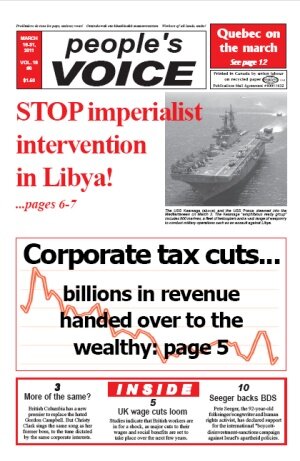
March 16-31, 2011
Volume 19 - Number 6
$1
Prolétaires de tous les pays, unissez-vous!
Otatoskewak ota kitaskinahk mamawestotan!
Workers of all lands, unite
1) CORPORATE TAX CUTS COULD BE MAJOR ELECTION ISSUE
2) MAJOR STRUGGLES BUILDING UP IN QUEBEC
3) SAME CLUB LED BY A DIFFERENT SMILE AND A DIFFERENT GENDER
4) YES, IT CAN HAPPEN HERE - Editorial
5) U.S. TROOPS COMING SOON? - Editorial
6) WHY HUMAN RIGHTS, SAFE SCHOOLS AND PINK SHIRT DAY MATTER
7) UFCW CALLS FOR JASON KENNEY RESIGNATION
8) RICH SCHOOLS GET RICHER IN ONTARIO
9) PREVENT AN IMPERIALIST MILITARY "SOLUTION" IN LIBYA, SAYS CPC
10) NO TO US-NATO MILITARY INTERVENTION IN LIBYA!
11) THE ROOTS OF THE REVOLUTION IN EGYPT
12) EGYPT AND IRAN: GIANTS OF THE MIDDLE EAST
13) THE WEST'S HYPOCRISY ON THE BOMB IN KOREA
14) NO FOREIGN INTERVENTION UNDER ANY PRETEXT!
15) JEANNE CORBIN: WORKING CLASS ORGANIZER
16) WHAT’S LEFT
16) CLARTÉ (en français)
17) THE SPARK! (Theoretical and Discussion Bulletin of the Communist Party of Canada)
18) INTRODUCING MARX
19) PV MOBILE
PEOPLE'S VOICE MARCH 16-31, 2011 (pdf)
|
|
|
|
The Spark!The Spark! The latest issue of The Spark! theoretical journal, is now on sale for $5 at Communist Party offices (see p. 8) or People’s Co-op Books, 1391 Commercial Drive, Vancouver. Articles include
plus reviews, editorials, and more.
|
|
|
Theoretical and Discussion Bulletin of the Communist Party of Canada |
|
|
People's Voice deadlines: April 1-15 April 16-30 Send submissions to PV Editorial Office,
|
|
REDS ON THE WEB |
|
People's Voice finds many "Global Class Struggle" reports at the "Labour Start" website, http://www.labourstart.org/. We urge our readers to check it out! |
* * * * *
People's Voice
Canadian Publications Mail Sales Product Agreement #205214
ISSN number 1198-8657
People's Voice is published by
New Labour Press Ltd
PV Editorial Office
706 Clark Drive,
VANCOUVER, B.C. V5L 3J1
Phone:604-255-2041
Fax:604-254-9803
email: pvoice@telus.net
Editor: Kimball Cariou : Business Manager: Sam Hammond
Editorial Board: Kimball Cariou, Miguel Figueroa,
Doug Meggison, Naomi Rankin, Liz Rowley, Jim Sacouman
* * * * * *
Letters
People's Voice welcomes your letters
on any subject covered in our pages.
We reserve the right to edit for length and clarity,
and to refuse to print letters which may be libellous
or which contain unnecessary personal attacks.
Send your views to:
"Letters to the Editor",
706 Clark Dr., Vancouver, BC V5L 3J1,
or pvoice@telus.net
People's Voice articles may be reprinted without permission,
provided the source is credited.
* * * * * *
The Communist Party of Canada, formed in 1921,
has a proud history of fighting for jobs, equality, peace,
Canadian independence, and socialism.
The CPC does much more than run candidates in elections.
We think the fight against big business and its parties
is a year-round job,
so our members are active across the country,
to build our party and to help strengthen people's movements
on a wide range of issues.
All our policies and leadership
are set democratically by our members.
To find out more about Canada's party of Socialism,
give us a call at the nearest CPC office.
* * * * * *
Central Committee CPC
290A Danforth Ave Toronto, Ont. M4K 1N6
Ph: (416) 469-2446
fax: (416) 469-4063 E-mailmailto:info@cpc-pcp.ca
Parti Communiste du Quebec (section du
Parti communiste du Canada)
5359 Ave du Parc, Montréal, Québec,
H2V 4G9
B.C.Committee CPC
706 Clark Drive, Vancouver, V5L 3J1
Tel: (604) 254-9836
Fax: (604) 254-9803
Edmonton CPC
Box 68112, 70 Bonnie Doon P.O.
Edmonton, AB, T6C 4N6
Tel: (780) 465-7893
Fax: (780)463-0209
Calgary CPC
Unit #1 - 19 Radcliffe Close SE
Calgary AB, T2A 6B2
Tel: (403) 248-6489
Ottawa CPC
Tel: (613) 232-7108
Manitoba Committee
387 Selkirk Ave., Winnipeg, R2W 2M3
Tel/fax: (204) 586-7824
Ontario Ctee. CPC
290A Danforth Ave., Toronto, M4K 1N6
Tel: (416) 469-2446
Hamilton Ctee. CPC
265 Melvin Ave., Apt. 815
Hamilton, ON.
Tel: (905) 548-9586
Atlantic Region CPC
Box 70 Grand Pré, NS, B0P 1M0
Tel/fax: (902) 542-7981
http://www.communist-party.ca/
* * * * * *
News for People, Not for Profits!
Every issue of People's Voice
gives you the latest
on the fightback from coast to coast.
Whether it's the struggle for jobs or peace, resistance to social cuts,
solidarity with Cuba, or workers' struggles around the world,
we've got the news the corporate media won't print.
And we do more than that
- we report and analyze events
from a revolutionary perspective,
helping to build the movements for justice and equality,
and eventually for a socialist Canada.
Read the paper that fights for working people
- on every page, in every issue!
People's Voice
$30 for 1 year
$50 for 2 years
Low-income special rate: $15 for 1-year
Outside Canada $50 for 1 year
Send to: People's Voice, 706 Clark Drive, Vancouver, BC, V5L 3J1
You can call the editorial office at 604-255-2041
REDS ON THE WEB
http://www.communist-party.ca/
http://www.ycl-ljc.ca/
http://www.solidnet.org/
(The following articles are from the March 16-31, 2011, issue of People's Voice, Canada's leading communist newspaper. Articles can be reprinted free if the source is credited. Subscription rates in Canada: $30/year, or $15 low income rate; for U.S. readers - $45 US per year; other overseas readers - $45 US or $50 CDN per year. Send to People's Voice, c/o PV Business Manager, 706 Clark Drive, Vancouver, BC, V5L 3J1.)
1) CORPORATE TAX CUTS COULD BE MAJOR ELECTION ISSUE
By Kimball Cariou
The Harper government is being less than accurate about the cost of its corporate tax cuts, judging by a report from Parliamentary Budget Officer Kevin Page.
The PBO released a report on Feb. 27 in response to a request from the House of Commons finance committee, seeking cost estimates related to corporate tax cuts, crime bills and the government's planned purchase of F‑35 fighter jets.
Globe and Mail reporter Bill Curry wrote that "On all three issues, the PBO reports that Ottawa would only provide a small amount of the data requested to assess the veracity of the government's own estimates."
That left the PBO unable to price the justice bills, but Page's office will provide its own estimate on the cost of the fighter jets in the next few weeks.
Using recent information on corporate profits, the PBO reports that Finance Canada appears to be taking an "overly optimistic" view of future corporate profits and tax revenue.
"Finance Canada's estimate of the costs of the planned corporate tax rate reductions appears to be understated," according to the report. According to Finance Canada, the Tory move to reduce the corporate tax rate from 18% in 2010 to 15% in 2012 is estimated to cost $10 billion from 2011‑12 to 2013‑14. But the PBO estimates the cost would be $11.5 billion over those three fiscal years.
The PBO says it cannot explain the $1.5 billion difference between the estimates. The office has asked Finance to provide more detail regarding its figures.
Meanwhile, after years of waffling on the issue, opposition leaders have finally begun to speak out against the ongoing corporate tax cuts. The issue could become a hot campaign topic if Finance Minister Jim Flaherty's 2011-12 budget is defeated. Recent speculation is that the budget will be introduced on March 22. If the Liberals, Bloc Quebecois and NDP vote against the budget, a federal election would be triggered as early as May 2.
Speaking to a business luncheon in Halifax in late February, Flaherty tried to deflect criticism, condemning the former Liberal government of Jean Chretien for slashing fiscal transfers to the provinces back in the mid-1990s. The cuts in Liberal finance minister Paul Martin's budgets downloaded billions of dollars in health and social program spending onto the provinces and municipalities, tearing huge holes in the social safety net. But at the time, those cuts were dismissed as insufficient by the Conservatives and other right forces.
For their part, the Liberals now argue that the corporate tax cuts, the $16 billion F-35 fighter jet purchase, and huge spending on "maga-prisons" will make it difficult to maintain federal health transfers to the provinces. The federal government is committed to increasing health transfers by 6% annually through to 2013‑14, but there are no guarantees after that date.
By raising these issues, the Liberals appear to be trying to marginalize the NDP in the impending election. NDP leader Jack Layton has done little over the past few years to focus on these topics, apparently trying to appeal to the business sector and the centre-right of the political spectrum. Instead of demanding lower military spending, Layton has often joined the call for "better equipment" for the armed forces, and his party has been reluctant to challenge the "law and order" wedge politics of the Harper Tories.
The Communist Party of Canada is gearing up to nominate about twenty candidates across the country if an election takes place this spring. The Party's platform will include reversing the corporate tax cuts which began under the federal Liberals, slashing the military budget, and cancelling plans for a major expansion of prisons.
Corporate profits are nearing the pre-crisis levels of about $250 billion annually. Restoring the 29% tax rate on corporate profits - the level of just a decade ago - would bring more than $100 billion into federal coffers over a four-year period. Cutting the military budget by 75% would provide at least another $40 billion over this time, and halting the "law and order" projects would save billions more.
The Communist Party's plan would provide the federal government with at least $140 billion to invest in social housing, child care, job creation, environmental initiatives, and other urgent priorities, without adding any new taxes for working people.
2) MAJOR STRUGGLES BUILDING UP IN QUEBEC
PV Montréal Bureau
Over 30,000 trade union members, students, women's organizations, environmentalists and other social groups are expected to march on Premier Charest's Montréal offices on March 12, in a vocal show of protest against the Liberal budget to be presented by Finance Minister Raymond Bachand.
The mobilization is organized by two major groups, l'Alliance sociale and la Coalition opposée a la tarification et a la privatisation des services publics (The Social Alliance and the Coalition opposed to pricing and privatization of public services).
They are rallying under the slogan "Québec's budget, an question of choice!", highlighting that the budget is being rammed through the National Assembly without consultation or discussion. Bachand's austerity budget, they say, is not a necessity but an ideological decision, prioritizing profits before people.
"We oppose all forms of regressive taxation, which burden the less fortunate and those whose health is most fragile" a statement by the two groups said. "The proposed health fee of $200 (per person, per year) in addition to being discriminatory against women, is deeply unfair, because it requires the same effort to all households, regardless of their income."
The organizations also reject the severe increase of tuition fees, and the wide scope of privatization and cuts.
"It is time that the government favours socially positive choices that reflect a better redistribution of wealth. It must invest in services to the population and make every effort to ensure that jobs are quality," concluded the representatives of the Coalition and the Social Alliance.
At a meeting of the Parti Communiste du Québec (PCQ) the weekend before the rally, Robert Luxley, editor of the newspaper Clarté, explained that a mass mobilization of as many people as possible for the demonstration was a priority of all progressives.
Luxley stressed that it was essential the mobilizations continue after March 12. No official plans have yet been announced, but the spirit is optimistic.
The coalescing of these two groups can be seen as the uniting of tendencies within the labour and people's fightback in Québec. The l'Alliance sociale formed in the wake of the dissolution of the Front Commun, a bargaining coalition of all the major trade union centrals in Québec which came together last year, but folded to concessions offered by the government.
The major weapon of the labour movement - strike action and a general social or political strike - was not off the table, Luxley said. However, the dissolution of the Front Commun was a major step back for working‑class struggle and weakened the fightback.
The other group calling the demonstration, la Coalition opposée a la tarification et a la privatisation des services publics, is smaller but more militant. It is composed largely of individual unions or locals and the left‑wing of the student movement.
Noting that the left party Québec solidaire is the only political party that is an observer to the coalition process, and a supporter of the mass united people's action, the PCQ also announced that it was forming an organized collective within Québec solidaire under the name of the Communist Party of Canada.
Québec solidaire (QS) has one elected member in the National Assembly, Amir Khadir. It was formed five years ago when the Union des forces progressiste (UFP) merged with a major feminist group in Québec. A founding member of the UFP, the PCQ has advocated for a federated workers' party since 1965.
In addition to providing an independent voice within Québec solidaire, the creation of a communist collective will be an important step for the participation of left forces within the broad "umbrella" left party in two other ways, the PCQ meeting concluded.
First, the Communists will be advocating a position within Québec solidaire in support of the right of self‑determination and sovereignty up to and including separation for Québec. However, in a letter to the QS leadership applying for the status of a collective, the Communists state that they oppose a strategy of independence at the current time.
Instead, they will be arguing for the unity of the Québec working class with the Canadian working class in its struggle against finance capital. Such unity of the people should ultimately be expressed in a radically new republican constitution for Canada, guaranteeing national rights not just for Québec but also Aboriginal peoples.
Therefore, the meeting noted, if Québec solidaire accepts this application, it will effectively be sending a positive message that the non‑nationalist left are still welcome "under the tent" of Québec solidaire. This includes a large number of progressive immigrants in Montréal.
The forming of a collective is also important as the PCQ is engaging militants and activists from across the left spectrum in a major debate within QS about the content of its platform and programme.
At an upcoming QS convention, the party will debate the question of whether to call for nationalization of the economy, including energy and banking. The PCQ is advocating that Québec solidaire take on the character of an anti‑imperialist, anti-monopoly, and pro‑democratic party with stronger links to labour.
The PCQ is participating in a major round‑table of pro-socialist and anti‑capitalist groups within QS, and is circulating its own statement which will be reprinted, in English, in the upcoming edition of the theoretical journal The Spark!
3) SAME CLUB LED BY A DIFFERENT SMILE AND A DIFFERENT GENDER
The new leader of the BC Liberal Party, Christy Clark, may be the only person who believes that Gordon Campbell left the province in better shape at the time of his departure than at his debut. Sam Hammond, BC provincial leader of the Communist Party, points out that, "This is more than naiveté. It is a declaration of more of the same old, same old."
"Christy Clark claims to put `Family First' but her vision of family values nicely skips over unemployment, homelessness, child poverty, education cuts and the impacts of privatization," points out Hammond. "Her vision of family does not include the working people".
Despite having portrayed herself during the leadership campaign as an outsider, Clark played a leading role in the first draconian term of the Gordon Campbell Liberals. Her term as Education Minister was marked with unprecedented conflict and chaos.
"Christy Clark made attacking the BC Teachers Federation one of her main priorities," Hammond points out. "The imposition of collective agreements on teachers is the most glaring example of her hostility."
Clark also made legislative changes, and changed the school funding formula, with the result of increased class sizes and decreased supports for all students, but particularly those with special needs. She not only froze education funding, but also announced the government would not pay for teacher salary increases agreed to by the previous NDP government. School Boards were forced to cover the increases, resulting in unprecedented cuts, amounting to $25.5 million in Vancouver alone. Even future Liberal Cabinet Minister, Mary Polak, then a Surrey School Board trustee, expressed anger at Clark's actions. She was famous for a flurry of policy announcements that School Boards were expected to implement with little or no notice.
Clark's short term at Ministry of Children and Families, was similarly marked by chaos. Nor should it be forgotten that Christy Clark was Deputy Premier for the scandal‑ridden sale of BC Rail.
"Clark championed the giveaway of the publicly owned BC Rail to private ownership", Hammond stated, despite having helped write the Liberal election platform that promised not to sell BC Rail." The new premier Clark has repeatedly rejected calls for a public inquiry into the BC Rail scandal.
"She is not an outsider," says Hammond. "She actively participated at the Cabinet table in some of the worst attacks on working families in the history of BC, from tearing up labour agreements and reducing welfare, to presiding over one of the greatest transfers of wealth from the public coffers to private hands. It is clear from her record that the family that really comes first for Christy Clark is the `Coalition of Corporate Interest'. The Liberal Party in British Columbia has not changed leadership. It is the same club led by a different smile and a different gender."
Clark has moved the HST referendum up to June 24th. "It is imperative for labour and its allies ‑ for all progressive voters in BC - to give the first signal of resistance to the new Premier", Hammond states. "Defeat the HST!"
People's Voice Editorial
Last year, when the ruling class "solution" to the economic crisis was met with anger in the streets of European cities, working people here looked on with admiration, and perhaps also a bit of confusion. Some swallowed them corporate lie that the "austerity" being rammed through in Europe was somehow the fault of workers for "living beyond their means". The old racist view that the "advanced" English‑speaking capitalist countries are superior to those in the Mediterranean region was dusted off to sow divisions.
Now the widespread attack on union rights across the United States and in Ontario brings the impact of the capitalist crisis into our own workplaces and homes. The attack in Ireland ‑ where neoliberal politicians seek to raise the retirement age to 75! ‑ is connected with U.S. Steel's theft of the pensions of Hamilton steelworkers and retirees. Everywhere, the capitalist profit agenda includes a drive to reduce the cost of labour by forcing more workers to stay on the job as long as possible.
Similarly, transit workers in Ontario and public sector workers in Wisconsin are being hammered by a global capitalist agenda, not just rotten politicians. Today, nothing is safe, from
wage rates to pensions to social programs. Nothing can be gained by trying to dodge the capitalist attack, or hoping that the corporations will spare one or another group of workers.
The only answer is to follow the lead of the so‑called "backward" countries, from India to Greece to Ireland, where workers have mounted struggles involving millions of people. Resistance is not a guarantee of victory, but failure to fight back is certainly a guarantee of defeat. This spring, the labour movement in Quebec is back in the streets, mobilizing to block the Charest government's anti‑working class budget. When delegates gather for the CLC Convention in Vancouver on May 9, the leadership should be compelled to learn from these examples and begin building the broadest possible militant fightback.
People's Voice Editorial
Once again, the Harper government has signed a backroom deal giving the U.S. empire further new power to intervene in Canadian affairs. Signed on Feb. 14 in Texas, the agreement paves the way for the military forces of either Canada or the U.S. to send troops across each other's borders during an "emergency." The agreement was not announced by the federal government, despite (or perhaps because of) its grave new implications for Canadian sovereignty. The U.S. military's Northern Command has publicized the agreement, signed by its top officer, Gen. Gene Renuart, and Canadian Lt.‑Gen. Marc Dumais, head of Canada Command.
There is certainly wide potential for this agreement to militarize civilian responses to emergency incidents, and work is underway on a joint plan to protect common infrastructure such as roadways and oil pipelines. As the Council of Canadians pointedly asks, "Are we going to see (U.S.) troops on our soil for minor potential threats to a pipeline or a road?"
There are other questions about this treasonous deal, which is certainly not an agreement between equals. Since the U.S. military does not allow its troops to operate under foreign command, Yankee forces on Canadian soil would be beyond the control of Canadian governments, despite bland assurances that "civilian authorities" would be in charge of supposedly "benign cooperation."
For several years, the trend towards closer integration of the Canadian Armed Forces into the U.S. military has been gathering momentum. There is only one tragic destination to this sellout of Canadian sovereignty: the elimination of any ability to control our own destiny in the northern half of the continent. Perhaps Mr. Harper's aim is to be governor of the 51st U.S. state, but the peoples of Canada must reject such a scenario with all our power.
6) WHY HUMAN RIGHTS, SAFE SCHOOLS AND PINK SHIRT DAY MATTER
By Jane Bouey, Vancouver
February 23 is Pink Shirt Day in B.C., an opportunity to redouble our efforts in combating all forms of bullying and discrimination, and their root causes - especially in our schools.
Pink Shirt Day should also bring special attention to Bill C‑389. This federal bill would add gender identity and gender
expression to the list of prohibited grounds of discrimination in the Canadian Human Rights Act, and also add gender identity and gender expression to the Criminal Code sections dealing with hate speech and sentencing for crimes where hate was a motivating factor.
Closer to home, during the Feb. 21 meeting of the Vancouver Board of Education, my motion of support for Bill C‑389 was passed unanimously. The motion also states the board will express this support to senators, who are now considering C‑389, which has passed third reading in the House of Commons.
Why is this bill school board business?
Harassment over gender expression can be for something as simple as wearing pink. The widely celebrated Pink Shirt Day started when Nova Scotia Grade 12 students David Shepherd and Travis Price heard that a Grade 9 student had been threatened and called a homosexual for wearing pink on the first day of school.
Shepherd and Price bought 50 pink shirts and e‑mailed friends to get them on board. The next day, hundreds of students showed
up wearing pink clothing. It then became a provincial phenomena, Canada‑wide campaign, and is now an internationally recognized day.
Egale's recent national climate survey determined that 95 percent of transgender students feel unsafe at school, that nine out of 10 trans students are verbally harassed because of their expression of gender, and that two out of five are physically harassed due to their expression of gender.
Harassment due to expression of gender isn't just experienced by trans, lesbian, gay, or bisexual students. The majority of those harassed for dressing or acting in ways that defy gender stereotypes are kids that don't even identify as LGBTQ.
Harassment drives LGBTQ youth out of school. Research in the U.S. shows LGBTQ students drop out at three times the national average. A large number of Canadian and international studies point to the fact that such youth make up a disproportionate number of the students on the streets.
In February 2004, the COPE school board passed groundbreaking policy that included the following: "the Board is committed to establishing and maintaining a positive learning environment for all students and employees including those who identify as lesbian, gay, bisexual, transgendered, transsexual, two‑spirit, or who are questioning their sexual orientation or gender identity. These students and employees, as all students and employees, have the right to learn and work in an environment free of discrimination and harassment... Specifically, the Board will not tolerate hate crimes, harassment or discrimination, and will vigorously enforce policy and regulations dealing with such matters."
The Vancouver school board is one of very few across the country that lists gender identity as an area of protection for students and staff. But once trans students leave our schools they are guaranteed no protection under the Canadian Human Rights Act or the Criminal Code. The VSB is working hard to make our schools more welcoming, safer, and inclusive places for all students to learn.
As our motion says, we urge the Senate "to consider how Bill C‑389 will make Canada a more welcoming, safer, and inclusive place for all citizens, but particularly for transgendered youth who may constitute a small minority of the Canadian population but disproportionately drop out of school because of harassment and may then face poverty, discrimination, harassment and hate‑motivated violence."
Bill C‑389 and the human rights it addresses are clearly issues that fall squarely on the shoulders of school districts across the country. The lives of our youth are literally at stake. I hope we can ensure that the Canadian Senate understands this and passes Bill C‑389.
(Bouey is a Coalition of Progressive Electors school trustee in Vancouver. This article first appeared in the Georgia Straight online edition.)
7) UFCW CALLS FOR JASON KENNEY RESIGNATION
Wayne Hanley, the national president of UFCW Canada, has called for the resignation of Jason Kenney, the Minister of Immigration and Citizenship for allowing his parliamentary office to be used in a partisan attempt to fundraise for a pre‑election advertising campaign.
The call comes in the wake of a misdirected letter on Kenney's constituency letterhead that was sent to Harper MPs, asking them to quickly raise $200,000 to pay for an advertising blitz aimed at Chinese, South Asian, Ukrainian and Jewish voters in ten ridings across Canada: four of them in Greater Toronto; four on B.C.'s Lower Mainland; and one each in Manitoba and Quebec.
The letter also outlined the Conservative strategy for a spring election, referring to a $378,000 "pre‑writ" ethnic media campaign to begin March 15.
"Minister Kenney should resign without delay. He and the Prime Minister have proven once again all they care about is politics, and not the rules of Parliament which forbid the use the use of parliamentary resources for partisan purposes," says Hanley. "The Harper government claims it doesn't want an election, but in the meantime the office of his immigration minister has become a campaign headquarters, cranking out fundraising letters."
Kenney apologized for the incident but refused to resign. He categorized it as an unfortunate mishap that he would have prevented, except he was overseas when the letters were sent. Instead, his director of multicultural affairs, Kasra Nejatian took the blame and tendered his resignation.
"A minister is responsible for what happens on his watch. Nejatian's resignation is just a scapegoat for Kenney's untenable stance to take advantage of his parliamentary office for selfish political gains. If there is any degree of transparency or ethics left in the Prime Minister's Office, then Mr. Harper must demand Mr. Kenney's resignation, not that of a civil servant," says the UFCW Canada national president.
"You cannot use your position as a minister or as an MP to solicit funds for a purely partisan initiative," says Naveen Mehta, UFCW Canada Director of Human Rights. "In all likelihood, and based on the past responses of this Tory Government, little if anything will be done and Kenney will walk away from this scandal with his job intact. Unfortunately, this is the unethical and morally bankrupt type of government that the Tories are trying to sell to immigrant communities."
8) RICH SCHOOLS GET RICHER IN ONTARIO
Special to PV
The Toronto Star reported on Feb. 28 that "two public and two Catholic high schools in Greater Toronto are bringing in more than a million dollars a year through student fees, private revenue and fundraising, with dozens more each taking in at least half a million dollars."
Other similar‑sized schools report a fraction of these totals, raising questions about equity in the public education system.
In Toronto alone, the top 20 money‑generating public schools, primarily in wealthy neighbourhoods, collected $4.4 million compared to just $103,000 for the bottom 20 schools, most in needy areas.
The figures obtained by the Star provide a school‑by‑school look at how $240 million in private money flows into the public system across the GTA region. "School‑generated funds" include student activity and athletic fees, cafeteria and vending machine profits, and money collected for field trips, book orders and charity fundraisers.
The four high schools in the million‑dollar club include Turner Fenton in Brampton ($1.4 million), Mayfield in Caledon ($1.3 million), St. Aloysius Gonzaga in Mississauga ($1 million), and Michael Power/St. Joseph in Toronto ($1.3 million). These schools charge exam fees as high as $1,200/student for the International Baccalaureate program, and student activity fees topping $100.
School‑generated funds help cover the shortfall between provincial funding and the real cost of educating students.
For schools that can raise a lot of money, "it ends up becoming a private school in the public system," said Annie Kidder of research and advocacy group People for Education. "It's hard to resist as a parent, but it really undermines the overall ideal of public education."
The aggregate dollar amount is "significant," said Education Minister Leona Dombrowsky, who pleaded ignorance in refusing to comment on whether the province would consider asking rich schools to share with needier schools.
People for Education has been tracking trends in school-generated funds since the province began asking boards to collect the data in 2005.
"We always used to think fundraising for extras was fine," said Kidder, "But what's an extra? I think we even used to think fundraising for playgrounds was okay, but then should kids in low‑income neighbourhoods have crappy playgrounds? The hardest question is where you draw the line."
Three-quarters of Ontario secondary schools charge student activity fees, but families cannot be forced to pay them, says People for Education. While schools often call such fees "mandatory", the practice is not allowed under the Education Act.
9) PREVENT AN IMPERIALIST MILITARY "SOLUTION" IN LIBYA, SAYS CPC
Issued by the Central Executive Committee, Communist Party of Canada, March 8, 2011
The uprising against the Qaddafi‑led regime and the resulting armed conflict in Libya is growing more intense, and the danger of foreign military intervention by the major imperialist powers including Canada looms larger with each passing day. Indeed, NATO commandoes are already reported to be inside the country, training the insurgent forces in Eastern Libya, and a massive naval armada is being assembled offshore preparing for a full‑scale assault.
The turmoil and resulting loss of life in Libya is horrendous and deeply regrettable; however this crisis must be resolved by the Libyan people themselves, not through foreign interference. The Communist Party of Canada is categorically opposed to imperialist intervention in any form, or under any pretext.
Efforts to mediate a peaceful, political settlement to the conflict under the aegis of the African Union have been stymied by the imperialist powers which seek to impose a military solution that would advance their economic and political interests not only in Libya but also throughout North Africa and the Middle East as a whole.
The mainstream corporate media equates the uprising in Libya with the previous uprisings in Tunisia and Egypt, but they are not at all the same. The opposition to the Qaddafi‑led regime is multi‑layered and very heterogeneous. On one hand, they include those justifiably demanding greater democratic rights and freedom of expression, and an immediate end to political suppression and human rights abuses by the current government.
Deteriorating socio‑economic conditions have also fed the fire of revolt. The social advances ushered in by the 1969 revolution which overthrew the monarchic regime significantly improved the living conditions of the Libyan working class. Financed largely through the revenues of the nationalized oil industry, universal access to quality healthcare, education (including post‑secondary studies) and social services were all greatly expanded and improved, and the real incomes of the people soared, helping Libya achieve the highest level of GNP per‑capita income and human development index ranking in all of Africa. However since the early 1990s, there has been a steady rollback in progressive social policies, under the tutelage of the IMF. A number of key industries where privatized, wealth became ever more concentrated in the hands of the well‑connected, unemployment (especially among youth) grew substantially, and social disparities widened along both class and regional lines, aggravating long‑standing tribal relations inside the country.
There can be no doubt that these political and socio‑economic grievances and contradictions laid the objective basis for the resulting protest movement. The unacceptable actions of the Qaddafi‑led regime in violently suppressing the largely peaceful protests further inflamed the situation, widening the social base of the opposition.
On the other hand, the opposition forces are also composed of reactionary and imperialist‑sponsored elements, including pro-monarchist forces which have never forgiven the '69 revolution for dethroning King Idris, and well‑financed pro‑imperialist groupings such as the so‑called "National Front for the Salvation of Libya" which is bankrolled by the U.S. National Endowment for Democracy, a notorious CIA‑conduit which finances counter‑revolutionary forces around the globe (in Cuba, Venezuela, etc.). The NFSL has maintained a para‑military training base for a "liberation army" across the Libya‑Egypt border for years, armed and financed by U.S. imperialism.
These are the reactionary forces which the imperialist powers are actively supporting and promoting - a puppet "government‑in‑waiting" that U.S. imperialism and its allies, including Canada, plan to impose on the Libyan people once they have crushed the Qaddafi regime. In this sense, it is fully accurate to speak of an imperialist conspiracy to impose its own solution through military force - either unilaterally or under the cover of the UN Security Council - with the aim of securing Libya's oil resources, and tilting the political‑economic and strategic balance of forces throughout the region back in its favour.
That is why it is absolutely crucial that the peace movement and all progressive, anti‑imperialist and peace‑loving people across Canada do everything possible to prevent such an imperialist‑led military "solution" to the Libyan crisis, hypocritically disguised as a "humanitarian intervention"; to oppose the threatened imposition of a "no‑fly zone" which would constitute an act of war under international law; to condemn the aggressive role of the Harper Conservative government in this dangerous misadventure; to demand the immediate recall of the HMCS Charlottetown, a heavily‑armed warship it has sent as part of the NATO military build‑up; to oppose that UN‑imposed sanctions on Libya which will inflict further pain on the already suffering masses of Libyan people; to uphold the national sovereignty of Libya; and to promote a peaceful, political solution to this crisis.
10) NO TO US-NATO MILITARY INTERVENTION IN LIBYA!
No to Canadian Military Involvement!
Canadian Peace Congress statement on events in Libya, March 2, 2011
As the crisis in Libya deepens, the Canadian Peace Congress denounces the rapid moves by imperialist forces - including the U.S., E.U., NATO, Canada and Israel - to intervene and exploit the conflict to their advantage. We call on the minority Harper Conservative government to withdraw the offensive Canadian JTF‑2 Special Forces who have been deployed to the region, recall the heavily armed HMCS Charlottetown and refrain from deploying logistical air refuelling and support power, and halt the implementation of offensive CF‑18s to the region. Furthermore, the Canadian government must oppose the United Nations Security Council's imposition of sanctions which will only result in the death and injury of Libyan people, and reject any form of foreign military intervention including the use of no‑fly zones which will involve massive bombardment to neutralize existing Libyan air defences.
While the composition and demands of the movement against the Qaddafi regime are not clear at this point, there is a strong component that is decidedly reactionary in nature. This element, centred in Eastern Libya, includes the so‑called "National Front for the Salvation of Libya" which is funded by the National Endowment for Democracy and is closely tied to anti‑Qaddafi exiles; pro‑monarchist forces which have never forgiven Qaddafi for overthrowing the king in 1969; and the Muslim brotherhood. These forces are pressing for theocratic, feudal and pro‑imperialist objectives, and it is they who have attracted the keen interest and support of large oil corporations and the Western governments.
The recent, successful uprisings in Tunisia and Egypt have placed those countries at the delicate, opening stages of profound change. How these societies develop remains an open question, but two things are already clear: first, the events in Tunisia and Egypt have served as a catalyst for similar popular protests throughout the Middle East and North Africa; second, the emergence of powerful, sovereigntist people's movements poses a dramatic threat to the balance of forces in the region, which has until now favoured the policies of transnational energy corporations, the imperialist states of Europe and North America, and the government of Israel. This threat is the primary motivator behind the desperate attempts to generate pretexts for foreign military interference in Libya.
The current efforts by Western governments to demonize Qaddafi as a murderous madman who has committed crimes against humanity are eerily reminiscent of the similar treatment that Saddam Hussein received prior to the US‑led invasion of Iraq, and should give pause for sober reflection. Reports of Libyan military strikes against unarmed civilians are distressing and such actions, if substantiated, deserve strong condemnation. However, it is dangerously hypocritical to demand that Qaddafi answer for these allegations without demanding that imperialist leaders answer for their role in bombing civilians in Yugoslavia in 1999, or for bulldozing trenches filled with live Iraqi soldiers in 2003, or for massacring thousands of civilians in US‑NATO actions over the past decade, or for knowingly handing Afghan detainees over to torture.
The Canadian Peace Congress is concerned that some voices in the broader peace movement have called for the governments of Canada and other countries to intervene in Libya, citing the doctrine of "Responsibility to Protect" or R2P. While the outrage over reports of civilian deaths is understandable, the R2P doctrine is framed in a manner that ignores the geopolitical realities of the current imperialist world order. From the experiences of NATO's intervention in Yugoslavia, two US‑led invasions of Iraq, the invasion and occupation of Afghanistan, and the coup in Haiti in 2004, it is very clear that foreign interventions under the guise of humanitarianism immediately transform into violent, exploitative campaigns whose aim is to control regions, peoples and resources for the benefit of powerful international entities. By citing the "Responsibility to Protect", the peace movement inadvertently becomes a political fig leaf for imperialist intervention.
The danger of war, including the use of nuclear weapons, is very real and is being fuelled by the military involvement of the US, EU, NATO and Israel. There are reports that hundreds of American, British and French military personnel have already landed in Libya, along with Canadian JTF2 forces, to act as "defence advisors" to sections of the anti‑Qaddafi forces. The United Nations Security Council has imposed sanctions on Libya and there are moves to militarily enforce a no‑fly zone over the eastern part of the country, a military measure that would necessarily be preceded by massive bombardment. Several countries - including Canada - have already contributed heavily armed warships to a naval armada in international waters off Libya.
If there is to be any hope of peace, democracy and progress in Libya, this interference must be opposed and reversed. Libya must not be allowed to become a US‑NATO military base in North Africa, the springboard for imperialist efforts to manipulate and corrupt the popular movements in Tunisia, Egypt and beyond. Ostensibly, imperialist moves to interfere in Libya emerge from their opposition to democratic, sovereigntist and progressive forces in Libya and throughout the entire region. Libya could serve as a dangerous precedent for imperialism to block all popular uprisings in the region and throughout the world.
It is the sole right and task of the people Libya to determine the course of their political and economic development, free from foreign interference. As the World Peace Council stated, "We underline the right of the Libyan people to express their anger and agony and their demands for changes in the social and economic field and their sovereign right to determine the political developments in their own country. The [imperialist governments] which are serving the interests of the multinational corporations and international capital are searching for opportunity to take more and open control of the oil and gas resources of Libya and expand their spheres of influence."
The key responsibility of the peace movement in Canada is to prevent Canadian involvement in aggressive, unjust and illegal military endeavours. In light of this responsibility, the Canadian Peace Congress:
* declares its solidarity with the Libyan people and demands an end to the bloodshed;
* denounces the UN sanctions against the Libyan people;
* calls on the Canadian government to withdraw from its military interference, including cancelling the deployment of the HMCS Charlottetown;
* opposes any foreign military intervention, including efforts to impose a no‑fly zone over Libya.
11) THE ROOTS OF THE REVOLUTION IN EGYPT
Excerpts from the speech given by Salah Adly, member of the political bureau of the Communist Party of Egypt, during a conference of communist and worker's parties held Feb. 25-26 in Cyprus at the invitation of the AKEL, that country's Marxist-Leninist party.
I have come to you from Egypt which is blazing with revolution in every corner. The revolution of January 25, which broke out across the country, is a social revolution launched by the youth, and the Egyptian people of all groups of men and women, the old and the youth, Muslims and Christians. Workers alongside with toilers and the middle and marginalized classes took part in a heroic epic and demonstrations of millions demanding the overthrow of the regime.
The main slogan for the revolution was freedom, social justice, human dignity. Those roaring mass demonstrations carried on throughout the governorates of Egypt in a civilized, peaceful and moral manner that terminated all the regime's plots to crush or oppress them using its powerful security arsenal. The central security forces number around 1.7 million, three times as many as the military forces, with their arms, armoured vehicles, bombs and live bullets coming from the snipers on the roofs of the buildings. But the great Egyptian people managed to triumph and abolish all the conspiracies of the counter‑revolution plotted by the regime, its agents, secret police, the leadership of the ruling party, and the looters of its businessmen.
In addition (the regime) cut off the internet connection and disabled all mobile networks on the eve of the January 28 "Friday of anger", which indicated that it was intent on committing a massacre. But the people abolished that plot too, and defeated that gigantic system. They directed their anger toward the oppressive figures of the regime, as 2000 police vehicles and police stations, in addition to the headquarters of the ruling party and its branches in the governorates, were burned down as symbols and tools of daily oppression, torture, and humiliation of the citizens...
The fascist plot was overturned because of the patriotic attitude of the military, in which they refused to use violence against demonstrators, and because of the vigilance of the revolutionary people who founded social committees in all the neighbourhoods. Those social committees protected the buildings, facilities, and citizens.
After the million-strong demonstration on Tuesday, February 1, the forces of the counter‑revolution tried to organize bribed pro‑dictator‑Mubarak demonstrations on bloody Wednesday, February 2... (They) deployed criminals and thugs in order to dissolve the revolution, and drive the demonstrators away from Tahrir Square, which has become a symbol of revolution and its persistence and continuity, but the revolutionaries stood against those barbarians, defeated them, and liberated the "Square of Liberation".
That bloody day was a critical day to the victory of the revolution in a historical scene, which manifested to the whole world the barbarism and brutality of the ruling regime, which used horses, camels, and bullets in a clear contrast between this savageness... and peaceful demonstrations where not even one stone was thrown, nor witnessed one single accident of religious intolerance, or sexual harassment during the 18 days of sit‑ins and demonstrations until the dictator fell... It has been proven to the masses and governments of the world the erroneousness of the lies that claimed the Egyptian people was unable to practice democracy.
The Egyptian people paid a high price with its resistance and insistence to overthrow the dictator Mubarak. According to the official statistics, the number of martyrs reached 365, besides 5500 injures. Those wrote with their blood-ink pure pages, and achieved a dream for which the Egyptian people had been waiting for decades.
There is no question the Egyptian and Tunisian revolutions have re‑considered the concept of social revolutions which the supporters of capitalism claimed had become outdated. Those masses have proved that revolution is the locomotive of history, as Marx said, and the tool that depicts the capability of the masses for deep‑rooted, peaceful, democratic change, in the face of oppressive regimes that block all the doors for the mechanism of change by traditional democratic means.
The revolution of January 25 did not happen accidentally, nor did it happen by a high‑level decision. It happened as a result of a total revolutionary crisis, whose objective and subjective conditions were available, and which were preceded by thousands of protests, strikes, and sit‑ins, with rippled the political and social life of Egypt in recent years, carried out by workers, students, and the toilers. Those protests represented the alarms for the imminent birth of this great revolution, which nobody could predict its timing, and which stunned everyone with its rich and diverse social participation, and the tremendous abilities of the youth, and the politically high roof of demands and goals from the first day of the revolution...
Also, the Tunisian revolution's success in overthrowing dictator Bin Ali was an important factor to inspire the Egyptian people, as it emphasized the capability of the masses to accomplish the victory and change the fates of their countries.
Some numbers give indications about the growth of the revolutionary crisis, and the deterioration of the standard of living as a result of the policies and practices of the autocratic ruling regime allied with American imperialism, and the steadfast executor of neoliberal economic policies imposed by the institutions of global capitalism.
In Egypt, we have 48 million poor, and 1109 slums (Report of the International Monetary Fund for Agricultural Development). Forty percent of Egyptians are below the poverty line, getting by on less than a dollar per day. Twelve million are homeless, and 500,000 reside in graveyards (Central Agency for Mobilization and Statistics)... Egypt comes first in terms of road accidents, as 8,000 get killed and tens of thousands are injured every year... Egypt comes last among 134 states regarding the rate of the appointment of relatives and cronies in various positions, 115th among 134 states to corruption perceptions index (Global Competitiveness Index), and 115th in the Index of transparency and Fairness (Transparency International). We have a child mortality rate of 50 in 1000 children, and the highest rate of Hepatitis infection (Statement issued by the Egyptian Minister of Health). We have ten million unemployed between the ages of 15 and 29 years, which means 22% of the workforce. Additionally, we have 9 million young men and women who passed 35 years without marriage, with a maidenhood percentage of 17%, and many more numbers.
Add the inheritance of power to Gamal Mubarak, which was being orchestrated, and forging elections relentlessly and systematically until the latest elections, where the NDP completely dominated the parliament (97% of the total seats), and the control of state security officers over all political and economic life, professional syndicates, trade unions, faculty members, and civil society organizations, in addition to the daily practices of oppression and torture inside police stations under the emergency law for 30 years.
All that implied it would be impossible for those circumstances to keep on. The revolution was inevitably imminent, as its objective conditions were present, as Marx said. The people and the youth couldn't keep living the same way as before, their future was darkened, and the regime along with its institutions had become unable to rule using the past ways, on account of their senility, mouldiness, internal conflicts, and its dependence on the oppressive mechanism.
Also the availability of the revolutionary moment played a major role, due to the accumulation of the activity of political forces, and the crystallization of alternative political, economic and national programs. Thus one can confidently say that is a revolution that has its own trait, not just a movement or an uprising.
The Egyptian people, during the revolution days, proved that decades of hard years could not terminate their ethical features, their tolerant habits, and their insistence... The military's attitude has also contributed to the accomplishment of the people's demands, and the overthrow of the regime. Egyptians have also proven through its demonstrations of millions that the revolution is ongoing. The slogans of the revolution chanted and insisted on by the public were inspirational. At the same time, it wasn't possible for any political force to claim they had mobilized the masses. The illusions of chaos, terrorism, and religious tension, promoted and used by the regime to intimidate the people, have been eliminated too.
12) EGYPT AND IRAN: GIANTS OF THE MIDDLE EAST
By Jane Green, Morning Star (UK)
Egypt and Iran have long been sleeping giants of the Middle East. Throughout history they have been major Middle Eastern powers, significant centres of trade, science and religion.
Both fell prey to the imperial interests of Britain ‑ Iran for its oil, Egypt for its natural resources and strategic location. Both hit back.
Egypt declared itself an Arab republic in 1953 and expelled British forces three years later, shortly before president Gamal Nasser nationalised the Suez canal, a vital asset for world shipping.
And, as Egypt was asserting its national independence, so too was Iran. It had not been occupied by British forces, but its corrupt leadership had served as a willing client of the empire. Leader Mohammed Mossadeq set out on a different course in 1953 when he nationalised the oil industry.
Nasser remained in power despite the best efforts of Egypt's former imperial masters. He trod a more independent path until his death, but Anwar Sadat's rise to power in 1970 redirected the country to the West. Hosni Mubarak's 1981 takeover consolidated Egypt's position as a key Western ally in the Arab world.
Oil‑rich Iran was to have a different fate. Its attempts to take charge of its own resources provoked a coup, inspired by the US and Britain, which overthrew Mossadeq's democratically elected government and installed a regime headed by the autocratic shah.
He himself was overthrown by a popular revolution in 1979. But hopes of progressive change were crushed when the uprising was usurped by Islamic fundamentalists. Washington became the great Satan and Iran began a disastrous, destructive war with its neighbour Iraq that had been orchestrated by the West.
For the past 30 years both Iran and Egypt have been dominated by autocratic regimes. And now both have the chance of decisive change.
This bubbled to the surface in Iran in June 2009, when popular opposition to the "re‑election" of President Mahmoud Ahmadinejad sparked protests as widespread as they were unexpected in a country which did not tolerate mass demonstrations. The Green Movement, headed by "defeated" presidential candidates Mehdi Karoubi and Mir Hossein Mousavi, along with his wife Zahra Rahnavard, had provided a focus for decades of frustration among the Iranian people.
And the protesters returned to the streets on February 14, striking a major psychological blow against the government. Despite waves of arrests, executions and attempts by the regime to label them foreign agents, this popular movement has continued.
So too has Tehran's repression. The past two weeks have seen a fresh crackdown by the regime, including mass arrests. Detainees have been transferred to the notorious Kahrizak prison for torture.
Now it appears that Iran's theocratic dictatorship hopes to decapitate the popular movement by targeting the movement's leaders and is calling for their execution. Karoubi and Mousavi's homes have been cut off, surrounded by plain‑clothes security agents posing as "defenders of Islam and the revolution," and a news blackout imposed.
Yet events in Egypt and across the Arab world continue to inspire the Iranian protesters. If mass protests could remove Mubarak after 30 years, the same could be true of the Ahmadinejad regime and the conservative clergy backing it.
The regime is keenly aware of this. However, its own policies have created the conditions for yet more unrest.
Ahmadinejad's recent neoliberal economic "shock therapy," which removed or restructured subsidies, is causing widespread price increases and is resulting in growing hardship and discontent ‑ key factors in Egypt's uprising. And, like Egypt, Iran has a significant working‑class base capable of wielding its industrial power to advance demands for greater economic justice through trades unions.
Much of this organisation remains clandestine due to the nature of these regimes. But it remains disciplined and has the potential to play a decisive role in the direction of current events.
Iran remains content to blame outside forces for its internal crisis, meaning that US Secretary of State Hillary Clinton's recent comments backing demonstrators play directly into the hands of the regime. Undoubtedly her words will be recalled by Tehran's torturers and will be repeated in forced confessions and show trials beamed to the country's TV screens.
The level of outside interference remains key to determining the scale of the changes in Egypt or Iran. Washington is being forced to change tactics by the power of popular movement. Where once it was able to directly back life‑long dictators it now wants to shape the leaderships and organisations which have ousted them.
The West's policy objective is to limit the desire of the masses to force fundamental socioeconomic changes that would threaten its "vital interests." In Egypt this means that protests must not become trade union‑led strikes.
As for Iran, its increasingly organised labour movement is rarely discussed by mainstream politicians and the Western media ‑ a clear indication of the West's real intentions.
People across the Middle East are striving for a national united front against the ruling dictatorships and for true democracy and social justice. Such a decisive shift, driven by the people, in Egypt and Iran would change the map of the region dramatically. Not only would it weaken the base for Islamic fundamentalism, but it would strengthen the case for Palestinian autonomy and help rein in the voices of zionist extremism.
The importance of these people's struggles for the region and world cannot be understated. Neither can the need for sustained, genuine support from progressives in the West to ensure that the goals of democracy and self‑determination are achieved.
(Jane Green is UK national officer of the Committee for Defence of the Iranian People's Rights. For further information, visit www.codir.net.)
13) THE WEST'S HYPOCRISY ON THE BOMB IN KOREA
By Sean Burton
The U.S. government recently announced that it has no intention of reinstalling tactical nuclear weapons in South Korea. Evidently this statement was deemed necessary due to recent comments by right‑wing South Korean politicians, to the effect that the country should be armed with nuclear weapons to counter the supposed threat from North Korea.
A number of national assembly members from South Korea's ruling Grand National Party (GNP), as well as the conservative media, have been arguing in favour of developing nuclear weapons, or at least having the US redeploy its weapons which were removed in the 1990s. GNP representatives apparently also haded out a survey which purports that two-thirds of South Koreans would favour the presence of nuclear weapons.
The right‑wing media has seen a flurry of pro‑nuclear weapon articles in recent weeks. In January, a columnist for the Chosun Ilbo openly called for South Korea to develop the bomb to escape the "hypocrisy trap" of making demands on North Korea without ever following through. The writer suggested that the weapons would not be "offensive or defensive", but would ensure "balance" and negotiation, in the manner of the Cold War arrangements between the USA and USSR. Similar sentiments have been put forward by GNP representatives.
Majority opinion in Seoul seems to be against such a plan, and the South Korean regime certainly considers an absence of nuclear weapons to give them the moral high ground. At the same time, they make it clear that South Korea is already within the USA's nuclear umbrella.
In other words, the immediate presence of nukes is irrelevant, since the U.S. military can attack from wherever it wants. The announcement that the U.S. will not redeploy is doubtless a recognition of the fact they have no need to do so.
Naturally, there is tremendous irony and hypocrisy in this situation. South Korea is taking the usual path of playing the victim when it is among the perpetrators. The South does not need nuclear weapons because the US has plenty nearby, and that has been the case for decades.
Therein lies the very reason for the North's nuclear program. Pyongyang is acting primarily to deter major U.S.‑South Korean military aggression. The South Korean government turns this argument on its head, making it seem as though the South needs a deterrent, in a despicable bid to once again shift blame and drum up more anti‑North sentiment.
It hardly matters if the desire to bring nukes back was genuine, or that Seoul denies any official plan along those lines. Nor does it matter that the US denies such plans. The point is to fuel anti‑North jingoism, by exploiting the hypocritical notion that it's okay for some countries to possess such weapons, but not others. Since South Korea already has the almighty guidance of the U.S. and the "umbrella" of its nukes, these methods are all the more shameless.
14) NO FOREIGN INTERVENTION UNDER ANY PRETEXT!
Statement of the World Peace Council on the situation in Libya and the plans for foreign intervention
The World Peace Council expresses its deepest concern and indignation with the recent and ongoing developments in Libya. While condemning the killing of hundreds of innocent civilian protesters by the heavily armed military of Libya, as well as the suffering of the very many migrant workers forced to leave the country by the political unrest and the aggressive pressure exerted by foreign forces and media, we express our categorical rejection for any foreign military intervention by the USA, NATO or the EU under any pretext.
We underline the right of the Libyan people to express their anger and agony and their demands for changes in the social and economic field and their sovereign right to determine the political developments in their own country and that foreign interference is boosting the risk of the violence escalating into a civil war.
The Imperialists that are serving the interests of the multinational corporations and international capital under the pretext of "humanitarian intervention", are searching for opportunity to take more and open control of the oil and gas resources of Libya and expand their spheres of influence.
We denounce the military presence of warships of various NATO states and the 6th US Fleet in the international waters in front of Libya which proves the preparations for a possible attack and demand their complete withdrawal from the area. Independently from the opinion one may have on the regime in Libya and its commitments and priorities in its foreign policy especially in the last years, it is the sole right and task of the Libyan people to formulate and impose whatever changes it considers necessary, without any foreign military or political imposition.
The WPC expresses its full‑hearted solidarity with the people of Libya and foreign workers there and demands the end of the bloodshed and of the military action. We express our disagreement with the sanctions imposed by the UN Security Council which will harm mainly the Libyan people and reiterate that no foreign military aggression can be accepted by any means!
The Secretariat of WPC March 3, 2011
15) JEANNE CORBIN: WORKING CLASS ORGANIZER
Our series of articles marking the 90th anniversary of the Communist Party of Canada continues with the story of a party militant who became known to many Canadians a few years ago with the publication of Red Travellers: Jeanne Corbin and Her Comrades. This important book by Andrée Lévesque adds to the rich historical study of women who made a profound contribution to the early revolutionary movement, such as Annie Buller, Becky Buhay and Florence Custance, and Canada's first Communist MP, Dorise Nielsen.
Born in 1906 in Cellettes, France, Jeanne Corbin immigrated with her family to Alberta in 1911. There are few biographical details about Corbin's early years, but most of the European immigrants who were lured to "settle" the prairie lands taken from the Indians and Métis faced terrible obstacles in their struggles to overcome poverty.
Seeking to improve her chances in life, Corbin's parents sent her to school in Edmonton at the age of 15. According to Levesque's research, "Beginning in 1922 she had been in contact with certain Communists who were lodging in the same boarding house as she, the Astor House on 103rd Avenue. She became a member of the Young Communist League and, when she turned eighteen, joined the Communist Party. During her last year at Victoria High she was actively involved in organizing the Young Pioneers..." In 1927 and 1928, she took classes at the Party's summer camp in Sylvan Lake, under the direction of Beckie Buhay.
By the time Corbin received her teaching credentials, she was already on an RCMP blacklist. Instead, she became a full-time revolutionary. As Robert Lanning wrote in a 2008 review for People's Voice, before her untimely death, "Corbin had become a model of the working class organizer of the 1920s and 30s: writing, speaking, raising money, demonstrating, teaching, knocking on doors and spending time in jail."
As the Dirty Thirties began, Jeanne Corbin quickly became one of the most committed and talented young activists in the communist movement. Her assignments included raising funds for the party's newspaper, The Worker, and campaigning for the Canadian Labor Defence League, the organization led by Rev. A.E. Smith which defended radicals facing legal charges. Corbin herself was first jailed in 1929, ironically for leading a rally during a Free Speech Conference in Toronto, where police arrested 15 people to enforce a bylaw which prohibited outdoor meetings of Communists.
Corbin toured northern Ontario and western Canada for The Worker, and then began a period in Montreal where she organized the Québecois working class through the Workers' Unity League. Her work took her to mining and lumber towns across northern Ontario and Québec, such as Timmins and Rouyn-Noranda. Fluently bilingual, she founded and edited the party's L'Ouvrier canadien (Canadian Worker) newspaper in Montreal, at the age of 24. Short of funds, and facing repression by the police and the Catholic Church, L'ouvrier canadian did not survive long. But eventually a new paper was published, La vie ouvrier, and the Communists continued to organize among French-speaking workers. As in the rest of Canada, these were years of intense working class struggles to block evictions, organize "hunger marches", and defend arrested comrades.
During the lumber workers' strike of 1933 in Abitibi, Corbin was accused of inciting riot and of illegal assembly, a common charge against WUL organizers during the Depression era. After serving three months in jail, she returned to Timmins to work in the Workers' Co‑operative Store.
As Lanning writes, "Corbin was living what she loved, not because working among the unemployed and exploited was something like a religious vocation, but because her vision was so evidently oriented to a socialist future out of a miserable capitalist present."
Lévesque and other authors have devoted much attention to the role of Communist women during this period. Looking back through the very different prism of later decades, some have argued that issues of women's inequality were downplayed in a party largely composed of male industrial workers. But from another perspective, Corbin and her sister comrades were pioneers in a broader cultural shift which challenged prevailing gender norms and stereotypes.
Tragically, Corbin's life and contributions were cut short by tuberculosis. Unfortunately, she had been reluctant to seek consistent medical care during her years of constant political activity. As Norman Bethune stressed, tuberculosis was largely an "environmental" disease, curable for the wealthy and deadly for the poor. The death rate from TB during this period was more than four times higher in Quebec than Ontario.
To make matters worse, Corbin's doctor in Timmins missed the early warnings of her disease. By 1942, her faltering health was unmistakable, and she was admitted to the Queen Alexandra Sanatorium in London, Ontario. There she kept on top of events through left-wing publications and letters from comrades, and helped organize a patients' association. But the advances in TB treatment came too late, and she succumbed to the disease in May 1944.
A.E. Smith, Tim Buck and Annie Buller spoke at Jeanne Corbin's funeral, and she was buried in Park Lawn cemetery in Toronto, where her grave is simply marked with a small stone numbered "4427". But as Becky Buhay wrote in her obituary, "Thousands will remember Jeanne, a devoted worker and a fighter for the people and for the workers."
Vancouver, BC
South Africa Yesterday, Today, and Tomorrow, Fri., March 11, 7 pm, 706 Clark Dr. South Africa under apartheid, and where it is going. Also report from delegates to 17th World Festival of Youth & Students held last December in South Africa. Sponsored by Young Communist League of BC.
March Against Racism, Sunday, March 20, 2 pm, from Waterfront Skytrain (601 W. Cordova), call 604-715-6990 for info.
Left Film Night/Pasta Dinner for People’s Voice, 6 pm, Sunday, March 27, tickets $12, followed by Left Film Night at 7 pm, 706 Clark Drive. For info, call 604-255-2041.
Migrant Workers: Equal in Rights? Public forum on class action suit against Denny’s Restaurants, Wed., March 23, 6-9 pm, Cracked Ice Lounge, Sheraton Wall Centre, 1088 Burrard St. For info contact Migrante BC, 604-254-5850.
Cuba’s Health Solidarity in Haiti, a first-hand account of Cuba’s health brigades, Dr. Alvarez Consuegra, participant in Henry Reeves Medical Brigade in Haiti, Sat., April 2, 7 pm, Maritime Labour Centre, 1880 Triumph. Call Canadian-Cuban Friendship Association Vancouver, Ray, 604-254-1350.
Winnipeg, MB
Marxism course, classes begin early 2011. Pre-register with the Communist Party, 586-7824 or cpc-mb@mts.net.
Toronto, ON
Cuba’s Health Solidarity in Haiti, a first-hand account of Cuba’s health brigades, Dr. Alvarez Consuegra, participant in Henry Reeves Medical Brigade in Haiti, Friday, March 25, 7:30 pm, Steelworkers Hall, 25 Cecil St. Admission free, sponsored by Canadian-Cuban Friendship Association Toronto, www.ccfatoronto.ca, ph. Liz Hill, 416-654-7105.
Our City, Our Services, Our Future, April 9 Community Day of Action at City Hall to defend good jobs, public services and greener cities. For info on the rally and buses to Toronto, contact Eddie Ste. Marie (CLC), 416-441-3710 x226 or Laurie Hardwick (OFL), 416-571-3087.
Montreal, QC
Palestinians And Jews United, boycott/disinvestment/sanctions picket, every Saturday, 1-3 pm, outside Le marcheur, at Duluth & St. Denis.
****************************************
IWD EVENTS
NORTH VANCOUVER - March 12, 7 pm, Crimson Cabaret at Centennial Theatre, to support North Shore Women’s Centre, tickets from 604-984-6009.