|
|
March 16-31, 2012
Volume 19 – Number 5
$1
Prolétaires de tous les pays, unissez-vous!
Otatoskewak ota kitaskinahk mamawestotan!
Workers of all lands, unite
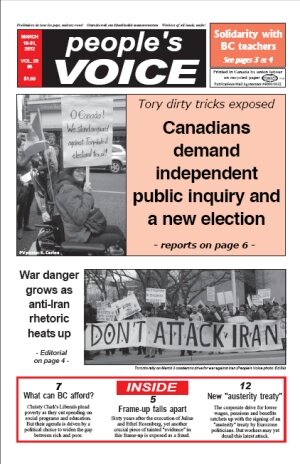
1) COMMUNISTS DEMAND INDEPENDENT INQUIRY AND A NEW FEDERAL ELECTION
2) TEACHERS SHOCKED BY BILL 22
3) AN ASSAULT ON COLLECTIVE BARGAINING, AND AN ATTACK ON YOUTH
4) STUDENT STRIKE SHAKES QUEBEC
5) "B.C. GOVERNMENT IS BY NO MEANS BROKE"
6) ONLY MASS ACTION CAN STOP WAR - Editorial
7) SALUTE TO B.C. TEACHERS - Editorial
8) BUILD THE ANTI-RACISM MOVEMENT
9) IMPORTANT VICTORY FOR LILIANY OBANDO
10) END GAME LOOMS NEARER IN AFGHANISTAN
11) NEW "AUSTERITY TREATY" SIGNED IN BRUSSELS
12) AN APPEAL TO THE MILLIONS OF UNEMPLOYED IN EUROPE
14) YOUR ALTERNATIVE TO THE MEDIA DICTATORS
15) WHAT’S LEFT
16) CLARTÉ (en français)
17) THE SPARK! (Theoretical and Discussion Bulletin of the Communist Party of Canada)
18) INTRODUCING MARX
PEOPLE'S VOICE MARCH 16-31, 2012 (pdf)
|
People's Voice deadlines: April 1-15 April 16-30 Send submissions to PV Editorial Office,
|
|
REDS ON THE WEB |
|
People's Voice finds many "Global Class Struggle" reports at the "Labour Start" website, http://www.labourstart.org/. We urge our readers to check it out! |
* * * * *
People's Voice
Canadian Publications Mail Sales Product Agreement #205214
ISSN number 1198-8657
People's Voice is published by
New Labour Press Ltd
PV Editorial Office
706 Clark Drive,
VANCOUVER, B.C. V5L 3J1
Phone:604-255-2041
Fax:604-254-9803
email: pvoice@telus.net
Editor: Kimball Cariou : Business Manager: Sam Hammond
Editorial Board: Kimball Cariou, Miguel Figueroa,
Doug Meggison, Naomi Rankin, Liz Rowley, Jim Sacouman
* * * * * *
Letters
People's Voice welcomes your letters
on any subject covered in our pages.
We reserve the right to edit for length and clarity,
and to refuse to print letters which may be libellous
or which contain unnecessary personal attacks.
Send your views to:
"Letters to the Editor",
706 Clark Dr., Vancouver, BC V5L 3J1,
or pvoice@telus.net
People's Voice articles may be reprinted without permission,
provided the source is credited.
* * * * * *
The Communist Party of Canada, formed in 1921,
has a proud history of fighting for jobs, equality, peace,
Canadian independence, and socialism.
The CPC does much more than run candidates in elections.
We think the fight against big business and its parties
is a year-round job,
so our members are active across the country,
to build our party and to help strengthen people's movements
on a wide range of issues.
All our policies and leadership
are set democratically by our members.
To find out more about Canada's party of Socialism,
give us a call at the nearest CPC office.
* * * * * *
Central Committee CPC
290A Danforth Ave Toronto, Ont. M4K 1N6
Ph: (416) 469-2446
fax: (416) 469-4063 E-mailmailto:info@cpc-pcp.ca
Parti Communiste du Quebec (section du
Parti communiste du Canada)
5359 Ave du Parc, Montréal, Québec,
H2V 4G9
B.C.Committee CPC
706 Clark Drive, Vancouver, V5L 3J1
Tel: (604) 254-9836
Fax: (604) 254-9803
Edmonton CPC
Box 68112, 70 Bonnie Doon P.O.
Edmonton, AB, T6C 4N6
Tel: (780) 465-7893
Fax: (780)463-0209
Calgary CPC
Unit #1 - 19 Radcliffe Close SE
Calgary AB, T2A 6B2
Tel: (403) 248-6489
Ottawa CPC
Tel: (613) 232-7108
Manitoba Committee
387 Selkirk Ave., Winnipeg, R2W 2M3
Tel/fax: (204) 586-7824
Ontario Ctee. CPC
290A Danforth Ave., Toronto, M4K 1N6
Tel: (416) 469-2446
Hamilton Ctee. CPC
265 Melvin Ave., Apt. 815
Hamilton, ON.
Tel: (905) 548-9586
Atlantic Region CPC
Box 70 Grand Pré, NS, B0P 1M0
Tel/fax: (902) 542-7981
http://www.communist-party.ca/
* * * * * *
News for People, Not for Profits!
Every issue of People's Voice
gives you the latest
on the fightback from coast to coast.
Whether it's the struggle for jobs or peace, resistance to social cuts,
solidarity with Cuba, or workers' struggles around the world,
we've got the news the corporate media won't print.
And we do more than that
- we report and analyze events
from a revolutionary perspective,
helping to build the movements for justice and equality,
and eventually for a socialist Canada.
Read the paper that fights for working people
- on every page, in every issue!
People's Voice
$30 for 1 year
$50 for 2 years
Low-income special rate: $15 for 1-year
Outside Canada $50 for 1 year
Send to: People's Voice, 706 Clark Drive, Vancouver, BC, V5L 3J1
You can call the editorial office at 604-255-2041
REDS ON THE WEB
http://www.communist-party.ca/
http://www.ycl-ljc.ca/
http://www.solidnet.org/
(The following articles are from the March 16-31, 2012, issue of People's Voice, Canada's leading communist newspaper. Articles can be reprinted free if the source is credited. Subscription rates in Canada: $30/year, or $15 low income rate; for U.S. readers - $45 US per year; other overseas readers - $45 US or $50 CDN per year. Send to People's Voice, c/o PV Business Manager, 706 Clark Drive, Vancouver, BC, V5L 3J1.)
1) COMMUNISTS DEMAND INDEPENDENT INQUIRY AND A NEW FEDERAL ELECTION
Statement issued on Feb, 29, 2012 by the Central Executive Committee, Communist Party of Canada.
There is overwhelming evidence that during the 2011 federal election, thousands of voters across Canada were phoned with fraudulent and misleading information. This sabotage of electoral democracy has removed any legitimacy for the Harper Conservatives. The Communist Party of Canada calls for the immediate resignation of the Harper government, a new general election, and an independent public inquiry into all aspects of this scandal. Everyone responsible for this tactic should face criminal charges, right up to the Prime Minister and his inner clique.
PM Stephen Harper's arrogant and corrupt government shows complete contempt for democratic rights and civil liberties. It is about to bring in a viciously anti‑working class federal budget, and may soon plunge Canada into catastrophic imperialist wars against Iran and Syria. This government is a serious threat to the Canadian people and to world peace.
It is no exaggeration to state that the 2011 election was stolen from Canadian voters, a vote fatally tainted by criminal tactics. It is impossible to count exactly how many voters were discouraged by "robo‑calls" from casting a ballot. But reports indicate that this illegal tactic was used in at least 45 ridings. Since many of these constituencies saw very narrow Conservative victories, robo‑calls may have lifted the Harper Tories from a minority into a majority in Parliament.
Canadians should remember the 2000 U.S. presidential election, which was also literally stolen by Republican thuggery, especially the refusal to count thousands of votes in Florida. This fraud led to the war against Iraq which cost countless lives.
"Voter suppression" has since become a key weapon in the arsenal of right‑wing political forces in North America, including the Conservative Party, which has close links with the Republicans. The aim is to discourage as many people as possible from casting a ballot, making it easier for the wealthy and for highly‑committed far‑right groups to exercise political influence far beyond their actual level of public support.
Right‑wing parties like the Tories understand that victory requires mobilizing their own pro‑corporate and far‑right base while demobilizing the majority of the population. They want lower voter turnouts on election day, not higher.
This strategy includes demonizing and threatening critics, a wide range of dirty tricks, refusing to accept legal or court restrictions on government actions, etc. Voter suppression takes other forms, such as the attempt by Conservatives last spring to steal ballot boxes at Guelph University. This "take no prisoners" approach aims to make voters more cynical and suspicious, and less likely to believe that electoral politics has any meaningful place in the struggle to achieve progressive social or economic change.
On a much larger scale, Canada now has voter ID requirements that cannot easily be met by millions of people. Potential voters are required to show proof of identity and street address, such as a driver's license with photo (but not a valid passport, for example). This particularly impacts large numbers of rural residents and Aboriginals on reserves, where most people have a postal box. Many senior citizens no longer have driver's licences, and tens of thousands of post‑secondary students and homeless people lack the necessary ID with street addresses.
While Elections Canada does not keep track of rejected voters, post‑election surveys have found that almost 5% of registered voters do not vote because they lack proper documentation. About 14.8 million ballots were cast in 2011, so the total of "lost voters" could be well over half a million, more than enough to tilt the outcome in most elections.
Genuine electoral reform requires dropping "first‑past‑the‑post", in favour of a mixed‑member proportional representation system which would encourage voters to support the party of their choice. A full enumeration process would help, along with a more realistic set of voter ID rules. The mass media should be required to cover all candidates and political parties, not just a favoured few "mainstream" parties.
These reforms alone would not bring about progressive economic and social change, but they would help to engage Canadians in the full range of struggles to "put people before profits."
Today, the most urgent priority for all Canadians who value democratic freedoms and civil liberties must be to mobilize in huge numbers, to demand a full and independent public inquiry into the robo‑call scandal, and to call for a new federal election. The Communist Party of Canada extends our complete solidarity to this crucial struggle for the future of our country.
2) TEACHERS SHOCKED BY BILL 22
Issued by the BC Teachers' Federation, Feb. 28, 2012
The legislation introduced this afternoon by Education Minister George Abbott constitutes yet another assault on the profession of teaching and the public education system by this provincial government.
BCTF President Susan Lambert characterized Bill 22, the cynically entitled Education Improvement Act, as "a destructive act of legislative vandalism that will violate collective bargaining rights for teachers and have a profoundly negative impact on learning conditions for students."
Under the guise of imposing a six‑month "cooling‑off period," the bill empowers the minister to appoint a mediator who is constrained by the net‑zero mandate and tasked with reaching agreement on a number of concessions tabled by the employer. The bill imposes a two‑year wage freeze, which means every teacher will lose about $2,800 in purchasing power.
"This bill forces us into a mock mediation that has a predetermined outcome, and is designed to make teachers complicit in stripping the remaining protections in our own collective agreement," said Lambert. "It's absolutely Orwellian."
The aspect of the legislation that is most damaging for students prohibits teachers from bargaining class size, average class size, staffing levels, ratios or caseloads for another two years. Thus, there are no effective limits on the number of children who can be assigned to any class over Grade 3 or on the diversity and complexity of needs represented within any class.
"Why should these bargaining rights be postponed until after the next election? This means students will have suffered worsening conditions for a full 12 years," Lambert said. "Teachers sacrificed raises in the past to win protections for class size and composition because we care about our students and want to be able to teach to individual needs. I can only imagine how concerned parents will be when they realize that learning conditions are only going to get worse as a result of this bill."
Bill 22 also includes severe penalties in the event of an illegal strike: $475 per day for individual teachers, $2,500 per day for union officers, and a minimum of $1.3 million per day for the BCTF. "The fines in this bullying legislation are punitive in the extreme," Lambert said. "They are a clear attempt to intimidate teachers."
As the legislature debated Bill 22, teachers across the province continued voting on whether to escalate their limited job action to a full‑scale walkout.
3) AN ASSAULT ON COLLECTIVE BARGAINING, AND AN ATTACK ON YOUTH
Statement of the B.C. Committee, Communist Party of Canada, Feb. 29, 2012
The Communist Party condemns Bill 22 as an assault on collective bargaining, a degradation of the judicial system and a threat to democracy in British Columbia.
In one stroke this failed and doomed Liberal government has violated the right to negotiate, to withdraw labour, and to exercise the franchise of citizenship in a democratic society. They have changed the meaning of the word "mediate" to "enforcement" and degraded the numerous court victories of the BC Teachers with legislation that is in opposition to the Teachers, the Court decisions, their own Labour Board, any sense of human decency and most important of all the quality of life and education of BC children. Twice the Supreme Court has ruled anti‑worker legislation of this government illegal.
The use of BC children, their teachers and the public school system as an anti‑labour bludgeon in the ongoing attack on the entire public sector exposes the underbelly of an anti‑people pro‑corporate government that must be defeated. The resource extractors can plunder and destroy the ecology with government subsidies, but the Teachers Federation will be fined $1.3 million a day if they fight for collective bargaining, the rights of children and democracy. Their officers and stewards can be fined $2500 per day and each individual $475 per day. Collectively this comes to over $5 million per day. This is not merely punitive legislation, it is the financial expression of class hatred.
The Communist Party compliments the BC Federation of Labour, and its affiliates and Labour Councils who stand in solidarity with BC Teachers. The Communist Party supports labour and stands also with the 41,000 teachers and their families who are on the front line in the struggle for collective bargaining, democracy and young people.
We also stand in solidarity with the 12,000 students who have committed themselves to rally in support of the Teachers on March 2 in Vancouver. We are convinced that the majority of BC citizens want justice for teachers and quality education for their children, and that their support will grow as the implications of the draconian Bill 22 becomes more widely known.
4) STUDENT STRIKE SHAKES QUEBEC
PV Montreal Bureau
The students are starting to shake Québec, with province‑wide student strike and rolling mobilizations that have brought have brought thousands into the streets despite blistering cold weather.
Over 123,000 students have now voted to join the strike and the number is increasing almost daily. Since January, student's unions have been holding general assemblies of their membership to take strike votes on a faculty or programme basis. A growing number of colleges (Cégeps) are entirely shut down while university campuses, usually bustling at this time of year, are more like ghost towns.
Instead, the students are hitting the streets with almost daily mobilizations and bi‑weekly demonstrations.
Already last semester, the students had built a brick wall over the door of the Minister of Education's office and staged mobilizations of thirty thousand people in the streets. This year has seen students, labour and community activists occupy the stock exchange, march for several hours through downtown Montreal, eventually shutting‑down the Cartier bridge, and converge on the National Assembly in Québec city overcoming blizzard conditions.
The police response to the demonstrations has been heavy-handed, with helicopters circling in the air, storm trooper‑style riot squads on the ground, and repeated indiscriminate use of tear‑gas. Behind the police barricades the Charest Liberals are not sitting comfortably. But the government is unlikely to give in, with a likely fall election around the corner.
The Charest Liberal government is officially proposing a $325 fee annual increase over five years, for a total increase of 75%. Québec currently has the lowest tuition fees for in‑province students and most accessible post‑secondary education in Canada. Polls show broad support behind the students.
Québec student's also have their own challenges with internal unity, although so far they have successfully been able to maintain a more or less united front, behind the "red square" ‑ a symbol of the student movement in Québec since the 2005 strike of 200,000 students for bursaries.
Unlike English‑speaking Canada, a large number of student unions have no affiliation and are independent. While a relatively loose table of consultation exists between McGill, Laval and several other schools, the strike is being driven by the main student union centrals, particularly the militant and leftist ASSE (Association for Student Union Solidarity).
ASSE has formed a short‑term coalition with several other student unions called the CLASSE (Broad Coalition of ASSE), campaigning for reduced fees and free education. Their English-language site, www.stopthehike.ca, shows what is perhaps key to the Quebec student's approach ‑ united, militant and political, with an escalating and democratically decided strategy.
A large number of students are also represented by two other federations of college and university students. The university federation tends to be much less confrontational and more tied‑in to a strategy of electing the Parti Québécois. The students have reached an agreement on the strike, and to keep internal the debate and criticisms about strategy and tactics.
Anglo campuses have been somewhat slower, but are also mobilizing. Concordia's Women studies programme students are reportedly the first to vote "en gréve." Outside of Québec, the Canadian Federation of Students have expressed solidarity while student unions internationally are also responding to a CLASSE call for statements of support. Québec labour and community groups have come on side, including the left‑wing Québec solidaire party, which is demanding elimination of fees.
"The students are the front‑line of the struggle against the capitalist attack here in Québec," Marianne Breton Fontaine organizer of the LJC‑Q told People`s Voice. "It is vital that this strike grow," she said, adding that labour needs to "more actively embrace the movement and help build a political strike against the government."
5) "B.C. GOVERNMENT IS BY NO MEANS BROKE"
On Feb. 27, teachers held a Day of Action across British Columbia to protest the Liberal government's decision to legislate their contract. Iglika Ivanova of the Canadian Centre for Policy Alternatives B.C. office spoke to the Surrey teachers rally. We reprint excerpts from her remarks.
The spin on this year's B.C. budget is so‑called "prudence" but in reality there is nothing prudent about failing to tackle the global climate crisis, reduce income inequality, adequately fund our schools, invest in community‑based supports for seniors, or reduce B.C.'s embarrassingly high poverty rate. For all the talk of preserving core public services, the budget offers only meager increases to the ministries of health, education and social assistance that don't keep pace with rising cost pressures and population growth. K‑12 education funding, for example, needs to rise by at least 2% to keep up with inflation and maintain the current levels of service; more if the province wants to address the unmet needs in the system. Instead, we're seeing what's essentially a frozen budget, a zero increase, which effectively amounts to funding cuts on the ground.
Practically speaking, it's not real fiscal constraints that stand in our way but a lack of political will. Our debt levels are very reasonable when considered as a share of our economy, and they are among the lowest in the country. We can afford to borrow a bit more at today's record low interest rates to make capital and social investments that will make us all better off in the long run.
Our Finance Minister Kevin Falcon claims we have no choice, but he's wrong. Our BC government is by no means broke, and the net zero mandate for public sector bargaining is a political choice, not a reflection of an economic imperative to cut costs.
The choice our government is making is to ask us to tighten our belts and keep out wages low for the benefit of economic growth during the recovery. Once growth returns, the government has often argued, the benefits would trickle down to everyone and wages will rise as the economy grows. Our Premier made that point quite clearly in her radio appearance on the Bill Good show earlier in February.
But the focus on pursuing jobs and growth without regard to what type of jobs we're getting hasn't paid off for BC families.
The 2008 recession and the current slow recovery are taking place in the context of a 30‑year‑long stagnation in BC family incomes. We don't hear this often, but median earnings for full time, full year workers in BC have actually fallen since the late 1970s, once inflation is taken into account. This means that over half of BC full year full time workers are earning less in real terms than their parents' generation. That's happened during a time when the provincial economy almost doubled in real terms, and real GDP per capita rose by 23%.
But it's clear that the benefits of prosperity have not trickled down to the bottom half of the population. This raises a moral question about fairness and social justice, one that the Occupy movement brought to the forefront of the public debate just last fall.
But it also has a direct impact on the economic well‑being of our province and our country. High inequality can diminish economic growth if it means that we are not fully using the skills and capabilities of all its citizens or if it undermines social cohesion, leading to increased social tensions. We must find a way to share prosperity more fairly.
This all starts with a solid and well‑funded public education system. Accessible, high quality education from the early years all the way to post‑secondary is the only way to ensure economic mobility in a modern society. Providing access to high quality education for all children is the greatest equalizer we have.
And this means treating the hard working women and men who teach our children with the respect they deserve and compensating them fairly.
There is no question that governments everywhere in Canada are facing pressure to balance their budgets. So far, efforts to reduce the deficit have disproportionately focused on cutting public sector jobs, wages and social programs. But we must remember that there are two sides to every budget - the spending side and the income or revenue side. The only proposals coming from the business sector are to cut government spending, but I think it's only fair and reasonable to look at the other side too and consider government income.
Over the past decade, the BC government has reshaped the provincial tax system. As a result, BC now boasts the lowest personal income taxes for individuals earning up to $120,000 per year and one of the lowest corporate income tax rates in the country. The savings have been small for all but the highest-earning families and have largely gone unnoticed as user fees have risen, including MSP which is going up next year for the fourth time since 2009. And a number of public services have been scaled back or suffered from declines in quality due to underfunding.
But these tax cuts have done considerable damage to our collective capacity to care for one another and protect the environment. If we were collecting taxes at the same share of the economy now as we were in 2000, we'd have $2.5 billion more. Every year.
The way the government got people to support tax cuts is by hiding the consequences. Low taxes sounded like a good idea to be people. Good idea until such time that you or somebody you love needs the services that the tax cuts have starved. Until you see how big your child's class is and how many kids with special needs are in it who don't receive the supports they need to learn well.
Until you have to get rushed into the overcrowded emergency room and treated in the hallway. Until you find out how long the waiting list is for your aging mother to be assessed for supportive housing.
This highlights a need for a public debate on a key question: do we really want BC to be a low tax society with low wages and frayed public services? Because this is where the government's current budget is leading us.
At a time when BC families are already stretched by record high debt levels and a weak labour market, the way out of this economic slump lies not in lowering the wages and benefits of teachers and other public sector workers, but in having stronger and more accessible public services, starting with education.
6) ONLY MASS ACTION CAN STOP WAR
People's Voice Editorial
Nine years ago, huge public protests compelled the Chretien government to back away from direct participation in the invasion of Iraq. Today, a new catastrophe is unfolding, but the Harper government appears to relish the prospect of war and devastation, and our mass media refuses to question the line that such a terrible outcome is both inevitable and justified.
Paul Heinbecker, Canada's ambassador to the United Nations from 2000 to 2004, wrote recently, "I had a front‑row seat for the march to war in Iraq. Now the target is Iran, and I have the sinking feeling that I have seen this movie before. The ending isn't happy."
Parallels between then and now are frightening. Most pervasive is the endless rhetoric about weapons of mass destruction. Of course, Iraq did not possess such an arsenal, despite the lies of the Bush administration. According to independent experts, the Iranian regime is years away from building a nuclear bomb, if indeed that is its goal.
Other lies are being spread, such as the deliberate mistranslation of a speech by President Ahmedinejad, to make it seem that he was calling for the military destruction of Israel. Some war advocates support the "responsibility to protect" doctrine, a 21st century version of the Vietnam War argument that "sometimes to save a village, you have to destroy it."
Cooler heads may prevail, since most of the international community is horrified at the vast human, social, economic and environmental cost of a U.S.-led war against Iran.
But hoping for the best is not an anti-war strategy. Unless millions of people in Canada, the U.S. and other NATO countries get mobilized, another illegal war of aggression may be unstoppable. And this time, the consequences for the people of Iran, and for our entire world, may be much worse.
People's Voice Editorial
As this issue goes to press on March 6, 41,000 British Columbia Teachers Federation members are on the picket lines. The outcome remains in the balance, but for the second time in seven years, this courageous union has stood up against the corrupt, pro-corporate gang of Liberal bullies in Victoria. We salute the BCTF and its members for their determined and principled stand in defence of public education and of the rights of all working people.
It is increasingly understood in B.C., Ontario and other provinces that politicians do have choices. Despite the line of the Fraser Institute, the Drummond Commission, and other voices for big business, governments have the option of compelling the rich and the corporations to pay a larger share of taxation. In fact, refusal to consider this option has deliberately starved provincial and federal treasuries of billions of dollars needed to protect and expand vital social programs, schools, pensions and public health care.
Similarly, governments do have the option of agreeing to allow public sector workers the right to withdraw their labour in pursuit of better pay and working conditions.
But governments never recognize such options without a struggle. By striking to demand better pay and working conditions, the teachers are defending the interests of students and families, and of the entire working class. Their stand has the support of a majority of British Columbians, including most students and their parents, who agree that Premier Clark's Liberals must be stopped. So far, the labour movement has responded with strong support for the BCTF. If that solidarity is continued and expanded, the fight to defeat the Liberals at the polls next year will be strengthened. That's why all-out support for the BCTF is crucial!
8) BUILD THE ANTI-RACISM MOVEMENT
From the Public Sector Workers Club of the Communist Party (Ontario)
On March 21 progressive people the world over will observe the International Day for the Elimination of Racial Discrimination. On that day, in 1960, police of the South African Apartheid regime opened fire and killed 69 unarmed children, women and men at a peaceful demonstration in Sharpeville. The demonstration was called against the apartheid state's "pass laws" which provided a racist "legal" basis for vicious discrimination to favour an elite white ruling class.
Proclaiming the Day in 1966, the General Assembly of the United Nations called on the international community to redouble its efforts to eliminate all forms of racial discrimination (resolution 2142).
It is an unfortunate fact that little headway has been made against racism in the world and there is much to be done here in Canada. As we approach this day the struggle against racial discrimination in Canada is far from won. The struggle goes on in the west with skinhead attacks on a young progressive family, and in the east with a cross burning on the lawn of a mixed race couple.
It continues on the unemployment lines with disproportionate representation by visible minorities and in the workplace with unfair wages and opportunities. It is widespread and institutionalized across the country with discrimination against First Nations' land rights and injustice. And it also continues in areas where you would think it should never take hold ‑ in the courts and in our unions.
Racism is a cancerous tool that is perpetuated by ignorance and is deliberately promoted to divide, undermine and disrupt progressive organized groups and political parties. It is a weapon that promotes hatred and is wielded with the purpose of self gain and exploitation. It thrives in justifying and enforcing colonial domination, imperialism, and terrorism.
It has had official sanction in early colonial times, in Nazi Germany and its allies, in the South African apartheid regime, and it is very much alive in the Israeli state policies and in the "settler" communities, and in many extremist religious and imperialist organizations and states. It's the old divide and conquer strategy.
Communists, Marxists and socialists recognize its use by ruling classes and their henchmen as a tool to erode and confuse progressive social and political movements and labour groups. Racism cannot be a tool of the genuine left because it is self defeating for their cause in the long run, but that hasn't prevented well meaning groups from erroneously taking a racist position. In the 1920s the South African Communist Party briefly carried a banner calling for the exclusion of blacks as foremen and blasters in the gold and coal mines when employers sought to replace whites with blacks to undermine white wages. The party ultimately corrected itself, and as is well recognized, was a leading force in the anti‑apartheid struggle.
Social and other scientists no longer use race as a reliable differentiator for analysis, preferring geographic, economic and historic indictors. But what can the ordinary person do? The least we can do is examine our own racism, and fight it wherever it rears its ugly head in our own lives. In our workplace and in social settings it has to be challenged at its first appearance and discussed openly and intelligently, because disruptive forces are not above using the accusation of racism to impede and disable progressive organizations to prevent action. We need to be alert to failures of democracy in our unions and our political organizations. We need to connect with progressive social organizations, including the Communist Party, to build a strong force for democracy and ultimately a just society in which there is no possibility of, and no will to make gains through racism.
9) IMPORTANT VICTORY FOR LILIANY OBANDO
The initial reports are sketchy, but it appears that Colombian political prisoner Liliany Obando has won an important legal victory.
In a Feb. 29 news release, the International Network of Solidarity with Political Prisoners and other solidarity groups announced that the Superior Court Judicial District of Bogota-Criminal Chamber had ordered Liliany's immediate release. The decision may reflect the possibility of a legitimate peace process in the country, which for decades has been racked by a civil war provoked by the Colombian ruling classes.
A powerful advocate of human and labour rights, Liliany Obando has been held in pre‑trial detention since August 8, 2008, a total of three years and seven months of arbitrary imprisonment without trial on charges of "rebellion."
Liliany was arrested while serving as the Human Rights Coordinator for Fensuagro, Colombia's largest organization of peasant farmers and farm workers unions and associations. She had been preparing a report about the more than 1,500 Fensuagro members killed by Colombian military and paramilitary troops over its first 30 years of existence.
The case was stretched for years without resolution. Even when the Colombian Supreme Court ruled that the evidence against her was inadmissible, she continued to be jailed despite international protests. Her release was announced concurrent with the "Colombia Behind Bars" conference in support of 8,000 political prisoners.
However, the court process has not been suspended and Liliany still could be sent back to jail. While the so-called "farc-politica" frame-up against human rights activists has now completely collapsed, the Colombian state may find another pretext to detain Liliany again, or she could become a target of murderous right-wing paramilitaries.
Solidarity groups are therefore demanding that the Colombian state guarantee Liliany's safety and personal integrity, and that of her family.
Moments after receiving the news, Liliany spoke from the Buen Pastor women's prison to a representative of the International Network for the Political Prisoners.
"I have mixed emotions," Liliany said. "I want to leave, but I don't want to leave the other political prisoners behind. We have to keep working until all the political prisoners are free."
10) END GAME LOOMS NEARER IN AFGHANISTAN
PV Vancouver Bureau
For years, Canadians have been told that "the Taliban are on the back foot" and that victory is near in Afghanistan. Most of us never believed it. Opinion surveys have consistently shown that the majority of Canadians want our troops brought home from this unwinnable war.
The latest news from Kabul confirms that the US-led occupation forces have utterly lost the battle for popular support. Contingents of NATO troops are being pulled out ahead of schedule, with the notable exception of Canada.
The spark for this development was lit when U.S. troops on clean-up duty tossed Korans into a burning pit at Bagram Air Base. Afghan workers rescued some singed pages, and before long, massive protests and riots shook the country. A swift round of apologies and promises by U.S. officials has done nothing to change the mood of an increasingly resentful Afghan public.
A decade after taking on the "colonial burden", the U.S. and its allies are paying the political price for an endless string of abuses, torture and killings committed in the name of "freedom". Before long, the remaining occupation troops may be inside their giant fortified bases, chowing down on expensive western-style fast food. As in Iraq, they may be replaced by western "civilians", but the signs of imperialist retreat are everywhere.
About 300 U.S. and other NATO advisors were withdrawn from Afghan ministries around Kabul in late February, as fears mounted for their safety. At the same time, the German military decided to speed up plans to abandon a 50‑soldier outpost in the north of the country.
The French are also eager to get out since four of their troops were killed (and 16 wounded) by an Afghan army soldier, just weeks after three others were shot by another Afghan in uniform. Both the French and the Germans have also withdrawn civilian advisors from Afghan government institutions.
As Tom Engelhardt and Nick Turse wrote in the Tom Dispatch blog on Feb. 28, "Eleven years in, if your forces are still burning Korans in a deeply religious Muslim country, it's way too late and you should go." Instead, General John R. Allen, the war commander in Afghanistan, has directed that all U.S. military personnel undergo ten days of sensitivity training in the proper handling of religious materials.
Sensitivity, as Engelhardt and Turse point out, has not been an American strong suit. They point to revelations about the 12‑soldier "kill team" that murdered Afghan civilians "for sport," and then posed for photos with the corpses. Four U.S. Marines videotaped themselves urinating on the bodies of dead Afghans. A U.S. sniper unit proudly sported a Nazi SS banner in another incident, and a U.S. combat outpost was named "Aryan." British soldiers were filmed abusing children. Eight shepherd boys, aged six to 18, were recently slaughtered in a NATO air strike in Kapisa Province in northern Afghanistan. Afghans have endured years of night raids by special operations forces that break into their homes, violating cultural boundaries and often killing civilians.
These actions have been protested by President Hamid Karzai, who has little power over his own country. And now, more than 30 protesters have been killed in demonstrations against the burning of the Korans.
The New York Times now reports that Afghanistan is "a religious country fed up with foreigners". Laura King of the Los Angeles Times writes about the "visceral distaste for Western behaviour and values" among significant numbers of Afghans.
Engelhardt and Turse provide details of the blowback against the NATO forces. In a heavily guarded room of the Afghan Interior Ministry in Kabul, the bodies of a U.S. lieutenant colonel and major were recently found, each executed with a shot in the back of the head while at work.
Two other U.S. troops died outside a small American base in Nangarhar Province in the midst of a demonstration in which two protestors were also killed. An Afghan soldier gunned the Americans down and then escaped into the crowd.
In fact, Afghans in police and army uniforms have repeatedly attacked their "allies". At least 36 U.S. and NATO troops have been killed this way in the past year, far beyond the level of "isolated incidents." This includes the April 2011 case in which an Afghan air force colonel murdered nine U.S. trainers in a heavily guarded area of Kabul International Airport. His funeral was attended by 1,500 mourners.
The time for "apologies" by the U.S. occupation forces has long passed. Many Afghans are demanding local trials and the death penalty for the Koran burners.
Engelhardt and Turse conclude, "despite its massive firepower and staggering base structure in Afghanistan, actual power is visibly slipping away from the United States. American officials are already talking about not panicking (which indicates that panic is indeed in the air). And in an election year, with the Obama administration's options desperately limited and what goals it had fast disappearing, it can only brace itself and hope to limp through until November 2012.
"The end game in Afghanistan has, it seems, come into view, and after all these fruitless, bloody years, it couldn't be sadder. Saddest of all, so much of the blood spilled has been for purposes, if they ever made any sense, that have long since disappeared into the fog of history."
For Canadians, this terrible tragedy includes 158 deaths among our own troops. When Afghanistan inevitably bids goodbye to NATO, our politicians will be asked: what was it all for? And there is no good answer.
11) NEW "AUSTERITY TREATY" SIGNED IN BRUSSELS
With files from the Morning Star (UK)
The leaders of 25 of the 27 European Union member states signed a new EU treaty in Brussels on March 2 that aims to bolster the power of unelected EU authorities to dictate economic policy across the bloc.
Only the governments of the Czech Republic and Britain decided not to sign the Stability, Co‑ordination and Governance in the Economic and Monetary Union Treaty, which bars member states from running deficits of more than 0.5 per cent of annual output under pain of regressive "structural reforms."
German Chancellor Angela Merkel, a key player in the drafting of the pact, said the member states who signed sent "a strong signal that we are focusing on the future of a politically united Europe."
European Commission president Jose Manuel Barroso added: "From monetary union, we are now progressing towards a true economic union."
But the treaty has to be ratified by the national governments of at least 12 of the 17 eurozone states, at a time when many citizens have become actively hostile to both the EU and the euro.
Two years of regressive austerity foisted on poorer EU states countries by the European Commission and the European Central Bank have served to boost unemployment and erode living standards, triggering an unprecedented outpouring of popular trade union‑led opposition.
In a bid to blackmail citizens and legislators, Brussels has decided that financial aid from the eurozone's new bailout fund, the European Stability Mechanism, will be limited to states that have enacted it.
European Council President Herman Van Rompuy was in bullish mood, telling the heads of EU member states: "You now all have to convince your parliaments and voters that this treaty is an important step to bring the euro durably back into safe waters.
"I am most confident you will succeed," he went on. "You are all gifted politicians, otherwise you would not be here."
But many eurozone politicians fear that the tighter spending rules in the treaty will limit their room to manoeuvre.
Critics warn that, if ratified, governments of eurozone states would be forced to cap public spending, privatise state property, increase indirect taxes, reduce wages, and deregulate the domestic market.
Irish citizens will have a say on whether their government should sign the austerity treaty, Taoiseach Enda Kenny announced on Feb. 28, hours after Attorney‑General Maire Whelan advised him that the Irish constitution requires a referendum. A date has yet to be announced for the vote.
Sinn Fein, which has been part of successful campaigns for No votes against the Nice and Lisbon treaties, argues that the new rules are designed to feather big bankers' sumptuous nests at the expense of the general public.
Speaking in the Dail, party president Gerry Adams predicted that far from helping to regenerate the economy "it will condemn the people here, particularly those people in lower and mid‑income brackets, to this government's terrible policy of austerity."
Mr Adams warned that the treaty would hand "what limited fiscal power remains in this parliament to unelected and undemocratic officials in Brussels.
"It's little wonder that Fianna Fail supports this. Fianna Fail, Labour and Fine Gael formed the consensus for cuts and we are going to see that replay again."
Workers Party of Ireland president Michael Finnegan has welcomed the referendum decision.
"The government" said Finnegan "have been dragged kicking and screaming to this announcement. It is clear that at the highest levels of government in Ireland and the EU there was serious collusion to draft a treaty that could be foisted on the people without a referendum. It is a good day for democracy that those underhand tactics have been rejected by the Attorney General".
Finnegan continued: "This treaty represents the most seismic shift in our relations within the EU since the Single European Act of 1987. It introduces a serious of draconion economic rules, with equally draconian punishments for any breach of those rules. It will tie the hands not only of this government but of all future governments into the foreseeable future as regards economic policy. And it buries once and for all the hope of a Social Europe".
"We reject," said Finnegan "the populist posturing of Fianna Fail in demanding and welcoming a referendum on this treaty. Twice in the last decade they have rejected the decision of the Irish people on both the Nice and Lisbon treaties. Their utterings of this issues have no credibility".
Padraig Mannion, Workers Party spokesperson on the EU added: "Once again the people of Ireland are the only people offered a chance to vote on this vital treaty. As a party we will oppose this treaty and I am confident that the people will reject it decisively. The imposition in the treaty of permanent Thatcherism into the economy; the limitations on social investment; the subservient position of our Oireachtas (Parliament) in our own economic policy; and the prioritisation of the needs of the banking sector are all anathema to the Irish people. The government themselves know that the people are opposed to this treaty and that is why the government were so determined to avoid a referendum. We look forward to the campaign ahead with confidence."
12) AN APPEAL TO THE MILLIONS OF UNEMPLOYED IN EUROPE
Joint Statement of the Communist and Workers' Parties of the countries with highest unemployment in the EU
Workers, Unemployed, the Communist and Workers Parties of the countries of Europe which have been most affected by unemployment Spain, Greece, Lithuania, Latvia and Ireland call on you to struggle and organize.
We address the 24 million "officially" unemployed people in the European Union, particularly the long term unemployed, the unemployed young people and women who are most badly affected. We address all those who are not recorded in the official statistics, but experience the same nightmare of unemployment.
We address the semi‑employed, the agency workers, the workers without social security, those who work in a state of employment by rotation with flexible shifts, with individual contracts, with piece‑work contracts, who experience employer intimidation, who face the danger of dismissal and unemployment.
We address those who are forced into unpaid labour under the pretence of opportunities to return to work; those who are deprived of their entitlements to redundancy payments by employers' pleading "inability to pay"; workers who are on strike and engaged in occupations and sit‑ins to protect their jobs and rights.
We also address the farmers who are being wiped out, the small professional and self‑employed who have been led to closure by the assault of the monopolies, the anti‑people political line of austerity which attacks the working class‑popular families.
All of you, as well as every worker today, better understands that this labour "jungle" is spreading and is becoming a general law which, slowly or quickly, big capital, its governments, and the EU seek to impose in every workplace. There is no time to lose.
In the countries where our parties operate, Spain, Greece, Lithuania, Latvia and Ireland, unemployment has reached very dangerous levels. The bourgeois class in each country and the predatory alliance of the EU as a whole, have declared war on the working class and the poor popular strata. The capitalist economic crisis brings new measures which smash whatever the anti‑people offensive in the previous period had left upright, especially after the Maastricht Treaty.
In this harsh reality, a handful of plutocrats have made fabulous profits. And yet they demand further measures. Their crisis is not a debt crisis, it is a capitalist crisis which came about due to the over‑accumulation of capital.
In order to overcome the crisis in favour of capital, the industrialists, the bankers and the other sections of the plutocracy along with their political representatives impose hard measures in order to further reduce the price of labour power and force more people into unemployment.
In this situation the people's resistance to these harsh measures has been hindered by those elements in the trade union and labour movement who, having long ago accepted the logic and the ideology of capitalism, now plead that there is no alternative but to succumb to the offensive of capital.
The way forward is to win the majority of workers and their families for class based popular struggles on the strategy which promotes their interests. The Communist and Workers parties must be at the heart of this process.
Struggle together with the class‑oriented forces, together with the Communist and Workers parties. Organize in your unions and workplaces. Contribute to the development of activity. In this direction the strength of the working class can be reinforced.
Demand immediate measures for the protection of the unemployed: decent unemployment benefit for all the unemployed. Comprehensive medical pharmaceutical healthcare and social security protection. Freezing of their loans and mortgages.
Unemployment is not a natural phenomenon. It is bred by the capitalist system which is characterized by the anarchy in production, by exploitation.
Only a socialist economy, that is to say a centrally planned economy that will be based on workers' power and the socialized means of production can guarantee the right to work for all. This is what happened in the Soviet Union and the other socialist countries and it is a historical achievement and one of the many accomplishments of the socialist countries.
Our parties call you to struggle every day, to struggle for the abolition of the exploitation of man by man, for a society without unemployment, for socialism which can satisfy the needs of the people.
Signed by: Communist Party of Greece, Workers Party of Ireland
Communist Party of Ireland, Socialist Party of Latvia, Socialist People's Front of Lithuania, Communist Party of the Peoples of Spain
By Rob Gowland, from The Guardian, newspaper of the Communist Party of Australia
They say you can prove anything with statistics, but that is generally said by people who want you to ignore a statistic that does not support their position on a particular issue. Some statistics however can be very instructive and revealing.
Thus, U.S. historians Walter Schiedel and Steven Freisen announced not long ago that the gap between rich and poor today was far greater than the gap between rich and poor in ancient Rome!
In the days of the Roman Republic (the time of Julius Caesar), the richest one percent of the population controlled 16 percent of society's wealth. Today in the U.S., that one percent on top controls 40 percent of the country's wealth.
What is perhaps most amazing about that statistic, is that the capitalists who make up that one percent on top seem to think they're going to stay there. To borrow an expression from somewhere else, I think they're riding for a fall.
The website of the Russian news channel Russia Today ran on online poll to mark the 20th anniversary of the overthrow of socialism in the USSR. It was not a very well designed poll, but the results are interesting anyway. Fifteen percent of respondents ticked the box "Yes we are definitely better off without the `evil empire'".
Twenty three percent however said it was not a good thing because it left the US unchecked. By contrast, a whopping 41 percent said it was not a good thing because Communism offered hope for a better future. And a politically naive 21 percent said it would have been better "if NATO had collapsed with it". (It makes you wonder what they think actually happened.)
Workers in Britain have been engaged for a couple of months now in protest rallies and demonstrations against government and business attacks on their pensions. Wringing their hands and claiming the attacks are "austerity measures", and that they are for "the common good", the Tory/Lib‑Dem government and the big capitalists are out to downgrade pensions and cheat workers out of their entitlements.
In the public sector, workers and employers both contribute to pension funds. (In the private sector, two thirds of workers get no contributions from their employers.) Workers get some security in their old age, while employers get a fresh source of investment capital they can draw on when needed. Supposedly, everybody wins.
But bosses (even in the public sector) resent having to pay anything to the workers' pension funds, and are always on the lookout for ways to get their hands on the money in the fund without having to pay any of it to the actual workers.
One popular way in recent times has been for the company to quietly transfer the workers to an associated company and then to send that company into liquidation.
The giant Unilever concern, the 18th richest company in the world, can hardly go down that road. Instead, it has chosen to downgrade the company pension scheme from a final salary scheme to a career average scheme. They might seem innocuous‑sounding differences, but if implemented they would see some workers losing 40 percent of the value of their pensions.
In a move calculated to embarrass the bosses of Unilever, a protest rally at the beginning of the year outside the company's London headquarters was joined by Lord Leverhulme himself, heir of the original Viscount Leverhulme. The present Lord Leverhulme called on the company not to stray from what he called its corporate social responsibility pledges and to stop taking risks with the company's reputation.
The first Viscount Leverhulme started out as plain William Lever, proprietor of a small soap factory in the old Lancashire manufacturing town of Warrington on the Mersey. He was imbued with the reformers' zeal which, although not widespread was also not uncommon among 19th century manufacturers. It often went along with strong religious convictions, especially in the industrial north of the country, stronghold of the English reformed churches (those who in response to the question "Religion?" would answer "Chapel!").
And of course, Engels, Marx's close friend and collaborator, was a factory owner.
While building up the vast Lever soap business, William Lever engaged in an historic fight to win pensions for workers. (At the protest rally in January, the present Lord Leverhulme warned that the pensions snatch planned by the company and its government backers "shames this legacy".)
His ancestor believed that workers also deserved decent housing, access to schools, all those things the affluent took for granted. At Bromborough Pool, in Cheshire, in 1888 he established a model industrial village, which he named Port Sunlight.
He became a Liberal MP in 1906, and was made a peer in 1917. He died in 1925. While he lived, the company supported the continued growth of Port Sunlight, but the moment he died the company abandoned it.
The cottages Lever provided for his workers hardly compared to the mansion he lived in himself, but the capitalists who sat on the Lever board were unwilling to share even that small fraction of their profits with their workers. Now they want to get their hands on their employees' pension funds.
One of the legacies left by Lever was a workforce that was kindly disposed towards the company, on historical grounds more than anything else. That too has gone: the company had its first strike in the UK only last December. In retaliation, the company cancelled the Christmas celebrations (how petty can you get?) It was of course inevitable that William Lever's hopes for "corporate social responsibility" would founder on the shoals of corporate greed. Engels could have set him straight, but doubtless Lever never asked.
Meanwhile, the present corporate heads of the Unilever company must be scratching their heads - or laughing derisively - over such alien concepts as being "shamed" by pinching their workers' pensions. Profits are profits - the name of the game is to get them any way you can.
14) YOUR ALTERNATIVE TO THE MEDIA DICTATORS
"Any dictator would admire the uniformity and obedience of the U.S. media." ‑ Noam Chomsky
In 1983, 50 corporations controlled the vast majority of all news media in the U.S. Since then, there have been dozens of mergers and the media's scope has expanded to include the Internet market. Today, only five huge corporations ‑ Time Warner, Disney, Murdoch's News Corporation, Bertelsmann of Germany, and Viacom (formerly CBS) ‑ control most of the U.S. media industry. General Electric's NBC is a close sixth.
The above quote from Noam Chomsky also applies to the Canadian mass media, which is dominated by a handful of major corporations.
Apart from some community broadcasters, media in Canada are primarily owned by a small number of companies, including Bell Media (formerly CTVglobemedia), Rogers Communications, Shaw Communications, Astral Media, Quebecor, and (unlike the U.S.) the government‑owned CBC. Each of these companies holds a diverse mix of TV, cable, radio, newspaper, magazine and internet operations.
These corporations are an important part of the overall structure of present-day monopoly capitalism, with interlocking directors and major shareholders, and a common interest in preserving the status quo. Little wonder that they express a consistent bias in favour of ruling class ideas, such as the so-called "natural" economic order based on private ownership of wealth, or the view that human beings are "hard-wired" to fight wars rather than to cooperate for survival.
In the realm of ideas, the only serious challenge to this corporate control arises from the resistance of the exploited, the vast majority of the population under capitalism. For over a hundred years, this resistance has included the working class media, taking many forms - newspapers, leaflets, books, radio, TV, internet, etc.
This month, we mark the 90th anniversary of The Worker, which was born on March 15, 1922. For nine decades, The Worker and its successor publications - The Clarion, the Canadian and Pacific Tribunes, Clarte, and People's Voice, among others - have fought relentlessly to expose the lies and distortions of the corporate media, and to cover the news ignored by the capitalist daily papers.
Shortly before this issue went to press, we mailed out our annual mail appeal for the 2012 People's Voice Fund Drive. The first replies are coming in, and as of March 2, we have received nearly $3,000. That's a promising start on our campaign to raise $50,000.
Over the next few months, we will be visiting our subscribers to seek your support. And our press activists will be holding a series of fundraisers, such as the June 2 Victory Banquet at the Russian Hall in Vancouver. As always, the value of May Day greeting ads (see page 3 for information) will count towards provincial targets.
Coming up first is the annual Pasta Dinner held as part of the Left Film Night, Sunday, March 25, 6 pm, at the Centre for Socialist Education, 706 Clark Drive, also in Vancouver. This month the film is "There But For Fortune", the powerful documentary on the life and times of radical U.S. folksinger Phil Ochs. Dinner is just $12, with vegetarian options. Join us for some delicious food and a great movie! Call 604-255-2041 for details.
In our next issue, we'll give the first full report on the progress of the Fund Drive. Thanks to all who have sent in donations so far. Your solidarity is deeply appreciated!
Victoria, BC
31st Annual Walk for Peace, Earth, and Justice, Sat., April 21, gather at the Legislature 11:30 am, walk at 12 noon to Centennial Square for speeches, entertainment, info tables. Call 250-888-2588.
Vancouver, BC
COPE Winter Gala, tribute to outgoing COPE electeds, new date Sat., March 31, 7 pm, Museum of Vancouver (1100 Chestnut). Tickets at 604-255-0400, or www.cope.bc.ca.
No War on Iran, Sat., March 17, 12 Noon, Art Gallery (Robson side), organized by StopWar, Vancouver’s broad-based peace coalition, http://stopwar.ca, email stopwar@resist.ca.
Community March Against Racism, Sunday, March 18, gather 2 pm at Clark Park (14th & Commercial), march to Grandview Park (1200 block Commercial) for speakers.
Left Film Night, “Phil Ochs: There But For Fortune”, documentary on the radical U.S. folksinger, Sun., March 25, Centre for Socialist Education, 706 Clark Dr. Come at 6 pm for the annual Pasta Dinner ($12), proceeds to People’s Voice Fund Drive, followed by film 7 pm. Call 604-255-2041 for information.
COPE Winter Gala, tribute to outgoing COPE electeds, Sat., March 31, 7 pm, Museum of Vancouver (1100 Chestnut). Tickets at 604-255-0400, or www.cope.bc.ca.
Winnipeg, MB
Marxism course, information or to register, contact the Communist Party, 586-7824 or cpc-mb @changethe-worldmb.ca.
Toronto, ON
Ontario Day of Action: Demand Prosperity, Not Austerity, Sat., April 21, 3-5 pm, Queen’s Park, organized by Ontario Federation of Labour and allies. For info call OFL, 416-571-3087
Montreal, QC
Palestinians And Jews United, boycott/disinvestment/sanctions picket, every Saturday, 1-3 pm, outside Israeli shoe store “NAOT”, 3941 St-Denis Street.