March 16-31, 2013
Volume 21 – Number 5
$1

Prolétaires de tous les pays, unissez-vous!
Otatoskewak ota kitaskinahk mamawestotan!
Workers of all lands, unite

CONTENTS

1) THE DEFICIT IS A HOAX - THERE ARE ALTERNATIVES

2) CANADIAN LABOUR CONGRESS TARGETS HARPER GOVERNMENT

3) METIS CELEBRATE SUPREME COURT RULING

4) COMMUNIST CANDIDATE MEETS NORTH VAN-LONSDALE VOTERS

5) CONGRATULATIONS TO THE METIS - Editorial

6) WHICH WAY FOR THE NDP? - Editorial

7) INTERVIEW WITH A SECURITY CERTIFICATE DEFENDANT

8) WE HAVE A WORLD TO WIN

9) THE DAY WE MET HUGO CHAVEZ

10) THE ACHIEVEMENTS OF HUGO CHAVEZ

11) THE NEW SCRAMBLE FOR AFRICA

12) DPRK DEFIES IMPERIALIST STRANGLEHOLD

13) LAND REMAINS KEY TO PEACE IN COLOMBIA


PRINTER FRIENDLY ARTICLES

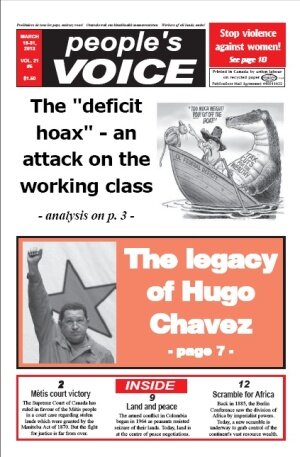
PEOPLE'S VOICE MARCH 16-31, 2013 (pdf)
People’s Voice 2013 Calendar
”Ideas of Revolution”


People's Voice deadlines:

April 1-15
Thursday, March 21

April 16-30
Thursday, April 4

Send submissions to PV Editorial Office,
706 Clark Drive, Vancouver, V5L 3J1, pvoice@telus.net

You can call the editorial office at 604-255-2041


REDS ON THE WEB
http://www.parti-communiste.ca/
peoplesvoice.ca
www.ycl-ljc.ca
www.solidnet.org


People's Voice finds many "Global Class Struggle" reports at the "Labour Start" website, http://www.labourstart.org/. We urge our readers to check it out!


*  *  *  *  *
People's Voice

Canadian Publications Mail Sales Product Agreement #205214
ISSN number 1198-8657
People's Voice is published by
New Labour Press Ltd
  PV Editorial Office
706 Clark Drive,
VANCOUVER, B.C. V5L 3J1
Phone:604-255-2041
Fax:604-254-9803
email:  pvoice@telus.net

Editor: Kimball Cariou : Business Manager: David Au
Editorial Board: Kimball Cariou, Miguel Figueroa,
Doug Meggison, Naomi Rankin, Liz Rowley, Jim Sacouman

* * * * * *
Letters
People's Voice welcomes your letters
on any subject covered in our pages.
We reserve the right to edit for length and clarity,
and to refuse to print letters which may be libellous
or which contain unnecessary personal attacks.
Send your views to:
"Letters to the Editor",
706 Clark Dr., Vancouver, BC V5L 3J1,
or pvoice@telus.net
People's Voice articles may be reprinted without permission,
provided the source is credited.


* * * * * *

The Communist Party of Canada, formed in 1921,
has a proud history of fighting for jobs, equality, peace,
Canadian independence, and socialism.
The CPC does much more than run candidates in elections.
We think the fight against big business and its parties
is a year-round job,
so our members are active across the country,
to build our party and to help strengthen people's movements
on a wide range of issues.

All our policies and leadership
are set democratically by our members.
To find out more about Canada's party of Socialism,
give us a call at the nearest CPC office.

* * * * * *
Central Committee CPC
290A Danforth Ave Toronto, Ont. M4K 1N6
Ph: (416) 469-2446
fax: (416) 469-4063 E-mailmailto:info@cpc-pcp.ca

Parti Communiste du Quebec (section du
Parti communiste du Canada)
5359 Ave du Parc, Montréal, Québec,
H2V 4G9

B.C.Committee CPC
706 Clark Drive, Vancouver, V5L 3J1
Tel: (604) 254-9836
Fax: (604) 254-9803

Edmonton CPC
Box 68112, 70 Bonnie Doon P.O.
Edmonton, AB, T6C 4N6
Tel: (780) 465-7893
Fax: (780)463-0209

Calgary CPC
Unit #1 - 19 Radcliffe Close SE
Calgary  AB, T2A 6B2
Tel: (403) 248-6489

Ottawa CPC
Tel: (613) 232-7108

Manitoba Committee
387 Selkirk Ave., Winnipeg, R2W 2M3
Tel/fax: (204) 586-7824

Ontario Ctee. CPC
290A Danforth Ave., Toronto, M4K 1N6
Tel: (416) 469-2446

Hamilton Ctee. CPC
265 Melvin Ave., Apt. 815
Hamilton, ON.
Tel: (905) 548-9586

Atlantic Region CPC
Box 70 Grand Pré, NS, B0P 1M0
Tel/fax: (902) 542-7981

http://www.parti-communiste.ca/

* * * * * *

News for People, Not for Profits!
Every issue of People's Voice
gives you the latest
on the fightback from coast to coast.
Whether it's the struggle for jobs or peace, resistance to social cuts,
solidarity with Cuba, or workers' struggles around the world,
we've got the news the corporate media won't print.
And we do more than that
- we report and analyze events
from a revolutionary perspective,
helping to build the movements for justice and equality,
and eventually for a socialist Canada.

Read the paper that fights for working people
- on every page, in every issue!

People's Voice
$30 for 1 year
$50 for 2 years
Low-income special rate: $15 for 1-year
Outside Canada $50 for 1 year

Send to: People's Voice, 706 Clark Drive, Vancouver, BC, V5L 3J1
You can call the editorial office at 604-255-2041

REDS ON THE WEB
http://www.parti-communiste.ca/
http://www.ycl-ljc.ca/
http://www.solidnet.org/

(Contents)
(Home)


(The following articles are from the March 16-31, 2013, issue of People's Voice, Canada's leading communist newspaper. Articles can be reprinted free if the source is credited. Subscription rates in Canada: $30/year, or $15 low income rate; for U.S. readers - $45 US per year; other overseas readers - $45 US or $50 CDN per year. Send to People's Voice, c/o PV Business Manager, 706 Clark Drive, Vancouver, BC, V5L 3J1.)

1) THE DEFICIT IS A HOAX - THERE ARE ALTERNATIVES

By Jean Kenyon

     It's budget season, and once again we are told the cupboard is bare. The federal and most provincial governments have been running big deficits ever since the financial crisis of 2008‑09, and therefore don't have enough money for health care, poverty reduction, infrastructure, and other basic needs.

     The deficit has become the latest excuse for skimping on the public services that once made Canada prosperous. But the deficit, truth to tell, is a bit of a hoax, for three big reasons:

1. Personal and corporate tax rates are way out of date.

2. Astounding revenues are lost each year to tax evasion and offshore havens.

3. Governments needlessly do most of their borrowing in the private market.

     If you're over 45, you remember when there used to be 15 tax brackets in Canada. It was a truly graduated system and reasonably fair. But the Mulroney government scrapped it and established only three steep brackets.

     Today we should restore the 15 smaller tax brackets, but scale up the thresholds so that the bottom two brackets are eliminated ‑ freeing the lowest‑income people from taxes ‑ and more brackets are added at the top.

     Today the top income bracket starts at $128,800, above which income is taxed at 29%. Larry Gordon, co‑founder of Canadians for Tax Fairness, writes:

     "According to the Canadian Centre for Policy Alternatives, adding two new tax brackets of 32 per cent on income over $250,000 and 35 per cent on income over $750,000 would generate about $12 billion in new revenue over the next three years. Those modest tax adjustments could fund a new national pharmacare program, or launch a national child‑care program, plus allow university tuition fees to be rolled back to 1991 levels."

     That is, it would generate $4 billion per year of needed revenue, while leaving average households where they are, or even a little better off.

     As for corporate tax rates, Canada's combined federal and provincial rate of 28.8% is the lowest of all the G8 countries.  With the US corporate tax rate at 44.8%, why does ours need to be so low to be "competitive"?

     According to The Star's Les Whittington, Harper's corporate tax cuts have cost Ottawa over $10 billion per year since 2007.  And this money, now left in the hands of business, isn't being plowed back into productive investment but frequently remains "dead money", held in inactive reserves.

     The Canadian Labour Congress calls for corporate tax cuts to be rolled back and restructured as credits, targeted only toward companies that invest in improvements to productivity. The rest should be invested by government in "public infrastructure including transit, literacy, workplace training and child care. These are good ways to prepare for the economy of tomorrow and to stimulate Canada's economic growth and development."

     Harper's cut of 2 percentage points to the GST in 2007‑08 is also costing the public treasury $13 billion per year. By one pen stroke he started his ideologically‑driven push to demolish the surplus he inherited.

     (Ultimately, of course, regressive taxes such as the GST and HST should be phased out as the income tax is reformed to cover the difference. Lowering regressive taxes shouldn't rob the treasury.)

     The introduction in 2009 of Tax‑Free Savings Accounts ‑ which benefit only those with a lot of spare cash ‑ will also cost an additional $3 billion per year as they become fully utilized by well‑to‑do taxpayers. TFSAs have been called an upper‑income tax cut in disguise.

     So far we're up to $30 billion/year in revenues that would be fairly painless to recapture, before we even look at tax havens.

     Canadians for Tax Fairness (CTF) has launched a campaign to urge the Finance Minister to go after money stashed offshore. Under pressure from the OECD, the Commons Finance committee started hearings in February on the problem of tax havens.

     Murray Dobbin, president of CTF states that, "The world's largest corporations and wealthiest individuals use these jurisdictions ‑ there are more than 70 countries offering these services. They park their money where there is minimal regulation, little or no taxation on non‑resident wealth, and guaranteed secrecy which is actually enshrined in the countries' laws. There is no easy way of knowing which corporations have accounts, and no systematic effort to share information with other countries.

Many of the world's largest banks ‑ including most of the big Canadian banks ‑ have divisions whose exclusive function is to facilitate this grand theft."

     Fully one‑tenth of the world's total wealth is sheltered in this way from taxes. The cost to the public sector everywhere is huge, and tragically so for developing countries. It is worth noting that Greece didn't fail because its social programs were too generous, but mainly because tax evasion was rampant.

     Murray Dobbin estimates that Canada is now losing $10 billion a year in revenue from money squirrelled away on sunny islands.  And that's only a small part of the total. Dennis Howlett of CTF, appearing before the Finance committee, estimated total yearly tax evasion in Canada at $80 billion.

     Canadians for Tax Fairness is publishing an eye‑opening new book called The Great Revenue Robbery. It will be launched in April with a Canada‑wide tour.

     It's important to note that most of the tax breaks to the rich, and revenue lost to tax evasion, have to be paid for through government borrowing, i.e. deficit spending.

     Until the mid‑1970s, our borrowing was handled through the Bank of Canada, which was publicly owned and tasked to carry out government policy. Loans were virtually interest‑free and the national debt did not increase. The war effort, housing for veterans, the St. Lawrence Seaway, and the introduction of old age security and medicare, were financed without inflation or significant deficits. Levels of borrowing had to reflect actual productivity, and borrowing in turn was used to enhance productivity. Most bonds did not have to be floated on the international private market as they are today.

     But since that time, the "Bank for International Settlements" ‑ the cabal of the developed world's central banks including the Bank of Canada ‑ has wrested much power away from governments and imposed policies of its own. It has limited the public's ability to borrow from safe sources, putting us at the mercy of private banks, bond traders, currency speculators, and unpredictable interest rates. The result has been out‑of‑control public debt, in Canada and around the world.

     Steps must be taken to reverse this trend, by starting to shift our borrowing back to the Bank of Canada. Beginning to lower the interest obligation on our existing national debt would start to get the austerity monkey off our backs.

     There are solutions, lots of them. I haven't even mentioned here the government policy decisions that squander public money ‑ like military equipment to support missions abroad, and needless jails.

     By updating personal and corporate tax rates, clamping down on tax havens, and shifting our borrowing back to our own central bank, we could eliminate the deficit a few times over.

     But our leaders would have us believe that money is tight and the only "solution" to the deficit is to ream out the public sector, abandon the poor, saddle students with mountainous debt, and privatize health care.

     This is frankly Bullfeathers!

Printer-friendly article

(Contents)

(Home)


2) CANADIAN LABOUR CONGRESS TARGETS HARPER GOVERNMENT

By Darrell Rankin

     Hundreds of delegates are expected to attend the Canadian Labour Congress' political action conference, which will plan how to defeat the Harper government, March 21‑23 in Toronto.

     The highly managed CLC conference comes at a time when the government is ripping the country apart and selling it part by part. The Communist Party has called for a broad, political action conference for years, and it is important that the most be made of it. Success will be measured by how the conference organizes the fight, especially before the election, not just during the campaign period.

     On the positive side, there is a focus on key issues like labour rights (the attack on the Rand formula and the closed shop), the Aboriginal question in the labour movement, creating industrial jobs, equality of women, child care, privatization, and green energy.

     Some focus is on rebuilding once‑vibrant coalitions, like those that thrived in the 1980s fighting against free trade and for nuclear disarmament. The new coalitions need to include those entering political life today, activists fighting for Aboriginal rights and the environment, students against tuition hikes, the Occupy movement.

     Many CLC affiliates already have their separate campaigns targeting the Harper Tories. The problem for the CLC and this conference is to send a message: Bring these efforts together! Unite, locally and across Canada.

     Local and regional coalitions will be a basis for strong Canada‑wide coalitions; these played an important part defeating the Mulroney‑Campbell Tories in 1993, and they are needed now.

     Unfortunately, the agenda is heavy on workshops like working with media. No time is available for different movement caucuses to meet. The agenda has little or nothing for anti‑war, environmental or anti‑free trade movements, all historically connected to the labour movement. The lack of travel equalization, income‑related fees, or billets makes it expensive for activists outside Toronto.

     The main thing, though, is that the conference is taking place. When hundreds of people start to talk, they can produce the sparks that will push the Tories to defeat.

     It will be hard to match the send‑off to the Mulroney‑Campbell government in 1993, when the CLC helped rally 100,000 people on Parliament Hill, through the anti‑free trade Pro‑Canada Network.

     Such rallies can and should take place again. The Harper government is carrying out a vicious attack on the labour movement and workers as a whole. The time has come for more thought about stronger measures in the fightback, including work stoppages and political strikes which are now common in many European and Asian countries.

     In 1988, the CLC targeted 50 Tory MPs for defeat in one of the Canada's most important elections dealing with Canada‑US Free Trade. The next election is equally important. If the CLC will carry out a similar campaign next election, groups need to sign‑up at the conference and get to work. Time is short.

     There is no shortage of political actions to take against the narrow Harper Tory corporate agenda which is leading us to disaster. Developing and mobilizing for a broad, emancipatory alternative, the CLC can help defeat Toryism and its big business agenda.

     Darrell Rankin represented the Canadian Peace Alliance at the Pro‑Canada Network, the Action Canada Network and the Solidarity Network.

Printer-friendly article

(Contents)

(Home)


3) METIS CELEBRATE SUPREME COURT RULING

PV Vancouver Bureau

     In a major Aboriginal legal rights case, the Supreme Court of Canada has ruled 6‑2 in a favour of a case brought by the Manitoba Métis Federation (MMF), regarding the issuance of lands designated for Métis children under the Manitoba Act of 1870. Passed by Parliament in the wake of the "Red River Rebellion" of 1869-70, the Manitoba Act brought that province into the new Confederation of Canada. The leader of the Red River Métis people, Louis Riel, is regarded as the founder of Manitoba for his role in these historic events.

     The March 8 ruling declared that the federal Crown failed to implement the land grant provision set out in Section 31 of the Manitoba Act, and awarded costs to the appellants.

     Prior to the ruling, MMF President David Chartrand said, "Our People sent a message that our Land Claim must be a priority and one that I must advance all the way to the Supreme Court of Canada to seek justice. This case is about lost and stolen properties and a People who were displaced and dispersed across and beyond their Homeland.

     "The 1870 Manitoba Act recorded solemn promises made to provide lands to our children and to recognize the titles to our lands along the Red River. These and other promises were not kept. The Métis children and their families were swindled and their lands stolen by speculators. This was facilitated by government delays, unconstitutional legislation, and orders in council.

     "This has been called the unfinished business of Confederation. As a Partner in bringing Manitoba into Confederation, and as an Aboriginal People, the Métis believe the Honour of the Crown and Canada's fiduciary responsibilities require this business be closed fairly and equitably. We have spent over 30 years in the courts struggling to right these wrongs done to our Ancestors."

     Hundreds of people were at Winnipeg Airport to greet Métis leaders returning from Ottawa after the decision. A rally was held at Louis Riel's gravesite, in the cemetery of the St. Boniface Cathedral, to celebrate their success and the prospects of the next steps of negotiations with the provincial and federal governments. A celebration with Métis fiddling, dancing, and traditional food was held at the Community Hall of the Cathedral.

     "To be a part of this historic event was truly a gift from the Great Spirit, a God‑inspired moment, with Riel surely smiling down upon the great victory and vindication of his sacrifices and a testament to the tenacity, perseverance and excellent leadership of President David Chartrand, his government members and the Métis Nation citizens within the province of Manitoba which brought the Métis Nation of the Northwest into confederation," stated President Clément Chartier of the Métis National Council.

     From another perspective, BC Métis Federation President Keith Henry stated, "Many Métis families across Canada are connected to the historic lands of the Red River in Manitoba, and to have the highest court in the lands rule that the Federal Government failed to implement the land grants is known to many of us. The decision will have to be fully reviewed to better understand the future impacts but clearly this is a major victory and will open the Federal Government up to future Métis land claims. Many of us Métis know today that the Federal Government continues to fail our people, and this is another court ruling supporting Métis rights."

Printer-friendly article

(Contents)

(Home)


4) COMMUNIST CANDIDATE MEETS NORTH VAN-LONSDALE VOTERS

     Kicking off his campaign for the May 14 B.C. provincial election, Communist Party of B.C. candidate Kimball Cariou met with North Vancouver-Lonsdale voters on March 9.

     Cariou will be the first Communist on the ballot in North Vancouver since the 1980s. Volunteers are already collecting nomination signatures, and the campaign will go public at the March 19 Nowruz Persian New Year fire celebration, which attracts thousands to Ambleside Park.

     At the forum, Cariou was joined by Communist Party of Canada leader Miguel Figueroa, making his final stop on a tour of western Canada. Figueroa has been from Winnipeg to Victoria, presenting the Party's views on how to defeat the war and austerity policies of the Harper Tory government.

     Most of the audience on March 9th were from the local Iranian-Canadian community, which numbers over 20,000. Many are strongly opposed to the undemocratic Ahmedinajad regime, but equally reject the push by Canada, the U.S. and other imperialist governments for war against Iran.

     Cariou, who has been active in peace movements since the days of the Vietnam War, will make opposition to Canadian warmaking a focus of his campaign. While this is a provincial election, he stressed, voters in North Vancouver-Lonsdale are paying for the military build-up under PM Harper. The billions spent on the military, he argued, should be redirected towards urgent civilian needs, such as low-income and social housing. Cariou pointed out that while North Vancouver has a reputation as a beautiful and wealthy area, there are thousands of poor people in the riding, including Iranian-Canadians who are falling through a dissolving social safety net. As in other parts of the region, rents are sky-high for North Vancouver voters living on minimum wage or part-time jobs.

     Speaking about recent B.C. Liberal scandals around "ethnic voter" schemes, Cariou said that Premier Christy Clark really needs to apologize for her role in covering-up the sale of B.C. Rail, and for the devastation to schools, teachers and students during her years as Education Minister in Gordon Campbell's Liberal government.

     For information on the Communist campaign in North Vancouver-Lonsdale, call 604-254-9836, email cpbcinfo@gmail.com.

Printer-friendly article

(Contents)

(Home)


5) CONGRATULATIONS TO THE METIS

People's Voice Editorial

     The Supreme Court's 6-2 ruling in favour of the legal case brought by the Manitoba Métis Federation is another important milestone in the long struggle by Aboriginal peoples to achieve justice and national equality within the Canadian state.

     The court's decision comes 140 years since the shameful theft of lands which were to be provided to the Métis under the terms of the Manitoba Act. Instead, the Métis were scattered by the Canadian colonial ruling class, which seized their homeland as part of the process of settling the prairie provinces for the expansion of an emerging capitalist economy. This genocidal policy continued with the defeat of the heroic Métis and their allies at Batoche in 1885, and the subsequent generations of abysmal poverty and racist oppression.

     But the Métis never surrendered to the push for assimilation and annihilation. New resistance leaders took up the cause of Louis Riel and Gabriel Dumont, including the "Métis Patriots of the 20th Century," the communists Jim Brady and Malcolm Norris, who played key roles in rebuilding the movements of the Métis for their national rights starting in the 1930s. The Métis succeeded in achieving recognition as a distinct Aboriginal people in the Canadian Constitution, and kept raising demands to redress the historic crimes committed against their nation. The latest SCC ruling, along with the court decision in the "Daniels" case, regarding the status of some 600,000 Métis and non-status Indians across Canada, show that major legal advances can be achieved as part of a wider strategy of popular struggles. It is no coincidence that the blue and white flags of the Métis have been prominent at many powerful actions of the Idle No More movement.

     We salute the Métis on this historic victory, and we pledge our solidarity in the struggle to turn this legal ruling into meaningful gains for their social equality and national rights.

Printer-friendly article

(Contents)

(Home)


6) WHICH WAY FOR THE NDP?

People's Voice Editorial

     The New Democratic Party's retreat towards "qualified support" for the Canada‑European Union Comprehensive Economic and Trade Agreement (CETA) is raising serious concerns within the trade union movement, and rightly so. As OFL President Sid Ryan wrote recently, "this particular trade deal is being negotiated in secret and in the interest of multinational corporations. A number of affiliates have invested significant resources into campaigning against CETA and have been working alongside coalition partners to raise public concern."

     The OFL President is not alone in his objections. Many trade unions and social justice movements - the backbone of the NDP's voter base across Canada - have campaigned hard to block CETA for years. The abject turnaround by Thomas Mulcair has shocked many of these organizations, which traditionally count on the NDP to represent their views on Parliament Hill. 

     Sadly, the NDP's change of course did not surprise observers who have followed its trajectory in recent years. Sensing a possible victory in the 2015 federal election, the party which claims to be the voice of "ordinary Canadians" is bending over backwards to reach out to big capital. This trend pre-dates Thomas Mulcair; recall Jack Layton's January 2009 speech to the Toronto Board of Trade urging workers to take pay cuts to save jobs, or his moves to water down the NDP's anti-war positions.

     When labour activists gather at the Canadian Labour Congress conference this month, there should be no illusions about a Mulcair NDP government. Only massive pressure by trade unions and all people's movements can compel political parties to put people's needs ahead of corporate greed. Leaving the political struggle to the NDP caucus in Ottawa will not achieve this goal.

Printer-friendly article

(Contents)

(Home)


7) INTERVIEW WITH A SECURITY CERTIFICATE DEFENDANT

     PV's Saleh Waziruddin recently interviewed Mohammed Mahjoub, the "security certificate" detainee who was finally freed from having to wear a GPS bracelet. Mohammed Mahjoub, a refugee from Egypt, was arrested in 2000, without being charged with a crime or given access to evidence against him. Mahjoub has been on a speaking tour about his case after being released from having to wear a GPS. He claims he has found evidence that Canada has spent over $1 billion on all security certificate cases, and that CSIS had used criminal records of five people with his name in Egypt who were convicted of various crimes to confuse the justice system.

     Although cleared of any charges in Egypt, Mahjoub has been unable to find out why he was arrested in Canada, other than the possibility that another security certificate arrestee, unknown to him, may have mentioned his name in a phone call. His house arrest conditions were so onerous and invasive that he initially went back to prison on his own, and his wife divorced him in 2011 when he was going to be released back into house arrest. His defense committee's website is www.supportmahjoub.org/. 

People's Voice: What would you say to someone who thinks what happened to you could never happen to them?

Mahjoub: I have never thought it will happen to me, but it happened.  It can happen to anybody here in Canada. My advice to them is: don't take everything granted forever. It happened to me today, it can happen to anyone else, especially minority people.


What have you found was most effective for the victories you've won in your struggle, such as being free from the GPS bracelet?

     The most thing effective in my case is speaking out, raising my voice, sharing my story with Canadians. Find other Canadians who have hope in their life to assist you.


What are things people in Canada can do to help win justice for you?

     They can do a lot of things. They can share the story in the internet, they can write to their MPs, they can share this information with human rights organizations. There are many, many things they can do, not only one thing. (They) can make events such as what happened today for instance here in St. Catharines.

What changed in your opinion about Canada after your experience?

     Again, the law is (supposed to) apply to every individual, whether they are citizen or non‑citizen. If someone commits a crime, he or she should face a fair trial, but in the security certificate cases there are no charges laid on me or any other security certificate individual. We didn't have a fair trial in the first place. We have to fight hard. Why there is (such a situation in) Canada? I am not angry, but I have to fight hard to clear my name. The individual who put me in this position, should be held accountable for what they did to me and my family as well.


Do you have advice to anyone facing a similar situation?

     My advice to them (is) to be patient, to fight through legal avenues, not do anything to make their case more miserable or more difficult. There are many ways to fight through the law, to hire a good lawyer to speak out, to have contacts with organizations (which) can raise your voice. They can share your story with other organizations - human rights groups, parliament, media.

Printer-friendly article

(Contents)

(Home)


8) WE HAVE A WORLD TO WIN

By Liz Payne, Morning Star, www.morningstaronline.uk

     International Women's Day each year provides an opportunity to focus in depth on the condition of women, the class struggle against inequality and the tasks that face us in the immediate and more long‑term future.

     In Britain, the austerity measures of the coalition have been nothing less than a brutal assault on working‑class women.

     Beginning with the Emergency Budget of June 2010 draconian measures "to fill the economic deficit" have hit women hardest, taking their jobs and slashing the benefits and services on which so many depend. And, with less than a quarter of the already-planned cuts implemented, the worst is yet to come ‑ that is, unless we put a stop to it.

     More than 400,000 women's jobs will be lost from the public sector alone, and hundreds of thousands more will go from the private sector. Pay cuts in the form of wage freezes and below cost‑of‑living rises will hit women workers hardest, concentrated as they are in low paid work. Sixty‑four per cent of all low‑paid workers are women.

     Women ‑ statistically twice as likely as men to depend on benefits ‑ will suffer most from government raids on welfare budgets. Many benefits under the axe relate to women's lives directly ‑ support during pregnancy, child care assistance via tax credits, child benefit.

     Women are the main recipients of housing benefits, including those supporting single‑parent families, nine out of 10 of whom are women.

     Decimated public services and unaffordable privatised "replacements" are in the main those on which women heavily rely. Caring services and public transport are only two examples. The cumulative effect will be the further isolation, impoverishment and disenfranchisement of women, denying them access to education, jobs, health care and amenities and increasing vulnerability to exploitation, abuse and violence.

     Low incomes demonstrably increase the latter risk. According to public‑service union Unison, women in households with an income of less than ,10,000 (about $15,300 Cdn.) are three‑and‑a‑half times more likely to experience domestic violence than those in households with an income of over ,20,000 ($30,600).

     Into this mix add the removal or reduction of state‑funded legal support for cases relating to welfare benefits, debt, family law, education and medical negligence, coupled with the tightening of eligibility criteria for legal aid. Add also the drastic reduction of funds for voluntary organisations that provide services that support women.

     Working women are increasingly aware of all this, but fewer feel certain that an alternative is possible.

     This International Women's Day we must commit to making everyone aware that none of these things needs to happen.

     Now is the time for women and men to fight back against the government, the banks, industrialists and public and private employers, asserting the right of working‑class women to jobs, justice and a decent life.

     But if that fightback is to be successful, it cannot begin and end with a short‑term economic challenge, crucial as that is. We must win understanding that we need to change the way women live and of how this might be done.

     The Charter for Women, supported by trade unions, trades councils and women's organisations across the country, sets out what life might look like for women ‑ in the wider society, at work and in the labour movement.

     It shows how campaigns built on the demands of women for equality, independence, justice, representation, work, fair pay, education and health can make broad, deep and irreversible changes to the lives of working women in Britain.

     But campaigning on the Charter for Women cannot itself be undertaken in isolation. The demands of women are integral to those of all working people, as put forward in the TUC‑adopted People's Charter.

     They must also be heard, recognised and incorporated in the work of the coming People's Assembly against Austerity on June 22, which hopes to mobilise millions against the Con‑Dem government and build a movement for genuine change founded on equality and social justice.

     In the long, hard battle we have to fight there must be fundamental recognition of the centrality of the struggle for women's equality.

     Capitalism worldwide depends on the exploitation of working women and on their unpaid labour. Without it capitalism's profit ceases and its crises cannot be resolved.

     Further, capitalism's continuance is assured only if working people are prevented from uniting to challenge it. The division between working women and men is not an option of capitalist strategy ‑ it is the system's lifeblood.

     And so the struggle for women's equality in Britain is linked with the struggle of women worldwide against a system that can only degrade and exploit them.

     Media coverage of women since last year's International Women's Day has graphically reflected this. It has been memorable and shocking ‑ depicting extremes of violence, sexual objectification, eroticisation of murder, denial of rights and representation, displacement, impoverishment and denial of voice.

     But the past year has also witnessed women fighting back ‑ the women of India rising together against endemic violence, the women of Egypt returning again and again to demonstrate for a more just and equal future despite the rape and sexual assault meted out to intimidate them.

     Women have been arrested, tortured and killed for organising, speaking out and challenging their oppressors in many countries. And yet, as ever, the brave struggle still continues.

     Helena Kennedy recently said of the position of women during her lifetime: "Although a lot has happened, not enough has really altered."

     Now is the time to "really alter things" ‑ win vital public support, defeat anti‑women austerity measures, get rid of the government of the super‑rich and begin to work towards a genuinely just, peaceful, democratic and socialist future that has seen out capitalism for ever. This is our task on every day of the year, not just on International Women's Day. We have no choice.

     Liz Payne is vice‑chair of the Communist Party of Britain and its women's organiser. She will speak at People's Voice events in Canada during June, including the annual PV Victory Banquet on June 8 in Vancouver.

Printer-friendly article

(Contents)

(Home)


9) THE DAY WE MET HUGO CHAVEZ

By Johan Boyden

     When the news came it was probably natural that almost all of us from that delegation thought about our experience, eight years ago. When I bumped into some of the delegation at International Women's Day events, since his death came so close to IWD, it seemed natural to talk about it.

     It was 16th World Festival of Youth and Students, in Caracas. I remember we got off the airplane after our long flight, arriving late at night, and immediately stepped into a wall of hot and humid air. A bit tired, we stumbled into the darkness with our bags.

     And then, there they were. A welcoming party of Venezuela youth. Some were holding roses. Each woman in our delegation got a rose as she stepped onto Venezuela soil.

     I remember noticing what they were wearing. Bright red t‑shirts emblazoned with the slogan: "Another world is possible, and that is socialism!"

     I have difficultly describing the impact of these few words on a t‑shirt. After all it seems that today, with the economic crisis, more and more young people today are opening their eyes. The most popular searched words in the online Merriam‑Webster Dictionary last year were "socialism" and "capitalism."

     During the "Dirty Thirties," in a speech advocating for public health care, Dr. Norman Bethune once said that "Twenty five years ago it was thought to be contemptible to be a socialist. Today it is ridiculous not to be one."

     Well, that dark night at Simon Bolivar International Airport felt a bit like the twenty five years had just ended.

     It was, I think, a quote from President Hugo Chavez. A clear statement. Here, in Venezuela, thousands of young people are debating a profoundly different future. Over the next two weeks we would learn that their truly was a serious, vibrant, and exciting argument.

     Up to that point, the link between socialism and the Bolivarian Revolution had been far from clear. Only days before had Chavez made the connection as necessary. Over the next few days during the World Festival of Youth and Students, Chavez would speak and develop this pro‑socialist perspective in more detail.

     It seemed ground‑breaking. It was.

     IT took us ages to get out of the airport, to the "bed city" where we stayed and finally, down to a giant parade ground for the opening ceremonies. Who would have known, just a few years later, we would be looking into the newspaper and recognize the very same parade ground as where his funeral procession would go, surrounded by hundreds of thousands.

     Those parade grounds are at the bottom of a valley. The city is all around, then big steep hills rise up which become giant mountains in the distance. The hills are covered with the communities of the poor, the barrios.

     Dusk fell. Then came the deep, black tropical darkness. Moving as a group, we slowly walked what seemed like a few miles, finally turning past a big podium. And then there he was. Hugo Chavez. The man himself. Full of life, surrounded by other youth leaders, welcoming the youth of the world who had assembled to raise high the banner of the festival: "for peace and solidarity, we struggle against imperialism and war."

     It seemed the procession was regularly interrupted. Chavez had a few people from some of the delegations brought up to the podium. The US delegation's flag‑bearer, for example, received a giant bear‑hug. And then he spoke. For our tired bodies it seemed long. There was no translation.

     "I was so young, I didn't appreciate how we were witnessing history," one former delegate told me the other day.

     We looked up at the hills, and realized that the twinkling tiny network of lights in a few small areas must generally outline the rich communities with electricity, hostile to the Bolivarian Revolution, while the slopes which had fallen into darkness were its social base.

     The festival was beginning. I personally didn't glimpse him again. But over the next week, in the voices and stories of all the youth involved in the Bolivarian process, it kind of felt like we were meeting with Chavez.

     As the World Federation of Democratic Youth said, "the ones who die for life, shouldn't be called dead." Today those youth we met are eight years older. If they retain a tenth of the energy of the energy they had then, I am confident I will meet Chavez again.

     Johan Boyden is the leader of the Young Communist League of Canada, which is helping organize a cross‑Canada delegation to the 18th World Festival of Youth and Students taking place late this year in Ecuador.

Printer-friendly article

(Contents)

(Home)


10) THE ACHIEVEMENTS OF HUGO CHAVEZ

From Counterpunch, by Carles Muntaner, Joan Benach, and Maria Paez Victor. This article was published on Dec. 14, 2012, while the late Hugo Chavez was hospitalized in Cuba. For a list of footnotes, visit www.counterpunch.org.

     While Venezuela's president Hugo Chavez is fighting for his life in Cuba, the liberal press of both sides of the Atlantic has not stopped trashing his government. The significance of his victory (12 points ahead of his contender) has yet to be analysed properly, with evidence. It is remarkable that Chavez would win, sick with cancer, outgunned by the local and international media and, rarely acknowledged, an electoral map extremely biased towards the middle and upper classes, with geographical barriers and difficult access to ID's for members of the working classes.

     One of the main factors for the popularity of the Chavez Government and its landslide victory in this re‑election results of October 2012, is the reduction of poverty, made possible because the government took back control of the national petroleum company PDVSA, and has used the abundant oil revenues, not for benefit of a small class of renters as previous governments had done, but to build needed infrastructure and invest in the social services that Venezuelans so sorely needed. During the last ten years, the government has increased social spending by 60.6%, a total of $772 billion.

     Poverty is not defined solely by lack of income nor is health defined as the lack of illness. Both are correlated and both are multi‑factorial, that is, determined by a series of social processes. To make a more objective assessment of the real progress achieved by the Bolivarian Revolution in Venezuela during the last 13 years it is essential to review some of the key available data on the social determinants of health and poverty: education, inequality, jobs and income, health care, food security and social support and services.

     With regard to these social determinants of health indicators, Venezuela is now the country in the region with the lowest inequality level (measured by the Gini Coefficient) having reduced inequality by 54%, poverty by 44%. Poverty has been reduced from 70.8% (1996) to 21% (2010). And extreme poverty reduced from 40% (1996) to a very low level of 7.3% (2010). About 20 million people have benefited from anti‑poverty programs, called "Misiones" (Up to now, 2.1 million elderly people have received old‑age pensions - that is 66% of the population while only 387,000 received pensions before the current government.

     Education is a key determinant of both health and poverty and the Bolivarian government has placed a particular emphasis on education allotting it more than 6% of GDP. UNESCO has recognized that illiteracy been eliminated furthermore, Venezuela is the 3rd county in the region whose population reads the most. There is tuition free education from daycare to university; 72% of children attend public daycares and 85% of school age children attend school. There are thousands of new or refurbished schools, including 10 new universities. The country places 2nd in Latin America and 5th in the world with the greatest proportions of university students. In fact, 1 out of every 3 Venezuelans are enrolled in some educational program. It is also a great achievement that Venezuela is now tied with Finland as the 5th country with the happiest population in the world.

     Before the Chavez government in 1998, 21% of the population was malnourished. Venezuela now has established a network of subsidized food distribution including grocery stores and supermarkets. While 90% of the food was imported in 1980, today this is less than 30%. Mision Agro‑Venezuela has given out 454,238 credits to rural producers and 39,000 rural producers have received credit in 2012 alone. Five million Venezuelan receive free food, four million of them are children in schools and 6,000 food kitchens feed 900,000 people. The agrarian reform and policies to help agricultural producers have increased domestic food supply. The results of all these food security measures is that today malnourishment is only 5%, and child malnutrition which was 7.7% in 1990 today is at 2.9%. This is an impressive health achievement by any standards.

     Some of the most important available data on health care and public health are as following:

* infant mortality dropped from 25 per 1000 (1990) to only 13/1000 (2010);

* An outstanding 96% of the population has now access to clean water (one of the goals of the revolution);

* In 1998, there were 18 doctors per 10,000 inhabitants, currently there are 58, and the public health system has about 95,000 physicians;

* It took four decades for previous governments to build 5,081 clinics, but in just 13 years the Bolivarian government built 13,721 (a 169.6% increase);

* Barrio Adentro (i.e., primary care program with the help of more than 8,300 Cuban doctors) has approximately saved 1,4 million lives in 7,000 clinics and has given 500 million consultations;

* In 2011 alone, 67,000 Venezuelans received free high cost medicines for 139 pathologies conditions including cancer, hepatitis, osteoporosis, schizophrenia, and others; there are now 34 centres for addictions,

* In six years 19,840 homeless have been attended through a special program; and there are practically no children living on the streets.

* Venezuela now has the largest intensive care unit in the region.

* A network of public drugstores sell subsidized medicines in 127 stores with savings of 34‑40%.

* 51,000 people have been treated in Cuba for specialized eye treatment, and the eye care program "Mision Milagro" has restored sight to 1.5 million Venezuelans.

     An example of how the government has tried to respond in a timely fashion to the real needs of its people is the situation that occurred in 2011 when heavy tropical rains left 100,000 people homeless. They were right away sheltered temporarily in all manner of public buildings and hotels and, in one and a half years, the government built 250,000 houses. The government has obviously not eradicated all social ills, but its people do recognize that, despite any shortcomings and mistakes, it is a government that is on their side, trying to use its resources to meet their needs. Part of this equation is the intense political participation that the Venezuelan democracy stands for, that includes 30,000 communal councils, which determine local social needs and oversee their satisfaction and allows the people to be protagonists of the changes they demand.

     The Venezuelan economy has low debts, high petroleum reserves and high savings, yet Western economists that oppose President Chavez repeat ad nauseam that the Venezuelan economy is not "sustainable" and predict its demise when the oil revenues stop. Ironically they do not hurl these dire predictions to other oil economies such as Canada or Saudi Arabia. They conveniently ignore that Venezuela's oil reservoir of 500 billion barrels of oil is the largest in the world and consider the social investment of oil revenues a waste or futile endeavour. However these past 13 years, the Bolivarian government has been building up an industrial and agricultural infrastructure that 40 years of previous governments had neglected and its economy continues to get stronger even in the face of a global financial crisis.

     An indication of the increasing diversification of the economy is the fact that the State now obtains almost as much revenue from tax collection as from the sale of oil, since it strengthened its capacity for tax collection and wealth redistribution. In just one decade, the State obtained $251,694 million (US) in taxes, more than its petroleum income per annum.

     Economic milestones these last ten years include reduction in unemployment from 11.3% to 7.7%; doubling the amount of people receiving social insurance benefits, and the public debt has been reduced from 20.7% to 14.3% of GNP and the flourishing of cooperatives has strengthen local endogenous economies. In general, the Venezuelan economy has grown 47.4% in ten years, that is, 4.3% per annum.

     Today many European countries would look jealously at these figures. Economists who studied in detail the Venezuelan economy for years indicate that, "The predictions of economic collapse, balance of payments or debt crises and other gloomy prognostications, as well as many economic forecasts along the way, have repeatedly proven wrong... Venezuela's current economic growth is sustainable and could continue at the current pace or higher for many years."

     According to Global Finance and the CIA World Factbook, the Venezuelan economy presents the following indicators: unemployment rate of 8%; 45.5% government (public) debt as a percent of GDP (by contrast the European Union debt/GDP is 82.5%); and a real GDP growth: GDP per capita is $13,070. In 2011, the Venezuelan economy defied most forecasts by growing 4.2 percent, and was up 5.6 percent in the first half of 2012. It has a debt‑to‑GDP ratio comfortably below the U.S. and the UK, and stronger than European countries; an inflation rate, an endemic problem during many decades, that has fallen to a four‑year low, or 13.7%, over the most recent 2012 quarter. Even The Wall Street Journal reports that Venezuela's stock exchange is by far the best‑performing stock market in the world, reaching an all‑time high in October 2012, and Venezuela's bonds are some of the best performers in emerging markets.

     Hugo Chavez's victory had an impact around the world as he is recognized as having spearheaded radical change not only in his own country but in all Latin America where progressive governments have also been elected, thereby reshaping the global order. The victory was even more significant considering the enormous financial and strategic help that the USA agencies and allies gave to the opposition parties and media. Since 2002, Washington channeled $100 million to opposition groups in Venezuela and this election year alone, distributed $40‑50 million there.

     But the Venezuelan people disregarded the barrage of propaganda unleashed against the president by the media that is 95% privately owned and anti‑Chavez. The tide of progressive change in the region has started to build the infrastructure for the first truly independent South America with political integration organizations such as Bank of the South, CELAC, ALBA, PETROSUR, PETROCARIBE, UNASUR, MERCOSUR, TELESUR and thus have demonstrated to the rest of the world that there are, after all, economic and social alternatives in the 21st century. Following a different model of development from that of global capitalism in sharp contrast to Europe, debt levels across Latin America are low and falling.

     The changes in Venezuela are not abstract. The government of President Chavez has significantly improved the living conditions of Venezuelans and engaged them in dynamic political participation to achieve it. This new model of socialist development has had a phenomenal impact all over Latin America, including Colombia of late, and the progressive left of centre governments that are now the majority in the region see in Venezuela the catalyst that has brought more democracy, national sovereignty and economic and social progress to the region. No amount of neoliberal rhetoric can dispute these facts. Dozens of opinionated experts can go on forever on whether the Bolivarian Revolution is or is not socialist, whether it is revolutionary or reformist (it is likely to be both), yet at the end of the day these substantial achievements remain.

     This is what infuriates its opponents the most both inside Venezuela and most notable, from neocolonialist countries. The "objective" and "empiricist" The Economist will not publicize this data, preferring to predict once again the imminent collapse of the Venezuelan economy and El Pais, in Spain, would rather have one of the architects of the Caracazo (the slaughter of 3000 people in Caracas protesting the austerity measures of 1989), the minister of finance of the former government Moises Naim, go on with his anti‑Chavez obsession. But none of them can dispute that the UN Human Development Index situates Venezuela in place #61 out of 176 countries having increased seven places in ten years.

     And that is one more reason why Chavez's Bolivarian Revolution will survive Venezuela's Socialist leader.

     Carles Muntaner is Professor of Nursing, Public Health and Psychiatry at the University of Toronto. Maria Paez Victor is a Venezuelan sociologist, specializing in health and medicine. Joan Benach is a professor of Public Health at the Universitat Pompeu Fabra, Barcelona.

Printer-friendly article

(Contents)

(Home)


11) THE NEW SCRAMBLE FOR AFRICA

By T.J. Petrowski

     As the capitalist crisis continues throughout the world, the imperialist powers, with the enthusiastic support of Canada, are seeking to recolonize Africa, in what could accurately be described as the "New Scramble for Africa." The former colonial rulers, France and Britain, along with the U.S. are at the forefront of this aggression.

     The latest intervention in Mali, and before that in Libya, are the more recent expressions of this new scramble. All across Africa the imperialist powers are intervening in an effort to secure geostrategic areas and precious resources, similar to the interventions in the Middle East, but with far less coverage in the media.

     U.S. imperialism is expanding its African Command (AFRICOM) to include more than 35 countries, with 3000 troops permanently stationed on the continent. Currently the U.S. is undertaking military operations in countries as diverse as Nigeria, the Central African Republic, Mali, Botswana, Morocco, Somalia, Senegal, Niger, Burkina Faso, Liberia, and Uganda.

     The "war on terror" ruse is being used to justify increased American military involvement in Africa, but as with elsewhere in the world, it is easy to see through this thin veil. The recent outbreak of violence in Mali, for example, can be directly linked back to the Western intervention in Libya, wherein these same Islamic extremists were armed by the West, Saudi Arabia, and Qatar to overthrow the Gaddafi government. Furthermore, the U.S. and other imperialist states as well as the Gulf states are arming the same Islamic extremists in Syria in an effort to overthrow the al‑Assad government, which would provide Israel and the U.S. a launching pad for a future attack against Iran.

     Western imperialism manufactures "terrorist" threats through its destructive interventions in foreign countries, and then later uses the threat of terrorism as justification for further interventions, creating a permanent state of war.

     The U.S. depends on Africa for more than a quarter of the oil and raw materials it requires. But China has now surpassed the U.S. as Africa's largest trading partner, and the U.S. ruling class, unable to compete with China economically, is resorting to militarism to secure these precious resources.

     The former colonial rulers, France and Britain, but also other European states, are actively engaged throughout the continent to control their share of the wealth.

     France is continuing its intervention in Mali and the Central African Republic, both impoverished nations with immense natural wealth, in an effort to "defend" the countries from rebel advances. In other words, France requires compliant regimes in power to be able to exploit the resources of these countries. Much of Mali's arable land and social infrastructure have been eliminated to make way for French capital. In 2011, France intervened for "humanitarian" reasons in Libya and the Ivory Coast, and French forces are stationed across the continent in Gabon, Niger, Senegal, Chad, and Djibouti.

     West Africa is crucial to the French ruling class because of its dependence on the resources of the region. The vast majority of the uranium needed for France's nuclear industry comes from West Africa, especially Niger. French special forces have been deployed in Niger specifically to defend the uranium mines from a possible spill over of the conflict in Mali. The ports in the Ivory Coast have global economic implications, and in 2011, during the civil war, 2% of the world's global cocoa output sat in the harbour of Abidjan. The Central African Republic has extensive natural resources, especially oil and mineral deposits of diamonds, gold, copper, etc., and oil has been discovered in Chad.

     Britain has increased its military forces in Africa in the last few years and has sent troops to assist in the French intervention in Mali. Of interest to British imperialism are countries with extensive oil and gas reserves, especially Nigeria and Algeria. Algeria now supplies 5% of Britain's natural gas, and BP has a stake at the Amenas facility in southern Algeria. Additionally, Britain is interested in building a pipeline from Nigeria to Europe, to exploit the country's oil and natural gas reserves more thoroughly.

     The German ruling class is also seeking to exploit Africa's wealth in an imperialist rivalry with the U.S., France, and China.

     Although Germany was not involved in the intervention in Libya, the German ruling class has been supportive of France's intervention in Mali, and German forces are active in the Horn of Africa. German energy and agricultural companies are investing heavily in the Ivory Coast and elsewhere in West Africa in competition with French and Chinese capital. A century after the genocide of the indigenous people of German South West Africa, Germany is once again a colonial power in the scramble for Africa.

     Canada has been an enthusiastic supporter of these interventions. Canada shamefully assisted the U.S. and NATO intervention in Libya, and is now assisting the French intervention in Mali. Knowing Canadians would not support Canada's involvement in Mali, the Harper Government has attempted to describe our role as limited, but the mission has been extended repeatedly, and a Canadian special forces general has been quoted saying this will be an "ongoing" mission for Canada.

     In addition to direct involvement in Mali, Canadian forces are now in Niger and Mauritania, allegedly for "training" purposes and for military exercises with U.S. and European troops. Canadian military bases are being built in Kenya, Tanzania, and elsewhere on the continent.

     Canada is a major economic player in Africa, and a dozen Canadian mining companies have more than half a billion dollars of assets in Mali alone. Neither the NDP nor the Liberals have opposed the Conservatives' intervention in Mali, rather they have criticized the Harper Government for not acting fast enough!

     Working people should not believe the propaganda campaign of the ruling elite. The "terrorist" threat is manufactured by the ruling class to justify its imperialist agenda, while in the last decade the imperialist powers have made use of these same "Islamic terrorists" when seeking to overthrow anti‑imperialist governments. Imperialist interventions abroad benefit no one but the ruling class, and Canada needs an independent foreign policy of peace and disarmament.

Printer-friendly article

(Contents)

(Home)


12) DPRK DEFIES IMPERIALIST STRANGLEHOLD

By Sean Burton

     People's Korea has faced a plethora of new challenges since December. On December 12, the DPRK successfully placed a satellite into orbit with its Unha (Galaxy)‑3 carrier system. The USA and its allies view such rocket systems to be in violation of UN resolutions designed to deny the DPRK the right to produce long‑range ballistic missiles. Given the obvious similarities in the technology, it is a convenient way for the imperialist clique to heap more criticism and sanctions on Korea. Despite being a peaceful launch related to space‑exploration, the economic stranglehold against the DPRK is being tightened even more.

     Naturally, the mainstream media had only praise for South Korea's own satellite launch in January 2013. It is interesting that despite the South's economic clout and foreign support, they were beaten to the punch by what we are supposed to believe is a state teetering on the edge of collapse and full of starving people. The media also has not made much about new South Korean missiles designed for precision strikes anywhere within the Korean peninsula, or the order for all border troops to respond with fire to any provocation without having to first consult ROK military headquarters. Instead, people are constantly expected to accept that the DPRK is solely responsible for all problems and confrontations in the region.

     Similar misrepresentations are applied to the DPRK's nuclear weapons program. No one can deny that such weapons are deplorable, but they can nonetheless prove useful when being threatened by a country with vast force and nuclear weapons of its own. The DPRK probably could have developed such weaponry decades ago if it really cared to. Only since the fall of the Soviet Union has Korea actively sought nuclear weapons, since the US was beginning to apply further pressure and direct threat of annihilation to one of the world's few remaining socialist states.

     The DPRK's underground test in mid-February was significantly smaller than the US devices used in Japan in 1945. Once again, this test promoted a round of sanctions. What could possibly be left to sanction? It clearly does not bother the US that this economic warfare is causing far more harm than it solves. Indeed, that's precisely the point! They want Koreans to suffer as punishment for not going along with the capitalist order. The imperialists constantly insist that the DPRK is squandering resources on rockets when it should be feeding its people. In that scenario, the DPRK is acting in a vacuum, without rhyme or reason, "just for the hell of it". The idea that if the DPRK were to cut back its military spending, which is already miniscule compared to its enemies, the US and its supporters would back off and become friendly to a socialist state is supremely naive. Libya serves as a fine example in that regard!

     The US has continued to make threats, constantly reminding the Koreans that "all options are on the table", ominously including a preemptive strike to prevent another nuclear test. The joint US‑ROK military exercises, very much a part of intimidating the Korean People's Army, are once again going ahead this March. The claim that the exercises are defensive in nature is rather ludicrous given the location and scale. Hundreds of thousands of troops participate, and the maritime exercises in particular get quite close to a disputed border zone that has been the site of past incidents.

     In response, the supreme command of the Korean People's Army released an important statement on March 5, asserting the DPRK's right to autonomy and citing the war games as violations of the Korean armistice. The statement threatened to disregard the armistice agreement if it means guarding the DPRK's autonomy. The media has been going crazy over the statement, but the KPA has in the past made many such warnings not to be trifled with. This one should not be seen any differently.

Printer-friendly article

(Contents)

(Home)


13) LAND REMAINS KEY TO PEACE IN COLOMBIA

By W.T. Whitney, People's World

     Small farmers formed the Revolutionary Armed Forces of Colombia (FARC) in 1964 to defend land. Now land is the first agenda item in peace talks in Havana between the FARC and Colombian government.

     Renewed struggle over land roiled the talks in late February as the government delivered a controversial tract of land to new owners and the FARC raised the issue of food sovereignty.

     Expressing hope earlier in the month, Humberto de la Calle, leader of the government's negotiating team, envisioned "a true opportunity to end armed conflict in Colombia through dialogue." Optimism vanished, however, on Feb. 23 when Colombian President Juan Manuel Santos threatened, "If talks don't advance, we'll leave the table."

     Santos was reacting to FARC criticism of his visit three days earlier to San Vicente del Caguan where he transferred 247,000 acres of land in the area to 342 farm families. In an open letter, FARC Commander Timoleon Jiménez rejected Santos' contention that the land had belonged to FARC commander Jorge Bricero, killed by government forces in 2010. "Let's save the peace, Santos," he asserted.

     With an average parcel size of 727 acres, far in excess of most small‑farm operations, the land deal raised questions. In fact, reported human rights activist Horacio Duque, Santos was "delivering land titles to members of the Army ... and to their paramilitary stand‑ins, land taken away from thousands of peasants." Duque contends Santos sought to "lower pressure from the ultra‑right military leaders, loyal to ex‑President Uribe, who are demanding that the peace negotiations be suspended."

     The land transfer event took place on the anniversary of the military takeover in Caguan in 2002 that marked the end of two years of peace negotiations there. Jiménez castigated Santos' commemoration of failed peace talks, his having "insulted the FARC in every possible way," and his silence on current peace talks. He warned that "official attitudes ... threaten to sink the process into a swamp."

     Santo's plans for running for re‑election in 2014 are unclear, and his opinion poll ratings are down. Predecessor Alvaro Uribe is spearheading efforts to return right‑wing orthodoxy to the presidency and congress.

     The FARC general staff on Feb. 26 expressed confidence peace talks would continue. The Colombian people were called upon "to mobilise against what caused and who was responsible for the plundering of 20 million acres over 20 years, [in order to] to facilitate delivery of a good part of the national territory to trans‑nationals."

     In an interview that day FARC delegation head Ivan Marquez broadened discussion of land to encompass larger societal needs. He referred to "war‑making sectors quite interested in sabotaging this process of dialogue that know there are themes they don't want discussed like concentration of land." Land for small farmers would come "from cattle raisers, for example, who have 100 million acres in their hands and a herd of 22 million cows that live like princes on large stretches of land we could put into cultivation, to produce food."

     Marquez cited "studies calling for distribution of 50 million acres among small farmers and dedicating them to food sovereignty. We need to produce food for Colombians. Until just recently Colombia was more or less self sufficient, at 90 percent. Now with neo‑liberal politics this changed and now we have to import more than 10 million tons of food products."

     A week earlier the FARC delegation publicised ten food sovereignty proposals. First, access to food would become a fundamental right. The people would be empowered "to define their own strategies for sustainable production commercialisation and consumption of food products."

     Other proposals were: "eradication of hunger; Production of food in stable, health‑promoting, and environmentally sustainable ways; consumers guaranteed access to food; protection, stimulation, and financial support" for small farmers; co‑existence of varying production models; protection against land diversion to "mega projects;" cooperation between farmers and city consumers to remove intermediaries; infrastructure improvements; and democratic decision‑making.

     Nevertheless, while negotiators were coping with the land question, a widespread coffee farmers' strike materialised on Feb. 25. Coffee farmers and cacao, cotton, sugar cane, and rice farmers are now victims of changing world market conditions and the impact of US, Canadian and European free trade agreements. Food importers undersell Colombian producers. Coffee prices and production have dropped precipitously.

     Police violence directed at the strikers reinforced media-inspired prejudice against agrarian agitators. Government spokespersons hinted strikers were taking orders from the FARC. Analyst José Antonio Gutiérrez points out that, "As is typical of the Colombian government, social protest has been turned into a military problem, and internal security problem."

     Gutiérrez reports, however, that "small [coffee] farmers complain [government] help serves only to benefit big producers, and the mid‑level and small ones don't see a peso." Says Gutiérrez, "Although the government wants to exclude discussion of the economic model from the peace negotiations, it's impossible to talk about agriculture without taking that model into consideration."

     He adds: "Coffee and cacao farmers are showing that social mobilisation in Colombian streets and countryside will make sure such discussion becomes the order of the day. Although Santos ... believes problems of class struggle can be confined to a negotiating table, the Colombian people are demonstrating that deep transformation of the country comes about through the daily construction of ... new political horizons. These winds blowing in favour of the people can no longer be contained by means of violence. Something is happening in Colombia."

Printer-friendly article

(Contents)

(Home)