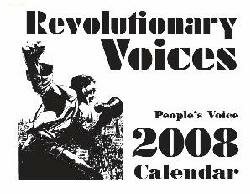
A calendar for the year 2008, dedicated to the struggles of the international working class for peace and socialism.
Featuring notable dates, short biographical sketches, plus poetry, speeches, and writings by
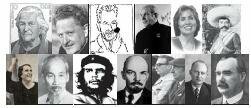
Che Guevara, Clara Zetkin, Norman Bethune, James Connolly, Emiliano Zapata, Nikos Beloyannis, Dolores Ibarruri, V.I. Lenin, Pablo Neruda, Gladys Marin, Tim Buck, Nazim Hikmet, Ho Chi Minh, and Salvador Allende.
Available for $10 plus $2 postage from People's Voice, 133 Herkimer St., Unit 502, Hamilton, ON, L8P 2H3.
|
People's Voice deadlines
DECEMBER 1-31 issue: Thursday, Nov. 22
JANUARY 1-15 issue: Thursday, Dec. 13
Send submissions to PV Editorial Office, 706 Clark Drive, Vancouver, V5L 3J1, pvoice@telus.net |
New issue of Rebel Youth hits the street
The summer 2007 edition of Rebel Youth, magazine of the Young Communist League of Canada, is now on sale.
To order your copy by mail send $3 to YCL c/o 290 Danforth Avenue, Toronto, ON, M4K 1N6, or c/o 706 Clark Drive, Vancouver, B.C., V5L 3J1. |
|
|
| Theoretical and Discussion Bulletin of the Communist Party of Canada |
People's Voice finds many "Global Class Struggle" reports at the "Labour Start" website, http://www.labourstart.org. We urge our readers to check it out!
|
People's Voice
Canadian Publications Mail Sales Product Agreement #205214
ISSN number 1198-8657
People's Voice is published by
New Labour Press Ltd
PV Editorial Office
706 Clark Drive,
VANCOUVER, B.C. V5L 3J1
Phone:604-255-2041
Fax:604-254-9803
email: pvoice@telus.net
Editor: Kimball Cariou
Editorial Board: Kimball Cariou, Miguel Figueroa,
Doug Meggison, Naomi Rankin, Liz Rowley, Jim Sacouman
* * * * * *
Letters
People's Voice welcomes your letters
on any subject covered in our pages.
We reserve the right to edit for length and clarity,
and to refuse to print letters which may be libellous
or which contain unnecessary personal attacks.
Send your views to:
"Letters to the Editor",
796 Clark Dr., Vancouver, BC V5L 3J1,
or pvoice@telus.net
People's Voice articles may be reprinted without permission,
provided the source is credited.
* * * * * *
The Communist Party of Canada, formed in 1921,
has a proud history of fighting for jobs, equality, peace,
Canadian independence, and socialism.
The CPC does much more than run candidates in elections.
We think the fight against big business and its parties
is a year-round job,
so our members are active across the country,
to build our party and to help strengthen people's movements
on a wide range of issues.
All our policies and leadership
are set democratically by our members.
To find out more about Canada's party of Socialism,
give us a call at the nearest CPC office.
* * * * * *
Central Committee CPC
290A Danforth Ave Toronto, Ont. M4K 1N6
Ph: (416) 469-2446
fax: (416) 469-4063 E-mail info@cpc-pcc.ca
Parti Communiste du Québec
3961 Av. Barclay, App. 4
Montréal, H3S 1K9
E-mail: pueblo@sympatico.ca
B.C.Committee CPC
706 Clark Drive, Vancouver, V5L 3J1
Tel: (604) 254-9836
Fax: (604) 254-9803
Edmonton CPC
Box 68112, 70 Bonnie Doon P.O.
Edmonton, AB, T6C 4N6
Tel: (780) 465-7893
Fax: (780)463-0209
Calgary CPC
Unit #1 - 19 Radcliffe Close SE
Calgary AB, T2A 6B2
Tel: (403) 248-6489
Regina CPC
P.O. Box 482, Regina, SK S4P 2Z6
Ottawa CPC
Tel: (613) 232-7108
Manitoba Committee
387 Selkirk Ave., Winnipeg, R2W 2M3
Tel/fax: (204) 586-7824
Ontario Ctee. CPC
290A Danforth Ave., Toronto, M4K 1N6
Tel: (416) 469-2446
Hamilton Ctee. CPC
265 Melvin Ave., Apt. 815
Hamilton, ON.
Tel: (905) 548-9586
Atlantic Region CPC
Box 70 Grand Pré, NS, B0P 1M0
Tel/fax: (902) 542-7981
http://www.communist-party.ca/
* * * * * *
News for People, Not for Profits!
Every issue of People's Voice
gives you the latest
on the fightback from coast to coast.
Whether it's the struggle for jobs or peace, resistance to social cuts,
solidarity with Cuba, or workers' struggles around the world,
we've got the news the corporate media won't print.
And we do more than that
- we report and analyze events
from a revolutionary perspective,
helping to build the movements for justice and equality,
and eventually for a socialist Canada.
Read the paper that fights for working people
- on every page, in every issue!
People's Voice
$25 for 1 year
$45 for 2 years
Low-income special rate: $12 for 1-year
Outside Canada $25 US or $35 Cdn for 1 year
Send to: People's Voice, 133 Herkimer St.., Unit 502, Hamilton, ON, L8P 2H3
REDS ON THE WEB
http://www.communist-party.ca
http://www.ycl-ljc.ca
FLAHERTY DELIVERS HUGE CORPORATE TAX CUT
(The following article is from the November 16-30, 2007 issue of People's Voice, Canada's leading communist newspaper. Articles can be reprinted free if the source is credited. Subscription rates in Canada: $25/year, or $12 low income rate; for U.S. readers - $25 US per year; other overseas readers - $25 US or $35 CDN per year. Send to: People's Voice, c/o PV Business Manager, 133 Herkimer St. Unit 502, Hamilton, ON, L8P 2H3.
By Liz Rowley
The Harper government's Hallowe'en mini-budget contains corporate tax cuts that Finance Minister Jim Flaherty boasts are "much deeper and much faster than ever contemplated before". By 2012, the corporate tax rate will drop to 15% - almost half the 28% rate in 2000. The small business tax rate will fall to 11%.
What's it worth? More than $13 billion annually in lost revenue: enough to pay for the previous Liberal government's child care deals, the Kelowna Accord with Aboriginal Peoples, the Canada-Ontario Agreement, and the offshore arrangements, which would have cost $5 billion over 5 years (CLC Submission to the House of Commons Finance Committee 2007 Pre-Budget Consultations). How low can we go? According to Flaherty, the goal is to lower Canada's corporate tax rates below every industrialized country in the world. That's something, considering that our combined federal/provincial corporate tax rate of 36% is already lower than Japan (41%), USA (40%), Germany (38%), and Italy (37%). Among the G-7 countries, only France (33%) and the UK (30%) are lower.
Can they do it? It seems they can. These massive cuts are being delivered in a mini-budget, by a minority government, with the support of Dion's Liberals, and not only because they don't want an election. This is the corporate agenda in neo-liberal times, and the Liberals are just as willing to deliver tax cut as the Tories.
Harper is following a path laid out by Brian Mulroney in the 1980s, when tax shifts from the corporations and the wealthy onto the backs of working people were the opening salvos for a massive redistribution of wealth.
The Harper Tories are selling corporate cuts with personal income tax cuts that they shamelessly assert are designed to help the poor (by raising the exemption and reducing taxes to 15% at the lowest end) and the manufacturing sector ("we have our tax instruments").
But the real story is the gains for the super-rich. While the marginal tax cuts for the very poor will not make any difference to their living standards, the very rich will receive enormous tax cuts (including capital gains tax cuts). On the other hand, the higher paid and middle income working class is going to pay much more, when property taxes, consumption taxes, payroll taxes (including health taxes in Ontario), and user fees are added in.
Add on the costs of programs that won't be adequately funded, such as tuition for post-secondary education, child care, Medicare, housing, infrastructure funding for cities, public pensions, employment insurance, pay equity, etc., and the costs being loaded onto working people are astronomical.
One week after the mini-budget, Mississauga City Council voted to levy a 5% property tax surcharge over and above the operating budget tax increase to pay for infrastructure renewal. Across Canada, the cost of infrastructure renewal is estimated at $100 billion, according to the Federation of Canadian Municipalities, which has campaigned for 1% of the GST to be transferred to cities to pay for this and other costs. But the Tories and their provincial counterparts have ignored the financial crises which now threaten to bankrupt local governments across Canada.
Finally, they are selling corporate and personal tax cuts with the incentive of using further budget surpluses (projected at $11.6 billion this year) to pay down the debt. The message: Canada is rich, and the Tories are going to share the wealth with the working class and poor. Nothing could be further from the truth.
Like the CLC, the NDP, and progressive organizations across Canada, the Communist Party has opposed the mini-budget and the corporate and personal tax cuts that are its centerpiece.
Instead the CPC calls for immediate action to (1) increase corporate taxes to the 2000 rate of 28%; (2) restore the capital tax eliminated in 2006; (3) make capital gains taxable at the rate of 100%; (3) introduce wealth and inheritance taxes on estates over $1 million; (4) abolish the GST (and provincial sales taxes); (5) restore progressivity in the personal income tax by re-establishing 10 steeply graduated tax brackets, and (6) eliminate taxes on incomes under $35,000.
The CPC also calls for massive public investment in affordable social housing, municipal and provincial infrastructure, a national child care program, public and post-secondary education, implementation of the Romanow recommendations to expand Medicare, and funding to immediately redress the third world living conditions of Aboriginal Peoples in cities and on reserves.
A new financial deal for cities is urgent, but it should not include GST points. One of the most regressive consumption taxes, the GST should be completely abolished. The Tories are keeping it because while they're lowering it today, they can raise it tomorrow, as other countries have done.
Instead, cities need constitutional status and new taxing powers that would enable them to tax corporate wealth and generate the funds needed to run municipalities in the 21st century. In the short-term, federal and provincial governments must cover 75% of the capital and operating costs of public transit, 100% of the costs of social housing, public health and welfare, and provide adequate and stable long-term funding in statutory provincial and federal grants.
New progressive tax measures, and a new economic direction for Canada, add up to a new government, the sooner the better. This Tory minority, which with the support of the Liberals acts like a majority government, can do great damage in a very short time. It's time to defeat them, and to replace them with a coalition of forces committed to address people's needs in the next Parliament. This should be the main objective for all labour and progressive organizations in the weeks and months ahead.
(print friendly article)
CRISES AND CHALLENGE IN LABOUR: FIGHT OR FOLD?
(The following article is from the November 16-30, 2007 issue of People's Voice, Canada's leading communist newspaper. Articles can be reprinted free if the source is credited. Subscription rates in Canada: $25/year, or $12 low income rate; for U.S. readers - $25 US per year; other overseas readers - $25 US or $35 CDN per year. Send to: People's Voice, c/o PV Business Manager, 133 Herkimer St. Unit 502, Hamilton, ON, L8P 2H3.
By Sam Hammond
We live in a world where the top 2% of adults own half of the total wealth. The top 10% own 85% of the world's wealth, while the bottom 50% own 1%. There has been an unprecedented worldwide shift of wealth from the producer classes to the military/industrial ruling classes, the result of a monstrous growth of inequality and finance capital domination. Corporate CEOs collect an average of 400 times the income of wage and salaried workers, who really produce everything; the casino/economy speculator/managers of hedge funds walk away with a 1000-1 average over real workers. These servants of the top 2% help them manage and maintain their 50%. Workers stand at the precipice of absolute poverty, while the established ruling class and their flunkeys never had it so good. There has never been such productive capacity, such technological innovation and efficiency; there has never been such wealth, or such poverty and human misery.
This offensive of capital has cost insufferable human wreckage, from the temporary destruction of the socialist bloc to the miseries inflicted on the global South and the workers of the developed capitalist world. The higher level globalization of capital is anchored securely in the imperialist countries (with the USA at the core) and the market economy lunacy of "commodification" of everything from labour power to national cultures and human genes. Everything is to be privatized for profit, with destruction, war and genocide for those who resist or have the bad fortune to live near desirable raw materials or resources. The US generals like to brag about "Shock and Awe" because the wholesale slaughter of peoples is a warning to all. Modest estimates place the toll in Iraq since 1991 at millions of dead, including perhaps a million children under five as a result of the 1991-2003 embargo. And that is just one of their adventures. Client states like Israel commit genocide as state policy, and puppet governments like Pinochet or the present day Colombians do the dirty work as well. But still the people resist, and the war machine stalls against the wall of determination that will eventually bring these criminals to account.
This is by no means what always was, or what always will be. Rather it is the aim and result of the present offensive of capital in the competition of two social systems: capitalism and socialism. One that worships exploitation and plunder, and one that is dedicated to accumulation and social distribution. One that has gained a brief rejoinder, but whose course is mainly run, and the other a new-born whose main existence is yet to come. Which one is the dream of the victims? Which one has to be neutralized if we are to exist? We have the Cubas and Venezuelas, the defence of social programs, the peace movement, the national-liberation movements, the global environmental movement and of course our labour movement. We are not helpless.
This tapestry must be recognized as the social environment, the arena in which the working class exists. In fact, the present capitalist offensive was launched to destroy previous working class gains, both international and domestic. It wasn't that long ago that colonialism ruled, until the first socialist revolution launched the forces of national liberation that changed the world forever. That was also the heady period of struggle that smashed Hitler fascism, established our industrial unions, and paved the way for our social programs and the massive numbers of unionized public workers who manage them on our behalf.
Those labour struggles were as much a civil war in the labour movement as they were a conflict with capital. The CIO was born in the rejection of AFL class collaboration. In our time, the birth of the CAW out of the UAW also had these characteristics. The two trends of collaboration and struggle are an inherent part of the working class struggle, seen most sharply in organized labour. The ascendancy of one or the other in a given time or place can accurately measure progress or defeat. It was in the periods where struggle was on the rise that the gains were made. Collaboration and partnership has always led to defeat and setbacks. The concessionary forces in the CIO eventually brought merger with the AFL (AFL-CIO). The recent CAW-Magna tryst will bring the CAW back into line ideologically with its former parent; if not halted, this collaboration will transform the CAW into a corporate partner and its members into industrial prisoners of war.
South of the border, the UAW engineered itself into the healthcare/pension/severance business by taking over the VEBA Trusts (Voluntary Employee Benefit Association) from the Big Three auto companies, becoming another private health care business that will manage workers' lives on behalf of the auto corporations for small per capita payments. It also sold its members and future members into poverty by giving up cost-of-living allowances, creating a two-tier wage system, and negotiating $14 per hour wage give-backs for all non-line employees and all new hires. Within ten years these new hires will represent 80% of the entire workforce, earning $2 per hour less than the non-union industrial average wage, with the benefit of paying dues. The declining dues base will not impoverish trade union staffers, who are now in the health care business. To keep the trough full, the workers will have to make up any shortfalls in the under-funded corporate gift. The leadership of the UAW say they have no choice. They have the stated purpose of saving the industry and themselves. When it comes to standing up or crawling, there always has to be a choice. It is not possible to resist on your knees, and when standing fully erect the air is much fresher. In time, the workers will have to replace these leaders to reform their union and to get at the corporate wealth they have created and need for subsistence.
In Canada, the CAW refined its concessionary drift under the leadership of Basil (Buzz) Hargrove by signing an odious "Framework of Fairness" partnership agreement between the union and Frank Stronach of Magna Corporation.
The CAW-Magna deal is a close repeat of the early model developed by Mackenzie King when he was working as a labour analyst for Rockefeller in 1914: a partnership where profit and efficiency were the glue of the wedding between management and labour, creating the traditional company-controlled "employee association". The miners in Colorado didn't agree with Mackenzie King. They went on strike, were evicted from company houses, and were machine gunned with their families in their tent city.
The industrial wars that swept Canada after the Second World War were the workers' answer to Mackenzie King and company unions. They created their own worker-controlled unions that were partisan for their interests, vehicles for social change and liberation which they have defended ever since. Company unions next appeared in the form of organizations that preached corporate-labour partnership as a "Christian" value. They evolved into CLAC, which is presently recognised as legitimate in only five provinces where labour legislation had to be changed to accomplish this goal. Hated by building trades unions for decades as an internal ulcer, a pro-company fifth column in the fight for wages and living standards, CLAC is presently moving into the industrial sector mostly in Alberta but also in a smaller way in Ontario and British Columbia.
So much for "innovation" under the tired old guise of class collaboration: unprincipled dues grabs, giving up the right to strike, signing contracts before the members are organized, putting the boss on the negotiating committee, destroying the right to nominate and vote, and quashing dissent. What a sad and tragic spectacle to see a once proud union go the way of Mackenzie King, European corporate unions of by-gone days, Mexican corporate unions, CLAC and who knows what else?
The press has reported that the same deal could be offered to Toyota and Honda, and the UAW is looking at it as a model for the parts sector in the US. But a virtual avalanche of retired officials, activists and important local union presidents are livid about this union-corporate deal.
There is a strong opposition emerging within the CAW. The leadership was forced to call a special executive board meeting, and although Hargrove got majority support, the largest local in the union (Oshawa, with 22,000 members) gave their president a resounding mandate to oppose the deal at the executive level, which he did. The resistance is growing with more and more local union presidents and executives coming out against deal. The leadership is definitely in trouble, which will not end even if the leadership can wangle support at the National Council meeting in December.
A very prominent member, Mike Shields, former CAW National Director of Organizing and now a staffer who currently services more than 24 bargaining units, has come out strongly against the deal. Other staffers may be discreetly silent, but there is dismay among them and they will carefully watch the strong resistance from the floor. The leadership would be very wrong to interpret silence as acquiescence. The resistance will continue to develop and it will spill out beyond the union. Ed Broadbent has unequivocally opposed the Magna deal, stating that Canadian workers do not need a "defanged" labour movement.
There is no denying the union is under extreme duress, as are all organized workers in the hard hit manufacturing sector, but corporate compliance is not the way out, any more than it was for the Chrysler workers in 1985 and the militant fightback that created the CAW. If the members of the CAW National Executive think this is only for Magna and won't affect their members, they are dreaming in Technicolor. This is a signal to the corporations and their political hacks in every level of government that the time is ripe for regressive changes to federal and provincial labour codes, that there is another CLAC in the game which should be promoted by "innovative" labour laws. What happens when Magna accomplishes their stated purpose of going into the assembly business? They have already tried to get control of Chrysler for that purpose, and are very much in the assembly business in Europe.
During the last week of November, two powerful and important provincial bodies are meeting, the British Columbia Federation of Labour and the Ontario Federation of Labour. Both share the same main challenges, and both face unique challenges. The BC Federation has an advanced case of TILMA and the Campbell government's privatization drive to deal with. The Ontario Federation has a great challenge to pull the majority of labour organizations into affiliation - especially the CAW - and to wake itself up out of a rather deep and long sleep.
In fact the OFL and the CLC are guilty of more than a long sleep. They sat it out while more than 300,000 manufacturing jobs disappeared and more than a million people took an economic and social dive. The present leadership of the OFL took the helm to kill the movement which started with the "Days of Protest". Their only objective was support for the NDP, where there are powerful elements who disagree with extra-parliamentary campaigning. These elements openly stated that the money spent on the "Days of Protest" to activate hundreds of thousands onto the streets, should have gone into their coffers for parliamentary campaigning. This precipitated the isolation of the CAW, then still fighting hard for a left class-struggle social movement. The CAW didn't leave the OFL, it was pushed out. The petty bickering that ensued is only camouflage to hide the split over social responsibility and social activism.
Where were they when the "Manufacturing Matters Campaign", mostly organized by CAW, put 40,000 protesters on the street in Windsor? Their support was token in other cities, and participation in the Ottawa demo was only a few hundred on top of the thousands of CAW members. This abandonment in the midst of crises, where the auto and parts sectors are the hardest hit, is for sure a major factor in the CAW move to "go it alone" and look for appeasement rather than struggle.
How long will the CLC's Georgetti and the OFL's Samuelson stand idle and silent while the entire manufacturing sector disappears and industrial jobs shift to part-time "McJobs" at minimum wages? Exactly what kind of human tragedy, of social trauma will it take to activate these people?
There will be a lot of negativity for trying to bring the CAW back into the OFL, but it should be pointed out that inclusion is part of the solution, and exclusion is the problem. It is extremely important that both these federations oppose the CAW corporate union model developed at Magna, but the OFL and the CLC in particular have to share the guilt because they were the first to abandon the fight-back, the first to leave the field.
The Canadian working people more than ever now need to take their fight into the streets and to fight for their workplaces. If big business and foreign owners want to close our plants, we should take possession and create the public support to keep them.
Autoworkers invented this tactic in the 1930's. It is part of their history and their essence. This requires a resurgence of a strong left within the trade union movement. It is the left who always have and always will bring the larger view of emancipation, of social movement, of social struggle and class power into the fray. As wrong and as bad as the CAW-Magna deal is, it has provided for the first time in years a glimpse of the left, which has also been a sleeping giant in some respects. The backlash inside and outside the CAW has already displayed that the fighters for social justice are still there, has laid the foundation of a new resistance. This must be reflected somehow in the debates and decisions of these two vital provincial labour conventions.
The signal must go to governments that downgrading standards of labour legislation to allow company unions will precipitate a fight. The signal must go out that the labour movement is waking up, that we will fight on every street in this country to protect the people and roll back the attack on our lives, our resources and our future. Delegates must show that the labour movement - the property of the working class, past, present and future - is alive and capable of representing its members, defending peace and our environment, standing in solidarity with the liberation and social justice movements and committed to our last resources to do this. Every member of the Communist Party is dedicated to this struggle, and will be at the heart of every militant action and in unity with all who struggle on behalf of working people. That is our legacy and that is our challenge.
(print friendly article)
YOUNG PEOPLE SEE FEW REAL GAINS FROM "ECONOMIC BOOM"
(The following article is from the November 16-30, 2007 issue of People's Voice, Canada's leading communist newspaper. Articles can be reprinted free if the source is credited. Subscription rates in Canada: $25/year, or $12 low income rate; for U.S. readers - $25 US per year; other overseas readers - $25 US or $35 CDN per year. Send to: People's Voice, c/o PV Business Manager, 133 Herkimer St. Unit 502, Hamilton, ON, L8P 2H3.
Guest editorial by Johan Boyden, General Secretary of the Young Communist League of Canada
November's headlines are pumping-up Canada's current great economic boom. But you don't have to look very far too see youth aren't benefitting very much.
Partly, the latest employment numbers are inflated. One third of the new jobs were hires from Ontario's October provincial election. The biggest employment gains are a 7% rise since January for workers 55 and over. But for workers 25 to 54, the increase is just 1.2%, as the economy continues to kill well paying, unionized manufacturing jobs.
Similarly, youth 15 to 24 have only seen a 1.6% employment rate gain. Full time youth jobs are actually shrinking. Many of the new part-time, jobs are also low-paid and dangerous. One in every four injured workers in Canada are youth.
Corporations demand a university-educated workforce, but it's students and taxpayers who foot that bill. Over two-thirds of today's 18 to 24 year-olds are in post-secondary, and about half of these students work. The 2007 Auditor General report says that almost a million Canadian students are in debt as tuition costs skyrocket. Student campaigns have won tuition freezes and roll-backs in some provinces, slowing the rise in undergraduate fees to 2.8% this year - but special fees are dramatically climbing. The average student now pays $663 in special fees, StatsCan says. Is it any surprise a Decima research poll last spring indicated over 30% of Canadians share the demand championed by the Young Communist League, to eliminate tuition fees?
While you might think low interest rates would benefit students, Canadian student loan interest rates are set above prime! Continued low interest rates actually hurt young Canadians, forcing them to start saving early to build a nest-egg like Mum and Dad - but it's money most young people don't have.
Youth homelessness is now a common trend. Today, youth account for a third of Canada's homeless. Even in Fort McMurray, Alberta, heartland of Canada's resource boom, there are homeless youth, but no emergency housing. Poverty and lack of affordable housing increasingly drive homelessness today, a crisis which earned condemnation last month by UN Special Rapporteur Miloon Kothari, who called for a "radical shift in government policy" towards housing.
But this is not the direction Canada is heading. With the Speech from the Throne, we're locked into a dangerous and expensive war-mongering foreign policy, and more tax breaks for the rich. It Seems everything we fight for hinges on the defeat of the Harper Conservatives. The question is how to help create the conditions for that change.
These priority topics will be up front for discussion at the next Central Committee meeting of the Young Communist League. Step one is getting more deeply involved in real struggles of young people - like military recruiting or the campaign for a $10 minimum wage, which would match the minimum wage, more or less to inflation, and be a step towards $15 dollar raise.
Now's the time to organize! There is a lot for young people to get active in, and the YCL has much to bring to these struggles.
(print friendly article)
ONE LOSS AFTER ANOTHER FOR CORNER BROOK
(The following article is from the November 16-30, 2007 issue of People's Voice, Canada's leading communist newspaper. Articles can be reprinted free if the source is credited. Subscription rates in Canada: $25/year, or $12 low income rate; for U.S. readers - $25 US per year; other overseas readers - $25 US or $35 CDN per year. Send to: People's Voice, c/o PV Business Manager, 133 Herkimer St. Unit 502, Hamilton, ON, L8P 2H3.
By Sean Burton
Within months of the loss of its gypsum plant, the western Newfoundland city of Corner Brook was dealt another economic blow, this one from the city's most vital industry: the large pulp and paper mill owned by Kruger. The company announced on October 22 that it was shutting down one the mill's paper machines, citing the high dollar as the reason.
Over one hundred employees are in the process of being laid off as the machine officially shuts down on November 5. More jobs are in jeopardy, according to the head of one local union, since any further increase in the value of the dollar diminishes Kruger's profit.
The consensus in the city is that this announcement was no real surprise, but little can be done about it. And no wonder. Newfoundland's minister of natural resources, Kathy Dunderdale, had already stated that no subsidies will be offered to keep the machine running. The Opposition has raised the issue of how long the Williams government knew about Kruger's plans, and it was confirmed by Dunderdale that one of those who broke the news to the government just after the October 9th election was the brother of Premier Danny Williams.
Complicating this situation is the fact that Newfoundland's House of Assembly will not be in session for several months. Workers in Corner Brook have justly asked where Premier Williams is during this crisis, which is in his own district, and have requested his input. The office of the premier stated that he was currently on vacation. Workers fear a lack of understanding among government officials about the impact of this shutdown. Younger, well-educated workers are going to suffer the most because of their lack of seniority, including this writer's brother. In the meantime, there is the possibility that the number of layoffs will be reduced in the end due to early retirements.
Danny Williams and his Progressive Conservative Party won an enormous majority in the Newfoundland and Labrador election, taking 43 of 47 seats. This is no doubt tied to his confrontational policy with the Harper government and his nationalist rhetoric, something rarely seen in Newfoundland political leaders. Yet for all his speeches, Newfoundland outside of St. John's has continued to suffer setbacks. Nothing has been done to protect Corner Brook's industries, or those of other towns in the province. In light of current economic events, unless something is done, Corner Brook may well have been dealt a fatal blow.
(print friendly article)
ONLY UNITY CAN DEFEAT THE NPA
(The following article is from the November 16-30, 2007 issue of People's Voice, Canada's leading communist newspaper. Articles can be reprinted free if the source is credited. Subscription rates in Canada: $25/year, or $12 low income rate; for U.S. readers - $25 US per year; other overseas readers - $25 US or $35 CDN per year. Send to: People's Voice, c/o PV Business Manager, 133 Herkimer St. Unit 502, Hamilton, ON, L8P 2H3.
Resolution adopted by the BC Committee, Communist Party of Canada, Nov. 11, 2007
With one year to go before municipal elections across British Columbia on Nov. 15, 2008, it is clear that local governments are an increasing arena of struggles for housing, the environment, democratic rights, and other important issues in our province. At the recent annual meeting of the Union of B.C. Municipalities, delegates backed the labour movement's demand to raise the BC minimum wage to $10, and called on the Campbell Liberals to remove local governments from the terms of TILMA, the corporate-driven Trade, Investment and Labour Mobility Agreement. Many civic governments are fighting to protect the environment for their citizens. These struggles emphasize the importance of stronger involvement by the labour and people's movements, including the political left, in the 2008 civic election campaigns.
For the left, the 2008 campaign in Vancouver has particular significance. The right-wing NPA majority on City Council suffers from internal divisions and widespread public anger over their role in forcing the longest civic workers strikes in Vancouver history. But the opportunity to defeat Mayor Sam Sullivan and the NPA could easily be lost in a scramble by various centre and left forces to nominate competing slates. That could almost certainly allow the NPA to cruise to victory next November.
For decades, Vancouver has been home to the strongest labour-left electoral formation in Canada, the Coalition of Progressive Electors. In 2002, COPE won control of City Council, School Board and Park Board in Vancouver, sweeping out the discredited pro-business NPA and carrying out a wide range of progressive changes over the next three years.
Of course, big business forces moved quickly to put maximum pressure on the new council, finding ways to divide the COPE majority on several major issues. Those who were vulnerable to such pressures eventually broke away from COPE to form the centrist Vision party. Understandably, this split created deep wounds within the wider alliance which had defeated the NPA in 2002, putting the brakes on the progressive agenda which voters backed in 2002, and contributing to huge setbacks for COPE in 2005.
Most COPE members have concluded that broad unity is necessary to prevent a repeat of this debacle at the polls. The COPE executive elected in the spring of 2007 is strongly committed to seeking such unity.
But others believe that the left in Vancouver must stand alone, regardless of the potential outcome in civic elections. Their view is that there is little or no difference between the NPA and Vision (which have taken very different positions on many key issues on Council). Some go so far as to consider the leadership of the Vancouver labour movement as enemies of working people and the poor for advocating unity against the NPA. Recently there have been signals that some of these forces are preparing to back another slate for 2008, led by mayoralty candidate Betty Krawczyk.
At the same time, some Vision supporters want their group to adopt a "go-it-alone" strategy by nominating a full slate for Council, and candidates for School Board and Parks Board, without regard for cooperation with other anti-NPA forces.
In short, the potential exists for three competing anti-NPA slates for Council in the 2008 election, and divisions in other races - great news for Sullivan and the NPA, but a recipe for electoral disaster for the left and the working class.
The Communist Party, which played a vital role in the formation of COPE, and which continues to give full support to COPE, urges all those who oppose the NPA to avoid this divisive scenario. The historical record shows that despite inevitable difficulties and contradictions, unity of left and centre forces is the essential condition for defeating the NPA and opening the door to progressive reforms at the local level in Vancouver.
Those who criticise unity efforts all argue that only "their" group has the ability to advance the progressive agenda in Vancouver. Such arguments can only help the NPA. At this time of enormous and wide-ranging corporate assaults on the people and environment of this area, such an outcome would be catastrophic, to say the least, especially given the critical role played by Vancouver in the Greater Vancouver region.
As preparations for the next campaign heat up, we appeal for all anti-NPA forces to find ways to build cooperation and unity. We believe that such unity is possible around key issues where there is already broad agreement: the need to build thousands of social and low-cost housing units to tackle the homelessness crisis; improved relations with civic unions; no more waste of taxpayers' dollars on the ever-ballooning costs of the 2010 Olympics; a focus on health-based solutions to the epidemic of drug abuse; democratic and civilian control over the police; reversing the NPA's drive to shift municipal taxes away from business and onto homeowners; pushing aggressively for more buses and lower fares to ease the regional transportation crisis; strong action to cut greenhouse gas emissions and protect the environment; defense of the public education system, including demands for adequate provincial funding; opposition to TILMA.
It would be counter-productive to demand full agreement in advance on every detail of these policies. The real question is to find ways to avoid vote-splitting by three different anti-NPA slates. Otherwise, the NPA will win easily, making it extremely difficult to win progress on any of these issues, at least until the following election in 2011, by which time enormous damage will be done. The conclusion is obvious: we must not allow our partisan differences to stop us from working towards common anti-NPA slates for City Council, School Board and Park Board. Hard as this may be, the alternative is simply not acceptable.
(print friendly article)
AFGHAN "SURVEY" NUMBERS DON'T ADD UP
(The following article is from the November 16-30, 2007 issue of People's Voice, Canada's leading communist newspaper. Articles can be reprinted free if the source is credited. Subscription rates in Canada: $25/year, or $12 low income rate; for U.S. readers - $25 US per year; other overseas readers - $25 US or $35 CDN per year. Send to: People's Voice, c/o PV Business Manager, 133 Herkimer St. Unit 502, Hamilton, ON, L8P 2H3.
Days before anti-war rallies took place in almost forty cities and towns across Canada on Oct. 27, a dubious "survey" of public opinion in Afghanistan was released. The Harper Tories and other pro-war forces seized on the Environics poll, claiming that it backs their military aims in Afghanistan. Extensive media coverage of the poll bolstered this claim, in an attempt to undermine participation in the rallies, organized mainly by the Canadian Peace Alliance and its affiliated groups. The CPA released the following analysis of the poll:
The Environics poll, conducted by D3 Systems in Afghanistan is being touted as "groundbreaking" research into the views of the Afghan people about the NATO occupation. The reality is that there are as many questions as answers arising from the poll results.
This new poll is not the first of its kind to be done in Afghanistan, but the results are striking because they contradict dozens of comprehensive studies conducted by other agencies. For example a remarkable 73 per cent of respondents in the D3 Systems study said that women's rights were improving in Afghanistan. This contradicts the NGO Womenkind Worldwide which found that attacks against women have actually been on the rise since 2001 and that there had been no improvement in the lives of Afghan women as a whole.
Likewise, a whopping 76 per cent of people said that they have "a lot" or "some" confidence in the Afghan National Army and 60 per cent have faith in the Afghan National Police (ANP). This contradicts countless documents from groups like Amnesty International and Human Rights Watch who have consistently found that a majority of Afghans cite the Army and ANP as a chief source of violence. In fact, poll results from December 2006 found 78 per cent of Afghan people believed that the ANP was corrupt and one in four Afghans had to pay bribes to local police for protection. So therefore, the numbers from D3 Systems either represent an astounding turnaround in public opinion or there was some type of flaw in the research.
These strange results aren't surprising given the history of the D3 Systems polling firm. The group, whose former clients include NATO and the RAND Corporation (a virtual who's who of the military industrial complex) is notorious for providing the results that are needed to advance a political agenda.
Tellingly, D3 Systems is the only polling form in the world that was able to consistently show that a majority of Iraqis felt their lives had improved since the invasion of 2003. In 2004 and 2005, D3 conducted polls for media outlets based in the US and found more than 50 per cent of Iraqis were exited about their future. As late as 2006 D3 found a miraculous 64 per cent of Iraqis who felt that their lives were improving.
There are still many other unanswered questions about this survey. For example, did security or military contingents escort the survey teams around the country? If so the results will be terribly skewed, as these types of escorts would have destroyed the impartiality of the surveyors. Also, if 75 per cent of respondents called for a negotiated settlement with the Taliban (a number that has been omitted from most media reports on the survey) how do we reconcile that with the 64 per cent who want us to continue to fight the Taliban. Furthermore, if only 2 per cent of respondents knew that Canada was fighting the Taliban, how did that 64 per cent think that we were doing a good job.
This survey has come out at a particularly fortuitous time for the Conservative government, days after a throne speech advocating and extension of Canada's war in Afghanistan and a week before a pan-Canadian day of action against the war. But as with most of what we hear from the Conservatives, the numbers just don't add up.
(print friendly article)
BIG BOX OPERATOR EYES CANADA'S CHILD CARE
(The following article is from the November 16-30, 2007 issue of People's Voice, Canada's leading communist newspaper. Articles can be reprinted free if the source is credited. Subscription rates in Canada: $25/year, or $12 low income rate; for U.S. readers - $25 US per year; other overseas readers - $25 US or $35 CDN per year. Send to: People's Voice, c/o PV Business Manager, 133 Herkimer St. Unit 502, Hamilton, ON, L8P 2H3.
From the Code Blue for Child Care website, http://www.buildchildcare.ca
The world's biggest child care corporation appears to be embarking on a Canadian buying spree - a development that threatens the future of a public, non-profit child care system.
In recent months a corporation called 123 Busy Beavers Learning Centres has approached for-profit child care centers in British Columbia, Alberta and Ontario, asking if they would be interested in selling. Despite the home-grown name, 123 Busy Beavers is linked with huge Australian multinational child care corporation ABC Learning Centres.
Code Blue helped uncover information showing the close links between 123 Busy Beavers and ABC Learning, through a child care corporation called 123 Global. It's a few short clicks from 123 Global's main page to a form for potential sellers, including Canadians.
This major development in the privatization of child care could seriously harm years of work towards a universal, public, non-profit system of early learning and child care. Big box expansion into Canada will divert public funds into private corporations, erode regulations and quality, increase user fees and trigger restrictive international trade rules.
Canadian child care advocates have been monitoring Australia's experience with for-profit care for a number of years. In 2005, CCAAC helped bring child care advocate Lynne Wannan from Down Under on a tour highlighting the serious problems with commercialized care. Before 1991, Australia's child care system was 70 per cent not-for-profit. Then the government opened up funding to the for-profit sector. Within a decade, that proportion had flipped, with ABC now owning about 25 per cent of the country's child care supply.
The quality, accessibility and affordability of Australian child care, along with the working conditions for child care workers are all significant concerns for parents, child care workers and child care advocates.
The pace of acquisitions appears to be rapid. The Coalition of Child Care Advocates of British Columbia has sounded the alarm, connecting the buying spree with a recent BC government announcement making child care capital funding available to private companies for the first time in the province's history. This change in public policy makes BC particularly attractive to large multinational child care chains.
The coalition reports that a member who is a child care operator recently received a buyout offer from a firm connected with 123 Global. She reports being told the sale could be completed in "as little as three weeks."
News reports from Calgary also suggest that some sales are pending or may already be complete. Letters have been mailed to child care centres across Ontario but so far there is no hard evidence that they are ready to launch centers under their name as quickly as they are in Alberta.
The state of Australian child care was the backdrop for Code Blue's presentation on Bill C-303, the NDP's Early Learning and Child Care Act last May.
Bill C-303 is expected to return to the House of Commons for a decisive vote on November 20. The bill limits expansion of for-profit child care, a move that protects Canada from international trade disputes and ensures the highest quality care. CUPE's brief provided warnings from Australia's experience with for-profit care and pointed to the solid evidence linking higher quality care with non-profit delivery.
In addition to concerns about the proliferation of large commercial child care centres focused on shareholder returns instead of quality, foreign-owned child care centers create other problems under international trade agreements.
In 2004, as the federal government was negotiating federal-provincial child care agreements, CUPE released a legal opinion highlighting the dangers of for-profit expansion. Those dangers are now on our doorstep.
123 Global is supporting an extensive child care empire in Australia, New Zealand, the United States and the United Kingdom. It isn't too late to keep Canada off their map.
We don't want to see the proliferation of large commercial child care centres in Canada that are focused on shareholder returns instead of quality. Code Blue and its coalition partners will mobilize public opinion to stop the expansion of for-profit child care and the foreign takeover of child care services in Canada. All working families have a stake in this fight.
(print friendly article)
COALITION CONDEMNS NEW SECURITY CERTIFICATE LAW
(The following article is from the November 16-30, 2007 issue of People's Voice, Canada's leading communist newspaper. Articles can be reprinted free if the source is credited. Subscription rates in Canada: $25/year, or $12 low income rate; for U.S. readers - $25 US per year; other overseas readers - $25 US or $35 CDN per year. Send to: People's Voice, c/o PV Business Manager, 133 Herkimer St. Unit 502, Hamilton, ON, L8P 2H3.
The Canadian Arab Federation (CAF) is calling on Parliament to reject Bill C-3, which allows for the continued use of the draconian security certificate process. The CAF has taken the initiative to win broad support for the following joint statement on the new Security Legislation:
A broad alliance of human rights, civil society and community organizations are calling on Parliamentarians to reject the new legislation that re-instates the use of the security certificate and allows "special advocates" to speak on behalf of the detainee.
The Supreme Court in February struck down the security certificate in Charkaoui v. Canada but the government hopes that the addition of the special advocate measure will allow the security certificate to remain a legal practice in the eyes of the Supreme Court although this law (minus the special advocate clause) is nearly identical to the previous, unconstitutional one.
The emergence of these provisions ensure that law enforcement and security agencies will be given extraordinary powers to detain and question individual suspects accused of terror activities without due process. Furthermore, the suspects have no means to defend themselves as they are forbidden to see the evidence, if any, against them, thereby further eroding the principles of the legal system.
This legislation also does not address human rights concerns and violations and does not even attempt to limit the powers of our policing bodies. The Conservative government does not even appear interested to relate our legitimate concerns regarding the egregious nature of the bill.
Canada is well on its way to creating a two-tier justice system - one for non-citizens and one for citizens. The implication that non-citizens pose a serious threat to Canada underlies this piece of legislation; it is a part of immigration policies and not part of the Criminal Code. If a citizen were detained under a security certificate, one may be assured of the public outcry resulting from several violations of the Charter.
We want to remind the Harper government that the re-introduction of the security certificate measure indicates a contempt for organizations in Canada which are opposed to this bill and represents a categorical and outright departure from the legal values of this country because it:
1) threatens fundamental civil and human rights guaranteed by the Constitution;
2) erodes the role of judges in our legal system;
3) discriminates against non-citizens from racialized communities;
4) gives augmented and unnecessary powers to law-enforcement personnel who have made grievous errors in the past;
5) constructs two separate, unequal justice systems for non-citizens and citizens;
6) betrays the lawyer-client privilege contained within our Charter;
7) is absolutely unnecessary to keep Canadians safe.
This coalition of organizations supports the rejection of the bill and a return to legislation which takes into account Canada's history as a fair and just nation. We believe that this bill and the Anti-Terrorism laws in this country do nothing to quell the threat of terrorism and instead impose threats to human rights and the rule of law. A strong commitment to safeguard human rights and the freedoms allowed by our Constitution will be a much more secure and sound means to keep those living in Canada safe from terror and rights abuses by the state. We do not want and should not have to live in fear from the state and each other.
Endorsed by the following groups: Adala-Canadian Arab Justice Committee, Vancouver; Al-Huda Lebanese Muslim Society; Al-Nahda Social and Cultural Club; Albilad Newspaper, London; Alliance of Concerned Jewish Canadians; Bayan Centre, Progressive Iranian Canadian Muslims; BC Southern Interior Peace Coalition, Grand Forks, BC; Brampton Coalition for Peace and Justice; Canadian Arab Society of London, Ontario; Canada Palestine Association, Vancouver; Canada Palestine Support Network, Ottawa; Canadian Islamic Congress; Canadian Labour Congress; Canadian Peace Alliance; Chinese Canadian National Council; Coalition Against Israeli Apartheid; Coalition of Arab Canadian Professionals and Community Associations, Ottawa; Communist Party of Canada; Council on American-Islamic Relations Canada (CAIR-CAN); Creative Response; CUPE Local 2191; CUPE Ontario; Forum Musulman Canadien - Canadian Muslim Forum (FMC-CMF); Gerald and Maas, editions, Ottawa; Hamilton Council of Canadian Arabs; Islamic Ahlul Bayt Assembly of Canada; Islamic Society of York Region; Jewish Women's Committee to End the Occupation; Justice for Mohamed Harkat Committee; Lawyers Against the War; Metro Toronto Chinese & Southeast Asian Legal Clinic; Moroccan Association of Toronto; Muslim Council of Montreal; Muslim Unity Group; National Anti-Racism Council of Canada; Niagara Coalition for Peace, St. Catharines; Niagara Palestinian Association, St Catharines; Not In Our Name (NION): Jewish Voices Against Israel's Wars; Ontario Federation of Labour; Palestine House, Mississauga; Palestinian and Jewish Unity, Montreal; Parole Arabe, Montreal; Peaceworks, Midland; Salaheddin Islamic Centre; Solidarity for Palestinian Human Rights, Carleton University; Solidarity for Palestinian Human Rights, McMaster University; Somali Canadian Diaspora Alliance; Somali Canadian National Congress; TARIC Islamic Centre, Toronto; The Muslim Services, Toronto; Voice of Palestine, Vancouver.
More information: http://www.caf.ca.
(print friendly article)
CALL FOR THE FREEDOM OF THE CUBAN FIVE
(The following article is from the November 16-30, 2007 issue of People's Voice, Canada's leading communist newspaper. Articles can be reprinted free if the source is credited. Subscription rates in Canada: $25/year, or $12 low income rate; for U.S. readers - $25 US per year; other overseas readers - $25 US or $35 CDN per year. Send to: People's Voice, c/o PV Business Manager, 133 Herkimer St. Unit 502, Hamilton, ON, L8P 2H3.
(Issued and adopted on November 10, 2007 at: "BREAKING THE SILENCE: Solidarity Conference for the Cuban Five," at Toronto, Canada, organized by the Canadian Network on Cuba, la Table de Concertation de Solidarité Québec-Cuba, and the National Network on Cuba (U.S.) and attended by hundreds of activists and prominent figures in the struggle for constitutional and human rights.)
We, participants in the two-day conference held in Toronto, Canada, "BREAKING THE SILENCE: Solidarity Conference for the Cuban Five" issue this call to all people of good will who want a world of peace and justice:
* To increase the momentum developed in countless movements around the world to free Gerardo Hernandez, René Gonzalez, Ramon Labanino, Antonio Guerrero and Fernando Gonzalez, five Cuban anti-terrorist political prisoners incarcerated in the United States since 1998, whose only crime was to work to prevent planned terrorists acts of Miami-based, anti-Cuba groups responsible for nearly 3500 deaths and thousands of injuries in Cuba since 1959.
* To join together in an immediate response and a "Week of Free the Five" actions whenever the decision of the Atlanta federal appellate court is reached.
* To support the formation of an international commission for the rights of family visits to help secure U.S. visas for Adriana Perez and Olga Salanueva to visit their husbands who they have been prevented from seeing for nine years, and to issue timely visas to all family members. To distribute the "100 Women in Each City" petitions for women to sign demanding the right of family visits for Adriana and Olga.
* To demand the extradition to the Bolivarian Republic of Venezuela of the terrorist Luis Posada Carriles whose acts included the bombing of a Cubana civilian airliner that caused the death of all 73 people aboard in 1976.
* To call on the U.S. government to end its double standard on terrorism, to cease its plans to change the constitutional order of Cuba and to end the blockade.
* To pressure the Canadian government not to cooperate with U.S.-imposed "security" requests but rather to expand its bilateral relations and strengthen its independent foreign policy towards Cuba.
* To call for organizations all over the world to urge their elected officials (parliamentarians, mayors, etc.) to sign letters and petitions addressed to the U.S. Attorney General, U.S. Ambassadors and Ministers of Foreign Affairs to demand justice for the Five and their families.
* To join together in broadening the international campaign to free the Cuban Five, to incorporate more youth, to link with other social movements including movements in support of political prisoners, and to engage in more frequent actions to "break the silence" of the mass media on the rights of the Five and their families.
(print friendly article)
ONTARIO REJECTS FAR-RIGHT POLICY AGENDA
(The following article is from the November 16-30, 2007 issue of People's Voice, Canada's leading communist newspaper. Articles can be reprinted free if the source is credited. Subscription rates in Canada: $25/year, or $12 low income rate; for U.S. readers - $25 US per year; other overseas readers - $25 US or $35 CDN per year. Send to: People's Voice, c/o PV Business Manager, 133 Herkimer St. Unit 502, Hamilton, ON, L8P 2H3.
By Liz Rowley
Now that the dust has settled a bit, it may be useful to look back on the recent Ontario election, and ahead to the political agenda for Canada's most populous province.
As various observers have noted, the right-wing platform of John Tory's Conservatives was rejected by voters. Despite the spin-doctoring to paint Tory as a moderate, the public smelled a rat: the neo-liberal agenda of free trade, privatization, deregulation, corporate tax cuts, and assaults on labour, democratic and civil rights.
The real tip-off was Tory's promise to publicly fund private religious schools, and to open up a parallel private for-profit health care system in Ontario. With a platform unpalatable to most voters, Tory's campaign team bet the margins. They aimed to secure the quarter-million votes attached to the religious school and private health care lobbies, calculating that this support might tilt the balance for a Tory minority government. They also counted on the loyalty of Conservative voters to swallow the poisoned pill in exchange for the promise of government.
This time, they miscalculated. Conservative candidates revolted, and then thousands of Conservative voters stayed home or voted Liberal in protest.
John Tory's eleventh hour conversion to "public concerns" about religious school funding, and his announcement that the necessary legislation would be subject to a free vote in the legislature, were too little too late.
Tory also tried to secure the "redneck" vote with a visit to Caledonia, when he proposed to forcibly evict the Six Nations reclamation site, fine them and their supporters, and jail any who resisted.
Caught in the contradiction of trying to woo right-wing support while simultaneously downplaying his extremist views, Tory drove voters away.
The initial inclination of working people was to punish the McGuinty Liberals for delivering the Harris Tory agenda. That gave way to strategic voting aimed to stop the Conservatives.
Voters were helped to this conclusion by the Working Families Coalition - a liberal-labour coalition including the building trades, the CAW and some teachers' unions, which spent huge sums on anti-Tory attack ads in the media. The Ontario Secondary School Teachers' Federation put money and workers into several Liberal campaigns, including about 300 workers for Education Minister Kathleen Wynn, who defeated John Tory, leaving him without a seat in the Legislature.
Faced with an electorate angry over their broken campaign promises, the Liberals finished as the big winners. They started with a platform of vague promises about public education, health care, child care, social programs, affordable housing, poverty and nursing home care. The effect on voters was to confirm that the Liberals were not brewing up a right-wing revolution, even if they were short-changing on social programs and the loss of manufacturing jobs.
This was the minimum requirement for a Liberal minority, until John Tory's hard-right ideas widened the gap. Only in the last days of the campaign did the media mention that the Liberals had also been courted for the fundamentalist religious vote, and that both the Premier and the Education Minister had said "yes". Asked about her change of heart, Wynn said, "the sands have shifted since then". Yes, indeed.
Until then, only the Communist Party had warned voters that the Liberals had also supported funding for religious schools, and that a vote to protect public education had to be a vote for one universal, quality, and secular system of public education.
Regrettably, only the Communist Party and the Greens campaigned for this view. The NDP continued to support public funding for Catholic schools (promised by the Tories and delivered by the Liberals in the 1985 election).
NDP leader Howard Hampton followed some bad advice when he teamed up with John Tory to attack the Liberals. At the annual meeting of the Association of Ontario Municipalities, Hampton told delegates that Tory was not a bad guy and had been demonized by the media. Tory responded that Hampton was his friend, and both then opened fire on the Liberals. During the televised leaders' debate, Hampton and Tory again focussed their attacks on Dalton McGuinty, a detente so evident that it was one of the main subjects of the debate post-mortems.
The lackluster NDP campaign on "six priorities" offered little that was new or hard-hitting, or even specific. Proposals to fund education, health and social programs were modest, as was their plan for childcare and social housing. On the crisis in manufacturing, which requires abrogating the free trade deals, along with big shifts in monetary, trade, investment and tax policy, the NDP had little to say. The campaign to raise the minimum wage helped re-elect the NDP's ten incumbents, including Cheri de Novo, who sparked the $10 an hour fight in the legislature.
Led by the business oriented Frank de Jong, the Green Party fielded a full slate, only to be again shut out of the leaders' debate by the TV networks. But the Greens made progress, securing 352,000 votes or 8% of the popular vote. This time their policies seemed more progressive, with the exception of their regressive taxation policy. In particular, the call for a single, secular public education system was a welcome step away from their 2003 support for charter schools. This policy shift and some statements by candidates seemed to suggest the growth of a more progressive wing in the Greens.
For the Communist Party, the battle was about democracy first and foremost, as the party fought to be seen and heard in the media and at candidate forums. When audiences were asked to decide on the participation of Communist candidates, the result was almost always for inclusion, putting the lie to arguments of "time and space limitations." The exceptions were business audiences such as the Chamber of Commerce meeting in St. Catharines, and some meetings where the NDP's right wing was influential.
Communists were the only candidates to speak substantively to economic issues, calling for plant closure legislation, and a range of sanctions from fines to plant take-overs to stop the closures and mass layoffs that have cost 141,000 jobs since the Liberals took office in 2003. The Communist Party also called on the government to block the sale of Stelco to US Steel.
The CPC (Ontario) fought to support the Mixed-Member Proportional Representation proposal, which garnered the backing of 37% of voters, despite attempts by the corporate media and the political right to smother public debate on electoral reform.
So what's ahead? Supporting the Liberals to block the Tories is like jumping from the frying pan into the fire: no solution. The new Liberal majority will face a firestorm of opposition to its policies, including more privatization of social programs, deregulation, tax cuts for the wealthy, and more attacks on the right to strike and on civil and democratic rights. Stay tuned.
(print friendly article)
ONE MILLION CANADIANS MAY LOSE VOTING RIGHTS
(The following article is from the November 16-30, 2007 issue of People's Voice, Canada's leading communist newspaper. Articles can be reprinted free if the source is credited. Subscription rates in Canada: $25/year, or $12 low income rate; for U.S. readers - $25 US per year; other overseas readers - $25 US or $35 CDN per year. Send to: People's Voice, c/o PV Business Manager, 133 Herkimer St. Unit 502, Hamilton, ON, L8P 2H3.
By Kimball Cariou
While the parties in Parliament engage in macho chest-thumping over the non-existent "threat" of voting by veiled Muslim women, the genuine attack on access to the ballot is getting more intense.
The Canada Elections Act does allow many voters the right not to reveal their faces - those who cast their ballots by mail. The real scandal is that if a federal election had been held this fall, as many as one million potential voters would have been denied ballots. That figure should set off alarm bells, but the mass media and most MPs other than some New Democrats have largely ignored this scandal.
In recent years, homeless people and other poor Canadians have faced increasing electoral barriers. Those difficulties were compounded by Bill C-31, amendments to the Elections Act passed last spring.
A coalition of citizens groups and lawyers in British Columbia warns that C-31 deprives many Canadians of the right to vote. The group is now preparing a legal challenge, arguing that the amendments violate the Charter of Rights. Section 3 of the Charter says that every citizen has the right to vote in a federal or provincial election, and Section 15 guarantees equal protection and benefit of the law. By interfering with the right to vote, the amendments erode hard-won democratic rights and single out particular groups.
The parts of C-31 that cause the most concern are the new, mandatory voter identification rules. Even those who are on the official list of electors and have a voter card will not be permitted to vote unless they can produce one piece of government-issued ID with photograph and current residential address, or two pieces of ID from a list to be issued by Elections Canada.
In British Columbia, for example, except for a drivers' license or B.C. ID (which costs $35 and can take six weeks to obtain), hardly any other forms of government-issued ID include a personal photo and address, not even a passport.
Those who do not have the mandatory ID can only receive a ballot by swearing an oath and producing another voter to vouch for them. The other voter must have the required ID, must live in the same polling district, and can only vouch for one person.
When a committee of the House of Commons was preparing these changes, Chief Electoral Officer Jean-Pierre Kingsley testified that there is no evidence of voter fraud to require fixing. And when representatives of the access coalition appeared before the Committee, they were told that the purpose of the changes was "to address a political problem."
As the coalition points out, "It is interesting to note that in the recent US mid-term elections, many Republican-dominated states adopted exactly these kinds of voter ID rules in an attempt to make it harder for groups who tend to lean toward the Democrats to vote. These laws were struck down by the courts in several states."
People who are less likely to own driver's licenses will be widely affected, including many seniors, people with restricted physical mobility or other disabilities, poor people, and Indigenous people (who have the highest poverty rate in Canada).
In poor urban communities, like Vancouver's Downtown Eastside, many people have difficulty obtaining and keeping photo ID. In past elections, squads of lawyers helped hundreds of people register to vote by swearing affidavits to identify them. The new rules would eliminate this solution.
New Canadians may face added difficulties in meeting the requirements, including language barriers, more recent addresses, and less access to eligible registered voters who can vouch for them. People who have fled or are living in abusive situations may not have access to their ID documents. Transgendered people may face difficulties at polling stations if their ID does not seem to correspond with their perceived gender or current appearance.
People who are more likely to move around - tenants, students, those living in poverty - often do not own ID with their current address, and are less likely to know someone in their immediate neighbourhood who is eligible to vouch for them.
The rules will even affect some who do own the required ID. Many people will arrive at the polls with only their voter cards, only to be told to bring more ID. If it is late in the day, or if they have mobility or transportation problems, many will not be able to comply.
Even more potential victims live in rural Canada. The requirement to show photo ID including "residential address" will affect over a million electors who live outside cities and towns, carrying ID that may contain only a box number, rural route, or range road number. This is 4.4% of all eligible voters. In 3,560 polls, more than 30% of electors do not have a residential address - enough to dramatically affect the outcome of an election.
In Saskatchewan, 189,000 voters, or 27.33% of all electors, do not have a residential address. In Manitoba 149,547 voters (18%) have no such address and could be denied a ballot as a result. The figure is 320,238 voters (13.5%) in Alberta; 91,000 (23.21%) in Newfoundland, 148,295 in Ontario, and 53,811 in Quebec. In the north, where Aboriginal voters are the majority, the figures are even worse: 13,092 voters (80.75%) in Nunavut; 7,632 (27.76%) in NWT; and 3,702 (16.39%) in Yukon.
A Tory proposal to "fix" this problem by allowing ID "consistent with" the information on the electors' list is now before a parliamentary committee. NDP members on the committee argue that the "fix" is inadequate; they propose that voters should be allowed to simply swear an oath and receive their ballot. Unless Parliament acts soon, the next election may see polling officials refuse to provide ballots to huge numbers of Canadians.
"This situation is outrageous," says Liz Rowley, who attended a recent meeting of Elections Canada's Advisory Committee of Political Parties on behalf of the Communist Party of Canada.
Rowley says the real issue is not "voter fraud," but the potential for a much broader form of "election fraud." She notes that voter turnout in the Oct. 10th Ontario election was just 53%, an 80 year record low. Voter ID was required for the first time in Ontario, and many people were illegally turned away at the polls by demands for photo ID, which is not required at the provincial level.
Making the voting process ever more complicated, she warns, has the effect of disfranchising large numbers of Canadians, which will fraudulently affect the outcome of elections.
"The Tories seem determined to obstruct democracy and prevent huge numbers of people from exercising their fundamental right to vote," says Rowley. "The corporate media refuses to cover the views and candidates of the smaller parties, Parliament has set an arbitrary 2% barrier against funding of these parties, and there are attempts to restrict participation in all-candidate forums. Putting it all together, we can see that the Big Business parties are trying to transform the universal franchise into a two-tier operation, where some people have more rights and opportunities to vote than others. We will continue to fight these undemocratic restrictions every step of the way, in the courts and in the arena of public opinion."
(print friendly article)
THE MEDICAL-INDUSTRIAL COMPLEX
(The following article is from the November 16-30, 2007 issue of People's Voice, Canada's leading communist newspaper. Articles can be reprinted free if the source is credited. Subscription rates in Canada: $25/year, or $12 low income rate; for U.S. readers - $25 US per year; other overseas readers - $25 US or $35 CDN per year. Send to: People's Voice, c/o PV Business Manager, 133 Herkimer St. Unit 502, Hamilton, ON, L8P 2H3.
Letter to the Editor
Re. "Time for a fact check on Brian Day, M.D." in the October 16-31 edition of People's Voice.
Although I endorse the basic content of the article by Michael McBane of the Canadian Health Coalition/CALM, and I don't wish to quibble over minor points, I do have some concerns about the analysis of health care financing. The suggestion that one must not look at health care budgeting as a percentage of overall government budgets as opposed to GDP is questionable. Since there have been all sorts of cutbacks in health care, including layoffs, contracting out using lower paid workers, service reductions, hospital closures and delisting, it follows that health care costs should at least stay stable as a percentage of government budgets as other departmental budgets are cut.
The fact is that it is rising. The government blames "rising workers wages" and "misuse of health services." But workers' wages have scarcely risen in two decades and many services have been cut. There is another factor at play.
Health care has become a milk cow for big business with government support. The obvious example is the skyrocketting cost of drugs perpetrated by the drug cartels. But that is just the tip of the iceberg. There are private contractors doing renovations in health facilities. In the hospital sites where I worked for over 30 years, I have seen constant renovations, sometimes three and four times in one area. I have witnessed in-house maintenance workers fixing what these private contractors did wrong.
One day in the mid '90s, I noticed a small bag of hard plastic items in the sterile processing department. I have no idea what they were, but they had a price tag on them, which was unusual, as most people don't see the price of hospital supplies. It was $98. I can't forget the scandal in the U.S. military during the Reagan era whereby toilet seats cost $600.
All sorts of supplies go into health care, the cost of which inevitably go northward. Medical, housekeeping, food service, laboratory, office, rehabilitation and other supplies are required for the running the system. But many times things are not needed. At the end of the fiscal year, if a departmental budget is not spent, it will not get it the following year. So there is a spending spree, while workers' wages are being held down and there is less staff. This is a handout to all sorts of business.
The health care hierarchy, especially in hospitals, are linked in all sorts of ways with business interests, ways in which I can only guess. Most local managers and directors all the way up to the CEOs, the boards of directors, health authorities or whatever structure there happens to be, province to province, have business training. One former CEO of the hospital where I worked before I retired bragged that only M.B.A.'s like herself were worth anything.
Public hospital corridors are littered with temporary and permanent commercial outlets, from Second Cup and Starbucks to Tupperware and bookstores. They are beginning to look like shopping malls. Some of these outlets are linked with charities, like the hospital foundations, which are also controlled by various corporations.
In addition, all sorts of consultants are hired to screw public health care and the base level workers. In the 1980s when I worked in the old Shaughnessy Hospital in Vancouver, I discovered an ad by an anti-union outfit promoting a meeting on "Zero based budgeting".
A lot of the hospital closures are due to the pressure from developers who want to get hold of land on which the buildings sit to build condos or townhouses. The people who are fighting to preserve and enhance the public health care system should never forget that we live in a capitalist system, and that not only are the capitalists trying to retake control of all aspects of the system, but also they feed off it right now. Even though it is a partly public system, under capitalism, health care in Canada is part of the Medical Industrial Complex.
- Peter Marcus, Vancouver
(print friendly article)
MILITARY COMMUNITIES SPEAK OUT AGAINST WAR
(The following article is from the November 16-30, 2007 issue of People's Voice, Canada's leading communist newspaper. Articles can be reprinted free if the source is credited. Subscription rates in Canada: $25/year, or $12 low income rate; for U.S. readers - $25 US per year; other overseas readers - $25 US or $35 CDN per year. Send to: People's Voice, c/o PV Business Manager, 133 Herkimer St. Unit 502, Hamilton, ON, L8P 2H3.
PV Vancouver Bureau
A new and effective voice has joined the broad movement against Canada's role in the occupation of Afghanistan, with the launching of Military Communities Speak Out (MCSO).
Formed at the initiative of ex-soldier Francisco Juarez, the organization is "ready to advocate for those in the military community who oppose the nature of Canada's new militarism and subservience to US foreign policy. MCSO will take the initiative and contribute to the national debate surrounding Canada's Afghan mission by uniting and facilitating communication between those who do not accept neo-liberal and conservative paradigms in human security and peace building.
"Beginning with two chapters on either side of the country we can offer all members effective analysis and salient discussion both online and by attending events and conferences across the country. We look forward to engaging internationally as the movement for an end to the US led global war grows in the military communities of the United Kingdom and United States itself. Canada is no longer the refuge from militarism that we once proudly were, and we will stand to raise our voices in demanding the Canadian government not continue to resort to undemocratic means in order to perpetuate the wars in the Middle East, and misuse the CF (Canadian Forces) in that ultimate purpose. We advocate for a new model CF, not based on supporting illegal global wars but instead incorporating responsible use of our Armed Forces, linked to international law and principles of human rights."
After joining the Canadian Forces in 2002, Francisco Juarez worked in the regular Navy before transferring to the Army Reserve as an infantry officer. He hoped to secure a place on a rotation to Afghanistan by 2009. However, during officer training he decided he could no longer support Canada's mission or be a part of a military whose focus had been lost. For the past year, he has been a highly visible spokesperson in the anti-war movement, particularly on the west coast where he lives.
But Juarez is far from the only soldier who has concluded that the Afghanistan war is not supportable. A recent Sun Media news report says the Canadian military has released several soldiers who claimed conscientious objection to serving in Afghanistan. Internal records from the National Defence department obtained by Sun Media reveal several cases where "regular or reserve members were ordered or voluntarily released from the Canadian Forces for refusing deployment."
For example, one reservist was expelled "as soon as administratively possible" after refusing to deploy. The member had already received training to serve in theatre and imposed an "unnecessary burden" on the Forces, according to the heavily censored documents. Other regular members were let go for breach of the "universality of service" principle.
The National Defence department says that conscientious objection applies only to those who oppose war and armed conflict in general, not those who oppose a particular mission. The military says its policy requires that every member "must be prepared to perform any lawful duty to defend Canada, its interests and its values, while contributing to international peace and security." It appears that in some cases, the military has decided to simply release objectors rather than redeploy them in non-combat roles.
MCSO offers membership to family and loved ones of current or former military members, and current and former members of the CF, both regular and reserve. The organization also welcomes those outside the military community as registered supporters. Information on joining the group is available at the MCSO website, http://milcomspeakout.ca. The group can also be contacted by email info@milcomspeakout.ca or telephone, 250-220-2911.
(print friendly article)
UN CONDEMNS ANTI-CUBA EMBARGO FOR 16TH YEAR
(The following article is from the November 16-30, 2007 issue of People's Voice, Canada's leading communist newspaper. Articles can be reprinted free if the source is credited. Subscription rates in Canada: $25/year, or $12 low income rate; for U.S. readers - $25 US per year; other overseas readers - $25 US or $35 CDN per year. Send to: People's Voice, c/o PV Business Manager, 133 Herkimer St. Unit 502, Hamilton, ON, L8P 2H3.
The United Nations General Assembly voted overwhelmingly on October 30 to urge the United States to lift its embargo against Cuba. This was the sixteenth consecutive annual resolution on "The necessity of ending the economic, commercial and financial embargo imposed by the United States of America against Cuba". It was adopted by a record vote of 184 in favour (including Canada), four opposed (the United States, Israel, Palau and the Marshall Islands), and one abstention (Micronesia).
In a stinging attack on U.S. policy, Cuba's Foreign Minister Felipe Perez Roque said the embargo has cost Cuba more than $89 billion in more than 40 years, the equivalent of $222 billion in current dollars.
Perez Roque mentioned U.S. film makers Michael Moore and Oliver Stone as examples of how Washington restricts freedom of speech by hampering their efforts to film in Cuba. "With its grotesque persecution of the honest word And independent art, the president of the United States is emulating the inquisition of the Middle Ages," he said. Ignoring world opinion, President George W. Bush has rejected any easing of sanctions, instead elaborating plans to impose capitalism in Cuba.
Cuba's report to the United Nations prior to the Oct. 30 vote noted that "The US blockade imposes its criminal provisions on Cuba's relations with other countries that make up this General Assembly. The blockade prevents Cuba's trade with companies based in your countries, delegates, not only US companies but also companies from the countries that you represent in this Assembly and which are subsidiaries of US corporations. Nor can vessels with flags from your countries call at US ports, delegates, if they previously carried goods from or towards Cuba. That is the Torricelli Act, signed by President Bush Sr. in 1992. The US blockade also prevents the companies from the rest of the world, those of your countries, delegates, from exporting to the US any products containing Cuban raw materials; and it also prevents those companies from exporting to Cuba products or equipment containing more than 10% of American components."
Bush's plans for the "Restitution of Property Rights", the report said, would mean taking away the land from hundreds of thousands of farmers who now own their land either individually or in cooperatives, in order to reinstate the landowners' system. It would also imply evicting millions of Cubans from their homes in order to return their properties or plots of land to their former claimants.
The Permanent Committee of the US Government for Cuba's Economic Reconstruction plans to implement a harsh neoliberal adjustment program in Cuba, including the privatization of education and health services and the elimination of social security and welfare. Retirements and pensions would be removed and retirees would be offered the chance to do construction work as part of a so-called "Body of Cuban Retirees."
(print friendly article)
What's Left
(The following article is from the November 16-30, 2007 issue of People's Voice, Canada's leading communist newspaper. Articles can be reprinted free if the source is credited. Subscription rates in Canada: $25/year, or $12 low income rate; for U.S. readers - $25 US per year; other overseas readers - $25 US or $35 CDN per year. Send to: People's Voice, c/o PV Business Manager, 133 Herkimer St. Unit 502, Hamilton, ON, L8P 2H3.)
SURREY, BC
Towards a World Without War - speaker Sean Currie, Canadian Peace Congress delegate to recent World Peace Council forum in Venezuela, presented by Fraser Valley Peace Council, Sat., Nov. 18, 11 am, George Mackie Library, 8440-112 St, North Delta.
VANCOUVER, BC
John Graham Benefit Concert - 8 pm, Fri., Nov. 16, Heritage Hall, 3102 Main St. Tickets $15 at door, for info see http://www.grahamdefense.org.
International Day of Solidarity with the Palestinian People - Canada Palestine Association forum, Sat., Nov. 24, 7 pm, Maritime Labour Centre, 1880 Triumph. Keynote Speaker: Khaled Mouammar, National President of Canadian Arab Federation. For info see http://www.cpavancouver.org.
Left Film Night - 7 pm, Sunday, Nov. 25, “The Wind That Shakes the Barley,” Ken Loach film on the Irish struggles of the early 1920s, at Centre for Socialist Education, 706 Clark Drive, 604-255-2041 for details.
"Stephen Harper" is coming to town - Join us to tell the PM what’s wrong with his policies, social/political evening, 7:30 pm, Thursday, Nov. 29, at the Centre for Socialist Education, 706 Clark Drive. Organized by BC Ctee. CPC, 604-254-9836.
Human Rights in Colombia - forum at SFU Harbour Centre campus, 1-4 pm, Sat., Dec. 1, with speakers James Brittain (Acadia University Sociology Department), and Tom Burke (Coordinator for U.S.-based Colombia Action Network, organized by La-Surda Solidarity Collective and Campaign in Support for the Humanitarian Exchange in Colombia-BC, suggested donation $5-10. For info, contact lasurda@resist.ca.
Solidarity Notes Labour Choir - launch of new CD, “A New World for our Heirs”, Sat., Dec. 8, 7 pm, Unitarian Church, 949 W. 49th Ave., tickets $10 (reduced rate $5), for info call 604-730-8761.
CALGARY, AB
Bill 46 - why Albertans should be concerned - Council of Canadians forum on public rights and the power industry, Tuesday, Nov. 20, 7:30 pm, Wickenden Hall (Unitarian Church), 1703-1st St. NW. For info, call Mel, 295-8123.
EDMONTON, AB
HAMILTON, ON
Film Night, Solidarity House presents SICKO - Michael Moore’s documentary on health care in Canada, US, France, Britain and Cuba, 7 pm, Tuesday, Nov. 20, at 779 Barton St. East.
TORONTO, ON
Breaking the Silence: Truth and Lies in the War on Terror, John Pilger presents his documentary and new book “Freedom Next Time”, Sat., Nov. 17, 7 pm, tickets at Ryerson Student Campus Centre, 55 Gould St. For info contact Solidarity for Palestinian Human Rights, sphr@ryerson .ca.
Great October Socialist Revolution - political/cultural celebration, 6:30 pm, Sat., Dec. 8, Steelworkers Hall, 25 Cecil St., live music, bar and buffet dinner, guest speaker CPC leader Miguel Figueroa, participant in recent events in Minsk and Moscow marking the 90th Anniversary of the Revolution. For tickets & info, call Communist Party, 416-469-2446.
MONTREAL, QC
Vigil against occupation of Palestine - Fridays, noon to 1 pm, at Israeli Consulate, corner of Peel and Rene Levesque. For info: Palestinians And Jews United, 961-3928.
People's Voice deadlines
DECEMBER 1-31 issue: Thursday, Nov. 22
JANUARY 1-15 issue: Thursday, Dec. 13
Send submissions to PV Editorial Office, 706 Clark Drive, Vancouver, V5L 3J1, pvoice@telus.net |
(Contents)
(Home)