|
|
November 16-30, 2012
Volume 20 – Number 19
$1
Prolétaires de tous les pays, unissez-vous!
Otatoskewak ota kitaskinahk mamawestotan!
Workers of all lands, unite
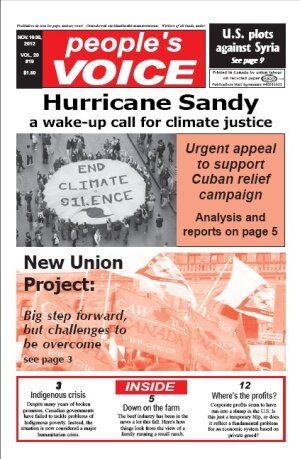
1) MCGUINTY ON COLLISION COURSE WITH COMMON FRONT
2) CLIMATE CHANGE: THE CHALLENGE OF HURRICANE SANDY
3) NUP: A STEP FORWARD OR JUST ANOTHER MERGER?
4) SOCIAL ASSISTANCE REVIEW: BRIGHTER PROSPECTS OR DEAD END?
5) IS THIS THE END OF FAMILY FARMING?
6) NO TIME FOR CELEBRATION - Editorial
7) BEWARE THE DROPPING SHOES - Editorial
8) POWER SHIFT 2012 QUESTIONS SYSTEM
9) SASKATCHEWAN LABOUR READY TO FIGHT BACK
10) INDIGENOUS PEOPLES FACE HUMANITARIAN CRISIS IN CANADA
11) CANADIAN NETWORK ON CUBA LAUNCHES "SANDY RELIEF FUND"
12) STATEMENT ON THE CONFLICT IN SYRIA
13) LIFE DISPROVES GORBACHEV'S "UNIVERSAL HUMAN VALUES"
14) TIME TO CELEBRATE 100 YEARS OF GHADAR PARTY
15) WHERE HAVE ALL THE PROFITS GONE?
PEOPLE'S VOICE NOVEMBER 16-30, 2012 (pdf)
|
People's Voice deadlines: December 1-31 January 1-31 Send submissions to PV Editorial Office,
|
REDS ON THE WEB
http://www.parti-communiste.ca/
peoplesvoice.ca
www.ycl-ljc.ca
www.solidnet.org
|
People's Voice finds many "Global Class Struggle" reports at the "Labour Start" website, http://www.labourstart.org/. We urge our readers to check it out! |
* * * * *
People's Voice
Canadian Publications Mail Sales Product Agreement #205214
ISSN number 1198-8657
People's Voice is published by
New Labour Press Ltd
PV Editorial Office
706 Clark Drive,
VANCOUVER, B.C. V5L 3J1
Phone:604-255-2041
Fax:604-254-9803
email: pvoice@telus.net
Editor: Kimball Cariou : Business Manager: Sam Hammond
Editorial Board: Kimball Cariou, Miguel Figueroa,
Doug Meggison, Naomi Rankin, Liz Rowley, Jim Sacouman
* * * * * *
Letters
People's Voice welcomes your letters
on any subject covered in our pages.
We reserve the right to edit for length and clarity,
and to refuse to print letters which may be libellous
or which contain unnecessary personal attacks.
Send your views to:
"Letters to the Editor",
706 Clark Dr., Vancouver, BC V5L 3J1,
or pvoice@telus.net
People's Voice articles may be reprinted without permission,
provided the source is credited.
* * * * * *
The Communist Party of Canada, formed in 1921,
has a proud history of fighting for jobs, equality, peace,
Canadian independence, and socialism.
The CPC does much more than run candidates in elections.
We think the fight against big business and its parties
is a year-round job,
so our members are active across the country,
to build our party and to help strengthen people's movements
on a wide range of issues.
All our policies and leadership
are set democratically by our members.
To find out more about Canada's party of Socialism,
give us a call at the nearest CPC office.
* * * * * *
Central Committee CPC
290A Danforth Ave Toronto, Ont. M4K 1N6
Ph: (416) 469-2446
fax: (416) 469-4063 E-mailmailto:info@cpc-pcp.ca
Parti Communiste du Quebec (section du
Parti communiste du Canada)
5359 Ave du Parc, Montréal, Québec,
H2V 4G9
B.C.Committee CPC
706 Clark Drive, Vancouver, V5L 3J1
Tel: (604) 254-9836
Fax: (604) 254-9803
Edmonton CPC
Box 68112, 70 Bonnie Doon P.O.
Edmonton, AB, T6C 4N6
Tel: (780) 465-7893
Fax: (780)463-0209
Calgary CPC
Unit #1 - 19 Radcliffe Close SE
Calgary AB, T2A 6B2
Tel: (403) 248-6489
Ottawa CPC
Tel: (613) 232-7108
Manitoba Committee
387 Selkirk Ave., Winnipeg, R2W 2M3
Tel/fax: (204) 586-7824
Ontario Ctee. CPC
290A Danforth Ave., Toronto, M4K 1N6
Tel: (416) 469-2446
Hamilton Ctee. CPC
265 Melvin Ave., Apt. 815
Hamilton, ON.
Tel: (905) 548-9586
Atlantic Region CPC
Box 70 Grand Pré, NS, B0P 1M0
Tel/fax: (902) 542-7981
http://www.parti-communiste.ca/
* * * * * *
News for People, Not for Profits!
Every issue of People's Voice
gives you the latest
on the fightback from coast to coast.
Whether it's the struggle for jobs or peace, resistance to social cuts,
solidarity with Cuba, or workers' struggles around the world,
we've got the news the corporate media won't print.
And we do more than that
- we report and analyze events
from a revolutionary perspective,
helping to build the movements for justice and equality,
and eventually for a socialist Canada.
Read the paper that fights for working people
- on every page, in every issue!
People's Voice
$30 for 1 year
$50 for 2 years
Low-income special rate: $15 for 1-year
Outside Canada $50 for 1 year
Send to: People's Voice, 706 Clark Drive, Vancouver, BC, V5L 3J1
You can call the editorial office at 604-255-2041
REDS ON THE WEB
http://www.parti-communiste.ca/
http://www.ycl-ljc.ca/
http://www.solidnet.org/
(The following articles are from the November 16-30, 2012, issue of People's Voice, Canada's leading communist newspaper. Articles can be reprinted free if the source is credited. Subscription rates in Canada: $30/year, or $15 low income rate; for U.S. readers - $45 US per year; other overseas readers - $45 US or $50 CDN per year. Send to People's Voice, c/o PV Business Manager, 706 Clark Drive, Vancouver, BC, V5L 3J1.)
1) MCGUINTY ON COLLISION COURSE WITH COMMON FRONT
By Liz Rowley
Premier Dalton McGuinty's unofficial pact with the Tories to dismantle free collective bargaining and the right to strike in Ontario's public sector is starting to stink in the Liberal leadership race. McGuinty has stepped down as leader, and will resign as Premier following the Jan. 25 Liberal convention. Most of the declared candidates say they don't need legislation to secure new contracts, and want to repair relations with the teachers' unions and others in the broader public sector.
Front runners Sandra Pupatella and Gerard Kennedy, who have both been out of the Legislature for several years, are particularly critical of McGuinty's anti‑labour Bills, and his decision to prorogue the Legislature.
While the Legislature sits idle, McGuinty is seeking to force public sector unions to "voluntarily" comply with a compulsory two-year wage freeze and other concessions, affecting 481,000 workers and 3,200 collective agreements. He is also trying to work out a deal with the Tories, who are campaigning to eliminate the Rand formula and the closed shop. This is McGuinty's big stick as he pushes union leaders to negotiate wage cuts, since that's what the freeze really means.
Teachers and educational workers in Ontario's English public schools have already been saddled with Bill 115. This legislation forces education unions and elected School Boards to "negotiate" agreements that mirror the wage freeze, pension changes, and changes to the grid, that were accepted by leaders of the English Catholics teachers' (OECTA) and French teachers' unions last summer. Bill 115 enables the Cabinet to impose such agreements, removes the right to strike, and prevents unions or school boards from challenging the legislation in court.
The Ontario Secondary School Teachers, Elementary Teachers, and CUPE have launched a Charter challenge to the legislation, and the Ontario Public School Boards Association has sought intervenor status in the challenge.
Negotiations between OSSTF and the government broke off Nov. 12 after the province made clear that it will not rescind its prohibition on free collective bargaining and the right to strike, despite the union's offer to accept a wage freeze. In response, teachers in secondary schools will end extra‑curricular activities, hall supervision, covering for absent colleagues, attending parent‑teacher conferences, etc.
Public sector union leaders have all made clear that the main issue is free collective bargaining and defence of public services. The OFL is gearing up for a Dec. 8 gathering of the "We are Ontario Common Front," the coalition of labour and its social and community allies formed last April to defend public services and labour and democratic rights.
Built on the model of the "We Are Wisconsin" coalition, the Common Front aims to stop the anti‑labour, anti‑people directions of Ontario's minority Liberal government with mass, independent labour and community political action.
OFL President Sid Ryan has indicated that the Days of Action against Mike Harris in the 1990s are a good example of the kind of action needed to head off this right‑wing agenda. The OFL has put much time and energy into organizing across the province, involving the student movement, anti‑poverty groups, housing advocates, healthcare advocates and the OHC among many others. The Communist Party is the only political affiliate, though many NDPers and some Greens are participating.
But others are more interested in the NDP's positioning in a provincial election expected next spring, following the Speech from the Throne and a new budget. The soft policies of the NDP caucus are not to be criticized, according to this thinking, and labour's resources should be directed to secure an "Orange Crush" in Ontario, built on the personal popularity of NDP leader Andrea Horwath and widespread anger at the Liberals.
This dangerous approach is no guarantee that the Tories will not be the main beneficiaries of a Liberal defeat. Nor is there any guarantee that the NDP would do anything very different than the Liberals. Horwath has stated that her caucus supports a negotiated wage freeze in the public sector, with the underlying argument that workers should pay for an economic crisis caused by the banks and the biggest corporations. This is a party that supports austerity. When it was last in government, the NDP attacked workers' rights and wages with the 1993 social contract.
The Communist Party in Ontario is calling on the labour and people's movements to support the Common Front and move the fight into the streets and workplaces. Sustained and escalating mass action and strikes could force the government to back off its austerity policies, and if it doesn't, to elect a new, more progressive government committed to labour's policies and a People's Agenda.
With this in mind, the Dec. 8 meeting will be very important for labour, and for the fightback overall in Ontario.
2) CLIMATE CHANGE: THE CHALLENGE OF HURRICANE SANDY
By Kimball Cariou
A week before the U.S. election, Mother Nature slammed the Caribbean and the eastern coast of North America. Over a hundred people were killed by Hurricane Sandy, and the damage to property and infrastructure is estimated at $50 billion. The storm devastated the city of Santiago de Cuba (see the Canadian Network on Cuba's relief appeal on page 5), the "Jersey Shore" region, and parts of New York.
The catastrophe may have altered the U.S. campaign, bolstering Barack Obama at a crucial moment, and undermining Republican Mitt Romney, who had previously attacked the need for federal emergency relief measures.
Yet neither candidate addressed the full implications of this massive event. Hurricane Sandy appears to have moved the scientific community from the consensus that human economic activity is driving climate change, to agreement that such storms are already becoming bigger and deadlier.
NASA scientist James Hansen recently wrote in the Washington Post, "It is no longer enough to say that global warming will increase the likelihood of extreme weather and to repeat the caveat that no individual weather event can be directly linked to climate change. To the contrary, our analysis shows that, for the extreme hot weather of the recent past, there is virtually no explanation other than climate change."
To his credit, Barack Obama did mention climate change as "a threat to our children's future". British environmental commentator George Monbiot, writing in The Guardian, says this was virtually the only reference to climate change by either candidate.
Monbiot explained, "There are several ways in which the impacts of Hurricane Sandy are likely to have been exacerbated by climate breakdown. Warmer oceans make hurricanes more likely and more severe. A warmer atmosphere holds more moisture, increasing the maximum rainfall. Higher sea levels aggravate storm surges. Sandy might not have hit the United States at all, had it not been for a blocking ridge of high pressure over Greenland, which diverted the storm westwards. The blocking high - rare there at this time of year - could be the result of the record ice melt in the Arctic this autumn."
This is not just "hindsight". Last February, the journal Nature Climate Change warned that global warming is likely to "increase the surge risk for New York City". As storms intensify and sea levels rise, storm surges described as 100‑year events would become between five and thirty times as frequent.
But when Obama took office in 2009, his strategists decided that climate change was too "controversial" to discuss. The President has talked about clean energy, green jobs and improved fuel economy, never explaining why these shifts are necessary.
This form of avoidance continued through a year of droughts and wildfires across the U.S. interior, the Arctic ice meltdown, and the superstorm that blasted the Caribbean and New York.
Big Oil, however, tackled the issue head-on, both directly and through its political surrogates. In the Republican platform, "climate change" was mentioned only to attack Obama for taking it seriously. The Republicans called for new coal projects, support for the Keystone XL tar sands pipeline, and oil drilling on the outer continental shelf and the Arctic National Wildlife Refuge.
A coalition of green NGOs managed to raise $22 million for election lobbying, only to be outspent by Exxon, which poured $27 million (one-half of one day's profits) into a counter‑campaign.
So what can be done?
As Canada's David Suzuki writes, "The damage of climate change will get worse if we fail to act. And, it will devastate the one thing that many corporate and government leaders put above all else: that human creation we call the economy - the very excuse many of our leaders use to block environmental protection and climate action."
Suzuki points to some "relatively simple" steps: conserve energy, put a price on carbon through taxes and cap‑and‑trade, and shift from fossil fuels to clean and renewable energy sources. He calls for reductions in auto use and air travel, and "shifting from rampant consumerism to a more conservative way of living." Rapid tar sands expansion, he says, is incompatible with action to stop global warming.
But in spite of Dr. Suzuki's appeal to "rethink the ways we measure progress and govern our economies," he fails to name the elephant in the room: the capitalist economic system, which demands constant growth, more intense exploitation of labour power, and imperialist wars to seize natural resources.
The "rethink" we do need is a plan to put all energy resources under public ownership and democratic control, and a strategy to use those resources far more carefully to create an economy based on reduced fuel consumption. In other words, a socially-owned economy focused on the needs of people and the environment, not the corporate drive for maximum profits.
The measures urged by David Suzuki and other environmentalists are important reforms. But until the economic and political domination of the big capitalist monopolies is ended by working class power, a truly green, sustainable, peaceful, socialist future will remain out of our grasp. To meet the challenge posed by Hurricane Sandy and climate change, we need to build a powerful People's Coalition, bringing together the organized labour movement, environmentalists, Aboriginal peoples, and all sections of the people whose lives are being sacrificed by Big Oil.
(Kimball Cariou is the editor of People's Voice)
3) NUP: A STEP FORWARD OR JUST ANOTHER MERGER?
By Sam Hammond
If contradiction, whether antagonistic or not, is the propellant of motion, then the velocity of the New Union Project is certainly understandable. The dominant contradiction is objective and has a history: the history of Canadian labour and the class struggle that sets the backdrop for the phenomenon of The New Union Project. The irreconcilable interests of labour and capital define this contradiction.
The contradictions and debates within labour, no matter how sharp, can be viewed as non‑antagonistic, even creative, except where capital (ideological, physical or both) fifth‑columns itself into the Labour movement as it has from Cold War McCarthyism to the present. Objectively speaking, the penetration of the neo‑liberal agenda by recognizable degrees ‑ acceptance, apathy, or even outright advocacy ‑ are all symptoms of corporate ideological intrusion.
The other side of the contradiction is the history of courageous and real struggles, waged by the people over generations, to win the social programs that we are trying to defend. Unity and renewal requires an independent working class program with an historical objective, and a departure from acquiescence, collaboration and defeatism. Any move forward must be propelled by resistance to the corporate agenda. Failure to do so means loss and retreat; there is no neutral gear in this vehicle.
This is what makes the New Union Project of such vital importance. The NUP moved through its second stage in October, with the unanimous support of the CEP Convention in Quebec City. The excitement and hope generated within the labour movement, and particularly amongst progressive activists, received another boost as the groundwork for the founding convention of the new union was confirmed. It is a fact now, it will happen.
Whatever contradictions exist now, resolved or not, will determine whether the dream of renewal and fightback becomes reality, or wakes up to another larger version of the same‑old same‑old. Another merger, with more members and not much else, would be a tragedy, because within the vision of the organizing committee lies a new level of development and a new direction for Canadian labour, enthusiastically supported across the working class and watched warily by the corporate opposition.
The founding of the CAW in 1985 was carried out in an environment of militant rejection of concessionary bargaining, refusal to bow to the Detroit Three, and the determination by Canadian autoworkers to be masters in their own house. The birth of CEP had its own characteristics, but it emerged and grew because it had the militancy and strength to provide a home for smaller unions (as did the CAW) who had to reorganize because of changing technology and demographics. Both unions added new chapters to Canadian labour and generally strengthened the working class. These are the traditions needed now in a new and more aggressive form. They must be elevated and built upon.
But over the years, in a chain of bitter decisions and skirmishes, within the two unions and between them, there have also been processes and trends that threaten the proposed renewal. The threat is like a serpent with two heads sharing a common body.
Within the two unions, under tremendous legal and economic corporate/government pressure, concessionary bargaining that started as a rearguard action developed into negotiating tactics that will be hard to reverse, especially with the auto makers. The acceptance of two‑tiered wages, pensions, etc. is absolutely incompatible with the stated goals of the New Union Project, but took place concurrently as the CAW leadership adroitly came to the crossroads and went both ways. In CEP, the paper industry has pried concessions from the union on a different scale, but they are there as well.
The Strategic Vision Document adopted at the October CEP Convention contains within it the other serpent's head, which put the two unions at loggerheads during the Days of Action against the Harris Tories in 1997. CEP was one of the larger "Pink Paper" unions that advocated withdrawing from extra‑parliamentary struggle, abandoning social justice partners and contracting out political struggle exclusively to the NDP. The Strategic Vision document calls for unqualified support for the NDP, and political campaigning to elect first NDP federal government in history.
Without qualification or programmatic guarantees, this means agreement with the NDP's acceptance of Harper's military budget, the bombing of Yugoslavia and Libya, future support for attacks on Syria, support for Israeli occupation of Palestine, no real fight against free trade, and probably acceptance of CETA. The list is longer. This is not an attack ‑ it is an observation of the NDP's performance.
The acceptance of the neo‑liberal agenda by social democracy globally, and its role as implementers in many countries, is also reflected in the NDP agenda in Canada. This role is in direct contradiction to the program and ideology in the New Union Project, and to most of the Strategic Vision Document. Social democracy's historic position is to accept capital, to support the unattainable reform of capitalism, as an alternative to the struggle for real working class and people's power. If this ideology is not rejected, it will ultimately destroy renewal, just as it has led to the present environment of defeat.
The most creative and productive way forward is through the debates over how to build appropriate democratic structures, and over inclusion of the unemployed, Aboriginal peoples, racialized communities, LGBT and social justice activists, environmentalists, peace groups, the women's movement. In the resolution of these structural and program items is the birth of something new and needed. It is difficult to see anything antagonistic or non‑productive in such debates.
But the debate over unqualified support for the NDP contains within it the relationship to capitalism itself. The historic resistance of the NDP to coalitions and united front movements is one of sectarianism and class propriety. It will not allow these formations to develop without interference and control.
The two‑headed monster of concessionary acquiescence and politics contracted out to social democracy is a threat to the New Union Project. On the other hand, extra‑parliamentary movements, militant action, inclusive coalition partnering, and an adversarial labour movement will force Parliament and parliamentary parties to adopt the agenda of the masses or disappear. The broadest possible involvement and the most inclusive social forces can make the dreams of millions into reality.
4) SOCIAL ASSISTANCE REVIEW: BRIGHTER PROSPECTS OR DEAD END?
The Communist Party of Canada (Ontario) has expressed deep concern over the Report of the Social Assistance Review Commission (SARC). Here are excerpts from a statement by the party's Ontario Committee.
Four years into the deepest economic crisis in recent memory, the official provincial unemployment rate is over 8%, youth unemployment is at 20%, and nearly one million Ontarians relying on social assistance. The federal government's attacks on pensions and Employment Insurance benefits add to this "perfect storm against the poor". People would be justified in expecting radical proposals and real action from the SARC.
Unfortunately, the recommendations fall far short of what is needed to reduce and eliminate poverty in Ontario. Worse, the provincial Minister of Community and Social Services, John Milloy, has indicated that the report's meagre improvements, such as increasing assistance payments by $100 per month, will not be implemented...
There are some very modest reforms in the SARC Report, but this thin veneer of progressiveness cannot salvage a deeply flawed set of proposals. The main objective of the SARC Report is not to increase assistance rates and improve services, but to reduce the number of people receiving social assistance. Instead of reducing poverty, by guaranteeing a liveable income for all Ontarians, the SARC and the Ontario government seem more interested in playing with statistics. The main vehicle for reducing recipients is the proposed elimination of the distinction between the Ontario Disability Support Program (ODSP) and Ontario Works (OW) categories. The report recommends a new formula for determining assistance rates, but does not specify what that formula would be. In any case, rates are tied to the provincial minimum wage, which is wholly inadequate; basing assistance rates on a benchmark that is already too low is only a guarantee of poverty.
While the report does recommend an increase of $100 in assistance payments, this is simply not enough. It would take a 56% increase in assistance rates to bring them back to the levels before the Harris government's vicious 22% cut; even then, the rates are far below poverty levels. Disappointingly, the SARC accepts that the $100 increase will be offset through the elimination of other benefits, like the Special Diet Allowance (SDA) and the Community Start Up and Maintenance Benefit (CSUMB).
Similarly, the report recommends an increase in the earnings exemption of people receiving social assistance and employment income. In principle this is a welcome idea, but while the SARC's proposal would enable (although not guarantee) a significant increase in income level, it would still leave recipients with a maximum annual income of less than $12,000, 40% below the official poverty line.
The inadequacies of the SARC Report are compounded by the brutality of the provincial government, which has already moved to cut social assistance benefits. In particular, the elimination of the CSUMB, due to end in January 2013, abandons thousands of poor people to homelessness and slams the door on women in poverty who are trying to leave abusive situations. Furthermore, the Liberals have already virtually eliminated the SDA by changing the eligibility rules to exclude nearly everyone who needs it.
One of the SARC Report's more insidious proposals is to create "Employer Councils", as a vehicle for moving people off assistance and into the workforce, meeting "employers' needs". People living in poverty clearly need a liveable income, and decent jobs are clearly a key method for achieving this.
However, the SARC recommendation reeks of Mike Harris' workfare on steroids. At a time when corporations and right‑wing governments are using every possible weapon to drive down wages, reduce pensions and benefits, and weaken unions, this recommendation is an early Christmas gift for the bosses. It is a classic and cynical capitalist scenario ‑ create a huge population of poor and unemployed people, then prey upon their desperation to weaken the working class as a whole...
The Communist Party of Canada (Ontario) joins with other voices in the labour, anti‑poverty and social justice movements in expressing disappointment with the SARC recommendations, and outrage at the government's dismissal of even a paltry $100 increase in assistance.
Ontario Communists are promoting a "10‑Point Prescription for a People's Recovery". This plan includes measures to curb corporate power and put people's needs before profit, one whose implementation would be a significant step toward opening the door to socialism.
The depth of poverty in Ontario demands immediate attention. There is unprecedented wealth in the province, more than sufficient to provide a liveable income for all. What is lacking is the political will to make the necessary changes, to make the wealthy and corporations pay their fair share of taxes so that assistance rates can be sufficiently increased.
The SARC Report does indeed promise "Brighter Prospects", but the main beneficiaries are corporations and the rich. They will see their power and wealth undiminished while thousands of poor people are placed into the workforce at poverty wages, and workers in this "legislated two tier wage system" are pitted against one another. For poor people, the SARC Report offers some small relief but, in the main, continues to channel them toward the same dull dead‑end.
Alternatives are possible, but they won't materialize without a strong, united struggle. The "We Are Ontario" campaign of the Ontario Common Front is currently the key vehicle for such a struggle at the provincial level. The Communist Party calls on the labour and progressive movements to continue to mobilize against austerity, to demand immediate and real action to reduce poverty, and to press for fundamental, progressive reforms that put people before profit.
To view the entire "10‑Point Prescription for a People's Recovery", visit the Communist Party of Canada (Ontario) web site, at www.communistpartyontario.ca.
5) IS THIS THE END OF FAMILY FARMING?
By Graham L. Wilson, Albertan family rancher
For much of my life I have felt like the last of a dying breed, rather than simply one of the next generation. So often I have seen my fellow ranchers, white haired old men in jeans and caps, relics of an age when Alberta's provincial product was raised from the ground and not extracted from underneath it.
Many were either the children of immigrants, or immigrants themselves, such as my late grandfather. The world they describe is unrecognizable from the Alberta of today, long before we became so "prosperous". They remember when being a farmer was not only sustainable, but sometimes quite lucrative. Sadly, this is no longer true. That time has come and gone.
What is even more striking is that at my tender young age of eighteen I too can remember better times. At no point in my life has our family ranch been more than a "hobby" operation, demanding the external employment of my father and older brothers to stay afloat - something which speaks volumes in itself.
However, I can recall some happier childhood memories of "calf cheques" and the spells of financial freedom they provided us. The bunk‑bed of my twin brother and I, for example, was financed through exactly these annual windfalls. A less pleasant memory, several years later, was that after expenses, all the calf money could purchase was a new toilet seat. What changed a profitable side interest into what it is now?
When the mad cow scandal broke out in May 2003, I was nine years old. I was not able to fully comprehend how it would affect my life, and pave the path for all the strife to come. All I can recall was the panic, and the sudden deprivation of those yearly calf cheques. I also recall the varied responses to the panic, such as Premier Ralph Klein's infamous "shoot, shovel and shut‑up", and the disloyalty of American ranchers' organizations like R‑CALF. Believing that by closing off their Canadian compatriots they would win out, they broke solidarity with the rest of us and unwittingly fell into the interests of the large agricultural companies.
Even so, we did emerge out of the crisis, battered and bruised, but still standing. Although now hardly profitable, we continued to break even: the price fetched for our calves paid for the cost of feeding the herd over the winter. This security proved vital to our continued operations when the other link in the chain broke. My father lost his embedded technology job after the fall of that great capitalist boondoggle, the Dot‑Com Boom, leaving him underemployed for the best part of a decade. It was a difficult balance, but we continued to work it out such that both bovine and human continued to be fed, sheltered and healthy.
Still, the industry continued to stagnate, as the large agricultural corporations continued their efforts to push out small farmers. The margin to pay for our feed became smaller and smaller, until finally a few years ago we started coming in at a loss. The enterprise of three generations of my family had finally become a liability. It was now financially poisonous to maintain our lifestyle and to retain our family traditions. This is particularly alarming given the relatively low inputs required: winter feed and the occasional salt block or fence repair. Conceivably, our operations should be sustainable and self‑sustaining. We thought that this was going to be pretty much the lowest it could get.
This year has proved us wrong. We are now facing the choice between selling our calves at rock‑bottom prices, or retaining them over the winter and hope for better in the spring. Since we were fortunately able to get a decent deal on hay last summer, it appears that the latter is our best option. But the hay purchase left a stoppage in our cash flow, driving us to the local food bank. For the first time since my father got his new job in June, we had to choose their feed above our own.
This is not just a one off in our case, but a larger issue affecting ranchers across the Prairies and beyond, all over the developed world in fact. The reasons for the current crisis are emblematic of the decline in Canadian family agriculture as a whole. The E.coli scandal and the atrocious policies of XL Foods are taking most of the spotlight, and rightly so, but ranchers had been nervous for months before that new revelation came to light.
The United States has spent most of the past year in an extreme drought, devastating the production of hay and corn, which has caused a feed crisis and a mass sell‑off of livestock. This influx of supply has naturally cratered demand in international markets.
Of course, the innate link between the drought and climate change has been largely ignored and under‑reported, along with how this has specifically targeted the most vulnerable. In the face of lower production of their preferred corn‑meal, the large feed‑lots have simply diversified their choices, making sugary swill out of things such as surplus Oreo cookies and gummy worms. This is not an option for those of us who feed our cattle grass and hay, as they are biologically suited to do. With lower hay crops, many farmers across the United States have had no option but to sell their stock or watch them slowly starve.
Thus calamities on both sides of the border have created the perfect storm, and like all such storms produced by the contradictory system of capitalism, the smaller and the poorer operations suffer far more. In the end, it is not the large monopolies like Cargill, Monsanto or XL Foods who foot the bill for our lost livelihoods. No, they will profit from the influx of cheap meat, with no added benefit to consumers or their employees. If it wipes out what little parts of the sector remain independent, all the better. A world where there are no family farmers, and no healthy, happy pasture-raised cattle with room to roam, has been the one they have been working towards for decades. Their crusade, with explicit government backing, has been widely successful.
Unless a drastic fightback takes place in support of family farming, the rural diaspora shall continue until the countryside is filled by nothing more than factory farms, animals treated as industrial materials, and a few tenant farmers on the payroll of their rich masters. In the context of a brewing food crisis across all agricultural sectors and in all parts in the world, due to years of mismanagement, unsustainable policies and the ravaging of climate change, this trend should worry everyone. If new blood such as myself and my brothers are the last of our kind, who will retain the skills needed to pick up the pieces when it all comes tumbling down? How can we ever come back to way we once were? Is this the end of sustainable, healthy, and humane ranching as we know it?
People's Voice Editorial
As U.S. election returns rolled in, most Canadians breathed a sigh of relief. The nightmare of a White House and Congress controlled by ultra-right bigots and warhawks was blocked, at least for the next few years.
Many people had feared that the right-wing corporate media, and "voter suppression" tactics, might help elect Mitt Romney. But the outcome reflects significant demographic and political trends. President Obama won by 3.5 million votes, thanks to support from trade unions, women, the Black and Latino communities, youth, and LBGT groups. These voters rejected the Republican lie that only wealthy, straight, white males "deserve" to govern. In many states, progressive forces won battles over union rights, marriage equality, and other major issues. Both the Democrats and the Republicans are dominated by big capital, but on Nov. 6, the working class majority of the 99% prevailed over the corporate elite, which desperately wanted a Republican president.
Unfortunately, there is no time for celebration. The global capitalist crisis is now in its fifth year, leaving hundreds of millions of working people facing poverty and hunger. The "austerity" attack against collective bargaining, wages, pensions and social programs is becoming even more aggressive. Unchecked greenhouse gas emissions are leading to catastrophic superstorms. The U.S. and its NATO allies still spend nearly a trillion dollars a year on military build-ups, and the threat of imperialist wars against Syria and Iran remains very real. The re-election of President Obama does not end the drone war against Pakistan, or the brutal Israeli occupation of Palestine.
These problems require mass mobilization of the working class and its allies, both on immediate demands, and around the compelling necessity to end capitalist exploitation. The U.S. election shows that the far right can be blocked at the polls, but this is just the first step in the fight for a better world.
People's Voice Editorial
In Stephen Harper's Canada, there's no point in waiting for the next shoe to drop. The real trick is to avoid the barrage of shoes flung by this far-right government.
Just as Canadians are fighting back against more secret trade deals and another omnibus budget bill, the Tories have announced plans to privatise federally-funded social programs. Human Resources Minister Diane Finley has issued a "call for concepts", asking businesses, not‑for‑profits and the volunteer sector to provide so‑called "fundamentally new ideas." Finley says the government wants to tap into a "gold mine" of private‑sector funding. Yes, there's a gold mine here - for the corporations.
The neoliberal concept is that the private sector will provide the capital for projects that the federal government currently operates (perhaps Employment Insurance?). It's simple, Minister Finley says - pick a corporation or a not-for-profit to do the work, and the government pays the bill, naturally including a return on investment. If the program's objectives are met, the government even adds a premium.
There's no need to test drive this abomination, which has been tried here and in other countries, with predictable results. Taxpayer dollars become private profits. Program recipients are shafted, universal coverage goes out the door. The rich get richer, the poor get poorer. Not-for-profits which currently offer important services either get trampled in the mad rush for contracts, or turn into mega-bodies which act like corporations, complete with fat bonuses for their new CEOs.
Contrary to some arguments, Harper's gang don't want to "downsize" the state. They do want to eliminate social programs while boosting the military, the police, the courts and the prison system. It's a short and slippery road to hell. We can't let it happen.
8) POWER SHIFT 2012 QUESTIONS SYSTEM
By Johan Boyden
Over a thousand youth, students and young workers gathered at the University of Ottawa at the end of October for a busy weekend of presentations, workshops, seminars, and protests about climate change and social issues, under the banner of "Power Shift 2012."
The conference aimed to bring together "a broad, diverse movement to tackle the root causes of climate and change a fundamentally unsustainable economic system based on corporate greed and perpetual growth." The keynote speeches overflowed into three separate university auditoriums, linked by video stream.
Power Shift billed itself as coming at a key moment in history where "the reality of climate change is one of the central challenges of our time, showing the problem of corporate power and the urgent need for alternatives." Conference organizers said that "economic and climate crises we are facing have the same roots ‑ the relentless drive to put short‑term economic profits over the interests of our communities and the environment."
The mood was upbeat, inspired by the youth mobilizations of the past year, the Occupy movement, the Quebec student uprising, and the powerful show of opposition to the expansion of tar sands pipelines and tankers along the west coast.
"I think this is the first time I've been at an environmental conference that is actually talking about the system, not just the symptoms," keynote speaker Naomi Klein told participants.
"For a very long time the climate change movement has behaved as if it were the one issue that didn't have an enemy, and we're all in this together. You are coming of age in a society at war with your future" Klein said to loud cheers, pointing to reactionary governments, big corporations, war and especially the energy industry as the culprits.
Former co‑spokesperson of the CLASSE, Gabriel Nadeau‑Dubois, was equally frank. "The problem is not consumption, it is our economy and production. Our system is broken on a systemic level. The destruction of our environment is a natural and inevitable result" he told the conference, blaming the capitalist system.
"We will not get a second chance. Without radical change we will be faced with extinction. Resistance in these times is not an option, it is a duty", Nadeau‑Dubois said.
Several speakers from Quebec gave the student strike as an example of the power of mass mobilization in the streets, also noting the less‑well known victory against hydraulic fracturing ("fracking") used to extract shale gas.
The new Parti Québécois government of Pauline Marois has indicated serious concerns over the safety and environmental impact of fracking, with the environment minister talking about a full and permanent ban. Currently, fracking is partially banned in Quebec pending the results of two environmental studies. The energy company Talisman suspended all shale gas exploration in October.
A number of delegations, presenters and speakers came from First Nations communities.
"We have one thing that industry and government will never have, and that's the truth" Crystal Lameman with the Alberta‑based Indigenous Environmental Network told delegates. "My children have the right and ... the government has a fiduciary [Treaty] responsibility to give us clean drinking water. And it's not okay that ... when I walk past [the boarder between municipalities], our drinking water is different than others" said Lameman, a member of the Beaver Lake Cree First Nation, about the impact of the Tar Sands on her community and environmental racism.
"It's not okay that my 14‑year‑old niece have an asthma attack, that my son got a bleeding nose. And that's what we're living every single day," Lameman said. "It doesn't matter if you're indigenous or not ‑ it's not okay. This is what our future looks like, because they have desecrated a site the size of Switzerland, and they want to expand it ten times."
The Power Shift conferences were first organized in Australia, New Zealand, Britain and Canada after a US conference kicked‑off the initiative. Future meetings are planned for India, Africa and Japan.
From the beginning, Power Shift has drawn a broad range of voices speaking out against climate change. The US conferences have featured speakers from former US Vice‑President Al Gore, to journalist and activist Bill McKibben.
McKibben (founder of the group 360.org which uses social media to coordinate climate change protests globally) also spoke in Ottawa. He called on young people not to fear non‑violent civil disobedience to halt plans like the Enbridge Northern Gateway or Keystone XL pipelines, and spoke of his arrest last August outside the White House, along with about 70 other activists protesting Keystone XL.
A series of workshops dealt with activist training, led by campus, community and labour activists. Many local student unions as well as the Canadian Federation of Students sent delegates and trainers. While the contribution of the labour movement to Power Shift was smaller, a number of young workers came from unions including the CAW and CEP.
Training sessions addressed anti‑oppression and environmental justice, explained climate change issues, policy and science, and discussed questions like indigenous perspectives and working together in local action. There was discussion of direct action as well as lobbying, perhaps reflecting a certain lack of consensus around a common strategy.
Future preparations are focusing on the international climate negotiations, building links with social justice issues, and further campus and community training to draw more young people into the environmental movement.
9) SASKATCHEWAN LABOUR READY TO FIGHT BACK
By Darrell Rankin
The Brad Wall government's surprise 90‑day comprehensive review of provincial labour law was the main focus of the Oct. 31‑Nov. 3 Saskatchewan Federation of Labour convention. Delegates were solidly united to fight should the government revoke the 40‑hour work week or make Saskatchewan a "right to work" province - ending the closed shop.
Nearly 600 delegates heard labour minister Don Morgan say on the last day of the convention that the still‑secret labour law is not "an attack on unions." But the high number of labour fed presidents in attendance was a sign that Canada's entire union movement is watching carefully.
Held last spring, the review could be the opening salvo in a much broader attack against labour rights across the country. The responses posted online showed that corporations used the opportunity to create an anti‑labour wish list.
The review backfired, creating widespread alarm and unity among labour activists. The NDP, Wall's main opposition in the Legislature, held its own hearings with broader input, recommending to keep existing laws and to index the minimum wage to inflation. The Communist Party's response (heavily censored on the government's website), proposes ways to create good‑paying jobs, strengthen labour rights (e.g., ban scabbing), and end discrimination, among others.
Delegates were roused by SFL president Larry Hubich's opening remarks, and gave two other federation presidents standing ovations - Ontario's Sid Ryan and Alberta's Gil McGowan. Also attending was MFL president, Kevin Rebeck.
"Why target working people and their organizations?" said Hubich. "(I)n spite of attempts by governments... who have tried to convince people that life in Saskatchewan is about letting everyone fend for themselves... their unions have always worked for a world that is fair and just."
"We believe that our goal is to make life better, together. Not to pave the way for corporations to do whatever they want or take whatever they want from our province, and that corporations should only be allowed to operate in a community if they improve the lives of the people that live in the community."
If Don Morgan's comments at the convention are serious, Wall and his corporate backers are thinking twice about carrying out a full blown assault. Saskatchewan's trade union movement isn't asleep. Instead, hundreds of delegates rallied at the provincial legislature in support of labour rights, and many spoke from the floor against growing inequality and low wages.
10) INDIGENOUS PEOPLES FACE HUMANITARIAN CRISIS IN CANADA
Excerpt from an article by Pam Palmater, a Mi'kmaw citizen and member of the Eel River Bar First Nation in northern New Brunswick. She heads the Centre for Indigenous Governance at Ryerson University. For the full article, visit http://indigenousnationhood.blogspot.ca.
This blog post is not an official report, but is modeled off situation reports from international groups and organizations about specific crises in othercountries. Canada portrays itself as a model nation but always hides the darker side of the historic genocide perpetrated on Indigenous peoples and the aggressive assimilatory actions it is taking currently ‑ which only serve to make poverty in First Nations much worse...
Although the Government of Canada has been presenting a picture of stable relations with and improved living conditions for Indigenous Nations, the reality on the ground shows many Indigenous individuals, families, communities and Nations suffering from multiple, over‑lapping crises. Although federal, provincial, Indigenous and independent researchers have all verified the crises, Canada has refused to act. This is resulting in the pre‑mature deaths of hundreds, even thousands of Indigenous peoples every year. Many of those that do survive, do so with higher levels of injuries, disabilities, diabetes, TB, heart disease, and other preventable health issues.
There is a children in care crisis where 40% of children in care in Canada (30,000) are Indigenous children.
The crisis of over‑incarceration of Indigenous peoples in state prisons shows 25‑30% of prison populations are Indigenous and increasing.
The water crisis of 116+ First Nations not having clean water and 75% of their water systems being at medium to high risk is well‑known.
The housing crisis is particularly staggering when you consider that 40% of First Nations homes are in need of major repair and there is an 85,000 home backlog.
There is a growing crisis of violence against Indigenous women with over 600 murdered and missing Indigenous women in Canada. The health crisis results in a life expectancy of 8‑20 years less for Indigenous peoples due to extreme poverty.
This does not include the cultural crisis where 94% of Indigenous languages in Canada (47/50) are at high risk of extinction. These are all exacerbated for communities who suffer from massive flooding due to hydro‑electric operations.
The gap between Canadians and Indigenous peoples with regards to education, employment, skills training, food security, water security, health care, and mental health services continues to increase. Statistics are often manipulated by Canada to show that conditions are getting better, but when reviewed over a 20 year period, the statistics are clear that the socio‑economic conditions of Indigenous peoples are on a downward trend. The levels of poverty and ill‑health in northern Indigenous communities are even more acute. Suicide rates are amongst the highest in the world with suicides starting at much younger ages, like 9 years old. While Canada rates in the top 4 countries when measuring the human development index, when Indigenous peoples are isolated, Canada drops to 78th.
Indigenous Nations in Canada have attempted to work with federal and provincial governments to address these crisis areas, all to no avail. The closest Indigenous Nations came to accessing funding relief for the current crisis was in 2005 when the Government of Canada promised $5 billion over 10 years to address issues like education and housing. This commitment was later withdrawn when the Conservative Party came to power. Since then, Indigenous Nations, through their individual First Nation communities, representative organizations and advocacy groups, continue to try to raise public awareness and get Canada's attention ‑ but have been met with funding cuts, instead of assistance.
These funding and other cuts are in direct violation of Canada's domestic laws, legislated mandates and legally binding treaties and other agreements with Indigenous peoples. Indigenous peoples in Canada have been in a state of prolonged crisis and casualties continue to increase. The situation has become critical and many Indigenous individuals and communities are in need of immediate emergency assistance. Other communities not in a crisis, still require that their treaties be upheld, their stolen lands be returned and they have a fair share of the wealth that comes from their traditional territories in order to be self‑sustaining...
For more information, see Palmater's article "Stretched Beyond Human Limits: Death By Poverty in First Nations," in the journal Canadian Review of Social Policy: http://pi.library.yorku.ca/ojs/index.php/crsp/article/viewFile/35220/32057
11) CANADIAN NETWORK ON CUBA LAUNCHES "SANDY RELIEF FUND"
At 1:25 a.m. on Oct. 25, Hurricane Sandy entered Cuba, just west of Santiago de Cuba. as a category 2 hurricane. However, the extent and speed of Sandy gave it a destructive capability as great as any of the category 5 hurricanes. Its central path took it rapidly through the provinces of Santiago de Cuba, Holguin and Guantanamo, the former two provinces being the most populous in Cuba after the City of Havana.
The hurricane devastated the heroic city of Santiago de Cuba, destroying houses, damaging public buildings and monuments, leaving the city without water supply, electricity, shops, markets and trees. Despite massive evacuations, it took a toll of some 11 human lives, an unusually high number in Cuba for hurricanes (mainly by collapsing buildings). 132,733 houses were affected with 15,322 totally destroyed and 43,426 losing roofs. Massive damage, not yet fully calculated, was caused in Guantanamo and Holguin before the hurricane left this province near Banes, precisely where hurricane Ike had entered four years earlier.
President Raul Castro, visiting Santiago de Cuba on Oct. 28, said that only urgent temporary measures can be taken and that the recovery of Santiago would take years.
The emergency measures are well underway. Roads to healthcare centres and other essential services were speedily cleared. Linemen have been arriving from seven provinces to work together with local ones to restore electricity and telephone services. Roofing materials are arriving from neighbouring provinces such as Las Tunas. Temporary systems have been set up to provide 85% of the affected population with drinking water, and food supplies have been arriving to Santiago and other severely affected parts of eastern Cuba. Cultural activity has not been overlooked, with some cultural centres being promptly reopened, with artists from different parts of the country joining local artists in lifting the spirits of the people.
Good friends of Cuba have also been prompt to supply assistance. Venezuela, for example, has given 650 tons of help including non‑perishable food, drinking water and heavy machinery to Cuba, with some going to Haiti. However, the need remains great. Cuba continues to give its help to Haiti, which, although not directly hit by Sandy, suffered much destruction from flooding, with scores of lives lost.
Cuban provinces as far east as Villa Clara and Cienfuegos suffered from high winds and flooding due to heavy rainfall.
Canadians have responded generously in the past to disasters affecting Cuba and other Caribbean countries suffering from natural disasters. With great gratitude we recall that from coast to coast they responded to requests from the Canadian Network on Cuba, the umbrella group representing friendship organizations with Cuba. We forwarded to Cuba after 2008, when the country was ravaged by three hurricanes, more than $404,000.00.
When on January 12, 2010, Haiti suffered the horrific earthquake, the CNC, recognizing that the most effective way of helping Haiti was through Cuba, mounted its TO CUBA FOR HAITI Campaign, which so far has collected and sent to the Cuban Medical Brigade in Haiti $453,728.12.
Cuba needs substantial help, both immediate and long term, to overcome the crisis brought on by hurricane Sandy. Cuba's Ministry of External Commerce (MINCEX) is establishing an account to receive the financial contributions. As in all our previous fundraising efforts, every single penny donated will go to Cuba. Charitable tax receipts will be provided.
Our experience with regard to Cuba's response to natural disasters is that it knows how to multiply the value of any donations it receives. We feel confident, based on the island's unsurpassed humanitarian work both within Cuba and in other countries, that it has the skills, the organization and the ethical and moral values to put whatever aid it receives to the best possible use.
The CNC urges everyone who can afford to do so to support this effort by giving a donation:
1) payable to your local Friendship organization and please also write "CNC Sandy Relief Fund" on your cheque's memo line. They will forward the info/money for tax receipts to the Mackenzie‑Papineau MF.
2) payable to the "Mackenzie‑Papineau Memorial Fund" and mail to the Mackenzie‑Papineau Memorial Fund, Att: Sharon Skup, 56 Riverwood Terrace Bolton, ON, L7E 1S4. Please also write "CNC Sandy Relief Fund" on your cheque's memo line.
Charitable receipts will be issued by the Mackenzie‑Papineau Memorial Fund in 4‑8 weeks (Charitable Org ‑ Revenue Canada Reg, #88876 9197R0001). There will be no administrative charges, not even for postage stamps or anything else.
Keith Ellis, Coordinator, CNC Sandy Relief Fund (905-822-1972; zellis@yorku.ca)
Isaac Saney, CNC Co‑Chair and National Spokesperson
Elizabeth Hill, CNC Co‑Chair and Treasurer
12) STATEMENT ON THE CONFLICT IN SYRIA
Joint Initiative of the Parties that participate in the International Communist Review, from http://solidnet.org
Imperialism, disguising its face under the banner of the "Syrian opposition," has embarked upon a bloody assault on the Syrian people. After a brief period of confusion regarding the incidents in Syria, the haze has cleared. There is now no doubt that the rebel group, the so‑called "Free Syrian Army" (FSA), which is involved in an armed struggle against the Syrian government is sponsored by the US led imperialism, its counterpart the European Union and its regional clients including Saudi Arabia, Qatar and Turkey. Not only do they politically endorse the FSA but also finance its activities, train its militia and supply arms for their "holy" struggle.
Although the Syrian people have their own reasons for opposing the Assad regime, the ongoing campaign against the Syrian government does not reflect the will and demands of the Syrian people. The current conflict in Syria cannot simply be defined within the "people versus the dictator" template. Recent regime changes in the Arab world and primarily the notorious overthrow of the Libyan government demonstrated that the imperialists have been exploiting this template to draw support for imperialist intervention in the Middle East. Their goal is to stage the similar scenario in Syria.
The developments in the region express the intensification of the imperialist aggressiveness and the sharpening of the inter‑imperialist competition for the acquisition of new markets and the exploitation of the natural resources in the region. The aggression of the USA, NATO, EU and their allies against Syria serves this very goal and aims at the imposition of a government that totally complies with the imperialist dictates and loyally serves their interests. These imperialist forces openly state that through regime change in Syria they aim to isolate and weaken Iran as well. In this sense, it is not a coincidence that plans for a military offensive against Iran have been recently brought to the table again.
Since the attack against Syria is part of a greater strategic plan by the United States regarding the Middle East, other international actors are inevitably getting involved in the issue. Russia, confident of the capacity of the Syrian regime to resist against the ongoing assault, has sided with the Assad government.
In the region the U.S. government works in close collaboration with Saudi Arabia, Qatar and Turkey. These warmongers have been pouring money, arms and even importing international jihadists into Syria. Under these circumstances, the peoples of Syria who have different ethnic and religious identities are worried for their future and for the future of Syria as a secular and multi‑ethnic country.
Turkey, which shares borders with Syria, not only hosted meetings to establish a unified Sunni opposition against the Syrian regime but also deployed the Sunni‑Islamist militias in its border cities. In the refugee camps built within Turkey's borders, the militias are living among the civilian refugees, an open violation of international regulations regarding refugee camps. Additionally, in separate military camps, CIA and MOSSAD alongside Turkish intelligence forces are training the Syrian militias. We stress that the tension on the Turkish‑Syrian borders is particularly dangerous and note that the majority of the people in Turkey is against any intervention in Syria.
Furthermore, during the courses of the recent events in the Middle East, we witness that the imperialists and their corporate media and academic mouthpieces label the pro‑imperialist forces as "revolutionary." Doing this, they hope to be able to justify the imperialist interventions in the Middle East in the eyes of the people because forces that are called "revolutionary" demand them.
In this regard, as communist and workers' parties we condemn all kinds of imperialist intervention in Syria carried out either through supporting a group inside Syria to fight against the regime or through direct military operation. We recognize that any method that has been adopted or will be adopted by imperialism in Syria violates the Syrian people's right to self‑determination.
We declare that throughout this imperialist propaganda, the so‑called "revolution" and the intervention have become indissolubly linked. We condemn the apologists for imperialist intervention who praise pro‑imperialist forces including the Islamists now fighting against the Syrian people as "revolutionary".
This is a call from communist and workers' parties to all real revolutionary and peace‑loving forces, to the people's of the region to raise the level of struggle against the imperialist aggression in Syria and the threats against Iran.
13) LIFE DISPROVES GORBACHEV'S "UNIVERSAL HUMAN VALUES"
By Darrell Rankin
The last president of the Soviet Union, Mikhail Gorbachev, is frequently trotted out by our corporate elite as a role model. It is a sad image because of the harm he inflicted on the working class of this world, especially the workers of his own country.
But our establishment loves Gorbachev for his record of concealing troubling matters from the minds of young people. You won't hear him talk about the festering sores of capitalism, about how to create good‑paying jobs, solve injustice to Aboriginal peoples, cut tuition, end poverty, or prevent war. But you will hear him say that youth have a great future if they work hard.
Gorbachev is used as an ideological tool to trump reality and history. A decade after he presided over the counter-revolutionary destruction of the Soviet Union, the average male life expectancy in Russia dropped to 57, by about 15 years. A rapacious class of entrepreneurs ‑ many former communists like Gorbachev ‑ looted Russia's public property.
Outside Russia, the capitalist world was triumphal. The new imperialist diktat was epitomized by the creation of the World Trade Organization in 1994. People with a lingering desire for social change were told "there is no alternative" and "history has ended." But today, people are shaking off this confusion.
The Arab Spring, the left's gains in Latin America, the European resistance to the financial oligarchy, a leap in strike actions, the Occupy movement, and the Quebec student strike are all signs that resistance is growing to global capitalism.
When Gorbachev surrendered to capitalist ideology, capitalists promised a "peace dividend," ending the heavy burden of the arms race. Instead we face a very shaky economic future and permanent, global war.
Capitalism's profiteering also threatens nature on a scale that could kill billions of people. Locked into an endless race to make more profit, our capitalist overlords are ignoring the warnings of scientists about the need to end militarism, tar sands development and reliance on fossil fuels, which all produce enormous profits for the one percent.
We are all doomed unless our guide is "best science," not fast money. Capitalism bears responsibility for the growing economic crisis, for militarism and war, and the impending environmental catastrophe.
So why did Gorbachev depart from Marxism? He was elected to the highest positions in the Soviet Union at a time of dramatic nuclear tensions. An enormous anti‑war movement forced U.S. President Reagan to hold summit meetings with Gorbachev, resulting in the 1987 US‑Soviet Intermediate Nuclear Forces Treaty.
Yet this is when Gorbachev began to yield ideological ground, especially with his idea that universal values would now guide humanity's future. This ignored the rapacious appetite of U.S. military‑industrial corporations. Gorbachev followed a long line of ideological misleaders who argue that capitalism guided by "values" is no different than socialism, so socialism can be safely discarded.
In Gorbachev's words, "We are entering into a world of new dimensions, in which universal human values are acquiring the same meaning for all and in which human freedom and well‑being and the unique value of human life must become both the foundation and basis for universal security and the supreme criterion by which we measure progress." (Speech at the Second Summit of CSCE Heads of State or Government, Paris, Nov. 19-21, 1990. He first used the concept in a 1988 speech at the United Nations General Assembly.)
What do these fine words actually mean? Are freedom and human values consistent with the capitalist world we see today, which is in a state of permanent war and crises?
"Freedom" means different things to different people. Capitalists want the freedom to cut wages, but workers faced with such a demand view it as unreasonable. To capitalists, the freedom to make a private profit is the highest noble aim, but for socialists, this "freedom" is a threat to working people.
Gorbachev's view that capitalism and socialism would become a happy couple was nothing more than a regurgitation of the "convergence" theory advanced by bourgeois academics ‑ notably in the 1930s and 1970s ‑ to hide the growing failures of capitalism, and the success of socialism in creating a more fair society, defeating Hitler fascism or averting nuclear Armageddon.
The occasional capitalist embrace of "human rights" is a response to the successes of socialism and the working class. It is a way to hide capitalism's failures, like starting two world wars and the nuclear arms threat. For example, the defeat of Nazi Germany led to the Universal Declaration of Human Rights and the United Nations' Charter. The massive strike wave in Canada in the 1970s (the greatest hurrah of the militant unionists who came out of the Depression and War) led to Trudeau's Charter of Rights and Freedoms.
Marxists were never fooled into thinking that "universal values" would give us peace and paradise as long as capitalism rules the roost. The two world systems never converged, but capitalism did gain a temporary upper hand, and the spectre of nuclear war has not been removed.
Despite Gorbachev, we are still in the historic epoch of the transition from capitalism to socialism, and workers still have a world to win ‑ if we can prevent catastrophic new wars and environmental destruction.
14) TIME TO CELEBRATE 100 YEARS OF GHADAR PARTY
By Gurpreet Singh, Surrey, BC
All secularist and progressive groups active in Canada need to get together to celebrate 100 years of the Ghadar Party, a revolutionary movement launched in the U.S. by Indian immigrants who believed in an armed struggle to liberate India from the British occupation.
The Hind Pacific Association, formed with an objective to defeat British Imperialism through armed rebellion, came to be known as the Ghadar (Mutiny) Party after the name of its official newspaper, first published on November 1, 1913. Ghadar gave a call to Indians to take up arms against the foreign invaders, and ran inflammatory articles and poems.
Most of the founders of the Ghadar Party came to Canada and the U.S. for a better life, and had previously worked for the British army. Many believed they were British subjects and trusted in the "fairness" of British rule. However, racism and a hostile environment against immigrants, particularly in Canada, which also was a British dominion, transformed them into political activists.
The British Empire did not come to their rescue when they petitioned for equal rights. Thanks to the indifference of the Empire towards the concerns of its coloured subjects, these men were convinced that until their home country was free, they could not earn dignity abroad. Thus, the ground was ready for the Ghadar Party, giving these men a platform to organize against colonialism.
A number of community activists in Vancouver became members of the Ghadar Party, and also participated in campaigns for equal rights in Canada. Indians were not allowed to bring their families back then. They were disfranchised in 1907, and there was a conspiracy to relocate them to Honduras. An infamous "Continuous Journey Law" was passed to keep Canada white. The Komagata Maru ship carrying over 300 Indian passengers was turned away in 1914 under this discriminatory law.
Many of these Ghadar activists, who returned to India with intent to stir an armed revolt, were hanged or sentenced to life imprisonment. In later years, many became Communists while others joined different political parties.
Though the members of the Ghadar Party were predominantly Sikhs, they decided to keep religion and politics apart. It remained a secular movement throughout its political journey. Some prominent non-Sikh names associated with the Ghadar Party were Pandurang Khankhoje, Taraknath Dass, G.D. Kumar, Barkat Ullah and Hassan Rahim. Of these Dass, Kumar and Rahim were active in Vancouver.
Notably, some of the Ghadar party members tried to save Muslims from Hindu and Sikh extremists during religious violence that followed the partition of India and Pakistan in 1947. The Hindu and Sikh fundamentalists together targeted Muslims on the Indian side of the border during independence.
Ironically, religious fundamentalist groups are now trying to appropriate the Ghadar heroes to justify their own acts of violence. Such appropriation is visible in Vancouver, where those seeking a theocratic Sikh homeland openly glorify the Ghadar activists alongside their own militants. The idea is to justify the armed movement for a separate Sikh nation and confuse ordinary people.
The pro-Sikh homeland group now controls a temple established by the Ghadar activists in Stockton, California. This group celebrated the centenary of the Ghadar Party recently, projecting the founders as devout Sikhs, but deliberately obscuring the contributions of non-Sikh Ghadar activists. It has become morally important for all secularist groups to jointly celebrate the Ghadar Party centenary, and present its true and undistorted image to make the world understand that they were not trigger-happy religious extremists, but social justice activists who believed in equality and not theocracy.
15) WHERE HAVE ALL THE PROFITS GONE?
By Zoltan Zigedy, October 26, 2012, zoltanzigedy@gmail.com
Mid-September marked the fourth anniversary of the Lehman Brothers bankruptcy, widely viewed as the final trigger of the global economic collapse, a shock that remains the dominant factor in global economic life.
Friday, October 19 brought a dramatic drop in US equity values, caused, commentators speculate, by dismal reports of US corporate earnings. The most observant of these commentators did not fail to point out that Friday was also the 25th anniversary of the largest US one‑day percentage drop in stock values. The fact that such an anniversary came to mind reflects a general and widespread fear that more economic turbulence is forthcoming.
The growing gloom overshadows the glowing September report of retail sales released earlier in the week. Despite stagnant or slipping incomes, the US consumer turned to the credit card to boost purchases at retail stores, online, and in restaurants. Signs of an improving housing market also fuelled optimism.
Opinions change quickly. A week earlier, on October 9, the International Monetary Fund released its World Economic Report. While raising fears of a global downturn, the report cut the probability of a US recession by nearly a quarter from its April forecast!
Taken together, the sentiments of the last two weeks demonstrate widespread confusion and uncertainty.
Most of the conversation about the global economy, about capitalism, is shaped by ideological bias, academic dogma, distorted history and wishful thinking.
The global economy has never "recovered" from the shock of 2008. Nor does it teeter on the edge of another recession. In fact, it is fully in the grip of a profound systemic crisis, a crisis that has no certain conclusion. In this regard, the crisis is very much like its antecedent in the 1930s. The popular picture of The Great Depression as a massive collapse followed by the New Deal recovery is myth. Instead, like our current economic fortunes, it was like climbing a metaphorical grease pole - repeatedly advancing a few feet and then slipping down. Serious students of the Great Depression understand that its "solution" was World War II, with its state‑driven, planned, military "socialism."
Of course war itself is no solution, but the organized, collective, and social effort that capitalism only countenances for violence and aggression is a solution. Similarly, the success of the People's Republic of China in sidestepping the harsh edges of the 2008 collapse is due to the remaining features of socialism - public ownership of banks, state enterprises, and economic planning. Never mind that much of the PRC leadership hopes to jettison these features, the advantages are there for all to see. Yet few see.
Distorted history begets foolish theory. The two ideological poles that dominate economic discussion - classical liberalism and Keynesianism - both owe their claimed legitimacy to favoured, but mistaken views of the source and solution to the Great Depression. While expressions of these poles are found across the political policy spectrum, classical liberalism - often called neo-liberalism - is generally associated with the political right.
Political liberals and the left, on the other hand, often advocate for the analyses and prescriptions of the school associated with the views of John Maynard Keynes.
Since classical liberalism has been the dominant economic philosophy governing the global economy for many decades, common sense would dictate that, after four years of economic chaos and general immiseration, neo‑liberalism would be in disrepute. But thanks to the tenacity of ruling elites and the profound dogmatism of their intellectual lackeys, the market fetish of neo‑liberalism still reigns outside of Latin America and a few other outliers.
But Keynesianism - broadly understood as central government intervention in markets - enjoys a growing advocacy, particularly with liberals, leftists, and, sadly, "Marxists." Centrist Keynesians advocate intervention in markets from the supply side, most often through credit mechanisms and tax cuts that encourage investment and corporate confidence. Liberal and left interventionists argue for stimulating economic recovery and stability by generating consumption and expanding demand from government‑funded projects or government‑funded jobs.
The panic of 2008 turned most policy makers toward flirtation with supply‑side intervention and generally meager demand‑based stimulus, a fact that liberal Keynesians like Paul Krugman are fond of pointing out. Only China adopted a full‑blown demand‑oriented stimulus program. Yet that tact also brought a host of new contradictions in its wake.
Austerity versus Growth
Pundits like Krugman and politicians like Francois Hollande posture the theoretical divide as one between austerity and growth, a choice between rational growth stimulation and the irrationality of shrinking government spending to reduce debt. In an idealized classless world, this point would be well taken- austerity is an enemy of growth. However, it is naive and misleading to fantasize such a world.
In our era of global capitalism, the idea of cutting government spending and lowering taxes makes all the sense in the world to the ownership class. The resultant transfer of value counts as a significant element in restoring profit growth and expanding accumulation. In a real sense, the popular and apt anti‑austerity slogan ‑ "we will not pay for your crisis" ‑ tells only half the story. The other half should be "we will not pay for your recovery."
In the end, it is profit that determines the success and failure of the capitalist system. Accumulation of economic surplus - the value remaining after the bills are paid ‑ is the engine of capitalism, necessary for its motion and its trajectory. The dramatic drop in the Dow Jones industrial stock averages resulting from poor earnings this past Friday only underscores this point. Those who see consumption as the critical element in growth and recovery should recognize that this loss of momentum is independent of, as well as more decisive than, the September report of strong retail demand.
The Tendency of the Falling Rate of Profit
The central role of profit, its growth and momentum in understanding capitalism and its recurrent structural crises has been overshadowed, even among most Marxists, by the infection of left thought with Keynes' crisis theory. Theories of crisis that rest on underconsumption, overproduction, or imbalances reflect this infection and reduce political economy to the study of business cycles and avoidable and terminable economic hiccups - consumption can be expanded, production can be regulated, and balance can be restored. These are the assumptions of social democratic theory and what divides it from revolutionary Marxism.
Marx saw crisis as fundamentally embedded in capitalism's structure. Processes in the capitalist mode of production unerringly bring on crises. And he locates the most basic of these processes is the mechanism of accumulation, a process that tends to restrain the growth of the rate of profit.
While it is good to see a rebirth of interest in and advocacy of Marx's law of the tendency for the rate of profit to fall, most of its worthy supporters remain needlessly confined to Marx's expository formulae that serve well in revealing the anatomy of capitalism, but less so in exposing its disorders.
Yet the intuition behind Marx's law is easily grasped. When unmediated by the encroachment of working class forces, the capitalists' accumulation of surplus results in the extreme concentration of wealth, a concentration that reduces the opportunities to gather the expected return in the next and each successive cycle. Whether restrained by the physical limitations of workers, the potential length of the work day, diminished return on physical investment, rapacious competition, super‑inflated investment reserves, or the myriad other possible forces or factors, the rate of profit is under constant and persistent duress.
Leading up to the 2007 economic slowdown that presaged the 2008 collapse, the enormous pool of capital available for profitable investment was acknowledged by all reporters. Its sheer volume alone depressed interest and profit rates in the face of limited productive investment opportunities. The desperate search for a rate of return drove investors toward riskier and riskier ventures that generated the financial collapse which has been well documented. It was the pressure on profits - an expression of the tendency - that drove the investor class to a lemming‑like indulgence in arcane financial wizardry.
The neglect of Marx's tendential law since the popularity of Keynes and underconsumption/overproduction crisis theories has retarded Marxist and Communist understanding of capitalist crisis while bolstering reformist policies within the Communist movement.
Happily, there is a renewed interest in Marx's law, though a full and satisfactory understanding of its application to and operation within contemporary capitalism is yet to be given.
At any rate, the decline of earnings now emerging in the latest financial news indicates that counter‑crisis and counter-tendency measures are now exhausted in the US. Despite the euphoria of rising consumption spending and housing sales, the profit‑driven engine of US capitalism is slowing, likely allowing the US economy to drift closer to the whirlpool already drowning the European economies.
Tough times are ahead, but a fertile period to plant the seeds of socialism.