|
|
People’s Voice November 16-30, 2015
Volume 23 – Number 19 $1
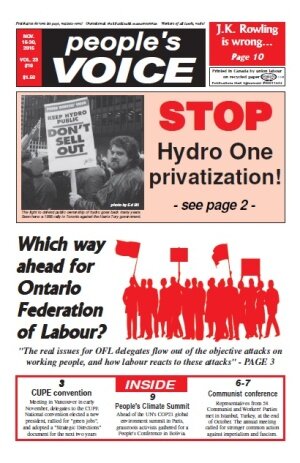
1) EDUCATION BARGAINING: ANOTHER MADE-IN-QUEENS-PARK MESS
2) “REAL CHANGE” AND THE ONTARIO FEDERATION OF LABOUR CONVENTION
3) CUPE ELECTS NEW PRESIDENT, ADOPTS “STRATEGIC DIRECTIONS”
4) MASS ACTION CAN HALT HYDRO PRIVATIZATION
5) CELEBRATIONS AND A CAUTION - Editorial
6) GETTING THE INQUIRY RIGHT - Editorial
7) THE LITTLE CAMPAIGN WITH BIG IDEAS
8) QUEBEC COMMON FRONT STANDS FIRM
9) NANAIMO GOLF CLUB LOCKOUT UPDATE
10) 17th IMCWP CALLS FOR “COMMON ACTION AGAINST IMPERIALISM AND FASCISM”
11) “A STRONG REJECTION OF THE PRO-AUSTERITY AND PRO-WAR AGENDA”
12) ARCTIC INITIATIVE FOR PEACE AND AN ECOLOGICALLY SUSTAINABLE FUTURE
13) DOCUMENTARY EXPOSES POLITICAL MASS MURDER IN MEXICO
14) THIS YEAR, PUT THE COMMUNIST PARTY ON YOUR GIFT LIST!
PEOPLE'S VOICE NOVEMBER 16-30, 2015 (pdf)
|
To order a copy send $15 (includes package and handling) to People’s Voice, 706 Clark Drive, Vancouver, BC, V5L 3J1. Contact us at 604-255-2041 or pvoice@telus.net for bulk order prices. |

|
People's Voice deadlines: December 1-31 January 1-31 Send submissions to PV Editorial Office,
|
|
|
REDS ON THE WEB
http://www.communist-party.ca
peoplesvoice.ca
www.ycl-ljc.ca
www.solidnet.org
|
People's Voice finds many "Global Class Struggle" reports at the "Labour Start" website, http://www.labourstart.org/. We urge our readers to check it out! |
* * * * * *
Central Committee CPC
290A Danforth Ave Toronto, Ont. M4K 1N6
Ph: (416) 469-2446
fax: (416) 469-4063 E-mailmailto:info@cpc-pcp.ca
Parti Communiste du Quebec (section du
Parti communiste du Canada)
5359 Ave du Parc, Montréal, Québec,
H2V 4G9
B.C.Committee CPC
706 Clark Drive, Vancouver, V5L 3J1
Tel: (604) 254-9836
Fax: (604) 254-9803
Edmonton CPC
Box 68112, 70 Bonnie Doon P.O.
Edmonton, AB, T6C 4N6
Tel: (780) 465-7893
Fax: (780)463-0209
Calgary CPC
Unit #1 - 19 Radcliffe Close SE
Calgary AB, T2A 6B2
Tel: (403) 248-6489
Ottawa CPC
Tel: (613) 232-7108
Manitoba Committee
387 Selkirk Ave., Winnipeg, R2W 2M3
Tel/fax: (204) 586-7824
Ontario Ctee. CPC
290A Danforth Ave., Toronto, M4K 1N6
Tel: (416) 469-2446
Hamilton Ctee. CPC
265 Melvin Ave., Apt. 815
Hamilton, ON.
Tel: (905) 548-9586
Atlantic Region CPC
Box 70 Grand Pré, NS, B0P 1M0
Tel/fax: (902) 542-7981
* * * * * *
News for People, Not for Profits!
Every issue of People's Voice
gives you the latest
on the fightback from coast to coast.
Whether it's the struggle for jobs or peace, resistance to social cuts,
solidarity with Cuba, or workers' struggles around the world,
we've got the news the corporate media won't print.
And we do more than that
- we report and analyze events
from a revolutionary perspective,
helping to build the movements for justice and equality,
and eventually for a socialist Canada.
Read the paper that fights for working people
- on every page, in every issue!
People's Voice
$30 for 1 year
$50 for 2 years
Low-income special rate: $15 for 1-year
Outside Canada $50 for 1 year
Send to: People's Voice, 706 Clark Drive, Vancouver, BC, V5L 3J1
You can call the editorial office at 604-255-2041
<pvoice@telus.net>
REDS ON THE WEB
www.communist-party.ca
peoplesvoice.ca
www.ycl-ljc.ca/
http://solidnet.org/
http://www,rebelyouth-magazine.blogspot.com
(The following articles are from the November 16-30, 2015, issue of People's Voice, Canada's leading socialist newspaper. Articles can be reprinted free if the source is credited. Subscription rates in Canada: $30/year, or $15 low income rate; for U.S. readers - $45 US per year; other overseas readers - $45 US or $50 CDN per year. Send to People's Voice, c/o PV Business Manager, 706 Clark Drive, Vancouver, BC, V5L 3J1.)
1) EDUCATION BARGAINING: ANOTHER MADE-IN-QUEENS-PARK MESS
By Liz Rowley
Ontario’s teachers and educational workers entered 2015 without a contract, and some may leave the year in the same condition. The problem? The Liberal government in Queen’s Park.
It started when Premier Wynne promised never to treat teachers and education workers the way her Liberal predecessor had, when Dalton McGuinty suspended free collective bargaining and imposed a contract with $2 billion in cuts in 2012.
McGuinty’s create-a-crisis government prorogued when the Tories smelled blood and refused to support his infamous Bill 115 to extend the wage freeze to the broader public sector. A month later McGuinty resigned, leaving his cabinet members to clean up the mess and try to hold onto government.
In the subsequent leadership campaign, Wynne campaigned from the left. Convention delegates elected her over a right-wing opponent, shaken by the sight of thousands of angry teachers and education workers demonstrating outside, supported by a mobilized labour movement led by OFL President Sid Ryan.
Clinging to government by a thread, Wynne promised to fix Bill 115. Teachers and educational workers, she said, could count on her to treat them with respect and fairness.
Wynne didn’t mention her government’s decisions: first, to continue the austerity course set by McGuinty, including an extended wage freeze across the public sector; and second, to abandon the government’s 2003 promise to introduce a needs-based funding formula for education, negatively affecting School Boards, communities, students’ learning conditions, and the working conditions of teachers and educational workers.
These are the real roots of the crisis in education, and the real reason for the difficulties faced by unions in the education sector trying to secure collective agreements 14 to 18 months after previous contracts expired.
Add to this the Wynne government’s decision to introduce two-tiered bargaining, where the unions each have to negotiate not one but two contracts: one with the province over wages, and the other with local School Boards over working conditions. This set of negotiations was all about contract stripping and “net zero” bargaining, which left unions (at best) with a 1.8% pay increase over three years, and a signing bonus that wasn’t part of the wage package, offset by changes to working conditions, and an inflation rate not much less than the wage increase.
Add to this the green light given by the Education Minister, allowing local School Boards to unilaterally cut wages by 10% to employees who are still working, but whose unions have refused to sign contract stripping collective agreements. Not mentioned is the School Boards’ earlier demand (now abandoned) that unions should agree to increased class sizes and decreased prep time for teachers. Not mentioned is the fact that School Boards deliberately backed away from negotiations with the Elementary Teachers, apparently hoping that the delays would turn the public against the unions and pressure them to make concessions.
Add to this a decision by the provincial government, deliberately leaked to the media, to reimburse unions and school boards for some of the extraordinary expenses incurred as a consequence of the two tiered bargaining imposed by Wynne. As expected, this generated a huge backlash against the unions, painted as greedy fat cats who are indifferent to cutbacks in schools and communities. Not mentioned is the fact that only unions – not School Boards – are now required to produce receipts for cheques still to be issued, or that the unions have always submitted receipts for expense cheques.
These protracted struggles directly affect students and the quality of education they receive, but the end is still not in sight. Many local contracts are still to be negotiated and more to be ratified.
While all of the unions in the sector expressed mutual solidarity at protests and demonstrations, there was no coordinated bargaining strategy, despite the fact their contracts all expired at the same time. Coordinated bargaining would have made them all stronger, and better able to communicate their anti-austerity, pro-education message to the public.
Once the larger unions and bargaining units have settled, smaller unions in the sector will be in the weakest position, as the most likely to face the public’s wrath alone. Labour must not allow this to happen. As the unions themselves say, “teachers’ working conditions are students’ learning conditions.” We’re talking about our children, and our sisters and brothers in the trade union movement. We’re talking about quality education and the future of our country.
The real causes of this protracted struggle need to be exposed. The policies of the Liberal government are directly responsible. In a workplace, they’d be fired. Come the next election, the Liberals should be fired too, and replaced with a government committed to a people’s agenda - not the corporate agenda so revered in the Ontario Legislature today.
In the meantime, the fight to defeat wage cuts, privatization, and austerity, has to be stepped up. The Common Front in Quebec is a splendid example of how the labour and people’s movements can join to fight austerity, to defend free collective bargaining and to protect and advance workers’ economic and social interests.
Likewise, the great Quebec student strike of 2012 to defend accessible post-secondary education was transformed into a struggle of all those who work for a living, who want real and fundamental change – not cosmetic change - for themselves and their children. This movement won the admiration and support of workers across Canada, and then it defeated a government and its anti-youth, anti-worker and anti-social policies.
That’s the kind of unity and all-in struggle we need today in Ontario, to restore quality public education and health care, to protect and expand civil, democratic, and labour rights, and to build a future where people’s needs trump corporate greed. For now, the fight by teachers and education workers continues to be a main battlefront in Ontario.
2) “REAL CHANGE” AND THE ONTARIO FEDERATION OF LABOUR CONVENTION
Commentary from the Ontario Trade Union Commission, Communist Party of Canada
The Ontario Federation of Labour Convention takes place from November 22 to 27, after unprecedented infighting, disaffiliation, dues strikes and back-room skirmishing. There will be a new leadership, guaranteed because the outgoing president Sid Ryan is not standing for re-election. But masked by the thrust and parry of trade union bickering and outright slander, usually delivered in the mainstream media, is the rather one-sided clash between social activism and social compliance. The pity is that after the smoke clears, even the combatants may not know what the fight was about or what was won or lost. That is because the contradictions preceding the convention were obscured by oblique sham issues - a created "financial crisis", hidden cameras and implied sexism - constructed for the purpose of obscuring the real problem.
The real issues flow out of the objective attacks on working people and how labour reacts to these attacks. The weapons of attack are: NAFTA, CETA, TPP, precarious work, the attack on collective bargaining, de-industrialization, privatization, the attack on the ecology, and thirty years of wage stagnation and a decline in the stability of life. The neo-liberal corporate agenda. Labour has had a mixed response at best, but within that mix are the seeds of the conflicts and contradictions that will shape this OFL Convention. The ghost of Wayne Samuelson or the ghost of Sid Ryan? The inertia of rest or the inertia of motion?
The last decade has been marked by unexpected militancy erupting in the Occupy Movement, Idle No More, the Quebec students struggle, the G8 demonstrations and hundreds of important engagements and environmental struggles. These movements have recruited labour support, and influenced labour, but none of them originated in or were led by the organized labour movement. Labour has fought a rearguard struggle marked by defensive action at best and concession bargaining at worst. The most organized section of the working class has been, with the exception of teachers and some other public sector unions, in a secondary role and generally in retreat. Why?
Why is it that with 40% of the working class precariously employed, contracted out and super-exploited, the percentages of the organized in an expanding workforce have dropped ten points in 30 years? Are today’s workers genetically or biologically different than their grandparents who built the labour movement? Or is it because we have a different leadership with different priorities?
The answer lies in the ideological contradiction between parliamentary struggle farmed out to the NDP, and advocacy for independent political action expressed by massive street-level mobilization. It should be obvious that what works, like the Quebec student strike, would be the acid test. But not so. No matter how successful, street level struggles seem to embarrass labour leaders and social-democratic politicians. They prefer antiseptic lobbying and endless petitions that beg for “fairness”. At the G8 Summit struggles, youth activists shared wire detention cages while top labour leaders had guest status at the cocktail parties.
The scenario of the NDP throwing away the BC and Ontario elections, now repeated in the Liberal majority federally, should cast some doubt on this methodology. But the response has been to undermine and replace leadership that attempted mass mobilization and partnership with the social justice movements. While the Liberals constructed a fantasy of “real change” for a hungry electorate, the NDP moved to the right for a balanced budget and responsible government.
The Liberals are a party of capital; while they talk of “real change”, that change will be within the parameters of the neo-liberal agenda. While the “iron glove” of Stephen Harper may be replaced by the “velvet glove” of Justin Trudeau, the “fist” of the ruling class is still there.
But what of the maligned precarious and unemployed legions of youth? What of the indigenous people and the missing and murdered indigenous women? What of the Hamilton Steel pensioners? What of the 60% of unemployed who are denied benefits? What of the working families who cannot afford hydro? The list goes on, including the future displaced victims of CETA and TPP. Can the working class afford to lobby and beg for fairness for another four years to see if the Liberals will destroy capitalism? What is the chance of that? The cards are dealt and the die is cast. The Liberals are the party of big business, we already know that. But what is the role of labour? What is to be done?
If labour adopts a policy of co-operation and conciliation, it will be pulled constantly to the right in parallel with the unrestricted flow of capital and the destruction of sovereignty imposed by CETA and TPP. Even if the trade unions and the NDP express official opposition to these deals, without massive mobilization and extreme economic pressure, the results are inevitable and predictable. The dream of working class unity will be spelled out in the reality of poverty, degradation and despair. Without a Common Front, a partnership with the social justice movements, Indigenous movements, LGBTQ organizations, women’s organizations, with labour as the catalyst, the outcome is sadly predictable. Even with this kind of unity the fight will be hard. Without it the fight is already lost.
In short, the working people need a marching song not a lullaby. We need leadership that will mobilize, not go back into hibernation. We need independent political action, not contracting out. We need mobilization and social pressure that tells the government that it cannot rule us without concessions to our demands, that we have the ability to force “real change”, and we don’t have to beg for it.
3) CUPE ELECTS NEW PRESIDENT, ADOPTS “STRATEGIC DIRECTIONS”
By Kimball Cariou, Vancouver
By a margin of about 300 votes, Mark Hancock was elected the new national president of the Canadian Union of Public Employees at the union’s 27th biennial convention, held Nov. 2-6 in Vancouver. Over 2100 delegates attended the convention, the first major trade union gathering since the Oct. 19 federal election.
Hancock, who has been president of CUPE’s British Columbia division since 2013, defeated Ontario CUPE leader Fred Hahn for the top post. He replaces Paul Moist, who retired after 12 years as CUPE national president. Charles Fleury was re-elected by acclamation as national secretary-treasurer.
While the outcome reflected a wide range of factors, such as provincial loyalties, some delegates viewed the contest as a referendum on differing strategies. Hancock is widely seen as a stronger supporter of the NDP, while Hahn has been associated with efforts to build common front struggles against right-wing economic and social policies. On the other hand, Hancock also speaks about labour-community coalition building, and Hahn is an NDP member.
Outgoing president Paul Moist spoke at a lunch hour rally held during the convention to promote the “Leap Manifesto,” the joint statement issued by progressive environment, indigenous and cultural activists during the federal election campaign. About half of the CUPE delegates took part in the “Leap” rally, along with hundreds of local community and labour activists. Many of the banners and placards emphasized the need for investment in renewable energy projects, to create jobs while curbing carbon emissions.
The mood of the rally was simultaneously festive and wistful. Participants celebrated the defeat of the Harper Conservatives, but many were still talking about the NDP’s “missed opportunity.” While most were pleased that the new Liberal government has responded positively to some of the demands raised by mass movements, there were also warnings that the Liberals support the Trans-Pacific Partnership deal and other key elements of the corporate agenda.
Besides Moist, other prominent speakers at the Leap rally included Tsleil-Waututh First Nation anti-fossil fuel campaigner Reuben George, Stephen Lewis, and author Naomi Klein. Lewis made a point of welcoming the growing expressions of opposition to capitalism, in terms which could imply criticism of the NDP’s centrist election campaign. All of the speakers called for unity of the labour movement, environmentalists, indigenous peoples and other progressive forces, but none addressed the thorny relationship between such struggles and the NDP.
These contradictions were evident in the “Strategic Directions” document adopted by delegates on the final day of the convention. Titled “Building Workers’ Power,” the paper outlines key issues facing organized labour today, and projects the main priorities for CUPE over the two years before the union’s next national convention.
Despite its revolutionary title, the document does not use the terms capitalism or socialism, instead presenting a broad outline of the neoliberal attack on working people, and the necessary response by trade unions. “Strategic Directions” calls for a range of approaches to strengthen the ability of CUPE to organize and engage in collective bargaining, to help elect NDP governments, and to protect the planet and fight for global justice. It also lays out a series of progressive policies, and advocates a “social unionism” approach to build wider movements around these issues.
Analysing the recent federal election, “Strategic Directions” argues that “the Liberal party successfully positioned itself to the left in the eyes of Canadians,” and goes on to state that “CUPE remains committed to ensuring that the New Democratic Party represents workers’ interests, and supporting the NDP to represent our interests in the political sphere. CUPE will participate in the NDP’s review of this election campaign, offering critical but constructive input and advice. We will continue to build our political party, the NDP. We must encourage more involvement in our party throughout the union....”
Given that many progressive activists were deeply disappointed by the NDP’s acceptance of fundamental neoliberal economics in recent elections (BC, Ontario, and now federal), it remains to be seen how the new CUPE leadership will convince its own members that the NDP really is the political party of the trade union movement.
“Strategic Directions” can be accessed at the CUPE website, www.cupe.ca.
4) MASS ACTION CAN HALT HYDRO PRIVATIZATION
By Liz Rowley, Toronto
The privatization of Hydro One has begun. In the first week of November, the first public offering of Hydro stocks resulted in the sale of about 10% of the public utility, generating great excitement on the TSX where the RBC Capital Markets and ScotiaBank led the pack in scooping up the largest parts of this and future offerings.
The Hydro One firesale is an out and out gift to the banks and corporations, in exchange for some quick money to fund the government’s unfunded $30 billion infrastructure program – one of two key promises that won them the June 2014 Ontario election.
The government says the main objective of the sale is funding for the infrastructure program. But only $4.6 billion will be realized by the sale – less than one-sixth of what’s needed – and at a huge cost to the public.
Instead, this $30 billion could be generated by reversing an estimated $15 billion in corporate tax cuts and by increasing the corporate tax rate to 22% for an additional $10.5 billion annually. That would raise the funds for the infrastructure program, and maintain Hydro One as a public utility. It would also generate a much larger, and stable revenue stream for other public projects, like public hospitals, the long promised (but never delivered) needs-based funding formula for education, or a provincial system of affordable public childcare, urban and inter-urban public transit.
But if the objective is privatization (or ‘unlocking’ equity in existing assets, as the Liberals so fetchingly describe it) then the government’s actions are much clearer. Privatization is a goal all by itself, and more will follow if the sale of Hydro One is successful.
The Liberals, and the corporations they evidently govern for, may think this is reasonable, but the public certainly doesn’t. What’s needed are more and better services; not less.
In all, the government plans to sell off 60% of Hydro One, claiming it can retain control over electricity in the province with 40% of the shares. That’s a story for the gullible and the uninformed, who don’t know how banks and corporations work together to secure control with very little equity. Even the Board will be filled with bank and corporate representatives, including those ‘representing’ the government and the public.
In fact, this sell-off is the realization of former Tory Premier Mike Harris’ effort to privatize Ontario Hydro – a deal that was stopped by an angry and organized public in 2002. Privatization, deregulation and trade deals were part of the austerity agenda then, and they’re part of it now too.
Former TD Chief Economist Douglas Peters says it like it is: corporations will demand at least an 8% return on their investment – fat profits in other words. This will send electricity rates through the roof for ratepayers, including industrial users, homeowners and tenants.
Furthermore, the 2004 province-wide electricity blackout was caused by a private electricity company in Ohio, which produced a power surge because it feared not getting approval of its bid for higher rates. Suffice it to say, corporate greed knows no borders.
Hydro One generates $1 billion annually for the public treasury, funds that are spent on health, education, public services, cities, and more. These cuts will be deep, and they will be permanent. Jobs and services will be lost across the province.
For more than 100 years, Ontario Hydro has maintained a reliable supply of cheap electricity to industry and ratepayers, becoming the province’s most valuable and productive public asset. Created by a Conservative government to develop industry and create jobs, that mandate is just as vital today.
Public opposition stopped Tory privatization plans 15 years ago. Widespread opposition this time includes the public, the NDP and Conservatives in Queen’s Park, the Communist Party, and organized labour. Ontario’s Financial Accountability Office states that privatization will raise electricity rates and government debt.
But the Liberals are plowing ahead anyway. Under cover of the federal election, they have set the privatization wheels in motion, trying to beat the clock figuratively and literally. If they can privatize more of the Hydro One stock before opposition crystallizes into public action, the government wins. By doing it early in their mandate, Liberal spin doctors hope the public will forget about it by the next election.
Fortunately for supporters of publicly owned and affordable electricity transmission, Ontario’s labour parliament meets in convention this month in Toronto. Decisive action by OFL delegates and leadership to take this fight to the streets, and to demand public hearings and a stop to the firesale of Ontario’s most important public asset, can put this on the front burner at Queen’s Park.
Working with labour’s allies in the Common Front, public opposition can be moved out of the kitchens and onto the lawns of Queen’s Park. Mass protests and independent political action by labour and its allies are the only thing that can stop the privatization train now.
Let’s hope this is a central issue at the OFL convention.
People’s Voice Editorial
Debates over the direction of the new federal government are heating up, across the political spectrum. For example, CUFI-Canada, a hardline Zionist group, has condemned Foreign Affairs Minister Stephan Dion’s statement that Canada will “return to the role of honest broker" on Israel/Palestine issues; if this does mark a break with support for the violent policies of the Israeli apartheid state, all supporters of Palestine welcome the news.
More such developments can be expected. The Harper Tories represented the most dangerous, anti-people elements of the ruling class in Canada, and their defeat is a significant victory, not just a simple transition from one bourgeois party to another. The new government plans to repeal the notorious anti-immigrant Bill C-24, to restore the Interim Federal Health Program for refugees, to let federal scientists speak about important research, to reinstate the long form census, to suspend the elimination of urban home mail delivery, etc. All these wins were achieved mainly by the mass movements which resisted the Tory agenda for years, and we join with them in celebrating every such victory.
At the same time, the Trudeau Liberals are still a party of big business, strongly committed to the capitalist system and to the “trade deals” pushed by transnational corporations.
The new Liberal caucus supports the “humanitarian intervention” doctrine used by imperialist powers to justify every disastrous US-led military action of the past two decades, from Yugoslavia to Iraq, Afghanistan, Libya, Syria, and other countries. Justin Trudeau promised to amend Bill C-51 and to change the electoral system, but it remains to be seen if these will be more than cosmetic fixes.
So let’s keep pressing the Liberals to carry out their positive promises - and prepare to resist the pro-corporate and pro-war agenda which will inevitably follow.
People’s Voice Editorial
Sometimes symbolic actions can deliberately obscure realities. Stephen Harper's 2008 "apology" to the victims of residential school abuse was later exposed as a brazen attempt to minimize political fallout. His government stubbornly resisted calls for an inquiry into missing and murdered indigenous women, signalling that the ex-PM does not regard indigenous people as equal to "old stock Canadians."
Now, the first steps of the Trudeau government towards reconciliation with indigenous peoples are being closely watched. Will the son of the prime minister whose government's infamous White Paper set off an upsurge of aboriginal militancy show true respect for First Nations? Or will Justin Trudeau stumble out of the gate? The national inquiry issue will be a critical test, around the terms of reference, the consultation process, and the political will to implement final recommendations.
Trudeau and his new Justice Minister, Jody Raybold-Wilson, must avoid the mistakes of the B.C. inquiry led by Wally Oppal, such as its narrow focus on the botched criminal investigation of Willy Pickton, or more accurately, the refusal of police forces to treat the disappearances of indigenous women seriously. The Oppal inquiry was never designed to gather information to help end systematic violence against indigenous women and girls.
The federal inquiry must instead take the advice of those who have worked so hard to keep this tragedy at the centre of public attention. Family members, the First Nations Summit, the B.C. Civil Liberties Association and others, all want prior consultation with indigenous women themselves. They stress that the inquiry should be conducted by a woman, and hear from all the affected communities. Not least, the government must take action, in contrast to British Columbia, where most of Oppal's recommendations were ignored. The proof of Justin Trudeau’s intentions will not be in his campaign promises of reconciliation, but in starting the national inquiry on the right foot.
7) THE LITTLE CAMPAIGN WITH BIG IDEAS
By Johan Boyden, Montreal
Finally, the marathon election is over. Harper got the boot. Now the Liberal Party is toasting a sweet majority: 54 percent of the seats, with 40 percent of the votes. Not a bad return on money, they must be thinking.
The mass media are currently giving Trudeau a honeymoon. The CBC and Radio Canada are no exception. Take, for example, CBC’s discovery of an “average, West Coast, middle-class mom voter,” who wrote a letter via Facebook to the young Prime Minister. And - wait for it - Trudeau replied!
Still, I read her message. “Even though I put my X next to your [party's] name, I did not vote for you. I voted against the alternative,” she wrote to Trudeau. “How many millions of us gambled today on whatever bet would be ‘not Harper’?”
Campaigning at the doors, people often spoke to Communist candidates about the need to kick out Harper, "but what can we vote for"? Such conversations were also reflected in discussions over Twitter and other relatively new social media.
To be sure, some twitter users simply kept us updated, albeit unintentionally. “There is a lot of signage in my neighborhood to vote Communist for a man named Iqbal Kahlon,” a young woman in Surrey wrote.
Others gave feedback on our leaflet: “So interesting. Found a Communist Party flyer on my car today in Esquimalt. Captivated by platform.” Or: “Reading through the platform of the Communist Party. There’s some pretty good stuff.”
These comments came out of the blue. “The Communist Party supports a $20 minimum wage, better than any other party.” “People should really check out the Communist Party and their position on indigenous rights.” “The Communist Party is the only political party that is all out pro-Palestinian.”
When the election came, people even tweeted that they had voted Communist. But for our party, it never was just about the votes. Of course, we fought hard for them, and the result was somewhat uplifting: 4,382 votes across the country despite an almost total media blackout. While only running 30% more candidates than in 2011, the Communist Party scored a 50% increase in votes.
Our best results were by Peter Marcus (525 in Vancouver East) and Kimball Cariou (447 in Vancouver Kingsway, breaking the 1% threshold), Jason Devine (390 in Calgary Forest Lawn), and party leader Miguel Figueroa (261 in Toronto's Davenport riding). Other candidates achieved over 150, including Marianne Breton Fontaine and Adrien Welsh (177 and 158 respectively in the Montreal ridings of Hochelaga and Outremont), Bob Mann (169 in Hamilton East-Stoney Creek), and Ryan Barry (151 in Nova Scotia's South Shore-St. Margarets).
All this was part of the struggle for ideas, a struggle perhaps most clearly illustrated in the tweets about our candidates in debates:
“I'd say the communist candidate [Sean Burton] is actually winning the debate so far.” “The Communist candidate [Mike Lewis] just got louder applause than the NDP.” “Communist Party candidate [Bill Sloan] starts the debate by breaking out into song. 'Go Harper Go, Just Go, And Don't Come Back'. Catchy tune.”
“Communist party candidate Darrell Rankin says 2% cap on federal funding for First Nations post secondary education is racist.” “Saleh Waziruddin: Isn't it a bit `barbaric' to refuse a new inquiry to missing and murdered aboriginal women?” “Liz Rowley says no Ring of Fire Development can happen until outstanding land claims are resolved.”
“First references of the night to `apartheid Israel' come from Communist candidate Drew Garvie.” “Yes the Canadian Wheat Board is fundamental to food security and survival of the family farm. Thanks Tristan Dineen.” “Stuart Ryan criticizes universities and the fed government of ‘using’ international students while simultaneously burdening them with high tuition. Right on!”
Another person tweeted, “The continued existence of the Communist Party is kind of admirable and impressive.”
These are just a few tiny snapshots in 120 characters. Snapshots of Communists in the battle of opinion. A campaign focused not on “the gamble of voting against Harper,” but on projecting and uniting around a real people’s alternative agenda.
Ours was a farsighted campaign, well worth remembering. And now, in different forms, that struggle continues to win a people’s alternative, to shift power to the working class, and for socialism. Well done, little party with big ideas!
(Boyden was the Communist Party's central campaign organizer.)
8) QUEBEC COMMON FRONT STANDS FIRM
PV Montreal Bureau
Quebec’s labour movement is standing firm, as the giant 400,000-strong public sector union strike by the Front Commun (Common Front) continues. The Front Commun, an alliance of trade unions in the Quebec public sector, plans to step up actions and hold a three-day general strike in early December.
Over the past weeks, rotating strikes have taken place across the province. Despite some cool seasonal weather, the mood on the picket lines has been resolute, upbeat and noisy. Thousands have walked out in every region, including 98,000 in Montreal and 41,800 in Quebec City. The strike is reaching as far north as Kuujjuaq, on Ungava Bay, where community health workers are involved; east to the social service workers on the Iles-de-la-Madeleine archipelago in the Gulf of St Lawrence, and west to the teachers of the Cree School Board on James Bay.
However, negotiations with the Couillard Liberal government are being overshadowed by the looming threat of back-to-work legislation. With the strong mobilization of their members, and favourable public support, such a decree would be likely very unpopular but could halt the action.
Anti-labour legislation in Quebec imposes harsh penalties on illegal strikers particularly in the over-broadly defined “essential services” of health care. Legislation brought in by the Bourassa Liberals after a 1986 strike imposed heavy fines. After the Quebec nurses staged the longest nurses strike in Canadian history in 1999, Bouchard’s Parti Québécois government further severely curtailed the right to strike in health care. Now, for every day on strike, workers lose two days’ pay and one year’s seniority, and the union loses twelve weeks of dues.
For now, the Liberals seem content to use the back-to-work legislation as a tactical threat. The government’s proposal was a two year wage freeze, followed by one percent annually for the remaining three years. Since then, reacting to the first wave of rotating strikes, the government has made a new offer: a one year freeze, then, after three years, another one year freeze, keeping the rate at just 3 percent over five years.
The Treasury Board’s proposal has been rejected by the unions, who note that it would reduce salaries for some 18,000 workers (mainly women), cap salaries for thousands of others, and start young workers at a lower pay level. Other sticking points include pensions.
9) NANAIMO GOLF CLUB LOCKOUT UPDATE
By Alan Boyden
On October 30, a rally took place to bolster support for the union workers locked out since April 24 at the Nanaimo Golf Club. Members of several unions and concerned citizens, including the Nanaimo Club CPC, joined the workers to show solidarity. Others came from Victoria, Vancouver and Courtenay, to demonstrate to patrons attending the Golf Club’s Gala Banquet that the workers are firm in their resolve to achieve a fair wage and fair working conditions.
The Club management led by Ash Chadha still refuses to come to the bargaining table. Preliminary steps to lay groundwork for a meeting, drawn up by the Club’s lawyer and union representatives, were sabotaged by management who leaked false information. Then, under the pretext of being generous and accommodating, they put forward a similar offer to the one rejected by the workers last May, showing that management is not prepared to negotiate in good faith.
However, the morale of the locked out workers is remarkably high. They cheerfully smile and wave to vehicles on the highway who honk and shout support. During the rally, some folks intending to have dinner at the Golf Club paused and then drove away. The parking area was conspicuously empty. Two citizens supporting the workers strolled over to the club banquet hall and see how the “gala evening” was going. They noticed that less than a third of the set tables were occupied.
A moral victory has been achieved by the courageous Local 40 workers. Thanks to their constant vigil, the word is getting out: “the Nanaimo Golf Club is not the place to eat!” This will remain until the restaurant, culinary support team and bartenders receive a fair deal. It is time for Mr. Chadha to resign and let a more competent and fair-minded successor take over.
The workers on the picket line appreciate the support and encouragement received from readers of People’s Voice. Their struggle is our struggle; in solidarity, united we stand.
10) 17th IMCWP CALLS FOR “COMMON ACTION AGAINST IMPERIALISM AND FASCISM”
Press release of the Communist Party, Turkey on the 17th International Meeting of Communist and Workers' Parties in Istanbul, October 30-November 1, 2015
The 17th International Meeting of Communist and Workers Parties has been successfully held in Istanbul on the topic "The tasks of Communist and Workers’ Parties to strengthen the struggle of the working class against capitalist exploitation, imperialist wars and fascism, for workers’ and peoples’ emancipation, for socialism".
The meeting was attended by 104 delegates, representing 58 communist and workers' parties from 48 countries. Six parties could not attend the meeting but sent their greetings and written contributions.
After the extraordinary meeting in Damascus and the 14th meeting in Beirut, it was the third of IMCWP meetings held in a Middle East country, Asia Minor being the junction point of unique spheres of political class struggle. The meeting took place during the heydays of the parliamentary elections in Turkey, in which the hosting Communist Party, Turkey took part, under the intense oppression of the government.
The meeting provided an opportunity for an exchange of opinions and information on the latest developments of imperialist restructuring, escalation of fascist movements in different regions and the quest for emancipation opening up opportunities for a vigorous working class struggle. The perspective to develop joint and convergent action was shared.
The parties that attended the meeting gave information on their activities and the progress of communist movement in their countries. The speakers expressed their concern towards the escalating prohibitions, persecutions and discrimination against Communist Parties.
The responsibility of the communist and workers’ parties to strengthen the working class struggle in regions under imperialist threat and intervention was underlined. Likewise stressed was the concern about rivalries among capitalist powers, aggravated by their regional collaborators. The dangers posed by militarization and the concern to fortify anti-imperialism in such regions of competition was expressed.
The refugee crisis came to the agenda and the need for promoting not only internationalist solidarity but also class consciousness against discrimination policies and abortive patronage policies was pointed put.
Due to the restructuring of capitalism exhausted by crisis and the restoration of imperialism in regions of vacuum, the meeting drew attention to the rise of erroneous expectations of reforming the capitalist order in favour of people's and of establishing peace under the patronage of imperialism.
The timeliness and urgent necessity for promoting socialism was resolved as the sole answer for the quest of peoples against barbarism and impoverishment. There was a confirmation on breaking away from the hegemonic capitalist modus vivendi.
The particular importance of orienting patriotic resistances against military aggression and popular struggles against austerity measures towards a class confrontation was pointed out. This was reiterated with the emphasis to mobilize the working class in order to lead these struggles towards socialism.
Coordinating communist and workers' parties' struggles on all these issues in order to stir up the class movement on a revolutionary basis was highlighted.
Participants saluted the struggle of the peoples in Latin America and the central role of communists in these struggles for independence and socialism strengthening the anti-imperialist and progressive forces of the region. Solidarity with Cuba and its socialist revolution, as well as with the Venezuelan people and their Bolivarian revolution was reasserted.
The meeting assessed the struggle of the European peoples against their governments’ imperialist policies and domestic exploitation of workers and enslavement of migrants. The determination of the working class in Greece to reject subordination to the blackmail of EU, ECB, IMF including the rejection of negotiations with the Troika was valued. The election results in Greece and Portugal for the communists were hailed, qualified as hopeful and encouraging.
The consequences of intercontinental confrontations and alliances between imperialist centers were dealt by the participants. NATO’s intention to open new military bases in Hungary and Slovakia and Russia’s interventionist policy towards Syria, beside the confrontation in Ukraine, emerge as a change in power balances, both paving the way for a reinforced anti-imperialist struggle and also increasing the precision of communists to keep independent from mainstream power politics. Fascist paramilitary forces are deliberately backed by liberal governments, shifting the context of struggle to identity politics and stimulating the dilemma of cosmopolitanism and nationalism which pushes back the internationalist stance of the working class. On the other hand, the Trans-Pacific Partnership (TPP) and Transatlantic Trade and Investment Partnership (TTIP) negotiations, which will provide a basis for a new wave of attacks on the working classes, was called to attention and taken as an agenda of struggle for the forthcoming period.
The dual threat in the Middle East and North Africa caused by the jihadists and the Israeli state was confirmed, both corresponding to a de facto coalition against secular and patriotic forces. Not only ISIS but also other Islamic reactionary groups, notably the components of the FSA in Syria, have a counter-revolutionary character and their role in legitimizing military interventions has to be deciphered. The Gulf states’ support for these jihadist groups and Saudi Arabia’s assault in Yemen was vigorously condemned as well as the threat posed by the Israeli state towards Syria. More revolting is the increasing attacks of Israel to the Palestinian people, bombing residential areas, carrying out arrests. The meeting declared its solidarity with the people resisting these attacks, particularly in Palestine and in Syria, calling for a uncompromising struggle against imperialism and fundamentalism.
The growing need to strengthen the ideological struggle against the infiltration of bourgeois ideology within the ranks of communist movement had been stressed in the previous communist and workers' parties' meetings. The current meeting updated the facts and warnings. The artificial revival of social democracy nourished by populism, narrowing the opposition to neo-liberal policies, obsolete dictatorships and military aggression sets a trap for the communist movement rendering the class struggle blind against the real sources of these attacks. While it is imperative to challenge all efforts to criminalize communists and condemn their historical legitimacy, there is a further need to demarcate the revolutionary and class based line of the communist and workers’ parties from the conformist and opportunist tendencies within heterogeneous opposition movements focused on mutant aspects of contemporary capitalism.
During the three-day meeting, the participant parties had the opportunity to develop their bilateral relations, to contact other parties and to exchange views.
We believe that the international meeting contributed to the consolidation of the communist and workers' parties' policies in triggering the working class movement in each country and will initiate their common action against imperialism, fascism by raising up socialism as the concrete solution for emancipation.
The meeting's issues of action were adopted by the parties as guidelines to be implemented, materialised and to be monitored by the Working Group until the 18th IMCWP meeting.
Istanbul, November 2nd, 2015
11) “A STRONG REJECTION OF THE PRO-AUSTERITY AND PRO-WAR AGENDA”
Contribution to the 17th International Meeting of Communist and Workers’ Parties, presented by Communist Party of Canada leader Miguel Figueroa
First of all, we join with others in expressing our solidarity to our host party, the Communist Party, Turkey... At such a critical moment in this region, with dark clouds of war swirling everywhere, with imperialist intrigues fomenting national and religious conflict in order to extend its hegemony, and with a humanitarian and refugee crisis of epic proportions, the principled, internationalist role of your party and other Communist and Workers’ parties across the Middle East are more crucial than ever.
The tasks currently facing our parties – and all the anti-imperialist and revolutionary forces in a broader sense – flow from an objective assessment of the general, systemic dynamics of capitalism today. In our view, the basic, underlying contradictions inherent to this system are maturing at an accelerating pace, giving rise to a series of interrelated crises which have sharpened over the recent period.
Foremost amongst these continues to be the historic conflict between the two main classes – the working class and the ruling capitalist class – locked in dialectical unity and struggle by virtue of their central location in the process of production. The class struggle is intensifying everywhere, as state-monopoly capital strives to drive down the price of labour-power to reverse the decline in the rate of profit, and to preserve their class domination at the expense of the workers and their labour rights.
In the Canadian context, this takes the form of an all-sided capitalist offensive against the wages and living standards of workers, the loss of full-time and permanent employment, especially in industry, and its replacement with part-time, contractual and other forms of precarious employment, growing social disparities between the super-rich and the vast majority of working people, the spread of poverty and insecurity, and the increased attack on the trade unions, labour standards and workers’ rights in general.
The Canadian State plays a central role in enforcing this capitalist offensive, through austerity programs, the weakening and privatization of public programs, services and social protections, the imposition of pro-corporate trade and investment pacts like the Canada-Europe (CETA) and Trans-Pacific Partnership deals, and legislative and judicial attacks on trade union rights.
Another critical aspect of this capitalist offensive which our Party prioritizes in its work is the drive to militarization, imperialist aggression and war. Over the past decade in particular, Canada has played in increasingly active and bellicose role within the NATO imperialist alliance, especially in the occupation of Afghanistan, in Libya, in support of the fascist regime in Kiev, and as one of Zionist Israel’s strongest backers. It has hiked military spending, announced major procurements of new stealth fighter jets and warships, and is now expanding the number of Canadian military bases on foreign soil.
A third priority for our Party is the struggle to defend and extend the democratic rights of the people and to combat every encroachment on the right to political dissent, violations of civil liberties, and the passage of authoritarian and even proto-fascist, police state laws such as C-51 (the new ‘anti-terrorism’ law) by governments at every level. This also includes the battle against all forms of racism and Islamophobia, and ultra-right, fascist groups seeking to divide the working class on this basis; the struggle for the full emancipation and social equality of women and sexual minorities; and the struggle in solidarity of the just demands and national rights of Canada’s indigenous peoples and of Quebec.
Finally, our Party also considers among its top priorities our active participation in the environmental movement, and in particular efforts to mitigate and reverse climate change, the impact of which falls most heavily on the working class, peasants and farmers, and on the poor and marginalized sections of the people around the world. We sense a special responsibility on this point, not only because on a per capital basis, Canada is among the very worst polluters in the world – but also because of the disgusting role which the Harper Conservative government has played over the past decade in obstructing any binding international agreement to reduce emissions – a cravenly self-serving policy on behalf of Canadian energy, mining and resource monopolies.
The recent federal elections must be seen in this context. In our view, the defeat of the Harper government marked a significant victory for the working class, for indigenous peoples, for women, youth and students, for the unemployed and underemployed, and for the LGBTiQ communities. It was a victory for all those dedicated to peace and disarmament, for immediate action to combat climate change, and to the struggle for social equity and social justice. The results reflected a strong rejection of the pro-austerity and pro-war agenda of the Harper Conservatives by the peoples of Canada.
We have no illusions about the new Liberal majority under Justin Trudeau that is now in place. The Liberal Party is also a bourgeois, big business party; it has not changed its political colouring or class orientation. It remains committed to neoliberal economic doctrine at home, and to an imperialist foreign policy abroad.
We think it wrong however to dismiss this outcome as simply the meaningless replacement of one bourgeois government with another. The Harper government was the most anti-working class, anti-democratic, pro-war, misogynistic government in Canadian history. Its defeat opens up new political space to not only reverse the damage already done, but to also win more advanced and radical democratic, economic and political demands. This will require however a conscious political and organizational struggle to invigorate the extra-parliamentary movements, and an ideological struggle to shed illusions about the bourgeois role and character of the Liberal government....
12) ARCTIC INITIATIVE FOR PEACE AND AN ECOLOGICALLY SUSTAINABLE FUTURE
The Communist Parties of the Nordic countries, the Russian Federation, Canada and the USA have adopted an “Arctic Initiative” resolution against militarization and exploitation of the northern environment. The parties were present in Istanbul for the 17th meeting of Communist and Workers’ Parties. The joint statement, titled the “Arctic Initiative for Peace and an Ecologically Sustainable Future” reads:
We the Communists in the high North share a common need to strengthen the struggle of the working class against capitalist exploitation, imperialist wars and fascism, for workers’ and peoples’ emancipation, for socialism.
We struggle in different conditions. Neoliberal politics has a global plan of action. Publicly-produced and owned services are competing with private sector business politics. In all our countries communists are working for stronger working class rights and better public services.
We share common worries about the state of the Arctic’s natural environment which is especially vulnerable. Expansion of mining industries and oil and gas drilling will maximize business profits at the cost of nature. Capitalist exploitation in the Arctic means increasing activities with extremely high risks of natural catastrophes, and trampling the basic rights of the aboriginal peoples.
We are extremely worried because of the NATO’s growing military activities in the Arctic. NATO aims to incorporate all the Nordic countries into its military exercises and membership, and into the campaign to depict Russia as the next possible war enemy.
Instead of military confrontation and exploitation of nature in the Arctic, we require strengthening peaceful collaboration, development and ecologically sustainable plans on how to use the Arctic natural resources.
Signatures (in alphabetical order): Communist Party in Denmark; Communist Party of Canada; Communist Party of Denmark; Communist Party of Finland; Communist Party of Norway; Communist Party of Russian Federation; Communist Party of Sweden; Communist Party USA.
13) DOCUMENTARY EXPOSES POLITICAL MASS MURDER IN MEXICO
Ayotzinapa: Chronicle of a State Crime, documentary by director Xavier Robles, El Principio Producciones, 140 minutes, Spanish with English subtitles. Review by Tim Pelzer.
The disappearance of 43 students in Iguala last year remains an open, festering wound in Mexico. While many Mexicans suspect that security forces killed the students, President Enrique Pena Nieto blames drug gang members. Xavier Roble’s “Ayotzinapa: Chronicle of a State Crime” clears up any doubt about what really happened to the students.
On September 26, 2014, students from the Ayotzinapa Normalista school went to Iguala to raise money to finance a trip to Mexico City. Every year, Mexicans march in the capital to honour student protestors who were massacred by the army in Mexico City in 1968, and the young students, mostly in their early 20s, wanted to be there. According to survivors Jose and Omar, heavily armed police, waiting for the young defenceless students when they arrived in Iguala, opened fire on the buses carrying them. Video evidence taken by cell phones confirms this. While police gathered up surviving students who were never seen again, a few were able to slip away.
The ambush took place within blocks of the base of the 27th infantry battalion which never tried to rescue the students, despite crackling gunfire ripping through the night air. Soldiers only appeared 2-3 hours later to search for wounded students in the local hospital, according to Omar. Soldiers verbally abused the wounded survivors, calling them common criminals. As they were leaving, the green clad infantrymen threatened to let the police take care of the students. “They were going to let the police do their dirty work”, remarked Omar.
This raises the question: why would police want to disappear 43 young students? Robles suggests that the students were killed for political reasons. Established in 1926, after the Mexican revolution, for students from indigenous, campesino and poor backgrounds, the Normalista schools had always been hotbeds of resistance against social injustice. Required readings in these schools include Pablo Neruda, Eduardo Galeano, Maxim Gorky, Karl Marx and Vladimir Lenin. These schools have produced a steady stream of left-wing political activists and figures, including famed 1970s guerrilla Lucio Cabanas. Guerrero, the state where the students were disappeared, has been in a continuous rebellion against central and state governments aligned with drug cartels, which have pursued neo-liberal policies.
For many years now, police, soldiers and drug cartels have carried out a campaign of terror against environmentalists, peasant and union activists and leaders in Guerrero. Many have turned up dead.
Robles places the disappearance of the students in Iguala within a broader context, where Mexican governments at the state, national and municipal levels have melded with drug cartels, turning the country into a narco state.
“Ayotzinapa: Chronicle of a State Crime” is an eye-opening, elegantly crafted documentary that sheds light on what happened on that tragic night in Iguala. While not currently available on DVD or Blue Ray, it is making the rounds of the world film festival circuit, recently being screened in Vancouver, Kamloops, Victoria and Kelowna in British Columbia. It will be shown in 150 cities in 26 countries, including the upcoming Havana festival of New Latin American film in December. While it is a long documentary to sit through at 140 minutes, it is a worthwhile view. Watch for a screening near you.
For more information, visit the Vancouver Solidarity with Ayotzinapa Facebook group.
14) THIS YEAR, PUT THE COMMUNIST PARTY ON YOUR GIFT LIST!
This holiday season the Communist Party is celebrating the end of 10 years of Harper’s extreme right-wing, pro-war government, and the upsurge of public opposition that ushered him out October 19!
But significant parts of the Harper agenda remain on the table, still in play with the new Liberal government:
* the Trans Pacific Partnership, which will decimate the auto industry in Canada; undermine the supply management system, cut farm incomes, and compromise Canada’s food security; protect drug company patents for years, making drugs even more expensive, draining our Medicare budgets, and fattening profits for Big Pharma; and allow transnational corporations to over-ride elected Canadian governments.
* a foreign policy of permanent involvement in US and NATO dirty wars against countries that pose no threat to Canada.
* Bill C-51, which must be repealed, not amended, to protect our civil, labour and democratic rights.
* mass unemployment and austerity policies designed to drive down wages, incomes and living conditions, leaving our youth without a future,
* the privatization of Medicare and the attack on the Canada Health Act.
* the Immigration and Refugee Act which welcomes the wealthy and rejects the rest.
* the Foreign Temporary Workers’ Program that turns foreign workers into indentured labour with no rights and no access to citizenship
Canadians may not see it yet, but a massive struggle is shaping up. At issue is the kind of country we want, vs. the country the transnational corporations and their governments intend to impose. In this, they have the support of both the Liberals and Conservatives, and on too many occasions even the support of the NDP.
The Communist Party has consistently opposed this anti-human capitalist agenda in the streets, in the factories and workplaces, on the picket lines, sit-ins, protests and demonstrations, on the hustings, wherever people are in struggle. Since 1921, we have fought for a better life for workers, youth, and women, for peace and disarmament, for sovereignty, democracy, and equality. We fight for working class and people’s unity, and for strategies and tactics to strengthen the working class movement, while always advocating for a socialist Canada as the real alternative to imperialism, racism, fascism and war. Today this struggle is international as well as in Canada, and more important than ever.
We need your support now to help us organize through the winter, when many of the struggles mentioned above will be in full swing.
Your contributions help us organize across Canada around issues like C-51 and the fight to Save Canada Post, to print booklets and leaflets, to hold public speaking tours, educational events, and seminars. All of this and more is paid for by your donations.
The Communist Party is supported solely and only by its members and friends – working people like you who know why these struggles are so important.
Thanks to tax rebates available from Revenue Canada for political donations to the Communist Party of Canada, contributors can make their donations stretch up to four times more than the actual cost, after rebates are applied.
For example, a $400 donation will only cost the donor $100, after filing the Official receipt with your taxes, and receiving the 75% rebate. A $100 donation will only cost $25 after applying the rebate, while a $200 donation will cost $50, and a $300 donation will cost $75, after the rebate. Please note that donors must have a taxable income of at least $20,000 to qualify for the rebate, according to Revenue Canada.
Donors in Ontario can get around this by making their donations to the CPC (Ontario) which has no income requirements for rebates to apply. Every donation to CPC (Ontario) receives a rebate of 75% on every donation up to $372.
For a 2015 tax receipt, donations must be dated and mailed before midnight December 31st.
Please make out your cheque today, payable to “CPC”, and mail it to CPC, 290A Danforth Avenue, Toronto, ON, M4K 1N6.
Thank you for your support!
Central Committee, CPC