|
|
October 16-31, 2012
Volume 19 – Number 16
$1
Prolétaires de tous les pays, unissez-vous!
Otatoskewak ota kitaskinahk mamawestotan!
Workers of all lands, unite
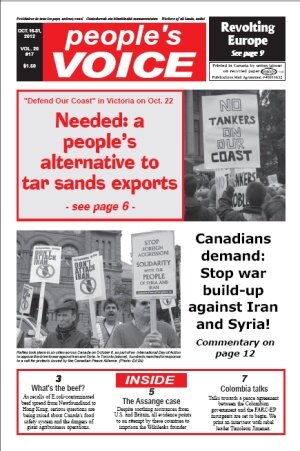
1) NEEDED: A PEOPLE'S ALTERNATIVE TO TAR SANDS EXPORTS
2) FARMERS, CONSUMERS, WORKERS PAY FOR FEDERAL POLICIES
3) END THE AGGRESSION AGAINST SYRIA! STOP THE DRIVE TO WAR AGAINST IRAN!
5) CONGRATULATIONS TO THE VENEZUELAN PEOPLE - Editorial
6) AUSTERITY UNDER FIRE - Editorial
7) COURT STRIKES DOWN B.C. GAG LAW
8) FURLONG ABUSE ALLEGATIONS ROCK BRITISH COLUMBIA
9) UKRAINIAN LABOUR TEMPLE PLAQUE UNVEILED
10) "WE WILL NEVER GIVE UP THIS JUST FIGHT"
11) THE SCHEMING CENTRED ON ASSANGE
12) THE REAL DANGER IS WAR, NOT DIALOGUE
14) DOCUMENTARY REVEALS CASTE OPPRESSION IN INDIA
15) THE SPARK! (Theoretical and Discussion Bulletin of the Communist Party of Canada)
PEOPLE'S VOICE OCTOBER 16-31, 2012 (pdf)
|
People's Voice deadlines: November 1-15 November 16-30 Send submissions to PV Editorial Office,
|
REDS ON THE WEB
http://www.parti-communiste.ca/
peoplesvoice.ca
www.ycl-ljc.ca
www.solidnet.org
|
People's Voice finds many "Global Class Struggle" reports at the "Labour Start" website, http://www.labourstart.org/. We urge our readers to check it out! |
* * * * *
People's Voice
Canadian Publications Mail Sales Product Agreement #205214
ISSN number 1198-8657
People's Voice is published by
New Labour Press Ltd
PV Editorial Office
706 Clark Drive,
VANCOUVER, B.C. V5L 3J1
Phone:604-255-2041
Fax:604-254-9803
email: pvoice@telus.net
Editor: Kimball Cariou : Business Manager: Sam Hammond
Editorial Board: Kimball Cariou, Miguel Figueroa,
Doug Meggison, Naomi Rankin, Liz Rowley, Jim Sacouman
* * * * * *
Letters
People's Voice welcomes your letters
on any subject covered in our pages.
We reserve the right to edit for length and clarity,
and to refuse to print letters which may be libellous
or which contain unnecessary personal attacks.
Send your views to:
"Letters to the Editor",
706 Clark Dr., Vancouver, BC V5L 3J1,
or pvoice@telus.net
People's Voice articles may be reprinted without permission,
provided the source is credited.
* * * * * *
The Communist Party of Canada, formed in 1921,
has a proud history of fighting for jobs, equality, peace,
Canadian independence, and socialism.
The CPC does much more than run candidates in elections.
We think the fight against big business and its parties
is a year-round job,
so our members are active across the country,
to build our party and to help strengthen people's movements
on a wide range of issues.
All our policies and leadership
are set democratically by our members.
To find out more about Canada's party of Socialism,
give us a call at the nearest CPC office.
* * * * * *
Central Committee CPC
290A Danforth Ave Toronto, Ont. M4K 1N6
Ph: (416) 469-2446
fax: (416) 469-4063 E-mailmailto:info@cpc-pcp.ca
Parti Communiste du Quebec (section du
Parti communiste du Canada)
5359 Ave du Parc, Montréal, Québec,
H2V 4G9
B.C.Committee CPC
706 Clark Drive, Vancouver, V5L 3J1
Tel: (604) 254-9836
Fax: (604) 254-9803
Edmonton CPC
Box 68112, 70 Bonnie Doon P.O.
Edmonton, AB, T6C 4N6
Tel: (780) 465-7893
Fax: (780)463-0209
Calgary CPC
Unit #1 - 19 Radcliffe Close SE
Calgary AB, T2A 6B2
Tel: (403) 248-6489
Ottawa CPC
Tel: (613) 232-7108
Manitoba Committee
387 Selkirk Ave., Winnipeg, R2W 2M3
Tel/fax: (204) 586-7824
Ontario Ctee. CPC
290A Danforth Ave., Toronto, M4K 1N6
Tel: (416) 469-2446
Hamilton Ctee. CPC
265 Melvin Ave., Apt. 815
Hamilton, ON.
Tel: (905) 548-9586
Atlantic Region CPC
Box 70 Grand Pré, NS, B0P 1M0
Tel/fax: (902) 542-7981
http://www.parti-communiste.ca/
* * * * * *
News for People, Not for Profits!
Every issue of People's Voice
gives you the latest
on the fightback from coast to coast.
Whether it's the struggle for jobs or peace, resistance to social cuts,
solidarity with Cuba, or workers' struggles around the world,
we've got the news the corporate media won't print.
And we do more than that
- we report and analyze events
from a revolutionary perspective,
helping to build the movements for justice and equality,
and eventually for a socialist Canada.
Read the paper that fights for working people
- on every page, in every issue!
People's Voice
$30 for 1 year
$50 for 2 years
Low-income special rate: $15 for 1-year
Outside Canada $50 for 1 year
Send to: People's Voice, 706 Clark Drive, Vancouver, BC, V5L 3J1
You can call the editorial office at 604-255-2041
REDS ON THE WEB
http://www.parti-communiste.ca/
http://www.ycl-ljc.ca/
http://www.solidnet.org/
(The following articles are from the October 6-31, 2012, issue of People's Voice, Canada's leading communist newspaper. Articles can be reprinted free if the source is credited. Subscription rates in Canada: $30/year, or $15 low income rate; for U.S. readers - $45 US per year; other overseas readers - $45 US or $50 CDN per year. Send to People's Voice, c/o PV Business Manager, 706 Clark Drive, Vancouver, BC, V5L 3J1.)
1) NEEDED: A PEOPLE'S ALTERNATIVE TO TAR SANDS EXPORTS
Statement by the BC Provincial Executive Committee, Communist Party of Canada, October 4, 2012
On October 22, thousands of people will gather at the Legislature in Victoria for a powerful protest against the corporate drive for more tar sands exports and tankers on the west coast. The Communist Party extends full solidarity to this courageous action, which will include members and supporters of our party.
Earlier this year, the Communist Party submitted our views to the Joint Review Panel hearings into the Enbridge Northern Gateway (ENG) pipeline. At the time, we called the hearings "a historic clash between two different visions for the future of Canada."
Subsequent events have validated this prediction. The broad coalition against the ENG proposal brings together growing numbers of Aboriginal peoples, environmentalists, working people, and even business people who understand the grave environmental, economic and social dangers posed by this project.
Public opposition has even compelled Premier Christy Clark to pose as a critic of the ENG proposal. But this phony public relations battle is not between the working people of B.C. and Alberta. In fact, both British Columbians and growing numbers of Albertans fear the threats posed by tar sands expansion, new pipelines and expanded tanker traffic.
Submissions to the panel hearings have shown that the Northern Gateway project does not meet the criteria of being "required" and "in the public interest." Rather, it is intended to generate huge new profits for the oil and gas monopolies.
Aboriginal peoples along the pipeline corridors, many of whom have never ceded inherent indigenous title to their traditional lands and waters, call the ENG project a direct attack on their national rights. Instead of meeting legal and constitutional obligations to engage in meaningful consultations with First Nations, the pipeline proponents and its political backers set up phony pro-pipeline groups and pay so-called aboriginal leaders to issue supportive statements. These corrupt tactics have only strengthened opposition by First Nations across B.C.
The potential for catastrophic environmental damage was seen again by revelations about Enbridge's failure to prevent and respond to its catastrophic oil spill in Michigan. The Northern Gateway pipeline would be constructed across 1177 kilometres, crossing some 1,000 rivers, streams and bodies of water, bringing bitumen to load onto supertankers in the narrow Douglas Channel, one of the most environmentally fragile areas of the west coast. Despite its expensive greenwash propaganda, Enbridge's record of more than 800 leaks over the past decade proves that the only real question is the frequency and scale of more such disasters.
But the transnational energy monopolies and the federal and Alberta governments have not given up. These forces remain determined to proceed despite negative public opinion and scientific warnings. Last spring, the Harper Tories used their parliamentary majority to remove key legal barriers to the rubber-stamping of controversial energy projects. The Tories demonize critics as "foreign radicals" and "billionaire socialists", but this smear tactic has only strengthened popular determination to block this dangerous project.
Bitter struggles over energy and resource policy go back decades in Canada. Natural resources such as fossil fuels, lumber, water and minerals could provide the material base for a publicly-owned "value-added" economic structure, focused on creating good jobs and meeting people's needs, without destroying the natural environment. Instead, starting with the colonial seizure of Aboriginal lands, and the "Abbott Plan" adopted by the post‑war Liberal government, vast resources within the borders of the Canadian state have been grabbed by transnational (especially U.S.) capital. Canada has become mainly a supplier of raw materials for the U.S. military-industrial war machine. "Free trade" sellouts ensure that the First Nations and the peoples of Quebec and the rest of Canada are still denied any genuine sovereignty over our economic future. The Enbridge project is another nail in the coffin of Canada's declining domestic manufacturing base.
The ENG project, the twinning of the Kinder-Morgan pipeline to Burnaby, and massive natural gas fracking in northern BC, all feed into the global imperialist pattern of fossil fuel dependence and domination. This relentless capitalist expansion not only threatens British Columbia's coastline, it has grave health consequences for the people of Alberta, and contributes to the deadly spiral of global warming and climate change.
The Communist Party opposes the policy of exporting unprocessed raw materials. Instead, we call for a People's Energy Plan, based on a sustainable, conservation‑based economy; full respect for the inherent rights of First Nations over their traditional territories and resources; and public ownership of the energy industry, as the material basis to rebuild Canada's industrial and manufacturing sector and to create jobs.
Ultimately, blocking the Northern Gateway pipeline and other forms of tar sands expansion will require united, massive, and militant mobilizations, like the Oct. 22 action in Victoria. We urge the labour and democratic movements to build united solidarity with the Aboriginal peoples and environmentalists, both to kill this dangerous project, and to create a genuine people's alternative plan for economic development, based on people's needs, not corporate greed!
2) FARMERS, CONSUMERS, WORKERS PAY FOR FEDERAL POLICIES
By Kimball Cariou
New revelations keep emerging about the XL Foods tainted beef scandal, as recalls of contaminated products expanded nearly every day during late September and early October.
For example, there was a delay in getting data from the Alberta slaughterhouse at the centre of the largest beef recall in Canadian history.
That was the word from Canadian Food Inspection Agency president George Da Pont, speaking on Oct. 3 to reporters in Calgary together with Agriculture Minister Gerry Ritz. Shortly after Da Pont's admission, a federal government staffer cut the news conference short.
Da Pont said the CFIA asked for information from XL Foods on Sept. 6, but there was a delay in getting a response. Tests in the U.S. raised further alarms, but the plant continued to operate until the Inspection Agency closed it on Sept. 27.
After visiting the XL plant in Brooks, Alberta, Ritz said the facility would not reopen until inspectors certify that Canadians are not at risk. The reopening was initially expected almost immediately, but then kept getting delayed.
As the Globe and Mail's Andre Picard pointed out in an Oct. 8 commentary, "XL Foods... the Canadian Food Inspection Agency, which oversees the monitoring and enforcement of food safety regulations, and Agriculture Minister Gerry Ritz, who is ultimately responsible for food regulation, have distinguished themselves with foot-dragging, the uttering of half‑truths, cowering in fear, and inappropriate beef boosterism."
After routine testing revealed E.coli 0157 in meat produced at XL Foods, the U.S. Department of Agriculture halted shipments, but the CFIA first determined "there was no risk to consumers." The CFIA did not issue an alert to consumers until Sept. 16, days after the first illnesses were reported.
After Gerry Ritz's Oct. 3 news conference was cut short, he attended a Rotary Club luncheon, where he said of his beef entrée: "I don't know where it came from. I don't care. I know it's safe."
XL Foods said nothing until Oct. 4, when it posted a statement on an answering machine, saying: "We take full responsibility for our plant operations and the food it produces."
But as the E.coli 0157 outbreak spreads, it becomes more and more apparent that soothing words are just not good enough.
Federal agriculture and trade policy created the conditions that led to the massive recall of beef from stores, homes and restaurants across Canada due to E.coli 0157 contamination.
That's the view of the National Farmers Union (NFU), which opposes the massive concentration in the meat packing industry and increased self‑regulation of a few high‑volume, high‑speed processing plants. These developments, says the NFU, are due to policies that help the biggest companies increase profits and market share in pursuit of global competitiveness, by allowing them to reduce costs for meat inspection.
"Cattle farmers are already feeling the effect of the closure, as prices for fat steers and cull cows have already dropped by 20% and 30% respectively," says Glenn Tait, NFU Board member from Meota, Saskatchewan. "This sudden and unpredictable loss of income may well wipe out our 2012 profits. As farmers, we have done nothing wrong, but we are paying the price for XL's inability to run a clean plant and the Canadian Food Inspection Agency's inability to enforce food safety standards."
The XL Food plant processes about 30,000 animals per week,
with Cargill, the largest packer, processing slightly more. About 80% of Canada's beef is processed in Alberta, mostly at these two operations. With Alberta's capacity virtually cut in half, a backlog is developing at cattle auctions, driving prices down. The NFU warns that many cow‑calf producers, the foundation of Canada's beef sector, may soon suffer serious losses, compromising their capacity to continue raising cattle.
Neil Peacock, National Farmers Union Board member and cattle producer from Sexsmith, Alberta, remembers the 23 deaths and 57 illnesses from the 2008 listeriosis crisis at Maple Leaf Foods, and asks "Isn't this XL Foods situation just more evidence that Canada's food safety, security and sovereignty is in danger?"
While farmers wait for the CFIA and XL Foods to re‑establish clean and safe processing, they must feed their cattle longer and incur extra costs, or else sell sooner at reduced prices. The food safety risk was taken by XL Foods, says the NFU, but the costs of that risk are being borne by consumers who have gotten ill from the tainted meat and farmers who cannot sell their cattle for the price they had expected.
The 2,200 workers at XL Foods are also paying the price for corporate and government policies. Largely immigrants from Sudan and other African countries, they are members of the United Food and Commercial Workers Union. The crisis affecting the industry could soon have a major negative impact on the workers and their families.
Some XL employees have told the media that food safety was regularly jeopardized inside the plant. The UFCW's Tom Hesse says the union has heard about management's a general lack of concern for food safety issues, such as clogged cleaning equipment.
Workers also say that if they take the time necessary to sterilize their knives between cuts, they can't keep up with the workflow demanded by the company. Employees have described witnessing unhygienic behaviour, including failure to wash hands properly, and wearing contaminated clothing into clean areas. Management allegedly turns a blind eye, refusing to stop the production line when such problems are found.
"(The workers) are saying that XL is more concerned with the numbers they can produce rather than the safety of the workers or the safety of the product," according to Hesse.
3) END THE AGGRESSION AGAINST SYRIA! STOP THE DRIVE TO WAR AGAINST IRAN!
The Canadian government is called upon to act for peace, not promote war - Canadian Peace Congress
The Canadian Peace Congress condemns the ongoing foreign intervention in Syria and the escalating drive to war against Iran, and calls for the immediate withdrawal of all Canadian, NATO and foreign mercenary forces from the region. We further call upon the Conservative government of Stephen Harper to restore and normalize its diplomatic relations with Syria and Iran, and to re‑orient Canadian foreign policy toward peace, international cooperation and solidarity.
The Harper government's decision to adopt an international policy of belligerence, and to do so without consulting Parliament, is further evidence of its abandonment of a foreign policy of peace and diplomacy in favour of aggressive and hostile interference in the internal affairs of sovereign countries. Syria and Iran are member states of the United Nations and have expressed no hostile intent towards Canada or its people. Prime Minister Harper is actively contributing to the danger of war, through hostile policies that are out of step with the Canadian peoples' longstanding support for peace.
The Canadian government has allied itself with a minority of Western governments who, along with pro‑war forces within Israel and a few reactionary Arab regimes, are seeking new pretexts for intervention and war. These include the protection of human rights or the prevention of the alleged proliferation of weapons of mass destruction. These objectives cannot be achieved by breaking diplomatic relations, imposing economic sanctions, arming foreign mercenaries, or forging international campaigns for regime change and by installing puppet governments favourable to the strategic goals of the major western power.
Foreign intervention, sanctions and military aggression only weaken the human and democratic rights of the Syrian and Iranian people, and diminish their ability to develop and improve their societies. The aftermath of NATO intervention in Libya last year, in which Canadian armed forces bombed Libyan territory, has been disastrous for the people of Libya who are now plunged into factional warfare. This, plus the catastrophic consequences of the military occupation of Iraq, including the deaths of over one million Iraqis, clearly indicate that the main victim of any war is the civilian population.
As in the case of Libya last year, the drive to interfere in Syria and Iran is driven by the strategic and economic interests of imperialist powers. These countries - including the United States, Britain, the European Union and Canada - choose militarism and war as their preferred option for expanding their spheres of influence and control over resources and markets. The result is destruction, displacement and despair to the peoples of the developing countries who have been targeted. Far from resolving conflicts, these policies of interference only deepen current crises and escalate the danger to world peace.
Pro‑war forces have seized upon the many complexities in the situations in Iran and Syria, to promote misinformation and confusion. The threat to peace in the Middle East does not arise from countries who exercise their sovereign right to develop the nuclear energy industries to build their economies. Nor does it originate with countries who oppose Western efforts to re‑colonize the Middle East and control its vast energy resources, through the New Middle East Plan. Rather, the concrete threat to peace is the existing conventional and nuclear weapons that the US, its NATO allies and Israel constantly brandish in their effort to destabilize the region, to demonize governments that oppose imperialist plans, and to justify interference and war.
The Canadian Peace Congress asserts that the direction of economic, political and social development in any country is the sole right of the people of that country to determine, without foreign interference. We hold this principle to be true for the people of Canada, as we hold it to be true for the people of Syria and Iran. We are completely opposed to any foreign political or military intervention, under any pretext. This includes efforts to interfere with and divert genuine democratic domestic movements.
The role of the Canadian government in both of these crises has been shameful. Under Stephen Harper's Conservatives, Canada has abandoned its reputation as a country with an independent stance in international relations, and assumed the posture of a vocal NATO aggressor state. In all dimensions - political‑diplomatic, economic and military - Canada's recent policies toward Syria and Iran have been geared toward three goals:
- Isolate and neutralize sources of information that conflict with imperialist aims, by cutting off communication with the governments and peoples in Syria and Iran;
- Increase the suffering of the people and generate anti‑government sentiment, by imposing economic sanctions that particularly target energy industries who produce for local consumption;
- Increase the active military threat in the region, by deploying warships and other military resources to the region.
These goals all directly serve the overall objective of pro‑Western regime change in Syria and Iran, and the Harper government has campaigned hard internationally, to convince other countries to assume similar policies against both countries.
In the case of Syria, the Conservatives have also campaigned aggressively to create and promote a political opposition movement to the government. In November 2011, the NATO Parliamentary Assembly received a report that "virtually no one [in Syria] is calling for international military intervention" and that Syria was "without a clearly identifiable opposition with precise political ambitions." Yet, just prior to that report, Canada's Foreign Affairs Minister John Baird had met with the Syrian National Council and proclaimed them to be the legitimate opposition who has "continuously outlined their appetite for change." It is unclear how Baird identified an organized and "legitimate" opposition when NATO could not, and it suggests that the Syrian National Council is little more than a pro‑Western puppet government‑in‑waiting that has been fashioned by imperialist forces.
Furthermore, Canada has supported the arming of an estimated 40‑60,000 foreign mercenaries to fight inside Syria. These mercenaries form the backbone of the Free Syrian Army, and indicate the degree of armed foreign intervention already underway in Syria. The recent elections in Syria had a higher voter turnout than in Canada, and a number of independents and government opponents were elected and have been included in the cabinet. The Syrian people have spoken, yet Canada and other interventionist forces continue to pick sides in an internal matter.
In the case of Iran, the frenzied drive to war has obscured certain significant facts from the public eye:
Iran is a non‑nuclear state and a signatory to the Nuclear Non‑Proliferation Treaty (NPT), and is under the supervision of the United Nations' International Atomic Energy Agency (IAEA). Iran has repeatedly stated that its nuclear program is for peaceful purposes and not for military ends. The fact of the matter is that neither the IAEA nor the U.S. administration has been able to show any substantiated evidence about the weaponization of Iran's nuclear energy program. The U.S. Secretary of Defence, Leon Panetta, has publicly conceded, "there is no evidence that Iran has a nuclear weapon."
Israel is a nuclear weapons state with an estimated 200‑400 nuclear weapons, who has refused to join the NPT. There is no UN supervision over Israel's nuclear activities. It has pre‑emptively attacked other neighbouring states, and has threatened Iran with military attack many times.
United States is a nuclear weapons state with more than 10,000 nuclear weapons, and it has not allowed any inspection of its nuclear facilities by the IAEA. The U.S. has used nuclear weapons against other countries, when it exploded two nuclear bombs on Japan and when it used uranium‑enriched weapons in Iraq. The U.S. also has repeatedly threatened Iran with military attack, and has nuclear‑equipped forces currently stationed in the region.
The Canadian Peace Congress supports the October 6 Day of Protest Against War, initiated by the Canadian Peace Alliance. After more than a year of conflict and violent foreign intervention, thousands of Syrian people have died. If governments like Canada are allowed to continue their current policies of aggression, interference and colonization, thousands more will die. All peace‑supporting groups in Canada - including trade unions, faith communities and student groups - need to speak out and mobilize against intervention in Syria and Iran and the threat of a far broader war in the region.
The Canadian Peace Congress demands that the Canadian government:
* Immediately withdraw Canadian military forces from the region, and oppose military intervention in Syria and Iran, under any pretext;
* Restore diplomatic relations with Syria and Iran, remove sanctions, and support the peace initiatives of those states and organizations advocating a cease fire and negotiated end to the war;
* Withdraw from NATO, which has a nuclear first‑strike policy and complimentary sea‑ and land‑based ballistic missile systems, and all other military alliances;
* Promote full nuclear disarmament, beginning with the nuclear stockpiles of the United States, Israel and NATO;
* Adopt a new independent Canadian foreign policy of peace, non-intervention and diplomacy in international relations.
Here at People's Voice we aren't shy about making the case for policies to put people before profits. Occasionally we have been accused of exaggerating the facts to make a political point. So it's great to see mainstream media reports which back up our arguments.
Here are two recent examples, starting with corporate taxation.
For years, we have called to stop the reduction of taxes on corporations, a neoliberal policy that puts an increasing burden on working people.
Don't take our word for it. Turns out that "the tax burden for businesses in Canada is second lowest among 14 major countries and lowest among developed countries, according to a KPMG survey of international tax competitiveness." (That's the Globe and Mail speaking on Sept. 25.)
KPMG's Elio Luongo (probably no relation to Roberto of the Vancouver Canucks) says that "the tax system is often what tips the scales" in attracting investment.
India had the lowest overall tax levels. China, Mexico and Russia ranged third, fourth and fifth. Among developed countries, Britain ranked second, followed by the Netherlands, the United States, Germany, Australia and Japan.
KPMG uses an index composed of corporate income tax, capital taxes, sales taxes, property taxes, local business taxes and statutory payroll taxes, using rates applicable as of Jan. 1, 2012.
Comparing major international cities, KPMG also found that Toronto, Vancouver and Montreal are all in the top 10 among 55 cities with populations of more than two million. All 16 Canadian cities analyzed by KPMG had lower tax rates than the least taxed U.S. city - Baton Rouge, Louisiana. So much for all the whining from corporate shills about Canada's "heavy tax burden"!
Then we come to the supposedly complex problem of homelessness. People's Voice has long stated that simply building more low-income housing would be a great way to cut spending on health care, emergency services, policing, etc. Too expensive, according to right-wing politicians and corporate think tanks.
Now, a new study by Stephen Gaetz, director of the Canadian Homelessness Research Network, based on research from across North America, suggests it's far cheaper to give a homeless person a place to live than to provide a patchwork of emergency services.
Gaetz says governments spend at least $4.5 billion a year dealing with homeless people, including the costs of emergency health care, mental‑health services, law enforcement, shelters and food banks. Their use of the health system is high and unpredictable, and many end up homeless again after brushes with the law upon release from jail.
For chronically homeless people who are frequent users of social services, the annual savings are $25,899 per person, enough for a "housing first" approach across Canada, according to the newly formed Canadian Alliance to End Homelessness.
$4.5 billion would build an estimated 45,000 housing units. Such an investment over several years would end street homelessness across Canada. Too expensive? No, and we'll continue to say "told you so".
5) CONGRATULATIONS TO THE VENEZUELAN PEOPLE
People's Voice Editorial
The October 7 election in Venezuela was a major victory for President Hugo Chavez, for working people and the poor in that country, and for the global movements for democracy, national liberation, social justice, peace, and revolutionary change. The "Great Patriotic Pole" (GPP) coalition which includes Chavez's PSUV, the Communist Party of Venezuela and other left forces won 54.4% of the popular vote, to 45% for the right-wing Democratic Unity candidate Henrique Apriles Radonski.
This success was achieved under difficult circumstances for the Bolivarian Revolution, which faces complex challenges at a time of global capitalist crisis. The GPP was confronted not only by united domestic capital, but also by Yanqui imperialism and the world-wide corporate media. Absurdly posing as defenders of social justice, this counter-revolutionary alliance also engaged in vicious tactics, predicting that the outcome would be "razor thin" in hopes of provoking post-election violence.
In the end, there was a record turnout and eight million Venezuelans cast their ballots for President Chavez, giving him a strong mandate for another six-year term. But already, capitalist media pundits in Canada are calling on Chavez to yield to the demands of his opponents. When was the last time these hypocrites ordered the dictatorial Stephen Harper to pay attention to the 61% of Canadians who voted against his destructive far-right policies?
Despite such background noise, the outcome will strengthen progress towards socialism in Venezuela. The Bolivarian Revolution remains a bulwark of Latin America's rejection of domination by Washington, towards policies which put the interests of the people ahead of the greed of big capital. We congratulate the people of Venezuela for standing firm against the threats of imperialism!
People's Voice Editorial
Across the planet, the tide of popular anger against "austerity" policies keeps rising. Some of the most publicised examples are in Europe, where huge general strikes and demonstrations have spread to many countries. The European working class and its allies are turning their fire not just on government cutbacks and attacks on social benefits, but on the so-called "treaties" which eliminate any democratic, popular sovereignty. As critics of capitalist globalization have warned since the WTO "Battle in Seattle", these treaties are a strategy by transnational corporations to enforce their "race to the bottom", the push to reduce wages and working conditions to the lowest possible level everywhere. Today this policy is called austerity, supposedly needed to "share the pain" of the capitalist economic crisis. There is no "sharing" by the bosses, just by working people.
Resistance is not limited to Europe. Look at Indonesia, one of the world's most populous countries, where nearly three million factory workers hit the streets in early October to demand higher wages and an end to the one-year contract system (with no benefits) imposed by employers. Or Latin America, where working people in Venezuela have resoundingly re-elected Hugo Chavez, on a platform to expand the Bolivarian Revolution. The working class is clearly at the centre of an emerging world-wide movement for fundamental social transformation.
Many Canadian working people share this hunger for a better future for our families and communities. The main bodies of the labour movement, especially the Canadian Labour Congress, need to recognize this reality and step forward to provide stronger leadership. We urge the CLC and the Quebec union federations to seize the moment, by convening a People's Summit of the labour movement and its social allies, to hammer out a united popular struggle to demand people's needs, not corporate greed.
7) COURT STRIKES DOWN B.C. GAG LAW
The BC Court of Appeal has again unanimously rejected the BC Liberal government's latest attempt at gagging third parties from advertising about political issues. This time, the government has announced it will finally give up.
Prior to the 2009 B.C. election, the Campbell Liberals tried to impose restrictions on advertising for 60 days before the campaign period. The government's stated intention was to prevent trade unions or other movements from mounting effective publicity campaigns to raise their issues with the public.
But that heavy-handed legislation went much further, threatening heavy fines against nearly any organization or individual which spent any money to speak out on issues. According to legal advice at the time, for example, a newspaper such as People's Voice would have been barred from printing articles or advertisements which covered topics likely to arise during an election, starting sixty days prior to the writ being dropped.
After the courts struck down that law as an infringement of free speech rights, the Liberals pushed another set of amendments through the Legislature, proposing restrictions for up to 40 days before the campaign period. The court ruled that these amendments violate the Charter of Rights as well.
Writing on behalf of the court, Mr. Justice Lowry quoted from Supreme Court of Canada decisions saying "It is difficult to imagine a guaranteed right more important to a democratic society than freedom of expression. Indeed a democracy cannot exist without that freedom to express new ideas and to put forward opinions about the functioning of public institutions."
He added that advertising by individuals and groups "enriches the political discourse" by raising issues unlikely to get the attention of parties and candidates. The court said that interfering with political expression is allowed "only where there are the clearest and most compelling reasons for doing so," and found that the government had failed to show any such reason.
Indirectly, the ruling may bolster efforts by small political parties to cut down the web of political and bureaucratic barriers which hamper their efforts to reach voters. In recent elections, there have been growing attempts to block small parties from taking part in all-candidate forums, and even to bar candidates from speaking to voters or handing out campaign materials on post-secondary campuses. Such measures are clearly at odds with the emphasis on free political expression outlined by Justice Lowry in the B.C. case.
8) FURLONG ABUSE ALLEGATIONS ROCK BRITISH COLUMBIA
By Kimball Cariou
British Columbians appear sharply divided over allegations that the top organizer of the Vancouver 2010 Winter Olympics lied about his past and abused Aboriginal children. The dispute raises critical questions about the role of journalists and the mass media in Canada today. Just as important, the case indicates that racism and sexism, and the extraordinary privilege granted to wealthy white males, remain powerful factors in our society.
When the September 27 edition of Vancouver's free weekly Georgia Straight hit the streets, the uproar was immediate. Well-known journalist Laura Robinson wrote that Olympics CED John Furlong's 2011 memoir left out his early years in Canada. Furlong's book "Patriot Hearts" places his arrival from Ireland in 1974. That version omits Furlong's stint as an 18-year-old teacher at the Immaculata Catholic school in northern British Columbia, where several ex-students allege that he was verbally and physically abusive. A separate complaint of sexual assault was filed in July, and is under currently investigation by the RCMP.
Robinson appears to have done her homework, gathering eight signed affidavits, and making repeated attempts to contact Furlong by email through his publisher for his side of the story.
Furlong denies everything, except to admit that he had indeed first come to Canada in 1969. This period of his life was uneventful, he says, even though he married his wife at the time. He also launched legal actions against Robinson and the Straight, accusing her of not doing her job properly, and of conducting a vendetta against him. Even more startling, Furlong alleged that somebody told him the accusations would go away in return for cash. In the context of his statements, this appeared to implicate Robinson has begun a counter-suit, claimng defamation by Furlong.
What can people make of these allegations and counter-charges?
Some answers may come through the courts. Furlong is so far not replying to questions from reporters, even as more allegations emerge. But if the legal cases proceed, it seems that either Furlong or Robinson will be exposed as a liar.
This is the point to put my own cards on the table. As the editor of People's Voice, working just blocks from key Olympic sites, I published many articles critical of the huge social and economic costs of the Winter Games. I wrote some of those stories myself, and I took part in activities to oppose the Games, starting with Vancouver's civic referendum on the 2010 bid. Along with others, I helped turn the Olympic Torch away from its planned route along Commercial Drive, and I marched with thousands of protesters during the opening ceremonies.
That said, I also enjoyed the Winter Games. I was elated when the Canadian women's team won our first ice hockey gold medal since 1952, and when Sidney Crosby scored in overtime against the U.S. a couple of days later. I share with Laura Robinson a passion for sports, from neighbourhood soccer fields to the highest level of competition.
I also profoundly admire her willingness to write about the men who dictated that women could not ski jump at the Vancouver Olympics. Furlong and his supporters seem stunned that a woman would dare to question such decisions by the rich and powerful. In fact, Furlong charges Robinson with "open contempt for the Olympic Games and male authority figures in sport", but I and many others cheer such contempt for patriarchy in sport and the rest of society.
The vitriol directed against Robinson extends in other directions. Many of Furlong's backers appear outraged that former students have anything critical to say about the man. After all, "everybody knows that things were different back then"; supposedly violence by teachers against students was widespread and acceptable forty years ago. Others say worse things happened to Aboriginal children at many residential schools, so why pick on Furlong years later? Some simply dismiss the affidavits as lies, particularly those who have worked as colleagues with Furlong.
In one form or another, such responses point to deep-rooted racist attitudes, no doubt unrecognized by some of Furlong's defenders. Anyone who has spoken to survivors of the residential schools realizes that it was extremely difficult, even impossible, for many Aboriginal people to come forward with their tragic stories. Those who airily dismiss the Furlong affidavits have no idea how much courage it takes to finally speak to a reporter about the past; in fact, such reactions show that Aboriginal people are still often stereotyped as liars or habitually lazy. The same racist and sexist stereotypes apply in reverse, implying that a wealthy white male would never lie about important matters.
Robinson, along with Georgia Straight editor Charlie Smith, have brought a difficult story to the attention of the public. These are highly competent journalists, and the Straight has excellent lawyers. Furlong, on the other hand, appears to have hidden a controversial period of his life in Canada.
Three years ago, the Supreme Court of Canada established the defence of "responsible communication on matters of public interest". If Furlong's lawsuit proceeds, the Straight and Robinson will have to prove that the story was a matter of public interest, that they made every effort to verify the published claims, and that they gave Furlong full opportunity to answer the claims. My money is on Robinson and Smith, although one should never underestimate the determination of the ruling class to protect its own.
9) UKRAINIAN LABOUR TEMPLE PLAQUE UNVEILED
PV Manitoba Bureau
On September 29, Winnipeg's Ukrainian Labour Temple finally received a plaque marking it as a National Historic Site. Close to one hundred people attended the unveiling ceremony which included performances by the hall's orchestra and choir.
The ULT and its manor continue to play an active role in Winnipeg's progressive community, including as a venue for meetings of the Communist Party's Mathew Popowich Club. (On this point, the plaque has an error.)
The ceremony was postponed for a year after Parks Canada officials received a communication from Ottawa forbidding the choir from singing the Internationale as part of the program.
The text of the plaque is:
"Constructed in 1918‑1919, this imposing building was at the centre of a radical left‑wing movement committed to improving the lot of Ukrainian workers and farmers. Housing a printing shop and the headquarters of several national organizations devoted to education and mutual aid, it also served as a base for the promotion of Ukrainian performing arts. It was a gathering place for strikers during the Winnipeg General Strike of 1919 and for the Communist Party of Canada until the 1950s. Continuing to serve a cultural function, this neoclassical building is one of the grandest and largest labour temples in Canada."
10) "WE WILL NEVER GIVE UP THIS JUST FIGHT"
Final Declaration of the People's Tribunal and Assembly, "Breaking the Silence: Justice for the Five". Held Sept. 21-23 in Toronto, the Assembly was attended by a wide range of supporters of the Cuban Five prisoners unjustly imprisoned in the United States.
Over the past two and a half days, we have reviewed in detail the legal miscarriages and political intrigue which led to the detention and wrongful conviction of the Cuban Five - Antonio Guerrero, Fernando Gonzalez, Gerardo Hernandez, Ramon Labanino, and René Gonzalez - patriots whose only "crime" was to investigate and expose the criminal, terrorist plots being hatched and executed against Cuba by hostile groups based in Southern Florida - extremist right‑wing groups aided and abetted by the U.S. government. The Cuban Five never spied upon or otherwise threatened U.S. national security; they acted only to protect their native country and the lives of their people.
Once again, we affirm that these five Cubans are not only the innocent victims of a grotesque miscarriage of justice, and not only prisoners of conscience. They are all that. But they are also, and foremost, "prisoners of war", an undeclared and unrelenting war which has been conducted by U.S. imperialism against Socialist Cuba and its people ever since the victory of the Revolution in 1959.
We express our deep appreciation for the tremendous legal work which has been and continues to be undertaken on behalf of the Five Cuban heroes. And we salute the tireless efforts of friendship and solidarity groups, trade union and labour organizations, the youth and student movement, First Nations organizations, progressive NGOs and other people's organizations and concerned individuals in Quebec and across the rest of Canada, as well as within the United States itself and indeed around the world, for speaking out in favour of winning justice for the Cuban Five and in demanding their immediate release, and for organizing campaigns and other initiatives to spread awareness of their plight and build pressure on the U.S. government to win their freedom.
At the same time, we express our anger at the intransigence of the U.S. authorities in refusing to reverse this grievous wrong, and at the mainstream corporate‑controlled press & media for maintaining a "wall of silence" around the case of the Cuban Five. We are convinced that our collective effort to break the silence and bring to light the full, untold story of the Cuban Five remains a decisive factor in ultimately overturning their conviction, winning their release and allowing them to return to their families in Cuba.
Despite all of the obstacles prolonging this injustice, we are not discouraged. We remain steadfast in our knowledge of the rightness of this cause, convinced that truth and justice will ultimately triumph. We draw strength from the victories - large and small - which have been won along the way. We are renewed by every solidarity initiative which helps spread awareness and build support for this struggle. And most of all, we are inspired by the Cuban Five themselves, by the remarkable courage and grace they have maintained through all they have endured over the past fourteen years.
At this Tribunal & Assembly, we have exchanged ideas and proposals on how we can move this struggle forward. It has been a dynamic and creative process, and while much remains to be done to bring these fresh ideas and initiatives to life, we are committed to ensuring their realization. We leave this Tribunal & Assembly with renewed energy and commitment, as well as a renewed sense of urgency, to broaden and deepen the solidarity movement supporting the Cuban Five. We will not be deterred. We will never give up this just fight. Let us move forward with vigour and unity.
Free the Cuban Five!
11) THE SCHEMING CENTRED ON ASSANGE
Editorial from The Guardian, newspaper of the Communist Party of Australia
It is now official - Julian Assange is considered an "enemy" of the United States. Documents obtained by The Sydney Morning Herald from US Air Force counter‑intelligence make it clear that contact with the Australian journalist or his organisation, WikiLeaks, will bring charges of "communicating with the enemy" down on the heads of US military personnel. The maximum sentence in the event of conviction is death.
The information blows apart the story pedalled by Australian Foreign Minister Bob Carr that the US has no interest in extraditing Assange to face charges of espionage or conspiracy. It confirms that authorities in Australia, Britain and the US have been engaged in delicate manoeuvring to neutralise a grave threat to their war plans - public awareness of the horrors of those wars and the dishonesty of diplomacy and manipulation of public opinion required to pursue them.
The US does not muck about with its "enemies". Such individuals have been targeted by drones in countries like Afghanistan, Iraq, Pakistan, Yemen and Somalia. There have been 297 strikes killing at least 1,800 people, many of them non‑combatants. Of course, it wouldn't do to attack Assange with a missile from a drone in the centre of London but make no mistake, hatred for the world's most famous whistle‑blower is deep‑seated in the upper reaches of government in the US and elsewhere.
In fact, the expressions of hostility to somebody whose only "crime" was to tell the international community precisely what happens behind embassy doors had to be toned down for the sake of decorum. Official US spokespersons used to openly refer to him as a "high‑tech terrorist" and an "enemy combatant". Prime Minister Gillard, a lawyer in a previous stage of her career, once declared WikiLeaks guilty without trial of "an illegal act" and the airing of the US' dirty laundry as "grossly irresponsible".
Bob Carr is in the forefront of the latest tread softly PR campaign, insisting the only issue to be cleared up in relation to Assange is that of the allegations of sexual assault in Sweden. With regard to those matters, Carr insists Assange has had extensive consular assistance though he hasn't specified to what end that "assistance" has been directed. Carr has joined a chorus of right‑wing commentary asserting that extradition to Sweden would actually make any subsequent extradition to the US more difficult. It is hard to believe the assurances of this most pro‑US of foreign ministers.
The reasons given as to why Assange can not be questioned in London over allegations of sexual assault keep shifting. It was originally claimed that Swedish law would not permit it. In the end, the only obstacle was said to be that of the "prestige" of the Swedish judicial process. Concerning the possibility of extradition from Sweden it was claimed that the Swedish courts would determine any such request in complete isolation from the sordid world of politics. It turns out that the government has the last word in these questions and its record is not good.
Much is made of the claim that Sweden cannot extradite a person to a country where they may face the death penalty. That didn't prevent its involvement in the "extraordinary rendition" of two asylum seekers to Egypt where they were imprisoned, beaten and tortured. It is not hard to imagine a scenario in which Assange could be extradited in exchange for assurances he would not face the death penalty.
The government of Ecuador has come under attack for granting asylum to Assange. There are allegations of "hypocrisy" directed at WikiLeaks because of the Latin American nation's supposedly woeful record on freedom of speech. Ecuador has broken away from US dominance since the election of President Rafael Correa late in 2006. The shift has earned the enmity of the US and dubious NGOs like Reporters Without Borders whose major donors are to be found in the Miami‑based Cuban ex‑pat community with all their CIA connections.
Ecuador has confirmed its status as a leader of the movement of countries reasserting their independence after decades of dominance by the US. Australia's record, on the other hand, shows just how disgraceful its government is in its subservience to US military, economic and political interests. We need have no illusions about its loyalty to its citizens or the cause of truth in international relations.
12) THE REAL DANGER IS WAR, NOT DIALOGUE
Timoleon Jimenez, commander in chief of the central high command of the FARC‑EP, is the visible head of the legendary guerrilla movement. Today he is committed to the search for a democratic peace by means of new dialogue with the national government. This interview with Timoleon Jimenez, conducted by Carlos Lozano Guillen, editor of VOZ, the Colombian communist newspaper, takes place at the moment of a new effort to achieve peace in Colombia.
Carlos Lozano: You begin a new process of discussion with a government that in some way is a descendent of Uribe's "democratic security." How does the FARC approach this?
Timoleon Jimenez: We always have been disposed to looking for solutions other than war. With Uribe, that wasn't possible, what with his open disavowal of our political orientation. Santos not only is heir to democratic security, but more than that, one of its star protagonists. (President Alvaro Uribe, 2002‑2010, propounded "Democratic Security" as his national security plan directed at "terrorism," i.e. the FARC.) In fact, with embellishments to the name he is continuing it. But as he himself says, Santos decided to assume the risks of dialogue and take positive steps along these lines. Any Colombian would say that the real danger is war, not dialogue. On that account we don't waver in accepting conversations in a search for peace. In regards to how to approach the new process, I would say that we do it with great expectations of arriving at an end to conflict. The President reiterates that he doesn't want to commit errors of the past, and we trust that's the way it will be. You know that the main error of all previous processes was to come to the table demanding surrender, with no real disposition to solving the causes that led to and kept on feeding confrontation.
The agenda includes the theme of "giving up arms," which would be the point at which an agreement or a peace pact has arrived. What does the FARC expect in this regard?
Without thinking of an arrival point of laying down arms we would lack any sense of beginning a process aimed at a definitive termination of conflict. Giving up arms consists of giving up on use of force, of appeal to any type of violence as remedy for economic or political ends. It's a veritable goodbye to arms. If we made that into a reality it in Colombia, our country would take an enormous leap forward. For the first time, we trust that the Santos administration and all sectors resorting to violence as a method of economic and political action are together with us on this criterion.
President Santos has said his government insists that this negotiating process "not repeat the errors of the past," also offers a guarantee it's heading toward an end of conflict and indicates his government will maintain military operations and military pressure on the FARC. What assumptions does the insurgency have so the process might end up successfully?
The dominant Colombian oligarchy, with solid support from U.S. governments, has for almost 50 years bet on exterminating the guerrillas. Twelve presidents, one serving twice, have invariably promised to finish us off. To do so, they've given the military apparatus a free hand. When Santos orders intensified operations, sections of the extreme right are not satisfied. He does it because he believes with them, as with all previous governments, that in fact he can make us surrender through force of arms. It's precisely that vicious cycle that needs to be broken. If you look at the general plebiscite giving approval to conversations on peace, you see that the great majority of Colombians don't share the idea of a military solution, among other reasons because, with more wisdom than their governments, they know it's not possible. We start out with the idea that this process will be successful. But that depends on those great majorities inclined toward a political solution having the opportunity to speak out, get mobilized, exert their influence, and decide the outcome. And we are inviting them to do it.
In various sectors supportive of dialogues, they are proposing a truce proposal, a cease‑fire, and cessation of hostilities. What does the FARC‑EP think?
We agree completely. It's always been in the forefront of our plans for trying to get close to different governments. Unfortunately the Colombian oligarchy has turned away because dialogues play out in the midst of confrontation. If the de-militarized zone of the most recent process had been accompanied by a mechanism of this sort, there might have been a different outcome.
In Colombia, the dominant sectors, its political class, and its mass media suffer from the obsession of looking at only one side of things. A report on the slaughter of 30 guerrillas in an aerial bombardment elicits their applause, while combat causalities on their side they repudiate as assassinations. We anticipate further heavy pressures on us at the negotiating tables from such manipulation...
The Colombia that is ignored and victimized must now rise up and, speaking through those who were murdered and disappeared, demand a definitive end to the war, end consecration of impunity, and satisfy old cries for vengeance for those who were violated in such wide‑spread, atrocious ways.
What do you think of the six to eight months President Santos is proposing?
That has to do with one expectation he is bringing up on his own. It hardly squares with the letter and spirit of what was agreed upon in the exploratory meeting. It was decided upon there to set no "drop‑dead" dates, not even use the word "months." What the President said suggests for us how difficult this road we are undertaking is going to be. At the same time, it clearly pointed up the strategy they are going to implement when they don't achieve something at the table: they'll try to impose it through the mass media. Even being in Havana and being able to carry out exploratory meetings took two years, not a matter of weeks, as we originally thought. And that wasn't precisely because of the insurgency. I don't want to go into particulars on that theme out of respect for our promise to keep silent on details for the moment. From stories coming up in the media, our counterpart seems to have forgotten that.
What political proposal will the FARC‑EP make to Colombians at the beginning of negotiations?
First, we want to mobilize around definitive termination of the conflict. The question of war or peace is a business concerning all of us Colombians and we are obliged to speak out. As it repeatedly insists, the government assumes negotiations will play out exclusively between their spokespersons and ours, discretely and without fanfare. That was the way when Laureano Gomez and Lleras Camargo signed the Sitges and Benidorm accords in Europe. The government alleges we of the FARC reject its plans for the most suitable government for the country. (Liberal and conservative party leaders signed the "Sitges and Benidorm accords" in Europe in 1956‑1957, introducing power‑sharing arrangements between two parties taking over from the Rojas Pinilla dictatorship.)
What we are saying is that once more they are disregarding the Colombian people. They agree to impose on them that which interests and suits, in truth, only the trans‑nationals, bankers, business people, and landowners. This can no longer happen in this country. The great majority must be listened to and heeded. Our proposal leads in that direction.
Why did the FARC decide to take on this new attempt at peace? Weakness? Strategy? Realism?
Whoever says military pressure was decisive in moving us to political negotiation forgets that this decade of war was unleashed when Pastrana unilaterally ended the peace process taking place in Caguan. It's now the state who is returning to the negotiating table with the FARC. It must have undertaken its own internal assessment. One of their considerations, not yet made public, has to do with their recognizing that the enormous effort undertaken to defeat us turns out to have been useless. The FARC keeps on: fighting, resisting, and advancing. Now we return to the natural scenario of politics, civilized dialogue. It's absurd to insist they made us sit down at the table, when it was the state that furiously left it. We negotiate because a political solution has been our banner always, and also that of the people's movement.
But, wait, hasn't the FARC taken severe blows during these last ten years?
I can't deny we've received serious blows ‑ and extremely painful ones. The deaths of four members of the National Secretariat can't be minimized. And combatants' dying under fire from bombardments has been hard. Nevertheless we have courageously adjusted to all these situations. None of the current members of the Secretariat has had less than 35 years of guerrilla experience, which applies also to the Central High Command. There's no improvising when it comes to relief personnel.
Forty eight years of continual struggle has enabled us to gear up in formidable fashion. We keep on moving, with pain in our soul, but more attached to and convinced of our reasons. There are deaths in every war. The media campaign insists on presenting us as a worn out and dead ‑ end organization. It's always been that way. If it were a question of confronting an already defeated force, they would not be working, as they are doing, to augment their forces even more, and also their enormous, acquired arsenal. These are truths that the state and the mass media deliberately hide.
So, although the FARC is not carrying out operations of the calibre of those 14 years ago, can you affirm that confrontation continues on a large scale? The Minister of Defense minimizes them completely and alleges that engagement persists only in rural areas of the country, in ten isolated municipalities.
The FARC‑EP operates and moves about in the same areas they occupy. The supposed control exercised by their combined commands ‑ tasks forces, brigades, and battalions ‑ is frequently on pins and needles through the activity of mobile guerrillas. The number of the armed forces casualties peaked not long ago. Clearly, we've also taken hits, which have been much publicized by the media. That's what conflict is. A war is joined according to circumstances. There are no operating rules valid for all situations. It's obvious that conditions of today are not the same as those a decade ago, above all through the massive use of military aviation.
But we are fighting everyday. In all blocs of the FARC, we undertake to vary that equation according to the moment. Come what may, persisting conflict will entail many more deaths and great destruction, more sorrow and tears, more poverty and misery for some and greater wealth for others. Imagine the lives that could have been saved these ten years. That's why we seek negotiations, a solution without blood, and an understanding through political routes. We are confident that the national government also understands the necessity to finish with such long, drawn ‑ out violence against the Colombian people.
(Published in VOZ on Sept. 19, 2012. Translated by W.T. Whitney Jr.)
By Tom Gill, London, Sept. 29, 2012
A general strike in Greece, massive protests by the indignados in Spain, public transport strikes in Portugal (and Spain), and industrial action by aluminium, steel and public sector workers in Italy headlined this week.
On Saturday mass protests will erupt again in Portugal as the indignaos movement that brought out a million into the streets of the country on September 15 - the same day there was another huge scale turn out into the plazas in Spain - join action called by the country's largest trade union, CGTP.
And it's not just in the Continent's south. On Sunday mass demonstrations are expected in France, calling for a referendum over the EU Fiscal Compact, the `permanent austerity' treaty.
The focus of popular anger is `Europe's austerity madness', as Paul Krugman puts it in his latest column in the New York Times. But the protests also reflect a wider rejection of a political elite that is rolling back basic democratic rights, from protections at work to welfare support and gains for women and minority groups, and privatising as well as slashing public services.
A slew of economic data this week confirmed what is now patently obvious to anybody but the criminally insane (and economists) - austerity is not working. Eurozone business confidence fell to a three‑year low and a number of other indicators across the continent pointed towards recession. Most damning for the architects of austerity, unemployment is rising in Germany, which was until now a mainstay for growth in the 17 nation economic and monetary bloc.
Overall, the eurozone economy stagnated in the first three months of the year and contracted 0.2% in the April‑June period. Economists now expect another economic contraction in the third quarter. The European Central Bank meanwhile released data that showed lending to households and companies fell, and by more than expected, in August.
Yet Europe's austerity madness continues. This week Spain, Greece and France pushed ahead with fresh programmes of spending cuts. In Greece, at least 11.5 billion euros will be axed from the national budget. In Spain there will be another 20 billion euros of cuts. In France, President Francois Hollande's government is going for a 30 billion euro cuts package.
What do these huge but dry numbers mean in practice?
18 million unemployed across the Eurozone, for starters, to which another million will be soon added, according to a new report by Ernst and Young.
In Greece, a cuts package near agreed by the government will see wage cuts, a rise in the retirement age from 65 to 67 years, cut backs to pensions - lengthening the contribution period to get the minimum pension - cuts in benefits for the disabled and the sick, cuts to health benefits, cuts to unemployment benefits for workers temporarily laid off in the construction industry, in hotels and in other sectors, new cuts to spending on hospitals, and an average 12% reduction in the salaries of soldiers, policemen and judges.
In Spain, the "depression budget" as Socialist economy spokeswoman, Inmaculada Rodriguez Pinero, describes it, will see the wages of millions of public sector workers frozen for the third year in a row and pensions cut in real terms, and there'll be no relief for collapsing health services, schools and social services. And the arts and culture will take a massive hit, with cuts hurting renowned institutions such as the Prado and Reina Sofia museums, another self‑defeating move that will no doubt hit tourism.
Austerity has already resulted in over a million Spaniards queuing at the doors of charities for food handouts and other aid. That's a tripling since 2007, according to Caritas. And it is not just in the south. In France poverty is on the rise particularly among the young, including students.
The health effects of mounting misery are being felt too. A quarter of Portuguese are now suffering from depression, according to a new study.
The perversity of austerity - which at its most fundamental level is about drastically curtailing the capacity and incentives for 320 million odd people to spend - was highlighted yet again this week. Despite all the cuts, it turns out that Spain's spending is actually set to go up. That's because of a soaring social security bill to pay benefits to the unemployed and interest rate payments on sovereign debt that have been driven once again by international speculators who are right in just one respect - without growth a country's public finances will just go from bad to worse and so lending to Spain and other recession‑hit countries is most definitely a risky business.
This is something that the new mechanism to `save' struggling Eurozone states - the 500 billion euro European Stability Mechanism that forms part of the EU Fiscal Compact - will not fix. To the contrary. It will bury them deeper into the ground. The fund will swallow up about a quarter of the cuts Spain has just pushed through its own budget in order to save itself, and around a third of those planned in Portugal.
The reality is the latest round of EU centralising moves, from banking union, to ECB sovereign bond purchases and the EU Fiscal Compact that President Francois Hollande wants ratified in parliament next month - even at the cost of splitting his Socialist Party and deep divisions with his Green allies - are based on a huge lie. That greater integration and renouncing national sovereignty are essential to fix the Continent's financial and economic problems.
Spain, Italy, Portugal and Greece don't need an international rescue. Their own ruling classes have more than enough to bail their own nations out. In Italy, private wealth stands at 8.6 trillion euros, according to the Bank of Italy, or more than four times the country's public debt mountain of around two trillion euros. If the wealth of the top 50% richest were taxed at a rate of 2%, that could raise more than 100 billion euros annually. A moderate tax on the top 1% could bring up to 15 billion euros annually into the state coffers. And then there's the hundreds of billions in dodged taxes, facilitated by tax amnesties and tax havens that cash‑strapped governments across the currency bloc like to talk much about, but don't ever shut down.
Even Portugal, the poorest of EU nations, can dig itself out of its own hole if it wishes. The government caused outrage by proposals to raid the incomes of workers through a massive hike in social security contributions, a measure now withdrawn the mass protests earlier in the month. The government needs to save 4.9 billion euros in 2013. The CGTP trade union confederation knows how it could plug that hole and indeed beat that target. Its 6 billion euro budget proposals, unveiled last week, comprise a new 0.25% tax on financial transactions (2 billion euros), a 10% surcharge on dividends targeting the largest shareholders (1.7 billion euros), a higher, 33.33% rate of corporate tax for larger companies with turnover above 1.2 million euros to be implemented in a progressive fashion (1.1 billion) and a plan to combat fraud and evasion, through deploying more inspectors, setting targets to reduce the black economy and by broadening the tax base (1.2 billion euros). But that plan would of course mean Portugal's 1% paying their dues.
There's dozens of other costed proposals out there that could tackle Europe's debt burden and provide plenty of funds for growth, jobs and public services without raiding the pockets of working people.
Take Italy again and international missions like Afghanistan that are in place in the name of peace and humanity but are instead resulting in death and destruction. Withdrawing from these commitments would not only save lives abroad but save Italians a tidy 616 million euros, according to campaign group Sbilanciamoci!, money that could be spent on improving their quality of life. Taking the axe to the military budget could yield 3 billion euros.
But these solutions don't fit the priorities of the current crop of EU leaders (with the notable exception of socialist‑led France where at least the government has moved to impose a 75% tax on the incomes of the very rich). Their number one goal is to protect the billionaires, the corporations and the banks. And so, amid the penury for ordinary people, plans roll on for blank cheques - including the 100 billion euro bailout of Spain's reckless bankers - underwritten by millions of ordinary Spaniards and their European brothers and sisters.
Opinion polls across the EU show a growing popular rejection of European governments and their neo‑liberal policies. In Spain, almost three quarters of Spaniards disapprove of Mariano Rajoy's handling of the country's economy. More serious for Euro supporters, a majority in a nation that once was a bastion of support for the EU now think the Single Currency is bad for the economy. And if it can't deliver on that, what's the point of it at all? A question no doubt on the minds of a great many people in a Europe now in open revolt.
Tom Gill is a London‑based writer and journalist. He blogs at www.revolting‑europe.com on European affairs from a radical left perspective.
14) DOCUMENTARY REVEALS CASTE OPPRESSION IN INDIA
By Gurpreet Singh
A powerful new documentary by a prominent leftist filmmaker, Anand Patwardhan, reveals the ugly reality of ongoing caste oppression in Indian society.
Jai Bhim Comrade, screened at the recent Vancouver International Film Festival, is based on events after the killing of ten unarmed Dalits or so-called untouchables by police in India's financial capital of Mumbai in 1997.
The police fired without any serious provocation after Dalits gathered to protest the desecration of the statue of Dr. Bhim Rao Ambedkar, the architect of the Indian constitution and a Dalit thinker himself. "Jai Bhim" or "long live Bhim" is the most popular slogan of Dalit activists.
At the time, Maharashtra state was ruled by the Hindu nationalist BJP and its Hindu right-wing partner, Shiv Sena. It is no coincidence that ultra-nationalist Hindus support the status quo of the ancient caste structure of orthodox Hindu society.
Unable to bear the sufferings of the families of the deceased, a Dalit activist and poet, Vilas Ghogre, committed suicide. Ghogre, was previously a Marxist activist who gradually became an Ambedkarite. These incidents happened when India was preparing to celebrate its 50th anniversary of independence from British occupation.
Dalits continue to suffer at the hands of "upper caste" groups, vigilantes and the state machinery. Even though their leadership has also deceived them by forging opportunistic alliances with parties like BJP and Shiv Sena, Dalit activists carry on their struggle through street shows, music and art in the face of both the state and upper casteist goons. A case in point is the artists associated with Kabir Kala Manch, a Dalit activist network who are hounded by the police and branded as Maoist extremists. Some of them have gone underground.
The most striking question the film tries to raise is the role of the left parties. In the director's view, the communists could not recognize the caste reality within society, seeing only class divisions. As a result, poor Dalit workers who could have been ready recruits for the communist parties embraced other forces or were eventually co‑opted by the bourgeois parties.
The brutality of caste discrimination is so powerful that it cannot go away even after the class shift of the Dalit population. Overall, the film has a potential to prompt the left parties to indulge in self criticism.