|
|
September 16-30 2012
Volume 19 – Number 15
$1
Prolétaires de tous les pays, unissez-vous!
Otatoskewak ota kitaskinahk mamawestotan!
Workers of all lands, unite
1) PQ MINORITY GOVERNMENT FOR QUEBEC
2) NDP WINS SEAT, ONTARIO LIBERALS DENIED MAJORITY
3) CAW DELEGATES BACK NEW UNION PROJECT
4) B.C. PUBLIC EMPLOYEES DEMAND A "FAIR DEAL NOW"
5) "SECURITY CERTIFICATE" MYTHS – Editorial
6) ASSIMILATION: A RACIST TORY POLICY – Editorial
7) HOW MUCH IS ONE KILLER AIRPLANE WORTH? - Part 2
8) THE GROWING ECONOMIC GAP: RECORD BANK PROFITS
9) STOP THE DEPORTATION OF KIMBERLEY RIVERA!
10) FOCUS ON CULTURE AND LANGUAGE AT FIRST PEOPLES FESTIVAL
11) TRANS-PACIFIC TRADE PACT WOULD KILL JOBS
12) VENEZUELA TODAY - GREAT ACHIEVEMENTS, GRAVE THREATS
13) GOVERNMENT OF COLOMBIA AND FARC TO LAUNCH PEACE TALKS
16) THE SPARK! (Theoretical and Discussion Bulletin of the Communist Party of Canada)
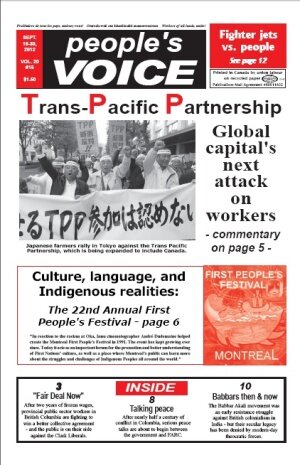
PEOPLE'S VOICE SEPTEMBER 16-30, 2012 (pdf)
|
People's Voice deadlines: October 1-15 October 16-31 Send submissions to PV Editorial Office,
|
REDS ON THE WEB
http://www.parti-communiste.ca/
peoplesvoice.ca
www.ycl-ljc.ca
www.solidnet.org
|
People's Voice finds many "Global Class Struggle" reports at the "Labour Start" website, http://www.labourstart.org/. We urge our readers to check it out! |
* * * * *
People's Voice
Canadian Publications Mail Sales Product Agreement #205214
ISSN number 1198-8657
People's Voice is published by
New Labour Press Ltd
PV Editorial Office
706 Clark Drive,
VANCOUVER, B.C. V5L 3J1
Phone:604-255-2041
Fax:604-254-9803
email: pvoice@telus.net
Editor: Kimball Cariou : Business Manager: Sam Hammond
Editorial Board: Kimball Cariou, Miguel Figueroa,
Doug Meggison, Naomi Rankin, Liz Rowley, Jim Sacouman
* * * * * *
Letters
People's Voice welcomes your letters
on any subject covered in our pages.
We reserve the right to edit for length and clarity,
and to refuse to print letters which may be libellous
or which contain unnecessary personal attacks.
Send your views to:
"Letters to the Editor",
706 Clark Dr., Vancouver, BC V5L 3J1,
or pvoice@telus.net
People's Voice articles may be reprinted without permission,
provided the source is credited.
* * * * * *
The Communist Party of Canada, formed in 1921,
has a proud history of fighting for jobs, equality, peace,
Canadian independence, and socialism.
The CPC does much more than run candidates in elections.
We think the fight against big business and its parties
is a year-round job,
so our members are active across the country,
to build our party and to help strengthen people's movements
on a wide range of issues.
All our policies and leadership
are set democratically by our members.
To find out more about Canada's party of Socialism,
give us a call at the nearest CPC office.
* * * * * *
Central Committee CPC
290A Danforth Ave Toronto, Ont. M4K 1N6
Ph: (416) 469-2446
fax: (416) 469-4063 E-mailmailto:info@cpc-pcp.ca
Parti Communiste du Quebec (section du
Parti communiste du Canada)
5359 Ave du Parc, Montréal, Québec,
H2V 4G9
B.C.Committee CPC
706 Clark Drive, Vancouver, V5L 3J1
Tel: (604) 254-9836
Fax: (604) 254-9803
Edmonton CPC
Box 68112, 70 Bonnie Doon P.O.
Edmonton, AB, T6C 4N6
Tel: (780) 465-7893
Fax: (780)463-0209
Calgary CPC
Unit #1 - 19 Radcliffe Close SE
Calgary AB, T2A 6B2
Tel: (403) 248-6489
Ottawa CPC
Tel: (613) 232-7108
Manitoba Committee
387 Selkirk Ave., Winnipeg, R2W 2M3
Tel/fax: (204) 586-7824
Ontario Ctee. CPC
290A Danforth Ave., Toronto, M4K 1N6
Tel: (416) 469-2446
Hamilton Ctee. CPC
265 Melvin Ave., Apt. 815
Hamilton, ON.
Tel: (905) 548-9586
Atlantic Region CPC
Box 70 Grand Pré, NS, B0P 1M0
Tel/fax: (902) 542-7981
http://www.parti-communiste.ca/
* * * * * *
News for People, Not for Profits!
Every issue of People's Voice
gives you the latest
on the fightback from coast to coast.
Whether it's the struggle for jobs or peace, resistance to social cuts,
solidarity with Cuba, or workers' struggles around the world,
we've got the news the corporate media won't print.
And we do more than that
- we report and analyze events
from a revolutionary perspective,
helping to build the movements for justice and equality,
and eventually for a socialist Canada.
Read the paper that fights for working people
- on every page, in every issue!
People's Voice
$30 for 1 year
$50 for 2 years
Low-income special rate: $15 for 1-year
Outside Canada $50 for 1 year
Send to: People's Voice, 706 Clark Drive, Vancouver, BC, V5L 3J1
You can call the editorial office at 604-255-2041
REDS ON THE WEB
http://www.parti-communiste.ca/
http://www.ycl-ljc.ca/
http://www.solidnet.org/
(The following articles are from the September 16-30, 2012, issue of People's Voice, Canada's leading communist newspaper. Articles can be reprinted free if the source is credited. Subscription rates in Canada: $30/year, or $15 low income rate; for U.S. readers - $45 US per year; other overseas readers - $45 US or $50 CDN per year. Send to People's Voice, c/o PV Business Manager, 706 Clark Drive, Vancouver, BC, V5L 3J1.)
1) PQ MINORITY GOVERNMENT FOR QUEBEC
By Johan Boyden, Montreal
Quebec headed to the polls on Sept. 4 for a historic election. The Liberals, including leader Jean Charest, went down to defeat, as voters granted a slim minority government to the Parti Québécois (PQ) led by Pauline Marois.
The PQ's first act will be to cancel the tuition fee hike and abolish Law 78, which effectively criminalized the student strikers. Their platform also called to abolish tuition increases until 2018, eliminate the health tax, reconsider additional fees for Hydro Quebec usage, increase taxes and fees on natural resource exploitation, expand daycare spaces, and enact Employment Insurance reforms by repatriating EI to Quebec.
Marois' PQ, however, is nine seats short of a majority to implement this agenda, sitting at 54 MNAs. The Liberals won 50 seats in the 125‑member National Assembly, while Francois Legault's new ultra‑right Coalition Avenir Québec (CAQ) expanded to 19 seats. The progressive Quebec Solidaire (QS) doubled to two MNAs, and is expected to have a bigger presence in the National Assembly beyond its small numbers.
Speaking to People's Voice, Robert Luxley, editor of the Communist Party of Quebec's newspaper Clarté, drew attention to voter participation and the strong mobilization by right‑wing forces. At almost 75 per cent, the turnout approached levels similar to the 1998 election (following the second referendum on Quebec's independence).
As leaked Liberal strategy documents revealed, Charest pursued a strategy of provocation and intransigence towards the student strike for months, hoping to create the basis for a "law and order" campaign. On the eve of the election the Liberal message shifted to blackmail, threatening voters with catastrophe if the PQ won and called another referendum.
On the other hand, pressure from the people's forces, unleashed as the student struggle broadened into a popular movement, pushed the PQ into adopting a progressive‑sounding and nationalist agenda. Without the student mobilizations, the PQ platform would probably have reflected their true identity as a nationalist party of small and large‑scale business.
Many new young voters turned to Quebec Solidaire and helped double their popular vote. But another large component of high participation came from ridings won by the CAQ, often in places where the populist ADQ had made gains in the past.
The Liberals received 31.2% and the CAQ 27% of the popular vote. The PQ took 31.95% while QS won just over 6%. Thus the division of the right helps explain the victory of the PQ.
Unable to avoid convening a commission on corruption scandals, Charest effectively set the election timeline when his government established the commission's schedule. In the end the Liberals were squeezed by the student protests, which favoured the PQ.
The Liberals won seats in Quebec City and the regions, but the lions share of their seats came from Greater Montreal, the Gatineau‑Hull area, and the Eastern Townships ‑ not surprising given that they were the only federalist party in the election.
Conservative Prime Minister Steven Harper has said the vote suggests debate about the national question should now be shut down. This stifling of democratic discussion about Quebec's future is unlikely to happen, however, given the reactionary framework that federalism imposes, as well as continued chauvinism from the corporate media and some Anglophones.
At the election rally of Quebec Solidaire, newly elected MNA Francoise David congratulated Marois, and vowed to work together on any policy the PQ might advance in support of women's rights, the environment, labour, and other social issues.
It is more likely that the PQ will now try to shift from its promises and form an alliance with the right. Another election is almost certain well before four years ‑ which has also led the NDP to officially drop its plan to build a provincial party, which is also good news for QS.
David will join QS MNA Amir Khadir in the National Assembly, representing back‑to‑back ridings in urban Montreal. While perhaps not as much as the party wished, QS made important gains and finished second in at least three other Montreal ridings.
Marianne Breton Fontaine, the leader of the Young Communist League of Quebec, doubled the popular vote for QS in the riding of Acadie, coming in with almost 2,500 votes and 8%.
The next issue of PV will have more about the response of the student, labour and people's movements to the election results.
2) NDP WINS SEAT, ONTARIO LIBERALS DENIED MAJORITY
PV Ontario Bureau
In a "stunning upset", the NDP won the September 6 by‑election in Kitchener Waterloo. Newly elected MPP Catharine Fife was Chair of the Ontario Public School Boards Association when the by‑election was called, and also the well-known Chair of the Kitchener Waterloo board. So the upset wasn't as stunning as pundits suggest.
The by‑election was bought and paid for by Liberal Premier Dalton McGuinty (or so he thought), who offered Tory MPP Elizabeth Witmer (a former Cabinet Minister in the Mike Harris government) a patronage appointment as head of the WSIB. At $188,000 a year, it was a deal Witmer couldn't refuse. Witmer did not endorse the Tory candidate who hoped to capture the riding she had held since 1990.
Government polling showed that the Liberals could win the seat, gaining the majority that voters denied McGuinty last fall. But the 2012 provincial "austerity budget" proposed massive cuts to public services and jobs, the sale of public assets, and a warning that legislation would be drafted if public sector unions did not voluntarily agree to wage and benefit cuts.
War on the unions
Early on, the government declared war on the unions representing teachers and educational workers. The move sidelined locally elected School Boards - the employers who bargain with the unions representing School Board employees.
Discussions between the unions and the province were characterized as "bargaining" by the Liberals, though the talks had no legal basis. The Catholic teachers' union, OECTA, and a smaller union representing French language teachers caved in and agreed to terms dictated by the province. Catholic teachers in several cities demanded ratification votes in their Locals, and threatened to take their union to court.
The Elementary teachers were vociferous in rejecting the government's "parameters", while OSSTF President Ken Coran suggested that his union was prepared to accept the two-year wage freeze, but not changes to the grid or cuts to sick days.
Emboldened, the government fabricated the story that the unions were planning strikes and lockouts (sic) on the first day of school. The issue, the Liberals said, was stopping the unions from disrupting the school year and the roll-out of full‑day kindergarten across the province, and from reducing Ontario's $15 billion deficit.
The Liberals prepared legislation to suspend free collective bargaining, ban strikes, freeze wages, change the grid, and reduce sick days. Bill 115 was to be imposed effective September 1, days before the new school year.
The Tories went further, demanding legislation to freeze all public sector wages, and to bring in US right‑to‑work legislation to break the back of the trade union movement.
In response, 15,000 teachers and education workers and their supporters demonstrated against Bill 115 in late August. Their spirited show of opposition impacted public opinion across the province, and helped turn the tide against the Liberals in Kitchener‑Waterloo.
"A useful crisis"
Voters, and especially teachers and educational workers, had heard the Liberal line before. John Snobelen, the first Tory Education Minister under Harris, had been caught on tape extolling the virtues of "creating a useful crisis" in order to introduce massive cuts and privatization.
Same plan, different government. Or maybe there wasn't much difference between the Liberals and Tories when it came to attacking quality public education, driving down wages and living standards, or nullifying trade union rights. But on the other hand, if the Liberals are bad, the Tories are even worse.
When pressed, the usual comment from Catharine Fife was that the NDP opposed the Liberals' manufactured crisis and legislation. In nuanced terms, she spoke about "a conversation about a wage freeze", suggesting that negotiations and discussions could secure the same outcome, without legislation.
The NDP was evasive on many issues, providing few specifics. It was a reflection of the very soft policies and agenda they now advocate in Ontario, and an indication of how far to the political centre the NDP has moved.
One key message was preventing a Liberal majority, a point hammered home by Fife at every opportunity. Little policy was delivered by either Fife or NDP leader Andrea Horvath, who was active in the campaign along with others in her caucus.
Both Fife and Horvath made a brief appearance at the K‑W Labour Day picnic, but neither spoke. It was clear the NDP wanted labour votes, but not the tag. In fact, the NDP was after Liberal votes, trying to appear "neutral" towards labour.
Many unions sent workers to support the Fife campaign from as far away as Windsor, Toronto, London and elsewhere. For many, defeating the Liberals and Tories was as important as electing Fife.
The Common Front
The Common Front, another name for the "We Are Ontario Coalition" birthed by the OFL and its social and community allies last April, did not endorse any candidates. But the coalition was active in the campaign promoting health care, education and labour issues, and warning against a Liberal majority or a strengthened Tory opposition.
The KW Common Front was born in the campaign's early days, a local coalition including the Labour Council, various unions, the anti‑poverty movement, housing and other community advocates, the Kitchener club of the Communist Party, and others. While many were members or supporters of the NDP, the NDP was not present in any of these gatherings.
Organizers for the Common Front say they are here for the long term, to build a movement to throw out neo‑liberal governments and secure a government tied to a progressive political program.
The Communist campaign
Communist Party (Ontario) leader Liz Rowley was the Communist candidate in the by‑election, working with the Party club, its friends and supporters, to expose the Liberal and Tory austerity policies, prevent a Liberal majority, and campaign for the party's 10 point Prescription for a People's Recovery.
She pointed out that the main issues would not be settled on Sept. 6.
"A strong, united and inclusive movement needs to be built that can successfully strike down neo‑liberal policies and governments, and put in governments with policies that put people's needs ahead of corporate greed", Rowley said. "Things could get a lot worse with another recession that both federal and provincial governments are driving into. The Liberals promise more legislation to cover the whole public sector, and the Tories will support them, just as the Liberals can be expected to support Tory proposals for right‑to‑work legislation affecting the entire working class. We have to build that people's movement in the street, to mobilize and exercise that power that can stop the corporate sledgehammer. Another world is possible, but we'll have to fight for it."
Though K-W leans towards the right more often than not, major canvassing in working class districts showed that voters were very interested in the CP platform. The platform focused on job creation, increasing wages and incomes to provide a living wage for all, and raising living standards as the key to recovery. It proposed massive investment in job creation and expanded public services, to be paid for by doubling the corporate income tax rate, restoring the capital tax, introducing wealth and inheritance taxes, reversing corporate tax cuts, and collecting deferred corporate taxes at every level of government.
Elections Ontario
Major efforts were made to suppress the Communist message of a real alternative to capitalist austerity. Media in K-W refused to allow the Communist Party to participate in sponsored debates on television and radio. Meeting organizers like the Chamber of Commerce also refused to allow candidates other than the Liberals, Tories, NDP and Green, and police were present to eject Rowley and others who spoke from the floor. Elections Ontario took the position that election debates are private meetings, and that organizers are free to invite and exclude whomever they wish.
In a major new development, Elections Ontario declared campuses private property and therefore off‑limits for campaigning. This applied to buildings and land owned by the universities and colleges, making it virtually impossible to reach thousands of student electors.
As People's Voice was going to press, the misnamed "Putting Students First" legislation, was passed into law. CUPE Ontario President Fred Hahn, who was present at the Legislature along with the Presidents and members of ETFO, OSSTF, and CUPE, told People's Voice that the unions would launch a legal and constitutional challenge to Bill 115, and were also planning political action to resist the Liberal attack on collective bargaining and public education.
"All the unions are united in this", he said, adding "you'll hear more about this very soon".
Mass independent political action is on the agenda this fall and winter, to stop the right‑wing assault and to press the NDP to squeeze some concessions out of this minority government. A general election is expected sometime next spring.
3) CAW DELEGATES BACK NEW UNION PROJECT
By Stuart Ryan
The 1000 delegates to the August Constitutional Convention of the Canadian Auto Workers voted unanimously to endorse the New Union Project to form a new Union with the Communications, Energy and Paper Workers. Some 41 delegates spoke enthusiastically, embracing the call for the labour movement to rethink and reorganize itself to fight the unprecedented attacks by the major corporations and right‑wing governments across Canada and around the world.
CAW President Ken Lewenza called the proposal "incredibly visionary, incredibly ambitious, and incredibly needed."
Co‑Chair Gaetan Menard from CEP said the debate is not a discussion of merging two organizations, but of what is needed in the labour movement to be more effective and relevant. The Report is "not the final solution to the corporate and government attacks on workers, but is the best response for us to respond to these attacks," Menard said. "If you agree with us, come join us."
Menard expressed his solidarity with the students in Quebec and the Occupy Movement in 2011, who gave hope that a better world is possible. "What did they teach us ‑ if you want change, you need mobilization."
The idea began in 2011 with discussions at CLC Executive meetings by Lewenza and CEP President Dave Coles. A joint Proposal Committee was formed with eight representatives from each union, with the goal of having a proposal ready for the CAW Convention.
Last January the committee published "A Moment of Truth for Canadian Unions," which outlined the stark challenges following the capitalist economic crisis of 2008:
* erosion of union density
* failure of union organizing
* concerted government attacks on unions
* global corporations extracting concessions in benefits and pensions through lengthy strikes and lockouts, with the blessing of governments
* politicians advocating right‑to‑work legislation
* "paralysis and dysfunction of some (not all) labour centrals"
* aging of union activists, and inability to organize young workers in anti‑union climate.
The paper suggested that unless Canadian unions reenergize, they could end up in the position of the U.S. labour movement. It saw an opportunity to tap into the discontent and resistance about growing inequality, as shown by the Occupy Movement: "If unions can position themselves as a legitimate voice of this discontent, and channel Canadians' anger and worry in progressive and effective directions, we could emerge from the current crisis stronger and more confident ‑ just as unions emerged stronger from the 1930s, thanks to innovation in organizing and bargaining strategies, and a willingness to directly confront the political and economic failures of that daunting time."
In August, the Proposal Committee issued a report called "Towards a New Union". Dave Coles told the CAW delegates that the mounting job losses, poverty and economic insecurity were "not a product of a broken system of global capitalism; it is capitalism." The Canadian labour movement responded to the Harper Conservatives "like a deer caught in the headlights," Coles said, but the New Union proposal "can give labour a stronger voice to challenge the dominant agenda."
The proposed new union will spend over $50 million over the next five years on organizing. A national division will be established, and membership will be open for individual workers in a non‑union workplace; unemployed workers' who had been involved in an unsuccessful unionization drive; precarious workers involved in contract work or workplaces with high turnover; students and youth.
The structure and governance is designed to be open, democratic and accountable to the combined membership of more than 300,000 workers, of which 86,000 are women. The number of women on the National Executive Board will be equal to their proportion of the total membership. There will also be one representative of racialized and aboriginal workers.
The NEB will have three National Officers: President; Secretary‑Treasurer and Quebec Director; three Regional Directors, 5 regional chairpersons; a representative from skilled trades and retirees; and 11 representatives of industrial councils where membership reflects a critical mass in industries across the country.
A Constitutional Convention will happen every 3 years. A Canadian council with delegates from each local will meet once a year. Each year both Regional and Industrial Council conferences will shape the direction of the union in their areas of interest.
Only one delegate raised questions, though he rose in support of the proposal. Since organizing the youth was such a key objective, he asked, why wasn't there a young worker position on the new NEB? He added that having a GBLTTQ representative would be a clear signal that the new Union wants to be inclusive and represent the interests of all workers. Lewenza's answer was that the proposal could not be amended at this CAW Convention.
The question of affiliation with the NDP will also be left to the deliberations of the new union. The CEP is affiliated with the NDP. The CAW is not affiliated to any party since former President Buzz Hargrove was expelled from the NDP for advocating strategic voting in the 2006 federal election.
Jerry Dias said the new union would be strong enough to challenge the NDP if it is not representing the interests of labour. He asked why Manitoba, which has had an NDP government for over a decade, still does not have anti‑scab legislation or card‑check certification.
The proposal will next be voted on by delegates to the CEP Convention in Quebec City, October 14‑17. If, as expected, the proposal is supported there, the two unions will call for a founding convention of the New Union in 2013. Then the real work will start, said Menard.
4) B.C. PUBLIC EMPLOYEES DEMAND A "FAIR DEAL NOW"
PV Vancouver Bureau
The sands of time appear to be running out for British Columbia's Liberal government, but that hasn't stopped Premier Christy Clark from picking a fight with public sector workers. Over 25,000 members of three unions held a one-day walkout on Sept. 5, closing liquor stores and many government offices in 153 communities.
The one-day action did not include child protection workers, correctional officers and forest firefighters. Hospital, ferry and school workers were also not on strike.
But further action is expected as the BC Government and Service Employees Union (BCGEU), Canadian Office and Professional Employees Local 378 (Insurance Corporation of BC employees), and the Professional Employees Association (representing over 1,200 licensed professionals) press for a new collective agreement after two years of frozen pay rates.
For months, the Liberals have been 20% or more behind Adrian Dix's NDP in the polls, and nearly half of Clark's caucus say they will not run in the May 2013 provincial election. In fact, the B.C. Conservatives are challenging the Liberals for second place. Barring the unexpected, next spring could see an electoral tsunami sweep the Liberals out into the Pacific.
A survey conducted in late August for the B.C. Federation of Labour showed that a majority of B.C. residents agreed with the statement that public sector workers should at least get a cost of living increase without having to take cuts elsewhere in their collective agreement (38 per cent strongly agree, 36 per cent somewhat agree).
Almost as many backed the public sector workers job action if the government refuses to offer at least a cost of living wage increase (28 per cent strongly agreed, and 33 per cent somewhat agreed).
In another significant finding, most British Columbians support an increase in corporate taxes (79%) and a surtax on high‑income earners (80%). This overwhelming sentiment could help pressure an incoming NDP government to reverse the Campbell Liberal tax cuts which mainly benefitted the wealthy and the corporations, and to use the resulting revenues to raise public sector salaries and improve social programs.
In a media commentary issued for the Sept. 5 one-day walkout, the leaders of the three unions said, "For the first time in more than 20 years, the entire government of B.C. is behind picket lines today in support of a fair and reasonable collective agreement...
"We have not taken the decision to strike lightly - striking is our only recourse to a fair deal. B.C. has the leanest public service in Canada on a per‑capita basis. In 2010, with the world economy in the doldrums, B.C. government workers did their part and took two years with no wage increases. Their last increase was three and a half years ago, which amounts to a five‑per‑cent wage cut after you take inflation into account. COPE 378 members have been without a contract for over two years, with wages stagnant since 2009.
"BCGEU and PEA members can't keep falling behind the higher cost of living. BCGEU public‑sector workers are asking for a wage increase of 3.5 per cent in Year 1 and a cost‑of‑living allowance in Year 2. The PEA is also seeking inflation‑based increases, which is reasonable. Non‑union workers across Canada can expect average wage increases of 3.2 per cent next year, according to global consulting firm Mercer.
"By contrast, Victoria's final offer to the PEA and BCGEU amounted to 3.5 per cent over two years, amounting to a further wage cut after inflation. ICBC offered COPE 378 less - a four‑year contract with one‑per‑cent increases in the last two years.
Government workers cannot subsidize the operation of the B.C. government through continued wage cuts. A looming shortage of professionals is forecast in the next couple of years and real wage cuts only exacerbate the problem. Maintaining a strong professional workforce after years of job cuts is a priority for the PEA.
"Three‑quarters of British Columbians don't want the men and women - and 60 per cent of the public service are women - on the front lines of public service falling further behind, according to a recent Environics survey. Seventy‑four per cent said public sector workers should at least get a cost of living increase without having to take cuts elsewhere. A majority also supports our one‑day strike.
"We do not want to increase your taxes. Instead, the BCGEU made several proposals that would generate additional revenue for the government.
"Of 197 public liquor stores, 175 are closed on Sundays. Opening them seven days a week would generate up to $100 million annually...
"Assigning additional duties to the B.C. Sheriff Services would save money and generate revenue. In Alberta, sheriffs handle traffic duties alongside the RCMP. The successful program was doubled in size in the first year, and spawned $111 million in new government revenue in 2009‑10, half of which was returned to general revenue. Expanded sheriff duties would also reduce health care costs by improving road safety, alleviating delays in courts and freeing up police to focus on the Criminal Code.
"COPE Local 378 has suggested savings ICBC will gain by implementing new technologies and work processes should be returned to its workers as improvements to wages and benefits.
"The time for a fair deal for public sector workers is now."
5) "SECURITY CERTIFICATE" MYTHS - Editorial
People's Voice Editorial
The case of "security certificate" detainee Mohammad Mahjoub proves the need to defend civil rights for all in Canada, regardless of our origins or beliefs. For 12 years, Mr. Mahjoub has been struggling to clear his name against shadowy accusations by the Canadian Security and Intelligence Service. Most of that time he has been incarcerated, and his family has faced intense state harassment. Finally on September 6, defence lawyers were able to compel former federal minister Stockwell Day to explain in court why he signed a security certificate against Mohammad Mahjoub, and to shed much-needed light on this controversial case.
On the witness stand, Day praised himself for taking care to review all the evidence in such cases. But he could not explain why "evidence" likely obtained through torture in other countries should be sufficient to condemn the accused.
Instead, Day accepted the word of CSIS that Mr. Mahjoub was a "leading member" of the "Vanguards of Conquest" in Egypt prior to coming to Canada. Yet the only four judgements of Egyptian courts relating to this group do not name Mr. Mahjoub; CSIS was not aware of these judgments before Mr. Mahjoub's lawyers brought them to the attention of the Department of Justice. It also seems the title "Vanguards of Conquest" was manufactured by the Mubarak regime as a political tool to torture and jail opponents.
The rest of the "evidence" is just as flimsy. But this did not stop Stockwell Day from implying that Mr. Mahjoub may (or may not) have been "linked" to people who may (or may not) have planned to commit serious crimes, and therefore should remain in prison.
Canada's "security certificate" regime is a dangerous attack on the right of accused persons to an open and fair trial. This abuse of state power must be ended, but it will take much greater public pressure to force the Harper Tories to stop this shocking violation of human rights.
6) ASSIMILATION: A RACIST TORY POLICY - Editorial
People's Voice Editorial
The federal funding cuts to Aboriginal organizations show that the Harper Tories are moving quickly to silence and assimilate Indigenous peoples. For example, the Assembly of Manitoba Chiefs faces an 80% cut to its core funding, from $2.6 million to $500,000 a year. Over half of the AMC's staff may be cut, affecting lobbying efforts on behalf of missing and murdered women and for clean drinking water. AMC Grand Chief Derek Nepinak rightly calls this "a direct attack on the political voice of First Nations communities."
The Harper government also intends to turn reserve lands into "fee simple" individual holdings. The First Nation Property Ownership Act (FNPOA) would turn the collective ownership of reserve lands into small pieces of land owned by individuals, who could then sell it to non‑First Nations peoples, land‑holding companies and corporations.
This idea goes back to the Dawes Act in the United States, where reserve lands given to individuals became subject to state laws. The purpose was to assimilate Indigenous peoples by breaking up their governments. In the Canadian context, the FNPOA will open up "Indian lands" for oil, gas and mineral extraction by transnational capital.
This racist concept is being pushed by people like far-right Tory academic Tom Flanagan, and Manny Jules, a former chief of the Kamloops Indian Band who is now the federally-appointed head of the so-called "First Nation Tax Commission" (at a salary of $200,000 per year, untouched by the funding cuts).
As First Nations activist Pam Palmater says, "Canada needs to stop trying to assimilate us, and focus on fulfilling its legal and treaty obligations instead of trying to find ways around them." The labour movement and all progressive forces must give full support to this struggle against the racist Tory policy of assimilation.
7) HOW MUCH IS ONE KILLER AIRPLANE WORTH? - Part 2
In our previous issue, we reprinted the first half of a commentary by Katie Hyslop, who reports on youth and education issues for The Tyee Solutions Society. Hyslop asks: what alternatives could be found for the $475 million to be spent on each of the sixty-five F35 fighter jets which the Harper Tory government proposes to purchase. Here is the second part of Hyslop's article, which appears in full online at http://thetyee.ca/News/2012/08/13/F35‑Worth/.
Buoying the poorest
Economist Iglika Ivanova spoke for almost everyone we recruited for this article when she pointed out the mismatch between the price of the world's most advanced production warplane, and the cost of helping people through social programs. In short, flying war machines are a lot cheaper than programs designed to help people.
Said Ivanova: "If you're going to actually look into reducing poverty, [$475 million] is a small amount for the country as a whole." But again, it's a number that could make a big difference to a province, says Ivanova, who works for the B.C. office of the Canadian Centre for Policy Alternatives. It could, for example, increase welfare rates in this province for a year, by $200 for individuals, $300 for couples without children, and $400 for couples and single people with children. Equivalent to a monthly raise of between 32 and 42 per cent, the extra generosity would cost $383 million per year.
It won't bring individuals or families above the poverty line, but Ivanova says it's a start. "What that money would do for the families, is increase the embarrassingly low rates we have now," she told The Tyee Solutions Society.
The leftover funds could return some money to single parents on social assistance whose child support payments are now being clawed back through deductions in their monthly cheques. In B.C., the amount of child support a non‑custodial parent owes depends on their annual income (although a judge ultimately determines the payment). For example, a father who makes an annual gross income of $36,000 would likely have to pay $327 per month in support for one child. But if the mother is on welfare, that $327 is deducted from her monthly cheque as unearned income, leaving her no further ahead.
Before welfare reforms in 2002, parents could keep up to $100 of their monthly child support payments. Ivanova would like to see that returned for the 13,760 single parent families on welfare as of June 2012: "If every single‑parent family has $100 a month exempt [from clawback] that would be $16 million (per year)."
With $475 million, minus the $383 million to buoy up monthly welfare payments, we could support that payment for five years.
The lifetime costs of one jet could also ensure food security for over 13,000 people on disability assistance. While higher than B.C.'s welfare rates, disability assistance still falls below the low‑income cut‑off line in most areas of the province after tax. A single person on disability receives just $10,872 annually, not including GST/HST or carbon tax rebates, or any other benefits like Canada Pension Plan Disability Benefits. Someone on disability in B.C. who is able to work may earn up to an additional $800 per month, enough to put a single person just over the poverty line in a city the size of Vancouver. But if you can't work or find a job, you have to make do on $906 a month for housing, clothing, and food.
One foregone F‑35 would cover $100 extra per month for 13,194 people on disability assistance for 30 years. It wouldn't be enough to pull them out of poverty, but it might allow for such small quality‑of‑life improvements as better food. And that's just one jet.
"If all 65 jets were not purchased and those monies were instead spent on food security for the most vulnerable, some 857,639 people ‑ almost equal to the number of people using food banks every month ‑ could be supported over 30 years," Rob Rainer, executive director of Canada Without Poverty told The Tyee Solutions Society via email. "Bombs or bread, indeed."
Support for Aboriginal people
The 2012 federal budget promised new support for Aboriginal Canadians, including a $275 million investment in Aboriginal education. But Aboriginal leaders have dismissed the number as insufficient to meet the underfunded needs of Canada's Aboriginal youth.
An additional $475 million would almost triple resources for Aboriginal education. But the Assembly of First Nations (AFN) points out that the price of one jet could also cover the one‑time cost of 38 of the 40 new schools needed on Aboriginal reserves (at an average of $12.5 million each). Or it could pay the $126 million annual cost of funding First Nations language education for three and a half years ‑ bringing First Nations language instruction up to the same level as public school language programs. Or how about funding primary healthcare (visits to family doctors, nurse practitioners, pharmacists, etc.) for residents of remote Aboriginal communities? One foregone fighter plane would cover the entire cost of primary healthcare for men, women and children in 70 of the nation's most remote and isolated Aboriginal communities for a year, with almost $180 million left over.
It's not just doctors and new schools that rural and remote reserves are missing. Many are in need of other infrastructure from roads and bridges to basic housing. This was apparent in the media firestorm earlier this year over Attawapiskat, a First Nations reserve in northern Ontario where residents were forced to live in overcrowded makeshift tents or dilapidated, mouldy housing without plumbing. An extreme case, but poor infrastructure and overcrowded living conditions are common on reserves across the country.
As of last August, 118 First Nations reserves were on boil-water orders, and the federal government's own analysis found 73 per cent of on‑reserve water systems were at risk. The price tag for bringing safe water to every reserve is $6.578 billion.
Still the AFN estimates that $169 to $189 million more a year in federal spending would begin to retire unsafe reserve infrastructure like housing and roads.
The $475 million price of one warplane wouldn't close the infrastructure gap between reserves and non‑Aboriginal communities. But it would almost double Ottawa's 2011‑2012 commitment to its National First Nations Infrastructure Investment Plan, which puts money in schools, houses, roads, and water infrastructure for reserves, either for Ontario, Quebec and the Atlantic provinces combined, or all the prairie provinces.
Informing decision‑makers
One of the smaller news items during coverage of the 2012 federal budget was the loss in action of the National Council on Welfare. Created under a Liberal federal government in 1969, the council had a mandate to advise the Ministry of Human Resources and Skills Development Canada on the country's social development, particularly poverty and low incomes. It also provided a wealth of information to the public on provincial welfare rates, what poverty costs the rest of society, and possible solutions to poverty.
"We were the only organization that looked annually at welfare incomes province by province, and at poverty profiles: who's in poverty, why are they in poverty, and what can we do about it," the council's former chair, John Rook, told The Tyee Solutions Society. The federal government dismissed Rook's organization along with several similar advisory groups in science and the environment. On the money it will take to purchase one F‑35, the National Council on Welfare could have completed its mission well past the quincentenary of the War of 1812, sometime into the final quarter of the 25th century.
` "It was a really sad day when I heard the government wouldn't support something like [fighting] poverty, but they could do things like provide for an airplane that's going to do a lot of damage in the world," Rook lamented. If he had $475 million to deploy, Rook would not only restore the council's funding. He'd raise it, to pay for research into how ideas like those floated in New Democratic Party MP Tony Martin's bill C‑545, An Act to Eliminate Poverty in Canada, could be implemented. (The bill, unlikely to become law, would require government to create a national poverty reduction plan.)
8) THE GROWING ECONOMIC GAP: RECORD BANK PROFITS
Canada's five biggest banks have posted a staggering $7.8 billion of profits in the third quarter of this year. That's an increase of 45 percent in net income over the same three month period of 2011.
The biggest winner was the Royal Bank, which reported all‑time record profits amounting to $2.24 billion, up from $1.29 billion during the third quarter of 2011.
Scotiabank was number two, with $2.05 billion in profits for the third quarter. That includes an after‑tax gain of $614 million from the sale of its Bay Street headquarters, Scotia Plaza. Scotiabank announced in late August that it will buy ING Bank of Canada from its Dutch parent company in a $3.13‑billion deal.
Other third quarter profits included $1.7 billion for TD Bank, $841 million for CIBC, and $970 million for the Bank of Montreal.
All five banks delivered a surprise boost to their dividends paid to shareholders, after previous predictions that lending would fall during the period.
Financial analysts say that Canadian consumers have maintained their borrowing levels, which probably reflects the inability of many jobless or low-income working people to survive on their present incomes.
At least two recent studies found that consumer debt has not dropped, despite warnings from Bank of Canada governor Mark Carney that interest rates will eventually rise, leaving many households unable to meet their loan and mortgage payments. Reports from TransUnion and Equifax Canada show that consumer indebtedness, excluding mortgage debt, is now 3.1 per cent higher than last year, hitting new record highs.
9) STOP THE DEPORTATION OF KIMBERLEY RIVERA!
By Kimball Cariou
Time may be running out for yet another U.S. war resister who faces deportation from Canada. On September 20, Kimberley Rivera, her husband Mario and their four young children, are scheduled to be sent to the U.S., where she faces a possible two to five years in a military prison for opposing the war in Iraq.
Rivera joined the U.S. Army at the age of 24, believing that the war would make the United States a safer country safer and bring democracy to Iraq. As she writes, "Once I was stationed in Iraq, I realized I had been lied to. I saw the true face of war: countless civilian casualties, and Iraqi children left devastated by loss and filled with fear. We were not bringing freedom to Iraq; we were bringing needless pain and suffering and death. How could I look my children in the eye and tell them to be good people, when I was contributing to causing harm and death to innocent people on the other side of the world? As this became clear to me, my conscience would no longer let me participate in the war in Iraq."
Five years ago, Rivera and her family came to Canada, where she later applied for refugee status. She has been a community peace activist in Toronto's Parkdale neighbourhood, and two of her children were born here. They want to continue to live in Canada, so their children can "grow up in a peaceful country that values tolerance, respect, and community."
But at this point, Rivera's fate lies with Immigration Minister Jason Kenney, so she is appealing to Canadians to urge the federal government to stop the deportation.
"My biggest fear is being separated from my children and having to sit in a prison for politically being against the war in Iraq," Rivera told a news conference on Sept. 7, where she was supported by the War Resisters Support Campaign, Amnesty International, the Canadian Labour Congress, and other groups.
Lawyer Alyssa Manning said Rivera may appeal a ruling on her pre‑removal risk assessment, which has ordered that she leave Canada by Sept. 20. According to Manning, federal officials making the assessment failed to consider that Rivera has been outspoken about her opposition to the Iraq war. While many of those who flee the U.S. military are not jailed, Manning says those who are outspoken about their beliefs are much more likely to get prison time.
"We have spoken with the command at Fort Carson," said Manning, "and they have explained to the Rivera family that they have every intention of detaining and then prosecuting (Rivera) upon her return."
The War Resisters Support Campaign says that two other Iraq war resisters who were deported, Robin Long and Clifford Cornell, faced year‑long jail sentences upon their return. Despite this, Jason Kenney's press secretary says the federal government does not believe the U.S. subjects dissenting soldiers to persecution.
Rivera is also considering asking the government to delay her deportation while her humanitarian and compassionate grounds application is still being weighed. That application raises concerns such as the best interests of her young children.
For more information and to sign a petition, visit resisters.ca, the website of the War Resisters Support Campaign. But given the imminent deportation date, we urge readers to phone the office of Minister of Citizenship and Immigration Jason Kenney (613.954.1064, 9‑5 EST), to let him know that you want Kimberley Rivera to stay in Canada.
10) FOCUS ON CULTURE AND LANGUAGE AT FIRST PEOPLES FESTIVAL
By Adrien Welsh
Can the Canadian state really call itself a positive example when it comes to the national question and self-determination?
Just talking about the situation of the First People, there's a lot to say. For example, the Harper Conservative government waited until 2010 to sign the Declaration on the Rights of Indigenous Peoples ‑ almost three years after it was adopted by the UN General Assembly. And First People's communities are still subject to an obsolete law, the Indian Act, which was used as a model by the South African Afrikaner's ruling class to inspire the apartheid regime!
These facts are generally not mentioned, even in Canadian school history textbooks ‑ which, of course, does not help resolve the tense situation that Aboriginal People experience. Here in Québec, these tensions reached a climax in 1990 with the "Oka Crisis," during which a lot of racist prejudices were expressed against Kanesatake Mohawks because they stood up against policies of genocide and assimilation and to defend their traditional territories.
In reaction to the racism at Oka, Innu cinematographer André Dudemaine helped create the Montreal First People's Festival in 1991. The event has kept growing ever since. Today it acts as an important forum for the promotion and better understanding of First Nations' culture, as well as a place where Montreal's public can learn more about the struggles and challenges of Indigenous Peoples all around the world.
This year, the First People's Festival celebrated its 22nd edition from July 31 to August 8. More than 50 films were screened (including documentaries, short footage and long footage, motion pictures as well as animation movies) for the modest sum of $2 per screening!
The struggle for language
The importance of language‑related films has to be underlined as one of the major themes. Two documentaries featuring Noam Chomsky were shown as well as the first movie (an animation) in the Mohawk language ever produced. The animation explains in a funny tone why, in Iroquoian tradition, beans, corn and squash are called the "three sisters", and why they grow together. Viewers also had a chance to hear the Piraha language, spoken by the Hyponym indigenous people from Brazil.
Another documentary told the story of the outstanding work achieved by Jessie Little Doe Baird since 1993. Baird helped revive the Algonquian Wampanoag language among her community, a language that was almost dead. Both Dan Everett and Jessie Little Doe Baird attended, discussing their work openly with festival goers.
The importance of language for First People is not accidental. Language is one of the main characteristics describing a nation. Language evolves along with the awakening of national consciousness, and against national and linguistic oppression. After all, the case of Wampanoag is not isolated. The same is true for Huron‑Wendat or Abenakis, languages which tragically count less than ten fluent speakers right now.
Reintegrating languages in all spheres of society, including cinema or just everyday life, shows us how determined Aboriginal peoples are to rectify the national and linguistic oppression they have suffered.
Untold stories
Many of the documentaries screened this year were highly social or political in concern. In Smoke Traders, by Jeff Dorn, the question of the cigarette "business" in Mohawk territories is presented from a Native point of view. The audience comes to understand how this trade, perceived as contraband, is actually an economic backbone of life on impoverished reserves.
In Granito: How to Nail a Dictator, Pamela Yates (winner of the Festival's Rigoberta Menchu award) performs a flash‑back on the Guatemalan civil war and especially on her well known documentary When the Mountains Tremble. According to a Spanish lawyer trying to accuse former General Efrain Rios Montt for this genocide of 20,000 Mayan people, Yates' footage may contain information that could help charge those responsible.
More than just films
While cinematography used to be the Festival's principal aim, today it has a multi‑disciplinary approach, including literature (readings by Native poets or writers), as well as music, dance and craft work. Probably one of the most notable achievements made by the Festival team is the outdoor site at Montreal's Place des festivals.
For a weekend the space is covered by native craftspeople, tipis, and much more. Despite being in downtown Montreal, festival goers could enjoy the smell of pine trees and goose cooked on an open fire, and talk with all the attending craftspeople giving workshops about their work, usually strongly linked to their culture. Every day different outstanding performances were held in the area, including Florent Vollant, an Innu from Northern Québec and an electro music show by the group A Tribe Called Red, a collaboration with Berber musicians from Morocco.
One highlight is the traditional "Boréades de la danse", a dance performance by troups representing nations from all over the Americas. This year, it was followed by the Nuestro América Friendship Parade, which for the first time saw participation of delegations representing Bulgaria and the Philippines. The parade ended at Place des festivals, where they were welcomed by the Mohawk drum troop Keepers of the Eastern Door before a talk in French, Spanish, English and Bulgarian about the UN's Charter for Indigenous Rights.
A national awakening
While the First People's Festival can be a little too folkloric, it is one of the very few large events in Québec, and Canada, prioritizing a truly broad perspective on First People's culture and struggles all around the world. It challenges festival goers to try to understanding the problematics First People's face on a daily basis. The Festival is a place to build bridges between different cultures, and to counteract the many prejudices that First Nations people combat.
The fact that there is more than enough material to organize such an event ‑ which keeps growing since its first edition ‑ is a testimony of the important national awakening among Aboriginal People. This is something that progressive people should fully support. After all, the rights of First Peoples inseparably goes together with respecting and defending their culture and language, milestones on which any nation is built.
(Adrien Welsh is a student and activist in Montreal and has worked at the First People's Festival for several years.)
11) TRANS-PACIFIC TRADE PACT WOULD KILL JOBS
By Bill Knight, People's World
You don't have to blame mainstream media or be outright paranoid to think there must be a news blackout about the newest scheme by corporations trying to grease another way to move jobs overseas and move money around the world.
Leaked documents show the free trade proposal would ensure strong rights for investors but weak protections for labour, the environment, and national sovereignty.
The lack of coverage of the Trans Pacific Partnership (TPP), or "the NAFTA of the Pacific," as activists call it, is more because of the secrecy in which it has being written. Of course, that is not an excuse, but an explanation.
The possible results of another "free trade agreement" - as opposed to a "fair" trade deal accommodating labour rights, environmental protections and national sovereignty) - could range from more closed factories like Maytag in Galesburg, Illinois, to more despoiled lands and lives. That's just like NAFTA, the controversial US‑Canada‑Mexico "free trade deal" which took effect in 1994.
Since President George W. Bush signed it and Democratic President Bill Clinton jammed it through Congress over labour's strong opposition, NAFTA produced these effects in Mexico alone, along with the "giant sucking sound" of lost US jobs:
* Significantly lower birth weights. The impact on reproductive health is significant because there are over 350,000 women working in the maquiladoras, factories along the US‑Mexico border, who are of reproductive age.
* Weakened food safety inspections. Mexican‑grown strawberries, head lettuce, and carrots sold in Illinois groceries have violation rates of 18.4, 15.6, and 12.3 percent, respectively, for illegal pesticide residues.
* Ozone depletion has increased steadily since NAFTA opened US borders to Mexican trucks that don't meet US safety standards.
* Fewer than one percent of the 3.3 million trucks entering the US each year are inspected and 50 percent of those inspected are rejected for major safety violations. The Teamsters waged a long campaign to keep those dangerous Mexican trucks off US roads.
* The emergence of rural slums in an "American Calcutta" that stretches for kilometres along the US‑Mexico border, housing families whose members toil in maquiladoras.
Text of some of the TPP proposal recently leaked, released by the Citizens Trade Campaign. It shows the free trade proposal would ensure strong rights for investors but weak protections for labour, the environment, and national sovereignty.
The TPP is being drafted to include the US and Australia, Brunei, Chile, Malaysia, New Zealand, Peru, Singapore, and Vietnam. In July, the 13th round of TPP talks were at the Hilton San Diego Bayfront Hotel, where suggestions of also including Canada, Japan, and Mexico were made, sparking demonstrations there.
The next TPP negotiating round is scheduled for Leesburg, Virginia, on September 6‑15. Of the 28 chapters of the leaked TPP draft, 26 have nothing to do with trade.
As drafted, TPP would limit regulation of foreign corporations operating within US boundaries, giving them more rights than US firms.
It also would extend incentives for US firms to move investments and jobs to lower‑wage countries, and set up an alternative legal system giving foreign corporations new rights to circumvent US courts and laws, including letting them sue the US government before foreign tribunals and demand compensation for lost revenue due to US laws they claim undermine their TPP privileges or even investment "expectations."
"While the public has no access to the full text, 600 representatives from lobby groups like the American Petroleum Institute and corporations like Johnson & Johnson do, and negotiators seek those representatives' advice," writes Labour Notes reporter Cynthia Phinney, an Electrical Worker (IBEW) and the labour representative on Maine's Citizen Trade Policy Commission from 2003‑2010.
There have been few protests in the US, probably due to the secrecy around planning of the TPP. One was in July outside the Cargill headquarters in the Twin Cities suburbs, organised by Minnesota's chapter of the Citizens Trade Campaign. Cargill, the big agribusiness giant, was one of the corporations whose reps were inside the negotiations room in San Diego, while labour and citizens were kept out.
Because NAFTA‑like trade pacts make it easier to offshore jobs to low‑wage countries, they have profoundly hurt American workers. Elsewhere, "provisions promoting competition in agriculture have driven many subsistence farmers off their land and into cities to seek work, creating a downward wage spiral for workers in other countries as well," Phinney wrote.
Both consequences contribute to the "giant sucking sound," as 1992 independent presidential candidate Ross Perot put it, in describing one negative effect of NAFTA, which he opposed. Coined during that year's campaign, Perot's phrase referred to the sound of US jobs heading overseas if NAFTA took effect, as it did in 1994.
Estimates of US jobs lost to NAFTA range from 700,000 to nine million. TPP, like other trade pacts in intervening years, is modelled on NAFTA.
Such trade deals also have troubling language that limits democratically elected governments' power to act in the public interest, if that interest can be interpreted as impeding competition and profits.
Most importantly, in Article 12 - TPP's chapter on Investments - the texts show negotiators are considering a dispute resolution process that would grant transnational corporations special authority to challenge countries' own laws, regulations, and court decisions in international tribunals that circumvent domestic judicial systems.
"We are just beginning to analyse the new texts now, but they clearly contain proposals designed to give transnational corporations special rights that go far beyond those possessed by domestic businesses and American citizens," said Arthur Stamoulis, executive director of Citizens Trade Campaign.
"A proposal that could have such broad effects on environmental, consumer safety and other public interest regulations deserves public scrutiny and thorough public debate. It shouldn't be crafted behind closed doors."
If corporate investors or financial interests feel that laws or other regulations interfere with profitability, they may sue the government responsible for the regulation, but the case is decided by a trade tribunal instead of a court accountable to citizens.
President Obama unfortunately is acting more like the corporate‑cozy Clinton than a progressive. In 2008, candidate Obama often criticised NAFTA and similar deals, but his administration has made trade deals with Colombia and South Korea, over strong objections by many unions and allied groups.
"Our hope is the US Trade Representative (Ron Kirk) will answer the growing calls for transparency in the TPP," said Stamoulis. "If not, the time has come for members of Congress to intervene." Some 132 lawmakers have already written to Kirk demanding full release of the TPP drafts and explanation of his negotiating priorities. "Americans deserve the right to know what US negotiators are proposing in our names," Stamoulis says.
Adds Dr. Brian Moench, a physician and member of the Union of Concerned Scientists: "This sellout to foreign corporations is not just a rogue brain cramp of President Obama. Mitt Romney demanded this agreement be signed months ago, and called Obama's `the most hostile administration to business in recent history.' If the TPP trade agreement is `hostile' to business, God help us if we have an administration, presumably Romney's, `friendly' to business."
12) VENEZUELA TODAY - GREAT ACHIEVEMENTS, GRAVE THREATS
Carolus Wimmer is a Communist Party of Venezuela deputy in the Latin American Parliament, the editor of a discussion journal called Debate Abierto (Open Debate), and the CPV's secretary for international relations. He recently completed a tour of Australia, where has interviewed by Bob Briton from The Guardian, weekly paper of the Communist Party of Australia. Here are excerpts from the interview.
Bob Briton: Could you tell us about developments within the Bolivarian Revolution and its achievements? Is there still a situation of dual authority in the country - the old ministries existing alongside new structures?
Carolus Wimmer: Despite the attempts by imperialism, especially US imperialism... we have managed to continue this Bolivarian Revolution. We can say that now a lot of things are more mature, for example the necessity for a Marxist‑Leninist Party is now clear.
There was a great discussion in 2007 about whether there should be a single party of the Revolution. The Communist Party conducted a special discussion and we are open to discussing this question in the future. At this moment we have decided - and we think our decision is correct - to maintain a Marxist‑Leninist, Communist Party which carries out its work among the working class, which builds class‑oriented trade unions, which organises the workers for the revolutionary process.
As a Party we cannot understand the idea of building a revolution without the leadership of the working class. This is one of the discussions we are having in Venezuela and to have this discussion it is necessary to have a class‑oriented, Marxist‑Leninist Party.
We can say during these years, the people and the workers have really received a lot of benefits. We can say that in every family someone has received some important results from the revolution. Maybe there are still a lot of difficulties, people who from the individual point of view still have a lot of problems and needs. But when we look at it not from the point of view of capitalism, not as a number of individuals but as families or as a class we can see a lot of results that would have been impossible without the Bolivarian Revolution.
This year a new labour law was approved... It was discussed by the workers and with the workers and you can say that with this law we have recovered a lot of rights lost during the terrible time of the 1980s and '90s when the different governing parties pushed forward neo‑liberal policies of privatisation in all sectors, when workers lost permanent employment and a lot of social rights. Very important in this new law is recognition of a new type of workers' organisation parallel to the trade unions.
This labour law makes possible the creation of Socialist Worker Councils. The idea is that the benefits are not only material. Of course, there have been a lot of advances in the fields of education, healthcare, housing, culture and labour rights but there are also benefits in the political conditions. As the Communist Party of Venezuela we see it as necessary at this time, after 13 years of the Bolivarian Revolution, that we take a step forward in the direction that the working class must control production on the one hand and must have the political control of the Bolivarian Revolution.
In these Socialist Worker Councils the concept is for workers to control the planning or take part in the planning of production, the administration of the company with total transparency. For example, we hear often from the bosses, the owners of the company, that there must be a reduction in the personnel, the number of workers because the company is in trouble. We say in Venezuela that in that case the workers have the right to see the books to see if that it is the reality or a lie on the part of the capitalist owners. On the other hand, if there are troubles in the company we know that the fault usually lies with the management and not the workers. In this situation the workers have to find solutions with the owners that exclude the loss of workers' jobs.
These are examples of some of the benefits of the Bolivarian Revolution to this point. Of course, it's a transition in the capitalist structure of the state to a non‑capitalist structure. We are going forward in this but the dominant model is still the capitalist structure of the state of Venezuela.
For that reason it is necessary that, alongside the ministries as you called them, alongside the government structure that we continue with the social missions, as we call them in Venezuela. They are continuing. Nowadays they have a higher quality. For example in healthcare there were first small units for treatment of patients distributed in the suburbs. Now you can say that we have a third level of high‑technology treatment in popular hospitals in this health care mission.
Also, when we met in 2006 the mission began with reading and writing with the "Yes I Can" program. Now we have a mission in education with the great solidarity of the Cuban government to reach the university level. We have new universities. So we have great advances in the education profession. We are also advancing in political and ideological education.
BB: What are the next likely steps towards socialism and which forces are leading the way?
Wimmer: Regarding socialism - for the Communist Party we don't consider that we are building socialism in a direct form. In the Communist Party we describe this moment as the anti‑imperialist struggle and in that struggle we are working to build the anti-imperialist front. We say we have to go forward very cautiously; we have to maintain a majority in the different struggles including in the election. It is very important to know what the historic moment is and with which allies we can go forward.
Of course, it's very important in this anti‑imperialist work we are carrying out now that there is an anti‑capitalist and pro‑socialist orientation and concept. The Communist Party views its work with great responsibility. It concentrates its efforts on the workers, to organise them in class‑oriented trade unions to provide them with a political and ideological education. We do this to show that we favour the working class and to maintain our independence to criticise and to propose solutions when we think decisions have been made by the government that don't favour the working class or the people in general.
We have an extremely good relationship with President Chavez. It's well known that ours was the first party to select him as candidate for the election to take place on October 7. The decision was made at our last Party Congress. We see with President Chavez our strategic allies and we maintain fraternal relations with the Socialist Party [PSUV]. At the moment you can say that we are the two parties moving forward with the work of the election campaign, in the leadership of the election campaign there are the Socialist Party and the Communist Party.
There is another important political work to build up the Great Patriotic Pole (Gran Polo Patriotico), which should be a strategic alliance of political parties, mass movements, the women's movement, the youth, the farmers, workers in the field of culture. In this area of the building up of the Great Patriotic Pole, the Communist Party also has a lot of responsibilities in the frontline and, with the Socialist Party, has the responsibility to build the Patriotic Council of Political Parties, which has seven political parties in it. We are sure that President Chavez, who has recovered well from a very bad illness, should win the presidential election of October 7. But as revolutionaries, we know the enemy - especially US imperialism and the national bourgeoisie - will do anything legal or illegal to make this victory impossible.
There have been the expressions of the US Secretary of State, Hillary Clinton, that unforeseen events will take place. It's a threat to undermine the democratic right for elections... We fear there is a possibility that the opposition will not recognise the victory of President Chavez. That plan would get the immediate support of the imperialist mass media. It could get support of international imperialist institutions, organisations and of governments.
We can say there are very few options available to the opposition to win. All the polls give a lead of 10 to 20 percent to Chavez. Most are conducted by the opposition but there are such great differences that it's impossible to hide. For that reason it's been very difficult to promote the opposition candidate.
[Henrique] Capriles comes directly from the high bourgeoisie of Venezuela. They present him as a young man, as a new man, but we must point out that in his youth he was a member of the international fascist movement Tradicion, Familia y Propriedad [Tradition, Family and Property]. He was then a member of the Christian Democratic Party, a conservative party. In the 1990s he was president of the Venezuelan parliament. In that role he has guilt for all the privatisations carried out in those days and it is an indication that he is not new.
He is older than Chavez. He was in power before Chavez, and represented the interests of the bourgeoisie and imperialism. It appears to our Party that those forces will not accept defeat. For example, President Chavez signed an official commitment in the National Electoral Council to accept the result of the election, to accept the will of the people. The candidate of the right refused to sign it. It's a message. So what is the plan?
BB: Are there others dangers facing the Bolivarian Revolution? Does it have support internationally?
Wimmer: The dangers for the Bolivarian Revolution continue inside and outside. Of course, for the US on the one hand will continue with its efforts to recover its "backyard" in Latin America. They have lost influence in the region but they will do everything possible to regain that influence. There's an economic blockade against Venezuela, especially in the scientific and technology sector. Countries and companies are forbidden from selling high technologies to Venezuela.
They can create more military bases. At the moment we can count 47 U.S. bases in the region. In Colombia it is well known they are building seven military bases. Now the US is building 11 military bases in Panama - six on the Pacific side and five on the Caribbean side. There are NATO bases in front of Venezuela in Aruba and Curacao controlled by The Netherlands. For those reasons there continue great dangers for the revolution but there exists a high political consciousness among the Venezuelan working class, among the people to continue fighting for national independence and sovereignty, for more and more integration of Latin America.
The proof of the dangers posed to Latin America can be seen in what happened in Honduras and Paraguay. Against great illusions in Latin America that President Obama would represent change we now know that he is carrying on with the same imperialist policies that the US used to carry on in our countries. They don't accept the results of democratic elections if they are against the interests of the US.
They intervene militarily or with military support as in Honduras. They interfered directly through the US embassy in Paraguay against elected President Lugo and we have to be very cautious that what has happened in some countries in Europe they now do in Latin America. There you see presidents who are not elected by the people in Greece and Italy, and now in Honduras and Paraguay we have two presidents who came to office without elections.
We have to underscore this because normally the US government is very vigilant about democracy in other countries. But we can see they don't respect it if the presidents or the government don't express the politics of the US - they are not willing to accept the democratic will of the people.
There are the highest relations between Cuba and Venezuela. We say that in general in Latin America we are dealing with a new concept of international relationships not based on competition but on solidarity and cooperation. A very good example is Cuba and Venezuela. Another example is the ALBA countries [Bolivarian Alliance for the Americas] where there is a great relationship of solidarity and cooperation. In Venezuela we support socialist Cuba and its great solidarity, especially in the areas of education and healthcare that we receive from Cuba...
Of course, one of the responsibilities of the Communist Party is to work for the integration of Latin America. We must underline that the struggles and experiences of the different Communist parties are very important; that all the parties of the different governments, such as in Venezuela, Ecuador and Bolivia receive the solidarity of the Communist parties. In Venezuela, the Communist Party and the Socialist Party work together. In Bolivia, MAS [the Movement Towards Socialism] and the Communist Party work together. In Ecuador, Allianza PAIS [Proud and Sovereign Fatherland Alliance] and the Communist Party of Ecuador work together. It is a wonderful step forward that the Communist parties support progressive governments but at the same time maintain their independence as parties of the working class. In this way the Communist Parties in general participate in the deepening of this process.
Our Party, the PCV, sees the great dangers globally. There's more and more confrontation by the imperialist countries against the independent countries. We in Latin America remember that there are many peoples who are not independent. We remember Puerto Rico and that part of Cuba - Guantanamo - are under the imperialist control of the US. Martinique, Guadalupe and French Guyana are still colonies of France. Britain still controls some islands in the Caribbean and the Malvinas Argentinas [the Falkland Islands]. The Netherlands control some Caribbean islands, for example Aruba and Curacao...
Of course, we have a very optimistic view of this struggle for the future. We are sure the international working class will win this struggle but we also recognise they could be very hard struggles because imperialism and worldwide capitalism will not surrender without this hard class struggle as in the examples of Syria, Afghanistan, the Middle East - Iraq, Iran and Libya. The imperialist, criminal actions could also take place against Latin America, not only because they don't agree with the politics of some government or other.
Normally they say that the national interests of the US are threatened, that their national interests are in danger when there is a progressive government in Argentina or in Uruguay or in Brazil, Ecuador, Bolivia, and Nicaragua or in Venezuela or when there's success in building socialism as in Cuba.
Because of this great crisis of capitalism in the northern countries they need to gain control quickly of natural resources - energy resources, mineral resources, water resources. If you look at a map of the world you will notice that these resources are mostly to be found in the south. For that reason we are thinking not only about integration of the Latin American countries. We are working towards the integration of the south which includes southern Africa and also the southern part of Asia.
13) GOVERNMENT OF COLOMBIA AND FARC TO LAUNCH PEACE TALKS
The Colombian government of Juan Manuel Santos and the FARC-EP (Revolutionary Armed Forces of Colombia-People's Army) have signed an agreement to start formal peace talks. The agreement was signed in Havana on August 27, after nearly half a century of armed conflict. Negotiations are to begin next month in Oslo, the Norwegian capital.
The teleSUR news service reports that secret talks began in Havana earlier this year, with the support of the governments of Venezuela, Cuba and Norway. According to teleSUR, the architects of this process included the FARC guerrilla commander Mauritius, better known as The Doctor, who succeeded the assassinated Jorge Briceno, known as Mono Jojoy. Rebel leaders Rodrigo Granda, Mark and Andrew Calarca Paris also participated.
On the government side, the current security adviser Sergio Jaramillo, the Environment Minister Frank Pearl and the president's brother, Juan Manuel Santos were involved in the process.
In August 2011, the top leader of the FARC, Alfonso Cano, stated FARC's desire for peace talks to end the war in Colombia after almost half a century. In a video released by the New Colombia News Agency (Anncol), Cano reminded that "in his inaugural address, President Santos promised to leave behind the hatred that had characterized the eight years of the previous government".
"The FARC‑EP today wants to reiterate that we believe in a political solution, we believe in dialogue," said Cano, who stressed that since FARC's return to civilian life implies and demands a different Colombia, trust "must be official and guaranteed on both sides".
Meanwhile, President Santos said last July that "Colombia needs and deserves peace after so much blood has been spilled."
An agenda for the peace negotiations has also appeared in the media, based on mutual agreement to discuss a number of critical issues facing the people of Colombia. These include:
- the need for integral agricultural development to boost the equitable social and economic development of Colombia. This covers the need to stimulate "agricultural production and the economy of solidarity and cooperation", through technical assistance, subsidies, credit, marketing, etc.
- questions of access and use of land.
- social development in the areas of health, education, housing, eradication of poverty.
- rights and guarantees for the political opposition in general, and for the new movements that arise after the signing of a Final Agreement.
- the need for a bilateral and definitive ceasefire and end of hostilities, abandonment of arms, and reincorporation of FARC‑EP fighters into civil life ‑ economic, social and political ‑ in accordance with their interests.
- an end to prosecution against individuals, charged or convicted, for belonging to or collaborating with the FARC‑EP.
- an intensified government fight against criminal organizations responsible for killings of social and political activists.
- a solution to the problem of illicit drugs, for example programs to encourage farmers to switch to other crops.
- compensation for the victims of human rights abuses.
For more information, see http://colombiareports.com/colombia‑news/fact‑sheets/25784‑agreement‑colombia‑government‑and‑rebel‑group‑farc.html
By Gurpreet Singh
The death anniversary of Karam Singh Daulatpur, a rebellious participant of the Indian freedom struggle, is an ugly reminder of continued appropriation of secularist heroes by the theocratic militant groups.
Daulatpur died fighting against the British police during the occupation of India on September 1, 1923. He came to Canada in 1907 and spent several years in Abbotsford, before returning home to pursue the liberation of India. Like many Indian immigrants, he had served in the British army before migrating to this part of the world. Most believed in the fairness of the British justice system.
But this myth was broken following their encounter with the rampant racism and anti-immigration policies of the Canadian establishment. Canada was also a British colony back then. They soon discovered that the root cause of their sufferings was their slavery back home. These hardships transformed many into activists, including Daulatpur. They all joined the Ghadar Party that was formed in the US in 1913. The party believed in an armed struggle against the British Empire and was secular in character. Daulatpur returned to India to launch an armed revolt, but was arrested.
By the time of his release, the Ghadar movement had phased out and he joined another armed struggle to free the historical Sikh temples of Punjab, India, from the corrupt priests who enjoyed the backing of the British officers. The British government was using the priest class to keep Sikhs away from the freedom movement, as Punjab was a garrison state that provided recruits to the British armies.
In his new avatar, Daulatpur was a changed man, and his mission was not to let Sikhs become ready recruits for the British. He started a militant newspaper that laid the foundation of the Babbar Akali movement, which indulged in armed resistance against the British agents and corrupt priests. Though the immediate objective was to liberate Sikh temples, the whole campaign was a part of the bigger freedom struggle.
Daulatpur was not alone, as many other former Ghadar Party activists also joined the Babbar Akali movement. They inherited the legacy of secularism and patriotism from their previous party. When partition on religious lines, between a secular India and Muslim Pakistan, followed independence in 1947, many of these former Ghadarites and Babbars tried to save Muslims from the Hindu and Sikh fundamentalists during sectarian violence.
Despite these glaring facts that speak for themselves, the Sikh separatists in Canada continue to appropriate the Babbars of yesteryears to their advantage. Many try to bracket them with banned terrorist groups like Babbar Khalsa, which is blamed for the Air India bombings of 1985, the worst incident in the history of aviation terrorism before 9/11. Its activists recently pled guilty for the bombings of cinema halls in New Delhi during 2005. A former Babbar Khalsa leader, Ajaib Singh Bagri, publicly threatened to kill 50,000 Hindus following ugly political events during 1984, in which innocent Sikhs were targeted by the mobs following the assassination of Prime Minister Indira Gandhi by her Sikh bodyguards.
Going by the plain facts, the Babbar Akali movement cannot be equated with the Babbar Khalsa, a theocratic militant group that seeks a separate Sikh homeland which is likely to be modelled after Taliban regime in Afghanistan. Those who lived in Punjab when the Sikh separatist movement was its peak may recall how these groups imposed a code under which women were forced to cover their heads with saffron scarves, the tobacco shops were closed, and many scholars and journalists were murdered for challenging the ideology of fanatical organisations.
White Rock, BC
Social Justice Film Festival, new season starts Friday, Sept. 28, 7 pm, at First United, 15385 Semiahmoo Ave., screening
Ethos, documentary hosted by Woody Harrelson, on politics, multinational corporations and the media.
Vancouver, BC
Indigenous Women Against the Tar Sands, Friday, Sept. 21, doors at 5:30, Friendship Center, 1607 E. Hastings. Dinner and childcare provided. Speakers: Ta’Kaiya Blaney (Sliammon Nation youth), Eriel Tchekwie Deranger (Athabasca Chipewyan First Nation), Melina Laboucan-Massimo (Lubicon Cree). Free, organized by Indigenous Environmental Network.
COPE Summer BBQ, Wed., Sept. 19, at Vancouver Rowing Club. Visit www.cope.bc.ca for full details.
La Pena Latinoamericana, 8 pm, Sept. 28, and last Friday each month, 706 Clark Drive, $10 admission, refreshments and food on sale, all welcome, organized by a Trova Nuestra (see ad on this page).
Left Film Night, Tower of Babel, documentary on homeless occupation of a 23-story apartment in Sao Paulo, free, Sunday, Sept. 30, 7 pm, Centre for Socialist Education, 706 Clark Drive. For details, ph. 604-255-2041.
Winnipeg, MB
Take Back The Night, march to end violence against women and reclaim the streets for all, Thur., Sept 20. Meet 6:30 pm at 324 Logan, depart 7 pm. Confirm the meeting point at www.facebook.com/events/457240747654290/
6th Annual Grandmother’s Protecting Our Children Medicine Walk, Fri., Sept. 21, 9 am-Noon, from Thunderbird House, Main St. at Higgins.
5th Annual Radical Bookfair, Sept. 21-23, on Albert St. and A-Zone Bldg at 91 Albert, info at http://www.winnipegbookfair.blogspot.com
Ukrainian Labour Temple plaque unveiling, marking designation as national historic site. Sat., Sept. 29, 3 pm, 591 Pritchard Ave. Info 204-984-1759.
Marxism course to begin in November. To register, contact Communist Party of Canada-Manitoba, 586-7824 or cpcmb@changetheworldmb.ca
Toronto, ON
Breaking the Silence: People’s Tribunal & Assembly, Justice for the Cuban Five, at City Hall, Sept. 21-23. For full details, see page 9 and visit
Montreal, QC
Palestinians And Jews United, boycott/disinvestment/sanctions picket, every Saturday, 1-3 pm, outside Israeli shoe store “NAOT”, 3941 St-Denis Street.