|
|
September 16-30, 2013
Volume 21 – Number 15
$1
Prolétaires de tous les pays, unissez-vous!
Otatoskewak ota kitaskinahk mamawestotan!
Workers of all lands, unite
1) UNIFOR COMES TO LIFE AT FOUNDING CONVENTION
2) HANDS OFF SYRIA! NO TO WAR!
3) CRITICS PAN PREMIER WYNNE'S TASER ROLL-OUT
4) EMPLOYERS USING TFW PROGRAM TO CUT WAGES
5) UNIONS WEIGH UP QUEBEC CHARTER OF VALUES
6) TIME FOR LABOUR OFFENSIVE - Editorial
7) PEACE IS STILL EVERYONE'S BUSINESS - Editorial
8) ON THE SO-CALLED "MONUMENT TO VICTIMS OF COMMUNISM"
9) HOW INTELLIGENCE WAS TWISTED TO SUPPORT AN ATTACK ON SYRIA
10) HUMAN RIGHTS CONCERNS OVER ISRAELI PRACTICES IN PALESTINE
11) CANADIAN GROUPS SPEAK OUT ON ANTI-LGBT LAW
13) THE REVOLUTION IS ONGOING! ANTI-IMPERIALIST SOLIDARITY WITH THE EGYPTIAN PEOPLE MUST CONTINUE!
14) VISITING INDIAN MP CALLS TO UPHOLD SECULAR VALUES
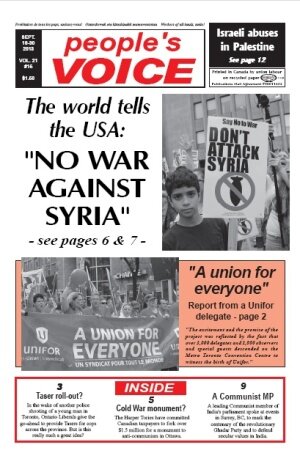
PEOPLE'S VOICE SEPTEMBER 16-30, 2013 (pdf)
People’s Voice 2013 Calendar
”Ideas of Revolution”

|
People's Voice deadlines: October 1-15 October 16-31 Send submissions to PV Editorial Office,
|
REDS ON THE WEB
http://www.parti-communiste.ca/
peoplesvoice.ca
www.ycl-ljc.ca
www.solidnet.org
|
People's Voice finds many "Global Class Struggle" reports at the "Labour Start" website, http://www.labourstart.org/. We urge our readers to check it out! |
* * * * *
People's Voice
Canadian Publications Mail Sales Product Agreement #205214
ISSN number 1198-8657
People's Voice is published by
New Labour Press Ltd
PV Editorial Office
706 Clark Drive,
VANCOUVER, B.C. V5L 3J1
Phone:604-255-2041
Fax:604-254-9803
email: pvoice@telus.net
Editor: Kimball Cariou : Business Manager: David Au
Editorial Board: Kimball Cariou, Miguel Figueroa,
Doug Meggison, Naomi Rankin, Liz Rowley, Jim Sacouman
* * * * * *
Letters
People's Voice welcomes your letters
on any subject covered in our pages.
We reserve the right to edit for length and clarity,
and to refuse to print letters which may be libellous
or which contain unnecessary personal attacks.
Send your views to:
"Letters to the Editor",
706 Clark Dr., Vancouver, BC V5L 3J1,
or pvoice@telus.net
People's Voice articles may be reprinted without permission,
provided the source is credited.
* * * * * *
The Communist Party of Canada, formed in 1921,
has a proud history of fighting for jobs, equality, peace,
Canadian independence, and socialism.
The CPC does much more than run candidates in elections.
We think the fight against big business and its parties
is a year-round job,
so our members are active across the country,
to build our party and to help strengthen people's movements
on a wide range of issues.
All our policies and leadership
are set democratically by our members.
To find out more about Canada's party of Socialism,
give us a call at the nearest CPC office.
* * * * * *
Central Committee CPC
290A Danforth Ave Toronto, Ont. M4K 1N6
Ph: (416) 469-2446
fax: (416) 469-4063 E-mailmailto:info@cpc-pcp.ca
Parti Communiste du Quebec (section du
Parti communiste du Canada)
5359 Ave du Parc, Montréal, Québec,
H2V 4G9
B.C.Committee CPC
706 Clark Drive, Vancouver, V5L 3J1
Tel: (604) 254-9836
Fax: (604) 254-9803
Edmonton CPC
Box 68112, 70 Bonnie Doon P.O.
Edmonton, AB, T6C 4N6
Tel: (780) 465-7893
Fax: (780)463-0209
Calgary CPC
Unit #1 - 19 Radcliffe Close SE
Calgary AB, T2A 6B2
Tel: (403) 248-6489
Ottawa CPC
Tel: (613) 232-7108
Manitoba Committee
387 Selkirk Ave., Winnipeg, R2W 2M3
Tel/fax: (204) 586-7824
Ontario Ctee. CPC
290A Danforth Ave., Toronto, M4K 1N6
Tel: (416) 469-2446
Hamilton Ctee. CPC
265 Melvin Ave., Apt. 815
Hamilton, ON.
Tel: (905) 548-9586
Atlantic Region CPC
Box 70 Grand Pré, NS, B0P 1M0
Tel/fax: (902) 542-7981
http://www.parti-communiste.ca/
* * * * * *
News for People, Not for Profits!
Every issue of People's Voice
gives you the latest
on the fightback from coast to coast.
Whether it's the struggle for jobs or peace, resistance to social cuts,
solidarity with Cuba, or workers' struggles around the world,
we've got the news the corporate media won't print.
And we do more than that
- we report and analyze events
from a revolutionary perspective,
helping to build the movements for justice and equality,
and eventually for a socialist Canada.
Read the paper that fights for working people
- on every page, in every issue!
People's Voice
$30 for 1 year
$50 for 2 years
Low-income special rate: $15 for 1-year
Outside Canada $50 for 1 year
Send to: People's Voice, 706 Clark Drive, Vancouver, BC, V5L 3J1
You can call the editorial office at 604-255-2041
REDS ON THE WEB
http://www.parti-communiste.ca/
http://www.ycl-ljc.ca/
http://www.solidnet.org/
(The following articles are from the September 16-30, 2013, issue of People's Voice, Canada's leading communist newspaper. Articles can be reprinted free if the source is credited. Subscription rates in Canada: $30/year, or $15 low income rate; for U.S. readers - $45 US per year; other overseas readers - $45 US or $50 CDN per year. Send to People's Voice, c/o PV Business Manager, 706 Clark Drive, Vancouver, BC, V5L 3J1.)
1) UNIFOR COMES TO LIFE AT FOUNDING CONVENTION
By Stuart Ryan, Ottawa
When the leaders of the Canadian Auto Workers and the Communications, Energy and Paper Workers announced Unifor as the name for their proposed new union on May 30, the response around the labour movement was, "What?". People googled the name and discovered, among other things, a uniform company in Italy. Some thought the new symbol was militaristic. Perhaps the leaders had lost sight of the hope and excitement generated from the initial document, "A Moment of Truth for Canadian Unions".
The leaders explained that the name reflected the purpose of the New Union Project, to reach out to organize the unorganized, to build an inclusive "union for everyone". They also said that the actions of the new union will define its effectiveness more than its name: come to Toronto and see Unifor come to life.
The excitement and the promise of the project was reflected by the fact that over 3,000 delegates and 1,000 observers and special guests descended on the Metro Toronto Convention Centre to witness the birth of Unifor on August 31 and September 1.
A day earlier, the two unions held special conventions to allow their National Executive Boards to approve the dissolution of the existing unions and the joining together to create Unifor.
At the CAW convention, there was a sense of nostalgia and pride in its history, from the breakaway from the American UAW, its growth by the mergers of other unions into the CAW, and the development of a culture of a social union with its own path in the labour movement. That pride was matched with eagerness to form a militant social union that will try to reverse the decline of the labour movement in the private sector in Canada.
Saturday morning, the delegates gathered with anticipation and excitement. Peter Kennedy apologized to the observers that because of the over 4,000 participants, it was necessary to place them in another hall, to watch the proceedings via television prompters.
After a video showing the range of workers and workplaces that will make up Unifor, the outgoing presidents spoke: David Coles from the CEP, and Ken Lewenza from the CAW. Lewenza brought delegates to their feet when he said the most important card in your wallet was your union card.
The first item of business was the adoption of the new Constitution, to be decided on a yes or no vote on its entirety. Amendments had already been made through the lengthy consultation process across the country. It passed by 94.54%.
The Constitution established three National Offices: President, Treasurer and Quebec Director; and three regional directors (Atlantic, Ontario, and Western). Five Regional Councils are established (BC, Prairies, Ontario, Quebec and Atlantic) and eleven industry councils (Transportation, Forestry, Media, Retail, Energy, Auto, Communications, Manufacturing, Health Care, Resources and Service). The chairs of each council sit on the National Executive Board, as well as positions for Racialized Workers, Skilled Trades and Retirees.
During regional meetings across the country in April and May, the two co‑chairs of the Proposal Committee, Peter Kennedy from the CAW and Gaeten Menard from the CEP, stated that for the founding convention only, there with be a proposed slate for all 25 positions on the NEB. The reason was that there needed to be a committed group of leaders who could bring the new union into a cohesive force. They reiterated the pledge that the NEB would reflect the gender composition of the new union, which has some 86,000 women members out of a total 315,000.
A Unity Caucus met on Friday night to present the proposed leadership, a slate which included 11 women out of the 25 positions.
Members were entitled to stand for positions, and Lindsay Hirshellwood was nominated for president, against the Unity Slate's Jerry Dias. When Dave Coles moved to immediately start the elections, delegates demanded to hear from each candidate before voting. When Coles said there was no provision for that in the agenda, the crowd reacted.
Bowing to the demands of the floor, each candidate was given five minutes. Hirshellwood said that she would push for no concessions, and that she would not try to sell a concession in bargaining as a victory. Dias commented on his experience on negotiating with some of the most notorious and largest corporations in the world, as an Assistant to two CAW Presidents over the last seven years, and would have much more to say if indeed he was elected.
An electronic voting system allowed each delegate to vote on behalf of a proportion of the local's membership. Dias received 214,694 votes, 82.55%, to Hirshellwood's 45,697 votes, 17.45% of the total. All the other positions were acclaimed. Peter Kennedy was elected Treasurer and Michel Arsenault, from CEP, was elected Quebec Director.
In his acceptance speech, Jerry Dias tried to explain the hope and determination expected of the new union. After introducing his parents, his wife and children, and how each influenced his union career and his support to stop violence against women, he outlined the political and economic challenges facing the Canadian labour movement. "Rampant capitalism" is tearing apart the economic and social fabric of Canada, he said. Jobs are disappearing in the manufacturing sector, jobs are getting worse, and two million people are unemployed.
The political decisions of the Harper government - "free trade", a "resource‑based" currency that inflates the cost of living and leads to job losses, changes to Employment Insurance - are choices to advance the interests of business over the people, Dias said. "Unifor has to stop playing defensive," he said. "It is time to go on the offensive and set the agenda."
He paid tribute to two members of CEP Local 249 who were killed in the Lac‑Mégantic disaster. The explosion was not an accident, he said, but a product of the lack of regulation by the federal government. The Montreal, Maine and Atlantic Railway, with a terrible record of health and safety, was allowed to cut staff and store dangerous material on side‑tracks without any employees watching the cargo. We cannot let them get away with it, he said.
Unifor will never forget the accomplishments of its two founding unions, but will never be a captive of its collective past, said Dias, stressing that "we will build a new union, modern, accountable and democratic, fighting for good jobs and social equity in Canada."
He called for a "Good Jobs Summit", no more Free Trade Agreements like CETA and TPP, a Canadian Energy Strategy where raw materials would be processed in Canada, support for public health care, and an improved Canada Pension Plan.
The first agenda item is to defend the Rand Formula, he argued, warning that the government will not succeed without a hell of a fight from Unifor and the labour movement. He eagerly endorsed the Together For Fairness Campaign of the CLC, while promoting the Union Advantage.
Organizing will become a key culture of the new union. Dias said it will look to organize young people in precarious employment. Youth are restless and frustrated, and will fight back, he said, citing the Occupy movement, the Quebec student strike and Idle No More. For the rest of the working class, he said, "Unifor is a union for U."
The day ended with both unions voting overwhelmingly to join Unifor. This move gave UNFOR successor rights for all the bargaining units previously organized by CAW and CEP.
Sunday was spent debating and adopting policies on the direction of the new union. A Policy Paper called, "A new Union for a Challenging World: Unifor's Vision and Plan" described how neo‑liberalism had destroyed the dream of shared prosperity after the Second World War, and outlined six fundamental priorities for Unifor: Building the new union, organizing new members, staying tough at the bargaining table, defending labour rights, making its progressive voice heard in the communities and in politics, and building a stronger labour movement.
Another paper outlined how an "organizing culture" would be at the centre of the agendas of Unifor at every level, from the Local to union conferences to the NEB. A National Organizing department will combine with the CEP plan of member organizers getting 50% time off work to organize. Ten million dollars each year will be assigned to this task.
A third exciting aspect of organizing is Community Chapters. Workers in non‑unionized workplaces, or in precarious employment, can approach either the National Union or a Local to become a Community Chapter. Each group would need to have a sufficient number of active potential members, a common interest in a particular workplace or a defined community, and a clear strategy of how the collective power of the union can enhance their working conditions or enhance their social security.
Unifor staffer Roxanne Dubois introduced three groups who want to become Community Chapters: Canadian Freelancers, United Church Ministers, and bike couriers in Toronto. Other groups mentioned in debate are digital journalists in BC and Niagara Casino workers. The convention ended on a controversial issue that indicated Unifor will be a different kind of union. A motion was presented to take $15 million from the combined strike funds of the two founding unions to pay for the transition costs of the creation of Unifor.
Delegates asked whether the money would be returned to the Strike Fund in the future. Treasurer Peter Kennedy stated that if the general fund was healthy at the time of the 2016 Convention he would be the first person to make such a motion.
A delegate proposed an amendment that the NEB come to the 2016 Convention with a plan to pay back that money over time. Kennedy declared the amendment out of order. When the floor raised objections, Jerry Dias took the chair and made a passionate plea for the motion. A delegate got up and informed Dias that as chair of the convention, he was not allowed to make a statement on the issue before the convention.
Dias declared that no one would silence him. Once the amendment was seconded, it was debated and defeated. The original motion then passed overwhelmingly.
Dias finished by saying that this union will have passionate debates, which is healthy, and once a decision is made, the union will unite and move forward. He said that unity will be the strength of the union.
The Policy Paper "A new Union for a Challenging World: Unifor's Vision and Plan" states the founding of Unifor is an act of hope. "But like all great projects the building of Unifor will succeed because Unifor will succeed because Unifor is larger than the sum of its parts. We are motivated and guided by shared ideals and principles that will strengthen us to meet the challenges ahead... And let's dedicate ourselves to building Unifor, building our movement and building a better Canada."
Lofty goals indeed, but based on the founding convention, it is off to a promising start.
|
|
2) HANDS OFF SYRIA! NO TO WAR!
Issued by the Central Executive Committee, Communist Party of Canada, August 30, 2013
The `drums of war' are beating ever louder in the Middle East. For more than two and a half years, the devastating internal conflict in Syria has resulted in over 100,000 casualties, millions of civilians displaced from their homes and communities, and growing sectarian violence in Lebanon, Iraq and other neighbouring countries. Now the war faces a most dangerous escalation.
The United States and some of its NATO allies, along with Saudi Arabia and other reactionary Gulf states, are preparing to launch a coordinated attack in response to the alleged use of chemical weapons by the Syrian government against its own citizens in Eastern Ghouta, a suburb of Damascus, on August 21st.
Yet no credible or verifiable evidence has been forthcoming to confirm this dubious claim. It is far more likely that this is a classic "false flag" operation, and that Syrian rebel forces and mercenaries - no doubt with outside guidance and assistance from imperialist quarters - are responsible for this horrendous act in order to provide a pretext for foreign intervention by the imperialist powers to prevent a rebel defeat.
The launching of such unilateral US‑led aggression, in the absence of any hard evidence of Syrian government involvement in the chemical attack and without any UN mandate, would be immoral, irresponsible, and a gross violation of international law.
A military attack on Syria would have dire consequences, threatening even more civilian deaths and the destruction of the country's infrastructure. It would further inflame tensions throughout the Middle East and could engulf the entire region in war.
For all these reasons, it is vital that all conscientious people speak out now to demand the Canadian government oppose war on Syria. The Communist Party of Canada condemns these war preparations and the pro‑war propaganda that is being whipped up to justify such an attack on Syria.
Background to the Syrian conflict
Protests against the Al‑Assad government in Syria began in early 2011 in opposition to neoliberal "reforms" which increased unemployment and widened social and economic disparities. But legitimate opposition voices were quickly co‑opted or shunted aside by hardcore, foreign‑financed and armed gangs determined to make Syria ungovernable. Terrorist attacks to spur further government crackdowns, sectarian violence to incite distrust and enmity between the Sunni majority and the Shia, Alawite and other minorities, the smuggling of heavy weapons and even mercenaries from abroad, and open calls for direct foreign intervention in violation of Syria's national sovereignty - this has been the orchestrated game plan carried out by the "internal opposition".
The extent of foreign covert intervention in the conflict proves that this is not a "civil war" but rather a highly coordinated imperialist conspiracy against Syria.
But popular support for the rebel forces has since evaporated. Significant sections of the former opposition, disillusioned by the sectarian violence and brutal atrocities committed by the rebel forces, are now supporting the Syrian government and defending Syria's national sovereignty under threat from this orchestrated conspiracy. On the `war front' the Syrian Armed Forces have made significant advances against the rebels in recent months, leading many observers to predict the imminent collapse of the armed rebellion. This is the real reason why the imperialist powers - under the code‑name "Friends of Syria" - are now moving to intervene directly in the conflict.
Gross hypocrisy
U.S. President Obama's "disgust" at the alleged use of chemical weapons by Syria is utterly hypocritical, given that U.S. imperialism itself has been the main violator of international covenants banning the use of chemical and other weapons of mass destruction (WMD). In addition to its use of nuclear weapons against civilian populations in Hiroshima and Nagasaki, Japan during the Second World War, there is credible evidence of its use of biological weapons during the Korean War[1], its widespread use of napalm and other chemical agents during the Vietnam War, and its use of white phosphorus and depleted uranium weapons in Iraq. It also `looked the other way' when Saddam used chemical weapons in 1988 during the Iraq‑Iran conflict because it was anxious to weaken and defeat the Iranian regime for its own imperialist interests. The use of chemical or other WMDs is a heinous war crime.
The real aims of U.S. aggression against Syria
The threatened attack on Syria is part of a broader imperialist strategy to crush (and possibly dismember) the Syrian state. The ultimate objective is to fashion a "New Middle East" of weak and pliant Arab states under the domination of U.S. and European imperialist powers and their local gendarme, the state of Israel. This would guarantee unfettered access to the petroleum, mineral and other natural resources of the region, and extend imperialist geopolitical hegemony into the "underbelly" of Asia, further encircling both the Russian Federation and China.
Undermining the Syrian state is pivotal in achieving this imperialist ambition. Due to its central location in the Middle East, its secular character, and its firm solidarity with the just struggle of the Palestinian people and opposition to the expansionist policies of Zionist Israel, Syria has long been in the cross‑hairs of U.S. imperialism. For their own reasons, reactionary Arab regimes - especially Saudi Arabia and Qatar - as well as Turkey are also anxious to weaken and crush Syria.
"Regime change" in Damascus and its replacement by a more pliant, pro‑imperialist regime would compound the suffering of the Syrian people. It would also dramatically alter the regional balance of forces, weakening the anti‑imperialist forces, and serving as a prelude - and launching pad - for NATO/Israeli aggression against neighbouring Iran.
Worldwide Opposition Growing
Despite imperialism's campaign to whip up international support for this impending aggression, Washington's "coalition of the willing" is crumbling quickly. UN Secretary‑General Ban Ki‑moon has spoken out against any foreign aggression and called on all parties to "give peace a chance", and for a return to the negotiating table in Geneva to reach a political settlement to the conflict. Russia, China, and most developing countries have condemned the call to attack Syria. Even the British Parliament has now voted against any British participation in such an attack.
In Canada, all concerned organizations - unions, peace and solidarity groups, and other mass democratic organizations - as well as conscientious and peace‑loving individuals, need to speak out quickly and demand that the Harper government reverse its support for such aggression. In the days ahead, the Communist Party of Canada urges all‑out support and participation in the anti‑war campaign developing across the country to stave off the impending catastrophe!
[1] Endicott, Stephen and Hagerman, Edward, "United States Biological Warfare during the Korean War: rhetoric and reality", www.yorku.ca/sendicot/ReplytoColCrane.htm
|
|
3) CRITICS PAN PREMIER WYNNE'S TASER ROLL-OUT
In the wake of highly-publicised cases involving police violence, the Ontario government says it will permit all officers to carry Tasers. The decision on Aug. 27, weeks after police fired nine bullets into Sammy Yatim and then tasered the dying teen. Just a day after Community Safety Minister Madeleine Meilleur's announcement, Peel Police tasered an 80 year woman in Mississauga, breaking her hip and hospitalizing her with other injuries.
As Toronto's NOW magazine reports, civil liberties groups, criminologists, and mental health advocates worry that "conducted energy weapons" (CEWs) may be over‑used by police.
Restating its "long‑standing concerns about the safety and appropriate uses of CEWs," the Canadian Civil Liberties Association investments in better de‑escalation training and crisis intervention teams. The CCLA argues that the "lax" current guidelines in Ontario allow officers to fire a Taser when a subject exhibits "assaultive behaviour," which can include "aggressive body language".
B.C.'s Braidwood Inquiry, which followed the 2007 Tasering death of Robert Dziekanski, found that the "assaultive threshold" was too low. In the wake of the Braidwood recommendations, CEW use in B.C. has plummeted dramatically, with no corresponding rise in shootings, indicating that police may be using less violent strategies in difficult situations.
According to the Toronto Police Service, during 2012 officers used Tasers in 255 incidents, 43.6 per cent of which involved subjects deemed to be "emotionally disturbed"
The Communist Party of Canada (Ontario) is calling on the provincial government to rescind its decision, and instead train police to de‑escalate crisis situations. The CPC(O) also demands that police should be put under strict control of civilian boards.
A statement from the CPC(O) says that Premier Wynne hopes to absolve the government of responsibility for the increasing number of police shootings. But arming officers with another lethal weapon, the statement says, has escalated the danger of even more police killings.
"The solution is not more force, but less force by police, and more education and training to effectively de‑escalate crises situations," says the CPC(O). "These are the recommendations of dozens of Coroner's Inquests into police killings of individuals in crisis situations ‑ recommendations that have been consistently ignored by Liberal and Tory governments.
"Further, Police Services and Senior Staff must be held accountable to ensure that de‑escalating crises situations is the first response and that police guns are holstered. This accountability can only be ensured with public civilian control of police. The provincial government must give civilian boards the powers they need to make police accountable to the communities they police."
The CPC(O) also points out that at $1,500 each, the Taser purchase will impact municipal services, at a time when the province is downloading costs onto over‑burdened civic governments.
"The escalation of police shootings of individuals in crisis parallels the increased police violence against legal strikes, protests and demonstrations such as occurred at the G20 in 2010," warns the CPC(O). "In addition to putting police under public civilian control, the provincial government should act now to repeal the Public Works Protection Act, which enabled martial law and the largest mass arrest in Canadian history."
|
|
4) EMPLOYERS USING TFW PROGRAM TO CUT WAGES
Wages are being undermined by employers who use the Temporary Foreign Worker (TFW) program to avoid paying more than minimum wage, warns the Alberta Federation of Labour.
A list obtained by the AFL shows that 243 employers in Alberta are accessing the Temporary Foreign Worker program rather than paying employees more than the province's minimum wage, which was raised by 20 cents to $9.95/hour on Sept. 1.
"If employers were really using the TFW program as a last resort, rather than a first choice, they wouldn't be paying these workers the minimum wage," Alberta Federation of Labour president Gil McGowan said. "They can't say they've actually tried to hire Canadians if they're not offering more than minimum wage."
Of the 243 employers, the majority (58 per cent) are in the food service industry. The list includes Boston Pizza locations, Ricky's All‑Day Grills and a variety of sushi restaurants and pubs. Most of these approved Labour Market Opinions (LMOs) will permit the employer to hire multiple Temporary Foreign Workers.
"This list shows that the TFW program is being used to suppress wages and displace Canadian workers. Anyone claiming that there's a labour shortage is either deliberately lying, or deeply misinformed," McGowan said. "If there's a labour shortage, wages are supposed to be going up to attract workers to fill the vacancies."
Under the Temporary Foreign Worker program, employers applying to bring in workers must commit to paying the prevailing wages for the type of worker they are hiring. By paying the TFWs minimum wage, these employers are admitting that paying bottom dollar is their standard practice.
"It's an irony that the Harper Government claims to be a big defender of the free market, but it's clear that they're using the TFW program to undermine the Canadian labour market," McGowan said. "The Federal Conservatives are deliberately using their power to help service‑sector employers keep wages low when economic conditions suggest they should be going up."
The documents released by the AFL help explain why more teenagers and recently arrived landed immigrants are having a hard time getting entry‑level jobs. According to Statistics Canada, the unemployment rate for youths aged 15‑24 in Alberta was more than 11 per cent in May.
"For young people, low‑wage jobs in the service sector have traditionally been the entry point into the labour market," McGowan said. "But now those bottom rungs on the ladder are increasingly being filled with exploitable TFWs."
Working 35 hours a week, 52 weeks a year, someone earning Alberta's minimum wage of $9.95 an hour will earn $18,109 a year before taxes. According to Statistics Canada, the Low‑Income Cut‑Off for a single wage earner with no dependents is $23,298. The AFL has called for a minimum wage that would allow those working full‑time to earn that amount, which works out to $14.05/hour without benefits, or $12.08 with benefits.
|
|
5) UNIONS WEIGH UP QUEBEC CHARTER OF VALUES
PV Vancouver Bureau
The "Charter of Quebec Values" was introduced by the Parti Quebecois minority government on Sept. 9, but one large group representing public sector workers has long been on record as supporting the general approach of "secularising" public services in Quebec.
A very different position was expressed in early September, however, by a union representing one-third of all teachers in Quebec. A report in the Globe and Mail says the Fédération autonome de l'enseignement will oppose measures that ban religious headgear in the classroom, characterizing any such crackdown as a "witch hunt."
The FAE says it supports the concept of secular state institutions, but not through targeting personal religious symbols.
"We won't go on a witch hunt to see who wears a hijab, kippa or cross," Sylvain Mallette, president of the union, said in an interview. "We will defend the right of our members to work."
If a teacher faced losing a job due to religious garb, the union says it would be prepared to fight the case in court.
Mallette says the union believes there are real issues over religious accommodations in public schools, such as parents who want to withdraw their children from classes that teach evolution. But dress codes for teachers are beside the point, he argues.
"Preventing someone from wearing a hijab or kippa isn't a way to ensure the secular nature of the state and its institutions," Mallette told the Globe and Mail. "For us, respecting secularism has nothing to do with whether you wear religious symbols or accessories."
The FAE includes 32,000 teachers in the French‑language school system in Montreal, home to most immigrants who settle in Quebec. These teachers live day‑to‑day with the realities of multicultural classrooms. Montreal city council has unanimously adopted a motion that calls for "inclusive secularism" which "unites Montrealers of all backgrounds and beliefs."
The FAE also disagrees with the PQ government about the crucifix hanging in the National Assembly, saying it would be "incoherent" for legislators to pass a law in favour of state secularism while sitting beneath a religious symbol. The cross should be moved elsewhere in the building, it says.
Meanwhile, most other public‑sector unions in Quebec, including the largest teachers' union, decided to wait for the Marois government to table its proposals before commenting.
However, the Syndicat de la fonction publique du Québec, which represents provincial civil servants, is already on record as saying it supports a ban on religious headgear for state employees.
The minority Marois government, which marked its one‑year anniversary on Sept. 4, has made the Values Charter and other identity issues a centrepiece of its agenda, from dress codes to mandatory Quebec history courses.
Drainville told Radio‑Canada that after Quebec rid itself of religion in its public institutions in the 1960s, public servants became "neutral" in appearance.
"If it was fine for Catholics in the 1960s, why wouldn't it be good for all religions 50 years later?" he asked.
|
|
People's Voice Editorial
"Great minds think alike," as the old saying goes, or perhaps "necessity is the mother of invention." Difficult circumstances sometimes compel individuals or movements to take decisive action. The AFL-CIO is looking at new ways to help unorganized U.S. workers and community groups to join the "house of labour". This decision comes just after Canada's new Unifor union adopted a constitution and organizing strategies to establish "community chapters".
We recall another watershed moment in the annals of the North American labour movement. In 1935, in the depths of the worst economic crisis in capitalist history, embattled trade unions faced a choice: stick with traditional "craft union" tactics aimed at appeasing employers to protect a shrinking membership base, or launch militant struggles to organize millions of industrial workers. The latter option led to the emergence of the CIO in the U.S. and similar campaigns in Canada. Thanks in part to sweeping advances for socialism in Europe, this strategy led to major victories for working people within a generation.
There is no guarantee that similar gains will be achieved by Unifor and the AFL-CIO. It will take a massive fightback for workers to resist the corporate assault, including in Canada. But after a long period of primarily defensive and isolated struggles, the labour movement is trying out creative ways to turn the tables on big capital. Bringing new sections of working people into the labour movement will puncture the vicious corporate media lie that trade unionists are living the easy life at the expense of unorganized workers. This strategy will help unite all working people - organized and unorganized, public and private sector, employed and unemployed, Aboriginal and non-Aboriginal, young and old, from all national origins and genders - into a powerful coalition to fight for their common interests. This is an idea whose time has come - let's help make it happen!
|
|
7) PEACE IS STILL EVERYONE'S BUSINESS
People's Voice Editorial
Way back in the scary 1980s, a decade of justified fears of imperialist war threats, the peace movement in Canada coined the slogan, "peace is everybody's business." Winding down massive spending on militarism, went the argument, would allow governments to tackle hunger, homelessness, poverty, and other devastating social problems.
More than twenty years later, the U.S. remains the undisputed global leader in the arms race, pouring hundreds of billions into new weapons of mass destruction and a global network of military bases. The only "winners" from the latest round of sabre-rattling by the Obama administration appear to be corporations like Raytheon, makers of the Cruise missiles which may soon be destroying Damascus, one of the historic centres of civilisation.
The world now spends about a trillion dollars a year on the insane pursuit of military domination. Even a fraction of that sum could go a long way towards providing billions of people with clean drinking water, decent homes, adequate schooling, good jobs, and protection from the impending climate change catastrophe.
By the time this newspaper is printed, the people of Syria may be the next victims of imperialism's revolting "responsibility to protect" mass murder doctrine. Or it may be that worldwide popular opposition is able to prevent this deadly attack. In either case, the fundamental problem will remain: how to wind down the arms race and dismantle all weapons of mass destruction, including the Pentagon's vast arsenal of killing machines. Under the shadow of the constant threat of war, humanity can never turn its full collective attention to the struggle for survival. Today, more than ever, peace must become the number one priority of all those who love this planet.
|
|
8) ON THE SO-CALLED "MONUMENT TO VICTIMS OF COMMUNISM"
Issued by the Central Executive Committee, Communist Party of Canada, Sept. 3, 2013
The Communist Party of Canada is appalled that the federal Conservative government will provide a massive taxpayer donation of $1.5 million under Citizenship and Immigration's Inter‑Action program, to help build a so‑called "monument to victims of communism" in Ottawa. Despite opposition, approval has previously been granted by the National Capital Commission for a site between Library and Archives Canada and the Supreme Court of Canada.
The monument project is a throwback to the sordid era of the Cold War, which resulted in a wave of anti‑communist frenzy, RCMP spying, witch‑hunts, blacklisting, social ostracism, imprisonment and deportations against many progressive‑minded Canadians. Such policies had a terrible "chilling effect" on public discourse and sharply curtailed the freedom of expression and associated democratic and trade union rights of all Canadians. The sponsors of this monument are now attempting to revive this tragic McCarthyist era of red‑baiting, which had been tossed into the dustbin of history.
The "Tribute to Liberty" group operates as a charitable foundation, despite the federal government's denial of charitable status to organizations which engage in political advocacy (a biased policy which exempts right‑wing groups linked to the Harper Conservatives, such as the Fraser Institute). The "Tribute to Liberty" organizers are well aware of the highly‑charged political nature of said `monument'. As they admitted several years ago, the proposal's "commemorative theme remains not entirely compatible with the NCC's policy for commemorations that mark national events or individuals. However, the international significance of the proposed subject is gaining considerable profile and support from various foreign governments..."
Indeed, they openly celebrate their "significant high‑level political support", as confirmed by press reports indicating that Jason Kenney (Minister of Citizenship, Immigration and Multiculturalism), and Prime Minister Stephen Harper have given active encouragement to this defamatory initiative. Having raised only a fraction of their $4 million fundraising target, the organizers have now been given the bulk of the remaining funds by their Tory friends.
The political implications of this proposal go far beyond the National Capital Region, or Canada as a whole. In Europe, recent years have seen a concerted campaign to whip up a renewed atmosphere of anti‑communism. A resolution adopted by the Parliamentary Assembly of the Organization for Security and Cooperation in Europe (OSCE) equates fascism and communism, a nauseating attempt to rewrite the history of the 20th century. Anti‑communist attacks have been launched by governments against Communist parties and affiliated organizations in several countries, including the Czech Republic, Hungary, Latvia, Ukraine, Estonia, Greece and elsewhere, without any legal or justifiable basis. The true underlying goal of this campaign is intended to intimidate and isolate progressive parties and movements, and to limit the free expression of ideas.
The authors of the monument proposal go so far as to turn history on its head, claiming that the monument would "honour the 100 million lives lost under Communist regimes" ‑ a figure which includes the estimated 25 million Soviet citizens who perished at the hands of the Nazi invaders during World War II, defending their homeland, fighting heroically as allies of Canada in the war against Hitlerism.
Announcing his government's support for the project, Jason Kenney stated that "it will also serve as a reminder to all Canadians that glorifying Communist symbols insults the memory of these victims..." We must ask: among those who are allegedly "insulted" by Communist symbols, does Mr. Kenney mean the supporters of Nazi aggression, which was decisively defeated on the eastern front by Soviet troops under the banner of the Red Flag? And do the Conservatives intend to follow the example of other reactionary governments which have used similar arguments in their attempts to ban Communist symbols?
We must further note that the name for this monument also defames the many accomplishments of communist parties which have formed governments, in countries such as the People's Republic of China, Cuba, and Vietnam, or taken part in governments, including South Africa, India, Venezuela, Brazil, Chile, etc.
This proposal also represents a profoundly unjust attack on Canadian Communists, who have made many pioneering contributions since 1921, such as fighting against fascism, organizing industrial workers into unions, initiating movements to win Unemployment Insurance, public healthcare and other social programs, to campaign for peace and disarmament, fighting for the full national rights of Aboriginal peoples and Quebec, and to defend Canada's sovereignty.
It is deeply unfortunate that the NCC set aside its initial misgivings and violated its own guidelines to allow construction of this monument, and that Canadians are being compelled to pay for this red‑baiting project which falsely blames Communists for the crimes of fascism. We demand that these decisions be reversed, before this celebration of anti‑communism becomes a permanent shameful blot on the capital city of Canada.
|
|
9) HOW INTELLIGENCE WAS TWISTED TO SUPPORT AN ATTACK ON SYRIA
By Gareth Porter, Truthout, Sept. 3, 2013
Secretary of State John Kerry assured the public that the Obama administration's summary of the intelligence on which it is basing the case for military action to punish the Assad regime for an alleged use of chemical weapons was put together with an acute awareness of the fiasco of the 2002 Iraq WMD intelligence estimate. Nevertheless, the unclassified summary of the intelligence assessment made public August 30, 2013, utilizes misleading language evocative of the infamous Iraq estimate's deceptive phrasing. The summary cites signals, geospatial and human source intelligence that purportedly show that the Syrian government prepared, carried out and "confirmed" a chemical weapons attack on August 21. And it claims visual evidence "consistent with" a nerve gas attack.
But a careful examination of those claims reveals a series of convolutedly worded characterizations of the intelligence that don't really mean what they appear to say at first glance. The document displays multiple indications that the integrity of the assessment process was seriously compromised by using language that distorted the intelligence in ways that would justify an attack on Syria.
Spinning the secret intelligence
That pattern was particularly clear in the case of the intelligence gathered by covert means. The summary claims, "We intercepted communications involving a senior official intimately familiar with the offensive who confirmed that chemical weapons were used by the regime on August 21 and was concerned with the U.N. inspectors obtaining evidence."
That seems to indicate that U.S. intelligence intercepted such communications. But former British Ambassador Craig Murray pointed out on his blog August 31 that the Mount Troodos listening post in Cyprus is used by British and U.S. intelligence to monitor "all radio, satellite and microwave traffic across the Middle East ..." and that "almost all landline telephone communications in this region is routed through microwave links at some stage [and] picked up on Troodos."
All intelligence picked by the Troodos listening post is shared between the U.S. and British intelligence, Murray wrote, but no communications such as the ones described were shared with the British Joint Intelligence Organization. Murray said a personal contact in U.S. intelligence had told him the reason was that the purported intercept came from the Israelis. The Israeli origin of the intelligence was reported in the U.S. press as well, because an Israeli source apparently leaked it to a German magazine.
The clumsy attempt to pass off intelligence claimed dubiously by the Israelis as a U.S. intercept raises a major question about the integrity of the entire document. The Israelis have an interest in promoting a U.S. attack on Syria, and the authenticity of the alleged intercept cannot be assumed. Murray believes that it is fraudulent.
But even if the intercept is authentic, the description in the intelligence summary appears to be misleading. Another description leaked to The Cable by an administration official (described) those same communications as an exchange of "panicked phone calls" between a Syrian Defense Ministry official and someone in a chemical weapons unit in which the defence ministry official was "demanding answers for [about?] a nerve agent strike." That clearly suggests that the Syrian senior official's questions were prompted by the charges being made on August 21 by opposition sources in Ghouta.
The main problem with the description is that it doesn't answer the most obvious and important question about the conversation: Did the purported chemical weapons officer at the other end of the line say that the regime had used chemical weapons or not? If the officer said that such weapons had been used, that would obviously have been the primary point of the report of the intercept. But the summary assessment does not say that, so the reader can reasonably infer that the officer did not make any such admission. The significance of the intercept is, therefore, that an admission of chemicals weapons use was not made.
The carefully chosen wording of the summary ‑ the ministry official was "concerned with the U.N. inspectors obtaining evidence" ‑ suggests that the official wanted to make sure that UN inspectors would not find evidence of a nerve gas attack. But it could also mean precisely the opposite ‑ that the official wanted the inspectors to be able to ascertain that there was no use of chemical weapons by Syrian forces in eastern Ghouta. The latter possibility is bolstered by the fact that the regime agreed within 24 hours of the first formal request on August 24 from UN envoy Angela Kane for unimpeded access to eastern Ghouta. As late as August 23, the UN Department of Safety and Security had not yet decided to give permission to the UN investigators to go into the area because of uncertainties about their safety.
The intelligence summary makes no effort to explain why the regime promptly granted access to the investigators. Another anomaly: the UN investigators were already present in Damascus, having been initially requested by the Assad regime to look into a gas attack the regime had charged was carried out by the rebels on March 19. The two‑page assessment by the British Joint Intelligence Organization released August 29, pointed to this question:"There is no obvious political or military trigger," it said, "for regime use of Chemical War on an apparently larger scale now, particularly given the current presence of the UN investigating team."
Another obvious case of a misleading description of intelligence in the summary involves information from US geospatial and signals intelligence purporting to show that the Assad regime was preparing for a chemical attack in the three days prior to August 21. The summary describes the intelligence as follows: "Syrian chemical weapons personnel were operating in the Damascus suburb of Adra from August 18 until early in the morning on August 21 near an area that the regime uses to mix chemical weapons, including sarin."
That seems like damning evidence at first glance. However, despite the use of the term "operating," the US intelligence had no information about the actual activities being tracked through geospatial and signals intelligence. When administration officials leaked the information to CBS news last week, they conceded that the presence of the individual being tracked in the area in question had been viewed as "nothing out of the ordinary."
Yet, after the August 21 event, the same information was suddenly transformed into "evidence" that supports the official line. The summary refers to "streams of human signals and geospatial intelligence that revealed regime activities that we assessed were associated with preparations for a chemical attack." Thus the same information that provided no indication of "preparations" was now presented as though it included knowledge of some "activities" somehow related to getting ready for chemical warfare.
A third piece of intelligence cited in the summary ‑ unsourced but presumably from an intelligence agent - might seem to denote the intent to carry out a chemical weapons attack. However, the wording is slippery. "On August 21," the document says, "a Syrian regime element prepared for a chemical weapons attack in the Damascus area, including through the utilization of gas masks." That intelligence, if accurate, doesn't establish an intent by the government to carry out an attack; it could conversely suggest the government's anticipation of a chemical attack by the rebels...
Behind the uncertainty on "Nerve Gas"
The summary includes a notable indication that the intelligence community was far from convinced that nerve gas had been used August 21.
The summary said the intelligence community had "high confidence" that the government had carried out a "chemical weapons attack," and added, "We further assess that the regime used a nerve agent in the attack." The fact that a separate sentence was used to characterize the assessment of the nerve agent issue and that it did not indicate any level of confidence is a signal that the intelligence community does not have much confidence in the assessment that nerve gas was used, according to a former senior US intelligence official who insisted on anonymity. The former official told Truthout that the choice of wording actually means the intelligence analysts "do not know" if nerve gas was used.
The summary includes yet another sign of the analysts' lack of confidence that nerve gas was used, which was equally well-disguised. "We have identified one hundred videos attributed to the attack," it said, "many of which show large numbers of bodies exhibiting physical signs consistent with, but not unique to, nerve agent exposure." Unless it is read carefully, the use of the word "bodies" ‑ meaning corpses ‑ instead of "victims" might be missed. But why would the intelligence community be focused on how many "bodies" exhibit particular "physical signs" when the far more relevant indicator of nerve gas would the number of "victims" exhibiting certain symptoms?
That strange choice averts acknowledgement of a fundamental problem for the intelligence community: Most of the alleged victims being shown in the videos posted online do not show symptoms associated with exposure to nerve agent. Corpses without any sign of wounds, on the other hand, would be "consistent" with a nerve agent attack.
The symptoms of a nerve agent attack are clear‑cut: Soon after initial symptoms of tightness of chest, pinpoint pupils and running nose, the victim begins to vomit and to defecate and urinate uncontrollably, followed by twitching and jerking. Ultimately, the victim becomes comatose and suffocates in a series of convulsive spasms. The symptoms shown in dozens of videos of victims being treated in medical centers in Ghouta, however, are quite different. In an interview with Truthout, Dan Kaszeta, a specialist on chemical, biological and radiological weapons who has advised the White House on those issues, pointed out that a nerve gas attack would have been accompanied by a pattern of symptoms that are not shown in the videos posted online.
"There should be more or less universal vomiting," Kaszeta said. But he did not see any vomiting or evidence of such vomiting on the clothing or on the floor in any of the videos he saw. Stephen G. Johnson, a chemical weapons forensics expert at Cranfield University in the United Kingdom, noticed the same thing. "Why aren't more people vomiting?" he asked Truthout in an interview.
A number of specialists, including Kaszeta and Johnson, also noticed that personnel were shown handling the victims without any special protective clothing but not exhibiting any symptoms themselves. Paula Vanninen, director of the Finnish Institute for Verification of Chemical Weapons, and Gwynn Winfield, the editor of CBRNe World, a magazine specializing in chemical weapons, made the same point in interviews with AFP on August 21. The only evidence of such effects is secondhand at best: statements issued the following day by both the spokesman for the Supreme Military Council of the Free Syrian Army, Khaled Saleh, and the spokesman for its Washington, DC, arm, the Syrian Support Group, said that doctors and "first responders" had reported that they were suffering symptoms of neurotoxic poisoning. Saleh claimed that at least six doctors had died.
Experts noticed yet another anomaly: The number of those treated who survived far outnumbered the dead, contrary to what would be expected in a nerve gas attack. Dr. Ghazwan Bwidany told CBS news August 24 that his mobile medical unit had treated 900 people after the attack and that 70 had died. "Médecins Sans Frontieres" reported that 3,600 patients had been treated at hospitals in the area of the attack and that 355 had died. Such ratios of survivors to dead were the opposite of what chemical weapons specialists would have expected from a nerve gas attack.
Kaszeta told Truthout that the "most nagging doubt" he had about the assumption that a nerve gas attack had taken place is the roughly 10‑to‑1 ratio of total number treated to the dead. "The proportions are all wrong," he said. "There should be more dead people." Johnson agreed. In an actual nerve gas attack, he said, "You'd get some survivors, but it would be very low. This [is] a very low level of lethality."
These multiple anomalies prompted some specialists to come up with the theory that the government had somehow diluted the nerve gas to make it less detectable and thus made it less lethal. Hamish de Bretton‑Gordon, a former commander of the chemical biological and nuclear terrorism unit in the UK Ministry of Defense, told USA Today August 23 that the absence of symptoms associated with nerve gas attack might be explainable by a "low dose" chemical weapons attack.
Three days later, Winfield wrote in an article for CNN that the symptoms seen in the videos indicated "lower toxicity" than was associated with nerve agents. Winfield suggested that nerve agent might have been mixed with other substances that were likely to remain in the environment longer than a nerve agent such as sarin.
But Kaszeta cast doubt on the idea of a "low dose" nerve agent. In an interview with blogger Eliot Higgins, who specializes in weapons associated with the Syrian conflict under the name Brown Moses, he said, "There's not much leeway between the incapacitating doses and lethal doses with Sarin." The concentration causing any symptoms at all, he said, "would quickly lead to absorption of a lethal dose."
Case not closed
If it wasn't a nerve gas attack, then, what other chemical weapon could have produced the symptoms exhibited in the videos? In an analysis on the Strongpoint Security website, Kaszeta considered each known type of chemical weapon in turn and concluded that the symptoms exhibited in the videos were not consistent with those associated with any of them. And as Kaszeta told the Israeli daily Ha'aretz, the fact that none of the people treating casualties were suffering obvious symptoms "would seem to rule out most types of military‑grade chemical weapons..."
Instead of addressing the issue, the intelligence community opted to accept information about the numbers and the cause of death provided by sources that were presumably subject to the influence of opposition forces in the area. The intelligence summary cites a "preliminary U.S. government assessment" that 1,429 people were killed by chemical weapons, including "at least 426 children." It provides no indication of how the analysts arrived at such a precise estimate, which is highly unusual for an intelligence assessment. The normal practice in arriving at such an estimate is to give a range of figures reflecting different data sources as well as assumptions.
The main center for analyzing issues relating to weapons of mass destruction is the CIA's Office of Weapons Intelligence, Nonproliferation and Arms Control (WINPAC) Center. It is the same center that tilted the 2002 Iraq estimate toward conclusions that were not supported by technical facts. As the Robb‑Silverman report on the Iraq WMD intelligence fiasco pointed out, intelligence analysts at WINPAC explained to the staff privately that they had reversed the normal intelligence analysis burden of proof and operated on the assumption that Iraq did have WMD programs.
That dynamic seems to have re‑emerged in the case of Syrian chemical weapons, especially with the appearance of hundreds of videos containing highly emotive scenes of children suffering and, in many cases, already having died. The contradiction between the emotionally charged visual evidence and the technical analysis by chemical weapons specialists, however, poses an unresolved issue. The uncertainty about what actually happened on August 21 can be resolved only on the basis of actual blood samples from victims who have been gathered by the UN inspectors and are now being analyzed in European laboratories...
But the advocates of an attack on Syria within the Obama administration have not demonstrated a willingness to rely on the definitive evidence from the UN investigators. Instead, they have evinced a strong hostility toward the UN investigation ever since the Syrian government agreed to allow it unimpeded access to the locations where chemical attacks were alleged. National Security Adviser Susan Rice sent an e‑mail to key officials August 25 asserting that the UN investigation was pointless.
Since then, administration officials have dismissed the UN investigation as representing a Syrian political tactic. Kerry claimed in his statement Friday (Aug. 30) that when the UN inspections were "finally given access, that access ‑ as we now know - was restricted and controlled."
But Farhan Haq, the associate spokesperson for Secretary General Ban Ki‑Moon, who has been getting regular reports from the UN team on its work in Syria, told Truthout that he was unaware of any restrictions on the team's work.
The Obama administration has made it clear it does not intend to rely on the UN investigation's findings. Kerry declared on Sept. 1 that samples of blood and hair from medical personnel in eastern Ghouta had been found to contain traces of sarin nerve gas.
However, those samples did not go through the UN investigators, but were smuggled out of Syria by opposition activists. The spokesman for the Free Syrian Army's Supreme National Council, Khaled Saleh, had announced August 22 that "activists" had collected their own hair, blood and soil samples and were smuggling them out of the country.
The Obama administration had obtained physiological samples related to previous alleged nerve gas attacks, which had tested positive for sarin, but administration officials had insisted that, without being certain of the chain of custody, "they couldn't be sure who had handled those samples," as one official put it.
Despite the knowledge that samples lacking a clear chain of custody could have been tampered with, however, the administration began to disregard that key factor in June. It adopted a policy of accepting such samples as evidence of government guilt, on the argument, as one official explained, "It's impossible that the opposition is faking the stuff in so many instances in so many locations."
That policy shift is part of the undeclared framework in which the intelligence assessment was carried out.
Regardless of what evidence emerges in coming weeks, we would do well to note the inconsistencies and misleading language contained in the assessment, bearing in mind the consequences of utilizing ambiguous intelligence to justify an act of war.
|
|
10) HUMAN RIGHTS CONCERNS OVER ISRAELI PRACTICES IN PALESTINE
By Kanaga Raja, Third World Resurgence
Following its latest fact‑finding visit to Amman and Cairo on June 22‑27, the UN Special Committee to Investigate Israeli Practices Affecting the Human Rights of the Palestinian People and Other Arabs of the Occupied Territories has warned that "popular discontent could result in another round of violence" in the Occupied Territories. (The Committee was not allowed by Israel to visit the Occupied Territories.)
The Committee, established by the UN General Assembly in 1968, comprises three UN member states currently represented by Ambassador Palitha T.B. Kohona of Sri Lanka (Chairperson), Ambassador Dato Hussein Haniff of Malaysia and Ambassador Fode Seck of Senegal.
"Israel's continued detention of an estimated 5,000 Palestinians should be of deep concern to the world," said Ambassador Kohona, highlighting especially 20 prisoners "who are on hunger strikes to protest abuses such as arbitrary detention, poor prison conditions, denial of family visits, solitary confinement, lack of access to education and negligent medical treatment".
"Witnesses informed the Committee that Israeli prison doctors have betrayed their Oath - the fundamental premise of the medical profession that their patients' health comes first," he further said in the news release.
The Sri Lankan envoy pointed out that several witnesses had raised the case of Maysara Abu Hamdiyeh, who died earlier this year from cancer after being misdiagnosed and mistreated - having had to wait for over four months before being sent to hospital.
"Witnesses also discussed the death of Arafat Jaradat, citing clear evidence of torture while under Israeli interrogation," Ambassador Kohona said. "The most alarming testimony concerned the systematically abusive detention and interrogation by Israeli authorities of Palestinian children."
Witnesses reported that approximately 200 children are in Israeli detention at any given time, and that children are often taken away in the middle of the night, blindfolded and hands tied, after being shocked awake by Israeli soldiers busting in with sound grenades, smashed glass and instructions screamed at the entire family.
"Witnesses stated that Palestinian children are denied requests to be accompanied by a parent, denied access to a lawyer, and put at serious risk of torture and ill‑treatment at the hands of Israeli security officials," the Special Committee Chair said.
On Israel's blockade of Gaza, Ambassador Kohona said: "For over six years, the lives of Palestinians in Gaza have been profoundly disrupted by Israel's blockade."
According to the UN news release, under the Oslo Accords, Israel agreed to a 20‑nautical‑mile area for Palestinian fishermen in Gaza, but the Israeli government has militarily enforced a three‑nautical‑mile limit.
The Committee was informed that Israel has extended access for fishermen up to six nautical miles, but was also informed that Israel had again reduced it to three nautical miles during the prime fishing season.
"Gaza's 4,000 fishermen used to catch four tons of fish each year, now they bring in only 1.5 tons," the Committee noted, adding that today 80 percent of Palestinian fishermen live in poverty.
In turn, said the Committee members, Israel's severe punishment of Palestinian fishermen, including by confiscating their motors, reduces access to health care and educational opportunities for their families.
"Again this year, we received allegations of Palestinian fishermen being subjected to arrest, confiscation of their equipment and abusive treatment by Israeli security forces."
"Gaza's farmers find themselves in similar circumstances," the Committee noted, stressing that "they aren't maximising the cultivation of their traditional crops of strawberries, carnations, herbs and sweet peppers, due to Israel's near total restriction on exports and enforcement of a buffer zone inside of Gaza."
According to the UN news release, the Committee expressed regret that testimony concerning the buffer zone mirrored what they have been told during previous visits, namely, that a lack of clarity regarding the Israeli‑enforced no‑go area creates grave dangers for Palestinian farmers, since Israeli soldiers fire live ammunition at persons between 300 and 1,000 metres from the fence.
"Farmers in Gaza can't till all of their land and much of what they do produce can't be exported," Ambassador Kohona said. "The Committee was told that five persons have been killed and 92 injured near the buffer zone since the end of November 2012 alone."
"The international community must pressure the Israeli government to let Palestinians farm, fish and export. Otherwise, Israel will entrench Gaza's dependence on the international community," the Sri Lankan envoy underscored.
The Committee also stressed that six years of blockade is bifurcating Palestinian society. "We heard of many Palestinians in Gaza who haven't seen family members in the West Bank for years, owing to Israeli restrictions on movement between Gaza and the rest of Palestine," Ambassador Kohona said. "There is a sense that dividing the Palestinian population between the Gaza Strip and the West Bank, including East Jerusalem, is an objective driving Israel's blockade. This should be an urgent concern to the UN Security Council."
The Committee said it heard disturbing testimony about the treatment of Palestinians who seek a permit to leave Gaza, including efforts by Israeli officials to pressure them into becoming informants and force women to undergo humiliating strip searches.
"The Committee deplores such treatment and strongly urges the Israeli government to treat all Palestinians with respect and dignity," Ambassador Kohona said.
According to the UN news release, witnesses from Gaza further informed the Committee of the extremely limited educational opportunities open to their children, owing to Israel's restrictions on travelling outside of Gaza to study in Palestinian schools in the West Bank.
On Israel's attacks during the November 14‑21, 2012 "Operation Pillar of Defence", the Committee, which was briefed extensively on this operation, said: "While we have a range of concerns regarding Israel's compliance with the basic principles of international humanitarian law during Pillar of Defence, of particular worry were reports of Israeli attacks that targeted journalists covering the conflict."
"Such attacks, especially those that resulted in the death of journalists, wantonly reject the right to freedom of expression," the Committee underlined.
The Committee also heard extensive testimony on continuing settlement construction in the West Bank, including East Jerusalem, the widespread phenomenon of Israeli settler violence and Israel's discriminatory planning and zoning regime that effectively prohibits Palestinians from building or even renovating their homes.
According to the UN news release, witnesses told the Committee that even when Israel has, in the past, temporarily frozen settlement expansion, it has sped up the construction of its network of roads that link settlements and Israeli business interests in the occupied Palestinian territory.
"One witness explained that the expansion of the settlements combined with the unilateral establishment of closed military zones and so‑called nature reserves jeopardise the contiguity of the West Bank. Another witness described how Israeli settlements and the continued construction of the Wall are isolating Palestinian communities and forcing displacement. In this regard, the Palestinian village of Al‑Walaja was highlighted as a case requiring urgent intervention by the international community."
In the first five months of this year, the Committee heard, 42 Palestinian structures were demolished and 149 displaced in East Jerusalem. One witness reminded the Committee that not all demolitions are reported as some families are forced to demolish their own homes to avoid huge fees from the Israeli government.
Listening to reports of businesses, including multinational corporations, which are profiting from the Israeli settlement enterprise, the Committee stressed: "Businesses have a responsibility to not be complicit in Israel's policies and practices that openly violate Palestinian rights."
"It is inconceivable that any business could not be aware of the illegal nature of Israel's settlement activities in the West Bank, including East Jerusalem," Ambassador Kohona said. "There is a need for scrupulous due diligence and a clear awareness of the potential legal and reputational consequences for businesses associated with the Israeli settlement enterprise."
The Committee also highlighted the ongoing research mentioned by witnesses concerning non‑profit groups in the United States and Canada, which collect donations and transfer funds to Israeli organisations supporting the expansion of settlements.
"If accurate, such organisations are perpetuating the occupation and likely aiding and abetting what is clearly a war crime," the Committee members said.
"The Special Committee joins many of the witnesses in hoping that current efforts to re‑start meaningful negotiations are successful. We were repeatedly told that the only way to end Israeli violations of Palestinian rights is to end the occupation. While we are deeply hopeful that such efforts advance quickly, we also note that Palestine's new status as a non‑Member Observer State opens the door to international mechanisms that can take up many of the Israeli policies and practices that have been violating Palestinian rights for so long," the Committee stressed.
|
|
11) CANADIAN GROUPS SPEAK OUT ON ANTI-LGBT LAW
PV Vancouver Bureau
World-wide protests continue against the homophobic legislation adopted in June by the Russian Duma (parliament). Hundreds of people gathered outside the Russian Consulate in Vancouver on Sept. 3, for a lively and dynamic demonstration. Such protests may escalate with the news of further legislation, including measures to remove children from LGBT parents in Russia.
In late August, over 100 Canadian organizations sent an "open letter against hate" to the governments of Russia and Canada, and to the International Olympic Committee. The letter was also sent to prominent corporate sponsores of the Sochi Winter Olympic Games, which will be hosted by Russia next February.
The letter says, in part, "We, the undersigned Canadian civil society organizations, call upon you to stand against the rising tide of hate against lesbian, gay, bisexual and transgender (LGBT) people in Russia. We are deeply troubled by the ongoing and intensifying attacks against LGBT, not least those led and encouraged by President Vladimir Putin and the federal Parliament (Duma). These actions include, most recently, the unanimous adoption of a federal law banning the distribution of "propaganda of non‑traditional sexual relations" (Federal Law 135‑FZ of June 29, 2013).
The letter points out that LGBT people risk prosecution for exercising their freedom of expression and association, "as does anyone who defends the human rights of LGBT people or even mentions the existence of LGBT people in an approving fashion." Individuals can be fined up to 100,000 rubles ($3000) for breaking the law, and organizations can be fined up to 1 million roubles ($30,000) and closed down for up to 90 days.
The letter lists a series of actions against LGBT people in Russia, from the banning of Pride parades, to violent street attacks: "LGBT youth and adults are being assaulted and tortured by thugs who then broadcast video recordings of these attacks online. So far, Russian authorities have turned a blind eye to such hate crimes, even though some perpetrators are easily identifiable."
This climate of hatred, the letter notes, flies in the face of not just international human rights law but the ostensible spirit of the Olympic Games."
The signing organizations call on the government of Canada to continue to speak out against the anti‑gay legislation, and to oppose the "traditional values" resolution being advanced by Russia at the UN, "which is a patent attempt to cloak bigotry and hate in the legitimacy of a Human Rights Council resolution."
Among other proposals, the letter urges the International Olympic Committee and International Paralympic Committee to host a Pride House in Sochi, and "to include explicit reference in their respective Charters to discrimination based on sexual orientation or gender identity as incompatible with the Olympic and Paralympic Movements, as is already done with grounds such as race, gender and religion." (The Paralympic Movement already includes sexual orientation in its Charter.)
The letter calls upon the CBC, as the exclusive Canadian broadcaster of the Sochi Games, to "commit to reporting, before, during and after the Sochi Games, on human rights abuses in Russia, including against LGBT people, other minorities and political dissidents targeted by the Russian government."
Signing groups range from the Canadian HIV/AIDS Legal Network and other health advocacy organizations, to Egale Canada, the BC Civil Liberties Association, the Canadian Anthropology Society, and the United Church of Canada.
Labour movement endorsers include the Canadian Association of University Teachers, Canadian Labour Congress, Canadian Union of Public Employees, CAW Canada, Ontario Federation of Labour, OPSEU Rainbow Alliance, Elementary Teachers' Federation of Ontario, United Steelworkers.
|
|
Morning Star, Sept. 7, 2013
Washington's attempt to hijack the G20 summit in Moscow to build support for its illegal plan to bomb Syria has been an abject failure. Barack Obama has been able to count on the usual suspects - Britain, France, Australia, Turkey and Canada - to echo his bellicose comments and offer to hold his coat.
But the majority of participants, representing some of the most populous states in the world - China, India, Russia, Brazil and Indonesia - reject the US recourse to war that it deploys so freely.
"International responses should not lead to more and worse humanitarian problems," says Indonesian Foreign Minister Marty Natalegawa. "The misery of the Syrian people has been too long and we need to ensure there is no military approach used, but instead peaceful diplomatic measures must be utilised to settle the problems."
Prime Minister Manmohan Singh made clear that India opposes any action outside the framework of the UN and rejects armed intervention aimed at regime change as this would violate international law.
Brazilian Foreign Minister Luiz Alberto Figueiredo said that any military intervention against Syria would be a violation of international law unless the UN security council gives approval.
Argentinian President Cristina Kirchner declared: "No‑one, no‑one at all, wants war and we do not believe that solving the problem of those killed would be through more killing."
Despite the stance of Britain and France, the European Union, which has a collective voice at the G20, is also opposed to military action. "There is no military solution to the Syrian conflict," said European Council president Van Rompuy. "Only a political solution can end the terrible bloodshed, grave violations of human rights and the far‑reaching destruction of Syria."
Yet pro‑war politicians and media in the imperialist states obsess over the stance taken by Russia and its President Vladimir Putin. US ambassador to the UN Samantha Power went so far as to accuse Moscow of holding the security council hostage and shirking its international responsibilities. Power berated Russia for exploiting the system that gives a veto to the post‑war big five - US, Soviet Union, China, France and Britain. She ought to know that since Russia superseded the Soviet Union in 1991, taking up its veto power, it has deployed that power just twice.
In contrast, the US has wielded its veto 55 times to prevent the international community taking action over crimes committed by its client state Israel against the Palestinian people.
Washington and its cheerleaders in Paris and London must appreciate that the world has changed. The old colonial powers no longer hold sway. The UN set up after the second world war provides, for all its faults, a means of discussing and tackling problems that arise within a framework of international law.
UN weapons inspector Hans Blix has experience of having his work frustrated and terminated by the bloodlust of US and British leaders. His advice that "one should not be arrogant and take unilateral action but actually turn and use the security council" is sound. It's also in line with what people think in Britain, the US and the rest of the world.
The way to end the Syrian people's suffering is for all states to stop supplying weaponry and combatants and for the UN to facilitate a conference for political forces in Syria to negotiate an end to war and an agreed way forward.
|
|
13) THE REVOLUTION IS ONGOING! ANTI-IMPERIALIST SOLIDARITY WITH THE EGYPTIAN PEOPLE MUST CONTINUE!
Statement by the Central Executive Committee, Communist Party of Canada, Sept. 4, 2013
Since the overthrow of the brutal regime of Hosni Mubarak in February 2011 ‑ the "first wave" of the Egyptian revolution ‑ the Egyptian people have not ceased their mobilizations for democracy, social progress and peace. Their demonstrations and strike actions blossomed into the Tamarod movement during the presidency of Mohamed Morsi, as it became increasingly apparent that he and the Muslim Brotherhood were authoritarian, sectarian and corrupt. Clearly, it is this people's movement that has forced Morsi from power and set the stage for new elections.
The Communist Party of Canada expresses its continued support for the progressive people's movement in Egypt, and calls on all democratic and progressive forces in Canada to extend and deepen anti‑imperialist solidarity with the Egyptian people.
During the past year, with over 30% unemployment and a poverty rate of 50%, with skyrocketing public debt, and with mass fury over Morsi's betrayal of the ideals of the first wave of the revolution, the Egyptian people organized a staggering 7400 protests and strikes. This ongoing and deepening organization of the mass of the Egyptian workers and people has been critically important for the purpose of maintaining and strengthening a progressive, democratic current within the pluralistic people's movement. While the military and Muslim Brotherhood emerged in positions of power early on, the people have continued to be a force for social change and progress. Within this struggle, the people's movement continues to project a popular, democratic alternative for Egypt's development.
There has been much confusion over the characterization of Morsi and the Muslim Brotherhood as democrats. The sources of this confusion are varied ‑ pro‑Brotherhood organizations, pro‑imperialist "liberals", and sectarian leftists ‑ but they all have the same dangerous potential to neutralize active anti‑imperialist solidarity with the Egyptian people and their revolution. It is true that Morsi and the Brotherhood were elected, but it is far more significant that they quickly and decisively turned their backs to democracy ‑ by imposing a constitution with their own, narrow, interpretation of Sharia law; by avoiding the people's "first wave" demands for economic, social and cultural rights, political freedom and secularism; by encouraging foreign intervention to overthrow the Syrian government; by continuing neoliberal privatization and austerity policies; and by leading murderous, sectarian attacks against minorities in Egypt.
What is truly democratic is the massive and broadly‑based movement to oust Morsi. Over 22 million people ‑ one quarter of the country's population ‑ signed petitions indicating non‑confidence in Morsi and calling for early elections. The anti‑Morsi demonstrations on June 30, 2013 involved 27 million people ‑ one out of three Egyptians ‑ on a single day. These demonstrations and mobilizations, reflecting secularism and unity, are the real expressions of the Egyptian people's revolution.
The uprising against Morsi in 2013, led by the Tamarod movement and the National Salvation Front, was stronger and deeper than that against Mubarak in 2011 and, as had occurred two years prior, the military was moved to intervene ahead of the people's movement. The military leadership's concern is similar to that of imperialist states and organizations ‑ that the revolutionary movement was maturing and growing, and was becoming capable of achieving political and social change on a truly democratic and anti‑imperialist basis.
The Egyptian people have now begun the "second wave" of their revolution. While the struggle against sectarianism and religious fundamentalism is not over, the people have overwhelmingly turned their backs to the authoritarianism and reaction of Morsi and the Muslim Brotherhood. Many contradictions remain ‑ the military has assumed power and control, and the people's revolution will need to confront that powerful apparatus and replace it with democratic, progressive institutions of governance.
One of the great dangers is that imperialism will use the current situation, of confusion and violent conflict, as a pretext to once again interfere in Egypt's internal affairs. On July 5, less than a week after Morsi had been ousted, the Wall Street Journal opined that Egypt needs fascism, declaring, "Egyptians would be lucky if their new ruling generals turn out to be in the mold of Chile's Augusto Pinochet, who took over power amid chaos but hired free‑market reformers and midwifed a transition to democracy." This kind of "advice" needs to be roundly condemned. There must be no imperialist or foreign interference in Egypt, under any pretext. It is the sole right of the Egyptian people to determine the path of their social, economic and political development.
The Communist Party of Canada expresses its unqualified solidarity with the Egyptian people and with the progressive movements of Egypt. In particular, the CPC declares its support for the Communist Party of Egypt, whose militants are continuing to organize among working people and projecting a democratic, secular and anti‑imperialist alternative for Egypt.
The Communist Party of Canada is confident that the ongoing, unfinished Egyptian revolution will achieve a transformative victory. We call on all of our members and supporters, and all democratic‑minded and anti‑imperialist Canadians to support the Egyptian people and the revolutionary process unfolding in Egypt today.
|
|
14) VISITING INDIAN MP CALLS TO UPHOLD SECULAR VALUES
By Gurpreet Singh, Surrey, BC
A visiting Communist Member of Parliament from India has called upon the South Asian Diaspora to the uphold secular values of the Ghadar Party. Speaking in Surrey on Sept. 7 at a seminar held to celebrate the 100th anniversary of the Ghadar Party, Sitaram Yechury, a member of the upper house of the Indian parliament, urged everyone to work together to defeat the
"nefarious designs" of sectarian and fundamentalist forces bent upon dividing people on religious lines.
The Ghadar Party was established in 1913 by South Asian immigrants on the Pacific coast of North America, to launch an armed rebellion against the British occupation of India. The party was secular in character and vehemently denounced caste and religious prejudices.
A senior member of the Communist Party of India (Marxist), Yechury warned that India's unity and diversity are under threat from the Hindu nationalist Bhartiya Janata Party. The BJP is indirectly projecting the Gujarat Chief Minister, Narendra Modi, as a future Prime Minister. Modi's government is widely blamed for the 2002 anti-Muslim pogrom in Gujarat. Yechury cautioned that any attempt to turn a pluralist Indian society into a theocracy needs to be challenged.
Yechury recently received threats for questioning a condolence motion that was brought in the Indian parliament following the death of Shiv Sena leader, Bal Thackrey. A staunch BJP ally, Shiv Sena is accused of bashing Muslims and non-Maharashtrians in Mumbai.
Interestingly, Yechury shared the platform at the Surrey event with an Akali Dal MP, Sukhdev Singh Dhindsa. Akali Dal is another ally of the BJP, and supports Modi.
The event was organized by the Indo-Canadian Workers' Association, a CPI(M) offshoot in Vancouver. The CPI(M) fought the last assembly election in Punjab in partnership with the People's Party of Punjab, formed by Akali Dal rebel Manpreet Singh Badal. The Indo-Canadian Workers' Association had expressed its support to Badal when he came here before the election.
Yechury was also critical of Sikh fundamentalists who are trying to appropriate the Ghadar history. "The Ghadar Party was not just a party of the Sikhs. It had supporters from other religious communities as well. How can one ignore the participation of the Hindus and Muslims in the Ghadar movement?", he asked.
He noted that the Ghadarites did not confine their struggle to the freedom of India from foreign rule, but continued it for a just society even after the country gained independence. According to Yechury, bigger challenges from imperial forces still prevail. He observed that the free market economy and liberalization have created a yawning gap between the rich and the poor.
"As a fitting tribute to the Ghadarites we must keep this struggle alive," said Yechury, who also released a souvenir publication dedicated to the Ghadar history.
Others who spoke on the occasion were Sukhdev Singh Dhindsa, and local MPs Jinny Sims and Jasbir Sandhu. Former MLA Dave Hayer was also present. Among other notable speakers were the Counsel General of India, Ravi Shankar Aisola; prominent history researchers and scholars, Sohan Pooni, Dr. Raghbir Singh Sirjana and Naveen Girn; Indian Workers' Association leader from UK, Harsev Bains; and leaders of the Indo-Canadian Workers' Association, Surinder Sangha, Surinder Dhesi and Kulwant Dhesi.
|
|